Table of Contents
- Key Takeaway you will Learn in this Post:
- SEO Basics
- Keyword Research & Strategy
- On-Page SEO
- Off-Page SEO & Link Building
- Technical SEO
- Local SEO
- Content & SEO Copywriting
- Analytics & Measurement
- SEO Ethics & Penalties
- Related Digital Marketing
- SEO Professionals & Services
- Ready to Master SEO for Your Kenyan Business?
- Frequently Asked Questions
TL;DR: SEO helps Kenyan businesses appear in Google search results when customers in Nairobi or Mombasa search for their products or services.
Last Updated: March 2026
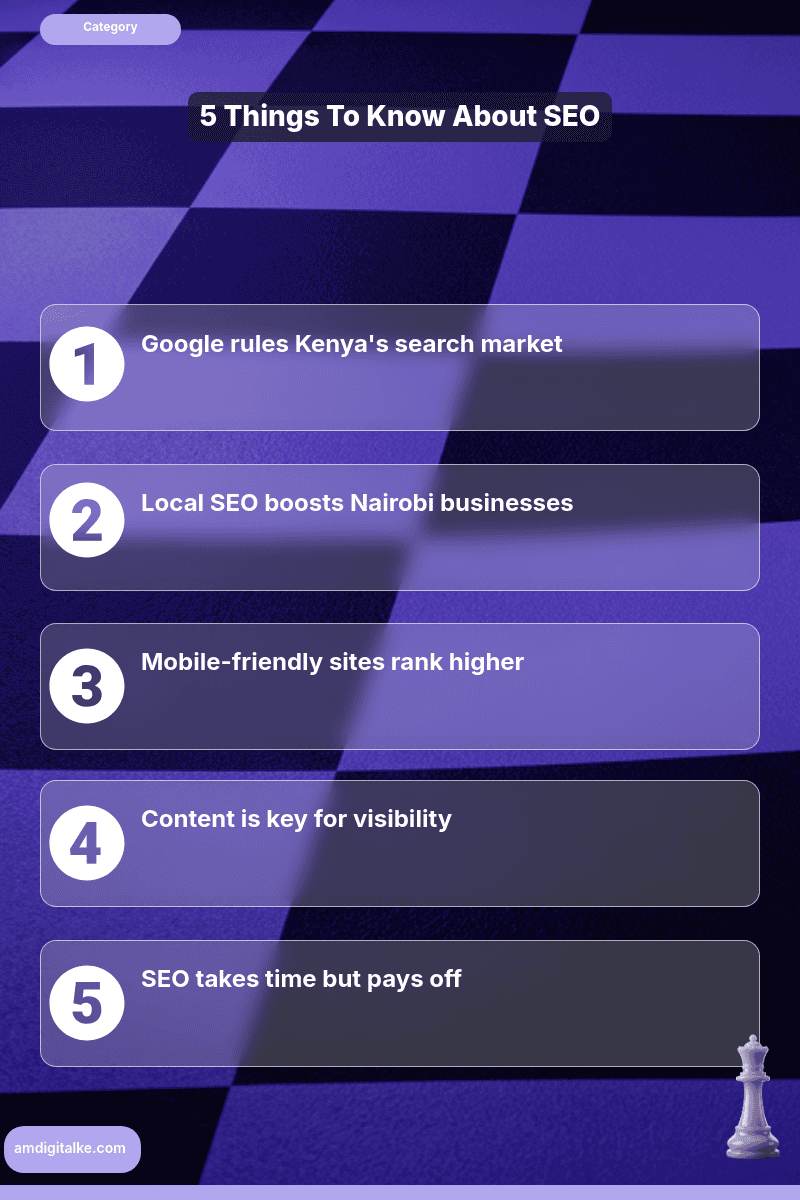
Key Takeaways
- SEO improves website visibility
- Google dominates Kenya’s search market
- SERP shows organic and paid results
- Local SEO boosts Kenyan businesses
- Optimized content attracts more customers
Understanding SEO can feel overwhelming.
But it doesn’t have to be.
I’ve compiled answers to the most common SEO questions to help Kenyan businesses master digital marketing.
Each answer gives you a quick overview, with links to detailed explanations.
Key Takeaway you will Learn in this Post:
- The basic definition of common SEO terms
- Why are they important to your SEO
- Links to more detailed explanations of the topics
With that said, let us get into it.
SEO Basics
What is SEO?
SEO (Search Engine Optimisation) is the strategic process of improving your website’s visibility in search engine results like Google.
It involves optimising content, technical elements, and building authority so your business appears when potential customers search for your services.
For Kenyan businesses, effective SEO means being found by customers actively looking for what you offer in Nairobi, Mombasa, or anywhere in Kenya.
Nairobi-based? Here is our dedicated SEO company in Nairobi page.
Read the full guide: What is SEO
Ready to put this knowledge into action?
Learn how to implement SEO strategically for your Kenyan business.
What is a Search Engine?
A search engine is software that indexes and retrieves information from the internet based on user queries.
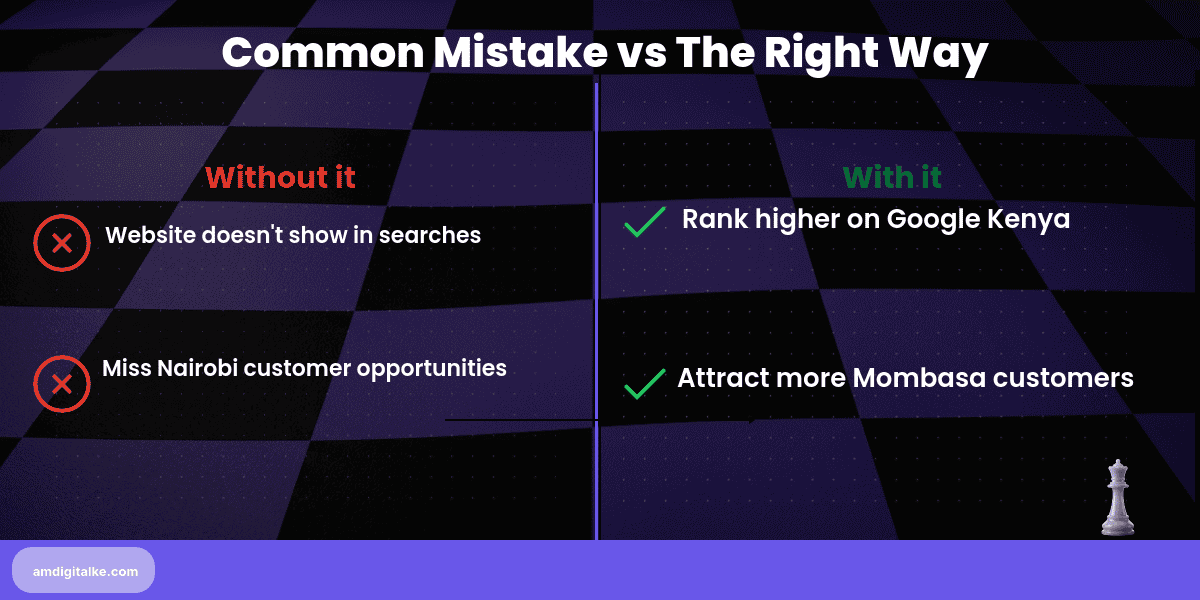
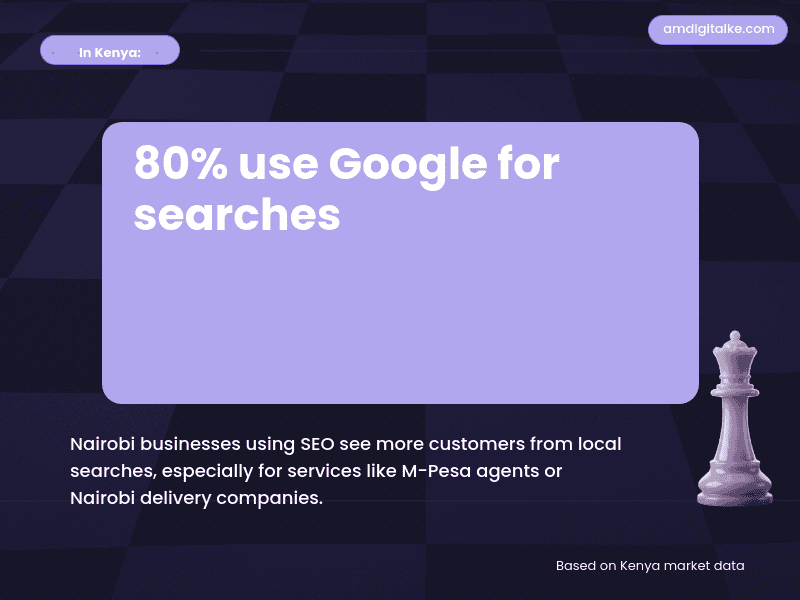
Google dominates Kenya’s search market, followed by Bing and others.
Search engines use complex algorithms to crawl websites, understand content, and rank pages.
Understanding how search engines work helps Kenyan businesses optimise their online presence and connect with customers searching for their products or services daily.
Read the full guide: What is a Search Engine
Take the next step on how to leverage search engines effectively for maximum visibility.
What is SERP?
SERP (Search Engine Results Page) is the page you see after searching on Google.
It displays organic results, paid ads, featured snippets, local packs, and other features.
For Kenyan businesses, understanding SERPs is crucial because your position here determines visibility.
The top three organic results capture most clicks.
This makes SERP rankings directly impact your website traffic, leads, and ultimately your business growth in Kenya’s competitive market.
Read the full guide: What is SERP
Discover how to rank on SERPs consistently and dominate your market.
Keyword Research & Strategy
What is a Keyword?
A keyword is a word or phrase people type into search engines when looking for information, products, or services.
For Kenyan businesses, keywords like “best coffee shop Westlands” or “accounting services Nairobi” connect you with customers.
Choosing the right keywords means understanding how your target audience searches.
An effective keyword strategy considers search volume, competition, and relevance to your business offerings in the Kenyan market.
Read the full guide: What is a Keyword
Plus, here is a guide on how to do keyword research.
What is Keyword Research?
Keyword research is the process of discovering and analysing search terms your target audience uses.
It involves identifying high-value keywords, understanding search volume, assessing competition, and evaluating search intent.
For Kenyan businesses, proper keyword research reveals opportunities to rank for terms your customers actually use.
This strategic foundation ensures your content marketing and SEO efforts target searches that drive real business results and qualified leads.
Read the full guide: What is Keyword Research
Master the execution with how to do keyword research systematically for your Kenyan business.
What are Long-tail Keywords?
Long-tail keywords are specific, longer search phrases typically containing three or more words.
While they have lower search volume individually, they’re less competitive and attract highly targeted traffic.
For example, “affordable web design for small businesses in Nairobi” is more specific than “web design.”
Kenyan businesses benefit from long-tail keywords because they capture searchers with clear intent.
This leads to higher conversion rates and better ROI from SEO efforts.
Read the full guide: What are Long-tail Keywords
Now learn how to leverage long-tail keywords effectively to attract qualified traffic.
What is Search Volume?
Search volume indicates how many times a keyword is searched within a specific timeframe, usually monthly.
Higher search volume suggests more potential traffic but often means tougher competition.
For Kenyan businesses, understanding search volume helps prioritise keywords.
Based on AM Digital KE client data across Kenyan accounts, a term with 1,000 monthly searches in Kenya might be more valuable than 10,000 global searches.
Balance search volume with relevance, competition, and your business capacity to serve that demand effectively.
Read the full guide: What is Search Volume
See how to analyze search volume strategically to find the best opportunities.
What is Search Intent?
Search intent is the underlying reason behind a user’s search query.
It’s what they’re trying to accomplish.
Intent falls into categories: informational (learning), navigational (finding a specific site), transactional (ready to buy), or commercial (comparing options).
Understanding intent helps Kenyan businesses create content that matches what searchers need.
When your content aligns with search intent, you satisfy both users and Google’s algorithms, improving rankings and conversions.
Read the full guide: What is Search Intent
Apply this knowledge with how to leverage search intent for SEO success.
What is Keyword Density?
Keyword density is the percentage of times a keyword appears in content compared to the total word count.
While historically important, modern SEO focuses on natural usage rather than specific percentages.
Overusing keywords (keyword stuffing) triggers Google penalties.
For Kenyan businesses, aim for natural keyword placement that reads well for humans.
Use variations and related terms.
Focus on comprehensive, helpful content rather than hitting arbitrary keyword density targets.
Read the full guide: What is Keyword Density
Get it right with how to get keyword density right without penalties.
On-Page SEO
What is On-Page SEO?
On-Page SEO involves optimising individual web pages to rank higher in search results.
This includes content quality, keyword placement, title tags, meta descriptions, header tags, URL structure, and internal linking.
For Kenyan businesses, on-page optimisation is directly controllable and crucial for rankings.
Well-optimised pages help Google understand your content’s topic and relevance.
This makes it easier for potential customers to find your business online.
Read the full guide: What is On-Page SEO
Ready to optimize?
Discover how to optimize on-page SEO comprehensively for your pages.
What is a Meta Description?
A meta description is the brief summary that appears below your page title in search results.
While not a direct ranking factor, it influences click-through rates significantly.
Write compelling 150-160 character descriptions that accurately preview your content and encourage clicks.
For Kenyan businesses, include location when relevant and focus on benefits.
A well-crafted meta description turns search visibility into actual website traffic and potential customers.
Read the full guide: What is a Meta Description
Master the craft of how to perfect meta descriptions that drive clicks.
What are Header Tags?
Header tags (H1, H2, H3, etc.) structure your content hierarchically, making it easier for readers and search engines to understand.
The H1 is your main title, while H2s divide major sections, and H3s create sub-sections.
For Kenyan businesses, proper header structure improves user experience and helps Google understand your content’s organisation.
Well-structured content keeps readers engaged longer.
This reduces bounce rates and signals content quality to search engines.
Read the full guide: What are Header Tags
Implement them correctly with how to apply header tags strategically for SEO.
What is Alt Text?
Alt text (alternative text) describes images for screen readers and appears when images fail to load.
It helps visually impaired users understand image content and gives search engines context since they can’t “see” images.
For Kenyan businesses, descriptive alt text improves accessibility and image SEO.
Include relevant keywords naturally when appropriate, but prioritise accurate descriptions.
Well-optimised images can drive traffic through Google Image Search.
Read the full guide: What is Alt Text
Write better alt text with how to do alt text right for accessibility and SEO.
What is Internal Linking?
Internal linking connects pages within your website through hyperlinks.
Strategic internal links help users navigate your site, distribute page authority, and guide search engines to important content.
For Kenyan businesses, internal linking improves SEO by showing content relationships and keeping visitors engaged longer.
Link related services, blog posts to service pages, and important pages from your homepage using descriptive anchor text that tells users what they’ll find.
Read the full guide: What is Internal Linking
Build a strong internal structure with how to implement internal linking effectively for your site.
What is Anchor Text?
Anchor text is the clickable words in a hyperlink.
It tells users and search engines what the linked page is about.
Types include exact match (using the target keyword), partial match, branded, generic (“click here”), and naked URLs.
For Kenyan businesses, varied, natural anchor text is ideal.
Over-optimisation with exact-match keywords can appear manipulative.
Use descriptive, relevant anchor text that helps users understand where they’re going.
Tip: See how I add anchor links in this post to get a better idea.
Read the full guide: What is Anchor Text
Perfect your linking strategy with how to use anchor text properly for Kenyan businesses.
What is a Canonical URL?
A canonical URL tells search engines which version of a page is the “official” one when duplicate or similar content exists.
This prevents duplicate content issues that can dilute your rankings.
For Kenyan businesses with eCommerce sites or pages accessible through multiple URLs, canonical tags consolidate ranking signals to one preferred version.
This technical element ensures your SEO efforts aren’t spread across multiple duplicate pages.
Read the full guide: What is a Canonical URL
Implement them correctly with how to optimize with canonical URLs effectively.
Off-Page SEO & Link Building
What is Off-Page SEO?
Off-Page SEO encompasses activities outside your website that influence rankings, primarily link building, brand mentions, and social signals.
It builds your site’s reputation and authority across the internet.
For Kenyan businesses, off-page SEO includes getting listed in local directories, earning media coverage, building partnerships, and generating quality backlinks.
These external signals tell Google your business is credible, authoritative, and deserves to rank for relevant searches.
Read the full guide: What is Off-Page SEO
Build your authority with how to improve off-page SEO systematically for your Kenyan business.
What is a Backlink?
A backlink is a link from another website to yours.
Google views quality backlinks as votes of confidence, signalling your content is valuable and trustworthy.
Backlinks remain one of the strongest ranking factors.
For Kenyan businesses, earning links from reputable local sites, industry publications, and business directories builds authority.
Focus on quality over quantity.
One link from Nation Media Group beats dozens from low-quality directories.
Read the full guide: What is a Backlink
Start earning them with how to get backlinks strategically for your Kenyan business.
What is Link Building?
Link building is the process of acquiring backlinks from other websites to improve your site’s authority and rankings.
Strategies include creating valuable content, guest posting, broken link building, and digital PR.
For Kenyan businesses, local link building, partnerships with complementary businesses, local news coverage, and sponsorships are particularly effective.
Ethical, white-hat link building takes time but creates sustainable SEO results without risking Google penalties.
Read the full guide: What is Link Building
Execute it properly with how to build links ethically and effectively in Kenya.
What is Domain Authority?
Domain Authority (DA) is a metric predicting how well a website will rank in search results, scored 1-100.
Created by Moz, it considers backlink quality, quantity, and other factors.
While not a direct Google ranking factor, DA helps assess a site’s strength.
For Kenyan businesses, improving DA means building quality backlinks, creating valuable content, and strengthening technical SEO.
Higher DA generally correlates with better ranking potential, though it’s not the only factor.
Read the full guide: What is Domain Authority
Boost your score with how to increase domain authority strategically for Kenyan sites.
What is PageRank?
PageRank is Google’s original algorithm for evaluating webpage importance based on the quantity and quality of links pointing to it.
While no longer publicly displayed, PageRank concepts still influence Google’s ranking algorithm.
For Kenyan businesses, understanding PageRank reinforces why quality backlinks matter.
Links from authoritative sites pass more “link juice” than low-quality sources, making strategic link building more effective than accumulating numerous weak links.
Read the full guide: What is PageRank
Leverage this knowledge with how to boost PageRank effectively for your pages.
Technical SEO
What is Technical SEO?
Technical SEO optimises your website’s infrastructure to help search engines crawl, index, and understand your site effectively.
It includes site speed, mobile-friendliness, secure connections (HTTPS), XML sitemaps, structured data, and fixing crawl errors.
For Kenyan businesses, technical SEO creates the foundation for all other optimisation.
Even great content won’t rank well if search engines can’t access, crawl, or understand your site properly due to technical issues.
Read the full guide: What is Technical SEO
Master the execution with how to perfect technical SEO comprehensively for your site.
What is Page Speed?
Page speed measures how quickly your website loads for users.
Google considers speed a ranking factor because fast sites provide a better user experience.
For Kenyan businesses where mobile internet can be slower, optimised page speed is crucial.
Compress images, minimise code, leverage browser caching, and use content delivery networks.
Faster sites see lower bounce rates, higher engagement, and better conversion rates alongside improved search rankings.
Read the full guide: What is Page Speed
Speed up your site with how to optimize page speed effectively for Kenyan audiences.
What are Core Web Vitals?
Core Web Vitals are Google’s metrics measuring user experience: Largest Contentful Paint (loading), First Input Delay (interactivity), and Cumulative Layout Shift (visual stability).
These became ranking factors in 2021.
For Kenyan businesses, meeting Core Web Vitals thresholds improves both user experience and SEO.
Optimise images, minimise JavaScript, ensure stable page elements, and test on various devices, including the mobile devices most Kenyan users rely on.
Read the full guide: What are Core Web Vitals
Meet the standards with how to optimise Core Web Vitals for better rankings.
What is Mobile-First Indexing?
Mobile-first indexing means Google predominantly uses the mobile version of your site for indexing and ranking.
Since most Kenyan users access the internet via smartphones, having a mobile-optimised site is essential.
Ensure your mobile site contains the same content as desktop, loads quickly, and provides excellent user experience.
Responsive design that adapts to any screen size is ideal for Kenyan businesses serving mobile-first audiences.
Read the full guide: What is Mobile-First Indexing
Optimize for mobile with how to leverage mobile-first indexing successfully.
What is HTTPS?
HTTPS (Hypertext Transfer Protocol Secure) is the secure version of HTTP, encrypting data between users and your website.
Google confirmed HTTPS as a ranking signal and Chrome marks HTTP sites as “Not Secure.”
For Kenyan businesses, especially eCommerce or those collecting customer information, HTTPS is essential.
It builds trust, protects user data, and provides a minor SEO boost.
Most hosting providers offer free SSL certificates.
Read the full guide: What is HTTPS
Secure your site with how to master HTTPS implementation properly.
What is an XML Sitemap?
An XML sitemap is a file listing all important pages on your website, helping search engines discover and crawl your content efficiently.
It’s especially valuable for new sites, large sites, or sites with pages not well-linked internally.
For Kenyan businesses, submitting your sitemap to Google Search Console ensures search engines know about all your pages.
Update your sitemap when adding significant content to help Google index new pages quickly.
Read the full guide: What is an XML Sitemap
Create yours with how to set up an XML sitemap correctly.
What is Robots.txt?
Robots.txt is a text file telling search engine crawlers which pages or sections of your site to crawl or avoid.
It manages crawler access and conserves crawl budget by blocking unimportant pages.
For Kenyan businesses, proper robots.txt configuration prevents search engines from wasting time on admin pages, duplicate content, or private sections.
Be careful.
Blocking important pages accidentally can remove them from search results entirely, harming your SEO.
Read the full guide: What is Robots.txt
Configure it properly with how to set up robots.txt file correctly.
What is a 301 Redirect?
A 301 redirect permanently sends users and search engines from one URL to another.
It’s essential when moving pages, changing domains, or consolidating content.
The redirect passes most link equity to the new URL.
For Kenyan businesses restructuring websites or merging services, 301 redirects preserve your hard-earned SEO value.
Implement redirects before deleting old pages to maintain rankings and avoid frustrating users with 404 errors.
Read the full guide: What is a 301 Redirect
Set them up right with how to implement 301 redirects without losing rankings.
What is Schema Markup?
Schema markup is structured data code that helps search engines understand your content’s meaning and context.
It can generate rich results like star ratings, prices, event dates, and FAQs in search results.
For Kenyan businesses, implementing schema for local businesses, reviews, services, and products enhances search visibility.
Rich results attract more clicks and provide users with helpful information directly in search results before they visit your site.
Read the full guide: What is Schema Markup
Implement it effectively with how to use schema markup for your Kenyan business.
What is Indexing?
Indexing is when search engines store and organise webpage content in their database, making it eligible to appear in search results.
Google’s crawlers discover pages, analyse content, and add information to Google’s index.
For Kenyan businesses, ensuring pages are indexed is fundamental.
Check indexing in Google Search Console, submit sitemaps, and ensure no technical issues block crawlers.
Content must be indexed before it can rank in search results.
Read the full guide: What is Indexing
Ensure complete indexing with how to index your website properly.
What is Web Crawling?
Web crawling is how search engines discover and access web pages using automated programs called crawlers or spiders.
These bots follow links from page to page, downloading content for indexing.
For Kenyan businesses, understanding crawling helps optimise your site’s structure.
Use internal linking to help crawlers find important pages, fix broken links, optimise page speed for efficient crawling, and maintain a clean site architecture that crawlers can easily navigate.
Read the full guide: What is Web Crawling
Optimize for crawlers with how to master web crawling for your site.
Local SEO
What is Local SEO?
Local SEO optimizes your online presence to attract customers from location-specific searches.
It focuses on Google My Business, local citations, location pages, and reviews.
For Kenyan businesses with physical locations or serving specific areas, local SEO is invaluable.
Optimizing for “restaurants Westlands” or “plumbers Mombasa” connects you with nearby customers ready to buy.
Local SEO combines traditional SEO with location-based factors to dominate your geographical market.
Read the full guide: What is Local SEO
Dominate local search with how to improve local SEO comprehensively for your area.
What is Google My Business?
Google My Business (now Google Business Profile) is a free tool for managing how your business appears in Google Search and Maps.
It displays business hours, location, photos, reviews, and contact information.
For Kenyan businesses, an optimised GMB profile is crucial for local visibility.
Complete every section, regularly post updates, respond to reviews, and add photos.
Appearing in the local “Map Pack” dramatically increases visibility and drives foot traffic.
Read the full guide: What is Google My Business
Set up your profile with how to set up Google Business Profile properly.
What is NAP Consistency?
NAP (Name, Address, Phone Number) consistency means displaying identical business information across all online platforms, like websites, Google My Business, directories, and social media.
Inconsistencies confuse search engines and weaken local rankings.
For Kenyan businesses, especially those with multiple locations, maintaining consistent NAP builds trust with Google.
Use the exact same format everywhere.
Even small differences like “St” versus “Street” can create confusion, affecting local SEO performance.
Read the full guide: What is NAP Consistency
Maintain consistency with how to perfect NAP consistency across platforms.
What is a Citation?
A citation is any online mention of your business name, address, and phone number (NAP), even without a link.
Citations appear in business directories, websites, apps, and social platforms.
For Kenyan businesses, citations from local directories (like Ghafla, PigiaMe) and industry-specific platforms build local SEO authority.
Quality citations signal to Google that your business is legitimate and established, improving local search rankings and helping customers discover you.
Read the full guide: What is a Citation
Build them strategically with how to use citations effectively for your Kenyan business.
Content & SEO Copywriting
What is Content Marketing?
Content marketing creates and distributes valuable, relevant content to attract and engage a target audience, ultimately driving profitable customer action.
It includes blog posts, videos, infographics, guides, and social media content.
For Kenyan businesses, content marketing builds authority, educates customers, and supports SEO by targeting keywords naturally.
Quality content earns backlinks, keeps visitors engaged, and establishes your business as an industry expert worth trusting.
Read the full guide: What is Content Marketing
Execute it effectively with how to execute content marketing strategically in Kenya.
What is SEO Copywriting?
SEO copywriting creates content optimised for both search engines and human readers.
It strategically incorporates keywords while maintaining natural, engaging writing that converts visitors into customers.
For Kenyan businesses, effective SEO copywriting balances technical optimisation with persuasive messaging.
Write for your audience first, then optimise for search.
Include keywords naturally, structure content clearly, and focus on solving customer problems while meeting SEO best practices for maximum impact.
Read the full guide: What is SEO Copywriting
Master the craft with how to do SEO copywriting that converts visitors.
Analytics & Measurement
What is Google Analytics?
Google Analytics is a free SEO tool that tracks website traffic and user behaviour.
It shows visitor demographics, traffic sources, popular pages, conversion rates, and user journey paths.
For Kenyan businesses, this analytics tracking reveals which marketing efforts work, which pages convert, and where visitors drop off.
This data informs SEO strategy, content creation, and website improvements.
Understanding your data helps allocate resources effectively and measure ROI from your digital marketing investments.
Read the full guide: What is Google Analytics
Use it strategically with how to make decisions with Google Analytics effectively.
What is Google Search Console?
Google Search Console is a free tool showing how Google sees your site.
It reports indexing status, search queries driving traffic, mobile usability issues, security problems, and manual penalties.
For Kenyan businesses, Search Console is essential for monitoring SEO health.
Submit sitemaps, identify technical issues, see which keywords bring traffic, and receive alerts about problems.
It’s your direct communication channel with Google about your site’s search performance.
Read the full guide: What is Google Search Console
Master it with how to use Google Search Console effectively for your Kenyan business.
What is CTR?
CTR (Click-Through Rate) is the percentage of people who click your link after seeing it in search results.
High CTR signals your title and meta description are compelling and relevant to the search query.
For Kenyan businesses, improving CTR means more traffic without ranking higher.
Optimise titles to include keywords and benefits, write compelling meta descriptions, and use structured data for rich results.
Even small CTR improvements significantly impact total website traffic.
Read the full guide: What is CTR
Boost your clicks with how to maximise CTR strategically for your Kenyan business.
What is Bounce Rate?
Bounce rate measures the percentage of visitors who leave your site after viewing only one page without interaction.
High bounce rates may indicate irrelevant content, poor user experience, slow loading, or technical issues.
For Kenyan businesses, bounce rate provides insight into content quality and user satisfaction.
Improve by matching content to search intent, enhancing page speed, improving mobile experience, and using clear calls-to-action that encourage visitors to explore your site.
Read the full guide: What is Bounce Rate
Reduce it with how to lower your bounce rate effectively.
What is Dwell Time?
Dwell time is how long a visitor stays on your page after clicking from search results before returning to Google.
Longer dwell time suggests your content satisfies the search query, potentially improving rankings.
For Kenyan businesses, increasing dwell time means creating comprehensive, engaging content that fully answers questions.
Use clear formatting, multimedia elements, internal links to related content, and compelling writing that keeps visitors engaged rather than immediately returning to search results.
Read the full guide: What is Dwell Time
Keep visitors engaged with how to boost dwell time on your pages.
What is Organic Traffic?
Organic traffic consists of visitors who find your website through unpaid search results rather than ads.
It’s the primary goal of SEO efforts and represents people actively searching for what you offer. For Kenyan businesses, organic traffic is valuable because it’s free, sustainable, and consists of users with clear intent.
Unlike paid advertising that stops when your budget runs out, well-executed SEO generates consistent organic traffic over time without ongoing costs.
Read the full guide: What is Organic Traffic
Grow it consistently with how to boost organic traffic for your Kenyan business.
SEO Ethics & Penalties
What is E-E-A-T?
E-E-A-T stands for Experience, Expertise, Authoritativeness, and Trustworthiness.
It is a criterion Google uses to assess content quality, especially for YMYL (Your Money Your Life) topics affecting health, finances, or safety.
For Kenyan businesses, demonstrating E-E-A-T means showcasing credentials, earning quality backlinks, displaying customer reviews, maintaining accurate information, and establishing authors’ expertise.
Strong E-E-A-T signals help Google confidently rank your content, particularly in competitive or sensitive industries requiring verified expertise.
Read the full guide: What is E-E-A-T
Build your authority with how to leverage E-A-T for rankings in Kenya.
What is White Hat SEO?
White hat SEO uses ethical optimisation techniques that follow search engine guidelines and focus on providing value to users.
Strategies include quality content creation, legitimate link building, technical optimisation, and improving user experience.
For Kenyan businesses, white hat SEO builds sustainable rankings without penalty risks.
While results take longer than manipulative tactics, they’re stable, build genuine authority, and align with Google’s goal of connecting users with valuable content.
Read the full guide: What is White Hat SEO
Practice it correctly with how to win with white hat SEO strategies.
What is Black Hat SEO?
Black hat SEO uses manipulative tactics, violating search engine guidelines, to achieve quick rankings.
Techniques include keyword stuffing, hidden text, link schemes, cloaking, and content scraping.
For Kenyan businesses, black hat SEO is tempting but dangerous.
While it may produce fast results, Google’s algorithms increasingly detect manipulation, resulting in severe penalties, including complete removal from search results.
The reputational and business damage far outweighs any temporary gains.
Read the full guide: What is Black Hat SEO
Protect yourself with how to prevent black hat SEO practices.
What is a Google Penalty?
A Google penalty is a negative impact on your website’s rankings due to violating Google’s guidelines, either through algorithmic detection or manual review.
Penalties range from ranking demotions to complete deindexing. For Kenyan businesses, avoiding penalties means following white hat practices.
If penalised, identify the violation, fix issues, and submit a reconsideration request for manual penalties.
Prevention through ethical SEO is far easier than recovery, which can take months and permanent reputation damage.
Read the full guide: What is a Google Penalty
Avoid them with how to protect your site from Google penalties effectively.
Related Digital Marketing
What is SEM?
SEM (Search Engine Marketing) encompasses both SEO and paid search advertising (PPC) to increase visibility in search results.
While SEO focuses on organic rankings, SEM includes paid strategies through platforms like Google Ads.
For Kenyan businesses, SEM provides comprehensive search visibility.
Use SEO for long-term sustainable traffic and PPC for immediate results while SEO develops. The combined approach dominates search results pages, capturing both organic and paid clicks effectively.
Read the full guide: What is SEM
Execute it effectively with how to grow your business with SEM in Kenya.
What is PPC?
PPC (Pay-Per-Click) is advertising where you pay each time someone clicks your ad. Google Ads is the dominant PPC platform, showing ads above organic results.
For Kenyan businesses, PPC delivers immediate traffic while SEO builds. It’s ideal for product launches, seasonal promotions, or competitive keywords.
Effective PPC requires keyword research, compelling ad copy, optimised landing pages, and budget management.
Combined with SEO, PPC creates a comprehensive search marketing strategy that captures maximum visibility.
Read the full guide: What is PPC
Launch campaigns with how to do PPC campaigns for your Kenyan business.
What are Featured Snippets?
Featured snippets are selected search results appearing above organic results in a box, often answering questions directly. They include paragraph snippets, lists, tables, and videos.
For Kenyan businesses, earning featured snippets dramatically increases visibility and CTR, even from lower rankings.
Optimise by answering questions clearly and concisely, using proper formatting, and structuring content for easy extraction.
Featured snippet position “position zero” provides a massive competitive advantage and authority in your industry.
Read the full guide: What are Featured Snippets
Capture them with how to optimize for featured snippets strategically.
SEO Professionals & Services
What is an SEO Agency?
An SEO agency is a company specialising in improving clients’ search engine rankings and online visibility through comprehensive optimisation strategies.
Agencies provide keyword research, content creation, technical optimisation, link building, and analytics.
For Kenyan businesses, partnering with a top SEO agency like AM Digital KE offers expertise, saves time, and delivers results faster than learning SEO independently.
Look for agencies with proven Kenya-specific experience, transparent practices, and measurable results.
Read the full guide: What is an SEO Agency
Choose wisely with how to choose an SEO agency in Kenya.
What is an SEO Specialist?
An SEO specialist is a professional focused on improving website visibility in search results through technical optimisation, content strategy, and link building.
They analyse data, conduct keyword research, implement technical fixes, and stay updated on algorithm changes.
For Kenyan businesses, an experienced SEO specialist understands local market nuances, speaks your language, and knows how Kenyan consumers search.
Whether hiring internally or working with an agency, SEO expertise accelerates results and avoids costly mistakes.
Read the full guide: What is an SEO Specialist
Hire the right expert with how to evaluate an SEO specialist properly.
Ready to Master SEO for Your Kenyan Business?
Understanding these SEO fundamentals is your first step toward dominating search results in Kenya.
Each concept builds on others, creating a comprehensive strategy that attracts customers actively searching for your services.
Next, check out these posts for even better SEO understanding.
- The Best Niche and Industry SEO Strategies Built for Kenyan Markets
- SEO Services in Kenya Vs Social Media Ads in Kenya
- Getting Started with SEO in Kenya For Free: Your First Steps
- Types of SEO in Kenya
Need expert help implementing these strategies?
At AM Digital KE, we don’t just do SEO for you. We make you understand it. Our systematic approach combines international best practices with deep knowledge of the Kenyan market.
Get started today with a Free SEO Audit to discover your biggest SEO opportunities. It comes with a website audit to identify what’s holding your rankings back
Once you sign up, we will get started on a custom strategy, a roadmap tailored to your business goals
Contact AM Digital KE and transform your online visibility into real business growth.
Have more SEO questions? Our SEO FAQs Kenya page answers the most common ones.
Frequently Asked Questions
Why is SEO important for Kenyan businesses?
SEO helps Kenyan businesses reach customers searching for their products or services online, especially in competitive markets like Nairobi.
What is local SEO in Kenya?
Local SEO helps Kenyan businesses appear in searches from nearby customers, like a Nairobi restaurant showing up for ‘best eateries near me.’
How long does SEO take in Kenya?
SEO in Kenya typically takes 3-6 months to see results, depending on competition and your website’s starting point.