Table of Contents
- Key Takeaways
- Why HTTPS Matters for Your Kenyan Business
- How HTTPS Works (With Examples)
- Quick Action Checklist
- Frequently Asked Questions
- Why is HTTPS important for Kenyan businesses?
- Does HTTPS affect website speed in Kenya?
- Is HTTPS mandatory for Kenyan websites?
- How much does HTTPS cost for Kenyan websites?
TL;DR: HTTPS is a website security protocol that encrypts data transmission, keeping customer information safe.
Last Updated: March 2026
Key Takeaways
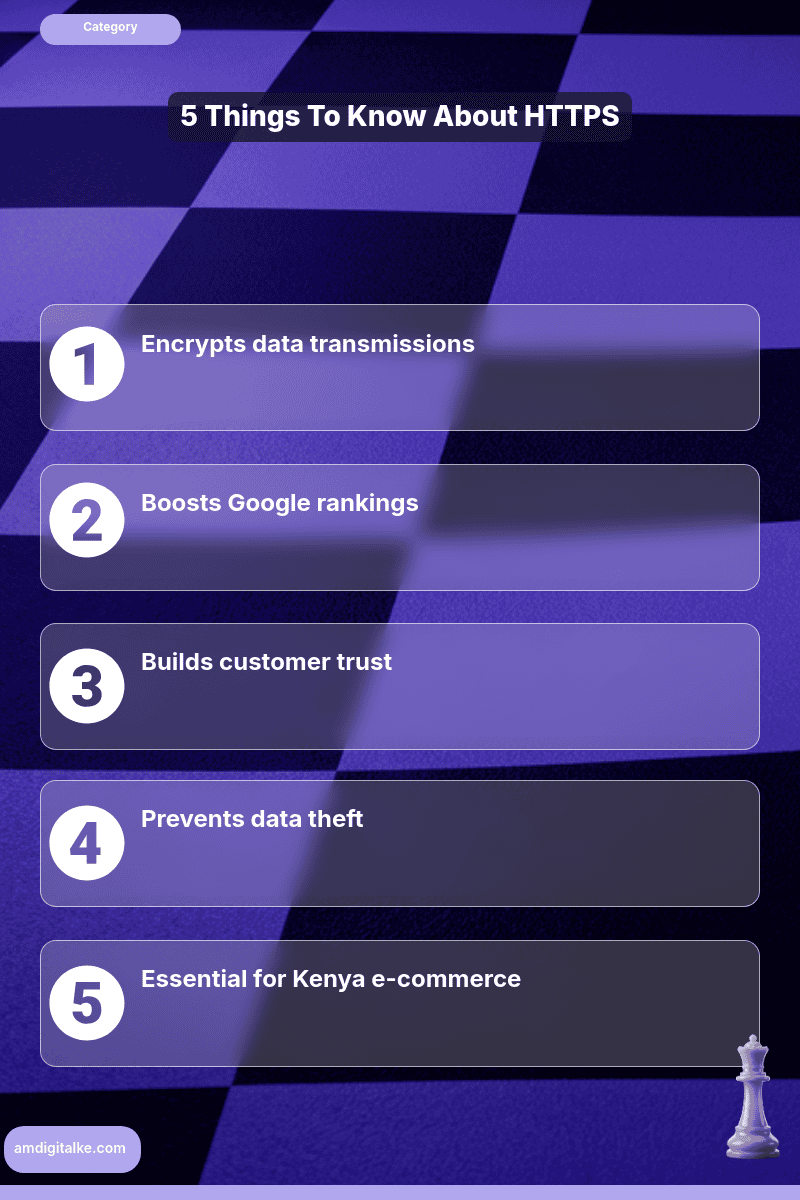
- Protects customer data in Kenya
- Builds trust for businesses
- Boosts Google search rankings
- Prevents hacking attempts
- Essential for Kenyan e-commerce
HTTPS (HyperText Transfer Protocol Secure) is a secure version of HTTP that encrypts data between your website and visitors’ browsers, and it is one of the ranking signals covered in our SEO basics guide for Kenya.
For Kenyan businesses, it’s the digital equivalent of having security guards at your shop. It protects customer information and builds trust while browsing your site.
Picture your business like a matatu route in Nairobi. HTTP is like an open matatu where everyone can see and hear your conversations with passengers.
HTTPS is like a private car with tinted windows. Your conversations with customers stay completely confidential.
When a customer enters their phone number on your website to make an order, HTTPS ensures hackers along Mombasa Road can’t intercept that information.
Why HTTPS Matters for Your Kenyan Business
Without HTTPS, your website displays “Not Secure” warnings that immediately scare away potential customers. In Kenya’s competitive digital market, this kills trust faster than a matatu tout refusing to give change.
Google also penalises non-HTTPS sites in search rankings. Your Westlands restaurant could lose customers to a competitor in Kilimani simply because their site feels safer.
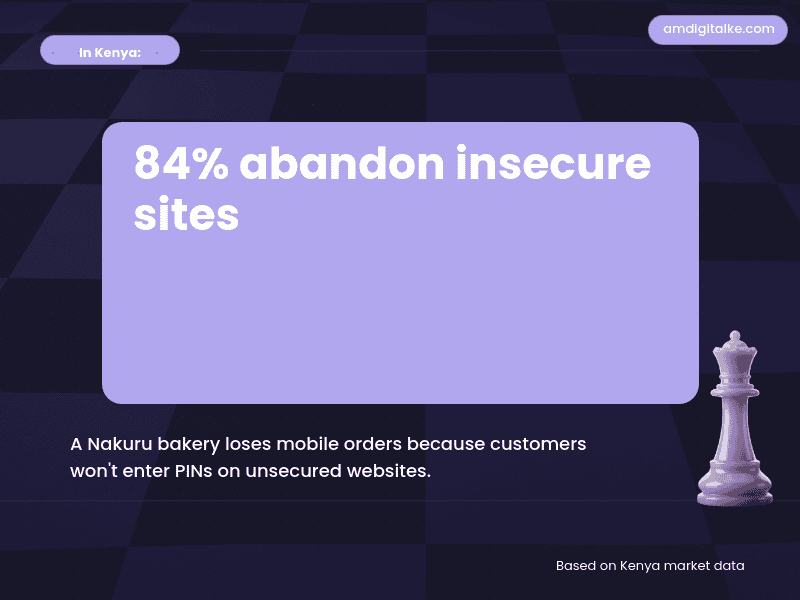
Based on AM Digital KE client data across Kenyan accounts, most internet users abandon websites showing security warnings. Consider a Nairobi electronics shop losing mobile money transactions because customers don’t trust entering their PIN on an unsecured site.
HTTPS prevents this costly mistake while boosting your Google rankings and conversion rates.
How HTTPS Works (With Examples)
HTTPS creates an encrypted tunnel between your website and visitors using SSL certificates. Here’s how it protects Kenyan businesses:
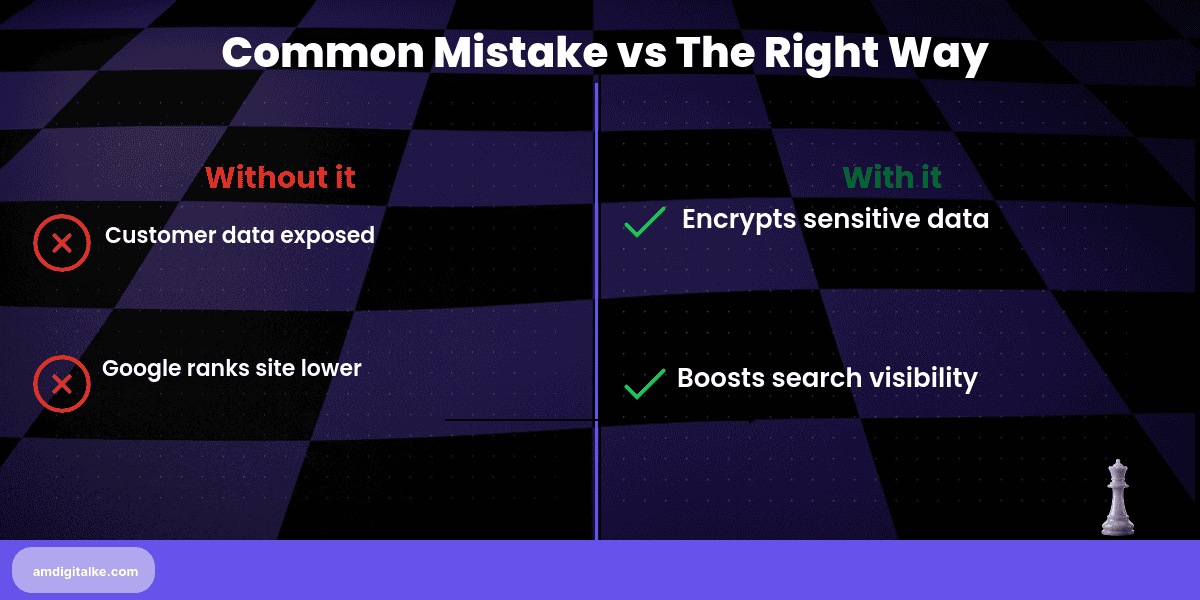
Before HTTPS: A customer ordering from your Nakuru bakery enters their details, but hackers at the cyber cafe can steal this information.
After HTTPS: The same order gets encrypted, making stolen data useless. It’s like trying to read a scrambled Swahili text message.
The good news is that most hosting providers provide a free SSL certificate. If you are looking for one, check out this post I did for one of my clients on the 10 best website hosting providers that offer free SSL certificates.
Key benefits include:
- Trust signals: Green padlock icon increases customer confidence
- SEO boost: Google prioritises secure sites in Kenyan search results
- Mobile safety: Protects M-Pesa and card details on mobile devices
- Professional image: Positions your business alongside major Kenyan banks and telecoms
To learn more about terms like these, check out my SEO FAQs page for a glossary. Then, see how to master site security with this post.
Quick Action Checklist
Here’s your HTTPS action checklist:
- ☐ Check your current status: Visit your website and look for a padlock icon in the address bar
- ☐ Test competitor sites: Search for businesses like yours in Nairobi and see which ones display “Secure” vs “Not Secure”
- ☐ Contact your hosting provider: Ask about SSL certificate installation (many Kenyan hosts offer free options)
- ☐ Verify mobile security: Test your site on different phones to ensure the security badge appears
- ☐ Update internal links: Change any old HTTP links to HTTPS across your website
- ☐ Monitor search rankings: Track how HTTPS implementation improves your Google visibility in Kenya
Need a complete walk-through? Download this complete SEO Checklist for everything you need to do.
Ready to secure your website and boost customer trust? Let’s analyse your site SEO for free and see its current security status.
Then, we will implement professional-grade HTTPS for your Kenya business.
Curious to learn more about similar SEO concepts? Check out the posts below
- You can use Google Search Console to see security risks on your site
- Learn what technical SEO is. Site security falls under this
- Follow that by understanding off-page SEO. If done wrong, it can become a security concern
- If you want to avoid any site security issues, make sure you evaluate the SEO specialist before hiring
These guides will help you understand the SEO holes that can lead to site security.
Have more SEO questions? Our SEO FAQs Kenya page answers the most common ones.
Frequently Asked Questions
Why is HTTPS important for Kenyan businesses?
Protects customer data like M-PESA transactions and builds trust for Nairobi shops and online stores.
Does HTTPS affect website speed in Kenya?
Modern HTTPS implementations improve speed for Kenyan users through security and performance optimizations.
Is HTTPS mandatory for Kenyan websites?
Yes, Google flags Kenyan sites as ‘Not Secure’ without HTTPS, hurting online business credibility.
How much does HTTPS cost for Kenyan websites?
Most hosts offer free SSL certificates for HTTPS, making it affordable for Kenyan businesses.