Table of Contents
- Key Takeaways
- Why Reviews Matter for Kenyan Hotels
- The Systematic Review Generation Strategy
- Your Hotel Review Generation Checklist
- Related Content
- Frequently Asked Questions
- How do reviews help Kenyan hotels?
- When should I ask for a hotel review?
- What’s the best way to ask for reviews in Kenya?
- How many reviews do Kenyan hotels need?
TL;DR: Hotels in Kenya need reviews to rank higher and attract more guests. Ask for reviews right after checkout using WhatsApp or QR codes.
Last Updated: March 2026
Key Takeaways
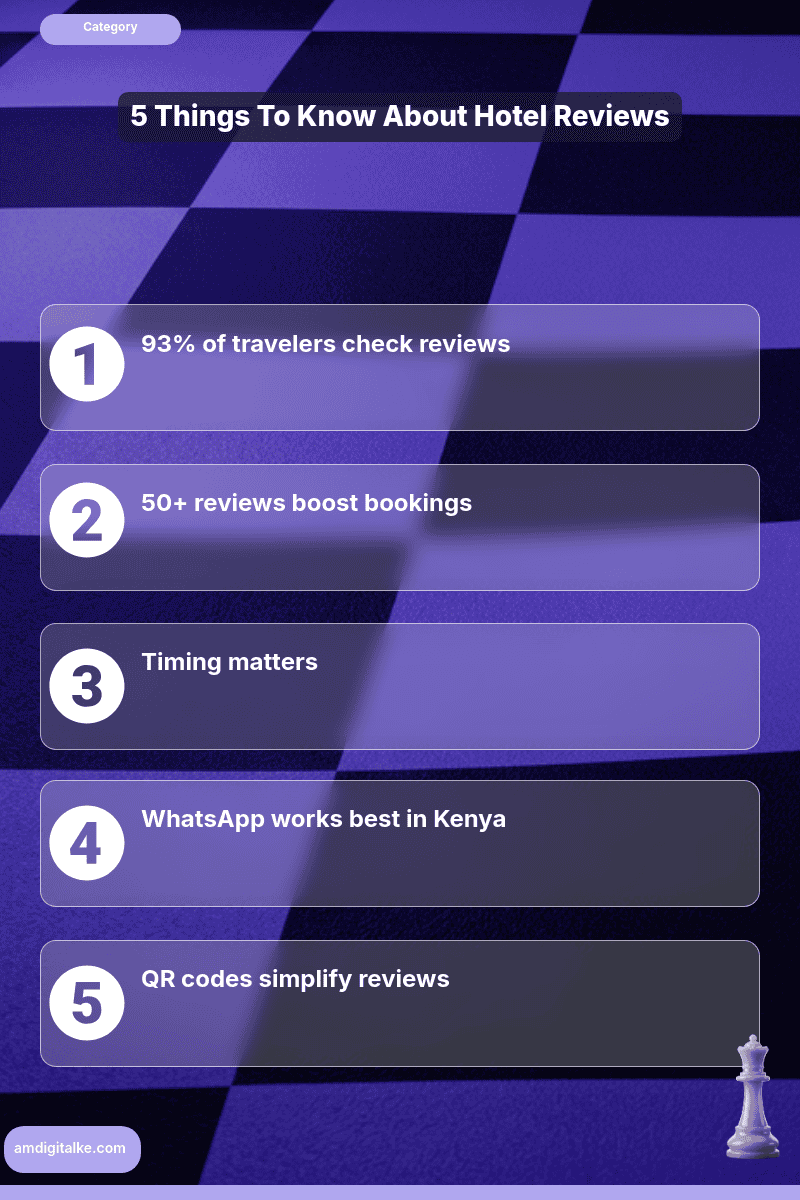
- Use WhatsApp for Kenyan guests
- Timing boosts review responses
- Make leaving reviews easy
Your hotel has excellent service. The rooms are spotless.
Guests leave happy. But when potential visitors search for “best hotels in Nairobi” or “where to stay in Mombasa,” your property barely shows up, a visibility gap we address fully in our hotel review SEO guide.
Meanwhile, competitors with average service but hundreds of reviews dominate the results.
The gap isn’t your hospitality. It’s your review strategy.
Why Reviews Matter for Kenyan Hotels
Online reviews are the new word-of-mouth for Kenya’s hospitality industry when understanding what local SEO really means for hotel visibility.
Before booking, 93% of travellers read online reviews.
Google’s local ranking algorithm heavily weights review quantity, quality, and recency when determining which hotels appear in the Local 3-Pack for searches like “hotels near JKIA” or “boutique hotel Westlands.”
But here’s what most Kenyan hoteliers don’t realise: Only a small fraction of satisfied guests leave reviews naturally.
That four-star experience your guest raved about at checkout? Without a systematic approach to requesting reviews, it disappears into thin air.
Your competitors aren’t necessarily better. They’re just better at asking.
The Systematic Review Generation Strategy
1. Time Your Review Requests Perfectly
The best time to request a review is 24-48 hours after checkout.
The experience is fresh, but the guest is settled. Send an email or WhatsApp message thanking them for their stay and including a direct link to your Google Business Profile or TripAdvisor page by optimising your Google Business Profile systematically.
Avoid:
- Requesting reviews during the stay (feels transactional)
- Waiting weeks later (memory has faded)
For negative experiences, address issues immediately during the stay rather than hoping they don’t review.
2. Make Leaving Reviews Effortless
Create a simple review funnel:
- QR code on checkout receipts linking directly to your Google review page
- Text message with a clickable review link sent post-checkout automatically
- Email follow-up with one-click review buttons (Google, TripAdvisor, Booking.com)
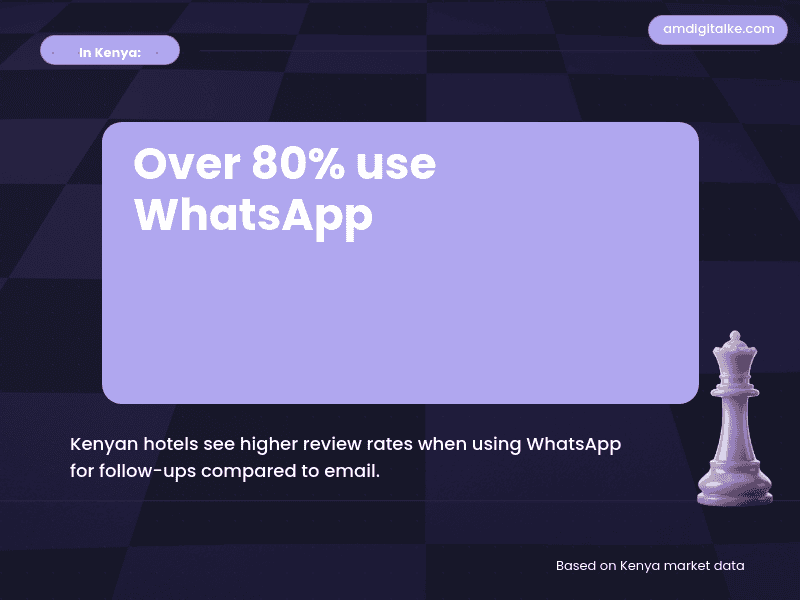
- WhatsApp message for Kenyan guests who prefer this platform
The easier you make it, the higher your response rate.
A guest shouldn’t need to search for your hotel, navigate multiple pages, or remember login credentials. One tap should take them directly to the review form.
3. Train Your Team to Earn Reviews Naturally
Your front desk, housekeeping, and restaurant staff are your review generation team.
Train them to:
- Introduce themselves by name (personalised service gets mentioned in reviews)
- Exceed expectations in small ways (surprise room upgrade, complimentary fruit plate, remembering guest preferences)
- Address issues immediately (a problem solved quickly becomes a positive review about your responsiveness)
- Mention reviews at checkout (“If you enjoyed your stay, we’d love to hear about it on Google”)
Don’t incentivise reviews with discounts or rewards.
Google prohibits this and can penalise your profile. Instead, build a service so remarkable that guests want to share it.
4. Respond to Every Review Within 24 Hours
Responding to reviews isn’t just polite.
It’s an SEO strategy for improving your local SEO presence actively. Google sees active engagement as a trust signal and ranks responsive businesses higher.
For positive reviews: “Thank you, [Guest Name]! We’re thrilled you enjoyed [specific detail they mentioned].
Our [team member name] will be delighted to hear your kind words. We look forward to welcoming you back to [neighbourhood/city].”
For negative reviews: “Thank you for this feedback, [Guest Name]. We sincerely apologise for [specific issue].
This isn’t the experience we strive for. We’ve addressed [action taken] and would appreciate the opportunity to make it right. Please contact us directly at [phone/email].”
Never:
- Argue publicly
- Make excuses
- Get defensive
Address legitimate concerns, explain (don’t excuse) any misunderstandings, and always offer resolution offline.
5. Leverage Multiple Review Platforms Strategically
Don’t put all your reviews in one basket when building quality backlinks strategically through review platforms.
Different travellers check different platforms:
- Google Business Profile: Critical for local SEO and “hotels near me” searches
- TripAdvisor: International travellers planning Kenya safaris and beach holidays
- Booking.com/Hotels.com: Guests who booked through OTAs (request reviews through these platforms)
- Facebook: Local Kenyans planning staycations or events
Rotate which platform you request reviews on, or let guests choose their preferred platform.
A hotel in Diani Beach might prioritise TripAdvisor for international tourists, while a business hotel in Westlands focuses on Google for corporate travellers searching “hotel near UN Gigiri.”
6. Showcase Reviews Everywhere
Your reviews are powerful social proof.
Don’t hide them by creating valuable content marketing assets. Display testimonials on:
- Homepage (carousel of recent 5-star Google reviews)
- Booking page (removes last-minute hesitation)
- Email signatures (builds credibility in correspondence)
- Social media (turn great reviews into posts)
- Physical lobby (printed reviews create in-person trust)
For local SEO, embed your Google reviews widget on your website.
This creates fresh, user-generated content that Google crawls and reinforces your authority.
Case Study 1: Karen Boutique Hotel
A 28-room boutique hotel in Karen struggled with occupancy despite excellent TripAdvisor scores.
The issue? Only 12 Google reviews.
We implemented a systematic review request process:
- QR codes at checkout
- Automated WhatsApp follow-ups
- Staff training on review conversations
Within 6 months:
- Grew from 12 to 87 Google reviews with a 4.7-star average
- Based on AM Digital KE client data across Kenyan accounts, Google Business Profile visibility increased significantly
- Direct bookings from Google searches jumped substantially
Case Study 2: Mombasa Beach Resort
A Mombasa beach resort with 150 rooms had reviews scattered across platforms, with no response strategy when understanding what off-page SEO means for hotel authority.
We consolidated their review management:
- Responded to every review (including 47 previously ignored negative reviews)
- Created platform-specific request campaigns
- Built systematic follow-up sequences
Results:
- TripAdvisor ranking in Mombasa improved from #38 to #12
- Repeat bookings mentioned “reading how you handle feedback” as a trust factor
- Based on AM Digital KE client data across Kenyan accounts, overall review volume increased substantially
Your Hotel Review Generation Checklist
☐ Create Google Business Profile and TripAdvisor review links (short, easy URLs)
☐ Generate QR codes linking to review pages for checkout receipts and room cards
☐ Set up automated review request system (email + WhatsApp 24-48 hours post-checkout)
☐ Train all guest-facing staff on review importance and natural conversation triggers
☐ Commit to responding to all reviews within 24 hours (assign responsibility)
☐ Add the Google reviews widget to your website homepage
☐ Create a monthly review report tracking quantity, average rating, and platform distribution
☐ Set up Google Alerts for your hotel name to catch reviews on unexpected platforms and respond quickly
For comprehensive review management guidance, check out my SEO FAQs page, where I answer common hotel review questions.
Before launching your review generation campaign, download this complete SEO Checklist to ensure you’ve optimised all trust-building elements.
Build Review Momentum That Compounds
Building a strong review foundation takes time, but it compounds.
Every new review makes the next one easier to get. Travellers trust hotels with robust, recent feedback.
At AM Digital KE, we help Kenyan hotels implement systematic review generation strategies that boost local SEO rankings while building authentic trust with travellers.
Your guests are having great experiences. Let’s make sure future guests know about it.
Ready to turn happy guests into powerful reviews?
Explore our Hospitality SEO Services in Kenya and discover how we help hotels build systematic review generation strategies that boost rankings and drive bookings through authentic guest feedback.
Wondering why competitors with fewer rooms have more reviews?
Get a free SEO strategy audit where we’ll assess your current review volume across platforms, evaluate your request system effectiveness, and design a response framework that builds trust with future guests.
Related Content
Curious to learn more about building review authority? Check out the posts below
- What is Google Business Profile (GBP)? (A Kenya Business Guide) – Google Business Profile is the primary platform for hotel reviews that influence local search rankings and booking decisions
- What is Domain Authority? (A Kenya Business Guide) – Review quantity and quality contribute to your hotel’s overall domain authority and trust signals that Google evaluates
- Why Search Intent Beats Search Volume: The Strategic SEO Move – Understanding why travellers read reviews helps you generate feedback that addresses their specific booking concerns
- The Best Niche and Industry SEO Strategies Built for Kenyan Markets – See how Kenyan hotels apply systematic review strategies to build competitive advantages in local markets
These articles will walk you through the basics of building review authority that drives bookings and improves rankings.
Have more SEO questions? Our SEO FAQs Kenya page answers the most common ones.
Frequently Asked Questions
How do reviews help Kenyan hotels?
Reviews boost hotel rankings on Google and TripAdvisor, attracting more guests in cities like Nairobi and Mombasa.
When should I ask for a hotel review?
Ask 24-48 hours after checkout when the guest experience is still fresh.
What’s the best way to ask for reviews in Kenya?
Use WhatsApp messages or QR codes on receipts for ease and convenience.
How many reviews do Kenyan hotels need?
Based on AM Digital KE client data across Kenyan accounts, hotels with 50+ recent reviews get significantly more bookings.