Table of Contents
TL;DR: User-generated reviews and Q&As boost rankings by showing Google your business is trusted and relevant, especially for Kenyan consumers.
Last Updated: March 2026
Key Takeaways
- Google uses reviews to rank businesses
- Kenyan buyers trust peer reviews
- Respond to all reviews
- Ask for reviews post-service
- Activate your Q&A section
Your Nairobi restaurant has amazing food. Your Westlands salon delivers exceptional service.
Your Kilimani clinic has the best specialists. But when potential customers search for you on Google, they see three short reviews from 2022 and zero questions answered.
Meanwhile, your competitor down the street has 127 reviews, an active Q&A section, and consistently ranks above you. The difference? They’ve unlocked the power of user-generated content, the same trust signal that helps hotels win direct bookings, as covered in our direct booking SEO guide.
Why UGC Matters for Kenyan Businesses
Google doesn’t just look at what you say about your business. It pays attention to what your customers say.
User-generated content (reviews, ratings, questions, answers, and testimonials) sends powerful trust signals to search engines. When real people consistently engage with your business online, Google interprets this as proof that you’re legitimate, relevant, and worth ranking higher.
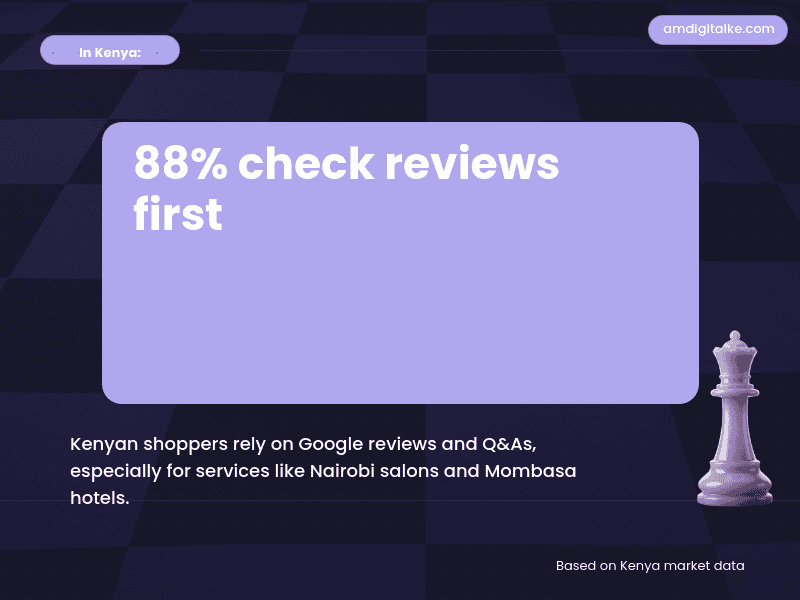
The Kenya Reality: Kenyan consumers are sceptical of marketing claims but trust peer recommendations. Most Kenyan online shoppers read reviews before making a purchase decision.
When your optimising your Google Business Profile properly, website, and social platforms are filled with authentic customer voices, you’re not just building SEO authority. You’re building the trust that converts searchers into customers.
The Three UGC Pillars That Boost Rankings
1. Google Business Profile Reviews: Your Local SEO Foundation
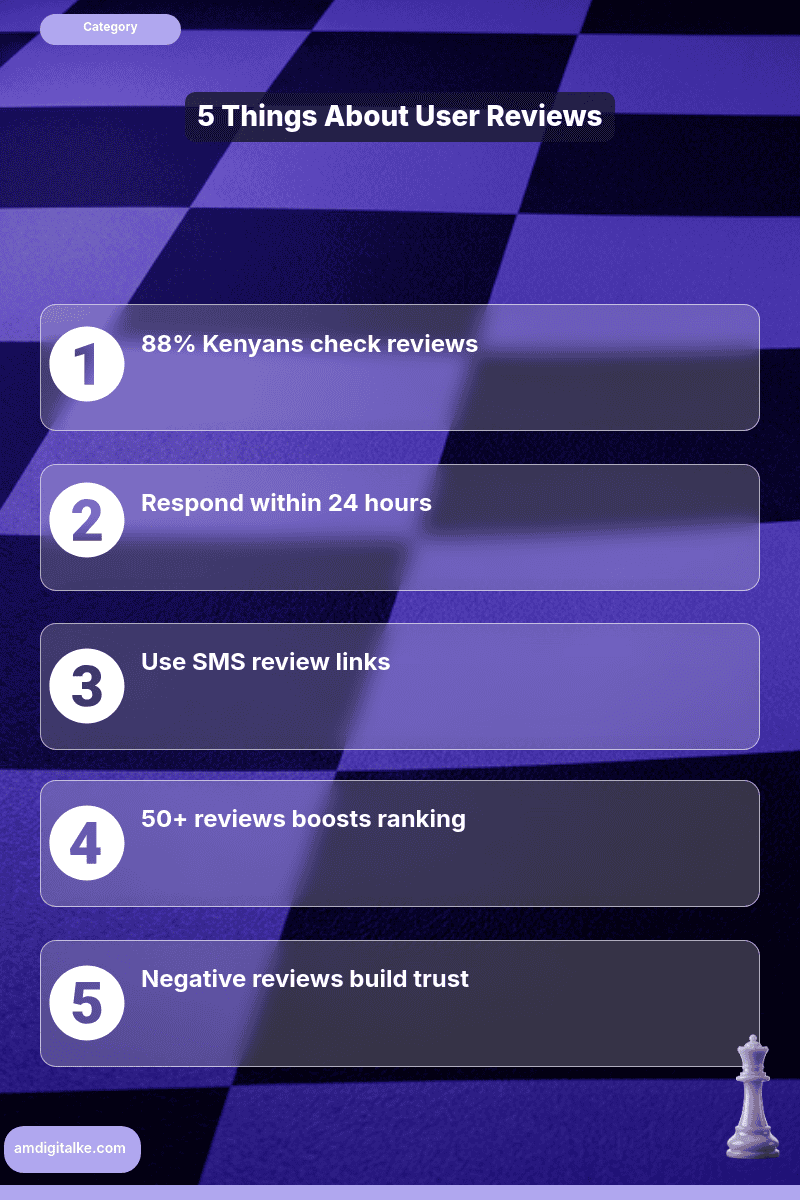
Reviews are the backbone of understanding local SEO fundamentals. Businesses with 50+ reviews rank significantly higher in the Local 3-Pack than those with fewer reviews.
But it’s not just about quantity.
How to Generate Reviews Systematically:
Timing is everything: Ask within 24-48 hours of a positive interaction when the experience is fresh.
Make it effortless: Send a direct Google review link via WhatsApp or SMS. Don’t make customers hunt for your profile.
Ask the right people: Focus on satisfied customers who’ve expressed appreciation verbally.
Train your team: Your receptionist, cashier, or account manager should naturally mention reviews as part of the customer journey.
Responding to Reviews: Every response is indexed by Google and counts as fresh content on your profile. Respond to all reviews, especially negative ones.
A well-handled negative review can actually boost trust more than ten generic positive ones.
Example Response Template: “Hi [Name], thank you for choosing [Business Name]! We’re thrilled you enjoyed [specific detail they mentioned]. Looking forward to serving you again soon here in [neighbourhood]. – [Your Name], [Your Role]”
2. Google Q&A: The Goldmine Most Businesses Ignore
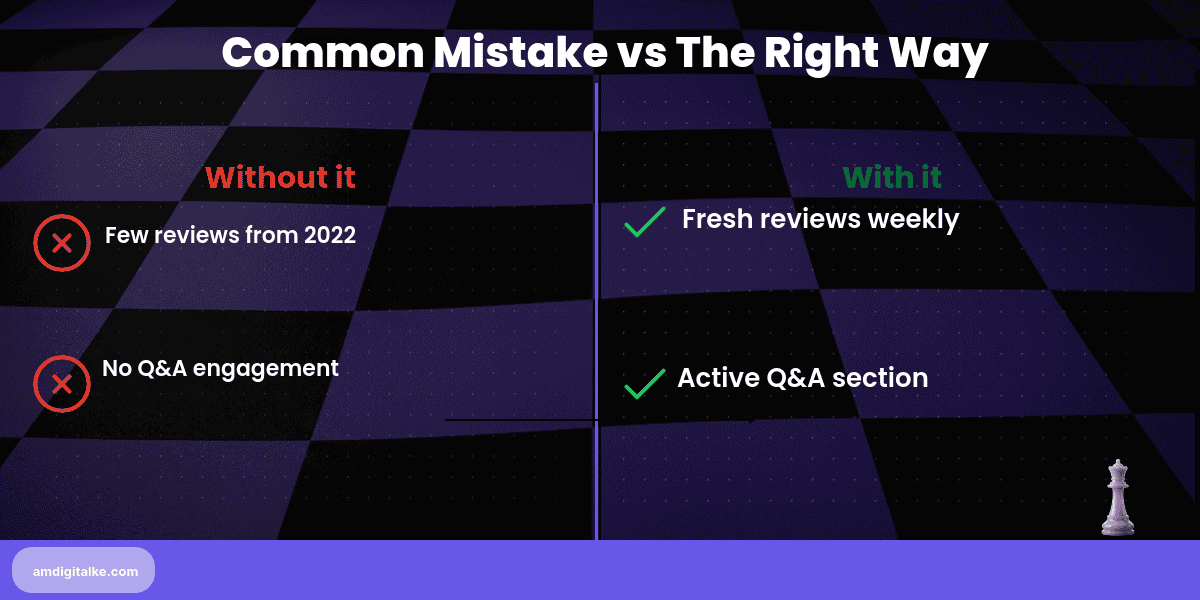
The Questions & Answers section on your Google Business Profile is an SEO weapon hiding in plain sight. Q&A content is indexed by Google and can rank for long-tail keywords.
It captures hyper-specific local search queries (“Do you accept M-PESA?” “Is parking available in Westlands?”). It reduces friction in the customer journey by answering concerns before they call.
Your Q&A Strategy: Don’t wait for customers to ask questions. Seed your own.
Identify the ten questions prospects ask most frequently and answer them yourself. Use natural language that mirrors how Kenyans actually search.
Power Questions to Answer:
- “Do you accept M-PESA/credit cards?”
- “Is parking available?”
- “What are your weekend hours?”
- “Do you offer [specific service]?”
- “How much does [service] cost?”
- “Is [Location] easily accessible via public transport?”
Pro Tip: Refresh Q&As every quarter. Search behaviour changes, and so should your answers.
3. Website Testimonials & Case Studies: Content That Ranks
Reviews on your Google Business Profile boost local SEO, but testimonials on your website build topical authority. When you create dedicated testimonial pages or case study content, you’re generating keyword-rich, authentic content that Google rewards through understanding what content marketing is.
How to Structure Testimonials for SEO:
- Use customer names and businesses (with permission): “John Kamau, Owner of XYZ Hardware, Nairobi”
- Include keywords naturally: If a client says, “AM Digital helped us rank #1 for ‘plumber in Kilimani,'” that’s gold
- Add schema markup: Structured data tells Google exactly what these testimonials represent
- Create video testimonials: Video content increases time-on-site, a ranking factor that Google watches
Case Study Formula:
- The Challenge: “ABC Law Firm in Westlands wasn’t showing up for ‘family lawyer Nairobi'”
- The Strategy: Brief overview of what you implemented
- The Results: Specific metrics – traffic increase, ranking improvements, lead growth
- Customer Voice: Direct quote about their experience
Understanding implementing E-E-A-T principles properly is crucial. User-generated content directly boosts your Experience, Expertise, Authority, and Trust signals that Google evaluates.
If you’re wondering about maintaining NAP consistency across all review platforms, our SEO FAQs page provides detailed guidance on local citation management.
Mobile-First UGC Strategy
Most Kenyan customers browse on mobile. User-generated content loads quickly, doesn’t require heavy design, and provides exactly what mobile searchers want: fast, trustworthy proof that your business delivers.
Reviews and Q&As are scannable, authentic, and persuasive. Perfect for mobile decision-making.
Kenya-Specific Insight: With data costs always on customers’ minds, lightweight UGC-heavy pages perform better than image-heavy marketing pages. Authenticity wins over production value every time.
Real Results from Kenyan Businesses
A Kilimani dental clinic implemented a systematic review generation strategy and seeded 15 Q&As covering everything from payment methods to parking availability.
Within 4 months:
Google Business Profile reviews increased from 12 to 94. They ranked #2 in the Local 3-Pack for “dentist Kilimani”.
Website traffic from local search grew substantially. Phone inquiries specifically mentioning “I saw your reviews” doubled.
A Westlands boutique law firm added a testimonials page with 10 detailed client case studies, each optimised for different legal service keywords. The testimonials page became their third-most-visited page and generated consistent leads from organic search.
Building understanding domain authority effectively takes time, but user-generated content accelerates the process by signaling real-world trust and engagement to Google’s algorithm.
For online stores, implementing product page SEO properly should include customer reviews and Q&As directly on product pages. This boosts both rankings and conversion rates.
Your UGC Action Plan:
Quick Wins (This Month):
- ☐ Set up a review request system via WhatsApp (send link within 48 hours of service)
- ☐ Seed 10 Q&As on your Google Business Profile covering your most-asked questions
- ☐ Respond to every existing review with personalised, keyword-conscious replies
Long-Term Strategy (3-6 Months):
- ☐ Create a dedicated testimonials page on your website with schema markup
- ☐ Develop 3-5 detailed case studies showcasing client transformations
- ☐ Implement a quarterly Q&A refresh to capture evolving search behaviour
- ☐ Set a goal of 50+ Google reviews with consistent monthly growth
Pro Tip: The businesses that win aren’t necessarily the best. They’re the ones whose customers speak the loudest online.
User-generated content isn’t just nice to have. It’s the competitive edge that separates page one from page five.
Download this complete SEO Checklist to see how UGC fits into your comprehensive SEO strategy.
At AM Digital KE, we help Kenyan businesses build systematic UGC strategies that amplify customer voices, boost rankings, and build the trust that converts.
Want to turn customer reviews into ranking power? Visit our eCommerce SEO Services in Kenya and see how we help online stores leverage user-generated content to boost visibility and build buyer trust.
Curious how your review strategy stacks up? Request a complimentary SEO analysis where we’ll benchmark your review volume against competitors, evaluate your Q&A presence, and uncover UGC gaps costing you sales.
Related Content
Curious to learn more about leveraging customer voices for SEO? Check out the posts below:
- How to Execute Content Marketing – A Kenyan Expert’s Playbook — UGC is one content type; this guide shows you how to build a complete content strategy that ranks and converts.
- The Review Velocity Strategy-Outranking Competitors Fast — Learn the systematic approach to generating reviews faster than competitors to boost local rankings quickly.
- Why Search Intent Beats Search Volume: The Strategic SEO Move — Understanding search intent helps you optimize UGC to attract qualified buyers, not just traffic.
- Medical Review Management – Handling Patient Feedback Professionally in Kenya — Healthcare businesses face unique UGC challenges; see how they handle privacy while building online reputation.
These articles will walk you through the basics of building comprehensive content and reputation strategies.
Have more SEO questions? Our SEO FAQs Kenya page answers the most common ones.
Frequently Asked Questions
How do Google reviews help Kenyan businesses?
Reviews on your Google Profile make you more visible to local searchers in cities like Nairobi and Mombasa.
Should I respond to negative reviews?
Yes! A professional reply shows you care about customer experiences.
How often should I ask for reviews?
Request reviews right after service – like after a salon visit or hotel stay.
Can Q&As improve my ranking?
Yes! Answering customer questions adds fresh content Google considers.
How many reviews should I target?
Aim for 50+ reviews to rank higher than competitors.