Table of Contents
- Key Takeaways
- Why Route-Specific Pages Matter for Kenyan Transport Companies
- How to Build High-Ranking Route Pages
- Your Route Page Optimisation Checklist
- Related Content
- Frequently Asked Questions
- Why do I need separate pages for each route?
- What details should I include on a route page?
- How does this help my Kenyan transport business?
TL;DR: Create specific pages for each transport route like Nairobi to Mombasa to rank higher and attract more customers searching for that exact route.
Last Updated: March 2026
Key Takeaways
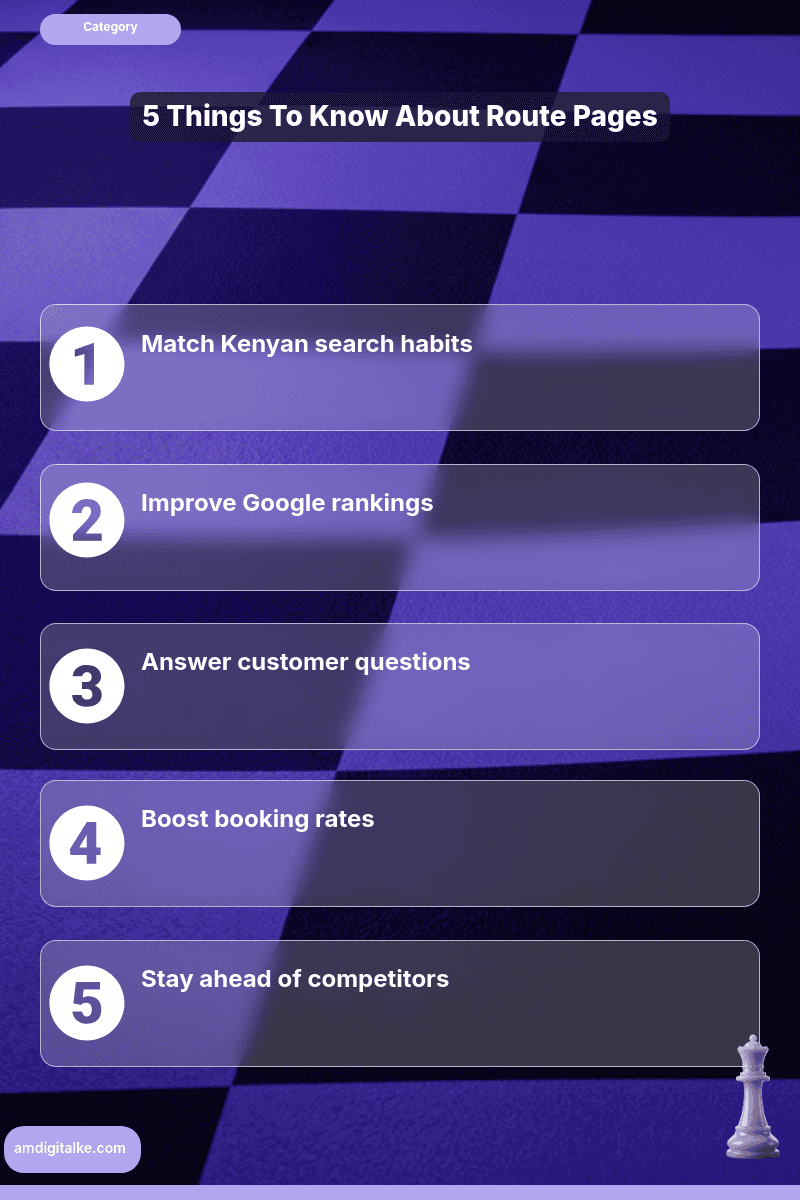
- One route = one page
- Use exact route in URLs
- Optimize titles and headers
- Answer customer FAQs
- Include Kenyan-specific details
You run a transport company connecting Nairobi to Mombasa.
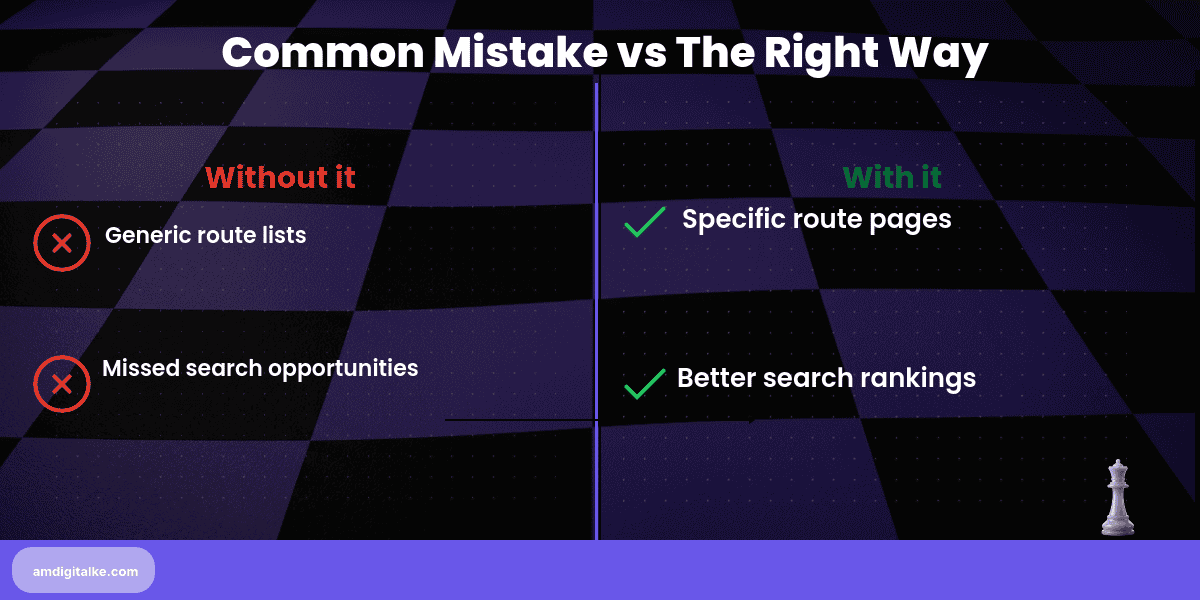
Your website has a generic “Our Routes” page listing everything from Nairobi-Kisumu to Mombasa-Malindi.
But when someone searches “Nairobi to Mombasa transport,” your competitor with a dedicated route page ranks higher, the same principle that helps properties rank for specific stays, as explained in our hotel SEO fundamentals guide.
This happens even though your service is better.
The problem? Google rewards specificity.
You’re giving it vagueness.
Why Route-Specific Pages Matter for Kenyan Transport Companies
Most transport businesses in Kenya treat routes as a list item rather than individual landing pages.
This is a massive missed opportunity.
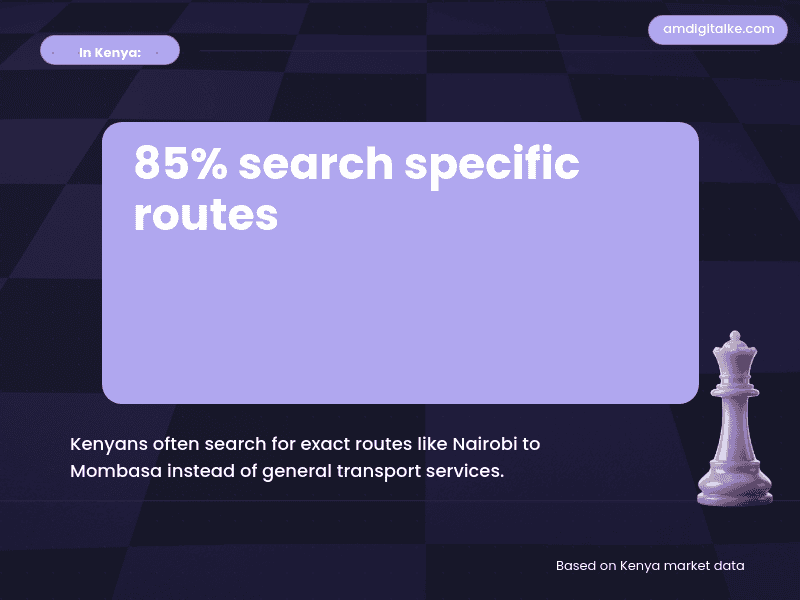
Kenyans search for specific routes.
They type “Nairobi to Mombasa bus,” “cheap transport Nairobi Mombasa,” “Nairobi Mombasa travel time.”
Each of these searches deserves a dedicated page that answers those exact questions.
When you create individual route pages, you’re not just organising your website better.
You’re matching how your customers actually search.
Google sees this relevance and rewards you with higher rankings.
Understanding what local SEO really means helps you dominate city-to-city search results.
Your competitor isn’t necessarily doing better marketing.
They’re just doing smarter SEO.
How to Build High-Ranking Route Pages
1. One Route = One Dedicated Page
Create separate URLs for each major route:
- amdigitalke.com/routes/nairobi-to-mombasa-transport
- amdigitalke.com/routes/nairobi-to-kisumu-bus
- amdigitalke.com/routes/mombasa-to-malindi-shuttle
Each URL should include the route naturally.
This helps Google understand exactly what the page offers. Implementing proper keyword research techniques ensures your URL structure matches actual search patterns.
2. Optimise Your Title Tags and Headers
Your page title should match search intent:
Good: “Nairobi to Mombasa Transport – Daily Departures, Online Booking”
Better: “Nairobi to Mombasa Bus – Affordable Daily Transport | [Your Company]”
Use H1 for the main route (“Nairobi to Mombasa Transport”).
Then use H2s for key sections like “Schedule & Departures,” “Ticket Prices,” “Travel Time & Stops.”
3. Answer Every Customer Question on the Page
Include specific details Kenyan travellers search for:
Departure times: “We depart Nairobi CBD at 7 AM, 2 PM, and 9 PM daily”
Travel duration: “Average journey time: 8-10 hours depending on traffic and stops”
Pickup/dropoff points: “Nairobi: Railway Station, Eastleigh. Mombasa: Mwembe Tayari, Likoni Ferry”
Pricing: “Standard: KES 1,500 | VIP: KES 2,200 (includes WiFi, charging ports)”
Amenities: “Air-conditioned buses, reclining seats, onboard entertainment, refreshments”
The more comprehensive your page, the more likely Google ranks it as the best answer.
Check out my SEO FAQs page for a glossary of terms that help optimise service pages.
4. Add Trust Signals and Social Proof
Include customer testimonials specific to that route:
“The Nairobi-Mombasa journey was smooth and comfortable. Arrived on time!” – Jane M., Verified Passenger
Display safety certifications, NTSA compliance, and any awards.
Kenyan travellers prioritise safety, especially for long-distance routes.
5. Optimise for Mobile and Speed
Most Kenyans will book transport on their phones.
Your route page must:
- Load in under 3 seconds (use compressed images)
- Have clear “Book Now” buttons above the fold
- Display pricing and schedules without scrolling
- Support M-PESA payment integration
A slow, clunky mobile experience kills conversions even if you rank well.
Optimising your page speed properly ensures mobile visitors convert into bookings.
6. Build Internal Links to Route Pages
Link from your homepage, blog posts, and other route pages.
For example, your “Nairobi to Kisumu” page could mention: “Also travelling to the coast? Check our Nairobi to Mombasa transport service.”
This internal linking helps Google discover and understand the relationship between your pages.
Understanding what SEO in Kenya means helps you create these strategic page connections.
Download this complete SEO Checklist to ensure your route pages have all critical optimisation elements.
Case Study: Nairobi Bus Company Route Pages
A Nairobi-based bus company created dedicated pages for their top 10 routes instead of one generic routes page.
Within 4 months, they saw:
- 60% increase in organic bookings from search
- Their “Nairobi to Mombasa transport” page alone now ranks position 2
- 200+ monthly bookings from that single page
Another company optimised their route pages with customer FAQs and real-time availability.
Their mobile conversion rate improved by 35% because travellers found exactly what they needed without calling or messaging.
Your Route Page Optimisation Checklist
☐ Create individual landing pages for your top 10 routes (start with the highest demand)
☐ Write unique titles targeting “[City A] to [City B] transport/bus”
☐ Include departure times, travel duration, pricing, and pickup points
☐ Add 5+ customer testimonials specific to each route
☐ Optimise images (compress to under 200KB) for faster mobile loading
☐ Install M-PESA payment gateway for seamless mobile booking
☐ Link route pages from the homepage and relevant blog content
Pro Tip: Use Google Search Console effectively to find which route searches already bring traffic to your generic routes page.
Then prioritise creating dedicated pages for those routes first.
Make Every Route Work for You
Transport SEO isn’t about having the flashiest website.
It’s about giving Google and travellers exactly what they’re searching for.
Want each route you serve to capture bookings from search?
Check out our Logistics SEO Services in Kenya and learn how we help transport companies build route-specific pages that dominate city-to-city searches and convert travellers into confirmed bookings.
Listing all routes on one page and wondering why bookings are low?
Let’s run a free SEO analysis where we’ll identify your highest-demand routes, evaluate your current page structure, and show you route-specific searches your competitors are capturing.
Related Content
Curious to learn more about transport and logistics SEO? Check out the posts below:
- How to Improve Your Local SEO – A Kenyan Expert’s Approach — Local SEO tactics help your route pages appear in “transport near me” searches and location-specific queries.
- What is Google Business Profile (GBP)? — Your GBP listing complements route pages by capturing searchers looking for transport companies in specific cities.
- B2B SEO for Logistics – Long Sales Cycles and Content Strategy — Learn how logistics companies create comprehensive content strategies that attract both B2C travellers and B2B cargo clients.
- How to Optimise On-Page SEO – A Kenyan Expert’s Guide — Master the on-page elements that make route pages rank higher in competitive transport searches.
These articles will walk you through the basics of optimising location-specific service pages for maximum visibility.
Have more SEO questions? Our SEO FAQs Kenya page answers the most common ones.
Frequently Asked Questions
Why do I need separate pages for each route?
Separate pages help Google understand and rank your site better for specific searches like Nairobi to Mombasa transport.
What details should I include on a route page?
Include departure times, ticket prices, travel duration, stops, and booking info for Kenyan customers.
How does this help my Kenyan transport business?
It matches how Kenyans search online, improving your visibility and attracting more customers.