Table of Contents
- Key Takeaways
- Why B2B Logistics SEO Is Different
- The B2B Logistics Content Funnel
- SEO Tactics That Work for Long Sales Cycles
- Your B2B Logistics SEO Roadmap
- Related Content
- Frequently Asked Questions
- Why is B2B logistics SEO different in Kenya?
- What content works for Kenyan logistics SEO?
- How long do Kenya logistics sales take?
TL;DR: B2B logistics SEO needs content for each buyer stage, from Kenya import guides to Nairobi freight forwarder comparisons.
Last Updated: March 2026
Key Takeaways
- Logistics buyers research for 6+ months
- Create content for all decision-makers
- Use Kenya-specific case studies
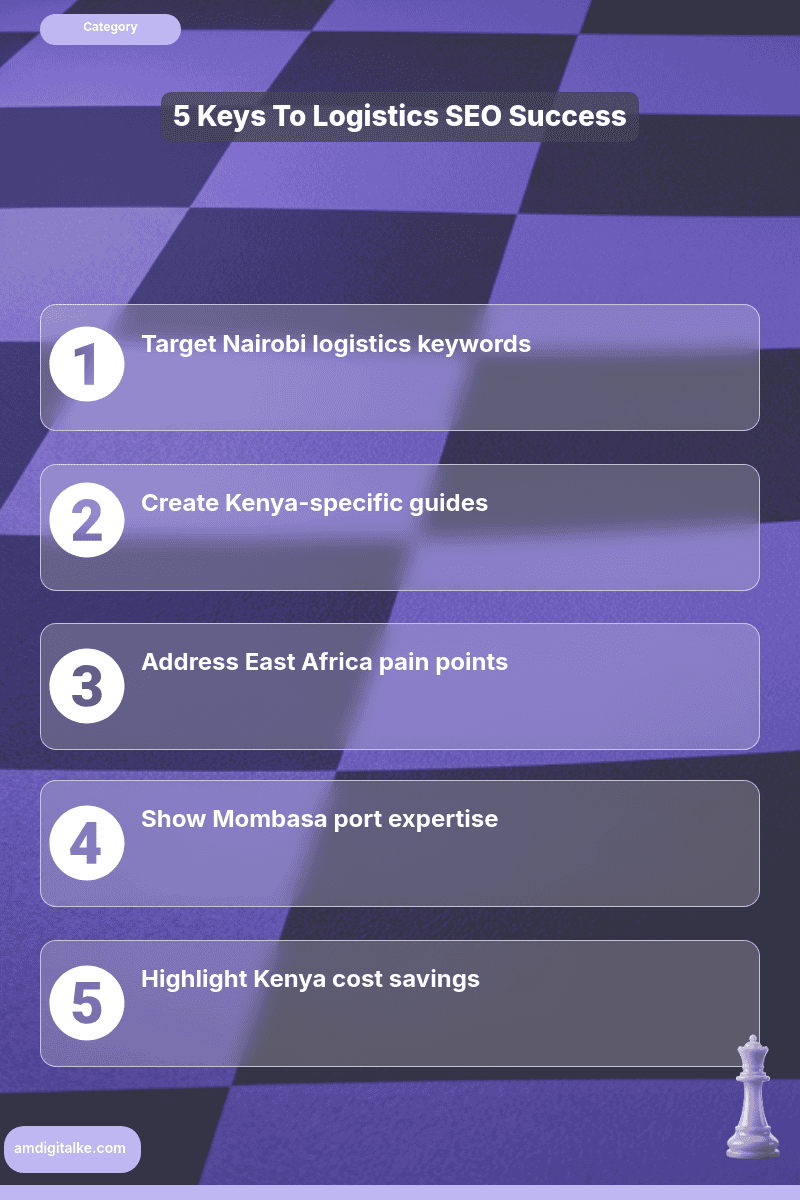
- Target Nairobi logistics keywords
- Focus on East Africa supply chains
You’ve got the trucks. The warehouses. The technology.
Your logistics company can move cargo from Mombasa to Malaba faster than your competitors.
But when procurement managers at Nairobi manufacturing companies search for “freight forwarding Kenya” or “warehousing solutions East Africa,” they’re finding your competitors instead.
Here’s the problem: B2B logistics sales cycles take 6-12 months. Most logistics companies create content for 6-12 days.
Why B2B Logistics SEO Is Different
B2B logistics isn’t impulse buying.
A warehouse manager at Bidco or Bamburi Cement isn’t switching logistics partners because of a clever Facebook ad.
They’re researching for months, comparing proposals, getting stakeholder buy-in, and negotiating contracts.
Your understanding of what SEO in Kenya really means strategy needs content for every stage of that journey.
The typical procurement process involves 6-8 decision-makers across operations, finance, and management.
Each person is Googling different questions.
The operations manager searches “cold storage facilities Nairobi.” The CFO searches “logistics cost reduction strategies Kenya.” The CEO searches “supply chain risk management East Africa.”
If your content only targets one persona, you’re losing most of the buying committee.
The B2B Logistics Content Funnel
Top of Funnel: Awareness (Months 1-3)
These prospects don’t know you exist yet.
They’re researching general logistics challenges, industry trends, and educational content.
Target keywords:
- “Supply chain challenges Kenya”
- “Cross-border logistics East Africa”
- “Warehousing best practices”
- “Import clearance process Kenya”
Content types: Blog posts, industry reports, guides, infographics.
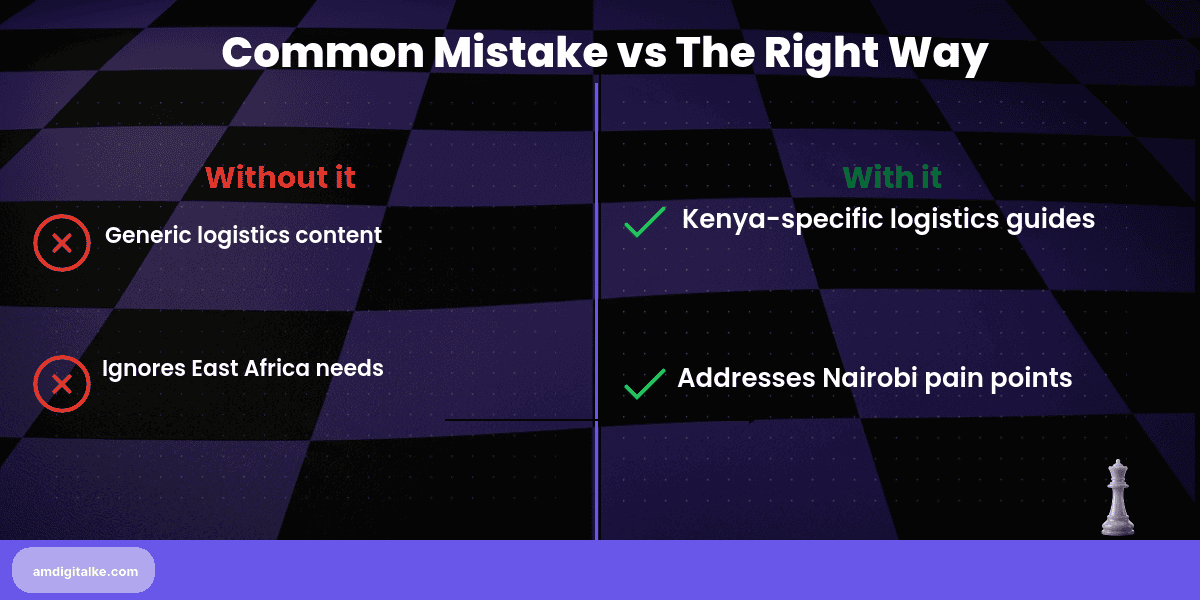
A Nairobi freight forwarder could publish “The Complete Guide to Importing from China to Kenya” or “5 Supply Chain Risks Kenyan Manufacturers Face in 2025.”
Middle of Funnel: Consideration (Months 4-8)
Now they’re evaluating solutions and comparing providers.
They want proof you can solve their specific problems.
Target keywords:
- “[Your service] + Nairobi/Kenya”
- “Best logistics company for [industry]”
- “How to choose freight forwarder Kenya”
- “[Competitor name] alternative”
Content types: Case studies, comparison guides, service pages, webinars.
Create “How Kenyan FMCG Companies Reduce Distribution Costs by 30%” or “Choosing a 3PL Partner: 12-Point Evaluation Checklist.”
Bottom of Funnel: Decision (Months 9-12)
They’re ready to request proposals.
They want specific capabilities, pricing frameworks, and risk mitigation details.
Target keywords:
- “[Your company name] + reviews/pricing”
- “RFP template logistics Kenya”
- “Logistics contract negotiation”
- “[Service] + SLA guarantees”
Content types: Service detail pages, pricing guides (even if ranges), RFP templates, contract explainers.
Publish “What Should Be in Your Logistics SLA Agreement?” or “Understanding Demurrage and Detention Charges in Kenya.”
SEO Tactics That Work for Long Sales Cycles
1. Create Content Hubs, Not Isolated Posts
Build comprehensive resource centres around your services.
If you offer warehousing, create a hub with 10-15 interlinked articles covering warehouse selection, inventory management, fulfilment strategies, technology integration, and cost optimisation.
This signals topical authority to Google and keeps prospects on your site longer. Implementing effective content marketing strategies helps you create these interconnected resources systematically.
2. Optimise for Decision-Maker Titles
Include phrases like “for logistics managers,” “procurement guide,” or “supply chain directors” in your content.
When someone searches “warehousing solutions for operations managers Kenya,” you want to appear.
These leveraging long-tail keywords properly have lower search volume but 3x higher conversion rates.
3. Use Lead Magnets at Every Funnel Stage
Gate your best content behind email forms. Offer:
- Top funnel: “Kenya Logistics Industry Report 2025”
- Mid funnel: “Freight Cost Calculator” or “Warehouse Selection Checklist”
- Bottom funnel: “RFP Template for 3PL Services”
A Mombasa-based logistics company used a “Port Congestion Tracker” tool as a lead magnet and generated 240 qualified leads in 6 months.
Check out my SEO FAQs page for a glossary of terms to include in your educational content.
4. Leverage LinkedIn for Content Distribution
Most B2B decision-makers aren’t on Instagram. They’re on LinkedIn.
Share every blog post, case study, and guide on your company page. Encourage your team (especially sales and operations) to share on personal profiles.
Add “Share on LinkedIn” CTAs in your articles.
You’re creating valuable content marketing consistently reaches buyers where they actually spend time.
5. Target Problem-Aware Keywords
Instead of just “logistics services Kenya,” target problem-specific searches:
- “How to reduce demurrage charges Kenya”
- “Customs clearance delays Mombasa solutions”
- “Last-mile delivery challenges Nairobi”
- “Cross-border cargo tracking issues”
These searchers know they have a problem and are actively looking for solutions.
They’re closer to conversion. Implementing proper keyword research strategies helps you identify these high-intent search terms.
Your B2B Logistics SEO Roadmap
Days 1-30: Foundation & Research
- ✓ Audit current website content and identify funnel gaps
- ✓ Research buyer personas and map their search queries
- ✓ Set up Google Search Console and Analytics conversion tracking
- ✓ Create content calendar for 12 months (1-2 posts per week minimum)
Days 31-90: Awareness Content Creation
- ✓ Publish 8-10 top-of-funnel educational blog posts
- ✓ Create one major lead magnet (industry report or guide)
- ✓ Optimise existing service pages with target keywords
- ✓ Build 5 internal links from new posts to service pages
Days 91-180: Consideration Content & Link Building
- ✓ Publish 4-6 case studies with measurable results
- ✓ Create comparison/evaluation guides for your services
- ✓ Guest post on Kenyan business publications (Business Daily, Nation Business)
- ✓ Request backlinks from satisfied clients’ websites
Building quality backlinks for your logistics website strengthens your domain authority and search visibility.
Days 181-365: Decision Content & Optimisation
- ✓ Build detailed service pages with pricing frameworks
- ✓ Create bottom-funnel lead magnets (RFP templates, calculators)
- ✓ Launch monthly webinars on logistics trends and best practices
- ✓ A/B test landing pages and CTAs for conversion rate optimisation
- ✓ Monitor rankings monthly and refresh underperforming content
Ongoing: Long-Term Nurture Strategy
- ✓ Email drip campaigns for leads at each funnel stage
- ✓ Quarterly industry reports to maintain thought leadership
- ✓ Monthly LinkedIn content distribution
- ✓ Retargeting campaigns for website visitors who don’t convert
Download this complete SEO Checklist to track your B2B logistics SEO implementation progress.
Case Study: Nairobi Freight Forwarder
Before Systematic B2B SEO:
- ❌ Ranking page 5+ for “freight forwarding Nairobi”
- ❌ 300 monthly website visitors (mostly existing clients)
- ❌ 2-3 inbound RFP requests per quarter
- ❌ 18-month average sales cycle
After 12 Months with AM Digital KE:
- ✅ Position 2-4 for primary logistics keywords
- ✅ 3,500+ monthly organic visitors
- ✅ 45+ qualified leads per quarter from search
- ✅ 12-month average sales cycle (33% reduction)
The Strategy: Built content hubs around warehousing, freight forwarding, and customs clearance; created lead magnets for each buyer persona; implemented LinkedIn distribution strategy; optimised for long-tail problem-aware keywords.
B2B logistics SEO isn’t about quick wins.
It’s about building a content engine that works as hard as your trucks.
Tired of 18-month sales cycles with few inbound leads? Check out our Logistics SEO Services in Kenya and learn how we build content funnels that attract decision-makers at every stage and shorten B2B logistics sales cycles.
Wondering why procurement managers find competitors first? Let’s run a free SEO analysis where we’ll map your buyer journey content gaps, identify decision-maker search patterns, and show you which funnel stages are losing qualified leads.
Related Content
Curious to learn more about B2B logistics SEO? Check out the posts below:
- Freight Forwarding SEO – Ranking for Import and Export Services — Learn specific tactics for ranking in competitive freight forwarding search terms and capturing import/export leads.
- How to Build Links – A Kenyan Expert’s Guide — Discover practical link-building strategies that work for B2B logistics companies in Kenya’s competitive market.
- Why Search Intent Beats Search Volume: The Strategic SEO Move — Understanding search intent helps you target decision-makers at the right buying stage instead of chasing vanity metrics.
- The Best Niche and Industry SEO Strategies Built for Kenyan Markets — See how specialised industries like logistics require unique SEO approaches different from general business strategies.
These articles will walk you through the basics of building long-term SEO strategies for complex B2B sales cycles.
Have more SEO questions? Our SEO FAQs Kenya page answers the most common ones.
Frequently Asked Questions
Why is B2B logistics SEO different in Kenya?
Kenyan logistics buyers take 6-12 months, researching import processes and Nairobi storage options before decisions.
What content works for Kenyan logistics SEO?
Kenya-specific guides, East Africa logistics case studies, Nairobi warehouse comparisons, and cost reduction strategies.
How long do Kenya logistics sales take?
6-12 months typically, with Bidco, Bamburi Cement evaluating multiple suppliers before contracts.