Table of Contents
- Key Takeaways
- Why Project Galleries Matter for Construction SEO
- The 6-Step Project Gallery Optimisation System
- What Proper Gallery Optimisation Achieves
- Your Project Gallery Optimisation Checklist
- Related Content
- Frequently Asked Questions
- Why is project gallery optimization important in Kenya?
- How do I name construction project images for SEO?
- What should I include in image alt text?
TL;DR: Optimize project galleries with descriptive file names, alt text, and Kenyan locations to rank in Google Images and attract Nairobi construction clients.
Last Updated: March 2026
Key Takeaways
- Google Images drives web searches
- Kenyan clients rely on visual content
- Descriptive file names boost visibility
- Alt text improves accessibility and SEO
- Localize content with Kenyan project examples
You’ve completed stunning construction projects across Nairobi. Luxury homes in Karen, commercial buildings in Westlands, residential estates in Kilimani, the kind of visual proof that also drives bookings for properties following our hotel gallery SEO tips.
Your portfolio is impressive. But when potential clients search “modern house designs Kenya” or “commercial construction Nairobi,” they’re finding your competitors instead.
Your project gallery isn’t just invisible. It’s working against you.
Why Project Galleries Matter for Construction SEO
Here’s what most Kenyan construction firms don’t realise. Your project gallery is one of your most powerful SEO assets.
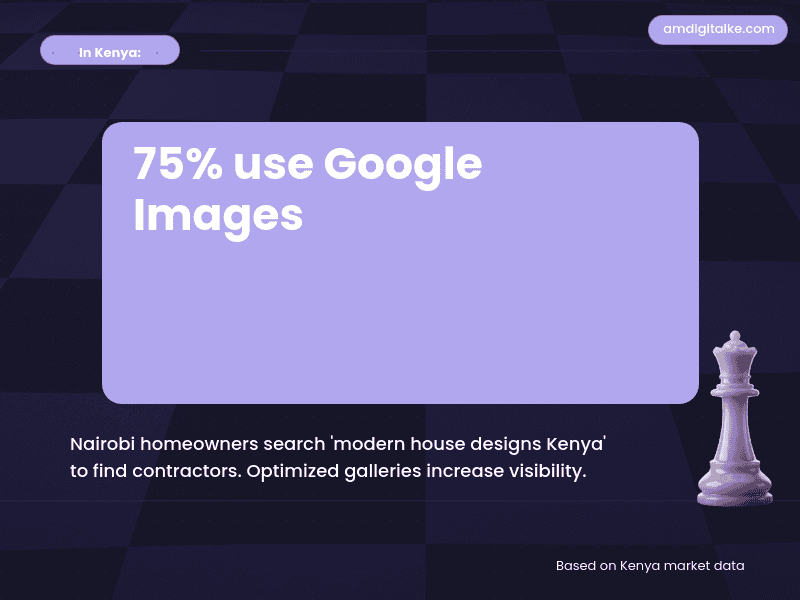
Google Images drives web searches, and Kenyan homeowners and property developers heavily rely on visual search when choosing contractors.
When someone searches “contemporary house designs Nairobi” or “office renovation before and after,” they’re in research mode. They’re actively seeking construction partners.
If your optimised project gallery appears in those results, you’ve just earned a high-intent lead. But if your images are named “IMG_2034.jpg” with no context, Google has no idea what you’ve built or where.
The opportunity cost is massive. While your competitors with optimised galleries capture leads from image search, you’re paying for ads or relying solely on referrals.
Let’s fix that.
The 6-Step Project Gallery Optimisation System
1. Strategic Image File Naming
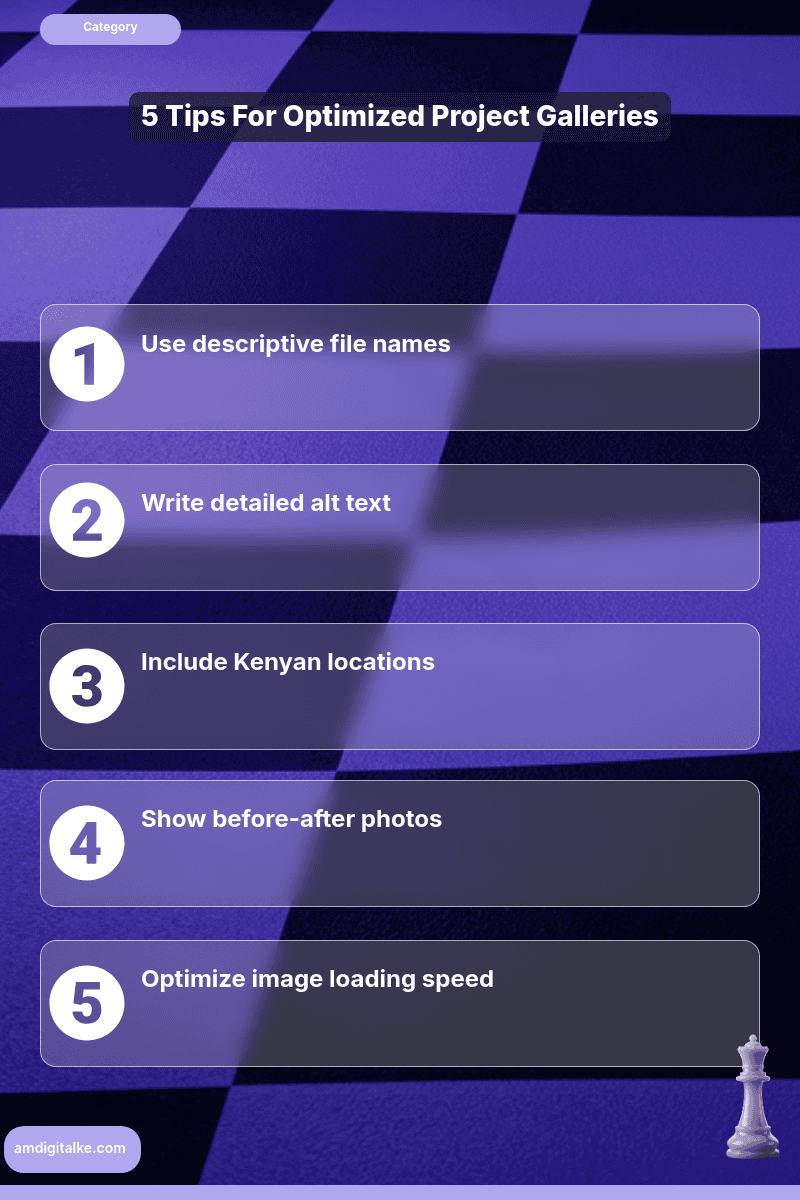
Before uploading any project photo, rename the file descriptively with your target keywords.
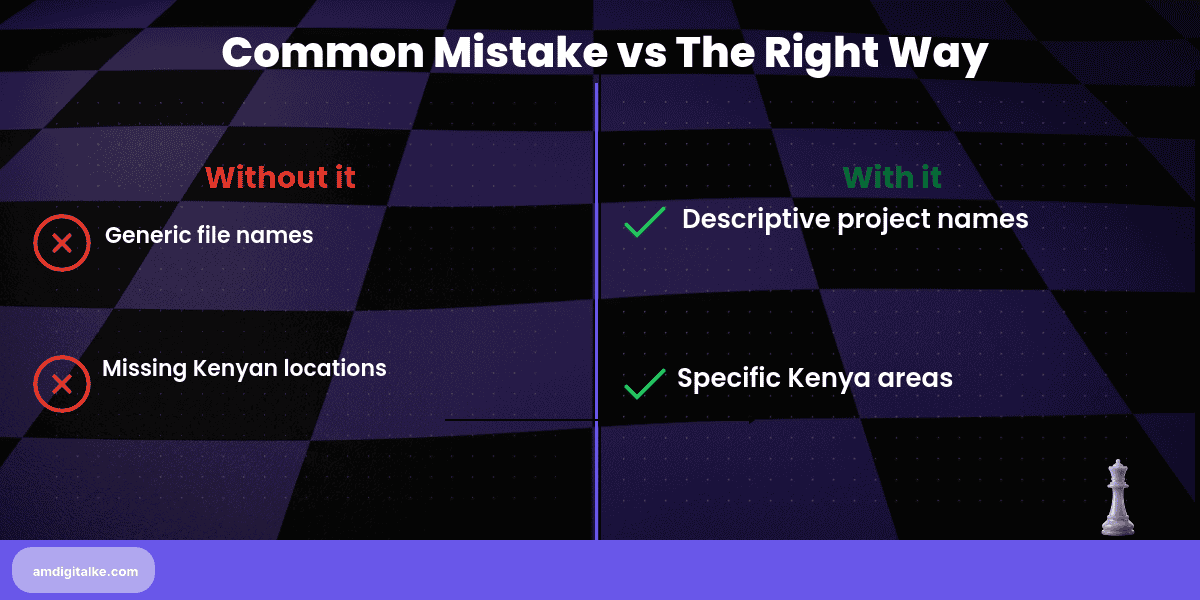
Wrong approach:
- DSC_2034.jpg
- Photo1.jpg
- IMG_4521.jpg
Right approach:
- modern-3-bedroom-house-karen-nairobi.jpg
- commercial-office-renovation-westlands.jpg
- luxury-villa-construction-runda-estate.jpg
The formula: [project-type]-[location]-[unique-feature].jpg
This seems basic, but it’s foundational. Google’s image recognition is sophisticated, but descriptive file names give crucial context about what the image shows and where the project is located.
2. Write Compelling Alt Text for Every Image
Alt text (alternative text) serves two purposes: accessibility for visually impaired users and SEO context for search engines. Every project image needs unique, descriptive alt text.
Wrong approach:
- Alt text: “house”
- Alt text: “construction project”
- Alt text: blank (the worst option)
Right approach:
- Alt text: “Modern 4-bedroom house with glass facade in Karen, Nairobi”
- Alt text: “Commercial office space renovation showing open-plan layout in Westlands”
- Alt text: “Luxury master bathroom with Italian marble finishes, Runda Estate”
Best practices:
- Include location (neighbourhood + city)
- Describe what makes the project unique
- Keep it under 125 characters
- Use natural language, not keyword stuffing
- Be specific about the project type and features
3. Optimise Image File Sizes Without Losing Quality
This is critical for Kenyan users. Data costs and internet speeds vary widely across Kenya, and slow-loading galleries frustrate potential clients and hurt your SEO rankings.
Google’s Core Web Vitals penalise slow-loading images.
Your optimisation checklist:
- Compress images before uploading using tools like TinyPNG or ShortPixel
- Target file sizes under 200KB for gallery images
- Use modern formats like WebP (reduces file size by 25-35% vs. JPEG)
- Implement lazy loading so images load only when users scroll to them
- Set explicit width and height attributes to prevent layout shifts
Based on AM Digital KE client data across Kenyan accounts, a Kilimani construction firm reduced its gallery page load time from 8.5 seconds to 2.1 seconds through image optimisation alone. Their mobile traffic increased 67% because potential clients weren’t abandoning the slow-loading page.
4. Create Detailed Project Descriptions with Local Keywords
Each project in your gallery needs context. Not just for visitors, but for search engines crawling your content.
Minimum information for each project:
- Project type: “Residential Construction,” “Commercial Renovation,” “Interior Fit-Out”
- Location: Specific neighbourhood and city (“Karen, Nairobi”, not just “Nairobi”)
- Timeline: “Completed in 6 months” or “3-month renovation”
- Key features: “4 bedrooms, 5 bathrooms, infinity pool, solar panels”
- Unique selling points: “First LEED-certified home in the estate” or “Budget-friendly modern design”
Write 50-100 words per project minimum. This gives Google enough content to understand what you’ve built and match it to relevant searches.
Pro tip: Include client testimonials within project descriptions when possible. “The team delivered our dream home on time and within budget” adds trust signals and natural keyword variations.
5. Implement Schema Markup for Projects
Schema markup is structured data that tells Google exactly what your content represents. For construction galleries, use the ImageObject schema combined with the Product or Service schema.
This code tells Google your images are professional construction projects with specific locations. It makes you eligible for rich results in image search.
What schema markup enables:
- Enhanced visibility in Google Images
- Rich snippets with project details in search results
- Local pack inclusion for location-based searches
- Better categorisation of your portfolio
If schema markup sounds technical, tools like technical SEO plugins (for WordPress) or Schema.org generators can help implement it without coding knowledge.
6. Organise Gallery by Project Type and Location
Don’t dump all projects into one massive, unsorted gallery. Strategic organisation improves both user experience and SEO.
Recommended structure:
Residential Projects
- Modern Homes
- Luxury Villas
- Affordable Housing
- Renovations & Extensions
Commercial Projects
- Office Buildings
- Retail Spaces
- Hospitality & Hotels
- Warehouses & Industrial
Location-Based Pages
- Projects in Karen
- Projects in Westlands
- Projects in Kilimani
- Projects in Runda
This structure allows you to create dedicated landing pages like “Modern House Construction in Karen” or “Office Renovations in Westlands.” These pages rank for highly specific, high-intent searches.
A Nairobi construction company reorganised their 80+ projects into location-specific galleries. Within 4 months, they ranked on page one for “luxury homes Karen,” “office construction Westlands,” and six other location-based terms.
Based on AM Digital KE client data across Kenyan accounts, organic leads from gallery pages increased 135%.
Check out my SEO FAQs page for a glossary of technical terms that’ll help you understand how visual content optimisation fits into your overall SEO strategy.
What Proper Gallery Optimisation Achieves
Before Optimisation:
- Gallery page had 200 monthly visitors
- Zero visibility in Google Images
- 3% conversion rate (visitors to inquiries)
- Ranked page 5+ for target keywords
After 6 Months with AM Digital KE:
- 2,400+ monthly visitors to gallery pages
- Featured in Google Images for 40+ construction-related searches
- 11% conversion rate from gallery visitors
- Multiple page-one rankings for “[project type] + [Nairobi location]” terms
The implementation: File renaming, alt text optimisation, location-based gallery organisation, schema markup, and strategic internal linking to service pages.
Your Project Gallery Optimisation Checklist
☐ Audit existing images: Rename files descriptively with location keywords before uploading
☐ Write unique alt text for every project image (include project type + location)
☐ Compress all images to under 200KB using TinyPNG or similar tools
☐ Add 50-100-word descriptions for each project with location and key features
☐ Organise the gallery into project-type categories and location-based pages
☐ Implement schema markup using ImageObject for all portfolio images
☐ Enable lazy loading and set explicit image dimensions for faster load times
Pro tip: Start with your 10-15 most impressive projects. Perfect the optimisation process on these flagship projects before scaling to your entire portfolio.
Quality over quantity wins in SEO.
Download this complete SEO Checklist to track your gallery optimisation progress and ensure you’re covering both technical and on-page elements systematically.
Your project gallery should be working 24/7 to attract qualified leads through search. Not just sitting there looking pretty.
At AM Digital KE, we help Kenyan construction firms transform their portfolios into lead-generation engines through systematic image optimisation, strategic content, and local SEO.
Ready to turn your portfolio into a lead generation machine? Visit our Construction SEO Services in Kenya and see how we optimise project galleries to rank in image searches and capture clients researching contractors visually.
Curious if your gallery is costing you leads? Request a free website review where we’ll audit your image SEO, evaluate gallery structure, and identify visual searches showing your competitors’ work instead of yours.
Related Content
Curious to learn more about visual SEO? Check out the posts below:
- How to Optimise Page Speed – A Kenyan Expert’s Playbook – Learn techniques to compress images without quality loss and improve gallery load times dramatically.
- How to Optimise On-Page SEO – A Kenyan Expert’s Guide – Discover how project descriptions and structured content improve your gallery’s search visibility.
- The Best Niche and Industry SEO Strategies Built for Kenyan Markets – See how construction firms use specialised SEO tactics to dominate image and local searches.
- Real Estate SEO Services in Kenya – Learn how property developers optimise listing photos to attract buyers searching visually.
These articles will walk you through the basics of making your visual content work harder for lead generation.
Have more SEO questions? Our SEO FAQs Kenya page answers the most common ones.
Frequently Asked Questions
Why is project gallery optimization important in Kenya?
Kenyan clients use Google Images to find contractors. Optimized galleries increase visibility for searches like ‘luxury homes Nairobi’.
How do I name construction project images for SEO?
Use the format: ‘[project-type]-[location]-[unique-feature].jpg’, like ‘modern-home-karen-nairobi.jpg’
What should I include in image alt text?
Describe the project and location, like ‘Contemporary 3-bedroom house in Runda Estate, Nairobi’