Table of Contents
TL;DR: Boost Kenyan sales by writing unique, Kenya-focused product descriptions and using SEO-friendly titles.
Last Updated: March 2026
Key Takeaways
- Unique descriptions rank higher
- Kenya buyers research online
- Include delivery info
- Use Kenyan examples
- Add trust signals
Your online store has amazing products. Your prices are competitive.
Your customer service is solid. But when Kenyan shoppers search “buy [your product] Kenya” or “[product] online Nairobi,” they’re landing on Jumia or Kilimall instead of your site.
The problem? Your product pages aren’t optimised for both search engines and conversions.
Let’s fix that.
Why Product Pages Are Your Money Pages
Product pages are where SEO meets sales. They need to rank on Google AND convince visitors to add items to the cart.
Most Kenyan online stores get one right but miss the other. They either create keyword-stuffed pages that rank but don’t convert, or beautiful pages that convert but never get found.
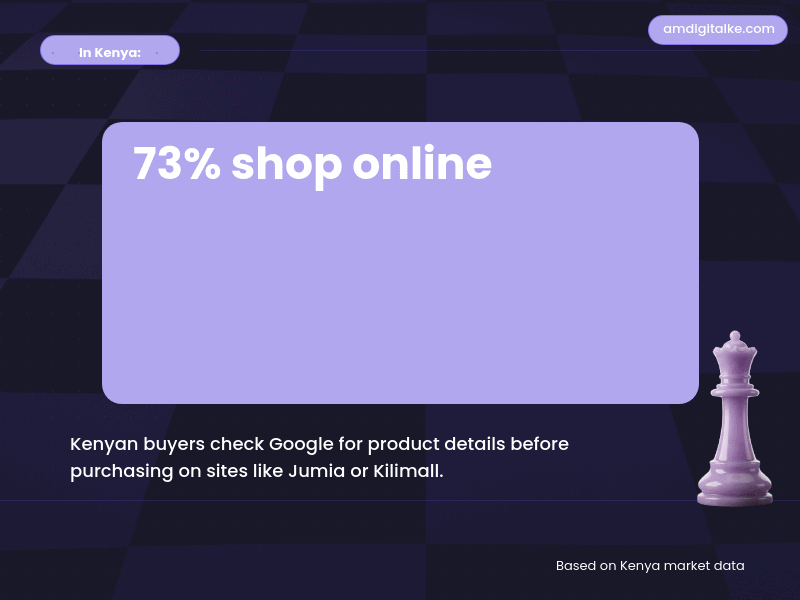
The opportunity is massive. Kenyan online shoppers research products on Google before buying.
If your product pages aren’t ranking, you’re invisible during the most critical part of the customer journey. That’s when they’re actively searching with intent to purchase.
The Product Page Optimisation Formula
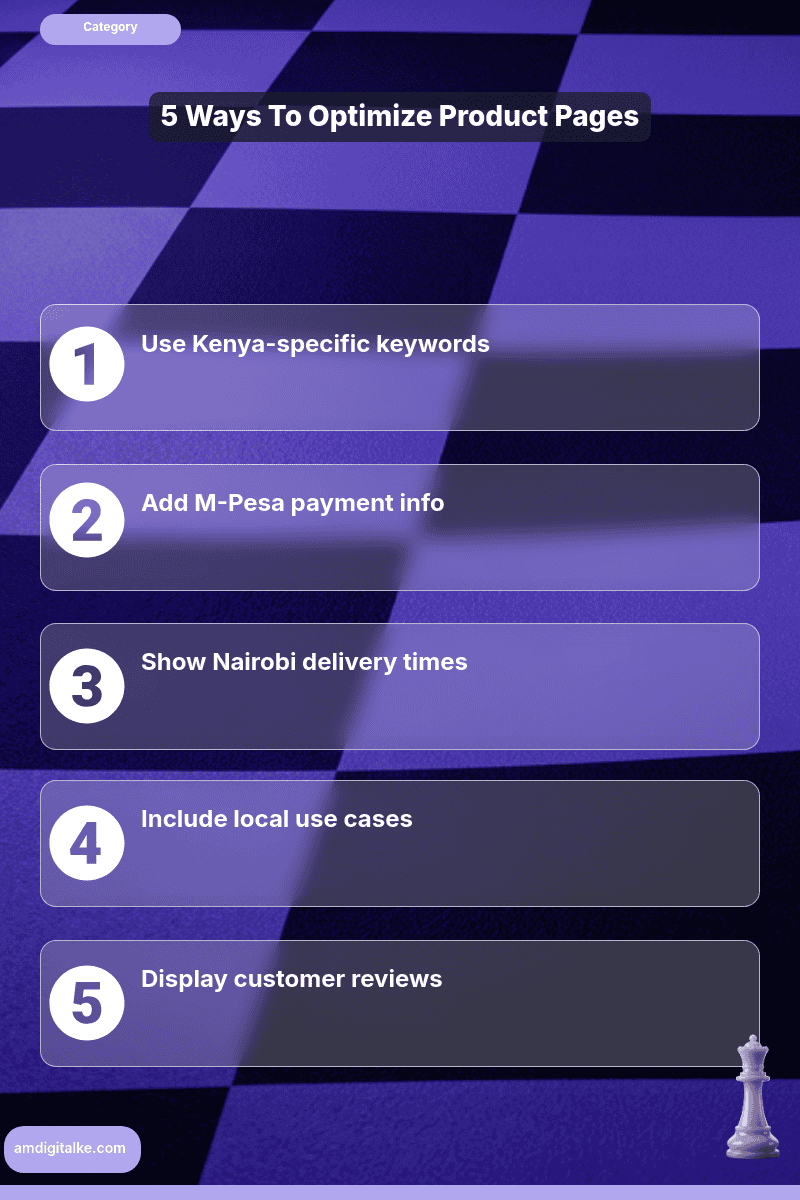
1. Write Unique, Detailed Product Descriptions
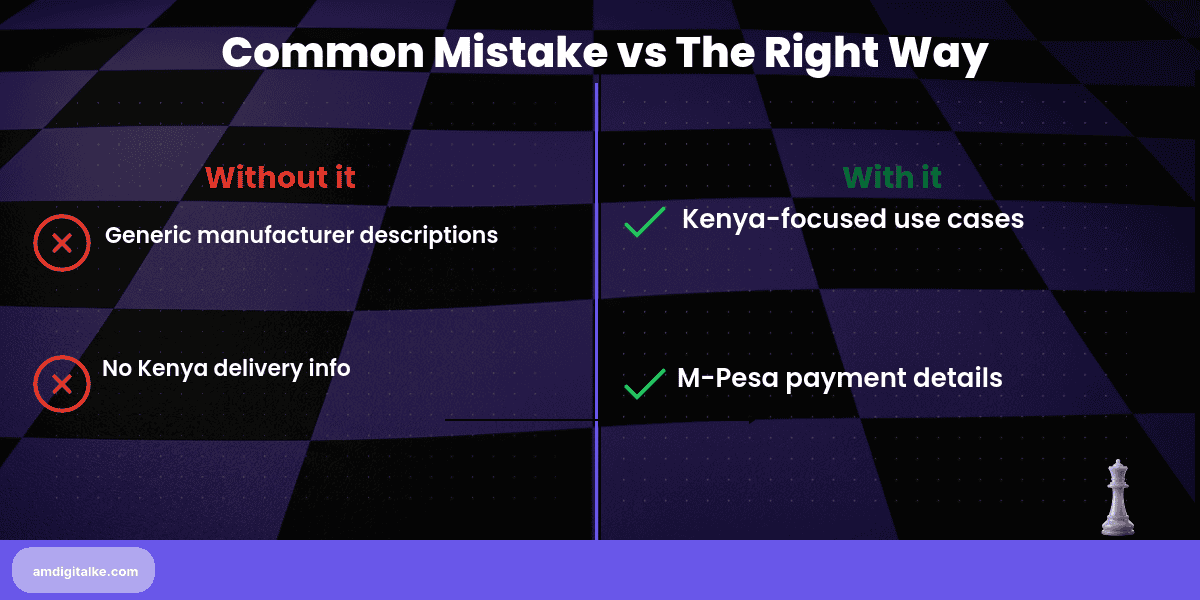
Stop copying manufacturer descriptions. Google sees duplicate content across hundreds of sites and ranks none of them well.
Your descriptions need to be original and comprehensive.
Structure your descriptions like this:
- Opening line: What problem does this product solve? “Struggling with Nairobi’s unpredictable power cuts? This 5000mAh power bank keeps your devices charged for 48 hours.”
- Features breakdown: List 5-7 key features with context. Don’t just say “Bluetooth 5.0” – explain “Bluetooth 5.0 connectivity means a stable connection up to 10 meters, even in crowded spaces.”
- Use cases: How do Kenyan customers actually use this? “Perfect for matatus, road trips to Mombasa, or backup during loadshedding.”
- Trust signals: Warranty info, certifications, and delivery details specific to Kenya
Aim for 300-500 words per product. Yes, it’s work.
But product pages with longer descriptions rank higher on Google.
2. Optimise Your Product Titles for Search
Your product title is prime SEO real estate. Use this formula:
[Brand] [Product Type] [Key Feature/Model] [Size/Colour] – [Location/Use Case]
Wrong: “Power Bank” Right: “Anker PowerCore 20000mAh Fast Charging Power Bank – Kenya Delivery”
Include your target keyword naturally. If Kenyans search “wireless earbuds Kenya,” make sure “wireless earbuds Kenya” appears in your title.
But keep it readable. Keyword stuffing kills conversions.
3. Create SEO-Friendly URLs
Wrong: yourstore.co.ke/product-12345 Right: yourstore.co.ke/anker-20000mah-power-bank-kenya
Clean, descriptive URLs rank better and build trust. Include your primary keyword in the URL slug.
4. Optimise Product Images for Speed and Search
Image optimisation matters twice as much in Kenya. Slow-loading images kill conversions on mobile data.
Unoptimised images hurt SEO.
Your image checklist:
- Compress images to under 100KB (use TinyPNG or ShortPixel)
- Use descriptive file names: “anker-power-bank-20000mah.jpg”, not “IMG_12345.jpg”
- Add alt text with keywords: “Anker PowerCore 20000mAh power bank with fast charging for Kenya”
- Include 5-8 images: product alone, lifestyle shots, size comparison, packaging
- Enable lazy loading so images below the fold load only when scrolled to
Why this matters: Based on AM Digital KE client data across Kenyan accounts, product pages with optimised images load faster and rank higher for image search.
Image search is a growing discovery channel for Kenyan shoppers.
5. Structure with Schema Markup
Schema markup is code that tells Google exactly what’s on your product page. It shows price, availability, ratings, and brand.
When you add schema, your products can show rich snippets in search results with star ratings, prices, and stock status.
Result? Higher click-through rates because shoppers see key info before clicking.
Most Kenyan eCommerce platforms (WooCommerce, Shopify) have plugins that add schema automatically. Enable it.
Test it using Google’s Rich Results Test tool.
6. Leverage Customer Reviews Strategically
Reviews are conversion gold AND SEO fuel. Google sees fresh user-generated content as a sign of an active, trustworthy page.
Your review strategy:
- Email customers 7 days after delivery, asking for reviews
- Incentivise with discount codes for the next purchase
- Respond to ALL reviews (good and bad) within 24 hours
- Include “reviewed by [X] Kenyan customers” in your descriptions
Target 10+ reviews per product for maximum trust and SEO impact. Products with reviews convert better than those without.
7. Build Internal Links Between Related Products
Internal linking distributes SEO authority across your site and helps Google understand your product relationships.
Do this:
- Add “Frequently Bought Together” sections
- Create “You Might Also Like” recommendations
- Link from blog posts to relevant products (e.g., blog about “Best Power Banks for Travel” links to your power bank products)
- Use descriptive anchor text: “Check out our best-selling 20000mAh power banks”, not “click here”
8. Optimise for Mobile-First Shopping
Kenyan eCommerce traffic is mobile. If your product pages aren’t mobile-optimised, you’re losing sales and rankings.
Mobile optimisation musts:
- Large, tappable “Add to Cart” buttons
- Easy zoom on product images (pinch-to-zoom)
- Streamlined checkout (M-PESA integration is non-negotiable)
- Fast load times under 3 seconds
- Readable text without zooming (16px minimum font size)
Test your product pages on a Safaricom connection, not your office WiFi. That’s the real experience.
A Nairobi electronics store rewrote 50 product descriptions with unique content, added schema markup, and optimised images. Within 4 months:
- Organic traffic increased 65% from product searches
- Average session duration up 40% (shoppers stayed longer and browsed more)
- Conversion rate improved from 1.2% to 2.8%
A fashion boutique in Mombasa added customer reviews, optimised product titles with location keywords, and compressed all images. Result?
Google Shopping traffic tripled, and they started ranking page 1 for “buy dresses online Kenya.”
Your Product Page SEO Checklist:
- ☐ Rewrite the top 20 product descriptions with unique 300+ word content (start with best sellers)
- ☐ Optimise product titles using the keyword + location formula
- ☐ Compress all product images to under 100KB and add descriptive alt text
- ☐ Enable schema markup and verify with Google’s Rich Results Test
- ☐ Set up automated review requests 7 days post-delivery
- ☐ Add internal links between related products (minimum 3 per product page)
- ☐ Test mobile experience on Safaricom 4G – aim for under 3-second load time
Pro Tip: Start with your top 10-20 revenue-generating products. Optimise these first, measure results for 60 days, then scale to your full catalogue.
Want product pages that rank AND convert? At AM Digital KE, we optimise eCommerce sites for Kenyan search behaviour and shopping patterns.
We handle technical setup to conversion rate optimisation. Our clients don’t just get traffic; they get buyers.
Explore our eCommerce SEO Services in Kenya and discover how we help online stores capture high-intent shoppers searching for products to buy.
Curious why your products aren’t showing up in searches? Get a free SEO analysis where we’ll evaluate your product descriptions, identify technical SEO issues affecting visibility, and show you quick wins to boost both rankings and conversions.
Have more SEO questions? Our SEO FAQs Kenya page answers the most common ones.
Frequently Asked Questions
How long should product descriptions be?
Aim for 300-500 words with Kenya-specific details on features, use cases, and delivery.
Why are my product pages not ranking?
Duplicate manufacturer descriptions and missing Kenya-focused keywords hurt ranking in Google Kenya.
What trust signals work for Kenyans?
Show warranty details, M-Pesa payment options, and same-day Nairobi delivery info.