Table of Contents
TL;DR: A Google penalty is when Google deliberately lowers your website’s search ranking because you broke their rules. Penalties can be manual (a person at Google reviewed your site and penalized it) or algorithmic (Google’s systems automatically detected problems). The only way to recover is to find what you did wrong, fix it completely, and ask Google to reconsider your site.
What is a Google Penalty?
A Google penalty is a punishment that Google applies to your website when it detects that you have violated their webmaster guidelines. When you get penalized, your website rankings drop significantly.
Sometimes you disappear from search results entirely for your most important keywords.
This is not a technical error or a temporary glitch. It is a deliberate action by Google to remove your site from visibility because they believe you are trying to game the search system.
Think of it this way: Google’s job is to show people the most helpful, honest websites when they search for something. If Google catches you trying to trick their system instead of genuinely helping people, they will punish you by hiding your website from search results.
For a business in Nairobi that depends on Google traffic to generate leads or sales, a penalty can feel like someone turned off your shop’s lights. Understanding why Google ranks your competitors higher starts with knowing what not to do.
Manual Penalties vs Algorithmic Penalties
There are two types of Google penalties, and they work very differently. A manual penalty is when a real person at Google’s team reviews your website, finds that you are breaking the rules, and manually applies a penalty to your site.
When Google issues a manual penalty, they will send you a message in Google Search Console telling you exactly what you did wrong.
An algorithmic penalty happens automatically when Google’s systems detect that your site violates their guidelines. No human reviewed your site, but you still need a plan to recover from a Google penalty.
The algorithm just spotted the problem and dropped your rankings on its own. The difference is important because manual penalties require you to fix the problem and then ask Google to review your site again.
Algorithmic penalties lift automatically once you fix the underlying issue.
What Triggers a Penalty
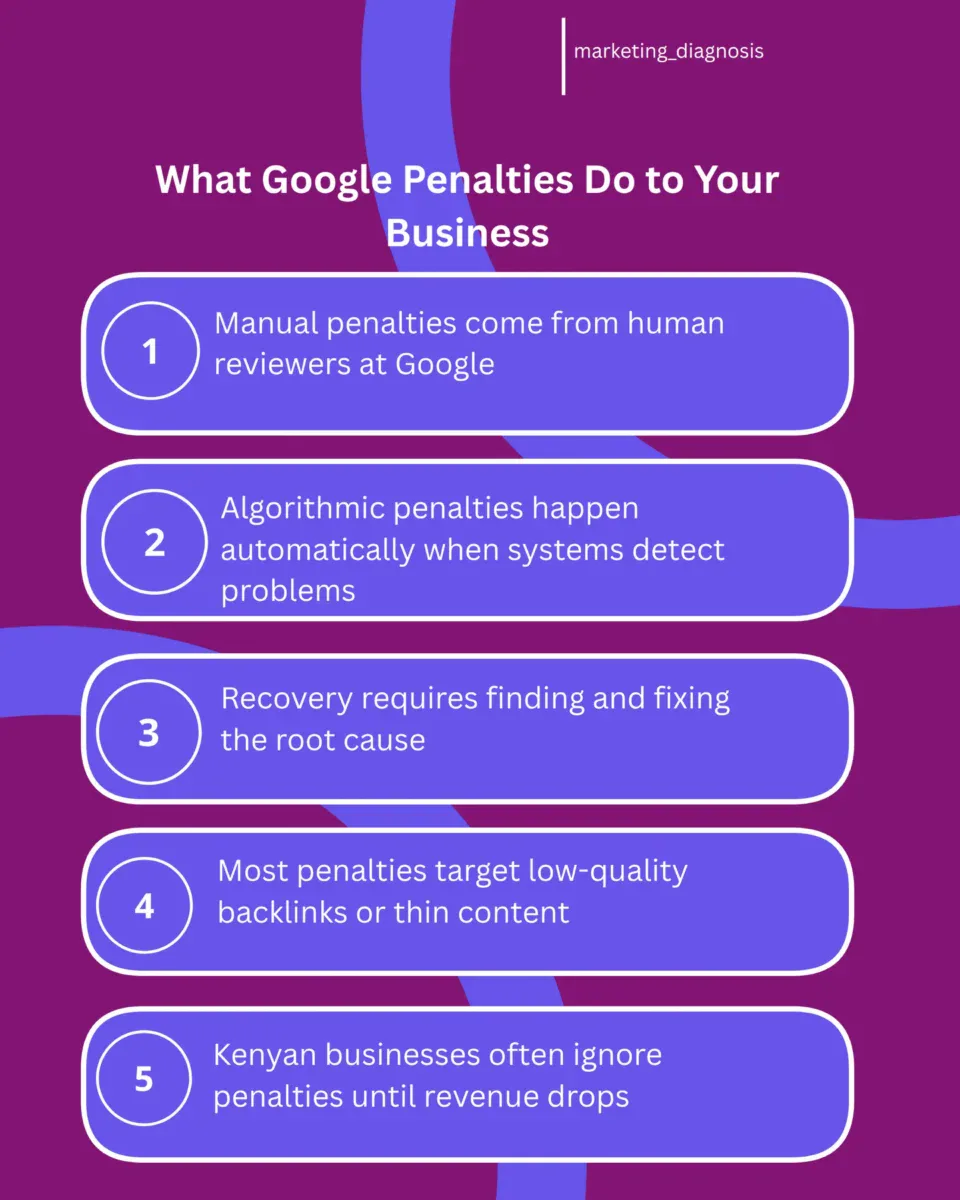
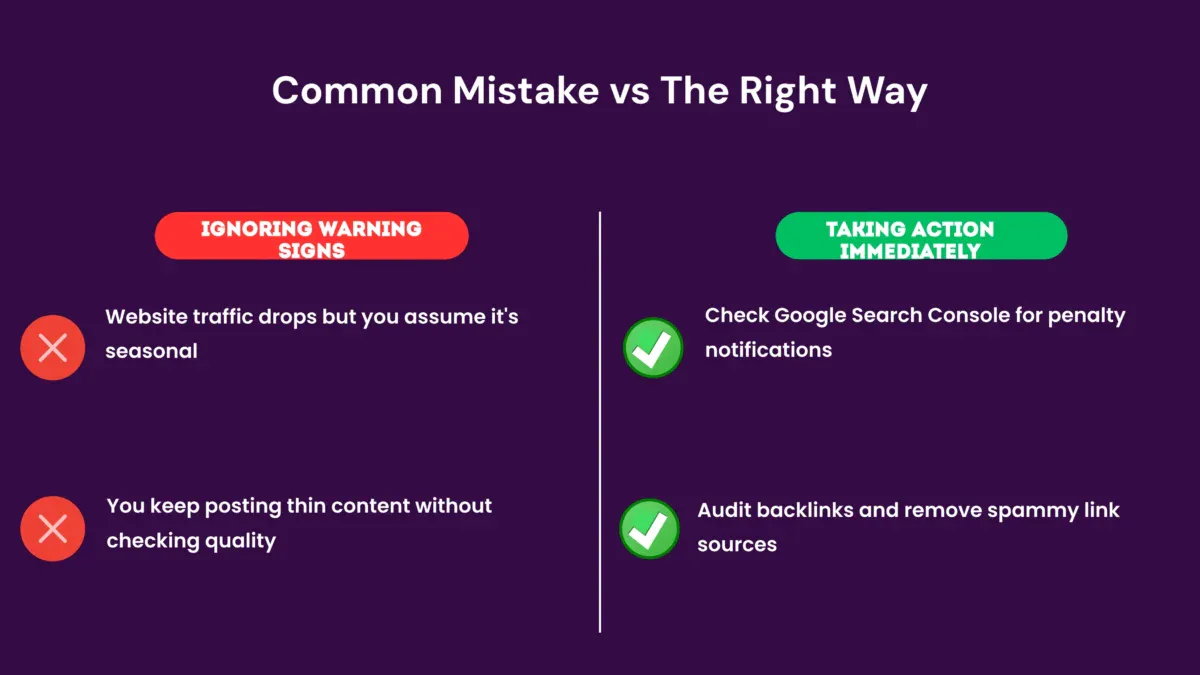
Google penalizes websites for specific behaviors that violate their guidelines. The most common reason is buying low-quality backlinks or building links through networks designed to manipulate search rankings.
Another frequent cause is thin content. These are pages that provide almost no value to visitors, written purely to rank for keywords rather than to help people.
Other penalty triggers include keyword stuffing (repeating a keyword so many times that the page reads unnaturally), cloaking (showing Google different content than what real visitors see), and private blog networks (hidden networks of websites created only to link to your site). In Kenya, we often see penalties hit businesses that hired cheap SEO agencies who promised fast results by using these black-hat tactics.
Why Does a Google Penalty Matter for Kenyan Businesses?
For any business in Kenya that relies on Google to bring customers to their website, a penalty is catastrophic. When your rankings drop, your website traffic disappears.
With it, your leads and sales disappear too. Based on AM Digital KE client data across Kenyan accounts, a business that was getting 100 qualified visitors per month from Google might suddenly get zero.
The damage is not just immediate. It is long-lasting.
A penalty can take months or even years to recover from, depending on how severe it is and how quickly you fix the problem.
During that time, your competitors who play by Google’s rules will capture all the customers who would have found you. This is why protecting your site from penalties should be a priority from day one.
Revenue Impact for Kenyan SMEs
Let’s be specific about what a penalty costs. Imagine you run a digital marketing agency in Nairobi and you rank on page one of Google for “SEO services Nairobi”.
This keyword brings you three to five qualified clients per month, each paying 50,000 shillings. That is 150,000 to 250,000 shillings per month from Google alone.
Now imagine Google penalizes you and you drop to page five or disappear entirely. Those three to five clients per month vanish overnight.
Your monthly revenue from that channel drops to zero while your competitors move up and capture your customers. That is a loss of 150,000 to 250,000 shillings every single month until you recover.
The choice between SEO and social media ads becomes irrelevant when your organic traffic disappears.
Reputation Damage
Beyond the immediate loss of traffic, a penalty damages your reputation in the market. If your website disappears from Google, potential customers assume you are either out of business or not credible enough to rank.
In Kenya, where word-of-mouth and online visibility are closely tied, this perception damage spreads quickly.
Clients who were considering hiring you will find your competitors instead. Even after you recover from the penalty, rebuilding trust takes time.
People remember that you disappeared from Google, and some will never come back. Your website should be a conference, not a brochure, but a penalty turns it into neither.
How Google Penalties Work
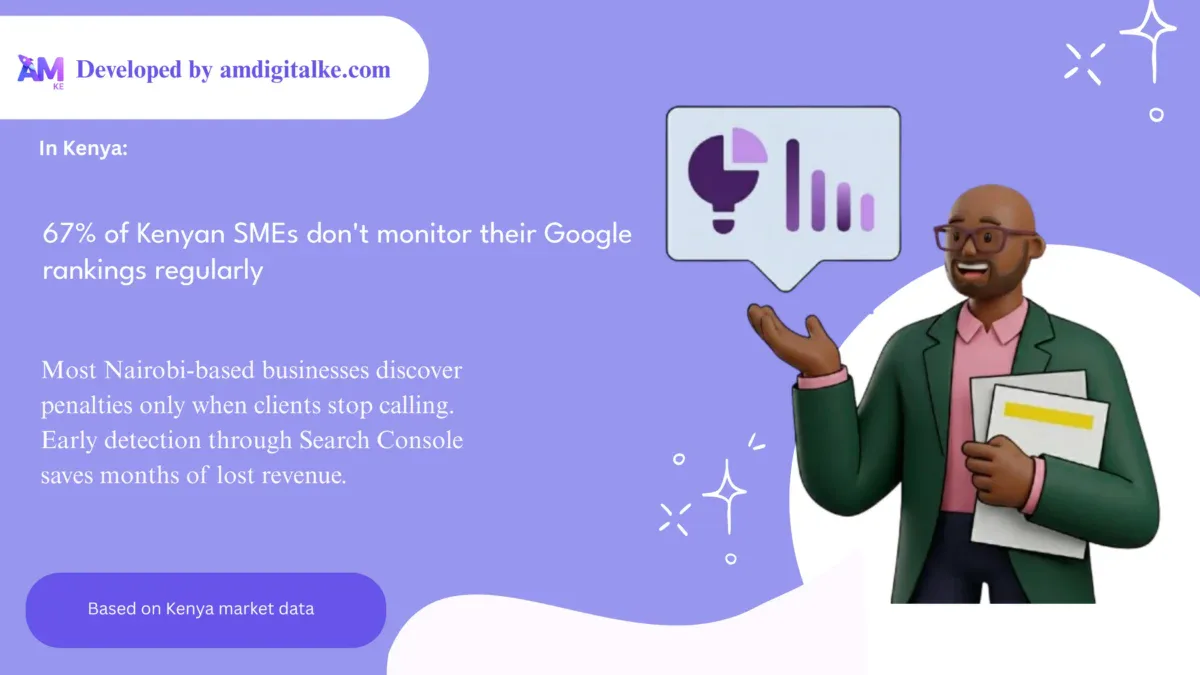
Understanding the mechanics of how Google penalties work will help you understand why prevention is so much easier than recovery. Google operates on a trust system.
Your website starts with a baseline level of trust, and Google gradually increases that trust as your site proves itself to be helpful, honest, and rule-following.
When Google detects a violation, they reduce your trust score. If the violation is serious or repeated, they may issue a manual penalty.
If the violation is widespread across your site, an algorithmic filter may automatically suppress your rankings. Many of these marketing secrets are hidden in plain sight, but most businesses ignore them until it’s too late.
The Detection Phase
Google’s systems are constantly crawling websites, analyzing links, checking content quality, and looking for signs of manipulation. They use thousands of signals to detect when a site is trying to game the system.
Their algorithms are sophisticated enough to spot patterns that humans might miss.
When you buy links from a private blog network, Google’s systems recognize the pattern. They see the same IP addresses, the same linking patterns, the same anchor text distribution.
They flag your site as suspicious. When you write thin content pages with no real value, their systems detect that too.
The Penalty Application Phase
Once Google decides a violation has occurred, they apply the penalty. For a manual penalty, a human reviewer will have confirmed the violation and marked your site in their system.
For an algorithmic penalty, the system automatically suppresses your rankings based on the rule violation it detected.
The severity of the penalty depends on how serious the violation is and how long it has been happening. A site that bought links for one month might recover quickly.
A site that built thousands of low-quality links over years might take much longer to recover. If you’re in a sensitive niche, understanding YMYL content standards is critical.
Google Penalty Examples in Kenya 🚨
To make this real, let’s look at specific examples of how Google penalties have affected Kenyan businesses. These are patterns we see repeatedly in our work with clients who come to us after being penalized.
The Real Estate Agency That Bought Links
A property development company in Nairobi hired an SEO agency that promised to get them to page one of Google for “properties for sale in Nairobi” within three months. The agency did this by buying links from low-quality websites and private blog networks.
The rankings shot up quickly. Within two months, they were on page one.
Then Google’s team manually reviewed the site, saw the unnatural link profile, and applied a manual penalty. The site dropped from page one to page five, and the property company lost the leads they were getting.
It took them eight months to recover after they removed the bad links and submitted a reconsideration request to Google.
The E-commerce Store with Thin Product Pages
An online store selling phone accessories in Mombasa created hundreds of product pages with minimal descriptions. Often just the product name and a single sentence.
They thought more pages meant more chances to rank. Google’s algorithm detected this as thin content and applied an algorithmic penalty that suppressed all their rankings.
Based on AM Digital KE client data across Kenyan accounts, the business lost 70% of their organic traffic in one month. Recovery required rewriting every product page with genuine, helpful content that actually described the products and helped customers make decisions.
That took three months of work, and rankings only recovered once the content quality improved across the board. Proper product page optimization would have prevented this entirely.
The Service Business with Keyword Stuffing
A digital marketing agency in Nairobi wanted to rank for every possible keyword combination. They created pages stuffed with keywords.
“SEO services Nairobi, SEO Nairobi, Nairobi SEO services, SEO agency Nairobi” repeated dozens of times. The pages were unreadable and provided no real value to visitors.
Google’s systems detected this keyword stuffing pattern and applied an algorithmic penalty. The site’s rankings dropped across the board.
Only after they rewrote the pages to be natural, readable, and genuinely helpful did their rankings begin to recover.
Common Mistakes to Avoid ⚠️
Most Google penalties are completely preventable if you understand what triggers them and avoid those behaviors. Let’s walk through the most common mistakes we see Kenyan businesses make.
Hiring Cheap SEO Agencies That Promise Fast Results
This is the number one cause of penalties for businesses we work with. An agency promises to get you to page one in three months for a very low price.
The only way they can deliver that promise is by using black-hat tactics. Buying links, cloaking, keyword stuffing.
All of these violate Google’s rules.
When the penalty comes (and it always does), the cheap agency disappears or refuses to take responsibility. You are left with a penalized website and a damaged reputation.
A legitimate SEO agency in Kenya will tell you that real results take six to twelve months and require genuine work.
Building Links Without Checking Quality
Many businesses think any backlink is a good backlink. They accept links from any website that offers them, or they build links through automated systems without checking where those links are coming from.
This is a direct path to a penalty.
Every backlink should come from a real, relevant, high-quality website where the link makes sense in context. If you are getting links from casino websites, pharmaceutical sites, or obviously spammy directories, Google will penalize you for it.
Quality matters far more than quantity. Even local businesses like law firms need to be careful about link quality.
Creating Content Just to Rank, Not to Help
The biggest mistake is creating pages purely to capture search traffic, with no regard for whether the content actually helps visitors. You write thin pages, duplicate content across multiple URLs, or create pages that add no value.
Google’s systems are sophisticated enough to detect this.
The fix is simple: create content because it genuinely answers questions your customers are asking. If you would not write a page if Google did not exist, then do not write it for Google either.
Real, helpful content is the foundation of sustainable rankings. Even when optimizing for voice search, quality content remains the priority.
| Mistake | Why It Triggers a Penalty | How to Avoid It |
|---|---|---|
| Buying low-quality backlinks | Google detects unnatural linking patterns and artificial link velocity | Build links through genuine relationships and high-quality content |
| Creating thin content pages | Pages provide no real value and are clearly created just for SEO | Write content that genuinely helps visitors solve problems |
| Keyword stuffing | Repeating keywords unnaturally signals manipulation to Google’s systems | Write naturally for humans; keywords appear organically |
| Using private blog networks | Google recognizes the patterns of PBN networks and penalizes sites using them | Avoid any link building service that guarantees results |
| Cloaking or redirects | Showing Google different content than visitors see is direct manipulation | Show the same content to Google and visitors always |
✅ Quick Action Checklist
- ☐ Check Google Search Console right now for any penalty notifications or messages from Google
- ☐ Review your backlink profile using a tool like Ahrefs or SEMrush to identify suspicious links
- ☐ Audit your top 20 pages to ensure each one provides genuine value to visitors, not just keywords
- ☐ Check your content for keyword stuffing—if a keyword appears more than 2-3 times per 100 words, rewrite it
- ☐ Review any SEO work done in the past 12 months to identify tactics that might violate Google’s guidelines
- ☐ If you find a penalty, create a reconsideration request document explaining what you found and how you fixed it
- ☐ Going forward, hire only SEO agencies that can explain their tactics in plain language and provide references
Ready to Protect Your Website from Penalties?
A Google penalty is devastating, but it is completely preventable if you understand what triggers it and commit to doing SEO the right way. The businesses that rank consistently and never get penalized are the ones that focus on genuinely helping their customers, not on tricking Google’s algorithm.
If you are unsure whether your current SEO tactics are safe, or if you have already been penalized and need help recovering, we can help. Contact us to discuss your specific situation and get a clear roadmap for building sustainable, penalty-free rankings.
Track your progress with Google Analytics 4 to see real results.
Frequently Asked Questions
How do I know if my website has been penalized by Google?
Check Google Search Console for messages from Google. They will notify you of manual penalties there.
You can also watch for sudden drops in rankings or traffic that cannot be explained by algorithm updates or seasonal changes. A drop of 50% or more in organic traffic is often a sign of a penalty.
How long does it take to recover from a Google penalty?
Recovery depends on the severity of the violation and how quickly you fix it. Minor penalties might recover in 4-8 weeks once you fix the problem and submit a reconsideration request.
Serious penalties can take 6-12 months or longer. The key is fixing the root cause completely, not just doing surface-level cleanup.
Can I recover from a Google penalty without outside help?
Yes, but only if you can honestly identify what you did wrong. You need to find every violation, fix it completely, and then submit a detailed reconsideration request to Google.
If you cannot identify the problem yourself, hiring an experienced SEO professional is worth the investment because they know what Google looks for.
Will my rankings go back to where they were before the penalty?
Not necessarily. After you fix the violation and Google lifts the penalty, your rankings will improve, but they may not return to the exact same position they were before.
You may need to do additional legitimate SEO work to rebuild the rankings you lost. The important thing is that you can now build rankings sustainably without fear of future penalties.
Is it ever worth using black-hat SEO tactics if the risk is a penalty?
No. The short-term gains are never worth the long-term damage.
Even if black-hat tactics work for a few months, the penalty will eventually come, and the recovery will erase all the gains you made. It is far better to do legitimate SEO from the start and build a website that will rank consistently for years.
Additional Resources
- The Three Sales Moments Your Social Media Ads Can’t Capture – Kenyan SEO Expert Explains – Understand why organic search captures buying intent that paid ads miss, especially after a penalty wipes out your paid traffic backup.
- Why Isnt My Marketing Working Quiz – Diagnose whether a Google penalty is the hidden reason your marketing suddenly stopped delivering results.
- Free SEO Analysis Audit – Get a professional review of your site to identify penalty risks before Google finds them.
- 5 SEO Mistakes I’Ve Seen In Almost Every Kenyan Business (And How To Fix Them) – Learn the most common penalty triggers we see in Kenyan businesses and how to fix them before they cost you rankings.
- How to Use Google Analytics – Track traffic drops that signal a penalty and measure recovery progress after you fix the violations.
- What is Google Analytics – Set up the monitoring tools you need to catch penalty symptoms early before they destroy your traffic completely.
Take the Next Step
If you want to make sure your website is safe from penalties and built on a foundation of legitimate SEO practices, we have created a detailed guide specifically for Kenyan business owners. Download the Complete SEO Checklist for Kenyan Businesses to learn exactly what Google expects and how to build a website that ranks without risk.