Table of Contents
- 📋 Key Takeaways
- What is Conversion Rate Optimization?
- Why Does Conversion Rate Optimization Matter for Kenyan Businesses?
- How Conversion Rate Optimization Works 🔄
- Conversion Rate Optimization Examples in Kenya 🇰🇪
- Common Mistakes to Avoid ⚠️
- Quick CRO Improvements You Can Make This Week
- ✅ Quick Action Checklist
- Ready to Improve Your Conversion Rate?
- Frequently Asked Questions
- Additional Resources
- Take the Next Step
TL;DR: Conversion Rate Optimization (CRO) is the practice of testing and improving your website to turn more visitors into customers without buying more traffic. For Kenyan SMEs, this means fixing broken checkout processes, unclear messaging, and poor mobile experience that cost you sales every single day. The math is simple: if you get 1,000 visitors monthly and 1% convert, that’s 10 customers; if you improve to 2%, you’ve doubled revenue with zero extra marketing spend.
📋 Key Takeaways
- ☐ CRO is about maximizing revenue from traffic you already have, not buying more visitors
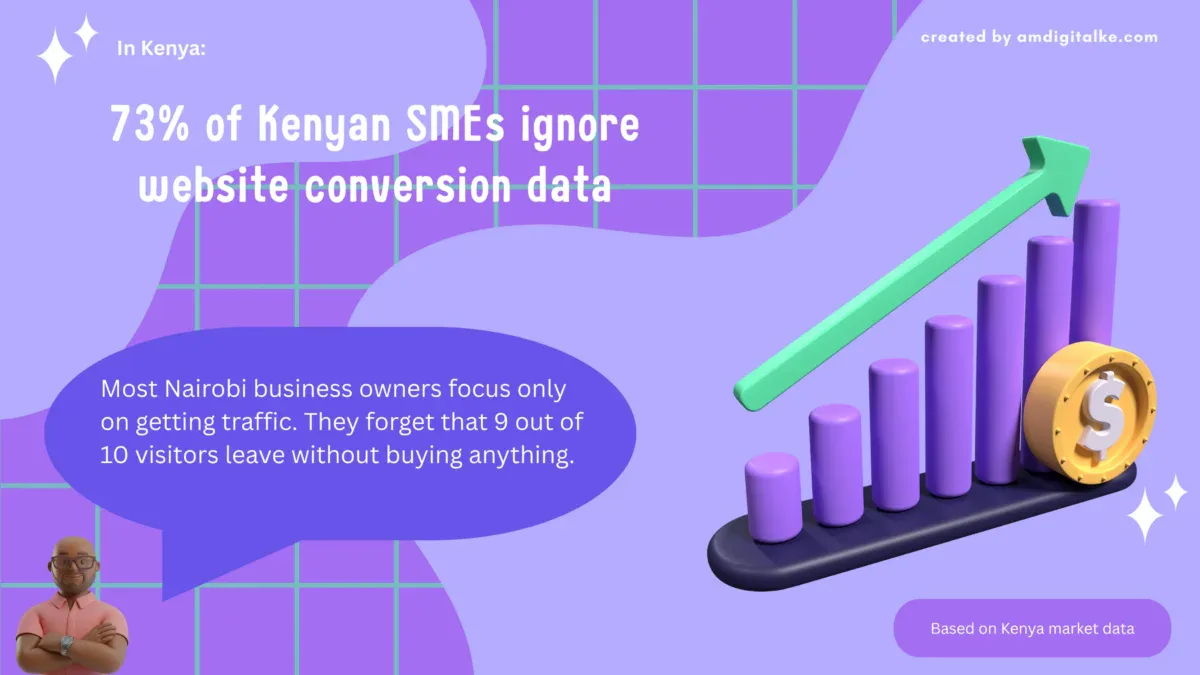
- ☐ Most Kenyan websites leave 90% of potential customers on the table through poor design and messaging
- ☐ Testing is the foundation: you measure, hypothesize, test, and learn from real visitor behavior
- ☐ Mobile optimization is non-negotiable in Kenya where 85% of internet users are mobile-only
- ☐ Small improvements compound: a 0.5% conversion increase on 5,000 monthly visitors adds 25 extra customers per month
What is Conversion Rate Optimization?
Conversion Rate Optimization, or CRO, is the systematic process of improving your website to increase the percentage of visitors who take a desired action.
That action might be buying a product, filling out a contact form, downloading a resource, or signing up for your email list.
Think of it this way: your website is like a physical shop in Nairobi’s Westlands or Mombasa’s Old Town.
If 100 people walk in every day but only 5 buy something, you have a conversion rate of 5%.
CRO is about studying why those 95 people leave without buying, then fixing those problems so more people convert.
The beauty is that you don’t need more foot traffic to make more sales.
You just need to be smarter about the traffic you already have.
Conversion Rate vs Traffic: Which Matters More?
Most Kenyan business owners obsess over getting more website visitors.
They spend money on Google Ads, social media marketing, or hiring SEO agencies to rank higher.
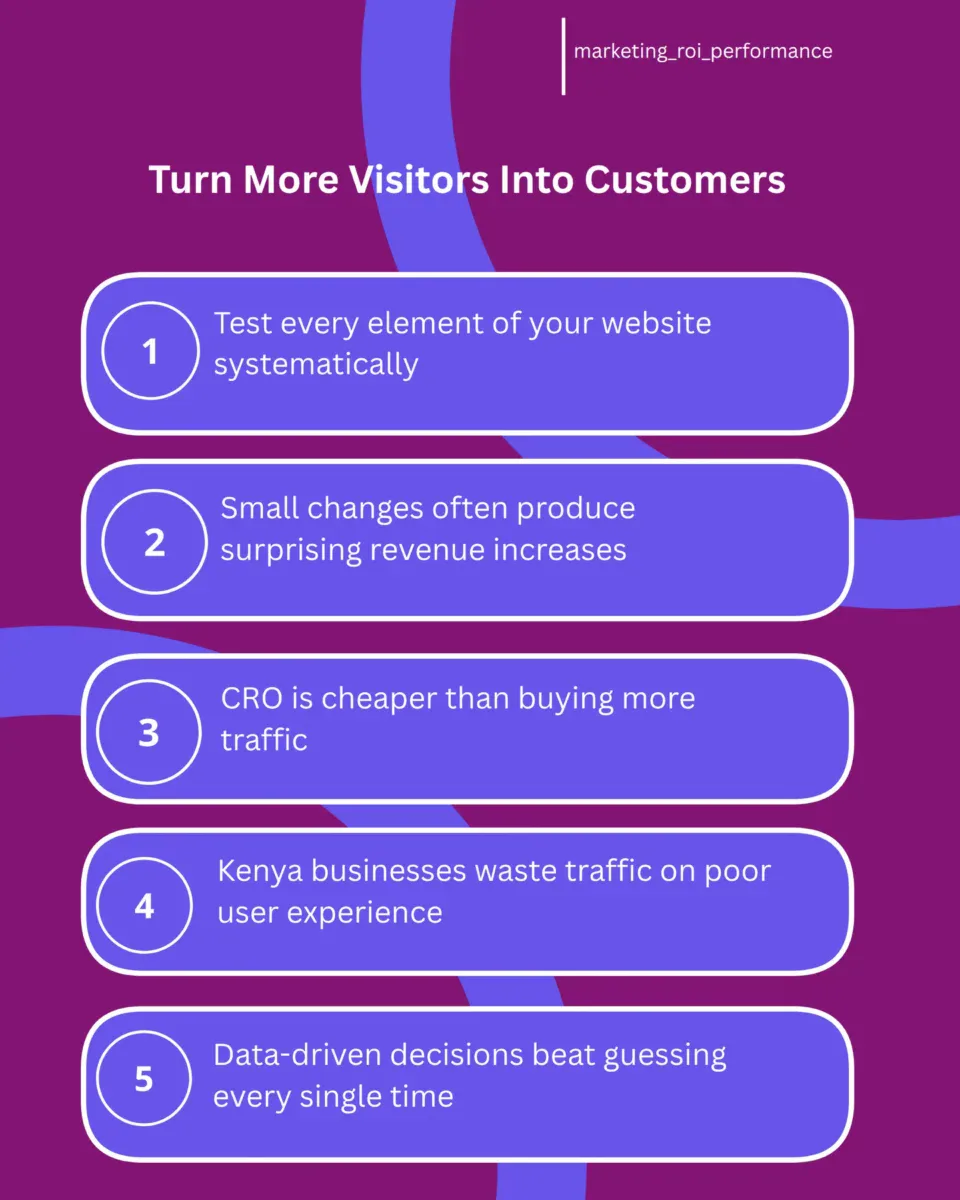
But here’s the uncomfortable truth: if your website converts at 0.5% and you double your traffic, you’ve only doubled your customers.
If you double your conversion rate from 0.5% to 1%, you’ve achieved the same result without spending extra on marketing.
CRO is often cheaper and faster than buying more traffic because you’re working with the audience you’ve already attracted.
A Nairobi e-commerce business with 10,000 monthly visitors converting at 1% makes 100 sales.
If they improve conversion to 2%, they’re now making 200 sales from the same 10,000 visitors.
That’s an extra 100 customers without buying a single extra ad.
The Math Behind Conversion Rate Optimization
Conversion rate is calculated as a simple percentage: (Number of Conversions / Total Visitors) × 100.
If your website gets 5,000 visitors in a month and 50 of them buy something, your conversion rate is 1%.
The reason this matters for revenue is exponential.
A SaaS company in Nairobi with 20,000 monthly visitors at a 2% conversion rate gets 400 new customers.
If they improve to 3%, they now get 600 customers from the same traffic.
That’s 200 extra customers, or potentially 200,000 KES in extra revenue if each customer pays 1,000 KES monthly.
This is why CRO teams exist at big tech companies: small percentage improvements create massive revenue gains at scale.
For Kenyan SMEs, the gains are equally real, just starting from smaller numbers.
Why Does Conversion Rate Optimization Matter for Kenyan Businesses?
Kenya’s digital economy is growing fast, but most local businesses are still learning how to sell online effectively.
The opportunity is enormous, but so is the waste.
Based on AM Digital KE client data across Kenyan accounts, a typical e-commerce site or service business leaves 95% of its potential revenue on the table because visitors have a poor experience.
You’re Already Paying for Traffic You’re Not Converting
If you’re running Google Ads or Facebook ads in Kenya, you’re paying per click.
A Nairobi digital marketing agency might spend 50,000 KES monthly on ads and get 2,000 clicks.
If only 10 of those clicks convert to customers, you’re paying 5,000 KES per customer.
But if you optimize your website first and improve conversion to 30 clicks, you’re now paying 1,667 KES per customer.
That’s a 66% reduction in customer acquisition cost, and you didn’t change your ad spend at all.
You just made your website work harder.
Mobile-First Kenya Demands Mobile-First Optimization
In Kenya, most internet users access the web exclusively or primarily through mobile phones.
Yet most Kenyan business websites are designed for desktop first, then squeezed onto mobile as an afterthought.
This is a conversion killer.
A slow mobile checkout, tiny buttons, or confusing navigation on a phone means customers abandon their purchase mid-way.
CRO for Kenyan businesses means testing your website on actual phones that Kenyans use: iPhone 11s, Samsung A-series phones, and budget Android devices.
If your site doesn’t work smoothly on a 6-year-old Android phone on 3G, you’re losing sales.
Competition is Increasing, Margins are Tight
The Kenyan e-commerce and service space is getting crowded.
Ten years ago, having a website was a competitive advantage.
Today, every business has one.
The differentiation is now in the user experience and how well you convert visitors into customers.
A Mombasa hotel that converts 3% of website visitors to bookings will outcompete a hotel with a better location that only converts 1%.
CRO is now table stakes for survival.
You Can’t Always Afford More Marketing Spend
A Nairobi startup with limited budget can’t compete with established brands on ad spend.
But they can absolutely compete on website quality and conversion efficiency.
It costs far less than hiring more salespeople or buying more ads, yet it produces measurable revenue gains.
For a 5-person Kenyan business, improving conversion rate by 1% might add 500,000 KES in annual revenue.
That’s real money that translates to hiring another team member or investing in inventory.
How Conversion Rate Optimization Works 🔄
CRO follows a scientific process: you observe user behavior, form a hypothesis about what’s preventing conversion, test a change, measure the results, and implement winners.
This cycle repeats continuously.
It’s not about guessing or copying what another business does.
It’s about understanding your specific visitors and what stops them from converting.
The Testing Framework: Observe, Hypothesize, Test, Learn
First, you observe.
This means looking at actual user behavior on your website using tools that track where people click, how far they scroll, and where they drop off.
A Nairobi online fashion store might discover that 60% of visitors click on the “Shop” button but then leave within 10 seconds.
This tells you the category page isn’t matching what visitors expected.
Next, you hypothesize.
You form a testable prediction: “If we improve the category page layout and add clearer product filters, more people will stay and browse.”
Then you test.
You change the category page for half your traffic and leave the original for the other half.
You measure conversion rate on both versions.
Finally, you learn.
If the new version converts better, you roll it out to everyone.
If not, you try something different.
Common Testing Methods: A/B Tests and Multivariate Tests
An A/B test compares two versions of a page: the original (A) and a modified version (B).
You split your traffic 50/50 and measure which version converts better.
A multivariate test changes multiple elements at once: button color, headline text, and form fields.
This is faster but more complex to analyze.
For most Kenyan SMEs, A/B testing is the right starting point because it’s simple to understand and implement.
Test one change at a time, measure the impact, and move forward.
Key Elements You Test in CRO
Headlines are the first thing visitors read.
A vague headline like “Welcome to Our Site” converts worse than a specific one like “Get Your Nairobi Business Listed in 5 Minutes.”
Call-to-action buttons matter enormously.
The color, size, text, and placement all affect whether people click.
A Mombasa travel agency might test “Book Now” versus “Check Availability” and find one converts 40% better.
Form fields are conversion killers if poorly designed.
Asking for 20 pieces of information before letting someone sign up will destroy your conversion rate.
Testing a shorter form with fewer fields often wins.
Page speed is critical in Kenya where many users are on slower mobile networks.
Based on AM Digital KE client data across Kenyan accounts, a 3-second page load versus a 1-second load can reduce conversion by 50% or more.
Trust signals like customer testimonials, security badges, and guarantees reduce buyer hesitation.
Testing their placement and wording can meaningfully improve conversion.
Conversion Rate Optimization Examples in Kenya 🇰🇪
Understanding CRO in theory is one thing.
Seeing it work in real Kenyan businesses makes it concrete.
Example 1: A Nairobi E-Commerce Store Improves Checkout
A Nairobi online electronics retailer was getting 8,000 monthly visitors but only 60 were completing purchases, a 0.75% conversion rate.
They suspected the checkout process was the problem.
They tested a simplified checkout that removed the “Create an Account” requirement and allowed guest checkout.
Visitors could now buy in three steps instead of five.
The result: conversion rate jumped to 1.2%, adding 36 extra sales per month.
At an average order value of 15,000 KES, that’s an extra 540,000 KES monthly with zero additional marketing spend.
Example 2: A Mombasa Service Business Clarifies Its Value Proposition
A Mombasa digital marketing agency’s website had a generic headline: “Digital Marketing Services for Your Business.”
Visitors had no idea what they actually did or why they should care.
They tested a new headline: “Get Your Mombasa Business 50 More Website Leads Per Month.”
This was specific, outcome-focused, and relevant to their target customer.
Conversion rate on the contact form improved from 2.1% to 3.8%.
Over a year, this translated to 20 extra qualified leads, with several converting to clients worth 200,000 KES each.
Example 3: A Nairobi SaaS Company Optimizes Mobile Experience
A Nairobi accounting software company noticed 65% of their traffic came from mobile, but the mobile conversion rate was half the desktop rate.
They tested a mobile-specific design with larger buttons, simpler navigation, and faster loading.
Mobile conversion improved by 40%.
Since mobile traffic was their largest segment, overall conversion rate climbed from 2.1% to 2.6%, translating to 15 extra trial signups per month.
Example 4: A Kisumu Online Course Creator Reduces Form Friction
An online course creator in Kisumu was asking for 8 form fields before allowing people to download a free guide.
Only 3% of visitors completed the form.
They tested a two-field form: just email and first name.
Completion rate jumped to 12%.
This meant 3x more leads entering their email list.
Within six months, they’d converted enough of these leads to online courses to generate an extra 2 million KES in revenue.
Common Mistakes to Avoid ⚠️
Many Kenyan businesses understand CRO in theory but make practical mistakes that waste time and money.
Knowing these pitfalls helps you avoid them.
Mistake 1: Testing Without a Baseline Measurement
You can’t improve what you don’t measure.
Many Kenyan business owners change their website and guess whether it helped.
Before you test anything, establish your baseline conversion rate.
Know exactly how many visitors you get and how many convert.
Without this number, you can’t tell if your changes actually worked or if you just got lucky with traffic that month.
Use Google Analytics to track this, and check it weekly.
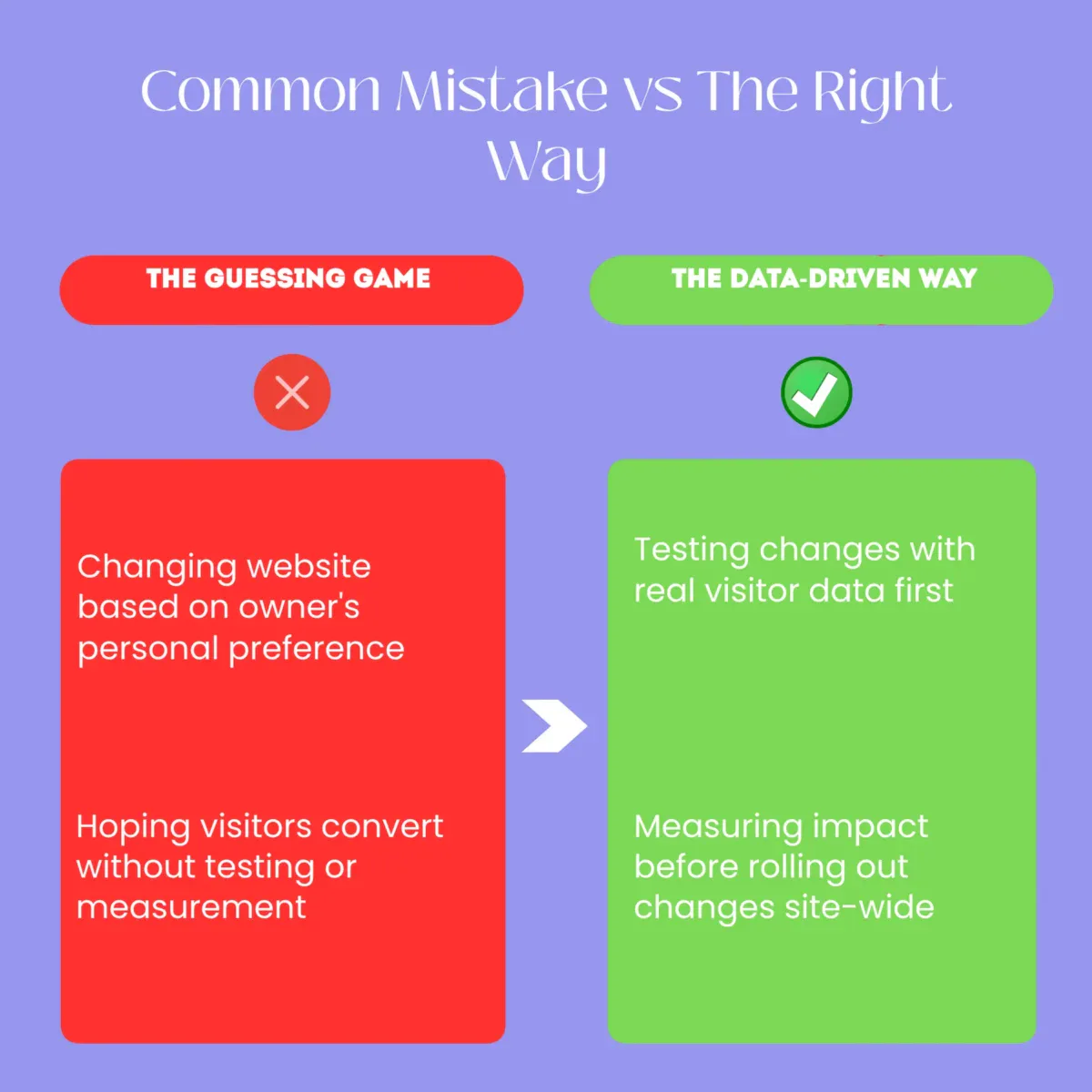
Mistake 2: Making Changes Based on Personal Preference, Not Data
A business owner likes blue buttons, so they change the red button to blue.
But they never tested whether blue actually converts better.
This is guessing, not optimization.
Always test changes with real visitor data before implementing them site-wide.
Your personal preference doesn’t matter.
What matters is what your actual customers respond to.
Mistake 3: Stopping Tests Too Early
You run a test for three days, see a small improvement, and declare victory.
But three days might not be enough traffic to be statistically significant.
A Nairobi business with 100 daily visitors needs at least 2-4 weeks of testing to get reliable results.
Run tests long enough to collect meaningful data.
Mistake 4: Ignoring Mobile Even Though Most Traffic is Mobile
A business owner checks their website on a desktop and it looks great.
But 80% of their visitors use mobile phones.
If the mobile experience is poor, you’re optimizing for 20% of your traffic while ignoring 80%.
In Kenya, mobile-first is not optional.
It’s mandatory.
Mistake 5: Changing Too Many Things at Once
You redesign your entire homepage: new colors, new layout, new copy, new images.
Conversion goes up.
But which change actually caused the improvement?
You can’t tell, so you can’t repeat it.
Always test one change at a time so you know exactly what works.
Quick CRO Improvements You Can Make This Week
| Element | Current Problem | Quick Fix | Expected Impact |
|---|---|---|---|
| Headline | Generic or vague | Make it specific and benefit-focused | 5-15% conversion lift |
| CTA Button | Weak text like “Submit” | Action-oriented text like “Get Started” | 3-10% conversion lift |
| Form Fields | Too many required fields | Remove non-essential fields | 10-25% completion lift |
| Page Speed | Loads in 4+ seconds | Compress images and enable caching | 5-20% conversion lift |
| Trust Signals | No testimonials or guarantees | Add customer reviews and guarantees | 5-15% conversion lift |
✅ Quick Action Checklist
- ☐ Install Google Analytics and measure your current conversion rate this week
- ☐ Identify where visitors drop off most (use heatmaps like Hotjar for free)
- ☐ Test your website on a real mobile phone to experience it as your customers do
- ☐ Rewrite your homepage headline to be specific and benefit-focused, not generic
- ☐ Reduce your contact form to the minimum fields needed (email, name, message)
- ☐ Add at least one customer testimonial or success story to your homepage
- ☐ Test your page load speed using Google PageSpeed Insights and optimize if it’s over 3 seconds
- ☐ Plan your first A/B test: pick one element, create two versions, and run it for two weeks
Ready to Improve Your Conversion Rate?
Conversion Rate Optimization is not a one-time project.
It’s an ongoing process of testing, learning, and improving.
Every percentage point improvement in conversion rate compounds into real revenue growth for your business.
The good news is that you don’t need a massive budget or technical skills to get started.
You need curiosity, patience, and a commitment to measuring what actually works.
Start this week by measuring your baseline conversion rate and identifying one element to test.
Small improvements compound into big results.
Frequently Asked Questions
What is a good conversion rate for a Kenyan business?
It depends on your industry.
Based on AM Digital KE client data across Kenyan accounts, e-commerce sites typically convert at 1-3%, service businesses at 2-5%, and SaaS at 2-10%.
Don’t compare yourself to other businesses.
Focus on improving your own baseline by 20-30% over six months.
How long does it take to see results from CRO?
You can see directional results in 2-4 weeks if you have decent traffic.
Significant, statistically reliable improvements usually take 2-3 months of continuous testing.
Patience is essential because you need enough data to make confident decisions.
Do I need expensive tools to do CRO?
No.
Google Analytics (free), Hotjar (free tier), and Google Optimize (free) are enough to get started.
As you scale, paid tools like Optimizely or VWO add power, but they’re not necessary for SMEs learning CRO basics.
What if my website traffic is too low to test?
If you have fewer than 100 visitors daily, focus on qualitative feedback first: call customers, send surveys, and observe user behavior manually.
Run longer tests (3-4 weeks) and make bigger changes.
Once traffic grows, move to A/B testing.
Can CRO work for service businesses or only e-commerce?
CRO works for any business with a website.
For service businesses, conversions might be contact form submissions or phone calls instead of purchases.
The testing principles are identical regardless of industry.
Additional Resources
- How Long Does SEO Take In Kenya? An Honest Answer From Someone Who’S Done It – Understand realistic timelines for SEO improvements so you can balance CRO efforts with long-term organic growth strategies.
- Social Media Content That Drives Website Traffic in Kenya – Learn how to drive quality traffic from social platforms so your CRO improvements convert more of those visitors into customers.
- Service Page Copy – Selling Without Being Salesy – Master the messaging techniques that convert service page visitors without aggressive sales tactics that hurt conversion rates.
- Service Area Business SEO – Ranking Without a Physical Location – Optimize for local search visibility so you attract the right traffic that’s more likely to convert into paying customers.
- PR-Driven Link Building: Media Coverage as SEO Strategy – Build trust signals through media coverage that improve both your search rankings and on-site conversion rates.
- Optimising for Voice Search: ‘Hey Google Find Me…’ – Capture voice search traffic with high commercial intent so you’re converting visitors who are ready to take action.
Take the Next Step
You now understand the fundamentals of CRO and how it directly impacts your revenue.
The next step is to implement what you’ve learned with a structured approach and real data.
We’ve created a free resource to help you audit your website and identify your biggest conversion opportunities.
Download the CRO Quick Audit Checklist for Kenyan Businesses and start identifying what’s costing you sales right now.