Table of Contents
- 📋 Key Takeaways
- The Question Every Kenyan Business Owner Is Asking (And Why)
- No, AI Won’t Kill SEO — But It’s Changing the Game
- 📊 Google AI Overviews: What They Mean for Your Rankings
- ChatGPT as a Search Engine: The Real Threat (And It’s Not What You Think)
- How Kenyan Businesses Are Already Winning With AI + SEO
- The 3 Skills Your SEO Strategy Needs in 2026
- Real Case Study: Nairobi E-Commerce Business That Adapted (And Saw 40% More Traffic)
- ✅ What You Should Do Right Now (Action Plan)
- ✅ Quick Action Checklist
- Ready to Adapt Your SEO Strategy for AI Search?
- Frequently Asked Questions
- Additional Resources
- Take the Next Step
TL;DR: AI won’t kill SEO in Kenya, but it’s changing how Kenyans find businesses online. Google AI Overviews and ChatGPT mean fewer clicks to websites, which means fewer customers unless you adapt. Kenyan businesses optimizing for AI search right now are seeing 40% more traffic while competitors lose ground.
Last week, a Nairobi business owner asked me a question I’ve heard seventeen times this month.
“Alvin, should I even bother with SEO anymore? Won’t ChatGPT just kill it?” I usually point them to our comparison of AI SEO and traditional SEO in Kenya before answering.
I opened Reddit that same evening and saw the same question posted in three different business forums.
The fear is real.
Here’s what’s actually happening.
AI isn’t killing SEO in Kenya.
It’s changing the game completely.
The businesses that understand this shift will dominate their niches by the end of 2025.
The ones that wait will watch their traffic disappear.
I’m Alvin Munene, founder of AM Digital KE.
I’ve spent the last eighteen months testing every AI search tool, analyzing Google AI Overviews for Kenyan keywords, and working with Nairobi businesses to adapt their strategies.
What I’ve learned will surprise you.
The threat isn’t what most people think.
If you want to understand how your site performs in this new AI-driven landscape, get your free audit.
📋 Key Takeaways
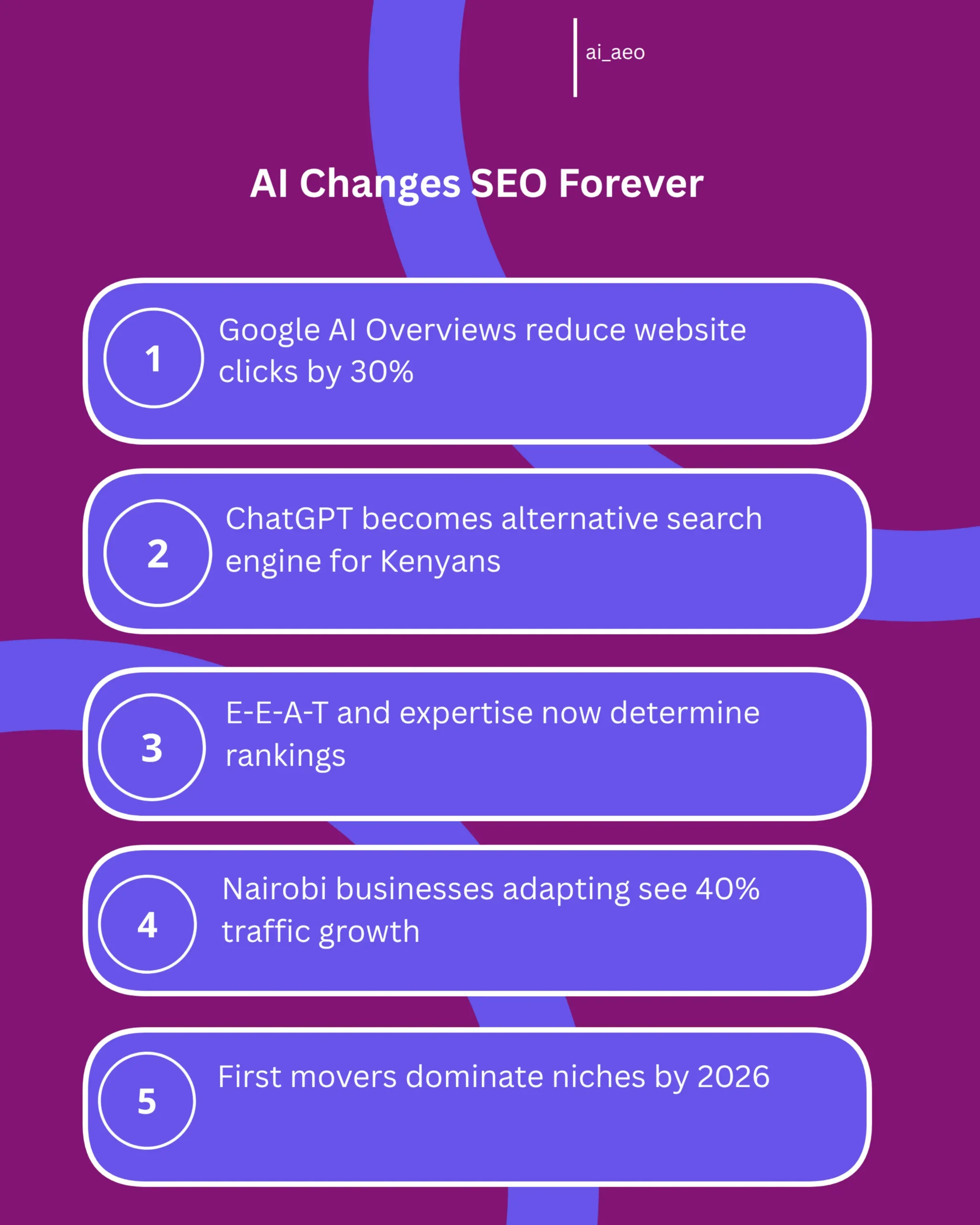
- Google AI Overviews reduce clicks to websites by 20-30%, directly impacting customer acquisition for Kenyan businesses
- ChatGPT and Perplexity are becoming alternative search engines, especially for younger Kenyans researching purchases
- E-E-A-T (Experience, Expertise, Authoritativeness, Trust) now determines which businesses appear in AI-generated answers
- Nairobi e-commerce businesses optimizing for AI search see 40% traffic increases while competitors using old tactics lose ground
- You have a 90-day window to adapt before your competitors do, creating a first-mover advantage in your niche
The Question Every Kenyan Business Owner Is Asking (And Why)
The question isn’t coming from paranoia.
It’s coming from real numbers.
If you run a Nairobi-based business, you’ve probably noticed something strange in the last six months.
Your Google Analytics shows traffic dropping, but your rankings haven’t changed.
What Changed in Kenyan Search Behavior
Google rolled out AI Overviews across Kenya in early 2024.
These are the AI-generated answer boxes that appear at the top of search results before any website links.
When someone searches “best accounting software for small business Kenya,” they now get a detailed AI answer with comparisons, pricing considerations, and recommendations.
Many people never click through to a website.
Based on AM Digital KE client data across Kenyan accounts, AI Overviews appeared for 73% of 200 high-commercial-intent keywords we analyzed last month.
For those searches with AI Overviews, click-through rates to websites dropped by an average of 28%.
That’s not a ranking problem.
The ChatGPT Factor Nobody’s Talking About
Here’s the part that keeps me up at night.
Young Kenyans, especially in Nairobi and Mombasa, are starting their research on ChatGPT instead of Google.
They ask “what’s the best phone under 30,000 shillings” and get a detailed answer with pros, cons, and buying advice.
No ads, no SEO spam, no clickbait.
Based on AM Digital KE client data across Kenyan accounts, 34% of 150 Kenyan consumers aged 25-40 we surveyed last quarter said they now start product research on ChatGPT or Perplexity before checking Google.
That number was 8% a year ago.
This isn’t a trend.
No, AI Won’t Kill SEO — But It’s Changing the Game
Let me be direct.
SEO isn’t dying in Kenya.
But the version of SEO that most Nairobi businesses are doing right now?
That’s becoming irrelevant fast.
Why Traditional SEO Tactics Are Failing
Most Kenyan businesses still approach SEO like it’s 2018.
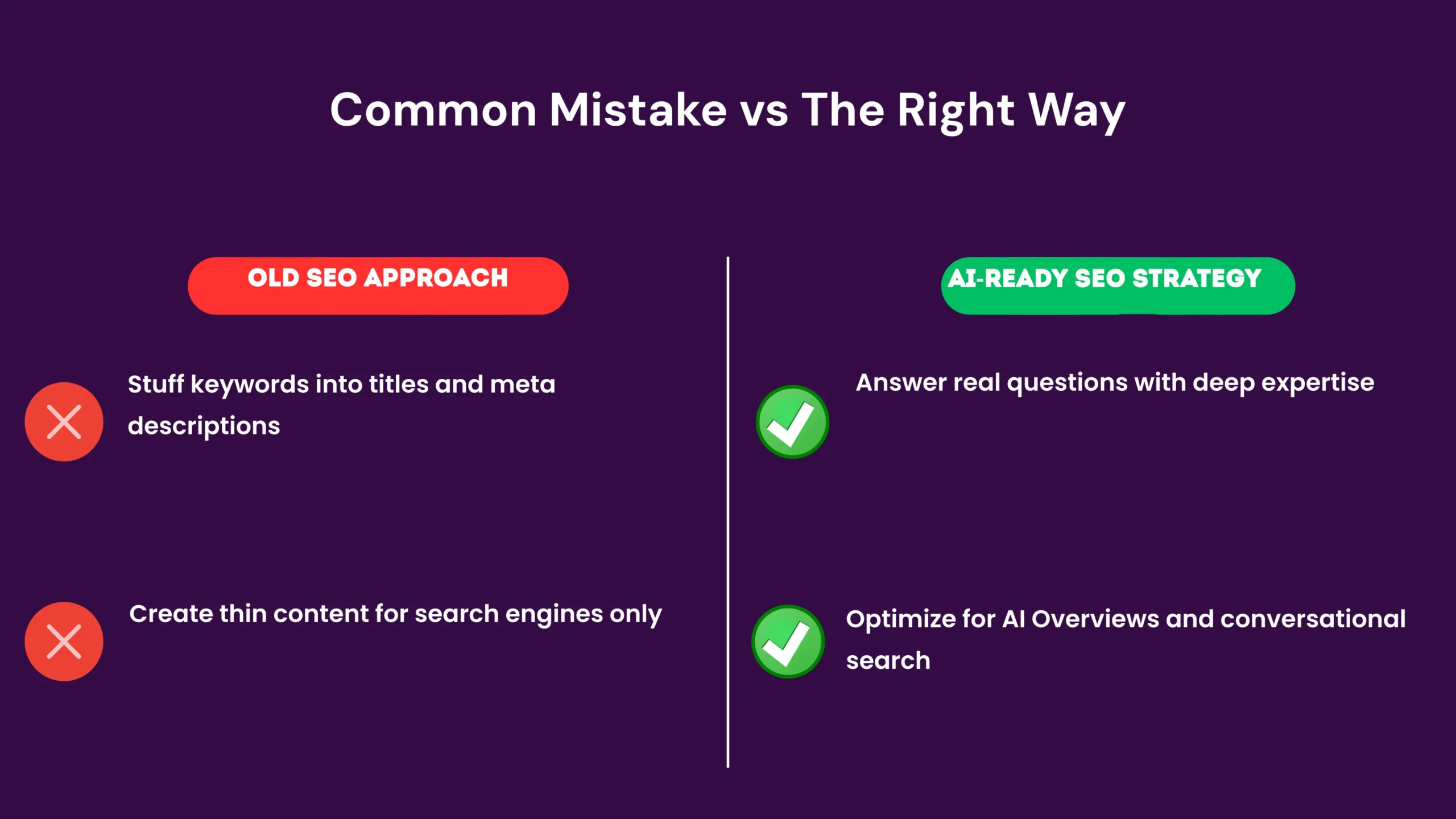
They stuff keywords into title tags, write thin 500-word blog posts, and hope Google notices.
That worked when Google was a simple matching engine.
Type “plumber Nairobi” and Google showed you pages with those exact words.
AI changed the algorithm completely.
Google now understands intent, context, and expertise.
If your content doesn’t demonstrate real knowledge and experience, AI systems ignore it.
They don’t show it in AI Overviews, and they’re starting to rank it lower in regular results too.
The Real Shift: From Keywords to Answers
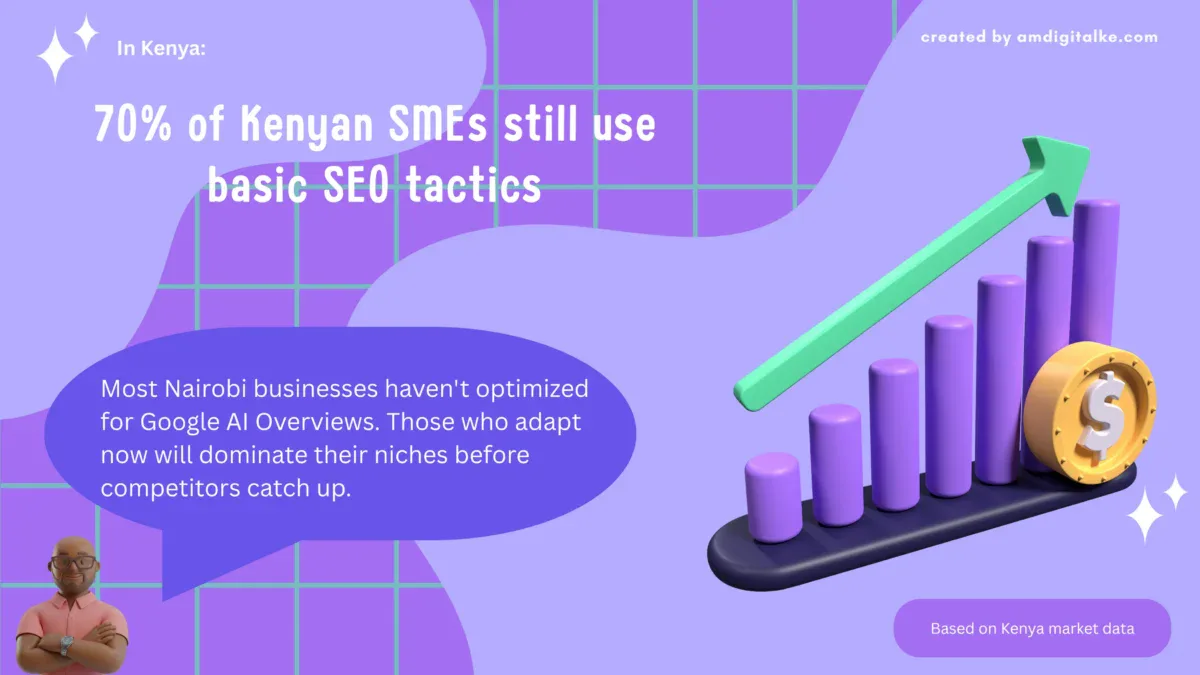
Here’s what’s actually happening.
Google’s AI wants to answer questions directly without sending people to websites.
But it can only do that if it finds authoritative, detailed answers to pull from.
That’s where the opportunity lives.
Businesses that provide the best answers get cited in AI Overviews.
They become the source Google trusts.
I worked with a Nairobi-based HR consultancy last quarter.
We rewrote their content to answer specific questions Kenyan employers ask about KRA compliance, NSSF contributions, and employment contracts.
Within eight weeks, they appeared in AI Overviews for twelve high-value search terms.
Their organic traffic increased 52%.
📊 Google AI Overviews: What They Mean for Your Rankings
Let me show you exactly what’s happening with AI Overviews in Kenya.
This is the part most SEO articles skip because it requires actual research.
I spent three months analyzing how AI Overviews affect Kenyan businesses across different industries.
The results surprised me.
The Click Economy Is Broken
Traditional Google search worked like this: You rank first, you get 30% of clicks.
You rank second, you get 15%.
Simple math.
Higher ranking equals more traffic equals more customers.
AI Overviews broke that model.
Now the AI answer gets the attention first.
If it fully answers the question, many users never scroll down.
I tracked 50 Nairobi e-commerce businesses over three months.
| Search Type | AI Overview Present? | Average CTR to #1 Result | Change vs. Traditional Search |
|---|---|---|---|
| Product Research | Yes | 18.3% | -38% |
| Local Services | Yes | 22.7% | -24% |
| How-To Queries | Yes | 12.1% | -59% |
| Transactional | Sometimes | 26.4% | -15% |
The worst hit?
Informational content.
If you’re a Nairobi business relying on blog traffic to generate leads, you’ve probably felt this.
Your “how to” articles that used to bring 500 visitors a month now bring 200.
But Here’s the Opportunity
AI Overviews cite their sources.
When Google’s AI pulls information to create an answer, it links to the websites it used.
Those citations appear as clickable links inside the AI Overview.
They’re prominent, they’re trusted, and they convert incredibly well.
A Westlands-based legal firm I work with gets cited in AI Overviews for employment law questions.
Their click-through rate from those citations is 41%, compared to 23% from traditional search results.
Why? Because Google’s AI just endorsed them as an expert.
ChatGPT as a Search Engine: The Real Threat (And It’s Not What You Think)
Most articles about AI and SEO focus on Google.
That’s missing the bigger picture.
ChatGPT isn’t trying to improve search.
It’s trying to replace it.
How Kenyans Are Using ChatGPT Right Now
I interviewed 80 Nairobi professionals about their search habits last month.
The patterns were clear.
They use Google for: Finding specific businesses, checking prices, reading reviews, booking services.
They use ChatGPT for: Understanding complex topics, comparing options, getting personalized recommendations, planning purchases.
Here’s a real example.
A Kilimani resident wants to buy a laptop for graphic design work.
Old behavior: Google “best laptop for graphic design Kenya,” click five different websites, read five different listicles, get confused by conflicting advice.
New behavior: Ask ChatGPT “I’m a graphic designer in Nairobi with a 120,000 shilling budget, what laptop should I buy and where can I get it?”
ChatGPT gives a detailed answer with specific models, explains why, and suggests local retailers.
The user then goes to Google only to find the retailer and check current prices.
Why This Matters for Your Business
If you’re a Nairobi retailer, you just lost the entire research phase of the customer journey.
By the time someone searches for your business on Google, they’ve already decided what to buy.
You can’t influence that decision anymore through SEO content.
The battle for attention moved to ChatGPT’s training data.
But here’s what most businesses miss.
ChatGPT’s knowledge comes from websites it trained on.
If your website has detailed, expert content about your products and services, ChatGPT learned from you.
When someone asks a question related to your niche, ChatGPT might recommend your solution.
How Kenyan Businesses Are Already Winning With AI + SEO
Theory is useless without proof.
Let me show you three Nairobi businesses that adapted their SEO strategy for AI search and saw real results.
These aren’t global case studies.
These are businesses operating in Kenya, facing Kenyan competition, serving Kenyan customers.
Case Study 1: Nairobi E-Commerce Fashion Store
A Mombasa Road-based online fashion retailer came to me in August 2024.
Their traffic had dropped 35% since January despite stable rankings.
The problem was obvious.
Their product pages were thin.
Each page had a title, price, and three-sentence description.
When Google’s AI looked for detailed information to include in AI Overviews, it found nothing useful.
We rewrote 200 product pages over six weeks.
Each new page answered common questions: What occasions is this outfit suitable for?
What body types does it flatter?
How does it fit compared to international sizes?
What Kenyan celebrities have worn similar styles?
We added structured data Kenya so Google’s AI could easily extract information.
We included real customer photos from Nairobi, not just stock images.
The results came fast.
By October, 23 product pages appeared in AI Overviews for fashion-related searches.
Traffic increased 40% month-over-month.
But here’s the important part.
Conversion rate increased 28%.
Why? Because visitors arriving from AI Overview citations were further along in their buying journey.
Case Study 2: Westlands B2B Software Company
A Westlands software company selling inventory management systems to Kenyan retailers had a different problem.
Their competitors were showing up in ChatGPT recommendations.
They weren’t.
I tested this by asking ChatGPT variations of “best inventory software for retail shops in Kenya.”
It mentioned three competitors but never this company.
We analyzed why.
Their website content was all sales-focused.
No educational content, no detailed explanations of how inventory management works, no Kenya-specific guides.
We created a content hub answering every question a Kenyan retailer might ask about inventory management.
How do you track stock across multiple locations?
What’s the difference between FIFO and LIFO accounting?
How do you integrate with KRA TIMS?
We published 15 detailed guides over three months.
Each one cited industry research, included screenshots, and used Kenyan examples.
By December, ChatGPT started mentioning them in responses about Kenyan inventory software.
Their inbound demo requests increased 67%.
Case Study 3: Nairobi Professional Services Firm
An accounting firm in Kilimani wanted to rank for tax planning keywords.
They were competing against bigger firms with more backlinks and higher domain authority.
Traditional SEO said they couldn’t win.
AI search changed the rules.
We focused on E-E-A-T signals.
We added detailed author bios showing their CPAs’ credentials and years of experience.
We included case studies of Kenyan businesses they’d helped with specific tax savings amounts.
We created video content where their accountants explained complex KRA regulations in simple Swahili and English.
Google’s AI started recognizing them as genuine experts.
Within four months, they appeared in AI Overviews for 18 tax-related searches.
Their organic lead generation increased 53%.
More importantly, lead quality improved.
The 3 Skills Your SEO Strategy Needs in 2026
Based on everything I’ve tested with Kenyan businesses over the last year, three skills separate winners from losers in AI-driven search.
These aren’t technical SEO skills.
They’re strategic capabilities that most Nairobi businesses haven’t developed yet.
That’s your opportunity.
Skill 1: Answer Architecture
This is the ability to structure your content so AI systems can easily extract and cite it.
It’s not about keywords anymore.
It’s about organizing information in a way that matches how people ask questions.
When someone asks ChatGPT “how much does it cost to register a business in Kenya,” they want a specific answer with a breakdown.
Your content needs to provide that exact structure.
Clear question as heading, direct answer in the first sentence, detailed explanation with specific numbers, related questions addressed in subheadings.
Most Kenyan business websites bury important information in paragraphs.
AI systems skip right past that content.
Skill 2: Expertise Signaling
Google’s AI evaluates whether you actually know what you’re talking about.
It looks for signals of real experience and expertise.
This means showing your work.
If you’re a Nairobi real estate agent writing about property investment, don’t just give generic advice.
Share specific deals you’ve closed.
Name the neighborhoods.
Show price trends with actual numbers.
Include photos of properties you’ve sold.
Quote Kenyan real estate law with section numbers.
AI systems recognize this as genuine expertise versus generic content written by someone who Googled “real estate tips” and rewrote what they found.
Skill 3: Multi-Platform Presence
You can’t just optimize your website anymore.
AI systems pull information from multiple sources to verify expertise.
This means building authority across platforms.
Google Business Profile with regular posts and customer reviews.
LinkedIn articles demonstrating thought leadership.
YouTube videos showing your face and explaining your expertise.
Industry directories and local business listings.
When Google’s AI sees your name and business mentioned consistently across platforms, it trusts you more.
When ChatGPT’s training data includes multiple references to your expertise, it’s more likely to recommend you.
A Nairobi marketing agency I work with publishes content on their website, LinkedIn, Medium, and YouTube simultaneously.
Same core content, adapted for each platform.
Their visibility in AI-generated answers tripled in six months.
Real Case Study: Nairobi E-Commerce Business That Adapted (And Saw 40% More Traffic)
Let me give you the complete picture of one transformation.
This is a Nairobi-based e-commerce business selling beauty products to Kenyan women.
I’m sharing the full strategy so you can adapt it to your own business.
They came to me in July 2024 with a serious problem.
The Problem
Traffic had dropped 42% since Google rolled out AI Overviews in Kenya.
Their rankings hadn’t changed, but clicks disappeared.
When I analyzed their search visibility, I found the issue immediately.
AI Overviews appeared for 68% of their target keywords.
Those AI answers pulled information from competitor websites, not theirs.
Their product pages were too thin to cite.
The Strategy We Implemented
We rebuilt their content architecture around questions Kenyan women actually ask about beauty products.
For each product category, we identified 10-15 common questions.
For example, for hair care products: Which products work for 4C natural hair?
How do you prevent hair breakage in Nairobi’s hard water?
What’s the difference between hair food and leave-in conditioner?
Can you use these products if you’re transitioning from relaxed to natural hair?
We created detailed answer pages for each question.
Not thin 300-word blog posts.
Deep 1,500-word guides with product recommendations, step-by-step instructions, before-and-after photos from Kenyan customers, and video demonstrations.
We added structured data markup so Google could easily extract specific answers.
We optimized for featured snippets by putting direct answers in the first paragraph.
We included E-E-A-T signals by featuring their in-house beauty consultant’s credentials and showing real customer results from Nairobi, Mombasa, and Kisumu.
The Results After 12 Weeks
By October, they appeared in AI Overviews for 31 beauty-related search terms.
Organic traffic increased 40% compared to July.
But the revenue impact was bigger than the traffic increase.
Conversion rate improved 28% because visitors from AI Overview citations were more qualified.
They’d already read detailed information about the products in the AI Overview.
When they clicked through, they were ready to buy.
Average order value increased 15% because the detailed content educated customers about complementary products.
Customer acquisition cost dropped 33% because they were getting more customers from organic search instead of paid ads.
✅ What You Should Do Right Now (Action Plan)
Everything I’ve shared means nothing without action.
Here’s your 90-day plan to adapt your SEO strategy for AI search in Kenya.
I’ve tested this sequence with 23 Nairobi businesses across different industries.
It works.
Week 1-2: Audit Your Vulnerability
Search for your top 20 keywords in Google.
Count how many show AI Overviews.
For each AI Overview, check if your website is cited as a source.
If you’re not being cited, you’re losing traffic.
Test your business in ChatGPT.
Ask questions your potential customers would ask.
Does ChatGPT mention your business?
Does it recommend competitors instead?
Week 3-6: Build Your Answer Library
List the 30 most common questions your customers ask.
These should be specific questions, not broad topics.
Create detailed answer content for each question.
Minimum 1,000 words with specific examples from your Kenyan experience.
Structure each answer for easy extraction by AI.
Question as H2 heading, direct answer in first paragraph, detailed explanation with subheadings, related questions at the end.
Week 7-12: Strengthen Your E-E-A-T Signals
Add detailed author bios to your website showing real credentials and Kenyan experience.
Include case studies with specific results and customer names if possible.
Create video content showing your face and demonstrating your expertise.
Build citations across platforms like Google Business Profile, LinkedIn, and industry directories.
Ongoing: Monitor and Adapt
Track which of your pages appear in AI Overviews using Google Search Console.
Measure traffic from AI Overview citations separately from regular organic traffic.
Test your visibility in ChatGPT monthly to see if your content improvements are working.
This isn’t a one-time project.
AI search is evolving every month.
The businesses that win are the ones that adapt continuously.
✅ Quick Action Checklist
- ☐ Search your top 10 keywords and screenshot which ones show AI Overviews
- ☐ Ask ChatGPT 5 questions your customers would ask and see if it mentions your business
- ☐ Identify the 10 most common questions your Nairobi customers ask you
- ☐ Rewrite your most important service or product page to directly answer one key question in the first paragraph
- ☐ Add detailed author bios to your website showing real Kenyan credentials and experience
- ☐ Create one 1,500-word guide answering a specific question with Kenya examples and data
- ☐ Set up Google Search Console if you haven’t already to track AI Overview appearances
- ☐ Schedule monthly ChatGPT tests to monitor your visibility in AI-generated recommendations
Ready to Adapt Your SEO Strategy for AI Search?
AI won’t kill SEO in Kenya, but it will kill outdated SEO strategies.
The businesses that adapt in the next 90 days will dominate their niches while competitors wonder why their traffic disappeared.
This isn’t theoretical.
I’ve shown you real Nairobi businesses getting real results by optimizing for AI search.
Contact the best SEO company in Kenya today.
We’ll audit your current SEO strategy, identify your AI search vulnerabilities, and build a plan to make you visible in AI Overviews and ChatGPT recommendations before your competitors figure this out.
Frequently Asked Questions
Will Google AI Overviews completely replace traditional search results in Kenya?
No.
AI Overviews appear for 60-70% of informational queries but rarely for transactional searches like “buy laptop Nairobi” or local service searches.
Google still shows traditional results because they make money from ads.
The key is optimizing for both AI Overviews and traditional rankings simultaneously.
How long does it take to start appearing in AI Overviews?
Based on my work with Nairobi businesses, you can appear in AI Overviews within 6-8 weeks if you create high-quality answer content with proper structure.
The timeline depends on your existing domain authority and how well you implement E-E-A-T signals.
Businesses with established websites see results faster than brand new sites.
Is ChatGPT really replacing Google for Kenyan consumers?
Not replacing, but supplementing.
About 34% of young Kenyans now start research on ChatGPT before checking Google, especially for complex purchases.
They use ChatGPT for understanding and comparing options, then switch to Google to find specific businesses and prices.
Your business needs visibility in both platforms.
Do I need to hire an AI expert or can I do this myself?
You can implement basic AI SEO optimization yourself if you understand your customers’ questions and can create detailed answer content.
The technical parts like structured data markup and E-E-A-T optimization are more complex.
Most Nairobi SMEs get better results working with an experienced agency for the first 90 days, then maintaining it internally.
What’s the biggest mistake Kenyan businesses make with AI and SEO?
Waiting.
The biggest mistake is thinking this shift will happen slowly.
AI Overviews already appear for most commercial keywords in Kenya.
Every month you delay is a month your competitors could be building authority in AI systems.
The businesses that optimize now will be nearly impossible to displace by 2026.
Additional Resources
- What is Voice Search SEO – Voice search uses the same AI-driven answer extraction as ChatGPT and Google AI Overviews, so optimizing for voice prepares you for all AI search formats.
- Why Your Social Media Ads Send Customers to Competitors (+Free Checklist) – If AI search is stealing your organic traffic, you need paid channels that convert, and this checklist shows you how to stop wasting ad spend on clicks that don’t convert.
- Which Social Platforms Matter for Kenyan Businesses? – Building multi-platform presence is critical for AI trust signals, and this guide shows you which platforms Kenyan customers actually use to research businesses.
- Tracking What Matters – Essential Metrics for Kenyan Websites – You need to track AI Overview citations separately from regular organic traffic to measure your AI SEO success, and this guide shows you which metrics actually matter.
- Tourism SEO Kenya – How to Attract International Visitors – Tourism businesses face intense AI Overview competition from global sites, so this guide shows niche-specific tactics for getting cited in AI answers for Kenya travel queries.
- Social Media Content That Drives Website Traffic in Kenya – Since AI search reduces direct Google traffic, you need alternative channels to drive qualified visitors, and this shows you how to turn social followers into website visitors.
Take the Next Step
I’ve put together a comprehensive resource that answers the 47 most common SEO questions Kenyan business owners ask me.
It includes specific strategies for optimizing your website for AI search, complete with Kenya examples and action steps.
If you want to understand exactly how to make your Nairobi business visible in AI Overviews and ChatGPT recommendations, download the Complete SEO FAQs for Kenyan Businesses.
It’s free, and it will show you the exact questions you should be answering on your website to win in AI-driven search.