Table of Contents
- What You Need to Know Right Now
- 📋 Key Takeaways
- What is Voice Search SEO?
- Why Does Voice Search SEO Matter for Kenyan Businesses?
- How Voice Search SEO Works 🎯
- Voice Search SEO Examples in Kenya 📱
- Common Mistakes to Avoid ⚠️
- ✅ Quick Action Checklist
- Ready to Improve Your Voice Search SEO?
- Frequently Asked Questions
- Related Posts You May Be Interested In
- Take the Next Step
TL;DR: Voice search SEO is how you make your business findable when people search using their voice on phones and smart speakers. Unlike typing a search, voice searches use natural language, longer phrases, and local intent. If your website isn’t optimized for voice, you’re invisible to customers using Alexa, Siri, and Google Assistant, a gap we cover in our take on AI SEO versus traditional SEO in Kenya.
What You Need to Know Right Now
Your customers are no longer just typing into Google.
They are speaking to their phones while driving in Nairobi traffic. They ask ChatGPT where to find a lawyer in Westlands. They use Google Assistant to locate a restaurant near them in Mombasa.
Voice search is part of a broader shift toward AI-generated search results that Kenyan businesses must adapt to.
Voice search is changing how people find businesses.
If your shop, salon, restaurant, or service business isn’t optimized for voice, you are losing customers to competitors who are. This is closely tied to building topical authority for AI search, which determines whether AI trusts you enough to mention you at all.
📋 Key Takeaways
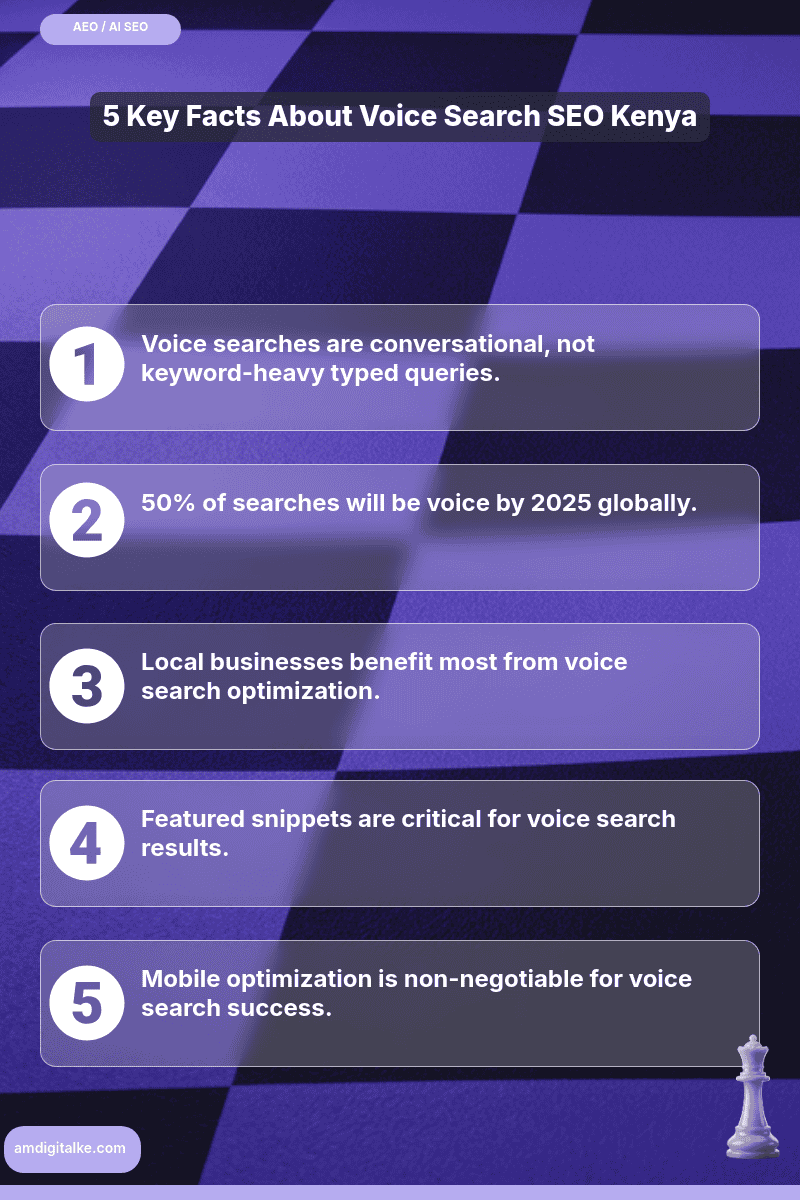
- Voice searches are conversational and longer than typed searches. People say “Where can I find a good hair salon near me?” instead of typing “salon Nairobi”.
- Google, Siri, and Alexa prioritize local businesses with complete, accurate information. Your Google Business Profile is your voice search foundation.
- Featured snippets (the answer boxes at the top of Google) are how voice assistants find answers to read aloud to users.
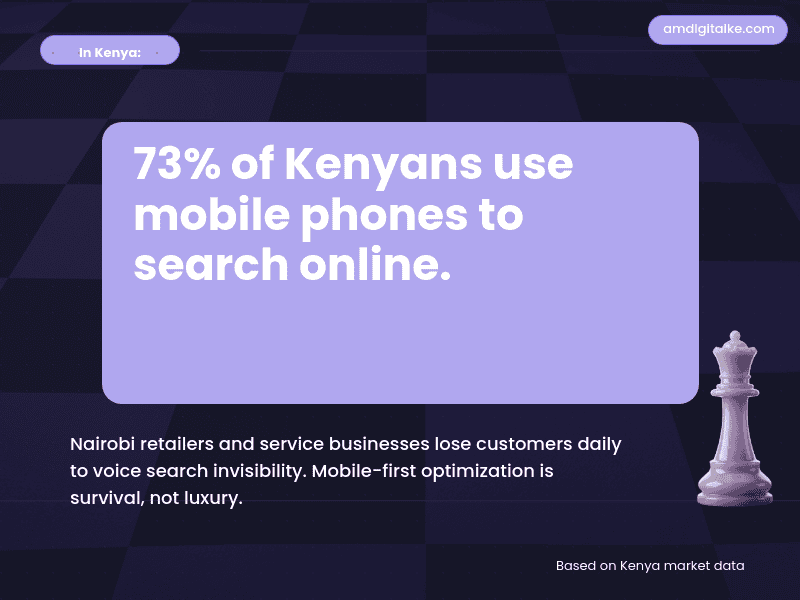
- Mobile optimization is non-negotiable. Based on AM Digital KE client data across Kenyan accounts, most voice searches happen on mobile phones.
- Long-tail keywords and question-based content are essential. Voice search rewards natural, conversational writing.
What is Voice Search SEO?
Voice search SEO is the practice of optimizing your website and online presence so that your business appears when someone uses voice commands to search.
When a customer in Karen asks Google Assistant “Where is the nearest accountant?” or a tourist in Diani Beach asks Siri “Best seafood restaurant near me,” voice search SEO determines whether your business shows up.
Voice search is different from traditional SEO because the search itself is different.
When someone types, they use short, fragmented keywords: “accountant Nairobi.” When someone speaks, they use natural language: “I need a reliable plumber in Nairobi who can come today.”
How Voice Search Differs from Typed Search
Typed searches are efficient and keyword-focused.
A customer might type “pizza delivery Kilimani” in 5 seconds. Voice searches are conversational and intent-driven. The same customer might say “Hey Google, where can I get pizza delivered to Kilimani in the next 30 minutes?”
Voice searches also include more location-based intent.
Most voice searches seek local information: “near me” searches, directions, business hours, and phone numbers. If you run a salon in Lavington, you need to be found when someone says “best salon near me.”
The Platforms Behind Voice Search
Voice search happens on multiple platforms.
Google Assistant (on Android phones and Google Home speakers) is the largest. Apple’s Siri (on iPhones and iPads) is second. Amazon’s Alexa (on Echo devices and other smart speakers) is growing in Kenya as more urban households adopt smart home technology.
Each platform has different algorithms and priorities.
Google Assistant rewards Google Business Profiles and featured snippets. Siri prioritizes Apple Maps and local business information. Alexa relies on Amazon’s own data and third-party integrations.
To rank across all three, you need a solid foundation of local SEO first.
Why Does Voice Search SEO Matter for Kenyan Businesses?
Voice search adoption in Kenya is accelerating.
More Kenyans own smartphones than computers. More of these phones come with voice assistants built in. More people are comfortable using voice commands, especially as internet speeds improve and data becomes cheaper.
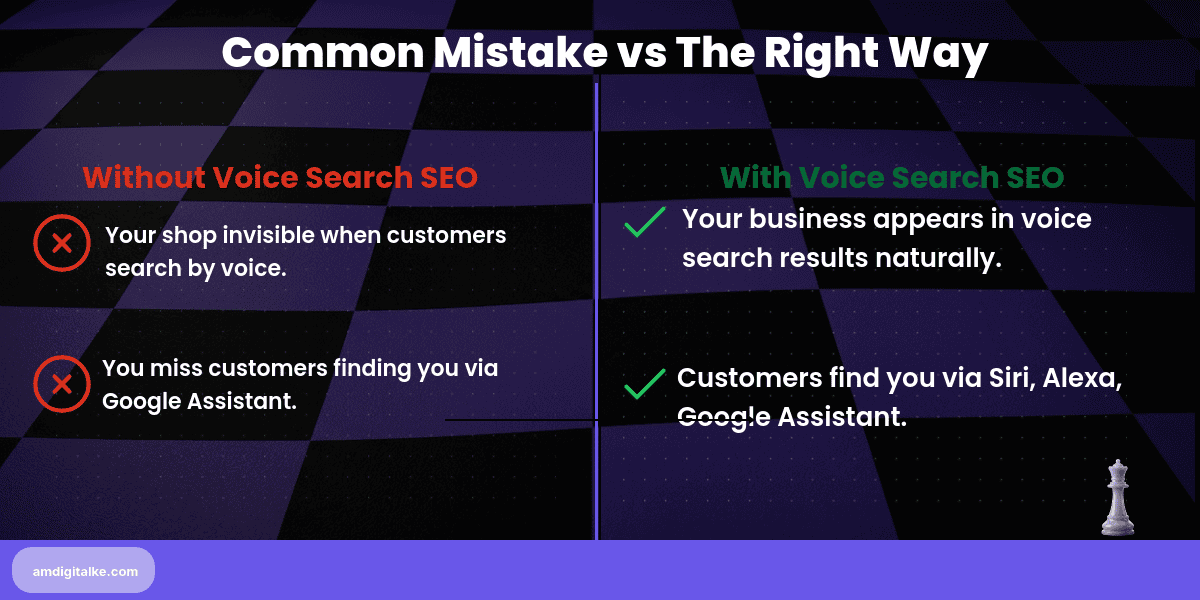
If you are not optimized for voice search now, you will lose customers to businesses that are.
This is not theoretical. This is happening today in Nairobi, Mombasa, Kisumu, and every other Kenyan city.
Your Customers Are Already Using Voice Search
A customer in Westlands is driving and needs a phone repair shop.
They do not pull over to type. They say “Hey Google, phone repair near me.” If your shop does not appear in that voice search result, the customer goes to a competitor.
A small business owner in Kilimani is looking for an accountant to file their KRA returns.
They ask Siri while in a meeting. A business owner in Mombasa is searching for a reliable contractor. They use Google Assistant while on a matatu.
Voice search is already part of how Kenyans find services.
Local Businesses Win with Voice Search
Voice search is hyperlocal.
Most voice searches include location intent. This is perfect for small and medium-sized businesses in Kenya. A salon in Nairobi does not compete with a salon in London when someone searches by voice.
They compete with salons in their neighborhood.
This is your competitive advantage.
Your competitors might be larger, but if they are not optimized for voice search, they are invisible to customers using voice assistants. A well-optimized small business in Kilimani can outrank a poorly optimized large business for voice searches in that neighborhood.
Voice Search Drives Mobile Traffic and Revenue
Voice searches happen on mobile phones.
Mobile traffic converts. A customer who uses voice search to find you is already on their phone and ready to take action. They are calling you, visiting your website, or coming to your shop immediately.
This is different from typed searches, where intent can be unclear.
A voice search customer has clear intent. They want your service now. If you are optimized for voice, you capture these high-intent customers before your competitors do.
How Voice Search SEO Works 🎯
Voice search optimization is not magic.
It is a combination of three elements: your Google Business Profile, your website content, and your technical SEO. Get these three right, and voice assistants will find you.
Element One: Google Business Profile Optimization
Your Google Business Profile is your foundation.
This is the information that appears when someone searches your business name or searches for your service in your area. Google Assistant pulls information from Google Business Profiles to answer voice queries.
Your profile must be complete and accurate.
Business name, phone number, address, hours of operation, website, photos, and customer reviews all matter. If your hours are wrong, a customer might call when you are closed. If your phone number is outdated, they cannot reach you.
Element Two: Featured Snippets and Question-Based Content
Featured snippets are the answer boxes that appear at the top of Google search results.
Voice assistants read these snippets aloud to answer voice queries. If your content appears in a featured snippet, your business gets read to voice search users.
To earn featured snippets, you need to answer questions your customers ask.
A plumber in Nairobi should write content answering “How much does it cost to fix a burst pipe?” A salon in Mombasa should answer “How long does a relaxer take?” Write natural, conversational answers, and Google will often feature them.
Element Three: Mobile Optimization and Page Speed
Based on AM Digital KE client data across Kenyan accounts, most voice searches happen on mobile phones.
Your website must load fast on mobile and be easy to navigate on a small screen. If your website takes 5 seconds to load, voice search users will bounce to a competitor.
Page speed also affects your overall SEO ranking.
Google prioritizes fast websites. A fast, mobile-friendly website ranks higher in voice search results than a slow website with the same content.
Voice Search SEO Examples in Kenya 📱
Let me show you how this works in real Kenyan businesses.
These are not theoretical examples. These are situations you face every day.
Example One: A Salon in Kilimani
Sarah owns a salon in Kilimani.
She does traditional SEO and gets some website traffic. But she is not optimized for voice search. When a customer in Kilimani says “best salon near me” to Google Assistant, Sarah’s salon does not appear.
A competitor down the street has optimized their Google Business Profile with complete information, customer reviews, and photos.
Their website has a blog post answering “How to choose the right hair treatment for your hair type.” Google features this post in a snippet. When the customer asks Google Assistant, the competitor’s salon appears first.
Sarah loses the customer.
The competitor gets the call, the booking, and the revenue. All because Sarah was not optimized for voice search.
Example Two: An Accountant in Westlands
James is an accountant in Westlands.
He helps small business owners file KRA returns and manage their accounts. His website has good SEO, but his content is technical and not conversational. His Google Business Profile is incomplete.
When a business owner in Westlands asks Siri “accountant near me who helps with KRA returns,” James does not appear.
A competitor with a complete Google Business Profile and a blog post titled “How to File KRA Returns as a Sole Proprietor in Kenya” appears first. The customer calls the competitor, not James.
James is losing business to voice search invisibility.
He has the expertise, but his online presence is not optimized for how customers actually search.
Example Three: A Restaurant in Mombasa
Amina owns a seafood restaurant in Mombasa.
Tourists and locals use voice search to find restaurants. When a tourist asks Google Assistant, “best seafood restaurant near me,” Amina’s restaurant competes with dozens of others.
The restaurants that win have complete Google Business Profiles with photos of their food, customer reviews, accurate hours, and a website optimized for mobile.
Their menus are easy to find. Their location is clear. When Google Assistant recommends a restaurant, it recommends the one with the best information and highest ratings.
Amina’s restaurant has a basic website and an outdated Google Business Profile.
She loses customers to competitors with better online presence. Voice search amplifies this advantage for well-optimized businesses and punishes poorly optimized ones.
Common Mistakes to Avoid ⚠️
Most Kenyan business owners make the same mistakes with voice search.
Here are the ones that cost you money.
Mistake One: Ignoring Your Google Business Profile
Your Google Business Profile is not optional.
It is the foundation of voice search. Many business owners set up a profile and never update it. Wrong phone numbers, outdated hours, missing photos, and no customer reviews are common.
Voice assistants cannot recommend a business with incomplete information.
Fix your Google Business Profile today. Add your correct phone number, accurate hours, a clear address, and at least 10 high-quality photos. Ask customers to leave reviews. This alone will improve your voice search visibility significantly.
Mistake Two: Writing for SEO Professionals Instead of Real Customers
Many businesses write content stuffed with keywords but not written for humans.
Voice search rewards natural, conversational writing. If your content sounds robotic, voice assistants will not feature it.
Write like you are explaining something to a friend.
Answer real questions your customers ask. Use natural language. Include long-tail keywords naturally, not forced. A blog post titled “The Ultimate Guide to Fixing Burst Pipes in Nairobi,” written conversationally, will outrank a post titled “Burst Pipe Repair Services Nairobi Kenya,” written stiffly.
Mistake Three: Neglecting Mobile Optimization
Voice searches happen on mobile phones.
If your website is not mobile-friendly, you will not rank for voice searches. Test your website on a phone right now. Can you read it? Can you click buttons easily? Can it load in under 3 seconds?
If the answer is no, fix it immediately.
Mobile optimization is not a nice-to-have. It is essential. Google prioritizes mobile-friendly websites. Voice search depends on mobile optimization.
| Mistake | Impact on Your Business | How to Fix It |
|---|---|---|
| Incomplete Google Business Profile | Voice assistants cannot recommend you | Update all information, add photos, get reviews |
| No conversational content | You do not appear in featured snippets | Write natural, question-based blog posts |
| Poor mobile optimization | Slow page load, low voice search ranking | Test on mobile, optimize images, improve speed |
| Ignoring local SEO | Missing “near me” voice searches | Add location pages, local keywords, NAP consistency |
| No customer reviews | Lower trust, lower voice search visibility | Ask customers to review, respond to reviews |
✅ Quick Action Checklist
- ☐ Log in to your Google Business Profile today and verify all information is correct and current.
- ☐ Add at least 10 high-quality photos of your business, products, or services to your profile.
- ☐ Ask five current customers to leave a review on your Google Business Profile this week.
- ☐ Test your website on a mobile phone and identify any pages that load slowly or are hard to navigate.
- ☐ Write one blog post answering a question your customers frequently ask, using natural, conversational language.
- ☐ Check that your phone number, address, and hours are consistent across Google, Facebook, and your website.
- ☐ Research three long-tail keywords your customers use when searching for your service and plan content around them.
- ☐ Install a tool like Google PageSpeed Insights and commit to improving your mobile page speed score above 80.
Ready to Improve Your Voice Search SEO?
Voice search is not the future.
It is happening now. Kenyans are using Siri, Google Assistant, and Alexa to find businesses every single day. If you are not optimized for voice search, you are losing customers to competitors who are.
Start with your Google Business Profile.
Make sure it is complete, accurate, and up to date. Then write one piece of conversational content answering a real customer question. Optimize your website for mobile.
These three steps will put you ahead of most Kenyan businesses.
Ready to improve your voice search SEO and capture customers searching by voice?
Contact AM Digital KE today. Start with a free SEO audit.
Frequently Asked Questions
What is the difference between voice search SEO and regular SEO?
Voice search SEO focuses on conversational keywords and question-based content.
Regular SEO targets typed keywords. Voice search prioritizes local intent, featured snippets, and mobile optimization more heavily. Both use similar foundations, but voice search requires more emphasis on natural language and local information.
Do I need a smart speaker to optimize for voice search?
No.
You do not need a smart speaker to optimize for voice search. You need a mobile-optimized website, a complete Google Business Profile, and conversational content. Most voice searches happen on smartphones, not smart speakers.
Focus on mobile optimization first.
How long does it take to see results from voice search SEO?
Results depend on competition and your starting point.
If your Google Business Profile is new, you might see results in 2-4 weeks. If you are competing in a crowded market, it might take 2-3 months. Consistent optimization and customer reviews accelerate results.
Is voice search SEO only for big businesses?
No.
Voice search is actually better for small and medium-sized businesses. Most voice searches are hyperlocal. A small salon in Kilimani can rank for voice searches in Kilimani without competing nationally.
Local businesses have a natural advantage in voice search.
How do I know if my website is mobile-friendly?
Use Google’s Mobile-Friendly Test tool (free).
Enter your website URL, and it will tell you if your site is mobile-friendly. Check your page speed with Google PageSpeed Insights. Also, test manually by visiting your website on your phone and trying to navigate it easily.
Related Posts You May Be Interested In
These articles cover topics that work alongside what is voice search seo.
Worth reading if you want stronger results in Kenya.
- What is a Featured Snippet
- I Break Down Search Intent Optimisation for Kenya Businesses
- What is E-E-A-T in SEO
- Social Media Content That Drives Website Traffic in Keny
Take the Next Step
Voice search optimization is a long-term strategy that pays dividends.
Start optimizing today and watch your voice search visibility grow. For a comprehensive guide to voice search SEO specific to Kenyan businesses, download the FAQs Guide for Kenyan SMEs.