Table of Contents
- What This Means for Your Nairobi Business
- 📋 Key Takeaways
- What You Need Before You Start
- Step 1: Add Schema Markup to Your Content
- Step 2: Restructure Your Content to Answer Questions First
- Step 3: Build E-E-A-T Signals Into Your Content and Website
- Step 4: Optimize for Question-Based Keywords
- Step 5: Monitor Your Performance in Search Console
- Common Mistakes to Avoid 🚫
- ✅ Quick Action Checklist
- Ready to Improve Your How To Optimize?
- Frequently Asked Questions
- Related Posts You May Be Interested In
- Take the Next Step
TL;DR: AI Overviews are Google’s new answer boxes that pull content directly from your website. To win them, you need structured data, direct answers in your first 100 words, and E-E-A-T signals that prove your expertise. This article shows you exactly how Kenyan businesses can capture this new search real estate before your competitors do, a shift we unpack further in what still works with SEO in Kenya today.
What This Means for Your Nairobi Business
Google is no longer just showing you a list of blue links. Instead, it’s pulling information directly from websites and summarizing it right at the top of the search results in what Google calls AI Overviews.
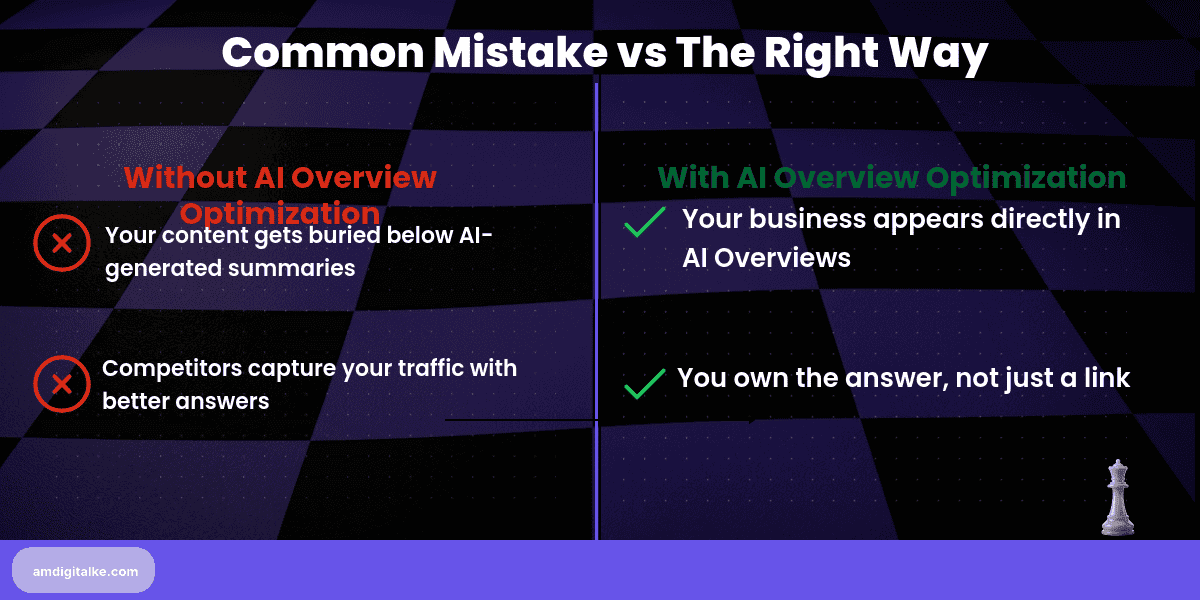
This changes everything for Kenyan business owners. Your competitor in Westlands might rank on page two, but still capture your customer because Google pulled their answer into the AI Overview.
If you sell plumbing services in Nairobi, run an eCommerce store in Mombasa, or offer accounting services to SACCOs, AI Overviews are now part of how people find you.
Ignoring this is like ignoring Google itself five years ago.
The question is not whether AI Overviews matter.
The question is: will your content be the source Google pulls from, or will your competitor’s be?
📋 Key Takeaways
- ☐ AI Overviews pull direct answers from websites, not just links. Your content can appear at the very top of search results before any organic ranking.
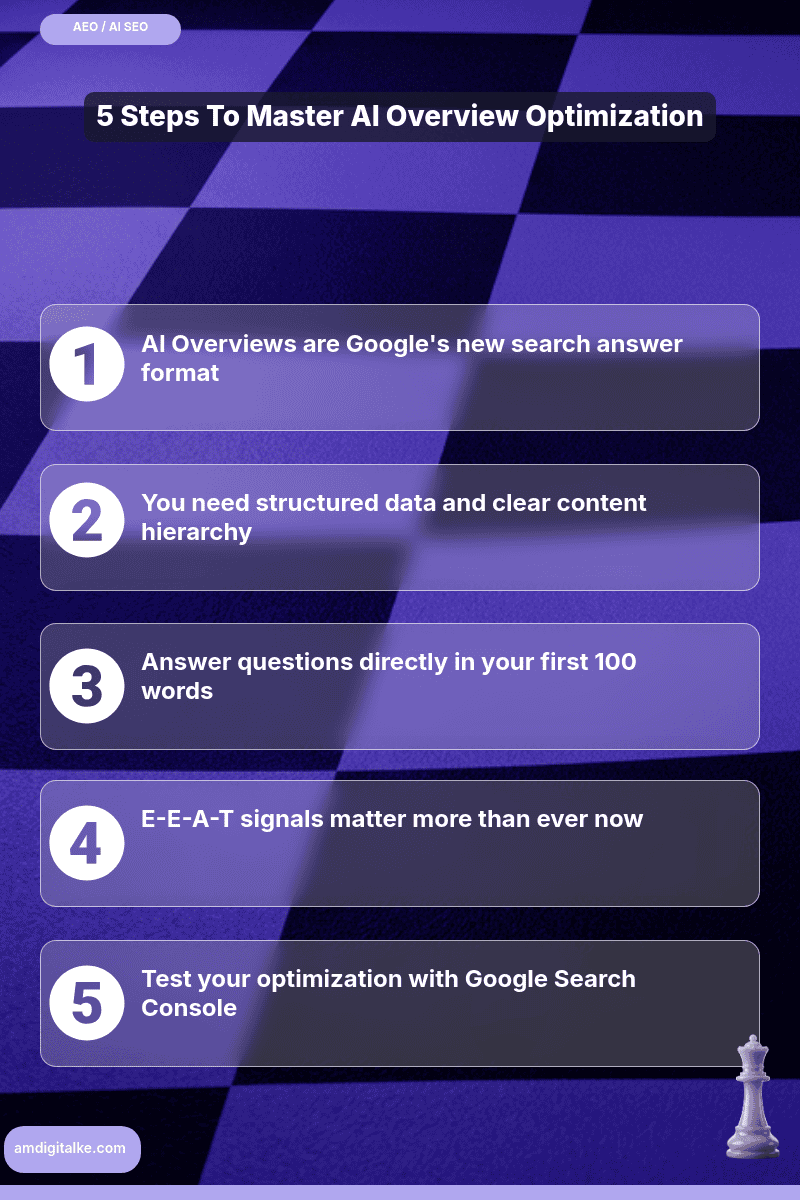
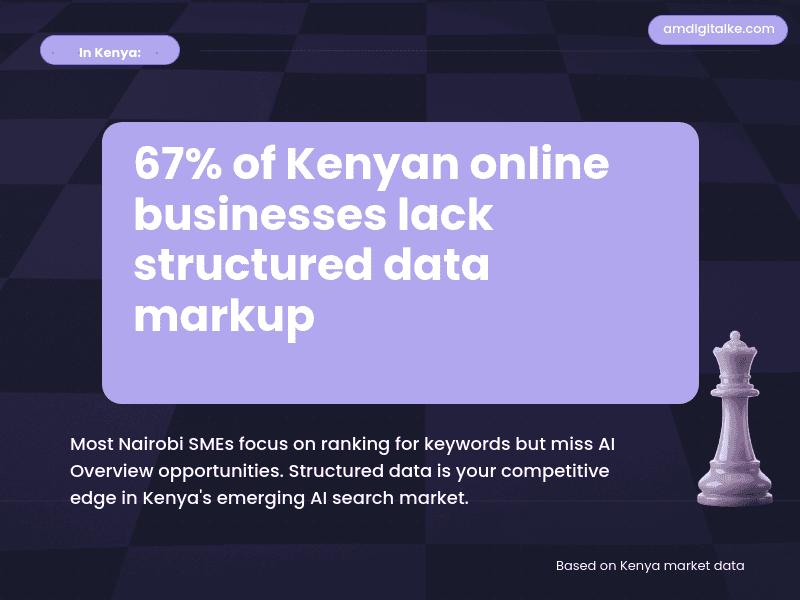
- ☐ Schema markup (structured data) is now essential. Google uses it to understand and extract your content for AI Overviews.
- ☐ Your first 100 words must answer the question completely. AI Overviews prioritize concise, direct answers over long-form content.
- ☐ E-E-A-T signals (Experience, Expertise, Authoritativeness, Trustworthiness) determine whether Google picks your content or a competitor’s.
- ☐ You can monitor your AI Overview performance in Google Search Console. Track impressions, clicks, and which queries trigger your content in AI Overviews.
What You Need Before You Start
Before you optimize for AI Overviews, you need three foundational things in place.
Without these, your optimization efforts will fail, no matter how much effort you put in.
A Website That Loads Fast and Works on Mobile
Google will not pull content from a slow website.
If your Nairobi e-commerce site takes five seconds to load on a 4G connection, Google will skip it.
Test your website speed right now using Google PageSpeed Insights.
If your score is below 50 on mobile, fix that first before you do anything else with AI Overviews.
Mobile is not an afterthought in Kenya. Most of your customers are on their phones.
Clear, Original Content on Your Topic
You cannot optimize for AI Overviews if you do not have real content to optimize.
This means articles, guides, or pages that actually answer questions your customers ask.
If you run a salon in Karen, you need content that answers questions like “how long does a keratin treatment last” or “what is the best hair treatment for damaged hair.”
If you sell agricultural supplies in Kisumu, you need content about crop rotation, pest control, or soil testing.
AI Overviews pull from existing content. You are not creating something new.
You are making existing content visible to Google’s AI systems.
Google Search Console Connected to Your Website
You cannot measure what you cannot see.
Google Search Console is where you will track whether your content appears in AI Overviews.
Set it up today if you have not already. It is free and takes 15 minutes.
Step 1: Add Schema Markup to Your Content
Schema markup is like a translator between your website and Google’s AI.
It tells Google exactly what your content is about, who wrote it, and why it is trustworthy.
Without schema markup, Google has to guess what your content means.
With it, Google knows exactly what it is looking at and can confidently pull it into an AI Overview.
The Schema Types That Matter Most for AI Overviews
You do not need to add every schema type.
Focus on the ones that matter for your business and content type.
If you write blog posts or guides, use Article schema. This tells Google the headline, author, publication date, and main image.
If you have product pages, use Product schema. Include the product name, description, price, and availability.
If you answer specific questions, use the FAQPage schema.
This is powerful for AI Overviews because it directly tells Google you have answers to questions.
If you offer services like plumbing, accounting, or hair styling, use the LocalBusiness schema.
Include your business name, address in Nairobi or wherever you operate, phone number, and opening hours.
How to Add Schema Markup Without Coding
You do not need to hire a developer to add schema markup.
WordPress plugins like Yoast SEO, Rank Math, and Schema Pro do this automatically.
If you use Shopify, most themes include schema markup built in.
If you use a custom website, ask your developer to add schema markup using JSON-LD format.
Start with one page. Add the Article schema to your best blog post about your main topic.
Test it using Google’s Rich Results Test tool.
Once you see it working, add the schema to more pages. Build this gradually over two to four weeks.
Step 2: Restructure Your Content to Answer Questions First
AI Overviews do not care about your introduction or your brand story. They care about the answer.
If someone searches “how to apply for a business license in Kenya,” Google’s AI will pull the first 100 to 150 words that directly answer that question. It will not read your entire article.
The Answer-First Content Structure
Start every article or guide with a direct answer. No fluff.
No “let me tell you a story.” Just the answer.
For example, if your article is about “starting a salon in Nairobi,” your first sentence should be: “You need a business license from your county government, a salon premises with proper ventilation, and at least Ksh 500,000 to start with basic equipment.” That is the answer.
After the direct answer, you can provide context, steps, and details. But the answer comes first.
This is different from traditional blog writing.
You are not building suspense. You are giving people what they want immediately.
Use Numbered Lists and Tables for Complex Information
AI Overviews pull from lists and tables more easily than from paragraphs.
If your content has a list of steps or a comparison table, Google will often use that in the AI Overview.
If you are explaining “how to calculate tax for a SACCO,” use a numbered list.
If you are comparing different M-Pesa payment methods, use a table.
Tables are especially powerful. Google loves pulling tables into AI Overviews because they present information clearly.
| Content Format | AI Overview Likelihood | Why It Works |
|---|---|---|
| Direct answer in first sentence | Very High | AI systems prioritize clear, concise answers |
| Numbered lists (5-10 items) | High | Easy for AI to extract and structure |
| Comparison tables | Very High | Tables present information in AI-friendly format |
| Long paragraphs (500+ words) | Low | AI must summarize, risking inaccuracy |
| Bullet points without structure | Medium | Better than paragraphs but less clear than lists |
Step 3: Build E-E-A-T Signals Into Your Content and Website
E-E-A-T stands for Experience, Expertise, Authoritativeness, and Trustworthiness.
Google uses these signals to decide whose content to pull into AI Overviews.
If you are a plumber in Nairobi with 15 years of experience, that is E-E-A-T.
If you are a random blog with no credentials, that is not.
How to Show Experience
Write an author bio that includes your real experience. Do not just say “I am a plumber.”
Say “I am a master plumber with 15 years of experience fixing burst pipes in Nairobi’s estates.”
Include this bio on every article you write. Google reads author information and uses it to evaluate your credibility.
If you have worked with well-known brands or clients, mention them.
If you have been featured in the media, link to those articles on your author page.
How to Show Expertise and Authority
Create a dedicated expertise page on your website. List your qualifications, certifications, and achievements.
If you are a tax accountant in Nairobi, mention that you are KRA-registered and have handled tax compliance for over 200 SACCOs.
If you run a digital marketing agency, list the awards you have won or the publications you have been featured in.
Link to this page from your author bio and from the footer of your website.
Make it easy for Google to find proof of your authority.
How to Show Trustworthiness
Add client testimonials to your website. Include real names, photos, and details.
A testimonial that says “great service” is worthless.
A testimonial that says “Alvin helped my salon increase bookings by 40% in three months” is powerful.
Display your business registration, certifications, and any professional memberships prominently.
If you are registered with the Kenya Revenue Authority or the Law Society of Kenya, show it.
Add an About page that tells your story honestly.
Explain why you started your business and what problem you solve for Kenyans.
Step 4: Optimize for Question-Based Keywords
AI Overviews are triggered by question-based searches.
If someone types “how to,” “what is,” “why should,” or “where can I,” Google is more likely to show an AI Overview.
This means you need to target these question keywords in your content.
Find the Questions Your Customers Ask
Go to Google and start typing your main keyword. Look at the autocomplete suggestions.
These are real questions people are asking.
If you run a gym in Kilimani, type “fitness in Nairobi” and Google will show you “fitness in Nairobi for weight loss,” “best gyms in Nairobi,” “fitness classes in Nairobi,” and more.
These are the questions you need to answer.
Write one article for each question. Title it with the question.
Answer it directly in the first paragraph.
Use the “People Also Ask” Section
Below every Google search result, there is a section called “People Also Ask.”
These are questions related to the main search.
Click on each one. Google will show you even more related questions.
Create content that answers these too.
If you sell agricultural equipment in Kisumu, the “People Also Ask” section might show questions like “what is the best time to plant maize,” “how much fertilizer do I need,” and “what pests affect maize.”
Write articles answering each of these.
Step 5: Monitor Your Performance in Search Console
You cannot improve what you do not measure.
Google Search Console now shows you data about AI Overviews.
What to Track in Search Console
Look for a report called “AI Overviews” or “Generative AI Overviews” in your Search Console.
This shows which queries trigger your content in AI Overviews.
Check how many impressions you are getting.
An impression means your content appeared in an AI Overview, whether or not someone clicked through to your site.
Compare your click-through rate on AI Overview queries versus regular search results.
You might find that AI Overview impressions lead to fewer clicks, which is normal. The goal is visibility and brand awareness.
Identify Gaps and Opportunities
If you are ranking for a keyword but not appearing in AI Overviews, it means your content needs optimization.
Go back to Step 2 and restructure that article to answer the question more directly.
If you see competitors appearing in AI Overviews for keywords you want to rank for, analyze their content.
What did they do differently? How did they structure their answer?
Use this data to improve your content every month.
AI Overviews are not static. Google updates them as your content changes.
Common Mistakes to Avoid 🚫
Most Kenyan businesses make the same mistakes when optimizing for AI Overviews.
Knowing these will save you months of wasted effort.
Mistake 1: Writing for Humans, Not for AI
You might have written beautiful, long-form content that ranks well in traditional search.
But AI Overviews do not care about beautiful writing.
They care about clarity and directness.
If your first paragraph is a metaphor about your journey as a business owner, Google’s AI will skip it and look for a direct answer.
This does not mean your writing should be boring.
It means your answer should come first, then you can add storytelling and context.
Mistake 2: Ignoring Schema Markup
Schema markup is not optional anymore.
It is how Google understands your content well enough to pull it into AI Overviews.
If you have not added schema markup to your website, you are competing with one hand tied behind your back.
Your competitors who use schema markup will beat you.
Start today. Pick one page and add schema markup.
Test it. Then scale.
Mistake 3: Targeting Long-Tail Keywords Without Question Intent
Not every keyword triggers an AI Overview. Keywords without question intent rarely do.
If someone searches “best pizza in Nairobi,” that is a question-based search and might trigger an AI Overview.
If someone searches “pizza,” it probably will not.
Focus your AI Overview optimization on keywords that start with “how,” “what,” “why,” “where,” “when,” and “which.”
Mistake 4: Not Updating Your Content Regularly
Google favors fresh content in AI Overviews.
If your article has not been updated in two years, Google will prefer newer content from competitors.
Update your top-performing articles every three to six months.
Add new information, remove outdated details, and refresh your examples.
If you mention a price or a process that has changed in Kenya, update it immediately. Google notices when content is outdated.
Mistake 5: Hiding Your Expertise
If no one knows who wrote your content or why they should trust it, Google will not put it in an AI Overview.
Add author bios. Show your credentials.
Link to your expertise page. Make it obvious why you are qualified to answer this question.
✅ Quick Action Checklist
- ☐ Set up Google Search Console today and check for AI Overview data in your account
- ☐ Identify your top 5 question-based keywords that your customers actually search for
- ☐ Add Article or FAQ schema markup to your best-performing blog post this week
- ☐ Rewrite the first paragraph of your top 3 pages to answer the question directly in the first sentence
- ☐ Create an author bio with your real experience and add it to every article you publish
- ☐ Build a table or numbered list on one of your existing articles to make information easier for AI to extract
- ☐ Check Google’s autocomplete suggestions for your main keyword and create one article answering a related question
- ☐ Update one of your old articles (older than 12 months) with fresh information and new examples
Ready to Improve Your How To Optimize?
AI Overviews are not the future. They are here now, and Google is showing them to millions of Kenyans every day.
If your content is not optimized for them, your competitors’ content will be the answer Google shows instead of yours.
The businesses that act now will own this new search real estate. The ones that wait will be left behind.
Ready to capture AI Overview traffic for your Nairobi business? Contact AM Digital KE today.
Frequently Asked Questions
Do AI Overviews replace traditional organic rankings?
No. AI Overviews appear above traditional rankings, but traditional rankings still matter.
You can appear in an AI Overview and also rank on page one. In fact, appearing in both gives you more visibility and more clicks.
Will optimizing for AI Overviews hurt my traditional SEO rankings?
No. The optimization techniques we discussed (schema markup, direct answers, E-E-A-T) actually improve your traditional rankings too.
You are not choosing between AI Overviews and traditional SEO. You are doing both at the same time.
How long does it take to see results in AI Overviews?
Google usually needs two to four weeks to re-crawl and re-index your updated content.
You might see changes in AI Overviews within 30 days, but it can take up to 60 days for full impact. Be patient and keep monitoring Search Console.
Can small businesses in Kenya compete with big brands in AI Overviews?
Yes. AI Overviews are based on content quality and relevance, not brand size.
A small plumbing business in Nairobi with great content and E-E-A-T signals can beat a big international brand if the big brand’s content is weaker.
What if Google pulls content from my competitor in the AI Overview instead of mine?
Analyze why. Is their content more direct?
Do they have better schema markup? Are they more established in your industry?
Use this as motivation to improve your own content.
Update your article, add more E-E-A-T signals, and reoptimize. Google re-evaluates AI Overviews regularly.
Related Posts You May Be Interested In
These articles cover topics that work alongside how to optimize for AI overviews, worth reading if you want stronger results in Kenya.
Take the Next Step
AI Overviews are changing how Kenyans search for answers.
Do not let your competitors own this new opportunity. Start optimizing your website today and capture the traffic that matters.
Download the Complete SEO FAQs Checklist for Kenyan Businesses and get a step-by-step framework you can implement this week.