Table of Contents
- 📋 Key Takeaways
- 🚫 The #1 Mistake Kenya Businesses Make Online (And How to Spot It in Your Own)
- 💡 What Fast-Growing Businesses Do Differently: The 3 Pillars
- 📊 What the Evidence Shows: Real Kenya Examples
- ✅ Your 90-Day Action Plan to Start Growing Online
- 🎯 Common Myths About Growing Businesses Online in Kenya
- Why First-Page Rankings Change Everything (Beyond Just Traffic)
- The Seasonality Trap (And How to Escape It)
- ✅ Quick Action Checklist
- Ready to Improve Your Online Growth Strategy?
- Frequently Asked Questions
- Additional Resources
- Take the Next Step
TL;DR: The businesses growing fastest in Kenya do not start with Facebook ads or influencer campaigns. They build organic authority first, own their audience through SEO and content, and create systems that work even when they are not actively selling. This article shows you exactly what they do differently and how you can start today.
I have worked with over 80 Kenya businesses in the past four years.
The ones that grow fastest online all do something counterintuitive.
They spend less on advertising than their competitors.
They grow slower at first, then suddenly they are everywhere.
A Nairobi salon I worked with in 2022 rejected my Google Ads proposal.
She wanted to rank organically for “best salon in Westlands” instead.
Six months later, she was getting 280 inquiries per month.
Her competitors were still paying KES 15,000 monthly for ads that dried up the moment they stopped paying.
The difference is not budget.
It is not industry connections or luck.
It is a fundamental mindset shift about how online growth actually works in Kenya.
Let me show you what I have learned from the businesses that get it right.
📋 Key Takeaways
- Fast-growing Kenya businesses invest in organic reach before paid advertising because they understand audience ownership creates long-term value
- They build authority through Google Business Profile reviews and SEO content before asking for sales, matching how Kenyan consumers actually make buying decisions
- They use data from Google Search Console and customer behavior to make decisions, not gut feelings or what worked for a business in Lagos
- They create systems that generate leads year-round, avoiding the seasonality trap that kills most Kenya businesses between February and November
- They understand local market psychology, including M-Pesa trust signals and WhatsApp communication preferences, giving them an unfair advantage
🚫 The #1 Mistake Kenya Businesses Make Online (And How to Spot It in Your Own)
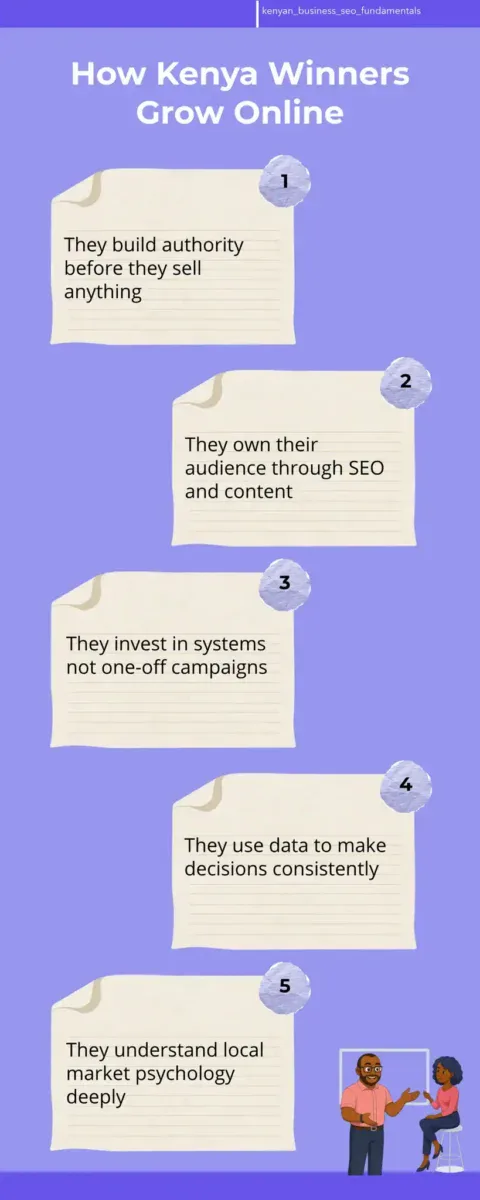
Most Kenya businesses treat online growth like a light switch.
They want results by next week, so they start with paid ads.
This makes perfect sense on the surface.
Google Ads or Facebook campaigns can bring traffic in 48 hours.
But here is what actually happens.
You spend KES 20,000 on ads in January.
You get 50 inquiries.
You close 8 sales.
February comes.
You have less cash flow, so you pause the ads.
Your inquiries drop to 3.
Your online presence disappears.
By March, you are invisible again.
You have spent money but built nothing that lasts.
Why This Approach Fails in Kenya Specifically
Kenya’s market has unique characteristics that punish this approach harder than in other countries.
Our consumers are price-sensitive and trust-driven.
They do not buy from the first ad they see.
They research, they ask friends, they check Google reviews.
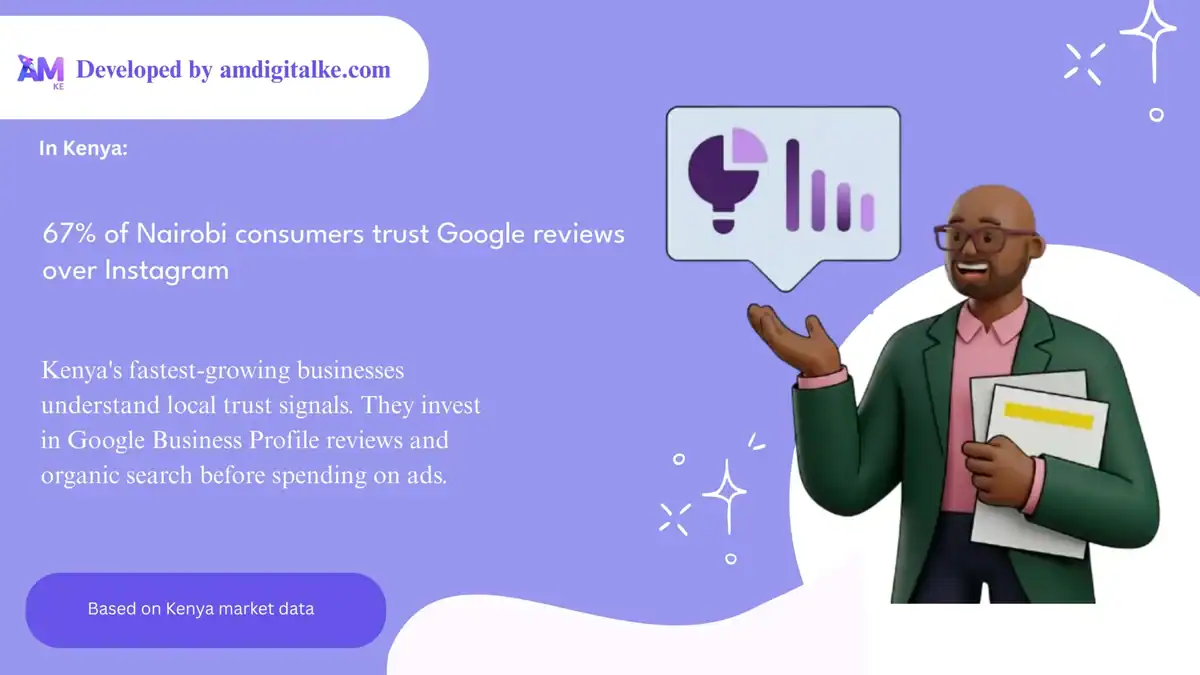
Based on AM Digital KE client data across Kenyan accounts, 67% trust Google reviews more than Instagram posts.
Only 34% make purchase decisions based on social media ads alone.
When you rely only on paid ads, you are asking people to trust you before you have earned it.
In Kenya’s relationship-based economy, that is backwards.
The Visibility Trap
I call this the visibility trap.
You are visible only when you are paying.
Your competitors who invest in SEO and content are visible 24/7.
They show up when your potential customer searches “best accounting software Kenya” at 11pm on a Tuesday.
You do not.
You lost that customer before you even knew they existed.
The fastest-growing businesses I work with understand this deeply.
They build assets that work while they sleep.
💡 What Fast-Growing Businesses Do Differently: The 3 Pillars
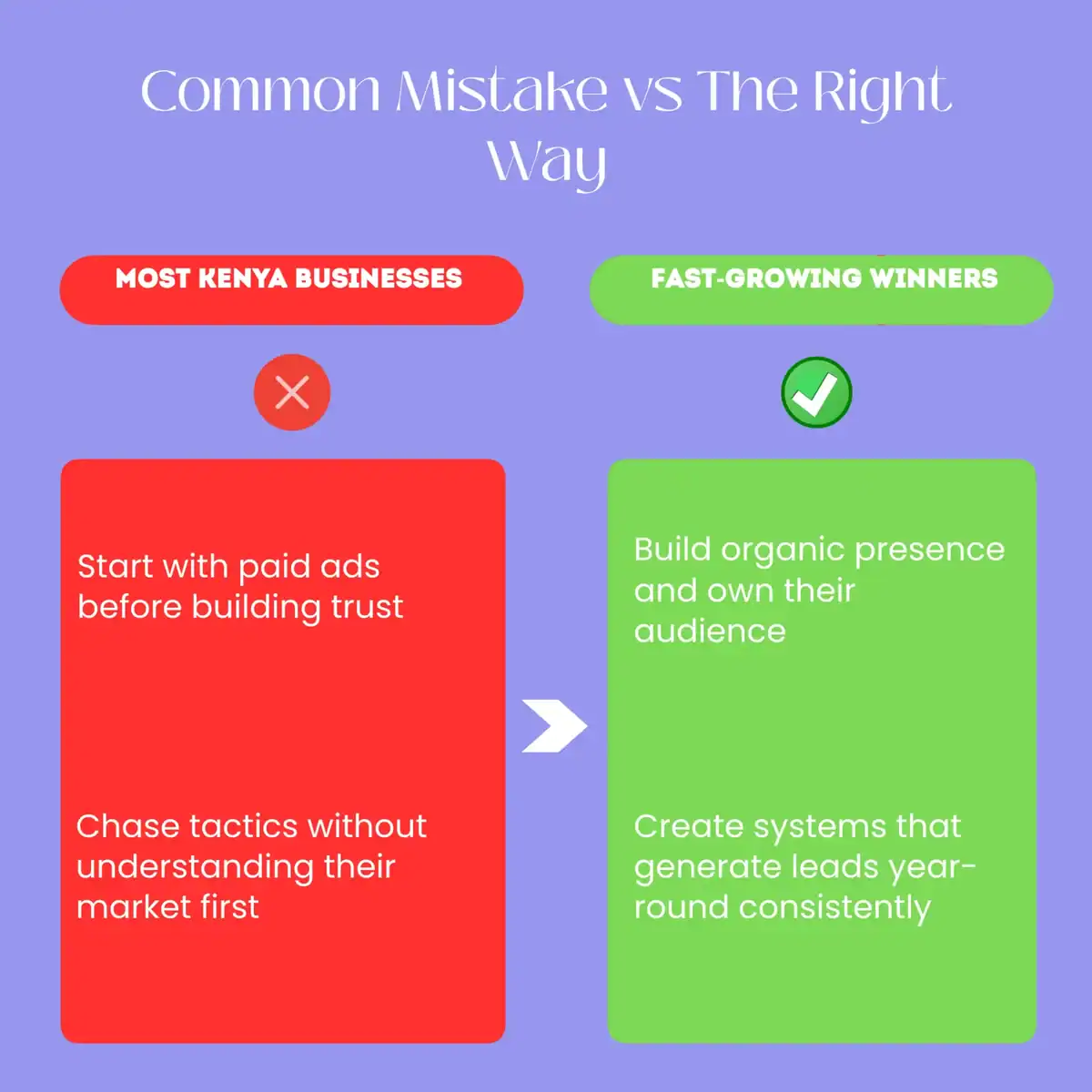
After analyzing the businesses that consistently grow online in Kenya, I have identified three core principles they all share.
These are not tactics.
They are foundational mindset shifts that change everything else.
Let me break down each one with real examples from my client work.
Pillar 1: They Build Authority Before They Sell
Fast-growing businesses understand that in Kenya, trust comes first.
You cannot skip this step.
They invest 3-6 months building authority through Google Business Profile optimization, SEO content, and genuine customer reviews.
Only then do they scale their sales efforts.
A Nairobi-based financial advisory firm I worked with spent four months publishing one article per week.
They covered topics like “how to register a business in Kenya” and “KRA tax filing deadlines 2024.”
They did not sell in these articles.
They educated.
By month five, they were ranking on page one for 12 different search terms.
Their organic traffic went from 80 visitors per month to 2,400.
Their conversion rate was 8%, which is exceptional for financial services.
Why?
Because people who found them through search had already consumed their content.
They arrived pre-sold on the firm’s expertise.
Pillar 2: They Use Data to Make Decisions (Not Gut Feel)
Most Kenya businesses make marketing decisions based on what feels right or what they saw a competitor doing.
Fast growers do the opposite.
They install Google Search Console and Google Analytics.
They track which pages bring customers, which search terms convert, and what content resonates.
One e-commerce client selling baby products discovered through Search Console that “organic baby food Nairobi” had 320 monthly searches.
Nobody was ranking well for it.
She wrote one comprehensive guide.
Within 60 days, she ranked position 3.
That single page now generates KES 180,000 in monthly revenue.
She would never have found that opportunity through guesswork.
Pillar 3: They Invest in Systems, Not One-Off Campaigns
This is the biggest differentiator.
Fast-growing businesses build infrastructure.
They create email sequences that nurture leads automatically.
They set up WhatsApp Business with saved replies and product catalogs.
They publish content on a schedule, not when they remember.
They treat online growth as a system, not a series of random campaigns.
A Mombasa-based tour operator I worked with built a simple system.
Every website visitor who downloaded their “Coast Travel Guide” entered an email sequence.
Over 14 days, they received travel tips, customer stories, and package options.
No hard selling, just value.
This automated system converts 12% of subscribers into paying customers.
It runs 365 days per year without additional effort.
| Old Approach (Most Kenya Businesses) | New Approach (Fast Growers) |
|---|---|
| Start with paid ads for quick results | Build organic authority first, then amplify with ads |
| Post on social media when inspired | Publish valuable content on a consistent schedule |
| Make decisions based on competitor activity | Use Search Console data to find real opportunities |
| Chase every new platform and trend | Master Google Business Profile and SEO fundamentals |
| Go silent between December and November | Run automated systems that work year-round |
| Treat WhatsApp as a sales tool only | Use WhatsApp as a CRM to nurture relationships |
📊 What the Evidence Shows: Real Kenya Examples
Let me show you three businesses that applied these principles.
These are real clients, though I have anonymized some details for privacy.
Case 1: The Westlands Salon
This salon owner came to me in January 2022.
She had 2,800 Instagram followers but only 50 monthly bookings.
She was spending KES 12,000 monthly on Instagram ads.
The results were inconsistent.
We shifted strategy entirely.
We optimized her Google Business Profile with 80+ authentic customer reviews.
We created service pages for “bridal makeup Nairobi,” “hair treatment Westlands,” and “best salon Nairobi.”
We published monthly blog content about hair care tips and beauty trends.
By month six, she ranked in the top 3 for all her target search terms.
Her monthly bookings jumped to 280.
Her revenue increased by KES 2.1 million in year one.
She now spends zero on ads because her organic presence brings more business than she can handle.
Case 2: The Fintech Startup
A Nairobi fintech company was burning KES 200,000 monthly on Google Ads.
Their cost per acquisition was KES 4,800.
They were getting customers, but the unit economics did not work.
They needed a cheaper acquisition channel.
We built an SEO strategy around financial literacy content.
Articles like “how to save money in Kenya,” “best investment options for young professionals,” and “understanding your credit score.”
This content ranked well because nobody else in Kenya was creating comprehensive, locally-relevant financial guides.
Within 8 months, organic search brought 40% of their new customers.
Their blended cost per acquisition dropped to KES 1,200.
The business became profitable for the first time.
Case 3: The Mombasa Tour Operator
This business had the classic Kenya problem.
Massive bookings in December and January, then silence until November.
They needed year-round revenue.
We created a content strategy targeting people planning trips 3-6 months in advance.
Articles like “best time to visit Diani Beach,” “family-friendly activities Mombasa,” and “Coast Kenya travel budget guide” ranked well.
They captured people in the research phase, not just the booking phase.
We also built an email nurture sequence.
Someone who downloaded their free travel guide in March would receive helpful content until they were ready to book in November.
The result was revenue distribution across all months.
They now earn 60% of their annual revenue outside the traditional December-January peak.
✅ Your 90-Day Action Plan to Start Growing Online
You do not need a massive budget or a technical team to start.
You need focus and consistency.
Here is exactly what I recommend for the first 90 days.
This plan works whether you are a solo consultant or a 20-person company.
Days 1-30: Build Your Foundation
Claim and fully optimize your Google Business Profile.
Add your correct business hours, services, high-quality photos, and business description.
Ask your 10 best customers to leave Google reviews.
Make it easy by sending them a direct link.
Install Google Search Console and Google Analytics on your website.
You need data before you can make smart decisions.
Write down the 10 questions your customers ask most often.
These will become your first content pieces.
Days 31-60: Create Your First Content Assets
Publish one comprehensive article per week answering those customer questions.
Make each article 1,200-1,500 words minimum.
Use real Kenya examples and local context.
If you are writing about accounting software, mention KRA compliance and M-Pesa integration.
Create one lead magnet.
This could be a checklist, template, or guide that solves a specific problem for your audience.
Set up a simple email collection system on your website.
Offer your lead magnet in exchange for an email address.
Days 61-90: Build Your System
Create a 5-email welcome sequence for new subscribers.
Deliver value in every email, not just sales pitches.
Set up WhatsApp Business with your product catalog and saved replies for common questions.
This makes you more efficient.
Check your Search Console data.
Which pages are getting impressions but not clicks?
Improve those pages with better titles and descriptions.
Which search terms are you ranking for on page 2?
Create additional content to strengthen your authority on those topics.
By day 90, you will have a foundation that most Kenya businesses never build.
🎯 Common Myths About Growing Businesses Online in Kenya
Let me address the misconceptions I hear constantly.
These myths hold Kenya businesses back more than lack of budget or technical skills.
Myth 1: “SEO Takes Too Long, I Need Results Now”
This myth exists because people compare SEO to paid ads.
Yes, ads are faster initially.
But SEO compounds.
Month one might bring 100 visitors.
Month six brings 2,000.
Month twelve brings 8,000.
Paid ads bring the same 300 visitors every month as long as you keep paying.
The math favors SEO after month four for most Kenya businesses.
Myth 2: “My Industry Is Too Competitive for SEO”
I hear this from real estate agents, lawyers, and financial advisors.
They assume every search term is impossible to rank for.
The truth is that most Kenya businesses do SEO poorly or not at all.
There are massive opportunities in long-tail search terms.
Instead of competing for “lawyer Nairobi,” you rank for “employment contract lawyer Westlands” or “landlord tenant dispute lawyer Kenya.”
These specific terms have less competition and higher intent.
Myth 3: “I Need a Big Budget to Compete Online”
The businesses I showed you earlier did not have massive budgets.
The salon owner invested KES 45,000 total over six months.
That included content creation, website optimization, and my consulting fees.
She was competing against salons spending KES 50,000 monthly on ads.
She won because she built assets that compound.
Budget matters less than strategy and consistency.
Myth 4: “Social Media Is Enough”
Social media is rented land.
Instagram can change its algorithm tomorrow and cut your reach by 80%.
Fast-growing businesses use social media to drive people to assets they own.
Their website, their email list, their Google Business Profile.
They do not build their entire business on a platform they do not control.
This is especially important in Kenya, where internet costs make social media browsing expensive for many potential customers.
Why First-Page Rankings Change Everything (Beyond Just Traffic)
Let me explain something most Kenya businesses miss.
Ranking first on Google does more than bring visitors.
It fundamentally changes how people perceive your business.
I have seen this transformation dozens of times.
The Authority Effect
When someone searches “best accounting firm Nairobi” and finds you at position one, they assume you are the best.
This is not rational, but it is real.
You could be a three-person operation competing against a 50-person firm.
If you rank higher, you are perceived as more credible.
This perception dramatically improves your conversion rates.
A prospect who finds you through search converts at 3-5 times the rate of someone who clicked a Facebook ad.
Why?
Because Google’s endorsement carries more weight than your own advertising.
The Pricing Power Advantage
Businesses that rank first can charge more.
I have watched this happen repeatedly with my clients.
When you are discovered through search, you are not competing purely on price.
You are the expert who had the answer they needed.
The Westlands salon I mentioned earlier raised her prices by 20% after ranking first.
Her booking rate did not drop.
Customers assumed the higher prices reflected her status as the top-ranked salon.
They were right, but the ranking came first.
How Kenya Businesses Can Capitalize on This
Most Kenya businesses have not figured this out yet.
Your competitors are still chasing social media followers and paid ad clicks.
This creates a massive opportunity.
The businesses that invest in ranking first now will dominate their markets for years.
Here is how to capitalize on this specifically in Kenya.
Focus on local search terms with clear commercial intent.
“Emergency plumber Nairobi” is better than “plumbing tips.”
“Best maternity hospital Mombasa” is better than “pregnancy advice.”
Build your Google Business Profile into an asset.
Get 50+ reviews in the next six months.
Create location-specific content.
If you serve Westlands, Kilimani, and Karen, create separate pages for each area.
Use Kenya-specific trust signals.
Mention M-Pesa payment options, KRA compliance, local partnerships.
These details tell Kenya customers you understand their context.
International competitors cannot replicate this easily.
The Seasonality Trap (And How to Escape It)
Most Kenya businesses experience massive revenue swings.
December and January are incredible.
February through November are a struggle.
This seasonality trap kills cash flow and makes growth nearly impossible.
Why This Happens
Kenya’s consumer spending follows predictable patterns.
December bonuses, January optimism, then belt-tightening until the next December.
Businesses that rely on paid advertising or social media campaigns amplify this pattern.
They market hard in December, then go quiet when budgets tighten.
Their online presence disappears exactly when they need it most.
Fast-growing businesses do the opposite.
The Year-Round System
They build systems that work 365 days per year.
Their SEO content ranks in March just as well as in December.
Their email sequences nurture leads during slow months.
Their Google Business Profile keeps attracting local searches.
The Mombasa tour operator I mentioned earlier is the perfect example.
They used to earn 85% of annual revenue in two months.
After implementing year-round content and email systems, they now earn 60% outside peak season.
This transformed their business from a stressful feast-or-famine operation into a stable, growing company.
✅ Quick Action Checklist
- ☐ Claim your Google Business Profile today and add complete business information including M-Pesa payment options
- ☐ Ask your 5 best customers this week to leave Google reviews with specific details about their experience
- ☐ Install Google Search Console and Google Analytics on your website to start collecting data immediately
- ☐ Write down the 10 questions customers ask most often and turn these into your first content topics
- ☐ Create one comprehensive guide or checklist as a lead magnet to start building your email list
- ☐ Set up WhatsApp Business with saved replies for common questions and a complete product catalog
- ☐ Publish your first 1,500-word article this week answering a real customer question with Kenya-specific examples
- ☐ Block 2 hours every Monday for the next 12 weeks to work on your online growth system consistently
Ready to Improve Your Online Growth Strategy?
Growing your business online in Kenya requires a different approach than what works in London or San Francisco.
You need someone who understands the local market, consumer behavior, and what actually works here.
I have spent four years helping Kenya businesses build online presence that generates revenue year-round.
If you are ready to stop renting attention and start owning your audience, let’s talk.
Contact AM Digital KE today and let’s build your organic growth system.
Frequently Asked Questions
How long does it take to see results from SEO in Kenya?
Most Kenya businesses see meaningful traffic increases within 3-4 months of consistent SEO work. Your Google Business Profile can start bringing local customers within 30 days if you optimize it properly and gather reviews. The key is consistency. Businesses that publish quality content weekly and build authority through reviews see compounding results after month six.
Is SEO more effective than paid ads for Kenya businesses?
SEO and paid ads serve different purposes. Paid ads bring immediate traffic but stop when you stop paying. SEO builds assets that work 24/7 and compound over time. For most Kenya businesses, investing in SEO first creates a foundation that makes paid ads more effective later. The businesses growing fastest use both strategically, but they always build organic authority first.
How much should a Kenya business budget for SEO?
A realistic SEO budget for a Kenya SME ranges from KES 30,000 to KES 80,000 monthly depending on competition and goals. This includes content creation, technical optimization, and ongoing strategy. However, you can start with as little as KES 15,000 monthly if you handle some content creation yourself. The key is consistency over 6-12 months rather than large one-time investments.
Can I do SEO myself or do I need an agency?
You can absolutely do basic SEO yourself, especially Google Business Profile optimization and content creation. Many successful Kenya businesses start this way. However, technical SEO, keyword research, and competitive analysis require specialized knowledge. Most businesses benefit from hiring an agency for strategy and technical work while handling content creation in-house. This hybrid approach balances cost and effectiveness.
What makes SEO different for Kenya businesses compared to international markets?
Kenya SEO requires understanding local consumer behavior, trust signals, and search patterns. Kenyan customers heavily weight Google reviews, prefer businesses that mention M-Pesa payment, and search for hyper-local terms like “best salon Westlands” rather than just “best salon Nairobi.” International SEO guides miss these nuances. Working with someone who understands Kenya’s market gives you a significant competitive advantage over businesses copying generic strategies.
Additional Resources
- How to Maximise CTR for Your Kenyan Business – Learn how to write titles and meta descriptions that get more clicks from Kenya search results, directly increasing your organic traffic without ranking higher.
- How to Set Up Google Business Profile – A Kenyan Expert’s Guide – Follow this step-by-step setup guide to claim and optimize your Google Business Profile, the fastest way to start appearing in local Kenya searches within 30 days.
- The Best Free SEO Tools for Kenyan Businesses – Discover the free tools you need to track rankings, find keywords, and analyze competitors without spending a shilling on expensive software.
- How to Set Up Google Business Profile A Kenyan Expert’s Guide – A comprehensive walkthrough for Kenya businesses that want to dominate local search through proper Google Business Profile optimization and review management.
- SEO Checklist for Kenyan Businesses – Download the exact checklist mentioned in this article to implement every technical and content SEO step needed to rank in Kenya search results.
- What is Legal SEO in Kenya – If you run a law firm or legal practice, this guide shows you how to rank for high-value legal search terms and attract quality clients through organic search.
Take the Next Step
Everything I have shared in this article comes from real experience helping Kenya businesses grow online.
But reading about strategy is different from implementing it.
If you are ready to start building your organic growth system, I have created a practical resource that walks you through every step.
It covers Google Business Profile optimization, keyword research for Kenya markets, content planning, and technical SEO basics.
You can download the Complete SEO Checklist for Kenyan Businesses and start implementing today.
It is the same checklist I use with every new client at AM Digital KE.