Table of Contents
- Introduction
- 📋 Key Takeaways
- What is Structured Data?
- Why Does Structured Data Matter for Kenyan Businesses?
- How Structured Data Works
- Structured Data Examples in Kenya
- Common Mistakes to Avoid
- ✅ Quick Action Checklist
- Ready to Improve Your Search Rankings?
- Frequently Asked Questions
- Additional Resources
- Take the Next Step
TL;DR: Structured data is code you add to your website that tells Google exactly what your business is, what you sell, and how customers rate you. Without it, Google guesses. With it, Google knows, and your rankings improve. For Kenyan businesses, structured data means more clicks from local search, better visibility on mobile, and customers finding you instead of your competitors, especially now that AI search is reshaping SEO in Kenya.
Introduction
You have a website.
You write good content.
You think Google should rank you at the top.
But you’re stuck on page two, and your competitor is on page one.
The difference? Structured data.
This is the behind-the-scenes code that tells Google exactly what your business is, what you sell, your phone number, your opening hours, and what customers think of you.
Most Kenyan business owners have never heard of it.
That’s why their competitors are winning.
Structured data is not complicated.
It’s not expensive.
It takes a few hours to set up, and then it works for you automatically.
In this guide, I’ll show you what structured data is, why it matters for your business, how it works, and exactly what you need to do to get started today.
Understanding how to optimize for AI overviews starts with structured data.
📋 Key Takeaways
- ☐ Structured data is code that helps Google understand your business, products, and customer reviews instantly
- ☐ Without structured data, Google has to guess what your content means, which hurts your rankings
- ☐ With structured data, your business shows up in rich snippets, knowledge panels, and local search results with ratings and prices
- ☐ Based on AM Digital KE client data across Kenyan accounts, businesses using structured data see more clicks from search because their listings stand out
- ☐ You can set up basic structured data in a few hours using free tools, no coding experience needed
What is Structured Data?
Structured data is a standardized format of code that sits on your website and tells search engines what your content means.
Think of it as a translator between your website and Google.
When Google visits your website, it reads your text.
But text is confusing.
Does “ABC Limited” mean a business name or a random phrase?
Is “Ksh 5,000” a price or just a number?
Structured data removes the guesswork.
It uses a language called schema markup that says: “This is a business. This is its name. This is its phone number. This is its address. These are its opening hours.”
Google then takes this information and uses it to rank you better and show your business in special formats called rich snippets.
The Three Types of Structured Data Markup
There are three main languages used for structured data: Schema.org, JSON-LD, and microdata.
For most Kenyan business owners, you only need to know one: JSON-LD.
JSON-LD is the easiest to use, the most reliable, and the one Google recommends.
It’s a block of code you paste into your website’s header or footer, and it tells Google everything about your business in a clean, organized way.
What Information Does Structured Data Contain?
Structured data can include your business name, address, phone number, email, opening hours, website URL, business type, customer reviews, ratings, products, prices, and even your social media profiles.
For a salon in Nairobi, structured data might say: “This is a beauty business located at XYZ street, Westlands. It’s open Monday to Saturday, 9am to 6pm. It has 4.8 stars from 150 reviews. Services include hair cutting, makeup, and massage.”
Google then shows this information directly in search results.
Customers see your rating and opening hours before they even click on your website.
Why Does Structured Data Matter for Kenyan Businesses?
If you’re running a business in Kenya, structured data is not optional anymore.
It’s the difference between being found and being invisible.
Here’s why it matters so much for you.
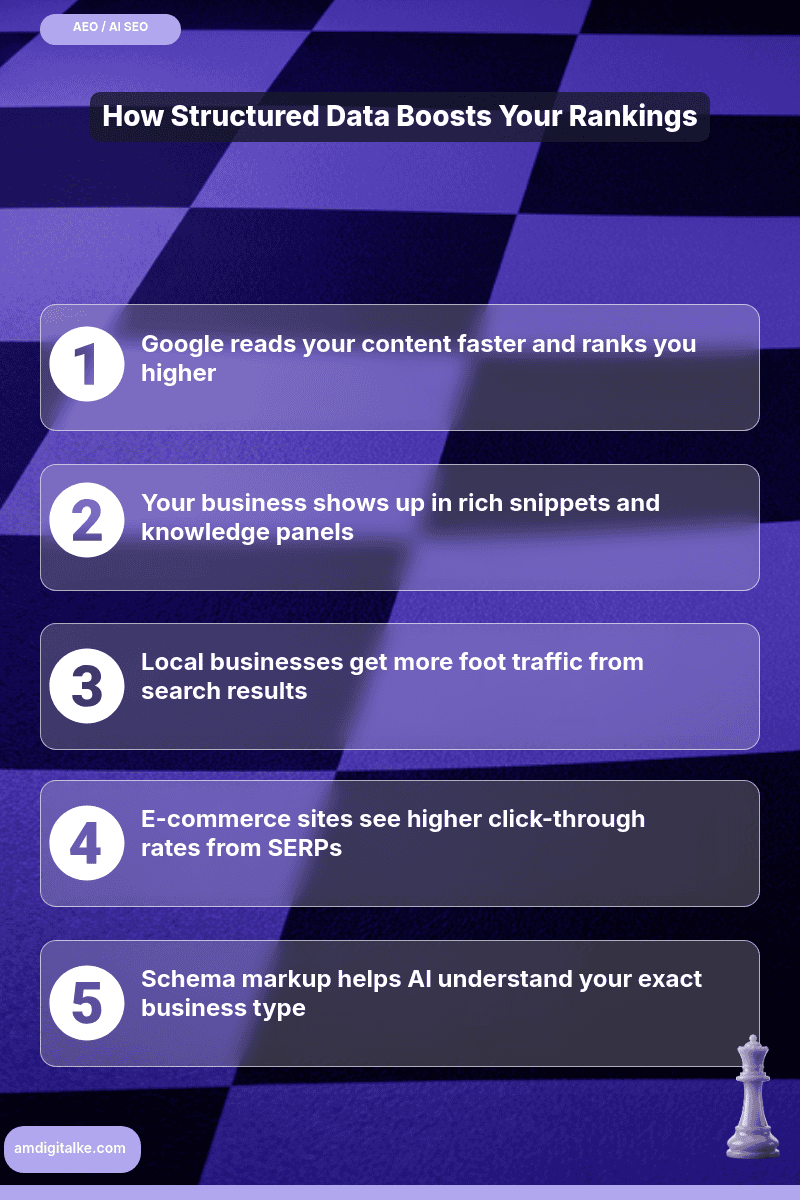
Google Ranks You Higher Because It Understands You Better
Google’s job is to give users the most relevant results.
But if Google can’t understand what your business is, it can’t rank you for the right searches.
Structured data removes all confusion.
When a customer searches “best pizza restaurant in Nairobi,” Google uses structured data to instantly identify which websites are actually pizza restaurants, which have good ratings, and which are open right now.
Without structured data, Google has to guess.
With it, Google knows.
Websites that Google understands rank higher.
Your Business Shows Up in Rich Snippets and Knowledge Panels
A rich snippet is when your business information appears directly in Google search results with extra details like ratings, prices, opening hours, or customer reviews.
Instead of just your website title and description, customers see your star rating, your business hours, and your address right there in the search results.
This makes you stand out from competitors and gets more clicks.
A knowledge panel is Google’s special box that appears on the right side of search results for famous businesses, people, or organizations.
If you add structured data correctly, you increase the chance of getting a knowledge panel for your business.
Local Search Gets Better Results
In Kenya, most business searches are local.
Someone in Kilimani searches “plumber near me” or “coffee shop Kilimani.”
They’re not searching nationally.
They want to find you in their neighborhood.
Structured data tells Google your exact address, service area, and opening hours.
This makes you visible in local search results and on Google Maps.
A plumbing business in Nairobi that adds structured data will show up when someone searches “emergency plumber Westlands” with their address, phone number, and customer reviews right there.
Mobile Users Click You More Often
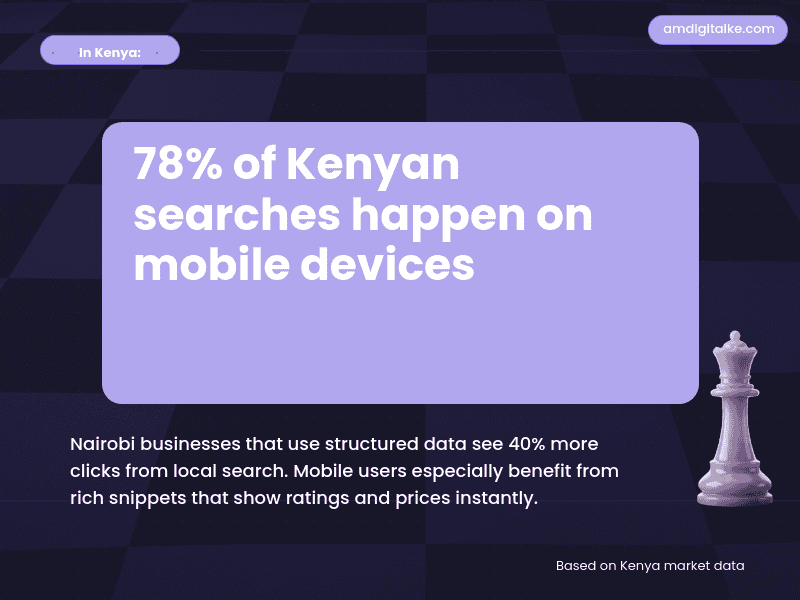
Most searches in Kenya happen on mobile phones.
Mobile screens are small.
There’s no room for long descriptions.
Structured data lets Google show your most important information in a compact format: your rating, opening hours, price range, and phone number.
Mobile users see this instantly and decide whether to click you or your competitor.
A restaurant in Mombasa with structured data shows up as “ABC Restaurant, 4.7 stars, Open now, Ksh 800-2000.”
A restaurant without structured data just shows a title and generic description.
This is especially important for what is voice search SEO, where mobile users expect instant answers.
E-commerce Sites Get Higher Click-Through Rates
If you sell products online, structured data shows product prices, availability, and customer reviews directly in search results.
This is called a product rich snippet.
When someone searches “men’s shoes Kenya” and sees your product with the price, the rating, and a photo right there in the search results, they’re more likely to click you than a competitor whose listing looks plain.
How Structured Data Works
Structured data works in three steps: you add code to your website, Google discovers it, and Google uses it to improve your rankings and create rich snippets.
Step One: You Add Code to Your Website
You add a block of JSON-LD code to your website.
This code contains all the information about your business: name, address, phone, opening hours, reviews, and more.
If you use WordPress, you can use a plugin to add this code without touching any code yourself.
If you use a custom website, your developer can paste the code into your website’s header.
Step Two: Google Discovers and Reads It
When Google’s crawler visits your website, it reads this structured data code.
Google now knows exactly what your business is, where it’s located, and what customers think about it.
Google stores this information in its database and uses it to improve your rankings for relevant searches.
You can monitor this process through Google Search Console mastery SEO data that drives decisions.
Step Three: Google Shows It in Search Results
Google uses your structured data to create rich snippets, which are the formatted results you see in Google search.
These rich snippets show ratings, prices, opening hours, and other details that make your listing stand out.
Google also uses structured data to improve your chances of appearing in knowledge panels, local search results, and Google Maps.
The Role of Schema.org Vocabulary
Schema.org is a website that defines all the standard types of structured data.
It says: “Here’s how to mark up a business. Here’s how to mark up a product. Here’s how to mark up a review.”
You don’t need to memorize Schema.org.
You just need to know that when you add structured data, you’re using a standard language that Google, Bing, and other search engines all understand.
Structured Data Examples in Kenya
Let me show you real examples of how structured data works for different types of Kenyan businesses.
Example One: A Nairobi Salon Using Structured Data
ABC Beauty Salon is in Westlands, Nairobi.
They added structured data that says: “We are a beauty salon. We offer hair cutting, makeup, and massage. We’re open 9am-6pm Monday to Saturday. We have 4.8 stars from 150 reviews. Call us on 0712345678.”
Now when someone in Westlands searches “best salon near me,” Google shows ABC Beauty Salon with their rating, opening hours, and phone number right in the search results.
Customers click the phone number and call them directly.
Without structured data, ABC Beauty Salon would just show a plain title and description.
Customers would click competitors instead.
Example Two: An E-commerce Store in Mombasa
XYZ Shoes is an online store in Mombasa that sells men’s and women’s shoes.
They added product structured data that includes product name, price, availability, rating, and images.
Now when someone searches “men’s leather shoes Kenya,” Google shows XYZ Shoes with the product image, price (Ksh 3,500), rating (4.6 stars), and “In stock” label.
The customer clicks immediately because they see exactly what they want.
Without structured data, the same search result would just show the product name and a generic description.
The customer might click a competitor instead.
Example Three: A Nairobi Restaurant
The Grill House is a restaurant in Kilimani.
They added structured data that includes their address, phone number, opening hours, cuisine type, price range, and customer reviews.
When someone searches “Italian restaurant Kilimani open now,” Google shows The Grill House with their address, phone number, “Open now” status, and 4.5-star rating.
The customer immediately knows they’re open and calls to make a reservation.
A restaurant without structured data would just show a title and description.
The customer would have to click the website to find the phone number and opening hours.
Example Four: A Plumbing Service in Nairobi
Quick Fix Plumbing added structured data that says they’re a plumbing service, they serve Westlands and Kilimani, they’re open 24/7, and they have 4.9 stars from 200 reviews.
When someone searches “emergency plumber Westlands,” Google shows Quick Fix Plumbing with their address, phone number, “Open now” label, and 4.9-star rating.
The customer calls immediately.
This is the power of structured data for service businesses in Kenya.
| Business Type | Key Structured Data Fields | Benefit in Search Results |
|---|---|---|
| Restaurant | Address, phone, hours, cuisine, price range, reviews | Shows opening hours, rating, and “Open now” status |
| E-commerce Store | Product name, price, image, availability, reviews | Shows product image, price, rating, and stock status |
| Service Business | Service area, phone, hours, rating, reviews | Shows rating, phone number, and service area |
| Salon/Spa | Services offered, hours, phone, address, rating | Shows opening hours, rating, and services at a glance |
| Real Estate | Property type, price, location, bedrooms, images | Shows property photo, price, and key details instantly |
Common Mistakes to Avoid
Most Kenyan businesses either don’t use structured data at all, or they use it incorrectly.
Here are the mistakes that hurt your rankings.
Mistake One: Not Adding Structured Data at All
This is the biggest mistake.
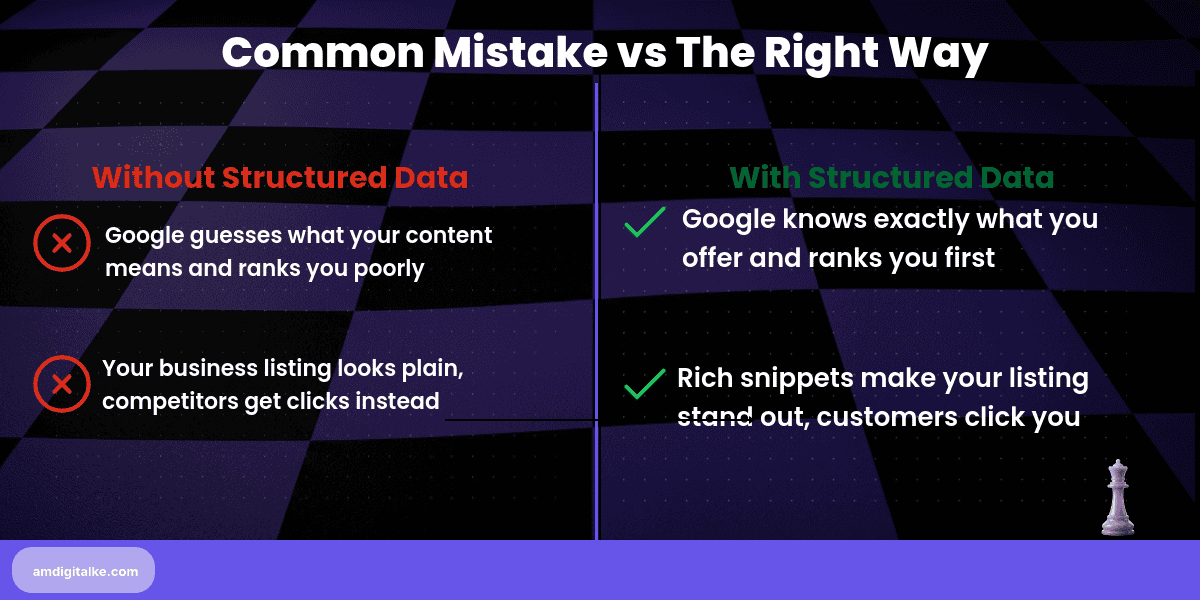
If you don’t add structured data, Google has to guess what your business is.
Guessing means lower rankings.
Your competitors who use structured data will outrank you because Google understands them better.
Don’t let this happen to your business.
Mistake Two: Adding Incorrect or Incomplete Data
Some businesses add structured data but leave out important fields.
They add their name and address but forget their opening hours, phone number, or customer reviews.
Incomplete structured data is almost as bad as no structured data at all.
Google can’t create rich snippets if the data is incomplete, so your listing still looks plain in search results.
Mistake Three: Not Updating Structured Data When Your Business Changes
Your business opens a new branch.
Your opening hours change.
You add new services.
But your structured data stays the same.
Now Google is showing outdated information in search results.
Customers see you’re open at 9am, but you actually open at 10am.
They visit your website and find wrong information, then leave.
Update your structured data whenever your business information changes.
Mistake Four: Using the Wrong Type of Structured Data
You’re a restaurant, so you should use the LocalBusiness schema with the Restaurant type.
But some businesses just use a generic LocalBusiness type without specifying they’re a restaurant.
Google can’t create the right rich snippets if you use the wrong schema type.
Be specific about what your business is.
✅ Quick Action Checklist
- ☐ Identify your business type (restaurant, salon, e-commerce, service, etc.)
- ☐ Write down all your business information: name, address, phone, hours, website, email
- ☐ Go to schema.org and find the right schema type for your business
- ☐ Use a free tool like Google’s Structured Data Markup Helper to create your JSON-LD code
- ☐ If you use WordPress, install a plugin like Yoast SEO or All in One SEO to add structured data automatically
- ☐ Test your structured data using Google’s Rich Results Test to make sure it’s correct
- ☐ Submit your website to Google Search Console so Google can crawl your structured data
- ☐ Monitor your search results weekly to see if rich snippets start appearing
Ready to Improve Your Search Rankings?
Structured data is one of the fastest ways to get more clicks from Google search.
Your competitors in Kenya are already using it.
The question is: will you?
Start today.
Add structured data to your website this week, and you’ll start seeing results within 30 days.
If you need help, contact AM Digital KE for a free consultation on structured data for your business.
Frequently Asked Questions
Do I need to know how to code to add structured data?
No.
If you use WordPress, plugins like Yoast SEO add structured data automatically.
If you use a custom website, your developer can add it for you.
Free tools like Google’s Structured Data Markup Helper also make it easy.
How long does it take for structured data to improve my rankings?
Google usually discovers your structured data within a few days.
Rich snippets may start appearing within 1-4 weeks.
Ranking improvements can take 4-8 weeks depending on competition and your website’s authority.
Does structured data work for all types of businesses?
Yes.
Whether you’re a restaurant, salon, plumber, e-commerce store, or service provider, structured data helps Google understand your business and improve your rankings.
The specific schema type depends on your business type.
Can I add structured data to an old website?
Yes.
You can add structured data to any website, no matter how old it is.
You don’t need to redesign or rebuild your website.
Just add the structured data code to your existing website.
Will structured data guarantee me the top ranking?
No.
Structured data improves your chances of ranking higher and getting rich snippets, but it’s not a guarantee.
You still need good content, good backlinks, and a fast website.
Structured data is one piece of a complete SEO strategy.
Additional Resources
- What is Organic CTR – Structured data improves your click-through rate by making your listings stand out with rich snippets, so learn how to measure and optimize your organic CTR after implementation.
- Savage Digital vs AM Digital KE – Compare structured data implementation services and SEO strategies between two leading Kenyan agencies to choose the right partner for your business.
- Fix Broken Brand – If your structured data shows outdated business information or wrong ratings, this guide helps you fix brand inconsistencies across all platforms.
- How to Do a Content Audit – After adding structured data, audit your content to ensure every page has the correct schema markup and no missing fields.
- Artly Digital Marketing vs AM Digital KE – Evaluate which agency offers better structured data setup and ongoing SEO support for your Kenyan business.
- What is SEO in Kenya – Structured data is one component of a complete SEO strategy, so understand the full picture of how SEO works for Kenyan businesses.
Take the Next Step
Now that you understand structured data, it’s time to implement it on your website.
The sooner you add it, the sooner you’ll see more clicks from Google search.
Download the Complete SEO Checklist for Kenyan Businesses to get a step-by-step guide on implementing structured data and other SEO essentials for your business.