Table of Contents
TL;DR: Organic CTR is the percentage of people who see your website in Google search results and actually click it. If 100 people search for your product in Nairobi and only 2 click your link, your CTR is 2%. Google uses CTR to decide whether your site deserves higher rankings, so a low CTR can trap you at position 5 or 6 forever.
You rank on page one of Google for “Lawyer services Westlands,” but your phone is not ringing.
Your website is there, it shows up in the search results, but nobody is clicking it.
This is an organic CTR problem.
And it is costing you money right now.
CTR stands for Click-Through Rate.
It is simply the percentage of people who see your website in Google search results and click on it to visit your site.
If 100 people search for your service and 3 click your link, your CTR is 3%.
Most Kenyan business owners never think about this metric.
They focus on ranking position and assume that ranking on page one is enough.
It is not.
Google measures not just where you rank, but whether people actually want to visit you.
When your CTR is low, Google notices.
Over time, it pushes you down the rankings because it assumes searchers do not find your listing compelling.
In this article, you will learn exactly what organic CTR is, why it matters for your business revenue, and how to improve it starting today.
📋 Key Takeaways
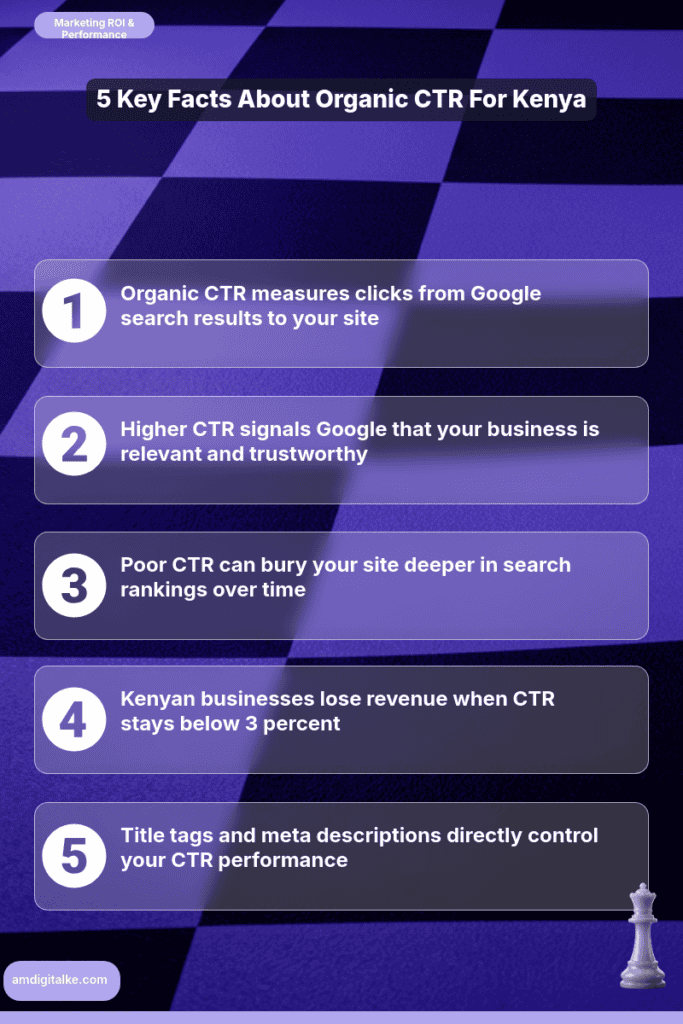
- Organic CTR is the percentage of Google searchers who click your website link from the search results page.
- Google uses CTR as a ranking signal. Low CTR can cause your rankings to drop even if your content is good.
- Your title tag and meta description are the only things searchers see before deciding to click. They control your CTR completely.
- Based on AM Digital KE client data across Kenyan accounts, businesses typically see CTR between 2% and 5%, depending on competition and keyword difficulty.
- Improving your CTR often produces faster ranking improvements than adding more content to your website.
What is Organic CTR?
Organic CTR is a percentage that tells you how many people click your website when they see it in Google search results.
The word “organic” means these are unpaid clicks from Google Search, not from Google Ads.
Here is how it works in real life.
A woman in Nairobi searches “best hair salon Kilimani” on Google.
Google shows her 10 results on the first page.
One of those results is your salon.
She sees your salon name, a short description, and your website address.
She decides whether to click it or click one of the other 9 results.
If she clicks your link, that counts as one click toward your CTR.
Google tracks this for every keyword you rank for.
It calculates: (Total clicks on your link) ÷ (Total times your link appeared in search results) = Your CTR percentage.
CTR vs Position: They Are Not the Same Thing
Many Kenyan business owners confuse ranking position with CTR.
Position 1 means you appear first. CTR means people actually click you.
You can rank position 1 and still have low CTR if your title and description do not appeal to searchers.
You can also rank position 3 and have higher CTR than the position 1 result if your listing is more compelling.
How Google Shows Your CTR Data
You can see your organic CTR in Google Search Console, which is Google’s free tool for website owners.
It shows you the average CTR for each keyword you rank for.
This data is crucial.
It tells you which keywords are attracting clicks and which are just taking up space.
A keyword where you rank position 2 but get 1% CTR is underperforming.
Why Does Organic CTR Matter for Kenyan Businesses?
CTR matters because Google uses it as a ranking signal.
This is not a theory. Google’s own engineers have confirmed this multiple times.
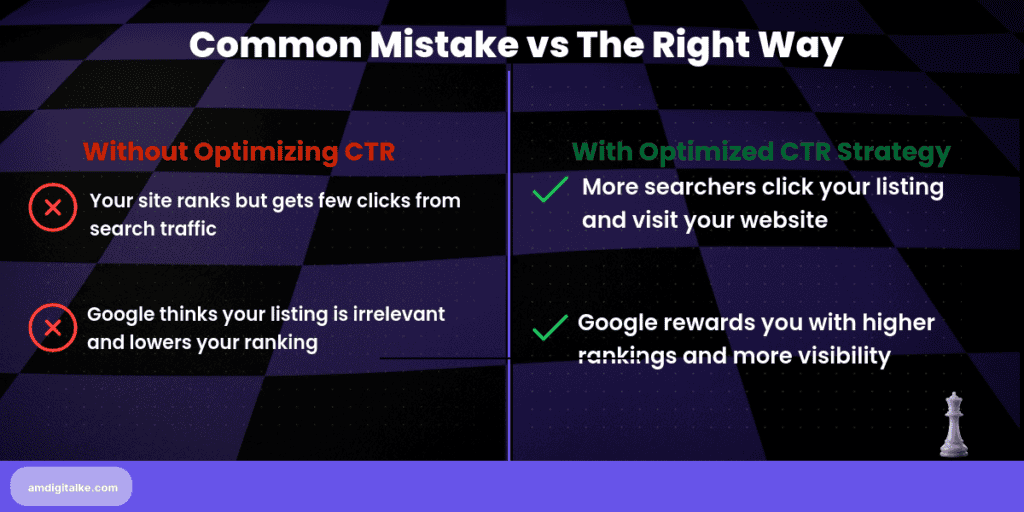
When your CTR is low, Google interprets this as a signal that your listing is not meeting searcher intent.
It assumes users are clicking on other results instead because they are more relevant.
Over weeks and months, Google lowers your ranking.
CTR Directly Affects Your Search Rankings
Imagine you rank position 3 for “event planning services Nairobi” with a 2% CTR.
Position 1 and 2 both have 5% CTR.
Google notices that fewer people click you even though you are on the first page.
After a few weeks, Google tests pushing you down to position 4 or 5.
It is testing whether a lower position is more “honest” given that people do not seem to want to click you anyway.
If your CTR stays low, you stay lower.
Conversely, if you improve your title and description and your CTR jumps to 4%, Google sees this as validation.
It may move you up because users clearly find you more relevant than before.
Low CTR Means Lost Revenue
Even if your ranking stays the same, low CTR directly costs you money.
You are paying for ranking position with your SEO effort, but you are not converting that position into website visits.
A Nairobi restaurant that ranks position 2 for “best nyama choma Westlands” but gets 1.5% CTR is losing customers to the position 1 result.
The restaurant is paying the same SEO cost as the competitor but getting fewer reservations.
Improving CTR is often faster than improving rankings.
You can test a new title tag today and see CTR improvements within days.
Getting a ranking improvement from position 2 to position 1 can take weeks.
CTR Compounds Over Time
Higher CTR does not just improve one ranking.
It improves your entire domain authority and topical relevance in Google’s eyes.
When Google sees that users consistently click your site across multiple keywords, it becomes more confident in your expertise.
This confidence spreads.
Google may rank you higher for related keywords you have not even optimized for yet.
A Nairobi accounting firm that improves CTR on “tax preparation services” may see ranking improvements on “bookkeeping services” and “payroll management” without doing any additional optimization.
How Organic CTR Works
CTR is calculated by Google automatically.
You do not need to do anything to measure it.
Google Search Console collects the data and shows it to you.
But understanding how CTR is calculated helps you see why improving it is possible.
CTR depends on two things: how many times your link appears in search results, and how many of those appearances result in clicks.
Impressions: How Many Times People See Your Link
An impression is counted every time your website appears in someone’s Google search results.
If you rank position 2 for “digital marketing agency Nairobi” and 1,000 people search that keyword this month, you get 1,000 impressions.
You do not control impressions directly.
Google decides how many times to show you based on your ranking position.
Position 1 gets shown more often than position 5.
Clicks: How Many People Actually Click Your Link
A click is counted when someone sees your link in the search results and clicks it to visit your website.
Clicks are what you control through your title tag and meta description.
These are the only two elements searchers see before deciding to click.
Your title tag is the headline. Your meta description is the short paragraph underneath.
The CTR Formula
CTR = (Total Clicks) ÷ (Total Impressions) × 100.
If your link appeared 1,000 times and got 30 clicks, your CTR is 3%.
This percentage varies wildly depending on your industry, competition, and ranking position.
A position 1 result typically gets 20-30% CTR.
A position 5 result typically gets 3-5% CTR.
| Ranking Position | Typical CTR Range | What This Means |
|---|---|---|
| Position 1 | 20-30% | 1 in 3 to 1 in 5 searchers click you |
| Position 2 | 10-15% | 1 in 7 to 1 in 10 searchers click you |
| Position 3 | 7-10% | 1 in 10 to 1 in 14 searchers click you |
| Position 4-5 | 3-6% | 1 in 17 to 1 in 33 searchers click you |
| Position 6-10 | 1-3% | 1 in 33 to 1 in 100 searchers click you |
Organic CTR Examples in Kenya
CTR looks different across different industries and keywords.
Understanding these examples helps you know whether your own CTR is healthy.
E-Commerce: Nairobi Online Boutique
A Nairobi fashion boutique ranks position 2 for “women’s dresses Nairobi” with 5,000 monthly impressions.
They get 180 clicks. Their CTR is 3.6%.
This is slightly below average for position 2 (which typically sees 10-15% CTR).
Why? The title tag says “Dresses – Boutique” which is generic.
Competitors with titles like “Designer Women’s Dresses | Free Delivery Nairobi” get 5-6% CTR.
By changing the title to “Trendy Women’s Dresses | Fast Shipping Nairobi | Shop Now” the boutique improved CTR to 4.8% within two weeks.
Same ranking position, 33% more clicks.
Services: Nairobi Plumbing Company
A plumbing company in Westlands ranks position 3 for “emergency plumbing services Nairobi” with 800 monthly impressions.
They get 24 clicks. Their CTR is 3%.
This is below average for position 3 (typically 7-10%).
The meta description says “We fix pipes and drains.”
Competitors say “24/7 Emergency Plumbing | 30-Min Response | Call Now | Westlands & Nearby.”
The plumbing company updated their description to “Emergency Plumbing 24/7 | 30-Minute Response | Licensed Technicians | Free Quotes.”
CTR jumped to 6.2% in three weeks.
Local Services: Gym in Kilimani
A gym in Kilimani ranks position 1 for “fitness gym Kilimani” with 2,000 monthly impressions.
They get 380 clicks. Their CTR is 19%.
This is below the typical 20-30% for position 1.
Why? Because three other gyms rank positions 2-4, and their titles include “New Year Promo” or “Free Trial Week.”
The Kilimani gym’s title just says “Fitness Gym Kilimani.”
By updating the title to “Fitness Gym Kilimani | 2-Week Free Trial | Modern Equipment” CTR improved to 24% within one month.
The ranking stayed position 1, but more people clicked.
Common Mistakes to Avoid
Most Kenyan businesses make the same CTR mistakes.
These mistakes cost them thousands of shillings in lost traffic every month.
Mistake 1: Ignoring Your Title Tag
Your title tag is the headline people see in Google search results.
Many businesses use generic titles like “Home | Company Name” or “Services | Website.”
Google shows this title to searchers.
A generic title gives them no reason to click you instead of the competitor below.
Your title must include the keyword, a benefit, or a reason to click.
A Nairobi accounting firm with the title “Accounting Services” gets low CTR.
A title like “Tax Accounting & Bookkeeping | Nairobi | Free Consultation” gets more clicks because it tells searchers exactly what they will get.
Mistake 2: Writing Meta Descriptions That Do Not Sell
Your meta description is the short paragraph under your title in search results.
Many businesses write these for Google, not for humans.
Google does not rank you based on your meta description.
Humans decide whether to click based on it.
If your description is boring or does not address the searcher’s problem, they will click a competitor instead.
A restaurant with the description “Restaurant in Nairobi serving food” will get fewer clicks than “Authentic Italian Restaurant | Fresh Pasta Daily | Reservations Available | Westlands.”
The second one speaks to what the searcher actually wants.
Mistake 3: Not Matching Search Intent
Search intent is what the searcher actually wants when they type a keyword.
If your title and description do not match what they want, they will not click you.
Someone searching “how to fix a leaky tap” wants instructions, not a plumber’s contact information.
If your title says “Call Us for Plumbing Help” and you rank for this keyword, your CTR will be terrible because you are not matching intent.
The searcher will click a blog post that explains how to fix the tap.
Later, if they cannot fix it, they will search “plumber near me” and then click you.
✅ Quick Action Checklist
- ☐ Go to Google Search Console and check your average CTR for your top 10 keywords
- ☐ Identify keywords where you rank position 1-3 but CTR is below 5%
- ☐ Write a new title tag for your top underperforming keyword (include keyword, benefit, and reason to click)
- ☐ Write a new meta description (40-160 characters, speak to searcher’s problem, include a benefit)
- ☐ Wait 2-3 weeks and check CTR again in Google Search Console
- ☐ If CTR improved, apply the same approach to your next 5 underperforming keywords
- ☐ Document which title and description formats work best for your industry
- ☐ Set a monthly reminder to review CTR data and optimize low-performing keywords
Ready to Improve Your Organic CTR?
CTR is one of the fastest ways to improve your search rankings without waiting weeks for new content to rank.
A better title and description can improve your clicks within days.
The businesses that win at SEO are not the ones with the most content.
They are the ones who optimize every detail, including the small things searchers see first.
Start with your top 5 keywords today.
Check their CTR in Google Search Console.
If any are below 4%, rewrite the title and description.
Contact AM Digital KE if you need help implementing a CTR improvement strategy.
We start with a Free SEO Audit to know your actual CTR.
Frequently Asked Questions
What is a good organic CTR for my website?
A good CTR depends on your ranking position.
Position 1 should be 15-25%. Position 2-3 should be 5-10%. Position 4-5 should be 2-5%. If you are below these ranges, your title and description need improvement.
Can I improve CTR without changing my ranking position?
Yes. CTR is controlled by your title tag and meta description, not your ranking position.
You can rank position 3 and get 8% CTR if your title and description are compelling. You can also rank position 2 and get 2% CTR if they are weak.
How long does it take to see CTR improvements?
Google updates CTR data daily.
You should see changes within 3-7 days if you rewrite your title and description. Give it 2-3 weeks for a full picture of the impact.
Does CTR affect my ranking directly or indirectly?
CTR is a ranking signal, meaning Google uses it to decide whether to move you up or down.
When users click your result more often, Google assumes it is more relevant and may rank it higher. This is a direct ranking factor.
Should I use keywords in my title tag?
Yes. Include your main keyword in your title tag if possible.
But do not stuff keywords. “Tax Accounting Nairobi | Tax Accounting Services | Accounting” is keyword stuffing. “Tax Accounting & Bookkeeping Services | Nairobi” is natural and includes the keyword.
Related Posts You May Be Interested In
These articles cover topics that work alongside what is organic CTR.
Worth reading if you want stronger results in Kenya.
- How to Maximise CTR for Your Kenyan Business
- Call-To-Action Copy – Getting Kenyan Visitors to Act
- Tracking What Matters – Essential Metrics for Kenyan Websites
- How to Boost Dwell Time- A Kenyan Expert’s Playbook
Take the Next Step
CTR optimization is a skill most Kenyan business owners never learn.
But once you understand it, you can implement it in under an hour and see results within weeks.
Ready to audit your current CTR and create a plan to improve it?
Check out this Kenya marketing calculator to see exactly which metrics matter most for your business.