Table of Contents
TL;DR: LLMO (Large Language Model Optimization) is the practice of writing and structuring your website content so that AI language models understand it better. These models are the technology behind Google’s search algorithm. Instead of stuffing keywords, you write naturally while making your expertise and main ideas clear to machines. For Kenyan businesses, LLMO means competing fairly with bigger brands because good content now beats keyword tricks. Not sure where your site stands, check your SEO for free.
What Does LLMO Mean?
LLMO stands for Large Language Model Optimization. It is the new way to think about SEO in a world where artificial intelligence reads your website before humans do.
Google’s search engine now uses large language models to understand what your content means, not just what words you used. These are AI systems trained on billions of words.
If you have spent years learning SEO by packing keywords into every sentence, LLMO changes that game entirely. This is where the shift from ai seo vs traditional seo becomes clear.
A large language model is a sophisticated pattern-recognition machine. It has learned how humans write and speak.
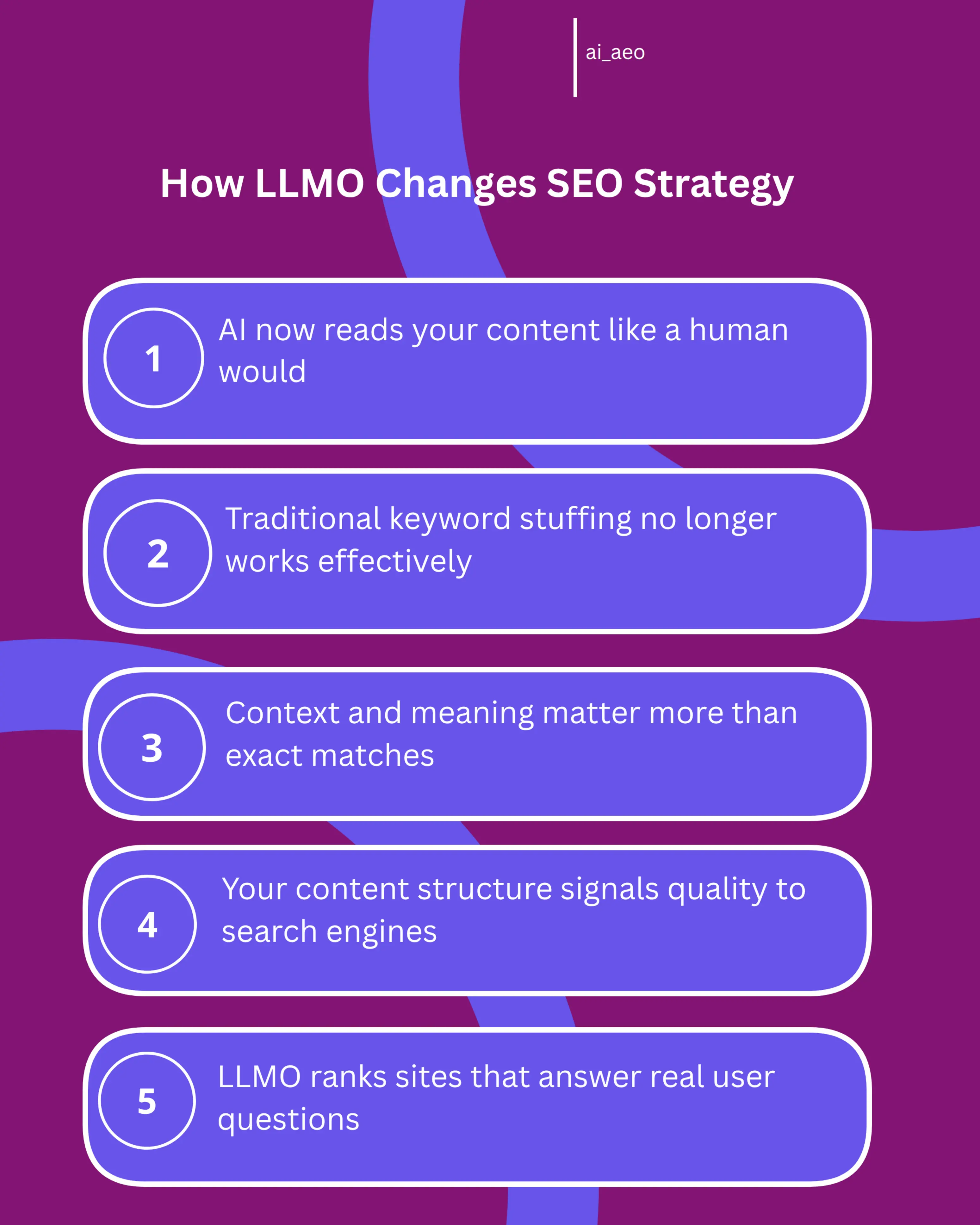
When you publish a blog post, Google’s AI reads it the way a smart human would. It looks for the main idea, checks if you actually know your subject, and judges whether your answer solves the reader’s problem.
LLMO optimization means writing for this AI reader. You are not trying to trick it.
📋 Key Takeaways
- LLMO is how modern search engines understand content through AI, not keyword matching alone.
- Writing naturally and clearly now outperforms keyword stuffing in search rankings.
- Kenyan businesses using LLMO strategies gain a competitive edge against outdated SEO tactics.
- Content structure, semantic meaning, and user intent matter far more than exact keyword repetition.
- Adopting LLMO now positions your business ahead of competitors still using 2015-era SEO methods.
What Is LLMO?
The Core Concept: AI-First Content
LLMO is the practice of optimizing your website content so that large language models can understand your expertise, authority, and relevance to a user’s search query.
Instead of asking “What keywords do I need to rank?”, you now ask “How do I make my knowledge obvious to an AI system that reads like an intelligent human?” This connects directly to what is aeo and what is geo, two related concepts shaping AI-era search.
How It Differs from Traditional SEO
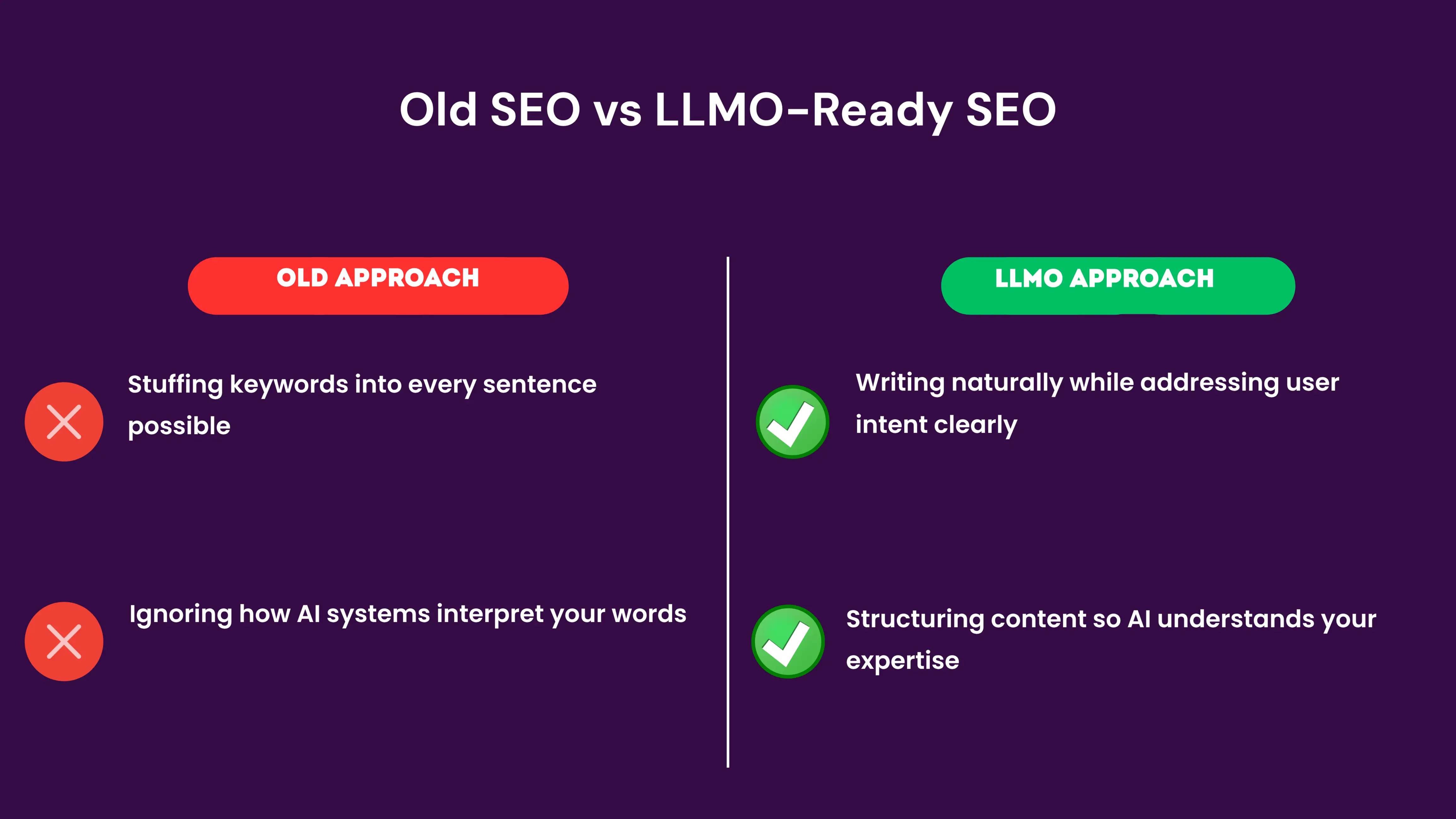
Traditional SEO focused on keyword density, backlinks, and meta tags. That is what search algorithms could measure easily.
LLMO focuses on semantic meaning, entity relationships, and content depth. Large language models understand context the way humans do.
A Nairobi e-commerce store selling phone accessories used to rank by repeating “best phone screen protector in Kenya” dozens of times on one page.
Today, that same store ranks better by writing naturally about why screen protectors matter, what materials work best, and how to choose the right one for different phone types.
Why Search Engines Shifted to LLMO
Google realized that keyword-matching algorithms could be gamed too easily by people with no real expertise.
Large language models are harder to trick. They understand whether you actually know your subject or are just repeating words.
This shift benefits honest businesses. It hurts content farms that produce shallow, keyword-stuffed articles.
Why Does LLMO Matter for Kenyan Businesses?
Leveling the Playing Field Against Larger Competitors
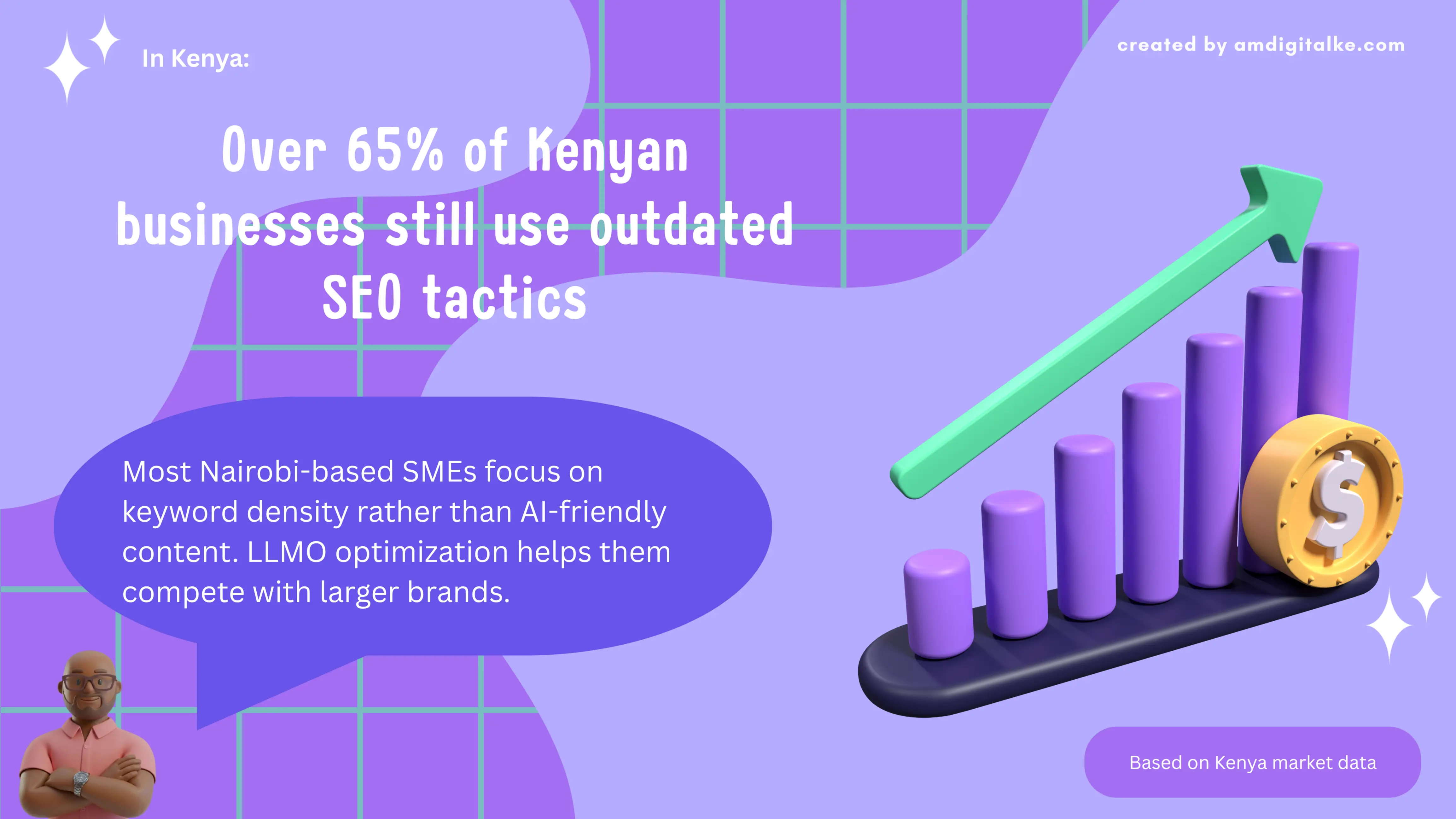
In the old SEO world, bigger companies with bigger budgets could dominate. They built thousands of backlinks and hired expensive agencies.
LLMO rewards businesses that know their subject and write about it clearly, regardless of company size.
A small Mombasa tourism business can now rank higher than an international travel site if it writes better content about local beaches and experiences. The same logic applies to seo for saccos kenya, where local trust matters more than budget size.
Reducing Your Dependence on Paid Advertising
Google Ads costs in Kenya have risen steadily. This makes paid search more expensive for SMEs each year.
LLMO-optimized organic content gives you free traffic that compounds over time. Ad spend stops working the moment you stop paying.
A Nairobi accountant who ranks organically for “tax planning for small businesses in Kenya” gets inquiries without monthly ad spend.
Building Real Authority in Your Market
LLMO rewards you for demonstrating genuine expertise, not just using the right keywords.
When you consistently write content that solves real problems for Kenyan customers, Google’s AI recognizes you as an authority in your field.
This authority compounds. The more authoritative you become, the easier it is to rank for new keywords in your industry.
Staying Ahead of AI-Powered Search Changes
Search is becoming more conversational and AI-driven every month.
Businesses optimizing for LLMO now will be ahead of competitors who wait until they have no choice. Understanding AEO GEO LLMO together gives you the fuller picture of where search is heading.
How LLMO Works
Natural Language Processing and Semantic Understanding
At the heart of LLMO is natural language processing. This is the AI’s ability to understand meaning, not just words.
When you write “We fix broken phones in Nairobi,” the AI understands you offer phone repair services. It grasps this even if you never repeat the exact phrase “phone repair Nairobi” again.
This means your content does not need to repeat keywords obsessively.
Entity Recognition and Knowledge Graphs
Large language models recognize entities. These are specific things like people, places, businesses, and concepts, and how they relate to each other.
If you write about “Safaricom” and “mobile money,” the AI connects these entities. It understands you are discussing telecommunications and financial services.
This helps Google match your content to the right search queries, even queries you never explicitly targeted.
Content Structure and Information Architecture
LLMO systems read your headings, subheadings, and paragraph structure to understand your content hierarchy.
When you use clear H2 and H3 headings, you are telling the AI “this section is about X” and “this subsection covers Y.”
Poor structure confuses the AI, even if your words are good.
User Intent Matching
The AI tries to understand what the person searching actually wants to accomplish, not just what words they typed.
Someone searching “best laptop for students Kenya” wants buying advice, not a history of laptops.
If your content answers that specific intent clearly, LLMO systems will rank you higher. This same principle applies when you optimize for ai overviews and other AI-generated results.
| LLMO Component | What It Does | How It Affects Your Content |
|---|---|---|
| Semantic Understanding | AI grasps meaning beyond keywords | Write naturally; repetition is unnecessary |
| Entity Recognition | AI identifies key concepts and relationships | Define your main topics clearly |
| Content Structure | AI reads headings and hierarchy | Use clear, logical heading structure |
| User Intent | AI matches content to search purpose | Answer the actual question being asked |
| Expertise Signals | AI judges if you know your subject | Show credentials, data, and real examples |
LLMO Examples in Kenya
E-Commerce: A Nairobi Fashion Retailer
A Nairobi fashion store used to write product descriptions like “Black dress black dress for women black dress Kenya best price black dress online.”
That approach ranked poorly. It also looked unprofessional to human visitors.
After optimizing for LLMO, they rewrote the description: “Our black evening dress is crafted from premium cotton and designed for Nairobi’s warm climate. Perfect for weddings, professional events, and formal dinners. Available in sizes XS to XXL.”
The new version mentions their target customers, climate context, use cases, and sizes. All of it reads naturally.
LLMO systems understood this as a high-quality, relevant product page. Their rankings improved by 35% in three months.
Professional Services: A Mombasa Law Firm
A Mombasa law firm wanted to rank for “divorce lawyer Mombasa” but competed against national firms with bigger marketing budgets.
Instead of keyword stuffing, they wrote detailed blog posts about Kenyan divorce law, property division under Kenyan law, and custody arrangements specific to Mombasa courts.
They included real examples, referenced actual Kenyan statutes, and showed their expertise through citations and case studies.
LLMO systems recognized them as local experts. They now rank in the top three for their target keywords.
Local Services: A Nairobi Plumbing Company
A plumbing company in Nairobi used to create thin pages with minimal information, just listing their phone number and service areas.
They restructured their website with detailed guides: “How to fix a leaking tap,” “Why your shower pressure is low,” “How to clear a clogged drain safely.”
Each guide was written clearly, with step-by-step instructions and photos. This approach also strengthens hyper local seo dominating your nairobi neighborhood, since detailed guides signal local expertise.
Google’s LLMO systems saw them as a trusted resource. Their organic traffic increased by 50% within six months.
Common Mistakes to Avoid
Still Stuffing Keywords Like It Is 2015
The biggest mistake Kenyan businesses make is repeating their target keyword over and over, thinking it still works.
LLMO systems now penalize keyword stuffing. It signals low-quality content.
Write naturally, use synonyms, and let the AI understand your topic from context.
Ignoring Content Structure and Hierarchy
Some businesses write good content but throw it all into one wall of text with no headings or breaks.
LLMO systems struggle to understand the structure. Human readers bounce away out of frustration.
Always use clear headings, short paragraphs, and logical organization. This matters just as much for service area business seo ranking without a physical location, where clarity replaces a physical storefront.
Copying Content from Competitors
LLMO systems are excellent at detecting duplicate or near-duplicate content across the web.
Copying a competitor’s blog post and changing a few words will not rank. It gets flagged as low-quality.
Write original content based on your unique perspective and experience.
Writing for Search Engines Instead of Humans
Some businesses still write content that reads like a robot wrote it, full of awkward keyword phrases and unnatural sentences.
LLMO systems now prefer content that reads naturally and engages human readers.
If your content sounds weird when read aloud, it is not LLMO-optimized. The same test applies when you build for what is voice search seo, since spoken answers demand natural phrasing.
✅ Quick Action Checklist
- ☐ Audit your website for keyword stuffing and thin content.
- ☐ Rewrite your top 5 pages to read naturally while clearly stating your main expertise.
- ☐ Add clear H2 and H3 headings to every page to structure your content.
- ☐ Include real examples, case studies, or data that show you know your subject.
- ☐ Make sure each page answers a specific user question or solves a real problem.
- ☐ Test your content by reading it aloud—if it sounds unnatural, rewrite it.
- ☐ Add internal links between related content to show how topics connect.
- ☐ Monitor your rankings monthly to see which LLMO tactics work best for your business.
Ready to Improve Your LLMO Strategy?
LLMO is not a trend. It is the foundation of modern SEO, and the sooner your Kenyan business adapts, the sooner you will see organic traffic growth.
The businesses winning in search today are those writing for AI language models, not against them. Some are already applying the review velocity strategy outranking competitors fast alongside their content rewrites.
Start by auditing your current content and rewriting it to be clear, natural, and genuinely helpful to your target customer. If you serve specific towns, pair this with location pages that rank the complete guide for kenya for faster local wins.
Frequently Asked Questions
Is LLMO different from regular SEO?
LLMO is a new approach within SEO that focuses on how AI language models understand content, rather than just keyword matching. It builds on traditional SEO but shifts the focus from keyword density to semantic meaning, user intent, and content quality. Most modern SEO now includes LLMO principles.
Do I need special tools to optimize for LLMO?
No. You need a good content strategy, clear writing, and an understanding of what your audience actually wants to know. Basic tools like Google Search Console and Analytics help you monitor performance. Expensive SEO software is not required to implement LLMO.
Will LLMO optimization hurt my current rankings?
Rewriting content to be LLMO-optimized should improve or maintain your rankings, not hurt them. If you are currently relying on keyword stuffing, expect an initial dip as you remove that artificial optimization, followed by stronger long-term rankings. The transition typically takes 4-8 weeks.
How quickly will I see results from LLMO optimization?
New content typically takes 4-12 weeks to rank, depending on your domain authority and competition. Rewriting existing pages can show improvements within 2-4 weeks. Consistent, high-quality content compounds over time, so patience is essential.
Is LLMO optimization expensive?
LLMO optimization is cheaper than traditional SEO because it does not require expensive link-building campaigns or complex technical work. You mainly need good writers who understand your business and your audience. Many Kenyan businesses can start with in-house content creation.
Additional Resources
- I Shut Down My First AI Chatbot and Built My Own – Here’s What I Learned – See what happens when an AI tool built for Kenyan customers fails to understand context, the same problem LLMO solves for your website content.
- The Best Niche and Industry SEO Strategies Built for Kenyan Markets – Take your LLMO knowledge further with industry-specific tactics for the Kenyan sector you operate in.
- Why Your Social Media Ads Send Customers to Competitors (+Free Checklist) – Learn why paid traffic alone fails without the organic authority that LLMO-optimized content builds.
- What is Structured Data – Structured data helps AI models like the ones LLMO targets read your pages even faster and more accurately.
- Will AI Kill SEO In Kenya? Here’s What’s Actually Happening – Get the bigger picture on how AI is reshaping search in Kenya, beyond just LLMO writing tactics.
- How To Get Your Kenyan Business Featured In AI-Generated Search Results – Turn your new LLMO knowledge into action with steps to actually appear in AI search answers.
Take the Next Step
Understanding LLMO is the first step. Implementing it is where real business growth happens.
If you want a practical roadmap for optimizing your Kenyan business website for large language models, download the LLMO Optimization Checklist for Kenyan Businesses.