Table of Contents
- Why Kenyan Businesses Need to Rank in AI Search Now
- 📋 Key Takeaways
- What You Need Before You Start
- Step 1: Structure Your Content for AI Understanding
- Step 2: Build Authority Signals (E-E-A-T)
- Step 3: Optimize for AI-Specific Search Queries
- Step 4: Keep Your Content Fresh and Updated
- Step 5: Optimize for Local AI Search
- Common Mistakes to Avoid
- Content Structure Comparison Table
- ✅ Quick Action Checklist
- Ready to Improve Your AI Search Ranking?
- Frequently Asked Questions
- Additional Resources
- Take the Next Step
TL;DR: AI search engines like ChatGPT and Google’s AI Overviews pull answers from your website differently than Google’s traditional search. You need clear, authoritative, well-structured content that answers specific questions directly. Update your content regularly, cite your sources, and prove your expertise to get featured in AI results. Want a clear picture of where you stand? get your free SEO review.
Why Kenyan Businesses Need to Rank in AI Search Now
Your customers are asking questions to ChatGPT, Google’s AI Overviews, and Perplexity instead of scrolling through Google search results. If your website doesn’t show up in those AI-generated answers, you’re losing leads to competitors who do.
AI search is not coming. It’s here.
Google has already rolled out AI Overviews to millions of users. Millions more use ChatGPT, Claude, and other AI assistants to find products, services, and local businesses every single day.
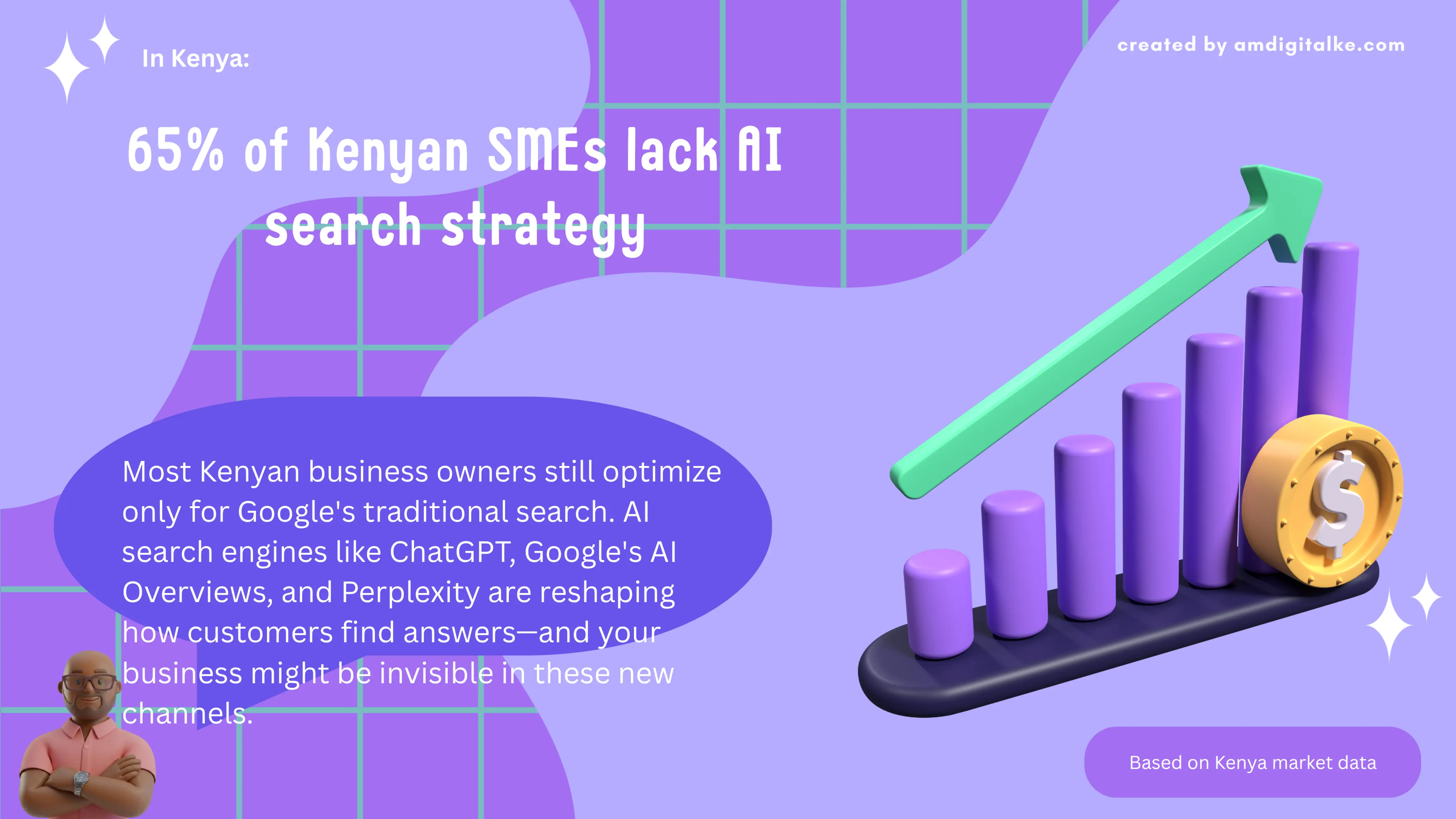
The problem is simple. Most Kenyan businesses still optimize only for traditional Google search. They built their websites around keywords and backlinks, the old SEO playbook.
But AI search engines read and rank content differently. Understanding ai seo vs traditional seo is the first step to fixing this.
This article teaches you the new rules. You’ll learn how to structure your content, prove your authority, and get featured in AI search results so customers find your business first.
📋 Key Takeaways
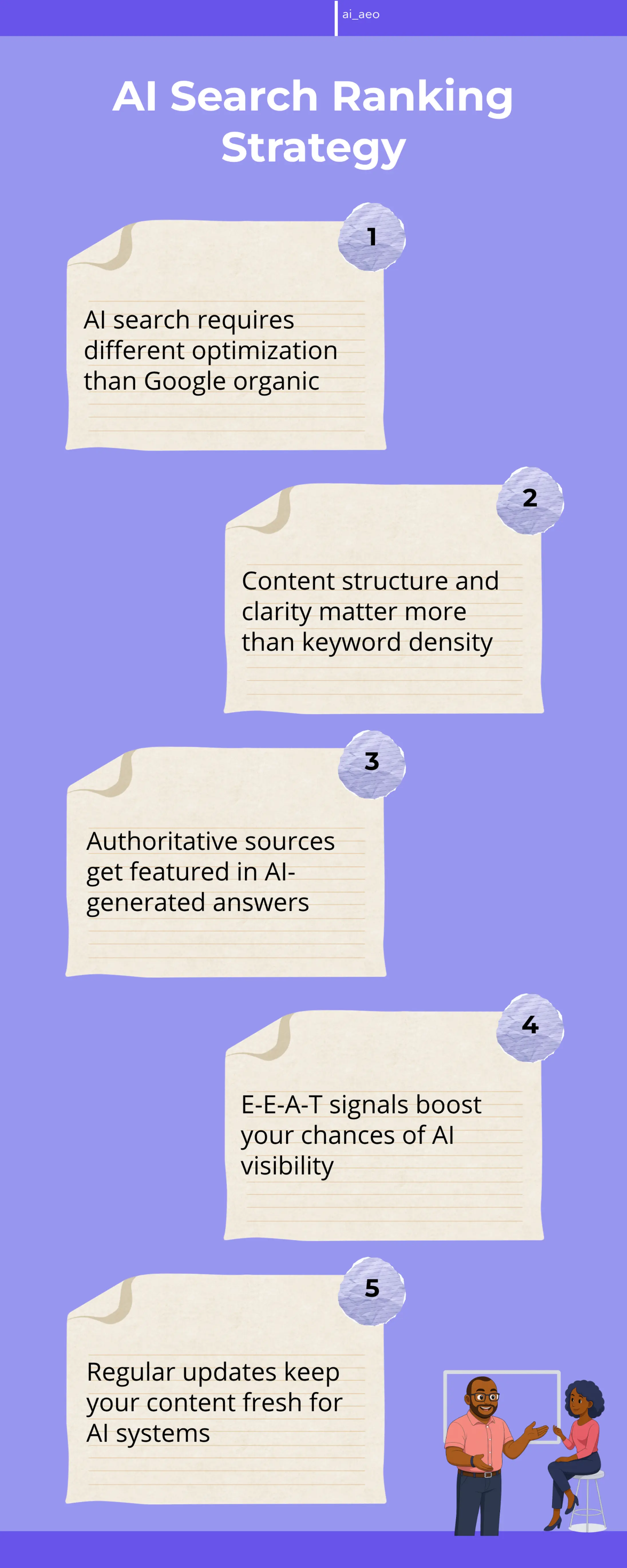
- AI search engines reward clear, direct answers over keyword-stuffed content.
- Authority and expertise (E-E-A-T) are now ranking signals that matter more than backlinks.
- Content structure—headings, lists, tables—helps AI understand and feature your answers.
- Freshness and regular updates tell AI systems your content is current and trustworthy.
- Local businesses in Kenya need to claim profiles and optimize for AI-powered local search.
What You Need Before You Start
Before you optimize for AI search, get the foundation right. AI search engines crawl the same web as Google.
If your website isn’t indexed in Google, it won’t appear in AI results either. But AI search demands more than being indexed.
You need to be credible, clear, and current.
A Website Google Can Crawl and Index
Your website must be live, fast, and mobile-friendly. AI search engines send crawlers to read your pages, just like Google does.
If your website takes 5 seconds to load on a phone, or your hosting is unreliable, AI systems struggle to fetch your content. Test your site speed using Google’s PageSpeed Insights tool, and use a reliable hosting provider.
Published Content About Your Business or Industry
You need actual content to rank. AI search engines don’t rank empty websites or pages with just a few sentences.
If you’re a salon in Nairobi, you need pages about your services, your team, your location, and answers to questions customers ask. If you’re a freelancer, you need a portfolio and case studies that prove what you do.
Proof of Expertise and Authority
AI search engines look for signals that you know what you’re talking about. Your name, credentials, and experience need to be visible on your website.
If you’re a tax consultant in Kenya, mention your CPA certification or years of experience. If you run a digital marketing agency, show past client results.
AI systems are trained to recognize authority, and they reward it in rankings. Learning how to get featured in AI search results starts with this signal.
Access to Google Search Console
You need to monitor how your website appears in search. Google Search Console is free and essential.
It shows you which queries bring visitors to your site, which pages rank, and any technical issues Google finds. This data tells you whether your AI search optimization is working.
Step 1: Structure Your Content for AI Understanding
AI search engines don’t read your website the way humans do. They parse the structure, headings, paragraphs, lists, tables, to understand what your page answers.
If your content is one giant block of text, AI systems struggle to extract the answer. If it’s well-structured, they can pull your content into an AI-generated response and credit your site.
Use Clear Headings and Subheadings
Break your content into sections with descriptive H2 and H3 headings. Each heading should tell AI, and your reader, what that section answers.
Instead of a heading like “More Information,” use “How to Register a Business in Kenya with KRA.” AI systems use headings to understand the hierarchy of your content and decide which section answers a specific query.
Answer Questions Directly in the First Paragraph
Don’t bury your answer halfway through the page. Put it in the first sentence under the heading.
If someone asks “How much does it cost to start a salon in Nairobi?” your first paragraph should say something like “Starting a salon in Nairobi typically costs between KES 150,000 and KES 500,000.” AI systems extract this sentence and feature it in their answer.
Use Lists and Tables to Organize Information
Bullet points and numbered lists make content easier for AI to parse. So do tables.
If you’re writing about steps to get a business license in Kenya, use a numbered list. If you’re comparing mobile money platforms, use a table with columns for fees, speed, and availability.
Step 2: Build Authority Signals (E-E-A-T)
E-E-A-T stands for Experience, Expertise, Authoritativeness, and Trustworthiness. Google and other AI systems use these signals to decide whether your content deserves a spot in AI results.
This is not about backlinks anymore. It’s about proving who you are and why you’re qualified to answer the question.
Show Your Experience and Credentials
Create an About page or author bio that states your background clearly. If you’re a lawyer, mention your law degree and years of practice.
For a Nairobi restaurant, this might mean mentioning your chef’s training, years in the business, and awards you’ve won. AI systems look for these signals on your About page and author bios.
Cite Your Sources and Link to Authority
When you make a claim, back it up with a source. If you’re writing about Kenya’s tax rates, link to the KRA website.
AI systems recognize authoritative sources. When they see your content citing official government data, they treat your content as more trustworthy, which increases your chance of getting featured.
Gather Reviews and Social Proof
Customer reviews on Google, Trustpilot, or your website tell AI systems that real people trust your business. Aim to build a consistent stream of positive reviews.
If you’re a plumber in Mombasa, encourage satisfied customers to leave Google reviews. Fast, consistent reviews build momentum. The review velocity strategy outranking competitors fast shows you how to speed this up.
Publish Content Consistently Over Time
A website with one article from 2021 looks abandoned. AI systems favor websites that show ongoing activity and freshness.
Publish a blog post, case study, or resource guide at least once a month. This signals to AI systems that you’re actively maintaining your expertise.
Step 3: Optimize for AI-Specific Search Queries
People ask AI search engines questions differently than they ask Google. They use conversational, question-based queries.
When someone searches Google, they might type “best accountant Nairobi.” When they ask ChatGPT, they type “What should I look for in an accountant in Nairobi?”
Research Question-Based Keywords
Find the questions your customers actually ask. Use Google’s “People Also Ask” section, or ask your customers directly what questions they had before hiring you.
If you’re a digital marketing agency in Kenya, your customers might ask: “How much does SEO cost in Kenya?” or “What’s the difference between SEO and SEM?” Create content that answers these exact questions.
Create FAQ Pages and Answer Guides
FAQ pages are perfect for AI search. Each question-and-answer pair is a self-contained chunk of content that AI systems can extract and feature.
Build a comprehensive FAQ for your business. If you run a logistics company, answer questions like “How long does delivery take to rural Kenya?” Each answer should be 50-100 words, clear and direct.
Target Long-Tail, Conversational Phrases
Short, generic keywords like “SEO” or “marketing” are hard to rank for in AI search. Long-tail phrases like “how to improve Google ranking for my salon in Nairobi” work better.
These longer, specific phrases match how people actually talk to AI assistants. They also face less competition, so your chances of ranking are higher. Voice queries follow this same pattern, and knowing what is voice search seo helps you capture both.
Step 4: Keep Your Content Fresh and Updated
AI search engines prioritize fresh content. If your page hasn’t been updated in two years, AI systems assume it’s outdated, even if the information is still accurate.
Freshness is a ranking signal. Every time you update a page, search engines recrawl it and re-evaluate its relevance.
Set a Content Review Schedule
Pick a date each quarter to review and update your top pages. Check that prices, dates, and facts are still accurate.
If you wrote a guide to “Starting a Business in Kenya” in 2022, review it now. Update the page with current information and today’s date.
Add New Sections to Existing Pages
You don’t have to rewrite a page from scratch. Add a new section, update an example, or expand an answer with recent data.
If you have a page about mobile money in Kenya, add a new section about the latest USSD codes. This signals freshness without requiring a complete rewrite.
Publish New Content on Trending Topics
When something new happens in your industry, write about it fast. If the Kenya Revenue Authority announces a new tax deadline, publish a guide immediately.
AI systems reward timeliness. New, relevant content gets crawled quickly, and it often ranks well because there’s less competition.
Step 5: Optimize for Local AI Search
If you’re a local business in Kenya, you need to optimize for location-based AI queries. When someone asks “best plumber near me,” AI systems need to know where you are and what you offer.
Claim and Complete Your Google Business Profile
Your Google Business Profile is your local identity. AI search systems use this data to understand your business name, location, hours, phone number, and services.
Claim your profile, fill in every field, add photos, and encourage reviews. This is the single most important local signal for AI search ranking.
Use Local Keywords and Location Pages
If you serve multiple areas in Kenya, create location-specific pages. A salon in both Nairobi and Mombasa should have separate pages for each location.
On your Nairobi page, mention “Westlands,” “Karen,” and other neighborhoods. AI systems use these location mentions to match your business with local queries, and location pages that rank the complete guide for kenya covers this in depth.
If you don’t operate from a fixed storefront, you still need visibility. Service area business SEO ranking without a physical location explains how to structure this correctly.
Build Local Citations
A citation is any mention of your business name, address, and phone number online. Directories, review sites, and local listings all count.
List your business on Google Business, Jumia, and OLX Kenya. Consistent citations across platforms tell AI systems your business is legitimate.
Common Mistakes to Avoid
Many businesses make predictable errors when trying to rank in AI search. Understanding these mistakes helps you avoid them.
Mistake 1: Ignoring Content Quality
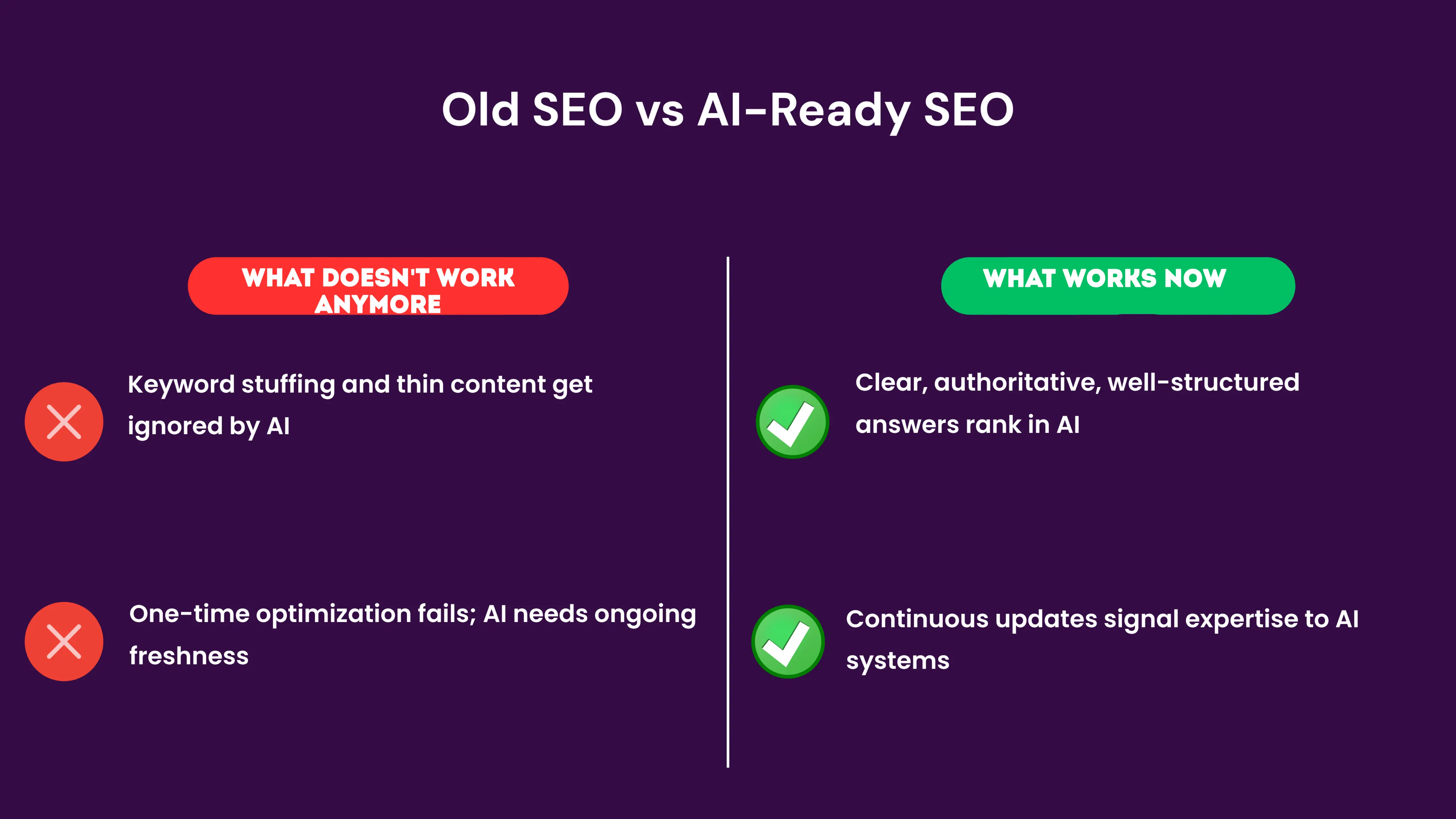
Some businesses think they can stuff keywords into thin, low-quality content and rank in AI search. This doesn’t work.
AI systems are trained to recognize poor-quality content. A 100-word page with repeated keywords will not rank, no matter how many backlinks you build.
Mistake 2: Not Updating Old Content
Businesses publish a page once and never touch it again. AI systems see this as a red flag.
Your content needs to stay current. Review and update your top pages at least quarterly.
Mistake 3: Hiding Your Expertise
Some business owners don’t mention their credentials or experience on their website. They assume it’s obvious or irrelevant.
AI systems can’t assume. If you don’t state your qualifications explicitly, AI systems won’t recognize your authority.
Mistake 4: Targeting the Wrong Keywords
Businesses optimize for short, competitive keywords that don’t match how people ask AI assistants. “SEO” might be popular, but “how to improve my Google ranking without paying for ads” is more likely to match an AI query.
Research the actual questions your customers ask. Target these instead of generic, short phrases.
Mistake 5: Neglecting Local Optimization
Local businesses often ignore their Google Business Profile or fail to create location-specific pages. This is a massive missed opportunity.
If you’re a business in Kenya, local optimization is critical for AI search. Complete your profile, add location pages, and build local citations.
Content Structure Comparison Table
Here’s a quick reference for how to structure different types of content for AI search.
| Content Type | Best Structure | Why AI Prefers It |
|---|---|---|
| How-to Guide | Numbered steps, clear headings, images | AI can extract step-by-step instructions and feature them in answers |
| Product Comparison | Table with columns for features, prices, pros/cons | Tables help AI organize and display structured data clearly |
| FAQ Page | Question as H3, answer in 50-100 words below | Each Q&A is self-contained; AI can pull individual answers |
| Industry Guide | Sections with H2 headings, bullet points, examples | Clear hierarchy helps AI understand topics and subtopics |
| Local Service Page | Service name, description, price, location, reviews | AI uses structured data to match local queries |
✅ Quick Action Checklist
- ☐ Audit your top 10 pages and restructure them with clear H2/H3 headings
- ☐ Create an About page that clearly states your credentials and experience
- ☐ Claim and complete your Google Business Profile with all details and photos
- ☐ Identify 5-10 question-based keywords your customers ask and create FAQ content
- ☐ Update your oldest, most important pages with current information and today’s date
- ☐ Add tables, lists, or structured data to pages about products, services, or processes
- ☐ Set a quarterly content review schedule and stick to it
- ☐ List your business on 3-5 local Kenya directories (Google Business, Jumia, OLX)
Ready to Improve Your AI Search Ranking?
AI search is reshaping how customers find businesses in Kenya. If you start optimizing now, you’ll gain a competitive advantage over businesses that wait.
The steps in this guide work together to get your website featured in AI-generated answers. Start with your top pages, apply these principles, and monitor your results in Google Search Console.
If your business operates beyond one city, growth means thinking bigger. Competing nationally in Kenya ranking beyond your city shows you how to scale this strategy across regions.
Understanding how ai is changing seo also helps you plan further ahead. And if you want the full technical picture, AEO GEO LLMO breaks down every framework you’ll need.
Frequently Asked Questions
How long does it take to rank in AI search results?
AI search systems crawl faster than traditional Google search, but it still takes time. Expect 2-4 weeks for new content to be indexed and evaluated. Ranking depends on competition and content quality. Fresh, authoritative content ranks faster than old, thin pages.
Do backlinks still matter for AI search ranking?
Backlinks matter less for AI search than they do for traditional Google search. Authority and expertise (E-E-A-T) are now more important. Focus on proving your credentials and citing authoritative sources rather than chasing backlinks.
Can I rank in AI search if I’m a small business in Kenya?
Yes. Small, local businesses often rank well in AI search because they face less competition than national brands. Optimize your Google Business Profile, create location-specific content, and prove your local expertise. Size doesn’t matter; quality and relevance do.
What’s the difference between ranking in Google search and AI search?
Google search ranks pages. AI search ranks content snippets that answer specific questions. A single page might contribute multiple answers to different AI queries. AI search also prioritizes freshness and authority more heavily than traditional search.
Should I stop optimizing for Google if I’m focusing on AI search?
No. Traditional Google search still drives most traffic. Optimize for both. The strategies overlap significantly, since clear structure, fresh content, and authority benefit both. You’re not choosing one over the other; you’re preparing for both.
Additional Resources
- How to Optimize for AI Overviews – Go deeper into the specific tactics that get your content pulled into Google’s AI Overview box.
- I Shut Down My First AI Chatbot and Built My Own – Here’s What I Learned – See how one Kenyan business owner learned the hard way what AI tools actually need from your content.
- The Best Niche and Industry SEO Strategies Built for Kenyan Markets – Apply the AI search principles from this guide to the specific tactics that work for your industry.
- Why Your Social Media Ads Send Customers to Competitors (+Free Checklist) – Find out if your paid traffic is leaking to competitors while you focus on organic AI visibility.
- What is Structured Data – Learn the markup that helps AI systems parse and trust the content you just restructured.
- Will AI Kill SEO In Kenya? Here’s What’s Actually Happening – Get the bigger picture on whether SEO still matters once AI search takes over more searches.
Take the Next Step
Ready to rank in AI search but unsure where to start? Download our AI Search Optimization Checklist for Kenyan Businesses to get a step-by-step template you can use this week to audit and optimize your content.