
Table of Contents
- 📋 Key Takeaways
- The Problem — What Most Businesses Get Wrong
- The Real Reason: AI SEO Is an Evolution, Not a Replacement
- 📊 What the Evidence Shows
- ✅ What to Do Instead
- ✅ Quick Action Checklist
- Ready to Improve Your AI SEO vs Traditional SEO Approach?
- Frequently Asked Questions
- Additional Resources
- Take the Next Step
TL;DR: AI has not killed SEO in Kenya. It has changed how people search and where answers appear. Traditional tactics like local listings, backlinks, and clear content still drive real traffic and sales. The businesses winning right now are the ones optimizing for both Google rankings and AI-generated answers, not choosing one over the other.
Every few months a client walks into our Nairobi office convinced that AI has made SEO pointless.
A few months later, a different client asks if they can just use ChatGPT to write their website and skip SEO entirely, forgetting that AI tools have their own rules, much like learning how to get cited by Perplexity AI.
Both are wrong, and both are missing the real opportunity.
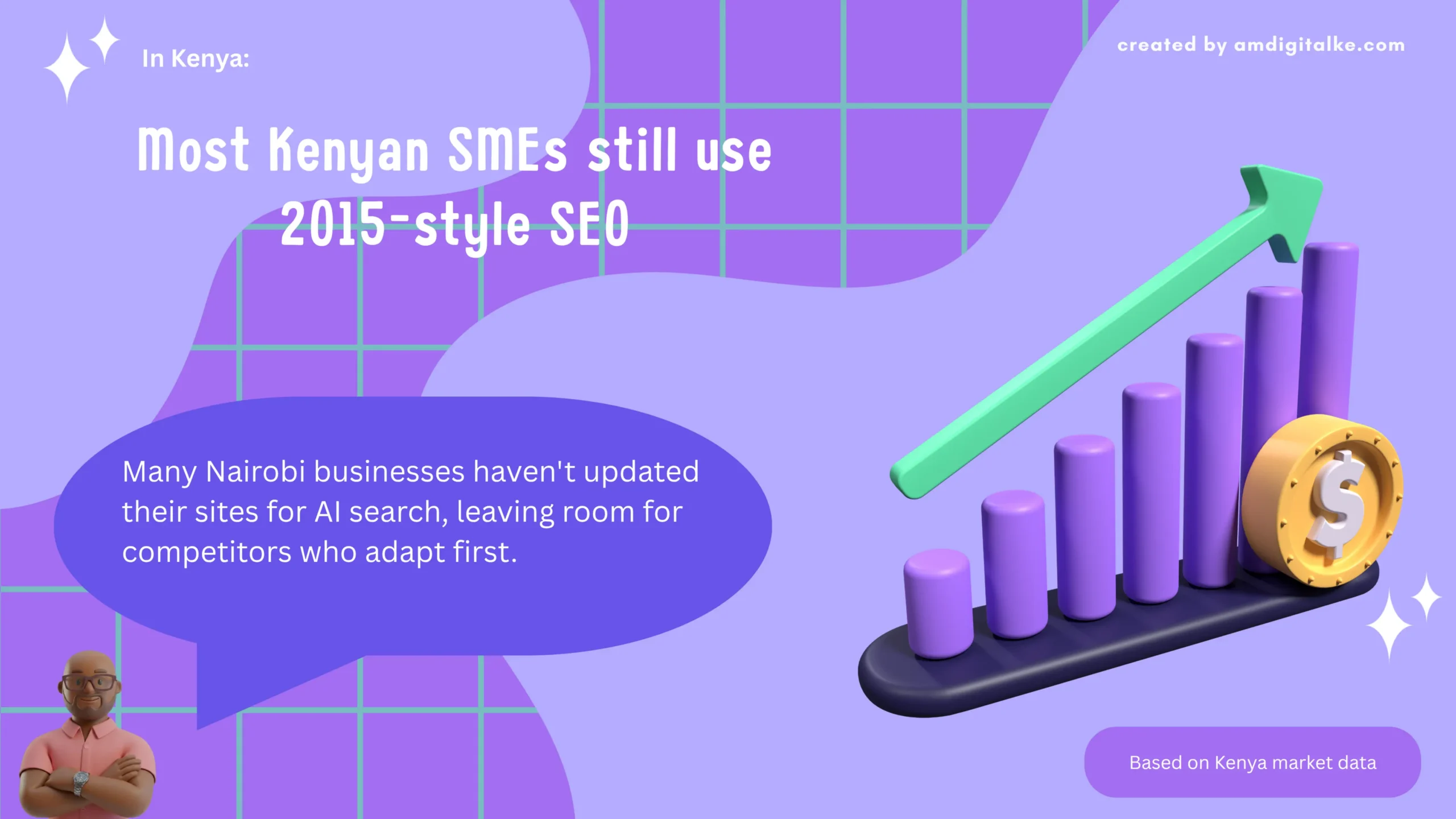
Most Kenyan businesses are still running 2015-style SEO. The few who adapt to how AI search actually works right now have a genuine head start.
📋 Key Takeaways
- AI search tools like Google AI Overviews and ChatGPT have not replaced SEO. They have added a new layer to it.
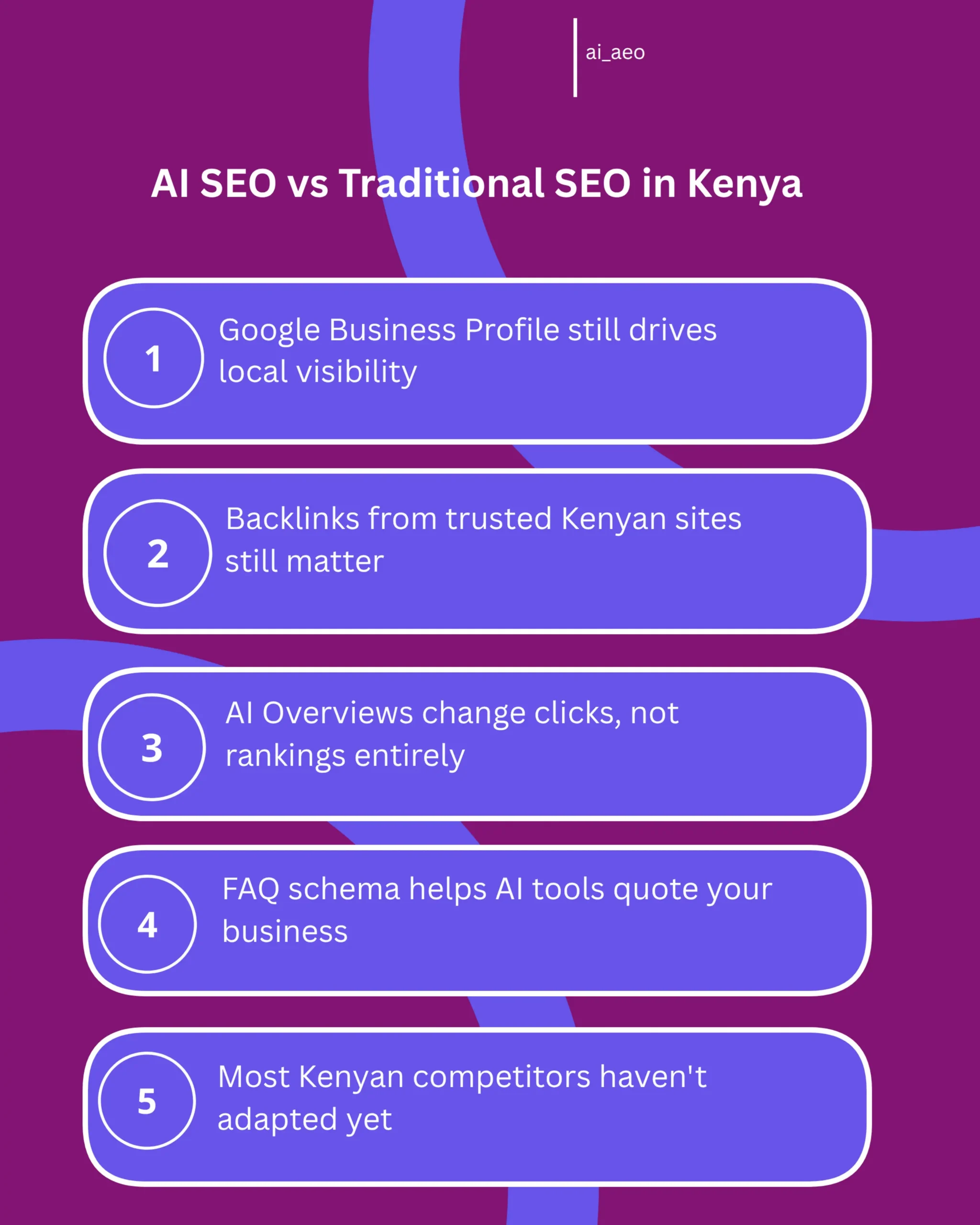
- Traditional tactics like Google Business Profile optimization and quality backlinks still drive real business results in Kenya.
- AI-generated answers reward clear, structured content more than keyword-stuffed pages.
- Most Kenyan competitors have not adjusted their SEO for AI search. This creates an opening for early movers.
- The winning approach combines classic ranking factors with new answer-focused content built for AI tools.
The Problem — What Most Businesses Get Wrong
The confusion around AI SEO in Kenya comes from two opposite extremes.
Both cost businesses money.
One side panics and stops investing in their website. The other side hands everything to an AI tool and expects magic, without understanding how a knowledge graph shapes what AI already knows about their business.
The “SEO Is Dead” Myth
I hear this most from business owners who saw a Google AI Overview answer a question directly on the results page, often because their content lacks the structure that semantic SEO requires.
They assume nobody clicks through anymore, so ranking does not matter.
What actually happens is more nuanced. People still click through for anything transactional, like booking a service, comparing prices, or finding a location, but reaching them at all now depends on strengthening your topical authority for AI search.
That is where most Kenyan businesses make their money.
The “AI Tools Can Replace SEO” Myth
The opposite mistake is thinking a tool like ChatGPT or an AI chatbot for Kenya can do the job of an SEO strategy.
I have seen Nairobi businesses publish AI-generated blog posts with zero local context, zero structure, and zero connection to what their actual customers search for, the exact opposite of what it takes to show up in ChatGPT answers.
These pages rarely rank. They almost never get quoted by AI answer engines either, so if you are unsure where your own pages stand, get a free SEO audit first.
Content without strategy is still content without strategy, whether a human or a machine wrote it.
The Real Reason: AI SEO Is an Evolution, Not a Replacement
The truth sits between the panic and the hype.
AI has changed how search results are displayed and how answers get generated. But it has not changed the underlying goal of SEO, which is to be found, trusted, and chosen by the right customer.
Traditional SEO vs AI SEO: What’s the Difference?
Traditional SEO focused on ranking a page for a specific keyword so it appears in the ten blue links.
AI SEO, sometimes called generative engine optimization, focuses on getting your business mentioned, quoted, or recommended inside an AI-generated answer. That answer might come from Google, ChatGPT, or Bing Copilot.
The two are not competing systems. A page that is well structured, answers a real question clearly, and earns trust signals tends to do well in both worlds.
What Traditional SEO Tactics Still Work in Kenya?
Google Business Profile optimization still matters enormously for any Nairobi restaurant, Mombasa hotel, or Kisumu clinic trying to show up in local searches.
Backlinks from respected Kenyan sites still carry weight. Clear on-page content that matches search intent still ranks.
Based on AM Digital KE client data across Kenyan accounts, businesses that keep basic technical SEO healthy (fast load times, mobile-friendly design, and clean site structure) continue to outperform competitors who ignore it.
AI or no AI.
| SEO Element | Traditional SEO Approach | AI-Ready SEO Approach |
|---|---|---|
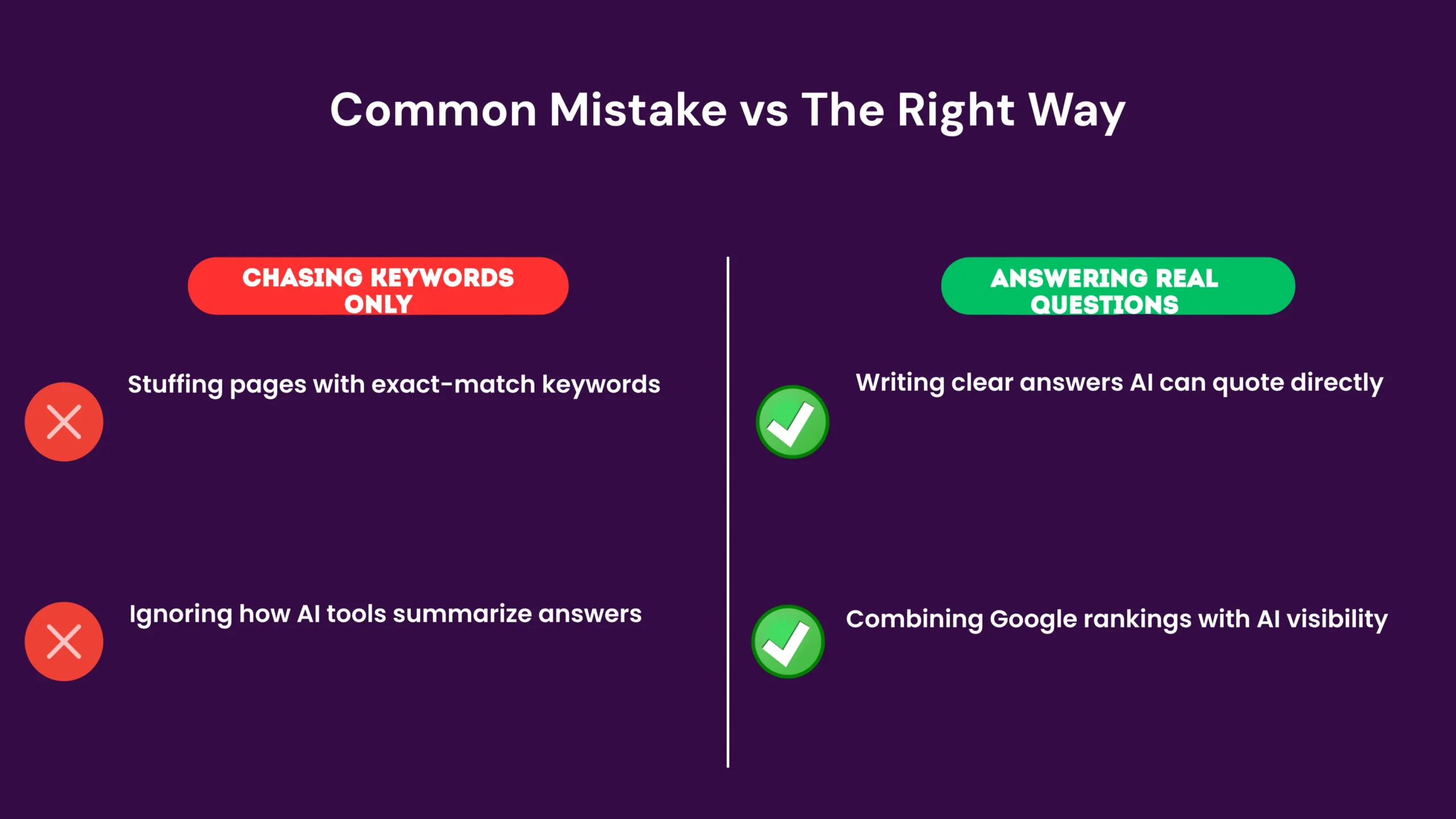
| Keywords | Exact match keyword repetition | Answering the real question in plain language |
| Content Length | Longer is always better | Clear, direct answers AI can quote easily |
| Backlinks | Volume of links from anywhere | Quality links from trusted, relevant Kenyan sources |
| Local Listings | Treated as a minor add-on | Treated as a core visibility channel |
| Structure | Long unbroken paragraphs | FAQ sections, headings, and structured data |
📊 What the Evidence Shows
Kenya’s search behavior is shifting faster than most business owners realize.
Smartphone use keeps climbing across the country. Internet access in Kenya has grown steadily year on year, and much of that growth comes from mobile-first users who search, compare, and buy entirely from their phones, according to the Communications Authority of Kenya.
How AI Is Changing Search (Google AI Overviews, ChatGPT & Bing)
Google AI Overviews now answer many informational questions directly on the results page.
This changes click behavior more than it changes rankings. A search like “how does M-Pesa international transfer work” might get answered instantly by an AI Overview. But a search like “best M-Pesa agent near me in Westlands” still sends the user to click through and choose a business.
ChatGPT and Bing Copilot behave differently again. They pull from indexed content, structured data Kenya, and sources with strong topical authority.
A business with thin, generic content is far less likely to get mentioned than one with clear, well-organized answers on its own site.
What Changed in Kenyan Search Behavior
Nairobi real estate is a clear example.
Individual agents who used to rank for “apartments for rent in Kilimani” are increasingly losing visibility to large property aggregators. AI Overviews often summarize listings from those bigger platforms first.
The click-through rate for the top organic result drops noticeably whenever an AI Overview appears above it. This is a pattern seen across many industries, not only Kenyan ones.
Fintech searches show the same pattern from a different angle. A search for “send money to Kenya from abroad” often triggers an AI-generated summary mentioning M-Pesa by default.
Smaller money transfer businesses need sharper local SEO and stronger content to even appear in the conversation, based on Kenya search behavior data.
✅ What to Do Instead
The businesses that win from here will not choose between traditional SEO and AI optimization.
They will build a single strategy that serves both humans and machines at the same time.
The New SEO Strategy: Optimizing for Humans and AI
Start by writing content that answers one clear question per page, in plain language, near the top of the page.
This structure helps a human customer scanning on their phone. It also gives AI tools an easy, quotable answer to lift.
Add FAQ schema markup to your key service pages. Structured data helps search engines and AI tools understand exactly what your content is answering.
A Nairobi salon that lists clear pricing, location, and service FAQs is far more likely to appear in both a Google result and an AI-generated answer than one with a single vague homepage.
Learn how to get featured in AI search results by structuring your content for both traditional rankings and answer engines.
AI SEO Mistakes Kenyan Businesses Should Avoid
The biggest mistake I see is publishing AI-written content with no editing, no local voice, and no fact-checking against Kenyan realities.
Google’s own guidance is clear that content quality and helpfulness matter more than how the content was produced, according to Google’s search documentation.
Another common mistake is ignoring technical basics while chasing AI trends. A slow-loading site or a broken mobile menu will hurt you in traditional rankings.
It also makes it far less likely an AI tool trusts your page enough to cite it. Average bounce rates climb sharply once page load times slow down.
If you are wondering will AI kill SEO Kenya, the answer is no. But ignoring how AI changes search behavior will hurt your visibility.
Your Next Step: Audit Your Website for AI Search Readiness
Before changing anything, you need a clear picture of where your site currently stands on both fronts.
That means checking your Google Business Profile, your site structure, your backlink profile, and whether your content is written to be quoted, not just read.
Most Kenyan businesses have never had this kind of audit done. That is exactly why the opportunity is still wide open.
A structured audit turns guesswork into a clear list of fixes, ranked by what will move the needle fastest.
Understanding AEO GEO LLMO frameworks helps you optimize for both traditional search engines and AI-powered answer engines.
✅ Quick Action Checklist
- ☐ Claim and fully optimize your Google Business Profile with accurate location, hours, and photos
- ☐ Rewrite key service pages to answer one clear question each near the top of the page
- ☐ Add FAQ schema markup to your most important pages
- ☐ Audit your backlinks and remove or disavow low-quality links
- ☐ Fix mobile load speed issues before investing in new content
- ☐ Stop publishing unedited AI-generated blog posts with no local context
- ☐ Check whether AI Overviews already appear for your top keywords and adjust content accordingly
- ☐ Run a full SEO audit to see where you stand on both traditional and AI visibility
Ready to Improve Your AI SEO vs Traditional SEO Approach?
AI has not killed SEO in Kenya. It will not replace the fundamentals that build trust with both customers and search engines.
The businesses that adapt now, blending solid traditional SEO with AI-ready content, will be the ones customers find first in the next few years.
Whether you need SEO for SACCOs Kenya or the best niche and industry SEO strategies built for Kenyan markets, AM Digital KE has the local expertise to help you rank and convert.
Contact AM Digital KE today.
Frequently Asked Questions
Does SEO still work in Kenya in 2026?
Yes, SEO still works in Kenya.
Google Business Profile optimization, quality backlinks, and clear on-page content continue to drive real traffic and sales for local businesses. This remains true even as AI Overviews and chat tools change how some answers get delivered.
What is the difference between AI SEO and traditional SEO?
Traditional SEO focuses on ranking a page in Google’s organic results for specific keywords.
AI SEO, or generative engine optimization, focuses on getting your business mentioned or quoted inside AI-generated answers from tools like Google AI Overviews, ChatGPT, or Bing Copilot.
Will Google AI Overviews kill my website traffic?
AI Overviews reduce clicks for purely informational searches where a short answer satisfies the user.
Transactional searches, like finding a service or comparing local businesses, still send traffic to websites. This is especially true when your content is structured clearly enough to be trusted.
Understanding featured snippets helps you compete for visibility in both traditional and AI-powered search results.
Can ChatGPT replace an SEO strategy for my business?
No. ChatGPT can help generate ideas or draft content.
But it cannot build backlinks, optimize your Google Business Profile, fix technical site issues, or understand your specific Kenyan market the way a proper SEO strategy does.
How do I know if my website is ready for AI search?
Check whether your key pages answer specific customer questions clearly near the top.
Check whether you have FAQ schema markup. Check whether your content is structured in a way that AI tools can easily quote and cite.
If you are unsure where to start, consider how which social platforms matter for Kenyan businesses can complement your SEO strategy and drive additional visibility.
Additional Resources
- What is Voice Search SEO – Voice search uses the same AI-driven answer extraction as ChatGPT and Google AI Overviews, so optimizing for voice prepares you for all AI search formats.
- Why Your Social Media Ads Send Customers to Competitors (+Free Checklist) – If AI search is stealing your organic traffic, you need paid channels that convert, and this checklist shows you how to stop wasting ad spend on clicks that don’t convert.
- Which Social Platforms Matter for Kenyan Businesses? – Building multi-platform presence is critical for AI trust signals, and this guide shows you which platforms Kenyan customers actually use to research businesses.
- Tracking What Matters – Essential Metrics for Kenyan Websites – You need to track AI Overview citations separately from regular organic traffic to measure your AI SEO success, and this guide shows you which metrics actually matter.
- Tourism SEO Kenya – How to Attract International Visitors – Tourism businesses face intense AI Overview competition from global sites, so this guide shows niche-specific tactics for getting cited in AI answers for Kenya travel queries.
- Social Media Content That Drives Website Traffic in Kenya – Since AI search reduces direct Google traffic, you need alternative channels to drive qualified visitors, and this shows you how to turn social followers into website visitors.
Take the Next Step
I’ve put together a comprehensive resource that answers the 47 most common SEO questions Kenyan business owners ask me.
It includes specific strategies for optimizing your website for AI search, complete with Kenya examples and action steps.
If you want to understand exactly how to make your Nairobi business visible in AI Overviews and ChatGPT recommendations, download the Complete SEO FAQs for Kenyan Businesses.
It’s free, and it will show you the exact questions you should be answering on your website to win in AI-driven search.