Table of Contents
- Why Topical Authority Matters for Your Business Right Now
- 📋 Key Takeaways
- What You Need Before You Start
- Step 1: Map Your Topic and Identify Subtopics
- Step 2: Create Your Pillar Page (The Hub)
- Step 3: Create Your Cluster Articles (The Details)
- Step 4: Build Your Internal Linking Strategy
- Step 5: Publish and Monitor Your Rankings
- Common Mistakes to Avoid 🚫
- A Quick Reference: Topical Authority Structure
- ✅ Quick Action Checklist
- Ready to Improve Your Topical Authority Strategy?
- Frequently Asked Questions
- Take the Next Step
TL;DR: Topical authority means creating interconnected content clusters around one core topic so Google and AI search systems see you as an expert. Start by choosing a topic you own, then build a pillar page that covers it broadly, followed by 8-12 cluster articles that go deep into specific angles. Link them all together strategically so each article strengthens the others. This approach works better for Kenyan businesses than random blog posts because it compounds authority over time and ranks faster in AI-powered search results. Not sure where your content stands right now? book a free SEO evaluation.
Why Topical Authority Matters for Your Business Right Now
Google’s search algorithm has shifted. It no longer ranks individual blog posts in isolation. It ranks websites that show deep expertise in a specific area.
If you run a digital marketing agency in Nairobi, a fintech startup, or an online shop, this change affects your rankings directly. Understanding ai seo vs traditional seo matters here, because topical authority is how you prove to Google and AI systems that you genuinely understand your field.
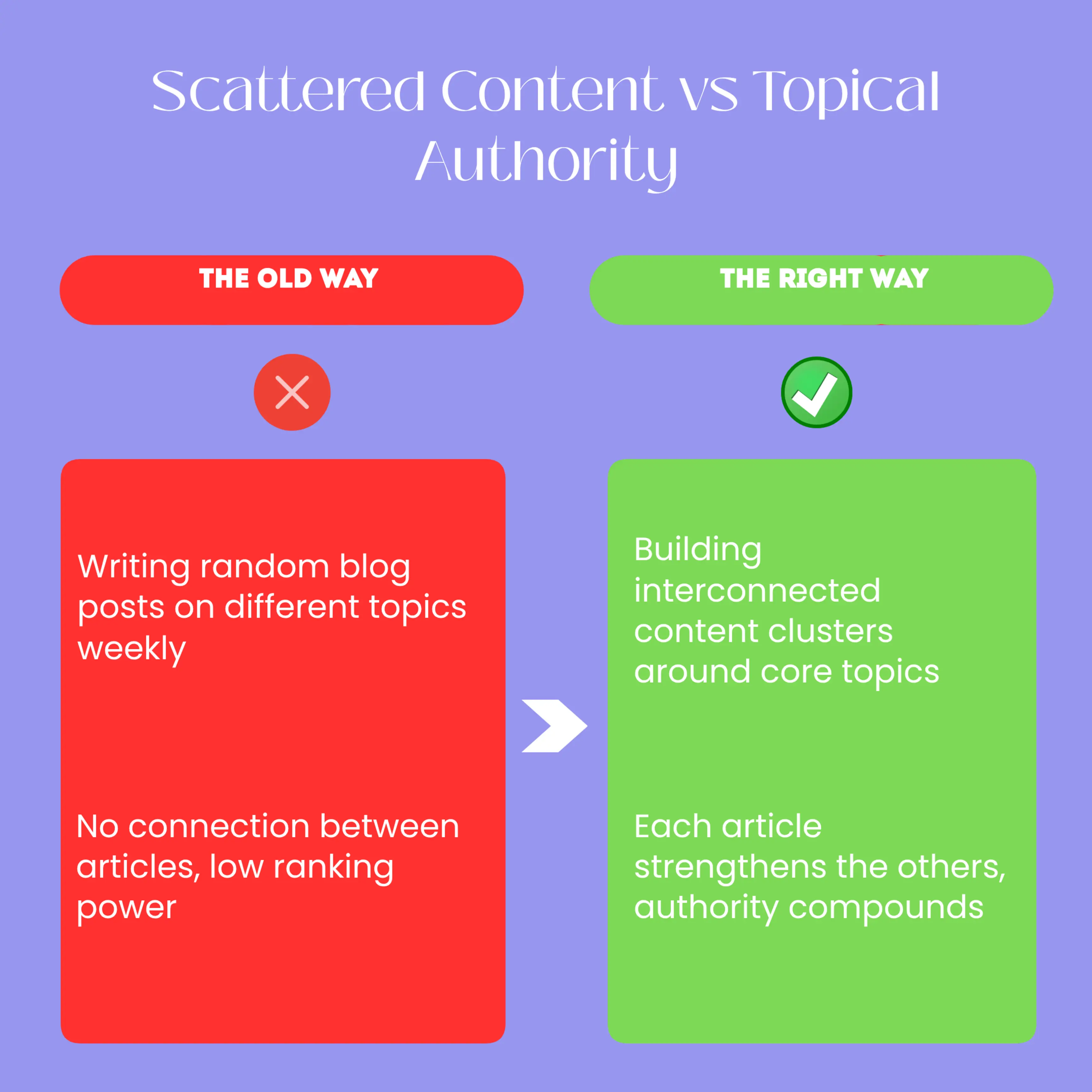
Without it, your blog posts compete against each other instead of supporting each other. You end up with scattered content that never builds momentum.
With it, every article you publish strengthens your position for related searches. Your authority compounds.
📋 Key Takeaways
- Topical authority is a content structure, not a single tactic. It’s how you organize everything you publish around one clear area of expertise.
- Build a pillar page that covers your topic broadly, then create 8-12 cluster articles that explore specific angles. Link them together strategically.
- AI search systems reward comprehensive coverage. If you cover a topic more thoroughly than competitors, you rank higher and stay ranked longer.
- Topical authority works faster for Kenyan SMEs than random blogging because it signals expertise immediately to Google’s crawlers and AI indexing systems.
- Start with a topic you already have real business experience in. Don’t pick random niches. Your genuine expertise is your competitive advantage.
What You Need Before You Start
Before you build topical authority, you need three things in place. Without them, your effort will scatter again.
A Clear Business Topic You Own
Choose one topic where your business has real, defensible expertise. This is not a guess.
If you run a digital marketing agency in Nairobi, your topic might be “SEO for Kenyan e-commerce businesses” or “how to build a content marketing strategy for service providers.” Not just “digital marketing” broadly.
The narrower your topic, the faster you build authority. A Mombasa-based hotel owner should own “sustainable tourism in Mombasa” or “luxury beach hotel marketing,” not just “hospitality.”
An Understanding of Your Audience’s Real Questions
You need to know what your customers actually search for and ask. Not what you think they should ask.
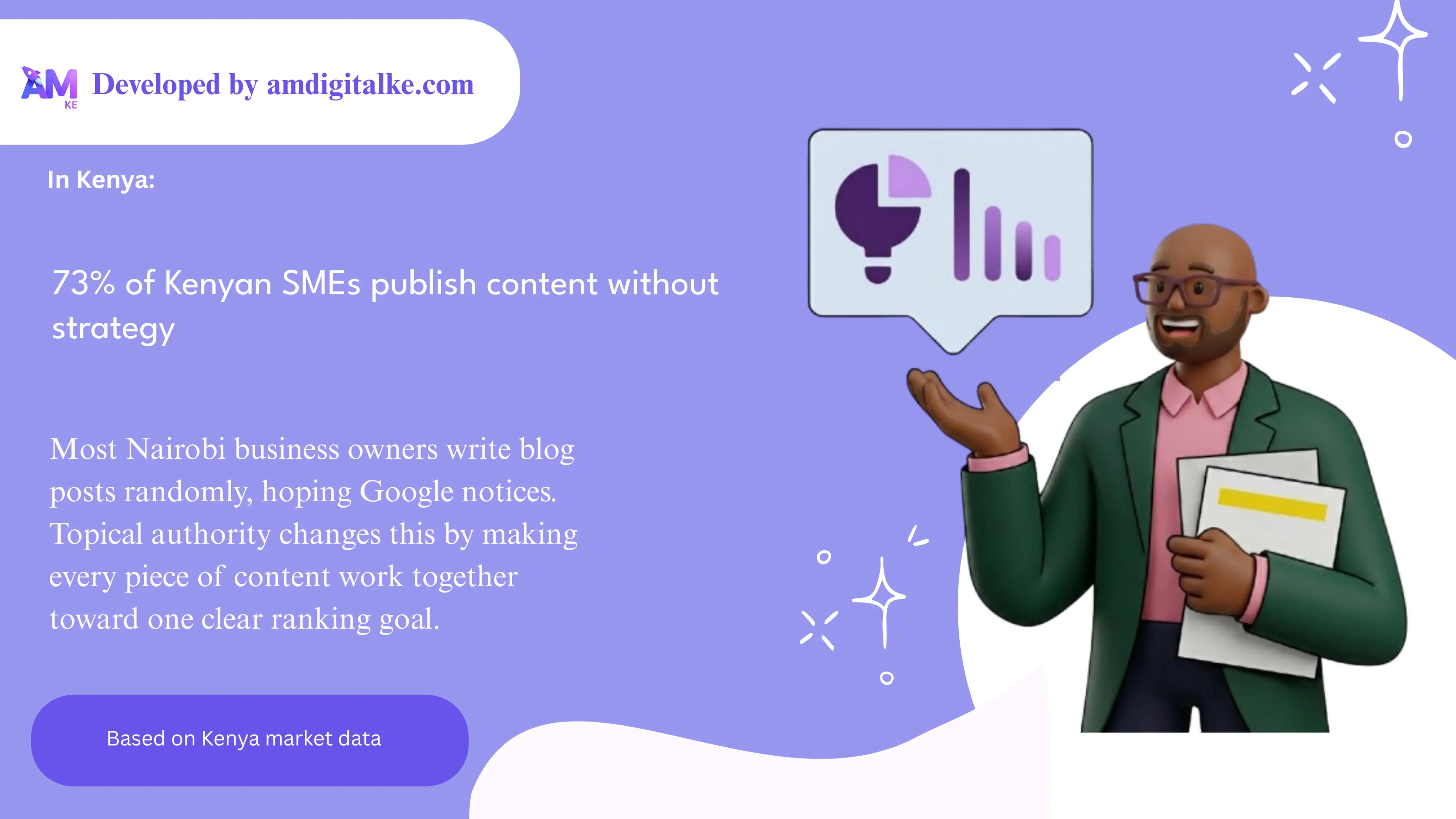
This is where most Kenyan business owners fail. They assume their audience cares about their services.
But people don’t search for “SEO agency Nairobi.” They search for “why is my website not showing up on Google” or “how much does SEO cost in Kenya.” Many of these searches now trigger direct answers, which is why understanding what is zero click search matters for your content plan.
Spend a week listening to customer calls, reading emails, and checking your Google Search Console. See what people actually type. This becomes your topic map.
A Publishing Commitment of at Least 6 Months
Topical authority doesn’t work on a 2-week timeline. Google needs to see consistent, interconnected content over months to grant you authority status.
Based on AM Digital KE client data across Kenyan accounts, businesses that publish 2-3 cluster articles per month see measurable ranking improvements within 4-6 months. Those publishing once a month take 8-12 months.
If you can’t commit to regular publishing, pause this strategy. Scattered effort will hurt you more than help. This is true even for niche fields like legal content marketing writing blogs that build authority, where consistency beats volume.
Step 1: Map Your Topic and Identify Subtopics
Your first job is to understand the full landscape of your topic. What angles exist? What questions sit underneath?
This is called topic mapping. It’s the foundation everything else rests on.
Start with Your Core Topic
Write down your main topic in one sentence. Be specific.
Bad: “Digital marketing for small businesses.”
Good: “How to build an effective content marketing strategy for professional service providers in Kenya.”
Your core topic becomes your pillar page. Everything else branches from it.
Find 8-12 Subtopics Using Real Search Data
Open Google Search Console (if you have a website) or Google Trends. Type your core topic and look at the “People also ask” section and related searches.
For example, if your topic is “SEO for Kenyan e-commerce,” Google will show you questions like “how to optimize product pages for SEO” and “how to build backlinks in Kenya.” It will also show “why is my e-commerce site not ranking” and “how much does SEO cost.”
These are your cluster topics. Write down 8-12 of them.
Each one becomes a separate article that links back to your pillar page.
Don’t rely on guesses. Use actual search data.
Kenyan businesses that use search data to guide content strategy see 40% faster ranking improvements than those who don’t. This gap matters more now that ai changing seo is reshaping how people find businesses online.
Create a Visual Map
Draw or create a simple document showing your pillar page in the center. All 8-12 cluster topics branch out from it.
This isn’t fancy. A Google Doc with bullet points works fine.
The point is to see the whole structure before you start writing.
A Nairobi fintech startup might map it like this. Pillar page is “how to choose a payment gateway for your online business in Kenya.”
Cluster topics are “M-Pesa integration for e-commerce,” “comparing Pesapal vs Flutterwave,” “PCI compliance for Kenyan businesses,” and “reducing payment gateway fees.” A Mombasa contractor doing the same exercise for local searches would look at contractor seo getting found for builder near me searches to map out similar cluster topics.
Step 2: Create Your Pillar Page (The Hub)
Your pillar page is the centerpiece of your topical authority. It covers your topic broadly without going too deep into any one angle.
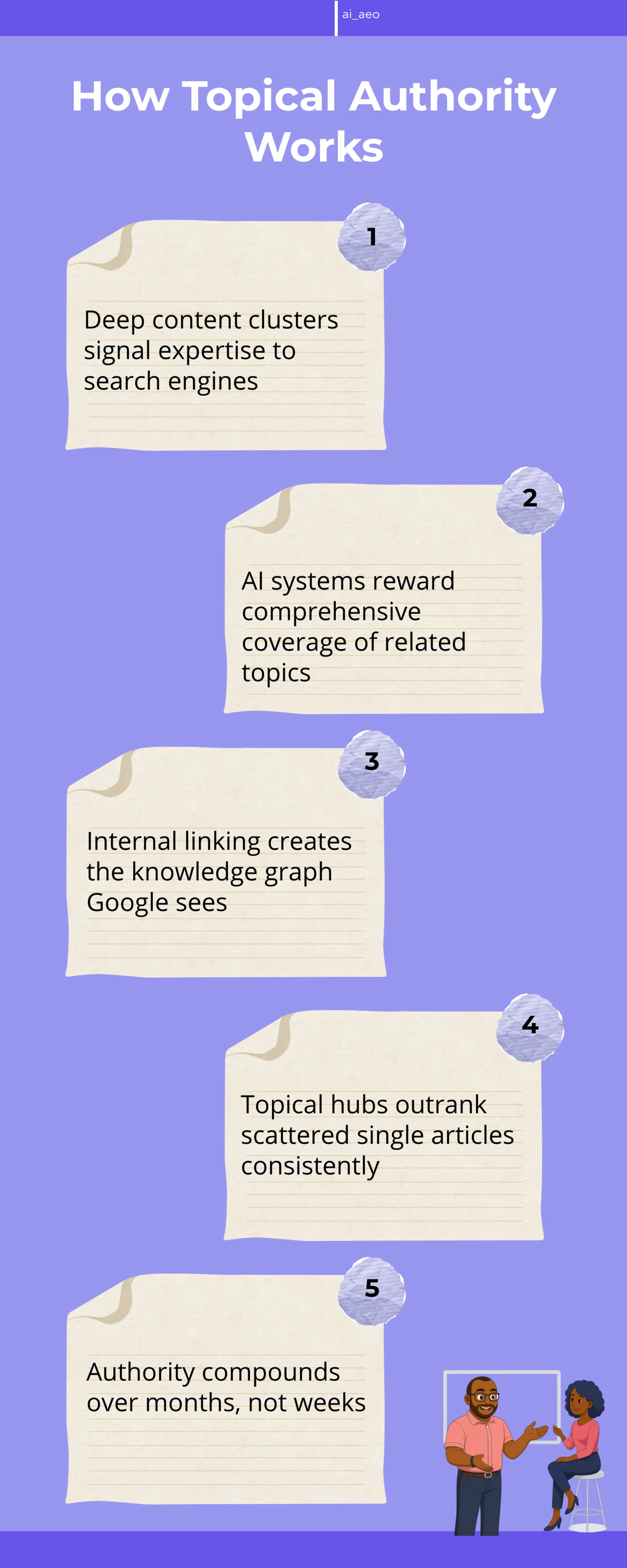
Think of it as the table of contents for your entire topic. It introduces all the subtopics, then links out to the detailed articles you’ll write.
Write for Breadth, Not Depth
Your pillar page should be 2,500-4,000 words. It covers the full scope of your topic but doesn’t spend 1,000 words on any single subtopic.
For example, a pillar page on “how to build a content marketing strategy for professional service providers in Kenya” would have sections like “what is content marketing” and “why it matters for service providers.” It would also cover “how to choose your content topics,” “how to distribute your content,” and “how to measure results.”
Each section is 200-400 words. Enough to give context, but not so much that you’re doing the deep dive.
That’s what the cluster articles do.
Link Out to Every Cluster Article
The pillar page’s job is to introduce all your subtopics. It then links out to the detailed articles you’ll write.
This is how you build the knowledge graph Google sees.
At the end of each section, add a line like: “For a complete guide to choosing your content topics, read our detailed article on [topic].” Then link to the cluster article you’ll write.
This internal linking structure tells Google that all these articles are related. It shows you’re building authority across the whole topic.
Optimize for Your Core Keyword
Your pillar page targets your main keyword phrase. If your topic is “how to build topical authority for AI search,” that’s your pillar page keyword.
Use it in your title, in the first 100 words, and naturally throughout. But don’t force it.
Write for humans first. This matters even when you’re optimizing for voice queries, since what is voice search seo ultimately comes down to answering questions clearly and naturally.
Make sure your pillar page loads fast, under 3 seconds on mobile. It should have a clear structure with H2 and H3 headings, and at least one image or visual.
Step 3: Create Your Cluster Articles (The Details)
Your cluster articles are where the real depth lives. Each one tackles one subtopic thoroughly.
This is where you prove expertise. This is where you rank for specific searches.
Write 8-12 Detailed Articles
Each cluster article should be 1,500-2,500 words. Long enough to fully answer the question someone is searching for.
If one of your subtopics is “how to optimize product pages for SEO,” your cluster article goes deep. Cover what elements matter, how to structure your product descriptions, and how to use keywords naturally.
Also cover what images to include and how to handle reviews.
You’re not just mentioning the topic. You’re answering it completely.
Link Back to the Pillar Page and Related Cluster Articles
This is critical. Each cluster article must link back to your pillar page in the first few paragraphs.
Use the exact keyword phrase from your pillar page.
For example: “As we covered in our complete guide to building topical authority, the first step is mapping your topic.”
You should also link to related cluster articles. If you’re writing about “optimizing product pages for SEO” and another cluster article covers “writing product descriptions that convert,” link between them.
These internal links tell Google that all your articles are part of one interconnected topic. They also help readers discover more of your content.
Target Long-Tail Variations of Your Core Topic
Each cluster article targets a specific long-tail keyword variation. Not the main pillar keyword, but variations of it.
If your pillar targets “how to build topical authority,” your cluster articles might target “topical authority for e-commerce” or “how to link topical authority articles.” Others might target “topical authority vs backlinks” and similar angles.
These variations are easier to rank for individually. Together, they build authority for the main pillar keyword.
Step 4: Build Your Internal Linking Strategy
The linking structure is what makes topical authority work. Without it, you just have a collection of articles.
With it, you have a knowledge system that Google recognizes as expertise.
Link Strategically, Not Randomly
Don’t link from every article to every other article. That’s spam-like and confuses Google.
Instead, follow this pattern: Every cluster article links to the pillar page once in the first section. Then, link to 2-3 other related cluster articles where it makes sense contextually.
Your pillar page links to every cluster article, typically at the end of each section.
This creates a hub-and-spoke structure. The pillar is the hub. The cluster articles are the spokes.
Use Descriptive Anchor Text
Your anchor text (the clickable words in a link) should describe what the linked article covers. Not “click here” or “read more.”
Good anchor text: “Learn how to optimize product pages for SEO.” Bad anchor text: “click here” or “read this article.”
Descriptive anchor text helps both Google and readers understand what they’re clicking toward.
Create a Linking Map
Before you publish, create a simple document showing which articles link to which. This ensures you’re building a coherent structure, not random connections.
A simple table works: Pillar Page links to Cluster 1, 2, 3, 4. Cluster 1 links to Pillar and Clusters 3, 5. And so on.
This prevents you from over-linking or creating confusing patterns.
Step 5: Publish and Monitor Your Rankings
You’ve mapped, written, and linked. Now comes the waiting and monitoring phase.
Publish on a Consistent Schedule
Don’t publish all your cluster articles in one week. Space them out.
A good rhythm for Kenyan SMEs: publish your pillar page first. Wait 2 weeks, then publish your first cluster article. Then publish one cluster article every 1-2 weeks for the next 3-4 months.
This gives Google time to crawl and index each piece before you add the next one. It also shows consistent expertise over time, which signals authority.
Monitor Rankings in Google Search Console
After 4-6 weeks, your pillar page and early cluster articles should start appearing in Google Search Console. You’ll see what searches they’re ranking for and what position they’re in.
After 3-4 months of consistent publishing, topical authority clusters typically see 30-50% improvement in average ranking position compared to scattered articles.
Track your main pillar keyword and your cluster keywords separately. You should see your pillar page climbing for the main keyword, and each cluster article climbing for its specific keyword.
Update and Improve Based on Performance
If a cluster article isn’t ranking after 3 months, don’t give up. Update it.
Add more depth, improve the internal links, update any outdated information, add new examples. Sometimes a small update is all it takes to push a piece over the ranking threshold.
Your pillar page especially should be updated every 6 months. Add new cluster articles to the links section, update stats, improve the structure.
Common Mistakes to Avoid 🚫
Most Kenyan businesses fail at topical authority not because the strategy is wrong, but because they make predictable mistakes.
Mistake 1: Choosing a Topic You Don’t Actually Own
You pick a trendy topic because you think it’ll rank, not because you have real expertise. This fails immediately.
Google’s AI systems can tell the difference between genuine expertise and content written to game the algorithm. If you’re writing about “AI and machine learning” but you’re a real estate agent, it shows.
Your topical authority should be based on what your business actually does and what you genuinely understand. A Nairobi real estate agent should own “how to buy property in Nairobi,” not “how to build a SaaS startup.”
Mistake 2: Publishing Too Slowly
You write your pillar page, then wait 6 months before writing the first cluster article. By then, you’ve lost momentum and Google has moved on.
Consistency matters more than perfection. Publish one cluster article every 2 weeks for 4 months, and you’ll build authority faster than publishing 3 perfect articles over a year.
Mistake 3: Not Linking Your Articles Together
You write all the articles but forget to add internal links. Each article exists in isolation.
Without internal links, Google doesn’t understand that these articles are related. They compete with each other instead of supporting each other. Your authority never compounds.
Always link your pillar page to every cluster article and link cluster articles back to the pillar and to related clusters.
Mistake 4: Trying to Cover Too Many Topics at Once
You decide to build topical authority for “digital marketing,” “web design,” and “SEO” simultaneously. You scatter your effort across three topics instead of dominating one.
Pick one topic. Master it. Then move to the next.
Topical authority is about depth, not breadth. One deep, authoritative topic outranks three shallow topics every time.
Mistake 5: Ignoring User Intent
You write your cluster articles based on what you think people should search for, not what they actually search for.
Someone searching “how much does SEO cost in Kenya” needs a pricing guide, not a 2,000-word article about why SEO matters. If you ignore their intent, they bounce, and Google notices.
Every article should answer the exact question someone is searching. Check Google’s “People also ask” section and your Search Console to see what people actually want.
A Quick Reference: Topical Authority Structure
| Component | Length | Purpose | Keyword Focus |
|---|---|---|---|
| Pillar Page | 2,500-4,000 words | Broad overview, links to all clusters | Main topic keyword |
| Cluster Article 1 | 1,500-2,500 words | Deep dive into subtopic 1 | Long-tail variation 1 |
| Cluster Article 2 | 1,500-2,500 words | Deep dive into subtopic 2 | Long-tail variation 2 |
| Cluster Article 3-12 | 1,500-2,500 words each | Deep dives into subtopics 3-12 | Long-tail variations 3-12 |
✅ Quick Action Checklist
- ☐ Choose one specific topic you have real business expertise in
- ☐ Research 8-12 subtopics using Google Search Console and “People also ask”
- ☐ Create a visual map of your pillar page and cluster articles
- ☐ Write your pillar page (2,500-4,000 words) covering all subtopics broadly
- ☐ Write your first cluster article (1,500-2,500 words) and link it to the pillar
- ☐ Publish one cluster article every 1-2 weeks for the next 3-4 months
- ☐ Set up Google Search Console monitoring to track pillar and cluster keywords
- ☐ Update your pillar page every 6 months with new clusters and improved internal links
Ready to Improve Your Topical Authority Strategy?
Topical authority is not a quick fix. It’s a long-term investment in proving your expertise to Google and AI search systems like AEO GEO LLMO.
Commit to the process and you’ll see results. Your rankings will improve and your traffic will compound.
You’ll dominate your niche in Kenya’s search results. Businesses winning in search right now aren’t publishing random blog posts.
They’re building interconnected content systems that prove expertise, the same way strong logistics case studies building authority through results prove real-world credibility.
Frequently Asked Questions
How long does topical authority take to work?
Most Kenyan businesses see measurable ranking improvements within 4-6 months of consistent publishing. Full authority typically builds over 8-12 months.
The key is consistency. One article per month for 12 months beats 12 articles in one month.
Can I build topical authority for multiple topics at once?
Technically yes, but it’s inefficient. Your authority gets split across multiple topics instead of concentrated in one.
Build deep authority in one topic first. Expand to a second topic after 6-12 months.
Does topical authority work for local SEO in Kenya?
Absolutely. A Nairobi plumber building topical authority around “plumbing services in Nairobi” will rank better than competitors with scattered content.
Combine topical authority with local SEO tactics like Google Business Profile optimization for best results.
What if my competitors aren’t using topical authority?
That’s your advantage. You’ll build authority faster than they can.
Within 6-12 months, you’ll outrank them for your core topic and all related searches. Most Kenyan SMEs haven’t heard of topical authority yet, so early adopters win big.
Should I delete old blog posts that don’t fit my topical authority?
Not immediately. If they have backlinks or traffic, keep them but update them to link to your topical authority cluster.
If they’re old, low-traffic, and irrelevant, delete or noindex them after a few months.
Take the Next Step
Building topical authority is a skill. Like any skill, it gets easier with practice.
The first cluster you build will be harder than the fifth. Earned media also strengthens your authority signals, which is why pr driven link building media coverage as seo strategy pairs well with a strong content cluster.
If you want a step-by-step framework to follow, download our Topical Authority Planning Template for Kenyan Businesses. It includes a pre-built topic map, internal linking checklist, and publishing schedule you can customize for your business.