Table of Contents
- What Does Knowledge Graph Mean for Your Kenyan Business?
- 📋 Key Takeaways
- What is a Knowledge Graph?
- Why Does a Knowledge Graph Matter for Kenyan Businesses?
- How Does a Knowledge Graph Work?
- Knowledge Graph Examples in Kenya
- Common Mistakes to Avoid ⚠️
- Knowledge Graph Optimization: A Practical Table
- ✅ Quick Action Checklist
- Ready to Improve Your Knowledge Graph Presence?
- Frequently Asked Questions
- Additional Resources
- Take the Next Step
TL;DR: A Knowledge Graph is Google’s system for understanding what things mean, not just matching keywords. It connects facts, entities, and relationships so Google can answer questions accurately. Kenyan businesses that structure their data properly appear in featured snippets, knowledge panels, and better search positions. Want to know where your business currently stands? Claim your free SEO check.
What Does Knowledge Graph Mean for Your Kenyan Business?
A Knowledge Graph sounds like tech jargon. Here is what it actually does: it helps Google understand what your business is, who you serve, and how you connect to other things people search for.
Think of it like this. When you search for “best coffee in Nairobi,” Google doesn’t just look for those exact words on websites anymore.
Instead, Google’s Knowledge Graph understands that you want a specific type of business in a specific place. It connects that search to coffee shops, their locations, their ratings, their hours, and the people who own them.
For your business, this means one thing. If Google understands who you are and what you do, it can show you to the right customers at the right moment. This is also why the debate around ai seo vs traditional seo matters so much for businesses in Kenya right now.
📋 Key Takeaways
- A Knowledge Graph is Google’s system for understanding entities (things, people, businesses, concepts) and how they relate to each other, not just matching keywords on a page.
- Kenyan businesses that structure their data properly (business name, address, phone, categories, relationships) rank higher and appear in featured snippets and knowledge panels.
- Knowledge Graphs power featured snippets, knowledge panels, and rich results that drive more clicks and trust from potential customers.
- Most Kenyan SMEs ignore Knowledge Graph optimization, which means Google doesn’t fully understand their business, costing them visibility and revenue.
- You optimize for Knowledge Graphs by claiming your Google Business Profile, organizing your schema markup, and building consistent business citations across the web.
What is a Knowledge Graph?
A Knowledge Graph is Google’s massive database of facts, entities, and relationships. It helps Google understand the real world, not just the words on a page.
Google built this system because keyword matching alone is not good enough. If someone searches for “Safaricom customer service Nairobi,” Google needs to know that Safaricom is a telecommunications company, that Nairobi is a city in Kenya, and that customer service is a function of that company.
How Google Sees Your Business Through a Knowledge Graph
When Google crawls your website, it is not just reading words. It is looking for structured data that tells it what you are.
That structured data is called schema markup. It is code you add to your website that says “this is a business,” “this is the business name,” “this is the address,” “this is the phone number.”
When you add this code, Google’s Knowledge Graph connects your business to other related entities. Your location connects to the city, your category connects to other businesses like yours, and your phone number connects to your identity across the web.
A Nairobi restaurant that adds schema markup and keeps its details consistent can also show up better on tools like an ai chatbot for kenya when customers ask for recommendations nearby.
The Difference Between Old SEO and Knowledge Graph SEO
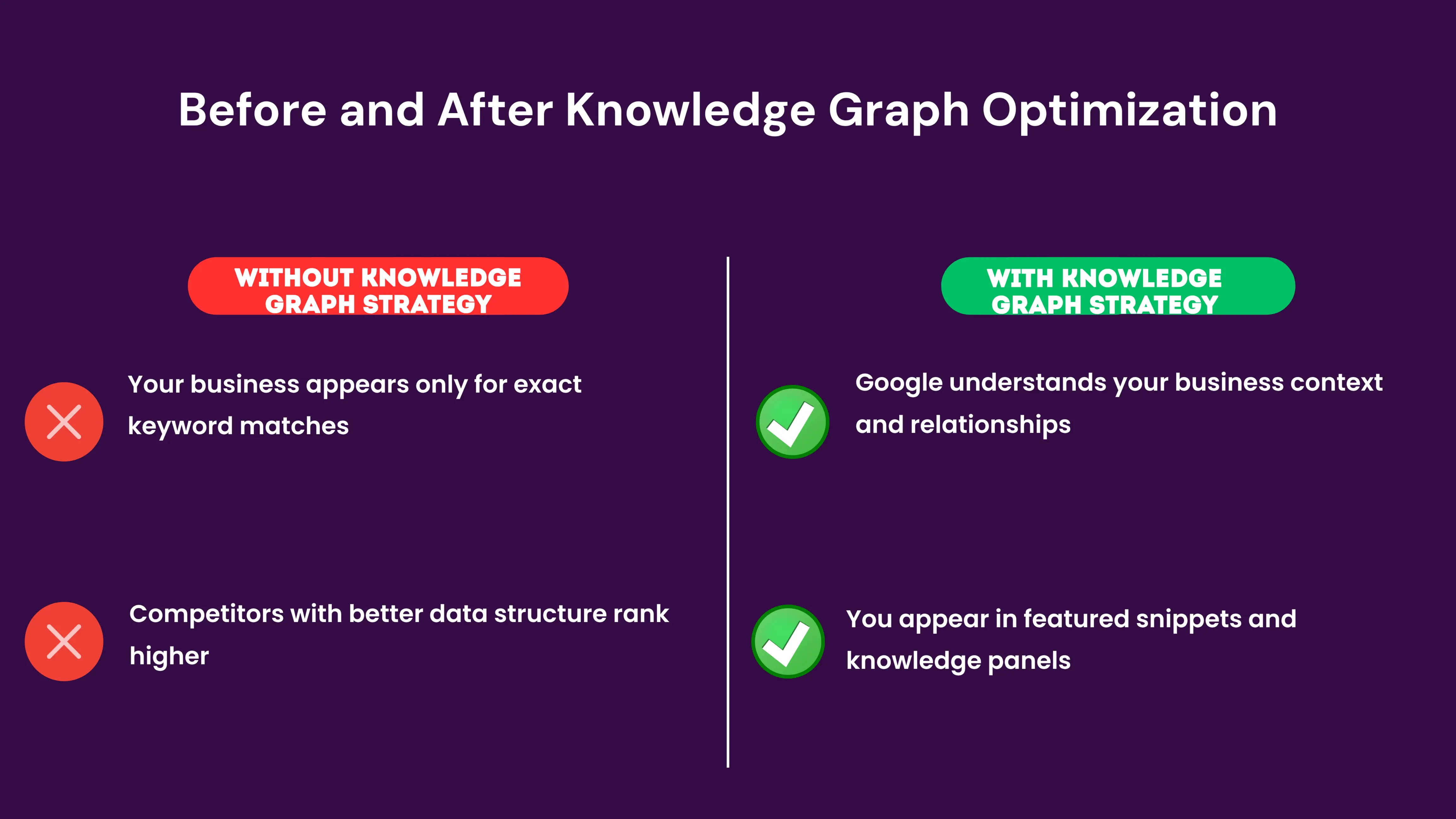
Old SEO was about getting keywords on your page and building links. You stuffed your page with the word “plumber Nairobi” and hoped Google would rank you for that phrase.
Knowledge Graph SEO is about helping Google understand what you actually are. You tell Google you are a plumber in Nairobi. Google then connects you to people searching for plumbers, to the Nairobi location, to your specific service categories, and to reviews and ratings that validate your existence.
The result is that you show up not just for “plumber Nairobi.” You also appear for related searches like “emergency plumbing Westlands,” “24-hour plumber near me,” and “best-rated plumber in Nairobi.”
Why Does a Knowledge Graph Matter for Kenyan Businesses?
If Google does not understand your business, you are invisible to customers actively looking for you. This is the reality for most Kenyan SMEs right now.
A Knowledge Graph matters because it determines whether Google shows your business or your competitor’s business when someone searches.
Better Visibility in Search Results
When your business is properly connected in Google’s Knowledge Graph, you appear in more search results, not fewer.
Let’s say you run a digital marketing agency in Nairobi. Without Knowledge Graph optimization, you only show up when someone searches “digital marketing agency Nairobi” exactly.
With Knowledge Graph optimization, you also appear for “SEO services Nairobi,” “Google Ads management Kenya,” and “social media marketing Westlands.” Google understands what you do and connects you to those related searches.
Featured Snippets and Knowledge Panels
Featured snippets are the boxes that appear at the top of Google search results with an answer to a question. They are worth thousands of shillings in free visibility because they get clicked more than regular results.
Knowledge panels are the boxes on the right side of Google search that show information about a business, person, or concept. They show your business name, address, phone, website, hours, and reviews all in one place.
Both of these features are powered by Knowledge Graph data. If your business is not in Google’s Knowledge Graph properly, you will never appear in these high-visibility spots.
Trust and Click-Through Rate
Featured snippets and knowledge panels drive higher click-through rates because they look official and complete. Customers trust them more than regular search results.
A customer who sees your business in a knowledge panel with verified address, phone, hours, and reviews trusts it instantly. They are far more likely to call you or visit than if your business appears as a plain blue link.
Voice Search and AI-Powered Results
Voice search is growing in Kenya. When someone asks their phone “where is the nearest good restaurant in Westlands,” Google’s Knowledge Graph powers that answer.
If your restaurant is not properly structured in the Knowledge Graph, it will never be suggested as an answer. This holds true no matter how good your reviews are.
How Does a Knowledge Graph Work?
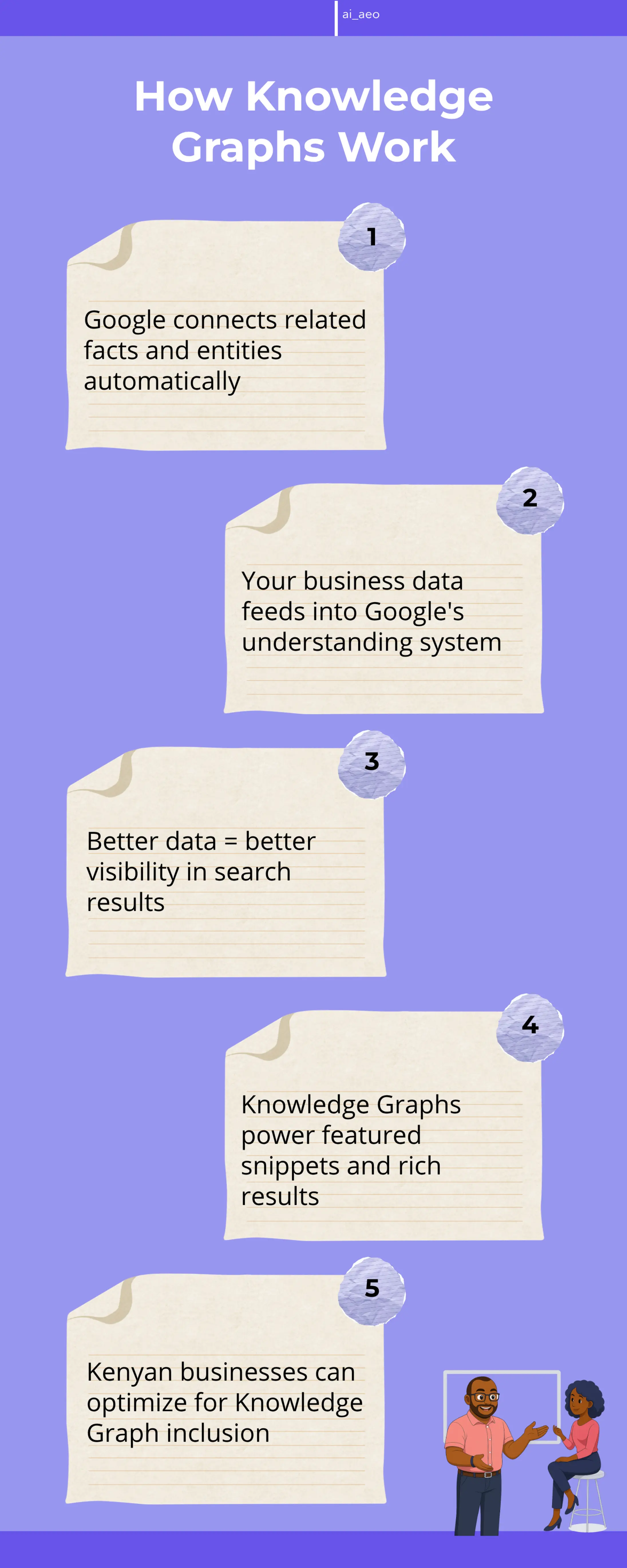
A Knowledge Graph is not magic. It is a system with specific inputs and outputs, and understanding it helps you optimize for it.
Entity Recognition
The first step is entity recognition. Google’s AI reads the web and identifies entities: businesses, people, places, products, concepts.
When Google sees your website, it asks: “Is this a business? Is this a person? Is this a place?” It looks for clues in your schema markup, your Google Business Profile, your domain registration, and your citations across the web.
Relationship Mapping
Once Google recognizes an entity, it maps relationships. It asks what the business is related to, what location it is in, what category it belongs to, and who owns it.
These relationships are stored in the Knowledge Graph as connections. Your business is connected to your location, your category, your owner’s name, your phone number, and your website.
Data Validation and Enrichment
Google does not trust one source of information alone. It validates data by cross-referencing multiple sources.
If your business name appears on your website, your Google Business Profile, and five business directories with the same spelling and address, Google trusts that data more. Inconsistent information confuses Google, and your Knowledge Graph entry becomes weaker.
Ranking and Display
Finally, Google uses Knowledge Graph data to rank and display results. When someone searches, Google pulls from the Knowledge Graph to show the most relevant and trustworthy results first.
Businesses with complete, consistent, and well-structured Knowledge Graph data rank higher. This is one reason the best niche and industry SEO strategies built for Kenyan markets always start with clean entity data.
Knowledge Graph Examples in Kenya
Real Kenyan business scenarios show how this works in practice.
A Nairobi Coffee Shop
A coffee shop in Nairobi called “Brew & Bean” has a website, a Google Business Profile, and listings on TripAdvisor, Instagram, and a local business directory.
All these sources agree. Brew & Bean sits at a specific address in Kilimani, opens at 7 AM, serves coffee and pastries, and has a working phone number.
Google’s Knowledge Graph connects all of this information into one profile. When someone searches “best coffee Kilimani” or “coffee shop near me,” Google shows Brew & Bean in the results.
Sometimes it appears in a knowledge panel with photos, hours, and reviews. The coffee shop shows up in Google Maps, Google Search, and voice search results.
A Mombasa Digital Agency
A digital agency in Mombasa called “Coast Digital” offers SEO, web design, and social media marketing. Without Knowledge Graph optimization, they only rank for “digital agency Mombasa.”
Proper schema markup on their website changes this. A complete Google Business Profile, citations on industry directories, and consistent business information across the web help too.
Google’s Knowledge Graph now understands that Coast Digital is a digital marketing agency with multiple service categories. They appear for “SEO services Mombasa,” “web design Kenya,” and “social media management coastal region” because Google has connected their business to these concepts.
A Nairobi Medical Clinic
A medical clinic in Nairobi with proper Knowledge Graph optimization shows up in search results with a knowledge panel. This panel displays the clinic’s name, address, phone, hours, website, and patient reviews.
Someone searches “doctor near me” or “clinic in Westlands.” Google pulls from the Knowledge Graph and shows this clinic because the data is complete and trustworthy.
The clinic also appears in Google Maps with directions, parking information, and ratings. Businesses that understand how to optimize for ai overviews often see this same visibility carry over into AI-generated search summaries.
Common Mistakes to Avoid ⚠️
Most Kenyan businesses weaken their Knowledge Graph presence through simple, fixable mistakes.
Inconsistent Business Information
Your business name, address, and phone number must match exactly everywhere. This includes your website, Google Business Profile, Facebook, business directories, and citations.
If your website says “ABC Plumbing Services” but your Google Business Profile says “ABC Plumbing” and your Facebook says “ABC Plumbers,” Google gets confused. Your Knowledge Graph entry becomes fragmented and you rank lower.
Missing or Incomplete Schema Markup
Schema markup is code that tells Google what your business is. Many Kenyan websites have no schema markup at all, so Google has to guess what you do.
Without schema markup, Google might not understand that you are a business. It might not connect your address to your location or link your phone number to your identity.
Ignoring Your Google Business Profile
Your Google Business Profile is your direct line to Google’s Knowledge Graph. If you have not claimed it, completed it, or updated it, Google lacks complete information about your business.
A claimed, complete, and regularly updated profile is the single most important factor in Knowledge Graph optimization for local businesses in Kenya.
Not Building Citations
A citation is a mention of your business name, address, and phone on other websites. Business directories, review sites, and industry listings all count.
Citations validate your business to Google. They confirm your business information is real and consistent across the web, and without them your Knowledge Graph entry stays weak.
Knowledge Graph Optimization: A Practical Table
| Element | What It Does | How Kenyan Businesses Get It Right |
|---|---|---|
| Google Business Profile | Direct connection to Google’s Knowledge Graph | Claim, complete with accurate address, phone, hours, categories, and photos. Update weekly with posts. |
| Schema Markup | Tells Google what your business is and what you offer | Add LocalBusiness, Organization, or Service schema to your website. Use a plugin or hire a developer. |
| Business Citations | Validates your business across the web | List your business on Google Maps, business directories, review sites, and industry-specific platforms. |
| Consistent NAP | NAP = Name, Address, Phone. Must match everywhere | Audit your website, Google Business Profile, and all directories. Fix any mismatches immediately. |
| Reviews and Ratings | Social proof that validates your business | Ask customers to leave reviews on Google, Facebook, and industry-specific platforms. Respond to all reviews. |
✅ Quick Action Checklist
- ☐ Claim your Google Business Profile if you haven’t already. Go to google.com/business and search for your business name.
- ☐ Complete your Google Business Profile with accurate name, address, phone, hours, categories, description, photos, and website URL.
- ☐ Audit your business name, address, and phone across your website, Facebook, Instagram, and all business directories. Fix any inconsistencies.
- ☐ Add schema markup to your website. Use LocalBusiness schema at minimum. If you are not technical, use an SEO plugin or hire a developer.
- ☐ List your business on at least five business directories or review sites relevant to your industry and location.
- ☐ Ask your customers to leave reviews on Google, Facebook, and industry-specific review platforms. Respond to all reviews within 48 hours.
- ☐ Update your Google Business Profile at least once a week with posts, photos, or updates about your business.
- ☐ Monitor your Google Business Profile insights to see how customers are finding you and what searches bring them to you.
Ready to Improve Your Knowledge Graph Presence?
Google shows either your business or your competitor’s business to customers searching for what you offer. Most Kenyan businesses are losing customers right now because Google does not fully understand their business.
The good news is that Knowledge Graph optimization is not complicated. It follows clear steps, and you can start today with your Google Business Profile and consistent business information across the web.
Frequently Asked Questions
What is the difference between a Knowledge Graph and a knowledge panel?
A Knowledge Graph is Google’s entire system for understanding entities and relationships. A knowledge panel is a specific display box on the right side of search results. It shows information about a business, person, or concept pulled from the Knowledge Graph.
How long does it take for my business to appear in Google’s Knowledge Graph?
It can take weeks to months for a new or updated business to fully appear in Google’s Knowledge Graph. Speed depends on how complete your Google Business Profile is, how many citations you have, and how consistent your business information is across the web.
Can I pay Google to add my business to the Knowledge Graph?
No, you cannot pay Google to add your business to the Knowledge Graph. It is automatic. Google crawls the web and builds the Knowledge Graph based on what it finds. You optimize by providing complete, consistent, and structured data.
Does Knowledge Graph optimization work for service-based businesses in Kenya?
Yes, absolutely. Service businesses like plumbers, electricians, lawyers, accountants, and consultants benefit greatly from Knowledge Graph optimization. Customers search for these services by location and category, and this same behavior shapes what is voice search seo for local queries.
What is the most important factor in Knowledge Graph optimization?
Your Google Business Profile is the single most important factor. It is your direct connection to Google’s Knowledge Graph. A complete, accurate, and regularly updated profile is the foundation of all Knowledge Graph optimization.
Additional Resources
- Why Your Social Media Ads Send Customers to Competitors (+Free Checklist) – A knowledge graph shapes what Google and AI already know about your business, but weak ad targeting still leaks customers to competitors, so check this before you spend another shilling.
- What is Structured Data – Structured data is how you feed information directly into the knowledge graph, so read this to see the actual code and setup behind the concept.
- Will AI Kill SEO In Kenya? Here’S What’S Actually Happening – If AI tools already pull answers from knowledge graphs, find out here whether traditional SEO still matters for Kenyan businesses.
- How To Get Your Kenyan Business Featured In AI-Generated Search Results – Once you understand how the knowledge graph works, this shows you the exact steps to get your business pulled into AI search answers.
- AEO, GEO & LLMO: SEO for the Age of AI Search – The knowledge graph is one piece of a bigger shift in search, and this breaks down the other new terms every Kenyan marketer should know.
- What is AI SEO – Knowledge graphs feed AI search results, and this explains how AI SEO builds on that foundation to get your business found.
Take the Next Step
Knowledge Graph optimization is not a one-time task. It is an ongoing process of keeping your business information accurate, complete, and consistent across the web.
If you want a step-by-step guide to optimizing your Kenyan business for Google’s Knowledge Graph, download the Complete Knowledge Graph Optimization Checklist for Kenyan Businesses. It will help you appear in featured snippets and knowledge panels.