Table of Contents
- What Zero-Click Search Actually Means
- 📋 Key Takeaways
- Why Does Zero-Click Search Matter for Kenyan Businesses?
- How Zero-Click Search Works
- Zero-Click Search Examples in Kenya
- Common Mistakes to Avoid
- ✅ Quick Action Checklist
- Ready to Improve Your Zero-Click Visibility?
- Frequently Asked Questions
- Additional Resources
- Take the Next Step
TL;DR: Zero-click search is when Google answers your question directly on the search results page, without you needing to click any link. For Kenyan businesses, this means ranking first isn’t enough anymore. You now need to win visibility through featured snippets, knowledge panels, and local packs even if users never visit your website. Curious how your business is showing up, get a no-obligation SEO check.
What Zero-Click Search Actually Means
A zero-click search happens when someone searches Google for an answer, gets the answer right there on the search results page, and never clicks through to any website. Google shows the information directly in what’s called an answer box or featured snippet.
Think of it like this: you search “best plumber in Nairobi” on your phone and Google shows you a list of plumbers with their phone numbers, ratings, and hours right at the top of the search results. You call one directly without ever visiting their website.
This is different from a traditional search where you click on the first result and land on someone’s website. In a zero-click search, Google itself becomes the destination, not the pathway to another website. Understanding ai seo vs traditional seo helps you see why this shift matters for your business.
Zero-click searches happen in multiple formats. Featured snippets are the most common, where Google pulls a paragraph or list from a website and displays it in a box above all the regular search results.
Knowledge panels are another format. When you search for a person, business, or concept, Google shows a card on the right side with key facts, images, and information pulled from various sources.
Local packs are the third major format. When you search for a service plus a location, Google shows a map with three businesses listed, complete with ratings, addresses, and phone numbers.
📋 Key Takeaways
- Zero-click searches now account for a significant portion of all Google searches, especially on mobile devices in Kenya
- Featured snippets, knowledge panels, and local packs are the main zero-click formats your business needs to optimize for
- Ranking first in zero-click results builds brand authority and visibility even if users don’t click through to your site
- Kenyan businesses ignoring zero-click SEO are losing visibility to competitors who optimize for these formats
- Zero-click strategy requires different content structure and optimization than traditional SEO
Why Does Zero-Click Search Matter for Kenyan Businesses?
You’re Losing Visibility Without Knowing It
Many Kenyan business owners check their Google ranking and see “position 1” next to their keyword. They think they’re winning because they’re at the top of the search results, without realizing that building topical authority for AI search matters more now.
What they don’t see is that 64% of Kenyan mobile searches now trigger zero-click results. That means even though they’re ranking first, the user got their answer from Google’s answer box and never visited the website.
Mobile Traffic Is Disappearing Faster Than You Think
In Kenya, most people search on mobile phones, not computers. On mobile, zero-click formats take up the entire screen before users scroll down to see regular search results.
A Nairobi restaurant owner might rank first for “best restaurants in Westlands” but never see the traffic because Google shows the top restaurants with ratings and hours right in the local pack. Users see the answer and make their decision without clicking.
Your Competitors Are Already Winning This Format
While you’re focused on traditional SEO, smarter Kenyan businesses are optimizing their content to appear in featured snippets and knowledge panels. They’re getting visibility without paying for ads.
This means even if you rank second or third, you might actually get more visibility if your content is formatted correctly for zero-click results. Learning how to get featured in AI search results gives you that competitive edge.
Brand Authority Grows Even Without Clicks
When Google shows your business information in a knowledge panel or featured snippet, your brand appears as an authority source. Users see your name and information repeatedly, even if they don’t click through.
This builds trust and brand recognition. A Mombasa hotel owner appearing in the local pack for “beachfront hotels Mombasa” gets visibility every single time someone searches that term, building familiarity with potential customers.
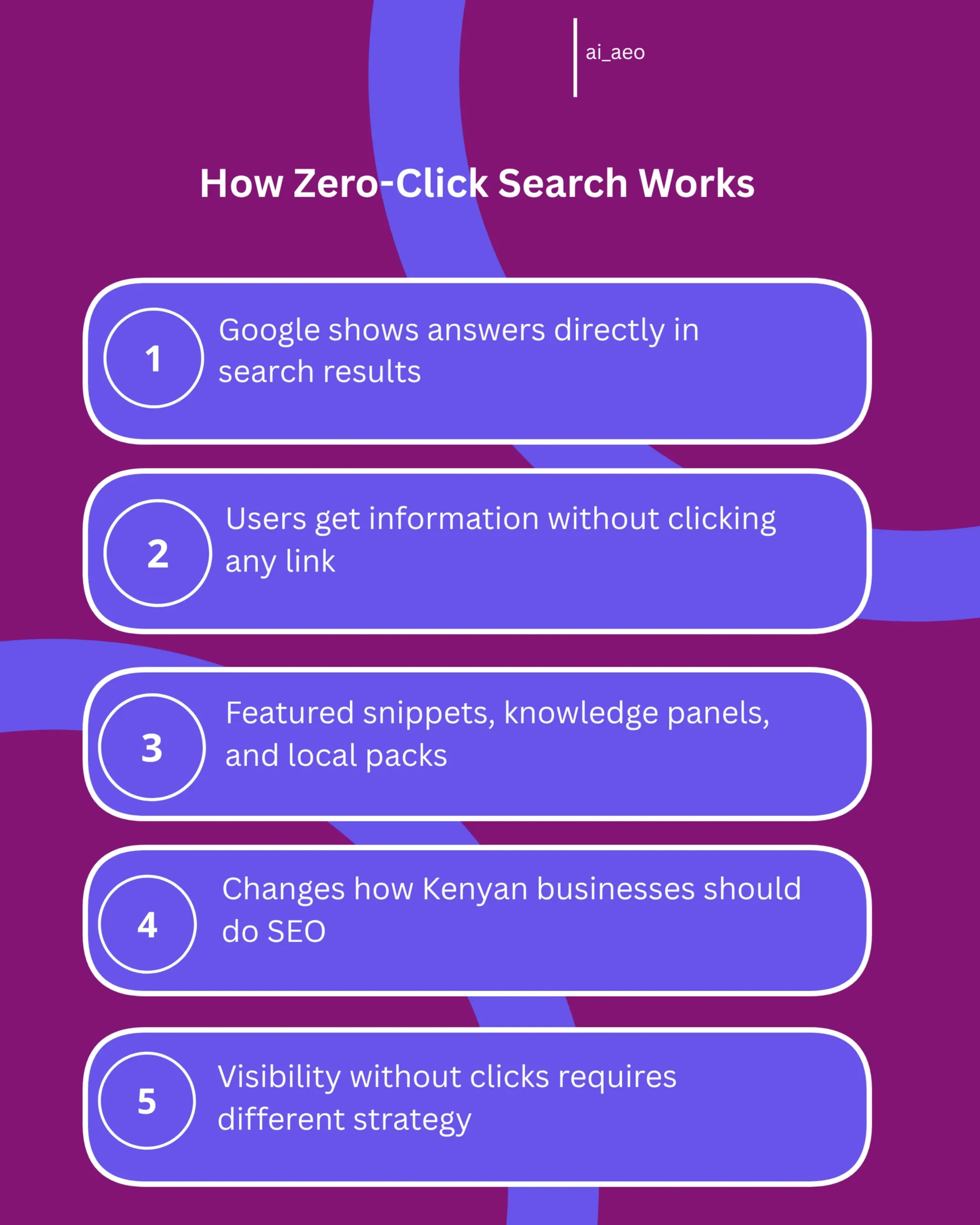
How Zero-Click Search Works
Google’s Algorithm Decides What Gets Shown
Google’s system scans the top-ranking websites for a search query and picks the best-formatted answer to display in the answer box. It looks for content that directly answers the question in a clear, concise way.
If your content answers the question better than everyone else’s, but it’s buried in a long paragraph, Google might pick a competitor’s answer that’s formatted as a clear list or definition. Understanding how to optimize for ai overviews helps you structure content that Google prefers.
Content Structure Determines Zero-Click Visibility
How you structure your content on the page matters more now than ever before. Google favors content that’s organized in specific ways: lists, tables, definitions, and short paragraphs that directly answer questions.
A Nairobi accountant writing about “how to file KRA returns” will get picked for the featured snippet if they format their answer as a numbered list. The same information buried in paragraphs won’t get picked, even if it ranks first.
Local Packs Require Business Profile Optimization
For local searches, Google pulls information from your Google Business Profile. If you haven’t updated your hours, phone number, address, or photos recently, you won’t show up properly in the local pack.
A Safaricom retailer in Nairobi needs a complete Google Business Profile with accurate hours, photos of the store, and regular customer reviews to appear in the local pack for “Safaricom shop near me.”
Zero-Click Search Examples in Kenya
Restaurant Search: The Local Pack Example
When someone in Nairobi searches “best restaurants in Kilimani,” Google shows a map with three restaurants, complete with ratings, photos, hours, and phone numbers. Users can call or navigate directly without visiting any website.
A restaurant owner who hasn’t updated their Google Business Profile with current hours and photos won’t appear in this pack. Their website traffic drops because they’re invisible in the zero-click format where most searches happen.
Product Information: The Featured Snippet Example
When someone searches “how much does M-Pesa charge for transfers,” Google shows a featured snippet with the exact fee structure pulled from a financial website or M-Pesa’s own content. Users get their answer without clicking.
A Kenyan fintech blog that formats their M-Pesa fee comparison as a clear table will get picked for the featured snippet over competitors with better content buried in paragraphs.
Business Information: The Knowledge Panel Example
When you search for a well-known Kenyan business like “Equity Bank,” Google shows a knowledge panel on the right with the company logo, description, headquarters location, stock price, and links to official pages. Most users get what they need from this panel.
Smaller Kenyan businesses can claim and optimize their knowledge panel through Google Business Profile and structured data markup, ensuring their information appears correctly when someone searches their name.
How-To Guides: The Step-by-Step Example
When someone searches “how to open a business in Kenya,” Google often shows a featured snippet with numbered steps pulled from a government or business website. Users scan the steps and decide if they need more detail before clicking.
A Nairobi business consultant who formats their guide with clear H2 headings and numbered steps will get picked for this featured snippet, appearing above competitors with more detailed but less scannable content. This is part of the broader AEO GEO LLMO optimization strategy.
Common Mistakes to Avoid
Ignoring Your Google Business Profile
Many Kenyan business owners set up their Google Business Profile once and never touch it again. They don’t update hours, add new photos, or respond to reviews.
This is a critical mistake because your profile is the main data source for local pack results and knowledge panels. An outdated profile means you won’t appear correctly in zero-click formats, even if you rank well.
Writing Long Paragraphs Instead of Scannable Content
Google’s algorithm favors content it can easily extract and display in an answer box. Long, dense paragraphs don’t get picked for featured snippets.
A Mombasa travel blogger writing about “best beaches in Mombasa” will get featured if they use a bulleted list with short descriptions. The same information in paragraph form won’t get picked, no matter how good it is.
Not Using Structured Data Markup
Structured data is code you add to your website that tells Google exactly what information is on your page: your business name, address, phone number, reviews, product prices, recipe ingredients, and so on.
Without structured data, Google has to guess what your content means. With it, Google knows exactly what you’re saying and can display it correctly in zero-click formats.
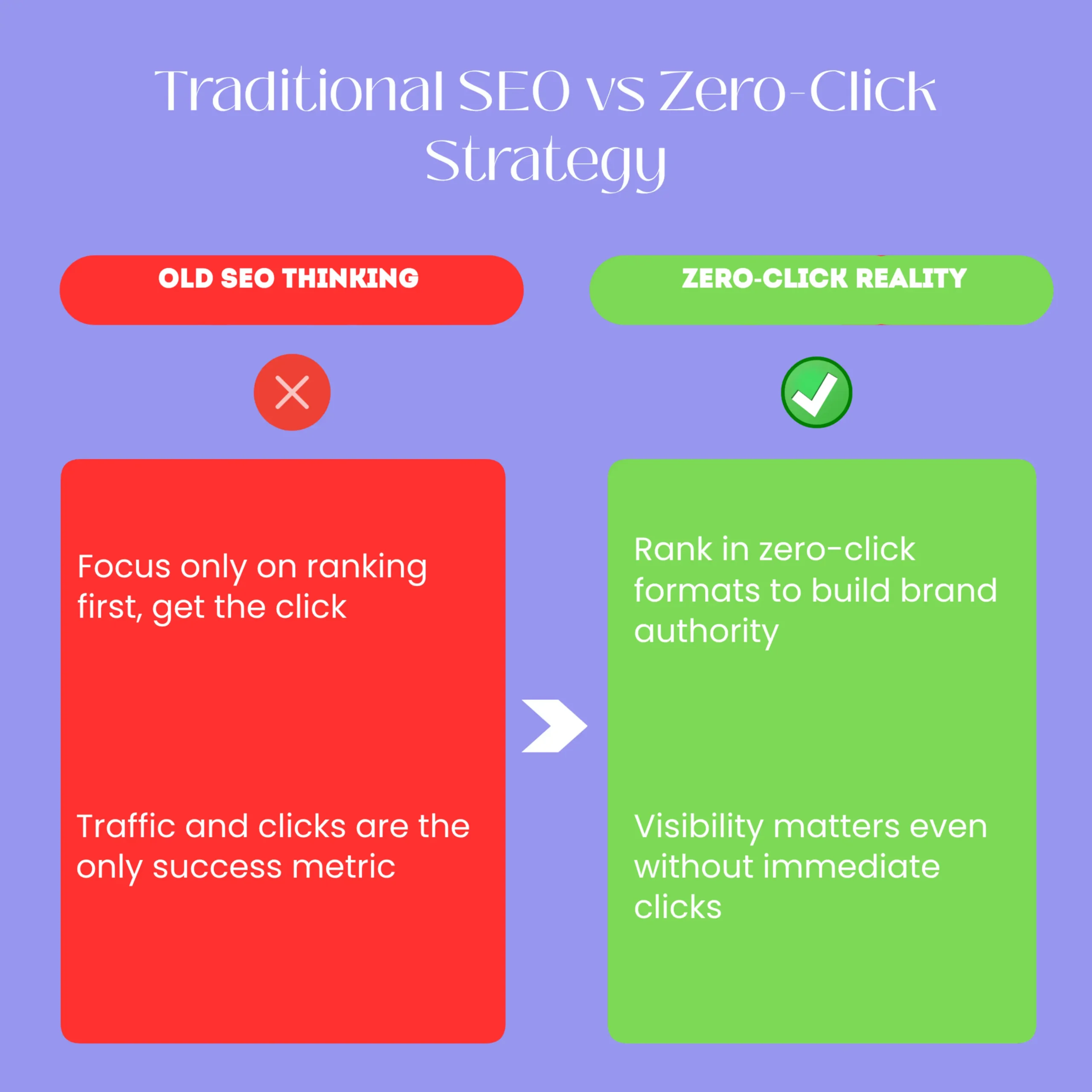
Focusing Only on Clicks and Missing Brand Authority
Some Kenyan business owners see their website traffic drop when they start appearing in featured snippets and think their SEO is failing. Actually, they’re winning in a new way.
Appearing in zero-click formats builds brand authority and awareness. Users see your business name and information repeatedly, even if they don’t click. This leads to direct searches, phone calls, and offline visits. Even what is voice search seo optimization contributes to this visibility.
| Zero-Click Format | What It Shows | Best For | Kenyan Example |
|---|---|---|---|
| Featured Snippet | A paragraph, list, or table pulled from a website and displayed above search results | How-to guides, definitions, comparisons, lists | “How to register a business with KRA” |
| Knowledge Panel | A card on the right side with key facts, images, and links about a person, business, or concept | Businesses, notable people, organizations, concepts | Searching for “Safaricom” or “Nairobi” |
| Local Pack | A map with three businesses showing ratings, hours, photos, and phone numbers | Local services, restaurants, retail, professional services | “Plumber near me Nairobi” or “restaurants in Westlands” |
| Answer Box | A direct answer to a simple question displayed at the very top | Quick facts, definitions, calculations, current information | “What is the current KES to USD exchange rate?” |
✅ Quick Action Checklist
- ☐ Audit your current Google rankings to identify which keywords trigger zero-click results
- ☐ Update your Google Business Profile with current hours, phone number, address, and at least 5 recent photos
- ☐ Reformat your website content using lists, tables, and clear headings instead of long paragraphs
- ☐ Add structured data markup to your website using Schema.org code for your business type
- ☐ Identify 5 high-value keywords where you rank in the top 3 but don’t appear in featured snippets
- ☐ Rewrite those pages to directly answer the question in the first 50 words using scannable format
- ☐ Monitor your visibility in zero-click formats using Google Search Console
- ☐ Train your team to measure SEO success by brand visibility, not just website clicks
Ready to Improve Your Zero-Click Visibility?
Zero-click search is not a threat to your SEO strategy. It’s an evolution that rewards businesses that optimize for how modern users actually search.
Kenyan business owners who understand and optimize for zero-click formats will dominate their local markets. The businesses that ignore it will watch their visibility disappear to competitors who don’t.
The question isn’t whether zero-click search matters. The question is whether you’re ready to adapt your SEO strategy to win in this new format. Tools like ai chatbot for kenya can help you capture leads even when users don’t click through.
Frequently Asked Questions
Does zero-click search mean I don’t need SEO anymore?
No. Zero-click search is part of SEO, not a replacement for it.
You still need to rank well to appear in featured snippets, knowledge panels, and local packs. The difference is that ranking first isn’t enough anymore. You need to optimize your content format and business profile data.
How do I know if my keywords trigger zero-click results?
Search your target keywords on Google and look at the search results page. If you see a featured snippet, knowledge panel, local pack, or answer box before the regular search results, that’s a zero-click format.
Use Google Search Console to see which of your pages appear in these formats.
Will optimizing for featured snippets reduce my website traffic?
Sometimes. If users get their answer from your featured snippet, they might not click through to your website.
But they remember your brand. They’re more likely to call you directly, search for you by name later, or visit your business offline. This is a win in a different way.
Can small Kenyan businesses compete in zero-click search?
Yes. Zero-click optimization is based on content quality and format, not budget.
A small Nairobi plumber who formats their content correctly can outrank a large company with poorly formatted content. This levels the playing field for SMEs. Strategies like service area business seo ranking without a physical location work especially well for small businesses.
What’s the difference between a featured snippet and a knowledge panel?
A featured snippet is content pulled from a website and displayed above the regular search results. A knowledge panel is information Google has compiled from multiple sources and displays in a card on the right side.
Knowledge panels are typically for businesses, people, and concepts that Google has verified information about.
Additional Resources
- The Best Niche and Industry SEO Strategies Built for Kenyan Markets – Discover sector-specific tactics that help Kenyan businesses dominate zero-click formats in their industry.
- Why Your Social Media Ads Send Customers to Competitors (+Free Checklist) – Learn how to align your paid ads with zero-click visibility so you don’t lose customers at the search stage.
- What is Structured Data – Master the code that tells Google exactly how to display your business in featured snippets and knowledge panels.
- Will AI Kill SEO In Kenya? Here’S What’S Actually Happening – Understand how AI-powered search is changing zero-click results and what Kenyan businesses must do to stay visible.
- What is a Knowledge Panel – Get step-by-step instructions for claiming and optimizing your business knowledge panel to win zero-click visibility.
- What is AI SEO – Learn how AI is reshaping search and why zero-click optimization is now a core part of modern SEO strategy.
Take the Next Step
Understanding zero-click search is the first step. The next step is optimizing your business to win in these formats and measuring success beyond just website clicks.
If you’re ready to adapt your Kenyan business SEO strategy for zero-click search, get your free zero-click SEO audit for Kenyan businesses and see exactly where you’re losing visibility to Google’s answer boxes. Specialized approaches like seo for saccos kenya or school seo attracting enrollments through search can help sector-specific businesses win in zero-click formats.