Table of Contents
- What Is ChatGPT SEO and Why Your Kenyan Business Needs It Now
- 📋 Key Takeaways
- What You Need Before You Start
- Step 1: Audit Your Current ChatGPT Visibility
- Step 2: Optimize Your Content for AI-Friendly Structure
- Step 3: Build Topical Authority
- Step 4: Earn Quality Backlinks
- Step 5: Monitor Your ChatGPT Visibility
- Common Mistakes to Avoid
- ✅ Quick Action Checklist
- Ready to Show Up in ChatGPT Answers?
- Frequently Asked Questions
- Additional Resources
- Take the Next Step
TL;DR: ChatGPT now pulls answers from real websites, and if your site isn’t optimized, your competitors will show up instead. To appear in ChatGPT answers, you need strong topical authority, clear content structure, quality backlinks, and regular updates. Start by auditing your current mentions, then optimize your website for AI-friendly formats like FAQ sections and data-backed statements that ChatGPT can cite. Before you start, get a free website analysis to see where you’re losing visibility.
What Is ChatGPT SEO and Why Your Kenyan Business Needs It Now
ChatGPT is not just a chatbot your customers use for fun. It is a search engine that pulls answers from real websites, and it cites those sources directly in its responses.
When a customer asks ChatGPT “Who is the best digital marketing agency in Nairobi?”, the AI does not make up an answer. It searches the web, finds relevant content, and pulls a response from real websites that rank high for that question.
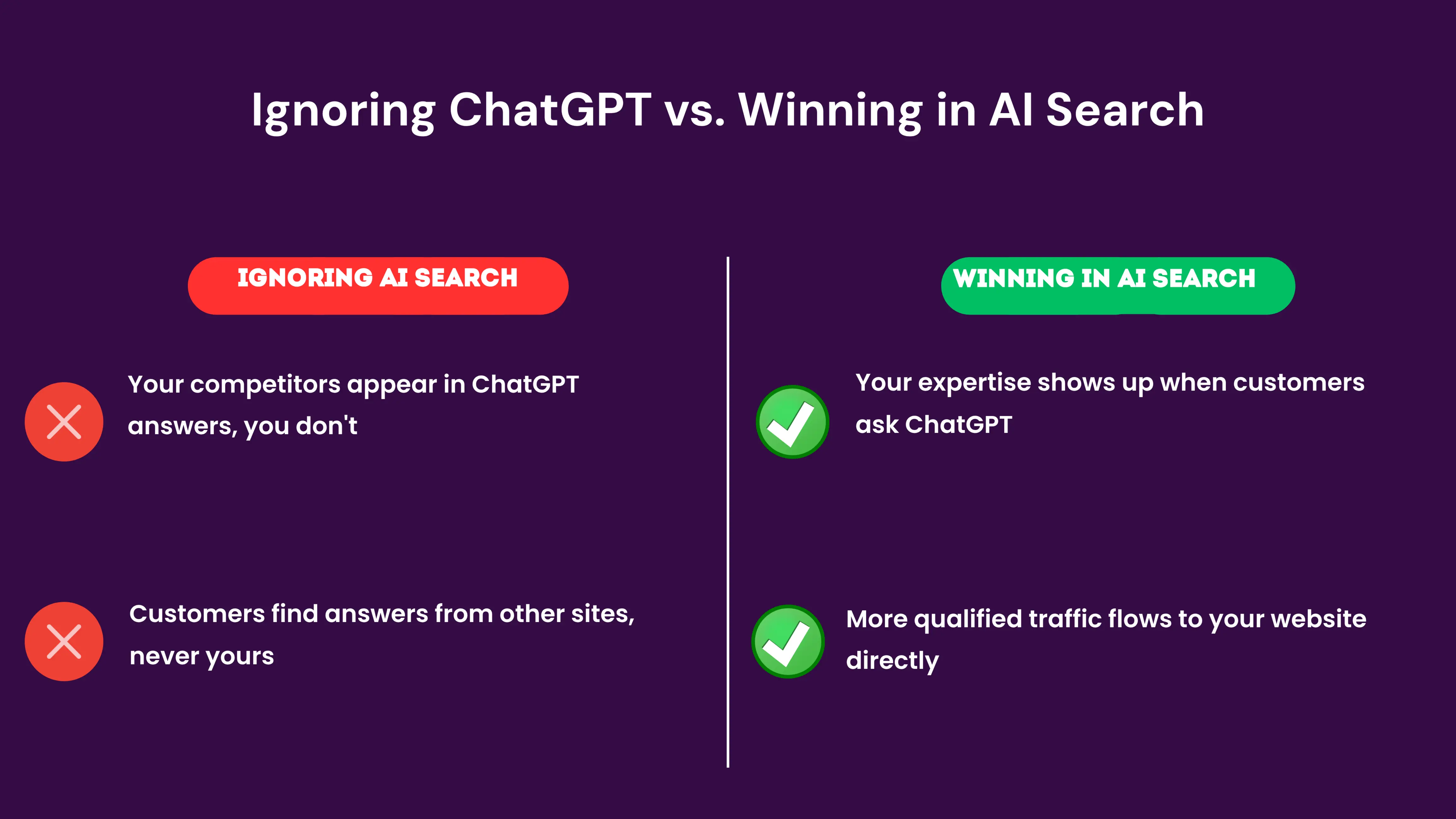
If your website is not optimized for ChatGPT, your competitors will show up instead. Understanding ai seo vs traditional seo is the first step to fixing that gap.
This means lost customers, lost revenue, and lost market share.
More Kenyan businesses are now searching for their ChatGPT visibility than ever before. Most of them are discovering they are completely invisible in AI answers.
The good news is you can fix this. The strategy is different from traditional Google SEO, but it is learnable and it works fast if you execute it right.
📋 Key Takeaways
- ChatGPT pulls answers from authoritative websites and cites them directly in responses.
- Your website must have strong topical authority to be selected as a source by AI models.
- Content structure matters more for AI than for Google: clear headings, FAQ sections, and data-backed claims are critical.
- Quality backlinks signal authority to both Google and ChatGPT’s training data.
- Monitoring your ChatGPT visibility is now as important as tracking your Google rankings.
What You Need Before You Start
Before you optimize for ChatGPT, you need to understand what ChatGPT actually sees when it evaluates your website. It is not looking at your logo or your colour scheme.
ChatGPT is trained on a snapshot of the internet from April 2024. Older websites with outdated content have an advantage only if that content is still relevant.
The AI looks for authority signals: backlinks, mentions, citations, and topical depth. A well-run ai chatbot for kenya businesses can also help surface these signals directly to customers.
Your Website Must Already Rank on Google
ChatGPT does not pull from websites that do not rank on Google. If your site is invisible to Google, it is invisible to ChatGPT.
Start by checking where your website ranks for your main business keywords. If you are not on the first page of Google for at least 5-10 keywords in your industry, fix that before you optimize for ChatGPT.
You Need a Clear Content Inventory
Know exactly what content you have, what keywords it targets, and how it performs. A Nairobi digital marketing agency should have a spreadsheet listing every blog post, service page, and resource on their website.
Without this inventory, you will not know where to add the structure ChatGPT needs to cite you.
You Must Understand Your Audience’s Questions
ChatGPT answers questions. If you do not know what questions your customers are actually asking, you cannot optimize for ChatGPT.
Spend time in your customer service emails, your WhatsApp messages, and your social media comments. Write down the exact questions people ask about your product or service.
Step 1: Audit Your Current ChatGPT Visibility
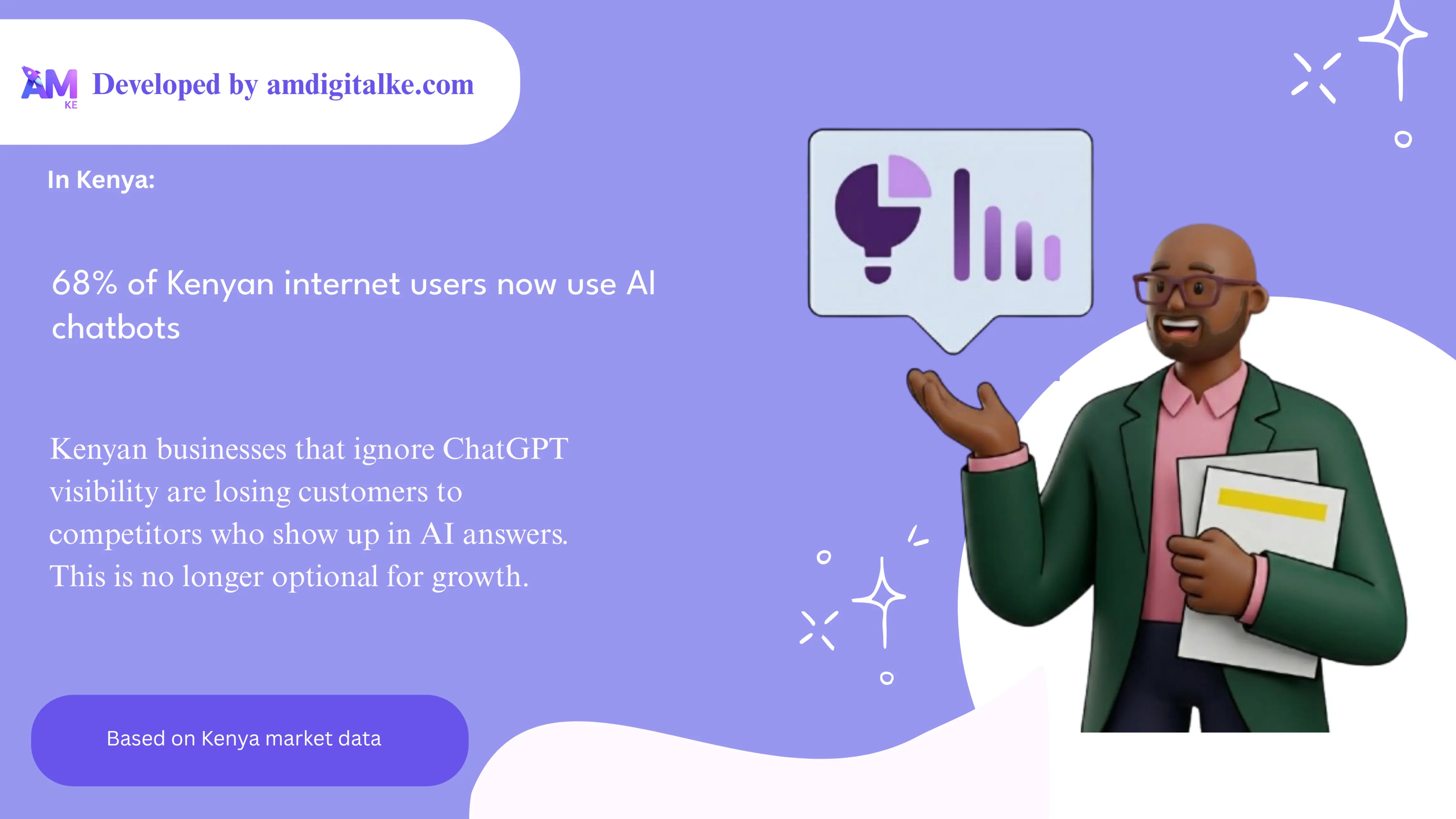
You cannot improve what you do not measure. Start by finding out if ChatGPT is already citing your website.
Open ChatGPT and ask it questions related to your business. Ask it the same questions your customers ask you.
Search for Your Business Name and Keywords
Ask ChatGPT: “What are the best digital marketing agencies in Nairobi?” or “Who offers SEO services in Mombasa?”
Check if your website appears in the sources ChatGPT cites. Write down every question and every result.
If your competitors appear and you don’t, that is your baseline problem. This gap is exactly what what is aeo work aims to close.
Check for Partial Visibility
Sometimes ChatGPT cites your website for some questions but not others. This tells you where your content is strong and where it is weak.
If ChatGPT cites you for “How to improve website speed” but not for “Best SEO practices in Kenya,” you know where the gap is. Create more content on the second topic.
Document the Sources ChatGPT Actually Uses
When ChatGPT gives an answer, it lists its sources at the bottom. Click on those sources and study them.
What do those websites have in common? How long is their content, and what structure do they use?
Check how many backlinks they have too. This reverse engineering tells you exactly what ChatGPT values.
Step 2: Optimize Your Content for AI-Friendly Structure
Google reads your content like a human would. ChatGPT reads it like a machine hunting for facts it can extract and cite.
This means your content structure must be crystal clear. Vague, fluffy writing will not work.
Use Clear Headings and Subheadings
ChatGPT uses your heading hierarchy to understand your content structure. If your blog post jumps from H1 to H4 with no logical progression, the AI gets confused.
Use H2 for main topics and H3 for subtopics. Make sure every heading clearly states what the section is about.
Create FAQ Sections on Your Service Pages
ChatGPT loves FAQ sections because they are pure questions and answers. Create a dedicated FAQ section on every service page you have.
A Mombasa-based hotel should have FAQs like: “What is your cancellation policy?” and “Do you offer airport transfers?”
Add one on WiFi speed too. ChatGPT will pull these answers directly and cite your website.
Back Every Claim with Data or Attribution
ChatGPT is trained to be cautious about facts. If you make a claim without backing it up, the AI will not cite you.
Instead of writing “We are the best SEO agency in Kenya,” write “We have helped 47 Kenyan businesses increase organic traffic by 156% in 12 months.” The second statement can be cited.
Use Structured Data Markup
Structured data is code that tells search engines and AI exactly what information is on your page. It works like invisible labels for your content.
Add schema markup for your business type, your services, your FAQs, and your reviews. Google and ChatGPT both read this markup, and it increases your chances of being cited.
Step 3: Build Topical Authority
ChatGPT does not cite random websites. It cites websites that are authorities on a specific topic.
If you have one blog post about SEO and 50 blog posts about dog grooming, ChatGPT will not treat you as an SEO authority. That stays true even if the one post is excellent.
Create a Content Cluster Around Your Main Topics
Identify 3-5 core topics that define your business. For each topic, create 5-10 pieces of content that explore different angles.
A Nairobi accounting firm should build clusters around “Tax Planning for Small Businesses,” “Payroll Management,” and “Financial Reporting.” Each cluster needs multiple pieces of content at different depths.
Link Your Content Together Strategically
Internal links tell ChatGPT that your website is comprehensive on a topic. Link from your main pillar content to your supporting content, and back again.
If you have a main page on “SEO for E-Commerce Businesses in Kenya,” link to supporting posts about “Keyword Research for E-Commerce” and “Product Page Optimization.” This is the same clustering logic behind the best niche and industry seo strategies built for kenyan markets.
Update Old Content Regularly
ChatGPT’s training data has a cutoff date, but it still prefers websites that are actively maintained. If your website has not been updated in a year, ChatGPT will assume it is stale.
Set a schedule to review and update your top 20 pieces of content every quarter. Add new examples, update statistics, and refresh the date.
Step 4: Earn Quality Backlinks
Backlinks are still the strongest authority signal in the world. ChatGPT’s training data includes the entire web. It knows which websites are linked to by other authoritative sources.
If your website has no backlinks, ChatGPT will not consider you an authority. This holds true no matter how good your content is.
Get Mentioned in Kenyan Industry Publications
Reach out to Business Daily, Nation, The Standard, and industry-specific publications in Kenya. Offer to be a source for their articles or write a guest post.
One backlink from a major Kenyan news outlet is worth more than 50 links from random blogs.
Build Relationships with Other Businesses in Your Industry
Create content that other businesses want to link to. Write a comprehensive guide to your industry, create a free tool, or publish original research.
A Kisumu-based digital marketing agency could publish “The State of Digital Marketing in Kenya 2024”. Then pitch it to every other agency and business publication in the country.
Guest Post on Established Websites
Write guest posts for websites that already rank well for your keywords. Include a link back to your website in the author bio or within the content.
Make sure the website you guest post on is actually relevant to your business. One guest post on a high-authority website in your industry beats ten posts on random sites.
| Backlink Source | Authority Level | Time to Acquire | Best For |
|---|---|---|---|
| Major Kenyan News Outlet | Very High | 2-4 weeks | Building immediate authority |
| Industry Publication | High | 3-6 weeks | Topical authority |
| Guest Post on Competitor Site | Medium-High | 4-8 weeks | Audience reach |
| Business Directory Listing | Medium | 1-2 weeks | Local visibility |
| Partner Website Link | Medium | 2-4 weeks | Relationship building |
Step 5: Monitor Your ChatGPT Visibility
You cannot manage what you do not measure. Set up a system to track your ChatGPT visibility every month.
This is not about vanity metrics. This is about understanding whether your strategy works and where you need to adjust.
Create a Monthly Tracking Spreadsheet
List 10-15 questions that customers ask about your business. Every month, ask ChatGPT those questions and record whether your website appears in the sources cited.
Track the percentage of questions where you appear. If you start at 10% and reach 60% in six months, your strategy is working.
Watch Your Google Rankings Alongside ChatGPT Visibility
ChatGPT pulls from Google results. So your Google rankings and your ChatGPT visibility are connected, and if your Google ranking drops, your ChatGPT visibility will follow.
Use Google Search Console to track your rankings for your main keywords. If you see a drop, investigate and fix it immediately.
Track the Traffic That Comes from ChatGPT Citations
When ChatGPT cites your website, it includes a clickable link. Set up UTM parameters on your links so you can track traffic from ChatGPT separately from other sources.
In Google Analytics, create a custom segment for ChatGPT traffic. Over time, you will see whether this traffic converts into customers.
Common Mistakes to Avoid
Most businesses that try to optimize for ChatGPT fail because they make the same mistakes over and over. Learn from others and avoid these traps.
Mistake 1: Ignoring Google SEO and Focusing Only on ChatGPT
ChatGPT pulls from Google. If your Google rankings are weak, your ChatGPT visibility will be weak too, no matter what you do.
Do not treat ChatGPT SEO as separate from Google SEO. They are connected, so improve both at the same time. If you want the full picture, read how to optimize for ai overviews as well.
Mistake 2: Writing Content That Is Too Vague or Fluffy
ChatGPT needs to extract facts from your content. If your content is full of marketing fluff and no actual information, ChatGPT will not cite you.
Replace phrases like “We are passionate about helping our clients succeed” with actual data and concrete examples. ChatGPT cites facts, not feelings.
Mistake 3: Building Topical Authority Too Slowly
You cannot become a ChatGPT authority with one blog post. You need depth, so create at least 10-15 pieces of content on your main topics before you expect results.
A Nairobi consulting firm should not expect ChatGPT to cite them after writing two blog posts. Write 20 pieces, then measure. If you are wondering how long does seo take kenya, this is part of the answer.
Mistake 4: Forgetting to Update Your Content
ChatGPT prefers fresh content. If your website has not been updated in two years, ChatGPT will assume it is outdated and cite more recent sources instead.
Set a calendar reminder to review and update your top 20 pages every quarter. Add new data, new examples, and a new publication date.
Mistake 5: Chasing Backlinks Without Quality
One backlink from a high-authority website is worth more than 100 backlinks from spam sites. Do not buy links or trade links with random websites.
Focus on earning links from relevant, authoritative sources in your industry. Quality over quantity always wins.
✅ Quick Action Checklist
- ☐ Ask ChatGPT 10 questions about your business and record which sources it cites
- ☐ Audit your Google rankings for your main keywords using Google Search Console
- ☐ Add FAQ sections to your top 5 service pages with real customer questions
- ☐ Create a content cluster of 5-10 pieces around your main business topic
- ☐ Add schema markup to your service pages and blog posts
- ☐ Reach out to 3 Kenyan industry publications to pitch a guest post or expert source opportunity
- ☐ Set up a monthly ChatGPT visibility tracking spreadsheet
- ☐ Schedule quarterly content updates for your top 20 pages
Ready to Show Up in ChatGPT Answers?
ChatGPT visibility is not a luxury. It is a business necessity for Kenyan companies that want to reach customers where they search.
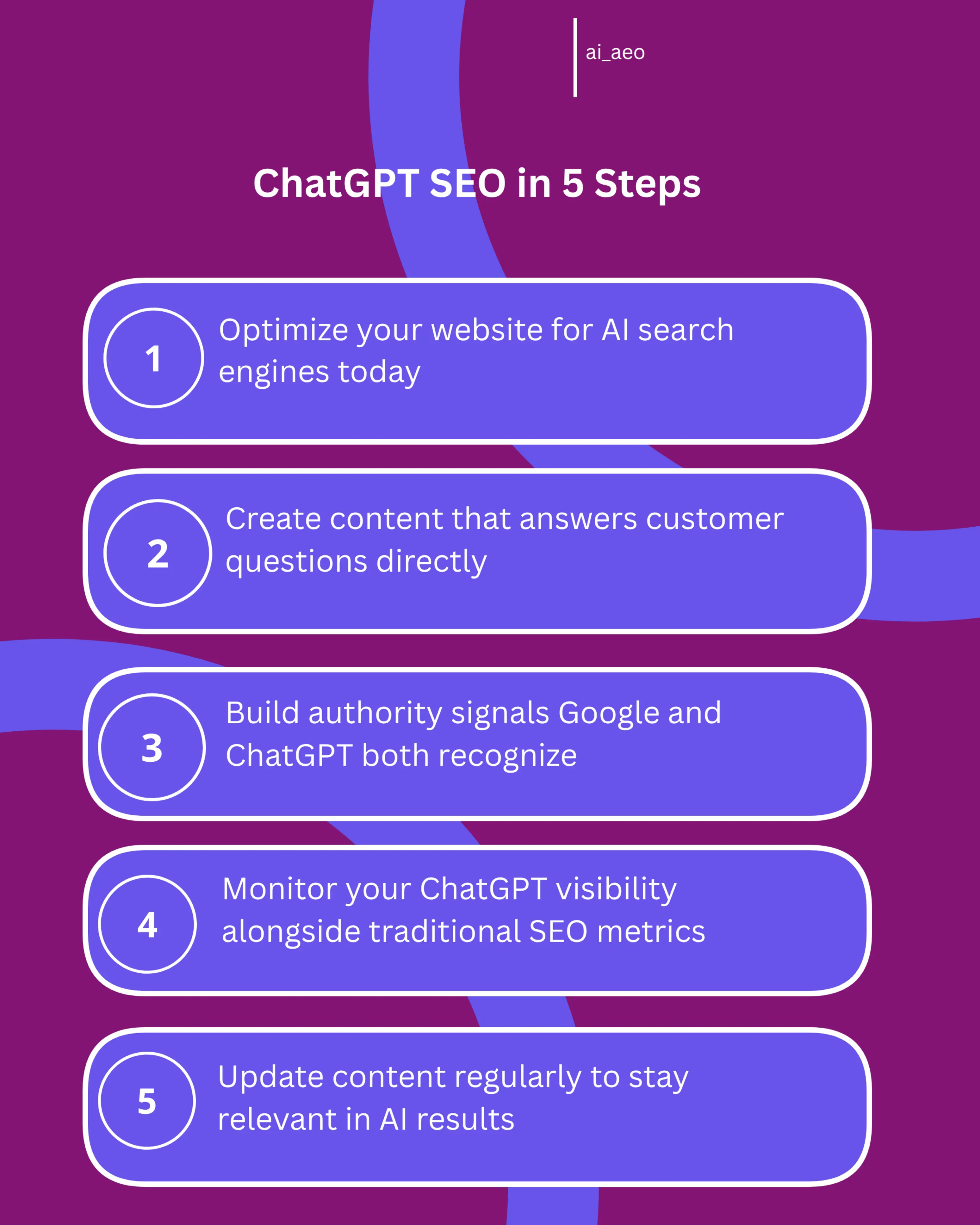
The strategy is clear. Build topical authority, optimize your content structure, earn quality backlinks, and monitor your progress.
Start with the audit. Then move through each step systematically, the same way you would refine what is voice search seo for your business.
If you want a detailed plan tailored to your specific business, reach out to AM Digital KE. We help Kenyan businesses show up in ChatGPT answers and capture the customers searching with AI.
Frequently Asked Questions
Does ChatGPT pull answers from every website on the internet?
No. ChatGPT pulls from websites that rank well on Google and have strong authority signals like backlinks and citations.
If your website is not ranking on Google, ChatGPT will not cite it.
How long does it take to see results in ChatGPT visibility?
Based on AM Digital KE client data across Kenyan accounts, most businesses see measurable ChatGPT visibility improvements within 3-6 months of consistent optimization. Some see results faster if they already have strong Google rankings.
Is ChatGPT SEO different from Google SEO?
The foundation is the same. Authority, relevance, and content quality matter in both.
The execution is different. ChatGPT values clear structure, factual claims, and topical depth more than Google does, so you need both strategies.
Can I rank in ChatGPT without building backlinks?
It is very difficult. Backlinks are one of the strongest authority signals ChatGPT recognizes.
You do not need thousands of backlinks. You need quality links from relevant, authoritative sources.
What if my competitors are already showing up in ChatGPT answers?
You can still beat them. Study their content structure, their backlink profile, and their topical coverage.
Create better, more comprehensive content. Earn more authoritative backlinks and optimize your structure more carefully than they did.
Additional Resources
- Why Your Social Media Ads Send Customers to Competitors (+Free Checklist) – If ChatGPT is sending your traffic to competitors instead of you, your paid ads probably have the same leak, check this list before you spend another shilling.
- What is Structured Data – ChatGPT pulls answers from clean, structured information, learn what structured data actually is before you try to feed it to AI.
- Will AI Kill SEO In Kenya? Here’S What’S Actually Happening – Before you rebuild your whole strategy around ChatGPT, read this to understand what AI is really doing to SEO in Kenya right now.
- How To Get Your Kenyan Business Featured In AI-Generated Search Results – Showing up in ChatGPT is one piece, this covers the full playbook for getting featured across AI search results in Kenya.
- What is a Knowledge Panel – ChatGPT often trusts the same signals Google uses for knowledge panels, see what that is and why it matters for your brand’s credibility.
- AEO, GEO & LLMO: SEO for the Age of AI Search – ChatGPT visibility is just one part of a bigger shift, get the full breakdown of AEO, GEO and LLMO for Kenyan businesses.
Take the Next Step
Getting your business featured in ChatGPT answers requires a clear strategy and consistent execution. Download the ChatGPT SEO Audit Template for Kenyan Businesses to see exactly where your website stands and what to fix first.
This template walks you through the same audit process we use with our clients. It shows you exactly which questions your customers ask ChatGPT and whether your website shows up.