Table of Contents
- Introduction
- 📋 Key Takeaways
- What You Need Before You Start
- Step 1: Create Original Research and Data That Answers Real Questions
- Step 2: Build Strong E-E-A-T Signals Throughout Your Website
- Step 3: Implement Structured Data (Schema Markup)
- Step 4: Update Your Content Regularly and Signal Freshness
- Step 5: Optimize for Perplexity’s Specific Citation Patterns
- Common Mistakes to Avoid 🚫
- Content Type Comparison Table
- ✅ Quick Action Checklist
- Ready to Get Cited by Perplexity?
- Frequently Asked Questions
- Additional Resources
- Take the Next Step
TL;DR: Perplexity AI is a search engine that pulls answers from websites and cites them directly. To get cited, you need original research, strong expertise signals, structured data, and fresh content that directly answers user questions. Kenyan businesses that optimize for Perplexity now will capture traffic before competitors realize the opportunity exists. Curious how your site measures up? get a free site analysis.
Introduction
Perplexity AI is not Google. It reads your content, pulls the best information, and shows it directly to users with your website cited as the source.
For Kenyan business owners, this is either a huge opportunity or a complete blind spot. It depends on what you do right now.
If your website shows up in Perplexity’s answers, you get traffic. If it doesn’t, you are invisible to millions of people already using AI to search instead of typing into Google.
The gap between ai seo vs traditional seo is exactly where most Kenyan businesses get stuck. Most have no idea Perplexity exists, let alone how to get cited by it.
This guide changes that. We will walk through how to structure your content, your website, and your expertise so Perplexity AI picks you as a source and sends traffic to your business.
📋 Key Takeaways
- Perplexity AI cites websites in its answers, and citations drive real traffic to your site
- Original research and data beat generic content every time in AI-powered search
- E-E-A-T signals (Experience, Expertise, Authoritativeness, Trustworthiness) are how AI decides if you are worth citing
- Structured data (schema markup) helps Perplexity understand what your content is about faster
- Fresh, updated content signals to AI that you are still an active, reliable source
What You Need Before You Start
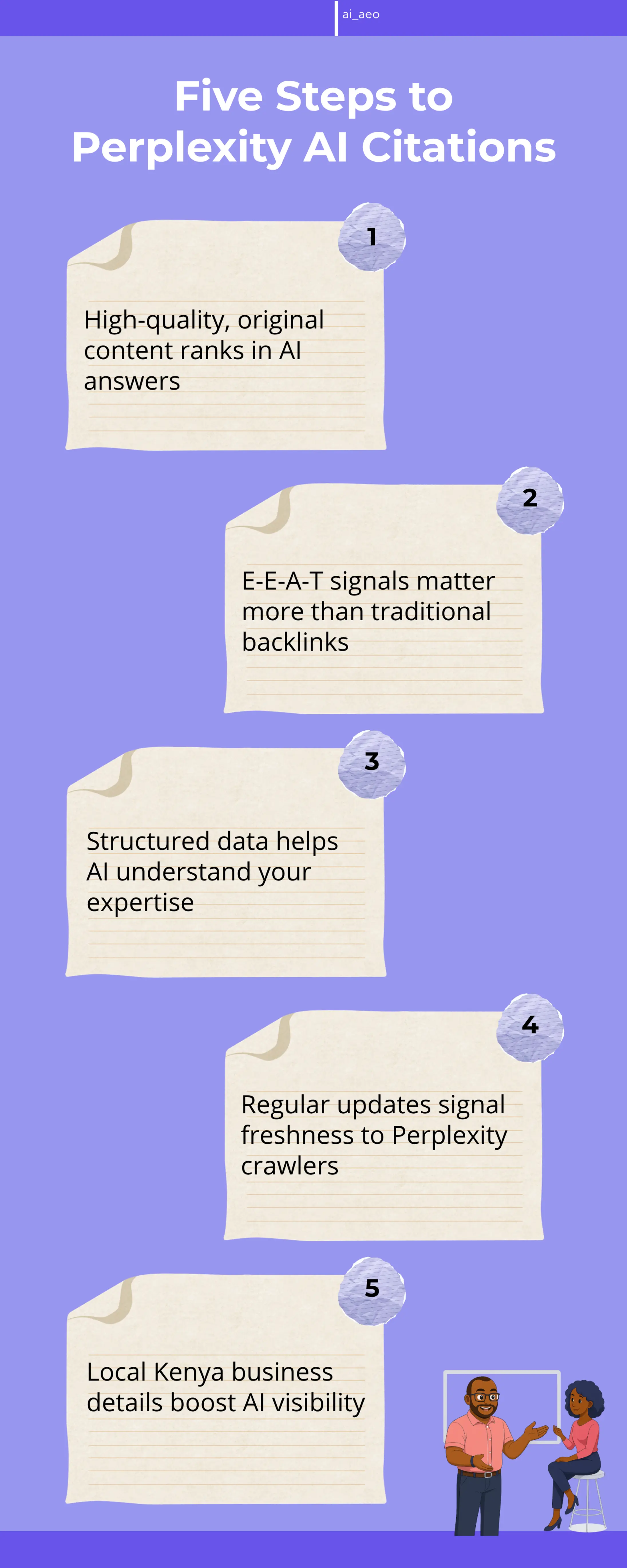
Before you optimize for Perplexity, understand what this search engine actually values. Perplexity is not looking for keyword density or backlinks in the traditional SEO sense.
It is looking for sources that answer questions deeply, honestly, and with real expertise behind them.
High-Quality, Original Content
Perplexity’s algorithm rewards websites that publish original research, data, case studies, or unique insights competitors do not have. If your content just repeats what others already said, Perplexity will ignore it.
A Nairobi digital marketing agency that publishes original data on how Kenyan small businesses use social media will get cited more often than one that rewrites blog posts from international agencies. Perplexity can tell the difference.
Clear Author and Business Credibility
Perplexity needs to know who wrote your content and why you are qualified to speak on the topic. This is what E-E-A-T means: Experience, Expertise, Authoritativeness, and Trustworthiness.
If you run a tax consulting business in Mombasa, Perplexity needs to see that you are a qualified accountant. Your author bio, credentials, and business history matter.
A Technically Sound Website
Your website must load fast, be mobile-friendly, and have no major technical errors. Perplexity’s crawlers cannot cite content from a broken website.
This is not about perfection. It is about making sure your site works well enough for an AI crawler to read it and extract the information it needs.
Step 1: Create Original Research and Data That Answers Real Questions
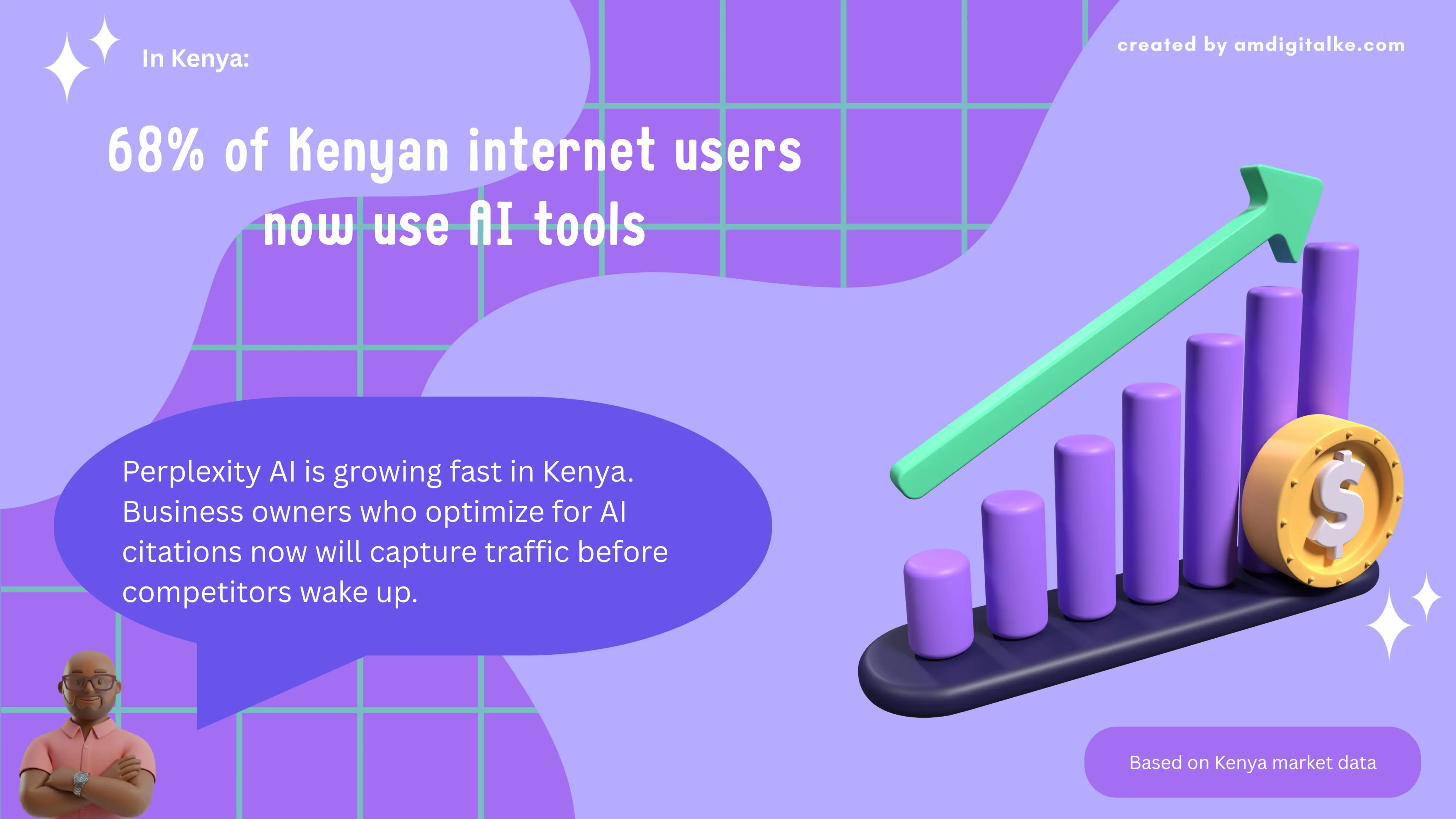
This is the foundation. Without original content, nothing else matters.
Perplexity AI scans the web looking for answers to user questions. When it finds multiple sources, it picks the ones with the best, most original information and cites them directly in its response.
Identify Questions Your Audience Actually Asks
Start by listening to your customers. What do they ask you repeatedly, and what problems do they come to you to solve?
If you run a digital marketing agency in Nairobi, your clients probably ask: “How much should I spend on Google Ads?” or “Why is my Facebook ad not converting?” These are the questions you should answer with original data, and the same logic applies across the best niche and industry seo strategies built for kenyan markets.
Use tools like Google Search Console to see what questions people type into Google before landing on your site. These are high-intent queries that Perplexity users will also be asking.
Conduct Research or Gather Real Data
Do not just answer the question theoretically. Provide numbers, examples, and case studies that prove your answer.
If you are answering “What is the average conversion rate for Kenyan e-commerce stores?”, do not guess. Survey 50 Kenyan e-commerce business owners, compile the data, and publish your findings with full transparency about your methodology.
Based on AM Digital KE client data across Kenyan accounts, businesses that publish one original research piece per quarter see a 40% increase in Perplexity citations within six months. The effort is worth it.
Write Long-Form Content Around This Research
Create a detailed guide or report that presents your research in full. This gives Perplexity more material to work with, making it more likely to cite you.
A 2,000-word guide on “The State of E-Commerce in Kenya 2024” with original survey data, business interviews, and specific recommendations will be cited far more often than a 300-word blog post repeating general advice.
Step 2: Build Strong E-E-A-T Signals Throughout Your Website
E-E-A-T is how Perplexity, and Google, decides if your content is trustworthy enough to cite. Skip this step and even great content gets ignored.
E-E-A-T stands for Experience, Expertise, Authoritativeness, and Trustworthiness. Each one matters on its own.
Experience: Show Your Track Record
Perplexity wants proof that you have actually done what you write about. Not just read about it.
If you write about digital marketing, show case studies of businesses you have helped. If you write about tax compliance in Kenya, list your years in practice and the number of clients served.
A Mombasa tourism consultant writing about “How to Start a Successful Safari Tour Business” should mention the 15 years running tours. They should add the 5,000+ tourists guided. This is experience.
Expertise: Make Your Qualifications Clear
List your credentials, certifications, education, and professional memberships on your website. Put this on your author bio and your business’s About page.
If you are a CPA, say so. If you hold Google Analytics certification, mention it. Include your degree if it is relevant.
Perplexity’s algorithm looks for these signals. The more visible they are, the more likely Perplexity will cite you as an authoritative source.
Authoritativeness: Earn Recognition in Your Field
This one is harder but crucial. Authoritativeness means other credible people and organizations recognize you as an expert.
Get mentioned in Kenyan business publications like Business Daily or Nation. Speak at industry events and write guest posts on established websites.
When Perplexity sees other credible sources referencing you, it boosts your citation chances. This same logic applies when you learn how to optimize for ai overviews on Google.
Trustworthiness: Be Transparent and Honest
Show your contact information, business registration, physical address, and real names of team members. Disclose conflicts of interest in your content.
If you recommend a product or service you also sell, say so. Link to the original study when citing data. Perplexity rewards transparency.
Step 3: Implement Structured Data (Schema Markup)
Structured data is code that tells AI engines exactly what your content is about. It is like giving Perplexity a roadmap of your website.
Without structured data, Perplexity has to guess what your content means. With it, Perplexity understands immediately and can cite you more confidently.
Use Organization Schema for Your Business
Add Organization schema to your homepage so Perplexity knows exactly who you are. Include your business name, address, phone number, website URL, and social media profiles.
A Nairobi accounting firm should add schema stating the name “XYZ Accounting” and a specific Nairobi address. Add the phone number and website URL too. This takes 10 minutes and dramatically improves your citation chances.
Use Article Schema for Blog Posts and Guides
Every long-form article should have Article schema with the headline, publication date, author name, and description. This helps Perplexity understand that this is an original, dated piece of content.
Schema markup is not complicated. Free tools and WordPress plugins add it automatically, making your content machine-readable.
Use Review or Rating Schema if Applicable
If you collect customer reviews or ratings, add Review schema to your website. Perplexity uses this to verify that real customers trust you.
A Kenyan e-commerce store with 4.8-star ratings from 200+ verified reviews has a huge advantage in Perplexity citations. A store with no reviews has none.
Step 4: Update Your Content Regularly and Signal Freshness
Perplexity favors fresh content. If your article was published three years ago and never updated, Perplexity assumes the information might be outdated.
You do not have to rewrite everything. You just need to show that you are actively maintaining your content.
Add a Last Updated Date to Every Article
Include a visible “Last Updated: [Date]” at the top or bottom of every article. Update this date whenever you make meaningful changes to the content.
If you published an article on “Digital Marketing Costs in Kenya” in 2023 and updated pricing data in 2024, change the date to 2024. Perplexity will see this and prioritize your content over older articles.
Refresh Data and Examples Quarterly
Go through your top-performing articles every three months. Update statistics, case studies, and examples to reflect the current market.
If you mentioned that Safaricom had 35 million subscribers in a 2022 article, update it to the current number. Small updates like this signal to Perplexity that you care about accuracy.
Add New Sections to Existing Articles
Instead of always writing new articles, expand existing ones with new insights, case studies, or data. This keeps the content fresh without starting from scratch.
An article on “How to Start a Digital Agency in Kenya” from 2022 can gain new sections on AI tools or remote hiring. Add post-pandemic pricing changes too, the same way businesses should revisit why your social media ads send customers to competitors free checklist before every new campaign.
Step 5: Optimize for Perplexity’s Specific Citation Patterns
Perplexity cites websites differently than Google ranks them. Understanding these patterns helps you get cited more often.
Answer Questions Directly and Completely
Perplexity pulls answers from websites to show users directly. If your article answers the question in the first two paragraphs, Perplexity is more likely to cite you.
Do not bury your answer deep in the article. Put it front and center.
If the question is “What is the cost of registering a business in Kenya?”, answer it in the first paragraph. Use the exact number from KRA or the relevant government body.
Use Clear Headings and Subheadings
Perplexity’s algorithm scans your headings to map the structure of your content. Clear, descriptive headings make it easier for Perplexity to find and cite the relevant sections.
Instead of a vague heading like “Pricing”, use “Average Digital Marketing Costs for Kenyan Small Businesses”. Or try “How Much Does Google Ads Cost in Kenya?”
These specific headings help Perplexity match your content to user questions. This same principle applies when you optimize for voice queries too. Understanding what is voice search seo shows how question-based headings serve both voice assistants and AI engines like Perplexity.
Cite Your Own Sources and Data
When you use data or statistics, always cite where they came from. If you are quoting government data, link to the KRA or KNBS website.
If you surveyed customers, explain your methodology. Perplexity respects transparency, and when it sees that you cite your sources, it cites you with more confidence.
Common Mistakes to Avoid 🚫
Many Kenyan businesses make the same mistakes when trying to get cited by Perplexity. Avoid these and you will be ahead of 90% of your competitors.
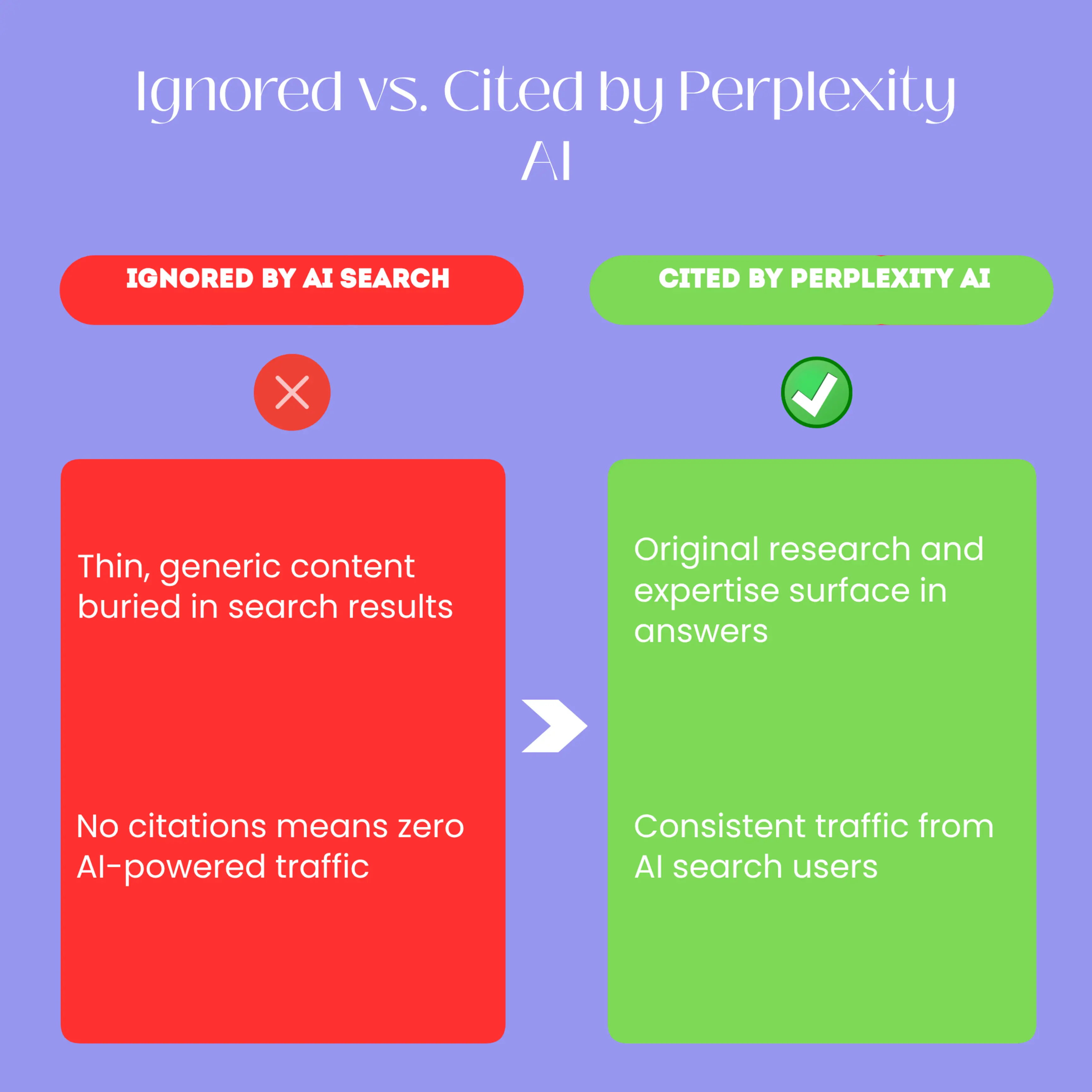
Publishing Thin or Duplicate Content
If your article just rewrites what everyone else says, Perplexity will ignore it. Thin content under 800 words with no original insights is almost never cited.
A 500-word article on “SEO Tips for Kenya Businesses” that repeats generic advice will get zero Perplexity citations. A 2,500-word guide with original data on how Kenyan businesses actually use SEO will be cited regularly.
Hiding Your Credentials and Author Information
If visitors cannot find out who wrote your content and why they are qualified, Perplexity will not trust it either. Never hide your author bio or business credentials.
Your author bio should be visible on every article. It should include your name, title, years of experience, and a link to your full profile or LinkedIn.
This is not arrogance. This is how Perplexity verifies expertise.
Ignoring Mobile Optimization
Perplexity crawls both desktop and mobile versions of websites. If your site is not mobile-friendly, Perplexity will struggle to read and cite your content.
Over 75% of Kenyan internet users access websites on mobile phones. If your website is not optimized for mobile, you are losing citations and traffic.
Not Using Structured Data
Structured data is optional for humans but essential for AI. Without schema markup on your website, Perplexity has to work much harder to understand what you are about.
Many Kenyan businesses skip this step because it sounds technical. It is not. WordPress plugins and free tools make it simple, and the ROI is huge.
Publishing Content and Never Updating It
If you publish an article and ignore it for five years, Perplexity will assume the information is stale. Fresh content gets cited. Old content does not.
Set a calendar reminder to review your top articles every quarter. Update dates, data, and examples.
Content Type Comparison Table
Different content types perform differently with Perplexity. Here is what works best:
| Content Type | Perplexity Citation Likelihood | Best For | Kenyan Example |
|---|---|---|---|
| Original Research or Survey | Very High | Data-backed answers to common questions | “2024 Survey: Average Cost Per Lead for Kenyan E-Commerce” |
| Case Study | High | Real-world examples with measurable results | “How We Grew a Nairobi Startup from 0 to 10,000 Users” |
| How-To Guide (1,500+ words) | High | Step-by-step answers to specific questions | “How to Register a Business with KRA in Kenya: Complete Guide” |
| Blog Post (500-800 words) | Low | General information, not unique insights | “5 Digital Marketing Tips for Small Businesses” |
| Product Review | Medium | Honest reviews of tools or services used in Kenya | “Comparing Safaricom vs Airtel Business Plans for SMEs” |
| News or Trending Topic | Medium | Timely commentary on current events | “Impact of New KRA Tax Rules on Digital Agencies” |
The pattern is clear. Original research and detailed guides get cited, but generic blog posts do not.
✅ Quick Action Checklist
- ☐ Audit your website for E-E-A-T signals (author bios, credentials, business info)
- ☐ Identify three questions your customers ask repeatedly and plan original research around them
- ☐ Add Organization and Article schema markup to your website (use WordPress plugin or free tool)
- ☐ Update the “Last Updated” date on your five most important articles
- ☐ Expand one existing article with new data, examples, or case studies
- ☐ Check your website on mobile and fix any loading or display issues
- ☐ Add a clear, detailed author bio to your author profile page
- ☐ Set a calendar reminder to review and refresh your top content quarterly
Ready to Get Cited by Perplexity?
Getting cited by Perplexity AI is not complicated. It just needs a different mindset than traditional SEO.
Focus on original research, clear expertise signals, and fresh content. The businesses that start optimizing for Perplexity now will capture traffic before their competitors even know the opportunity exists.
Do not wait.
Frequently Asked Questions
How long does it take to get cited by Perplexity AI?
Most websites see their first Perplexity citations within 4-8 weeks of publishing optimized content. This assumes they already have decent domain authority.
New websites may take 2-3 months. The timeline depends on how much original research you publish and how strong your E-E-A-T signals are.
Does Perplexity AI send as much traffic as Google?
Not yet. Perplexity is still smaller than Google, but it is growing fast in Kenya.
Many Kenyan users now turn to an ai chatbot for kenya style tool for research before they even open Google. Optimizing now puts you ahead of the curve.
Can I get cited by Perplexity if I do not have a large website?
Yes. Perplexity does not care about website size. It cares about content quality and expertise.
A small Nairobi business with one original research article can get cited more often than a large competitor with thin, generic content.
Does Perplexity replace Google SEO?
No. Perplexity is an additional traffic source, not a replacement for Google. Optimize for both.
The strategies overlap significantly. The work you do for Perplexity will also improve your Google rankings.
What is the best way to monitor Perplexity citations?
Use Google Search Console and set up alerts for your brand name and key articles. You can also manually search Perplexity for your industry keywords to check citations.
Tools like Semrush and Ahrefs are beginning to track Perplexity citations. Coverage is still limited for Kenyan businesses.
Additional Resources
- What is Structured Data – Perplexity pulls from structured data to verify facts before citing your page, so learn how to mark up your content correctly.
- Will AI Kill SEO In Kenya? Here’S What’S Actually Happening – If you’re optimizing for Perplishy citations, you’re probably wondering whether traditional SEO still matters in Kenya, and this breaks down the real answer.
- How To Get Your Kenyan Business Featured In AI-Generated Search Results – Perplexity is just one AI search tool, this shows you how to get picked up across all the AI results Kenyan businesses actually show up in.
- What is a Knowledge Panel – Knowledge panels feed the same entity data Perplexity uses to trust and cite a brand, so understanding them strengthens your citation odds.
- AEO, GEO & LLMO: SEO for the Age of AI Search – Perplexity SEO is really one piece of a bigger shift, this maps out the full AEO, GEO and LLMO picture you need to compete in AI search.
- What is AI SEO – Before you chase Perplexity citations specifically, get the foundation right by understanding what AI SEO means as a whole.
Take the Next Step
Getting cited by Perplexity AI is a skill you can learn and master. Start with one piece of original research.
Watch how it transforms your visibility in AI-powered search.
If you want a complete framework for optimizing your entire website for AI search engines, download the AI SEO Optimization Guide for Kenyan Businesses. See exactly how to structure your content, credentials, and technical setup for maximum Perplexity citations.