Table of Contents
- Introduction
- 📋 Key Takeaways
- What You Need Before You Start
- Step 1: Conduct Keyword Research for Your Kenyan Market
- Step 2: Optimize Your Product Pages for Search Engines and Customers
- Step 3: Fix Your Site’s Technical Foundation
- Step 4: Build Authority Through Links and Citations
- Step 5: Monitor Performance and Adjust Your Strategy
- Common Mistakes to Avoid 🚫
- Comparison Table: E-commerce SEO Tactics by Priority
- ✅ Quick Action Checklist
- Ready to Improve Your E-commerce SEO?
- Frequently Asked Questions
- Additional Resources
- Take the Next Step
TL;DR: Ranking your online shop on Google Kenya means fixing your technical foundation, researching the keywords Kenyans actually search, optimizing every product page, and building authority through links. Most shop owners skip the basics and waste money on ads instead. Start with site speed, mobile optimization, and clear product descriptions, then move to content and link building. Results take 3-6 months, but organic traffic is free and grows over time.
Introduction
Your online shop is invisible on Google. A customer in Nairobi searching for “leather bags Nairobi” sees your competitor’s store on page one. Yours does not show up until page five, and by then the sale is gone.
This is not a technology problem. It is a strategy problem. Most Kenyan shop owners either ignore Google search entirely and spend thousands on Facebook ads, or they try SEO and give up after two weeks because they do not understand what they are doing.
E-commerce SEO is different from regular SEO. You are not just trying to rank a blog post, you are trying to rank product pages that convert visitors into paying customers. The same core principles apply whether you run a shoe store or a hotel booking site. If you run a hospitality business instead, our guide on hotel seo kenya covers the same fundamentals applied to bookings.
This guide will walk you through exactly how to rank your WooCommerce store, Shopify shop, or any online store on Google Kenya. You will understand why each step matters, what to do first, and how long to expect before you see results.
📋 Key Takeaways
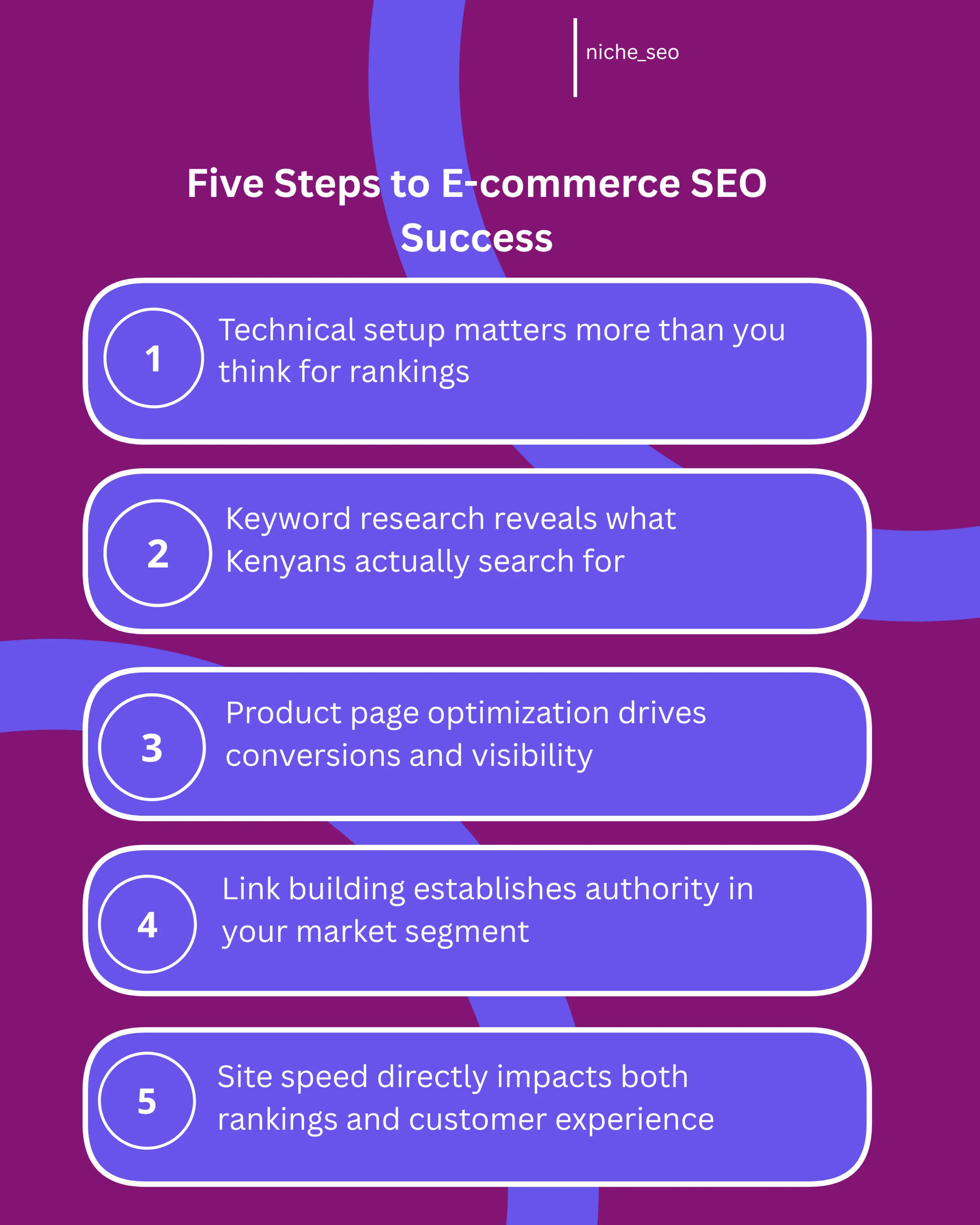
- Technical SEO is your foundation: site speed, mobile optimization, and clean URL structure rank before content does.
- Keyword research for e-commerce is about search intent: find what Kenyans search for, not what you think they should search for.
- Product page optimization requires both humans and search engines to understand your product: write clear descriptions and use structured data markup.
- E-commerce sites need internal linking strategy: guide customers and search engines from category pages to product pages to related products.
- Link building for online shops is harder than blogs, but possible: partnerships, press, and resource pages are your best bets.
What You Need Before You Start
Before you optimize a single product page, you need three things in place. Without them, your efforts will not stick, and you will waste time.
A Properly Configured Analytics and Search Console Account
You cannot improve what you do not measure. Google Search Console is free and shows you exactly which keywords people search for before they land on your site.
Set up Google Search Console right now by going to search.google.com/search-console and adding your online shop’s domain. Verify ownership, then link Google Analytics to your shop. Our google analytics 4 for kenyan businesses setup guide walks you through the setup step by step.
A Fast, Mobile-First Online Shop
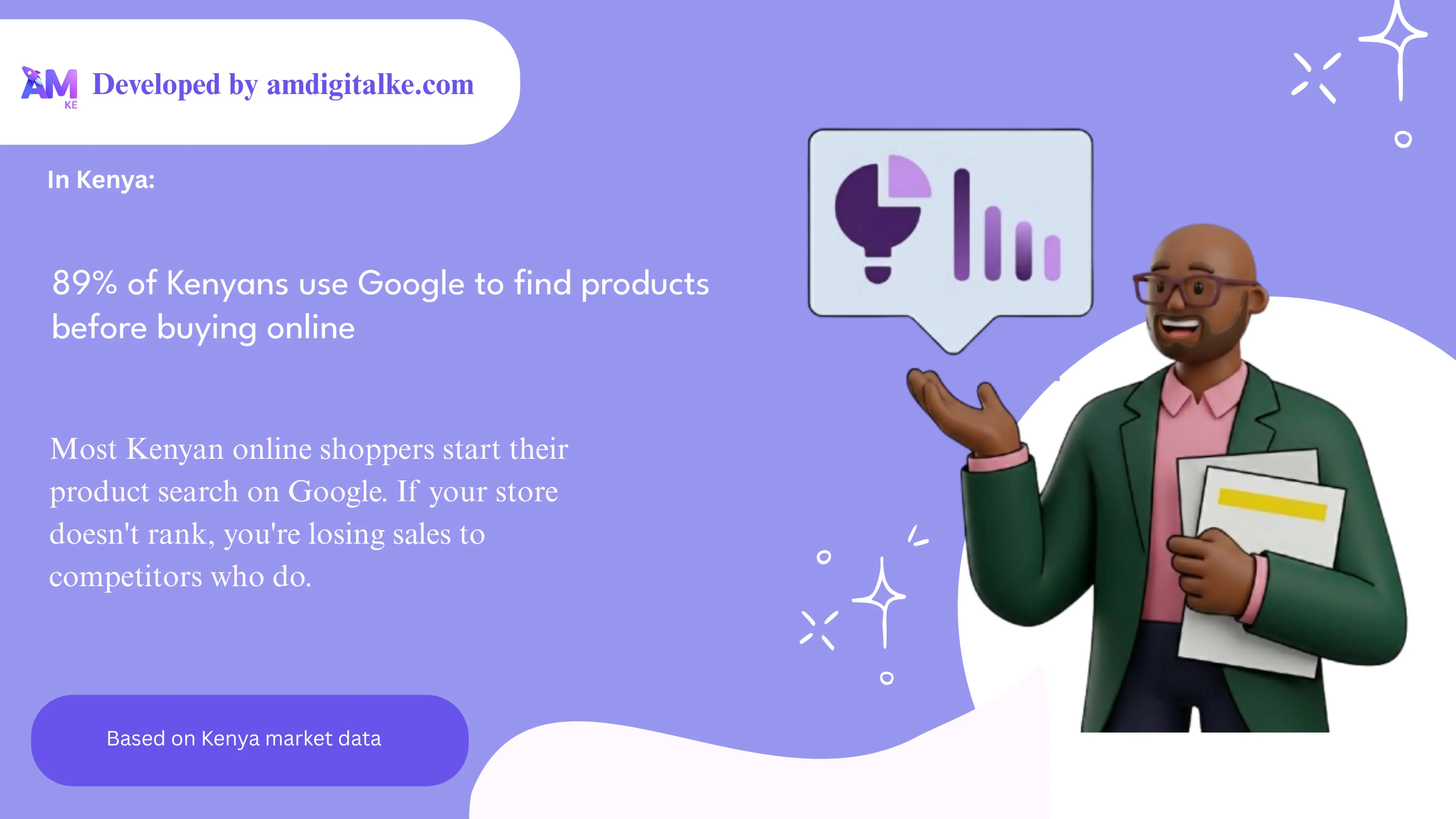
Mobile users now account for over 60% of e-commerce traffic in Kenya, and Google ranks mobile versions of websites first. If your shop is slow on mobile or has a broken checkout on phones, you will not rank and you will not convert.
Test your shop’s speed right now using Google’s PageSpeed Insights tool. If your score is below 50, you have a serious problem. If it is between 50 and 90, you have work to do. Above 90, you are in good shape.
Clear Business and Product Categories
Your shop’s structure decides whether Google understands what you sell. You need clear category pages, such as “Men’s Shoes,” “Women’s Bags,” or “Electronics,” with organized product pages under each one.
If your shop is a mess of random products with no clear structure, Google cannot understand what you sell, and neither can customers. Spend time organizing before you start optimizing. Structured categories work the same way for service businesses too, as shown in our piece on practice area pages that rank seo for kenyan law firms.
Step 1: Conduct Keyword Research for Your Kenyan Market
Keyword research is where most e-commerce SEO fails. Shop owners either skip it entirely and guess what people search for. Others copy keywords from other countries that do not apply to Kenya.
A Kenyan customer searching for shoes will use different words than someone in the United States. They might search “school shoes for boys Nairobi” instead of just “boys shoes.” They might search “affordable phone cases Kenya” instead of just “phone cases.”
Find Keywords That Match Kenyan Search Behavior
Use Google Keyword Planner (free with a Google Ads account) or Ubersuggest to find keywords people actually search for in Kenya. Set your location to Kenya and your language to English.
Look for keywords that have real search volume but are not too competitive. A keyword like “shoes” gets thousands of searches but is nearly impossible to rank for.
A keyword like “affordable leather school shoes for boys Nairobi” might get 50 searches a month. It is much more rankable.
Separate Keywords by Search Intent
Not all keywords are created equal. Some keywords mean a customer is ready to buy, while others mean they are just researching.
For e-commerce, focus on commercial keywords: “buy leather bags Nairobi,” “best phone cases Kenya under 2000,” “affordable winter jackets Mombasa.” These keywords show buying intent.
A customer searching these words is close to making a purchase. Businesses selling vehicles should apply the same logic through car dealership seo ranking for makes and models in kenya.
Create a simple spreadsheet with three columns: keyword, monthly search volume, and competition level. Aim for keywords with 50-500 monthly searches and low to medium competition.
These are your targets. If this process feels like too much to manage alone, professional ecommerce seo services kenya can build this keyword map for you.
Step 2: Optimize Your Product Pages for Search Engines and Customers
A product page that ranks on Google is different from a product page that converts visitors into buyers. You need both.
Write Product Titles That Include Your Target Keyword
Your product title is the most important on-page SEO signal. It tells Google what your product is, and it tells customers whether to click your result.
Instead of “Leather Bag,” write “Premium Brown Leather Shoulder Bag for Women, Nairobi.” This is longer, but it includes your keyword.
It is specific, and it answers the customer’s question before they click.
Create Unique, Detailed Product Descriptions
Do not copy the manufacturer’s description from the supplier. Write your own description that speaks to your Kenyan customer.
A good product description is 150-300 words. It should answer these questions: What is this product? What problem does it solve?
Who is it for? Why should someone buy it from you instead of another shop? What are the key features and benefits?
Include your target keyword naturally in the first 100 words of the description. If you sell phone cases, mention “durable phone cases Kenya” or “affordable phone cases Nairobi” early in the text.
Use Structured Data Markup for Product Information
Structured data is code that tells Google exactly what information on your page means. For e-commerce, you need product schema markup.
Include the product name, description, price, availability, and customer reviews. This markup helps Google display rich results for your products.
Most e-commerce platforms like WooCommerce and Shopify add basic product schema automatically. You should still verify it is correct using Google’s Structured Data Testing Tool.
Optimize Your Product Images
Images matter for both SEO and conversion. Name your image files descriptively instead of using “IMG_12345.jpg.”
Use “leather-shoulder-bag-brown-women.jpg” instead. Add alt text to every image that describes what the image shows.
Include your keyword in the alt text when it makes sense. Alt text helps Google understand your images and helps customers using screen readers.
Step 3: Fix Your Site’s Technical Foundation
Technical SEO is invisible to customers, but it is critical for rankings. If your site’s technical foundation is broken, no amount of content optimization will help.
Improve Your Site Speed on Mobile and Desktop
Google uses site speed as a ranking factor. A slow site ranks lower than a fast site, even if the content is better.
More importantly, slow sites lose customers. A one-second delay in page load time can reduce conversions by 7%.
Enable image compression, use a content delivery network, minimize CSS and JavaScript, and enable browser caching. If you use WooCommerce, install a caching plugin like WP Super Cache or W3 Total Cache.
Make Your Site Mobile-Friendly
Google’s mobile-first indexing means Google crawls and ranks your mobile site before your desktop site. If your site does not work well on mobile, you will not rank.
Test your site on actual mobile phones, not just in a browser. Check that buttons are clickable, text is readable, and the checkout process works smoothly on a phone.
Create a Clean URL Structure
Your URLs should be simple and descriptive. Instead of “myshop.com/product?id=12345,” use “myshop.com/leather-bags/brown-shoulder-bag.”
This tells both Google and customers what the page is about. Use hyphens to separate words, not underscores.
Keep URLs under 75 characters when possible. Avoid special characters and numbers that do not add meaning.
Set Up Proper Internal Linking
Internal links are links from one page on your site to another page on your site. They help Google understand your site’s structure and distribute ranking power to your most important pages.
Link from your homepage to your main category pages. Link from category pages to product pages, and link from product pages to related products.
Use descriptive anchor text like “browse men’s shoes” instead of “click here.” A site that ranks well but neglects customer trust can still lose sales, so pair your SEO work with solid practices for managing your online reputation pr crisis response for kenyan brands.
Step 4: Build Authority Through Links and Citations
Links from other websites to your online shop are votes of confidence. They tell Google your shop is trustworthy and relevant. Without links, you will struggle to rank for competitive keywords.
Get Links from Local Kenyan Directories and Business Listings
Submit your shop to local directories like Google My Business, Jumia Seller Central, and local business listing sites. Make sure your business name, address, and phone number stay consistent across all listings.
This is not traditional link building. It is citation building, and it helps Google understand that your business is real and located in Kenya.
Reach Out to Kenyan Bloggers and Journalists
If you sell a unique product or have an interesting story, reach out to Kenyan bloggers and journalists who cover your industry. Offer them a free product in exchange for a review or mention.
A link from a reputable Kenyan blog or news site beats 100 links from low-quality sites. Focus on quality over quantity.
Create Content Worth Linking To
The best way to earn links is to create something so useful that people want to link to it. For e-commerce, this might be a buying guide, a size chart, or a comparison of similar products.
Write a detailed guide like “The Complete Guide to Choosing the Right Leather Bag in Nairobi” and promote it to relevant websites and social media. If it genuinely helps, people will link to it. This is where strong product page optimisation selling and ranking on google kenya pays off too, since good product pages get shared and linked just as often as guides.
Step 5: Monitor Performance and Adjust Your Strategy
SEO is not a one-time project. It is an ongoing process where you monitor results and adjust based on what the data tells you.
Track Your Rankings Over Time
Use Google Search Console to track which keywords you rank for and your average ranking position. Most e-commerce sites see their first real results after 3-6 months of consistent effort.
Do not expect to rank on page one for competitive keywords in the first month. Focus on long-tail keywords first, then expand to more competitive ones as your authority grows.
Measure Traffic and Conversions
Ranking is not the goal. Sales are the goal.
Use Google Analytics to track traffic from Google search. Use your e-commerce platform to track how many of those visitors actually buy.
Calculate your conversion rate: purchases from Google divided by total traffic from Google, times 100. If you get 1,000 visitors from Google and 20 buy, your conversion rate is 2%.
Identify Your Best-Performing Keywords and Products
Not all keywords and products are equal. Some drive traffic, others drive sales.
Focus your effort on the keywords and products that actually make money. If a keyword drives lots of traffic but no sales, optimise that product page or stop targeting that keyword.
If a keyword drives less traffic but a higher conversion rate, invest more effort in ranking for it. The same logic applies whether you sell shoes online or run real estate seo kenya campaigns for property listings.
Common Mistakes to Avoid 🚫
Most Kenyan shop owners make the same mistakes over and over. Learning what not to do matters as much as learning what to do.
Copying Product Descriptions from Suppliers
Duplicate content is a major SEO problem. Google penalises sites that copy content from other sources.
If you copy your product descriptions from the supplier’s website or another retailer, Google will not rank your pages. Write unique descriptions for every product.
Make them specific to your shop and your Kenyan customers. This takes more time, but it is the only way to rank.
Ignoring Mobile Optimization
If your site is not optimised for mobile, you will not rank and you will not convert. Over 70% of online shopping in Kenya happens on mobile devices.
Test your site on actual phones. Make sure navigation is clear, buttons are easy to tap, and checkout works smoothly.
Do not assume it works because it looks fine on your desktop.
Targeting Keywords with No Local Intent
A keyword like “leather bags” might get 100,000 searches per month globally, but only 50 of those searches come from Kenya. Target keywords that Kenyans actually search for.
Use location modifiers in your keywords: “leather bags Nairobi,” “phone cases Mombasa,” “school shoes Kisumu.” These keywords have lower search volume but much higher conversion rate because the intent is local.
If you run a shop with multiple branches, this is exactly the strategy covered in location pages that rank the complete guide for kenya.
Expecting Immediate Results
SEO takes time. Most shop owners expect results in 2-4 weeks and give up when they do not see them.
Real results take 3-6 months of consistent effort. Google needs time to crawl your site, understand your changes, and decide whether to rank you higher.
Do not give up after one month. Stick with it for at least three months before you evaluate whether your strategy works.
Not Building Links
Some shop owners focus only on on-page optimisation and ignore links entirely. Links stay critical for e-commerce ranking, especially for competitive keywords.
You do not need thousands of links. You need links from relevant, trustworthy sites.
Start with local directories, then move to outreach and content creation.
Comparison Table: E-commerce SEO Tactics by Priority
| Tactic | Difficulty | Time to Results | Impact on Rankings | Priority |
|---|---|---|---|---|
| Fix site speed | Medium | 1-2 weeks | High | 1 (Start here) |
| Mobile optimization | Medium | 1-2 weeks | High | 1 (Start here) |
| Product page optimization | Low | 2-4 weeks | High | 2 |
| Keyword research | Low | 1 week | Medium | 2 |
| Internal linking | Low | 1-2 weeks | Medium | 2 |
| Link building | High | 3-6 months | High | 3 |
| Content creation | Medium | 2-3 months | Medium | 3 |
✅ Quick Action Checklist
- ☐ Set up Google Search Console and link it to Google Analytics
- ☐ Test your site speed on Google PageSpeed Insights and fix any issues below 50
- ☐ Conduct keyword research for your products using Google Keyword Planner (Kenya location)
- ☐ Rewrite at least 5 product descriptions with your target keywords included
- ☐ Add descriptive alt text to all product images
- ☐ Check your URL structure and clean up any messy URLs
- ☐ Create internal links from category pages to related product pages
- ☐ Submit your shop to Google My Business and local directories
Ready to Improve Your E-commerce SEO?
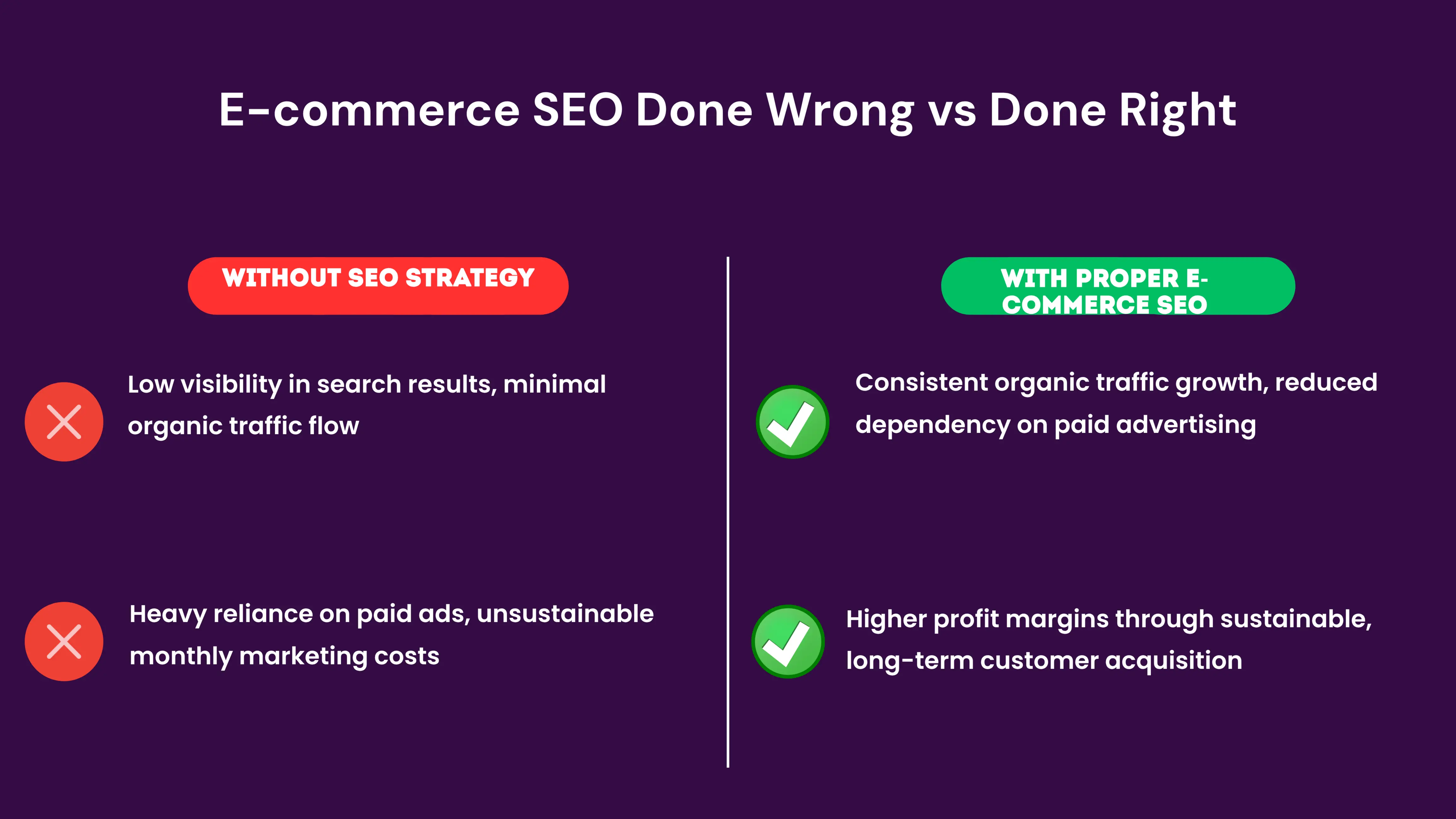
Ranking your online shop on Google Kenya is not complicated. It requires patience and consistency.
Start with the technical foundation. Move to product page optimization, then build authority through links and content, including user generated content reviews and qas that boost rankings.
Most shop owners never rank because they do not understand SEO or they give up too early. You now understand the strategy.
The question is: will you actually do it?
Frequently Asked Questions
How long does it take to rank on Google Kenya?
Most e-commerce sites see their first rankings for long-tail keywords within 6-12 weeks. Competitive keywords take 3-6 months or longer.
Results depend on your site’s age, domain authority, competition level, and effort. Do not expect immediate results.
Is WooCommerce or Shopify better for SEO?
Both platforms are SEO-capable, but WooCommerce gives you more control. Shopify is easier to set up and faster out of the box.
For SEO, the difference is small. What matters more is how well you optimize your site, not which platform you use.
Do I need to hire an SEO agency to rank my shop?
No. You can rank your shop yourself if you understand the fundamentals and commit to consistent effort.
If you do not have time or expertise, hiring an agency can speed up results. Make sure the agency understands Kenya’s market and e-commerce specifically.
How many product pages do I need to rank?
Start with 20-50 well-optimized product pages. Quality matters more than quantity.
A hundred poorly optimized pages will not rank better than 20 excellent pages. Focus on depth and relevance first.
Can I rank my shop without building links?
For very low-competition keywords, yes. For anything moderately competitive, you will need links.
Start with local citations and directories. Then move to outreach and content creation as your shop grows, especially if you are competing nationally in kenya ranking beyond your city.
Additional Resources
- What is eCommerce SEO in Kenya – Before you rank your shop, get the fundamentals right, this article breaks down what eCommerce SEO actually means in the Kenyan market.
- Tracking What Matters – Essential Metrics for Kenyan Websites – Once your product pages start ranking, use this guide to know which numbers actually show your SEO is working.
- Tourism SEO Kenya – How to Attract International Visitors – If your online shop ships to buyers abroad, this piece shows how Kenyan sites win visibility with international searchers.
- SACCO SEO – Digital Visibility for Kenyan Financial Cooperatives – See how a different type of Kenyan business tackles local search competition, useful if your shop also serves a niche member base.
- Property Listing Pages – SEO Best Practices for Kenyan Real Estate – Product pages and property listings share the same SEO challenge, structuring individual pages to rank, so this comparison sharpens your approach.
- Parent-Focused Keywords – Understanding Education Search Intent in Kenya – Learn how to map buyer intent to keywords, a skill this article applies to parents but you can apply directly to your shoppers.
Take the Next Step
Ranking your online shop on Google Kenya is possible. It requires a clear strategy and consistent execution.
If you want a done-with-you approach, we help Kenyan shop owners rank their products and scale their revenue through SEO. The same principles apply whether you run a retail shop or a school website seo kenya project.
Get a free e-commerce SEO audit for your online shop. Discover exactly what is holding you back from ranking on Google Kenya.