Table of Contents
- Introduction
- 📋 Key Takeaways
- What You Need Before You Start
- Step 1: Research Keywords Parents Actually Search For
- Step 2: Optimize Your Homepage and Key Pages for Parent Intent
- Step 3: Set Up Local SEO to Rank for “Near Me” Searches
- Step 4: Fix Technical SEO Issues That Block Rankings
- Step 5: Build Authority Through Education Backlinks
- Common Mistakes to Avoid 🚫
- Comparison Table: SEO Actions and Their Impact
- ✅ Quick Action Checklist
- Ready to Improve Your School’s Visibility on Google?
- Frequently Asked Questions
- Additional Resources
- Take the Next Step
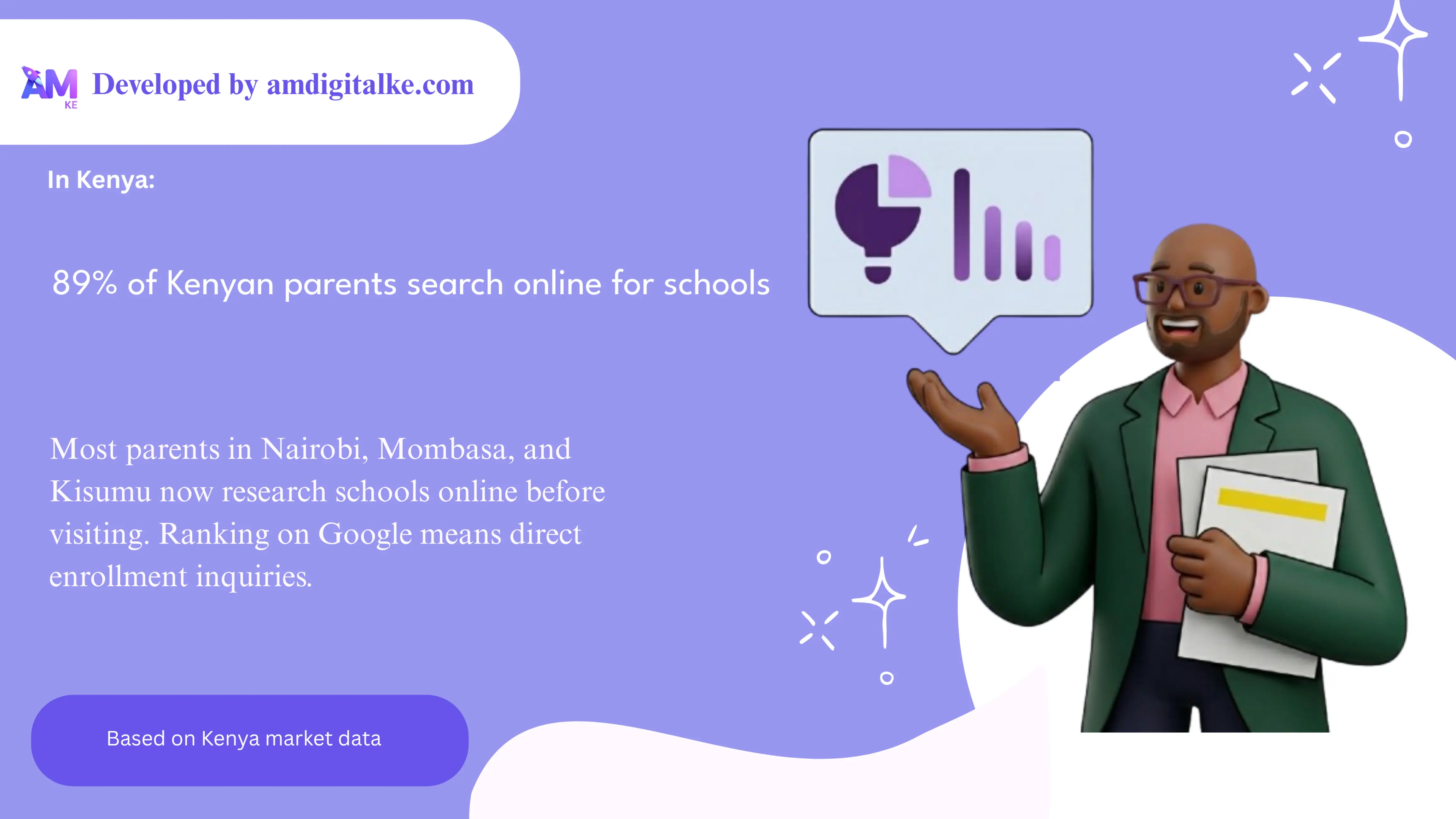
TL;DR: Ranking your school website on Google Kenya requires keyword research for parent searches, on-page optimization with school-specific content, local SEO setup, technical fixes for mobile and speed, and backlinks from education directories. Most Kenyan parents now search online for schools before enrolling, so ranking on Google directly drives enrollment inquiries.
Start with Google Search Console, optimize your homepage and key pages, claim your Google Business Profile, and build authority through education partnerships.
Introduction
If your school website does not appear on Google, you lose enrollment inquiries every day. Parents in Nairobi, Mombasa, and Kisumu search online before choosing a school.
This guide builds on the basics of seo in kenya and applies them directly to schools.
This guide walks you through the exact steps to rank on Google Kenya. It covers keyword research, on-page fixes, and backlink building for school seo kenya.
📋 Key Takeaways
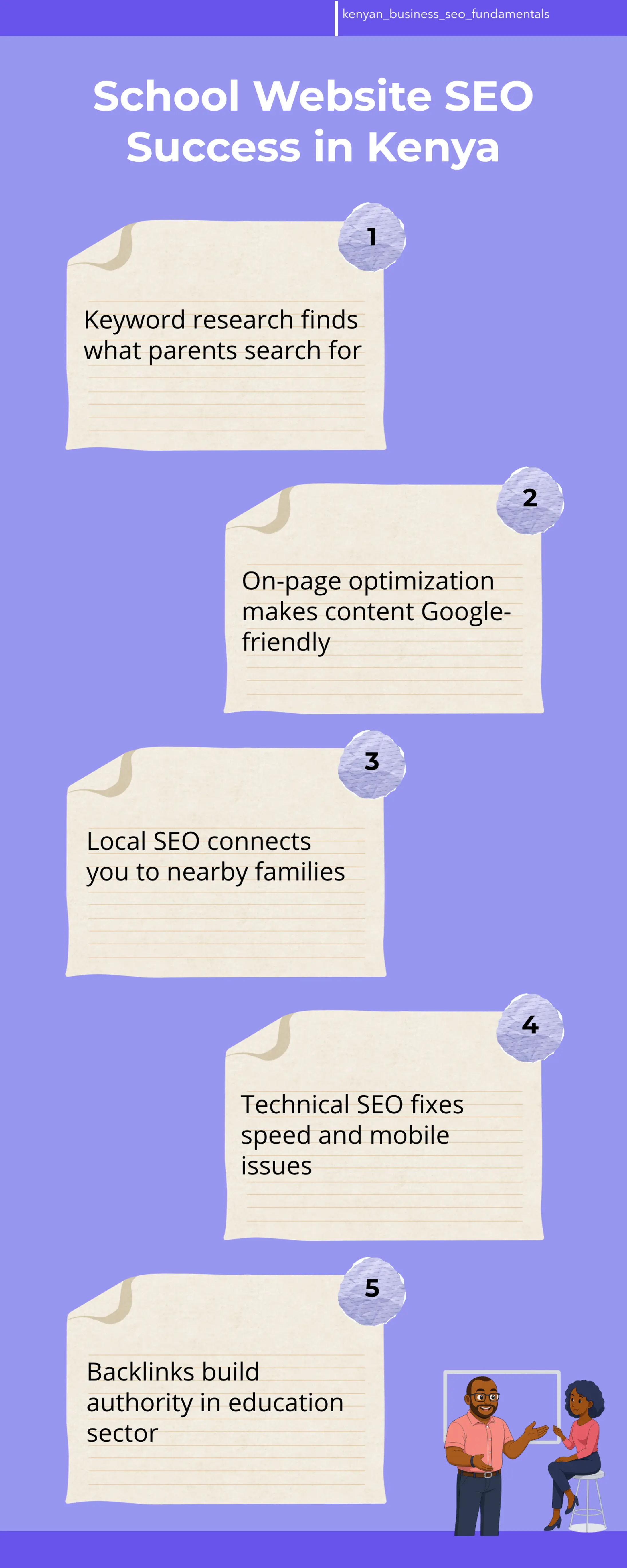
- Keyword research must target what parents actually search for, not just your school name.
- On-page optimization means writing for both Google and parent visitors, not keyword stuffing.
- Local SEO through Google Business Profile and location pages ranks you for nearby searches.
- Technical SEO fixes like mobile speed and site structure directly impact Google ranking.
- Backlinks from education directories and parent blogs build trust and ranking authority.
What You Need Before You Start
Before you optimize a page, you need three tools and one clear understanding. These cost nothing to set up.
Google Search Console Access
Google Search Console is your direct line to Google about your school website. It tells you which searches bring visitors, which pages rank, and which technical issues Google has found.
Go to search.google.com/search-console, sign in with your Google account, and add your school website. Verify ownership by adding a DNS record or uploading an HTML file to your hosting.
Google Business Profile Setup
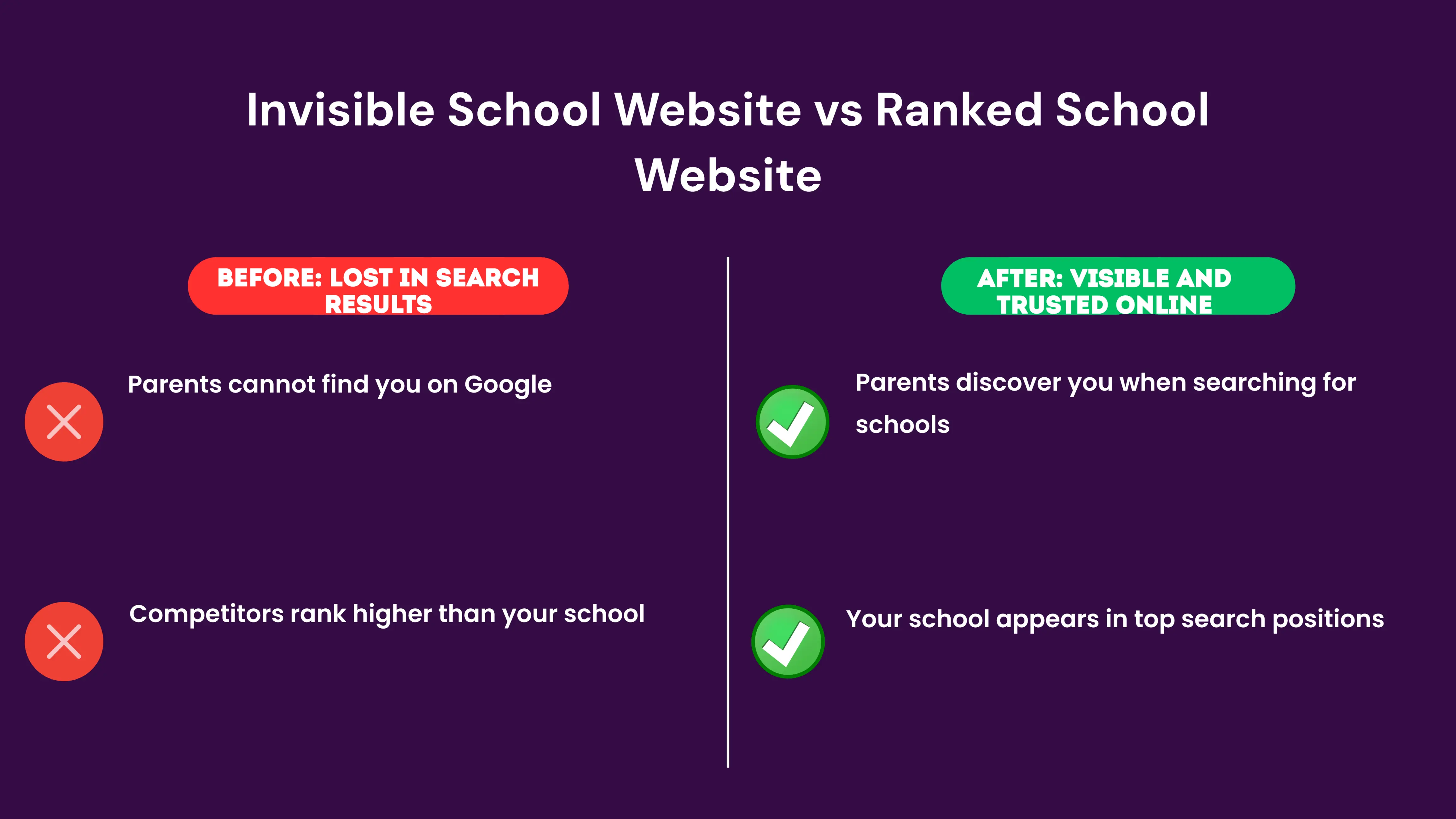
Your Google Business Profile is the second most important ranking factor for local searches. When a parent searches “primary schools in Nairobi” or “secondary schools near Westlands,” Google shows results from Business Profiles first.
Claim or create your school’s Google Business Profile at google.com/business. Add your full address, phone number, website URL, and upload photos of your campus and classrooms.
Baseline Analytics
You need to know your starting point before you make changes. Install Google Analytics 4 to track visitors, where they come from, and which pages they visit.
This data shows you whether your SEO efforts are actually working. Tracking what matters for Kenyan websites keeps you focused on the right numbers, not vanity metrics.
A Clear List of Your Competitor Schools
Identify five to ten schools in your area that you compete with for students. These are your SEO benchmarks.
Visit their websites, note their page structure, and check their ranking position for key searches. This tells you what level of optimization you need to match and beat.
Step 1: Research Keywords Parents Actually Search For
Most schools optimize for the wrong keywords. They assume parents search for their school name, but that is not how ranking works.
Parents search for broad terms like “best primary schools in Nairobi” or “schools with online classes in Mombasa” long before they know your school exists. This same principle applies across sectors, from real estate seo kenya to schools.
Ranking for these broad, parent-focused keywords is how you get discovered. Your school name keyword comes later, after parents already know about you.
Understand the Three Types of Parent Searches
Parents search in three distinct ways. Each requires a different page on your website.
First, informational searches happen when parents start researching. They search “how to choose a primary school in Kenya” or “best STEM schools in Nairobi.”
Second, comparison searches happen when parents narrow down options. They search “primary schools in Kileleshwa” or “international schools with IB curriculum in Nairobi.”
Third, decision searches happen when parents are ready to enroll. They search your school name directly or “enroll at [your school name]” or “fees at [your school name].”
Use Free Tools to Find Real Search Volume
You do not need expensive SEO tools to find keywords. Google Keyword Planner, free through Google Ads, shows monthly search volume for any phrase.
Go to ads.google.com, click Tools, and select Keyword Planner.
Type phrases like “primary schools Nairobi,” “secondary schools Mombasa,” and “international schools Kenya.” Note the monthly search volume for each.
Target keywords with at least 50 monthly searches in Kenya but low competition.
Check What Your Competitors Rank For
Visit the websites of five competing schools. Note which pages they have.
Do they have a page for each class level? Do they have pages for specific programs like “sports” or “music”?
Use Google Search Console (if you have access to a competitor’s account) or simply search for your competitors’ school name in Google and note which pages appear in the results. This shows you the page structure that works in your market.
Step 2: Optimize Your Homepage and Key Pages for Parent Intent
Your homepage is your most important ranking page. It must answer the parent’s question immediately: “Why should I choose this school?”
If your homepage is vague or focused only on history, parents and Google will leave. Strong website copywriting kenya keeps visitors reading and keeps you ranking.
Write a Homepage Title and Description for Google (and Parents)
Your page title, the blue link in Google search results, must include your target keyword and unique value. Good homepage copy that converts for Kenyan visitors starts right here.
Instead of “Welcome to [School Name],” write “Best Primary School in Nairobi with STEM Focus and Online Classes.”
Your meta description (the gray text below the title) should be a two-sentence summary of why a parent should click. Example: “Award-winning primary school in Nairobi offering STEM curriculum, online learning, and holistic development. Enroll today for a 2024 intake.”
Structure Your Homepage Content for Both Google and Visitors
Your homepage content must have a clear hierarchy. Start with an H1 heading that includes your target keyword and unique value.
Example: “Best Primary School in Nairobi Combining Traditional Excellence with STEM Innovation.”
Follow with H2 headings that answer parent questions: “Why Choose Our School,” “Our Curriculum and Programs,” “Meet Our Teachers,” “Parent Testimonials,” and “Enroll Now.” Each section should be 100-150 words and use simple, direct language.
Create Dedicated Pages for Each Program or Class Level
Do not bury your primary school program inside the homepage. Create a separate page titled “Primary School Program,” much like product page optimisation for selling and ranking on Google Kenya.
Parents searching “primary schools in Nairobi with online learning” should land on your primary school page, not your homepage. This increases relevance and ranking.
Step 3: Set Up Local SEO to Rank for “Near Me” Searches
Local SEO is how you rank for searches like “schools near me” or “primary schools in Westlands.” Most local searches now include location modifiers, and parents use their phones to find schools while driving or walking.
Ranking locally is only the start. Competing nationally in Kenya means ranking beyond your city once your local base is strong.
Claim and Optimize Your Google Business Profile Completely
Your Google Business Profile is not optional. Go to google.com/business and claim your school.
Fill in every field: full address, phone number, website, hours, and categories.
Upload at least ten photos: your school gate, classrooms, playground, library, cafeteria, and student activities. Write a 200-word description that includes your target keywords and unique value.
Example: “Award-winning primary school in Nairobi offering STEM curriculum, online classes, and holistic development for students aged 4-13.”
Create Location-Specific Pages
If your school has multiple campuses, create a page for each location. This is the core of local seo for multiple school campuses in Kenya.
Title it “Primary School in [Suburb Name]” and include the address, directions, and programs available there.
A school with campuses in Westlands and Kileleshwa should have two separate location pages, each optimized for local searches in that suburb.
Get Listed in Local Education Directories
Education directories like SchoolsNet Kenya and Parents Kenya are local authority sites that link to school websites. These backlinks improve your ranking and drive direct referral traffic.
Claim your school’s listing on every major Kenyan education directory. Ensure your school name, address, phone, and website are identical across all listings.
Step 4: Fix Technical SEO Issues That Block Rankings
Technical SEO is the foundation that allows Google to crawl, index, and rank your pages. If your website has technical problems, even perfect content will not rank.
Ensure Your Website is Mobile-Friendly
Over 85% of Kenyan internet users access the web on mobile phones. If your school website does not work well on mobile, Google will not rank it.
Good mobile first copywriting for Kenya’s phone users keeps parents reading on small screens.
Test your website on a mobile phone. Can you read the text without zooming?
Do buttons and forms work? Is the site fast?
If not, contact your web developer immediately. Google Search Console also has a Mobile Usability report that flags specific problems.
Improve Your Website Speed
A slow website ranks lower and loses visitors. Pages that load in under three seconds have significantly higher engagement than slow pages.
Test your site speed at pagespeed.insights.google.com. If your score is below 50, you have serious speed problems.
Common fixes include compressing images, enabling caching, and removing unnecessary plugins. Contact your web host or developer for help.
Fix Crawl Errors and Indexing Issues
Go to Google Search Console and check the Coverage report. This shows pages Google can and cannot index.
If you see “Excluded” or “Error” pages, fix them immediately.
Common issues include broken internal links, pages blocked by robots.txt, and duplicate content. Google Search Console tells you exactly which pages have problems and how to fix them.
Create an XML Sitemap
An XML sitemap is a file that lists all your website pages for Google. Most modern website platforms (WordPress, Wix, Squarespace) generate this automatically, but verify it exists.
Go to yourschoolwebsite.com/sitemap.xml. If you see an XML file with a list of your pages, you are good.
If you get a 404 error, ask your web developer to create one.
Step 5: Build Authority Through Education Backlinks
A backlink is a link from another website to your school website. Google treats backlinks as votes of confidence.
The more backlinks you have from trusted education websites, the higher you rank.
Get Listed in Education Directories and Parent Blogs
Education directories like SchoolsNet Kenya, Parents Kenya, and Local Kenya all link to school websites. These are free or low-cost listings that improve your ranking and send direct traffic.
Create a simple spreadsheet of 20-30 Kenyan education directories, parent blogs, and local business listings. Contact each one and request a listing or backlink to your school website.
Partner with Parent Bloggers and Education Influencers
Parent bloggers in Kenya often write reviews of schools and link to school websites. Identify five to ten popular parent blogs in Kenya and reach out with a genuine offer to provide information about your school.
Offer to do an interview, provide photos of your campus, or write a guest post about your teaching philosophy. In return, ask for a link back to your website.
Create Shareable Content That Earns Backlinks Naturally
The best backlinks come from content that is so useful or interesting that other websites link to it without being asked. Create guides like “How to Prepare Your Child for Primary School” or “The Complete Guide to School Fees in Nairobi” and publish them on your blog.
Share this content with parent forums, education groups on Facebook, and parent WhatsApp groups. This is where social media content that drives website traffic in Kenya pays off.
If the content is genuinely helpful, other websites and blogs will link to it.
Common Mistakes to Avoid 🚫
Most schools make the same SEO mistakes that prevent them from ranking. Knowing these mistakes now saves you months of wasted effort.
Mistake 1: Keyword Stuffing Instead of Natural Writing
Some schools try to rank by repeating their target keyword over and over. Example: “Our primary school in Nairobi offers primary school education in Nairobi for students seeking primary school excellence in Nairobi.”
Google penalizes this. Protect your site from Google penalties by writing naturally for parents first, keywords second.
Use your target keyword once in the title, once in the first paragraph, and once or twice more in the body. That is enough.
Mistake 2: Ignoring Mobile Optimization
Parents search for schools on their phones while walking around Nairobi or waiting for a matatu. If your website does not work on mobile, you lose these prospects immediately.
Test your website on at least three different mobile phones. Make sure text is readable, buttons are clickable, and forms work.
If you are not sure, ask your web developer to run a mobile audit.
Mistake 3: Not Updating Your Google Business Profile Regularly
Your Google Business Profile is not a set-and-forget tool. Update it monthly with new photos, events, or announcements.
Schools that update profiles regularly rank higher than schools that do not.
Add a new photo every month, post updates about school events, and respond to parent reviews and questions. This activity tells Google that your school is active and trustworthy.
Mistake 4: Creating Pages Without Keyword Research
Some schools create pages about topics that no one searches for. They write detailed pages about their school history or philosophy, but parents are searching for “best schools with swimming pools in Nairobi,” not your history.
Always do keyword research before creating a new page. Ask: “Will a parent search for this topic?”
If the answer is no, do not create the page.
Mistake 5: Ignoring Competitor Rankings
If your competitors rank on page one and you are on page three, you need to understand why. Visit their pages, read their content, and check their backlinks.
You do not copy them, but you learn from them. What keywords do they target?
How do they structure their content? What backlinks do they have?
This analysis guides your own strategy.
Comparison Table: SEO Actions and Their Impact
| SEO Action | Time to Implement | Ranking Impact | Priority Level |
|---|---|---|---|
| Google Business Profile Setup | 2-4 hours | High (local rankings) | Critical |
| Homepage Keyword Optimization | 4-8 hours | High (broad rankings) | Critical |
| Mobile Speed Fixes | 8-20 hours | High (all rankings) | Critical |
| Location Pages Creation | 6-12 hours | Medium (local rankings) | High |
| Education Directory Listings | 4-8 hours | Medium (authority) | High |
| Blog Content Creation | 2-4 hours per post | Medium (organic traffic) | Medium |
✅ Quick Action Checklist
- ☐ Set up Google Search Console and verify your school website
- ☐ Claim or create your Google Business Profile with complete information and photos
- ☐ Install Google Analytics 4 to track baseline traffic and visitor behavior
- ☐ Research and list five competitor schools to benchmark against
- ☐ Optimize your homepage title and meta description with target keywords
- ☐ Test your website on mobile and fix any usability issues
- ☐ Check Google Search Console Coverage report and fix any errors
- ☐ Create location pages for each school campus or service area
Ready to Improve Your School’s Visibility on Google?
Ranking your school website on Google Kenya is not complicated, but it requires focus and consistency. Start with the critical actions: set up Google Business Profile, optimize your homepage, and fix mobile and speed issues.
These three steps alone will move you from invisible to visible within 60 to 90 days. After that, build authority through backlinks and keep your profile updated.
Frequently Asked Questions
How long does it take to rank a school website on Google Kenya?
Most schools see ranking improvements within 60 to 90 days of consistent optimization, especially for local searches. Broader, competitive keywords take longer, often 6 to 12 months.
The timeline depends on your competition level and how thoroughly you optimize.
Does my school name need to be in every page title?
No. Your school name should be in your homepage title and Google Business Profile, but not every page title.
Focus page titles on parent intent and keywords. Example: “Primary School Program in Nairobi” instead of “[School Name] Primary School Program.”
How often should I update my Google Business Profile?
Update your profile at least monthly with new photos, posts about school events, or responses to parent reviews. Active profiles rank higher than inactive ones.
Aim for one new photo or post every two weeks.
What is the most important SEO factor for schools in Kenya?
Google Business Profile setup and local keyword optimization are the most important factors for schools. Most parents search with location modifiers like “schools in Nairobi,” so local SEO directly drives enrollment inquiries.
Should my school website have a blog?
Yes, but only if you publish useful content regularly. A blog with posts like “How to Help Your Child Succeed in Primary School” or “Understanding the Kenyan Curriculum” attracts parent traffic and builds authority.
Publish at least twice monthly.
Additional Resources
- How to Set Up Google Business Profile – A Kenyan Expert’s Guide – Your Google Business Profile is the biggest local ranking lever for schools, so get the full setup walkthrough here.
- How to Set Up Google Business Profile A Kenyan Expert’s Guide – Cross-check your profile against this second guide to catch settings and categories many schools miss.
- How to Get SACCO Members from Google in Kenya – See how another membership-based Kenyan institution uses local SEO to pull in new sign-ups, the same tactics work for enrollment inquiries.
- How to Get Car Dealer Customers from Google in Kenya – Borrow ideas on structuring product and program pages that convert browsers into direct inquiries.
- 7 Kenyan Businesses That Are Winning On Google Right Now (And What You Can Copy) – Get real Kenyan examples of what ranks right now, then apply the same moves to your school’s website.
- What are Featured Snippets (for the Kenya Market) – Learn how to win the answer box for common parent questions like fees and admission requirements.
Take the Next Step
Now that you understand the core steps to rank your school website on Google Kenya, it is time to take action. The schools that start SEO today will dominate search results in your area within six months.
Download our Complete SEO Checklist for Kenyan Schools to get a detailed action plan with templates, timelines, and tracking sheets that you can use immediately.