Table of Contents
- 📋 Key Takeaways
- Why Nairobi Businesses Are Rushing to Optimize for AI
- The Biggest AI SEO Mistakes Kenyan Businesses Make
- Why Publishing AI-Generated Content Isn’t an AI SEO Strategy
- What AI Search Engines Actually Look For
- The Difference Between Ranking on Google and Being Cited by AI
- 📊 What the Evidence Shows
- ✅ What to Do Instead
- ✅ Quick Action Checklist
- Ready to Improve Your AI Optimization?
- Frequently Asked Questions
- Additional Resources
- Take the Next Step
TL;DR: Most Nairobi businesses think “optimizing for AI” means publishing AI-written blog posts, but that is not what gets you cited by ChatGPT or Google AI Overviews. AI tools look for structured, credible, and specific information, not just more content. This guide breaks down the real mistakes and gives you a practical framework to become a source AI trusts.
Every second business owner I talk to in Nairobi now asks me the same question. “Alvin, how do I optimize for AI?”
Most of them think the answer is simple. Use ChatGPT to write blog posts and publish more of them.
That is not optimization. That is noise, and AI search engines are getting very good at ignoring noise. Before you touch AI tools, you need a solid grip on seo in kenya fundamentals, because AI optimization is built on top of them, not instead of them.
📋 Key Takeaways
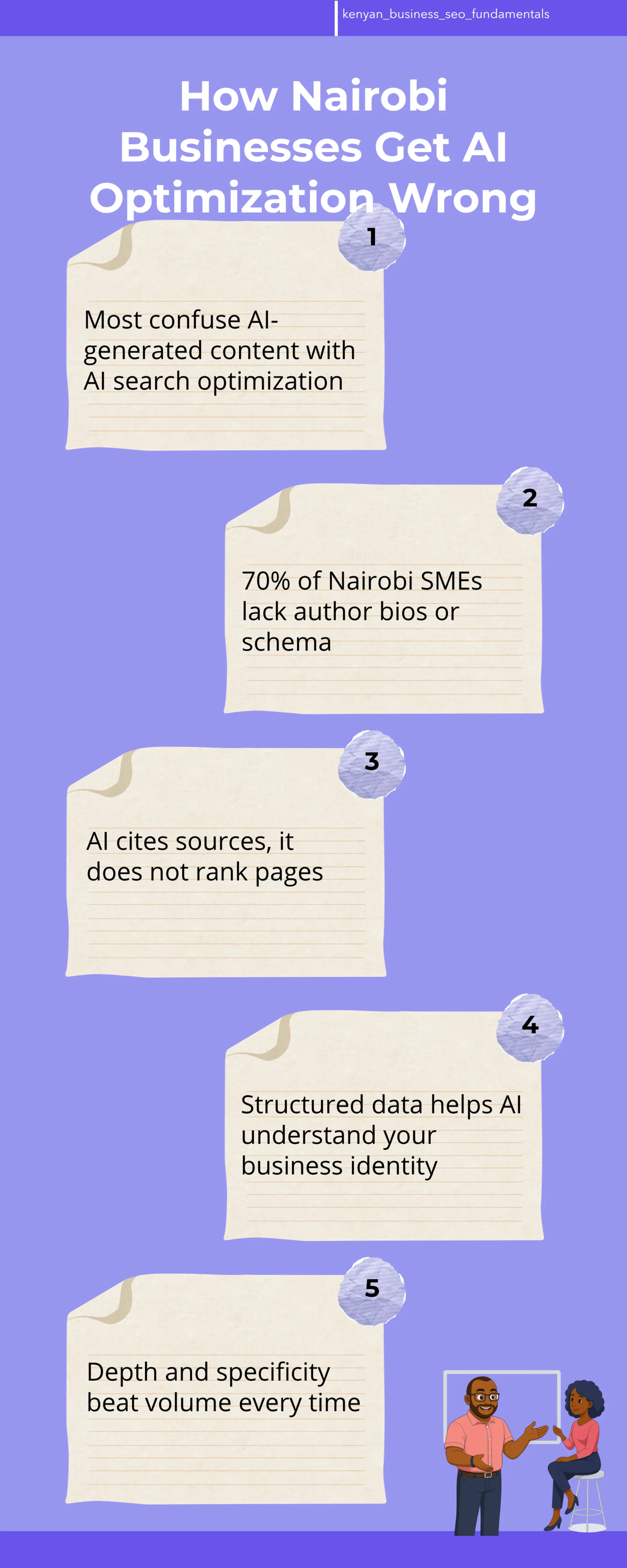
- Publishing AI-generated content is not the same as optimizing for AI search. AI tools reward depth and credibility, not volume.
- AI assistants like ChatGPT and Google AI Overviews cite sources, they do not “rank” pages the way Google search results do.
- Most Nairobi SMEs lack basic structured data and author identity, which blocks AI tools from trusting them as sources.
- Local, specific, and verifiable information about your Kenyan business beats generic global advice every time.
- Getting cited by AI starts with fixing SEO fundamentals you may have skipped, not chasing the next AI trend.
Why Nairobi Businesses Are Rushing to Optimize for AI
I understand the panic. Google AI Overviews are showing up on more searches.
ChatGPT has become a research tool for millions of people, and business owners are worried their website will become invisible.
The fear is real, but the response has been rushed. Many Nairobi businesses are trying to “hack” AI visibility before they have even fixed the basics on their own website, the same basics that trip people up with diy seo kenya attempts.
The Pressure to Keep Up
I have had clients in Westlands and Kilimani ask me to “add AI SEO” to their package without understanding what it means. They have read a LinkedIn post or watched a YouTube video and now believe there is a magic switch to flip.
There isn’t one. AI search optimization is built on the same foundation as good SEO, just with a few new layers on top.
Why This Matters for Kenyan SMEs Specifically
Kenyan businesses face a unique disadvantage. Large language models are trained mostly on international content, which means local businesses already start with less representation in AI training data.
A Nairobi accounting firm competing for AI visibility is not just competing with other Kenyan firms. It is competing with thousands of global finance blogs the AI already trusts.
The Biggest AI SEO Mistakes Kenyan Businesses Make
The mistakes I see are consistent across industries, from e-commerce shops in Nairobi to fintech startups building payment products. They almost always come down to misunderstanding what AI tools actually reward.
Let me walk through the two biggest ones I encounter every week.
Mistake One: Confusing AI-Generated Content With AI Optimization
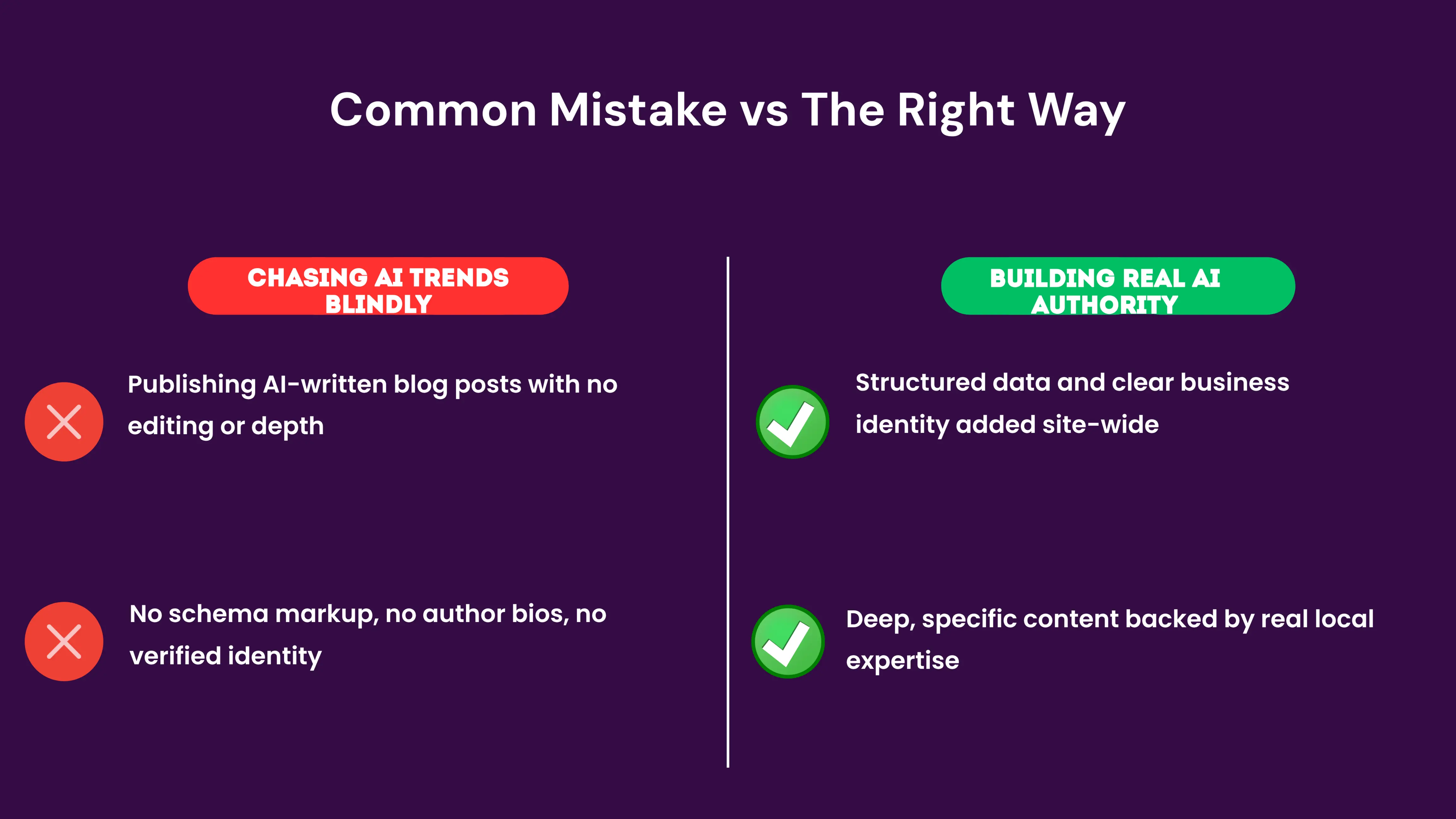
Publishing content written by AI is not the same as optimizing your content for AI search engines. These are two completely different things, and conflating them is the single biggest error I see.
A business can publish fifty AI-written articles and still be invisible to ChatGPT. The content lacks depth, specificity, and any real signal of expertise.
Mistake Two: Chasing Trends Instead of Fixing Foundations
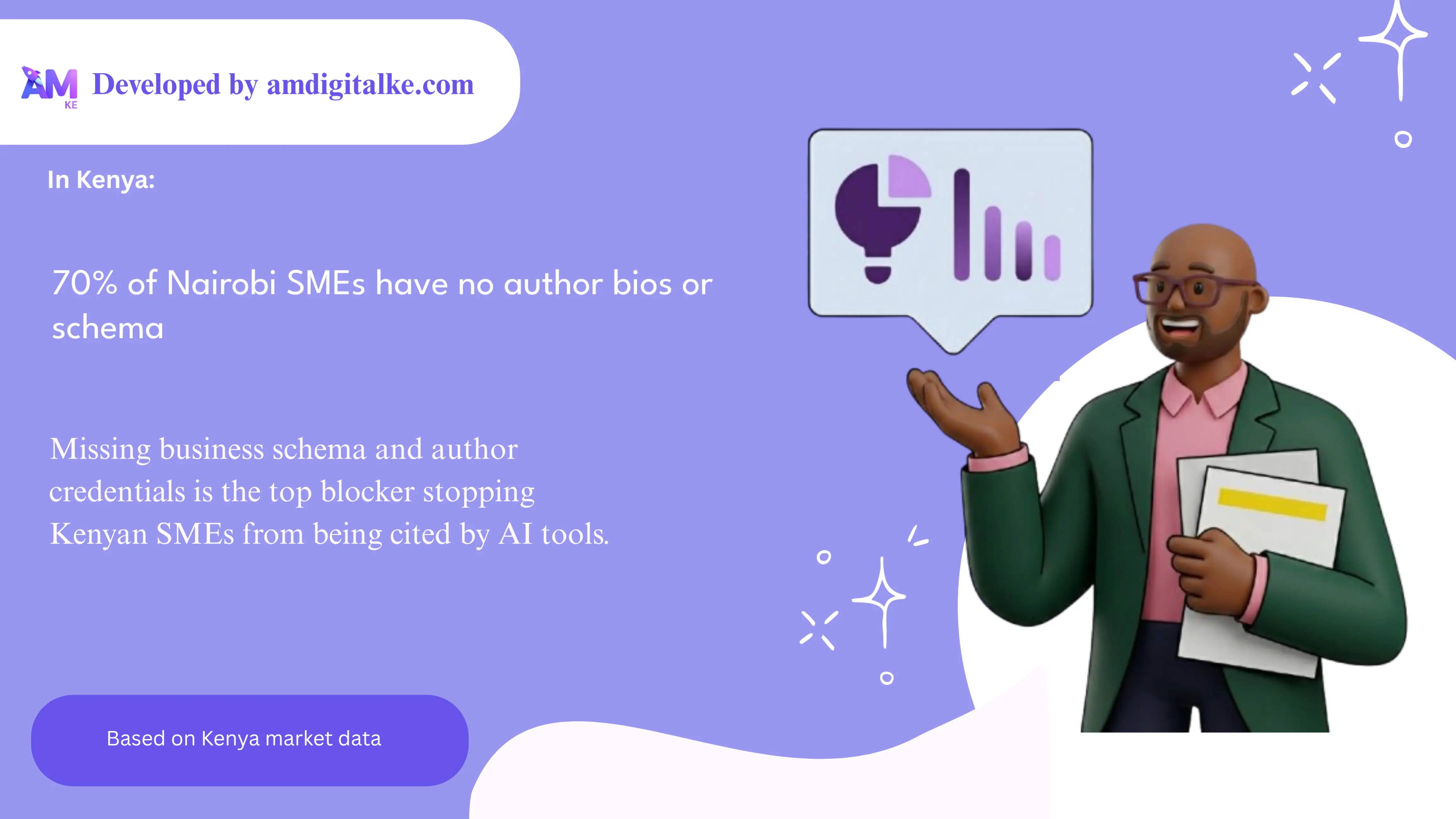
The second mistake is skipping fundamentals. I regularly audit websites that have zero schema markup, no author bios, and no consistent business information across the web.
Then the owner asks me why AI tools don’t know they exist. This gap shows up the same way it does for niche businesses, like when we look at seo for saccos kenya and find the same missing schema and inconsistent listings.
Based on AM Digital KE client data across Kenyan accounts, businesses that fix these basics before attempting anything “AI-specific” see far stronger and faster gains in visibility.
Why Publishing AI-Generated Content Isn’t an AI SEO Strategy
I want to be direct about this because so much confusion sits here. AI-generated content is a production method.
AI search optimization is a visibility strategy. You can use AI to help you write, but if the final content is shallow and generic, no AI search engine will trust it enough to cite it.
The Real Problem Is Shallow Thinking, Not the Tool
Whether a human or a machine wrote the sentence does not matter to Google or ChatGPT. What matters is whether the content answers a specific question with real, verifiable detail.
A generic article about “how to grow your business online” will lose every time. A specific one about how a Nairobi salon increased bookings using WhatsApp reminders and M-Pesa deposits wins instead.
Where Hybrid Approaches Work Better
I am not against using AI tools in the writing process. I use them myself for research and drafting structure.
The difference is that every draft gets rewritten with real business detail, real Kenyan context, and a clear point of view before it goes live.
What AI Search Engines Actually Look For
AI search tools are not magic. They are pattern-recognition systems trained to identify content that is trustworthy, well-structured, and specific enough to quote confidently.
According to Google’s own guidance on AI features, the same quality signals that matter for traditional search still apply directly to how content appears in AI-generated answers. Expertise, experience, authority, and trust remain the core signals.
Structured Data and Entities
AI tools rely heavily on structured data. This is simply organized information in your website’s code that tells search engines exactly what your business is, what it sells, and where it operates.
Think of it as a clearly labeled shelf in a supermarket versus a pile of unsorted goods. Without this, even a well-written page about your Nairobi law firm might get misread or ignored entirely by AI crawlers, the same way a google business profile for lawyers standing out in nairobi searches gets overlooked without proper setup.
Topical Authority Over Random Posts
AI systems also look for topical authority. This means a website that consistently covers one subject area in depth rather than jumping between unrelated topics.
A Mombasa freight company that publishes deeply about East African shipping logistics will build far more AI trust than one that occasionally posts about shipping alongside unrelated lifestyle content. This same logic applies when from nairobi to mombasa scaling your seo nationally pages stay focused on one route instead of scattering across unrelated services.
| Old SEO Thinking | AI-Ready Approach |
|---|---|
| Publish more content, any content | Publish fewer, deeper, more specific pieces |
| Keyword stuffing | Clear entities and structured data |
| Generic global advice | Kenya-specific examples and data |
| No author identity | Verified author bios and business schema |
| Rank for keywords | Get cited as a trusted source |
The Difference Between Ranking on Google and Being Cited by AI
This is the mental shift every Nairobi business owner needs to make. Ranking on Google means your page appears in a list of ten blue links, and the user clicks through to decide for themselves.
Being cited by AI means the AI has already decided you are credible enough to summarize on your behalf. Often the user never visits your site at all.
Why Citation Is Harder to Earn
To rank on Google, you needed decent keywords and some backlinks. To be cited by AI, you need to be one of the few sources the model considers reliable enough to represent an entire topic accurately.
That is a much higher bar. It rewards businesses with real expertise, not just SEO tricks, which is why understanding national seo vs local seo which does your kenyan business need matters before you even think about AI citation.
Why This Should Change Your Content Strategy
If your goal shifts from “rank higher” to “get cited,” your content priorities shift too. You start writing fewer, more authoritative pieces instead of chasing every long-tail keyword variation.
A Nairobi fintech founder writing one deeply researched piece on mobile money adoption trends will get cited more than ten shallow posts about “best payment apps.”
📊 What the Evidence Shows
Kenya’s digital landscape is shifting fast. The numbers back up the urgency, even if the response has been misdirected.
Internet penetration in Kenya continues to climb, with Kenya’s growing internet user base creating more competition for every search query, AI-powered or not.
At the same time, click behavior is changing. Users interacting with AI Overviews and chat-based search tools often click through at lower rates than traditional search results, because the AI has already answered their question.
This means visibility inside the AI answer itself matters more than ever before. Based on AM Digital KE client data across Kenyan accounts, businesses with clear schema markup and consistent business information across the web are far more likely to appear as a cited source in AI-generated summaries.
I have seen this play out with a Nairobi-based logistics client. Once we added structured data describing their service areas, delivery times, and verified business details, their inclusion in AI-generated answers for “delivery services in Nairobi” queries improved noticeably within weeks, the kind of gain you also see when service area business seo ranking without a physical location is done properly.
✅ What to Do Instead
The fix is not complicated, but it does require discipline. Stop chasing AI trends and start building the kind of digital identity that both Google and AI tools can trust.
This means investing in the fundamentals most Nairobi businesses have skipped, the same fundamentals we cover when diagnosing why nairobi business not ranking google.
Build a Verified Digital Identity
Add schema markup to your website describing your business, services, location, and team. Make sure your business name, address, and phone number are consistent everywhere online, from Google Business Profile to your website footer.
Write With Depth, Not Volume
Pick fewer topics and go deeper into each one, using real Kenyan examples, case studies, and data. One well-researched piece on KRA tax compliance for freelancers will outperform ten generic “tax tips” articles every time, and the same principle applies to service route pages optimizing for nairobi to mombasa transport content that goes deep on one corridor instead of skimming many.
✅ Quick Action Checklist
- ☐ Add schema markup to your homepage and key service pages
- ☐ Create author bios with real names, photos, and credentials
- ☐ Audit your business name, address, and phone number for consistency online
- ☐ Rewrite your top three shallow pages with real Kenyan examples and data
- ☐ Pick one topic area and commit to covering it in depth for the next quarter
- ☐ Check if your Google Business Profile is complete and verified
- ☐ Run a technical SEO check to confirm AI crawlers can actually read your site
- ☐ Stop publishing AI-written content without human editing and local context
Ready to Improve Your AI Optimization?
AI optimization is not a shortcut you buy. It is the natural result of building a website that Google, ChatGPT, and every AI tool in between can trust, understand, and confidently cite.
Get the fundamentals right first, and the AI visibility will follow. Contact AM Digital KE today, and if you are curious how AI is reshaping which social platforms matter for kenyan businesses, that conversation ties directly into this one.
Frequently Asked Questions
What does AI optimization actually mean for a Kenyan business?
It means structuring your website and content so AI tools like ChatGPT and Google AI Overviews can understand, trust, and cite your business as a source. It relies on the same SEO fundamentals as traditional search, plus structured data and clear authority signals. See our seo faqs kenya for more on the basics.
Is publishing AI-generated content bad for SEO?
Not inherently, but shallow AI-generated content without editing or local context performs poorly. The problem is depth and specificity, not the writing tool. Hybrid content, AI-assisted but human-refined with real Kenyan detail, works far better.
How is being cited by AI different from ranking on Google?
Ranking on Google means appearing in search results for users to click. Being cited by AI means the AI has judged your content credible enough to summarize directly in its answer, often without a click at all.
Do small Nairobi businesses really need schema markup?
Yes. Schema markup helps AI tools and search engines clearly understand what your business does, where it operates, and who runs it. Without it, even well-written content can be misread or overlooked by AI crawlers.
Where should a Nairobi SME start with AI SEO?
Start with a full SEO audit to find gaps in structured data, content depth, and technical health. Fixing these fundamentals first creates a stronger base than jumping straight into AI-specific tactics, especially in tight local markets like hyper local seo dominating your nairobi neighborhood.
Additional Resources
- How to Use Anchor Text for Your Kenyan Business – If you are fixing your site for AI citation, your internal links need the same structured clarity as your schema, this shows you how to build that properly.
- How to Protect Your Site from Google Penalties for Your Kenyan Business – Before you chase AI visibility, make sure sloppy AI-generated content hasn’t already put your site at risk of a Google penalty.
- How to Maximise CTR for Your Kenyan Business – With AI Overviews eating into click-through rates, this guide helps you win the clicks that are still up for grabs.
- What is Google Business Profile – A verified, consistent Google Business Profile is one of the trust signals AI tools check before citing your business, start here if you haven’t set one up.
- How to Set Up Google Business Profile – A Kenyan Expert’s Guide – This walks you through the exact setup steps needed to build the business identity AI search engines look for.
- I Describe Different Types of SEO in Kenya – Pick the Right One for Your Business – Once your AI-readiness basics are sorted, this helps you figure out which SEO approach fits your specific Kenyan business model.
Take the Next Step
If you want a clear starting point before tackling AI optimization, get the fundamentals right first. Download the Complete SEO Checklist for Kenyan Businesses and work through it step by step with your team.