Table of Contents
- Introduction
- 📋 Key Takeaways
- What Is Cost Per Lead?
- Why Does Cost Per Lead Matter for Kenyan Businesses?
- How Cost Per Lead Works
- Cost Per Lead Examples in Kenya
- Common Mistakes to Avoid
- ✅ Quick Action Checklist
- Ready to Improve Your Cost Per Lead?
- Frequently Asked Questions
- Additional Resources
- Take the Next Step
TL;DR: Cost per lead (CPL) is how much you spend to acquire one qualified customer lead. Calculate it by dividing total marketing spend by the number of leads generated. For Kenyan businesses, tracking CPL reveals which channels deliver affordable leads and which drain your budget.
Introduction
If you run a business in Nairobi, Mombasa, or anywhere in Kenya, you have probably spent money on marketing. You have posted on Facebook, run Google Ads, sent SMS campaigns, or paid for email marketing.
But do you know how much each lead actually costs you? Most Kenyan business owners cannot answer this question.
They spend money hoping for results, but they never measure what they get back. Cost per lead is the metric that changes this. It works alongside other key numbers, like how much does seo cost in kenya, to show you the full picture of what your marketing actually delivers.
CPL tells you exactly how much money you are burning to get one qualified customer interested in your product or service. When you know this number, you can make real decisions about where to spend your next shilling.
📋 Key Takeaways
- ☐ CPL is your total marketing spend divided by the number of leads you generate. It shows the true cost of customer acquisition.
- ☐ Tracking CPL helps Kenyan businesses stop wasting money on ineffective channels and double down on what works.
- ☐ Different channels have different CPL rates. Facebook might cost KES 150 per lead, while Google Ads costs KES 500, depending on your industry.
- ☐ A good CPL is one where the customer lifetime value is at least 3 times higher than the cost per lead you pay.
- ☐ CPL alone does not tell the full story. You must also track which leads actually convert into paying customers.
What Is Cost Per Lead?
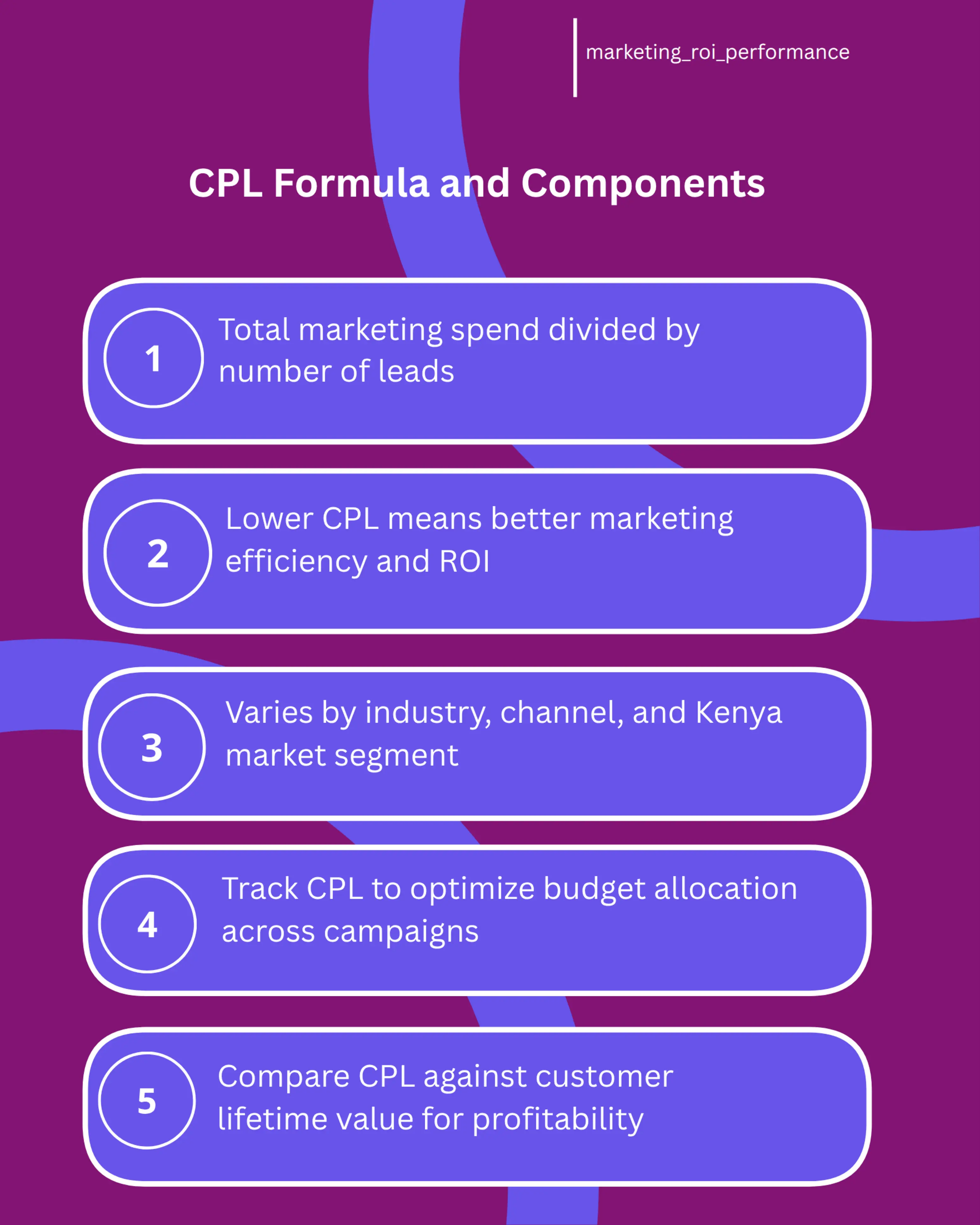
Cost per lead is a marketing metric that measures how much money you spend to generate one qualified lead. A lead is a person who has shown interest in your business.
This could be someone who fills out a contact form, calls your business, subscribes to your email list, or adds an item to their cart.
The formula is simple. Take your total marketing spend and divide it by the number of leads you generated.
If you spent KES 10,000 on a Facebook campaign and got 50 leads, your CPL is KES 200.
CPL vs Other Marketing Metrics
CPL is different from cost per click (CPC) and cost per acquisition (CPA). CPC measures how much you pay each time someone clicks your ad.
CPA measures how much you pay for an actual customer who buys something.
CPL sits in the middle. It tracks the cost of getting someone interested enough to raise their hand.
They have not bought yet, but they have moved one step closer to becoming a customer.
Why CPL Matters More Than Clicks
A lot of Kenyan businesses focus on clicks. They run cheap Google Ads campaigns and celebrate when they get 1,000 clicks for KES 5,000.
But clicks do not pay your rent. A click is just someone visiting your website for 3 seconds.
A lead is someone who actually wants to talk to you. If your website gets 1,000 clicks but only 10 people leave their contact details, you have wasted KES 5,000 to get 10 leads at KES 500 each.
CPL forces you to measure what actually matters. It is the bridge between what you spend and what you get back.
Why Does Cost Per Lead Matter for Kenyan Businesses?
You Cannot Improve What You Do Not Measure
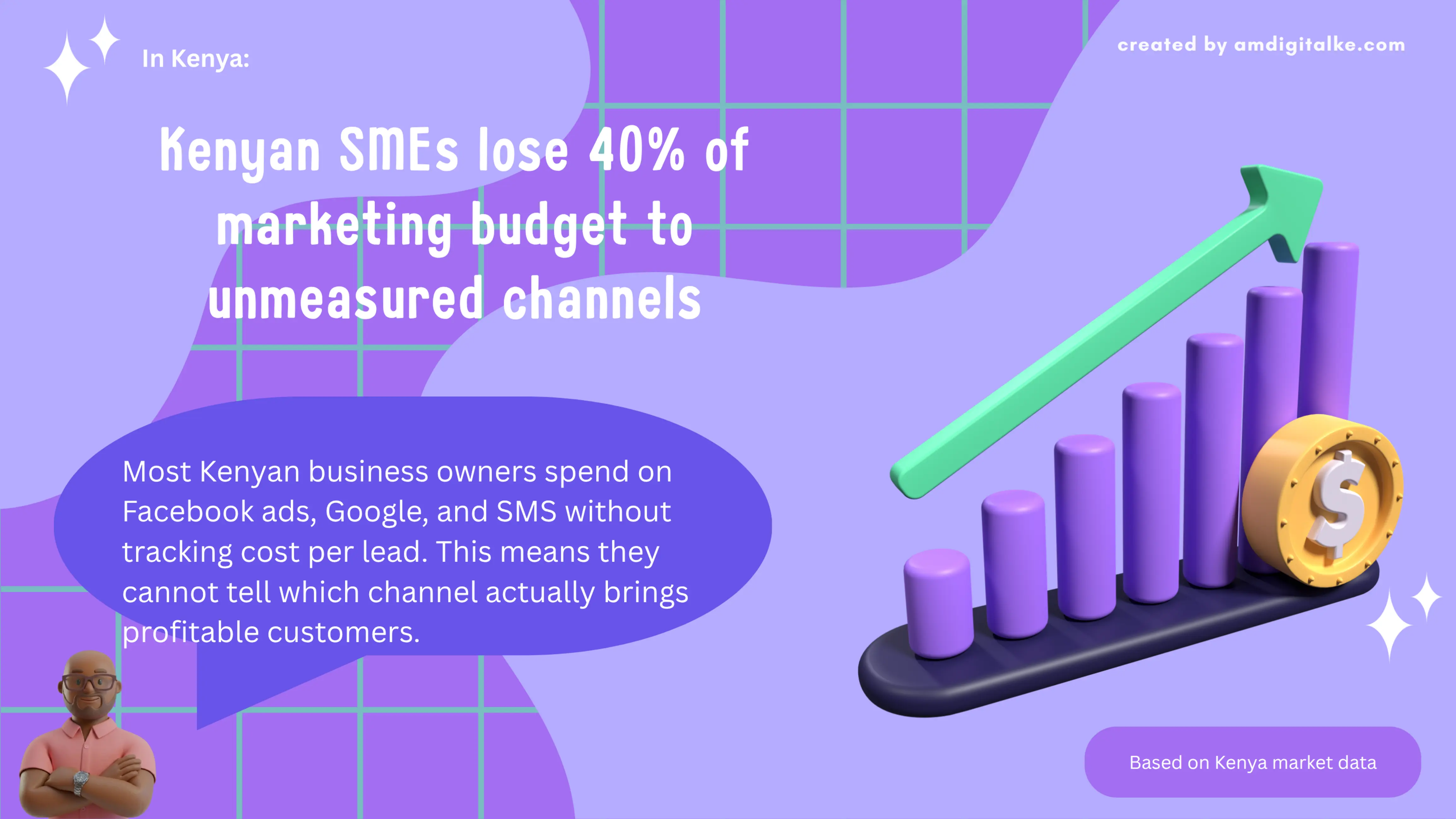
Most Kenyan SMEs spend on marketing without tracking results. A salon owner runs Instagram ads, a plumber posts on Facebook, a consultant pays for Google Ads.
But none of them know their CPL. Running a proper content audit often exposes the same blind spot: money spent with no clear return.
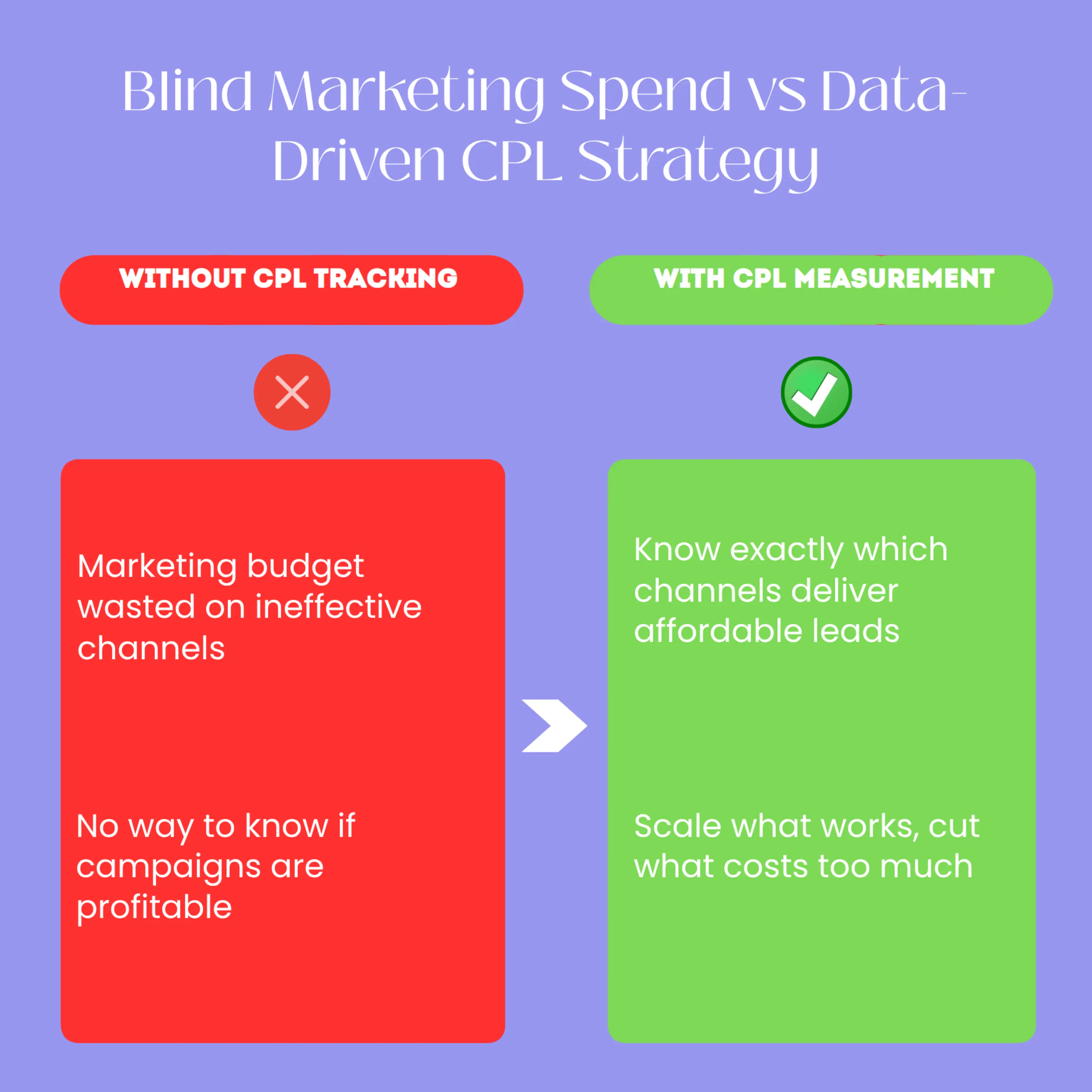
When you measure CPL, you create accountability. You can see which channels are efficient and which are wasting money.
This is the first step to fixing your marketing.
CPL Reveals Your True Marketing Efficiency
Imagine you run a real estate business in Nairobi and you use three marketing channels: Facebook Ads, Google Ads, and SMS marketing. Facebook might deliver leads at KES 180 per lead, Google at KES 450, and SMS at KES 120.
Without measuring CPL, you might assume all three channels are working equally well.
But when you track CPL, you see the truth. SMS is your most efficient channel.
You should spend more money there. Facebook is decent, and Google is expensive and maybe not worth the cost.
CPL Helps You Allocate Budget Like a Pro
Your marketing budget is limited. You have maybe KES 50,000 a month to spend.
If you do not know your CPL by channel, you are guessing where to put that money.
When you know CPL, you can be strategic. You can shift budget from expensive channels to cheap ones.
You can test new channels with small budgets and measure their CPL before committing more money. Publishing home improvement blog topics that generate leads is one low-cost way to test a new channel.
CPL Connects Marketing Spend to Real Revenue
Here is the real power of CPL. It lets you calculate whether your marketing is actually profitable.
If your CPL is KES 200 and your average customer lifetime value is KES 5,000, then you are making money.
But if your CPL is KES 500 and your customer lifetime value is only KES 2,000, you are losing money on every lead. CPL forces you to face this reality.
CPL Helps You Compete Against Bigger Businesses
Large corporations have marketing teams that obsess over metrics like CPL. They optimize every campaign to lower their cost per lead.
As a Kenyan SME, you can do the same thing.
By tracking and optimizing CPL, you can compete on efficiency, not just budget size. A small business with a CPL of KES 100 beats a large business with a CPL of KES 500, even if the large business spends more money.
How Cost Per Lead Works
The Basic CPL Calculation
The CPL formula is simple. Getting accurate numbers takes discipline. Start by defining what counts as a lead in your business.
For a salon, a lead might be someone who books an appointment through your website copywriting kenya page. For a B2B consulting firm, a lead might be someone who fills out a contact form or downloads a resource.
For an e-commerce store, a lead might be someone who adds their email to your mailing list. Be clear about your definition before you start measuring.
Tracking Marketing Spend Accurately
You need to know exactly how much you spent on marketing. This includes obvious costs like Google Ads spend and Facebook Ads budget.
It also includes hidden costs. Count the salary time your team spent managing campaigns, the tools you use to track leads, and content creation costs.
Many Kenyan business owners only count the ad spend and ignore everything else. This makes their CPL look better than it really is. For an accurate picture, include all costs.
Counting Leads Consistently
You need a system to count leads. If you are using a CRM like Pipedrive or HubSpot, this is built in.
If you are using a simple Google Form or email inbox, you need to track this manually. The key is consistency.
Count the same type of lead the same way every month. If you count email subscribers as leads in January, count them the same way in February.
Breaking Down CPL by Channel
Your overall CPL is useful. Channel-specific CPL is where the real insight lives.
Calculate CPL separately for Facebook Ads, Google Ads, SMS, email, referrals, and any other channel you use. Check your monthly seo reports what to track and why to see how organic channels compare.
This tells you which channels are efficient and which are wasteful. A Nairobi e-commerce business might find that referrals have a CPL of KES 50, while paid search has a CPL of KES 300.
This changes where you invest next.
Cost Per Lead Examples in Kenya
Example 1: A Nairobi Fitness Studio
A fitness studio in Westlands runs a 30-day Facebook Ads campaign. They spend KES 15,000 total.
They get 75 people who fill out a form expressing interest in membership. Their CPL is KES 15,000 divided by 75, which equals KES 200 per lead.
Their average member stays 6 months and pays KES 3,000 per month, so lifetime value is KES 18,000. Their CPL is profitable because KES 200 is much less than KES 18,000.
Example 2: A Mombasa Plumbing Business
A plumbing business in Mombasa uses Google Ads to capture emergency service calls. They spend KES 8,000 per month on Google Ads and get 12 qualified calls.
Their CPL is KES 8,000 divided by 12, which equals KES 667 per lead. Each plumbing job averages KES 4,000 in revenue.
They close about 60% of leads into paying customers. This means the average lead is worth KES 2,400 in revenue, and their CPL of KES 667 is reasonable.
Example 3: A Nairobi E-Commerce Store
An online fashion store in Nairobi runs three marketing channels. They spend KES 20,000 on Facebook Ads and get 200 email subscribers as leads.
They spend KES 10,000 on Google Shopping Ads and get 50 customers who buy directly. They also get 30 referrals from customers with zero ad spend.
Their Facebook CPL is KES 100. Their Google CPL is KES 200. Their referral CPL is KES 0.
They should invest more in Facebook and referral programs and reduce Google spend. A strong email automation for kenyan businesses converting leads while you sleep setup would help them nurture those Facebook subscribers too. This is the power of channel-specific CPL tracking.
Example 4: A Kampala Digital Marketing Agency
A digital agency in Kampala offers SEO services. They spend KES 12,000 monthly on LinkedIn Ads targeting business owners.
They get 8 qualified leads. Their CPL is KES 1,500 per lead.
Their average client contract is KES 100,000 over 6 months, so lifetime value is much higher. Even though CPL seems expensive, the metric is still healthy.
| Business Type | Channel | Monthly Spend (KES) | Leads Generated | CPL (KES) | Profitable? |
|---|---|---|---|---|---|
| Fitness Studio | Facebook Ads | 15,000 | 75 | 200 | Yes (LTV: 18,000) |
| Plumbing Service | Google Ads | 8,000 | 12 | 667 | Yes (LTV: 2,400) |
| E-Commerce Store | Facebook Ads | 20,000 | 200 | 100 | Yes (LTV: 3,000+) |
| Digital Agency | LinkedIn Ads | 12,000 | 8 | 1,500 | Yes (LTV: 100,000) |
Common Mistakes to Avoid
Mistake 1: Not Defining What a Lead Is
Many Kenyan businesses count everything as a lead. A website visitor, a Facebook comment, someone who clicked your ad all get lumped together.
This inflates your lead count and makes your CPL look artificially low. Define a lead clearly as someone who has explicitly shown interest by providing contact information or booking a call. Everything else is just a visitor.
Mistake 2: Ignoring Hidden Costs
You spend KES 5,000 on Google Ads and count that as your total marketing cost. But you also spent 10 hours managing the campaign at your hourly rate.
You also used Semrush to research keywords, which costs KES 500 monthly. Your true CPL is higher than you think once you add these in.
When you include all costs, your real CPL might be 30% higher. Many Kenyan businesses think their marketing is profitable when it is actually breaking even.
Mistake 3: Comparing CPL Across Different Time Periods Without Context
Your CPL in January was KES 150, but in February it was KES 250. You panic and think something is wrong.
But maybe in February you tested a new channel, or you had less budget, or the market was slower. Always compare CPL across the same channels, in similar market conditions, with similar budget sizes.
Otherwise you are comparing apples to oranges.
Mistake 4: Obsessing Over CPL and Ignoring Lead Quality
You can lower your CPL by accepting any lead that comes in. A Facebook ad that targets everyone in Kenya will get cheap leads, but most of those leads will never become customers.
A more targeted Facebook ad that only shows to people in Nairobi with high income will have a higher CPL. But those leads are much more likely to buy, so track both CPL and lead quality together.
Building lead magnets that convert attracts people who are genuinely interested, not just curious clickers. This keeps your quality high even as volume grows.
Mistake 5: Not Tracking CPL by Channel
You know your overall CPL is KES 200. But you do not know that Facebook is KES 100, Google is KES 400, and referrals are KES 0.
Without channel-specific tracking, you cannot optimize your budget. Set up separate tracking for each channel using UTM parameters in your links so you can see which channel each lead came from.
This takes 30 minutes to set up and saves you thousands in wasted spend. For lenders and Saccos, loan calculator pages converting searches into leads are worth tracking separately since they often produce your cheapest, most qualified leads.
✅ Quick Action Checklist
- ☐ Define what a lead is for your business in writing (not just in your head)
- ☐ Calculate your overall CPL for the last 30 days (total spend ÷ total leads)
- ☐ Break down CPL by channel (Facebook, Google, SMS, email, referrals, etc.)
- ☐ Calculate your average customer lifetime value and compare it to your CPL
- ☐ Set up UTM parameters on your links so you can track which channel each lead comes from
- ☐ Create a simple spreadsheet to track CPL monthly and watch for trends
- ☐ Identify your most expensive channel and test ways to lower its CPL
- ☐ Double your budget on your cheapest channel for one month and measure the results
Ready to Improve Your Cost Per Lead?
CPL is not just a number. It is a lens that shows you where your marketing money is actually going, and when you measure it, you can control it.
Start measuring your CPL this week. You will be shocked at what you discover, since some channels are gold and others are draining your account.
Once you know your CPL, you can build a marketing strategy that actually works. Beyond paid channels, building thought leadership through PR in Kenya can bring in leads at near-zero direct cost over time.
Download our guide to calculating and optimizing cost per lead for Kenyan businesses.
Frequently Asked Questions
What is a good cost per lead?
A good CPL depends on your industry and customer lifetime value. As a rule, if your CPL is less than one-third of your customer lifetime value, you are profitable.
If a customer is worth KES 3,000 to you, a CPL of KES 1,000 or less is good.
Should I focus on lowering CPL or improving lead quality?
Both matter, but lead quality comes first. A cheap lead that never converts is worthless.
Focus on getting high-quality leads first, then optimize to lower the cost of those quality leads.
How do I lower my cost per lead?
Lower CPL by improving your targeting, sharpening your ad creative, and making your landing page easier to convert on. Also test new channels since some may be cheaper for your business.
Is CPL the same as customer acquisition cost?
No. CPL is the cost to get a lead, while customer acquisition cost (CAC) is the cost to get a paying customer.
CAC is always higher than CPL because not all leads convert.
How often should I measure CPL?
Measure CPL at least monthly. If you are running multiple campaigns, measure weekly.
The more frequently you measure, the faster you can spot problems and fix them.
Additional Resources
- Marketing Reality Check Calculator – Plug in your numbers and see what your CPL should actually look like against real budget and revenue targets.
- Real Time Analytics – Track your leads as they come in so you can catch a rising CPL before it drains your budget.
- How Long Does SEO Take In Kenya? An Honest Answer From Someone Who’S Done It – SEO leads often cost less than paid ones long term, but only after you understand the timeline involved.
- What is Conversion Rate Optimization – Lowering CPL is only half the job, this shows you how to turn more of those leads into paying customers.
- How to Improve Organic CTR – A better click-through rate on organic search brings in cheaper leads without touching your ad spend.
- How Much Should You Spend On Marketing In Kenya? A Budget Guide For Every Business Size – Once you know your CPL, use this to figure out what marketing budget your business size can actually justify.
Take the Next Step
CPL tracking is the foundation of smart marketing. Tracking alone changes nothing though.
The real power comes when you use CPL data to make decisions. That means fixing weak organic ctr, tightening lead capture automation so you never miss a potential customer, or questioning a cheap seo agency in Kenya that quotes low but delivers weak leads.
We have built a simple CPL calculator for this. It shows exactly how much each lead costs across your channels.
You will also see whether your marketing is actually profitable. Download the Complete Marketing Reality Check Calculator for Kenyan Businesses and get clarity on your marketing ROI today.