Table of Contents
TL;DR: Marketing ROI is the profit you make from every shilling you spend on marketing. It tells you whether your campaigns are actually making you money or just burning cash. To calculate it, track your marketing spend, measure the revenue it generates, then divide profit by investment to get a percentage.
What is Marketing ROI?
Marketing ROI stands for Return on Investment. It shows you how much money you make back for every shilling you spend on marketing.
Think of it like this: you give a trader 100 shillings to buy stock. At the end of the day, they sell it and give you back 150 shillings. You made 50 shillings profit, which is a 50% ROI.
Marketing works the same way. You spend money on Google Ads, Facebook, email campaigns, or SEO.
Then you measure how much revenue comes back from those efforts. Knowing how much does seo cost in kenya upfront helps you calculate this properly from day one.
The formula is simple: ROI = (Profit / Investment) × 100. If you spent 50,000 KES on a campaign and made 100,000 KES in profit, your ROI is 200%.
Why ROI Matters More Than Just Traffic
Many Kenyan business owners get excited about vanity metrics. They see 10,000 website visitors and think they are winning.
But visitors do not pay your rent or staff salaries. Revenue does.
ROI forces you to answer the only question that matters: is this marketing actually making me money? A campaign that brings 100,000 visitors but zero sales has a negative ROI.
ROI vs Other Marketing Metrics
You might hear about engagement, impressions, clicks, or reach. These are all useful data points, but they are not ROI.
ROI is the only metric that connects marketing directly to your bottom line. Good seo analytics kenya tools help you track both types of metrics side by side.
Engagement tells you people saw your ad. ROI tells you people bought something because of your ad.
That is the difference between activity and results.
📋 Key Takeaways
- Marketing ROI measures profit generated from every shilling spent on marketing campaigns
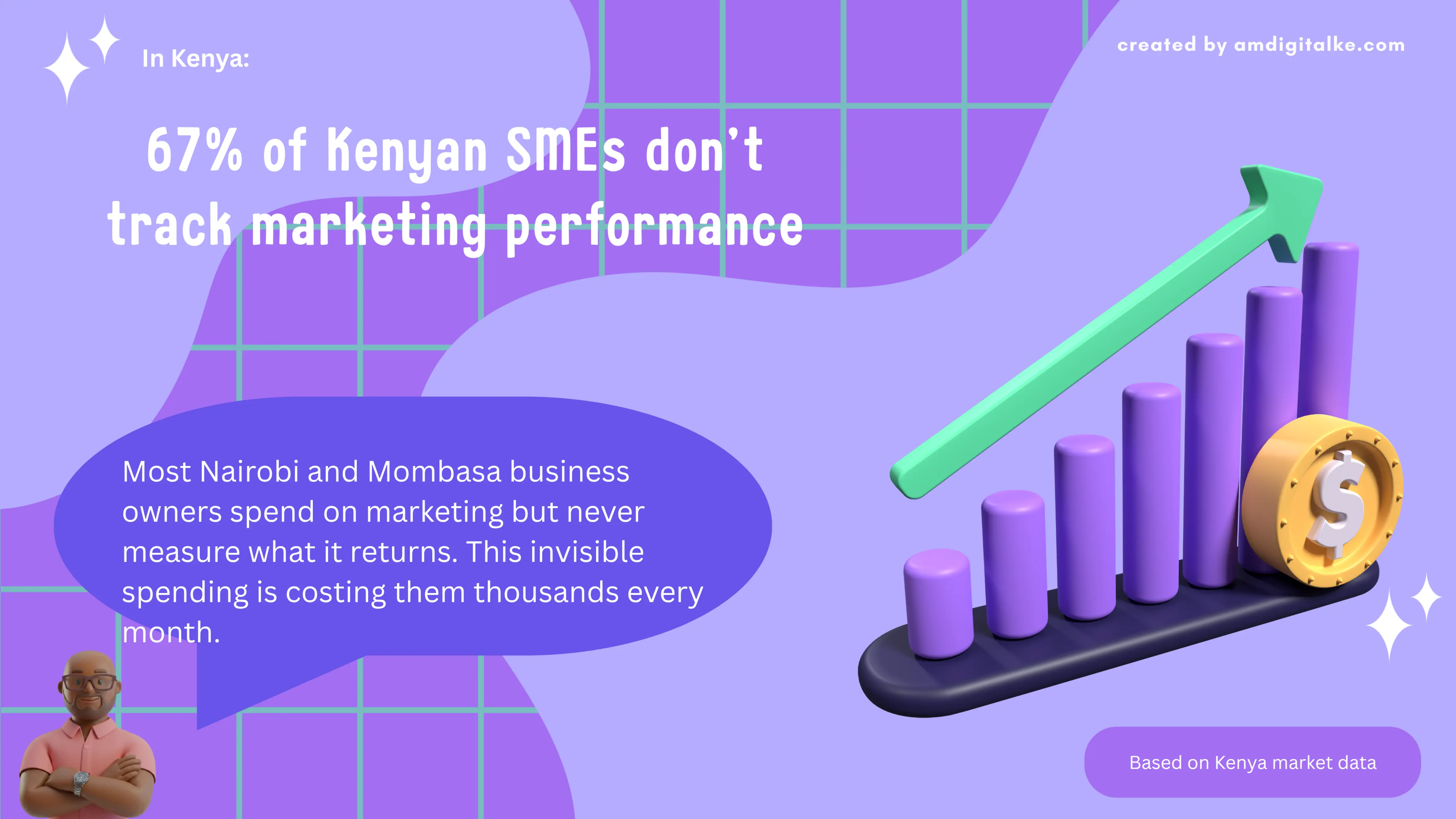
- Most Kenyan SMEs do not track ROI, meaning they are flying blind with marketing budgets
- ROI calculation is simple: divide profit by investment and multiply by 100 to get a percentage
- Different marketing channels will have different ROI; your job is to find which ones work best for your business
- Without ROI tracking, you cannot make smart decisions about where to spend next month’s marketing budget
Why Does Marketing ROI Matter for Kenyan Businesses?
Kenya is a price-sensitive market. Whether you are running a salon in Westlands, a shop in Mombasa, or a logistics business in Nairobi, every shilling counts.
You cannot afford to waste money on marketing that does not work.
Most Kenyan business owners have tight budgets. You cannot test ten different marketing channels and hope one works.
You need to know which channel gives you the best return before you spend a single extra shilling. Comparing agencies, like reviewing savage digital vs am digital ke, can help you pick a partner who prioritizes ROI over vanity metrics.
It Stops You From Wasting Money
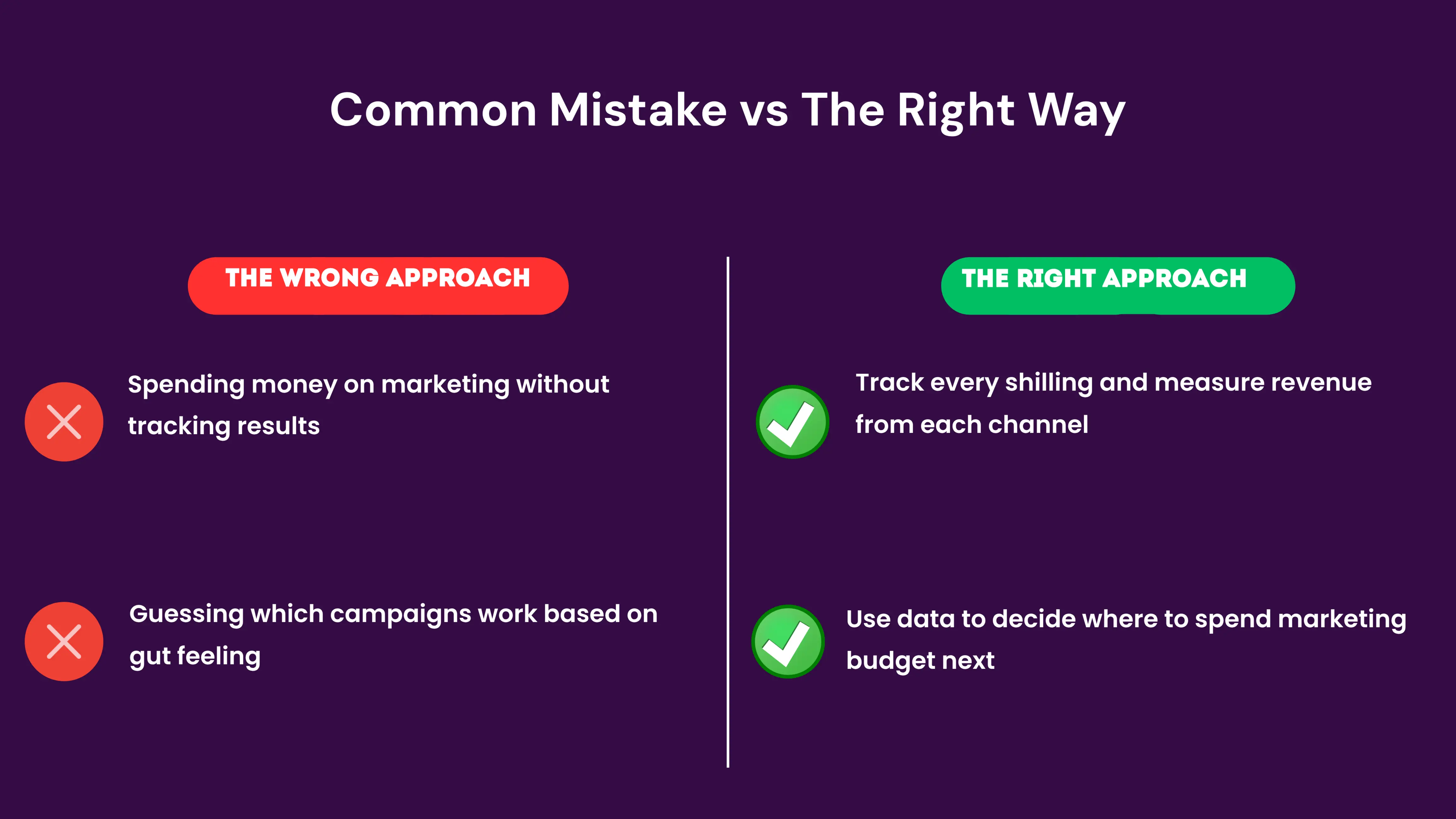
A common mistake is spending on every marketing channel because you think you should be everywhere. You run Facebook ads, Google Ads, Instagram, TikTok, email, and SMS all at once.
By the end of the month, you have spent 200,000 KES and have no idea which channel actually brought customers.
ROI tracking tells you the truth. Maybe Facebook is losing you money, but Google Ads is bringing in 300% ROI.
When you know this, you stop wasting money on Facebook and double down on Google.
It Helps You Grow Faster
If you know that a channel has a 200% ROI, you can confidently spend more on it. If you spend 50,000 KES and make 100,000 KES profit, you can reinvest that profit back into the same channel and grow faster.
This is how successful Kenyan businesses scale. They find what works, measure it carefully, and then double down.
Without ROI tracking, you are just guessing.
It Helps You Pitch to Investors or Lenders
If you ever need a loan from a bank or investment from a partner, they will ask one question: what is your ROI on marketing? A bank wants to see that your marketing is generating profit, not just spending money.
When you have clear ROI data, you look professional and trustworthy. This same discipline matters in sensitive fields too, where ymyl content writing health information google trusts proves your credibility with real data.
You are not just hoping things work. You have proof.
How Marketing ROI Works
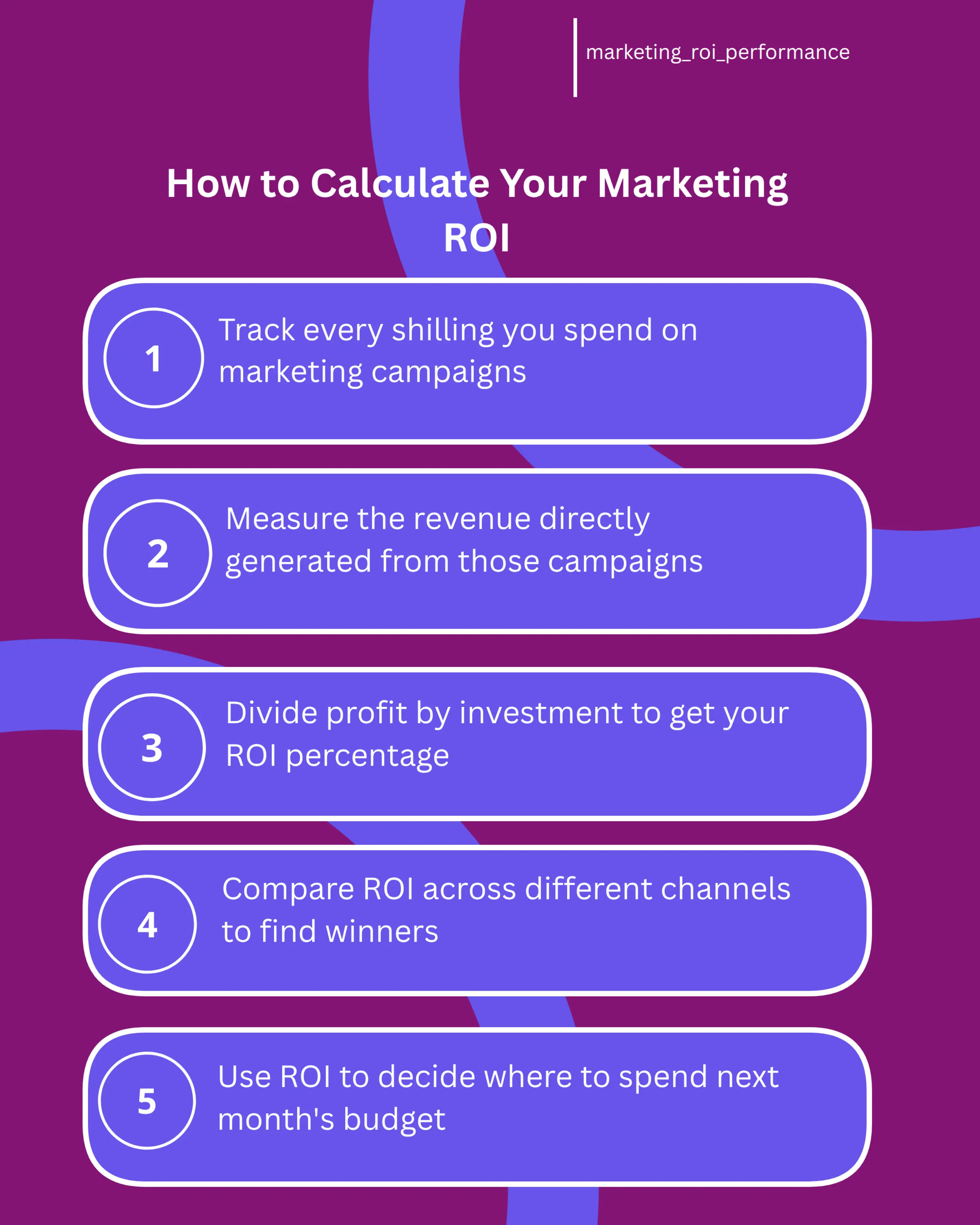
ROI tracking is not complicated. You need three things: a way to track what you spend, a way to measure what you earn, and a way to connect the two.
Step 1: Track Your Marketing Spend
Write down every shilling you spend on marketing. This includes Google Ads, Facebook Ads, email tools, SEO services, website copywriting kenya, and the time you spend managing your own social media.
Use a simple spreadsheet or Google Sheets. Create columns for date, channel, amount spent, and notes.
This takes five minutes per week. It saves you thousands in wasted spending.
Step 2: Measure Revenue Generated
This is where most Kenyan businesses struggle. You need to know which sales came from which marketing channel.
If someone buys from your shop, ask them how they heard about you. If they say Google, that sale counts toward your Google Ads ROI.
For online businesses, this is easier. Use Google Analytics or Facebook Pixel to track which ads led to purchases.
For brick-and-mortar businesses, ask customers directly. Or use discount codes unique to each channel.
Step 3: Calculate the ROI
Once you have spend and revenue, the math is simple. Profit = Revenue – Spend. ROI = (Profit / Spend) × 100.
Example: You spent 30,000 KES on Google Ads. Those ads brought in customers who spent 90,000 KES total.
Your profit is 60,000 KES. Your ROI is (60,000 / 30,000) × 100 = 200%.
| Marketing Channel | Amount Spent | Revenue Generated | Profit | ROI % |
|---|---|---|---|---|
| Google Ads | 30,000 KES | 90,000 KES | 60,000 KES | 200% |
| Facebook Ads | 20,000 KES | 35,000 KES | 15,000 KES | 75% |
| Email Marketing | 5,000 KES | 25,000 KES | 20,000 KES | 400% |
| TikTok Ads | 15,000 KES | 18,000 KES | 3,000 KES | 20% |
Look at this table. Email marketing has the highest ROI at 400%.
Google Ads is second at 200%. TikTok barely breaks even at 20%. If you only had budget for one channel next month, email is the clear winner.
Marketing ROI Examples in Kenya
Real numbers beat theory. Here is how Kenyan businesses use ROI to make smarter decisions.
Example 1: A Nairobi E-Commerce Store
A Nairobi fashion retailer was spending 100,000 KES per month across all marketing channels. She had no idea which channel was working.
After tracking ROI for three months, she discovered that Google Shopping ads had a 350% ROI. Instagram influencer posts had only 40% ROI.
She cut Instagram spending in half and doubled her Google budget. Within two months, her total marketing profit increased by 45% on the same total spend.
Example 2: A Mombasa Restaurant
A restaurant owner in Mombasa was running Facebook ads and getting lots of likes and comments. But he was not tracking whether those ads brought customers through the door.
When he asked customers how they heard about him, he learned most came from word-of-mouth and Google Search, not Facebook. He stopped wasting money on Facebook ads and invested in SEO and Google My Business optimization instead. Knowing how long does seo take kenya helped him set realistic expectations for the switch.
Six months later, his foot traffic increased by 60%. His marketing ROI jumped from 80% to 280%.
Example 3: A Nairobi B2B Service Company
A consulting firm was spending 50,000 KES per month on email marketing to past clients. They thought it was a waste because they could not directly track which emails led to new projects.
When they measured it properly, they found email had a 450% ROI. Past clients referred new business after receiving helpful emails.
This taught them an important lesson. Some ROI takes time to show up, so they increased email spend instead of cutting it, knowing long-term relationships drive profit.
Common Mistakes to Avoid
Most Kenyan businesses repeat the same ROI mistakes. Here are the ones that cost you the most money.
Mistake 1: Not Tracking Anything
This is the biggest mistake. You spend money, hope for the best, and never measure results.
You cannot improve what you do not measure. Start tracking today, even with a simple pen-and-paper system if you have to.
Based on AM Digital KE client data across Kenyan accounts, businesses that start tracking ROI increase their marketing profit by an average of 35% within three months. They do this simply by cutting the channels that do not work.
Mistake 2: Only Counting Direct Sales
Some marketing does not lead to immediate sales. A customer might see your Google Ad and not click it.
They see it again on Facebook and still do not click. Then they see your email, and only then do they buy. A whatsapp business automation answering customer questions 24 7 setup can capture that final step too.
If you only count the email sale as ROI, you undervalue your Google and Facebook spend. Use tools that track the full customer journey, not just the last click.
Mistake 3: Comparing ROI Across Different Time Periods
You cannot compare January ROI to July ROI if you changed your spending amounts or channels. Always compare the same channels over the same time period.
This is the only fair way to see if your strategy is working. Some agencies get this wrong too, which is one reason the artly vs am digital ke comparison matters when choosing a partner.
Keep a monthly record of ROI by channel. After three months, you will see clear patterns about what works and what does not.
✅ Quick Action Checklist
- ☐ Create a simple spreadsheet to track all marketing spend by channel and date
- ☐ Set up a system to ask customers how they heard about your business (or use tracking pixels for online sales)
- ☐ Calculate ROI for each marketing channel using the formula: (Profit / Spend) × 100
- ☐ Identify your top 2-3 highest ROI channels and plan to increase spending there next month
- ☐ Identify your lowest ROI channels and decide whether to cut, pause, or improve them
- ☐ Review your ROI data every month and adjust your budget based on what is working
- ☐ Set a minimum acceptable ROI for your business (for example, no channel should be below 100% ROI)
- ☐ Share your ROI data with your team so everyone understands which marketing efforts are driving profit
Ready to Improve Your Marketing ROI?
Marketing ROI rewards discipline, not luck. Start tracking today, even if you only track one channel.
Within one month, you will have data that changes how you spend money on marketing. Try our marketing reality check kenya tool to see where your budget stands right now.
The businesses winning in Kenya right now are not the ones spending the most on marketing. They are the ones measuring their ROI and making smart decisions with their budget.
Frequently Asked Questions
What is a good marketing ROI?
A good ROI depends on your industry and business model. Generally, anything above 100% ROI is profitable.
If you make 100 shillings profit for every 100 shillings spent, you are breaking even. Most successful businesses aim for 200% ROI or higher, meaning they make 2 shillings profit for every 1 shilling spent.
How long does it take to see marketing ROI?
This depends on your business. E-commerce businesses might see ROI within days, while B2B or high-ticket services might take months.
Track ROI over at least 30 days for short-cycle businesses. Give long-cycle businesses 90 days to get accurate data.
Can I have negative ROI?
Yes. If you spend 50,000 KES on a campaign and only make 30,000 KES back, your ROI is negative 40%.
This means you lost money. Negative ROI campaigns should be paused, improved, or cut entirely.
Should I track ROI for every single marketing activity?
Start with your biggest spending channels. If you spend 50,000 KES on Google Ads and 5,000 KES on LinkedIn, focus on Google first.
Once you have ROI data for your top three channels, expand to smaller channels. This is also where what is conversion rate optimization comes in, since better conversions boost ROI without extra spend.
What tools do I need to track marketing ROI?
You can start with Google Sheets and a simple calculator. For online businesses, Google Analytics and platform-specific tools like Facebook Ads Manager give you automatic ROI data.
As you grow, tools like HubSpot or Mixpanel can automate tracking. Start simple and upgrade as you scale.
Additional Resources
- Best Lead Magnets That Convert Traffic To Clients (And How To Use Them In Kenya) – If your marketing ROI looks weak, the problem may be a website that attracts visitors but never converts them into leads.
- How to Improve Organic CTR – A low click through rate quietly drags down your ROI calculations, and this guide shows you how to fix it.
- How Much Should You Spend On Marketing In Kenya? A Budget Guide For Every Business Size – Once you know how to measure ROI, the next question is how much budget you actually need to get a good one.
- SEO Packages in Kenya – See what an SEO investment costs in Kenya so you can plug real numbers into your ROI formula.
- SEO Reporting – Track the exact metrics that feed into your ROI calculations with reports built for Kenyan businesses.
- AM Digital KE Pricing – Compare our pricing against your expected returns to see if outsourcing marketing beats doing it in house.
Take the Next Step
Understanding marketing ROI is the first step. The next step is implementing it in your business.
We have created a practical guide that walks you through setting up ROI tracking for your specific business type, whether you are e-commerce, services, or retail. If you sell online, pairing this with user generated content reviews and qas that boost rankings can lift both trust and conversions.
Download the Marketing ROI Calculator for Kenyan Businesses to start measuring your campaigns today. You can also optimize your content to appear in featured snippets and capture more free organic traffic.