

Table of Contents
- The Kenyan SEO Market at a Glance
- What Each Price Level Actually Buys
- Under 20,000: The False Economy
- 20,000 to 40,000: The Freelancer Zone
- 40,000 to 100,000: Where Real SEO Starts
- 100,000 to 250,000: The Full Stack
- Above 250,000: Enterprise
- The Four Factors That Move Your Price
- SEO Cost vs SEO Value: The Only Math That Matters
- Red Flags When Comparing SEO Quotes in Kenya
- Frequently Asked Questions
- Know Your Numbers Before You Spend a Shilling
Short answer: between 15,000 and 250,000 shillings per month, depending on what you are actually buying.
That range is uselessly wide, we know. So this guide breaks down what each price level really includes, what the numbers mean for your business, and how to avoid the most expensive mistake: paying twice.
One disclosure before we start. We are an SEO agency, and our own prices are published here. We will reference them once. Everything else is about the market.
The Kenyan SEO Market at a Glance
| Monthly spend | What you typically get | Who it fits |
|---|---|---|
| Under KES 20,000 | Automated tools, recycled keywords, thin articles | Honestly? Nobody. See below. |
| KES 20,000 to 40,000 | Freelancer, part-time attention, basics done | Very small sites with light competition |
| KES 40,000 to 100,000 | Serious freelancer or lean agency, real strategy | SMEs in moderate competition |
| KES 100,000 to 250,000 | Full agency stack: technical, content, links, AI search | Competitive industries, growth-focused businesses |
| KES 250,000+ | Enterprise scope, dedicated teams | Corporates, national brands |
What Each Price Level Actually Buys
Under 20,000: The False Economy
At this price, the provider cannot afford to do real work. The math does not allow it. Quality content alone costs more to produce than the whole fee.
What you get instead: automated audit PDFs, a few directory submissions, maybe some bought backlinks that hurt you later. We wrote a full breakdown of what cheap SEO really costs. The summary: it is the most expensive option, because you pay again to undo it.
20,000 to 40,000: The Freelancer Zone
A competent freelancer can do good work here, part-time, for a small site. The risks are coverage and continuity. One person cannot be excellent at technical SEO, content, links, and analytics. And when they get busy, your project waits.
Fine for: a small business in a low-competition niche, with patience.
40,000 to 100,000: Where Real SEO Starts
This is where full strategies become possible. Proper technical audits. Content written from search data. Reporting worth reading. Most established Kenyan SMEs in competitive markets need to be in this range or above to make progress.
100,000 to 250,000: The Full Stack
Complete coverage: technical, content, authority building, AI search optimization, and automation. This range should come with education, transparency, and measurable business outcomes, not just rankings. For reference, our one plan, Managed SEO, starts at KES 80,000 a month.
Above 250,000: Enterprise
Dedicated teams, custom engineering, national campaign scope. If someone quotes you this without enterprise-level scope, ask exactly what justifies it.
The Four Factors That Move Your Price
1. Your competition. Ranking a Kilimani salon costs less than ranking a national insurance brand. The stronger your rivals, the more work winning takes.
2. Your starting point. A technically broken site needs foundation work before growth work. That first quarter costs more effort than any other.
3. Your ambition. Ten keywords or two hundred? Nairobi or all of Kenya? Scope drives hours, and hours drive price.
4. What is included. Two providers at the same price can deliver wildly different value. Always compare inclusions, never just the number. Ask specifically: is technical work included? Who writes the content? Where do links come from?
SEO Cost vs SEO Value: The Only Math That Matters
Here is the calculation most businesses never do.
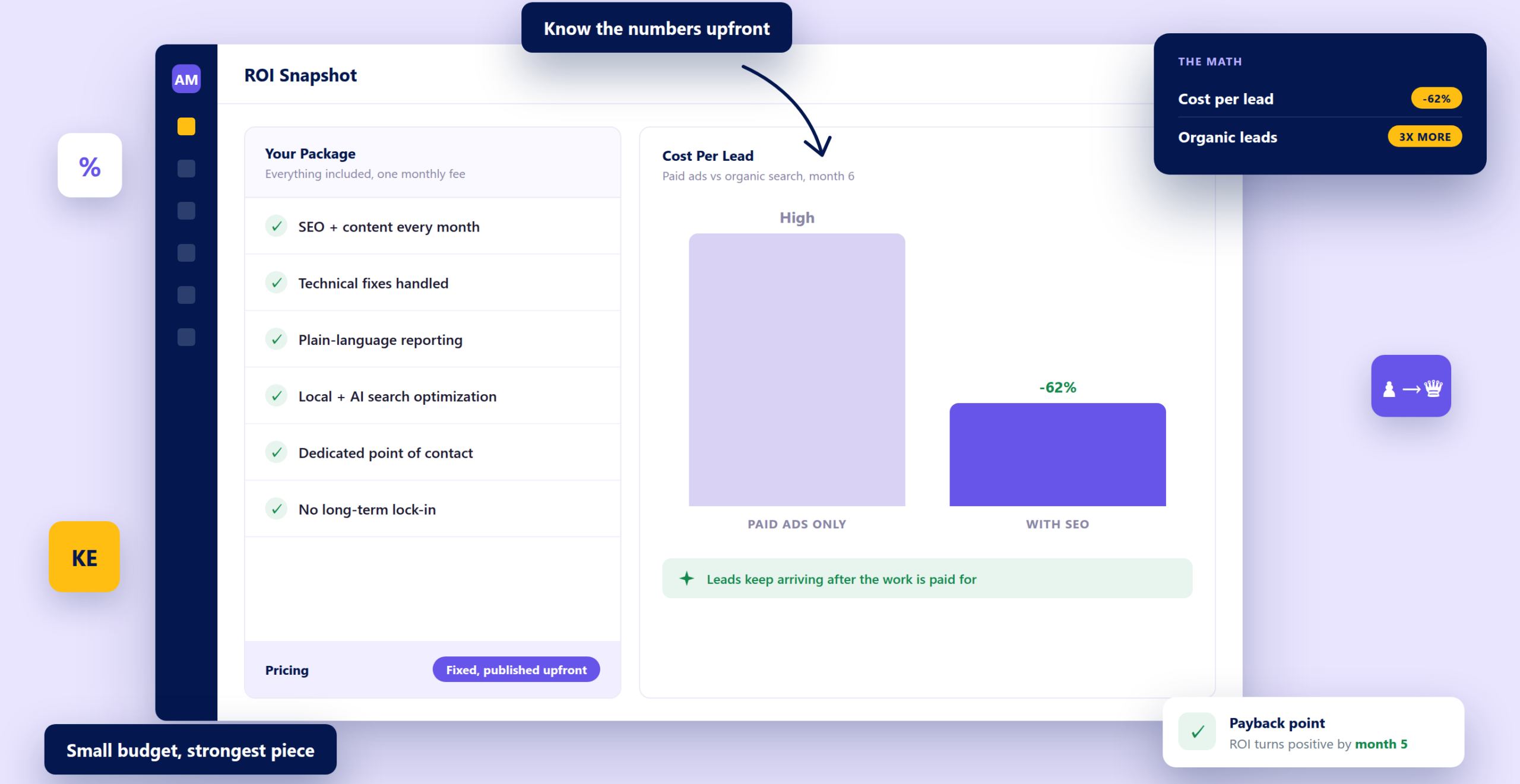
Say SEO costs you 75,000 monthly, and after six months it brings 20 extra enquiries a month. If you close a quarter of those at an average sale of 50,000 shillings, that is 250,000 in monthly revenue from a 75,000 spend.
And unlike ads, it compounds. The rankings you build keep working after the work is paid for. Here is the honest timeline for when each stage pays off.
Run your own numbers with our free Marketing Reality Check calculator. Two minutes, real figures.
Red Flags When Comparing SEO Quotes in Kenya
- Guaranteed #1 rankings. Nobody controls Google. This is the oldest lie in the industry.
- Fixed backlink quantities. “50 backlinks monthly” means bought links. Real links cannot be scheduled.
- No mention of your business goals. If they quote before asking what a customer is worth to you, they are selling a product, not a strategy.
- Hidden pricing everywhere. If you cannot find any number before a sales call, expect the price to be whatever they think you can pay.
- Jargon as a shield. If they cannot explain their plan in plain language, they either do not understand it or do not want you to.
Frequently Asked Questions
Is SEO worth it for small businesses in Kenya?
Usually yes, if the business is stable and the website works. SEO amplifies a working business. If you are still finding your model, spend on that first.
Can I do SEO myself instead of paying?
The basics, yes. Start with our free checklist. The ceiling is time: doing SEO properly is a part-time job, and your hours have a cost too.
Why do prices vary so much between agencies?
Because “SEO” describes both a 5,000-bob automated report and a full growth system. The word is the same. The work is not. Compare deliverables line by line.
How do I know if I am overpaying?
Ask your provider to show the work: what was done, why, and what changed. If they cannot, you are overpaying at any price.
Free Tools
Know Your Numbers Before You Spend a Shilling
The Marketing Reality Check shows what your marketing should cost. The free SEO analysis shows exactly where your site stands.
Or see your own numbers: