Table of Contents
- What Semantic SEO Actually Means
- 📋 Key Takeaways
- Why Does Semantic SEO Matter for Kenyan Businesses?
- How Semantic SEO Works 🔍
- Semantic SEO Examples in Kenya 💡
- Common Mistakes to Avoid ⚠️
- ✅ Quick Action Checklist
- Ready to Improve Your Semantic SEO? 🚀
- Frequently Asked Questions
- Additional Resources
- Take the Next Step
TL;DR: Semantic SEO means writing content that answers what your customers actually want to find, not just matching keywords. Google now understands meaning, context, and intent, so your job is to teach it that your business solves real problems. For Kenyan SMEs, this shift from keyword-stuffing to meaning-first writing is the difference between invisible and found. If you’re not sure where your site stands, get a free SEO breakdown here.
What Semantic SEO Actually Means
Semantic SEO is the practice of optimizing your content so Google understands the real meaning behind what your customers search for. It goes beyond matching exact words on the page.
For ten years, SEO was about keywords. You wanted to rank for “best plumber in Nairobi,” so you wrote that phrase fifty times and hoped Google noticed.
Google got smarter. It now understands that someone searching “best plumber in Nairobi” might also search “emergency plumbing services near me” or “pipe repair Nairobi.”
Google knows these searches mean the same thing. Someone needs a plumber right now.
Semantic SEO addresses the meaning behind those searches, not just one exact phrase. You write naturally for a human reader, and Google understands your content fits all those related searches.
This is also where the shift matters most when you compare ai seo vs traditional seo. Old ranking tactics chased single phrases. AI-driven search now maps meaning across your whole site.
Think of it this way. Old SEO taught a robot to recognize the word “car.”
Semantic SEO teaches that robot that “car,” “automobile,” “vehicle,” and “gari” all mean the same thing.
The Difference Between Keywords and Meaning
A keyword is a word or phrase someone types into Google. A semantic concept is the idea behind that phrase.
When a Nairobi business owner searches “how to increase sales online,” they want more than that exact phrase. They want digital marketing, conversion optimization, customer acquisition, and revenue growth.
Old SEO would have you title an article “How to Increase Sales Online” and repeat that phrase ten times. Semantic SEO has you write a full guide covering strategy, website optimization, and customer psychology, weaving in related terms naturally.
Google reads that article and understands the topic. It sees the content covers digital marketing, conversion rates, customer acquisition, and sales strategy.
It becomes relevant to anyone searching for ways to grow their business online.
Why Google Cares About Meaning
Google’s job is to answer search questions accurately. If it only matched keywords, it would show irrelevant results.
Someone searching “iPhone repair Mombasa” doesn’t want a page with those words scattered around it. They want an actual phone repair shop in Mombasa that fixes iPhones.
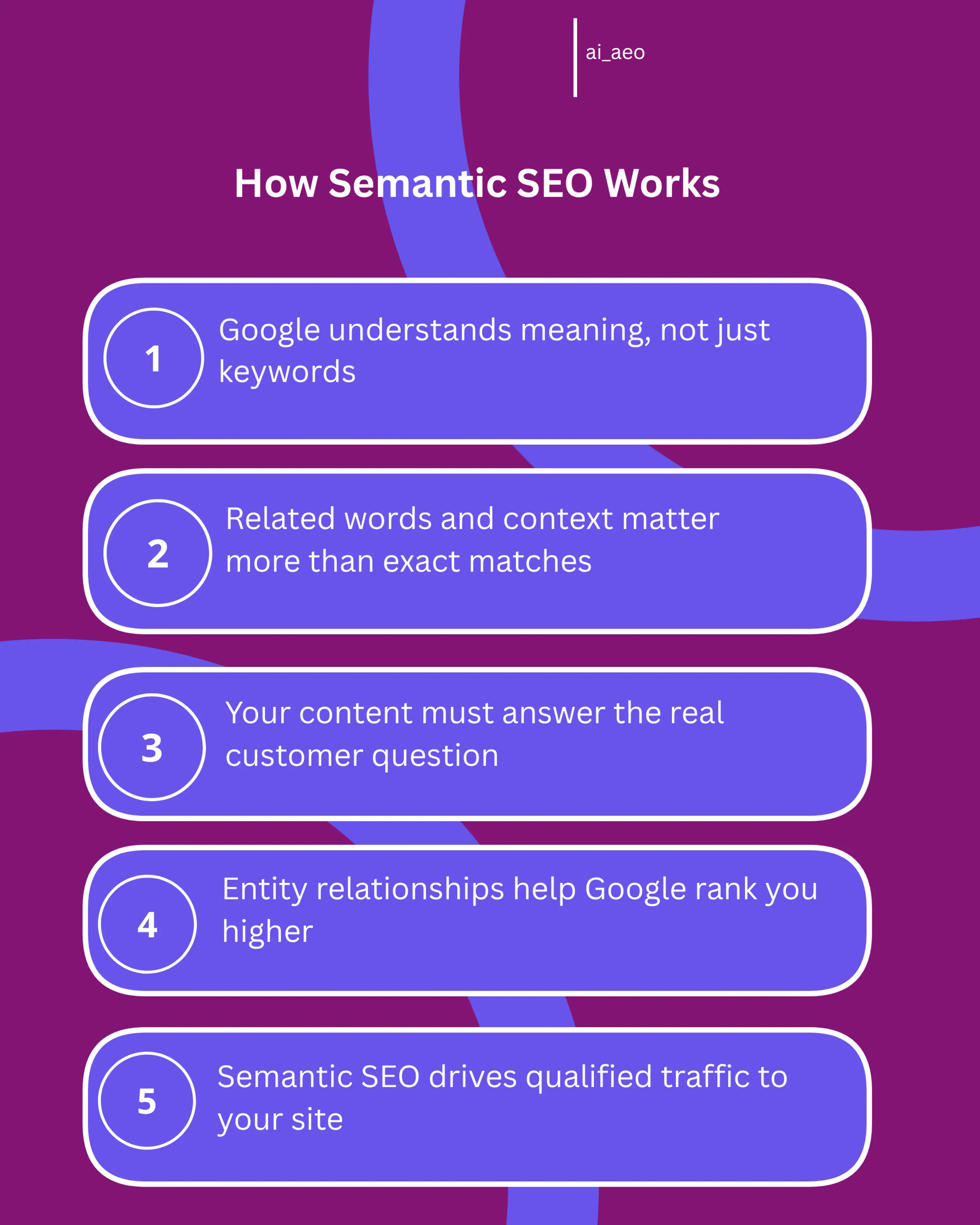
Semantic SEO helps Google figure out which pages actually solve the customer’s problem. Google looks at context, related information, content structure, and site authority to decide if you are a real answer.
📋 Key Takeaways
- Semantic SEO is about meaning, not keywords. Write for humans first, Google understands intent automatically.
- Related words and context matter more than exact keyword matches. Use synonyms and related concepts naturally.
- Google now understands entities (things, people, places, brands) and their relationships. Show Google how your business connects to customer problems.
- Search intent is everything. Know if the customer wants information, wants to buy, or wants to find a location before you write.
- Kenyan SMEs that adopt semantic SEO now will outrank competitors still keyword-stuffing. The shift is already happening.
Why Does Semantic SEO Matter for Kenyan Businesses?
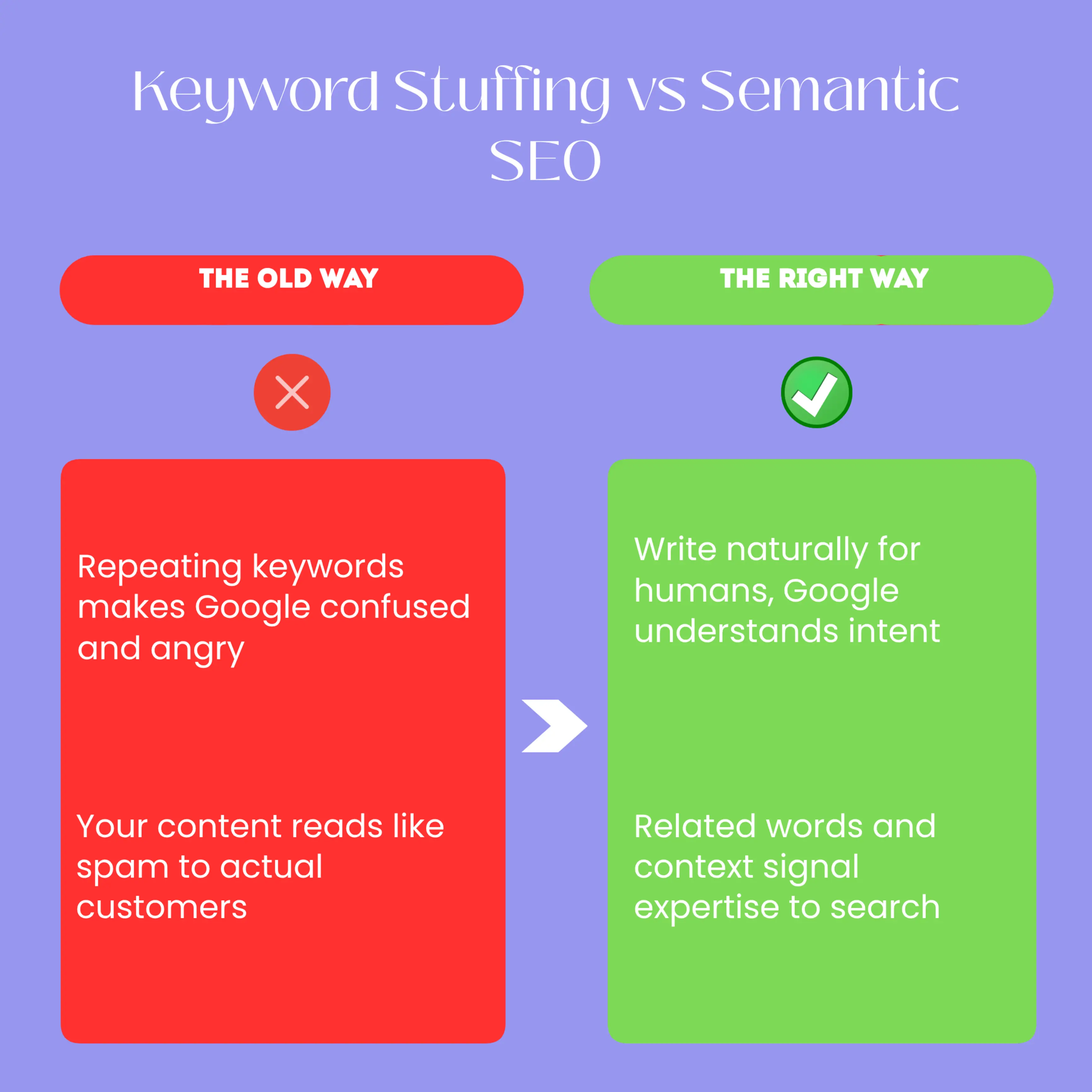
Most Kenyan SMEs still write for Google, not for customers. They keyword-stuff, they write awkwardly, and they wonder why they don’t rank.
Semantic SEO flips that. You write naturally for customers, answer their real questions, and Google rewards you by showing your content to the right people at the right time.
You Get More Qualified Traffic
When you optimize for meaning instead of keywords, you attract customers who actually want what you sell.
A Nairobi digital agency that writes “best SEO agency in Kenya” ten times might rank for that phrase. But someone searching it could be a student researching SEO, not a business owner ready to hire.
That same agency writing a detailed guide on “how to choose an SEO partner” attracts business owners actively comparing options. Those are the customers ready to pay.
Qualified traffic converts at 3-5 times higher rates than random visitors. Semantic SEO brings you qualified traffic.
Google Trusts You More
When your content shows deep understanding of a topic, Google sees you as an authority. Authorities rank higher.
A Mombasa hotel that writes “luxury beachfront hotel Mombasa” once is not an authority. A Mombasa hotel that writes guides on “best beaches near Mombasa” and “how to plan a coastal holiday” shows real expertise.
Google notices the depth and breadth of your knowledge. It ranks you higher for related searches you never even optimized for directly.
You Compete on Meaning, Not Just Price
When every business in your industry keyword-stuffs the same phrase, you all look the same to Google. The only way to win becomes price.
Semantic SEO lets you stand out by answering questions your competitors ignore. This matters even more once you look at the best niche and industry seo strategies built for kenyan markets, where specific expertise beats generic keyword chasing.
A Nairobi accounting firm that writes “best accountant in Nairobi” competes on price. A firm that writes “how to prepare for a KRA tax audit” attracts customers based on expertise.
How Semantic SEO Works 🔍
Semantic SEO has three main components. You understand search intent, use related concepts naturally, and show Google you are an authority on a topic.
Understanding Search Intent
Search intent is the reason someone typed that phrase into Google. Every search has one of four intents. It is informational when they want to learn, navigational when they want a specific site, commercial when they want to compare options, or transactional when they want to buy.
A search for “how to start a business in Kenya” is informational. Someone is learning, not ready to buy.
A search for “business registration KRA” is transactional. Someone is ready to take action.
A search for “best accounting software Kenya” is commercial. Someone is comparing options before buying.
Your content must match the intent. If you write a sales page for an informational search, you will not rank.
If you write a blog post for a transactional search, you will not convert. Getting this right also matters for how to optimize for ai overviews, since AI tools look at intent too.
Using Related Concepts Naturally
Semantic SEO means using synonyms, related terms, and related concepts throughout your content. You do this without forcing them.
If you are writing about “digital marketing for small businesses,” you naturally mention “online marketing,” “internet marketing,” and “digital strategy.” You also mention “content marketing,” “social media marketing,” and “online customer acquisition.” These are semantically related.
You do not force these phrases in. They appear naturally because you are writing comprehensively about the topic.
Google reads your content and understands you are talking about digital marketing broadly. It sees the whole picture, not just one narrow phrase.
Building Entity Authority
An entity is a thing: a person, place, brand, or concept. Google thinks in entities.
Google knows that “Nairobi,” “Mombasa,” and “Kenya” are entities. It knows that “Safaricom,” “Equity Bank,” and “KRA” are entities. It also knows that “digital marketing,” “SEO,” and “web design” are entities.
When your content mentions these entities and shows how they relate to your business, Google understands what you do. It also understands who you serve.
A Nairobi web design agency that mentions “Nairobi startups,” “Kenyan small businesses,” and “Nairobi digital ecosystem” shows Google that it serves Nairobi businesses. Google ranks it higher for local searches.
| SEO Approach | How It Works | What Happens |
|---|---|---|
| Old Keyword SEO | Repeat exact phrase, match keywords exactly | Ranks for one phrase, low traffic quality, easy to outrank |
| Semantic SEO | Answer intent, use related concepts, show authority | Ranks for many related searches, high traffic quality, hard to outrank |
Semantic SEO Examples in Kenya 💡
Real Kenyan businesses use semantic SEO to get found every day. Here is how it plays out in practice.
A Nairobi Salon Ranking for Hair Services
A salon in Westlands wants to rank for “hair salon Nairobi.” But that phrase is competitive and generic.
Instead, the salon writes guides on “best hairstyles for Nairobi weather” and “how to care for natural hair in Kenya.” It also covers “hair damage repair treatments” and “bridal hair services Nairobi.” These pages use related concepts: hair care, styling, treatments, and occasions.
Google understands that this salon is an authority on hair services in Nairobi. It ranks the salon for “hair salon Nairobi,” “haircut Westlands,” “hair treatment near me,” and dozens of related searches.
Customers find the salon not because of keyword matching. Google knows it solves hair problems.
A Kisumu E-Commerce Store Ranking for Products
An online fashion store in Kisumu sells dresses. It could write “buy dresses online Kisumu” fifty times.
Instead, it writes “summer dress styles 2024” and “how to style casual dresses.” It also covers “best fabrics for Kenyan climate” and “where to find affordable fashion in Kisumu.” These pages use related concepts: fashion trends, styling, fabrics, and value.
Google understands that this store is an authority on fashion in Kisumu. It ranks the store for “dresses Kisumu,” “online fashion Kenya,” “summer styles,” and “affordable clothing near me.”
Customers discover the store through multiple entry points. No single keyword carries the whole business.
A Nairobi Consulting Firm Ranking for Strategy
A management consulting firm wants to rank for “business consultant Nairobi.” This phrase is vague and competitive.
Instead, the firm publishes guides on “how to scale a Kenyan startup” and “financial planning for SMEs.” It also covers “market entry strategy for East Africa” and “organizational restructuring.” These pages show expertise in strategy, finance, growth, and operations.
Google sees the firm as an authority on business strategy. It ranks the firm for “business consultant Nairobi,” “startup advisor Kenya,” “financial planning services,” and “growth strategy.”
Potential clients find the firm because Google knows it solves business problems. The same logic explains why your social media ads send customers to competitors free checklist matters just as much as SEO does.
Common Mistakes to Avoid ⚠️
Most Kenyan businesses make the same semantic SEO mistakes. Here is how to avoid them.
Writing for Google, Not Customers
The biggest mistake is still writing awkwardly to include keywords and phrases. Your content reads like spam.
A plumber writes: “Our plumbing services in Nairobi provide plumbing solutions for plumbing problems in Nairobi. We are the best plumbing company in Nairobi.”
This is keyword-stuffing dressed up as semantic SEO. It does not work.
Instead, write naturally: “When your pipes burst at 2 AM, you need a plumber who answers the phone. We fix emergency leaks, burst pipes, and water damage in Nairobi.” Add: “We come within 30 minutes or your call is free.”
That second version is better for customers and for Google.
Ignoring Search Intent
Search intent mistakes waste your content budget fast. You write a sales page for an informational search, or a blog post for a transactional search.
You waste effort on content that will never rank or convert. This mistake also shows up in what is voice search seo, where matching intent matters even more.
If someone searches “how does SEO work,” they want to learn, not buy. Write a guide.
If someone searches “hire SEO agency Nairobi,” they want to buy. Write a sales page.
Match your content to the intent. Otherwise you are working against Google.
Using Unrelated Keywords
Unrelated keywords confuse Google fast. You stuff your page with keywords that are not semantically related, and Google sees this as spam.
A Nairobi accountant writes about “tax preparation,” “web design,” “social media marketing,” and “graphic design” on the same page. These are not related.
Google gets confused. It does not know if you are an accountant, a designer, or a marketer.
Stick to related concepts. Use synonyms and variations of your core topic.
✅ Quick Action Checklist
- ☐ Audit your top 10 pages. Do they answer a real customer question, or do they keyword-stuff?
- ☐ Research search intent for your main keywords. Are customers looking to learn, compare, or buy?
- ☐ Write one comprehensive guide on your core topic. Use related concepts naturally throughout.
- ☐ Identify 5-10 entities related to your business (locations, industries, customer types, problems you solve).
- ☐ Mention these entities naturally in your content. Show Google how you connect to them.
- ☐ Read your content out loud. If it sounds awkward, rewrite it naturally.
- ☐ Check Google Search Console to see what searches bring traffic. Are they related to your intent?
- ☐ Update old keyword-stuffed pages. Rewrite them for meaning and readability.
Ready to Improve Your Semantic SEO? 🚀
Semantic SEO is not complicated. It is about writing naturally for customers and letting Google understand your expertise.
Most Kenyan businesses are still keyword-stuffing. That means you have a huge opportunity to stand out with better content that answers real customer questions.
Start with one page. Choose a topic your customers care about.
Write a comprehensive, natural guide. Let Google do the rest.
Frequently Asked Questions
What is the difference between semantic SEO and regular SEO?
Regular SEO focuses on keywords and exact matches. Semantic SEO focuses on meaning and intent.
Semantic SEO works better because Google now understands meaning, not just keywords. If you are still keyword-stuffing, you are falling behind.
Do I need to change all my existing content?
No, but you should prioritize your top-performing pages. Start with pages that bring traffic but do not convert, or pages that rank on page 2-3.
Rewrite them for meaning and readability. New pages should be written with semantic SEO from the start.
How do I know if my content is semantic SEO optimized?
Read it out loud. If it sounds natural and answers a real customer question, it is semantic.
If it sounds awkward or repetitive, it is not. Also check if it uses related concepts naturally, shows authority, and matches search intent.
Can semantic SEO help me rank locally in Kenya?
Yes. Mention your location, your local customer base, and local entities naturally.
A Mombasa hotel that writes about “Mombasa beaches,” “coastal holiday planning,” and “North Coast travel” shows Google it serves Mombasa customers. You rank higher locally.
How long does semantic SEO take to work?
Like all SEO, it takes time. You should see improvements in 3-6 months.
Semantic SEO is more sustainable. Once you rank, you stay ranked because your content is harder to outrank, while competitors are still keyword-stuffing.
Additional Resources
- What is Structured Data – Structured data is how you hand search engines the exact entities and relationships semantic SEO depends on, so read this next to see it in practice.
- Will AI Kill SEO In Kenya? Here’S What’S Actually Happening – If semantic SEO is about meaning over keywords, find out here whether AI search is replacing traditional SEO altogether for Kenyan businesses.
- How To Get Your Kenyan Business Featured In AI-Generated Search Results – Once you understand semantic SEO, this shows you the practical steps to get your Kenyan business picked up by AI search tools.
- What is a Knowledge Panel – Knowledge panels are a direct result of search engines understanding entities semantically, this article shows you what that looks like on the results page.
- AEO, GEO & LLMO: SEO for the Age of AI Search – Semantic SEO is the foundation for these newer disciplines, read this to see where the field is heading next.
- What is AI SEO – Semantic SEO and AI SEO overlap heavily, this article draws the line between the two and shows how they work together.
Take the Next Step
Semantic SEO is the future of how Google ranks websites. Businesses that understand it now will dominate their industries in Kenya.
You don’t need expensive tools or complicated strategies. You need to understand how to write for meaning instead of keywords.
Pair this with tools like an ai chatbot for kenya to capture and answer visitor questions in real time. This strengthens the topical signals search engines use to understand your site.
To learn the exact steps to audit and optimize your website for semantic SEO, download the Semantic SEO Checklist for Kenyan Businesses.