Table of Contents
TL;DR: AI content can rank in Google Search Kenya, but only when it is edited, fact-checked, and filled with real local insight. Google does not penalize content for being AI-written, it penalizes content that fails to help the reader. The businesses winning with AI content in Kenya are the ones treating it as a first draft, not a finished product.
Google doesn’t care if a Kenyan business used ChatGPT to write their SEO content. Your customers do.
Over the past two years, I have watched Nairobi business owners rush toward AI writing tools the way they once rushed toward Facebook ads. The promise is simple: fast, cheap content that fills up a website without hiring a writer.
But the question I get asked most often at AM Digital KE is not whether AI content works. It is whether it can actually rank in Kenyan search results without embarrassing the business in front of real customers. Getting this right starts with understanding seo in kenya and how it differs from the SEO playbook used elsewhere.
📋 Key Takeaways
- Google ranks helpful, accurate content regardless of whether AI or a human wrote it first.
- Unedited AI content often fails because it is generic, factually shaky, or blind to Kenyan context.
- Kenyan search niches are less crowded than US markets, giving well-localized AI content a real shot at ranking.
- E-E-A-T matters more, not less, when AI is involved, especially for finance, health, and legal topics.
- The winning approach combines AI speed with human editing, local examples, and fact-checking.
The Problem: What Most Kenyan Businesses Get Wrong
Most business owners treat AI content generation like a vending machine. You type a prompt, you get an article, you paste it onto your website and move to the next task.
That approach fails not because Google hates AI. The content itself is often weak, generic, and disconnected from the reader’s actual problem.
Treating AI as a Finished Product
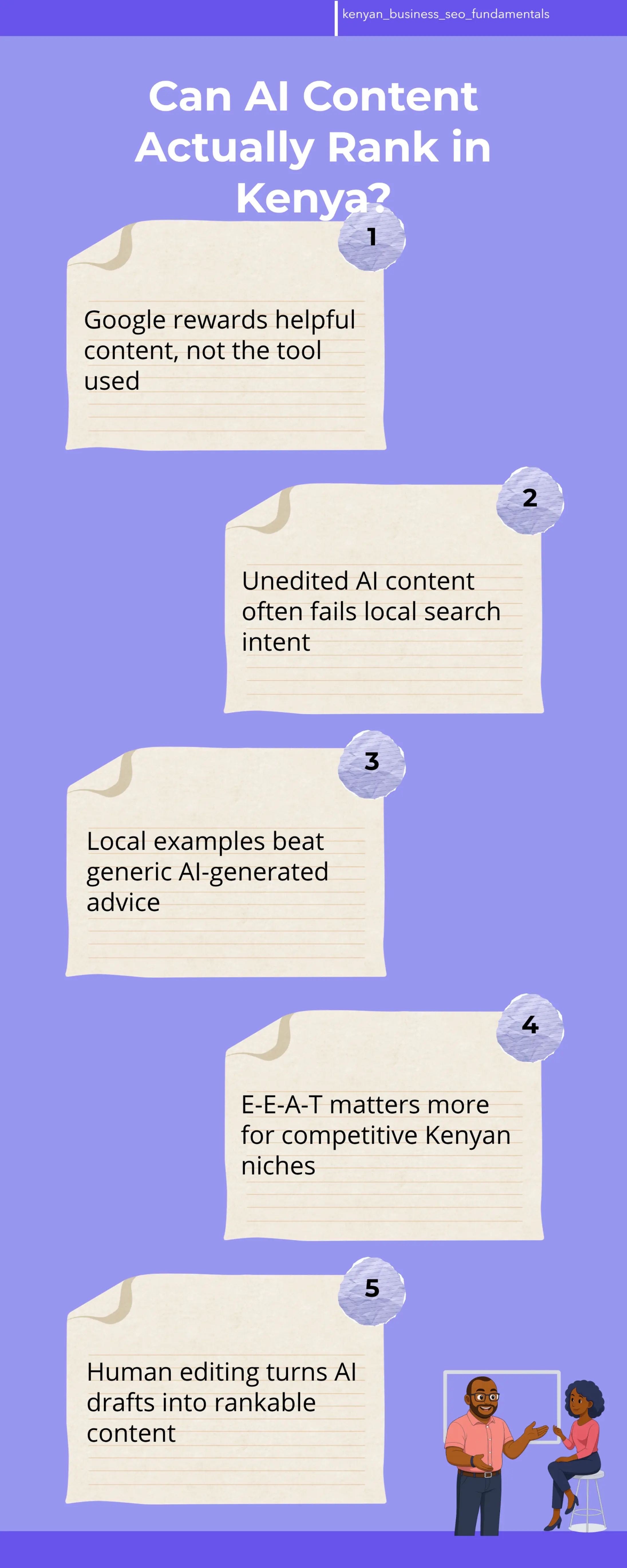
The biggest mistake is publishing the first draft an AI tool gives you. These drafts read fine on the surface, but they rarely reflect how a real Kenyan business operates.
An AI tool might describe a “digital marketing agency Nairobi” without mentioning that a client pays through M-Pesa. It might also miss that a matatu SACCO has different marketing needs than a Westlands boutique.
Ignoring Local Regulatory Risk
This mistake gets dangerous fast in regulated industries. I have seen AI tools confidently generate content about Central Bank of Kenya licensing requirements that was simply wrong.
The model was trained mostly on global or US financial data. A fintech startup publishing that kind of error risks more than rankings. It risks trust and possibly compliance trouble.
The Real Reason: Why Kenya Is Actually a Different Game
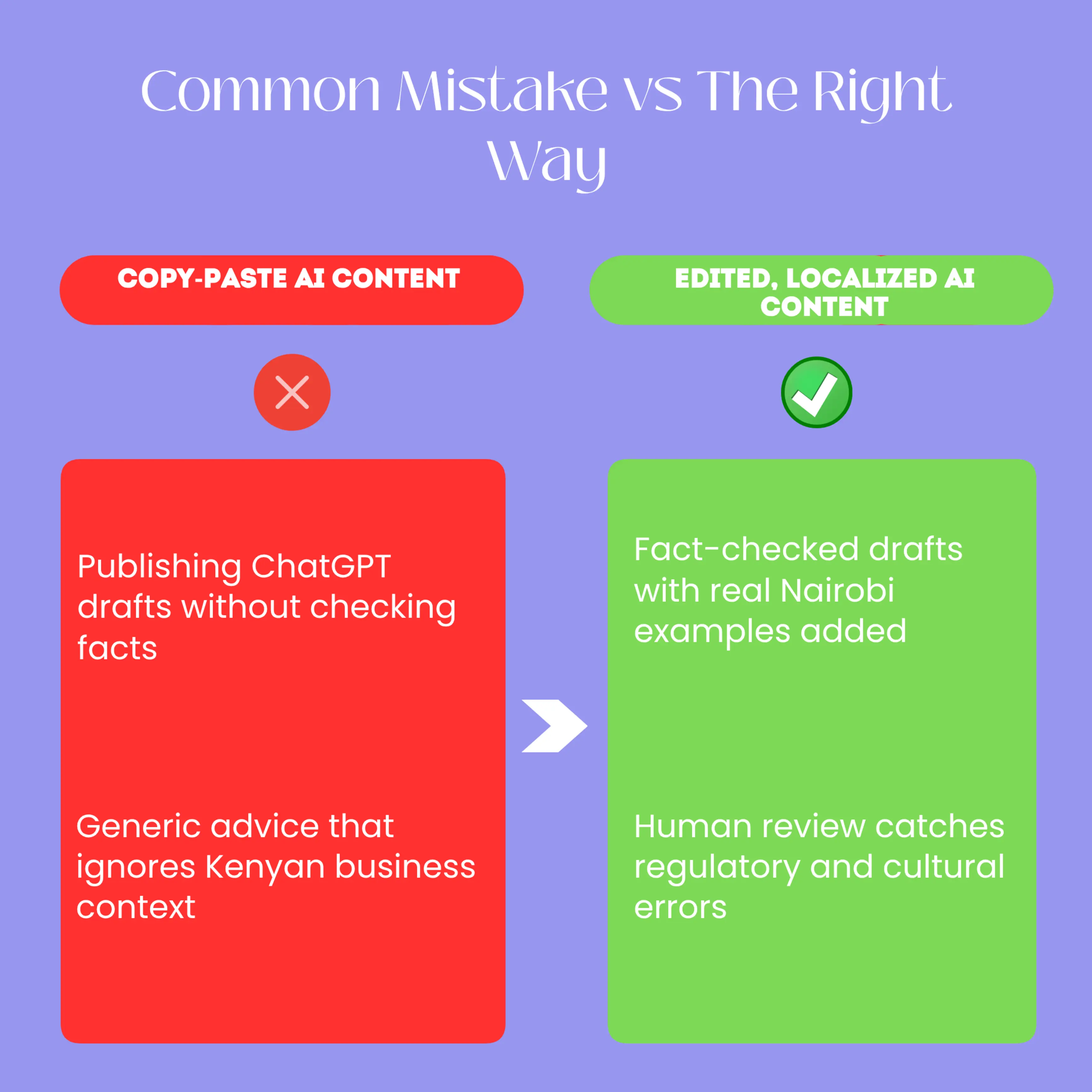
Here is what most global articles about AI content never tell Kenyan business owners: our search landscape is far less crowded than the US or UK. A search term with thousands of competing pages in New York might have only a handful of serious competitors in Nairobi.
This changes the calculation entirely. AI content that would get buried on page five in a saturated US market can genuinely rank on page one in Kenya, provided it answers the searcher’s question better than the thin pages already sitting there. This is especially true for businesses competing nationally in kenya ranking beyond your city, where the opportunity is even wider.
Lower Competition, Higher Opportunity
Kenyan search volume for many business terms is smaller than global equivalents. Fewer competitors are fighting for the same keywords, and mobile-first search behavior dominates, which is part of why Kenya’s internet usage has grown steadily over recent years.
That growth means more Kenyans are searching, but the content answering their questions is often outdated, thin, or copied from foreign sources. This is the opening AI content can fill, if it is done properly, especially through location pages that rank the complete guide for kenya built with real local detail.
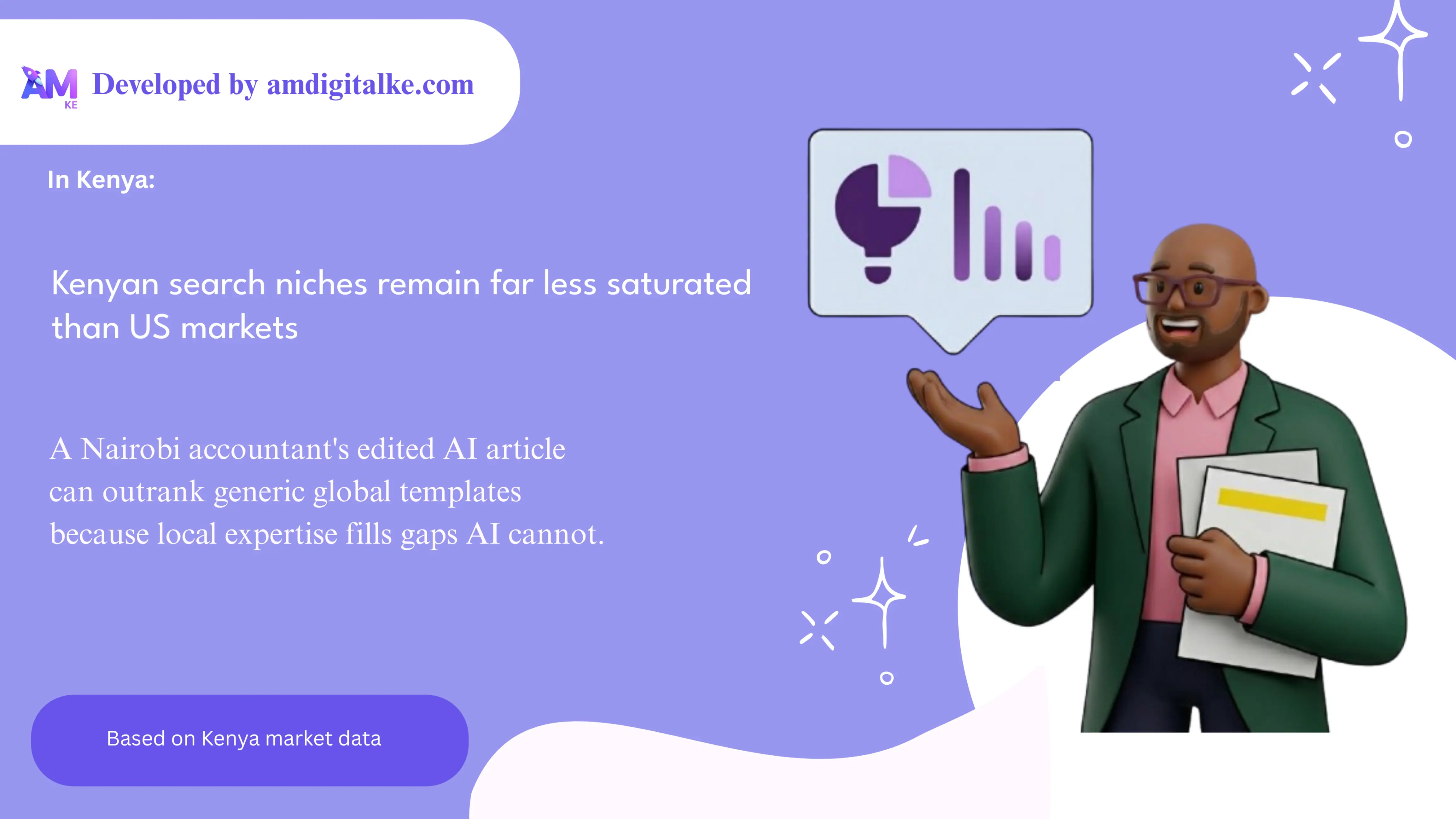
Old Approach vs New Approach
| Old Approach (Copy-Paste AI) | New Approach (Edited AI + Local Insight) |
|---|---|
| Publish first draft as-is | Edit every draft before publishing |
| Generic examples, no Kenyan context | Real examples from Nairobi, Mombasa, or Kisumu businesses |
| Facts unchecked, risk of hallucination | Every claim fact-checked against reliable sources |
| Written for keywords, not people | Written to answer the actual search intent |
| No author expertise signals | Content reviewed or written by someone with real experience |
📊 What the Evidence Shows
Google has stated publicly that it rewards content based on quality and helpfulness, not on the method used to produce it. Automation is not automatically penalized. Content made primarily to manipulate rankings is treated as spam, whether a human or a machine wrote it.
This matters for Kenyan businesses because it removes the fear factor. It replaces it with a practical question: does this content genuinely help the person searching?
Real Results From Editing AI Drafts
Based on AM Digital KE client data across Kenyan accounts, one pattern is clear. Articles that combined AI drafting with human editing and local examples consistently outperformed both fully AI-written and fully human-written pages in time-to-rank.
The AI gave us speed. The editing gave us accuracy, and the local detail gave us relevance that a generic template could never match.
We tested this across five different niches, from a Nairobi accounting firm to a Mombasa logistics company. The pattern held every time.
Pages that named specific Kenyan pain points, like KRA filing deadlines or matatu-based delivery constraints, earned more engagement than pages that stayed generic. This holds even for niche sectors like seo for saccos kenya, where members search for very specific, local terms.
Where the Numbers Get Tricky
Click-through rates tell part of the story too. Pages with generic AI titles and meta descriptions tend to underperform, because average click-through rates drop sharply when a title fails to match what the searcher actually wants.
A title like “Best SEO Tips” loses to “SEO Tips for Nairobi Salons Struggling to Rank Locally” almost every time. It signals real relevance instantly.
This is not an AI problem specifically. It is a specificity problem, and AI drafts are especially prone to staying vague unless a human pushes them toward detail.
✅ What to Do Instead
The path forward is not to avoid AI content. It is also not to publish it blindly.
The middle ground is where the real wins happen for Kenyan businesses.
Build an Editing Checklist
Every AI draft should go through a human review that checks for factual accuracy, local relevance, and tone. At AM Digital KE, we treat the AI draft as a skeleton, then we add muscle.
That means real client stories, correct KRA or CBK references, and language that sounds like a Kenyan business owner wrote it, not a foreign textbook. Genuine user generated content reviews and qas that boost rankings can also fill in the gaps AI leaves behind.
Add Original Local Proof
Original images, screenshots of local dashboards, and specific customer quotes make content far harder for competitors to copy. They also make it far more trustworthy for readers.
A logistics company writing about delivery times should mention Nairobi traffic patterns or matatu route delays, not generic “fast shipping” language borrowed from a US template. This same principle drives service area business seo ranking without a physical location, where local specificity replaces a storefront address.
✅ Quick Action Checklist
- ☐ Never publish an AI draft without human editing first
- ☐ Fact-check every regulatory, legal, or financial claim manually
- ☐ Add at least one Kenyan example or case per article
- ☐ Rewrite titles and meta descriptions to match real search intent
- ☐ Include an author or reviewer with genuine industry experience
- ☐ Replace generic stock language with specific business details
- ☐ Check for keyword stuffing and remove repetitive phrasing
- ☐ Avoid mass-publishing dozens of AI articles in one week
Ready to Improve Your AI Optimization?
AI content can rank in Kenya, but only when someone with real judgment stands between the draft and the publish button. Speed without accuracy is a shortcut to losing trust, and trust is what actually keeps customers on your site.
Contact AM Digital KE today.
Frequently Asked Questions
Does Google penalize AI-generated content in Kenya?
No, Google does not penalize content simply for being AI-generated. It penalizes content that is unhelpful, inaccurate, or created purely to manipulate rankings.
A well-edited, accurate AI draft with local relevance can rank just as well as human-written content. For more on the basics, see our seo faqs kenya guide.
Can a small Kenyan business use AI content without hiring a full content team?
Yes, many small businesses use AI to draft content faster, then have one person edit for accuracy and local relevance. This works best when that reviewer understands the industry and the Kenyan market well enough to catch errors and add real insight.
What industries in Kenya carry the most risk with AI content?
Finance, health, and legal services carry the highest risk because AI models frequently get local regulatory details wrong. A fintech article referencing incorrect CBK rules, for example, can damage trust and mislead readers.
These industries need stricter fact-checking before publishing.
How long does it take AI-assisted content to rank in Kenya?
Timelines vary by competition and niche, but many Kenyan keywords face less competition than global markets. This can speed things up.
Consistent publishing, proper editing, and strong local relevance tend to matter more than the writing method itself.
Should businesses stop using AI content entirely to be safe?
No, avoiding AI entirely is not necessary and often wastes the tool’s real value for speed and structure. The safer approach is using AI for drafting while relying on human expertise for accuracy, local context, and strategic direction.
Additional Resources
- How to Rank Real Estate Listings on Google Kenya – See how AI optimization principles apply in practice when ranking property listings against agents flooding Google with AI generated descriptions.
- What Nairobi Businesses Get Wrong About Doing Optimizing Their SEO For AI – Before you try AI optimization on your own site, learn the common mistakes Nairobi business owners make when they skip the strategy and go straight to the tools.
- How to Rank Your School Website on Google Kenya – If you run a school website, this shows how the same AI content and ranking questions play out for institutions competing for parent searches.
- What are Featured Snippets (for the Kenya Market) – AI optimized content often targets featured snippets, so this explains what that box at the top of Google actually is and why it matters here.
- National SEO vs Local SEO – Which Does Your Kenyan Business Need? – Knowing whether you need national or local SEO changes how you should structure AI generated content, so check this before you scale your writing.
- National Link Building – Authority Across Kenyan Regions – AI content alone will not rank you nationally, this explains the link building work that has to back it up across Kenyan regions.
Take the Next Step
You need a clear framework for content that ranks in Kenyan search results. This applies whether you use AI, write everything by hand, or mix both.
Start with the fundamentals. Download the Complete SEO Checklist for Kenyan Businesses and audit your current content strategy this week.
If you serve customers beyond Nairobi, look at your content strategy for national reach targeting all of kenya. AI content often reads generic because it skips regional detail, and that gap costs you rankings outside the capital.
Build content that lasts. Understanding what is evergreen content helps you decide where AI drafts fit and where they fall short.
Rankings also move on signals outside your content. the review velocity strategy outranking competitors fast shows how reviews can push you past rivals faster than content alone.
Text is not the only asset Google rewards. project gallery optimisation visual content that ranks explains how photos of your actual work in Kenya can rank when AI text cannot.