Table of Contents
- What Does Evergreen Content Actually Mean?
- Why Does Evergreen Content Matter for Kenyan Businesses? 📚
- How Evergreen Content Works 🔄
- Evergreen Content Examples in Kenya 💡
- Common Mistakes to Avoid ⚠️
- ✅ Quick Action Checklist
- Ready to Build Evergreen Content That Works?
- Frequently Asked Questions
- Additional Resources
- Take the Next Step
TL;DR: Evergreen content is material that stays relevant and useful for months or years without needing updates. Unlike trending posts that fade, evergreen content keeps attracting organic traffic and qualified leads long after you publish it. For Kenyan businesses, it’s the difference between chasing trends and building permanent assets that generate revenue while you sleep.
What Does Evergreen Content Actually Mean?
Evergreen content is any piece of writing, video, or resource that answers a question or solves a problem that people search for consistently, year after year.
Think of it like this: a blog post about “How to Register a Business in Kenya” will get searched today, next month, next year, and five years from now. Business registration doesn’t change fundamentally every quarter.
The term “evergreen” comes from trees that stay green all year round, never losing their leaves. Your content works the same way.
It stays valuable and relevant regardless of the season or current news cycle.
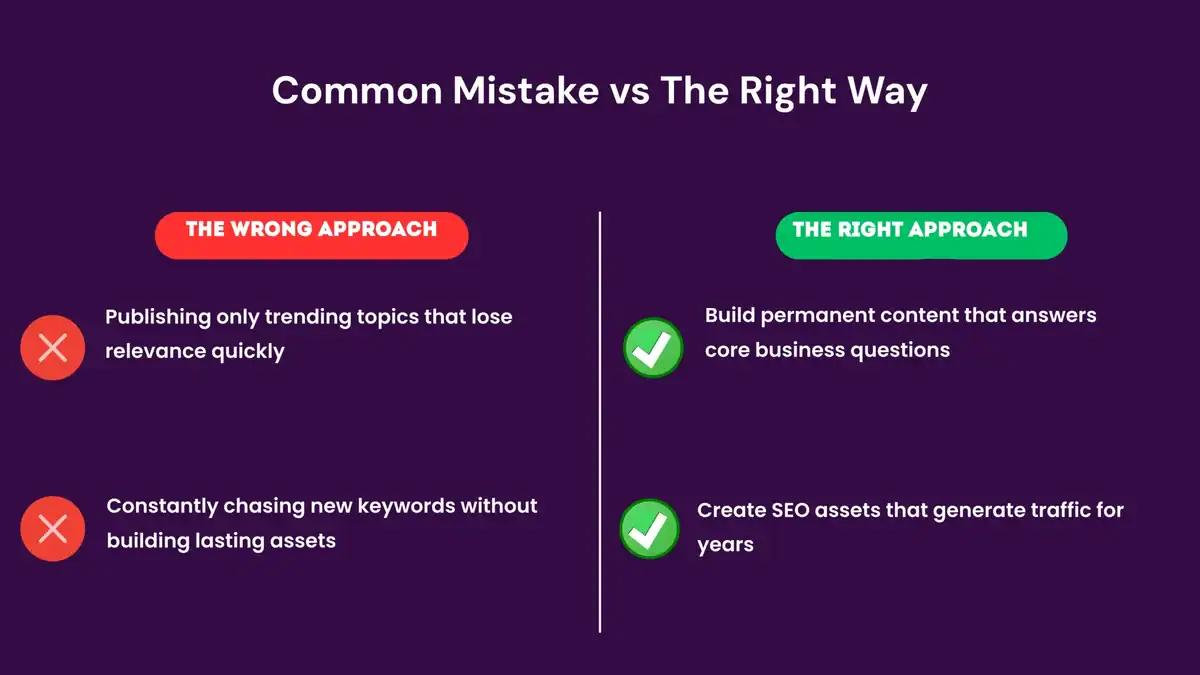
The opposite of evergreen content is trending content. Trending content gets a spike of traffic for a few days or weeks and then disappears completely from search results.
How Evergreen Differs From Trending Content
Trending content is timely but temporary. A post about “Safaricom’s new data bundles” might get traffic for two weeks.
Then nobody searches for it again because the offer changes.
Evergreen content is timeless but ongoing. A guide on “How to Choose the Right Mobile Network for Your Business” will get searched forever.
Businesses always need to make that decision.
Trending content feels urgent and exciting. It catches attention fast but burns out fast too.
Evergreen content feels foundational. It builds authority slowly and compounds over time, like compound interest in a fixed deposit.
The Core Characteristics of Evergreen Content
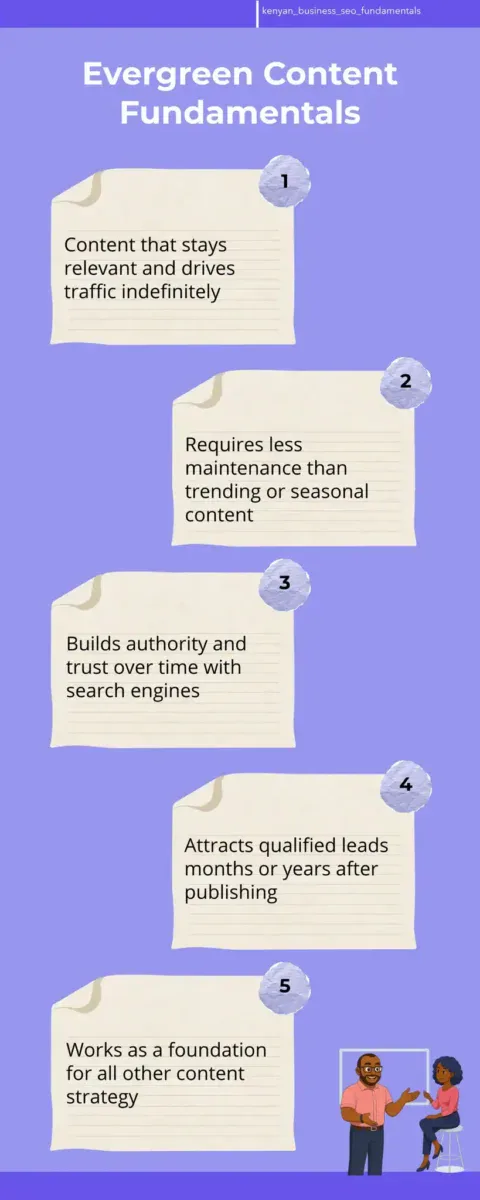
Real evergreen content has specific markers that separate it from everything else you publish. First, it answers a question that doesn’t change with time.
Second, it doesn’t reference specific dates, prices, or events that will become outdated. If your article says “in 2024,” it’s already aging.
Third, it solves a real problem that your target customer faces repeatedly. A Nairobi salon owner needs to know how to manage staff scheduling.
That problem exists forever.
Fourth, it can be updated with fresh examples or new sections without losing its core value. You can add new case studies without rewriting the entire piece.
Why Does Evergreen Content Matter for Kenyan Businesses? 📚
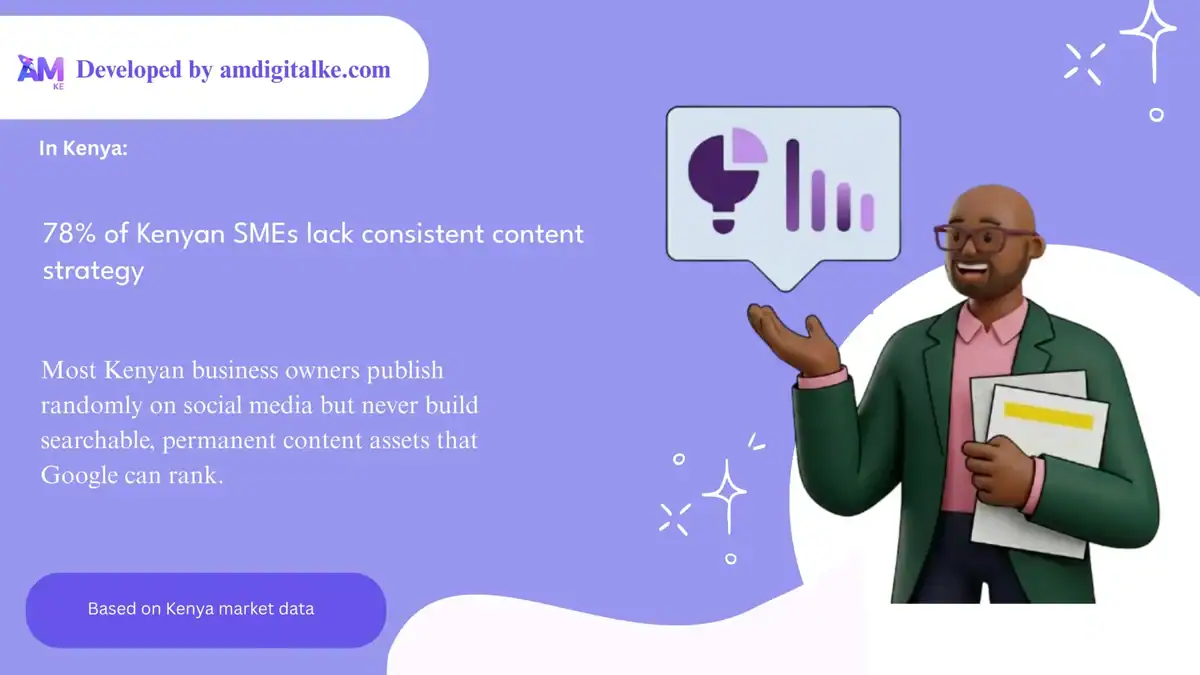
Most Kenyan business owners chase trends because trends feel exciting and urgent. But trends are also expensive and exhausting.
Evergreen content is the opposite: it’s boring to create but incredibly profitable once it’s working. It’s the difference between running a treadmill and building a house.
Consistent Organic Traffic Without Paid Ads
When you publish evergreen content on your website, Google indexes it and keeps showing it to people searching for answers to your core business questions. This traffic is completely free.
A Kenyan accountant who publishes a detailed guide on “How to Claim Tax Deductions for Small Businesses in Kenya” will get steady traffic from business owners searching that exact phrase every single month, year after year.
That traffic costs nothing. No Facebook ads. No Google ads.
Just organic search results.
Content marketing through evergreen pieces means most Kenyan businesses can spend significantly less on paid ads once they understand how to build sustainable content assets.
Building Authority and Trust Over Time
Google’s algorithm rewards websites that consistently provide helpful, accurate information. Evergreen content is how you prove you’re trustworthy.
When you have 50 pieces of high-quality evergreen content on your website, Google sees you as an authority in your industry. That authority translates into better rankings for everything you publish.
A Nairobi digital marketing agency with 40 detailed guides on SEO in Kenya, content marketing, and social media will rank higher than an agency with 200 random blog posts published over the same period.
Quality and consistency beat quantity and chaos every single time.
Lead Generation That Works While You Sleep
Evergreen content attracts leads automatically, 24 hours a day, whether you’re working or sleeping. Someone in Mombasa might find your article at 2 AM and become a customer.
Unlike paid ads that stop working the moment you stop paying, evergreen content keeps generating leads indefinitely. It’s a one-time investment that pays dividends forever.
A plumbing company in Kampala published a guide on “How to Fix a Leaking Tap” three years ago. That article still gets 50 visitors a month.
Based on AM Digital KE client data across Kenyan accounts, at least two of those visitors become customers each month.
That’s 24 customers per year from a single piece of content that cost less than KES 10,000 to create.
How Evergreen Content Works 🔄
Evergreen content works by answering the core questions your customers ask before they ever contact you. Those questions don’t change.
When someone searches “How to start an online business in Kenya,” they’re looking for answers. If your website has that answer, Google shows your page in the results.
The Search Intent Foundation
Every piece of evergreen content starts with understanding what people actually search for. This is called search intent.
Search intent is the reason behind the search. When someone searches “best accounting software for small businesses Kenya,” they intend to find a tool, not a history lesson.
Evergreen content matches search intent perfectly. You find out what your customers search for, and you create content that answers exactly that question.
Nothing more, nothing less.
A Kenyan e-commerce owner might search “How to reduce cart abandonment on Shopify.” The intent is clear: they want practical steps to recover lost sales.
Evergreen content for that search would be a step-by-step guide with specific Shopify settings and email templates. Not a 5,000-word essay about the history of online shopping.
The Ranking and Traffic Cycle
Once you publish evergreen content, it enters a cycle: Google indexes it, shows it to people searching, measures engagement, and ranks it higher if people find it helpful.
Your article might rank on page 5 of Google after two weeks. After three months, it moves to page 3.
After six months, it’s on page 1.
This isn’t automatic. It depends on how good your content is, how many other websites link to it, and how many people click through from search results.
A well-optimized piece of evergreen content can take 6 to 12 months to reach peak rankings. Once it gets there, it stays there for years.
Evergreen Content Examples in Kenya 💡
The best way to understand evergreen content is to see real examples from Kenyan businesses. Here’s what actually works.
Example 1: How-To Guides for Service Businesses
A Nairobi marketing agency published “How to Create a Social Media Content Calendar for Your Business.” That guide answers a specific, unchanging problem.
Business owners need content calendars every single month. They search for how to create them every quarter.
Based on AM Digital KE client data across Kenyan accounts, that article gets 200-300 organic visitors per month, three years after publication.
The guide includes templates, examples, and step-by-step instructions. It solves the complete problem without selling aggressively.
At the bottom, there’s a soft call to action: “If you need help managing your content calendar, we offer social media content that drives website traffic in Kenya.” Simple. Effective.
Not pushy.
Example 2: Industry-Specific Problem Solving
A Mombasa real estate agent created “What to Check Before Buying a House in Kenya: The Complete Inspection Checklist.” This solves a problem people face once in their lifetime but search for before they face it.
That article ranks for multiple related searches: “house inspection checklist Kenya,” “what to look for when buying a house,” “how to inspect a property before purchase.”
It gets 100-150 visitors per month from organic search. Based on AM Digital KE client data across Kenyan accounts, roughly 8-12 of those visitors become consultation requests.
Over three years, that’s 300+ leads from a single piece of content.
The article doesn’t change because house inspection standards don’t change. It stays relevant forever.
Example 3: Educational Content That Builds Trust
A Kenyan tax consultant published “Understanding VAT in Kenya: A Guide for Small Business Owners.” VAT rules don’t change dramatically, so the content stays relevant.
That article attracts business owners who are confused about VAT, which is basically everyone starting a business. They read the article, learn something valuable, and remember the consultant when they need help.
The article doesn’t sell tax services. It educates freely.
By the time someone finishes reading, they trust the consultant enough to ask for a quote.
That’s how evergreen content builds authority: by giving value first, asking for nothing in return, and letting trust develop naturally.
| Content Type | Typical Search Volume | Time to Rank | Lead Value |
|---|---|---|---|
| How-To Guides | High (100-500/month) | 6-9 months | Very High |
| Checklists | Medium (30-200/month) | 4-6 months | High |
| Educational Guides | High (150-600/month) | 8-12 months | Very High |
| Comparison Posts | Medium (50-300/month) | 5-8 months | Very High |
| Trend Posts | Very High (500-5000/month) | 2-3 weeks | Low |
Common Mistakes to Avoid ⚠️
Most Kenyan businesses understand the concept of evergreen content but still mess up the execution. Here are the most expensive mistakes.
Mistake 1: Writing for Search Engines Instead of People
Some business owners stuff keywords into their content so aggressively that it becomes unreadable. “SEO optimization Kenya business marketing strategy online” is not a sentence.
Google’s algorithm now rewards content that reads naturally and helps real people. If your content sounds like a robot wrote it, people bounce off immediately.
Google notices.
Evergreen content should sound like you’re explaining something to a friend, not reciting a keyword list. Use conversational language.
Use short sentences. Use real examples from Kenya.
A guide on “How to Negotiate Better Prices with Suppliers” should read like advice from a successful business owner. Not a textbook written by a machine.
Mistake 2: Publishing Incomplete or Shallow Content
Many Kenyan businesses publish 500-word guides when the question actually needs 2,000 words to answer properly. Shallow content doesn’t rank because it doesn’t satisfy the search intent.
If someone searches “How to Start a Cleaning Business in Kenya,” they want to know about licensing, equipment, pricing, marketing, and staffing. A 600-word post that only mentions licensing will never rank well.
Evergreen content needs to be comprehensive. It should be the most complete answer to that question on the entire internet, at least for Kenya.
A proper guide takes 2-3 hours to research and write SEO content, not 30 minutes. Most Kenyan businesses aren’t willing to invest that time.
That’s why they never rank.
Mistake 3: Forgetting to Update and Refresh
Evergreen doesn’t mean “set it and forget it.” Your content needs periodic refreshes to stay current and maintain rankings.
A guide published in 2021 might have outdated examples, broken links, or references to old tools. Google notices when content becomes stale.
The best practice is to review your evergreen content every 6-12 months and add new examples, updated statistics, or improved formatting. This refresh signal tells Google the content is still relevant.
A Nairobi e-commerce store updated their “How to Optimize Your Shopify Store for Mobile” guide with new screenshots and current best practices. Traffic increased significantly after the update.
✅ Quick Action Checklist
- ☐ Identify five core questions your customers ask before they contact you
- ☐ Research monthly search volume for each question using free tools like Google Trends or Ubersuggest
- ☐ Create a content outline for the top three questions, aiming for 1,500+ words per piece
- ☐ Include at least one Kenya-specific example, statistic, or case study in each article
- ☐ Publish the first piece and set a calendar reminder to refresh it in 6 months
- ☐ Track organic traffic to each piece using Google Analytics to measure performance
- ☐ Build internal links between related evergreen content pieces to strengthen authority
- ☐ Create a content calendar with one new evergreen piece per month for the next year
Ready to Build Evergreen Content That Works?
Evergreen content is the foundation of sustainable SEO for Kenyan businesses. It’s not quick, but it’s permanent.
The businesses winning in search results right now are the ones who invested in evergreen content 18 months ago. Start today, and in a year, you’ll have content assets generating leads while you focus on serving existing customers.
Stop chasing trends. Start building assets.
Contact us to discuss how to launch your content strategy for national reach targeting all of Kenya.
Frequently Asked Questions
How long does it take for evergreen content to start ranking?
Most evergreen content takes 4-12 months to reach page one of Google, depending on competition and content quality. High-competition keywords take longer than niche keywords.
Your first pieces might rank faster than later ones because your domain authority grows over time.
Can I mix evergreen and trending content on my website?
Yes, absolutely. Evergreen content is your foundation, but trending content can drive short-term traffic spikes.
Use trending content to feed your email list and social media, then repurpose insights into evergreen content that lasts forever.
What’s the ideal length for evergreen content?
Between 1,500-2,500 words is ideal for most business websites. Shorter content (800 words) can work for very specific, narrow questions.
Longer content (3,000+ words) works for broad topics that need comprehensive coverage. Quality matters more than length.
How often should I update evergreen content?
Review and refresh your top-performing evergreen content every 6-12 months. Add new examples, update statistics, improve formatting, and check for broken links.
Minor refreshes keep content ranking while major updates signal freshness to Google.
Can small businesses compete with large companies in evergreen content rankings?
Yes. Small, specialized businesses often rank better than large companies because they target niche keywords with less competition and write more authentic, detailed content.
A Nairobi plumber ranking for “plumbing services Westlands” beats a national chain on that specific search.
Additional Resources
- What are Featured Snippets (for the Kenya Market) – Learn how to format your evergreen content to win position zero in Google search results and capture more organic traffic.
- What is Anchor Text – Discover how to link between your evergreen content pieces using anchor text that strengthens your site’s topical authority.
- What is SACCO SEO in Kenya – See how SACCOs use evergreen educational content to build trust and attract members through organic search.
- National SEO vs Local SEO – Which Does Your Kenyan Business Need? – Understand whether your evergreen content should target national keywords or location-specific searches for maximum ROI.
- National Link Building – Authority Across Kenyan Regions – Learn how to earn backlinks to your evergreen content from authoritative Kenyan websites to boost rankings.
- From Nairobi to Mombasa- Scaling Your SEO Nationally – Apply evergreen content principles to scale your visibility from one city to nationwide coverage across Kenya.
Take the Next Step
Evergreen content works, but it requires strategy and consistency. We help Kenyan businesses identify the right topics, create comprehensive guides, and optimize for sustainable organic traffic.
Download our free guide on building a complete content strategy for Kenyan businesses and learn exactly which content topics will drive qualified leads to your website.