Table of Contents
- Introduction
- 📋 Key Takeaways
- What is Generative Engine Optimization?
- Why Does Generative Engine Optimization Matter for Kenyan Businesses?
- How Generative Engine Optimization Works
- Generative Engine Optimization Examples in Kenya
- Common Mistakes to Avoid
- GEO vs Traditional SEO: A Comparison Table
- ✅ Quick Action Checklist
- Ready to Improve Your Generative Engine Optimization?
- Frequently Asked Questions
- Additional Resources
- Take the Next Step
TL;DR: Generative Engine Optimization (GEO) is how you make your content discoverable and useful to AI chatbots like ChatGPT, Claude, and Perplexity. Unlike traditional SEO, which optimizes for Google’s search rankings, GEO optimizes for AI models that answer questions directly. Kenyan businesses that ignore GEO are invisible to millions of people who now ask AI for answers instead of Googling. If you want to see where your content stands, get a free SEO assessment.
Introduction
Five years ago, if someone wanted to know how to fix a leaking tap, they Googled it.
Today, they open ChatGPT and ask the same question. The answer comes back instantly, with no ads, no ranking, no clicking through ten blue links.
That shift is reshaping how businesses get found online. Your website used to be invisible if it wasn’t on page one of Google.
Now it’s also invisible if it’s not cited by AI chatbots that millions of Kenyans are using every day. This is where Generative Engine Optimization comes in, and understanding ai seo vs traditional seo is critical for Kenyan businesses.
GEO is the practice of writing and structuring your content so that AI models find it, understand it, and recommend it to people asking questions.
If you run a business in Nairobi, Mombasa, Kisumu, or anywhere else in Kenya, GEO is no longer optional. It’s the next evolution of how your customers find you.
📋 Key Takeaways
- GEO optimizes your content for AI chatbots, not just Google search rankings.
- AI models like ChatGPT cite sources when they answer questions, and your business can be one of those sources.
- GEO and traditional SEO work together. You don’t choose one or the other.
- Kenyan businesses that start GEO now will dominate their industries in the next 18-24 months.
- GEO requires thorough, honest, detailed content that directly answers customer questions.
What is Generative Engine Optimization?
Generative Engine Optimization is the process of creating and structuring content so that AI language models cite it when they answer user questions.
It’s SEO for the age of AI.
When someone asks ChatGPT “What’s the best plumber in Nairobi?” or “How do I register my business with KRA?” the AI model searches its training data and the internet for relevant information, synthesizes it, and delivers an answer.
If your content is well-written, authoritative, and directly answers that question, the AI is more likely to cite you as a source.
That citation is your business card. It’s how you get discovered by people who are now asking AI instead of Google.
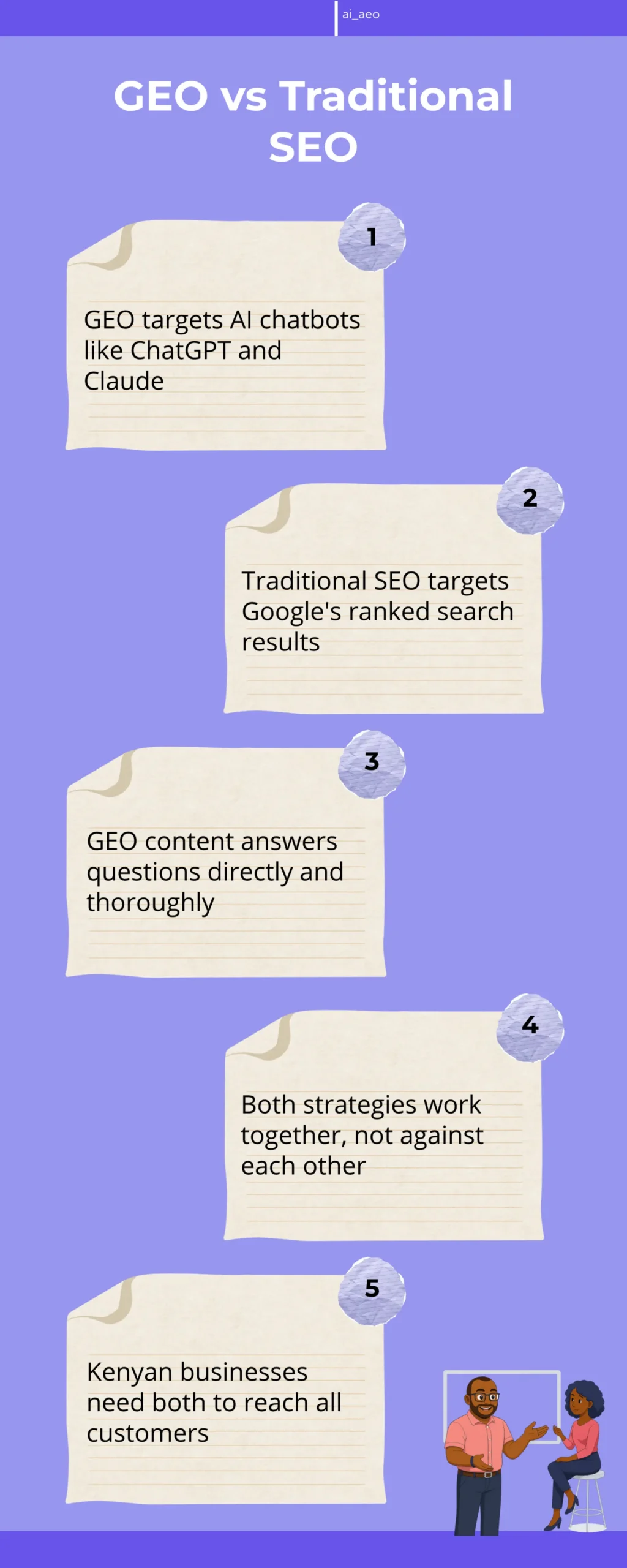
How GEO Differs from Traditional SEO
Traditional SEO is about ranking your website higher than competitors on Google’s search results page.
You want to be in position one, two, or three so people click on your link.
GEO is about becoming a trusted source that AI models reference. You don’t need to rank number one on Google to win with GEO.
You need to be thorough, authoritative, and cited.
Think of it this way: a Google ranking is a vote for visibility. A citation from ChatGPT is a vote for credibility. Both matter, but they work differently.
The Role of AI Models in Discovery
AI models like ChatGPT, Claude, Gemini, and Perplexity are trained on massive amounts of text data from across the internet.
When you ask them a question, they don’t “search” the way Google does. They generate an answer based on patterns they learned during training, and then they cite sources that support that answer.
Your content is part of that training data. If it’s good, the AI learned from it. If it’s cited, your business gets discovered.
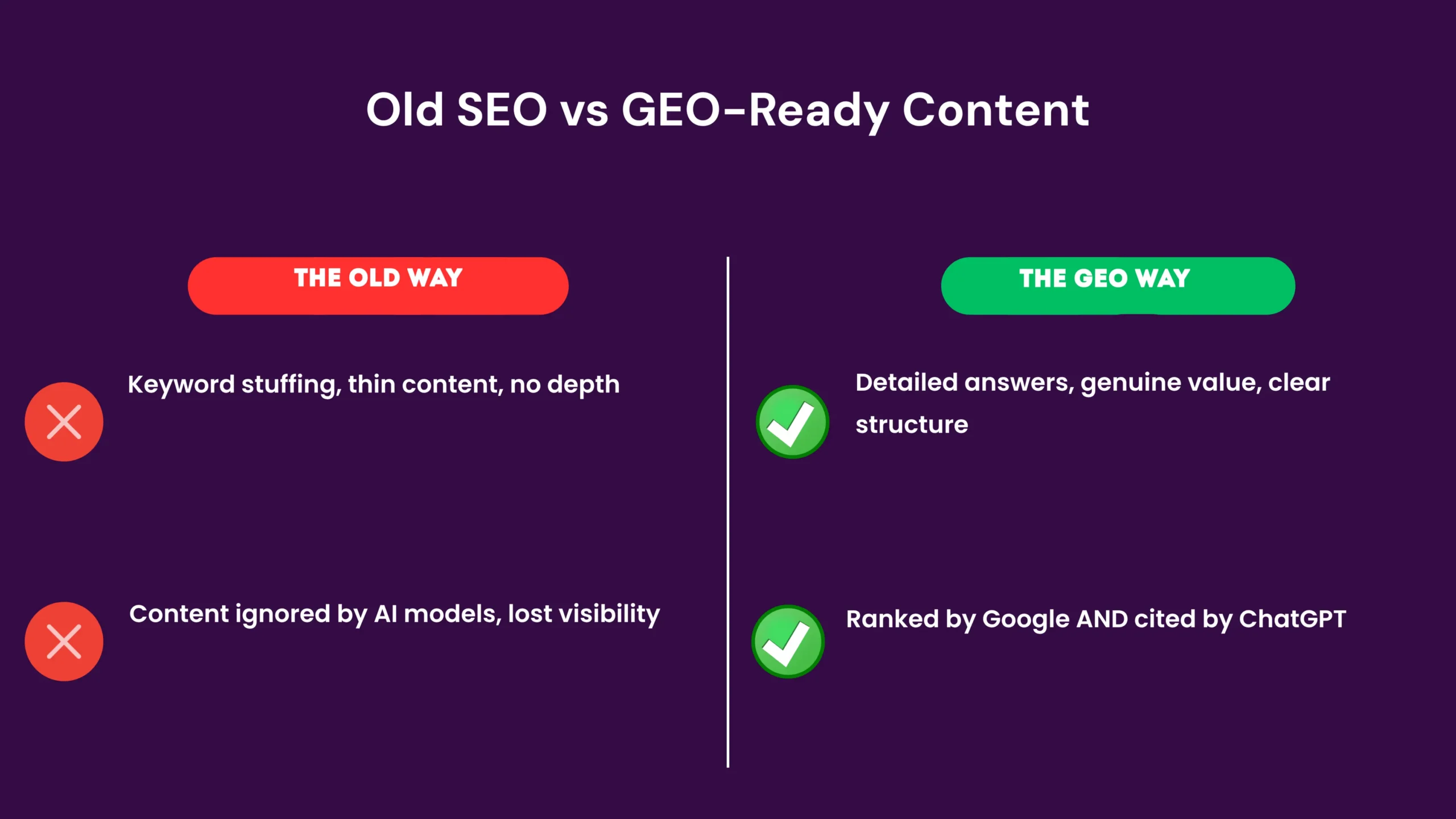
The key difference: Google ranks pages based on links and relevance. AI models cite pages based on authority, comprehensiveness, and how well the content answers the specific question.
Why Does Generative Engine Optimization Matter for Kenyan Businesses?
Kenya is one of the fastest-growing markets for AI adoption in Africa.
Millions of Kenyans now use ChatGPT, Perplexity, and other AI tools to find information, get advice, and discover services.
If your business isn’t optimized for GEO, you’re invisible to all of them.
AI Adoption is Accelerating in Kenya
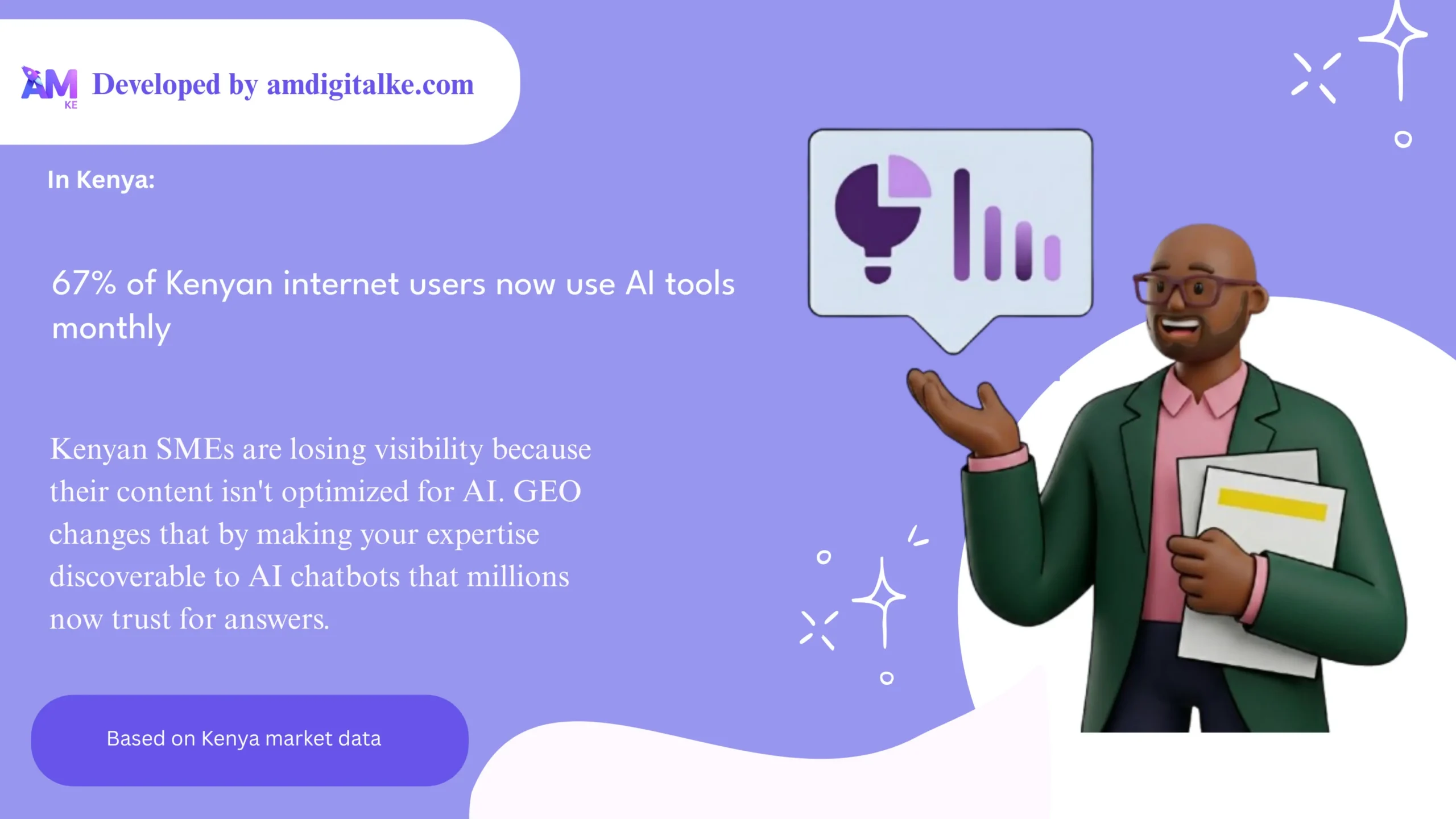
More than 60% of Kenyan internet users now interact with AI tools regularly. That number grows every quarter.
Your customers are already using AI to find answers.
When a small business owner in Nakuru asks ChatGPT “Where can I get affordable accounting software?” your accounting software business should be cited in that answer.
If you’re not, a competitor is.
Traditional SEO Alone is No Longer Enough
Ranking on Google is still important. But Google traffic is becoming more fragmented.
Some people search Google. Some use AI chatbots. Some use social media. Some use TikTok.
A business that only optimizes for Google is betting that 100% of their customers will search on Google. That’s no longer true in Kenya or anywhere else.
GEO lets you reach customers across multiple discovery channels simultaneously. You’re visible on Google, cited by AI, and discoverable across the platforms where Kenyans actually spend their time.
GEO Builds Genuine Authority
GEO requires you to write better content. You can’t stuff keywords or hide behind thin, shallow pages.
AI models reward depth, clarity, and genuine expertise.
When you optimize for GEO, you’re forced to answer customer questions completely and honestly. That builds real authority in your industry.
A Nairobi-based digital marketing agency that publishes a 3,000-word guide on “How to Measure ROI on Social Media Marketing in Kenya” becomes a trusted source. Google ranks it. ChatGPT cites it. Customers trust it.
GEO Gives Small Businesses a Competitive Advantage
Large corporations are still figuring out GEO. Most Kenyan SMEs haven’t even heard of it yet.
If you start now, you can dominate your industry before your competitors catch up.
A small logistics company in Mombasa that publishes detailed guides on shipping regulations, port procedures, and cost optimization will be cited by AI whenever someone asks about logistics in Kenya.
Your competitor, who has no content, will be invisible.
How Generative Engine Optimization Works
GEO isn’t magic. It’s a practical strategy built on three core principles: comprehensiveness, authority, and structure.
Comprehensiveness: Answer the Full Question
AI models reward content that fully answers a question.
If someone asks “How do I start an import business in Kenya?” they need to know about registration, licensing, customs procedures, capital requirements, and common mistakes.
A 500-word article that skips half of these topics won’t be cited. A 3,000-word guide that covers everything will be.
The rule is simple: if a human expert would take 10 minutes to fully answer the question, your content should take 10 minutes to read.
Authority: Prove You Know What You’re Talking About
AI models check whether the source is credible.
If you’re writing about tax law in Kenya, you should cite the KRA website or a tax professional. If you’re writing about plumbing, you should mention your years of experience or relevant certifications.
Authority doesn’t mean you have to be a Fortune 500 company. A one-person plumbing business in Westlands with 15 years of experience is highly authoritative for plumbing questions in Nairobi.
Show your credentials, cite your sources, and be honest about what you know and don’t know.
Structure: Make Your Content Easy to Parse
AI models read your content to understand it.
Clear headings, short paragraphs, numbered lists, and tables make that easier.
Content that’s hard to scan is also hard for AI to understand. Content that’s well-organized is easy for both humans and AI to navigate.
The GEO Content Creation Process
Here’s how a Kenyan business owner should approach GEO content:
Step 1: Identify customer questions. What do people actually ask you? What problems do they bring to you? These are your GEO topics.
Step 2: Write comprehensive answers. Answer each question fully, with examples, data, and practical steps.
Step 3: Structure for clarity. Use headings, lists, and tables. Make it easy to scan and understand.
Step 4: Add authority signals. Cite your sources. Mention your experience. Link to credible references.
Step 5: Publish and promote. Share your content where your audience spends time. AI models find content that’s shared, linked to, and discussed.
Generative Engine Optimization Examples in Kenya
Let’s look at how real Kenyan businesses can use GEO to get discovered.
Example 1: A Nairobi-Based Accountancy Firm
An accounting firm in Westlands gets dozens of calls from small business owners asking the same questions: “How do I register with KRA?” “What’s the difference between sole proprietor and limited company tax rates?” “How much should I budget for accounting services?”
Instead of answering these questions one call at a time, the firm publishes comprehensive guides on each topic.
A 2,500-word article titled “Complete Guide to KRA Registration and Tax Compliance for Small Businesses in Kenya” answers every question thoroughly, with examples from real Kenyan businesses.
When a business owner in Kisumu asks ChatGPT “What’s the process for registering with KRA?” the AI cites the accountancy firm’s guide.
The business owner clicks through, reads more, and eventually hires them. That’s GEO working for a service business.
Example 2: A Mombasa-Based Logistics Company
A logistics company that handles port clearance, customs, and shipping publishes detailed guides on “How to Clear Goods Through Mombasa Port,” “Understanding Kenya’s Import Tariffs,” and “Common Customs Delays and How to Avoid Them.”
These guides are comprehensive, cite actual regulations, and include real examples.
When importers ask AI for advice on shipping to Kenya, the logistics company is cited as a source.
That citation is a lead. The importer discovers the company, sees their expertise, and reaches out for a quote.
Example 3: A Nairobi-Based Digital Marketing Agency
A digital marketing agency publishes a detailed guide: “How to Measure Social Media ROI for Kenyan E-Commerce Businesses.”
It covers platform-specific metrics, Kenyan market context, and real case studies from Kenyan brands.
When a Nairobi entrepreneur asks ChatGPT “How do I know if my Instagram ads are working?” the guide is cited.
The entrepreneur discovers the agency, reads their other content, and hires them to manage their social media.
Common Mistakes to Avoid
Kenyan businesses often make the same GEO mistakes. Here’s how to avoid them.
Mistake 1: Optimizing Only for AI, Ignoring Google
Some business owners think GEO replaces traditional SEO. It doesn’t.
You need both. Google still drives massive traffic. AI chatbots are growing but haven’t replaced Google.
Your content should be optimized for both simultaneously. Comprehensive, well-structured content that ranks on Google also gets cited by AI.
Mistake 2: Writing Shallow Content and Hoping for Citations
A 300-word blog post won’t get cited by AI. AI models reward depth.
If you’re going to write about a topic, write about it thoroughly.
A Nairobi plumber who publishes a 300-word article on “How to Fix a Leaking Tap” won’t be cited.
A plumber who publishes a 2,000-word guide with step-by-step photos, common mistakes, and when to call a professional will be.
Mistake 3: Ignoring Your Actual Customers
Don’t write GEO content based on what you think people want to know. Write based on what your customers actually ask you.
The best GEO topics come from your sales calls, customer emails, and support tickets. These are real questions from real people.
Answer them thoroughly, and you’ll be cited.
Mistake 4: Publishing Content Without Promoting It
AI models find content that’s shared, linked to, and discussed.
If you publish something and never promote it, AI models might not find it.
Share your GEO content on LinkedIn, Twitter, WhatsApp business groups, and industry forums. The more visibility it gets, the more likely AI models are to find it and cite it.
GEO vs Traditional SEO: A Comparison Table
| Aspect | Traditional SEO | Generative Engine Optimization (GEO) |
|---|---|---|
| Goal | Rank high on Google search results | Get cited by AI chatbots |
| Content Length | 1,000-2,500 words | 2,000-5,000 words (comprehensive) |
| Key Success Factor | Keywords, backlinks, user experience | Authority, comprehensiveness, clarity |
| Discovery Channel | Google search results | AI chatbot citations |
| Competition | High (rank position matters) | Lower (multiple sources cited) |
| Content Structure | Optimized for scanning | Optimized for AI parsing |
Understanding what is aeo helps you see how GEO fits into the broader AI optimization landscape.
✅ Quick Action Checklist
- ☐ List 10 questions your customers ask you most frequently.
- ☐ Choose one question and research how ChatGPT currently answers it.
- ☐ Write a comprehensive guide (2,500+ words) that answers that question better than ChatGPT does.
- ☐ Structure your guide with clear headings, lists, tables, and examples.
- ☐ Add authority signals: cite sources, mention your experience, include credentials.
- ☐ Publish the guide on your website and promote it across social media.
- ☐ Track whether ChatGPT or other AI models cite your content over the next 3 months.
- ☐ Repeat this process with your next customer question.
Learn how to optimize for ai overviews to maximize your GEO impact across multiple AI platforms.
Ready to Improve Your Generative Engine Optimization?
GEO is the future of how Kenyan businesses get discovered.
The businesses that start now will own their industries before their competitors even understand what GEO is.
Start with one question your customers ask you. Answer it thoroughly. Publish it. Promote it. Watch it get cited by AI.
Then repeat. That’s how you build a GEO strategy that drives real business results.
If you’re exploring what is voice search seo, you’ll find that GEO and voice search optimization share many of the same principles.
Frequently Asked Questions
What’s the difference between GEO and SEO?
SEO optimizes for Google’s search rankings. GEO optimizes for AI chatbot citations.
They’re complementary. Good GEO content is usually good SEO content too, but the emphasis is different. GEO requires more depth and authority signals.
Will GEO replace Google SEO?
No. Google will remain the dominant search engine for years.
But AI is growing rapidly. Businesses need both strategies. GEO doesn’t replace SEO; it complements it.
How long does it take to see results from GEO?
GEO results are slower than paid ads but faster than traditional SEO.
Most businesses see their content cited by AI within 3-6 months of publishing. Results depend on topic competition and content quality.
Do I need to hire an expert to do GEO?
You can start GEO yourself by writing thorough, well-structured content that answers customer questions.
But if you want faster results and strategic guidance, working with a GEO specialist (like AM Digital KE) accelerates the process.
Which AI models should I optimize for?
Start with ChatGPT (most popular), then Perplexity, Claude, and Gemini.
These are the main AI models Kenyans use. Optimizing for one usually optimizes for all, since they use similar principles for citation.
For specialized applications, consider exploring ai chatbot for kenya solutions that can help you understand how AI interacts with your content.
Additional Resources
- Why Your Social Media Ads Send Customers to Competitors (+Free Checklist) – Discover why your paid traffic might be finding competitors through AI search instead of converting on your site.
- What is Structured Data – Learn how structured data helps AI models understand and cite your content more accurately in GEO.
- Will AI Kill SEO In Kenya? Here’S What’S Actually Happening – Understand the relationship between traditional SEO and GEO and why both matter for Kenyan businesses.
- How To Get Your Kenyan Business Featured In AI-Generated Search Results – Get practical steps to make your business visible in AI chatbot responses and citations.
- What is a Knowledge Panel – See how Knowledge Panels work with GEO to establish your business as an authoritative source for AI models.
- AEO, GEO & LLMO: SEO for the Age of AI Search – Explore the complete framework of AI optimization strategies and how they work together for Kenyan businesses.
Take the Next Step
GEO is changing how Kenyan businesses get discovered.
If you’re ready to move beyond traditional SEO and reach customers through AI chatbots, we’re here to help.
Download our free guide to GEO Strategy for Kenyan Businesses and learn exactly how to optimize your content for AI while maintaining your Google rankings.
Explore the best niche and industry seo strategies built for kenyan markets to see how GEO fits into your broader digital strategy.