Table of Contents
TL;DR: On-Page SEO is optimizing your website to rank higher in search results and attract more Kenyan customers online.
Last Updated: March 2026
Key Takeaways
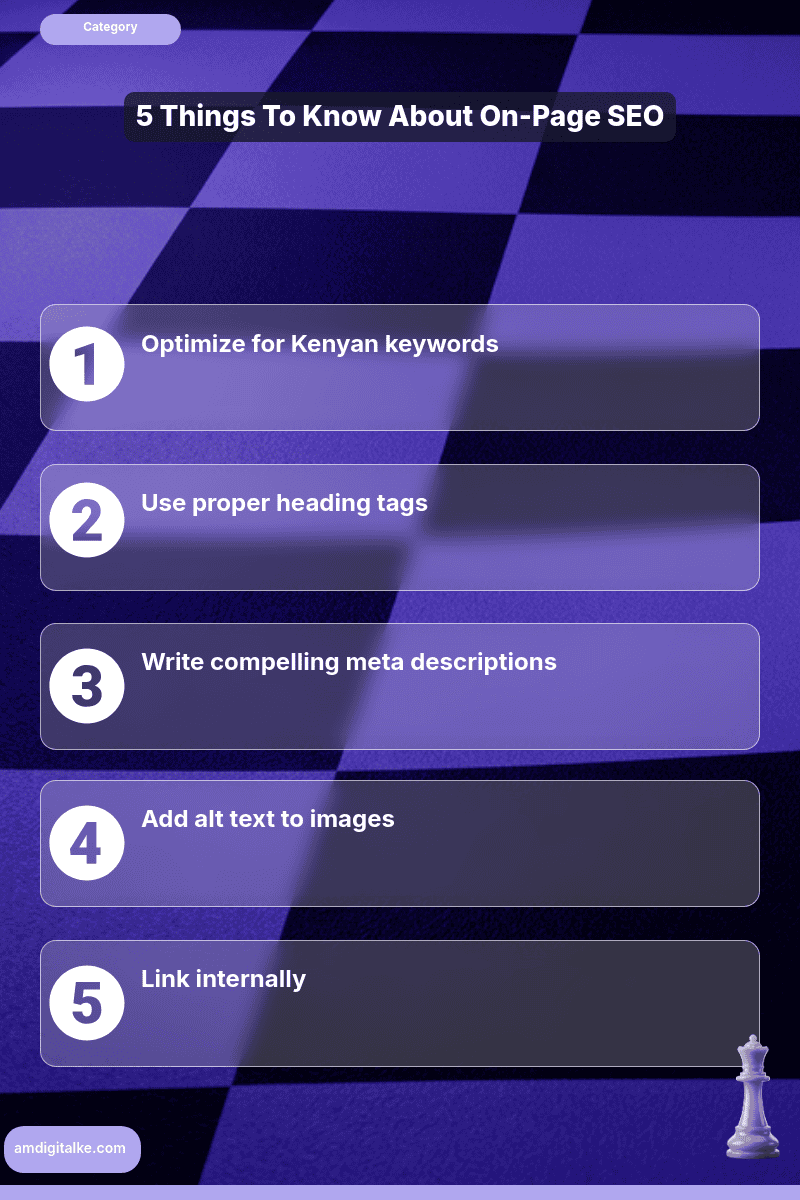
- Optimize titles for search rankings
- Use Kenyan keywords in content
- Improve page loading speed
- Add alt text to images
- Structure content for easy reading
I’ve spent years navigating the ever-evolving world of digital marketing here in Kenya.
One thing has become crystal clear: for any business, big or small, to truly shine online, understanding On-Page SEO isn’t just an advantage.
It’s a necessity.
Early in my career as an SEO expert, I quickly realized that simply having a website wasn’t enough.
It needed to be optimized and fine-tuned to speak to both potential customers and the search engines that connect them.
This realization led me down a path of deep dives into SEO algorithms, countless hours of testing, and a relentless pursuit of what truly works for the Kenyan market.
Many Kenyan businesses, especially those just starting out, often struggle to establish their online presence.
They might have a fantastic product or a service that could genuinely transform lives.
But if Google can’t easily find and understand what they offer, then all that potential remains untapped.
It’s like having the best ‘matatu tout’ in town, but he’s whispering in a crowded market.
Nobody hears him!
Through extensive research and hands-on application, I’ve developed a clear, actionable approach to On-Page SEO that cuts through the noise.
This isn’t about complex jargon or theoretical concepts.
It’s about practical steps that deliver real results.
In this article, I’ll walk you through the essentials of On-Page SEO.
I’ll show you how to make your website not just visible, but truly compelling to both search engines and your target audience right here in Kenya.
Usijali, by the end of this, you’ll have a solid foundation to elevate your online game.
Key Points Summary:
- Understand what On-Page SEO is and why it’s crucial for your online visibility.
- Learn the key elements of an optimized webpage, from titles to images.
- Discover practical, actionable techniques to improve your website’s search engine ranking.
- Gain insights into making your content resonate with both search engines and Kenyan audiences.
- Find out how to structure your content for maximum readability and impact.
What is On-Page SEO?
On-Page SEO, often called On-Site SEO, is all about optimizing the elements directly on your website.
This helps it rank higher and attract more relevant traffic from search engines.
Alvin Munene (founder AM Digital KE)“Think of it as giving your website a proper internal makeover so that Google and other search engines can easily understand what your pages are about. It differs from Off-Page SEO, which focuses on external signals, such as backlinks from other websites.”
While both are vital for a strong online presence, On-Page SEO is what you have direct control over, right there on your own site.
This On-page optimization includes things such as:
The words you use in your content
- The titles of your pages (Meta titles)
- The description that displays in Google search results with the title (Meta description)
- How you link different pages within your site (Interlinking)
- Structure of your website addresses (URLs)
- And More
Check out definitions for on-page SEO terms here.
By carefully fine-tuning these elements, you’re essentially telling search engines, “Hey, this page is super relevant to what people are searching for!”
It’s about making your content not just readable for humans, but also easily digestible for the algorithms that decide where your site appears in search results.
Why is On-Page SEO Important?
So, why should you bother with all this On-Page SEO stuff?
Simply put, it’s the foundation of your online visibility.
Search engines like Google use sophisticated algorithms to crawl and understand billions of web pages.
Communicate with Google Bots Better
On-Page SEO helps these algorithms correctly interpret your content.
This ensures that when someone searches for a product or service you offer, your website has a fighting chance of showing up in the results.
Improve User Experience
Beyond just rankings, On-Page SEO significantly enhances the user experience.
When your pages are well-structured, easy to read, and relevant to a user’s search query, visitors are more likely to stay longer, engage with your content, and ultimately convert into customers.
Offer Value to your Visitors
It’s about creating a seamless and valuable experience for anyone who lands on your site.
This in turn signals to search engines that your website is a high-quality resource.
In the competitive Kenyan digital space, a well-optimized page can be the difference between being found and being lost in the digital crowd.
Here is a step by step guide to implement on-page SEO for your site.
Key On-Page SEO Techniques
1. Optimizing Title Tags and Meta Descriptions
Your title tag is often the first thing a potential customer sees in search results.
It acts like a digital shop sign.
It’s crucial to make it click-worthy and informative.
I always advise placing your main keyword near the beginning of the title.
This immediately tells both search engines and users what your page is about.
Keep it concise, ideally under 60 characters, to ensure it displays fully on search engine results pages (SERPs).
Each page on your site should have a unique title to avoid confusion and improve clarity.
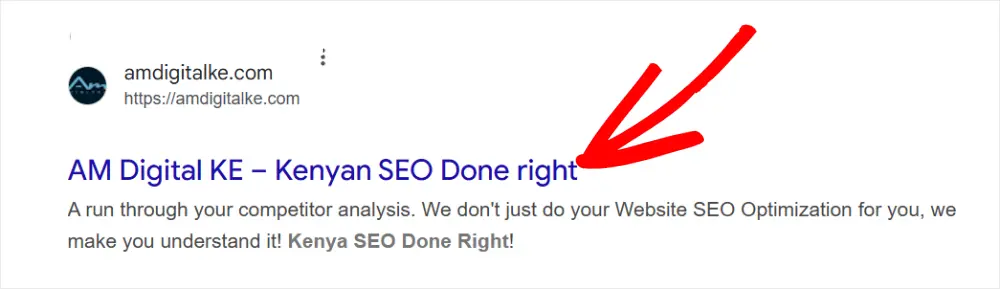
See how to create the perfect header or title tags here.
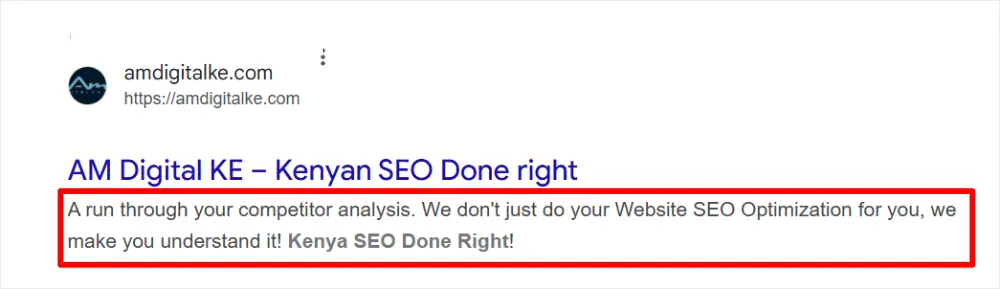
Similarly, meta descriptions, although not a direct ranking factor, are crucial for attracting clicks.
Think of them as a mini-advertisement for your page.
They should be compelling, summarize your content accurately, and ideally include your target keyword, which Google often bolds.
A good meta description encourages users to choose your link over others, boosting your click-through rate.
Remember, a well-crafted title and description can significantly impact how many people visit your site.
2. Crafting High-Quality Content
Content is king, especially in SEO.
But it’s not just about writing.
It’s about creating unique, valuable, and engaging content that truly serves your audience.
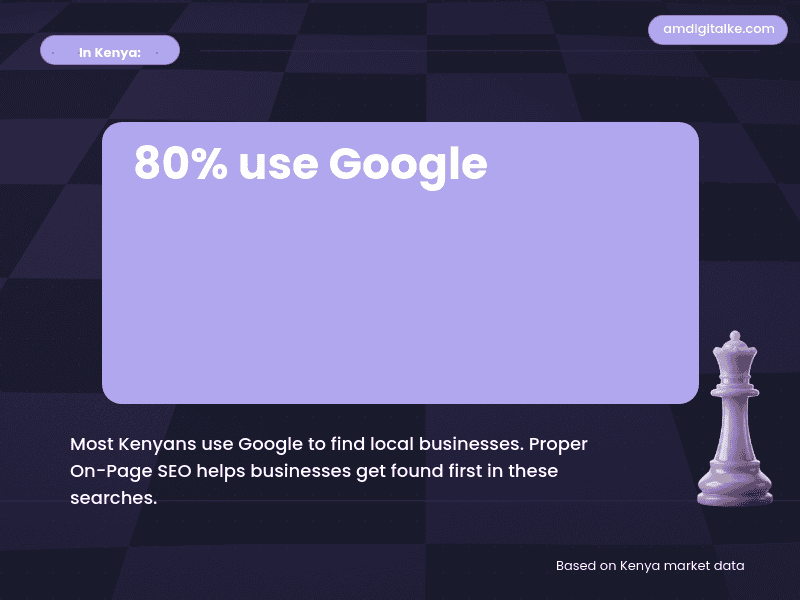
For the Kenyan market, this means content that resonates locally, addresses specific pain points, and offers actionable solutions.
Avoid simply rehashing what’s already out there.
Strive to provide fresh insights, new perspectives, or a more comprehensive guide.
Your content should be in-depth, user-friendly, and establish you as an authoritative and trustworthy source of information.
Optimizing for search intent is paramount here.
Understand what your audience is truly looking for when they type a query into Google.
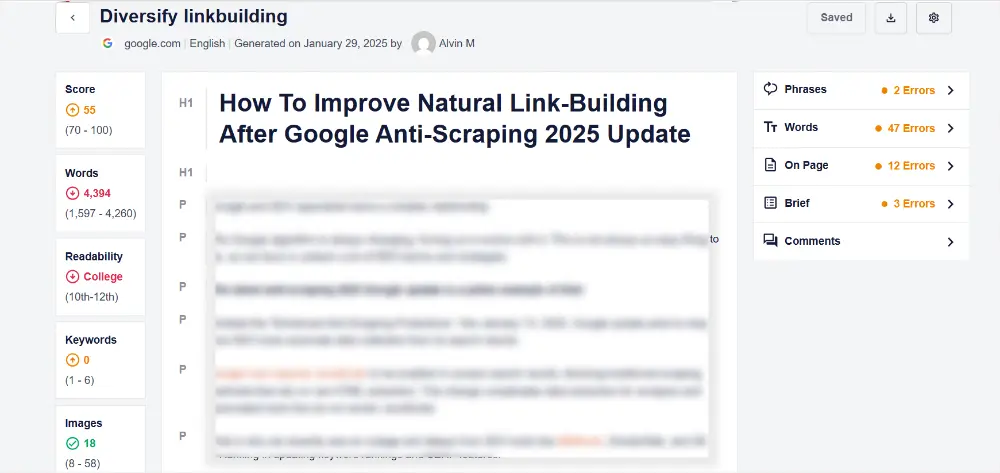
Are they seeking information, looking to buy something, or trying to navigate to a specific site?
Your content should directly answer their questions and fulfill their needs.
This approach not only pleases your readers but also signals to search engines that your page is highly relevant and valuable, increasing its chances of ranking well.
3. Strategic Keyword Placement
While keyword stuffing is a thing of the past, strategic keyword placement remains vital.
Your target keywords should appear naturally in key areas of your page.
This includes your main heading (H1), the first paragraph of your content, and within your subheadings (H2, H3, etc.).
This helps search engines quickly grasp the main topic of your page and confirms its relevance to specific search queries.
You can use tools like Ahrefs and SEMRush to find great keywords for your industry.
Check out their search volume to confirm that people are actually searching for the term.
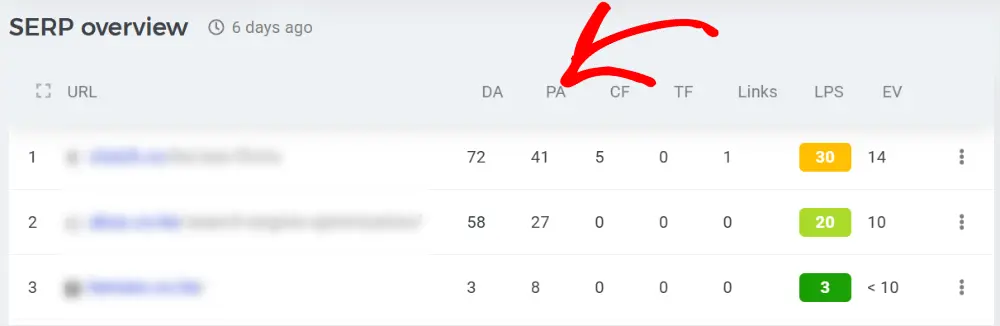
Most importantly, you can check how difficult it is to rank the keyword.
Most search optimization tools use DA Domain Authority and PA Page Authority to tell you how difficult it is to rank a keyword, depending on the site’s ranking for it.
Now, if you want to learn how to improve your Google reach for your Kenyan business yourself, here is a guide on the best free SEO tools to get you started.
The goal is to integrate keywords seamlessly, making them feel like a natural part of the conversation rather than forced insertions.
4. Structuring Content with Headings
Headings are not just for aesthetics.
They are crucial for both readability and SEO.
They break up your content into digestible chunks, making it easier for readers to skim and understand the flow of information.
For search engines, headings provide a hierarchical structure, helping them understand the main topics and subtopics on your page.
Use an H1 for your main title, H2s for major sections, and H3s (and deeper) for subsections.
This clear structure improves user experience and gives Google valuable context about your content.
All you have to do is check this article and see how I have structured my H tags.
See how I follow a logical flow and how they direct you throughout the article.
5. Optimizing URLs
Your website’s URLs should be simple, descriptive, and easy to understand.
Avoid cryptic strings of numbers or irrelevant characters.
Instead, use words that accurately reflect the content of the page, ideally including your target keyword.
A clean, keyword-rich URL not only provides more context to search engines but also makes it easier for users to remember and share your links.
For example, yourwebsite.com/what-is-on-page-seo is far better than yourwebsite.com/page?id=12345.
6. Internal Linking
Internal links are hyperlinks that connect one page on your website to another page on the same website.
They are incredibly important for several reasons.
- Firstly, they help search engines understand the structure of your site and discover new pages.
- Secondly, they pass authority (link juice) between your pages, boosting the SEO of linked content.
- Thirdly, and perhaps most importantly, they guide users through your website, encouraging them to explore more of your content and stay longer.
Think of it as creating a clear path for your visitors to follow, leading them to more valuable information.
7. External Linking
While internal links keep users on your site, external links (links to other reputable websites) also play a role in On-Page SEO.
When you link to authoritative and relevant external sources, you’re essentially providing additional value and credibility to your content.
This signals to search engines that your content is well-researched and trustworthy.
It’s like saying, “Don’t just take my word for it; here’s more proof from a reliable expert in the field.”
Just ensure the external sites you link to are high-quality and relevant to your topic.
But it is important to remember that you should avoid adding external links to a competitor, especially one targeting the same keyword.
For example, if your post is about the best phones in Nairobi, you should not link to another post that’s also optimized for best phones in Nairobi.
Doing so can signal to Google that the competing post is more authoritative, potentially weakening your own ranking.
Instead, link to something relevant but not directly competing.
Something like a post on how to choose the right smartphone features or a guide to Nairobi’s best electronics stores.
This keeps your content helpful without boosting a rival page for your target keyword with a backlink.
8. Image Optimization
Images make your content more engaging and easier to understand, but they also offer another opportunity for On-Page SEO.
Ensure your images are optimized for the web by compressing them to reduce file size without sacrificing quality.
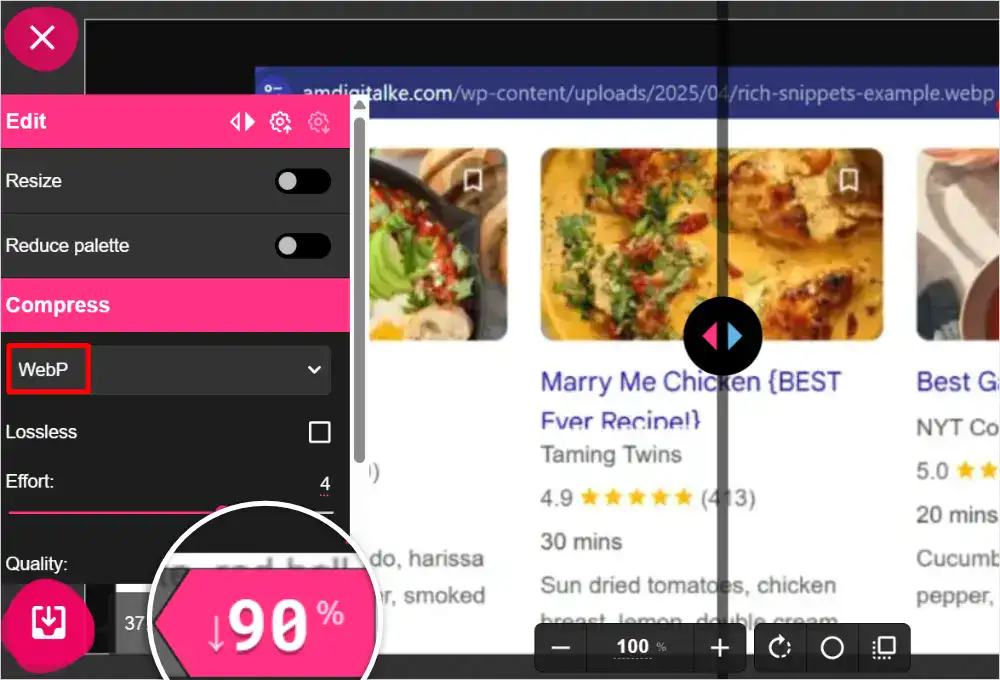
You can use a Cache plugin or manually use a tool like Squoosh App if you are not using WordPress.
Use descriptive file names and, most importantly, fill out the alt text (alternative text) field.
Alt text describes the image for visually impaired users and for search engines, helping them understand the image’s content.
Include relevant keywords in your alt text where appropriate.
To see what I mean, hover over any image on the AM Digital KE website, and you should see the alt text I have used.
You can also right-click on any image and open it in a new tab to see how I structure my image URL.
Using optimized formats like WebP, along with descriptive filenames and alt text, ensures your images work for your SEO, not against it.
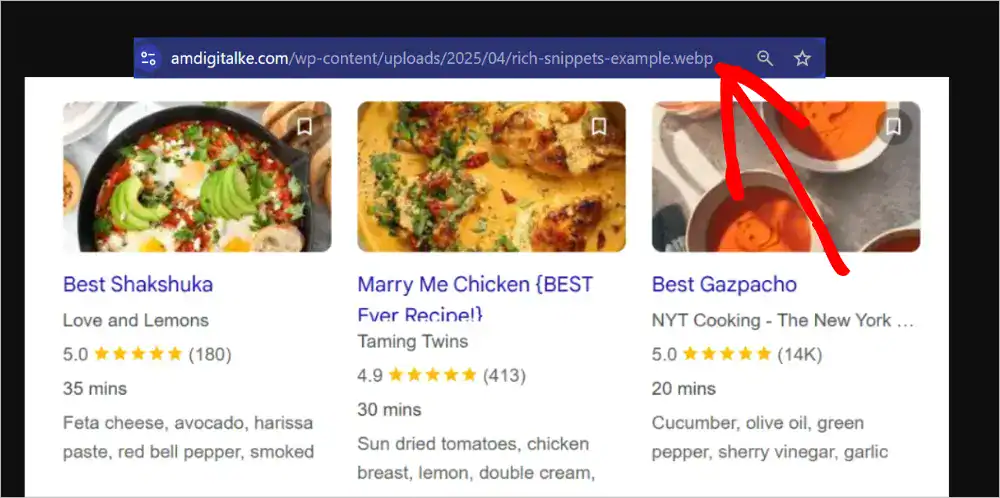
You’ll also notice that my image URLs end with “.webp”. This means I used the Squoosh App to compress and convert the images to the WebP format.
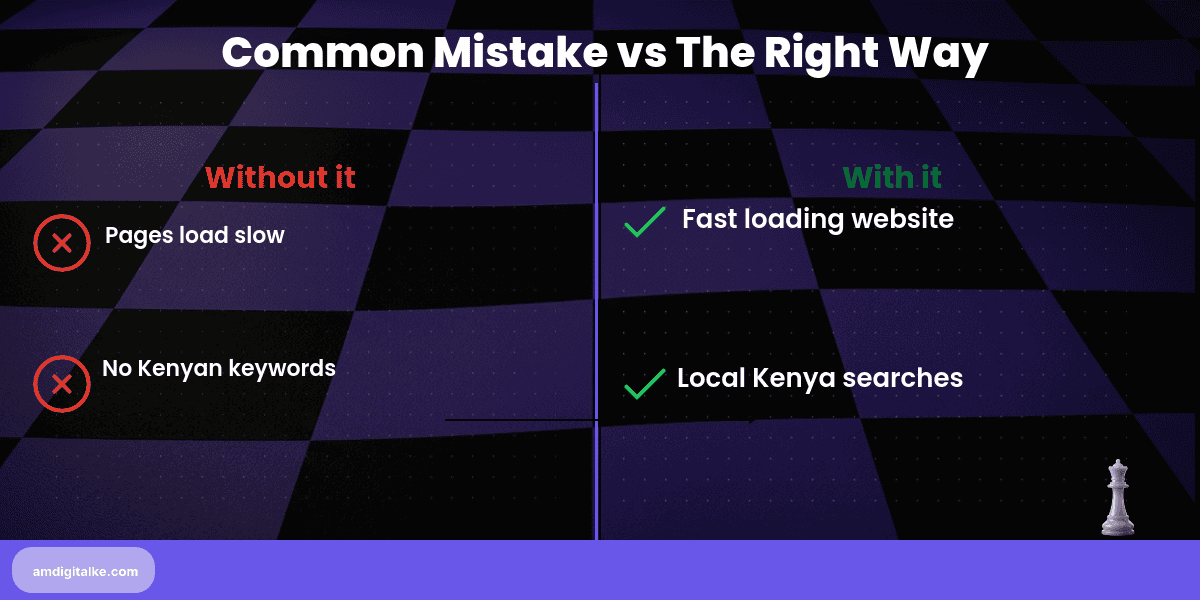
WebP offers excellent compression with minimal loss in quality, which helps improve page load speed.
Page speed is a key factor in both SEO and user experience.
For example, when I compressed the image above, it reduced its size by 90%, ensuring the page loads faster and improving user experience.
Now, if you want to learn how to do SEO yourself, check out this article on Getting Started with SEO in Kenya for Free: Your First Steps to get started.
That is it for me.
If anything is unclear about on-page SEO, check out the commonly asked questions below.
Your On-Page SEO Action Checklist
Here’s your immediate on-page SEO checklist:
- ✅ Audit your current page titles – Do they include your main keyword and location?
- ✅ Check your page loading speed – Test on mobile using Google PageSpeed Insights
- ✅ Review your main service pages – Are they targeting specific local keywords?
- ✅ Optimize your images – Rename files descriptively and add alt text
- ✅ Analyze your top 3 competitors – What keywords are they targeting that you’re missing?
- ✅ Update your meta descriptions – Write compelling 150-character summaries that include your location
Need the complete process?
Here is my SEO Checklist for Businesses in Nairobi.
It will help you implement on-page, off-page SEO and technical SEO.
Have more SEO questions? Our SEO FAQs Kenya page answers the most common ones.
Frequently Asked Questions
Why is On-Page SEO important?
On-Page SEO helps Kenyan businesses get found online by optimizing websites for both search engines and local customers.
What makes On-Page SEO different?
Unlike other SEO methods, On-Page SEO focuses on optimizing content and elements directly on your website.
Does On-Page SEO work in Kenya?
Yes, On-Page SEO works in Kenya by helping businesses rank higher in local searches and attract Kenyan customers.
How long does On-Page SEO take?
Based on AM Digital KE client data across Kenyan accounts, results can start showing in weeks.
But achieving top rankings may take 3-6 months of consistent effort.
Can small businesses do On-Page SEO?
Yes, even small Kenyan businesses can implement On-Page SEO tactics to improve their online visibility and attract customers.