
Table of Contents
- Common Mistakes to Avoid ⚠️
- ✅ Quick Action Checklist
- Ready to Improve Your ecommerce seo kenya?
- Frequently Asked Questions
- Additional Resources
- Take the Next Step
- eCommerce SEO Examples in Kenya 🇰🇪
- Common Mistakes to Avoid ⚠️
- ✅ Quick Action Checklist
- Ready to Improve Your ecommerce seo kenya?
- Frequently Asked Questions
- Additional Resources
- Take the Next Step
- eCommerce SEO Examples in Kenya 🇰🇪
- Common Mistakes to Avoid ⚠️
- ✅ Quick Action Checklist
- Ready to Improve Your ecommerce seo kenya?
- Frequently Asked Questions
- Additional Resources
- Take the Next Step
- eCommerce SEO Examples in Kenya 🇰🇪
- Common Mistakes to Avoid ⚠️
- ✅ Quick Action Checklist
- Ready to Improve Your ecommerce seo kenya?
- Frequently Asked Questions
- Additional Resources
- Take the Next Step
- eCommerce SEO Examples in Kenya 🇰🇪
- Common Mistakes to Avoid ⚠️
- ✅ Quick Action Checklist
- Ready to Improve Your ecommerce seo kenya?
- Frequently Asked Questions
- Additional Resources
- Take the Next Step
- eCommerce SEO Examples in Kenya 🇰🇪
- Common Mistakes to Avoid ⚠️
- ✅ Quick Action Checklist
- Ready to Improve Your ecommerce seo kenya?
- Frequently Asked Questions
- Additional Resources
- Take the Next Step
- eCommerce SEO Examples in Kenya 🇰🇪
- Common Mistakes to Avoid ⚠️
- ✅ Quick Action Checklist
- Ready to Improve Your ecommerce seo kenya?
- Frequently Asked Questions
- Additional Resources
- Take the Next Step
- eCommerce SEO Examples in Kenya 🇰🇪
- Common Mistakes to Avoid ⚠️
- ✅ Quick Action Checklist
- Ready to Improve Your ecommerce seo kenya?
- Frequently Asked Questions
- Additional Resources
- Take the Next Step
- What is eCommerce SEO in Kenya?
- Why Does eCommerce SEO Matter for Kenyan Businesses?
- How eCommerce SEO Works 🔍
- eCommerce SEO Examples in Kenya 🇰🇪
- Common Mistakes to Avoid ⚠️
- ✅ Quick Action Checklist
- Ready to Improve Your ecommerce seo kenya?
- Frequently Asked Questions
- Additional Resources
- Take the Next Step
- eCommerce SEO Examples in Kenya 🇰🇪
- Common Mistakes to Avoid ⚠️
- ✅ Quick Action Checklist
- Ready to Improve Your ecommerce seo kenya?
- Frequently Asked Questions
- Additional Resources
- Take the Next Step
- What is eCommerce SEO in Kenya?
- Why Does eCommerce SEO Matter for Kenyan Businesses?
- How eCommerce SEO Works 🔍
- eCommerce SEO Examples in Kenya 🇰🇪
- Common Mistakes to Avoid ⚠️
- ✅ Quick Action Checklist
- Ready to Improve Your ecommerce seo kenya?
- Frequently Asked Questions
- Additional Resources
- Take the Next Step
- eCommerce SEO Examples in Kenya 🇰🇪
- Common Mistakes to Avoid ⚠️
- ✅ Quick Action Checklist
- Ready to Improve Your ecommerce seo kenya?
- Frequently Asked Questions
- Additional Resources
- Take the Next Step
- What is eCommerce SEO in Kenya?
- Why Does eCommerce SEO Matter for Kenyan Businesses?
- How eCommerce SEO Works 🔍
- eCommerce SEO Examples in Kenya 🇰🇪
- Common Mistakes to Avoid ⚠️
- ✅ Quick Action Checklist
- Ready to Improve Your ecommerce seo kenya?
- Frequently Asked Questions
- Additional Resources
- Take the Next Step
- eCommerce SEO Examples in Kenya 🇰🇪
- Common Mistakes to Avoid ⚠️
- ✅ Quick Action Checklist
- Ready to Improve Your ecommerce seo kenya?
- Frequently Asked Questions
- Additional Resources
- Take the Next Step
- What is eCommerce SEO in Kenya?
- Why Does eCommerce SEO Matter for Kenyan Businesses?
- How eCommerce SEO Works 🔍
- eCommerce SEO Examples in Kenya 🇰🇪
- Common Mistakes to Avoid ⚠️
- ✅ Quick Action Checklist
- Ready to Improve Your ecommerce seo kenya?
- Frequently Asked Questions
- Additional Resources
- Take the Next Step
- eCommerce SEO Examples in Kenya 🇰🇪
- Common Mistakes to Avoid ⚠️
- ✅ Quick Action Checklist
- Ready to Improve Your ecommerce seo kenya?
- Frequently Asked Questions
- Additional Resources
- Take the Next Step
- What is eCommerce SEO in Kenya?
- Why Does eCommerce SEO Matter for Kenyan Businesses?
- How eCommerce SEO Works 🔍
- eCommerce SEO Examples in Kenya 🇰🇪
- Common Mistakes to Avoid ⚠️
- ✅ Quick Action Checklist
- Ready to Improve Your ecommerce seo kenya?
- Frequently Asked Questions
- Additional Resources
- Take the Next Step
- eCommerce SEO Examples in Kenya 🇰🇪
- Common Mistakes to Avoid ⚠️
- ✅ Quick Action Checklist
- Ready to Improve Your ecommerce seo kenya?
- Frequently Asked Questions
- Additional Resources
- Take the Next Step
- What is eCommerce SEO in Kenya?
- Why Does eCommerce SEO Matter for Kenyan Businesses?
- How eCommerce SEO Works 🔍
- eCommerce SEO Examples in Kenya 🇰🇪
- Common Mistakes to Avoid ⚠️
- ✅ Quick Action Checklist
- Ready to Improve Your ecommerce seo kenya?
- Frequently Asked Questions
- Additional Resources
- Take the Next Step
- eCommerce SEO Examples in Kenya 🇰🇪
- Common Mistakes to Avoid ⚠️
- ✅ Quick Action Checklist
- Ready to Improve Your ecommerce seo kenya?
- Frequently Asked Questions
- Additional Resources
- Take the Next Step
- What is eCommerce SEO in Kenya?
- Why Does eCommerce SEO Matter for Kenyan Businesses?
- How eCommerce SEO Works 🔍
- eCommerce SEO Examples in Kenya 🇰🇪
- Common Mistakes to Avoid ⚠️
- ✅ Quick Action Checklist
- Ready to Improve Your ecommerce seo kenya?
- Frequently Asked Questions
- Additional Resources
- Take the Next Step
- eCommerce SEO Examples in Kenya 🇰🇪
- Common Mistakes to Avoid ⚠️
- ✅ Quick Action Checklist
- Ready to Improve Your ecommerce seo kenya?
- Frequently Asked Questions
- Additional Resources
- Take the Next Step
- What is eCommerce SEO in Kenya?
- Why Does eCommerce SEO Matter for Kenyan Businesses?
- How eCommerce SEO Works 🔍
- eCommerce SEO Examples in Kenya 🇰🇪
- Common Mistakes to Avoid ⚠️
- ✅ Quick Action Checklist
- Ready to Improve Your ecommerce seo kenya?
- Frequently Asked Questions
- Additional Resources
- Take the Next Step
- eCommerce SEO Examples in Kenya 🇰🇪
- Common Mistakes to Avoid ⚠️
- ✅ Quick Action Checklist
- Ready to Improve Your ecommerce seo kenya?
- Frequently Asked Questions
- Additional Resources
- Take the Next Step
- eCommerce SEO Examples in Kenya 🇰🇪
- Common Mistakes to Avoid ⚠️
- ✅ Quick Action Checklist
- Ready to Improve Your ecommerce seo kenya?
- Frequently Asked Questions
- Additional Resources
- Take the Next Step
- What is eCommerce SEO in Kenya?
- Why Does eCommerce SEO Matter for Kenyan Businesses?
- How eCommerce SEO Works 🔍
- eCommerce SEO Examples in Kenya 🇰🇪
- Common Mistakes to Avoid ⚠️
- ✅ Quick Action Checklist
- Ready to Improve Your ecommerce seo kenya?
- Frequently Asked Questions
- Additional Resources
- Take the Next Step
- eCommerce SEO Examples in Kenya 🇰🇪
- Common Mistakes to Avoid ⚠️
- ✅ Quick Action Checklist
- Ready to Improve Your ecommerce seo kenya?
- Frequently Asked Questions
- Additional Resources
- Take the Next Step
- eCommerce SEO Examples in Kenya 🇰🇪
- Common Mistakes to Avoid ⚠️
- ✅ Quick Action Checklist
- Ready to Improve Your ecommerce seo kenya?
- Frequently Asked Questions
- Additional Resources
- Take the Next Step
- What is eCommerce SEO in Kenya?
- Why Does eCommerce SEO Matter for Kenyan Businesses?
- How eCommerce SEO Works 🔍
- eCommerce SEO Examples in Kenya 🇰🇪
- Common Mistakes to Avoid ⚠️
- ✅ Quick Action Checklist
- Ready to Improve Your ecommerce seo kenya?
- Frequently Asked Questions
- Additional Resources
- Take the Next Step
- eCommerce SEO Examples in Kenya 🇰🇪
- Common Mistakes to Avoid ⚠️
- ✅ Quick Action Checklist
- Ready to Improve Your ecommerce seo kenya?
- Frequently Asked Questions
- Additional Resources
- Take the Next Step
- eCommerce SEO Examples in Kenya 🇰🇪
- Common Mistakes to Avoid ⚠️
- ✅ Quick Action Checklist
- Ready to Improve Your ecommerce seo kenya?
- Frequently Asked Questions
- Additional Resources
- Take the Next Step
- What is eCommerce SEO in Kenya?
- Why Does eCommerce SEO Matter for Kenyan Businesses?
- How eCommerce SEO Works 🔍
- eCommerce SEO Examples in Kenya 🇰🇪
- Common Mistakes to Avoid ⚠️
- ✅ Quick Action Checklist
- Ready to Improve Your ecommerce seo kenya?
- Frequently Asked Questions
- Additional Resources
- Take the Next Step
- eCommerce SEO Examples in Kenya 🇰🇪
- Common Mistakes to Avoid ⚠️
- ✅ Quick Action Checklist
- Ready to Improve Your ecommerce seo kenya?
- Frequently Asked Questions
- Additional Resources
- Take the Next Step
- eCommerce SEO Examples in Kenya 🇰🇪
- Common Mistakes to Avoid ⚠️
- ✅ Quick Action Checklist
- Ready to Improve Your ecommerce seo kenya?
- Frequently Asked Questions
- Additional Resources
- Take the Next Step
- What is eCommerce SEO in Kenya?
- Why Does eCommerce SEO Matter for Kenyan Businesses?
- How eCommerce SEO Works 🔍
- eCommerce SEO Examples in Kenya 🇰🇪
- Common Mistakes to Avoid ⚠️
- ✅ Quick Action Checklist
- Ready to Improve Your ecommerce seo kenya?
- Frequently Asked Questions
- Additional Resources
- Take the Next Step
- eCommerce SEO Examples in Kenya 🇰🇪
- Common Mistakes to Avoid ⚠️
- ✅ Quick Action Checklist
- Ready to Improve Your ecommerce seo kenya?
- Frequently Asked Questions
- Additional Resources
- Take the Next Step
- eCommerce SEO Examples in Kenya 🇰🇪
- Common Mistakes to Avoid ⚠️
- ✅ Quick Action Checklist
- Ready to Improve Your ecommerce seo kenya?
- Frequently Asked Questions
- Additional Resources
- Take the Next Step
- What is eCommerce SEO in Kenya?
- Why Does eCommerce SEO Matter for Kenyan Businesses?
- How eCommerce SEO Works 🔍
- eCommerce SEO Examples in Kenya 🇰🇪
- Common Mistakes to Avoid ⚠️
- ✅ Quick Action Checklist
- Ready to Improve Your ecommerce seo kenya?
- Frequently Asked Questions
- Additional Resources
- Take the Next Step
- eCommerce SEO Examples in Kenya 🇰🇪
- Common Mistakes to Avoid ⚠️
- ✅ Quick Action Checklist
- Ready to Improve Your ecommerce seo kenya?
- Frequently Asked Questions
- Additional Resources
- Take the Next Step
- eCommerce SEO Examples in Kenya 🇰🇪
- Common Mistakes to Avoid ⚠️
- ✅ Quick Action Checklist
- Ready to Improve Your ecommerce seo kenya?
- Frequently Asked Questions
- Additional Resources
- Take the Next Step
- What is eCommerce SEO in Kenya?
- Why Does eCommerce SEO Matter for Kenyan Businesses?
- How eCommerce SEO Works 🔍
- eCommerce SEO Examples in Kenya 🇰🇪
- Common Mistakes to Avoid ⚠️
- ✅ Quick Action Checklist
- Ready to Improve Your ecommerce seo kenya?
- Frequently Asked Questions
- Additional Resources
- Take the Next Step
- eCommerce SEO Examples in Kenya 🇰🇪
- Common Mistakes to Avoid ⚠️
- ✅ Quick Action Checklist
- Ready to Improve Your ecommerce seo kenya?
- Frequently Asked Questions
- Additional Resources
- Take the Next Step
- eCommerce SEO Examples in Kenya 🇰🇪
- Common Mistakes to Avoid ⚠️
- ✅ Quick Action Checklist
- Ready to Improve Your ecommerce seo kenya?
- Frequently Asked Questions
- Additional Resources
- Take the Next Step
- eCommerce SEO Examples in Kenya 🇰🇪
- Common Mistakes to Avoid ⚠️
- ✅ Quick Action Checklist
- Ready to Improve Your ecommerce seo kenya?
- Frequently Asked Questions
- Additional Resources
- Take the Next Step
- What is eCommerce SEO in Kenya?
- Why Does eCommerce SEO Matter for Kenyan Businesses?
- How eCommerce SEO Works 🔍
- eCommerce SEO Examples in Kenya 🇰🇪
- Common Mistakes to Avoid ⚠️
- ✅ Quick Action Checklist
- Ready to Improve Your ecommerce seo kenya?
- Frequently Asked Questions
- Additional Resources
- Take the Next Step
- eCommerce SEO Examples in Kenya 🇰🇪
- Common Mistakes to Avoid ⚠️
- ✅ Quick Action Checklist
- Ready to Improve Your ecommerce seo kenya?
- Frequently Asked Questions
- Additional Resources
- Take the Next Step
- eCommerce SEO Examples in Kenya 🇰🇪
- Common Mistakes to Avoid ⚠️
- ✅ Quick Action Checklist
- Ready to Improve Your ecommerce seo kenya?
- Frequently Asked Questions
- Additional Resources
- Take the Next Step
- eCommerce SEO Examples in Kenya 🇰🇪
- Common Mistakes to Avoid ⚠️
- ✅ Quick Action Checklist
- Ready to Improve Your ecommerce seo kenya?
- Frequently Asked Questions
- Additional Resources
- Take the Next Step
- What is eCommerce SEO in Kenya?
- Why Does eCommerce SEO Matter for Kenyan Businesses?
- How eCommerce SEO Works 🔍
- eCommerce SEO Examples in Kenya 🇰🇪
- Common Mistakes to Avoid ⚠️
- ✅ Quick Action Checklist
- Ready to Improve Your ecommerce seo kenya?
- Frequently Asked Questions
- Additional Resources
- Take the Next Step
- eCommerce SEO Examples in Kenya 🇰🇪
- Common Mistakes to Avoid ⚠️
- ✅ Quick Action Checklist
- Ready to Improve Your ecommerce seo kenya?
- Frequently Asked Questions
- Additional Resources
- Take the Next Step
- eCommerce SEO Examples in Kenya 🇰🇪
- Common Mistakes to Avoid ⚠️
- ✅ Quick Action Checklist
- Ready to Improve Your ecommerce seo kenya?
- Frequently Asked Questions
- Additional Resources
- Take the Next Step
- eCommerce SEO Examples in Kenya 🇰🇪
- Common Mistakes to Avoid ⚠️
- ✅ Quick Action Checklist
- Ready to Improve Your ecommerce seo kenya?
- Frequently Asked Questions
- Additional Resources
- Take the Next Step
- What is eCommerce SEO in Kenya?
- Why Does eCommerce SEO Matter for Kenyan Businesses?
- How eCommerce SEO Works 🔍
- eCommerce SEO Examples in Kenya 🇰🇪
- Common Mistakes to Avoid ⚠️
- ✅ Quick Action Checklist
- Ready to Improve Your ecommerce seo kenya?
- Frequently Asked Questions
- Additional Resources
- Take the Next Step
- eCommerce SEO Examples in Kenya 🇰🇪
- Common Mistakes to Avoid ⚠️
- ✅ Quick Action Checklist
- Ready to Improve Your ecommerce seo kenya?
- Frequently Asked Questions
- Additional Resources
- Take the Next Step
- eCommerce SEO Examples in Kenya 🇰🇪
- Common Mistakes to Avoid ⚠️
- ✅ Quick Action Checklist
- Ready to Improve Your ecommerce seo kenya?
- Frequently Asked Questions
- Additional Resources
- Take the Next Step
- eCommerce SEO Examples in Kenya 🇰🇪
- Common Mistakes to Avoid ⚠️
- ✅ Quick Action Checklist
- Ready to Improve Your ecommerce seo kenya?
- Frequently Asked Questions
- Additional Resources
- Take the Next Step
- What is eCommerce SEO in Kenya?
- Why Does eCommerce SEO Matter for Kenyan Businesses?
- How eCommerce SEO Works 🔍
- eCommerce SEO Examples in Kenya 🇰🇪
- Common Mistakes to Avoid ⚠️
- ✅ Quick Action Checklist
- Ready to Improve Your ecommerce seo kenya?
- Frequently Asked Questions
- Additional Resources
- Take the Next Step
- eCommerce SEO Examples in Kenya 🇰🇪
- Common Mistakes to Avoid ⚠️
- ✅ Quick Action Checklist
- Ready to Improve Your ecommerce seo kenya?
- Frequently Asked Questions
- Additional Resources
- Take the Next Step
- eCommerce SEO Examples in Kenya 🇰🇪
- Common Mistakes to Avoid ⚠️
- ✅ Quick Action Checklist
- Ready to Improve Your ecommerce seo kenya?
- Frequently Asked Questions
- Additional Resources
- Take the Next Step
- eCommerce SEO Examples in Kenya 🇰🇪
- Common Mistakes to Avoid ⚠️
- ✅ Quick Action Checklist
- Ready to Improve Your ecommerce seo kenya?
- Frequently Asked Questions
- Additional Resources
- Take the Next Step
- What is eCommerce SEO in Kenya?
- Why Does eCommerce SEO Matter for Kenyan Businesses?
- How eCommerce SEO Works 🔍
- eCommerce SEO Examples in Kenya 🇰🇪
- Common Mistakes to Avoid ⚠️
- ✅ Quick Action Checklist
- Ready to Improve Your ecommerce seo kenya?
- Frequently Asked Questions
- Additional Resources
- Take the Next Step
- eCommerce SEO Examples in Kenya 🇰🇪
- Common Mistakes to Avoid ⚠️
- ✅ Quick Action Checklist
- Ready to Improve Your ecommerce seo kenya?
- Frequently Asked Questions
- Additional Resources
- Take the Next Step
- eCommerce SEO Examples in Kenya 🇰🇪
- Common Mistakes to Avoid ⚠️
- ✅ Quick Action Checklist
- Ready to Improve Your ecommerce seo kenya?
- Frequently Asked Questions
- Additional Resources
- Take the Next Step
- eCommerce SEO Examples in Kenya 🇰🇪
- Common Mistakes to Avoid ⚠️
- ✅ Quick Action Checklist
- Ready to Improve Your ecommerce seo kenya?
- Frequently Asked Questions
- Additional Resources
- Take the Next Step
- eCommerce SEO Examples in Kenya 🇰🇪
- Common Mistakes to Avoid ⚠️
- ✅ Quick Action Checklist
- Ready to Improve Your ecommerce seo kenya?
- Frequently Asked Questions
- Additional Resources
- Take the Next Step
- What is eCommerce SEO in Kenya?
- Why Does eCommerce SEO Matter for Kenyan Businesses?
- How eCommerce SEO Works 🔍
- eCommerce SEO Examples in Kenya 🇰🇪
- Common Mistakes to Avoid ⚠️
- ✅ Quick Action Checklist
- Ready to Improve Your ecommerce seo kenya?
- Frequently Asked Questions
- Additional Resources
- Take the Next Step
- eCommerce SEO Examples in Kenya 🇰🇪
- Common Mistakes to Avoid ⚠️
- ✅ Quick Action Checklist
- Ready to Improve Your ecommerce seo kenya?
- Frequently Asked Questions
- Additional Resources
- Take the Next Step
- eCommerce SEO Examples in Kenya 🇰🇪
- Common Mistakes to Avoid ⚠️
- ✅ Quick Action Checklist
- Ready to Improve Your ecommerce seo kenya?
- Frequently Asked Questions
- Additional Resources
- Take the Next Step
- eCommerce SEO Examples in Kenya 🇰🇪
- Common Mistakes to Avoid ⚠️
- ✅ Quick Action Checklist
- Ready to Improve Your ecommerce seo kenya?
- Frequently Asked Questions
- Additional Resources
- Take the Next Step
- eCommerce SEO Examples in Kenya 🇰🇪
- Common Mistakes to Avoid ⚠️
- ✅ Quick Action Checklist
- Ready to Improve Your ecommerce seo kenya?
- Frequently Asked Questions
- Additional Resources
- Take the Next Step
- What is eCommerce SEO in Kenya?
- Why Does eCommerce SEO Matter for Kenyan Businesses?
- How eCommerce SEO Works 🔍
- eCommerce SEO Examples in Kenya 🇰🇪
- Common Mistakes to Avoid ⚠️
- ✅ Quick Action Checklist
- Ready to Improve Your ecommerce seo kenya?
- Frequently Asked Questions
- Additional Resources
- Take the Next Step
- eCommerce SEO Examples in Kenya 🇰🇪
- Common Mistakes to Avoid ⚠️
- ✅ Quick Action Checklist
- Ready to Improve Your ecommerce seo kenya?
- Frequently Asked Questions
- Additional Resources
- Take the Next Step
- eCommerce SEO Examples in Kenya 🇰🇪
- Common Mistakes to Avoid ⚠️
- ✅ Quick Action Checklist
- Ready to Improve Your ecommerce seo kenya?
- Frequently Asked Questions
- Additional Resources
- Take the Next Step
- eCommerce SEO Examples in Kenya 🇰🇪
- Common Mistakes to Avoid ⚠️
- ✅ Quick Action Checklist
- Ready to Improve Your ecommerce seo kenya?
- Frequently Asked Questions
- Additional Resources
- Take the Next Step
- eCommerce SEO Examples in Kenya 🇰🇪
- Common Mistakes to Avoid ⚠️
- ✅ Quick Action Checklist
- Ready to Improve Your ecommerce seo kenya?
- Frequently Asked Questions
- Additional Resources
- Take the Next Step
- What is eCommerce SEO in Kenya?
- Why Does eCommerce SEO Matter for Kenyan Businesses?
- How eCommerce SEO Works 🔍
- eCommerce SEO Examples in Kenya 🇰🇪
- Common Mistakes to Avoid ⚠️
- ✅ Quick Action Checklist
- Ready to Improve Your ecommerce seo kenya?
- Frequently Asked Questions
- Additional Resources
- Take the Next Step
- eCommerce SEO Examples in Kenya 🇰🇪
- Common Mistakes to Avoid ⚠️
- ✅ Quick Action Checklist
- Ready to Improve Your ecommerce seo kenya?
- Frequently Asked Questions
- Additional Resources
- Take the Next Step
- eCommerce SEO Examples in Kenya 🇰🇪
- Common Mistakes to Avoid ⚠️
- ✅ Quick Action Checklist
- Ready to Improve Your ecommerce seo kenya?
- Frequently Asked Questions
- Additional Resources
- Take the Next Step
- eCommerce SEO Examples in Kenya 🇰🇪
- Common Mistakes to Avoid ⚠️
- ✅ Quick Action Checklist
- Ready to Improve Your ecommerce seo kenya?
- Frequently Asked Questions
- Additional Resources
- Take the Next Step
- eCommerce SEO Examples in Kenya 🇰🇪
- Common Mistakes to Avoid ⚠️
- ✅ Quick Action Checklist
- Ready to Improve Your ecommerce seo kenya?
- Frequently Asked Questions
- Additional Resources
- Take the Next Step
- What is eCommerce SEO in Kenya?
- Why Does eCommerce SEO Matter for Kenyan Businesses?
- How eCommerce SEO Works 🔍
- eCommerce SEO Examples in Kenya 🇰🇪
- Common Mistakes to Avoid ⚠️
- ✅ Quick Action Checklist
- Ready to Improve Your ecommerce seo kenya?
- Frequently Asked Questions
- Additional Resources
- Take the Next Step
- eCommerce SEO Examples in Kenya 🇰🇪
- Common Mistakes to Avoid ⚠️
- ✅ Quick Action Checklist
- Ready to Improve Your ecommerce seo kenya?
- Frequently Asked Questions
- Additional Resources
- Take the Next Step
- eCommerce SEO Examples in Kenya 🇰🇪
- Common Mistakes to Avoid ⚠️
- ✅ Quick Action Checklist
- Ready to Improve Your ecommerce seo kenya?
- Frequently Asked Questions
- Additional Resources
- Take the Next Step
- eCommerce SEO Examples in Kenya 🇰🇪
- Common Mistakes to Avoid ⚠️
- ✅ Quick Action Checklist
- Ready to Improve Your ecommerce seo kenya?
- Frequently Asked Questions
- Additional Resources
- Take the Next Step
- eCommerce SEO Examples in Kenya 🇰🇪
- Common Mistakes to Avoid ⚠️
- ✅ Quick Action Checklist
- Ready to Improve Your ecommerce seo kenya?
- Frequently Asked Questions
- Additional Resources
- Take the Next Step
- eCommerce SEO Examples in Kenya 🇰🇪
- Common Mistakes to Avoid ⚠️
- ✅ Quick Action Checklist
- Ready to Improve Your ecommerce seo kenya?
- Frequently Asked Questions
- Additional Resources
- Take the Next Step
- What is eCommerce SEO in Kenya?
- Why Does eCommerce SEO Matter for Kenyan Businesses?
- How eCommerce SEO Works 🔍
- eCommerce SEO Examples in Kenya 🇰🇪
- Common Mistakes to Avoid ⚠️
- ✅ Quick Action Checklist
- Ready to Improve Your ecommerce seo kenya?
- Frequently Asked Questions
- Additional Resources
- Take the Next Step
- eCommerce SEO Examples in Kenya 🇰🇪
- Common Mistakes to Avoid ⚠️
- ✅ Quick Action Checklist
- Ready to Improve Your ecommerce seo kenya?
- Frequently Asked Questions
- Additional Resources
- Take the Next Step
- eCommerce SEO Examples in Kenya 🇰🇪
- Common Mistakes to Avoid ⚠️
- ✅ Quick Action Checklist
- Ready to Improve Your ecommerce seo kenya?
- Frequently Asked Questions
- Additional Resources
- Take the Next Step
- eCommerce SEO Examples in Kenya 🇰🇪
- Common Mistakes to Avoid ⚠️
- ✅ Quick Action Checklist
- Ready to Improve Your ecommerce seo kenya?
- Frequently Asked Questions
- Additional Resources
- Take the Next Step
- eCommerce SEO Examples in Kenya 🇰🇪
- Common Mistakes to Avoid ⚠️
- ✅ Quick Action Checklist
- Ready to Improve Your ecommerce seo kenya?
- Frequently Asked Questions
- Additional Resources
- Take the Next Step
- eCommerce SEO Examples in Kenya 🇰🇪
- Common Mistakes to Avoid ⚠️
- ✅ Quick Action Checklist
- Ready to Improve Your ecommerce seo kenya?
- Frequently Asked Questions
- Additional Resources
- Take the Next Step
- What is eCommerce SEO in Kenya?
- Why Does eCommerce SEO Matter for Kenyan Businesses?
- How eCommerce SEO Works 🔍
- eCommerce SEO Examples in Kenya 🇰🇪
- Common Mistakes to Avoid ⚠️
- ✅ Quick Action Checklist
- Ready to Improve Your ecommerce seo kenya?
- Frequently Asked Questions
- Additional Resources
- Take the Next Step
- eCommerce SEO Examples in Kenya 🇰🇪
- Common Mistakes to Avoid ⚠️
- ✅ Quick Action Checklist
- Ready to Improve Your ecommerce seo kenya?
- Frequently Asked Questions
- Additional Resources
- Take the Next Step
- eCommerce SEO Examples in Kenya 🇰🇪
- Common Mistakes to Avoid ⚠️
- ✅ Quick Action Checklist
- Ready to Improve Your ecommerce seo kenya?
- Frequently Asked Questions
- Additional Resources
- Take the Next Step
- eCommerce SEO Examples in Kenya 🇰🇪
- Common Mistakes to Avoid ⚠️
- ✅ Quick Action Checklist
- Ready to Improve Your ecommerce seo kenya?
- Frequently Asked Questions
- Additional Resources
- Take the Next Step
- eCommerce SEO Examples in Kenya 🇰🇪
- Common Mistakes to Avoid ⚠️
- ✅ Quick Action Checklist
- Ready to Improve Your ecommerce seo kenya?
- Frequently Asked Questions
- Additional Resources
- Take the Next Step
- eCommerce SEO Examples in Kenya 🇰🇪
- Common Mistakes to Avoid ⚠️
- ✅ Quick Action Checklist
- Ready to Improve Your ecommerce seo kenya?
- Frequently Asked Questions
- Additional Resources
- Take the Next Step
- What is eCommerce SEO in Kenya?
- Why Does eCommerce SEO Matter for Kenyan Businesses?
- How eCommerce SEO Works 🔍
- eCommerce SEO Examples in Kenya 🇰🇪
- Common Mistakes to Avoid ⚠️
- ✅ Quick Action Checklist
- Ready to Improve Your ecommerce seo kenya?
- Frequently Asked Questions
- Additional Resources
- Take the Next Step
- eCommerce SEO Examples in Kenya 🇰🇪
- Common Mistakes to Avoid ⚠️
- ✅ Quick Action Checklist
- Ready to Improve Your ecommerce seo kenya?
- Frequently Asked Questions
- Additional Resources
- Take the Next Step
- eCommerce SEO Examples in Kenya 🇰🇪
- Common Mistakes to Avoid ⚠️
- ✅ Quick Action Checklist
- Ready to Improve Your ecommerce seo kenya?
- Frequently Asked Questions
- Additional Resources
- Take the Next Step
- eCommerce SEO Examples in Kenya 🇰🇪
- Common Mistakes to Avoid ⚠️
- ✅ Quick Action Checklist
- Ready to Improve Your ecommerce seo kenya?
- Frequently Asked Questions
- Additional Resources
- Take the Next Step
- eCommerce SEO Examples in Kenya 🇰🇪
- Common Mistakes to Avoid ⚠️
- ✅ Quick Action Checklist
- Ready to Improve Your ecommerce seo kenya?
- Frequently Asked Questions
- Additional Resources
- Take the Next Step
- eCommerce SEO Examples in Kenya 🇰🇪
- Common Mistakes to Avoid ⚠️
- ✅ Quick Action Checklist
- Ready to Improve Your ecommerce seo kenya?
- Frequently Asked Questions
- Additional Resources
- Take the Next Step
- eCommerce SEO Examples in Kenya 🇰🇪
- Common Mistakes to Avoid ⚠️
- ✅ Quick Action Checklist
- Ready to Improve Your ecommerce seo kenya?
- Frequently Asked Questions
- Additional Resources
- Take the Next Step
- What is eCommerce SEO in Kenya?
- Why Does eCommerce SEO Matter for Kenyan Businesses?
- How eCommerce SEO Works 🔍
- eCommerce SEO Examples in Kenya 🇰🇪
- Common Mistakes to Avoid ⚠️
- ✅ Quick Action Checklist
- Ready to Improve Your ecommerce seo kenya?
- Frequently Asked Questions
- Additional Resources
- Take the Next Step
- eCommerce SEO Examples in Kenya 🇰🇪
- Common Mistakes to Avoid ⚠️
- ✅ Quick Action Checklist
- Ready to Improve Your ecommerce seo kenya?
- Frequently Asked Questions
- Additional Resources
- Take the Next Step
- eCommerce SEO Examples in Kenya 🇰🇪
- Common Mistakes to Avoid ⚠️
- ✅ Quick Action Checklist
- Ready to Improve Your ecommerce seo kenya?
- Frequently Asked Questions
- Additional Resources
- Take the Next Step
- eCommerce SEO Examples in Kenya 🇰🇪
- Common Mistakes to Avoid ⚠️
- ✅ Quick Action Checklist
- Ready to Improve Your ecommerce seo kenya?
- Frequently Asked Questions
- Additional Resources
- Take the Next Step
- eCommerce SEO Examples in Kenya 🇰🇪
- Common Mistakes to Avoid ⚠️
- ✅ Quick Action Checklist
- Ready to Improve Your ecommerce seo kenya?
- Frequently Asked Questions
- Additional Resources
- Take the Next Step
- eCommerce SEO Examples in Kenya 🇰🇪
- Common Mistakes to Avoid ⚠️
- ✅ Quick Action Checklist
- Ready to Improve Your ecommerce seo kenya?
- Frequently Asked Questions
- Additional Resources
- Take the Next Step
- eCommerce SEO Examples in Kenya 🇰🇪
- Common Mistakes to Avoid ⚠️
- ✅ Quick Action Checklist
- Ready to Improve Your ecommerce seo kenya?
- Frequently Asked Questions
- Additional Resources
- Take the Next Step
- What is eCommerce SEO in Kenya?
- Why Does eCommerce SEO Matter for Kenyan Businesses?
- How eCommerce SEO Works 🔍
- eCommerce SEO Examples in Kenya 🇰🇪
- Common Mistakes to Avoid ⚠️
- ✅ Quick Action Checklist
- Ready to Improve Your ecommerce seo kenya?
- Frequently Asked Questions
- Additional Resources
- Take the Next Step
- eCommerce SEO Examples in Kenya 🇰🇪
- Common Mistakes to Avoid ⚠️
- ✅ Quick Action Checklist
- Ready to Improve Your ecommerce seo kenya?
- Frequently Asked Questions
- Additional Resources
- Take the Next Step
- eCommerce SEO Examples in Kenya 🇰🇪
- Common Mistakes to Avoid ⚠️
- ✅ Quick Action Checklist
- Ready to Improve Your ecommerce seo kenya?
- Frequently Asked Questions
- Additional Resources
- Take the Next Step
- eCommerce SEO Examples in Kenya 🇰🇪
- Common Mistakes to Avoid ⚠️
- ✅ Quick Action Checklist
- Ready to Improve Your ecommerce seo kenya?
- Frequently Asked Questions
- Additional Resources
- Take the Next Step
- eCommerce SEO Examples in Kenya 🇰🇪
- Common Mistakes to Avoid ⚠️
- ✅ Quick Action Checklist
- Ready to Improve Your ecommerce seo kenya?
- Frequently Asked Questions
- Additional Resources
- Take the Next Step
- eCommerce SEO Examples in Kenya 🇰🇪
- Common Mistakes to Avoid ⚠️
- ✅ Quick Action Checklist
- Ready to Improve Your ecommerce seo kenya?
- Frequently Asked Questions
- Additional Resources
- Take the Next Step
- eCommerce SEO Examples in Kenya 🇰🇪
- Common Mistakes to Avoid ⚠️
- ✅ Quick Action Checklist
- Ready to Improve Your ecommerce seo kenya?
- Frequently Asked Questions
- Additional Resources
- Take the Next Step
- eCommerce SEO Examples in Kenya 🇰🇪
- Common Mistakes to Avoid ⚠️
- ✅ Quick Action Checklist
- Ready to Improve Your ecommerce seo kenya?
- Frequently Asked Questions
- Additional Resources
- Take the Next Step
- What is eCommerce SEO in Kenya?
- Why Does eCommerce SEO Matter for Kenyan Businesses?
- How eCommerce SEO Works 🔍
- eCommerce SEO Examples in Kenya 🇰🇪
- Common Mistakes to Avoid ⚠️
- ✅ Quick Action Checklist
- Ready to Improve Your ecommerce seo kenya?
- Frequently Asked Questions
- Additional Resources
- Take the Next Step
They optimize each product page with the dress name, color, size, price, and high-quality photos. They also encourage customers to leave reviews on their Google Business Profile and website.
Within three months, they rank on page one for 15+ local keywords and see a 40% increase in online sales. These are customers actively looking for what they sell, not random browsers.
Example 2: A Mombasa Electronics Shop
An electronics retailer in Mombasa sells phone accessories, chargers, and cables. They create detailed product pages for “iPhone 15 charger Kenya” and “fast charging cable Mombasa,” each with exact specifications, pricing, and customer reviews.
They also build backlinks by getting mentioned in tech blogs and local Mombasa business directories. After six months, they rank for 8 high-intent keywords and receive 200+ organic visitors per week.
At a conservative 3% conversion rate, that’s 6 new customers per week from free, organic search traffic.
Example 3: A Kisumu-Based Handmade Goods Shop
A small shop selling handmade baskets and home décor items in Kisumu targets searches like “handmade baskets Kenya” and “artisan home décor Kisumu.” These are lower-volume searches, but they’re highly targeted since the people searching are specifically looking for what this shop sells.
By optimizing for these niche keywords and building a strong Google Business Profile with photos and customer reviews, they rank in the top three for all their target keywords. The same local targeting approach works for businesses drawing visitors from abroad, similar to tourism seo kenya how to attract international visitors strategies.
| Business Type | Target Keywords | Monthly Organic Visitors | Conversion Rate | Est. Monthly Revenue (KES) |
|---|---|---|---|---|
| Nairobi Fashion Boutique | Trendy dresses Westlands, affordable fashion Nairobi | 450 | 8% | 360,000 |
| Mombasa Electronics Shop | iPhone charger Kenya, fast charging cable Mombasa | 800 | 5% | 200,000 |
| Kisumu Handmade Goods | Handmade baskets Kenya, artisan home décor | 200 | 12% | 240,000 |
Common Mistakes to Avoid ⚠️
Most Kenyan eCommerce shops fail at SEO not because they don’t understand it. They make preventable mistakes.
Knowing what not to do matters just as much as knowing what to do.
Mistake 1: Ignoring Mobile Optimization
Most Kenyans shop on their phones, not on desktop computers. If your shop is slow, hard to navigate, or has images that don’t load, you lose sales.
Competitors who optimized for mobile take those sales instead.
Google now ranks sites primarily based on their mobile version. If your mobile site is poor, your desktop rankings don’t matter.
Every product page, checkout process, and image must be tested and optimized for mobile devices.
Mistake 2: Thin Product Descriptions
Many shop owners write descriptions that are too short or too generic. “Blue T-shirt, size M, KES 500” doesn’t help Google understand what you’re selling.
It doesn’t help customers make buying decisions either. This is where solid product page optimisation selling and ranking on google kenya practices make the difference.
Good product descriptions include details like material, fit, care instructions, and genuine benefits. They naturally include keywords without sounding forced.
A description like “100% cotton blue crew-neck t-shirt, perfect for casual Nairobi weather, machine washable, fits true to size” tells Google and customers much more.
Mistake 3: Not Building Local SEO
If you have a physical location in Nairobi, Mombasa, or anywhere else in Kenya, local SEO is critical. Many shop owners ignore their Google Business Profile.
Others don’t encourage customer reviews or add their location to their website.
When someone searches “phone shop near me” or “where to buy shoes in Nairobi,” Google uses local signals to decide which shops to show. A complete, verified Google Business Profile with photos, reviews, and accurate hours makes a huge difference.
Mistake 4: Competing Only on Price
Some shop owners optimize only for price-focused keywords like “cheapest laptop Kenya” or “lowest price shoes Nairobi.” This brings traffic, but it attracts bargain hunters, not loyal customers.
These visitors have low conversion rates and high return rates.
A better strategy targets keywords that include value, quality, or specific features. “Durable leather shoes Kenya” or “best budget laptop for students” attracts customers who care about more than price.
These customers are more likely to complete a purchase and stay loyal.
✅ Quick Action Checklist
- ☐ Identify 10-15 keywords your target customers actually search for (use Google Search Console and Google Trends Kenya)
- ☐ Audit your top 20 product pages for mobile speed and loading time (use Google PageSpeed Insights)
- ☐ Write or rewrite product descriptions to be 150-300 words, including relevant keywords naturally
- ☐ Set up or claim your Google Business Profile with accurate location, photos, hours, and category
- ☐ Ask your last 20 customers to leave reviews on Google and your website
- ☐ Check that your product pages include structured data (pricing, ratings, availability) that Google can read
- ☐ Identify 5-10 local websites or blogs that might link to your shop (and reach out with a genuine pitch)
- ☐ Create an internal linking strategy so related products link to each other naturally
Ready to Improve Your ecommerce seo kenya?
eCommerce SEO is not magic. It’s a methodical process of understanding what your customers search for and making sure your shop answers those searches better than competitors.
Building trust through reviews, speed, and authority matters too. Ranking well for featured snippets can also push your product pages above standard listings.
Done right, eCommerce SEO in Kenya delivers consistent, profitable sales for years.
The businesses that win online in Kenya combine good products with visibility. You can’t have one without the other.
If you’re ready to move beyond guessing and start ranking for keywords that bring real buyers, the next step is understanding your specific situation.
Contact AM Digital KE or download our free guide to see exactly where your shop stands and what your next three moves should be.
Frequently Asked Questions
How long does it take for eCommerce SEO to show results in Kenya?
Most shops see initial results within 3-6 months. Significant revenue impact usually takes 6-12 months.
Google needs time to crawl your site, understand your content, and build confidence in your shop. Patience and consistency matter more than speed.
Can I do eCommerce SEO myself, or do I need to hire an agency?
You can do it yourself if you’re willing to learn and invest time. Many Kenyan shop owners successfully optimize their own sites.
However, if your time is better spent on product sourcing, customer service, or growing your business, hiring an agency might deliver faster results.
What’s the difference between organic search and paid ads for eCommerce?
Organic search (SEO) is free long-term traffic that builds over time. Paid ads (Google Ads) give immediate visibility but cost money for every click.
The best approach combines both. Use paid ads for quick wins while SEO builds your long-term foundation.
Do I need to optimize every single product page, or just the bestsellers?
Start with your bestsellers and highest-margin products, then expand. Optimizing 50 product pages well beats poorly optimizing 500 pages.
Focus on the products that matter most to your revenue first.
How important are customer reviews for eCommerce SEO?
Very important. Reviews signal trust to Google and to customers.
Shops with 50+ reviews rank higher than shops with few or none. Reviews also increase conversion rates because customers see that others bought and were satisfied.
Additional Resources
- SACCO SEO – Digital Visibility for Kenyan Financial Cooperatives – See how a different Kenyan sector applies the same on-page and local SEO principles when the product isn’t physical goods.
- Property Listing Pages – SEO Best Practices for Kenyan Real Estate – Property listings and product pages share the same optimisation challenges, so this breaks down structuring listing pages that rank and convert.
- Parent-Focused Keywords – Understanding Education Search Intent in Kenya – If you sell to parents or families, this shows how to map keywords to a buyer group whose search intent differs from the norm.
- Nonprofit SEO – Visibility for Kenyan Organisations and Causes – Useful if your store also runs a cause-driven or CSR angle and needs visibility beyond pure sales keywords.
- Mobile-First Copywriting – Writing for Kenya’s Phone Users – Since most Kenyan shoppers browse and buy on phones, this shows how to write product copy that works on small screens.
- Medical Review Management – Handling Patient Feedback Professionally in Kenya – Product reviews affect ecommerce rankings and trust too, so this offers a framework for managing customer feedback well.
Take the Next Step
Knowing what eCommerce SEO means is one thing. Doing it right in your own shop is another.
We built a practical guide for this. It walks you through auditing your shop, finding your best opportunities, and building a plan that fits your budget and timeline.
Along the way, don’t ignore small wins like user generated content reviews and qas that boost rankings. Real customer feedback builds trust and gives Google fresh content to crawl.
If you’re comparing agencies before you commit, read our breakdown of savage digital vs am digital ke. It shows how different approaches to SEO play out for Kenyan businesses.
eCommerce SEO isn’t only for online shops selling physical goods. Even member-based organisations benefit, and our guide on seo for saccos kenya shows how the same principles apply.
Download the eCommerce SEO Audit Checklist for Kenyan Shops. Find the specific gaps in your current setup and know what to fix first.
Backlinks are links from other websites pointing to your shop. When a reputable website links to your product page, Google sees it as a vote of confidence.
This is especially powerful in eCommerce because it signals that your shop is legitimate and trustworthy.
Social proof works the same way. A product with 200 five-star reviews from real Kenyans will rank higher than an identical product with no reviews, because Google and customers both trust social proof that’s hard to fake.
eCommerce SEO Examples in Kenya 🇰🇪
Theory only takes you so far. Seeing eCommerce SEO work in real Kenyan businesses makes it concrete, so here are three examples of shops winning customers through search.
Example 1: A Nairobi-Based Fashion Boutique
A small fashion shop in Westlands, Nairobi sells trendy women’s dresses. Instead of competing nationally for “dresses Kenya,” which would be nearly impossible, they target specific local searches like “trendy dresses Westlands” and “affordable fashion Nairobi.”
They optimize each product page with the dress name, color, size, price, and high-quality photos. They also encourage customers to leave reviews on their Google Business Profile and website.
Within three months, they rank on page one for 15+ local keywords and see a 40% increase in online sales. These are customers actively looking for what they sell, not random browsers.
Example 2: A Mombasa Electronics Shop
An electronics retailer in Mombasa sells phone accessories, chargers, and cables. They create detailed product pages for “iPhone 15 charger Kenya” and “fast charging cable Mombasa,” each with exact specifications, pricing, and customer reviews.
They also build backlinks by getting mentioned in tech blogs and local Mombasa business directories. After six months, they rank for 8 high-intent keywords and receive 200+ organic visitors per week.
At a conservative 3% conversion rate, that’s 6 new customers per week from free, organic search traffic.
Example 3: A Kisumu-Based Handmade Goods Shop
A small shop selling handmade baskets and home décor items in Kisumu targets searches like “handmade baskets Kenya” and “artisan home décor Kisumu.” These are lower-volume searches, but they’re highly targeted since the people searching are specifically looking for what this shop sells.
By optimizing for these niche keywords and building a strong Google Business Profile with photos and customer reviews, they rank in the top three for all their target keywords. The same local targeting approach works for businesses drawing visitors from abroad, similar to tourism seo kenya how to attract international visitors strategies.
| Business Type | Target Keywords | Monthly Organic Visitors | Conversion Rate | Est. Monthly Revenue (KES) |
|---|---|---|---|---|
| Nairobi Fashion Boutique | Trendy dresses Westlands, affordable fashion Nairobi | 450 | 8% | 360,000 |
| Mombasa Electronics Shop | iPhone charger Kenya, fast charging cable Mombasa | 800 | 5% | 200,000 |
| Kisumu Handmade Goods | Handmade baskets Kenya, artisan home décor | 200 | 12% | 240,000 |
Common Mistakes to Avoid ⚠️
Most Kenyan eCommerce shops fail at SEO not because they don’t understand it. They make preventable mistakes.
Knowing what not to do matters just as much as knowing what to do.
Mistake 1: Ignoring Mobile Optimization
Most Kenyans shop on their phones, not on desktop computers. If your shop is slow, hard to navigate, or has images that don’t load, you lose sales.
Competitors who optimized for mobile take those sales instead.
Google now ranks sites primarily based on their mobile version. If your mobile site is poor, your desktop rankings don’t matter.
Every product page, checkout process, and image must be tested and optimized for mobile devices.
Mistake 2: Thin Product Descriptions
Many shop owners write descriptions that are too short or too generic. “Blue T-shirt, size M, KES 500” doesn’t help Google understand what you’re selling.
It doesn’t help customers make buying decisions either. This is where solid product page optimisation selling and ranking on google kenya practices make the difference.
Good product descriptions include details like material, fit, care instructions, and genuine benefits. They naturally include keywords without sounding forced.
A description like “100% cotton blue crew-neck t-shirt, perfect for casual Nairobi weather, machine washable, fits true to size” tells Google and customers much more.
Mistake 3: Not Building Local SEO
If you have a physical location in Nairobi, Mombasa, or anywhere else in Kenya, local SEO is critical. Many shop owners ignore their Google Business Profile.
Others don’t encourage customer reviews or add their location to their website.
When someone searches “phone shop near me” or “where to buy shoes in Nairobi,” Google uses local signals to decide which shops to show. A complete, verified Google Business Profile with photos, reviews, and accurate hours makes a huge difference.
Mistake 4: Competing Only on Price
Some shop owners optimize only for price-focused keywords like “cheapest laptop Kenya” or “lowest price shoes Nairobi.” This brings traffic, but it attracts bargain hunters, not loyal customers.
These visitors have low conversion rates and high return rates.
A better strategy targets keywords that include value, quality, or specific features. “Durable leather shoes Kenya” or “best budget laptop for students” attracts customers who care about more than price.
These customers are more likely to complete a purchase and stay loyal.
✅ Quick Action Checklist
- ☐ Identify 10-15 keywords your target customers actually search for (use Google Search Console and Google Trends Kenya)
- ☐ Audit your top 20 product pages for mobile speed and loading time (use Google PageSpeed Insights)
- ☐ Write or rewrite product descriptions to be 150-300 words, including relevant keywords naturally
- ☐ Set up or claim your Google Business Profile with accurate location, photos, hours, and category
- ☐ Ask your last 20 customers to leave reviews on Google and your website
- ☐ Check that your product pages include structured data (pricing, ratings, availability) that Google can read
- ☐ Identify 5-10 local websites or blogs that might link to your shop (and reach out with a genuine pitch)
- ☐ Create an internal linking strategy so related products link to each other naturally
Ready to Improve Your ecommerce seo kenya?
eCommerce SEO is not magic. It’s a methodical process of understanding what your customers search for and making sure your shop answers those searches better than competitors.
Building trust through reviews, speed, and authority matters too. Ranking well for featured snippets can also push your product pages above standard listings.
Done right, eCommerce SEO in Kenya delivers consistent, profitable sales for years.
The businesses that win online in Kenya combine good products with visibility. You can’t have one without the other.
If you’re ready to move beyond guessing and start ranking for keywords that bring real buyers, the next step is understanding your specific situation.
Contact AM Digital KE or download our free guide to see exactly where your shop stands and what your next three moves should be.
Frequently Asked Questions
How long does it take for eCommerce SEO to show results in Kenya?
Most shops see initial results within 3-6 months. Significant revenue impact usually takes 6-12 months.
Google needs time to crawl your site, understand your content, and build confidence in your shop. Patience and consistency matter more than speed.
Can I do eCommerce SEO myself, or do I need to hire an agency?
You can do it yourself if you’re willing to learn and invest time. Many Kenyan shop owners successfully optimize their own sites.
However, if your time is better spent on product sourcing, customer service, or growing your business, hiring an agency might deliver faster results.
What’s the difference between organic search and paid ads for eCommerce?
Organic search (SEO) is free long-term traffic that builds over time. Paid ads (Google Ads) give immediate visibility but cost money for every click.
The best approach combines both. Use paid ads for quick wins while SEO builds your long-term foundation.
Do I need to optimize every single product page, or just the bestsellers?
Start with your bestsellers and highest-margin products, then expand. Optimizing 50 product pages well beats poorly optimizing 500 pages.
Focus on the products that matter most to your revenue first.
How important are customer reviews for eCommerce SEO?
Very important. Reviews signal trust to Google and to customers.
Shops with 50+ reviews rank higher than shops with few or none. Reviews also increase conversion rates because customers see that others bought and were satisfied.
Additional Resources
- SACCO SEO – Digital Visibility for Kenyan Financial Cooperatives – See how a different Kenyan sector applies the same on-page and local SEO principles when the product isn’t physical goods.
- Property Listing Pages – SEO Best Practices for Kenyan Real Estate – Property listings and product pages share the same optimisation challenges, so this breaks down structuring listing pages that rank and convert.
- Parent-Focused Keywords – Understanding Education Search Intent in Kenya – If you sell to parents or families, this shows how to map keywords to a buyer group whose search intent differs from the norm.
- Nonprofit SEO – Visibility for Kenyan Organisations and Causes – Useful if your store also runs a cause-driven or CSR angle and needs visibility beyond pure sales keywords.
- Mobile-First Copywriting – Writing for Kenya’s Phone Users – Since most Kenyan shoppers browse and buy on phones, this shows how to write product copy that works on small screens.
- Medical Review Management – Handling Patient Feedback Professionally in Kenya – Product reviews affect ecommerce rankings and trust too, so this offers a framework for managing customer feedback well.
Take the Next Step
Knowing what eCommerce SEO means is one thing. Doing it right in your own shop is another.
We built a practical guide for this. It walks you through auditing your shop, finding your best opportunities, and building a plan that fits your budget and timeline.
Along the way, don’t ignore small wins like user generated content reviews and qas that boost rankings. Real customer feedback builds trust and gives Google fresh content to crawl.
If you’re comparing agencies before you commit, read our breakdown of savage digital vs am digital ke. It shows how different approaches to SEO play out for Kenyan businesses.
eCommerce SEO isn’t only for online shops selling physical goods. Even member-based organisations benefit, and our guide on seo for saccos kenya shows how the same principles apply.
Download the eCommerce SEO Audit Checklist for Kenyan Shops. Find the specific gaps in your current setup and know what to fix first.
Technical SEO also means your site is properly structured and easy for Google to crawl. It means using HTTPS for a secure connection and not blocking important content from Google’s view.
A shop that loads in 2 seconds will outrank a shop that loads in 5 seconds, all else being equal. This is one reason working with providers offering seo in kenya expertise matters for technical fixes.
Building Backlinks and Social Proof
Backlinks are links from other websites pointing to your shop. When a reputable website links to your product page, Google sees it as a vote of confidence.
This is especially powerful in eCommerce because it signals that your shop is legitimate and trustworthy.
Social proof works the same way. A product with 200 five-star reviews from real Kenyans will rank higher than an identical product with no reviews, because Google and customers both trust social proof that’s hard to fake.
eCommerce SEO Examples in Kenya 🇰🇪
Theory only takes you so far. Seeing eCommerce SEO work in real Kenyan businesses makes it concrete, so here are three examples of shops winning customers through search.
Example 1: A Nairobi-Based Fashion Boutique
A small fashion shop in Westlands, Nairobi sells trendy women’s dresses. Instead of competing nationally for “dresses Kenya,” which would be nearly impossible, they target specific local searches like “trendy dresses Westlands” and “affordable fashion Nairobi.”
They optimize each product page with the dress name, color, size, price, and high-quality photos. They also encourage customers to leave reviews on their Google Business Profile and website.
Within three months, they rank on page one for 15+ local keywords and see a 40% increase in online sales. These are customers actively looking for what they sell, not random browsers.
Example 2: A Mombasa Electronics Shop
An electronics retailer in Mombasa sells phone accessories, chargers, and cables. They create detailed product pages for “iPhone 15 charger Kenya” and “fast charging cable Mombasa,” each with exact specifications, pricing, and customer reviews.
They also build backlinks by getting mentioned in tech blogs and local Mombasa business directories. After six months, they rank for 8 high-intent keywords and receive 200+ organic visitors per week.
At a conservative 3% conversion rate, that’s 6 new customers per week from free, organic search traffic.
Example 3: A Kisumu-Based Handmade Goods Shop
A small shop selling handmade baskets and home décor items in Kisumu targets searches like “handmade baskets Kenya” and “artisan home décor Kisumu.” These are lower-volume searches, but they’re highly targeted since the people searching are specifically looking for what this shop sells.
By optimizing for these niche keywords and building a strong Google Business Profile with photos and customer reviews, they rank in the top three for all their target keywords. The same local targeting approach works for businesses drawing visitors from abroad, similar to tourism seo kenya how to attract international visitors strategies.
| Business Type | Target Keywords | Monthly Organic Visitors | Conversion Rate | Est. Monthly Revenue (KES) |
|---|---|---|---|---|
| Nairobi Fashion Boutique | Trendy dresses Westlands, affordable fashion Nairobi | 450 | 8% | 360,000 |
| Mombasa Electronics Shop | iPhone charger Kenya, fast charging cable Mombasa | 800 | 5% | 200,000 |
| Kisumu Handmade Goods | Handmade baskets Kenya, artisan home décor | 200 | 12% | 240,000 |
Common Mistakes to Avoid ⚠️
Most Kenyan eCommerce shops fail at SEO not because they don’t understand it. They make preventable mistakes.
Knowing what not to do matters just as much as knowing what to do.
Mistake 1: Ignoring Mobile Optimization
Most Kenyans shop on their phones, not on desktop computers. If your shop is slow, hard to navigate, or has images that don’t load, you lose sales.
Competitors who optimized for mobile take those sales instead.
Google now ranks sites primarily based on their mobile version. If your mobile site is poor, your desktop rankings don’t matter.
Every product page, checkout process, and image must be tested and optimized for mobile devices.
Mistake 2: Thin Product Descriptions
Many shop owners write descriptions that are too short or too generic. “Blue T-shirt, size M, KES 500” doesn’t help Google understand what you’re selling.
It doesn’t help customers make buying decisions either. This is where solid product page optimisation selling and ranking on google kenya practices make the difference.
Good product descriptions include details like material, fit, care instructions, and genuine benefits. They naturally include keywords without sounding forced.
A description like “100% cotton blue crew-neck t-shirt, perfect for casual Nairobi weather, machine washable, fits true to size” tells Google and customers much more.
Mistake 3: Not Building Local SEO
If you have a physical location in Nairobi, Mombasa, or anywhere else in Kenya, local SEO is critical. Many shop owners ignore their Google Business Profile.
Others don’t encourage customer reviews or add their location to their website.
When someone searches “phone shop near me” or “where to buy shoes in Nairobi,” Google uses local signals to decide which shops to show. A complete, verified Google Business Profile with photos, reviews, and accurate hours makes a huge difference.
Mistake 4: Competing Only on Price
Some shop owners optimize only for price-focused keywords like “cheapest laptop Kenya” or “lowest price shoes Nairobi.” This brings traffic, but it attracts bargain hunters, not loyal customers.
These visitors have low conversion rates and high return rates.
A better strategy targets keywords that include value, quality, or specific features. “Durable leather shoes Kenya” or “best budget laptop for students” attracts customers who care about more than price.
These customers are more likely to complete a purchase and stay loyal.
✅ Quick Action Checklist
- ☐ Identify 10-15 keywords your target customers actually search for (use Google Search Console and Google Trends Kenya)
- ☐ Audit your top 20 product pages for mobile speed and loading time (use Google PageSpeed Insights)
- ☐ Write or rewrite product descriptions to be 150-300 words, including relevant keywords naturally
- ☐ Set up or claim your Google Business Profile with accurate location, photos, hours, and category
- ☐ Ask your last 20 customers to leave reviews on Google and your website
- ☐ Check that your product pages include structured data (pricing, ratings, availability) that Google can read
- ☐ Identify 5-10 local websites or blogs that might link to your shop (and reach out with a genuine pitch)
- ☐ Create an internal linking strategy so related products link to each other naturally
Ready to Improve Your ecommerce seo kenya?
eCommerce SEO is not magic. It’s a methodical process of understanding what your customers search for and making sure your shop answers those searches better than competitors.
Building trust through reviews, speed, and authority matters too. Ranking well for featured snippets can also push your product pages above standard listings.
Done right, eCommerce SEO in Kenya delivers consistent, profitable sales for years.
The businesses that win online in Kenya combine good products with visibility. You can’t have one without the other.
If you’re ready to move beyond guessing and start ranking for keywords that bring real buyers, the next step is understanding your specific situation.
Contact AM Digital KE or download our free guide to see exactly where your shop stands and what your next three moves should be.
Frequently Asked Questions
How long does it take for eCommerce SEO to show results in Kenya?
Most shops see initial results within 3-6 months. Significant revenue impact usually takes 6-12 months.
Google needs time to crawl your site, understand your content, and build confidence in your shop. Patience and consistency matter more than speed.
Can I do eCommerce SEO myself, or do I need to hire an agency?
You can do it yourself if you’re willing to learn and invest time. Many Kenyan shop owners successfully optimize their own sites.
However, if your time is better spent on product sourcing, customer service, or growing your business, hiring an agency might deliver faster results.
What’s the difference between organic search and paid ads for eCommerce?
Organic search (SEO) is free long-term traffic that builds over time. Paid ads (Google Ads) give immediate visibility but cost money for every click.
The best approach combines both. Use paid ads for quick wins while SEO builds your long-term foundation.
Do I need to optimize every single product page, or just the bestsellers?
Start with your bestsellers and highest-margin products, then expand. Optimizing 50 product pages well beats poorly optimizing 500 pages.
Focus on the products that matter most to your revenue first.
How important are customer reviews for eCommerce SEO?
Very important. Reviews signal trust to Google and to customers.
Shops with 50+ reviews rank higher than shops with few or none. Reviews also increase conversion rates because customers see that others bought and were satisfied.
Additional Resources
- SACCO SEO – Digital Visibility for Kenyan Financial Cooperatives – See how a different Kenyan sector applies the same on-page and local SEO principles when the product isn’t physical goods.
- Property Listing Pages – SEO Best Practices for Kenyan Real Estate – Property listings and product pages share the same optimisation challenges, so this breaks down structuring listing pages that rank and convert.
- Parent-Focused Keywords – Understanding Education Search Intent in Kenya – If you sell to parents or families, this shows how to map keywords to a buyer group whose search intent differs from the norm.
- Nonprofit SEO – Visibility for Kenyan Organisations and Causes – Useful if your store also runs a cause-driven or CSR angle and needs visibility beyond pure sales keywords.
- Mobile-First Copywriting – Writing for Kenya’s Phone Users – Since most Kenyan shoppers browse and buy on phones, this shows how to write product copy that works on small screens.
- Medical Review Management – Handling Patient Feedback Professionally in Kenya – Product reviews affect ecommerce rankings and trust too, so this offers a framework for managing customer feedback well.
Take the Next Step
Knowing what eCommerce SEO means is one thing. Doing it right in your own shop is another.
We built a practical guide for this. It walks you through auditing your shop, finding your best opportunities, and building a plan that fits your budget and timeline.
Along the way, don’t ignore small wins like user generated content reviews and qas that boost rankings. Real customer feedback builds trust and gives Google fresh content to crawl.
If you’re comparing agencies before you commit, read our breakdown of savage digital vs am digital ke. It shows how different approaches to SEO play out for Kenyan businesses.
eCommerce SEO isn’t only for online shops selling physical goods. Even member-based organisations benefit, and our guide on seo for saccos kenya shows how the same principles apply.
Download the eCommerce SEO Audit Checklist for Kenyan Shops. Find the specific gaps in your current setup and know what to fix first.
Google has made it clear. If your shop is slow, it won’t rank well.
Kenyan internet speeds vary widely. Nairobi often has fast fiber, but other regions run on slower mobile networks, and your shop needs to load quickly on mobile because that’s how most Kenyans browse.
Technical SEO also means your site is properly structured and easy for Google to crawl. It means using HTTPS for a secure connection and not blocking important content from Google’s view.
A shop that loads in 2 seconds will outrank a shop that loads in 5 seconds, all else being equal. This is one reason working with providers offering seo in kenya expertise matters for technical fixes.
Building Backlinks and Social Proof
Backlinks are links from other websites pointing to your shop. When a reputable website links to your product page, Google sees it as a vote of confidence.
This is especially powerful in eCommerce because it signals that your shop is legitimate and trustworthy.
Social proof works the same way. A product with 200 five-star reviews from real Kenyans will rank higher than an identical product with no reviews, because Google and customers both trust social proof that’s hard to fake.
eCommerce SEO Examples in Kenya 🇰🇪
Theory only takes you so far. Seeing eCommerce SEO work in real Kenyan businesses makes it concrete, so here are three examples of shops winning customers through search.
Example 1: A Nairobi-Based Fashion Boutique
A small fashion shop in Westlands, Nairobi sells trendy women’s dresses. Instead of competing nationally for “dresses Kenya,” which would be nearly impossible, they target specific local searches like “trendy dresses Westlands” and “affordable fashion Nairobi.”
They optimize each product page with the dress name, color, size, price, and high-quality photos. They also encourage customers to leave reviews on their Google Business Profile and website.
Within three months, they rank on page one for 15+ local keywords and see a 40% increase in online sales. These are customers actively looking for what they sell, not random browsers.
Example 2: A Mombasa Electronics Shop
An electronics retailer in Mombasa sells phone accessories, chargers, and cables. They create detailed product pages for “iPhone 15 charger Kenya” and “fast charging cable Mombasa,” each with exact specifications, pricing, and customer reviews.
They also build backlinks by getting mentioned in tech blogs and local Mombasa business directories. After six months, they rank for 8 high-intent keywords and receive 200+ organic visitors per week.
At a conservative 3% conversion rate, that’s 6 new customers per week from free, organic search traffic.
Example 3: A Kisumu-Based Handmade Goods Shop
A small shop selling handmade baskets and home décor items in Kisumu targets searches like “handmade baskets Kenya” and “artisan home décor Kisumu.” These are lower-volume searches, but they’re highly targeted since the people searching are specifically looking for what this shop sells.
By optimizing for these niche keywords and building a strong Google Business Profile with photos and customer reviews, they rank in the top three for all their target keywords. The same local targeting approach works for businesses drawing visitors from abroad, similar to tourism seo kenya how to attract international visitors strategies.
| Business Type | Target Keywords | Monthly Organic Visitors | Conversion Rate | Est. Monthly Revenue (KES) |
|---|---|---|---|---|
| Nairobi Fashion Boutique | Trendy dresses Westlands, affordable fashion Nairobi | 450 | 8% | 360,000 |
| Mombasa Electronics Shop | iPhone charger Kenya, fast charging cable Mombasa | 800 | 5% | 200,000 |
| Kisumu Handmade Goods | Handmade baskets Kenya, artisan home décor | 200 | 12% | 240,000 |
Common Mistakes to Avoid ⚠️
Most Kenyan eCommerce shops fail at SEO not because they don’t understand it. They make preventable mistakes.
Knowing what not to do matters just as much as knowing what to do.
Mistake 1: Ignoring Mobile Optimization
Most Kenyans shop on their phones, not on desktop computers. If your shop is slow, hard to navigate, or has images that don’t load, you lose sales.
Competitors who optimized for mobile take those sales instead.
Google now ranks sites primarily based on their mobile version. If your mobile site is poor, your desktop rankings don’t matter.
Every product page, checkout process, and image must be tested and optimized for mobile devices.
Mistake 2: Thin Product Descriptions
Many shop owners write descriptions that are too short or too generic. “Blue T-shirt, size M, KES 500” doesn’t help Google understand what you’re selling.
It doesn’t help customers make buying decisions either. This is where solid product page optimisation selling and ranking on google kenya practices make the difference.
Good product descriptions include details like material, fit, care instructions, and genuine benefits. They naturally include keywords without sounding forced.
A description like “100% cotton blue crew-neck t-shirt, perfect for casual Nairobi weather, machine washable, fits true to size” tells Google and customers much more.
Mistake 3: Not Building Local SEO
If you have a physical location in Nairobi, Mombasa, or anywhere else in Kenya, local SEO is critical. Many shop owners ignore their Google Business Profile.
Others don’t encourage customer reviews or add their location to their website.
When someone searches “phone shop near me” or “where to buy shoes in Nairobi,” Google uses local signals to decide which shops to show. A complete, verified Google Business Profile with photos, reviews, and accurate hours makes a huge difference.
Mistake 4: Competing Only on Price
Some shop owners optimize only for price-focused keywords like “cheapest laptop Kenya” or “lowest price shoes Nairobi.” This brings traffic, but it attracts bargain hunters, not loyal customers.
These visitors have low conversion rates and high return rates.
A better strategy targets keywords that include value, quality, or specific features. “Durable leather shoes Kenya” or “best budget laptop for students” attracts customers who care about more than price.
These customers are more likely to complete a purchase and stay loyal.
✅ Quick Action Checklist
- ☐ Identify 10-15 keywords your target customers actually search for (use Google Search Console and Google Trends Kenya)
- ☐ Audit your top 20 product pages for mobile speed and loading time (use Google PageSpeed Insights)
- ☐ Write or rewrite product descriptions to be 150-300 words, including relevant keywords naturally
- ☐ Set up or claim your Google Business Profile with accurate location, photos, hours, and category
- ☐ Ask your last 20 customers to leave reviews on Google and your website
- ☐ Check that your product pages include structured data (pricing, ratings, availability) that Google can read
- ☐ Identify 5-10 local websites or blogs that might link to your shop (and reach out with a genuine pitch)
- ☐ Create an internal linking strategy so related products link to each other naturally
Ready to Improve Your ecommerce seo kenya?
eCommerce SEO is not magic. It’s a methodical process of understanding what your customers search for and making sure your shop answers those searches better than competitors.
Building trust through reviews, speed, and authority matters too. Ranking well for featured snippets can also push your product pages above standard listings.
Done right, eCommerce SEO in Kenya delivers consistent, profitable sales for years.
The businesses that win online in Kenya combine good products with visibility. You can’t have one without the other.
If you’re ready to move beyond guessing and start ranking for keywords that bring real buyers, the next step is understanding your specific situation.
Contact AM Digital KE or download our free guide to see exactly where your shop stands and what your next three moves should be.
Frequently Asked Questions
How long does it take for eCommerce SEO to show results in Kenya?
Most shops see initial results within 3-6 months. Significant revenue impact usually takes 6-12 months.
Google needs time to crawl your site, understand your content, and build confidence in your shop. Patience and consistency matter more than speed.
Can I do eCommerce SEO myself, or do I need to hire an agency?
You can do it yourself if you’re willing to learn and invest time. Many Kenyan shop owners successfully optimize their own sites.
However, if your time is better spent on product sourcing, customer service, or growing your business, hiring an agency might deliver faster results.
What’s the difference between organic search and paid ads for eCommerce?
Organic search (SEO) is free long-term traffic that builds over time. Paid ads (Google Ads) give immediate visibility but cost money for every click.
The best approach combines both. Use paid ads for quick wins while SEO builds your long-term foundation.
Do I need to optimize every single product page, or just the bestsellers?
Start with your bestsellers and highest-margin products, then expand. Optimizing 50 product pages well beats poorly optimizing 500 pages.
Focus on the products that matter most to your revenue first.
How important are customer reviews for eCommerce SEO?
Very important. Reviews signal trust to Google and to customers.
Shops with 50+ reviews rank higher than shops with few or none. Reviews also increase conversion rates because customers see that others bought and were satisfied.
Additional Resources
- SACCO SEO – Digital Visibility for Kenyan Financial Cooperatives – See how a different Kenyan sector applies the same on-page and local SEO principles when the product isn’t physical goods.
- Property Listing Pages – SEO Best Practices for Kenyan Real Estate – Property listings and product pages share the same optimisation challenges, so this breaks down structuring listing pages that rank and convert.
- Parent-Focused Keywords – Understanding Education Search Intent in Kenya – If you sell to parents or families, this shows how to map keywords to a buyer group whose search intent differs from the norm.
- Nonprofit SEO – Visibility for Kenyan Organisations and Causes – Useful if your store also runs a cause-driven or CSR angle and needs visibility beyond pure sales keywords.
- Mobile-First Copywriting – Writing for Kenya’s Phone Users – Since most Kenyan shoppers browse and buy on phones, this shows how to write product copy that works on small screens.
- Medical Review Management – Handling Patient Feedback Professionally in Kenya – Product reviews affect ecommerce rankings and trust too, so this offers a framework for managing customer feedback well.
Take the Next Step
Knowing what eCommerce SEO means is one thing. Doing it right in your own shop is another.
We built a practical guide for this. It walks you through auditing your shop, finding your best opportunities, and building a plan that fits your budget and timeline.
Along the way, don’t ignore small wins like user generated content reviews and qas that boost rankings. Real customer feedback builds trust and gives Google fresh content to crawl.
If you’re comparing agencies before you commit, read our breakdown of savage digital vs am digital ke. It shows how different approaches to SEO play out for Kenyan businesses.
eCommerce SEO isn’t only for online shops selling physical goods. Even member-based organisations benefit, and our guide on seo for saccos kenya shows how the same principles apply.
Download the eCommerce SEO Audit Checklist for Kenyan Shops. Find the specific gaps in your current setup and know what to fix first.
A well-optimized product page also includes customer reviews, ratings, and structured data. This is code that tells Google “this is a product, priced at X, with Y reviews.”
When Google can clearly see all this information, it ranks your product higher and shows it more often in search results.
Technical Site Speed and Mobile Optimization
Google has made it clear. If your shop is slow, it won’t rank well.
Kenyan internet speeds vary widely. Nairobi often has fast fiber, but other regions run on slower mobile networks, and your shop needs to load quickly on mobile because that’s how most Kenyans browse.
Technical SEO also means your site is properly structured and easy for Google to crawl. It means using HTTPS for a secure connection and not blocking important content from Google’s view.
A shop that loads in 2 seconds will outrank a shop that loads in 5 seconds, all else being equal. This is one reason working with providers offering seo in kenya expertise matters for technical fixes.
Building Backlinks and Social Proof
Backlinks are links from other websites pointing to your shop. When a reputable website links to your product page, Google sees it as a vote of confidence.
This is especially powerful in eCommerce because it signals that your shop is legitimate and trustworthy.
Social proof works the same way. A product with 200 five-star reviews from real Kenyans will rank higher than an identical product with no reviews, because Google and customers both trust social proof that’s hard to fake.
eCommerce SEO Examples in Kenya 🇰🇪
Theory only takes you so far. Seeing eCommerce SEO work in real Kenyan businesses makes it concrete, so here are three examples of shops winning customers through search.
Example 1: A Nairobi-Based Fashion Boutique
A small fashion shop in Westlands, Nairobi sells trendy women’s dresses. Instead of competing nationally for “dresses Kenya,” which would be nearly impossible, they target specific local searches like “trendy dresses Westlands” and “affordable fashion Nairobi.”
They optimize each product page with the dress name, color, size, price, and high-quality photos. They also encourage customers to leave reviews on their Google Business Profile and website.
Within three months, they rank on page one for 15+ local keywords and see a 40% increase in online sales. These are customers actively looking for what they sell, not random browsers.
Example 2: A Mombasa Electronics Shop
An electronics retailer in Mombasa sells phone accessories, chargers, and cables. They create detailed product pages for “iPhone 15 charger Kenya” and “fast charging cable Mombasa,” each with exact specifications, pricing, and customer reviews.
They also build backlinks by getting mentioned in tech blogs and local Mombasa business directories. After six months, they rank for 8 high-intent keywords and receive 200+ organic visitors per week.
At a conservative 3% conversion rate, that’s 6 new customers per week from free, organic search traffic.
Example 3: A Kisumu-Based Handmade Goods Shop
A small shop selling handmade baskets and home décor items in Kisumu targets searches like “handmade baskets Kenya” and “artisan home décor Kisumu.” These are lower-volume searches, but they’re highly targeted since the people searching are specifically looking for what this shop sells.
By optimizing for these niche keywords and building a strong Google Business Profile with photos and customer reviews, they rank in the top three for all their target keywords. The same local targeting approach works for businesses drawing visitors from abroad, similar to tourism seo kenya how to attract international visitors strategies.
| Business Type | Target Keywords | Monthly Organic Visitors | Conversion Rate | Est. Monthly Revenue (KES) |
|---|---|---|---|---|
| Nairobi Fashion Boutique | Trendy dresses Westlands, affordable fashion Nairobi | 450 | 8% | 360,000 |
| Mombasa Electronics Shop | iPhone charger Kenya, fast charging cable Mombasa | 800 | 5% | 200,000 |
| Kisumu Handmade Goods | Handmade baskets Kenya, artisan home décor | 200 | 12% | 240,000 |
Common Mistakes to Avoid ⚠️
Most Kenyan eCommerce shops fail at SEO not because they don’t understand it. They make preventable mistakes.
Knowing what not to do matters just as much as knowing what to do.
Mistake 1: Ignoring Mobile Optimization
Most Kenyans shop on their phones, not on desktop computers. If your shop is slow, hard to navigate, or has images that don’t load, you lose sales.
Competitors who optimized for mobile take those sales instead.
Google now ranks sites primarily based on their mobile version. If your mobile site is poor, your desktop rankings don’t matter.
Every product page, checkout process, and image must be tested and optimized for mobile devices.
Mistake 2: Thin Product Descriptions
Many shop owners write descriptions that are too short or too generic. “Blue T-shirt, size M, KES 500” doesn’t help Google understand what you’re selling.
It doesn’t help customers make buying decisions either. This is where solid product page optimisation selling and ranking on google kenya practices make the difference.
Good product descriptions include details like material, fit, care instructions, and genuine benefits. They naturally include keywords without sounding forced.
A description like “100% cotton blue crew-neck t-shirt, perfect for casual Nairobi weather, machine washable, fits true to size” tells Google and customers much more.
Mistake 3: Not Building Local SEO
If you have a physical location in Nairobi, Mombasa, or anywhere else in Kenya, local SEO is critical. Many shop owners ignore their Google Business Profile.
Others don’t encourage customer reviews or add their location to their website.
When someone searches “phone shop near me” or “where to buy shoes in Nairobi,” Google uses local signals to decide which shops to show. A complete, verified Google Business Profile with photos, reviews, and accurate hours makes a huge difference.
Mistake 4: Competing Only on Price
Some shop owners optimize only for price-focused keywords like “cheapest laptop Kenya” or “lowest price shoes Nairobi.” This brings traffic, but it attracts bargain hunters, not loyal customers.
These visitors have low conversion rates and high return rates.
A better strategy targets keywords that include value, quality, or specific features. “Durable leather shoes Kenya” or “best budget laptop for students” attracts customers who care about more than price.
These customers are more likely to complete a purchase and stay loyal.
✅ Quick Action Checklist
- ☐ Identify 10-15 keywords your target customers actually search for (use Google Search Console and Google Trends Kenya)
- ☐ Audit your top 20 product pages for mobile speed and loading time (use Google PageSpeed Insights)
- ☐ Write or rewrite product descriptions to be 150-300 words, including relevant keywords naturally
- ☐ Set up or claim your Google Business Profile with accurate location, photos, hours, and category
- ☐ Ask your last 20 customers to leave reviews on Google and your website
- ☐ Check that your product pages include structured data (pricing, ratings, availability) that Google can read
- ☐ Identify 5-10 local websites or blogs that might link to your shop (and reach out with a genuine pitch)
- ☐ Create an internal linking strategy so related products link to each other naturally
Ready to Improve Your ecommerce seo kenya?
eCommerce SEO is not magic. It’s a methodical process of understanding what your customers search for and making sure your shop answers those searches better than competitors.
Building trust through reviews, speed, and authority matters too. Ranking well for featured snippets can also push your product pages above standard listings.
Done right, eCommerce SEO in Kenya delivers consistent, profitable sales for years.
The businesses that win online in Kenya combine good products with visibility. You can’t have one without the other.
If you’re ready to move beyond guessing and start ranking for keywords that bring real buyers, the next step is understanding your specific situation.
Contact AM Digital KE or download our free guide to see exactly where your shop stands and what your next three moves should be.
Frequently Asked Questions
How long does it take for eCommerce SEO to show results in Kenya?
Most shops see initial results within 3-6 months. Significant revenue impact usually takes 6-12 months.
Google needs time to crawl your site, understand your content, and build confidence in your shop. Patience and consistency matter more than speed.
Can I do eCommerce SEO myself, or do I need to hire an agency?
You can do it yourself if you’re willing to learn and invest time. Many Kenyan shop owners successfully optimize their own sites.
However, if your time is better spent on product sourcing, customer service, or growing your business, hiring an agency might deliver faster results.
What’s the difference between organic search and paid ads for eCommerce?
Organic search (SEO) is free long-term traffic that builds over time. Paid ads (Google Ads) give immediate visibility but cost money for every click.
The best approach combines both. Use paid ads for quick wins while SEO builds your long-term foundation.
Do I need to optimize every single product page, or just the bestsellers?
Start with your bestsellers and highest-margin products, then expand. Optimizing 50 product pages well beats poorly optimizing 500 pages.
Focus on the products that matter most to your revenue first.
How important are customer reviews for eCommerce SEO?
Very important. Reviews signal trust to Google and to customers.
Shops with 50+ reviews rank higher than shops with few or none. Reviews also increase conversion rates because customers see that others bought and were satisfied.
Additional Resources
- SACCO SEO – Digital Visibility for Kenyan Financial Cooperatives – See how a different Kenyan sector applies the same on-page and local SEO principles when the product isn’t physical goods.
- Property Listing Pages – SEO Best Practices for Kenyan Real Estate – Property listings and product pages share the same optimisation challenges, so this breaks down structuring listing pages that rank and convert.
- Parent-Focused Keywords – Understanding Education Search Intent in Kenya – If you sell to parents or families, this shows how to map keywords to a buyer group whose search intent differs from the norm.
- Nonprofit SEO – Visibility for Kenyan Organisations and Causes – Useful if your store also runs a cause-driven or CSR angle and needs visibility beyond pure sales keywords.
- Mobile-First Copywriting – Writing for Kenya’s Phone Users – Since most Kenyan shoppers browse and buy on phones, this shows how to write product copy that works on small screens.
- Medical Review Management – Handling Patient Feedback Professionally in Kenya – Product reviews affect ecommerce rankings and trust too, so this offers a framework for managing customer feedback well.
Take the Next Step
Knowing what eCommerce SEO means is one thing. Doing it right in your own shop is another.
We built a practical guide for this. It walks you through auditing your shop, finding your best opportunities, and building a plan that fits your budget and timeline.
Along the way, don’t ignore small wins like user generated content reviews and qas that boost rankings. Real customer feedback builds trust and gives Google fresh content to crawl.
If you’re comparing agencies before you commit, read our breakdown of savage digital vs am digital ke. It shows how different approaches to SEO play out for Kenyan businesses.
eCommerce SEO isn’t only for online shops selling physical goods. Even member-based organisations benefit, and our guide on seo for saccos kenya shows how the same principles apply.
Download the eCommerce SEO Audit Checklist for Kenyan Shops. Find the specific gaps in your current setup and know what to fix first.
Your product page is where the sale happens. Google needs to understand what your product is and why it deserves to rank above competitors.
This means writing clear product titles and detailed descriptions that include your target keywords naturally. It also means using high-quality images and pricing information that’s easy for both Google and customers to find.
A well-optimized product page also includes customer reviews, ratings, and structured data. This is code that tells Google “this is a product, priced at X, with Y reviews.”
When Google can clearly see all this information, it ranks your product higher and shows it more often in search results.
Technical Site Speed and Mobile Optimization
Google has made it clear. If your shop is slow, it won’t rank well.
Kenyan internet speeds vary widely. Nairobi often has fast fiber, but other regions run on slower mobile networks, and your shop needs to load quickly on mobile because that’s how most Kenyans browse.
Technical SEO also means your site is properly structured and easy for Google to crawl. It means using HTTPS for a secure connection and not blocking important content from Google’s view.
A shop that loads in 2 seconds will outrank a shop that loads in 5 seconds, all else being equal. This is one reason working with providers offering seo in kenya expertise matters for technical fixes.
Building Backlinks and Social Proof
Backlinks are links from other websites pointing to your shop. When a reputable website links to your product page, Google sees it as a vote of confidence.
This is especially powerful in eCommerce because it signals that your shop is legitimate and trustworthy.
Social proof works the same way. A product with 200 five-star reviews from real Kenyans will rank higher than an identical product with no reviews, because Google and customers both trust social proof that’s hard to fake.
eCommerce SEO Examples in Kenya 🇰🇪
Theory only takes you so far. Seeing eCommerce SEO work in real Kenyan businesses makes it concrete, so here are three examples of shops winning customers through search.
Example 1: A Nairobi-Based Fashion Boutique
A small fashion shop in Westlands, Nairobi sells trendy women’s dresses. Instead of competing nationally for “dresses Kenya,” which would be nearly impossible, they target specific local searches like “trendy dresses Westlands” and “affordable fashion Nairobi.”
They optimize each product page with the dress name, color, size, price, and high-quality photos. They also encourage customers to leave reviews on their Google Business Profile and website.
Within three months, they rank on page one for 15+ local keywords and see a 40% increase in online sales. These are customers actively looking for what they sell, not random browsers.
Example 2: A Mombasa Electronics Shop
An electronics retailer in Mombasa sells phone accessories, chargers, and cables. They create detailed product pages for “iPhone 15 charger Kenya” and “fast charging cable Mombasa,” each with exact specifications, pricing, and customer reviews.
They also build backlinks by getting mentioned in tech blogs and local Mombasa business directories. After six months, they rank for 8 high-intent keywords and receive 200+ organic visitors per week.
At a conservative 3% conversion rate, that’s 6 new customers per week from free, organic search traffic.
Example 3: A Kisumu-Based Handmade Goods Shop
A small shop selling handmade baskets and home décor items in Kisumu targets searches like “handmade baskets Kenya” and “artisan home décor Kisumu.” These are lower-volume searches, but they’re highly targeted since the people searching are specifically looking for what this shop sells.
By optimizing for these niche keywords and building a strong Google Business Profile with photos and customer reviews, they rank in the top three for all their target keywords. The same local targeting approach works for businesses drawing visitors from abroad, similar to tourism seo kenya how to attract international visitors strategies.
| Business Type | Target Keywords | Monthly Organic Visitors | Conversion Rate | Est. Monthly Revenue (KES) |
|---|---|---|---|---|
| Nairobi Fashion Boutique | Trendy dresses Westlands, affordable fashion Nairobi | 450 | 8% | 360,000 |
| Mombasa Electronics Shop | iPhone charger Kenya, fast charging cable Mombasa | 800 | 5% | 200,000 |
| Kisumu Handmade Goods | Handmade baskets Kenya, artisan home décor | 200 | 12% | 240,000 |
Common Mistakes to Avoid ⚠️
Most Kenyan eCommerce shops fail at SEO not because they don’t understand it. They make preventable mistakes.
Knowing what not to do matters just as much as knowing what to do.
Mistake 1: Ignoring Mobile Optimization
Most Kenyans shop on their phones, not on desktop computers. If your shop is slow, hard to navigate, or has images that don’t load, you lose sales.
Competitors who optimized for mobile take those sales instead.
Google now ranks sites primarily based on their mobile version. If your mobile site is poor, your desktop rankings don’t matter.
Every product page, checkout process, and image must be tested and optimized for mobile devices.
Mistake 2: Thin Product Descriptions
Many shop owners write descriptions that are too short or too generic. “Blue T-shirt, size M, KES 500” doesn’t help Google understand what you’re selling.
It doesn’t help customers make buying decisions either. This is where solid product page optimisation selling and ranking on google kenya practices make the difference.
Good product descriptions include details like material, fit, care instructions, and genuine benefits. They naturally include keywords without sounding forced.
A description like “100% cotton blue crew-neck t-shirt, perfect for casual Nairobi weather, machine washable, fits true to size” tells Google and customers much more.
Mistake 3: Not Building Local SEO
If you have a physical location in Nairobi, Mombasa, or anywhere else in Kenya, local SEO is critical. Many shop owners ignore their Google Business Profile.
Others don’t encourage customer reviews or add their location to their website.
When someone searches “phone shop near me” or “where to buy shoes in Nairobi,” Google uses local signals to decide which shops to show. A complete, verified Google Business Profile with photos, reviews, and accurate hours makes a huge difference.
Mistake 4: Competing Only on Price
Some shop owners optimize only for price-focused keywords like “cheapest laptop Kenya” or “lowest price shoes Nairobi.” This brings traffic, but it attracts bargain hunters, not loyal customers.
These visitors have low conversion rates and high return rates.
A better strategy targets keywords that include value, quality, or specific features. “Durable leather shoes Kenya” or “best budget laptop for students” attracts customers who care about more than price.
These customers are more likely to complete a purchase and stay loyal.
✅ Quick Action Checklist
- ☐ Identify 10-15 keywords your target customers actually search for (use Google Search Console and Google Trends Kenya)
- ☐ Audit your top 20 product pages for mobile speed and loading time (use Google PageSpeed Insights)
- ☐ Write or rewrite product descriptions to be 150-300 words, including relevant keywords naturally
- ☐ Set up or claim your Google Business Profile with accurate location, photos, hours, and category
- ☐ Ask your last 20 customers to leave reviews on Google and your website
- ☐ Check that your product pages include structured data (pricing, ratings, availability) that Google can read
- ☐ Identify 5-10 local websites or blogs that might link to your shop (and reach out with a genuine pitch)
- ☐ Create an internal linking strategy so related products link to each other naturally
Ready to Improve Your ecommerce seo kenya?
eCommerce SEO is not magic. It’s a methodical process of understanding what your customers search for and making sure your shop answers those searches better than competitors.
Building trust through reviews, speed, and authority matters too. Ranking well for featured snippets can also push your product pages above standard listings.
Done right, eCommerce SEO in Kenya delivers consistent, profitable sales for years.
The businesses that win online in Kenya combine good products with visibility. You can’t have one without the other.
If you’re ready to move beyond guessing and start ranking for keywords that bring real buyers, the next step is understanding your specific situation.
Contact AM Digital KE or download our free guide to see exactly where your shop stands and what your next three moves should be.
Frequently Asked Questions
How long does it take for eCommerce SEO to show results in Kenya?
Most shops see initial results within 3-6 months. Significant revenue impact usually takes 6-12 months.
Google needs time to crawl your site, understand your content, and build confidence in your shop. Patience and consistency matter more than speed.
Can I do eCommerce SEO myself, or do I need to hire an agency?
You can do it yourself if you’re willing to learn and invest time. Many Kenyan shop owners successfully optimize their own sites.
However, if your time is better spent on product sourcing, customer service, or growing your business, hiring an agency might deliver faster results.
What’s the difference between organic search and paid ads for eCommerce?
Organic search (SEO) is free long-term traffic that builds over time. Paid ads (Google Ads) give immediate visibility but cost money for every click.
The best approach combines both. Use paid ads for quick wins while SEO builds your long-term foundation.
Do I need to optimize every single product page, or just the bestsellers?
Start with your bestsellers and highest-margin products, then expand. Optimizing 50 product pages well beats poorly optimizing 500 pages.
Focus on the products that matter most to your revenue first.
How important are customer reviews for eCommerce SEO?
Very important. Reviews signal trust to Google and to customers.
Shops with 50+ reviews rank higher than shops with few or none. Reviews also increase conversion rates because customers see that others bought and were satisfied.
Additional Resources
- SACCO SEO – Digital Visibility for Kenyan Financial Cooperatives – See how a different Kenyan sector applies the same on-page and local SEO principles when the product isn’t physical goods.
- Property Listing Pages – SEO Best Practices for Kenyan Real Estate – Property listings and product pages share the same optimisation challenges, so this breaks down structuring listing pages that rank and convert.
- Parent-Focused Keywords – Understanding Education Search Intent in Kenya – If you sell to parents or families, this shows how to map keywords to a buyer group whose search intent differs from the norm.
- Nonprofit SEO – Visibility for Kenyan Organisations and Causes – Useful if your store also runs a cause-driven or CSR angle and needs visibility beyond pure sales keywords.
- Mobile-First Copywriting – Writing for Kenya’s Phone Users – Since most Kenyan shoppers browse and buy on phones, this shows how to write product copy that works on small screens.
- Medical Review Management – Handling Patient Feedback Professionally in Kenya – Product reviews affect ecommerce rankings and trust too, so this offers a framework for managing customer feedback well.
Take the Next Step
Knowing what eCommerce SEO means is one thing. Doing it right in your own shop is another.
We built a practical guide for this. It walks you through auditing your shop, finding your best opportunities, and building a plan that fits your budget and timeline.
Along the way, don’t ignore small wins like user generated content reviews and qas that boost rankings. Real customer feedback builds trust and gives Google fresh content to crawl.
If you’re comparing agencies before you commit, read our breakdown of savage digital vs am digital ke. It shows how different approaches to SEO play out for Kenyan businesses.
eCommerce SEO isn’t only for online shops selling physical goods. Even member-based organisations benefit, and our guide on seo for saccos kenya shows how the same principles apply.
Download the eCommerce SEO Audit Checklist for Kenyan Shops. Find the specific gaps in your current setup and know what to fix first.
Each of these searches carries different intent and different commercial value. ecommerce seo services kenya begin by identifying these keywords and understanding which ones will bring you customers ready to buy.
You then create or optimize product pages specifically for those keywords. Your page title, product description, images, and pricing all need to signal to Google that your page is the best answer to that search.
Product Page Optimization
Your product page is where the sale happens. Google needs to understand what your product is and why it deserves to rank above competitors.
This means writing clear product titles and detailed descriptions that include your target keywords naturally. It also means using high-quality images and pricing information that’s easy for both Google and customers to find.
A well-optimized product page also includes customer reviews, ratings, and structured data. This is code that tells Google “this is a product, priced at X, with Y reviews.”
When Google can clearly see all this information, it ranks your product higher and shows it more often in search results.
Technical Site Speed and Mobile Optimization
Google has made it clear. If your shop is slow, it won’t rank well.
Kenyan internet speeds vary widely. Nairobi often has fast fiber, but other regions run on slower mobile networks, and your shop needs to load quickly on mobile because that’s how most Kenyans browse.
Technical SEO also means your site is properly structured and easy for Google to crawl. It means using HTTPS for a secure connection and not blocking important content from Google’s view.
A shop that loads in 2 seconds will outrank a shop that loads in 5 seconds, all else being equal. This is one reason working with providers offering seo in kenya expertise matters for technical fixes.
Building Backlinks and Social Proof
Backlinks are links from other websites pointing to your shop. When a reputable website links to your product page, Google sees it as a vote of confidence.
This is especially powerful in eCommerce because it signals that your shop is legitimate and trustworthy.
Social proof works the same way. A product with 200 five-star reviews from real Kenyans will rank higher than an identical product with no reviews, because Google and customers both trust social proof that’s hard to fake.
eCommerce SEO Examples in Kenya 🇰🇪
Theory only takes you so far. Seeing eCommerce SEO work in real Kenyan businesses makes it concrete, so here are three examples of shops winning customers through search.
Example 1: A Nairobi-Based Fashion Boutique
A small fashion shop in Westlands, Nairobi sells trendy women’s dresses. Instead of competing nationally for “dresses Kenya,” which would be nearly impossible, they target specific local searches like “trendy dresses Westlands” and “affordable fashion Nairobi.”
They optimize each product page with the dress name, color, size, price, and high-quality photos. They also encourage customers to leave reviews on their Google Business Profile and website.
Within three months, they rank on page one for 15+ local keywords and see a 40% increase in online sales. These are customers actively looking for what they sell, not random browsers.
Example 2: A Mombasa Electronics Shop
An electronics retailer in Mombasa sells phone accessories, chargers, and cables. They create detailed product pages for “iPhone 15 charger Kenya” and “fast charging cable Mombasa,” each with exact specifications, pricing, and customer reviews.
They also build backlinks by getting mentioned in tech blogs and local Mombasa business directories. After six months, they rank for 8 high-intent keywords and receive 200+ organic visitors per week.
At a conservative 3% conversion rate, that’s 6 new customers per week from free, organic search traffic.
Example 3: A Kisumu-Based Handmade Goods Shop
A small shop selling handmade baskets and home décor items in Kisumu targets searches like “handmade baskets Kenya” and “artisan home décor Kisumu.” These are lower-volume searches, but they’re highly targeted since the people searching are specifically looking for what this shop sells.
By optimizing for these niche keywords and building a strong Google Business Profile with photos and customer reviews, they rank in the top three for all their target keywords. The same local targeting approach works for businesses drawing visitors from abroad, similar to tourism seo kenya how to attract international visitors strategies.
| Business Type | Target Keywords | Monthly Organic Visitors | Conversion Rate | Est. Monthly Revenue (KES) |
|---|---|---|---|---|
| Nairobi Fashion Boutique | Trendy dresses Westlands, affordable fashion Nairobi | 450 | 8% | 360,000 |
| Mombasa Electronics Shop | iPhone charger Kenya, fast charging cable Mombasa | 800 | 5% | 200,000 |
| Kisumu Handmade Goods | Handmade baskets Kenya, artisan home décor | 200 | 12% | 240,000 |
Common Mistakes to Avoid ⚠️
Most Kenyan eCommerce shops fail at SEO not because they don’t understand it. They make preventable mistakes.
Knowing what not to do matters just as much as knowing what to do.
Mistake 1: Ignoring Mobile Optimization
Most Kenyans shop on their phones, not on desktop computers. If your shop is slow, hard to navigate, or has images that don’t load, you lose sales.
Competitors who optimized for mobile take those sales instead.
Google now ranks sites primarily based on their mobile version. If your mobile site is poor, your desktop rankings don’t matter.
Every product page, checkout process, and image must be tested and optimized for mobile devices.
Mistake 2: Thin Product Descriptions
Many shop owners write descriptions that are too short or too generic. “Blue T-shirt, size M, KES 500” doesn’t help Google understand what you’re selling.
It doesn’t help customers make buying decisions either. This is where solid product page optimisation selling and ranking on google kenya practices make the difference.
Good product descriptions include details like material, fit, care instructions, and genuine benefits. They naturally include keywords without sounding forced.
A description like “100% cotton blue crew-neck t-shirt, perfect for casual Nairobi weather, machine washable, fits true to size” tells Google and customers much more.
Mistake 3: Not Building Local SEO
If you have a physical location in Nairobi, Mombasa, or anywhere else in Kenya, local SEO is critical. Many shop owners ignore their Google Business Profile.
Others don’t encourage customer reviews or add their location to their website.
When someone searches “phone shop near me” or “where to buy shoes in Nairobi,” Google uses local signals to decide which shops to show. A complete, verified Google Business Profile with photos, reviews, and accurate hours makes a huge difference.
Mistake 4: Competing Only on Price
Some shop owners optimize only for price-focused keywords like “cheapest laptop Kenya” or “lowest price shoes Nairobi.” This brings traffic, but it attracts bargain hunters, not loyal customers.
These visitors have low conversion rates and high return rates.
A better strategy targets keywords that include value, quality, or specific features. “Durable leather shoes Kenya” or “best budget laptop for students” attracts customers who care about more than price.
These customers are more likely to complete a purchase and stay loyal.
✅ Quick Action Checklist
- ☐ Identify 10-15 keywords your target customers actually search for (use Google Search Console and Google Trends Kenya)
- ☐ Audit your top 20 product pages for mobile speed and loading time (use Google PageSpeed Insights)
- ☐ Write or rewrite product descriptions to be 150-300 words, including relevant keywords naturally
- ☐ Set up or claim your Google Business Profile with accurate location, photos, hours, and category
- ☐ Ask your last 20 customers to leave reviews on Google and your website
- ☐ Check that your product pages include structured data (pricing, ratings, availability) that Google can read
- ☐ Identify 5-10 local websites or blogs that might link to your shop (and reach out with a genuine pitch)
- ☐ Create an internal linking strategy so related products link to each other naturally
Ready to Improve Your ecommerce seo kenya?
eCommerce SEO is not magic. It’s a methodical process of understanding what your customers search for and making sure your shop answers those searches better than competitors.
Building trust through reviews, speed, and authority matters too. Ranking well for featured snippets can also push your product pages above standard listings.
Done right, eCommerce SEO in Kenya delivers consistent, profitable sales for years.
The businesses that win online in Kenya combine good products with visibility. You can’t have one without the other.
If you’re ready to move beyond guessing and start ranking for keywords that bring real buyers, the next step is understanding your specific situation.
Contact AM Digital KE or download our free guide to see exactly where your shop stands and what your next three moves should be.
Frequently Asked Questions
How long does it take for eCommerce SEO to show results in Kenya?
Most shops see initial results within 3-6 months. Significant revenue impact usually takes 6-12 months.
Google needs time to crawl your site, understand your content, and build confidence in your shop. Patience and consistency matter more than speed.
Can I do eCommerce SEO myself, or do I need to hire an agency?
You can do it yourself if you’re willing to learn and invest time. Many Kenyan shop owners successfully optimize their own sites.
However, if your time is better spent on product sourcing, customer service, or growing your business, hiring an agency might deliver faster results.
What’s the difference between organic search and paid ads for eCommerce?
Organic search (SEO) is free long-term traffic that builds over time. Paid ads (Google Ads) give immediate visibility but cost money for every click.
The best approach combines both. Use paid ads for quick wins while SEO builds your long-term foundation.
Do I need to optimize every single product page, or just the bestsellers?
Start with your bestsellers and highest-margin products, then expand. Optimizing 50 product pages well beats poorly optimizing 500 pages.
Focus on the products that matter most to your revenue first.
How important are customer reviews for eCommerce SEO?
Very important. Reviews signal trust to Google and to customers.
Shops with 50+ reviews rank higher than shops with few or none. Reviews also increase conversion rates because customers see that others bought and were satisfied.
Additional Resources
- SACCO SEO – Digital Visibility for Kenyan Financial Cooperatives – See how a different Kenyan sector applies the same on-page and local SEO principles when the product isn’t physical goods.
- Property Listing Pages – SEO Best Practices for Kenyan Real Estate – Property listings and product pages share the same optimisation challenges, so this breaks down structuring listing pages that rank and convert.
- Parent-Focused Keywords – Understanding Education Search Intent in Kenya – If you sell to parents or families, this shows how to map keywords to a buyer group whose search intent differs from the norm.
- Nonprofit SEO – Visibility for Kenyan Organisations and Causes – Useful if your store also runs a cause-driven or CSR angle and needs visibility beyond pure sales keywords.
- Mobile-First Copywriting – Writing for Kenya’s Phone Users – Since most Kenyan shoppers browse and buy on phones, this shows how to write product copy that works on small screens.
- Medical Review Management – Handling Patient Feedback Professionally in Kenya – Product reviews affect ecommerce rankings and trust too, so this offers a framework for managing customer feedback well.
Take the Next Step
Knowing what eCommerce SEO means is one thing. Doing it right in your own shop is another.
We built a practical guide for this. It walks you through auditing your shop, finding your best opportunities, and building a plan that fits your budget and timeline.
Along the way, don’t ignore small wins like user generated content reviews and qas that boost rankings. Real customer feedback builds trust and gives Google fresh content to crawl.
If you’re comparing agencies before you commit, read our breakdown of savage digital vs am digital ke. It shows how different approaches to SEO play out for Kenyan businesses.
eCommerce SEO isn’t only for online shops selling physical goods. Even member-based organisations benefit, and our guide on seo for saccos kenya shows how the same principles apply.
Download the eCommerce SEO Audit Checklist for Kenyan Shops. Find the specific gaps in your current setup and know what to fix first.
Here’s the simple version. Google crawls your website, reads your product pages, checks your site speed, and looks at your reviews and backlinks.
Then it decides whether to rank you for the keywords your customers are searching for.
Keyword Research and Intent Matching
It starts with understanding what Kenyan customers actually search for. A customer in Nairobi might search “phone charger,” but they might also search “fast phone charger,” “phone charger price Kenya,” “phone charger near me,” or “best phone charger brands.”
Each of these searches carries different intent and different commercial value. ecommerce seo services kenya begin by identifying these keywords and understanding which ones will bring you customers ready to buy.
You then create or optimize product pages specifically for those keywords. Your page title, product description, images, and pricing all need to signal to Google that your page is the best answer to that search.
Product Page Optimization
Your product page is where the sale happens. Google needs to understand what your product is and why it deserves to rank above competitors.
This means writing clear product titles and detailed descriptions that include your target keywords naturally. It also means using high-quality images and pricing information that’s easy for both Google and customers to find.
A well-optimized product page also includes customer reviews, ratings, and structured data. This is code that tells Google “this is a product, priced at X, with Y reviews.”
When Google can clearly see all this information, it ranks your product higher and shows it more often in search results.
Technical Site Speed and Mobile Optimization
Google has made it clear. If your shop is slow, it won’t rank well.
Kenyan internet speeds vary widely. Nairobi often has fast fiber, but other regions run on slower mobile networks, and your shop needs to load quickly on mobile because that’s how most Kenyans browse.
Technical SEO also means your site is properly structured and easy for Google to crawl. It means using HTTPS for a secure connection and not blocking important content from Google’s view.
A shop that loads in 2 seconds will outrank a shop that loads in 5 seconds, all else being equal. This is one reason working with providers offering seo in kenya expertise matters for technical fixes.
Building Backlinks and Social Proof
Backlinks are links from other websites pointing to your shop. When a reputable website links to your product page, Google sees it as a vote of confidence.
This is especially powerful in eCommerce because it signals that your shop is legitimate and trustworthy.
Social proof works the same way. A product with 200 five-star reviews from real Kenyans will rank higher than an identical product with no reviews, because Google and customers both trust social proof that’s hard to fake.
eCommerce SEO Examples in Kenya 🇰🇪
Theory only takes you so far. Seeing eCommerce SEO work in real Kenyan businesses makes it concrete, so here are three examples of shops winning customers through search.
Example 1: A Nairobi-Based Fashion Boutique
A small fashion shop in Westlands, Nairobi sells trendy women’s dresses. Instead of competing nationally for “dresses Kenya,” which would be nearly impossible, they target specific local searches like “trendy dresses Westlands” and “affordable fashion Nairobi.”
They optimize each product page with the dress name, color, size, price, and high-quality photos. They also encourage customers to leave reviews on their Google Business Profile and website.
Within three months, they rank on page one for 15+ local keywords and see a 40% increase in online sales. These are customers actively looking for what they sell, not random browsers.
Example 2: A Mombasa Electronics Shop
An electronics retailer in Mombasa sells phone accessories, chargers, and cables. They create detailed product pages for “iPhone 15 charger Kenya” and “fast charging cable Mombasa,” each with exact specifications, pricing, and customer reviews.
They also build backlinks by getting mentioned in tech blogs and local Mombasa business directories. After six months, they rank for 8 high-intent keywords and receive 200+ organic visitors per week.
At a conservative 3% conversion rate, that’s 6 new customers per week from free, organic search traffic.
Example 3: A Kisumu-Based Handmade Goods Shop
A small shop selling handmade baskets and home décor items in Kisumu targets searches like “handmade baskets Kenya” and “artisan home décor Kisumu.” These are lower-volume searches, but they’re highly targeted since the people searching are specifically looking for what this shop sells.
By optimizing for these niche keywords and building a strong Google Business Profile with photos and customer reviews, they rank in the top three for all their target keywords. The same local targeting approach works for businesses drawing visitors from abroad, similar to tourism seo kenya how to attract international visitors strategies.
| Business Type | Target Keywords | Monthly Organic Visitors | Conversion Rate | Est. Monthly Revenue (KES) |
|---|---|---|---|---|
| Nairobi Fashion Boutique | Trendy dresses Westlands, affordable fashion Nairobi | 450 | 8% | 360,000 |
| Mombasa Electronics Shop | iPhone charger Kenya, fast charging cable Mombasa | 800 | 5% | 200,000 |
| Kisumu Handmade Goods | Handmade baskets Kenya, artisan home décor | 200 | 12% | 240,000 |
Common Mistakes to Avoid ⚠️
Most Kenyan eCommerce shops fail at SEO not because they don’t understand it. They make preventable mistakes.
Knowing what not to do matters just as much as knowing what to do.
Mistake 1: Ignoring Mobile Optimization
Most Kenyans shop on their phones, not on desktop computers. If your shop is slow, hard to navigate, or has images that don’t load, you lose sales.
Competitors who optimized for mobile take those sales instead.
Google now ranks sites primarily based on their mobile version. If your mobile site is poor, your desktop rankings don’t matter.
Every product page, checkout process, and image must be tested and optimized for mobile devices.
Mistake 2: Thin Product Descriptions
Many shop owners write descriptions that are too short or too generic. “Blue T-shirt, size M, KES 500” doesn’t help Google understand what you’re selling.
It doesn’t help customers make buying decisions either. This is where solid product page optimisation selling and ranking on google kenya practices make the difference.
Good product descriptions include details like material, fit, care instructions, and genuine benefits. They naturally include keywords without sounding forced.
A description like “100% cotton blue crew-neck t-shirt, perfect for casual Nairobi weather, machine washable, fits true to size” tells Google and customers much more.
Mistake 3: Not Building Local SEO
If you have a physical location in Nairobi, Mombasa, or anywhere else in Kenya, local SEO is critical. Many shop owners ignore their Google Business Profile.
Others don’t encourage customer reviews or add their location to their website.
When someone searches “phone shop near me” or “where to buy shoes in Nairobi,” Google uses local signals to decide which shops to show. A complete, verified Google Business Profile with photos, reviews, and accurate hours makes a huge difference.
Mistake 4: Competing Only on Price
Some shop owners optimize only for price-focused keywords like “cheapest laptop Kenya” or “lowest price shoes Nairobi.” This brings traffic, but it attracts bargain hunters, not loyal customers.
These visitors have low conversion rates and high return rates.
A better strategy targets keywords that include value, quality, or specific features. “Durable leather shoes Kenya” or “best budget laptop for students” attracts customers who care about more than price.
These customers are more likely to complete a purchase and stay loyal.
✅ Quick Action Checklist
- ☐ Identify 10-15 keywords your target customers actually search for (use Google Search Console and Google Trends Kenya)
- ☐ Audit your top 20 product pages for mobile speed and loading time (use Google PageSpeed Insights)
- ☐ Write or rewrite product descriptions to be 150-300 words, including relevant keywords naturally
- ☐ Set up or claim your Google Business Profile with accurate location, photos, hours, and category
- ☐ Ask your last 20 customers to leave reviews on Google and your website
- ☐ Check that your product pages include structured data (pricing, ratings, availability) that Google can read
- ☐ Identify 5-10 local websites or blogs that might link to your shop (and reach out with a genuine pitch)
- ☐ Create an internal linking strategy so related products link to each other naturally
Ready to Improve Your ecommerce seo kenya?
eCommerce SEO is not magic. It’s a methodical process of understanding what your customers search for and making sure your shop answers those searches better than competitors.
Building trust through reviews, speed, and authority matters too. Ranking well for featured snippets can also push your product pages above standard listings.
Done right, eCommerce SEO in Kenya delivers consistent, profitable sales for years.
The businesses that win online in Kenya combine good products with visibility. You can’t have one without the other.
If you’re ready to move beyond guessing and start ranking for keywords that bring real buyers, the next step is understanding your specific situation.
Contact AM Digital KE or download our free guide to see exactly where your shop stands and what your next three moves should be.
Frequently Asked Questions
How long does it take for eCommerce SEO to show results in Kenya?
Most shops see initial results within 3-6 months. Significant revenue impact usually takes 6-12 months.
Google needs time to crawl your site, understand your content, and build confidence in your shop. Patience and consistency matter more than speed.
Can I do eCommerce SEO myself, or do I need to hire an agency?
You can do it yourself if you’re willing to learn and invest time. Many Kenyan shop owners successfully optimize their own sites.
However, if your time is better spent on product sourcing, customer service, or growing your business, hiring an agency might deliver faster results.
What’s the difference between organic search and paid ads for eCommerce?
Organic search (SEO) is free long-term traffic that builds over time. Paid ads (Google Ads) give immediate visibility but cost money for every click.
The best approach combines both. Use paid ads for quick wins while SEO builds your long-term foundation.
Do I need to optimize every single product page, or just the bestsellers?
Start with your bestsellers and highest-margin products, then expand. Optimizing 50 product pages well beats poorly optimizing 500 pages.
Focus on the products that matter most to your revenue first.
How important are customer reviews for eCommerce SEO?
Very important. Reviews signal trust to Google and to customers.
Shops with 50+ reviews rank higher than shops with few or none. Reviews also increase conversion rates because customers see that others bought and were satisfied.
Additional Resources
- SACCO SEO – Digital Visibility for Kenyan Financial Cooperatives – See how a different Kenyan sector applies the same on-page and local SEO principles when the product isn’t physical goods.
- Property Listing Pages – SEO Best Practices for Kenyan Real Estate – Property listings and product pages share the same optimisation challenges, so this breaks down structuring listing pages that rank and convert.
- Parent-Focused Keywords – Understanding Education Search Intent in Kenya – If you sell to parents or families, this shows how to map keywords to a buyer group whose search intent differs from the norm.
- Nonprofit SEO – Visibility for Kenyan Organisations and Causes – Useful if your store also runs a cause-driven or CSR angle and needs visibility beyond pure sales keywords.
- Mobile-First Copywriting – Writing for Kenya’s Phone Users – Since most Kenyan shoppers browse and buy on phones, this shows how to write product copy that works on small screens.
- Medical Review Management – Handling Patient Feedback Professionally in Kenya – Product reviews affect ecommerce rankings and trust too, so this offers a framework for managing customer feedback well.
Take the Next Step
Knowing what eCommerce SEO means is one thing. Doing it right in your own shop is another.
We built a practical guide for this. It walks you through auditing your shop, finding your best opportunities, and building a plan that fits your budget and timeline.
Along the way, don’t ignore small wins like user generated content reviews and qas that boost rankings. Real customer feedback builds trust and gives Google fresh content to crawl.
If you’re comparing agencies before you commit, read our breakdown of savage digital vs am digital ke. It shows how different approaches to SEO play out for Kenyan businesses.
eCommerce SEO isn’t only for online shops selling physical goods. Even member-based organisations benefit, and our guide on seo for saccos kenya shows how the same principles apply.
Download the eCommerce SEO Audit Checklist for Kenyan Shops. Find the specific gaps in your current setup and know what to fix first.
TL;DR: eCommerce SEO in Kenya means optimizing your online shop so customers find you on Google when they search for products you sell. It involves keyword research, product page optimization, technical site speed, building backlinks, and local SEO. Done right, it drives consistent sales from customers who are already looking to buy.
What is eCommerce SEO in Kenya?
eCommerce SEO is the practice of making your online shop rank higher on Google so Kenyan customers find you first. It works the same way hotel seo kenya strategies help hotels get found by travelers searching for a place to stay. It’s not about paying for ads or hoping people stumble on your site by accident.
It’s about being visible exactly when someone in Nairobi, Mombasa, or Kisumu types “best laptop prices in Kenya” into Google. Whatever product you sell, that search moment is where SEO wins or loses you a customer.
If your shop doesn’t show up on page one for the products you sell, you’re losing money every day. Customers are searching for what you offer, but they’re buying from competitors who show up first.
How eCommerce SEO Differs from Regular SEO
Regular SEO helps a blog or news site rank for topics people want to read about. eCommerce SEO is different because it’s built to help people find and buy products.
The goal is not just traffic. The goal is sales.
When someone searches “how to clean leather shoes,” they might just want information. When someone searches “leather shoe cleaner price Kenya,” they’re ready to buy. eCommerce SEO focuses on these buyer-intent searches because that’s where your revenue comes from.
The Three Layers of eCommerce SEO
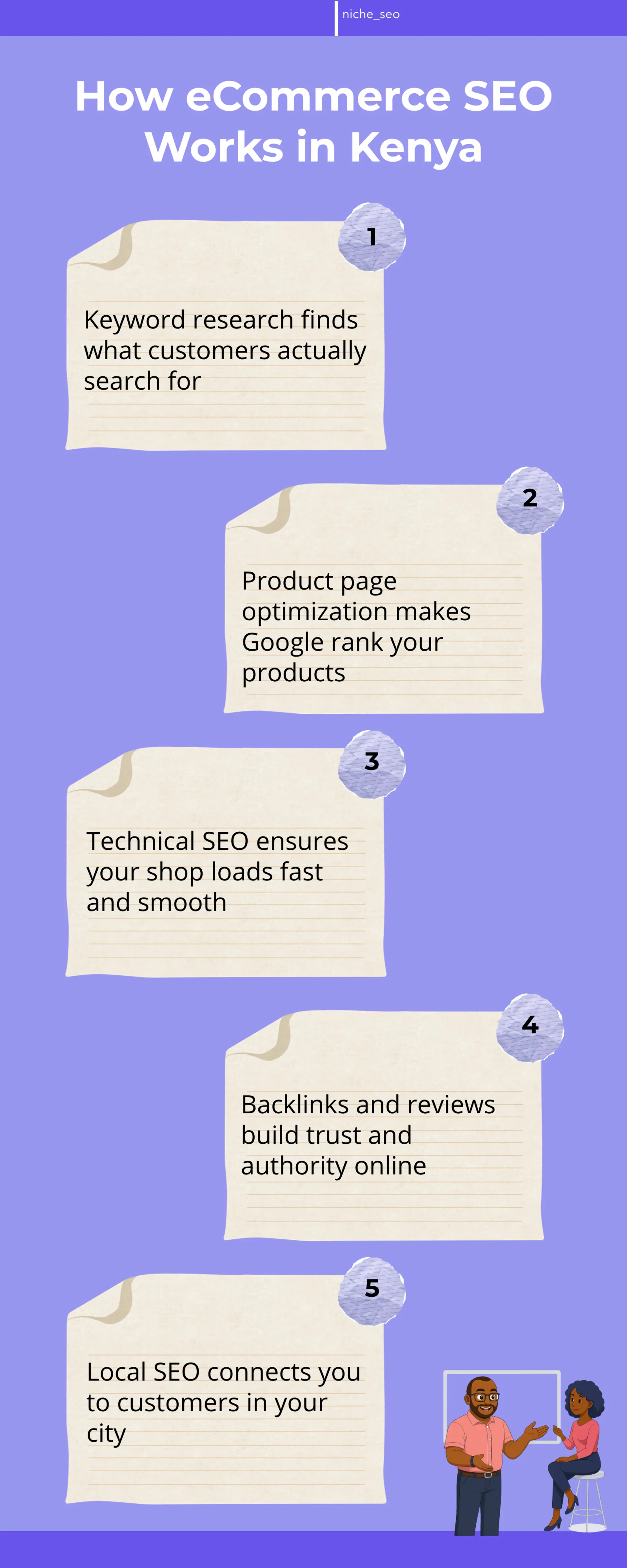
eCommerce SEO works across three layers. The first layer is your product pages. Each item you sell needs to be optimized so Google understands what it is and who might want it.
The second layer is your category pages, which group related products together. When someone searches “women’s shoes Kenya,” Google needs to see that your category page is relevant and trustworthy.
The third layer is your entire shop’s authority. This covers how Google views your domain, whether you’re a legitimate business, and whether customers trust you enough to buy.
Why Does eCommerce SEO Matter for Kenyan Businesses?
Most Kenyan online shoppers start their product search on Google, not Instagram, TikTok, or Facebook. 89% of Kenyans start product searches on Google. If you’re not optimized for Google, you’re missing nearly 9 out of every 10 potential customers actively looking for what you sell.
Unlike paid ads, where you pay every time someone clicks, SEO is a long-term investment that keeps paying you back month after month. A customer who finds you through Google search also trusts you more, because a high ranking feels like a recommendation, not a paid promotion.
Consistent Sales Without Paying for Every Click
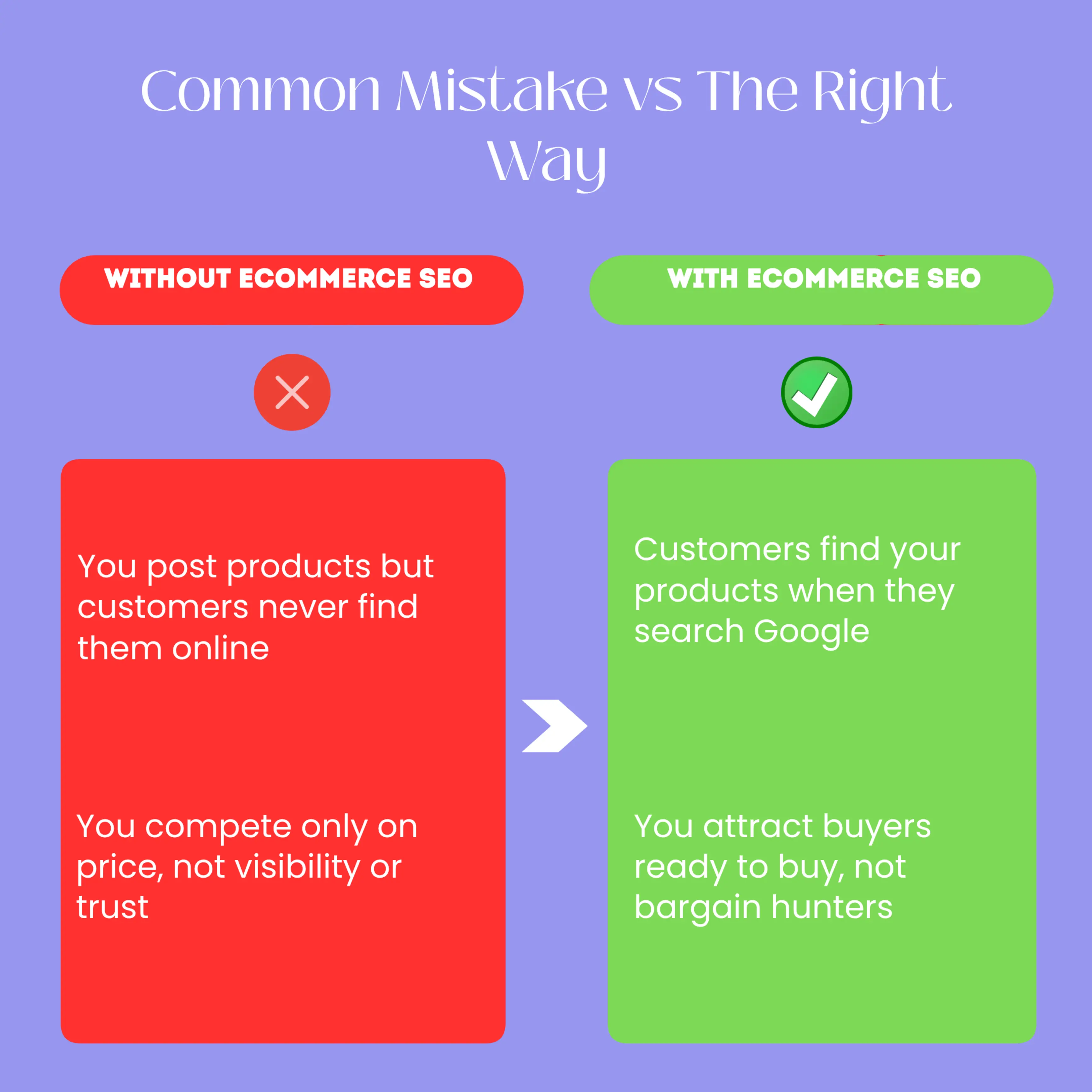
When you run Google Ads for your eCommerce shop, you pay for every click. The average cost per click for eCommerce in East Africa ranges from KES 15 to KES 80, depending on your product category and competition. If you want 100 clicks, you might spend between KES 1,500 and KES 8,000.
SEO doesn’t work that way. Once you rank on page one for a keyword, you get clicks for free, month after month.
A Nairobi-based clothing shop that ranks for “affordable dresses Nairobi” might get 50-100 clicks per day without spending a single shilling on ads. That’s the compounding value of ranking well, and it’s why tracking what matters essential metrics for kenyan websites is worth doing from day one.
Building Long-Term Authority and Customer Trust
Google doesn’t rank shops randomly. It rewards shops with good reviews, quality backlinks, fast loading speeds, and a clear track record as a legitimate business.
When your shop has authority, Google trusts it. So do customers.
A shop with 500 five-star reviews and product pages ranking on page one feels trustworthy. Customers complete their purchase because they see that other Kenyans have bought from you and had a good experience.
This trust translates directly into higher conversion rates. That means more sales from the same traffic.
Competing with Larger Retailers
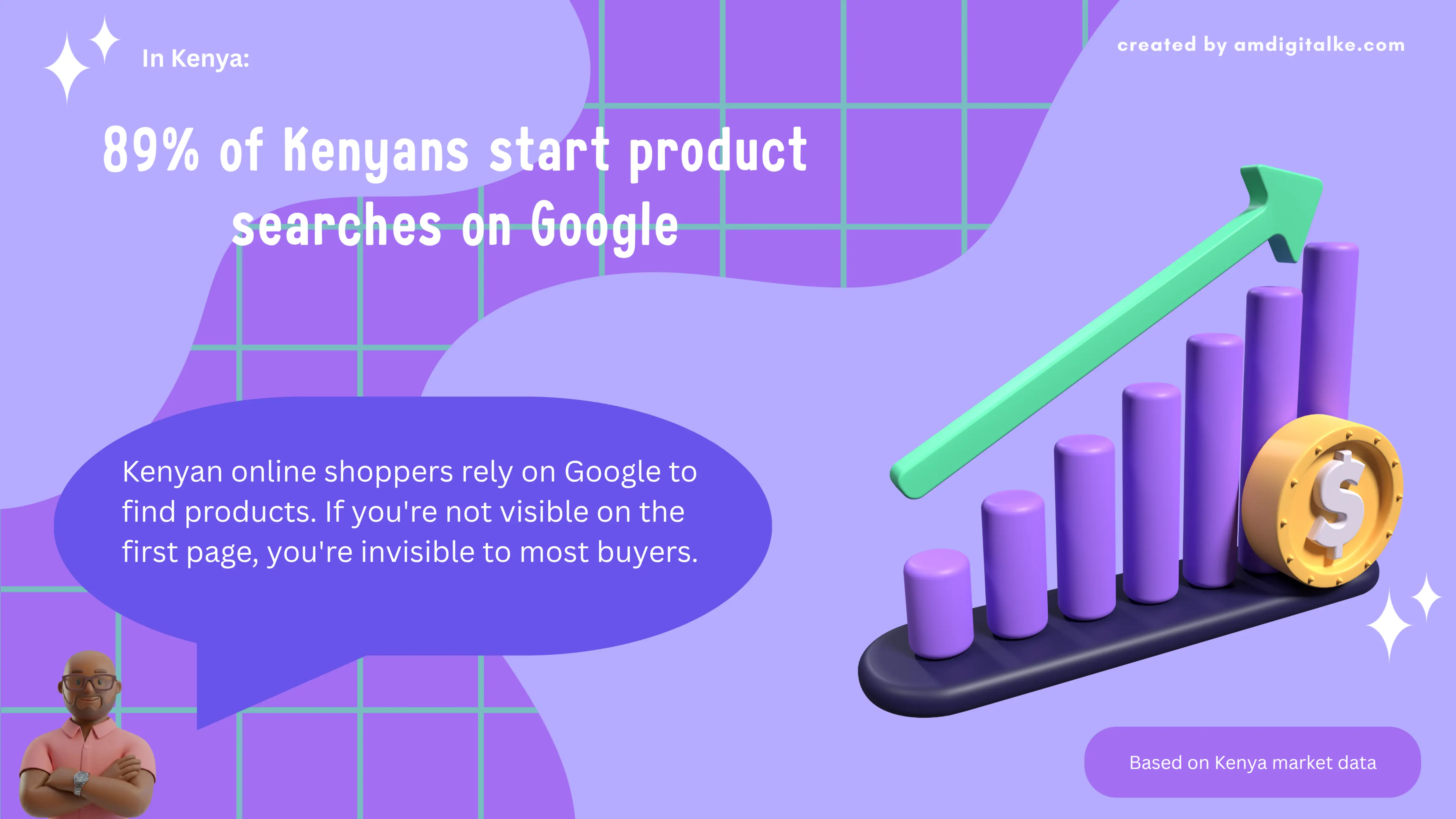
You might think large retailers like Jumia or Kilimall have an unfair advantage in search rankings. They do have some advantages, but not all of them.
A smaller, focused online shop selling specialized products can dominate search results in its niche. Choosing the right partner matters here too, which is why many Kenyan shop owners compare artly vs am digital ke before picking who handles their SEO.
For example, a Mombasa-based shop selling handmade leather goods can outrank a generic marketplace for “handmade leather bags Mombasa” or “artisan leather wallets Kenya.” By focusing on specific, local, high-intent keywords, smaller shops win against bigger competitors every single day.
How eCommerce SEO Works 🔍
eCommerce SEO works through three layers. On-page optimization is what you control on your website. Technical optimization is how your site is built, and off-page signals are what happens outside your website.
Here’s the simple version. Google crawls your website, reads your product pages, checks your site speed, and looks at your reviews and backlinks.
Then it decides whether to rank you for the keywords your customers are searching for.
Keyword Research and Intent Matching
It starts with understanding what Kenyan customers actually search for. A customer in Nairobi might search “phone charger,” but they might also search “fast phone charger,” “phone charger price Kenya,” “phone charger near me,” or “best phone charger brands.”
Each of these searches carries different intent and different commercial value. ecommerce seo services kenya begin by identifying these keywords and understanding which ones will bring you customers ready to buy.
You then create or optimize product pages specifically for those keywords. Your page title, product description, images, and pricing all need to signal to Google that your page is the best answer to that search.
Product Page Optimization
Your product page is where the sale happens. Google needs to understand what your product is and why it deserves to rank above competitors.
This means writing clear product titles and detailed descriptions that include your target keywords naturally. It also means using high-quality images and pricing information that’s easy for both Google and customers to find.
A well-optimized product page also includes customer reviews, ratings, and structured data. This is code that tells Google “this is a product, priced at X, with Y reviews.”
When Google can clearly see all this information, it ranks your product higher and shows it more often in search results.
Technical Site Speed and Mobile Optimization
Google has made it clear. If your shop is slow, it won’t rank well.
Kenyan internet speeds vary widely. Nairobi often has fast fiber, but other regions run on slower mobile networks, and your shop needs to load quickly on mobile because that’s how most Kenyans browse.
Technical SEO also means your site is properly structured and easy for Google to crawl. It means using HTTPS for a secure connection and not blocking important content from Google’s view.
A shop that loads in 2 seconds will outrank a shop that loads in 5 seconds, all else being equal. This is one reason working with providers offering seo in kenya expertise matters for technical fixes.
Building Backlinks and Social Proof
Backlinks are links from other websites pointing to your shop. When a reputable website links to your product page, Google sees it as a vote of confidence.
This is especially powerful in eCommerce because it signals that your shop is legitimate and trustworthy.
Social proof works the same way. A product with 200 five-star reviews from real Kenyans will rank higher than an identical product with no reviews, because Google and customers both trust social proof that’s hard to fake.
eCommerce SEO Examples in Kenya 🇰🇪
Theory only takes you so far. Seeing eCommerce SEO work in real Kenyan businesses makes it concrete, so here are three examples of shops winning customers through search.
Example 1: A Nairobi-Based Fashion Boutique
A small fashion shop in Westlands, Nairobi sells trendy women’s dresses. Instead of competing nationally for “dresses Kenya,” which would be nearly impossible, they target specific local searches like “trendy dresses Westlands” and “affordable fashion Nairobi.”
They optimize each product page with the dress name, color, size, price, and high-quality photos. They also encourage customers to leave reviews on their Google Business Profile and website.
Within three months, they rank on page one for 15+ local keywords and see a 40% increase in online sales. These are customers actively looking for what they sell, not random browsers.
Example 2: A Mombasa Electronics Shop
An electronics retailer in Mombasa sells phone accessories, chargers, and cables. They create detailed product pages for “iPhone 15 charger Kenya” and “fast charging cable Mombasa,” each with exact specifications, pricing, and customer reviews.
They also build backlinks by getting mentioned in tech blogs and local Mombasa business directories. After six months, they rank for 8 high-intent keywords and receive 200+ organic visitors per week.
At a conservative 3% conversion rate, that’s 6 new customers per week from free, organic search traffic.
Example 3: A Kisumu-Based Handmade Goods Shop
A small shop selling handmade baskets and home décor items in Kisumu targets searches like “handmade baskets Kenya” and “artisan home décor Kisumu.” These are lower-volume searches, but they’re highly targeted since the people searching are specifically looking for what this shop sells.
By optimizing for these niche keywords and building a strong Google Business Profile with photos and customer reviews, they rank in the top three for all their target keywords. The same local targeting approach works for businesses drawing visitors from abroad, similar to tourism seo kenya how to attract international visitors strategies.
| Business Type | Target Keywords | Monthly Organic Visitors | Conversion Rate | Est. Monthly Revenue (KES) |
|---|---|---|---|---|
| Nairobi Fashion Boutique | Trendy dresses Westlands, affordable fashion Nairobi | 450 | 8% | 360,000 |
| Mombasa Electronics Shop | iPhone charger Kenya, fast charging cable Mombasa | 800 | 5% | 200,000 |
| Kisumu Handmade Goods | Handmade baskets Kenya, artisan home décor | 200 | 12% | 240,000 |
Common Mistakes to Avoid ⚠️
Most Kenyan eCommerce shops fail at SEO not because they don’t understand it. They make preventable mistakes.
Knowing what not to do matters just as much as knowing what to do.
Mistake 1: Ignoring Mobile Optimization
Most Kenyans shop on their phones, not on desktop computers. If your shop is slow, hard to navigate, or has images that don’t load, you lose sales.
Competitors who optimized for mobile take those sales instead.
Google now ranks sites primarily based on their mobile version. If your mobile site is poor, your desktop rankings don’t matter.
Every product page, checkout process, and image must be tested and optimized for mobile devices.
Mistake 2: Thin Product Descriptions
Many shop owners write descriptions that are too short or too generic. “Blue T-shirt, size M, KES 500” doesn’t help Google understand what you’re selling.
It doesn’t help customers make buying decisions either. This is where solid product page optimisation selling and ranking on google kenya practices make the difference.
Good product descriptions include details like material, fit, care instructions, and genuine benefits. They naturally include keywords without sounding forced.
A description like “100% cotton blue crew-neck t-shirt, perfect for casual Nairobi weather, machine washable, fits true to size” tells Google and customers much more.
Mistake 3: Not Building Local SEO
If you have a physical location in Nairobi, Mombasa, or anywhere else in Kenya, local SEO is critical. Many shop owners ignore their Google Business Profile.
Others don’t encourage customer reviews or add their location to their website.
When someone searches “phone shop near me” or “where to buy shoes in Nairobi,” Google uses local signals to decide which shops to show. A complete, verified Google Business Profile with photos, reviews, and accurate hours makes a huge difference.
Mistake 4: Competing Only on Price
Some shop owners optimize only for price-focused keywords like “cheapest laptop Kenya” or “lowest price shoes Nairobi.” This brings traffic, but it attracts bargain hunters, not loyal customers.
These visitors have low conversion rates and high return rates.
A better strategy targets keywords that include value, quality, or specific features. “Durable leather shoes Kenya” or “best budget laptop for students” attracts customers who care about more than price.
These customers are more likely to complete a purchase and stay loyal.
✅ Quick Action Checklist
- ☐ Identify 10-15 keywords your target customers actually search for (use Google Search Console and Google Trends Kenya)
- ☐ Audit your top 20 product pages for mobile speed and loading time (use Google PageSpeed Insights)
- ☐ Write or rewrite product descriptions to be 150-300 words, including relevant keywords naturally
- ☐ Set up or claim your Google Business Profile with accurate location, photos, hours, and category
- ☐ Ask your last 20 customers to leave reviews on Google and your website
- ☐ Check that your product pages include structured data (pricing, ratings, availability) that Google can read
- ☐ Identify 5-10 local websites or blogs that might link to your shop (and reach out with a genuine pitch)
- ☐ Create an internal linking strategy so related products link to each other naturally
Ready to Improve Your ecommerce seo kenya?
eCommerce SEO is not magic. It’s a methodical process of understanding what your customers search for and making sure your shop answers those searches better than competitors.
Building trust through reviews, speed, and authority matters too. Ranking well for featured snippets can also push your product pages above standard listings.
Done right, eCommerce SEO in Kenya delivers consistent, profitable sales for years.
The businesses that win online in Kenya combine good products with visibility. You can’t have one without the other.
If you’re ready to move beyond guessing and start ranking for keywords that bring real buyers, the next step is understanding your specific situation.
Contact AM Digital KE or download our free guide to see exactly where your shop stands and what your next three moves should be.
Frequently Asked Questions
How long does it take for eCommerce SEO to show results in Kenya?
Most shops see initial results within 3-6 months. Significant revenue impact usually takes 6-12 months.
Google needs time to crawl your site, understand your content, and build confidence in your shop. Patience and consistency matter more than speed.
Can I do eCommerce SEO myself, or do I need to hire an agency?
You can do it yourself if you’re willing to learn and invest time. Many Kenyan shop owners successfully optimize their own sites.
However, if your time is better spent on product sourcing, customer service, or growing your business, hiring an agency might deliver faster results.
What’s the difference between organic search and paid ads for eCommerce?
Organic search (SEO) is free long-term traffic that builds over time. Paid ads (Google Ads) give immediate visibility but cost money for every click.
The best approach combines both. Use paid ads for quick wins while SEO builds your long-term foundation.
Do I need to optimize every single product page, or just the bestsellers?
Start with your bestsellers and highest-margin products, then expand. Optimizing 50 product pages well beats poorly optimizing 500 pages.
Focus on the products that matter most to your revenue first.
How important are customer reviews for eCommerce SEO?
Very important. Reviews signal trust to Google and to customers.
Shops with 50+ reviews rank higher than shops with few or none. Reviews also increase conversion rates because customers see that others bought and were satisfied.
Additional Resources
- SACCO SEO – Digital Visibility for Kenyan Financial Cooperatives – See how a different Kenyan sector applies the same on-page and local SEO principles when the product isn’t physical goods.
- Property Listing Pages – SEO Best Practices for Kenyan Real Estate – Property listings and product pages share the same optimisation challenges, so this breaks down structuring listing pages that rank and convert.
- Parent-Focused Keywords – Understanding Education Search Intent in Kenya – If you sell to parents or families, this shows how to map keywords to a buyer group whose search intent differs from the norm.
- Nonprofit SEO – Visibility for Kenyan Organisations and Causes – Useful if your store also runs a cause-driven or CSR angle and needs visibility beyond pure sales keywords.
- Mobile-First Copywriting – Writing for Kenya’s Phone Users – Since most Kenyan shoppers browse and buy on phones, this shows how to write product copy that works on small screens.
- Medical Review Management – Handling Patient Feedback Professionally in Kenya – Product reviews affect ecommerce rankings and trust too, so this offers a framework for managing customer feedback well.
Take the Next Step
Knowing what eCommerce SEO means is one thing. Doing it right in your own shop is another.
We built a practical guide for this. It walks you through auditing your shop, finding your best opportunities, and building a plan that fits your budget and timeline.
Along the way, don’t ignore small wins like user generated content reviews and qas that boost rankings. Real customer feedback builds trust and gives Google fresh content to crawl.
If you’re comparing agencies before you commit, read our breakdown of savage digital vs am digital ke. It shows how different approaches to SEO play out for Kenyan businesses.
eCommerce SEO isn’t only for online shops selling physical goods. Even member-based organisations benefit, and our guide on seo for saccos kenya shows how the same principles apply.
Download the eCommerce SEO Audit Checklist for Kenyan Shops. Find the specific gaps in your current setup and know what to fix first.
Backlinks are links from other websites pointing to your shop. When a reputable website links to your product page, Google sees it as a vote of confidence.
This is especially powerful in eCommerce because it signals that your shop is legitimate and trustworthy.
Social proof works the same way. A product with 200 five-star reviews from real Kenyans will rank higher than an identical product with no reviews, because Google and customers both trust social proof that’s hard to fake.
eCommerce SEO Examples in Kenya 🇰🇪
Theory only takes you so far. Seeing eCommerce SEO work in real Kenyan businesses makes it concrete, so here are three examples of shops winning customers through search.
Example 1: A Nairobi-Based Fashion Boutique
A small fashion shop in Westlands, Nairobi sells trendy women’s dresses. Instead of competing nationally for “dresses Kenya,” which would be nearly impossible, they target specific local searches like “trendy dresses Westlands” and “affordable fashion Nairobi.”
They optimize each product page with the dress name, color, size, price, and high-quality photos. They also encourage customers to leave reviews on their Google Business Profile and website.
Within three months, they rank on page one for 15+ local keywords and see a 40% increase in online sales. These are customers actively looking for what they sell, not random browsers.
Example 2: A Mombasa Electronics Shop
An electronics retailer in Mombasa sells phone accessories, chargers, and cables. They create detailed product pages for “iPhone 15 charger Kenya” and “fast charging cable Mombasa,” each with exact specifications, pricing, and customer reviews.
They also build backlinks by getting mentioned in tech blogs and local Mombasa business directories. After six months, they rank for 8 high-intent keywords and receive 200+ organic visitors per week.
At a conservative 3% conversion rate, that’s 6 new customers per week from free, organic search traffic.
Example 3: A Kisumu-Based Handmade Goods Shop
A small shop selling handmade baskets and home décor items in Kisumu targets searches like “handmade baskets Kenya” and “artisan home décor Kisumu.” These are lower-volume searches, but they’re highly targeted since the people searching are specifically looking for what this shop sells.
By optimizing for these niche keywords and building a strong Google Business Profile with photos and customer reviews, they rank in the top three for all their target keywords. The same local targeting approach works for businesses drawing visitors from abroad, similar to tourism seo kenya how to attract international visitors strategies.
| Business Type | Target Keywords | Monthly Organic Visitors | Conversion Rate | Est. Monthly Revenue (KES) |
|---|---|---|---|---|
| Nairobi Fashion Boutique | Trendy dresses Westlands, affordable fashion Nairobi | 450 | 8% | 360,000 |
| Mombasa Electronics Shop | iPhone charger Kenya, fast charging cable Mombasa | 800 | 5% | 200,000 |
| Kisumu Handmade Goods | Handmade baskets Kenya, artisan home décor | 200 | 12% | 240,000 |
Common Mistakes to Avoid ⚠️
Most Kenyan eCommerce shops fail at SEO not because they don’t understand it. They make preventable mistakes.
Knowing what not to do matters just as much as knowing what to do.
Mistake 1: Ignoring Mobile Optimization
Most Kenyans shop on their phones, not on desktop computers. If your shop is slow, hard to navigate, or has images that don’t load, you lose sales.
Competitors who optimized for mobile take those sales instead.
Google now ranks sites primarily based on their mobile version. If your mobile site is poor, your desktop rankings don’t matter.
Every product page, checkout process, and image must be tested and optimized for mobile devices.
Mistake 2: Thin Product Descriptions
Many shop owners write descriptions that are too short or too generic. “Blue T-shirt, size M, KES 500” doesn’t help Google understand what you’re selling.
It doesn’t help customers make buying decisions either. This is where solid product page optimisation selling and ranking on google kenya practices make the difference.
Good product descriptions include details like material, fit, care instructions, and genuine benefits. They naturally include keywords without sounding forced.
A description like “100% cotton blue crew-neck t-shirt, perfect for casual Nairobi weather, machine washable, fits true to size” tells Google and customers much more.
Mistake 3: Not Building Local SEO
If you have a physical location in Nairobi, Mombasa, or anywhere else in Kenya, local SEO is critical. Many shop owners ignore their Google Business Profile.
Others don’t encourage customer reviews or add their location to their website.
When someone searches “phone shop near me” or “where to buy shoes in Nairobi,” Google uses local signals to decide which shops to show. A complete, verified Google Business Profile with photos, reviews, and accurate hours makes a huge difference.
Mistake 4: Competing Only on Price
Some shop owners optimize only for price-focused keywords like “cheapest laptop Kenya” or “lowest price shoes Nairobi.” This brings traffic, but it attracts bargain hunters, not loyal customers.
These visitors have low conversion rates and high return rates.
A better strategy targets keywords that include value, quality, or specific features. “Durable leather shoes Kenya” or “best budget laptop for students” attracts customers who care about more than price.
These customers are more likely to complete a purchase and stay loyal.
✅ Quick Action Checklist
- ☐ Identify 10-15 keywords your target customers actually search for (use Google Search Console and Google Trends Kenya)
- ☐ Audit your top 20 product pages for mobile speed and loading time (use Google PageSpeed Insights)
- ☐ Write or rewrite product descriptions to be 150-300 words, including relevant keywords naturally
- ☐ Set up or claim your Google Business Profile with accurate location, photos, hours, and category
- ☐ Ask your last 20 customers to leave reviews on Google and your website
- ☐ Check that your product pages include structured data (pricing, ratings, availability) that Google can read
- ☐ Identify 5-10 local websites or blogs that might link to your shop (and reach out with a genuine pitch)
- ☐ Create an internal linking strategy so related products link to each other naturally
Ready to Improve Your ecommerce seo kenya?
eCommerce SEO is not magic. It’s a methodical process of understanding what your customers search for and making sure your shop answers those searches better than competitors.
Building trust through reviews, speed, and authority matters too. Ranking well for featured snippets can also push your product pages above standard listings.
Done right, eCommerce SEO in Kenya delivers consistent, profitable sales for years.
The businesses that win online in Kenya combine good products with visibility. You can’t have one without the other.
If you’re ready to move beyond guessing and start ranking for keywords that bring real buyers, the next step is understanding your specific situation.
Contact AM Digital KE or download our free guide to see exactly where your shop stands and what your next three moves should be.
Frequently Asked Questions
How long does it take for eCommerce SEO to show results in Kenya?
Most shops see initial results within 3-6 months. Significant revenue impact usually takes 6-12 months.
Google needs time to crawl your site, understand your content, and build confidence in your shop. Patience and consistency matter more than speed.
Can I do eCommerce SEO myself, or do I need to hire an agency?
You can do it yourself if you’re willing to learn and invest time. Many Kenyan shop owners successfully optimize their own sites.
However, if your time is better spent on product sourcing, customer service, or growing your business, hiring an agency might deliver faster results.
What’s the difference between organic search and paid ads for eCommerce?
Organic search (SEO) is free long-term traffic that builds over time. Paid ads (Google Ads) give immediate visibility but cost money for every click.
The best approach combines both. Use paid ads for quick wins while SEO builds your long-term foundation.
Do I need to optimize every single product page, or just the bestsellers?
Start with your bestsellers and highest-margin products, then expand. Optimizing 50 product pages well beats poorly optimizing 500 pages.
Focus on the products that matter most to your revenue first.
How important are customer reviews for eCommerce SEO?
Very important. Reviews signal trust to Google and to customers.
Shops with 50+ reviews rank higher than shops with few or none. Reviews also increase conversion rates because customers see that others bought and were satisfied.
Additional Resources
- SACCO SEO – Digital Visibility for Kenyan Financial Cooperatives – See how a different Kenyan sector applies the same on-page and local SEO principles when the product isn’t physical goods.
- Property Listing Pages – SEO Best Practices for Kenyan Real Estate – Property listings and product pages share the same optimisation challenges, so this breaks down structuring listing pages that rank and convert.
- Parent-Focused Keywords – Understanding Education Search Intent in Kenya – If you sell to parents or families, this shows how to map keywords to a buyer group whose search intent differs from the norm.
- Nonprofit SEO – Visibility for Kenyan Organisations and Causes – Useful if your store also runs a cause-driven or CSR angle and needs visibility beyond pure sales keywords.
- Mobile-First Copywriting – Writing for Kenya’s Phone Users – Since most Kenyan shoppers browse and buy on phones, this shows how to write product copy that works on small screens.
- Medical Review Management – Handling Patient Feedback Professionally in Kenya – Product reviews affect ecommerce rankings and trust too, so this offers a framework for managing customer feedback well.
Take the Next Step
Knowing what eCommerce SEO means is one thing. Doing it right in your own shop is another.
We built a practical guide for this. It walks you through auditing your shop, finding your best opportunities, and building a plan that fits your budget and timeline.
Along the way, don’t ignore small wins like user generated content reviews and qas that boost rankings. Real customer feedback builds trust and gives Google fresh content to crawl.
If you’re comparing agencies before you commit, read our breakdown of savage digital vs am digital ke. It shows how different approaches to SEO play out for Kenyan businesses.
eCommerce SEO isn’t only for online shops selling physical goods. Even member-based organisations benefit, and our guide on seo for saccos kenya shows how the same principles apply.
Download the eCommerce SEO Audit Checklist for Kenyan Shops. Find the specific gaps in your current setup and know what to fix first.
TL;DR: eCommerce SEO in Kenya means optimizing your online shop so customers find you on Google when they search for products you sell. It involves keyword research, product page optimization, technical site speed, building backlinks, and local SEO. Done right, it drives consistent sales from customers who are already looking to buy.
What is eCommerce SEO in Kenya?
eCommerce SEO is the practice of making your online shop rank higher on Google so Kenyan customers find you first. It works the same way hotel seo kenya strategies help hotels get found by travelers searching for a place to stay. It’s not about paying for ads or hoping people stumble on your site by accident.
It’s about being visible exactly when someone in Nairobi, Mombasa, or Kisumu types “best laptop prices in Kenya” into Google. Whatever product you sell, that search moment is where SEO wins or loses you a customer.
If your shop doesn’t show up on page one for the products you sell, you’re losing money every day. Customers are searching for what you offer, but they’re buying from competitors who show up first.
How eCommerce SEO Differs from Regular SEO
Regular SEO helps a blog or news site rank for topics people want to read about. eCommerce SEO is different because it’s built to help people find and buy products.
The goal is not just traffic. The goal is sales.
When someone searches “how to clean leather shoes,” they might just want information. When someone searches “leather shoe cleaner price Kenya,” they’re ready to buy. eCommerce SEO focuses on these buyer-intent searches because that’s where your revenue comes from.
The Three Layers of eCommerce SEO
eCommerce SEO works across three layers. The first layer is your product pages. Each item you sell needs to be optimized so Google understands what it is and who might want it.
The second layer is your category pages, which group related products together. When someone searches “women’s shoes Kenya,” Google needs to see that your category page is relevant and trustworthy.
The third layer is your entire shop’s authority. This covers how Google views your domain, whether you’re a legitimate business, and whether customers trust you enough to buy.
Why Does eCommerce SEO Matter for Kenyan Businesses?
Most Kenyan online shoppers start their product search on Google, not Instagram, TikTok, or Facebook. 89% of Kenyans start product searches on Google. If you’re not optimized for Google, you’re missing nearly 9 out of every 10 potential customers actively looking for what you sell.
Unlike paid ads, where you pay every time someone clicks, SEO is a long-term investment that keeps paying you back month after month. A customer who finds you through Google search also trusts you more, because a high ranking feels like a recommendation, not a paid promotion.
Consistent Sales Without Paying for Every Click
When you run Google Ads for your eCommerce shop, you pay for every click. The average cost per click for eCommerce in East Africa ranges from KES 15 to KES 80, depending on your product category and competition. If you want 100 clicks, you might spend between KES 1,500 and KES 8,000.
SEO doesn’t work that way. Once you rank on page one for a keyword, you get clicks for free, month after month.
A Nairobi-based clothing shop that ranks for “affordable dresses Nairobi” might get 50-100 clicks per day without spending a single shilling on ads. That’s the compounding value of ranking well, and it’s why tracking what matters essential metrics for kenyan websites is worth doing from day one.
Building Long-Term Authority and Customer Trust
Google doesn’t rank shops randomly. It rewards shops with good reviews, quality backlinks, fast loading speeds, and a clear track record as a legitimate business.
When your shop has authority, Google trusts it. So do customers.
A shop with 500 five-star reviews and product pages ranking on page one feels trustworthy. Customers complete their purchase because they see that other Kenyans have bought from you and had a good experience.
This trust translates directly into higher conversion rates. That means more sales from the same traffic.
Competing with Larger Retailers
You might think large retailers like Jumia or Kilimall have an unfair advantage in search rankings. They do have some advantages, but not all of them.
A smaller, focused online shop selling specialized products can dominate search results in its niche. Choosing the right partner matters here too, which is why many Kenyan shop owners compare artly vs am digital ke before picking who handles their SEO.
For example, a Mombasa-based shop selling handmade leather goods can outrank a generic marketplace for “handmade leather bags Mombasa” or “artisan leather wallets Kenya.” By focusing on specific, local, high-intent keywords, smaller shops win against bigger competitors every single day.
How eCommerce SEO Works 🔍
eCommerce SEO works through three layers. On-page optimization is what you control on your website. Technical optimization is how your site is built, and off-page signals are what happens outside your website.
Here’s the simple version. Google crawls your website, reads your product pages, checks your site speed, and looks at your reviews and backlinks.
Then it decides whether to rank you for the keywords your customers are searching for.
Keyword Research and Intent Matching
It starts with understanding what Kenyan customers actually search for. A customer in Nairobi might search “phone charger,” but they might also search “fast phone charger,” “phone charger price Kenya,” “phone charger near me,” or “best phone charger brands.”
Each of these searches carries different intent and different commercial value. ecommerce seo services kenya begin by identifying these keywords and understanding which ones will bring you customers ready to buy.
You then create or optimize product pages specifically for those keywords. Your page title, product description, images, and pricing all need to signal to Google that your page is the best answer to that search.
Product Page Optimization
Your product page is where the sale happens. Google needs to understand what your product is and why it deserves to rank above competitors.
This means writing clear product titles and detailed descriptions that include your target keywords naturally. It also means using high-quality images and pricing information that’s easy for both Google and customers to find.
A well-optimized product page also includes customer reviews, ratings, and structured data. This is code that tells Google “this is a product, priced at X, with Y reviews.”
When Google can clearly see all this information, it ranks your product higher and shows it more often in search results.
Technical Site Speed and Mobile Optimization
Google has made it clear. If your shop is slow, it won’t rank well.
Kenyan internet speeds vary widely. Nairobi often has fast fiber, but other regions run on slower mobile networks, and your shop needs to load quickly on mobile because that’s how most Kenyans browse.
Technical SEO also means your site is properly structured and easy for Google to crawl. It means using HTTPS for a secure connection and not blocking important content from Google’s view.
A shop that loads in 2 seconds will outrank a shop that loads in 5 seconds, all else being equal. This is one reason working with providers offering seo in kenya expertise matters for technical fixes.
Building Backlinks and Social Proof
Backlinks are links from other websites pointing to your shop. When a reputable website links to your product page, Google sees it as a vote of confidence.
This is especially powerful in eCommerce because it signals that your shop is legitimate and trustworthy.
Social proof works the same way. A product with 200 five-star reviews from real Kenyans will rank higher than an identical product with no reviews, because Google and customers both trust social proof that’s hard to fake.
eCommerce SEO Examples in Kenya 🇰🇪
Theory only takes you so far. Seeing eCommerce SEO work in real Kenyan businesses makes it concrete, so here are three examples of shops winning customers through search.
Example 1: A Nairobi-Based Fashion Boutique
A small fashion shop in Westlands, Nairobi sells trendy women’s dresses. Instead of competing nationally for “dresses Kenya,” which would be nearly impossible, they target specific local searches like “trendy dresses Westlands” and “affordable fashion Nairobi.”
They optimize each product page with the dress name, color, size, price, and high-quality photos. They also encourage customers to leave reviews on their Google Business Profile and website.
Within three months, they rank on page one for 15+ local keywords and see a 40% increase in online sales. These are customers actively looking for what they sell, not random browsers.
Example 2: A Mombasa Electronics Shop
An electronics retailer in Mombasa sells phone accessories, chargers, and cables. They create detailed product pages for “iPhone 15 charger Kenya” and “fast charging cable Mombasa,” each with exact specifications, pricing, and customer reviews.
They also build backlinks by getting mentioned in tech blogs and local Mombasa business directories. After six months, they rank for 8 high-intent keywords and receive 200+ organic visitors per week.
At a conservative 3% conversion rate, that’s 6 new customers per week from free, organic search traffic.
Example 3: A Kisumu-Based Handmade Goods Shop
A small shop selling handmade baskets and home décor items in Kisumu targets searches like “handmade baskets Kenya” and “artisan home décor Kisumu.” These are lower-volume searches, but they’re highly targeted since the people searching are specifically looking for what this shop sells.
By optimizing for these niche keywords and building a strong Google Business Profile with photos and customer reviews, they rank in the top three for all their target keywords. The same local targeting approach works for businesses drawing visitors from abroad, similar to tourism seo kenya how to attract international visitors strategies.
| Business Type | Target Keywords | Monthly Organic Visitors | Conversion Rate | Est. Monthly Revenue (KES) |
|---|---|---|---|---|
| Nairobi Fashion Boutique | Trendy dresses Westlands, affordable fashion Nairobi | 450 | 8% | 360,000 |
| Mombasa Electronics Shop | iPhone charger Kenya, fast charging cable Mombasa | 800 | 5% | 200,000 |
| Kisumu Handmade Goods | Handmade baskets Kenya, artisan home décor | 200 | 12% | 240,000 |
Common Mistakes to Avoid ⚠️
Most Kenyan eCommerce shops fail at SEO not because they don’t understand it. They make preventable mistakes.
Knowing what not to do matters just as much as knowing what to do.
Mistake 1: Ignoring Mobile Optimization
Most Kenyans shop on their phones, not on desktop computers. If your shop is slow, hard to navigate, or has images that don’t load, you lose sales.
Competitors who optimized for mobile take those sales instead.
Google now ranks sites primarily based on their mobile version. If your mobile site is poor, your desktop rankings don’t matter.
Every product page, checkout process, and image must be tested and optimized for mobile devices.
Mistake 2: Thin Product Descriptions
Many shop owners write descriptions that are too short or too generic. “Blue T-shirt, size M, KES 500” doesn’t help Google understand what you’re selling.
It doesn’t help customers make buying decisions either. This is where solid product page optimisation selling and ranking on google kenya practices make the difference.
Good product descriptions include details like material, fit, care instructions, and genuine benefits. They naturally include keywords without sounding forced.
A description like “100% cotton blue crew-neck t-shirt, perfect for casual Nairobi weather, machine washable, fits true to size” tells Google and customers much more.
Mistake 3: Not Building Local SEO
If you have a physical location in Nairobi, Mombasa, or anywhere else in Kenya, local SEO is critical. Many shop owners ignore their Google Business Profile.
Others don’t encourage customer reviews or add their location to their website.
When someone searches “phone shop near me” or “where to buy shoes in Nairobi,” Google uses local signals to decide which shops to show. A complete, verified Google Business Profile with photos, reviews, and accurate hours makes a huge difference.
Mistake 4: Competing Only on Price
Some shop owners optimize only for price-focused keywords like “cheapest laptop Kenya” or “lowest price shoes Nairobi.” This brings traffic, but it attracts bargain hunters, not loyal customers.
These visitors have low conversion rates and high return rates.
A better strategy targets keywords that include value, quality, or specific features. “Durable leather shoes Kenya” or “best budget laptop for students” attracts customers who care about more than price.
These customers are more likely to complete a purchase and stay loyal.
✅ Quick Action Checklist
- ☐ Identify 10-15 keywords your target customers actually search for (use Google Search Console and Google Trends Kenya)
- ☐ Audit your top 20 product pages for mobile speed and loading time (use Google PageSpeed Insights)
- ☐ Write or rewrite product descriptions to be 150-300 words, including relevant keywords naturally
- ☐ Set up or claim your Google Business Profile with accurate location, photos, hours, and category
- ☐ Ask your last 20 customers to leave reviews on Google and your website
- ☐ Check that your product pages include structured data (pricing, ratings, availability) that Google can read
- ☐ Identify 5-10 local websites or blogs that might link to your shop (and reach out with a genuine pitch)
- ☐ Create an internal linking strategy so related products link to each other naturally
Ready to Improve Your ecommerce seo kenya?
eCommerce SEO is not magic. It’s a methodical process of understanding what your customers search for and making sure your shop answers those searches better than competitors.
Building trust through reviews, speed, and authority matters too. Ranking well for featured snippets can also push your product pages above standard listings.
Done right, eCommerce SEO in Kenya delivers consistent, profitable sales for years.
The businesses that win online in Kenya combine good products with visibility. You can’t have one without the other.
If you’re ready to move beyond guessing and start ranking for keywords that bring real buyers, the next step is understanding your specific situation.
Contact AM Digital KE or download our free guide to see exactly where your shop stands and what your next three moves should be.
Frequently Asked Questions
How long does it take for eCommerce SEO to show results in Kenya?
Most shops see initial results within 3-6 months. Significant revenue impact usually takes 6-12 months.
Google needs time to crawl your site, understand your content, and build confidence in your shop. Patience and consistency matter more than speed.
Can I do eCommerce SEO myself, or do I need to hire an agency?
You can do it yourself if you’re willing to learn and invest time. Many Kenyan shop owners successfully optimize their own sites.
However, if your time is better spent on product sourcing, customer service, or growing your business, hiring an agency might deliver faster results.
What’s the difference between organic search and paid ads for eCommerce?
Organic search (SEO) is free long-term traffic that builds over time. Paid ads (Google Ads) give immediate visibility but cost money for every click.
The best approach combines both. Use paid ads for quick wins while SEO builds your long-term foundation.
Do I need to optimize every single product page, or just the bestsellers?
Start with your bestsellers and highest-margin products, then expand. Optimizing 50 product pages well beats poorly optimizing 500 pages.
Focus on the products that matter most to your revenue first.
How important are customer reviews for eCommerce SEO?
Very important. Reviews signal trust to Google and to customers.
Shops with 50+ reviews rank higher than shops with few or none. Reviews also increase conversion rates because customers see that others bought and were satisfied.
Additional Resources
- SACCO SEO – Digital Visibility for Kenyan Financial Cooperatives – See how a different Kenyan sector applies the same on-page and local SEO principles when the product isn’t physical goods.
- Property Listing Pages – SEO Best Practices for Kenyan Real Estate – Property listings and product pages share the same optimisation challenges, so this breaks down structuring listing pages that rank and convert.
- Parent-Focused Keywords – Understanding Education Search Intent in Kenya – If you sell to parents or families, this shows how to map keywords to a buyer group whose search intent differs from the norm.
- Nonprofit SEO – Visibility for Kenyan Organisations and Causes – Useful if your store also runs a cause-driven or CSR angle and needs visibility beyond pure sales keywords.
- Mobile-First Copywriting – Writing for Kenya’s Phone Users – Since most Kenyan shoppers browse and buy on phones, this shows how to write product copy that works on small screens.
- Medical Review Management – Handling Patient Feedback Professionally in Kenya – Product reviews affect ecommerce rankings and trust too, so this offers a framework for managing customer feedback well.
Take the Next Step
Knowing what eCommerce SEO means is one thing. Doing it right in your own shop is another.
We built a practical guide for this. It walks you through auditing your shop, finding your best opportunities, and building a plan that fits your budget and timeline.
Along the way, don’t ignore small wins like user generated content reviews and qas that boost rankings. Real customer feedback builds trust and gives Google fresh content to crawl.
If you’re comparing agencies before you commit, read our breakdown of savage digital vs am digital ke. It shows how different approaches to SEO play out for Kenyan businesses.
eCommerce SEO isn’t only for online shops selling physical goods. Even member-based organisations benefit, and our guide on seo for saccos kenya shows how the same principles apply.
Download the eCommerce SEO Audit Checklist for Kenyan Shops. Find the specific gaps in your current setup and know what to fix first.
Technical SEO also means your site is properly structured and easy for Google to crawl. It means using HTTPS for a secure connection and not blocking important content from Google’s view.
A shop that loads in 2 seconds will outrank a shop that loads in 5 seconds, all else being equal. This is one reason working with providers offering seo in kenya expertise matters for technical fixes.
Building Backlinks and Social Proof
Backlinks are links from other websites pointing to your shop. When a reputable website links to your product page, Google sees it as a vote of confidence.
This is especially powerful in eCommerce because it signals that your shop is legitimate and trustworthy.
Social proof works the same way. A product with 200 five-star reviews from real Kenyans will rank higher than an identical product with no reviews, because Google and customers both trust social proof that’s hard to fake.
eCommerce SEO Examples in Kenya 🇰🇪
Theory only takes you so far. Seeing eCommerce SEO work in real Kenyan businesses makes it concrete, so here are three examples of shops winning customers through search.
Example 1: A Nairobi-Based Fashion Boutique
A small fashion shop in Westlands, Nairobi sells trendy women’s dresses. Instead of competing nationally for “dresses Kenya,” which would be nearly impossible, they target specific local searches like “trendy dresses Westlands” and “affordable fashion Nairobi.”
They optimize each product page with the dress name, color, size, price, and high-quality photos. They also encourage customers to leave reviews on their Google Business Profile and website.
Within three months, they rank on page one for 15+ local keywords and see a 40% increase in online sales. These are customers actively looking for what they sell, not random browsers.
Example 2: A Mombasa Electronics Shop
An electronics retailer in Mombasa sells phone accessories, chargers, and cables. They create detailed product pages for “iPhone 15 charger Kenya” and “fast charging cable Mombasa,” each with exact specifications, pricing, and customer reviews.
They also build backlinks by getting mentioned in tech blogs and local Mombasa business directories. After six months, they rank for 8 high-intent keywords and receive 200+ organic visitors per week.
At a conservative 3% conversion rate, that’s 6 new customers per week from free, organic search traffic.
Example 3: A Kisumu-Based Handmade Goods Shop
A small shop selling handmade baskets and home décor items in Kisumu targets searches like “handmade baskets Kenya” and “artisan home décor Kisumu.” These are lower-volume searches, but they’re highly targeted since the people searching are specifically looking for what this shop sells.
By optimizing for these niche keywords and building a strong Google Business Profile with photos and customer reviews, they rank in the top three for all their target keywords. The same local targeting approach works for businesses drawing visitors from abroad, similar to tourism seo kenya how to attract international visitors strategies.
| Business Type | Target Keywords | Monthly Organic Visitors | Conversion Rate | Est. Monthly Revenue (KES) |
|---|---|---|---|---|
| Nairobi Fashion Boutique | Trendy dresses Westlands, affordable fashion Nairobi | 450 | 8% | 360,000 |
| Mombasa Electronics Shop | iPhone charger Kenya, fast charging cable Mombasa | 800 | 5% | 200,000 |
| Kisumu Handmade Goods | Handmade baskets Kenya, artisan home décor | 200 | 12% | 240,000 |
Common Mistakes to Avoid ⚠️
Most Kenyan eCommerce shops fail at SEO not because they don’t understand it. They make preventable mistakes.
Knowing what not to do matters just as much as knowing what to do.
Mistake 1: Ignoring Mobile Optimization
Most Kenyans shop on their phones, not on desktop computers. If your shop is slow, hard to navigate, or has images that don’t load, you lose sales.
Competitors who optimized for mobile take those sales instead.
Google now ranks sites primarily based on their mobile version. If your mobile site is poor, your desktop rankings don’t matter.
Every product page, checkout process, and image must be tested and optimized for mobile devices.
Mistake 2: Thin Product Descriptions
Many shop owners write descriptions that are too short or too generic. “Blue T-shirt, size M, KES 500” doesn’t help Google understand what you’re selling.
It doesn’t help customers make buying decisions either. This is where solid product page optimisation selling and ranking on google kenya practices make the difference.
Good product descriptions include details like material, fit, care instructions, and genuine benefits. They naturally include keywords without sounding forced.
A description like “100% cotton blue crew-neck t-shirt, perfect for casual Nairobi weather, machine washable, fits true to size” tells Google and customers much more.
Mistake 3: Not Building Local SEO
If you have a physical location in Nairobi, Mombasa, or anywhere else in Kenya, local SEO is critical. Many shop owners ignore their Google Business Profile.
Others don’t encourage customer reviews or add their location to their website.
When someone searches “phone shop near me” or “where to buy shoes in Nairobi,” Google uses local signals to decide which shops to show. A complete, verified Google Business Profile with photos, reviews, and accurate hours makes a huge difference.
Mistake 4: Competing Only on Price
Some shop owners optimize only for price-focused keywords like “cheapest laptop Kenya” or “lowest price shoes Nairobi.” This brings traffic, but it attracts bargain hunters, not loyal customers.
These visitors have low conversion rates and high return rates.
A better strategy targets keywords that include value, quality, or specific features. “Durable leather shoes Kenya” or “best budget laptop for students” attracts customers who care about more than price.
These customers are more likely to complete a purchase and stay loyal.
✅ Quick Action Checklist
- ☐ Identify 10-15 keywords your target customers actually search for (use Google Search Console and Google Trends Kenya)
- ☐ Audit your top 20 product pages for mobile speed and loading time (use Google PageSpeed Insights)
- ☐ Write or rewrite product descriptions to be 150-300 words, including relevant keywords naturally
- ☐ Set up or claim your Google Business Profile with accurate location, photos, hours, and category
- ☐ Ask your last 20 customers to leave reviews on Google and your website
- ☐ Check that your product pages include structured data (pricing, ratings, availability) that Google can read
- ☐ Identify 5-10 local websites or blogs that might link to your shop (and reach out with a genuine pitch)
- ☐ Create an internal linking strategy so related products link to each other naturally
Ready to Improve Your ecommerce seo kenya?
eCommerce SEO is not magic. It’s a methodical process of understanding what your customers search for and making sure your shop answers those searches better than competitors.
Building trust through reviews, speed, and authority matters too. Ranking well for featured snippets can also push your product pages above standard listings.
Done right, eCommerce SEO in Kenya delivers consistent, profitable sales for years.
The businesses that win online in Kenya combine good products with visibility. You can’t have one without the other.
If you’re ready to move beyond guessing and start ranking for keywords that bring real buyers, the next step is understanding your specific situation.
Contact AM Digital KE or download our free guide to see exactly where your shop stands and what your next three moves should be.
Frequently Asked Questions
How long does it take for eCommerce SEO to show results in Kenya?
Most shops see initial results within 3-6 months. Significant revenue impact usually takes 6-12 months.
Google needs time to crawl your site, understand your content, and build confidence in your shop. Patience and consistency matter more than speed.
Can I do eCommerce SEO myself, or do I need to hire an agency?
You can do it yourself if you’re willing to learn and invest time. Many Kenyan shop owners successfully optimize their own sites.
However, if your time is better spent on product sourcing, customer service, or growing your business, hiring an agency might deliver faster results.
What’s the difference between organic search and paid ads for eCommerce?
Organic search (SEO) is free long-term traffic that builds over time. Paid ads (Google Ads) give immediate visibility but cost money for every click.
The best approach combines both. Use paid ads for quick wins while SEO builds your long-term foundation.
Do I need to optimize every single product page, or just the bestsellers?
Start with your bestsellers and highest-margin products, then expand. Optimizing 50 product pages well beats poorly optimizing 500 pages.
Focus on the products that matter most to your revenue first.
How important are customer reviews for eCommerce SEO?
Very important. Reviews signal trust to Google and to customers.
Shops with 50+ reviews rank higher than shops with few or none. Reviews also increase conversion rates because customers see that others bought and were satisfied.
Additional Resources
- SACCO SEO – Digital Visibility for Kenyan Financial Cooperatives – See how a different Kenyan sector applies the same on-page and local SEO principles when the product isn’t physical goods.
- Property Listing Pages – SEO Best Practices for Kenyan Real Estate – Property listings and product pages share the same optimisation challenges, so this breaks down structuring listing pages that rank and convert.
- Parent-Focused Keywords – Understanding Education Search Intent in Kenya – If you sell to parents or families, this shows how to map keywords to a buyer group whose search intent differs from the norm.
- Nonprofit SEO – Visibility for Kenyan Organisations and Causes – Useful if your store also runs a cause-driven or CSR angle and needs visibility beyond pure sales keywords.
- Mobile-First Copywriting – Writing for Kenya’s Phone Users – Since most Kenyan shoppers browse and buy on phones, this shows how to write product copy that works on small screens.
- Medical Review Management – Handling Patient Feedback Professionally in Kenya – Product reviews affect ecommerce rankings and trust too, so this offers a framework for managing customer feedback well.
Take the Next Step
Knowing what eCommerce SEO means is one thing. Doing it right in your own shop is another.
We built a practical guide for this. It walks you through auditing your shop, finding your best opportunities, and building a plan that fits your budget and timeline.
Along the way, don’t ignore small wins like user generated content reviews and qas that boost rankings. Real customer feedback builds trust and gives Google fresh content to crawl.
If you’re comparing agencies before you commit, read our breakdown of savage digital vs am digital ke. It shows how different approaches to SEO play out for Kenyan businesses.
eCommerce SEO isn’t only for online shops selling physical goods. Even member-based organisations benefit, and our guide on seo for saccos kenya shows how the same principles apply.
Download the eCommerce SEO Audit Checklist for Kenyan Shops. Find the specific gaps in your current setup and know what to fix first.
TL;DR: eCommerce SEO in Kenya means optimizing your online shop so customers find you on Google when they search for products you sell. It involves keyword research, product page optimization, technical site speed, building backlinks, and local SEO. Done right, it drives consistent sales from customers who are already looking to buy.
What is eCommerce SEO in Kenya?
eCommerce SEO is the practice of making your online shop rank higher on Google so Kenyan customers find you first. It works the same way hotel seo kenya strategies help hotels get found by travelers searching for a place to stay. It’s not about paying for ads or hoping people stumble on your site by accident.
It’s about being visible exactly when someone in Nairobi, Mombasa, or Kisumu types “best laptop prices in Kenya” into Google. Whatever product you sell, that search moment is where SEO wins or loses you a customer.
If your shop doesn’t show up on page one for the products you sell, you’re losing money every day. Customers are searching for what you offer, but they’re buying from competitors who show up first.
How eCommerce SEO Differs from Regular SEO
Regular SEO helps a blog or news site rank for topics people want to read about. eCommerce SEO is different because it’s built to help people find and buy products.
The goal is not just traffic. The goal is sales.
When someone searches “how to clean leather shoes,” they might just want information. When someone searches “leather shoe cleaner price Kenya,” they’re ready to buy. eCommerce SEO focuses on these buyer-intent searches because that’s where your revenue comes from.
The Three Layers of eCommerce SEO
eCommerce SEO works across three layers. The first layer is your product pages. Each item you sell needs to be optimized so Google understands what it is and who might want it.
The second layer is your category pages, which group related products together. When someone searches “women’s shoes Kenya,” Google needs to see that your category page is relevant and trustworthy.
The third layer is your entire shop’s authority. This covers how Google views your domain, whether you’re a legitimate business, and whether customers trust you enough to buy.
Why Does eCommerce SEO Matter for Kenyan Businesses?
Most Kenyan online shoppers start their product search on Google, not Instagram, TikTok, or Facebook. 89% of Kenyans start product searches on Google. If you’re not optimized for Google, you’re missing nearly 9 out of every 10 potential customers actively looking for what you sell.
Unlike paid ads, where you pay every time someone clicks, SEO is a long-term investment that keeps paying you back month after month. A customer who finds you through Google search also trusts you more, because a high ranking feels like a recommendation, not a paid promotion.
Consistent Sales Without Paying for Every Click
When you run Google Ads for your eCommerce shop, you pay for every click. The average cost per click for eCommerce in East Africa ranges from KES 15 to KES 80, depending on your product category and competition. If you want 100 clicks, you might spend between KES 1,500 and KES 8,000.
SEO doesn’t work that way. Once you rank on page one for a keyword, you get clicks for free, month after month.
A Nairobi-based clothing shop that ranks for “affordable dresses Nairobi” might get 50-100 clicks per day without spending a single shilling on ads. That’s the compounding value of ranking well, and it’s why tracking what matters essential metrics for kenyan websites is worth doing from day one.
Building Long-Term Authority and Customer Trust
Google doesn’t rank shops randomly. It rewards shops with good reviews, quality backlinks, fast loading speeds, and a clear track record as a legitimate business.
When your shop has authority, Google trusts it. So do customers.
A shop with 500 five-star reviews and product pages ranking on page one feels trustworthy. Customers complete their purchase because they see that other Kenyans have bought from you and had a good experience.
This trust translates directly into higher conversion rates. That means more sales from the same traffic.
Competing with Larger Retailers
You might think large retailers like Jumia or Kilimall have an unfair advantage in search rankings. They do have some advantages, but not all of them.
A smaller, focused online shop selling specialized products can dominate search results in its niche. Choosing the right partner matters here too, which is why many Kenyan shop owners compare artly vs am digital ke before picking who handles their SEO.
For example, a Mombasa-based shop selling handmade leather goods can outrank a generic marketplace for “handmade leather bags Mombasa” or “artisan leather wallets Kenya.” By focusing on specific, local, high-intent keywords, smaller shops win against bigger competitors every single day.
How eCommerce SEO Works 🔍
eCommerce SEO works through three layers. On-page optimization is what you control on your website. Technical optimization is how your site is built, and off-page signals are what happens outside your website.
Here’s the simple version. Google crawls your website, reads your product pages, checks your site speed, and looks at your reviews and backlinks.
Then it decides whether to rank you for the keywords your customers are searching for.
Keyword Research and Intent Matching
It starts with understanding what Kenyan customers actually search for. A customer in Nairobi might search “phone charger,” but they might also search “fast phone charger,” “phone charger price Kenya,” “phone charger near me,” or “best phone charger brands.”
Each of these searches carries different intent and different commercial value. ecommerce seo services kenya begin by identifying these keywords and understanding which ones will bring you customers ready to buy.
You then create or optimize product pages specifically for those keywords. Your page title, product description, images, and pricing all need to signal to Google that your page is the best answer to that search.
Product Page Optimization
Your product page is where the sale happens. Google needs to understand what your product is and why it deserves to rank above competitors.
This means writing clear product titles and detailed descriptions that include your target keywords naturally. It also means using high-quality images and pricing information that’s easy for both Google and customers to find.
A well-optimized product page also includes customer reviews, ratings, and structured data. This is code that tells Google “this is a product, priced at X, with Y reviews.”
When Google can clearly see all this information, it ranks your product higher and shows it more often in search results.
Technical Site Speed and Mobile Optimization
Google has made it clear. If your shop is slow, it won’t rank well.
Kenyan internet speeds vary widely. Nairobi often has fast fiber, but other regions run on slower mobile networks, and your shop needs to load quickly on mobile because that’s how most Kenyans browse.
Technical SEO also means your site is properly structured and easy for Google to crawl. It means using HTTPS for a secure connection and not blocking important content from Google’s view.
A shop that loads in 2 seconds will outrank a shop that loads in 5 seconds, all else being equal. This is one reason working with providers offering seo in kenya expertise matters for technical fixes.
Building Backlinks and Social Proof
Backlinks are links from other websites pointing to your shop. When a reputable website links to your product page, Google sees it as a vote of confidence.
This is especially powerful in eCommerce because it signals that your shop is legitimate and trustworthy.
Social proof works the same way. A product with 200 five-star reviews from real Kenyans will rank higher than an identical product with no reviews, because Google and customers both trust social proof that’s hard to fake.
eCommerce SEO Examples in Kenya 🇰🇪
Theory only takes you so far. Seeing eCommerce SEO work in real Kenyan businesses makes it concrete, so here are three examples of shops winning customers through search.
Example 1: A Nairobi-Based Fashion Boutique
A small fashion shop in Westlands, Nairobi sells trendy women’s dresses. Instead of competing nationally for “dresses Kenya,” which would be nearly impossible, they target specific local searches like “trendy dresses Westlands” and “affordable fashion Nairobi.”
They optimize each product page with the dress name, color, size, price, and high-quality photos. They also encourage customers to leave reviews on their Google Business Profile and website.
Within three months, they rank on page one for 15+ local keywords and see a 40% increase in online sales. These are customers actively looking for what they sell, not random browsers.
Example 2: A Mombasa Electronics Shop
An electronics retailer in Mombasa sells phone accessories, chargers, and cables. They create detailed product pages for “iPhone 15 charger Kenya” and “fast charging cable Mombasa,” each with exact specifications, pricing, and customer reviews.
They also build backlinks by getting mentioned in tech blogs and local Mombasa business directories. After six months, they rank for 8 high-intent keywords and receive 200+ organic visitors per week.
At a conservative 3% conversion rate, that’s 6 new customers per week from free, organic search traffic.
Example 3: A Kisumu-Based Handmade Goods Shop
A small shop selling handmade baskets and home décor items in Kisumu targets searches like “handmade baskets Kenya” and “artisan home décor Kisumu.” These are lower-volume searches, but they’re highly targeted since the people searching are specifically looking for what this shop sells.
By optimizing for these niche keywords and building a strong Google Business Profile with photos and customer reviews, they rank in the top three for all their target keywords. The same local targeting approach works for businesses drawing visitors from abroad, similar to tourism seo kenya how to attract international visitors strategies.
| Business Type | Target Keywords | Monthly Organic Visitors | Conversion Rate | Est. Monthly Revenue (KES) |
|---|---|---|---|---|
| Nairobi Fashion Boutique | Trendy dresses Westlands, affordable fashion Nairobi | 450 | 8% | 360,000 |
| Mombasa Electronics Shop | iPhone charger Kenya, fast charging cable Mombasa | 800 | 5% | 200,000 |
| Kisumu Handmade Goods | Handmade baskets Kenya, artisan home décor | 200 | 12% | 240,000 |
Common Mistakes to Avoid ⚠️
Most Kenyan eCommerce shops fail at SEO not because they don’t understand it. They make preventable mistakes.
Knowing what not to do matters just as much as knowing what to do.
Mistake 1: Ignoring Mobile Optimization
Most Kenyans shop on their phones, not on desktop computers. If your shop is slow, hard to navigate, or has images that don’t load, you lose sales.
Competitors who optimized for mobile take those sales instead.
Google now ranks sites primarily based on their mobile version. If your mobile site is poor, your desktop rankings don’t matter.
Every product page, checkout process, and image must be tested and optimized for mobile devices.
Mistake 2: Thin Product Descriptions
Many shop owners write descriptions that are too short or too generic. “Blue T-shirt, size M, KES 500” doesn’t help Google understand what you’re selling.
It doesn’t help customers make buying decisions either. This is where solid product page optimisation selling and ranking on google kenya practices make the difference.
Good product descriptions include details like material, fit, care instructions, and genuine benefits. They naturally include keywords without sounding forced.
A description like “100% cotton blue crew-neck t-shirt, perfect for casual Nairobi weather, machine washable, fits true to size” tells Google and customers much more.
Mistake 3: Not Building Local SEO
If you have a physical location in Nairobi, Mombasa, or anywhere else in Kenya, local SEO is critical. Many shop owners ignore their Google Business Profile.
Others don’t encourage customer reviews or add their location to their website.
When someone searches “phone shop near me” or “where to buy shoes in Nairobi,” Google uses local signals to decide which shops to show. A complete, verified Google Business Profile with photos, reviews, and accurate hours makes a huge difference.
Mistake 4: Competing Only on Price
Some shop owners optimize only for price-focused keywords like “cheapest laptop Kenya” or “lowest price shoes Nairobi.” This brings traffic, but it attracts bargain hunters, not loyal customers.
These visitors have low conversion rates and high return rates.
A better strategy targets keywords that include value, quality, or specific features. “Durable leather shoes Kenya” or “best budget laptop for students” attracts customers who care about more than price.
These customers are more likely to complete a purchase and stay loyal.
✅ Quick Action Checklist
- ☐ Identify 10-15 keywords your target customers actually search for (use Google Search Console and Google Trends Kenya)
- ☐ Audit your top 20 product pages for mobile speed and loading time (use Google PageSpeed Insights)
- ☐ Write or rewrite product descriptions to be 150-300 words, including relevant keywords naturally
- ☐ Set up or claim your Google Business Profile with accurate location, photos, hours, and category
- ☐ Ask your last 20 customers to leave reviews on Google and your website
- ☐ Check that your product pages include structured data (pricing, ratings, availability) that Google can read
- ☐ Identify 5-10 local websites or blogs that might link to your shop (and reach out with a genuine pitch)
- ☐ Create an internal linking strategy so related products link to each other naturally
Ready to Improve Your ecommerce seo kenya?
eCommerce SEO is not magic. It’s a methodical process of understanding what your customers search for and making sure your shop answers those searches better than competitors.
Building trust through reviews, speed, and authority matters too. Ranking well for featured snippets can also push your product pages above standard listings.
Done right, eCommerce SEO in Kenya delivers consistent, profitable sales for years.
The businesses that win online in Kenya combine good products with visibility. You can’t have one without the other.
If you’re ready to move beyond guessing and start ranking for keywords that bring real buyers, the next step is understanding your specific situation.
Contact AM Digital KE or download our free guide to see exactly where your shop stands and what your next three moves should be.
Frequently Asked Questions
How long does it take for eCommerce SEO to show results in Kenya?
Most shops see initial results within 3-6 months. Significant revenue impact usually takes 6-12 months.
Google needs time to crawl your site, understand your content, and build confidence in your shop. Patience and consistency matter more than speed.
Can I do eCommerce SEO myself, or do I need to hire an agency?
You can do it yourself if you’re willing to learn and invest time. Many Kenyan shop owners successfully optimize their own sites.
However, if your time is better spent on product sourcing, customer service, or growing your business, hiring an agency might deliver faster results.
What’s the difference between organic search and paid ads for eCommerce?
Organic search (SEO) is free long-term traffic that builds over time. Paid ads (Google Ads) give immediate visibility but cost money for every click.
The best approach combines both. Use paid ads for quick wins while SEO builds your long-term foundation.
Do I need to optimize every single product page, or just the bestsellers?
Start with your bestsellers and highest-margin products, then expand. Optimizing 50 product pages well beats poorly optimizing 500 pages.
Focus on the products that matter most to your revenue first.
How important are customer reviews for eCommerce SEO?
Very important. Reviews signal trust to Google and to customers.
Shops with 50+ reviews rank higher than shops with few or none. Reviews also increase conversion rates because customers see that others bought and were satisfied.
Additional Resources
- SACCO SEO – Digital Visibility for Kenyan Financial Cooperatives – See how a different Kenyan sector applies the same on-page and local SEO principles when the product isn’t physical goods.
- Property Listing Pages – SEO Best Practices for Kenyan Real Estate – Property listings and product pages share the same optimisation challenges, so this breaks down structuring listing pages that rank and convert.
- Parent-Focused Keywords – Understanding Education Search Intent in Kenya – If you sell to parents or families, this shows how to map keywords to a buyer group whose search intent differs from the norm.
- Nonprofit SEO – Visibility for Kenyan Organisations and Causes – Useful if your store also runs a cause-driven or CSR angle and needs visibility beyond pure sales keywords.
- Mobile-First Copywriting – Writing for Kenya’s Phone Users – Since most Kenyan shoppers browse and buy on phones, this shows how to write product copy that works on small screens.
- Medical Review Management – Handling Patient Feedback Professionally in Kenya – Product reviews affect ecommerce rankings and trust too, so this offers a framework for managing customer feedback well.
Take the Next Step
Knowing what eCommerce SEO means is one thing. Doing it right in your own shop is another.
We built a practical guide for this. It walks you through auditing your shop, finding your best opportunities, and building a plan that fits your budget and timeline.
Along the way, don’t ignore small wins like user generated content reviews and qas that boost rankings. Real customer feedback builds trust and gives Google fresh content to crawl.
If you’re comparing agencies before you commit, read our breakdown of savage digital vs am digital ke. It shows how different approaches to SEO play out for Kenyan businesses.
eCommerce SEO isn’t only for online shops selling physical goods. Even member-based organisations benefit, and our guide on seo for saccos kenya shows how the same principles apply.
Download the eCommerce SEO Audit Checklist for Kenyan Shops. Find the specific gaps in your current setup and know what to fix first.
Google has made it clear. If your shop is slow, it won’t rank well.
Kenyan internet speeds vary widely. Nairobi often has fast fiber, but other regions run on slower mobile networks, and your shop needs to load quickly on mobile because that’s how most Kenyans browse.
Technical SEO also means your site is properly structured and easy for Google to crawl. It means using HTTPS for a secure connection and not blocking important content from Google’s view.
A shop that loads in 2 seconds will outrank a shop that loads in 5 seconds, all else being equal. This is one reason working with providers offering seo in kenya expertise matters for technical fixes.
Building Backlinks and Social Proof
Backlinks are links from other websites pointing to your shop. When a reputable website links to your product page, Google sees it as a vote of confidence.
This is especially powerful in eCommerce because it signals that your shop is legitimate and trustworthy.
Social proof works the same way. A product with 200 five-star reviews from real Kenyans will rank higher than an identical product with no reviews, because Google and customers both trust social proof that’s hard to fake.
eCommerce SEO Examples in Kenya 🇰🇪
Theory only takes you so far. Seeing eCommerce SEO work in real Kenyan businesses makes it concrete, so here are three examples of shops winning customers through search.
Example 1: A Nairobi-Based Fashion Boutique
A small fashion shop in Westlands, Nairobi sells trendy women’s dresses. Instead of competing nationally for “dresses Kenya,” which would be nearly impossible, they target specific local searches like “trendy dresses Westlands” and “affordable fashion Nairobi.”
They optimize each product page with the dress name, color, size, price, and high-quality photos. They also encourage customers to leave reviews on their Google Business Profile and website.
Within three months, they rank on page one for 15+ local keywords and see a 40% increase in online sales. These are customers actively looking for what they sell, not random browsers.
Example 2: A Mombasa Electronics Shop
An electronics retailer in Mombasa sells phone accessories, chargers, and cables. They create detailed product pages for “iPhone 15 charger Kenya” and “fast charging cable Mombasa,” each with exact specifications, pricing, and customer reviews.
They also build backlinks by getting mentioned in tech blogs and local Mombasa business directories. After six months, they rank for 8 high-intent keywords and receive 200+ organic visitors per week.
At a conservative 3% conversion rate, that’s 6 new customers per week from free, organic search traffic.
Example 3: A Kisumu-Based Handmade Goods Shop
A small shop selling handmade baskets and home décor items in Kisumu targets searches like “handmade baskets Kenya” and “artisan home décor Kisumu.” These are lower-volume searches, but they’re highly targeted since the people searching are specifically looking for what this shop sells.
By optimizing for these niche keywords and building a strong Google Business Profile with photos and customer reviews, they rank in the top three for all their target keywords. The same local targeting approach works for businesses drawing visitors from abroad, similar to tourism seo kenya how to attract international visitors strategies.
| Business Type | Target Keywords | Monthly Organic Visitors | Conversion Rate | Est. Monthly Revenue (KES) |
|---|---|---|---|---|
| Nairobi Fashion Boutique | Trendy dresses Westlands, affordable fashion Nairobi | 450 | 8% | 360,000 |
| Mombasa Electronics Shop | iPhone charger Kenya, fast charging cable Mombasa | 800 | 5% | 200,000 |
| Kisumu Handmade Goods | Handmade baskets Kenya, artisan home décor | 200 | 12% | 240,000 |
Common Mistakes to Avoid ⚠️
Most Kenyan eCommerce shops fail at SEO not because they don’t understand it. They make preventable mistakes.
Knowing what not to do matters just as much as knowing what to do.
Mistake 1: Ignoring Mobile Optimization
Most Kenyans shop on their phones, not on desktop computers. If your shop is slow, hard to navigate, or has images that don’t load, you lose sales.
Competitors who optimized for mobile take those sales instead.
Google now ranks sites primarily based on their mobile version. If your mobile site is poor, your desktop rankings don’t matter.
Every product page, checkout process, and image must be tested and optimized for mobile devices.
Mistake 2: Thin Product Descriptions
Many shop owners write descriptions that are too short or too generic. “Blue T-shirt, size M, KES 500” doesn’t help Google understand what you’re selling.
It doesn’t help customers make buying decisions either. This is where solid product page optimisation selling and ranking on google kenya practices make the difference.
Good product descriptions include details like material, fit, care instructions, and genuine benefits. They naturally include keywords without sounding forced.
A description like “100% cotton blue crew-neck t-shirt, perfect for casual Nairobi weather, machine washable, fits true to size” tells Google and customers much more.
Mistake 3: Not Building Local SEO
If you have a physical location in Nairobi, Mombasa, or anywhere else in Kenya, local SEO is critical. Many shop owners ignore their Google Business Profile.
Others don’t encourage customer reviews or add their location to their website.
When someone searches “phone shop near me” or “where to buy shoes in Nairobi,” Google uses local signals to decide which shops to show. A complete, verified Google Business Profile with photos, reviews, and accurate hours makes a huge difference.
Mistake 4: Competing Only on Price
Some shop owners optimize only for price-focused keywords like “cheapest laptop Kenya” or “lowest price shoes Nairobi.” This brings traffic, but it attracts bargain hunters, not loyal customers.
These visitors have low conversion rates and high return rates.
A better strategy targets keywords that include value, quality, or specific features. “Durable leather shoes Kenya” or “best budget laptop for students” attracts customers who care about more than price.
These customers are more likely to complete a purchase and stay loyal.
✅ Quick Action Checklist
- ☐ Identify 10-15 keywords your target customers actually search for (use Google Search Console and Google Trends Kenya)
- ☐ Audit your top 20 product pages for mobile speed and loading time (use Google PageSpeed Insights)
- ☐ Write or rewrite product descriptions to be 150-300 words, including relevant keywords naturally
- ☐ Set up or claim your Google Business Profile with accurate location, photos, hours, and category
- ☐ Ask your last 20 customers to leave reviews on Google and your website
- ☐ Check that your product pages include structured data (pricing, ratings, availability) that Google can read
- ☐ Identify 5-10 local websites or blogs that might link to your shop (and reach out with a genuine pitch)
- ☐ Create an internal linking strategy so related products link to each other naturally
Ready to Improve Your ecommerce seo kenya?
eCommerce SEO is not magic. It’s a methodical process of understanding what your customers search for and making sure your shop answers those searches better than competitors.
Building trust through reviews, speed, and authority matters too. Ranking well for featured snippets can also push your product pages above standard listings.
Done right, eCommerce SEO in Kenya delivers consistent, profitable sales for years.
The businesses that win online in Kenya combine good products with visibility. You can’t have one without the other.
If you’re ready to move beyond guessing and start ranking for keywords that bring real buyers, the next step is understanding your specific situation.
Contact AM Digital KE or download our free guide to see exactly where your shop stands and what your next three moves should be.
Frequently Asked Questions
How long does it take for eCommerce SEO to show results in Kenya?
Most shops see initial results within 3-6 months. Significant revenue impact usually takes 6-12 months.
Google needs time to crawl your site, understand your content, and build confidence in your shop. Patience and consistency matter more than speed.
Can I do eCommerce SEO myself, or do I need to hire an agency?
You can do it yourself if you’re willing to learn and invest time. Many Kenyan shop owners successfully optimize their own sites.
However, if your time is better spent on product sourcing, customer service, or growing your business, hiring an agency might deliver faster results.
What’s the difference between organic search and paid ads for eCommerce?
Organic search (SEO) is free long-term traffic that builds over time. Paid ads (Google Ads) give immediate visibility but cost money for every click.
The best approach combines both. Use paid ads for quick wins while SEO builds your long-term foundation.
Do I need to optimize every single product page, or just the bestsellers?
Start with your bestsellers and highest-margin products, then expand. Optimizing 50 product pages well beats poorly optimizing 500 pages.
Focus on the products that matter most to your revenue first.
How important are customer reviews for eCommerce SEO?
Very important. Reviews signal trust to Google and to customers.
Shops with 50+ reviews rank higher than shops with few or none. Reviews also increase conversion rates because customers see that others bought and were satisfied.
Additional Resources
- SACCO SEO – Digital Visibility for Kenyan Financial Cooperatives – See how a different Kenyan sector applies the same on-page and local SEO principles when the product isn’t physical goods.
- Property Listing Pages – SEO Best Practices for Kenyan Real Estate – Property listings and product pages share the same optimisation challenges, so this breaks down structuring listing pages that rank and convert.
- Parent-Focused Keywords – Understanding Education Search Intent in Kenya – If you sell to parents or families, this shows how to map keywords to a buyer group whose search intent differs from the norm.
- Nonprofit SEO – Visibility for Kenyan Organisations and Causes – Useful if your store also runs a cause-driven or CSR angle and needs visibility beyond pure sales keywords.
- Mobile-First Copywriting – Writing for Kenya’s Phone Users – Since most Kenyan shoppers browse and buy on phones, this shows how to write product copy that works on small screens.
- Medical Review Management – Handling Patient Feedback Professionally in Kenya – Product reviews affect ecommerce rankings and trust too, so this offers a framework for managing customer feedback well.
Take the Next Step
Knowing what eCommerce SEO means is one thing. Doing it right in your own shop is another.
We built a practical guide for this. It walks you through auditing your shop, finding your best opportunities, and building a plan that fits your budget and timeline.
Along the way, don’t ignore small wins like user generated content reviews and qas that boost rankings. Real customer feedback builds trust and gives Google fresh content to crawl.
If you’re comparing agencies before you commit, read our breakdown of savage digital vs am digital ke. It shows how different approaches to SEO play out for Kenyan businesses.
eCommerce SEO isn’t only for online shops selling physical goods. Even member-based organisations benefit, and our guide on seo for saccos kenya shows how the same principles apply.
Download the eCommerce SEO Audit Checklist for Kenyan Shops. Find the specific gaps in your current setup and know what to fix first.
TL;DR: eCommerce SEO in Kenya means optimizing your online shop so customers find you on Google when they search for products you sell. It involves keyword research, product page optimization, technical site speed, building backlinks, and local SEO. Done right, it drives consistent sales from customers who are already looking to buy.
What is eCommerce SEO in Kenya?
eCommerce SEO is the practice of making your online shop rank higher on Google so Kenyan customers find you first. It works the same way hotel seo kenya strategies help hotels get found by travelers searching for a place to stay. It’s not about paying for ads or hoping people stumble on your site by accident.
It’s about being visible exactly when someone in Nairobi, Mombasa, or Kisumu types “best laptop prices in Kenya” into Google. Whatever product you sell, that search moment is where SEO wins or loses you a customer.
If your shop doesn’t show up on page one for the products you sell, you’re losing money every day. Customers are searching for what you offer, but they’re buying from competitors who show up first.
How eCommerce SEO Differs from Regular SEO
Regular SEO helps a blog or news site rank for topics people want to read about. eCommerce SEO is different because it’s built to help people find and buy products.
The goal is not just traffic. The goal is sales.
When someone searches “how to clean leather shoes,” they might just want information. When someone searches “leather shoe cleaner price Kenya,” they’re ready to buy. eCommerce SEO focuses on these buyer-intent searches because that’s where your revenue comes from.
The Three Layers of eCommerce SEO
eCommerce SEO works across three layers. The first layer is your product pages. Each item you sell needs to be optimized so Google understands what it is and who might want it.
The second layer is your category pages, which group related products together. When someone searches “women’s shoes Kenya,” Google needs to see that your category page is relevant and trustworthy.
The third layer is your entire shop’s authority. This covers how Google views your domain, whether you’re a legitimate business, and whether customers trust you enough to buy.
Why Does eCommerce SEO Matter for Kenyan Businesses?
Most Kenyan online shoppers start their product search on Google, not Instagram, TikTok, or Facebook. 89% of Kenyans start product searches on Google. If you’re not optimized for Google, you’re missing nearly 9 out of every 10 potential customers actively looking for what you sell.
Unlike paid ads, where you pay every time someone clicks, SEO is a long-term investment that keeps paying you back month after month. A customer who finds you through Google search also trusts you more, because a high ranking feels like a recommendation, not a paid promotion.
Consistent Sales Without Paying for Every Click
When you run Google Ads for your eCommerce shop, you pay for every click. The average cost per click for eCommerce in East Africa ranges from KES 15 to KES 80, depending on your product category and competition. If you want 100 clicks, you might spend between KES 1,500 and KES 8,000.
SEO doesn’t work that way. Once you rank on page one for a keyword, you get clicks for free, month after month.
A Nairobi-based clothing shop that ranks for “affordable dresses Nairobi” might get 50-100 clicks per day without spending a single shilling on ads. That’s the compounding value of ranking well, and it’s why tracking what matters essential metrics for kenyan websites is worth doing from day one.
Building Long-Term Authority and Customer Trust
Google doesn’t rank shops randomly. It rewards shops with good reviews, quality backlinks, fast loading speeds, and a clear track record as a legitimate business.
When your shop has authority, Google trusts it. So do customers.
A shop with 500 five-star reviews and product pages ranking on page one feels trustworthy. Customers complete their purchase because they see that other Kenyans have bought from you and had a good experience.
This trust translates directly into higher conversion rates. That means more sales from the same traffic.
Competing with Larger Retailers
You might think large retailers like Jumia or Kilimall have an unfair advantage in search rankings. They do have some advantages, but not all of them.
A smaller, focused online shop selling specialized products can dominate search results in its niche. Choosing the right partner matters here too, which is why many Kenyan shop owners compare artly vs am digital ke before picking who handles their SEO.
For example, a Mombasa-based shop selling handmade leather goods can outrank a generic marketplace for “handmade leather bags Mombasa” or “artisan leather wallets Kenya.” By focusing on specific, local, high-intent keywords, smaller shops win against bigger competitors every single day.
How eCommerce SEO Works 🔍
eCommerce SEO works through three layers. On-page optimization is what you control on your website. Technical optimization is how your site is built, and off-page signals are what happens outside your website.
Here’s the simple version. Google crawls your website, reads your product pages, checks your site speed, and looks at your reviews and backlinks.
Then it decides whether to rank you for the keywords your customers are searching for.
Keyword Research and Intent Matching
It starts with understanding what Kenyan customers actually search for. A customer in Nairobi might search “phone charger,” but they might also search “fast phone charger,” “phone charger price Kenya,” “phone charger near me,” or “best phone charger brands.”
Each of these searches carries different intent and different commercial value. ecommerce seo services kenya begin by identifying these keywords and understanding which ones will bring you customers ready to buy.
You then create or optimize product pages specifically for those keywords. Your page title, product description, images, and pricing all need to signal to Google that your page is the best answer to that search.
Product Page Optimization
Your product page is where the sale happens. Google needs to understand what your product is and why it deserves to rank above competitors.
This means writing clear product titles and detailed descriptions that include your target keywords naturally. It also means using high-quality images and pricing information that’s easy for both Google and customers to find.
A well-optimized product page also includes customer reviews, ratings, and structured data. This is code that tells Google “this is a product, priced at X, with Y reviews.”
When Google can clearly see all this information, it ranks your product higher and shows it more often in search results.
Technical Site Speed and Mobile Optimization
Google has made it clear. If your shop is slow, it won’t rank well.
Kenyan internet speeds vary widely. Nairobi often has fast fiber, but other regions run on slower mobile networks, and your shop needs to load quickly on mobile because that’s how most Kenyans browse.
Technical SEO also means your site is properly structured and easy for Google to crawl. It means using HTTPS for a secure connection and not blocking important content from Google’s view.
A shop that loads in 2 seconds will outrank a shop that loads in 5 seconds, all else being equal. This is one reason working with providers offering seo in kenya expertise matters for technical fixes.
Building Backlinks and Social Proof
Backlinks are links from other websites pointing to your shop. When a reputable website links to your product page, Google sees it as a vote of confidence.
This is especially powerful in eCommerce because it signals that your shop is legitimate and trustworthy.
Social proof works the same way. A product with 200 five-star reviews from real Kenyans will rank higher than an identical product with no reviews, because Google and customers both trust social proof that’s hard to fake.
eCommerce SEO Examples in Kenya 🇰🇪
Theory only takes you so far. Seeing eCommerce SEO work in real Kenyan businesses makes it concrete, so here are three examples of shops winning customers through search.
Example 1: A Nairobi-Based Fashion Boutique
A small fashion shop in Westlands, Nairobi sells trendy women’s dresses. Instead of competing nationally for “dresses Kenya,” which would be nearly impossible, they target specific local searches like “trendy dresses Westlands” and “affordable fashion Nairobi.”
They optimize each product page with the dress name, color, size, price, and high-quality photos. They also encourage customers to leave reviews on their Google Business Profile and website.
Within three months, they rank on page one for 15+ local keywords and see a 40% increase in online sales. These are customers actively looking for what they sell, not random browsers.
Example 2: A Mombasa Electronics Shop
An electronics retailer in Mombasa sells phone accessories, chargers, and cables. They create detailed product pages for “iPhone 15 charger Kenya” and “fast charging cable Mombasa,” each with exact specifications, pricing, and customer reviews.
They also build backlinks by getting mentioned in tech blogs and local Mombasa business directories. After six months, they rank for 8 high-intent keywords and receive 200+ organic visitors per week.
At a conservative 3% conversion rate, that’s 6 new customers per week from free, organic search traffic.
Example 3: A Kisumu-Based Handmade Goods Shop
A small shop selling handmade baskets and home décor items in Kisumu targets searches like “handmade baskets Kenya” and “artisan home décor Kisumu.” These are lower-volume searches, but they’re highly targeted since the people searching are specifically looking for what this shop sells.
By optimizing for these niche keywords and building a strong Google Business Profile with photos and customer reviews, they rank in the top three for all their target keywords. The same local targeting approach works for businesses drawing visitors from abroad, similar to tourism seo kenya how to attract international visitors strategies.
| Business Type | Target Keywords | Monthly Organic Visitors | Conversion Rate | Est. Monthly Revenue (KES) |
|---|---|---|---|---|
| Nairobi Fashion Boutique | Trendy dresses Westlands, affordable fashion Nairobi | 450 | 8% | 360,000 |
| Mombasa Electronics Shop | iPhone charger Kenya, fast charging cable Mombasa | 800 | 5% | 200,000 |
| Kisumu Handmade Goods | Handmade baskets Kenya, artisan home décor | 200 | 12% | 240,000 |
Common Mistakes to Avoid ⚠️
Most Kenyan eCommerce shops fail at SEO not because they don’t understand it. They make preventable mistakes.
Knowing what not to do matters just as much as knowing what to do.
Mistake 1: Ignoring Mobile Optimization
Most Kenyans shop on their phones, not on desktop computers. If your shop is slow, hard to navigate, or has images that don’t load, you lose sales.
Competitors who optimized for mobile take those sales instead.
Google now ranks sites primarily based on their mobile version. If your mobile site is poor, your desktop rankings don’t matter.
Every product page, checkout process, and image must be tested and optimized for mobile devices.
Mistake 2: Thin Product Descriptions
Many shop owners write descriptions that are too short or too generic. “Blue T-shirt, size M, KES 500” doesn’t help Google understand what you’re selling.
It doesn’t help customers make buying decisions either. This is where solid product page optimisation selling and ranking on google kenya practices make the difference.
Good product descriptions include details like material, fit, care instructions, and genuine benefits. They naturally include keywords without sounding forced.
A description like “100% cotton blue crew-neck t-shirt, perfect for casual Nairobi weather, machine washable, fits true to size” tells Google and customers much more.
Mistake 3: Not Building Local SEO
If you have a physical location in Nairobi, Mombasa, or anywhere else in Kenya, local SEO is critical. Many shop owners ignore their Google Business Profile.
Others don’t encourage customer reviews or add their location to their website.
When someone searches “phone shop near me” or “where to buy shoes in Nairobi,” Google uses local signals to decide which shops to show. A complete, verified Google Business Profile with photos, reviews, and accurate hours makes a huge difference.
Mistake 4: Competing Only on Price
Some shop owners optimize only for price-focused keywords like “cheapest laptop Kenya” or “lowest price shoes Nairobi.” This brings traffic, but it attracts bargain hunters, not loyal customers.
These visitors have low conversion rates and high return rates.
A better strategy targets keywords that include value, quality, or specific features. “Durable leather shoes Kenya” or “best budget laptop for students” attracts customers who care about more than price.
These customers are more likely to complete a purchase and stay loyal.
✅ Quick Action Checklist
- ☐ Identify 10-15 keywords your target customers actually search for (use Google Search Console and Google Trends Kenya)
- ☐ Audit your top 20 product pages for mobile speed and loading time (use Google PageSpeed Insights)
- ☐ Write or rewrite product descriptions to be 150-300 words, including relevant keywords naturally
- ☐ Set up or claim your Google Business Profile with accurate location, photos, hours, and category
- ☐ Ask your last 20 customers to leave reviews on Google and your website
- ☐ Check that your product pages include structured data (pricing, ratings, availability) that Google can read
- ☐ Identify 5-10 local websites or blogs that might link to your shop (and reach out with a genuine pitch)
- ☐ Create an internal linking strategy so related products link to each other naturally
Ready to Improve Your ecommerce seo kenya?
eCommerce SEO is not magic. It’s a methodical process of understanding what your customers search for and making sure your shop answers those searches better than competitors.
Building trust through reviews, speed, and authority matters too. Ranking well for featured snippets can also push your product pages above standard listings.
Done right, eCommerce SEO in Kenya delivers consistent, profitable sales for years.
The businesses that win online in Kenya combine good products with visibility. You can’t have one without the other.
If you’re ready to move beyond guessing and start ranking for keywords that bring real buyers, the next step is understanding your specific situation.
Contact AM Digital KE or download our free guide to see exactly where your shop stands and what your next three moves should be.
Frequently Asked Questions
How long does it take for eCommerce SEO to show results in Kenya?
Most shops see initial results within 3-6 months. Significant revenue impact usually takes 6-12 months.
Google needs time to crawl your site, understand your content, and build confidence in your shop. Patience and consistency matter more than speed.
Can I do eCommerce SEO myself, or do I need to hire an agency?
You can do it yourself if you’re willing to learn and invest time. Many Kenyan shop owners successfully optimize their own sites.
However, if your time is better spent on product sourcing, customer service, or growing your business, hiring an agency might deliver faster results.
What’s the difference between organic search and paid ads for eCommerce?
Organic search (SEO) is free long-term traffic that builds over time. Paid ads (Google Ads) give immediate visibility but cost money for every click.
The best approach combines both. Use paid ads for quick wins while SEO builds your long-term foundation.
Do I need to optimize every single product page, or just the bestsellers?
Start with your bestsellers and highest-margin products, then expand. Optimizing 50 product pages well beats poorly optimizing 500 pages.
Focus on the products that matter most to your revenue first.
How important are customer reviews for eCommerce SEO?
Very important. Reviews signal trust to Google and to customers.
Shops with 50+ reviews rank higher than shops with few or none. Reviews also increase conversion rates because customers see that others bought and were satisfied.
Additional Resources
- SACCO SEO – Digital Visibility for Kenyan Financial Cooperatives – See how a different Kenyan sector applies the same on-page and local SEO principles when the product isn’t physical goods.
- Property Listing Pages – SEO Best Practices for Kenyan Real Estate – Property listings and product pages share the same optimisation challenges, so this breaks down structuring listing pages that rank and convert.
- Parent-Focused Keywords – Understanding Education Search Intent in Kenya – If you sell to parents or families, this shows how to map keywords to a buyer group whose search intent differs from the norm.
- Nonprofit SEO – Visibility for Kenyan Organisations and Causes – Useful if your store also runs a cause-driven or CSR angle and needs visibility beyond pure sales keywords.
- Mobile-First Copywriting – Writing for Kenya’s Phone Users – Since most Kenyan shoppers browse and buy on phones, this shows how to write product copy that works on small screens.
- Medical Review Management – Handling Patient Feedback Professionally in Kenya – Product reviews affect ecommerce rankings and trust too, so this offers a framework for managing customer feedback well.
Take the Next Step
Knowing what eCommerce SEO means is one thing. Doing it right in your own shop is another.
We built a practical guide for this. It walks you through auditing your shop, finding your best opportunities, and building a plan that fits your budget and timeline.
Along the way, don’t ignore small wins like user generated content reviews and qas that boost rankings. Real customer feedback builds trust and gives Google fresh content to crawl.
If you’re comparing agencies before you commit, read our breakdown of savage digital vs am digital ke. It shows how different approaches to SEO play out for Kenyan businesses.
eCommerce SEO isn’t only for online shops selling physical goods. Even member-based organisations benefit, and our guide on seo for saccos kenya shows how the same principles apply.
Download the eCommerce SEO Audit Checklist for Kenyan Shops. Find the specific gaps in your current setup and know what to fix first.
A well-optimized product page also includes customer reviews, ratings, and structured data. This is code that tells Google “this is a product, priced at X, with Y reviews.”
When Google can clearly see all this information, it ranks your product higher and shows it more often in search results.
Technical Site Speed and Mobile Optimization
Google has made it clear. If your shop is slow, it won’t rank well.
Kenyan internet speeds vary widely. Nairobi often has fast fiber, but other regions run on slower mobile networks, and your shop needs to load quickly on mobile because that’s how most Kenyans browse.
Technical SEO also means your site is properly structured and easy for Google to crawl. It means using HTTPS for a secure connection and not blocking important content from Google’s view.
A shop that loads in 2 seconds will outrank a shop that loads in 5 seconds, all else being equal. This is one reason working with providers offering seo in kenya expertise matters for technical fixes.
Building Backlinks and Social Proof
Backlinks are links from other websites pointing to your shop. When a reputable website links to your product page, Google sees it as a vote of confidence.
This is especially powerful in eCommerce because it signals that your shop is legitimate and trustworthy.
Social proof works the same way. A product with 200 five-star reviews from real Kenyans will rank higher than an identical product with no reviews, because Google and customers both trust social proof that’s hard to fake.
eCommerce SEO Examples in Kenya 🇰🇪
Theory only takes you so far. Seeing eCommerce SEO work in real Kenyan businesses makes it concrete, so here are three examples of shops winning customers through search.
Example 1: A Nairobi-Based Fashion Boutique
A small fashion shop in Westlands, Nairobi sells trendy women’s dresses. Instead of competing nationally for “dresses Kenya,” which would be nearly impossible, they target specific local searches like “trendy dresses Westlands” and “affordable fashion Nairobi.”
They optimize each product page with the dress name, color, size, price, and high-quality photos. They also encourage customers to leave reviews on their Google Business Profile and website.
Within three months, they rank on page one for 15+ local keywords and see a 40% increase in online sales. These are customers actively looking for what they sell, not random browsers.
Example 2: A Mombasa Electronics Shop
An electronics retailer in Mombasa sells phone accessories, chargers, and cables. They create detailed product pages for “iPhone 15 charger Kenya” and “fast charging cable Mombasa,” each with exact specifications, pricing, and customer reviews.
They also build backlinks by getting mentioned in tech blogs and local Mombasa business directories. After six months, they rank for 8 high-intent keywords and receive 200+ organic visitors per week.
At a conservative 3% conversion rate, that’s 6 new customers per week from free, organic search traffic.
Example 3: A Kisumu-Based Handmade Goods Shop
A small shop selling handmade baskets and home décor items in Kisumu targets searches like “handmade baskets Kenya” and “artisan home décor Kisumu.” These are lower-volume searches, but they’re highly targeted since the people searching are specifically looking for what this shop sells.
By optimizing for these niche keywords and building a strong Google Business Profile with photos and customer reviews, they rank in the top three for all their target keywords. The same local targeting approach works for businesses drawing visitors from abroad, similar to tourism seo kenya how to attract international visitors strategies.
| Business Type | Target Keywords | Monthly Organic Visitors | Conversion Rate | Est. Monthly Revenue (KES) |
|---|---|---|---|---|
| Nairobi Fashion Boutique | Trendy dresses Westlands, affordable fashion Nairobi | 450 | 8% | 360,000 |
| Mombasa Electronics Shop | iPhone charger Kenya, fast charging cable Mombasa | 800 | 5% | 200,000 |
| Kisumu Handmade Goods | Handmade baskets Kenya, artisan home décor | 200 | 12% | 240,000 |
Common Mistakes to Avoid ⚠️
Most Kenyan eCommerce shops fail at SEO not because they don’t understand it. They make preventable mistakes.
Knowing what not to do matters just as much as knowing what to do.
Mistake 1: Ignoring Mobile Optimization
Most Kenyans shop on their phones, not on desktop computers. If your shop is slow, hard to navigate, or has images that don’t load, you lose sales.
Competitors who optimized for mobile take those sales instead.
Google now ranks sites primarily based on their mobile version. If your mobile site is poor, your desktop rankings don’t matter.
Every product page, checkout process, and image must be tested and optimized for mobile devices.
Mistake 2: Thin Product Descriptions
Many shop owners write descriptions that are too short or too generic. “Blue T-shirt, size M, KES 500” doesn’t help Google understand what you’re selling.
It doesn’t help customers make buying decisions either. This is where solid product page optimisation selling and ranking on google kenya practices make the difference.
Good product descriptions include details like material, fit, care instructions, and genuine benefits. They naturally include keywords without sounding forced.
A description like “100% cotton blue crew-neck t-shirt, perfect for casual Nairobi weather, machine washable, fits true to size” tells Google and customers much more.
Mistake 3: Not Building Local SEO
If you have a physical location in Nairobi, Mombasa, or anywhere else in Kenya, local SEO is critical. Many shop owners ignore their Google Business Profile.
Others don’t encourage customer reviews or add their location to their website.
When someone searches “phone shop near me” or “where to buy shoes in Nairobi,” Google uses local signals to decide which shops to show. A complete, verified Google Business Profile with photos, reviews, and accurate hours makes a huge difference.
Mistake 4: Competing Only on Price
Some shop owners optimize only for price-focused keywords like “cheapest laptop Kenya” or “lowest price shoes Nairobi.” This brings traffic, but it attracts bargain hunters, not loyal customers.
These visitors have low conversion rates and high return rates.
A better strategy targets keywords that include value, quality, or specific features. “Durable leather shoes Kenya” or “best budget laptop for students” attracts customers who care about more than price.
These customers are more likely to complete a purchase and stay loyal.
✅ Quick Action Checklist
- ☐ Identify 10-15 keywords your target customers actually search for (use Google Search Console and Google Trends Kenya)
- ☐ Audit your top 20 product pages for mobile speed and loading time (use Google PageSpeed Insights)
- ☐ Write or rewrite product descriptions to be 150-300 words, including relevant keywords naturally
- ☐ Set up or claim your Google Business Profile with accurate location, photos, hours, and category
- ☐ Ask your last 20 customers to leave reviews on Google and your website
- ☐ Check that your product pages include structured data (pricing, ratings, availability) that Google can read
- ☐ Identify 5-10 local websites or blogs that might link to your shop (and reach out with a genuine pitch)
- ☐ Create an internal linking strategy so related products link to each other naturally
Ready to Improve Your ecommerce seo kenya?
eCommerce SEO is not magic. It’s a methodical process of understanding what your customers search for and making sure your shop answers those searches better than competitors.
Building trust through reviews, speed, and authority matters too. Ranking well for featured snippets can also push your product pages above standard listings.
Done right, eCommerce SEO in Kenya delivers consistent, profitable sales for years.
The businesses that win online in Kenya combine good products with visibility. You can’t have one without the other.
If you’re ready to move beyond guessing and start ranking for keywords that bring real buyers, the next step is understanding your specific situation.
Contact AM Digital KE or download our free guide to see exactly where your shop stands and what your next three moves should be.
Frequently Asked Questions
How long does it take for eCommerce SEO to show results in Kenya?
Most shops see initial results within 3-6 months. Significant revenue impact usually takes 6-12 months.
Google needs time to crawl your site, understand your content, and build confidence in your shop. Patience and consistency matter more than speed.
Can I do eCommerce SEO myself, or do I need to hire an agency?
You can do it yourself if you’re willing to learn and invest time. Many Kenyan shop owners successfully optimize their own sites.
However, if your time is better spent on product sourcing, customer service, or growing your business, hiring an agency might deliver faster results.
What’s the difference between organic search and paid ads for eCommerce?
Organic search (SEO) is free long-term traffic that builds over time. Paid ads (Google Ads) give immediate visibility but cost money for every click.
The best approach combines both. Use paid ads for quick wins while SEO builds your long-term foundation.
Do I need to optimize every single product page, or just the bestsellers?
Start with your bestsellers and highest-margin products, then expand. Optimizing 50 product pages well beats poorly optimizing 500 pages.
Focus on the products that matter most to your revenue first.
How important are customer reviews for eCommerce SEO?
Very important. Reviews signal trust to Google and to customers.
Shops with 50+ reviews rank higher than shops with few or none. Reviews also increase conversion rates because customers see that others bought and were satisfied.
Additional Resources
- SACCO SEO – Digital Visibility for Kenyan Financial Cooperatives – See how a different Kenyan sector applies the same on-page and local SEO principles when the product isn’t physical goods.
- Property Listing Pages – SEO Best Practices for Kenyan Real Estate – Property listings and product pages share the same optimisation challenges, so this breaks down structuring listing pages that rank and convert.
- Parent-Focused Keywords – Understanding Education Search Intent in Kenya – If you sell to parents or families, this shows how to map keywords to a buyer group whose search intent differs from the norm.
- Nonprofit SEO – Visibility for Kenyan Organisations and Causes – Useful if your store also runs a cause-driven or CSR angle and needs visibility beyond pure sales keywords.
- Mobile-First Copywriting – Writing for Kenya’s Phone Users – Since most Kenyan shoppers browse and buy on phones, this shows how to write product copy that works on small screens.
- Medical Review Management – Handling Patient Feedback Professionally in Kenya – Product reviews affect ecommerce rankings and trust too, so this offers a framework for managing customer feedback well.
Take the Next Step
Knowing what eCommerce SEO means is one thing. Doing it right in your own shop is another.
We built a practical guide for this. It walks you through auditing your shop, finding your best opportunities, and building a plan that fits your budget and timeline.
Along the way, don’t ignore small wins like user generated content reviews and qas that boost rankings. Real customer feedback builds trust and gives Google fresh content to crawl.
If you’re comparing agencies before you commit, read our breakdown of savage digital vs am digital ke. It shows how different approaches to SEO play out for Kenyan businesses.
eCommerce SEO isn’t only for online shops selling physical goods. Even member-based organisations benefit, and our guide on seo for saccos kenya shows how the same principles apply.
Download the eCommerce SEO Audit Checklist for Kenyan Shops. Find the specific gaps in your current setup and know what to fix first.
TL;DR: eCommerce SEO in Kenya means optimizing your online shop so customers find you on Google when they search for products you sell. It involves keyword research, product page optimization, technical site speed, building backlinks, and local SEO. Done right, it drives consistent sales from customers who are already looking to buy.
What is eCommerce SEO in Kenya?
eCommerce SEO is the practice of making your online shop rank higher on Google so Kenyan customers find you first. It works the same way hotel seo kenya strategies help hotels get found by travelers searching for a place to stay. It’s not about paying for ads or hoping people stumble on your site by accident.
It’s about being visible exactly when someone in Nairobi, Mombasa, or Kisumu types “best laptop prices in Kenya” into Google. Whatever product you sell, that search moment is where SEO wins or loses you a customer.
If your shop doesn’t show up on page one for the products you sell, you’re losing money every day. Customers are searching for what you offer, but they’re buying from competitors who show up first.
How eCommerce SEO Differs from Regular SEO
Regular SEO helps a blog or news site rank for topics people want to read about. eCommerce SEO is different because it’s built to help people find and buy products.
The goal is not just traffic. The goal is sales.
When someone searches “how to clean leather shoes,” they might just want information. When someone searches “leather shoe cleaner price Kenya,” they’re ready to buy. eCommerce SEO focuses on these buyer-intent searches because that’s where your revenue comes from.
The Three Layers of eCommerce SEO
eCommerce SEO works across three layers. The first layer is your product pages. Each item you sell needs to be optimized so Google understands what it is and who might want it.
The second layer is your category pages, which group related products together. When someone searches “women’s shoes Kenya,” Google needs to see that your category page is relevant and trustworthy.
The third layer is your entire shop’s authority. This covers how Google views your domain, whether you’re a legitimate business, and whether customers trust you enough to buy.
Why Does eCommerce SEO Matter for Kenyan Businesses?
Most Kenyan online shoppers start their product search on Google, not Instagram, TikTok, or Facebook. 89% of Kenyans start product searches on Google. If you’re not optimized for Google, you’re missing nearly 9 out of every 10 potential customers actively looking for what you sell.
Unlike paid ads, where you pay every time someone clicks, SEO is a long-term investment that keeps paying you back month after month. A customer who finds you through Google search also trusts you more, because a high ranking feels like a recommendation, not a paid promotion.
Consistent Sales Without Paying for Every Click
When you run Google Ads for your eCommerce shop, you pay for every click. The average cost per click for eCommerce in East Africa ranges from KES 15 to KES 80, depending on your product category and competition. If you want 100 clicks, you might spend between KES 1,500 and KES 8,000.
SEO doesn’t work that way. Once you rank on page one for a keyword, you get clicks for free, month after month.
A Nairobi-based clothing shop that ranks for “affordable dresses Nairobi” might get 50-100 clicks per day without spending a single shilling on ads. That’s the compounding value of ranking well, and it’s why tracking what matters essential metrics for kenyan websites is worth doing from day one.
Building Long-Term Authority and Customer Trust
Google doesn’t rank shops randomly. It rewards shops with good reviews, quality backlinks, fast loading speeds, and a clear track record as a legitimate business.
When your shop has authority, Google trusts it. So do customers.
A shop with 500 five-star reviews and product pages ranking on page one feels trustworthy. Customers complete their purchase because they see that other Kenyans have bought from you and had a good experience.
This trust translates directly into higher conversion rates. That means more sales from the same traffic.
Competing with Larger Retailers
You might think large retailers like Jumia or Kilimall have an unfair advantage in search rankings. They do have some advantages, but not all of them.
A smaller, focused online shop selling specialized products can dominate search results in its niche. Choosing the right partner matters here too, which is why many Kenyan shop owners compare artly vs am digital ke before picking who handles their SEO.
For example, a Mombasa-based shop selling handmade leather goods can outrank a generic marketplace for “handmade leather bags Mombasa” or “artisan leather wallets Kenya.” By focusing on specific, local, high-intent keywords, smaller shops win against bigger competitors every single day.
How eCommerce SEO Works 🔍
eCommerce SEO works through three layers. On-page optimization is what you control on your website. Technical optimization is how your site is built, and off-page signals are what happens outside your website.
Here’s the simple version. Google crawls your website, reads your product pages, checks your site speed, and looks at your reviews and backlinks.
Then it decides whether to rank you for the keywords your customers are searching for.
Keyword Research and Intent Matching
It starts with understanding what Kenyan customers actually search for. A customer in Nairobi might search “phone charger,” but they might also search “fast phone charger,” “phone charger price Kenya,” “phone charger near me,” or “best phone charger brands.”
Each of these searches carries different intent and different commercial value. ecommerce seo services kenya begin by identifying these keywords and understanding which ones will bring you customers ready to buy.
You then create or optimize product pages specifically for those keywords. Your page title, product description, images, and pricing all need to signal to Google that your page is the best answer to that search.
Product Page Optimization
Your product page is where the sale happens. Google needs to understand what your product is and why it deserves to rank above competitors.
This means writing clear product titles and detailed descriptions that include your target keywords naturally. It also means using high-quality images and pricing information that’s easy for both Google and customers to find.
A well-optimized product page also includes customer reviews, ratings, and structured data. This is code that tells Google “this is a product, priced at X, with Y reviews.”
When Google can clearly see all this information, it ranks your product higher and shows it more often in search results.
Technical Site Speed and Mobile Optimization
Google has made it clear. If your shop is slow, it won’t rank well.
Kenyan internet speeds vary widely. Nairobi often has fast fiber, but other regions run on slower mobile networks, and your shop needs to load quickly on mobile because that’s how most Kenyans browse.
Technical SEO also means your site is properly structured and easy for Google to crawl. It means using HTTPS for a secure connection and not blocking important content from Google’s view.
A shop that loads in 2 seconds will outrank a shop that loads in 5 seconds, all else being equal. This is one reason working with providers offering seo in kenya expertise matters for technical fixes.
Building Backlinks and Social Proof
Backlinks are links from other websites pointing to your shop. When a reputable website links to your product page, Google sees it as a vote of confidence.
This is especially powerful in eCommerce because it signals that your shop is legitimate and trustworthy.
Social proof works the same way. A product with 200 five-star reviews from real Kenyans will rank higher than an identical product with no reviews, because Google and customers both trust social proof that’s hard to fake.
eCommerce SEO Examples in Kenya 🇰🇪
Theory only takes you so far. Seeing eCommerce SEO work in real Kenyan businesses makes it concrete, so here are three examples of shops winning customers through search.
Example 1: A Nairobi-Based Fashion Boutique
A small fashion shop in Westlands, Nairobi sells trendy women’s dresses. Instead of competing nationally for “dresses Kenya,” which would be nearly impossible, they target specific local searches like “trendy dresses Westlands” and “affordable fashion Nairobi.”
They optimize each product page with the dress name, color, size, price, and high-quality photos. They also encourage customers to leave reviews on their Google Business Profile and website.
Within three months, they rank on page one for 15+ local keywords and see a 40% increase in online sales. These are customers actively looking for what they sell, not random browsers.
Example 2: A Mombasa Electronics Shop
An electronics retailer in Mombasa sells phone accessories, chargers, and cables. They create detailed product pages for “iPhone 15 charger Kenya” and “fast charging cable Mombasa,” each with exact specifications, pricing, and customer reviews.
They also build backlinks by getting mentioned in tech blogs and local Mombasa business directories. After six months, they rank for 8 high-intent keywords and receive 200+ organic visitors per week.
At a conservative 3% conversion rate, that’s 6 new customers per week from free, organic search traffic.
Example 3: A Kisumu-Based Handmade Goods Shop
A small shop selling handmade baskets and home décor items in Kisumu targets searches like “handmade baskets Kenya” and “artisan home décor Kisumu.” These are lower-volume searches, but they’re highly targeted since the people searching are specifically looking for what this shop sells.
By optimizing for these niche keywords and building a strong Google Business Profile with photos and customer reviews, they rank in the top three for all their target keywords. The same local targeting approach works for businesses drawing visitors from abroad, similar to tourism seo kenya how to attract international visitors strategies.
| Business Type | Target Keywords | Monthly Organic Visitors | Conversion Rate | Est. Monthly Revenue (KES) |
|---|---|---|---|---|
| Nairobi Fashion Boutique | Trendy dresses Westlands, affordable fashion Nairobi | 450 | 8% | 360,000 |
| Mombasa Electronics Shop | iPhone charger Kenya, fast charging cable Mombasa | 800 | 5% | 200,000 |
| Kisumu Handmade Goods | Handmade baskets Kenya, artisan home décor | 200 | 12% | 240,000 |
Common Mistakes to Avoid ⚠️
Most Kenyan eCommerce shops fail at SEO not because they don’t understand it. They make preventable mistakes.
Knowing what not to do matters just as much as knowing what to do.
Mistake 1: Ignoring Mobile Optimization
Most Kenyans shop on their phones, not on desktop computers. If your shop is slow, hard to navigate, or has images that don’t load, you lose sales.
Competitors who optimized for mobile take those sales instead.
Google now ranks sites primarily based on their mobile version. If your mobile site is poor, your desktop rankings don’t matter.
Every product page, checkout process, and image must be tested and optimized for mobile devices.
Mistake 2: Thin Product Descriptions
Many shop owners write descriptions that are too short or too generic. “Blue T-shirt, size M, KES 500” doesn’t help Google understand what you’re selling.
It doesn’t help customers make buying decisions either. This is where solid product page optimisation selling and ranking on google kenya practices make the difference.
Good product descriptions include details like material, fit, care instructions, and genuine benefits. They naturally include keywords without sounding forced.
A description like “100% cotton blue crew-neck t-shirt, perfect for casual Nairobi weather, machine washable, fits true to size” tells Google and customers much more.
Mistake 3: Not Building Local SEO
If you have a physical location in Nairobi, Mombasa, or anywhere else in Kenya, local SEO is critical. Many shop owners ignore their Google Business Profile.
Others don’t encourage customer reviews or add their location to their website.
When someone searches “phone shop near me” or “where to buy shoes in Nairobi,” Google uses local signals to decide which shops to show. A complete, verified Google Business Profile with photos, reviews, and accurate hours makes a huge difference.
Mistake 4: Competing Only on Price
Some shop owners optimize only for price-focused keywords like “cheapest laptop Kenya” or “lowest price shoes Nairobi.” This brings traffic, but it attracts bargain hunters, not loyal customers.
These visitors have low conversion rates and high return rates.
A better strategy targets keywords that include value, quality, or specific features. “Durable leather shoes Kenya” or “best budget laptop for students” attracts customers who care about more than price.
These customers are more likely to complete a purchase and stay loyal.
✅ Quick Action Checklist
- ☐ Identify 10-15 keywords your target customers actually search for (use Google Search Console and Google Trends Kenya)
- ☐ Audit your top 20 product pages for mobile speed and loading time (use Google PageSpeed Insights)
- ☐ Write or rewrite product descriptions to be 150-300 words, including relevant keywords naturally
- ☐ Set up or claim your Google Business Profile with accurate location, photos, hours, and category
- ☐ Ask your last 20 customers to leave reviews on Google and your website
- ☐ Check that your product pages include structured data (pricing, ratings, availability) that Google can read
- ☐ Identify 5-10 local websites or blogs that might link to your shop (and reach out with a genuine pitch)
- ☐ Create an internal linking strategy so related products link to each other naturally
Ready to Improve Your ecommerce seo kenya?
eCommerce SEO is not magic. It’s a methodical process of understanding what your customers search for and making sure your shop answers those searches better than competitors.
Building trust through reviews, speed, and authority matters too. Ranking well for featured snippets can also push your product pages above standard listings.
Done right, eCommerce SEO in Kenya delivers consistent, profitable sales for years.
The businesses that win online in Kenya combine good products with visibility. You can’t have one without the other.
If you’re ready to move beyond guessing and start ranking for keywords that bring real buyers, the next step is understanding your specific situation.
Contact AM Digital KE or download our free guide to see exactly where your shop stands and what your next three moves should be.
Frequently Asked Questions
How long does it take for eCommerce SEO to show results in Kenya?
Most shops see initial results within 3-6 months. Significant revenue impact usually takes 6-12 months.
Google needs time to crawl your site, understand your content, and build confidence in your shop. Patience and consistency matter more than speed.
Can I do eCommerce SEO myself, or do I need to hire an agency?
You can do it yourself if you’re willing to learn and invest time. Many Kenyan shop owners successfully optimize their own sites.
However, if your time is better spent on product sourcing, customer service, or growing your business, hiring an agency might deliver faster results.
What’s the difference between organic search and paid ads for eCommerce?
Organic search (SEO) is free long-term traffic that builds over time. Paid ads (Google Ads) give immediate visibility but cost money for every click.
The best approach combines both. Use paid ads for quick wins while SEO builds your long-term foundation.
Do I need to optimize every single product page, or just the bestsellers?
Start with your bestsellers and highest-margin products, then expand. Optimizing 50 product pages well beats poorly optimizing 500 pages.
Focus on the products that matter most to your revenue first.
How important are customer reviews for eCommerce SEO?
Very important. Reviews signal trust to Google and to customers.
Shops with 50+ reviews rank higher than shops with few or none. Reviews also increase conversion rates because customers see that others bought and were satisfied.
Additional Resources
- SACCO SEO – Digital Visibility for Kenyan Financial Cooperatives – See how a different Kenyan sector applies the same on-page and local SEO principles when the product isn’t physical goods.
- Property Listing Pages – SEO Best Practices for Kenyan Real Estate – Property listings and product pages share the same optimisation challenges, so this breaks down structuring listing pages that rank and convert.
- Parent-Focused Keywords – Understanding Education Search Intent in Kenya – If you sell to parents or families, this shows how to map keywords to a buyer group whose search intent differs from the norm.
- Nonprofit SEO – Visibility for Kenyan Organisations and Causes – Useful if your store also runs a cause-driven or CSR angle and needs visibility beyond pure sales keywords.
- Mobile-First Copywriting – Writing for Kenya’s Phone Users – Since most Kenyan shoppers browse and buy on phones, this shows how to write product copy that works on small screens.
- Medical Review Management – Handling Patient Feedback Professionally in Kenya – Product reviews affect ecommerce rankings and trust too, so this offers a framework for managing customer feedback well.
Take the Next Step
Knowing what eCommerce SEO means is one thing. Doing it right in your own shop is another.
We built a practical guide for this. It walks you through auditing your shop, finding your best opportunities, and building a plan that fits your budget and timeline.
Along the way, don’t ignore small wins like user generated content reviews and qas that boost rankings. Real customer feedback builds trust and gives Google fresh content to crawl.
If you’re comparing agencies before you commit, read our breakdown of savage digital vs am digital ke. It shows how different approaches to SEO play out for Kenyan businesses.
eCommerce SEO isn’t only for online shops selling physical goods. Even member-based organisations benefit, and our guide on seo for saccos kenya shows how the same principles apply.
Download the eCommerce SEO Audit Checklist for Kenyan Shops. Find the specific gaps in your current setup and know what to fix first.
Your product page is where the sale happens. Google needs to understand what your product is and why it deserves to rank above competitors.
This means writing clear product titles and detailed descriptions that include your target keywords naturally. It also means using high-quality images and pricing information that’s easy for both Google and customers to find.
A well-optimized product page also includes customer reviews, ratings, and structured data. This is code that tells Google “this is a product, priced at X, with Y reviews.”
When Google can clearly see all this information, it ranks your product higher and shows it more often in search results.
Technical Site Speed and Mobile Optimization
Google has made it clear. If your shop is slow, it won’t rank well.
Kenyan internet speeds vary widely. Nairobi often has fast fiber, but other regions run on slower mobile networks, and your shop needs to load quickly on mobile because that’s how most Kenyans browse.
Technical SEO also means your site is properly structured and easy for Google to crawl. It means using HTTPS for a secure connection and not blocking important content from Google’s view.
A shop that loads in 2 seconds will outrank a shop that loads in 5 seconds, all else being equal. This is one reason working with providers offering seo in kenya expertise matters for technical fixes.
Building Backlinks and Social Proof
Backlinks are links from other websites pointing to your shop. When a reputable website links to your product page, Google sees it as a vote of confidence.
This is especially powerful in eCommerce because it signals that your shop is legitimate and trustworthy.
Social proof works the same way. A product with 200 five-star reviews from real Kenyans will rank higher than an identical product with no reviews, because Google and customers both trust social proof that’s hard to fake.
eCommerce SEO Examples in Kenya 🇰🇪
Theory only takes you so far. Seeing eCommerce SEO work in real Kenyan businesses makes it concrete, so here are three examples of shops winning customers through search.
Example 1: A Nairobi-Based Fashion Boutique
A small fashion shop in Westlands, Nairobi sells trendy women’s dresses. Instead of competing nationally for “dresses Kenya,” which would be nearly impossible, they target specific local searches like “trendy dresses Westlands” and “affordable fashion Nairobi.”
They optimize each product page with the dress name, color, size, price, and high-quality photos. They also encourage customers to leave reviews on their Google Business Profile and website.
Within three months, they rank on page one for 15+ local keywords and see a 40% increase in online sales. These are customers actively looking for what they sell, not random browsers.
Example 2: A Mombasa Electronics Shop
An electronics retailer in Mombasa sells phone accessories, chargers, and cables. They create detailed product pages for “iPhone 15 charger Kenya” and “fast charging cable Mombasa,” each with exact specifications, pricing, and customer reviews.
They also build backlinks by getting mentioned in tech blogs and local Mombasa business directories. After six months, they rank for 8 high-intent keywords and receive 200+ organic visitors per week.
At a conservative 3% conversion rate, that’s 6 new customers per week from free, organic search traffic.
Example 3: A Kisumu-Based Handmade Goods Shop
A small shop selling handmade baskets and home décor items in Kisumu targets searches like “handmade baskets Kenya” and “artisan home décor Kisumu.” These are lower-volume searches, but they’re highly targeted since the people searching are specifically looking for what this shop sells.
By optimizing for these niche keywords and building a strong Google Business Profile with photos and customer reviews, they rank in the top three for all their target keywords. The same local targeting approach works for businesses drawing visitors from abroad, similar to tourism seo kenya how to attract international visitors strategies.
| Business Type | Target Keywords | Monthly Organic Visitors | Conversion Rate | Est. Monthly Revenue (KES) |
|---|---|---|---|---|
| Nairobi Fashion Boutique | Trendy dresses Westlands, affordable fashion Nairobi | 450 | 8% | 360,000 |
| Mombasa Electronics Shop | iPhone charger Kenya, fast charging cable Mombasa | 800 | 5% | 200,000 |
| Kisumu Handmade Goods | Handmade baskets Kenya, artisan home décor | 200 | 12% | 240,000 |
Common Mistakes to Avoid ⚠️
Most Kenyan eCommerce shops fail at SEO not because they don’t understand it. They make preventable mistakes.
Knowing what not to do matters just as much as knowing what to do.
Mistake 1: Ignoring Mobile Optimization
Most Kenyans shop on their phones, not on desktop computers. If your shop is slow, hard to navigate, or has images that don’t load, you lose sales.
Competitors who optimized for mobile take those sales instead.
Google now ranks sites primarily based on their mobile version. If your mobile site is poor, your desktop rankings don’t matter.
Every product page, checkout process, and image must be tested and optimized for mobile devices.
Mistake 2: Thin Product Descriptions
Many shop owners write descriptions that are too short or too generic. “Blue T-shirt, size M, KES 500” doesn’t help Google understand what you’re selling.
It doesn’t help customers make buying decisions either. This is where solid product page optimisation selling and ranking on google kenya practices make the difference.
Good product descriptions include details like material, fit, care instructions, and genuine benefits. They naturally include keywords without sounding forced.
A description like “100% cotton blue crew-neck t-shirt, perfect for casual Nairobi weather, machine washable, fits true to size” tells Google and customers much more.
Mistake 3: Not Building Local SEO
If you have a physical location in Nairobi, Mombasa, or anywhere else in Kenya, local SEO is critical. Many shop owners ignore their Google Business Profile.
Others don’t encourage customer reviews or add their location to their website.
When someone searches “phone shop near me” or “where to buy shoes in Nairobi,” Google uses local signals to decide which shops to show. A complete, verified Google Business Profile with photos, reviews, and accurate hours makes a huge difference.
Mistake 4: Competing Only on Price
Some shop owners optimize only for price-focused keywords like “cheapest laptop Kenya” or “lowest price shoes Nairobi.” This brings traffic, but it attracts bargain hunters, not loyal customers.
These visitors have low conversion rates and high return rates.
A better strategy targets keywords that include value, quality, or specific features. “Durable leather shoes Kenya” or “best budget laptop for students” attracts customers who care about more than price.
These customers are more likely to complete a purchase and stay loyal.
✅ Quick Action Checklist
- ☐ Identify 10-15 keywords your target customers actually search for (use Google Search Console and Google Trends Kenya)
- ☐ Audit your top 20 product pages for mobile speed and loading time (use Google PageSpeed Insights)
- ☐ Write or rewrite product descriptions to be 150-300 words, including relevant keywords naturally
- ☐ Set up or claim your Google Business Profile with accurate location, photos, hours, and category
- ☐ Ask your last 20 customers to leave reviews on Google and your website
- ☐ Check that your product pages include structured data (pricing, ratings, availability) that Google can read
- ☐ Identify 5-10 local websites or blogs that might link to your shop (and reach out with a genuine pitch)
- ☐ Create an internal linking strategy so related products link to each other naturally
Ready to Improve Your ecommerce seo kenya?
eCommerce SEO is not magic. It’s a methodical process of understanding what your customers search for and making sure your shop answers those searches better than competitors.
Building trust through reviews, speed, and authority matters too. Ranking well for featured snippets can also push your product pages above standard listings.
Done right, eCommerce SEO in Kenya delivers consistent, profitable sales for years.
The businesses that win online in Kenya combine good products with visibility. You can’t have one without the other.
If you’re ready to move beyond guessing and start ranking for keywords that bring real buyers, the next step is understanding your specific situation.
Contact AM Digital KE or download our free guide to see exactly where your shop stands and what your next three moves should be.
Frequently Asked Questions
How long does it take for eCommerce SEO to show results in Kenya?
Most shops see initial results within 3-6 months. Significant revenue impact usually takes 6-12 months.
Google needs time to crawl your site, understand your content, and build confidence in your shop. Patience and consistency matter more than speed.
Can I do eCommerce SEO myself, or do I need to hire an agency?
You can do it yourself if you’re willing to learn and invest time. Many Kenyan shop owners successfully optimize their own sites.
However, if your time is better spent on product sourcing, customer service, or growing your business, hiring an agency might deliver faster results.
What’s the difference between organic search and paid ads for eCommerce?
Organic search (SEO) is free long-term traffic that builds over time. Paid ads (Google Ads) give immediate visibility but cost money for every click.
The best approach combines both. Use paid ads for quick wins while SEO builds your long-term foundation.
Do I need to optimize every single product page, or just the bestsellers?
Start with your bestsellers and highest-margin products, then expand. Optimizing 50 product pages well beats poorly optimizing 500 pages.
Focus on the products that matter most to your revenue first.
How important are customer reviews for eCommerce SEO?
Very important. Reviews signal trust to Google and to customers.
Shops with 50+ reviews rank higher than shops with few or none. Reviews also increase conversion rates because customers see that others bought and were satisfied.
Additional Resources
- SACCO SEO – Digital Visibility for Kenyan Financial Cooperatives – See how a different Kenyan sector applies the same on-page and local SEO principles when the product isn’t physical goods.
- Property Listing Pages – SEO Best Practices for Kenyan Real Estate – Property listings and product pages share the same optimisation challenges, so this breaks down structuring listing pages that rank and convert.
- Parent-Focused Keywords – Understanding Education Search Intent in Kenya – If you sell to parents or families, this shows how to map keywords to a buyer group whose search intent differs from the norm.
- Nonprofit SEO – Visibility for Kenyan Organisations and Causes – Useful if your store also runs a cause-driven or CSR angle and needs visibility beyond pure sales keywords.
- Mobile-First Copywriting – Writing for Kenya’s Phone Users – Since most Kenyan shoppers browse and buy on phones, this shows how to write product copy that works on small screens.
- Medical Review Management – Handling Patient Feedback Professionally in Kenya – Product reviews affect ecommerce rankings and trust too, so this offers a framework for managing customer feedback well.
Take the Next Step
Knowing what eCommerce SEO means is one thing. Doing it right in your own shop is another.
We built a practical guide for this. It walks you through auditing your shop, finding your best opportunities, and building a plan that fits your budget and timeline.
Along the way, don’t ignore small wins like user generated content reviews and qas that boost rankings. Real customer feedback builds trust and gives Google fresh content to crawl.
If you’re comparing agencies before you commit, read our breakdown of savage digital vs am digital ke. It shows how different approaches to SEO play out for Kenyan businesses.
eCommerce SEO isn’t only for online shops selling physical goods. Even member-based organisations benefit, and our guide on seo for saccos kenya shows how the same principles apply.
Download the eCommerce SEO Audit Checklist for Kenyan Shops. Find the specific gaps in your current setup and know what to fix first.
TL;DR: eCommerce SEO in Kenya means optimizing your online shop so customers find you on Google when they search for products you sell. It involves keyword research, product page optimization, technical site speed, building backlinks, and local SEO. Done right, it drives consistent sales from customers who are already looking to buy.
What is eCommerce SEO in Kenya?
eCommerce SEO is the practice of making your online shop rank higher on Google so Kenyan customers find you first. It works the same way hotel seo kenya strategies help hotels get found by travelers searching for a place to stay. It’s not about paying for ads or hoping people stumble on your site by accident.
It’s about being visible exactly when someone in Nairobi, Mombasa, or Kisumu types “best laptop prices in Kenya” into Google. Whatever product you sell, that search moment is where SEO wins or loses you a customer.
If your shop doesn’t show up on page one for the products you sell, you’re losing money every day. Customers are searching for what you offer, but they’re buying from competitors who show up first.
How eCommerce SEO Differs from Regular SEO
Regular SEO helps a blog or news site rank for topics people want to read about. eCommerce SEO is different because it’s built to help people find and buy products.
The goal is not just traffic. The goal is sales.
When someone searches “how to clean leather shoes,” they might just want information. When someone searches “leather shoe cleaner price Kenya,” they’re ready to buy. eCommerce SEO focuses on these buyer-intent searches because that’s where your revenue comes from.
The Three Layers of eCommerce SEO
eCommerce SEO works across three layers. The first layer is your product pages. Each item you sell needs to be optimized so Google understands what it is and who might want it.
The second layer is your category pages, which group related products together. When someone searches “women’s shoes Kenya,” Google needs to see that your category page is relevant and trustworthy.
The third layer is your entire shop’s authority. This covers how Google views your domain, whether you’re a legitimate business, and whether customers trust you enough to buy.
Why Does eCommerce SEO Matter for Kenyan Businesses?
Most Kenyan online shoppers start their product search on Google, not Instagram, TikTok, or Facebook. 89% of Kenyans start product searches on Google. If you’re not optimized for Google, you’re missing nearly 9 out of every 10 potential customers actively looking for what you sell.
Unlike paid ads, where you pay every time someone clicks, SEO is a long-term investment that keeps paying you back month after month. A customer who finds you through Google search also trusts you more, because a high ranking feels like a recommendation, not a paid promotion.
Consistent Sales Without Paying for Every Click
When you run Google Ads for your eCommerce shop, you pay for every click. The average cost per click for eCommerce in East Africa ranges from KES 15 to KES 80, depending on your product category and competition. If you want 100 clicks, you might spend between KES 1,500 and KES 8,000.
SEO doesn’t work that way. Once you rank on page one for a keyword, you get clicks for free, month after month.
A Nairobi-based clothing shop that ranks for “affordable dresses Nairobi” might get 50-100 clicks per day without spending a single shilling on ads. That’s the compounding value of ranking well, and it’s why tracking what matters essential metrics for kenyan websites is worth doing from day one.
Building Long-Term Authority and Customer Trust
Google doesn’t rank shops randomly. It rewards shops with good reviews, quality backlinks, fast loading speeds, and a clear track record as a legitimate business.
When your shop has authority, Google trusts it. So do customers.
A shop with 500 five-star reviews and product pages ranking on page one feels trustworthy. Customers complete their purchase because they see that other Kenyans have bought from you and had a good experience.
This trust translates directly into higher conversion rates. That means more sales from the same traffic.
Competing with Larger Retailers
You might think large retailers like Jumia or Kilimall have an unfair advantage in search rankings. They do have some advantages, but not all of them.
A smaller, focused online shop selling specialized products can dominate search results in its niche. Choosing the right partner matters here too, which is why many Kenyan shop owners compare artly vs am digital ke before picking who handles their SEO.
For example, a Mombasa-based shop selling handmade leather goods can outrank a generic marketplace for “handmade leather bags Mombasa” or “artisan leather wallets Kenya.” By focusing on specific, local, high-intent keywords, smaller shops win against bigger competitors every single day.
How eCommerce SEO Works 🔍
eCommerce SEO works through three layers. On-page optimization is what you control on your website. Technical optimization is how your site is built, and off-page signals are what happens outside your website.
Here’s the simple version. Google crawls your website, reads your product pages, checks your site speed, and looks at your reviews and backlinks.
Then it decides whether to rank you for the keywords your customers are searching for.
Keyword Research and Intent Matching
It starts with understanding what Kenyan customers actually search for. A customer in Nairobi might search “phone charger,” but they might also search “fast phone charger,” “phone charger price Kenya,” “phone charger near me,” or “best phone charger brands.”
Each of these searches carries different intent and different commercial value. ecommerce seo services kenya begin by identifying these keywords and understanding which ones will bring you customers ready to buy.
You then create or optimize product pages specifically for those keywords. Your page title, product description, images, and pricing all need to signal to Google that your page is the best answer to that search.
Product Page Optimization
Your product page is where the sale happens. Google needs to understand what your product is and why it deserves to rank above competitors.
This means writing clear product titles and detailed descriptions that include your target keywords naturally. It also means using high-quality images and pricing information that’s easy for both Google and customers to find.
A well-optimized product page also includes customer reviews, ratings, and structured data. This is code that tells Google “this is a product, priced at X, with Y reviews.”
When Google can clearly see all this information, it ranks your product higher and shows it more often in search results.
Technical Site Speed and Mobile Optimization
Google has made it clear. If your shop is slow, it won’t rank well.
Kenyan internet speeds vary widely. Nairobi often has fast fiber, but other regions run on slower mobile networks, and your shop needs to load quickly on mobile because that’s how most Kenyans browse.
Technical SEO also means your site is properly structured and easy for Google to crawl. It means using HTTPS for a secure connection and not blocking important content from Google’s view.
A shop that loads in 2 seconds will outrank a shop that loads in 5 seconds, all else being equal. This is one reason working with providers offering seo in kenya expertise matters for technical fixes.
Building Backlinks and Social Proof
Backlinks are links from other websites pointing to your shop. When a reputable website links to your product page, Google sees it as a vote of confidence.
This is especially powerful in eCommerce because it signals that your shop is legitimate and trustworthy.
Social proof works the same way. A product with 200 five-star reviews from real Kenyans will rank higher than an identical product with no reviews, because Google and customers both trust social proof that’s hard to fake.
eCommerce SEO Examples in Kenya 🇰🇪
Theory only takes you so far. Seeing eCommerce SEO work in real Kenyan businesses makes it concrete, so here are three examples of shops winning customers through search.
Example 1: A Nairobi-Based Fashion Boutique
A small fashion shop in Westlands, Nairobi sells trendy women’s dresses. Instead of competing nationally for “dresses Kenya,” which would be nearly impossible, they target specific local searches like “trendy dresses Westlands” and “affordable fashion Nairobi.”
They optimize each product page with the dress name, color, size, price, and high-quality photos. They also encourage customers to leave reviews on their Google Business Profile and website.
Within three months, they rank on page one for 15+ local keywords and see a 40% increase in online sales. These are customers actively looking for what they sell, not random browsers.
Example 2: A Mombasa Electronics Shop
An electronics retailer in Mombasa sells phone accessories, chargers, and cables. They create detailed product pages for “iPhone 15 charger Kenya” and “fast charging cable Mombasa,” each with exact specifications, pricing, and customer reviews.
They also build backlinks by getting mentioned in tech blogs and local Mombasa business directories. After six months, they rank for 8 high-intent keywords and receive 200+ organic visitors per week.
At a conservative 3% conversion rate, that’s 6 new customers per week from free, organic search traffic.
Example 3: A Kisumu-Based Handmade Goods Shop
A small shop selling handmade baskets and home décor items in Kisumu targets searches like “handmade baskets Kenya” and “artisan home décor Kisumu.” These are lower-volume searches, but they’re highly targeted since the people searching are specifically looking for what this shop sells.
By optimizing for these niche keywords and building a strong Google Business Profile with photos and customer reviews, they rank in the top three for all their target keywords. The same local targeting approach works for businesses drawing visitors from abroad, similar to tourism seo kenya how to attract international visitors strategies.
| Business Type | Target Keywords | Monthly Organic Visitors | Conversion Rate | Est. Monthly Revenue (KES) |
|---|---|---|---|---|
| Nairobi Fashion Boutique | Trendy dresses Westlands, affordable fashion Nairobi | 450 | 8% | 360,000 |
| Mombasa Electronics Shop | iPhone charger Kenya, fast charging cable Mombasa | 800 | 5% | 200,000 |
| Kisumu Handmade Goods | Handmade baskets Kenya, artisan home décor | 200 | 12% | 240,000 |
Common Mistakes to Avoid ⚠️
Most Kenyan eCommerce shops fail at SEO not because they don’t understand it. They make preventable mistakes.
Knowing what not to do matters just as much as knowing what to do.
Mistake 1: Ignoring Mobile Optimization
Most Kenyans shop on their phones, not on desktop computers. If your shop is slow, hard to navigate, or has images that don’t load, you lose sales.
Competitors who optimized for mobile take those sales instead.
Google now ranks sites primarily based on their mobile version. If your mobile site is poor, your desktop rankings don’t matter.
Every product page, checkout process, and image must be tested and optimized for mobile devices.
Mistake 2: Thin Product Descriptions
Many shop owners write descriptions that are too short or too generic. “Blue T-shirt, size M, KES 500” doesn’t help Google understand what you’re selling.
It doesn’t help customers make buying decisions either. This is where solid product page optimisation selling and ranking on google kenya practices make the difference.
Good product descriptions include details like material, fit, care instructions, and genuine benefits. They naturally include keywords without sounding forced.
A description like “100% cotton blue crew-neck t-shirt, perfect for casual Nairobi weather, machine washable, fits true to size” tells Google and customers much more.
Mistake 3: Not Building Local SEO
If you have a physical location in Nairobi, Mombasa, or anywhere else in Kenya, local SEO is critical. Many shop owners ignore their Google Business Profile.
Others don’t encourage customer reviews or add their location to their website.
When someone searches “phone shop near me” or “where to buy shoes in Nairobi,” Google uses local signals to decide which shops to show. A complete, verified Google Business Profile with photos, reviews, and accurate hours makes a huge difference.
Mistake 4: Competing Only on Price
Some shop owners optimize only for price-focused keywords like “cheapest laptop Kenya” or “lowest price shoes Nairobi.” This brings traffic, but it attracts bargain hunters, not loyal customers.
These visitors have low conversion rates and high return rates.
A better strategy targets keywords that include value, quality, or specific features. “Durable leather shoes Kenya” or “best budget laptop for students” attracts customers who care about more than price.
These customers are more likely to complete a purchase and stay loyal.
✅ Quick Action Checklist
- ☐ Identify 10-15 keywords your target customers actually search for (use Google Search Console and Google Trends Kenya)
- ☐ Audit your top 20 product pages for mobile speed and loading time (use Google PageSpeed Insights)
- ☐ Write or rewrite product descriptions to be 150-300 words, including relevant keywords naturally
- ☐ Set up or claim your Google Business Profile with accurate location, photos, hours, and category
- ☐ Ask your last 20 customers to leave reviews on Google and your website
- ☐ Check that your product pages include structured data (pricing, ratings, availability) that Google can read
- ☐ Identify 5-10 local websites or blogs that might link to your shop (and reach out with a genuine pitch)
- ☐ Create an internal linking strategy so related products link to each other naturally
Ready to Improve Your ecommerce seo kenya?
eCommerce SEO is not magic. It’s a methodical process of understanding what your customers search for and making sure your shop answers those searches better than competitors.
Building trust through reviews, speed, and authority matters too. Ranking well for featured snippets can also push your product pages above standard listings.
Done right, eCommerce SEO in Kenya delivers consistent, profitable sales for years.
The businesses that win online in Kenya combine good products with visibility. You can’t have one without the other.
If you’re ready to move beyond guessing and start ranking for keywords that bring real buyers, the next step is understanding your specific situation.
Contact AM Digital KE or download our free guide to see exactly where your shop stands and what your next three moves should be.
Frequently Asked Questions
How long does it take for eCommerce SEO to show results in Kenya?
Most shops see initial results within 3-6 months. Significant revenue impact usually takes 6-12 months.
Google needs time to crawl your site, understand your content, and build confidence in your shop. Patience and consistency matter more than speed.
Can I do eCommerce SEO myself, or do I need to hire an agency?
You can do it yourself if you’re willing to learn and invest time. Many Kenyan shop owners successfully optimize their own sites.
However, if your time is better spent on product sourcing, customer service, or growing your business, hiring an agency might deliver faster results.
What’s the difference between organic search and paid ads for eCommerce?
Organic search (SEO) is free long-term traffic that builds over time. Paid ads (Google Ads) give immediate visibility but cost money for every click.
The best approach combines both. Use paid ads for quick wins while SEO builds your long-term foundation.
Do I need to optimize every single product page, or just the bestsellers?
Start with your bestsellers and highest-margin products, then expand. Optimizing 50 product pages well beats poorly optimizing 500 pages.
Focus on the products that matter most to your revenue first.
How important are customer reviews for eCommerce SEO?
Very important. Reviews signal trust to Google and to customers.
Shops with 50+ reviews rank higher than shops with few or none. Reviews also increase conversion rates because customers see that others bought and were satisfied.
Additional Resources
- SACCO SEO – Digital Visibility for Kenyan Financial Cooperatives – See how a different Kenyan sector applies the same on-page and local SEO principles when the product isn’t physical goods.
- Property Listing Pages – SEO Best Practices for Kenyan Real Estate – Property listings and product pages share the same optimisation challenges, so this breaks down structuring listing pages that rank and convert.
- Parent-Focused Keywords – Understanding Education Search Intent in Kenya – If you sell to parents or families, this shows how to map keywords to a buyer group whose search intent differs from the norm.
- Nonprofit SEO – Visibility for Kenyan Organisations and Causes – Useful if your store also runs a cause-driven or CSR angle and needs visibility beyond pure sales keywords.
- Mobile-First Copywriting – Writing for Kenya’s Phone Users – Since most Kenyan shoppers browse and buy on phones, this shows how to write product copy that works on small screens.
- Medical Review Management – Handling Patient Feedback Professionally in Kenya – Product reviews affect ecommerce rankings and trust too, so this offers a framework for managing customer feedback well.
Take the Next Step
Knowing what eCommerce SEO means is one thing. Doing it right in your own shop is another.
We built a practical guide for this. It walks you through auditing your shop, finding your best opportunities, and building a plan that fits your budget and timeline.
Along the way, don’t ignore small wins like user generated content reviews and qas that boost rankings. Real customer feedback builds trust and gives Google fresh content to crawl.
If you’re comparing agencies before you commit, read our breakdown of savage digital vs am digital ke. It shows how different approaches to SEO play out for Kenyan businesses.
eCommerce SEO isn’t only for online shops selling physical goods. Even member-based organisations benefit, and our guide on seo for saccos kenya shows how the same principles apply.
Download the eCommerce SEO Audit Checklist for Kenyan Shops. Find the specific gaps in your current setup and know what to fix first.
Each of these searches carries different intent and different commercial value. ecommerce seo services kenya begin by identifying these keywords and understanding which ones will bring you customers ready to buy.
You then create or optimize product pages specifically for those keywords. Your page title, product description, images, and pricing all need to signal to Google that your page is the best answer to that search.
Product Page Optimization
Your product page is where the sale happens. Google needs to understand what your product is and why it deserves to rank above competitors.
This means writing clear product titles and detailed descriptions that include your target keywords naturally. It also means using high-quality images and pricing information that’s easy for both Google and customers to find.
A well-optimized product page also includes customer reviews, ratings, and structured data. This is code that tells Google “this is a product, priced at X, with Y reviews.”
When Google can clearly see all this information, it ranks your product higher and shows it more often in search results.
Technical Site Speed and Mobile Optimization
Google has made it clear. If your shop is slow, it won’t rank well.
Kenyan internet speeds vary widely. Nairobi often has fast fiber, but other regions run on slower mobile networks, and your shop needs to load quickly on mobile because that’s how most Kenyans browse.
Technical SEO also means your site is properly structured and easy for Google to crawl. It means using HTTPS for a secure connection and not blocking important content from Google’s view.
A shop that loads in 2 seconds will outrank a shop that loads in 5 seconds, all else being equal. This is one reason working with providers offering seo in kenya expertise matters for technical fixes.
Building Backlinks and Social Proof
Backlinks are links from other websites pointing to your shop. When a reputable website links to your product page, Google sees it as a vote of confidence.
This is especially powerful in eCommerce because it signals that your shop is legitimate and trustworthy.
Social proof works the same way. A product with 200 five-star reviews from real Kenyans will rank higher than an identical product with no reviews, because Google and customers both trust social proof that’s hard to fake.
eCommerce SEO Examples in Kenya 🇰🇪
Theory only takes you so far. Seeing eCommerce SEO work in real Kenyan businesses makes it concrete, so here are three examples of shops winning customers through search.
Example 1: A Nairobi-Based Fashion Boutique
A small fashion shop in Westlands, Nairobi sells trendy women’s dresses. Instead of competing nationally for “dresses Kenya,” which would be nearly impossible, they target specific local searches like “trendy dresses Westlands” and “affordable fashion Nairobi.”
They optimize each product page with the dress name, color, size, price, and high-quality photos. They also encourage customers to leave reviews on their Google Business Profile and website.
Within three months, they rank on page one for 15+ local keywords and see a 40% increase in online sales. These are customers actively looking for what they sell, not random browsers.
Example 2: A Mombasa Electronics Shop
An electronics retailer in Mombasa sells phone accessories, chargers, and cables. They create detailed product pages for “iPhone 15 charger Kenya” and “fast charging cable Mombasa,” each with exact specifications, pricing, and customer reviews.
They also build backlinks by getting mentioned in tech blogs and local Mombasa business directories. After six months, they rank for 8 high-intent keywords and receive 200+ organic visitors per week.
At a conservative 3% conversion rate, that’s 6 new customers per week from free, organic search traffic.
Example 3: A Kisumu-Based Handmade Goods Shop
A small shop selling handmade baskets and home décor items in Kisumu targets searches like “handmade baskets Kenya” and “artisan home décor Kisumu.” These are lower-volume searches, but they’re highly targeted since the people searching are specifically looking for what this shop sells.
By optimizing for these niche keywords and building a strong Google Business Profile with photos and customer reviews, they rank in the top three for all their target keywords. The same local targeting approach works for businesses drawing visitors from abroad, similar to tourism seo kenya how to attract international visitors strategies.
| Business Type | Target Keywords | Monthly Organic Visitors | Conversion Rate | Est. Monthly Revenue (KES) |
|---|---|---|---|---|
| Nairobi Fashion Boutique | Trendy dresses Westlands, affordable fashion Nairobi | 450 | 8% | 360,000 |
| Mombasa Electronics Shop | iPhone charger Kenya, fast charging cable Mombasa | 800 | 5% | 200,000 |
| Kisumu Handmade Goods | Handmade baskets Kenya, artisan home décor | 200 | 12% | 240,000 |
Common Mistakes to Avoid ⚠️
Most Kenyan eCommerce shops fail at SEO not because they don’t understand it. They make preventable mistakes.
Knowing what not to do matters just as much as knowing what to do.
Mistake 1: Ignoring Mobile Optimization
Most Kenyans shop on their phones, not on desktop computers. If your shop is slow, hard to navigate, or has images that don’t load, you lose sales.
Competitors who optimized for mobile take those sales instead.
Google now ranks sites primarily based on their mobile version. If your mobile site is poor, your desktop rankings don’t matter.
Every product page, checkout process, and image must be tested and optimized for mobile devices.
Mistake 2: Thin Product Descriptions
Many shop owners write descriptions that are too short or too generic. “Blue T-shirt, size M, KES 500” doesn’t help Google understand what you’re selling.
It doesn’t help customers make buying decisions either. This is where solid product page optimisation selling and ranking on google kenya practices make the difference.
Good product descriptions include details like material, fit, care instructions, and genuine benefits. They naturally include keywords without sounding forced.
A description like “100% cotton blue crew-neck t-shirt, perfect for casual Nairobi weather, machine washable, fits true to size” tells Google and customers much more.
Mistake 3: Not Building Local SEO
If you have a physical location in Nairobi, Mombasa, or anywhere else in Kenya, local SEO is critical. Many shop owners ignore their Google Business Profile.
Others don’t encourage customer reviews or add their location to their website.
When someone searches “phone shop near me” or “where to buy shoes in Nairobi,” Google uses local signals to decide which shops to show. A complete, verified Google Business Profile with photos, reviews, and accurate hours makes a huge difference.
Mistake 4: Competing Only on Price
Some shop owners optimize only for price-focused keywords like “cheapest laptop Kenya” or “lowest price shoes Nairobi.” This brings traffic, but it attracts bargain hunters, not loyal customers.
These visitors have low conversion rates and high return rates.
A better strategy targets keywords that include value, quality, or specific features. “Durable leather shoes Kenya” or “best budget laptop for students” attracts customers who care about more than price.
These customers are more likely to complete a purchase and stay loyal.
✅ Quick Action Checklist
- ☐ Identify 10-15 keywords your target customers actually search for (use Google Search Console and Google Trends Kenya)
- ☐ Audit your top 20 product pages for mobile speed and loading time (use Google PageSpeed Insights)
- ☐ Write or rewrite product descriptions to be 150-300 words, including relevant keywords naturally
- ☐ Set up or claim your Google Business Profile with accurate location, photos, hours, and category
- ☐ Ask your last 20 customers to leave reviews on Google and your website
- ☐ Check that your product pages include structured data (pricing, ratings, availability) that Google can read
- ☐ Identify 5-10 local websites or blogs that might link to your shop (and reach out with a genuine pitch)
- ☐ Create an internal linking strategy so related products link to each other naturally
Ready to Improve Your ecommerce seo kenya?
eCommerce SEO is not magic. It’s a methodical process of understanding what your customers search for and making sure your shop answers those searches better than competitors.
Building trust through reviews, speed, and authority matters too. Ranking well for featured snippets can also push your product pages above standard listings.
Done right, eCommerce SEO in Kenya delivers consistent, profitable sales for years.
The businesses that win online in Kenya combine good products with visibility. You can’t have one without the other.
If you’re ready to move beyond guessing and start ranking for keywords that bring real buyers, the next step is understanding your specific situation.
Contact AM Digital KE or download our free guide to see exactly where your shop stands and what your next three moves should be.
Frequently Asked Questions
How long does it take for eCommerce SEO to show results in Kenya?
Most shops see initial results within 3-6 months. Significant revenue impact usually takes 6-12 months.
Google needs time to crawl your site, understand your content, and build confidence in your shop. Patience and consistency matter more than speed.
Can I do eCommerce SEO myself, or do I need to hire an agency?
You can do it yourself if you’re willing to learn and invest time. Many Kenyan shop owners successfully optimize their own sites.
However, if your time is better spent on product sourcing, customer service, or growing your business, hiring an agency might deliver faster results.
What’s the difference between organic search and paid ads for eCommerce?
Organic search (SEO) is free long-term traffic that builds over time. Paid ads (Google Ads) give immediate visibility but cost money for every click.
The best approach combines both. Use paid ads for quick wins while SEO builds your long-term foundation.
Do I need to optimize every single product page, or just the bestsellers?
Start with your bestsellers and highest-margin products, then expand. Optimizing 50 product pages well beats poorly optimizing 500 pages.
Focus on the products that matter most to your revenue first.
How important are customer reviews for eCommerce SEO?
Very important. Reviews signal trust to Google and to customers.
Shops with 50+ reviews rank higher than shops with few or none. Reviews also increase conversion rates because customers see that others bought and were satisfied.
Additional Resources
- SACCO SEO – Digital Visibility for Kenyan Financial Cooperatives – See how a different Kenyan sector applies the same on-page and local SEO principles when the product isn’t physical goods.
- Property Listing Pages – SEO Best Practices for Kenyan Real Estate – Property listings and product pages share the same optimisation challenges, so this breaks down structuring listing pages that rank and convert.
- Parent-Focused Keywords – Understanding Education Search Intent in Kenya – If you sell to parents or families, this shows how to map keywords to a buyer group whose search intent differs from the norm.
- Nonprofit SEO – Visibility for Kenyan Organisations and Causes – Useful if your store also runs a cause-driven or CSR angle and needs visibility beyond pure sales keywords.
- Mobile-First Copywriting – Writing for Kenya’s Phone Users – Since most Kenyan shoppers browse and buy on phones, this shows how to write product copy that works on small screens.
- Medical Review Management – Handling Patient Feedback Professionally in Kenya – Product reviews affect ecommerce rankings and trust too, so this offers a framework for managing customer feedback well.
Take the Next Step
Knowing what eCommerce SEO means is one thing. Doing it right in your own shop is another.
We built a practical guide for this. It walks you through auditing your shop, finding your best opportunities, and building a plan that fits your budget and timeline.
Along the way, don’t ignore small wins like user generated content reviews and qas that boost rankings. Real customer feedback builds trust and gives Google fresh content to crawl.
If you’re comparing agencies before you commit, read our breakdown of savage digital vs am digital ke. It shows how different approaches to SEO play out for Kenyan businesses.
eCommerce SEO isn’t only for online shops selling physical goods. Even member-based organisations benefit, and our guide on seo for saccos kenya shows how the same principles apply.
Download the eCommerce SEO Audit Checklist for Kenyan Shops. Find the specific gaps in your current setup and know what to fix first.
TL;DR: eCommerce SEO in Kenya means optimizing your online shop so customers find you on Google when they search for products you sell. It involves keyword research, product page optimization, technical site speed, building backlinks, and local SEO. Done right, it drives consistent sales from customers who are already looking to buy.
What is eCommerce SEO in Kenya?
eCommerce SEO is the practice of making your online shop rank higher on Google so Kenyan customers find you first. It works the same way hotel seo kenya strategies help hotels get found by travelers searching for a place to stay. It’s not about paying for ads or hoping people stumble on your site by accident.
It’s about being visible exactly when someone in Nairobi, Mombasa, or Kisumu types “best laptop prices in Kenya” into Google. Whatever product you sell, that search moment is where SEO wins or loses you a customer.
If your shop doesn’t show up on page one for the products you sell, you’re losing money every day. Customers are searching for what you offer, but they’re buying from competitors who show up first.
How eCommerce SEO Differs from Regular SEO
Regular SEO helps a blog or news site rank for topics people want to read about. eCommerce SEO is different because it’s built to help people find and buy products.
The goal is not just traffic. The goal is sales.
When someone searches “how to clean leather shoes,” they might just want information. When someone searches “leather shoe cleaner price Kenya,” they’re ready to buy. eCommerce SEO focuses on these buyer-intent searches because that’s where your revenue comes from.
The Three Layers of eCommerce SEO
eCommerce SEO works across three layers. The first layer is your product pages. Each item you sell needs to be optimized so Google understands what it is and who might want it.
The second layer is your category pages, which group related products together. When someone searches “women’s shoes Kenya,” Google needs to see that your category page is relevant and trustworthy.
The third layer is your entire shop’s authority. This covers how Google views your domain, whether you’re a legitimate business, and whether customers trust you enough to buy.
Why Does eCommerce SEO Matter for Kenyan Businesses?
Most Kenyan online shoppers start their product search on Google, not Instagram, TikTok, or Facebook. 89% of Kenyans start product searches on Google. If you’re not optimized for Google, you’re missing nearly 9 out of every 10 potential customers actively looking for what you sell.
Unlike paid ads, where you pay every time someone clicks, SEO is a long-term investment that keeps paying you back month after month. A customer who finds you through Google search also trusts you more, because a high ranking feels like a recommendation, not a paid promotion.
Consistent Sales Without Paying for Every Click
When you run Google Ads for your eCommerce shop, you pay for every click. The average cost per click for eCommerce in East Africa ranges from KES 15 to KES 80, depending on your product category and competition. If you want 100 clicks, you might spend between KES 1,500 and KES 8,000.
SEO doesn’t work that way. Once you rank on page one for a keyword, you get clicks for free, month after month.
A Nairobi-based clothing shop that ranks for “affordable dresses Nairobi” might get 50-100 clicks per day without spending a single shilling on ads. That’s the compounding value of ranking well, and it’s why tracking what matters essential metrics for kenyan websites is worth doing from day one.
Building Long-Term Authority and Customer Trust
Google doesn’t rank shops randomly. It rewards shops with good reviews, quality backlinks, fast loading speeds, and a clear track record as a legitimate business.
When your shop has authority, Google trusts it. So do customers.
A shop with 500 five-star reviews and product pages ranking on page one feels trustworthy. Customers complete their purchase because they see that other Kenyans have bought from you and had a good experience.
This trust translates directly into higher conversion rates. That means more sales from the same traffic.
Competing with Larger Retailers
You might think large retailers like Jumia or Kilimall have an unfair advantage in search rankings. They do have some advantages, but not all of them.
A smaller, focused online shop selling specialized products can dominate search results in its niche. Choosing the right partner matters here too, which is why many Kenyan shop owners compare artly vs am digital ke before picking who handles their SEO.
For example, a Mombasa-based shop selling handmade leather goods can outrank a generic marketplace for “handmade leather bags Mombasa” or “artisan leather wallets Kenya.” By focusing on specific, local, high-intent keywords, smaller shops win against bigger competitors every single day.
How eCommerce SEO Works 🔍
eCommerce SEO works through three layers. On-page optimization is what you control on your website. Technical optimization is how your site is built, and off-page signals are what happens outside your website.
Here’s the simple version. Google crawls your website, reads your product pages, checks your site speed, and looks at your reviews and backlinks.
Then it decides whether to rank you for the keywords your customers are searching for.
Keyword Research and Intent Matching
It starts with understanding what Kenyan customers actually search for. A customer in Nairobi might search “phone charger,” but they might also search “fast phone charger,” “phone charger price Kenya,” “phone charger near me,” or “best phone charger brands.”
Each of these searches carries different intent and different commercial value. ecommerce seo services kenya begin by identifying these keywords and understanding which ones will bring you customers ready to buy.
You then create or optimize product pages specifically for those keywords. Your page title, product description, images, and pricing all need to signal to Google that your page is the best answer to that search.
Product Page Optimization
Your product page is where the sale happens. Google needs to understand what your product is and why it deserves to rank above competitors.
This means writing clear product titles and detailed descriptions that include your target keywords naturally. It also means using high-quality images and pricing information that’s easy for both Google and customers to find.
A well-optimized product page also includes customer reviews, ratings, and structured data. This is code that tells Google “this is a product, priced at X, with Y reviews.”
When Google can clearly see all this information, it ranks your product higher and shows it more often in search results.
Technical Site Speed and Mobile Optimization
Google has made it clear. If your shop is slow, it won’t rank well.
Kenyan internet speeds vary widely. Nairobi often has fast fiber, but other regions run on slower mobile networks, and your shop needs to load quickly on mobile because that’s how most Kenyans browse.
Technical SEO also means your site is properly structured and easy for Google to crawl. It means using HTTPS for a secure connection and not blocking important content from Google’s view.
A shop that loads in 2 seconds will outrank a shop that loads in 5 seconds, all else being equal. This is one reason working with providers offering seo in kenya expertise matters for technical fixes.
Building Backlinks and Social Proof
Backlinks are links from other websites pointing to your shop. When a reputable website links to your product page, Google sees it as a vote of confidence.
This is especially powerful in eCommerce because it signals that your shop is legitimate and trustworthy.
Social proof works the same way. A product with 200 five-star reviews from real Kenyans will rank higher than an identical product with no reviews, because Google and customers both trust social proof that’s hard to fake.
eCommerce SEO Examples in Kenya 🇰🇪
Theory only takes you so far. Seeing eCommerce SEO work in real Kenyan businesses makes it concrete, so here are three examples of shops winning customers through search.
Example 1: A Nairobi-Based Fashion Boutique
A small fashion shop in Westlands, Nairobi sells trendy women’s dresses. Instead of competing nationally for “dresses Kenya,” which would be nearly impossible, they target specific local searches like “trendy dresses Westlands” and “affordable fashion Nairobi.”
They optimize each product page with the dress name, color, size, price, and high-quality photos. They also encourage customers to leave reviews on their Google Business Profile and website.
Within three months, they rank on page one for 15+ local keywords and see a 40% increase in online sales. These are customers actively looking for what they sell, not random browsers.
Example 2: A Mombasa Electronics Shop
An electronics retailer in Mombasa sells phone accessories, chargers, and cables. They create detailed product pages for “iPhone 15 charger Kenya” and “fast charging cable Mombasa,” each with exact specifications, pricing, and customer reviews.
They also build backlinks by getting mentioned in tech blogs and local Mombasa business directories. After six months, they rank for 8 high-intent keywords and receive 200+ organic visitors per week.
At a conservative 3% conversion rate, that’s 6 new customers per week from free, organic search traffic.
Example 3: A Kisumu-Based Handmade Goods Shop
A small shop selling handmade baskets and home décor items in Kisumu targets searches like “handmade baskets Kenya” and “artisan home décor Kisumu.” These are lower-volume searches, but they’re highly targeted since the people searching are specifically looking for what this shop sells.
By optimizing for these niche keywords and building a strong Google Business Profile with photos and customer reviews, they rank in the top three for all their target keywords. The same local targeting approach works for businesses drawing visitors from abroad, similar to tourism seo kenya how to attract international visitors strategies.
| Business Type | Target Keywords | Monthly Organic Visitors | Conversion Rate | Est. Monthly Revenue (KES) |
|---|---|---|---|---|
| Nairobi Fashion Boutique | Trendy dresses Westlands, affordable fashion Nairobi | 450 | 8% | 360,000 |
| Mombasa Electronics Shop | iPhone charger Kenya, fast charging cable Mombasa | 800 | 5% | 200,000 |
| Kisumu Handmade Goods | Handmade baskets Kenya, artisan home décor | 200 | 12% | 240,000 |
Common Mistakes to Avoid ⚠️
Most Kenyan eCommerce shops fail at SEO not because they don’t understand it. They make preventable mistakes.
Knowing what not to do matters just as much as knowing what to do.
Mistake 1: Ignoring Mobile Optimization
Most Kenyans shop on their phones, not on desktop computers. If your shop is slow, hard to navigate, or has images that don’t load, you lose sales.
Competitors who optimized for mobile take those sales instead.
Google now ranks sites primarily based on their mobile version. If your mobile site is poor, your desktop rankings don’t matter.
Every product page, checkout process, and image must be tested and optimized for mobile devices.
Mistake 2: Thin Product Descriptions
Many shop owners write descriptions that are too short or too generic. “Blue T-shirt, size M, KES 500” doesn’t help Google understand what you’re selling.
It doesn’t help customers make buying decisions either. This is where solid product page optimisation selling and ranking on google kenya practices make the difference.
Good product descriptions include details like material, fit, care instructions, and genuine benefits. They naturally include keywords without sounding forced.
A description like “100% cotton blue crew-neck t-shirt, perfect for casual Nairobi weather, machine washable, fits true to size” tells Google and customers much more.
Mistake 3: Not Building Local SEO
If you have a physical location in Nairobi, Mombasa, or anywhere else in Kenya, local SEO is critical. Many shop owners ignore their Google Business Profile.
Others don’t encourage customer reviews or add their location to their website.
When someone searches “phone shop near me” or “where to buy shoes in Nairobi,” Google uses local signals to decide which shops to show. A complete, verified Google Business Profile with photos, reviews, and accurate hours makes a huge difference.
Mistake 4: Competing Only on Price
Some shop owners optimize only for price-focused keywords like “cheapest laptop Kenya” or “lowest price shoes Nairobi.” This brings traffic, but it attracts bargain hunters, not loyal customers.
These visitors have low conversion rates and high return rates.
A better strategy targets keywords that include value, quality, or specific features. “Durable leather shoes Kenya” or “best budget laptop for students” attracts customers who care about more than price.
These customers are more likely to complete a purchase and stay loyal.
✅ Quick Action Checklist
- ☐ Identify 10-15 keywords your target customers actually search for (use Google Search Console and Google Trends Kenya)
- ☐ Audit your top 20 product pages for mobile speed and loading time (use Google PageSpeed Insights)
- ☐ Write or rewrite product descriptions to be 150-300 words, including relevant keywords naturally
- ☐ Set up or claim your Google Business Profile with accurate location, photos, hours, and category
- ☐ Ask your last 20 customers to leave reviews on Google and your website
- ☐ Check that your product pages include structured data (pricing, ratings, availability) that Google can read
- ☐ Identify 5-10 local websites or blogs that might link to your shop (and reach out with a genuine pitch)
- ☐ Create an internal linking strategy so related products link to each other naturally
Ready to Improve Your ecommerce seo kenya?
eCommerce SEO is not magic. It’s a methodical process of understanding what your customers search for and making sure your shop answers those searches better than competitors.
Building trust through reviews, speed, and authority matters too. Ranking well for featured snippets can also push your product pages above standard listings.
Done right, eCommerce SEO in Kenya delivers consistent, profitable sales for years.
The businesses that win online in Kenya combine good products with visibility. You can’t have one without the other.
If you’re ready to move beyond guessing and start ranking for keywords that bring real buyers, the next step is understanding your specific situation.
Contact AM Digital KE or download our free guide to see exactly where your shop stands and what your next three moves should be.
Frequently Asked Questions
How long does it take for eCommerce SEO to show results in Kenya?
Most shops see initial results within 3-6 months. Significant revenue impact usually takes 6-12 months.
Google needs time to crawl your site, understand your content, and build confidence in your shop. Patience and consistency matter more than speed.
Can I do eCommerce SEO myself, or do I need to hire an agency?
You can do it yourself if you’re willing to learn and invest time. Many Kenyan shop owners successfully optimize their own sites.
However, if your time is better spent on product sourcing, customer service, or growing your business, hiring an agency might deliver faster results.
What’s the difference between organic search and paid ads for eCommerce?
Organic search (SEO) is free long-term traffic that builds over time. Paid ads (Google Ads) give immediate visibility but cost money for every click.
The best approach combines both. Use paid ads for quick wins while SEO builds your long-term foundation.
Do I need to optimize every single product page, or just the bestsellers?
Start with your bestsellers and highest-margin products, then expand. Optimizing 50 product pages well beats poorly optimizing 500 pages.
Focus on the products that matter most to your revenue first.
How important are customer reviews for eCommerce SEO?
Very important. Reviews signal trust to Google and to customers.
Shops with 50+ reviews rank higher than shops with few or none. Reviews also increase conversion rates because customers see that others bought and were satisfied.
Additional Resources
- SACCO SEO – Digital Visibility for Kenyan Financial Cooperatives – See how a different Kenyan sector applies the same on-page and local SEO principles when the product isn’t physical goods.
- Property Listing Pages – SEO Best Practices for Kenyan Real Estate – Property listings and product pages share the same optimisation challenges, so this breaks down structuring listing pages that rank and convert.
- Parent-Focused Keywords – Understanding Education Search Intent in Kenya – If you sell to parents or families, this shows how to map keywords to a buyer group whose search intent differs from the norm.
- Nonprofit SEO – Visibility for Kenyan Organisations and Causes – Useful if your store also runs a cause-driven or CSR angle and needs visibility beyond pure sales keywords.
- Mobile-First Copywriting – Writing for Kenya’s Phone Users – Since most Kenyan shoppers browse and buy on phones, this shows how to write product copy that works on small screens.
- Medical Review Management – Handling Patient Feedback Professionally in Kenya – Product reviews affect ecommerce rankings and trust too, so this offers a framework for managing customer feedback well.
Take the Next Step
Knowing what eCommerce SEO means is one thing. Doing it right in your own shop is another.
We built a practical guide for this. It walks you through auditing your shop, finding your best opportunities, and building a plan that fits your budget and timeline.
Along the way, don’t ignore small wins like user generated content reviews and qas that boost rankings. Real customer feedback builds trust and gives Google fresh content to crawl.
If you’re comparing agencies before you commit, read our breakdown of savage digital vs am digital ke. It shows how different approaches to SEO play out for Kenyan businesses.
eCommerce SEO isn’t only for online shops selling physical goods. Even member-based organisations benefit, and our guide on seo for saccos kenya shows how the same principles apply.
Download the eCommerce SEO Audit Checklist for Kenyan Shops. Find the specific gaps in your current setup and know what to fix first.
Here’s the simple version. Google crawls your website, reads your product pages, checks your site speed, and looks at your reviews and backlinks.
Then it decides whether to rank you for the keywords your customers are searching for.
Keyword Research and Intent Matching
It starts with understanding what Kenyan customers actually search for. A customer in Nairobi might search “phone charger,” but they might also search “fast phone charger,” “phone charger price Kenya,” “phone charger near me,” or “best phone charger brands.”
Each of these searches carries different intent and different commercial value. ecommerce seo services kenya begin by identifying these keywords and understanding which ones will bring you customers ready to buy.
You then create or optimize product pages specifically for those keywords. Your page title, product description, images, and pricing all need to signal to Google that your page is the best answer to that search.
Product Page Optimization
Your product page is where the sale happens. Google needs to understand what your product is and why it deserves to rank above competitors.
This means writing clear product titles and detailed descriptions that include your target keywords naturally. It also means using high-quality images and pricing information that’s easy for both Google and customers to find.
A well-optimized product page also includes customer reviews, ratings, and structured data. This is code that tells Google “this is a product, priced at X, with Y reviews.”
When Google can clearly see all this information, it ranks your product higher and shows it more often in search results.
Technical Site Speed and Mobile Optimization
Google has made it clear. If your shop is slow, it won’t rank well.
Kenyan internet speeds vary widely. Nairobi often has fast fiber, but other regions run on slower mobile networks, and your shop needs to load quickly on mobile because that’s how most Kenyans browse.
Technical SEO also means your site is properly structured and easy for Google to crawl. It means using HTTPS for a secure connection and not blocking important content from Google’s view.
A shop that loads in 2 seconds will outrank a shop that loads in 5 seconds, all else being equal. This is one reason working with providers offering seo in kenya expertise matters for technical fixes.
Building Backlinks and Social Proof
Backlinks are links from other websites pointing to your shop. When a reputable website links to your product page, Google sees it as a vote of confidence.
This is especially powerful in eCommerce because it signals that your shop is legitimate and trustworthy.
Social proof works the same way. A product with 200 five-star reviews from real Kenyans will rank higher than an identical product with no reviews, because Google and customers both trust social proof that’s hard to fake.
eCommerce SEO Examples in Kenya 🇰🇪
Theory only takes you so far. Seeing eCommerce SEO work in real Kenyan businesses makes it concrete, so here are three examples of shops winning customers through search.
Example 1: A Nairobi-Based Fashion Boutique
A small fashion shop in Westlands, Nairobi sells trendy women’s dresses. Instead of competing nationally for “dresses Kenya,” which would be nearly impossible, they target specific local searches like “trendy dresses Westlands” and “affordable fashion Nairobi.”
They optimize each product page with the dress name, color, size, price, and high-quality photos. They also encourage customers to leave reviews on their Google Business Profile and website.
Within three months, they rank on page one for 15+ local keywords and see a 40% increase in online sales. These are customers actively looking for what they sell, not random browsers.
Example 2: A Mombasa Electronics Shop
An electronics retailer in Mombasa sells phone accessories, chargers, and cables. They create detailed product pages for “iPhone 15 charger Kenya” and “fast charging cable Mombasa,” each with exact specifications, pricing, and customer reviews.
They also build backlinks by getting mentioned in tech blogs and local Mombasa business directories. After six months, they rank for 8 high-intent keywords and receive 200+ organic visitors per week.
At a conservative 3% conversion rate, that’s 6 new customers per week from free, organic search traffic.
Example 3: A Kisumu-Based Handmade Goods Shop
A small shop selling handmade baskets and home décor items in Kisumu targets searches like “handmade baskets Kenya” and “artisan home décor Kisumu.” These are lower-volume searches, but they’re highly targeted since the people searching are specifically looking for what this shop sells.
By optimizing for these niche keywords and building a strong Google Business Profile with photos and customer reviews, they rank in the top three for all their target keywords. The same local targeting approach works for businesses drawing visitors from abroad, similar to tourism seo kenya how to attract international visitors strategies.
| Business Type | Target Keywords | Monthly Organic Visitors | Conversion Rate | Est. Monthly Revenue (KES) |
|---|---|---|---|---|
| Nairobi Fashion Boutique | Trendy dresses Westlands, affordable fashion Nairobi | 450 | 8% | 360,000 |
| Mombasa Electronics Shop | iPhone charger Kenya, fast charging cable Mombasa | 800 | 5% | 200,000 |
| Kisumu Handmade Goods | Handmade baskets Kenya, artisan home décor | 200 | 12% | 240,000 |
Common Mistakes to Avoid ⚠️
Most Kenyan eCommerce shops fail at SEO not because they don’t understand it. They make preventable mistakes.
Knowing what not to do matters just as much as knowing what to do.
Mistake 1: Ignoring Mobile Optimization
Most Kenyans shop on their phones, not on desktop computers. If your shop is slow, hard to navigate, or has images that don’t load, you lose sales.
Competitors who optimized for mobile take those sales instead.
Google now ranks sites primarily based on their mobile version. If your mobile site is poor, your desktop rankings don’t matter.
Every product page, checkout process, and image must be tested and optimized for mobile devices.
Mistake 2: Thin Product Descriptions
Many shop owners write descriptions that are too short or too generic. “Blue T-shirt, size M, KES 500” doesn’t help Google understand what you’re selling.
It doesn’t help customers make buying decisions either. This is where solid product page optimisation selling and ranking on google kenya practices make the difference.
Good product descriptions include details like material, fit, care instructions, and genuine benefits. They naturally include keywords without sounding forced.
A description like “100% cotton blue crew-neck t-shirt, perfect for casual Nairobi weather, machine washable, fits true to size” tells Google and customers much more.
Mistake 3: Not Building Local SEO
If you have a physical location in Nairobi, Mombasa, or anywhere else in Kenya, local SEO is critical. Many shop owners ignore their Google Business Profile.
Others don’t encourage customer reviews or add their location to their website.
When someone searches “phone shop near me” or “where to buy shoes in Nairobi,” Google uses local signals to decide which shops to show. A complete, verified Google Business Profile with photos, reviews, and accurate hours makes a huge difference.
Mistake 4: Competing Only on Price
Some shop owners optimize only for price-focused keywords like “cheapest laptop Kenya” or “lowest price shoes Nairobi.” This brings traffic, but it attracts bargain hunters, not loyal customers.
These visitors have low conversion rates and high return rates.
A better strategy targets keywords that include value, quality, or specific features. “Durable leather shoes Kenya” or “best budget laptop for students” attracts customers who care about more than price.
These customers are more likely to complete a purchase and stay loyal.
✅ Quick Action Checklist
- ☐ Identify 10-15 keywords your target customers actually search for (use Google Search Console and Google Trends Kenya)
- ☐ Audit your top 20 product pages for mobile speed and loading time (use Google PageSpeed Insights)
- ☐ Write or rewrite product descriptions to be 150-300 words, including relevant keywords naturally
- ☐ Set up or claim your Google Business Profile with accurate location, photos, hours, and category
- ☐ Ask your last 20 customers to leave reviews on Google and your website
- ☐ Check that your product pages include structured data (pricing, ratings, availability) that Google can read
- ☐ Identify 5-10 local websites or blogs that might link to your shop (and reach out with a genuine pitch)
- ☐ Create an internal linking strategy so related products link to each other naturally
Ready to Improve Your ecommerce seo kenya?
eCommerce SEO is not magic. It’s a methodical process of understanding what your customers search for and making sure your shop answers those searches better than competitors.
Building trust through reviews, speed, and authority matters too. Ranking well for featured snippets can also push your product pages above standard listings.
Done right, eCommerce SEO in Kenya delivers consistent, profitable sales for years.
The businesses that win online in Kenya combine good products with visibility. You can’t have one without the other.
If you’re ready to move beyond guessing and start ranking for keywords that bring real buyers, the next step is understanding your specific situation.
Contact AM Digital KE or download our free guide to see exactly where your shop stands and what your next three moves should be.
Frequently Asked Questions
How long does it take for eCommerce SEO to show results in Kenya?
Most shops see initial results within 3-6 months. Significant revenue impact usually takes 6-12 months.
Google needs time to crawl your site, understand your content, and build confidence in your shop. Patience and consistency matter more than speed.
Can I do eCommerce SEO myself, or do I need to hire an agency?
You can do it yourself if you’re willing to learn and invest time. Many Kenyan shop owners successfully optimize their own sites.
However, if your time is better spent on product sourcing, customer service, or growing your business, hiring an agency might deliver faster results.
What’s the difference between organic search and paid ads for eCommerce?
Organic search (SEO) is free long-term traffic that builds over time. Paid ads (Google Ads) give immediate visibility but cost money for every click.
The best approach combines both. Use paid ads for quick wins while SEO builds your long-term foundation.
Do I need to optimize every single product page, or just the bestsellers?
Start with your bestsellers and highest-margin products, then expand. Optimizing 50 product pages well beats poorly optimizing 500 pages.
Focus on the products that matter most to your revenue first.
How important are customer reviews for eCommerce SEO?
Very important. Reviews signal trust to Google and to customers.
Shops with 50+ reviews rank higher than shops with few or none. Reviews also increase conversion rates because customers see that others bought and were satisfied.
Additional Resources
- SACCO SEO – Digital Visibility for Kenyan Financial Cooperatives – See how a different Kenyan sector applies the same on-page and local SEO principles when the product isn’t physical goods.
- Property Listing Pages – SEO Best Practices for Kenyan Real Estate – Property listings and product pages share the same optimisation challenges, so this breaks down structuring listing pages that rank and convert.
- Parent-Focused Keywords – Understanding Education Search Intent in Kenya – If you sell to parents or families, this shows how to map keywords to a buyer group whose search intent differs from the norm.
- Nonprofit SEO – Visibility for Kenyan Organisations and Causes – Useful if your store also runs a cause-driven or CSR angle and needs visibility beyond pure sales keywords.
- Mobile-First Copywriting – Writing for Kenya’s Phone Users – Since most Kenyan shoppers browse and buy on phones, this shows how to write product copy that works on small screens.
- Medical Review Management – Handling Patient Feedback Professionally in Kenya – Product reviews affect ecommerce rankings and trust too, so this offers a framework for managing customer feedback well.
Take the Next Step
Knowing what eCommerce SEO means is one thing. Doing it right in your own shop is another.
We built a practical guide for this. It walks you through auditing your shop, finding your best opportunities, and building a plan that fits your budget and timeline.
Along the way, don’t ignore small wins like user generated content reviews and qas that boost rankings. Real customer feedback builds trust and gives Google fresh content to crawl.
If you’re comparing agencies before you commit, read our breakdown of savage digital vs am digital ke. It shows how different approaches to SEO play out for Kenyan businesses.
eCommerce SEO isn’t only for online shops selling physical goods. Even member-based organisations benefit, and our guide on seo for saccos kenya shows how the same principles apply.
Download the eCommerce SEO Audit Checklist for Kenyan Shops. Find the specific gaps in your current setup and know what to fix first.
TL;DR: eCommerce SEO in Kenya means optimizing your online shop so customers find you on Google when they search for products you sell. It involves keyword research, product page optimization, technical site speed, building backlinks, and local SEO. Done right, it drives consistent sales from customers who are already looking to buy.
What is eCommerce SEO in Kenya?
eCommerce SEO is the practice of making your online shop rank higher on Google so Kenyan customers find you first. It works the same way hotel seo kenya strategies help hotels get found by travelers searching for a place to stay. It’s not about paying for ads or hoping people stumble on your site by accident.
It’s about being visible exactly when someone in Nairobi, Mombasa, or Kisumu types “best laptop prices in Kenya” into Google. Whatever product you sell, that search moment is where SEO wins or loses you a customer.
If your shop doesn’t show up on page one for the products you sell, you’re losing money every day. Customers are searching for what you offer, but they’re buying from competitors who show up first.
How eCommerce SEO Differs from Regular SEO
Regular SEO helps a blog or news site rank for topics people want to read about. eCommerce SEO is different because it’s built to help people find and buy products.
The goal is not just traffic. The goal is sales.
When someone searches “how to clean leather shoes,” they might just want information. When someone searches “leather shoe cleaner price Kenya,” they’re ready to buy. eCommerce SEO focuses on these buyer-intent searches because that’s where your revenue comes from.
The Three Layers of eCommerce SEO
eCommerce SEO works across three layers. The first layer is your product pages. Each item you sell needs to be optimized so Google understands what it is and who might want it.
The second layer is your category pages, which group related products together. When someone searches “women’s shoes Kenya,” Google needs to see that your category page is relevant and trustworthy.
The third layer is your entire shop’s authority. This covers how Google views your domain, whether you’re a legitimate business, and whether customers trust you enough to buy.
Why Does eCommerce SEO Matter for Kenyan Businesses?
Most Kenyan online shoppers start their product search on Google, not Instagram, TikTok, or Facebook. 89% of Kenyans start product searches on Google. If you’re not optimized for Google, you’re missing nearly 9 out of every 10 potential customers actively looking for what you sell.
Unlike paid ads, where you pay every time someone clicks, SEO is a long-term investment that keeps paying you back month after month. A customer who finds you through Google search also trusts you more, because a high ranking feels like a recommendation, not a paid promotion.
Consistent Sales Without Paying for Every Click
When you run Google Ads for your eCommerce shop, you pay for every click. The average cost per click for eCommerce in East Africa ranges from KES 15 to KES 80, depending on your product category and competition. If you want 100 clicks, you might spend between KES 1,500 and KES 8,000.
SEO doesn’t work that way. Once you rank on page one for a keyword, you get clicks for free, month after month.
A Nairobi-based clothing shop that ranks for “affordable dresses Nairobi” might get 50-100 clicks per day without spending a single shilling on ads. That’s the compounding value of ranking well, and it’s why tracking what matters essential metrics for kenyan websites is worth doing from day one.
Building Long-Term Authority and Customer Trust
Google doesn’t rank shops randomly. It rewards shops with good reviews, quality backlinks, fast loading speeds, and a clear track record as a legitimate business.
When your shop has authority, Google trusts it. So do customers.
A shop with 500 five-star reviews and product pages ranking on page one feels trustworthy. Customers complete their purchase because they see that other Kenyans have bought from you and had a good experience.
This trust translates directly into higher conversion rates. That means more sales from the same traffic.
Competing with Larger Retailers
You might think large retailers like Jumia or Kilimall have an unfair advantage in search rankings. They do have some advantages, but not all of them.
A smaller, focused online shop selling specialized products can dominate search results in its niche. Choosing the right partner matters here too, which is why many Kenyan shop owners compare artly vs am digital ke before picking who handles their SEO.
For example, a Mombasa-based shop selling handmade leather goods can outrank a generic marketplace for “handmade leather bags Mombasa” or “artisan leather wallets Kenya.” By focusing on specific, local, high-intent keywords, smaller shops win against bigger competitors every single day.
How eCommerce SEO Works 🔍
eCommerce SEO works through three layers. On-page optimization is what you control on your website. Technical optimization is how your site is built, and off-page signals are what happens outside your website.
Here’s the simple version. Google crawls your website, reads your product pages, checks your site speed, and looks at your reviews and backlinks.
Then it decides whether to rank you for the keywords your customers are searching for.
Keyword Research and Intent Matching
It starts with understanding what Kenyan customers actually search for. A customer in Nairobi might search “phone charger,” but they might also search “fast phone charger,” “phone charger price Kenya,” “phone charger near me,” or “best phone charger brands.”
Each of these searches carries different intent and different commercial value. ecommerce seo services kenya begin by identifying these keywords and understanding which ones will bring you customers ready to buy.
You then create or optimize product pages specifically for those keywords. Your page title, product description, images, and pricing all need to signal to Google that your page is the best answer to that search.
Product Page Optimization
Your product page is where the sale happens. Google needs to understand what your product is and why it deserves to rank above competitors.
This means writing clear product titles and detailed descriptions that include your target keywords naturally. It also means using high-quality images and pricing information that’s easy for both Google and customers to find.
A well-optimized product page also includes customer reviews, ratings, and structured data. This is code that tells Google “this is a product, priced at X, with Y reviews.”
When Google can clearly see all this information, it ranks your product higher and shows it more often in search results.
Technical Site Speed and Mobile Optimization
Google has made it clear. If your shop is slow, it won’t rank well.
Kenyan internet speeds vary widely. Nairobi often has fast fiber, but other regions run on slower mobile networks, and your shop needs to load quickly on mobile because that’s how most Kenyans browse.
Technical SEO also means your site is properly structured and easy for Google to crawl. It means using HTTPS for a secure connection and not blocking important content from Google’s view.
A shop that loads in 2 seconds will outrank a shop that loads in 5 seconds, all else being equal. This is one reason working with providers offering seo in kenya expertise matters for technical fixes.
Building Backlinks and Social Proof
Backlinks are links from other websites pointing to your shop. When a reputable website links to your product page, Google sees it as a vote of confidence.
This is especially powerful in eCommerce because it signals that your shop is legitimate and trustworthy.
Social proof works the same way. A product with 200 five-star reviews from real Kenyans will rank higher than an identical product with no reviews, because Google and customers both trust social proof that’s hard to fake.
eCommerce SEO Examples in Kenya 🇰🇪
Theory only takes you so far. Seeing eCommerce SEO work in real Kenyan businesses makes it concrete, so here are three examples of shops winning customers through search.
Example 1: A Nairobi-Based Fashion Boutique
A small fashion shop in Westlands, Nairobi sells trendy women’s dresses. Instead of competing nationally for “dresses Kenya,” which would be nearly impossible, they target specific local searches like “trendy dresses Westlands” and “affordable fashion Nairobi.”
They optimize each product page with the dress name, color, size, price, and high-quality photos. They also encourage customers to leave reviews on their Google Business Profile and website.
Within three months, they rank on page one for 15+ local keywords and see a 40% increase in online sales. These are customers actively looking for what they sell, not random browsers.
Example 2: A Mombasa Electronics Shop
An electronics retailer in Mombasa sells phone accessories, chargers, and cables. They create detailed product pages for “iPhone 15 charger Kenya” and “fast charging cable Mombasa,” each with exact specifications, pricing, and customer reviews.
They also build backlinks by getting mentioned in tech blogs and local Mombasa business directories. After six months, they rank for 8 high-intent keywords and receive 200+ organic visitors per week.
At a conservative 3% conversion rate, that’s 6 new customers per week from free, organic search traffic.
Example 3: A Kisumu-Based Handmade Goods Shop
A small shop selling handmade baskets and home décor items in Kisumu targets searches like “handmade baskets Kenya” and “artisan home décor Kisumu.” These are lower-volume searches, but they’re highly targeted since the people searching are specifically looking for what this shop sells.
By optimizing for these niche keywords and building a strong Google Business Profile with photos and customer reviews, they rank in the top three for all their target keywords. The same local targeting approach works for businesses drawing visitors from abroad, similar to tourism seo kenya how to attract international visitors strategies.
| Business Type | Target Keywords | Monthly Organic Visitors | Conversion Rate | Est. Monthly Revenue (KES) |
|---|---|---|---|---|
| Nairobi Fashion Boutique | Trendy dresses Westlands, affordable fashion Nairobi | 450 | 8% | 360,000 |
| Mombasa Electronics Shop | iPhone charger Kenya, fast charging cable Mombasa | 800 | 5% | 200,000 |
| Kisumu Handmade Goods | Handmade baskets Kenya, artisan home décor | 200 | 12% | 240,000 |
Common Mistakes to Avoid ⚠️
Most Kenyan eCommerce shops fail at SEO not because they don’t understand it. They make preventable mistakes.
Knowing what not to do matters just as much as knowing what to do.
Mistake 1: Ignoring Mobile Optimization
Most Kenyans shop on their phones, not on desktop computers. If your shop is slow, hard to navigate, or has images that don’t load, you lose sales.
Competitors who optimized for mobile take those sales instead.
Google now ranks sites primarily based on their mobile version. If your mobile site is poor, your desktop rankings don’t matter.
Every product page, checkout process, and image must be tested and optimized for mobile devices.
Mistake 2: Thin Product Descriptions
Many shop owners write descriptions that are too short or too generic. “Blue T-shirt, size M, KES 500” doesn’t help Google understand what you’re selling.
It doesn’t help customers make buying decisions either. This is where solid product page optimisation selling and ranking on google kenya practices make the difference.
Good product descriptions include details like material, fit, care instructions, and genuine benefits. They naturally include keywords without sounding forced.
A description like “100% cotton blue crew-neck t-shirt, perfect for casual Nairobi weather, machine washable, fits true to size” tells Google and customers much more.
Mistake 3: Not Building Local SEO
If you have a physical location in Nairobi, Mombasa, or anywhere else in Kenya, local SEO is critical. Many shop owners ignore their Google Business Profile.
Others don’t encourage customer reviews or add their location to their website.
When someone searches “phone shop near me” or “where to buy shoes in Nairobi,” Google uses local signals to decide which shops to show. A complete, verified Google Business Profile with photos, reviews, and accurate hours makes a huge difference.
Mistake 4: Competing Only on Price
Some shop owners optimize only for price-focused keywords like “cheapest laptop Kenya” or “lowest price shoes Nairobi.” This brings traffic, but it attracts bargain hunters, not loyal customers.
These visitors have low conversion rates and high return rates.
A better strategy targets keywords that include value, quality, or specific features. “Durable leather shoes Kenya” or “best budget laptop for students” attracts customers who care about more than price.
These customers are more likely to complete a purchase and stay loyal.
✅ Quick Action Checklist
- ☐ Identify 10-15 keywords your target customers actually search for (use Google Search Console and Google Trends Kenya)
- ☐ Audit your top 20 product pages for mobile speed and loading time (use Google PageSpeed Insights)
- ☐ Write or rewrite product descriptions to be 150-300 words, including relevant keywords naturally
- ☐ Set up or claim your Google Business Profile with accurate location, photos, hours, and category
- ☐ Ask your last 20 customers to leave reviews on Google and your website
- ☐ Check that your product pages include structured data (pricing, ratings, availability) that Google can read
- ☐ Identify 5-10 local websites or blogs that might link to your shop (and reach out with a genuine pitch)
- ☐ Create an internal linking strategy so related products link to each other naturally
Ready to Improve Your ecommerce seo kenya?
eCommerce SEO is not magic. It’s a methodical process of understanding what your customers search for and making sure your shop answers those searches better than competitors.
Building trust through reviews, speed, and authority matters too. Ranking well for featured snippets can also push your product pages above standard listings.
Done right, eCommerce SEO in Kenya delivers consistent, profitable sales for years.
The businesses that win online in Kenya combine good products with visibility. You can’t have one without the other.
If you’re ready to move beyond guessing and start ranking for keywords that bring real buyers, the next step is understanding your specific situation.
Contact AM Digital KE or download our free guide to see exactly where your shop stands and what your next three moves should be.
Frequently Asked Questions
How long does it take for eCommerce SEO to show results in Kenya?
Most shops see initial results within 3-6 months. Significant revenue impact usually takes 6-12 months.
Google needs time to crawl your site, understand your content, and build confidence in your shop. Patience and consistency matter more than speed.
Can I do eCommerce SEO myself, or do I need to hire an agency?
You can do it yourself if you’re willing to learn and invest time. Many Kenyan shop owners successfully optimize their own sites.
However, if your time is better spent on product sourcing, customer service, or growing your business, hiring an agency might deliver faster results.
What’s the difference between organic search and paid ads for eCommerce?
Organic search (SEO) is free long-term traffic that builds over time. Paid ads (Google Ads) give immediate visibility but cost money for every click.
The best approach combines both. Use paid ads for quick wins while SEO builds your long-term foundation.
Do I need to optimize every single product page, or just the bestsellers?
Start with your bestsellers and highest-margin products, then expand. Optimizing 50 product pages well beats poorly optimizing 500 pages.
Focus on the products that matter most to your revenue first.
How important are customer reviews for eCommerce SEO?
Very important. Reviews signal trust to Google and to customers.
Shops with 50+ reviews rank higher than shops with few or none. Reviews also increase conversion rates because customers see that others bought and were satisfied.
Additional Resources
- SACCO SEO – Digital Visibility for Kenyan Financial Cooperatives – See how a different Kenyan sector applies the same on-page and local SEO principles when the product isn’t physical goods.
- Property Listing Pages – SEO Best Practices for Kenyan Real Estate – Property listings and product pages share the same optimisation challenges, so this breaks down structuring listing pages that rank and convert.
- Parent-Focused Keywords – Understanding Education Search Intent in Kenya – If you sell to parents or families, this shows how to map keywords to a buyer group whose search intent differs from the norm.
- Nonprofit SEO – Visibility for Kenyan Organisations and Causes – Useful if your store also runs a cause-driven or CSR angle and needs visibility beyond pure sales keywords.
- Mobile-First Copywriting – Writing for Kenya’s Phone Users – Since most Kenyan shoppers browse and buy on phones, this shows how to write product copy that works on small screens.
- Medical Review Management – Handling Patient Feedback Professionally in Kenya – Product reviews affect ecommerce rankings and trust too, so this offers a framework for managing customer feedback well.
Take the Next Step
Knowing what eCommerce SEO means is one thing. Doing it right in your own shop is another.
We built a practical guide for this. It walks you through auditing your shop, finding your best opportunities, and building a plan that fits your budget and timeline.
Along the way, don’t ignore small wins like user generated content reviews and qas that boost rankings. Real customer feedback builds trust and gives Google fresh content to crawl.
If you’re comparing agencies before you commit, read our breakdown of savage digital vs am digital ke. It shows how different approaches to SEO play out for Kenyan businesses.
eCommerce SEO isn’t only for online shops selling physical goods. Even member-based organisations benefit, and our guide on seo for saccos kenya shows how the same principles apply.
Download the eCommerce SEO Audit Checklist for Kenyan Shops. Find the specific gaps in your current setup and know what to fix first.
Backlinks are links from other websites pointing to your shop. When a reputable website links to your product page, Google sees it as a vote of confidence.
This is especially powerful in eCommerce because it signals that your shop is legitimate and trustworthy.
Social proof works the same way. A product with 200 five-star reviews from real Kenyans will rank higher than an identical product with no reviews, because Google and customers both trust social proof that’s hard to fake.
eCommerce SEO Examples in Kenya 🇰🇪
Theory only takes you so far. Seeing eCommerce SEO work in real Kenyan businesses makes it concrete, so here are three examples of shops winning customers through search.
Example 1: A Nairobi-Based Fashion Boutique
A small fashion shop in Westlands, Nairobi sells trendy women’s dresses. Instead of competing nationally for “dresses Kenya,” which would be nearly impossible, they target specific local searches like “trendy dresses Westlands” and “affordable fashion Nairobi.”
They optimize each product page with the dress name, color, size, price, and high-quality photos. They also encourage customers to leave reviews on their Google Business Profile and website.
Within three months, they rank on page one for 15+ local keywords and see a 40% increase in online sales. These are customers actively looking for what they sell, not random browsers.
Example 2: A Mombasa Electronics Shop
An electronics retailer in Mombasa sells phone accessories, chargers, and cables. They create detailed product pages for “iPhone 15 charger Kenya” and “fast charging cable Mombasa,” each with exact specifications, pricing, and customer reviews.
They also build backlinks by getting mentioned in tech blogs and local Mombasa business directories. After six months, they rank for 8 high-intent keywords and receive 200+ organic visitors per week.
At a conservative 3% conversion rate, that’s 6 new customers per week from free, organic search traffic.
Example 3: A Kisumu-Based Handmade Goods Shop
A small shop selling handmade baskets and home décor items in Kisumu targets searches like “handmade baskets Kenya” and “artisan home décor Kisumu.” These are lower-volume searches, but they’re highly targeted since the people searching are specifically looking for what this shop sells.
By optimizing for these niche keywords and building a strong Google Business Profile with photos and customer reviews, they rank in the top three for all their target keywords. The same local targeting approach works for businesses drawing visitors from abroad, similar to tourism seo kenya how to attract international visitors strategies.
| Business Type | Target Keywords | Monthly Organic Visitors | Conversion Rate | Est. Monthly Revenue (KES) |
|---|---|---|---|---|
| Nairobi Fashion Boutique | Trendy dresses Westlands, affordable fashion Nairobi | 450 | 8% | 360,000 |
| Mombasa Electronics Shop | iPhone charger Kenya, fast charging cable Mombasa | 800 | 5% | 200,000 |
| Kisumu Handmade Goods | Handmade baskets Kenya, artisan home décor | 200 | 12% | 240,000 |
Common Mistakes to Avoid ⚠️
Most Kenyan eCommerce shops fail at SEO not because they don’t understand it. They make preventable mistakes.
Knowing what not to do matters just as much as knowing what to do.
Mistake 1: Ignoring Mobile Optimization
Most Kenyans shop on their phones, not on desktop computers. If your shop is slow, hard to navigate, or has images that don’t load, you lose sales.
Competitors who optimized for mobile take those sales instead.
Google now ranks sites primarily based on their mobile version. If your mobile site is poor, your desktop rankings don’t matter.
Every product page, checkout process, and image must be tested and optimized for mobile devices.
Mistake 2: Thin Product Descriptions
Many shop owners write descriptions that are too short or too generic. “Blue T-shirt, size M, KES 500” doesn’t help Google understand what you’re selling.
It doesn’t help customers make buying decisions either. This is where solid product page optimisation selling and ranking on google kenya practices make the difference.
Good product descriptions include details like material, fit, care instructions, and genuine benefits. They naturally include keywords without sounding forced.
A description like “100% cotton blue crew-neck t-shirt, perfect for casual Nairobi weather, machine washable, fits true to size” tells Google and customers much more.
Mistake 3: Not Building Local SEO
If you have a physical location in Nairobi, Mombasa, or anywhere else in Kenya, local SEO is critical. Many shop owners ignore their Google Business Profile.
Others don’t encourage customer reviews or add their location to their website.
When someone searches “phone shop near me” or “where to buy shoes in Nairobi,” Google uses local signals to decide which shops to show. A complete, verified Google Business Profile with photos, reviews, and accurate hours makes a huge difference.
Mistake 4: Competing Only on Price
Some shop owners optimize only for price-focused keywords like “cheapest laptop Kenya” or “lowest price shoes Nairobi.” This brings traffic, but it attracts bargain hunters, not loyal customers.
These visitors have low conversion rates and high return rates.
A better strategy targets keywords that include value, quality, or specific features. “Durable leather shoes Kenya” or “best budget laptop for students” attracts customers who care about more than price.
These customers are more likely to complete a purchase and stay loyal.
✅ Quick Action Checklist
- ☐ Identify 10-15 keywords your target customers actually search for (use Google Search Console and Google Trends Kenya)
- ☐ Audit your top 20 product pages for mobile speed and loading time (use Google PageSpeed Insights)
- ☐ Write or rewrite product descriptions to be 150-300 words, including relevant keywords naturally
- ☐ Set up or claim your Google Business Profile with accurate location, photos, hours, and category
- ☐ Ask your last 20 customers to leave reviews on Google and your website
- ☐ Check that your product pages include structured data (pricing, ratings, availability) that Google can read
- ☐ Identify 5-10 local websites or blogs that might link to your shop (and reach out with a genuine pitch)
- ☐ Create an internal linking strategy so related products link to each other naturally
Ready to Improve Your ecommerce seo kenya?
eCommerce SEO is not magic. It’s a methodical process of understanding what your customers search for and making sure your shop answers those searches better than competitors.
Building trust through reviews, speed, and authority matters too. Ranking well for featured snippets can also push your product pages above standard listings.
Done right, eCommerce SEO in Kenya delivers consistent, profitable sales for years.
The businesses that win online in Kenya combine good products with visibility. You can’t have one without the other.
If you’re ready to move beyond guessing and start ranking for keywords that bring real buyers, the next step is understanding your specific situation.
Contact AM Digital KE or download our free guide to see exactly where your shop stands and what your next three moves should be.
Frequently Asked Questions
How long does it take for eCommerce SEO to show results in Kenya?
Most shops see initial results within 3-6 months. Significant revenue impact usually takes 6-12 months.
Google needs time to crawl your site, understand your content, and build confidence in your shop. Patience and consistency matter more than speed.
Can I do eCommerce SEO myself, or do I need to hire an agency?
You can do it yourself if you’re willing to learn and invest time. Many Kenyan shop owners successfully optimize their own sites.
However, if your time is better spent on product sourcing, customer service, or growing your business, hiring an agency might deliver faster results.
What’s the difference between organic search and paid ads for eCommerce?
Organic search (SEO) is free long-term traffic that builds over time. Paid ads (Google Ads) give immediate visibility but cost money for every click.
The best approach combines both. Use paid ads for quick wins while SEO builds your long-term foundation.
Do I need to optimize every single product page, or just the bestsellers?
Start with your bestsellers and highest-margin products, then expand. Optimizing 50 product pages well beats poorly optimizing 500 pages.
Focus on the products that matter most to your revenue first.
How important are customer reviews for eCommerce SEO?
Very important. Reviews signal trust to Google and to customers.
Shops with 50+ reviews rank higher than shops with few or none. Reviews also increase conversion rates because customers see that others bought and were satisfied.
Additional Resources
- SACCO SEO – Digital Visibility for Kenyan Financial Cooperatives – See how a different Kenyan sector applies the same on-page and local SEO principles when the product isn’t physical goods.
- Property Listing Pages – SEO Best Practices for Kenyan Real Estate – Property listings and product pages share the same optimisation challenges, so this breaks down structuring listing pages that rank and convert.
- Parent-Focused Keywords – Understanding Education Search Intent in Kenya – If you sell to parents or families, this shows how to map keywords to a buyer group whose search intent differs from the norm.
- Nonprofit SEO – Visibility for Kenyan Organisations and Causes – Useful if your store also runs a cause-driven or CSR angle and needs visibility beyond pure sales keywords.
- Mobile-First Copywriting – Writing for Kenya’s Phone Users – Since most Kenyan shoppers browse and buy on phones, this shows how to write product copy that works on small screens.
- Medical Review Management – Handling Patient Feedback Professionally in Kenya – Product reviews affect ecommerce rankings and trust too, so this offers a framework for managing customer feedback well.
Take the Next Step
Knowing what eCommerce SEO means is one thing. Doing it right in your own shop is another.
We built a practical guide for this. It walks you through auditing your shop, finding your best opportunities, and building a plan that fits your budget and timeline.
Along the way, don’t ignore small wins like user generated content reviews and qas that boost rankings. Real customer feedback builds trust and gives Google fresh content to crawl.
If you’re comparing agencies before you commit, read our breakdown of savage digital vs am digital ke. It shows how different approaches to SEO play out for Kenyan businesses.
eCommerce SEO isn’t only for online shops selling physical goods. Even member-based organisations benefit, and our guide on seo for saccos kenya shows how the same principles apply.
Download the eCommerce SEO Audit Checklist for Kenyan Shops. Find the specific gaps in your current setup and know what to fix first.
Here’s the simple version. Google crawls your website, reads your product pages, checks your site speed, and looks at your reviews and backlinks.
Then it decides whether to rank you for the keywords your customers are searching for.
Keyword Research and Intent Matching
It starts with understanding what Kenyan customers actually search for. A customer in Nairobi might search “phone charger,” but they might also search “fast phone charger,” “phone charger price Kenya,” “phone charger near me,” or “best phone charger brands.”
Each of these searches carries different intent and different commercial value. ecommerce seo services kenya begin by identifying these keywords and understanding which ones will bring you customers ready to buy.
You then create or optimize product pages specifically for those keywords. Your page title, product description, images, and pricing all need to signal to Google that your page is the best answer to that search.
Product Page Optimization
Your product page is where the sale happens. Google needs to understand what your product is and why it deserves to rank above competitors.
This means writing clear product titles and detailed descriptions that include your target keywords naturally. It also means using high-quality images and pricing information that’s easy for both Google and customers to find.
A well-optimized product page also includes customer reviews, ratings, and structured data. This is code that tells Google “this is a product, priced at X, with Y reviews.”
When Google can clearly see all this information, it ranks your product higher and shows it more often in search results.
Technical Site Speed and Mobile Optimization
Google has made it clear. If your shop is slow, it won’t rank well.
Kenyan internet speeds vary widely. Nairobi often has fast fiber, but other regions run on slower mobile networks, and your shop needs to load quickly on mobile because that’s how most Kenyans browse.
Technical SEO also means your site is properly structured and easy for Google to crawl. It means using HTTPS for a secure connection and not blocking important content from Google’s view.
A shop that loads in 2 seconds will outrank a shop that loads in 5 seconds, all else being equal. This is one reason working with providers offering seo in kenya expertise matters for technical fixes.
Building Backlinks and Social Proof
Backlinks are links from other websites pointing to your shop. When a reputable website links to your product page, Google sees it as a vote of confidence.
This is especially powerful in eCommerce because it signals that your shop is legitimate and trustworthy.
Social proof works the same way. A product with 200 five-star reviews from real Kenyans will rank higher than an identical product with no reviews, because Google and customers both trust social proof that’s hard to fake.
eCommerce SEO Examples in Kenya 🇰🇪
Theory only takes you so far. Seeing eCommerce SEO work in real Kenyan businesses makes it concrete, so here are three examples of shops winning customers through search.
Example 1: A Nairobi-Based Fashion Boutique
A small fashion shop in Westlands, Nairobi sells trendy women’s dresses. Instead of competing nationally for “dresses Kenya,” which would be nearly impossible, they target specific local searches like “trendy dresses Westlands” and “affordable fashion Nairobi.”
They optimize each product page with the dress name, color, size, price, and high-quality photos. They also encourage customers to leave reviews on their Google Business Profile and website.
Within three months, they rank on page one for 15+ local keywords and see a 40% increase in online sales. These are customers actively looking for what they sell, not random browsers.
Example 2: A Mombasa Electronics Shop
An electronics retailer in Mombasa sells phone accessories, chargers, and cables. They create detailed product pages for “iPhone 15 charger Kenya” and “fast charging cable Mombasa,” each with exact specifications, pricing, and customer reviews.
They also build backlinks by getting mentioned in tech blogs and local Mombasa business directories. After six months, they rank for 8 high-intent keywords and receive 200+ organic visitors per week.
At a conservative 3% conversion rate, that’s 6 new customers per week from free, organic search traffic.
Example 3: A Kisumu-Based Handmade Goods Shop
A small shop selling handmade baskets and home décor items in Kisumu targets searches like “handmade baskets Kenya” and “artisan home décor Kisumu.” These are lower-volume searches, but they’re highly targeted since the people searching are specifically looking for what this shop sells.
By optimizing for these niche keywords and building a strong Google Business Profile with photos and customer reviews, they rank in the top three for all their target keywords. The same local targeting approach works for businesses drawing visitors from abroad, similar to tourism seo kenya how to attract international visitors strategies.
| Business Type | Target Keywords | Monthly Organic Visitors | Conversion Rate | Est. Monthly Revenue (KES) |
|---|---|---|---|---|
| Nairobi Fashion Boutique | Trendy dresses Westlands, affordable fashion Nairobi | 450 | 8% | 360,000 |
| Mombasa Electronics Shop | iPhone charger Kenya, fast charging cable Mombasa | 800 | 5% | 200,000 |
| Kisumu Handmade Goods | Handmade baskets Kenya, artisan home décor | 200 | 12% | 240,000 |
Common Mistakes to Avoid ⚠️
Most Kenyan eCommerce shops fail at SEO not because they don’t understand it. They make preventable mistakes.
Knowing what not to do matters just as much as knowing what to do.
Mistake 1: Ignoring Mobile Optimization
Most Kenyans shop on their phones, not on desktop computers. If your shop is slow, hard to navigate, or has images that don’t load, you lose sales.
Competitors who optimized for mobile take those sales instead.
Google now ranks sites primarily based on their mobile version. If your mobile site is poor, your desktop rankings don’t matter.
Every product page, checkout process, and image must be tested and optimized for mobile devices.
Mistake 2: Thin Product Descriptions
Many shop owners write descriptions that are too short or too generic. “Blue T-shirt, size M, KES 500” doesn’t help Google understand what you’re selling.
It doesn’t help customers make buying decisions either. This is where solid product page optimisation selling and ranking on google kenya practices make the difference.
Good product descriptions include details like material, fit, care instructions, and genuine benefits. They naturally include keywords without sounding forced.
A description like “100% cotton blue crew-neck t-shirt, perfect for casual Nairobi weather, machine washable, fits true to size” tells Google and customers much more.
Mistake 3: Not Building Local SEO
If you have a physical location in Nairobi, Mombasa, or anywhere else in Kenya, local SEO is critical. Many shop owners ignore their Google Business Profile.
Others don’t encourage customer reviews or add their location to their website.
When someone searches “phone shop near me” or “where to buy shoes in Nairobi,” Google uses local signals to decide which shops to show. A complete, verified Google Business Profile with photos, reviews, and accurate hours makes a huge difference.
Mistake 4: Competing Only on Price
Some shop owners optimize only for price-focused keywords like “cheapest laptop Kenya” or “lowest price shoes Nairobi.” This brings traffic, but it attracts bargain hunters, not loyal customers.
These visitors have low conversion rates and high return rates.
A better strategy targets keywords that include value, quality, or specific features. “Durable leather shoes Kenya” or “best budget laptop for students” attracts customers who care about more than price.
These customers are more likely to complete a purchase and stay loyal.
✅ Quick Action Checklist
- ☐ Identify 10-15 keywords your target customers actually search for (use Google Search Console and Google Trends Kenya)
- ☐ Audit your top 20 product pages for mobile speed and loading time (use Google PageSpeed Insights)
- ☐ Write or rewrite product descriptions to be 150-300 words, including relevant keywords naturally
- ☐ Set up or claim your Google Business Profile with accurate location, photos, hours, and category
- ☐ Ask your last 20 customers to leave reviews on Google and your website
- ☐ Check that your product pages include structured data (pricing, ratings, availability) that Google can read
- ☐ Identify 5-10 local websites or blogs that might link to your shop (and reach out with a genuine pitch)
- ☐ Create an internal linking strategy so related products link to each other naturally
Ready to Improve Your ecommerce seo kenya?
eCommerce SEO is not magic. It’s a methodical process of understanding what your customers search for and making sure your shop answers those searches better than competitors.
Building trust through reviews, speed, and authority matters too. Ranking well for featured snippets can also push your product pages above standard listings.
Done right, eCommerce SEO in Kenya delivers consistent, profitable sales for years.
The businesses that win online in Kenya combine good products with visibility. You can’t have one without the other.
If you’re ready to move beyond guessing and start ranking for keywords that bring real buyers, the next step is understanding your specific situation.
Contact AM Digital KE or download our free guide to see exactly where your shop stands and what your next three moves should be.
Frequently Asked Questions
How long does it take for eCommerce SEO to show results in Kenya?
Most shops see initial results within 3-6 months. Significant revenue impact usually takes 6-12 months.
Google needs time to crawl your site, understand your content, and build confidence in your shop. Patience and consistency matter more than speed.
Can I do eCommerce SEO myself, or do I need to hire an agency?
You can do it yourself if you’re willing to learn and invest time. Many Kenyan shop owners successfully optimize their own sites.
However, if your time is better spent on product sourcing, customer service, or growing your business, hiring an agency might deliver faster results.
What’s the difference between organic search and paid ads for eCommerce?
Organic search (SEO) is free long-term traffic that builds over time. Paid ads (Google Ads) give immediate visibility but cost money for every click.
The best approach combines both. Use paid ads for quick wins while SEO builds your long-term foundation.
Do I need to optimize every single product page, or just the bestsellers?
Start with your bestsellers and highest-margin products, then expand. Optimizing 50 product pages well beats poorly optimizing 500 pages.
Focus on the products that matter most to your revenue first.
How important are customer reviews for eCommerce SEO?
Very important. Reviews signal trust to Google and to customers.
Shops with 50+ reviews rank higher than shops with few or none. Reviews also increase conversion rates because customers see that others bought and were satisfied.
Additional Resources
- SACCO SEO – Digital Visibility for Kenyan Financial Cooperatives – See how a different Kenyan sector applies the same on-page and local SEO principles when the product isn’t physical goods.
- Property Listing Pages – SEO Best Practices for Kenyan Real Estate – Property listings and product pages share the same optimisation challenges, so this breaks down structuring listing pages that rank and convert.
- Parent-Focused Keywords – Understanding Education Search Intent in Kenya – If you sell to parents or families, this shows how to map keywords to a buyer group whose search intent differs from the norm.
- Nonprofit SEO – Visibility for Kenyan Organisations and Causes – Useful if your store also runs a cause-driven or CSR angle and needs visibility beyond pure sales keywords.
- Mobile-First Copywriting – Writing for Kenya’s Phone Users – Since most Kenyan shoppers browse and buy on phones, this shows how to write product copy that works on small screens.
- Medical Review Management – Handling Patient Feedback Professionally in Kenya – Product reviews affect ecommerce rankings and trust too, so this offers a framework for managing customer feedback well.
Take the Next Step
Knowing what eCommerce SEO means is one thing. Doing it right in your own shop is another.
We built a practical guide for this. It walks you through auditing your shop, finding your best opportunities, and building a plan that fits your budget and timeline.
Along the way, don’t ignore small wins like user generated content reviews and qas that boost rankings. Real customer feedback builds trust and gives Google fresh content to crawl.
If you’re comparing agencies before you commit, read our breakdown of savage digital vs am digital ke. It shows how different approaches to SEO play out for Kenyan businesses.
eCommerce SEO isn’t only for online shops selling physical goods. Even member-based organisations benefit, and our guide on seo for saccos kenya shows how the same principles apply.
Download the eCommerce SEO Audit Checklist for Kenyan Shops. Find the specific gaps in your current setup and know what to fix first.
TL;DR: eCommerce SEO in Kenya means optimizing your online shop so customers find you on Google when they search for products you sell. It involves keyword research, product page optimization, technical site speed, building backlinks, and local SEO. Done right, it drives consistent sales from customers who are already looking to buy.
What is eCommerce SEO in Kenya?
eCommerce SEO is the practice of making your online shop rank higher on Google so Kenyan customers find you first. It works the same way hotel seo kenya strategies help hotels get found by travelers searching for a place to stay. It’s not about paying for ads or hoping people stumble on your site by accident.
It’s about being visible exactly when someone in Nairobi, Mombasa, or Kisumu types “best laptop prices in Kenya” into Google. Whatever product you sell, that search moment is where SEO wins or loses you a customer.
If your shop doesn’t show up on page one for the products you sell, you’re losing money every day. Customers are searching for what you offer, but they’re buying from competitors who show up first.
How eCommerce SEO Differs from Regular SEO
Regular SEO helps a blog or news site rank for topics people want to read about. eCommerce SEO is different because it’s built to help people find and buy products.
The goal is not just traffic. The goal is sales.
When someone searches “how to clean leather shoes,” they might just want information. When someone searches “leather shoe cleaner price Kenya,” they’re ready to buy. eCommerce SEO focuses on these buyer-intent searches because that’s where your revenue comes from.
The Three Layers of eCommerce SEO
eCommerce SEO works across three layers. The first layer is your product pages. Each item you sell needs to be optimized so Google understands what it is and who might want it.
The second layer is your category pages, which group related products together. When someone searches “women’s shoes Kenya,” Google needs to see that your category page is relevant and trustworthy.
The third layer is your entire shop’s authority. This covers how Google views your domain, whether you’re a legitimate business, and whether customers trust you enough to buy.
Why Does eCommerce SEO Matter for Kenyan Businesses?
Most Kenyan online shoppers start their product search on Google, not Instagram, TikTok, or Facebook. 89% of Kenyans start product searches on Google. If you’re not optimized for Google, you’re missing nearly 9 out of every 10 potential customers actively looking for what you sell.
Unlike paid ads, where you pay every time someone clicks, SEO is a long-term investment that keeps paying you back month after month. A customer who finds you through Google search also trusts you more, because a high ranking feels like a recommendation, not a paid promotion.
Consistent Sales Without Paying for Every Click
When you run Google Ads for your eCommerce shop, you pay for every click. The average cost per click for eCommerce in East Africa ranges from KES 15 to KES 80, depending on your product category and competition. If you want 100 clicks, you might spend between KES 1,500 and KES 8,000.
SEO doesn’t work that way. Once you rank on page one for a keyword, you get clicks for free, month after month.
A Nairobi-based clothing shop that ranks for “affordable dresses Nairobi” might get 50-100 clicks per day without spending a single shilling on ads. That’s the compounding value of ranking well, and it’s why tracking what matters essential metrics for kenyan websites is worth doing from day one.
Building Long-Term Authority and Customer Trust
Google doesn’t rank shops randomly. It rewards shops with good reviews, quality backlinks, fast loading speeds, and a clear track record as a legitimate business.
When your shop has authority, Google trusts it. So do customers.
A shop with 500 five-star reviews and product pages ranking on page one feels trustworthy. Customers complete their purchase because they see that other Kenyans have bought from you and had a good experience.
This trust translates directly into higher conversion rates. That means more sales from the same traffic.
Competing with Larger Retailers
You might think large retailers like Jumia or Kilimall have an unfair advantage in search rankings. They do have some advantages, but not all of them.
A smaller, focused online shop selling specialized products can dominate search results in its niche. Choosing the right partner matters here too, which is why many Kenyan shop owners compare artly vs am digital ke before picking who handles their SEO.
For example, a Mombasa-based shop selling handmade leather goods can outrank a generic marketplace for “handmade leather bags Mombasa” or “artisan leather wallets Kenya.” By focusing on specific, local, high-intent keywords, smaller shops win against bigger competitors every single day.
How eCommerce SEO Works 🔍
eCommerce SEO works through three layers. On-page optimization is what you control on your website. Technical optimization is how your site is built, and off-page signals are what happens outside your website.
Here’s the simple version. Google crawls your website, reads your product pages, checks your site speed, and looks at your reviews and backlinks.
Then it decides whether to rank you for the keywords your customers are searching for.
Keyword Research and Intent Matching
It starts with understanding what Kenyan customers actually search for. A customer in Nairobi might search “phone charger,” but they might also search “fast phone charger,” “phone charger price Kenya,” “phone charger near me,” or “best phone charger brands.”
Each of these searches carries different intent and different commercial value. ecommerce seo services kenya begin by identifying these keywords and understanding which ones will bring you customers ready to buy.
You then create or optimize product pages specifically for those keywords. Your page title, product description, images, and pricing all need to signal to Google that your page is the best answer to that search.
Product Page Optimization
Your product page is where the sale happens. Google needs to understand what your product is and why it deserves to rank above competitors.
This means writing clear product titles and detailed descriptions that include your target keywords naturally. It also means using high-quality images and pricing information that’s easy for both Google and customers to find.
A well-optimized product page also includes customer reviews, ratings, and structured data. This is code that tells Google “this is a product, priced at X, with Y reviews.”
When Google can clearly see all this information, it ranks your product higher and shows it more often in search results.
Technical Site Speed and Mobile Optimization
Google has made it clear. If your shop is slow, it won’t rank well.
Kenyan internet speeds vary widely. Nairobi often has fast fiber, but other regions run on slower mobile networks, and your shop needs to load quickly on mobile because that’s how most Kenyans browse.
Technical SEO also means your site is properly structured and easy for Google to crawl. It means using HTTPS for a secure connection and not blocking important content from Google’s view.
A shop that loads in 2 seconds will outrank a shop that loads in 5 seconds, all else being equal. This is one reason working with providers offering seo in kenya expertise matters for technical fixes.
Building Backlinks and Social Proof
Backlinks are links from other websites pointing to your shop. When a reputable website links to your product page, Google sees it as a vote of confidence.
This is especially powerful in eCommerce because it signals that your shop is legitimate and trustworthy.
Social proof works the same way. A product with 200 five-star reviews from real Kenyans will rank higher than an identical product with no reviews, because Google and customers both trust social proof that’s hard to fake.
eCommerce SEO Examples in Kenya 🇰🇪
Theory only takes you so far. Seeing eCommerce SEO work in real Kenyan businesses makes it concrete, so here are three examples of shops winning customers through search.
Example 1: A Nairobi-Based Fashion Boutique
A small fashion shop in Westlands, Nairobi sells trendy women’s dresses. Instead of competing nationally for “dresses Kenya,” which would be nearly impossible, they target specific local searches like “trendy dresses Westlands” and “affordable fashion Nairobi.”
They optimize each product page with the dress name, color, size, price, and high-quality photos. They also encourage customers to leave reviews on their Google Business Profile and website.
Within three months, they rank on page one for 15+ local keywords and see a 40% increase in online sales. These are customers actively looking for what they sell, not random browsers.
Example 2: A Mombasa Electronics Shop
An electronics retailer in Mombasa sells phone accessories, chargers, and cables. They create detailed product pages for “iPhone 15 charger Kenya” and “fast charging cable Mombasa,” each with exact specifications, pricing, and customer reviews.
They also build backlinks by getting mentioned in tech blogs and local Mombasa business directories. After six months, they rank for 8 high-intent keywords and receive 200+ organic visitors per week.
At a conservative 3% conversion rate, that’s 6 new customers per week from free, organic search traffic.
Example 3: A Kisumu-Based Handmade Goods Shop
A small shop selling handmade baskets and home décor items in Kisumu targets searches like “handmade baskets Kenya” and “artisan home décor Kisumu.” These are lower-volume searches, but they’re highly targeted since the people searching are specifically looking for what this shop sells.
By optimizing for these niche keywords and building a strong Google Business Profile with photos and customer reviews, they rank in the top three for all their target keywords. The same local targeting approach works for businesses drawing visitors from abroad, similar to tourism seo kenya how to attract international visitors strategies.
| Business Type | Target Keywords | Monthly Organic Visitors | Conversion Rate | Est. Monthly Revenue (KES) |
|---|---|---|---|---|
| Nairobi Fashion Boutique | Trendy dresses Westlands, affordable fashion Nairobi | 450 | 8% | 360,000 |
| Mombasa Electronics Shop | iPhone charger Kenya, fast charging cable Mombasa | 800 | 5% | 200,000 |
| Kisumu Handmade Goods | Handmade baskets Kenya, artisan home décor | 200 | 12% | 240,000 |
Common Mistakes to Avoid ⚠️
Most Kenyan eCommerce shops fail at SEO not because they don’t understand it. They make preventable mistakes.
Knowing what not to do matters just as much as knowing what to do.
Mistake 1: Ignoring Mobile Optimization
Most Kenyans shop on their phones, not on desktop computers. If your shop is slow, hard to navigate, or has images that don’t load, you lose sales.
Competitors who optimized for mobile take those sales instead.
Google now ranks sites primarily based on their mobile version. If your mobile site is poor, your desktop rankings don’t matter.
Every product page, checkout process, and image must be tested and optimized for mobile devices.
Mistake 2: Thin Product Descriptions
Many shop owners write descriptions that are too short or too generic. “Blue T-shirt, size M, KES 500” doesn’t help Google understand what you’re selling.
It doesn’t help customers make buying decisions either. This is where solid product page optimisation selling and ranking on google kenya practices make the difference.
Good product descriptions include details like material, fit, care instructions, and genuine benefits. They naturally include keywords without sounding forced.
A description like “100% cotton blue crew-neck t-shirt, perfect for casual Nairobi weather, machine washable, fits true to size” tells Google and customers much more.
Mistake 3: Not Building Local SEO
If you have a physical location in Nairobi, Mombasa, or anywhere else in Kenya, local SEO is critical. Many shop owners ignore their Google Business Profile.
Others don’t encourage customer reviews or add their location to their website.
When someone searches “phone shop near me” or “where to buy shoes in Nairobi,” Google uses local signals to decide which shops to show. A complete, verified Google Business Profile with photos, reviews, and accurate hours makes a huge difference.
Mistake 4: Competing Only on Price
Some shop owners optimize only for price-focused keywords like “cheapest laptop Kenya” or “lowest price shoes Nairobi.” This brings traffic, but it attracts bargain hunters, not loyal customers.
These visitors have low conversion rates and high return rates.
A better strategy targets keywords that include value, quality, or specific features. “Durable leather shoes Kenya” or “best budget laptop for students” attracts customers who care about more than price.
These customers are more likely to complete a purchase and stay loyal.
✅ Quick Action Checklist
- ☐ Identify 10-15 keywords your target customers actually search for (use Google Search Console and Google Trends Kenya)
- ☐ Audit your top 20 product pages for mobile speed and loading time (use Google PageSpeed Insights)
- ☐ Write or rewrite product descriptions to be 150-300 words, including relevant keywords naturally
- ☐ Set up or claim your Google Business Profile with accurate location, photos, hours, and category
- ☐ Ask your last 20 customers to leave reviews on Google and your website
- ☐ Check that your product pages include structured data (pricing, ratings, availability) that Google can read
- ☐ Identify 5-10 local websites or blogs that might link to your shop (and reach out with a genuine pitch)
- ☐ Create an internal linking strategy so related products link to each other naturally
Ready to Improve Your ecommerce seo kenya?
eCommerce SEO is not magic. It’s a methodical process of understanding what your customers search for and making sure your shop answers those searches better than competitors.
Building trust through reviews, speed, and authority matters too. Ranking well for featured snippets can also push your product pages above standard listings.
Done right, eCommerce SEO in Kenya delivers consistent, profitable sales for years.
The businesses that win online in Kenya combine good products with visibility. You can’t have one without the other.
If you’re ready to move beyond guessing and start ranking for keywords that bring real buyers, the next step is understanding your specific situation.
Contact AM Digital KE or download our free guide to see exactly where your shop stands and what your next three moves should be.
Frequently Asked Questions
How long does it take for eCommerce SEO to show results in Kenya?
Most shops see initial results within 3-6 months. Significant revenue impact usually takes 6-12 months.
Google needs time to crawl your site, understand your content, and build confidence in your shop. Patience and consistency matter more than speed.
Can I do eCommerce SEO myself, or do I need to hire an agency?
You can do it yourself if you’re willing to learn and invest time. Many Kenyan shop owners successfully optimize their own sites.
However, if your time is better spent on product sourcing, customer service, or growing your business, hiring an agency might deliver faster results.
What’s the difference between organic search and paid ads for eCommerce?
Organic search (SEO) is free long-term traffic that builds over time. Paid ads (Google Ads) give immediate visibility but cost money for every click.
The best approach combines both. Use paid ads for quick wins while SEO builds your long-term foundation.
Do I need to optimize every single product page, or just the bestsellers?
Start with your bestsellers and highest-margin products, then expand. Optimizing 50 product pages well beats poorly optimizing 500 pages.
Focus on the products that matter most to your revenue first.
How important are customer reviews for eCommerce SEO?
Very important. Reviews signal trust to Google and to customers.
Shops with 50+ reviews rank higher than shops with few or none. Reviews also increase conversion rates because customers see that others bought and were satisfied.
Additional Resources
- SACCO SEO – Digital Visibility for Kenyan Financial Cooperatives – See how a different Kenyan sector applies the same on-page and local SEO principles when the product isn’t physical goods.
- Property Listing Pages – SEO Best Practices for Kenyan Real Estate – Property listings and product pages share the same optimisation challenges, so this breaks down structuring listing pages that rank and convert.
- Parent-Focused Keywords – Understanding Education Search Intent in Kenya – If you sell to parents or families, this shows how to map keywords to a buyer group whose search intent differs from the norm.
- Nonprofit SEO – Visibility for Kenyan Organisations and Causes – Useful if your store also runs a cause-driven or CSR angle and needs visibility beyond pure sales keywords.
- Mobile-First Copywriting – Writing for Kenya’s Phone Users – Since most Kenyan shoppers browse and buy on phones, this shows how to write product copy that works on small screens.
- Medical Review Management – Handling Patient Feedback Professionally in Kenya – Product reviews affect ecommerce rankings and trust too, so this offers a framework for managing customer feedback well.
Take the Next Step
Knowing what eCommerce SEO means is one thing. Doing it right in your own shop is another.
We built a practical guide for this. It walks you through auditing your shop, finding your best opportunities, and building a plan that fits your budget and timeline.
Along the way, don’t ignore small wins like user generated content reviews and qas that boost rankings. Real customer feedback builds trust and gives Google fresh content to crawl.
If you’re comparing agencies before you commit, read our breakdown of savage digital vs am digital ke. It shows how different approaches to SEO play out for Kenyan businesses.
eCommerce SEO isn’t only for online shops selling physical goods. Even member-based organisations benefit, and our guide on seo for saccos kenya shows how the same principles apply.
Download the eCommerce SEO Audit Checklist for Kenyan Shops. Find the specific gaps in your current setup and know what to fix first.
Technical SEO also means your site is properly structured and easy for Google to crawl. It means using HTTPS for a secure connection and not blocking important content from Google’s view.
A shop that loads in 2 seconds will outrank a shop that loads in 5 seconds, all else being equal. This is one reason working with providers offering seo in kenya expertise matters for technical fixes.
Building Backlinks and Social Proof
Backlinks are links from other websites pointing to your shop. When a reputable website links to your product page, Google sees it as a vote of confidence.
This is especially powerful in eCommerce because it signals that your shop is legitimate and trustworthy.
Social proof works the same way. A product with 200 five-star reviews from real Kenyans will rank higher than an identical product with no reviews, because Google and customers both trust social proof that’s hard to fake.
eCommerce SEO Examples in Kenya 🇰🇪
Theory only takes you so far. Seeing eCommerce SEO work in real Kenyan businesses makes it concrete, so here are three examples of shops winning customers through search.
Example 1: A Nairobi-Based Fashion Boutique
A small fashion shop in Westlands, Nairobi sells trendy women’s dresses. Instead of competing nationally for “dresses Kenya,” which would be nearly impossible, they target specific local searches like “trendy dresses Westlands” and “affordable fashion Nairobi.”
They optimize each product page with the dress name, color, size, price, and high-quality photos. They also encourage customers to leave reviews on their Google Business Profile and website.
Within three months, they rank on page one for 15+ local keywords and see a 40% increase in online sales. These are customers actively looking for what they sell, not random browsers.
Example 2: A Mombasa Electronics Shop
An electronics retailer in Mombasa sells phone accessories, chargers, and cables. They create detailed product pages for “iPhone 15 charger Kenya” and “fast charging cable Mombasa,” each with exact specifications, pricing, and customer reviews.
They also build backlinks by getting mentioned in tech blogs and local Mombasa business directories. After six months, they rank for 8 high-intent keywords and receive 200+ organic visitors per week.
At a conservative 3% conversion rate, that’s 6 new customers per week from free, organic search traffic.
Example 3: A Kisumu-Based Handmade Goods Shop
A small shop selling handmade baskets and home décor items in Kisumu targets searches like “handmade baskets Kenya” and “artisan home décor Kisumu.” These are lower-volume searches, but they’re highly targeted since the people searching are specifically looking for what this shop sells.
By optimizing for these niche keywords and building a strong Google Business Profile with photos and customer reviews, they rank in the top three for all their target keywords. The same local targeting approach works for businesses drawing visitors from abroad, similar to tourism seo kenya how to attract international visitors strategies.
| Business Type | Target Keywords | Monthly Organic Visitors | Conversion Rate | Est. Monthly Revenue (KES) |
|---|---|---|---|---|
| Nairobi Fashion Boutique | Trendy dresses Westlands, affordable fashion Nairobi | 450 | 8% | 360,000 |
| Mombasa Electronics Shop | iPhone charger Kenya, fast charging cable Mombasa | 800 | 5% | 200,000 |
| Kisumu Handmade Goods | Handmade baskets Kenya, artisan home décor | 200 | 12% | 240,000 |
Common Mistakes to Avoid ⚠️
Most Kenyan eCommerce shops fail at SEO not because they don’t understand it. They make preventable mistakes.
Knowing what not to do matters just as much as knowing what to do.
Mistake 1: Ignoring Mobile Optimization
Most Kenyans shop on their phones, not on desktop computers. If your shop is slow, hard to navigate, or has images that don’t load, you lose sales.
Competitors who optimized for mobile take those sales instead.
Google now ranks sites primarily based on their mobile version. If your mobile site is poor, your desktop rankings don’t matter.
Every product page, checkout process, and image must be tested and optimized for mobile devices.
Mistake 2: Thin Product Descriptions
Many shop owners write descriptions that are too short or too generic. “Blue T-shirt, size M, KES 500” doesn’t help Google understand what you’re selling.
It doesn’t help customers make buying decisions either. This is where solid product page optimisation selling and ranking on google kenya practices make the difference.
Good product descriptions include details like material, fit, care instructions, and genuine benefits. They naturally include keywords without sounding forced.
A description like “100% cotton blue crew-neck t-shirt, perfect for casual Nairobi weather, machine washable, fits true to size” tells Google and customers much more.
Mistake 3: Not Building Local SEO
If you have a physical location in Nairobi, Mombasa, or anywhere else in Kenya, local SEO is critical. Many shop owners ignore their Google Business Profile.
Others don’t encourage customer reviews or add their location to their website.
When someone searches “phone shop near me” or “where to buy shoes in Nairobi,” Google uses local signals to decide which shops to show. A complete, verified Google Business Profile with photos, reviews, and accurate hours makes a huge difference.
Mistake 4: Competing Only on Price
Some shop owners optimize only for price-focused keywords like “cheapest laptop Kenya” or “lowest price shoes Nairobi.” This brings traffic, but it attracts bargain hunters, not loyal customers.
These visitors have low conversion rates and high return rates.
A better strategy targets keywords that include value, quality, or specific features. “Durable leather shoes Kenya” or “best budget laptop for students” attracts customers who care about more than price.
These customers are more likely to complete a purchase and stay loyal.
✅ Quick Action Checklist
- ☐ Identify 10-15 keywords your target customers actually search for (use Google Search Console and Google Trends Kenya)
- ☐ Audit your top 20 product pages for mobile speed and loading time (use Google PageSpeed Insights)
- ☐ Write or rewrite product descriptions to be 150-300 words, including relevant keywords naturally
- ☐ Set up or claim your Google Business Profile with accurate location, photos, hours, and category
- ☐ Ask your last 20 customers to leave reviews on Google and your website
- ☐ Check that your product pages include structured data (pricing, ratings, availability) that Google can read
- ☐ Identify 5-10 local websites or blogs that might link to your shop (and reach out with a genuine pitch)
- ☐ Create an internal linking strategy so related products link to each other naturally
Ready to Improve Your ecommerce seo kenya?
eCommerce SEO is not magic. It’s a methodical process of understanding what your customers search for and making sure your shop answers those searches better than competitors.
Building trust through reviews, speed, and authority matters too. Ranking well for featured snippets can also push your product pages above standard listings.
Done right, eCommerce SEO in Kenya delivers consistent, profitable sales for years.
The businesses that win online in Kenya combine good products with visibility. You can’t have one without the other.
If you’re ready to move beyond guessing and start ranking for keywords that bring real buyers, the next step is understanding your specific situation.
Contact AM Digital KE or download our free guide to see exactly where your shop stands and what your next three moves should be.
Frequently Asked Questions
How long does it take for eCommerce SEO to show results in Kenya?
Most shops see initial results within 3-6 months. Significant revenue impact usually takes 6-12 months.
Google needs time to crawl your site, understand your content, and build confidence in your shop. Patience and consistency matter more than speed.
Can I do eCommerce SEO myself, or do I need to hire an agency?
You can do it yourself if you’re willing to learn and invest time. Many Kenyan shop owners successfully optimize their own sites.
However, if your time is better spent on product sourcing, customer service, or growing your business, hiring an agency might deliver faster results.
What’s the difference between organic search and paid ads for eCommerce?
Organic search (SEO) is free long-term traffic that builds over time. Paid ads (Google Ads) give immediate visibility but cost money for every click.
The best approach combines both. Use paid ads for quick wins while SEO builds your long-term foundation.
Do I need to optimize every single product page, or just the bestsellers?
Start with your bestsellers and highest-margin products, then expand. Optimizing 50 product pages well beats poorly optimizing 500 pages.
Focus on the products that matter most to your revenue first.
How important are customer reviews for eCommerce SEO?
Very important. Reviews signal trust to Google and to customers.
Shops with 50+ reviews rank higher than shops with few or none. Reviews also increase conversion rates because customers see that others bought and were satisfied.
Additional Resources
- SACCO SEO – Digital Visibility for Kenyan Financial Cooperatives – See how a different Kenyan sector applies the same on-page and local SEO principles when the product isn’t physical goods.
- Property Listing Pages – SEO Best Practices for Kenyan Real Estate – Property listings and product pages share the same optimisation challenges, so this breaks down structuring listing pages that rank and convert.
- Parent-Focused Keywords – Understanding Education Search Intent in Kenya – If you sell to parents or families, this shows how to map keywords to a buyer group whose search intent differs from the norm.
- Nonprofit SEO – Visibility for Kenyan Organisations and Causes – Useful if your store also runs a cause-driven or CSR angle and needs visibility beyond pure sales keywords.
- Mobile-First Copywriting – Writing for Kenya’s Phone Users – Since most Kenyan shoppers browse and buy on phones, this shows how to write product copy that works on small screens.
- Medical Review Management – Handling Patient Feedback Professionally in Kenya – Product reviews affect ecommerce rankings and trust too, so this offers a framework for managing customer feedback well.
Take the Next Step
Knowing what eCommerce SEO means is one thing. Doing it right in your own shop is another.
We built a practical guide for this. It walks you through auditing your shop, finding your best opportunities, and building a plan that fits your budget and timeline.
Along the way, don’t ignore small wins like user generated content reviews and qas that boost rankings. Real customer feedback builds trust and gives Google fresh content to crawl.
If you’re comparing agencies before you commit, read our breakdown of savage digital vs am digital ke. It shows how different approaches to SEO play out for Kenyan businesses.
eCommerce SEO isn’t only for online shops selling physical goods. Even member-based organisations benefit, and our guide on seo for saccos kenya shows how the same principles apply.
Download the eCommerce SEO Audit Checklist for Kenyan Shops. Find the specific gaps in your current setup and know what to fix first.
Here’s the simple version. Google crawls your website, reads your product pages, checks your site speed, and looks at your reviews and backlinks.
Then it decides whether to rank you for the keywords your customers are searching for.
Keyword Research and Intent Matching
It starts with understanding what Kenyan customers actually search for. A customer in Nairobi might search “phone charger,” but they might also search “fast phone charger,” “phone charger price Kenya,” “phone charger near me,” or “best phone charger brands.”
Each of these searches carries different intent and different commercial value. ecommerce seo services kenya begin by identifying these keywords and understanding which ones will bring you customers ready to buy.
You then create or optimize product pages specifically for those keywords. Your page title, product description, images, and pricing all need to signal to Google that your page is the best answer to that search.
Product Page Optimization
Your product page is where the sale happens. Google needs to understand what your product is and why it deserves to rank above competitors.
This means writing clear product titles and detailed descriptions that include your target keywords naturally. It also means using high-quality images and pricing information that’s easy for both Google and customers to find.
A well-optimized product page also includes customer reviews, ratings, and structured data. This is code that tells Google “this is a product, priced at X, with Y reviews.”
When Google can clearly see all this information, it ranks your product higher and shows it more often in search results.
Technical Site Speed and Mobile Optimization
Google has made it clear. If your shop is slow, it won’t rank well.
Kenyan internet speeds vary widely. Nairobi often has fast fiber, but other regions run on slower mobile networks, and your shop needs to load quickly on mobile because that’s how most Kenyans browse.
Technical SEO also means your site is properly structured and easy for Google to crawl. It means using HTTPS for a secure connection and not blocking important content from Google’s view.
A shop that loads in 2 seconds will outrank a shop that loads in 5 seconds, all else being equal. This is one reason working with providers offering seo in kenya expertise matters for technical fixes.
Building Backlinks and Social Proof
Backlinks are links from other websites pointing to your shop. When a reputable website links to your product page, Google sees it as a vote of confidence.
This is especially powerful in eCommerce because it signals that your shop is legitimate and trustworthy.
Social proof works the same way. A product with 200 five-star reviews from real Kenyans will rank higher than an identical product with no reviews, because Google and customers both trust social proof that’s hard to fake.
eCommerce SEO Examples in Kenya 🇰🇪
Theory only takes you so far. Seeing eCommerce SEO work in real Kenyan businesses makes it concrete, so here are three examples of shops winning customers through search.
Example 1: A Nairobi-Based Fashion Boutique
A small fashion shop in Westlands, Nairobi sells trendy women’s dresses. Instead of competing nationally for “dresses Kenya,” which would be nearly impossible, they target specific local searches like “trendy dresses Westlands” and “affordable fashion Nairobi.”
They optimize each product page with the dress name, color, size, price, and high-quality photos. They also encourage customers to leave reviews on their Google Business Profile and website.
Within three months, they rank on page one for 15+ local keywords and see a 40% increase in online sales. These are customers actively looking for what they sell, not random browsers.
Example 2: A Mombasa Electronics Shop
An electronics retailer in Mombasa sells phone accessories, chargers, and cables. They create detailed product pages for “iPhone 15 charger Kenya” and “fast charging cable Mombasa,” each with exact specifications, pricing, and customer reviews.
They also build backlinks by getting mentioned in tech blogs and local Mombasa business directories. After six months, they rank for 8 high-intent keywords and receive 200+ organic visitors per week.
At a conservative 3% conversion rate, that’s 6 new customers per week from free, organic search traffic.
Example 3: A Kisumu-Based Handmade Goods Shop
A small shop selling handmade baskets and home décor items in Kisumu targets searches like “handmade baskets Kenya” and “artisan home décor Kisumu.” These are lower-volume searches, but they’re highly targeted since the people searching are specifically looking for what this shop sells.
By optimizing for these niche keywords and building a strong Google Business Profile with photos and customer reviews, they rank in the top three for all their target keywords. The same local targeting approach works for businesses drawing visitors from abroad, similar to tourism seo kenya how to attract international visitors strategies.
| Business Type | Target Keywords | Monthly Organic Visitors | Conversion Rate | Est. Monthly Revenue (KES) |
|---|---|---|---|---|
| Nairobi Fashion Boutique | Trendy dresses Westlands, affordable fashion Nairobi | 450 | 8% | 360,000 |
| Mombasa Electronics Shop | iPhone charger Kenya, fast charging cable Mombasa | 800 | 5% | 200,000 |
| Kisumu Handmade Goods | Handmade baskets Kenya, artisan home décor | 200 | 12% | 240,000 |
Common Mistakes to Avoid ⚠️
Most Kenyan eCommerce shops fail at SEO not because they don’t understand it. They make preventable mistakes.
Knowing what not to do matters just as much as knowing what to do.
Mistake 1: Ignoring Mobile Optimization
Most Kenyans shop on their phones, not on desktop computers. If your shop is slow, hard to navigate, or has images that don’t load, you lose sales.
Competitors who optimized for mobile take those sales instead.
Google now ranks sites primarily based on their mobile version. If your mobile site is poor, your desktop rankings don’t matter.
Every product page, checkout process, and image must be tested and optimized for mobile devices.
Mistake 2: Thin Product Descriptions
Many shop owners write descriptions that are too short or too generic. “Blue T-shirt, size M, KES 500” doesn’t help Google understand what you’re selling.
It doesn’t help customers make buying decisions either. This is where solid product page optimisation selling and ranking on google kenya practices make the difference.
Good product descriptions include details like material, fit, care instructions, and genuine benefits. They naturally include keywords without sounding forced.
A description like “100% cotton blue crew-neck t-shirt, perfect for casual Nairobi weather, machine washable, fits true to size” tells Google and customers much more.
Mistake 3: Not Building Local SEO
If you have a physical location in Nairobi, Mombasa, or anywhere else in Kenya, local SEO is critical. Many shop owners ignore their Google Business Profile.
Others don’t encourage customer reviews or add their location to their website.
When someone searches “phone shop near me” or “where to buy shoes in Nairobi,” Google uses local signals to decide which shops to show. A complete, verified Google Business Profile with photos, reviews, and accurate hours makes a huge difference.
Mistake 4: Competing Only on Price
Some shop owners optimize only for price-focused keywords like “cheapest laptop Kenya” or “lowest price shoes Nairobi.” This brings traffic, but it attracts bargain hunters, not loyal customers.
These visitors have low conversion rates and high return rates.
A better strategy targets keywords that include value, quality, or specific features. “Durable leather shoes Kenya” or “best budget laptop for students” attracts customers who care about more than price.
These customers are more likely to complete a purchase and stay loyal.
✅ Quick Action Checklist
- ☐ Identify 10-15 keywords your target customers actually search for (use Google Search Console and Google Trends Kenya)
- ☐ Audit your top 20 product pages for mobile speed and loading time (use Google PageSpeed Insights)
- ☐ Write or rewrite product descriptions to be 150-300 words, including relevant keywords naturally
- ☐ Set up or claim your Google Business Profile with accurate location, photos, hours, and category
- ☐ Ask your last 20 customers to leave reviews on Google and your website
- ☐ Check that your product pages include structured data (pricing, ratings, availability) that Google can read
- ☐ Identify 5-10 local websites or blogs that might link to your shop (and reach out with a genuine pitch)
- ☐ Create an internal linking strategy so related products link to each other naturally
Ready to Improve Your ecommerce seo kenya?
eCommerce SEO is not magic. It’s a methodical process of understanding what your customers search for and making sure your shop answers those searches better than competitors.
Building trust through reviews, speed, and authority matters too. Ranking well for featured snippets can also push your product pages above standard listings.
Done right, eCommerce SEO in Kenya delivers consistent, profitable sales for years.
The businesses that win online in Kenya combine good products with visibility. You can’t have one without the other.
If you’re ready to move beyond guessing and start ranking for keywords that bring real buyers, the next step is understanding your specific situation.
Contact AM Digital KE or download our free guide to see exactly where your shop stands and what your next three moves should be.
Frequently Asked Questions
How long does it take for eCommerce SEO to show results in Kenya?
Most shops see initial results within 3-6 months. Significant revenue impact usually takes 6-12 months.
Google needs time to crawl your site, understand your content, and build confidence in your shop. Patience and consistency matter more than speed.
Can I do eCommerce SEO myself, or do I need to hire an agency?
You can do it yourself if you’re willing to learn and invest time. Many Kenyan shop owners successfully optimize their own sites.
However, if your time is better spent on product sourcing, customer service, or growing your business, hiring an agency might deliver faster results.
What’s the difference between organic search and paid ads for eCommerce?
Organic search (SEO) is free long-term traffic that builds over time. Paid ads (Google Ads) give immediate visibility but cost money for every click.
The best approach combines both. Use paid ads for quick wins while SEO builds your long-term foundation.
Do I need to optimize every single product page, or just the bestsellers?
Start with your bestsellers and highest-margin products, then expand. Optimizing 50 product pages well beats poorly optimizing 500 pages.
Focus on the products that matter most to your revenue first.
How important are customer reviews for eCommerce SEO?
Very important. Reviews signal trust to Google and to customers.
Shops with 50+ reviews rank higher than shops with few or none. Reviews also increase conversion rates because customers see that others bought and were satisfied.
Additional Resources
- SACCO SEO – Digital Visibility for Kenyan Financial Cooperatives – See how a different Kenyan sector applies the same on-page and local SEO principles when the product isn’t physical goods.
- Property Listing Pages – SEO Best Practices for Kenyan Real Estate – Property listings and product pages share the same optimisation challenges, so this breaks down structuring listing pages that rank and convert.
- Parent-Focused Keywords – Understanding Education Search Intent in Kenya – If you sell to parents or families, this shows how to map keywords to a buyer group whose search intent differs from the norm.
- Nonprofit SEO – Visibility for Kenyan Organisations and Causes – Useful if your store also runs a cause-driven or CSR angle and needs visibility beyond pure sales keywords.
- Mobile-First Copywriting – Writing for Kenya’s Phone Users – Since most Kenyan shoppers browse and buy on phones, this shows how to write product copy that works on small screens.
- Medical Review Management – Handling Patient Feedback Professionally in Kenya – Product reviews affect ecommerce rankings and trust too, so this offers a framework for managing customer feedback well.
Take the Next Step
Knowing what eCommerce SEO means is one thing. Doing it right in your own shop is another.
We built a practical guide for this. It walks you through auditing your shop, finding your best opportunities, and building a plan that fits your budget and timeline.
Along the way, don’t ignore small wins like user generated content reviews and qas that boost rankings. Real customer feedback builds trust and gives Google fresh content to crawl.
If you’re comparing agencies before you commit, read our breakdown of savage digital vs am digital ke. It shows how different approaches to SEO play out for Kenyan businesses.
eCommerce SEO isn’t only for online shops selling physical goods. Even member-based organisations benefit, and our guide on seo for saccos kenya shows how the same principles apply.
Download the eCommerce SEO Audit Checklist for Kenyan Shops. Find the specific gaps in your current setup and know what to fix first.
TL;DR: eCommerce SEO in Kenya means optimizing your online shop so customers find you on Google when they search for products you sell. It involves keyword research, product page optimization, technical site speed, building backlinks, and local SEO. Done right, it drives consistent sales from customers who are already looking to buy.
What is eCommerce SEO in Kenya?
eCommerce SEO is the practice of making your online shop rank higher on Google so Kenyan customers find you first. It works the same way hotel seo kenya strategies help hotels get found by travelers searching for a place to stay. It’s not about paying for ads or hoping people stumble on your site by accident.
It’s about being visible exactly when someone in Nairobi, Mombasa, or Kisumu types “best laptop prices in Kenya” into Google. Whatever product you sell, that search moment is where SEO wins or loses you a customer.
If your shop doesn’t show up on page one for the products you sell, you’re losing money every day. Customers are searching for what you offer, but they’re buying from competitors who show up first.
How eCommerce SEO Differs from Regular SEO
Regular SEO helps a blog or news site rank for topics people want to read about. eCommerce SEO is different because it’s built to help people find and buy products.
The goal is not just traffic. The goal is sales.
When someone searches “how to clean leather shoes,” they might just want information. When someone searches “leather shoe cleaner price Kenya,” they’re ready to buy. eCommerce SEO focuses on these buyer-intent searches because that’s where your revenue comes from.
The Three Layers of eCommerce SEO
eCommerce SEO works across three layers. The first layer is your product pages. Each item you sell needs to be optimized so Google understands what it is and who might want it.
The second layer is your category pages, which group related products together. When someone searches “women’s shoes Kenya,” Google needs to see that your category page is relevant and trustworthy.
The third layer is your entire shop’s authority. This covers how Google views your domain, whether you’re a legitimate business, and whether customers trust you enough to buy.
Why Does eCommerce SEO Matter for Kenyan Businesses?
Most Kenyan online shoppers start their product search on Google, not Instagram, TikTok, or Facebook. 89% of Kenyans start product searches on Google. If you’re not optimized for Google, you’re missing nearly 9 out of every 10 potential customers actively looking for what you sell.
Unlike paid ads, where you pay every time someone clicks, SEO is a long-term investment that keeps paying you back month after month. A customer who finds you through Google search also trusts you more, because a high ranking feels like a recommendation, not a paid promotion.
Consistent Sales Without Paying for Every Click
When you run Google Ads for your eCommerce shop, you pay for every click. The average cost per click for eCommerce in East Africa ranges from KES 15 to KES 80, depending on your product category and competition. If you want 100 clicks, you might spend between KES 1,500 and KES 8,000.
SEO doesn’t work that way. Once you rank on page one for a keyword, you get clicks for free, month after month.
A Nairobi-based clothing shop that ranks for “affordable dresses Nairobi” might get 50-100 clicks per day without spending a single shilling on ads. That’s the compounding value of ranking well, and it’s why tracking what matters essential metrics for kenyan websites is worth doing from day one.
Building Long-Term Authority and Customer Trust
Google doesn’t rank shops randomly. It rewards shops with good reviews, quality backlinks, fast loading speeds, and a clear track record as a legitimate business.
When your shop has authority, Google trusts it. So do customers.
A shop with 500 five-star reviews and product pages ranking on page one feels trustworthy. Customers complete their purchase because they see that other Kenyans have bought from you and had a good experience.
This trust translates directly into higher conversion rates. That means more sales from the same traffic.
Competing with Larger Retailers
You might think large retailers like Jumia or Kilimall have an unfair advantage in search rankings. They do have some advantages, but not all of them.
A smaller, focused online shop selling specialized products can dominate search results in its niche. Choosing the right partner matters here too, which is why many Kenyan shop owners compare artly vs am digital ke before picking who handles their SEO.
For example, a Mombasa-based shop selling handmade leather goods can outrank a generic marketplace for “handmade leather bags Mombasa” or “artisan leather wallets Kenya.” By focusing on specific, local, high-intent keywords, smaller shops win against bigger competitors every single day.
How eCommerce SEO Works 🔍
eCommerce SEO works through three layers. On-page optimization is what you control on your website. Technical optimization is how your site is built, and off-page signals are what happens outside your website.
Here’s the simple version. Google crawls your website, reads your product pages, checks your site speed, and looks at your reviews and backlinks.
Then it decides whether to rank you for the keywords your customers are searching for.
Keyword Research and Intent Matching
It starts with understanding what Kenyan customers actually search for. A customer in Nairobi might search “phone charger,” but they might also search “fast phone charger,” “phone charger price Kenya,” “phone charger near me,” or “best phone charger brands.”
Each of these searches carries different intent and different commercial value. ecommerce seo services kenya begin by identifying these keywords and understanding which ones will bring you customers ready to buy.
You then create or optimize product pages specifically for those keywords. Your page title, product description, images, and pricing all need to signal to Google that your page is the best answer to that search.
Product Page Optimization
Your product page is where the sale happens. Google needs to understand what your product is and why it deserves to rank above competitors.
This means writing clear product titles and detailed descriptions that include your target keywords naturally. It also means using high-quality images and pricing information that’s easy for both Google and customers to find.
A well-optimized product page also includes customer reviews, ratings, and structured data. This is code that tells Google “this is a product, priced at X, with Y reviews.”
When Google can clearly see all this information, it ranks your product higher and shows it more often in search results.
Technical Site Speed and Mobile Optimization
Google has made it clear. If your shop is slow, it won’t rank well.
Kenyan internet speeds vary widely. Nairobi often has fast fiber, but other regions run on slower mobile networks, and your shop needs to load quickly on mobile because that’s how most Kenyans browse.
Technical SEO also means your site is properly structured and easy for Google to crawl. It means using HTTPS for a secure connection and not blocking important content from Google’s view.
A shop that loads in 2 seconds will outrank a shop that loads in 5 seconds, all else being equal. This is one reason working with providers offering seo in kenya expertise matters for technical fixes.
Building Backlinks and Social Proof
Backlinks are links from other websites pointing to your shop. When a reputable website links to your product page, Google sees it as a vote of confidence.
This is especially powerful in eCommerce because it signals that your shop is legitimate and trustworthy.
Social proof works the same way. A product with 200 five-star reviews from real Kenyans will rank higher than an identical product with no reviews, because Google and customers both trust social proof that’s hard to fake.
eCommerce SEO Examples in Kenya 🇰🇪
Theory only takes you so far. Seeing eCommerce SEO work in real Kenyan businesses makes it concrete, so here are three examples of shops winning customers through search.
Example 1: A Nairobi-Based Fashion Boutique
A small fashion shop in Westlands, Nairobi sells trendy women’s dresses. Instead of competing nationally for “dresses Kenya,” which would be nearly impossible, they target specific local searches like “trendy dresses Westlands” and “affordable fashion Nairobi.”
They optimize each product page with the dress name, color, size, price, and high-quality photos. They also encourage customers to leave reviews on their Google Business Profile and website.
Within three months, they rank on page one for 15+ local keywords and see a 40% increase in online sales. These are customers actively looking for what they sell, not random browsers.
Example 2: A Mombasa Electronics Shop
An electronics retailer in Mombasa sells phone accessories, chargers, and cables. They create detailed product pages for “iPhone 15 charger Kenya” and “fast charging cable Mombasa,” each with exact specifications, pricing, and customer reviews.
They also build backlinks by getting mentioned in tech blogs and local Mombasa business directories. After six months, they rank for 8 high-intent keywords and receive 200+ organic visitors per week.
At a conservative 3% conversion rate, that’s 6 new customers per week from free, organic search traffic.
Example 3: A Kisumu-Based Handmade Goods Shop
A small shop selling handmade baskets and home décor items in Kisumu targets searches like “handmade baskets Kenya” and “artisan home décor Kisumu.” These are lower-volume searches, but they’re highly targeted since the people searching are specifically looking for what this shop sells.
By optimizing for these niche keywords and building a strong Google Business Profile with photos and customer reviews, they rank in the top three for all their target keywords. The same local targeting approach works for businesses drawing visitors from abroad, similar to tourism seo kenya how to attract international visitors strategies.
| Business Type | Target Keywords | Monthly Organic Visitors | Conversion Rate | Est. Monthly Revenue (KES) |
|---|---|---|---|---|
| Nairobi Fashion Boutique | Trendy dresses Westlands, affordable fashion Nairobi | 450 | 8% | 360,000 |
| Mombasa Electronics Shop | iPhone charger Kenya, fast charging cable Mombasa | 800 | 5% | 200,000 |
| Kisumu Handmade Goods | Handmade baskets Kenya, artisan home décor | 200 | 12% | 240,000 |
Common Mistakes to Avoid ⚠️
Most Kenyan eCommerce shops fail at SEO not because they don’t understand it. They make preventable mistakes.
Knowing what not to do matters just as much as knowing what to do.
Mistake 1: Ignoring Mobile Optimization
Most Kenyans shop on their phones, not on desktop computers. If your shop is slow, hard to navigate, or has images that don’t load, you lose sales.
Competitors who optimized for mobile take those sales instead.
Google now ranks sites primarily based on their mobile version. If your mobile site is poor, your desktop rankings don’t matter.
Every product page, checkout process, and image must be tested and optimized for mobile devices.
Mistake 2: Thin Product Descriptions
Many shop owners write descriptions that are too short or too generic. “Blue T-shirt, size M, KES 500” doesn’t help Google understand what you’re selling.
It doesn’t help customers make buying decisions either. This is where solid product page optimisation selling and ranking on google kenya practices make the difference.
Good product descriptions include details like material, fit, care instructions, and genuine benefits. They naturally include keywords without sounding forced.
A description like “100% cotton blue crew-neck t-shirt, perfect for casual Nairobi weather, machine washable, fits true to size” tells Google and customers much more.
Mistake 3: Not Building Local SEO
If you have a physical location in Nairobi, Mombasa, or anywhere else in Kenya, local SEO is critical. Many shop owners ignore their Google Business Profile.
Others don’t encourage customer reviews or add their location to their website.
When someone searches “phone shop near me” or “where to buy shoes in Nairobi,” Google uses local signals to decide which shops to show. A complete, verified Google Business Profile with photos, reviews, and accurate hours makes a huge difference.
Mistake 4: Competing Only on Price
Some shop owners optimize only for price-focused keywords like “cheapest laptop Kenya” or “lowest price shoes Nairobi.” This brings traffic, but it attracts bargain hunters, not loyal customers.
These visitors have low conversion rates and high return rates.
A better strategy targets keywords that include value, quality, or specific features. “Durable leather shoes Kenya” or “best budget laptop for students” attracts customers who care about more than price.
These customers are more likely to complete a purchase and stay loyal.
✅ Quick Action Checklist
- ☐ Identify 10-15 keywords your target customers actually search for (use Google Search Console and Google Trends Kenya)
- ☐ Audit your top 20 product pages for mobile speed and loading time (use Google PageSpeed Insights)
- ☐ Write or rewrite product descriptions to be 150-300 words, including relevant keywords naturally
- ☐ Set up or claim your Google Business Profile with accurate location, photos, hours, and category
- ☐ Ask your last 20 customers to leave reviews on Google and your website
- ☐ Check that your product pages include structured data (pricing, ratings, availability) that Google can read
- ☐ Identify 5-10 local websites or blogs that might link to your shop (and reach out with a genuine pitch)
- ☐ Create an internal linking strategy so related products link to each other naturally
Ready to Improve Your ecommerce seo kenya?
eCommerce SEO is not magic. It’s a methodical process of understanding what your customers search for and making sure your shop answers those searches better than competitors.
Building trust through reviews, speed, and authority matters too. Ranking well for featured snippets can also push your product pages above standard listings.
Done right, eCommerce SEO in Kenya delivers consistent, profitable sales for years.
The businesses that win online in Kenya combine good products with visibility. You can’t have one without the other.
If you’re ready to move beyond guessing and start ranking for keywords that bring real buyers, the next step is understanding your specific situation.
Contact AM Digital KE or download our free guide to see exactly where your shop stands and what your next three moves should be.
Frequently Asked Questions
How long does it take for eCommerce SEO to show results in Kenya?
Most shops see initial results within 3-6 months. Significant revenue impact usually takes 6-12 months.
Google needs time to crawl your site, understand your content, and build confidence in your shop. Patience and consistency matter more than speed.
Can I do eCommerce SEO myself, or do I need to hire an agency?
You can do it yourself if you’re willing to learn and invest time. Many Kenyan shop owners successfully optimize their own sites.
However, if your time is better spent on product sourcing, customer service, or growing your business, hiring an agency might deliver faster results.
What’s the difference between organic search and paid ads for eCommerce?
Organic search (SEO) is free long-term traffic that builds over time. Paid ads (Google Ads) give immediate visibility but cost money for every click.
The best approach combines both. Use paid ads for quick wins while SEO builds your long-term foundation.
Do I need to optimize every single product page, or just the bestsellers?
Start with your bestsellers and highest-margin products, then expand. Optimizing 50 product pages well beats poorly optimizing 500 pages.
Focus on the products that matter most to your revenue first.
How important are customer reviews for eCommerce SEO?
Very important. Reviews signal trust to Google and to customers.
Shops with 50+ reviews rank higher than shops with few or none. Reviews also increase conversion rates because customers see that others bought and were satisfied.
Additional Resources
- SACCO SEO – Digital Visibility for Kenyan Financial Cooperatives – See how a different Kenyan sector applies the same on-page and local SEO principles when the product isn’t physical goods.
- Property Listing Pages – SEO Best Practices for Kenyan Real Estate – Property listings and product pages share the same optimisation challenges, so this breaks down structuring listing pages that rank and convert.
- Parent-Focused Keywords – Understanding Education Search Intent in Kenya – If you sell to parents or families, this shows how to map keywords to a buyer group whose search intent differs from the norm.
- Nonprofit SEO – Visibility for Kenyan Organisations and Causes – Useful if your store also runs a cause-driven or CSR angle and needs visibility beyond pure sales keywords.
- Mobile-First Copywriting – Writing for Kenya’s Phone Users – Since most Kenyan shoppers browse and buy on phones, this shows how to write product copy that works on small screens.
- Medical Review Management – Handling Patient Feedback Professionally in Kenya – Product reviews affect ecommerce rankings and trust too, so this offers a framework for managing customer feedback well.
Take the Next Step
Knowing what eCommerce SEO means is one thing. Doing it right in your own shop is another.
We built a practical guide for this. It walks you through auditing your shop, finding your best opportunities, and building a plan that fits your budget and timeline.
Along the way, don’t ignore small wins like user generated content reviews and qas that boost rankings. Real customer feedback builds trust and gives Google fresh content to crawl.
If you’re comparing agencies before you commit, read our breakdown of savage digital vs am digital ke. It shows how different approaches to SEO play out for Kenyan businesses.
eCommerce SEO isn’t only for online shops selling physical goods. Even member-based organisations benefit, and our guide on seo for saccos kenya shows how the same principles apply.
Download the eCommerce SEO Audit Checklist for Kenyan Shops. Find the specific gaps in your current setup and know what to fix first.
Google has made it clear. If your shop is slow, it won’t rank well.
Kenyan internet speeds vary widely. Nairobi often has fast fiber, but other regions run on slower mobile networks, and your shop needs to load quickly on mobile because that’s how most Kenyans browse.
Technical SEO also means your site is properly structured and easy for Google to crawl. It means using HTTPS for a secure connection and not blocking important content from Google’s view.
A shop that loads in 2 seconds will outrank a shop that loads in 5 seconds, all else being equal. This is one reason working with providers offering seo in kenya expertise matters for technical fixes.
Building Backlinks and Social Proof
Backlinks are links from other websites pointing to your shop. When a reputable website links to your product page, Google sees it as a vote of confidence.
This is especially powerful in eCommerce because it signals that your shop is legitimate and trustworthy.
Social proof works the same way. A product with 200 five-star reviews from real Kenyans will rank higher than an identical product with no reviews, because Google and customers both trust social proof that’s hard to fake.
eCommerce SEO Examples in Kenya 🇰🇪
Theory only takes you so far. Seeing eCommerce SEO work in real Kenyan businesses makes it concrete, so here are three examples of shops winning customers through search.
Example 1: A Nairobi-Based Fashion Boutique
A small fashion shop in Westlands, Nairobi sells trendy women’s dresses. Instead of competing nationally for “dresses Kenya,” which would be nearly impossible, they target specific local searches like “trendy dresses Westlands” and “affordable fashion Nairobi.”
They optimize each product page with the dress name, color, size, price, and high-quality photos. They also encourage customers to leave reviews on their Google Business Profile and website.
Within three months, they rank on page one for 15+ local keywords and see a 40% increase in online sales. These are customers actively looking for what they sell, not random browsers.
Example 2: A Mombasa Electronics Shop
An electronics retailer in Mombasa sells phone accessories, chargers, and cables. They create detailed product pages for “iPhone 15 charger Kenya” and “fast charging cable Mombasa,” each with exact specifications, pricing, and customer reviews.
They also build backlinks by getting mentioned in tech blogs and local Mombasa business directories. After six months, they rank for 8 high-intent keywords and receive 200+ organic visitors per week.
At a conservative 3% conversion rate, that’s 6 new customers per week from free, organic search traffic.
Example 3: A Kisumu-Based Handmade Goods Shop
A small shop selling handmade baskets and home décor items in Kisumu targets searches like “handmade baskets Kenya” and “artisan home décor Kisumu.” These are lower-volume searches, but they’re highly targeted since the people searching are specifically looking for what this shop sells.
By optimizing for these niche keywords and building a strong Google Business Profile with photos and customer reviews, they rank in the top three for all their target keywords. The same local targeting approach works for businesses drawing visitors from abroad, similar to tourism seo kenya how to attract international visitors strategies.
| Business Type | Target Keywords | Monthly Organic Visitors | Conversion Rate | Est. Monthly Revenue (KES) |
|---|---|---|---|---|
| Nairobi Fashion Boutique | Trendy dresses Westlands, affordable fashion Nairobi | 450 | 8% | 360,000 |
| Mombasa Electronics Shop | iPhone charger Kenya, fast charging cable Mombasa | 800 | 5% | 200,000 |
| Kisumu Handmade Goods | Handmade baskets Kenya, artisan home décor | 200 | 12% | 240,000 |
Common Mistakes to Avoid ⚠️
Most Kenyan eCommerce shops fail at SEO not because they don’t understand it. They make preventable mistakes.
Knowing what not to do matters just as much as knowing what to do.
Mistake 1: Ignoring Mobile Optimization
Most Kenyans shop on their phones, not on desktop computers. If your shop is slow, hard to navigate, or has images that don’t load, you lose sales.
Competitors who optimized for mobile take those sales instead.
Google now ranks sites primarily based on their mobile version. If your mobile site is poor, your desktop rankings don’t matter.
Every product page, checkout process, and image must be tested and optimized for mobile devices.
Mistake 2: Thin Product Descriptions
Many shop owners write descriptions that are too short or too generic. “Blue T-shirt, size M, KES 500” doesn’t help Google understand what you’re selling.
It doesn’t help customers make buying decisions either. This is where solid product page optimisation selling and ranking on google kenya practices make the difference.
Good product descriptions include details like material, fit, care instructions, and genuine benefits. They naturally include keywords without sounding forced.
A description like “100% cotton blue crew-neck t-shirt, perfect for casual Nairobi weather, machine washable, fits true to size” tells Google and customers much more.
Mistake 3: Not Building Local SEO
If you have a physical location in Nairobi, Mombasa, or anywhere else in Kenya, local SEO is critical. Many shop owners ignore their Google Business Profile.
Others don’t encourage customer reviews or add their location to their website.
When someone searches “phone shop near me” or “where to buy shoes in Nairobi,” Google uses local signals to decide which shops to show. A complete, verified Google Business Profile with photos, reviews, and accurate hours makes a huge difference.
Mistake 4: Competing Only on Price
Some shop owners optimize only for price-focused keywords like “cheapest laptop Kenya” or “lowest price shoes Nairobi.” This brings traffic, but it attracts bargain hunters, not loyal customers.
These visitors have low conversion rates and high return rates.
A better strategy targets keywords that include value, quality, or specific features. “Durable leather shoes Kenya” or “best budget laptop for students” attracts customers who care about more than price.
These customers are more likely to complete a purchase and stay loyal.
✅ Quick Action Checklist
- ☐ Identify 10-15 keywords your target customers actually search for (use Google Search Console and Google Trends Kenya)
- ☐ Audit your top 20 product pages for mobile speed and loading time (use Google PageSpeed Insights)
- ☐ Write or rewrite product descriptions to be 150-300 words, including relevant keywords naturally
- ☐ Set up or claim your Google Business Profile with accurate location, photos, hours, and category
- ☐ Ask your last 20 customers to leave reviews on Google and your website
- ☐ Check that your product pages include structured data (pricing, ratings, availability) that Google can read
- ☐ Identify 5-10 local websites or blogs that might link to your shop (and reach out with a genuine pitch)
- ☐ Create an internal linking strategy so related products link to each other naturally
Ready to Improve Your ecommerce seo kenya?
eCommerce SEO is not magic. It’s a methodical process of understanding what your customers search for and making sure your shop answers those searches better than competitors.
Building trust through reviews, speed, and authority matters too. Ranking well for featured snippets can also push your product pages above standard listings.
Done right, eCommerce SEO in Kenya delivers consistent, profitable sales for years.
The businesses that win online in Kenya combine good products with visibility. You can’t have one without the other.
If you’re ready to move beyond guessing and start ranking for keywords that bring real buyers, the next step is understanding your specific situation.
Contact AM Digital KE or download our free guide to see exactly where your shop stands and what your next three moves should be.
Frequently Asked Questions
How long does it take for eCommerce SEO to show results in Kenya?
Most shops see initial results within 3-6 months. Significant revenue impact usually takes 6-12 months.
Google needs time to crawl your site, understand your content, and build confidence in your shop. Patience and consistency matter more than speed.
Can I do eCommerce SEO myself, or do I need to hire an agency?
You can do it yourself if you’re willing to learn and invest time. Many Kenyan shop owners successfully optimize their own sites.
However, if your time is better spent on product sourcing, customer service, or growing your business, hiring an agency might deliver faster results.
What’s the difference between organic search and paid ads for eCommerce?
Organic search (SEO) is free long-term traffic that builds over time. Paid ads (Google Ads) give immediate visibility but cost money for every click.
The best approach combines both. Use paid ads for quick wins while SEO builds your long-term foundation.
Do I need to optimize every single product page, or just the bestsellers?
Start with your bestsellers and highest-margin products, then expand. Optimizing 50 product pages well beats poorly optimizing 500 pages.
Focus on the products that matter most to your revenue first.
How important are customer reviews for eCommerce SEO?
Very important. Reviews signal trust to Google and to customers.
Shops with 50+ reviews rank higher than shops with few or none. Reviews also increase conversion rates because customers see that others bought and were satisfied.
Additional Resources
- SACCO SEO – Digital Visibility for Kenyan Financial Cooperatives – See how a different Kenyan sector applies the same on-page and local SEO principles when the product isn’t physical goods.
- Property Listing Pages – SEO Best Practices for Kenyan Real Estate – Property listings and product pages share the same optimisation challenges, so this breaks down structuring listing pages that rank and convert.
- Parent-Focused Keywords – Understanding Education Search Intent in Kenya – If you sell to parents or families, this shows how to map keywords to a buyer group whose search intent differs from the norm.
- Nonprofit SEO – Visibility for Kenyan Organisations and Causes – Useful if your store also runs a cause-driven or CSR angle and needs visibility beyond pure sales keywords.
- Mobile-First Copywriting – Writing for Kenya’s Phone Users – Since most Kenyan shoppers browse and buy on phones, this shows how to write product copy that works on small screens.
- Medical Review Management – Handling Patient Feedback Professionally in Kenya – Product reviews affect ecommerce rankings and trust too, so this offers a framework for managing customer feedback well.
Take the Next Step
Knowing what eCommerce SEO means is one thing. Doing it right in your own shop is another.
We built a practical guide for this. It walks you through auditing your shop, finding your best opportunities, and building a plan that fits your budget and timeline.
Along the way, don’t ignore small wins like user generated content reviews and qas that boost rankings. Real customer feedback builds trust and gives Google fresh content to crawl.
If you’re comparing agencies before you commit, read our breakdown of savage digital vs am digital ke. It shows how different approaches to SEO play out for Kenyan businesses.
eCommerce SEO isn’t only for online shops selling physical goods. Even member-based organisations benefit, and our guide on seo for saccos kenya shows how the same principles apply.
Download the eCommerce SEO Audit Checklist for Kenyan Shops. Find the specific gaps in your current setup and know what to fix first.
Here’s the simple version. Google crawls your website, reads your product pages, checks your site speed, and looks at your reviews and backlinks.
Then it decides whether to rank you for the keywords your customers are searching for.
Keyword Research and Intent Matching
It starts with understanding what Kenyan customers actually search for. A customer in Nairobi might search “phone charger,” but they might also search “fast phone charger,” “phone charger price Kenya,” “phone charger near me,” or “best phone charger brands.”
Each of these searches carries different intent and different commercial value. ecommerce seo services kenya begin by identifying these keywords and understanding which ones will bring you customers ready to buy.
You then create or optimize product pages specifically for those keywords. Your page title, product description, images, and pricing all need to signal to Google that your page is the best answer to that search.
Product Page Optimization
Your product page is where the sale happens. Google needs to understand what your product is and why it deserves to rank above competitors.
This means writing clear product titles and detailed descriptions that include your target keywords naturally. It also means using high-quality images and pricing information that’s easy for both Google and customers to find.
A well-optimized product page also includes customer reviews, ratings, and structured data. This is code that tells Google “this is a product, priced at X, with Y reviews.”
When Google can clearly see all this information, it ranks your product higher and shows it more often in search results.
Technical Site Speed and Mobile Optimization
Google has made it clear. If your shop is slow, it won’t rank well.
Kenyan internet speeds vary widely. Nairobi often has fast fiber, but other regions run on slower mobile networks, and your shop needs to load quickly on mobile because that’s how most Kenyans browse.
Technical SEO also means your site is properly structured and easy for Google to crawl. It means using HTTPS for a secure connection and not blocking important content from Google’s view.
A shop that loads in 2 seconds will outrank a shop that loads in 5 seconds, all else being equal. This is one reason working with providers offering seo in kenya expertise matters for technical fixes.
Building Backlinks and Social Proof
Backlinks are links from other websites pointing to your shop. When a reputable website links to your product page, Google sees it as a vote of confidence.
This is especially powerful in eCommerce because it signals that your shop is legitimate and trustworthy.
Social proof works the same way. A product with 200 five-star reviews from real Kenyans will rank higher than an identical product with no reviews, because Google and customers both trust social proof that’s hard to fake.
eCommerce SEO Examples in Kenya 🇰🇪
Theory only takes you so far. Seeing eCommerce SEO work in real Kenyan businesses makes it concrete, so here are three examples of shops winning customers through search.
Example 1: A Nairobi-Based Fashion Boutique
A small fashion shop in Westlands, Nairobi sells trendy women’s dresses. Instead of competing nationally for “dresses Kenya,” which would be nearly impossible, they target specific local searches like “trendy dresses Westlands” and “affordable fashion Nairobi.”
They optimize each product page with the dress name, color, size, price, and high-quality photos. They also encourage customers to leave reviews on their Google Business Profile and website.
Within three months, they rank on page one for 15+ local keywords and see a 40% increase in online sales. These are customers actively looking for what they sell, not random browsers.
Example 2: A Mombasa Electronics Shop
An electronics retailer in Mombasa sells phone accessories, chargers, and cables. They create detailed product pages for “iPhone 15 charger Kenya” and “fast charging cable Mombasa,” each with exact specifications, pricing, and customer reviews.
They also build backlinks by getting mentioned in tech blogs and local Mombasa business directories. After six months, they rank for 8 high-intent keywords and receive 200+ organic visitors per week.
At a conservative 3% conversion rate, that’s 6 new customers per week from free, organic search traffic.
Example 3: A Kisumu-Based Handmade Goods Shop
A small shop selling handmade baskets and home décor items in Kisumu targets searches like “handmade baskets Kenya” and “artisan home décor Kisumu.” These are lower-volume searches, but they’re highly targeted since the people searching are specifically looking for what this shop sells.
By optimizing for these niche keywords and building a strong Google Business Profile with photos and customer reviews, they rank in the top three for all their target keywords. The same local targeting approach works for businesses drawing visitors from abroad, similar to tourism seo kenya how to attract international visitors strategies.
| Business Type | Target Keywords | Monthly Organic Visitors | Conversion Rate | Est. Monthly Revenue (KES) |
|---|---|---|---|---|
| Nairobi Fashion Boutique | Trendy dresses Westlands, affordable fashion Nairobi | 450 | 8% | 360,000 |
| Mombasa Electronics Shop | iPhone charger Kenya, fast charging cable Mombasa | 800 | 5% | 200,000 |
| Kisumu Handmade Goods | Handmade baskets Kenya, artisan home décor | 200 | 12% | 240,000 |
Common Mistakes to Avoid ⚠️
Most Kenyan eCommerce shops fail at SEO not because they don’t understand it. They make preventable mistakes.
Knowing what not to do matters just as much as knowing what to do.
Mistake 1: Ignoring Mobile Optimization
Most Kenyans shop on their phones, not on desktop computers. If your shop is slow, hard to navigate, or has images that don’t load, you lose sales.
Competitors who optimized for mobile take those sales instead.
Google now ranks sites primarily based on their mobile version. If your mobile site is poor, your desktop rankings don’t matter.
Every product page, checkout process, and image must be tested and optimized for mobile devices.
Mistake 2: Thin Product Descriptions
Many shop owners write descriptions that are too short or too generic. “Blue T-shirt, size M, KES 500” doesn’t help Google understand what you’re selling.
It doesn’t help customers make buying decisions either. This is where solid product page optimisation selling and ranking on google kenya practices make the difference.
Good product descriptions include details like material, fit, care instructions, and genuine benefits. They naturally include keywords without sounding forced.
A description like “100% cotton blue crew-neck t-shirt, perfect for casual Nairobi weather, machine washable, fits true to size” tells Google and customers much more.
Mistake 3: Not Building Local SEO
If you have a physical location in Nairobi, Mombasa, or anywhere else in Kenya, local SEO is critical. Many shop owners ignore their Google Business Profile.
Others don’t encourage customer reviews or add their location to their website.
When someone searches “phone shop near me” or “where to buy shoes in Nairobi,” Google uses local signals to decide which shops to show. A complete, verified Google Business Profile with photos, reviews, and accurate hours makes a huge difference.
Mistake 4: Competing Only on Price
Some shop owners optimize only for price-focused keywords like “cheapest laptop Kenya” or “lowest price shoes Nairobi.” This brings traffic, but it attracts bargain hunters, not loyal customers.
These visitors have low conversion rates and high return rates.
A better strategy targets keywords that include value, quality, or specific features. “Durable leather shoes Kenya” or “best budget laptop for students” attracts customers who care about more than price.
These customers are more likely to complete a purchase and stay loyal.
✅ Quick Action Checklist
- ☐ Identify 10-15 keywords your target customers actually search for (use Google Search Console and Google Trends Kenya)
- ☐ Audit your top 20 product pages for mobile speed and loading time (use Google PageSpeed Insights)
- ☐ Write or rewrite product descriptions to be 150-300 words, including relevant keywords naturally
- ☐ Set up or claim your Google Business Profile with accurate location, photos, hours, and category
- ☐ Ask your last 20 customers to leave reviews on Google and your website
- ☐ Check that your product pages include structured data (pricing, ratings, availability) that Google can read
- ☐ Identify 5-10 local websites or blogs that might link to your shop (and reach out with a genuine pitch)
- ☐ Create an internal linking strategy so related products link to each other naturally
Ready to Improve Your ecommerce seo kenya?
eCommerce SEO is not magic. It’s a methodical process of understanding what your customers search for and making sure your shop answers those searches better than competitors.
Building trust through reviews, speed, and authority matters too. Ranking well for featured snippets can also push your product pages above standard listings.
Done right, eCommerce SEO in Kenya delivers consistent, profitable sales for years.
The businesses that win online in Kenya combine good products with visibility. You can’t have one without the other.
If you’re ready to move beyond guessing and start ranking for keywords that bring real buyers, the next step is understanding your specific situation.
Contact AM Digital KE or download our free guide to see exactly where your shop stands and what your next three moves should be.
Frequently Asked Questions
How long does it take for eCommerce SEO to show results in Kenya?
Most shops see initial results within 3-6 months. Significant revenue impact usually takes 6-12 months.
Google needs time to crawl your site, understand your content, and build confidence in your shop. Patience and consistency matter more than speed.
Can I do eCommerce SEO myself, or do I need to hire an agency?
You can do it yourself if you’re willing to learn and invest time. Many Kenyan shop owners successfully optimize their own sites.
However, if your time is better spent on product sourcing, customer service, or growing your business, hiring an agency might deliver faster results.
What’s the difference between organic search and paid ads for eCommerce?
Organic search (SEO) is free long-term traffic that builds over time. Paid ads (Google Ads) give immediate visibility but cost money for every click.
The best approach combines both. Use paid ads for quick wins while SEO builds your long-term foundation.
Do I need to optimize every single product page, or just the bestsellers?
Start with your bestsellers and highest-margin products, then expand. Optimizing 50 product pages well beats poorly optimizing 500 pages.
Focus on the products that matter most to your revenue first.
How important are customer reviews for eCommerce SEO?
Very important. Reviews signal trust to Google and to customers.
Shops with 50+ reviews rank higher than shops with few or none. Reviews also increase conversion rates because customers see that others bought and were satisfied.
Additional Resources
- SACCO SEO – Digital Visibility for Kenyan Financial Cooperatives – See how a different Kenyan sector applies the same on-page and local SEO principles when the product isn’t physical goods.
- Property Listing Pages – SEO Best Practices for Kenyan Real Estate – Property listings and product pages share the same optimisation challenges, so this breaks down structuring listing pages that rank and convert.
- Parent-Focused Keywords – Understanding Education Search Intent in Kenya – If you sell to parents or families, this shows how to map keywords to a buyer group whose search intent differs from the norm.
- Nonprofit SEO – Visibility for Kenyan Organisations and Causes – Useful if your store also runs a cause-driven or CSR angle and needs visibility beyond pure sales keywords.
- Mobile-First Copywriting – Writing for Kenya’s Phone Users – Since most Kenyan shoppers browse and buy on phones, this shows how to write product copy that works on small screens.
- Medical Review Management – Handling Patient Feedback Professionally in Kenya – Product reviews affect ecommerce rankings and trust too, so this offers a framework for managing customer feedback well.
Take the Next Step
Knowing what eCommerce SEO means is one thing. Doing it right in your own shop is another.
We built a practical guide for this. It walks you through auditing your shop, finding your best opportunities, and building a plan that fits your budget and timeline.
Along the way, don’t ignore small wins like user generated content reviews and qas that boost rankings. Real customer feedback builds trust and gives Google fresh content to crawl.
If you’re comparing agencies before you commit, read our breakdown of savage digital vs am digital ke. It shows how different approaches to SEO play out for Kenyan businesses.
eCommerce SEO isn’t only for online shops selling physical goods. Even member-based organisations benefit, and our guide on seo for saccos kenya shows how the same principles apply.
Download the eCommerce SEO Audit Checklist for Kenyan Shops. Find the specific gaps in your current setup and know what to fix first.
TL;DR: eCommerce SEO in Kenya means optimizing your online shop so customers find you on Google when they search for products you sell. It involves keyword research, product page optimization, technical site speed, building backlinks, and local SEO. Done right, it drives consistent sales from customers who are already looking to buy.
What is eCommerce SEO in Kenya?
eCommerce SEO is the practice of making your online shop rank higher on Google so Kenyan customers find you first. It works the same way hotel seo kenya strategies help hotels get found by travelers searching for a place to stay. It’s not about paying for ads or hoping people stumble on your site by accident.
It’s about being visible exactly when someone in Nairobi, Mombasa, or Kisumu types “best laptop prices in Kenya” into Google. Whatever product you sell, that search moment is where SEO wins or loses you a customer.
If your shop doesn’t show up on page one for the products you sell, you’re losing money every day. Customers are searching for what you offer, but they’re buying from competitors who show up first.
How eCommerce SEO Differs from Regular SEO
Regular SEO helps a blog or news site rank for topics people want to read about. eCommerce SEO is different because it’s built to help people find and buy products.
The goal is not just traffic. The goal is sales.
When someone searches “how to clean leather shoes,” they might just want information. When someone searches “leather shoe cleaner price Kenya,” they’re ready to buy. eCommerce SEO focuses on these buyer-intent searches because that’s where your revenue comes from.
The Three Layers of eCommerce SEO
eCommerce SEO works across three layers. The first layer is your product pages. Each item you sell needs to be optimized so Google understands what it is and who might want it.
The second layer is your category pages, which group related products together. When someone searches “women’s shoes Kenya,” Google needs to see that your category page is relevant and trustworthy.
The third layer is your entire shop’s authority. This covers how Google views your domain, whether you’re a legitimate business, and whether customers trust you enough to buy.
Why Does eCommerce SEO Matter for Kenyan Businesses?
Most Kenyan online shoppers start their product search on Google, not Instagram, TikTok, or Facebook. 89% of Kenyans start product searches on Google. If you’re not optimized for Google, you’re missing nearly 9 out of every 10 potential customers actively looking for what you sell.
Unlike paid ads, where you pay every time someone clicks, SEO is a long-term investment that keeps paying you back month after month. A customer who finds you through Google search also trusts you more, because a high ranking feels like a recommendation, not a paid promotion.
Consistent Sales Without Paying for Every Click
When you run Google Ads for your eCommerce shop, you pay for every click. The average cost per click for eCommerce in East Africa ranges from KES 15 to KES 80, depending on your product category and competition. If you want 100 clicks, you might spend between KES 1,500 and KES 8,000.
SEO doesn’t work that way. Once you rank on page one for a keyword, you get clicks for free, month after month.
A Nairobi-based clothing shop that ranks for “affordable dresses Nairobi” might get 50-100 clicks per day without spending a single shilling on ads. That’s the compounding value of ranking well, and it’s why tracking what matters essential metrics for kenyan websites is worth doing from day one.
Building Long-Term Authority and Customer Trust
Google doesn’t rank shops randomly. It rewards shops with good reviews, quality backlinks, fast loading speeds, and a clear track record as a legitimate business.
When your shop has authority, Google trusts it. So do customers.
A shop with 500 five-star reviews and product pages ranking on page one feels trustworthy. Customers complete their purchase because they see that other Kenyans have bought from you and had a good experience.
This trust translates directly into higher conversion rates. That means more sales from the same traffic.
Competing with Larger Retailers
You might think large retailers like Jumia or Kilimall have an unfair advantage in search rankings. They do have some advantages, but not all of them.
A smaller, focused online shop selling specialized products can dominate search results in its niche. Choosing the right partner matters here too, which is why many Kenyan shop owners compare artly vs am digital ke before picking who handles their SEO.
For example, a Mombasa-based shop selling handmade leather goods can outrank a generic marketplace for “handmade leather bags Mombasa” or “artisan leather wallets Kenya.” By focusing on specific, local, high-intent keywords, smaller shops win against bigger competitors every single day.
How eCommerce SEO Works 🔍
eCommerce SEO works through three layers. On-page optimization is what you control on your website. Technical optimization is how your site is built, and off-page signals are what happens outside your website.
Here’s the simple version. Google crawls your website, reads your product pages, checks your site speed, and looks at your reviews and backlinks.
Then it decides whether to rank you for the keywords your customers are searching for.
Keyword Research and Intent Matching
It starts with understanding what Kenyan customers actually search for. A customer in Nairobi might search “phone charger,” but they might also search “fast phone charger,” “phone charger price Kenya,” “phone charger near me,” or “best phone charger brands.”
Each of these searches carries different intent and different commercial value. ecommerce seo services kenya begin by identifying these keywords and understanding which ones will bring you customers ready to buy.
You then create or optimize product pages specifically for those keywords. Your page title, product description, images, and pricing all need to signal to Google that your page is the best answer to that search.
Product Page Optimization
Your product page is where the sale happens. Google needs to understand what your product is and why it deserves to rank above competitors.
This means writing clear product titles and detailed descriptions that include your target keywords naturally. It also means using high-quality images and pricing information that’s easy for both Google and customers to find.
A well-optimized product page also includes customer reviews, ratings, and structured data. This is code that tells Google “this is a product, priced at X, with Y reviews.”
When Google can clearly see all this information, it ranks your product higher and shows it more often in search results.
Technical Site Speed and Mobile Optimization
Google has made it clear. If your shop is slow, it won’t rank well.
Kenyan internet speeds vary widely. Nairobi often has fast fiber, but other regions run on slower mobile networks, and your shop needs to load quickly on mobile because that’s how most Kenyans browse.
Technical SEO also means your site is properly structured and easy for Google to crawl. It means using HTTPS for a secure connection and not blocking important content from Google’s view.
A shop that loads in 2 seconds will outrank a shop that loads in 5 seconds, all else being equal. This is one reason working with providers offering seo in kenya expertise matters for technical fixes.
Building Backlinks and Social Proof
Backlinks are links from other websites pointing to your shop. When a reputable website links to your product page, Google sees it as a vote of confidence.
This is especially powerful in eCommerce because it signals that your shop is legitimate and trustworthy.
Social proof works the same way. A product with 200 five-star reviews from real Kenyans will rank higher than an identical product with no reviews, because Google and customers both trust social proof that’s hard to fake.
eCommerce SEO Examples in Kenya 🇰🇪
Theory only takes you so far. Seeing eCommerce SEO work in real Kenyan businesses makes it concrete, so here are three examples of shops winning customers through search.
Example 1: A Nairobi-Based Fashion Boutique
A small fashion shop in Westlands, Nairobi sells trendy women’s dresses. Instead of competing nationally for “dresses Kenya,” which would be nearly impossible, they target specific local searches like “trendy dresses Westlands” and “affordable fashion Nairobi.”
They optimize each product page with the dress name, color, size, price, and high-quality photos. They also encourage customers to leave reviews on their Google Business Profile and website.
Within three months, they rank on page one for 15+ local keywords and see a 40% increase in online sales. These are customers actively looking for what they sell, not random browsers.
Example 2: A Mombasa Electronics Shop
An electronics retailer in Mombasa sells phone accessories, chargers, and cables. They create detailed product pages for “iPhone 15 charger Kenya” and “fast charging cable Mombasa,” each with exact specifications, pricing, and customer reviews.
They also build backlinks by getting mentioned in tech blogs and local Mombasa business directories. After six months, they rank for 8 high-intent keywords and receive 200+ organic visitors per week.
At a conservative 3% conversion rate, that’s 6 new customers per week from free, organic search traffic.
Example 3: A Kisumu-Based Handmade Goods Shop
A small shop selling handmade baskets and home décor items in Kisumu targets searches like “handmade baskets Kenya” and “artisan home décor Kisumu.” These are lower-volume searches, but they’re highly targeted since the people searching are specifically looking for what this shop sells.
By optimizing for these niche keywords and building a strong Google Business Profile with photos and customer reviews, they rank in the top three for all their target keywords. The same local targeting approach works for businesses drawing visitors from abroad, similar to tourism seo kenya how to attract international visitors strategies.
| Business Type | Target Keywords | Monthly Organic Visitors | Conversion Rate | Est. Monthly Revenue (KES) |
|---|---|---|---|---|
| Nairobi Fashion Boutique | Trendy dresses Westlands, affordable fashion Nairobi | 450 | 8% | 360,000 |
| Mombasa Electronics Shop | iPhone charger Kenya, fast charging cable Mombasa | 800 | 5% | 200,000 |
| Kisumu Handmade Goods | Handmade baskets Kenya, artisan home décor | 200 | 12% | 240,000 |
Common Mistakes to Avoid ⚠️
Most Kenyan eCommerce shops fail at SEO not because they don’t understand it. They make preventable mistakes.
Knowing what not to do matters just as much as knowing what to do.
Mistake 1: Ignoring Mobile Optimization
Most Kenyans shop on their phones, not on desktop computers. If your shop is slow, hard to navigate, or has images that don’t load, you lose sales.
Competitors who optimized for mobile take those sales instead.
Google now ranks sites primarily based on their mobile version. If your mobile site is poor, your desktop rankings don’t matter.
Every product page, checkout process, and image must be tested and optimized for mobile devices.
Mistake 2: Thin Product Descriptions
Many shop owners write descriptions that are too short or too generic. “Blue T-shirt, size M, KES 500” doesn’t help Google understand what you’re selling.
It doesn’t help customers make buying decisions either. This is where solid product page optimisation selling and ranking on google kenya practices make the difference.
Good product descriptions include details like material, fit, care instructions, and genuine benefits. They naturally include keywords without sounding forced.
A description like “100% cotton blue crew-neck t-shirt, perfect for casual Nairobi weather, machine washable, fits true to size” tells Google and customers much more.
Mistake 3: Not Building Local SEO
If you have a physical location in Nairobi, Mombasa, or anywhere else in Kenya, local SEO is critical. Many shop owners ignore their Google Business Profile.
Others don’t encourage customer reviews or add their location to their website.
When someone searches “phone shop near me” or “where to buy shoes in Nairobi,” Google uses local signals to decide which shops to show. A complete, verified Google Business Profile with photos, reviews, and accurate hours makes a huge difference.
Mistake 4: Competing Only on Price
Some shop owners optimize only for price-focused keywords like “cheapest laptop Kenya” or “lowest price shoes Nairobi.” This brings traffic, but it attracts bargain hunters, not loyal customers.
These visitors have low conversion rates and high return rates.
A better strategy targets keywords that include value, quality, or specific features. “Durable leather shoes Kenya” or “best budget laptop for students” attracts customers who care about more than price.
These customers are more likely to complete a purchase and stay loyal.
✅ Quick Action Checklist
- ☐ Identify 10-15 keywords your target customers actually search for (use Google Search Console and Google Trends Kenya)
- ☐ Audit your top 20 product pages for mobile speed and loading time (use Google PageSpeed Insights)
- ☐ Write or rewrite product descriptions to be 150-300 words, including relevant keywords naturally
- ☐ Set up or claim your Google Business Profile with accurate location, photos, hours, and category
- ☐ Ask your last 20 customers to leave reviews on Google and your website
- ☐ Check that your product pages include structured data (pricing, ratings, availability) that Google can read
- ☐ Identify 5-10 local websites or blogs that might link to your shop (and reach out with a genuine pitch)
- ☐ Create an internal linking strategy so related products link to each other naturally
Ready to Improve Your ecommerce seo kenya?
eCommerce SEO is not magic. It’s a methodical process of understanding what your customers search for and making sure your shop answers those searches better than competitors.
Building trust through reviews, speed, and authority matters too. Ranking well for featured snippets can also push your product pages above standard listings.
Done right, eCommerce SEO in Kenya delivers consistent, profitable sales for years.
The businesses that win online in Kenya combine good products with visibility. You can’t have one without the other.
If you’re ready to move beyond guessing and start ranking for keywords that bring real buyers, the next step is understanding your specific situation.
Contact AM Digital KE or download our free guide to see exactly where your shop stands and what your next three moves should be.
Frequently Asked Questions
How long does it take for eCommerce SEO to show results in Kenya?
Most shops see initial results within 3-6 months. Significant revenue impact usually takes 6-12 months.
Google needs time to crawl your site, understand your content, and build confidence in your shop. Patience and consistency matter more than speed.
Can I do eCommerce SEO myself, or do I need to hire an agency?
You can do it yourself if you’re willing to learn and invest time. Many Kenyan shop owners successfully optimize their own sites.
However, if your time is better spent on product sourcing, customer service, or growing your business, hiring an agency might deliver faster results.
What’s the difference between organic search and paid ads for eCommerce?
Organic search (SEO) is free long-term traffic that builds over time. Paid ads (Google Ads) give immediate visibility but cost money for every click.
The best approach combines both. Use paid ads for quick wins while SEO builds your long-term foundation.
Do I need to optimize every single product page, or just the bestsellers?
Start with your bestsellers and highest-margin products, then expand. Optimizing 50 product pages well beats poorly optimizing 500 pages.
Focus on the products that matter most to your revenue first.
How important are customer reviews for eCommerce SEO?
Very important. Reviews signal trust to Google and to customers.
Shops with 50+ reviews rank higher than shops with few or none. Reviews also increase conversion rates because customers see that others bought and were satisfied.
Additional Resources
- SACCO SEO – Digital Visibility for Kenyan Financial Cooperatives – See how a different Kenyan sector applies the same on-page and local SEO principles when the product isn’t physical goods.
- Property Listing Pages – SEO Best Practices for Kenyan Real Estate – Property listings and product pages share the same optimisation challenges, so this breaks down structuring listing pages that rank and convert.
- Parent-Focused Keywords – Understanding Education Search Intent in Kenya – If you sell to parents or families, this shows how to map keywords to a buyer group whose search intent differs from the norm.
- Nonprofit SEO – Visibility for Kenyan Organisations and Causes – Useful if your store also runs a cause-driven or CSR angle and needs visibility beyond pure sales keywords.
- Mobile-First Copywriting – Writing for Kenya’s Phone Users – Since most Kenyan shoppers browse and buy on phones, this shows how to write product copy that works on small screens.
- Medical Review Management – Handling Patient Feedback Professionally in Kenya – Product reviews affect ecommerce rankings and trust too, so this offers a framework for managing customer feedback well.
Take the Next Step
Knowing what eCommerce SEO means is one thing. Doing it right in your own shop is another.
We built a practical guide for this. It walks you through auditing your shop, finding your best opportunities, and building a plan that fits your budget and timeline.
Along the way, don’t ignore small wins like user generated content reviews and qas that boost rankings. Real customer feedback builds trust and gives Google fresh content to crawl.
If you’re comparing agencies before you commit, read our breakdown of savage digital vs am digital ke. It shows how different approaches to SEO play out for Kenyan businesses.
eCommerce SEO isn’t only for online shops selling physical goods. Even member-based organisations benefit, and our guide on seo for saccos kenya shows how the same principles apply.
Download the eCommerce SEO Audit Checklist for Kenyan Shops. Find the specific gaps in your current setup and know what to fix first.
A well-optimized product page also includes customer reviews, ratings, and structured data. This is code that tells Google “this is a product, priced at X, with Y reviews.”
When Google can clearly see all this information, it ranks your product higher and shows it more often in search results.
Technical Site Speed and Mobile Optimization
Google has made it clear. If your shop is slow, it won’t rank well.
Kenyan internet speeds vary widely. Nairobi often has fast fiber, but other regions run on slower mobile networks, and your shop needs to load quickly on mobile because that’s how most Kenyans browse.
Technical SEO also means your site is properly structured and easy for Google to crawl. It means using HTTPS for a secure connection and not blocking important content from Google’s view.
A shop that loads in 2 seconds will outrank a shop that loads in 5 seconds, all else being equal. This is one reason working with providers offering seo in kenya expertise matters for technical fixes.
Building Backlinks and Social Proof
Backlinks are links from other websites pointing to your shop. When a reputable website links to your product page, Google sees it as a vote of confidence.
This is especially powerful in eCommerce because it signals that your shop is legitimate and trustworthy.
Social proof works the same way. A product with 200 five-star reviews from real Kenyans will rank higher than an identical product with no reviews, because Google and customers both trust social proof that’s hard to fake.
eCommerce SEO Examples in Kenya 🇰🇪
Theory only takes you so far. Seeing eCommerce SEO work in real Kenyan businesses makes it concrete, so here are three examples of shops winning customers through search.
Example 1: A Nairobi-Based Fashion Boutique
A small fashion shop in Westlands, Nairobi sells trendy women’s dresses. Instead of competing nationally for “dresses Kenya,” which would be nearly impossible, they target specific local searches like “trendy dresses Westlands” and “affordable fashion Nairobi.”
They optimize each product page with the dress name, color, size, price, and high-quality photos. They also encourage customers to leave reviews on their Google Business Profile and website.
Within three months, they rank on page one for 15+ local keywords and see a 40% increase in online sales. These are customers actively looking for what they sell, not random browsers.
Example 2: A Mombasa Electronics Shop
An electronics retailer in Mombasa sells phone accessories, chargers, and cables. They create detailed product pages for “iPhone 15 charger Kenya” and “fast charging cable Mombasa,” each with exact specifications, pricing, and customer reviews.
They also build backlinks by getting mentioned in tech blogs and local Mombasa business directories. After six months, they rank for 8 high-intent keywords and receive 200+ organic visitors per week.
At a conservative 3% conversion rate, that’s 6 new customers per week from free, organic search traffic.
Example 3: A Kisumu-Based Handmade Goods Shop
A small shop selling handmade baskets and home décor items in Kisumu targets searches like “handmade baskets Kenya” and “artisan home décor Kisumu.” These are lower-volume searches, but they’re highly targeted since the people searching are specifically looking for what this shop sells.
By optimizing for these niche keywords and building a strong Google Business Profile with photos and customer reviews, they rank in the top three for all their target keywords. The same local targeting approach works for businesses drawing visitors from abroad, similar to tourism seo kenya how to attract international visitors strategies.
| Business Type | Target Keywords | Monthly Organic Visitors | Conversion Rate | Est. Monthly Revenue (KES) |
|---|---|---|---|---|
| Nairobi Fashion Boutique | Trendy dresses Westlands, affordable fashion Nairobi | 450 | 8% | 360,000 |
| Mombasa Electronics Shop | iPhone charger Kenya, fast charging cable Mombasa | 800 | 5% | 200,000 |
| Kisumu Handmade Goods | Handmade baskets Kenya, artisan home décor | 200 | 12% | 240,000 |
Common Mistakes to Avoid ⚠️
Most Kenyan eCommerce shops fail at SEO not because they don’t understand it. They make preventable mistakes.
Knowing what not to do matters just as much as knowing what to do.
Mistake 1: Ignoring Mobile Optimization
Most Kenyans shop on their phones, not on desktop computers. If your shop is slow, hard to navigate, or has images that don’t load, you lose sales.
Competitors who optimized for mobile take those sales instead.
Google now ranks sites primarily based on their mobile version. If your mobile site is poor, your desktop rankings don’t matter.
Every product page, checkout process, and image must be tested and optimized for mobile devices.
Mistake 2: Thin Product Descriptions
Many shop owners write descriptions that are too short or too generic. “Blue T-shirt, size M, KES 500” doesn’t help Google understand what you’re selling.
It doesn’t help customers make buying decisions either. This is where solid product page optimisation selling and ranking on google kenya practices make the difference.
Good product descriptions include details like material, fit, care instructions, and genuine benefits. They naturally include keywords without sounding forced.
A description like “100% cotton blue crew-neck t-shirt, perfect for casual Nairobi weather, machine washable, fits true to size” tells Google and customers much more.
Mistake 3: Not Building Local SEO
If you have a physical location in Nairobi, Mombasa, or anywhere else in Kenya, local SEO is critical. Many shop owners ignore their Google Business Profile.
Others don’t encourage customer reviews or add their location to their website.
When someone searches “phone shop near me” or “where to buy shoes in Nairobi,” Google uses local signals to decide which shops to show. A complete, verified Google Business Profile with photos, reviews, and accurate hours makes a huge difference.
Mistake 4: Competing Only on Price
Some shop owners optimize only for price-focused keywords like “cheapest laptop Kenya” or “lowest price shoes Nairobi.” This brings traffic, but it attracts bargain hunters, not loyal customers.
These visitors have low conversion rates and high return rates.
A better strategy targets keywords that include value, quality, or specific features. “Durable leather shoes Kenya” or “best budget laptop for students” attracts customers who care about more than price.
These customers are more likely to complete a purchase and stay loyal.
✅ Quick Action Checklist
- ☐ Identify 10-15 keywords your target customers actually search for (use Google Search Console and Google Trends Kenya)
- ☐ Audit your top 20 product pages for mobile speed and loading time (use Google PageSpeed Insights)
- ☐ Write or rewrite product descriptions to be 150-300 words, including relevant keywords naturally
- ☐ Set up or claim your Google Business Profile with accurate location, photos, hours, and category
- ☐ Ask your last 20 customers to leave reviews on Google and your website
- ☐ Check that your product pages include structured data (pricing, ratings, availability) that Google can read
- ☐ Identify 5-10 local websites or blogs that might link to your shop (and reach out with a genuine pitch)
- ☐ Create an internal linking strategy so related products link to each other naturally
Ready to Improve Your ecommerce seo kenya?
eCommerce SEO is not magic. It’s a methodical process of understanding what your customers search for and making sure your shop answers those searches better than competitors.
Building trust through reviews, speed, and authority matters too. Ranking well for featured snippets can also push your product pages above standard listings.
Done right, eCommerce SEO in Kenya delivers consistent, profitable sales for years.
The businesses that win online in Kenya combine good products with visibility. You can’t have one without the other.
If you’re ready to move beyond guessing and start ranking for keywords that bring real buyers, the next step is understanding your specific situation.
Contact AM Digital KE or download our free guide to see exactly where your shop stands and what your next three moves should be.
Frequently Asked Questions
How long does it take for eCommerce SEO to show results in Kenya?
Most shops see initial results within 3-6 months. Significant revenue impact usually takes 6-12 months.
Google needs time to crawl your site, understand your content, and build confidence in your shop. Patience and consistency matter more than speed.
Can I do eCommerce SEO myself, or do I need to hire an agency?
You can do it yourself if you’re willing to learn and invest time. Many Kenyan shop owners successfully optimize their own sites.
However, if your time is better spent on product sourcing, customer service, or growing your business, hiring an agency might deliver faster results.
What’s the difference between organic search and paid ads for eCommerce?
Organic search (SEO) is free long-term traffic that builds over time. Paid ads (Google Ads) give immediate visibility but cost money for every click.
The best approach combines both. Use paid ads for quick wins while SEO builds your long-term foundation.
Do I need to optimize every single product page, or just the bestsellers?
Start with your bestsellers and highest-margin products, then expand. Optimizing 50 product pages well beats poorly optimizing 500 pages.
Focus on the products that matter most to your revenue first.
How important are customer reviews for eCommerce SEO?
Very important. Reviews signal trust to Google and to customers.
Shops with 50+ reviews rank higher than shops with few or none. Reviews also increase conversion rates because customers see that others bought and were satisfied.
Additional Resources
- SACCO SEO – Digital Visibility for Kenyan Financial Cooperatives – See how a different Kenyan sector applies the same on-page and local SEO principles when the product isn’t physical goods.
- Property Listing Pages – SEO Best Practices for Kenyan Real Estate – Property listings and product pages share the same optimisation challenges, so this breaks down structuring listing pages that rank and convert.
- Parent-Focused Keywords – Understanding Education Search Intent in Kenya – If you sell to parents or families, this shows how to map keywords to a buyer group whose search intent differs from the norm.
- Nonprofit SEO – Visibility for Kenyan Organisations and Causes – Useful if your store also runs a cause-driven or CSR angle and needs visibility beyond pure sales keywords.
- Mobile-First Copywriting – Writing for Kenya’s Phone Users – Since most Kenyan shoppers browse and buy on phones, this shows how to write product copy that works on small screens.
- Medical Review Management – Handling Patient Feedback Professionally in Kenya – Product reviews affect ecommerce rankings and trust too, so this offers a framework for managing customer feedback well.
Take the Next Step
Knowing what eCommerce SEO means is one thing. Doing it right in your own shop is another.
We built a practical guide for this. It walks you through auditing your shop, finding your best opportunities, and building a plan that fits your budget and timeline.
Along the way, don’t ignore small wins like user generated content reviews and qas that boost rankings. Real customer feedback builds trust and gives Google fresh content to crawl.
If you’re comparing agencies before you commit, read our breakdown of savage digital vs am digital ke. It shows how different approaches to SEO play out for Kenyan businesses.
eCommerce SEO isn’t only for online shops selling physical goods. Even member-based organisations benefit, and our guide on seo for saccos kenya shows how the same principles apply.
Download the eCommerce SEO Audit Checklist for Kenyan Shops. Find the specific gaps in your current setup and know what to fix first.
Here’s the simple version. Google crawls your website, reads your product pages, checks your site speed, and looks at your reviews and backlinks.
Then it decides whether to rank you for the keywords your customers are searching for.
Keyword Research and Intent Matching
It starts with understanding what Kenyan customers actually search for. A customer in Nairobi might search “phone charger,” but they might also search “fast phone charger,” “phone charger price Kenya,” “phone charger near me,” or “best phone charger brands.”
Each of these searches carries different intent and different commercial value. ecommerce seo services kenya begin by identifying these keywords and understanding which ones will bring you customers ready to buy.
You then create or optimize product pages specifically for those keywords. Your page title, product description, images, and pricing all need to signal to Google that your page is the best answer to that search.
Product Page Optimization
Your product page is where the sale happens. Google needs to understand what your product is and why it deserves to rank above competitors.
This means writing clear product titles and detailed descriptions that include your target keywords naturally. It also means using high-quality images and pricing information that’s easy for both Google and customers to find.
A well-optimized product page also includes customer reviews, ratings, and structured data. This is code that tells Google “this is a product, priced at X, with Y reviews.”
When Google can clearly see all this information, it ranks your product higher and shows it more often in search results.
Technical Site Speed and Mobile Optimization
Google has made it clear. If your shop is slow, it won’t rank well.
Kenyan internet speeds vary widely. Nairobi often has fast fiber, but other regions run on slower mobile networks, and your shop needs to load quickly on mobile because that’s how most Kenyans browse.
Technical SEO also means your site is properly structured and easy for Google to crawl. It means using HTTPS for a secure connection and not blocking important content from Google’s view.
A shop that loads in 2 seconds will outrank a shop that loads in 5 seconds, all else being equal. This is one reason working with providers offering seo in kenya expertise matters for technical fixes.
Building Backlinks and Social Proof
Backlinks are links from other websites pointing to your shop. When a reputable website links to your product page, Google sees it as a vote of confidence.
This is especially powerful in eCommerce because it signals that your shop is legitimate and trustworthy.
Social proof works the same way. A product with 200 five-star reviews from real Kenyans will rank higher than an identical product with no reviews, because Google and customers both trust social proof that’s hard to fake.
eCommerce SEO Examples in Kenya 🇰🇪
Theory only takes you so far. Seeing eCommerce SEO work in real Kenyan businesses makes it concrete, so here are three examples of shops winning customers through search.
Example 1: A Nairobi-Based Fashion Boutique
A small fashion shop in Westlands, Nairobi sells trendy women’s dresses. Instead of competing nationally for “dresses Kenya,” which would be nearly impossible, they target specific local searches like “trendy dresses Westlands” and “affordable fashion Nairobi.”
They optimize each product page with the dress name, color, size, price, and high-quality photos. They also encourage customers to leave reviews on their Google Business Profile and website.
Within three months, they rank on page one for 15+ local keywords and see a 40% increase in online sales. These are customers actively looking for what they sell, not random browsers.
Example 2: A Mombasa Electronics Shop
An electronics retailer in Mombasa sells phone accessories, chargers, and cables. They create detailed product pages for “iPhone 15 charger Kenya” and “fast charging cable Mombasa,” each with exact specifications, pricing, and customer reviews.
They also build backlinks by getting mentioned in tech blogs and local Mombasa business directories. After six months, they rank for 8 high-intent keywords and receive 200+ organic visitors per week.
At a conservative 3% conversion rate, that’s 6 new customers per week from free, organic search traffic.
Example 3: A Kisumu-Based Handmade Goods Shop
A small shop selling handmade baskets and home décor items in Kisumu targets searches like “handmade baskets Kenya” and “artisan home décor Kisumu.” These are lower-volume searches, but they’re highly targeted since the people searching are specifically looking for what this shop sells.
By optimizing for these niche keywords and building a strong Google Business Profile with photos and customer reviews, they rank in the top three for all their target keywords. The same local targeting approach works for businesses drawing visitors from abroad, similar to tourism seo kenya how to attract international visitors strategies.
| Business Type | Target Keywords | Monthly Organic Visitors | Conversion Rate | Est. Monthly Revenue (KES) |
|---|---|---|---|---|
| Nairobi Fashion Boutique | Trendy dresses Westlands, affordable fashion Nairobi | 450 | 8% | 360,000 |
| Mombasa Electronics Shop | iPhone charger Kenya, fast charging cable Mombasa | 800 | 5% | 200,000 |
| Kisumu Handmade Goods | Handmade baskets Kenya, artisan home décor | 200 | 12% | 240,000 |
Common Mistakes to Avoid ⚠️
Most Kenyan eCommerce shops fail at SEO not because they don’t understand it. They make preventable mistakes.
Knowing what not to do matters just as much as knowing what to do.
Mistake 1: Ignoring Mobile Optimization
Most Kenyans shop on their phones, not on desktop computers. If your shop is slow, hard to navigate, or has images that don’t load, you lose sales.
Competitors who optimized for mobile take those sales instead.
Google now ranks sites primarily based on their mobile version. If your mobile site is poor, your desktop rankings don’t matter.
Every product page, checkout process, and image must be tested and optimized for mobile devices.
Mistake 2: Thin Product Descriptions
Many shop owners write descriptions that are too short or too generic. “Blue T-shirt, size M, KES 500” doesn’t help Google understand what you’re selling.
It doesn’t help customers make buying decisions either. This is where solid product page optimisation selling and ranking on google kenya practices make the difference.
Good product descriptions include details like material, fit, care instructions, and genuine benefits. They naturally include keywords without sounding forced.
A description like “100% cotton blue crew-neck t-shirt, perfect for casual Nairobi weather, machine washable, fits true to size” tells Google and customers much more.
Mistake 3: Not Building Local SEO
If you have a physical location in Nairobi, Mombasa, or anywhere else in Kenya, local SEO is critical. Many shop owners ignore their Google Business Profile.
Others don’t encourage customer reviews or add their location to their website.
When someone searches “phone shop near me” or “where to buy shoes in Nairobi,” Google uses local signals to decide which shops to show. A complete, verified Google Business Profile with photos, reviews, and accurate hours makes a huge difference.
Mistake 4: Competing Only on Price
Some shop owners optimize only for price-focused keywords like “cheapest laptop Kenya” or “lowest price shoes Nairobi.” This brings traffic, but it attracts bargain hunters, not loyal customers.
These visitors have low conversion rates and high return rates.
A better strategy targets keywords that include value, quality, or specific features. “Durable leather shoes Kenya” or “best budget laptop for students” attracts customers who care about more than price.
These customers are more likely to complete a purchase and stay loyal.
✅ Quick Action Checklist
- ☐ Identify 10-15 keywords your target customers actually search for (use Google Search Console and Google Trends Kenya)
- ☐ Audit your top 20 product pages for mobile speed and loading time (use Google PageSpeed Insights)
- ☐ Write or rewrite product descriptions to be 150-300 words, including relevant keywords naturally
- ☐ Set up or claim your Google Business Profile with accurate location, photos, hours, and category
- ☐ Ask your last 20 customers to leave reviews on Google and your website
- ☐ Check that your product pages include structured data (pricing, ratings, availability) that Google can read
- ☐ Identify 5-10 local websites or blogs that might link to your shop (and reach out with a genuine pitch)
- ☐ Create an internal linking strategy so related products link to each other naturally
Ready to Improve Your ecommerce seo kenya?
eCommerce SEO is not magic. It’s a methodical process of understanding what your customers search for and making sure your shop answers those searches better than competitors.
Building trust through reviews, speed, and authority matters too. Ranking well for featured snippets can also push your product pages above standard listings.
Done right, eCommerce SEO in Kenya delivers consistent, profitable sales for years.
The businesses that win online in Kenya combine good products with visibility. You can’t have one without the other.
If you’re ready to move beyond guessing and start ranking for keywords that bring real buyers, the next step is understanding your specific situation.
Contact AM Digital KE or download our free guide to see exactly where your shop stands and what your next three moves should be.
Frequently Asked Questions
How long does it take for eCommerce SEO to show results in Kenya?
Most shops see initial results within 3-6 months. Significant revenue impact usually takes 6-12 months.
Google needs time to crawl your site, understand your content, and build confidence in your shop. Patience and consistency matter more than speed.
Can I do eCommerce SEO myself, or do I need to hire an agency?
You can do it yourself if you’re willing to learn and invest time. Many Kenyan shop owners successfully optimize their own sites.
However, if your time is better spent on product sourcing, customer service, or growing your business, hiring an agency might deliver faster results.
What’s the difference between organic search and paid ads for eCommerce?
Organic search (SEO) is free long-term traffic that builds over time. Paid ads (Google Ads) give immediate visibility but cost money for every click.
The best approach combines both. Use paid ads for quick wins while SEO builds your long-term foundation.
Do I need to optimize every single product page, or just the bestsellers?
Start with your bestsellers and highest-margin products, then expand. Optimizing 50 product pages well beats poorly optimizing 500 pages.
Focus on the products that matter most to your revenue first.
How important are customer reviews for eCommerce SEO?
Very important. Reviews signal trust to Google and to customers.
Shops with 50+ reviews rank higher than shops with few or none. Reviews also increase conversion rates because customers see that others bought and were satisfied.
Additional Resources
- SACCO SEO – Digital Visibility for Kenyan Financial Cooperatives – See how a different Kenyan sector applies the same on-page and local SEO principles when the product isn’t physical goods.
- Property Listing Pages – SEO Best Practices for Kenyan Real Estate – Property listings and product pages share the same optimisation challenges, so this breaks down structuring listing pages that rank and convert.
- Parent-Focused Keywords – Understanding Education Search Intent in Kenya – If you sell to parents or families, this shows how to map keywords to a buyer group whose search intent differs from the norm.
- Nonprofit SEO – Visibility for Kenyan Organisations and Causes – Useful if your store also runs a cause-driven or CSR angle and needs visibility beyond pure sales keywords.
- Mobile-First Copywriting – Writing for Kenya’s Phone Users – Since most Kenyan shoppers browse and buy on phones, this shows how to write product copy that works on small screens.
- Medical Review Management – Handling Patient Feedback Professionally in Kenya – Product reviews affect ecommerce rankings and trust too, so this offers a framework for managing customer feedback well.
Take the Next Step
Knowing what eCommerce SEO means is one thing. Doing it right in your own shop is another.
We built a practical guide for this. It walks you through auditing your shop, finding your best opportunities, and building a plan that fits your budget and timeline.
Along the way, don’t ignore small wins like user generated content reviews and qas that boost rankings. Real customer feedback builds trust and gives Google fresh content to crawl.
If you’re comparing agencies before you commit, read our breakdown of savage digital vs am digital ke. It shows how different approaches to SEO play out for Kenyan businesses.
eCommerce SEO isn’t only for online shops selling physical goods. Even member-based organisations benefit, and our guide on seo for saccos kenya shows how the same principles apply.
Download the eCommerce SEO Audit Checklist for Kenyan Shops. Find the specific gaps in your current setup and know what to fix first.
TL;DR: eCommerce SEO in Kenya means optimizing your online shop so customers find you on Google when they search for products you sell. It involves keyword research, product page optimization, technical site speed, building backlinks, and local SEO. Done right, it drives consistent sales from customers who are already looking to buy.
What is eCommerce SEO in Kenya?
eCommerce SEO is the practice of making your online shop rank higher on Google so Kenyan customers find you first. It works the same way hotel seo kenya strategies help hotels get found by travelers searching for a place to stay. It’s not about paying for ads or hoping people stumble on your site by accident.
It’s about being visible exactly when someone in Nairobi, Mombasa, or Kisumu types “best laptop prices in Kenya” into Google. Whatever product you sell, that search moment is where SEO wins or loses you a customer.
If your shop doesn’t show up on page one for the products you sell, you’re losing money every day. Customers are searching for what you offer, but they’re buying from competitors who show up first.
How eCommerce SEO Differs from Regular SEO
Regular SEO helps a blog or news site rank for topics people want to read about. eCommerce SEO is different because it’s built to help people find and buy products.
The goal is not just traffic. The goal is sales.
When someone searches “how to clean leather shoes,” they might just want information. When someone searches “leather shoe cleaner price Kenya,” they’re ready to buy. eCommerce SEO focuses on these buyer-intent searches because that’s where your revenue comes from.
The Three Layers of eCommerce SEO
eCommerce SEO works across three layers. The first layer is your product pages. Each item you sell needs to be optimized so Google understands what it is and who might want it.
The second layer is your category pages, which group related products together. When someone searches “women’s shoes Kenya,” Google needs to see that your category page is relevant and trustworthy.
The third layer is your entire shop’s authority. This covers how Google views your domain, whether you’re a legitimate business, and whether customers trust you enough to buy.
Why Does eCommerce SEO Matter for Kenyan Businesses?
Most Kenyan online shoppers start their product search on Google, not Instagram, TikTok, or Facebook. 89% of Kenyans start product searches on Google. If you’re not optimized for Google, you’re missing nearly 9 out of every 10 potential customers actively looking for what you sell.
Unlike paid ads, where you pay every time someone clicks, SEO is a long-term investment that keeps paying you back month after month. A customer who finds you through Google search also trusts you more, because a high ranking feels like a recommendation, not a paid promotion.
Consistent Sales Without Paying for Every Click
When you run Google Ads for your eCommerce shop, you pay for every click. The average cost per click for eCommerce in East Africa ranges from KES 15 to KES 80, depending on your product category and competition. If you want 100 clicks, you might spend between KES 1,500 and KES 8,000.
SEO doesn’t work that way. Once you rank on page one for a keyword, you get clicks for free, month after month.
A Nairobi-based clothing shop that ranks for “affordable dresses Nairobi” might get 50-100 clicks per day without spending a single shilling on ads. That’s the compounding value of ranking well, and it’s why tracking what matters essential metrics for kenyan websites is worth doing from day one.
Building Long-Term Authority and Customer Trust
Google doesn’t rank shops randomly. It rewards shops with good reviews, quality backlinks, fast loading speeds, and a clear track record as a legitimate business.
When your shop has authority, Google trusts it. So do customers.
A shop with 500 five-star reviews and product pages ranking on page one feels trustworthy. Customers complete their purchase because they see that other Kenyans have bought from you and had a good experience.
This trust translates directly into higher conversion rates. That means more sales from the same traffic.
Competing with Larger Retailers
You might think large retailers like Jumia or Kilimall have an unfair advantage in search rankings. They do have some advantages, but not all of them.
A smaller, focused online shop selling specialized products can dominate search results in its niche. Choosing the right partner matters here too, which is why many Kenyan shop owners compare artly vs am digital ke before picking who handles their SEO.
For example, a Mombasa-based shop selling handmade leather goods can outrank a generic marketplace for “handmade leather bags Mombasa” or “artisan leather wallets Kenya.” By focusing on specific, local, high-intent keywords, smaller shops win against bigger competitors every single day.
How eCommerce SEO Works 🔍
eCommerce SEO works through three layers. On-page optimization is what you control on your website. Technical optimization is how your site is built, and off-page signals are what happens outside your website.
Here’s the simple version. Google crawls your website, reads your product pages, checks your site speed, and looks at your reviews and backlinks.
Then it decides whether to rank you for the keywords your customers are searching for.
Keyword Research and Intent Matching
It starts with understanding what Kenyan customers actually search for. A customer in Nairobi might search “phone charger,” but they might also search “fast phone charger,” “phone charger price Kenya,” “phone charger near me,” or “best phone charger brands.”
Each of these searches carries different intent and different commercial value. ecommerce seo services kenya begin by identifying these keywords and understanding which ones will bring you customers ready to buy.
You then create or optimize product pages specifically for those keywords. Your page title, product description, images, and pricing all need to signal to Google that your page is the best answer to that search.
Product Page Optimization
Your product page is where the sale happens. Google needs to understand what your product is and why it deserves to rank above competitors.
This means writing clear product titles and detailed descriptions that include your target keywords naturally. It also means using high-quality images and pricing information that’s easy for both Google and customers to find.
A well-optimized product page also includes customer reviews, ratings, and structured data. This is code that tells Google “this is a product, priced at X, with Y reviews.”
When Google can clearly see all this information, it ranks your product higher and shows it more often in search results.
Technical Site Speed and Mobile Optimization
Google has made it clear. If your shop is slow, it won’t rank well.
Kenyan internet speeds vary widely. Nairobi often has fast fiber, but other regions run on slower mobile networks, and your shop needs to load quickly on mobile because that’s how most Kenyans browse.
Technical SEO also means your site is properly structured and easy for Google to crawl. It means using HTTPS for a secure connection and not blocking important content from Google’s view.
A shop that loads in 2 seconds will outrank a shop that loads in 5 seconds, all else being equal. This is one reason working with providers offering seo in kenya expertise matters for technical fixes.
Building Backlinks and Social Proof
Backlinks are links from other websites pointing to your shop. When a reputable website links to your product page, Google sees it as a vote of confidence.
This is especially powerful in eCommerce because it signals that your shop is legitimate and trustworthy.
Social proof works the same way. A product with 200 five-star reviews from real Kenyans will rank higher than an identical product with no reviews, because Google and customers both trust social proof that’s hard to fake.
eCommerce SEO Examples in Kenya 🇰🇪
Theory only takes you so far. Seeing eCommerce SEO work in real Kenyan businesses makes it concrete, so here are three examples of shops winning customers through search.
Example 1: A Nairobi-Based Fashion Boutique
A small fashion shop in Westlands, Nairobi sells trendy women’s dresses. Instead of competing nationally for “dresses Kenya,” which would be nearly impossible, they target specific local searches like “trendy dresses Westlands” and “affordable fashion Nairobi.”
They optimize each product page with the dress name, color, size, price, and high-quality photos. They also encourage customers to leave reviews on their Google Business Profile and website.
Within three months, they rank on page one for 15+ local keywords and see a 40% increase in online sales. These are customers actively looking for what they sell, not random browsers.
Example 2: A Mombasa Electronics Shop
An electronics retailer in Mombasa sells phone accessories, chargers, and cables. They create detailed product pages for “iPhone 15 charger Kenya” and “fast charging cable Mombasa,” each with exact specifications, pricing, and customer reviews.
They also build backlinks by getting mentioned in tech blogs and local Mombasa business directories. After six months, they rank for 8 high-intent keywords and receive 200+ organic visitors per week.
At a conservative 3% conversion rate, that’s 6 new customers per week from free, organic search traffic.
Example 3: A Kisumu-Based Handmade Goods Shop
A small shop selling handmade baskets and home décor items in Kisumu targets searches like “handmade baskets Kenya” and “artisan home décor Kisumu.” These are lower-volume searches, but they’re highly targeted since the people searching are specifically looking for what this shop sells.
By optimizing for these niche keywords and building a strong Google Business Profile with photos and customer reviews, they rank in the top three for all their target keywords. The same local targeting approach works for businesses drawing visitors from abroad, similar to tourism seo kenya how to attract international visitors strategies.
| Business Type | Target Keywords | Monthly Organic Visitors | Conversion Rate | Est. Monthly Revenue (KES) |
|---|---|---|---|---|
| Nairobi Fashion Boutique | Trendy dresses Westlands, affordable fashion Nairobi | 450 | 8% | 360,000 |
| Mombasa Electronics Shop | iPhone charger Kenya, fast charging cable Mombasa | 800 | 5% | 200,000 |
| Kisumu Handmade Goods | Handmade baskets Kenya, artisan home décor | 200 | 12% | 240,000 |
Common Mistakes to Avoid ⚠️
Most Kenyan eCommerce shops fail at SEO not because they don’t understand it. They make preventable mistakes.
Knowing what not to do matters just as much as knowing what to do.
Mistake 1: Ignoring Mobile Optimization
Most Kenyans shop on their phones, not on desktop computers. If your shop is slow, hard to navigate, or has images that don’t load, you lose sales.
Competitors who optimized for mobile take those sales instead.
Google now ranks sites primarily based on their mobile version. If your mobile site is poor, your desktop rankings don’t matter.
Every product page, checkout process, and image must be tested and optimized for mobile devices.
Mistake 2: Thin Product Descriptions
Many shop owners write descriptions that are too short or too generic. “Blue T-shirt, size M, KES 500” doesn’t help Google understand what you’re selling.
It doesn’t help customers make buying decisions either. This is where solid product page optimisation selling and ranking on google kenya practices make the difference.
Good product descriptions include details like material, fit, care instructions, and genuine benefits. They naturally include keywords without sounding forced.
A description like “100% cotton blue crew-neck t-shirt, perfect for casual Nairobi weather, machine washable, fits true to size” tells Google and customers much more.
Mistake 3: Not Building Local SEO
If you have a physical location in Nairobi, Mombasa, or anywhere else in Kenya, local SEO is critical. Many shop owners ignore their Google Business Profile.
Others don’t encourage customer reviews or add their location to their website.
When someone searches “phone shop near me” or “where to buy shoes in Nairobi,” Google uses local signals to decide which shops to show. A complete, verified Google Business Profile with photos, reviews, and accurate hours makes a huge difference.
Mistake 4: Competing Only on Price
Some shop owners optimize only for price-focused keywords like “cheapest laptop Kenya” or “lowest price shoes Nairobi.” This brings traffic, but it attracts bargain hunters, not loyal customers.
These visitors have low conversion rates and high return rates.
A better strategy targets keywords that include value, quality, or specific features. “Durable leather shoes Kenya” or “best budget laptop for students” attracts customers who care about more than price.
These customers are more likely to complete a purchase and stay loyal.
✅ Quick Action Checklist
- ☐ Identify 10-15 keywords your target customers actually search for (use Google Search Console and Google Trends Kenya)
- ☐ Audit your top 20 product pages for mobile speed and loading time (use Google PageSpeed Insights)
- ☐ Write or rewrite product descriptions to be 150-300 words, including relevant keywords naturally
- ☐ Set up or claim your Google Business Profile with accurate location, photos, hours, and category
- ☐ Ask your last 20 customers to leave reviews on Google and your website
- ☐ Check that your product pages include structured data (pricing, ratings, availability) that Google can read
- ☐ Identify 5-10 local websites or blogs that might link to your shop (and reach out with a genuine pitch)
- ☐ Create an internal linking strategy so related products link to each other naturally
Ready to Improve Your ecommerce seo kenya?
eCommerce SEO is not magic. It’s a methodical process of understanding what your customers search for and making sure your shop answers those searches better than competitors.
Building trust through reviews, speed, and authority matters too. Ranking well for featured snippets can also push your product pages above standard listings.
Done right, eCommerce SEO in Kenya delivers consistent, profitable sales for years.
The businesses that win online in Kenya combine good products with visibility. You can’t have one without the other.
If you’re ready to move beyond guessing and start ranking for keywords that bring real buyers, the next step is understanding your specific situation.
Contact AM Digital KE or download our free guide to see exactly where your shop stands and what your next three moves should be.
Frequently Asked Questions
How long does it take for eCommerce SEO to show results in Kenya?
Most shops see initial results within 3-6 months. Significant revenue impact usually takes 6-12 months.
Google needs time to crawl your site, understand your content, and build confidence in your shop. Patience and consistency matter more than speed.
Can I do eCommerce SEO myself, or do I need to hire an agency?
You can do it yourself if you’re willing to learn and invest time. Many Kenyan shop owners successfully optimize their own sites.
However, if your time is better spent on product sourcing, customer service, or growing your business, hiring an agency might deliver faster results.
What’s the difference between organic search and paid ads for eCommerce?
Organic search (SEO) is free long-term traffic that builds over time. Paid ads (Google Ads) give immediate visibility but cost money for every click.
The best approach combines both. Use paid ads for quick wins while SEO builds your long-term foundation.
Do I need to optimize every single product page, or just the bestsellers?
Start with your bestsellers and highest-margin products, then expand. Optimizing 50 product pages well beats poorly optimizing 500 pages.
Focus on the products that matter most to your revenue first.
How important are customer reviews for eCommerce SEO?
Very important. Reviews signal trust to Google and to customers.
Shops with 50+ reviews rank higher than shops with few or none. Reviews also increase conversion rates because customers see that others bought and were satisfied.
Additional Resources
- SACCO SEO – Digital Visibility for Kenyan Financial Cooperatives – See how a different Kenyan sector applies the same on-page and local SEO principles when the product isn’t physical goods.
- Property Listing Pages – SEO Best Practices for Kenyan Real Estate – Property listings and product pages share the same optimisation challenges, so this breaks down structuring listing pages that rank and convert.
- Parent-Focused Keywords – Understanding Education Search Intent in Kenya – If you sell to parents or families, this shows how to map keywords to a buyer group whose search intent differs from the norm.
- Nonprofit SEO – Visibility for Kenyan Organisations and Causes – Useful if your store also runs a cause-driven or CSR angle and needs visibility beyond pure sales keywords.
- Mobile-First Copywriting – Writing for Kenya’s Phone Users – Since most Kenyan shoppers browse and buy on phones, this shows how to write product copy that works on small screens.
- Medical Review Management – Handling Patient Feedback Professionally in Kenya – Product reviews affect ecommerce rankings and trust too, so this offers a framework for managing customer feedback well.
Take the Next Step
Knowing what eCommerce SEO means is one thing. Doing it right in your own shop is another.
We built a practical guide for this. It walks you through auditing your shop, finding your best opportunities, and building a plan that fits your budget and timeline.
Along the way, don’t ignore small wins like user generated content reviews and qas that boost rankings. Real customer feedback builds trust and gives Google fresh content to crawl.
If you’re comparing agencies before you commit, read our breakdown of savage digital vs am digital ke. It shows how different approaches to SEO play out for Kenyan businesses.
eCommerce SEO isn’t only for online shops selling physical goods. Even member-based organisations benefit, and our guide on seo for saccos kenya shows how the same principles apply.
Download the eCommerce SEO Audit Checklist for Kenyan Shops. Find the specific gaps in your current setup and know what to fix first.
Your product page is where the sale happens. Google needs to understand what your product is and why it deserves to rank above competitors.
This means writing clear product titles and detailed descriptions that include your target keywords naturally. It also means using high-quality images and pricing information that’s easy for both Google and customers to find.
A well-optimized product page also includes customer reviews, ratings, and structured data. This is code that tells Google “this is a product, priced at X, with Y reviews.”
When Google can clearly see all this information, it ranks your product higher and shows it more often in search results.
Technical Site Speed and Mobile Optimization
Google has made it clear. If your shop is slow, it won’t rank well.
Kenyan internet speeds vary widely. Nairobi often has fast fiber, but other regions run on slower mobile networks, and your shop needs to load quickly on mobile because that’s how most Kenyans browse.
Technical SEO also means your site is properly structured and easy for Google to crawl. It means using HTTPS for a secure connection and not blocking important content from Google’s view.
A shop that loads in 2 seconds will outrank a shop that loads in 5 seconds, all else being equal. This is one reason working with providers offering seo in kenya expertise matters for technical fixes.
Building Backlinks and Social Proof
Backlinks are links from other websites pointing to your shop. When a reputable website links to your product page, Google sees it as a vote of confidence.
This is especially powerful in eCommerce because it signals that your shop is legitimate and trustworthy.
Social proof works the same way. A product with 200 five-star reviews from real Kenyans will rank higher than an identical product with no reviews, because Google and customers both trust social proof that’s hard to fake.
eCommerce SEO Examples in Kenya 🇰🇪
Theory only takes you so far. Seeing eCommerce SEO work in real Kenyan businesses makes it concrete, so here are three examples of shops winning customers through search.
Example 1: A Nairobi-Based Fashion Boutique
A small fashion shop in Westlands, Nairobi sells trendy women’s dresses. Instead of competing nationally for “dresses Kenya,” which would be nearly impossible, they target specific local searches like “trendy dresses Westlands” and “affordable fashion Nairobi.”
They optimize each product page with the dress name, color, size, price, and high-quality photos. They also encourage customers to leave reviews on their Google Business Profile and website.
Within three months, they rank on page one for 15+ local keywords and see a 40% increase in online sales. These are customers actively looking for what they sell, not random browsers.
Example 2: A Mombasa Electronics Shop
An electronics retailer in Mombasa sells phone accessories, chargers, and cables. They create detailed product pages for “iPhone 15 charger Kenya” and “fast charging cable Mombasa,” each with exact specifications, pricing, and customer reviews.
They also build backlinks by getting mentioned in tech blogs and local Mombasa business directories. After six months, they rank for 8 high-intent keywords and receive 200+ organic visitors per week.
At a conservative 3% conversion rate, that’s 6 new customers per week from free, organic search traffic.
Example 3: A Kisumu-Based Handmade Goods Shop
A small shop selling handmade baskets and home décor items in Kisumu targets searches like “handmade baskets Kenya” and “artisan home décor Kisumu.” These are lower-volume searches, but they’re highly targeted since the people searching are specifically looking for what this shop sells.
By optimizing for these niche keywords and building a strong Google Business Profile with photos and customer reviews, they rank in the top three for all their target keywords. The same local targeting approach works for businesses drawing visitors from abroad, similar to tourism seo kenya how to attract international visitors strategies.
| Business Type | Target Keywords | Monthly Organic Visitors | Conversion Rate | Est. Monthly Revenue (KES) |
|---|---|---|---|---|
| Nairobi Fashion Boutique | Trendy dresses Westlands, affordable fashion Nairobi | 450 | 8% | 360,000 |
| Mombasa Electronics Shop | iPhone charger Kenya, fast charging cable Mombasa | 800 | 5% | 200,000 |
| Kisumu Handmade Goods | Handmade baskets Kenya, artisan home décor | 200 | 12% | 240,000 |
Common Mistakes to Avoid ⚠️
Most Kenyan eCommerce shops fail at SEO not because they don’t understand it. They make preventable mistakes.
Knowing what not to do matters just as much as knowing what to do.
Mistake 1: Ignoring Mobile Optimization
Most Kenyans shop on their phones, not on desktop computers. If your shop is slow, hard to navigate, or has images that don’t load, you lose sales.
Competitors who optimized for mobile take those sales instead.
Google now ranks sites primarily based on their mobile version. If your mobile site is poor, your desktop rankings don’t matter.
Every product page, checkout process, and image must be tested and optimized for mobile devices.
Mistake 2: Thin Product Descriptions
Many shop owners write descriptions that are too short or too generic. “Blue T-shirt, size M, KES 500” doesn’t help Google understand what you’re selling.
It doesn’t help customers make buying decisions either. This is where solid product page optimisation selling and ranking on google kenya practices make the difference.
Good product descriptions include details like material, fit, care instructions, and genuine benefits. They naturally include keywords without sounding forced.
A description like “100% cotton blue crew-neck t-shirt, perfect for casual Nairobi weather, machine washable, fits true to size” tells Google and customers much more.
Mistake 3: Not Building Local SEO
If you have a physical location in Nairobi, Mombasa, or anywhere else in Kenya, local SEO is critical. Many shop owners ignore their Google Business Profile.
Others don’t encourage customer reviews or add their location to their website.
When someone searches “phone shop near me” or “where to buy shoes in Nairobi,” Google uses local signals to decide which shops to show. A complete, verified Google Business Profile with photos, reviews, and accurate hours makes a huge difference.
Mistake 4: Competing Only on Price
Some shop owners optimize only for price-focused keywords like “cheapest laptop Kenya” or “lowest price shoes Nairobi.” This brings traffic, but it attracts bargain hunters, not loyal customers.
These visitors have low conversion rates and high return rates.
A better strategy targets keywords that include value, quality, or specific features. “Durable leather shoes Kenya” or “best budget laptop for students” attracts customers who care about more than price.
These customers are more likely to complete a purchase and stay loyal.
✅ Quick Action Checklist
- ☐ Identify 10-15 keywords your target customers actually search for (use Google Search Console and Google Trends Kenya)
- ☐ Audit your top 20 product pages for mobile speed and loading time (use Google PageSpeed Insights)
- ☐ Write or rewrite product descriptions to be 150-300 words, including relevant keywords naturally
- ☐ Set up or claim your Google Business Profile with accurate location, photos, hours, and category
- ☐ Ask your last 20 customers to leave reviews on Google and your website
- ☐ Check that your product pages include structured data (pricing, ratings, availability) that Google can read
- ☐ Identify 5-10 local websites or blogs that might link to your shop (and reach out with a genuine pitch)
- ☐ Create an internal linking strategy so related products link to each other naturally
Ready to Improve Your ecommerce seo kenya?
eCommerce SEO is not magic. It’s a methodical process of understanding what your customers search for and making sure your shop answers those searches better than competitors.
Building trust through reviews, speed, and authority matters too. Ranking well for featured snippets can also push your product pages above standard listings.
Done right, eCommerce SEO in Kenya delivers consistent, profitable sales for years.
The businesses that win online in Kenya combine good products with visibility. You can’t have one without the other.
If you’re ready to move beyond guessing and start ranking for keywords that bring real buyers, the next step is understanding your specific situation.
Contact AM Digital KE or download our free guide to see exactly where your shop stands and what your next three moves should be.
Frequently Asked Questions
How long does it take for eCommerce SEO to show results in Kenya?
Most shops see initial results within 3-6 months. Significant revenue impact usually takes 6-12 months.
Google needs time to crawl your site, understand your content, and build confidence in your shop. Patience and consistency matter more than speed.
Can I do eCommerce SEO myself, or do I need to hire an agency?
You can do it yourself if you’re willing to learn and invest time. Many Kenyan shop owners successfully optimize their own sites.
However, if your time is better spent on product sourcing, customer service, or growing your business, hiring an agency might deliver faster results.
What’s the difference between organic search and paid ads for eCommerce?
Organic search (SEO) is free long-term traffic that builds over time. Paid ads (Google Ads) give immediate visibility but cost money for every click.
The best approach combines both. Use paid ads for quick wins while SEO builds your long-term foundation.
Do I need to optimize every single product page, or just the bestsellers?
Start with your bestsellers and highest-margin products, then expand. Optimizing 50 product pages well beats poorly optimizing 500 pages.
Focus on the products that matter most to your revenue first.
How important are customer reviews for eCommerce SEO?
Very important. Reviews signal trust to Google and to customers.
Shops with 50+ reviews rank higher than shops with few or none. Reviews also increase conversion rates because customers see that others bought and were satisfied.
Additional Resources
- SACCO SEO – Digital Visibility for Kenyan Financial Cooperatives – See how a different Kenyan sector applies the same on-page and local SEO principles when the product isn’t physical goods.
- Property Listing Pages – SEO Best Practices for Kenyan Real Estate – Property listings and product pages share the same optimisation challenges, so this breaks down structuring listing pages that rank and convert.
- Parent-Focused Keywords – Understanding Education Search Intent in Kenya – If you sell to parents or families, this shows how to map keywords to a buyer group whose search intent differs from the norm.
- Nonprofit SEO – Visibility for Kenyan Organisations and Causes – Useful if your store also runs a cause-driven or CSR angle and needs visibility beyond pure sales keywords.
- Mobile-First Copywriting – Writing for Kenya’s Phone Users – Since most Kenyan shoppers browse and buy on phones, this shows how to write product copy that works on small screens.
- Medical Review Management – Handling Patient Feedback Professionally in Kenya – Product reviews affect ecommerce rankings and trust too, so this offers a framework for managing customer feedback well.
Take the Next Step
Knowing what eCommerce SEO means is one thing. Doing it right in your own shop is another.
We built a practical guide for this. It walks you through auditing your shop, finding your best opportunities, and building a plan that fits your budget and timeline.
Along the way, don’t ignore small wins like user generated content reviews and qas that boost rankings. Real customer feedback builds trust and gives Google fresh content to crawl.
If you’re comparing agencies before you commit, read our breakdown of savage digital vs am digital ke. It shows how different approaches to SEO play out for Kenyan businesses.
eCommerce SEO isn’t only for online shops selling physical goods. Even member-based organisations benefit, and our guide on seo for saccos kenya shows how the same principles apply.
Download the eCommerce SEO Audit Checklist for Kenyan Shops. Find the specific gaps in your current setup and know what to fix first.
Here’s the simple version. Google crawls your website, reads your product pages, checks your site speed, and looks at your reviews and backlinks.
Then it decides whether to rank you for the keywords your customers are searching for.
Keyword Research and Intent Matching
It starts with understanding what Kenyan customers actually search for. A customer in Nairobi might search “phone charger,” but they might also search “fast phone charger,” “phone charger price Kenya,” “phone charger near me,” or “best phone charger brands.”
Each of these searches carries different intent and different commercial value. ecommerce seo services kenya begin by identifying these keywords and understanding which ones will bring you customers ready to buy.
You then create or optimize product pages specifically for those keywords. Your page title, product description, images, and pricing all need to signal to Google that your page is the best answer to that search.
Product Page Optimization
Your product page is where the sale happens. Google needs to understand what your product is and why it deserves to rank above competitors.
This means writing clear product titles and detailed descriptions that include your target keywords naturally. It also means using high-quality images and pricing information that’s easy for both Google and customers to find.
A well-optimized product page also includes customer reviews, ratings, and structured data. This is code that tells Google “this is a product, priced at X, with Y reviews.”
When Google can clearly see all this information, it ranks your product higher and shows it more often in search results.
Technical Site Speed and Mobile Optimization
Google has made it clear. If your shop is slow, it won’t rank well.
Kenyan internet speeds vary widely. Nairobi often has fast fiber, but other regions run on slower mobile networks, and your shop needs to load quickly on mobile because that’s how most Kenyans browse.
Technical SEO also means your site is properly structured and easy for Google to crawl. It means using HTTPS for a secure connection and not blocking important content from Google’s view.
A shop that loads in 2 seconds will outrank a shop that loads in 5 seconds, all else being equal. This is one reason working with providers offering seo in kenya expertise matters for technical fixes.
Building Backlinks and Social Proof
Backlinks are links from other websites pointing to your shop. When a reputable website links to your product page, Google sees it as a vote of confidence.
This is especially powerful in eCommerce because it signals that your shop is legitimate and trustworthy.
Social proof works the same way. A product with 200 five-star reviews from real Kenyans will rank higher than an identical product with no reviews, because Google and customers both trust social proof that’s hard to fake.
eCommerce SEO Examples in Kenya 🇰🇪
Theory only takes you so far. Seeing eCommerce SEO work in real Kenyan businesses makes it concrete, so here are three examples of shops winning customers through search.
Example 1: A Nairobi-Based Fashion Boutique
A small fashion shop in Westlands, Nairobi sells trendy women’s dresses. Instead of competing nationally for “dresses Kenya,” which would be nearly impossible, they target specific local searches like “trendy dresses Westlands” and “affordable fashion Nairobi.”
They optimize each product page with the dress name, color, size, price, and high-quality photos. They also encourage customers to leave reviews on their Google Business Profile and website.
Within three months, they rank on page one for 15+ local keywords and see a 40% increase in online sales. These are customers actively looking for what they sell, not random browsers.
Example 2: A Mombasa Electronics Shop
An electronics retailer in Mombasa sells phone accessories, chargers, and cables. They create detailed product pages for “iPhone 15 charger Kenya” and “fast charging cable Mombasa,” each with exact specifications, pricing, and customer reviews.
They also build backlinks by getting mentioned in tech blogs and local Mombasa business directories. After six months, they rank for 8 high-intent keywords and receive 200+ organic visitors per week.
At a conservative 3% conversion rate, that’s 6 new customers per week from free, organic search traffic.
Example 3: A Kisumu-Based Handmade Goods Shop
A small shop selling handmade baskets and home décor items in Kisumu targets searches like “handmade baskets Kenya” and “artisan home décor Kisumu.” These are lower-volume searches, but they’re highly targeted since the people searching are specifically looking for what this shop sells.
By optimizing for these niche keywords and building a strong Google Business Profile with photos and customer reviews, they rank in the top three for all their target keywords. The same local targeting approach works for businesses drawing visitors from abroad, similar to tourism seo kenya how to attract international visitors strategies.
| Business Type | Target Keywords | Monthly Organic Visitors | Conversion Rate | Est. Monthly Revenue (KES) |
|---|---|---|---|---|
| Nairobi Fashion Boutique | Trendy dresses Westlands, affordable fashion Nairobi | 450 | 8% | 360,000 |
| Mombasa Electronics Shop | iPhone charger Kenya, fast charging cable Mombasa | 800 | 5% | 200,000 |
| Kisumu Handmade Goods | Handmade baskets Kenya, artisan home décor | 200 | 12% | 240,000 |
Common Mistakes to Avoid ⚠️
Most Kenyan eCommerce shops fail at SEO not because they don’t understand it. They make preventable mistakes.
Knowing what not to do matters just as much as knowing what to do.
Mistake 1: Ignoring Mobile Optimization
Most Kenyans shop on their phones, not on desktop computers. If your shop is slow, hard to navigate, or has images that don’t load, you lose sales.
Competitors who optimized for mobile take those sales instead.
Google now ranks sites primarily based on their mobile version. If your mobile site is poor, your desktop rankings don’t matter.
Every product page, checkout process, and image must be tested and optimized for mobile devices.
Mistake 2: Thin Product Descriptions
Many shop owners write descriptions that are too short or too generic. “Blue T-shirt, size M, KES 500” doesn’t help Google understand what you’re selling.
It doesn’t help customers make buying decisions either. This is where solid product page optimisation selling and ranking on google kenya practices make the difference.
Good product descriptions include details like material, fit, care instructions, and genuine benefits. They naturally include keywords without sounding forced.
A description like “100% cotton blue crew-neck t-shirt, perfect for casual Nairobi weather, machine washable, fits true to size” tells Google and customers much more.
Mistake 3: Not Building Local SEO
If you have a physical location in Nairobi, Mombasa, or anywhere else in Kenya, local SEO is critical. Many shop owners ignore their Google Business Profile.
Others don’t encourage customer reviews or add their location to their website.
When someone searches “phone shop near me” or “where to buy shoes in Nairobi,” Google uses local signals to decide which shops to show. A complete, verified Google Business Profile with photos, reviews, and accurate hours makes a huge difference.
Mistake 4: Competing Only on Price
Some shop owners optimize only for price-focused keywords like “cheapest laptop Kenya” or “lowest price shoes Nairobi.” This brings traffic, but it attracts bargain hunters, not loyal customers.
These visitors have low conversion rates and high return rates.
A better strategy targets keywords that include value, quality, or specific features. “Durable leather shoes Kenya” or “best budget laptop for students” attracts customers who care about more than price.
These customers are more likely to complete a purchase and stay loyal.
✅ Quick Action Checklist
- ☐ Identify 10-15 keywords your target customers actually search for (use Google Search Console and Google Trends Kenya)
- ☐ Audit your top 20 product pages for mobile speed and loading time (use Google PageSpeed Insights)
- ☐ Write or rewrite product descriptions to be 150-300 words, including relevant keywords naturally
- ☐ Set up or claim your Google Business Profile with accurate location, photos, hours, and category
- ☐ Ask your last 20 customers to leave reviews on Google and your website
- ☐ Check that your product pages include structured data (pricing, ratings, availability) that Google can read
- ☐ Identify 5-10 local websites or blogs that might link to your shop (and reach out with a genuine pitch)
- ☐ Create an internal linking strategy so related products link to each other naturally
Ready to Improve Your ecommerce seo kenya?
eCommerce SEO is not magic. It’s a methodical process of understanding what your customers search for and making sure your shop answers those searches better than competitors.
Building trust through reviews, speed, and authority matters too. Ranking well for featured snippets can also push your product pages above standard listings.
Done right, eCommerce SEO in Kenya delivers consistent, profitable sales for years.
The businesses that win online in Kenya combine good products with visibility. You can’t have one without the other.
If you’re ready to move beyond guessing and start ranking for keywords that bring real buyers, the next step is understanding your specific situation.
Contact AM Digital KE or download our free guide to see exactly where your shop stands and what your next three moves should be.
Frequently Asked Questions
How long does it take for eCommerce SEO to show results in Kenya?
Most shops see initial results within 3-6 months. Significant revenue impact usually takes 6-12 months.
Google needs time to crawl your site, understand your content, and build confidence in your shop. Patience and consistency matter more than speed.
Can I do eCommerce SEO myself, or do I need to hire an agency?
You can do it yourself if you’re willing to learn and invest time. Many Kenyan shop owners successfully optimize their own sites.
However, if your time is better spent on product sourcing, customer service, or growing your business, hiring an agency might deliver faster results.
What’s the difference between organic search and paid ads for eCommerce?
Organic search (SEO) is free long-term traffic that builds over time. Paid ads (Google Ads) give immediate visibility but cost money for every click.
The best approach combines both. Use paid ads for quick wins while SEO builds your long-term foundation.
Do I need to optimize every single product page, or just the bestsellers?
Start with your bestsellers and highest-margin products, then expand. Optimizing 50 product pages well beats poorly optimizing 500 pages.
Focus on the products that matter most to your revenue first.
How important are customer reviews for eCommerce SEO?
Very important. Reviews signal trust to Google and to customers.
Shops with 50+ reviews rank higher than shops with few or none. Reviews also increase conversion rates because customers see that others bought and were satisfied.
Additional Resources
- SACCO SEO – Digital Visibility for Kenyan Financial Cooperatives – See how a different Kenyan sector applies the same on-page and local SEO principles when the product isn’t physical goods.
- Property Listing Pages – SEO Best Practices for Kenyan Real Estate – Property listings and product pages share the same optimisation challenges, so this breaks down structuring listing pages that rank and convert.
- Parent-Focused Keywords – Understanding Education Search Intent in Kenya – If you sell to parents or families, this shows how to map keywords to a buyer group whose search intent differs from the norm.
- Nonprofit SEO – Visibility for Kenyan Organisations and Causes – Useful if your store also runs a cause-driven or CSR angle and needs visibility beyond pure sales keywords.
- Mobile-First Copywriting – Writing for Kenya’s Phone Users – Since most Kenyan shoppers browse and buy on phones, this shows how to write product copy that works on small screens.
- Medical Review Management – Handling Patient Feedback Professionally in Kenya – Product reviews affect ecommerce rankings and trust too, so this offers a framework for managing customer feedback well.
Take the Next Step
Knowing what eCommerce SEO means is one thing. Doing it right in your own shop is another.
We built a practical guide for this. It walks you through auditing your shop, finding your best opportunities, and building a plan that fits your budget and timeline.
Along the way, don’t ignore small wins like user generated content reviews and qas that boost rankings. Real customer feedback builds trust and gives Google fresh content to crawl.
If you’re comparing agencies before you commit, read our breakdown of savage digital vs am digital ke. It shows how different approaches to SEO play out for Kenyan businesses.
eCommerce SEO isn’t only for online shops selling physical goods. Even member-based organisations benefit, and our guide on seo for saccos kenya shows how the same principles apply.
Download the eCommerce SEO Audit Checklist for Kenyan Shops. Find the specific gaps in your current setup and know what to fix first.
TL;DR: eCommerce SEO in Kenya means optimizing your online shop so customers find you on Google when they search for products you sell. It involves keyword research, product page optimization, technical site speed, building backlinks, and local SEO. Done right, it drives consistent sales from customers who are already looking to buy.
What is eCommerce SEO in Kenya?
eCommerce SEO is the practice of making your online shop rank higher on Google so Kenyan customers find you first. It works the same way hotel seo kenya strategies help hotels get found by travelers searching for a place to stay. It’s not about paying for ads or hoping people stumble on your site by accident.
It’s about being visible exactly when someone in Nairobi, Mombasa, or Kisumu types “best laptop prices in Kenya” into Google. Whatever product you sell, that search moment is where SEO wins or loses you a customer.
If your shop doesn’t show up on page one for the products you sell, you’re losing money every day. Customers are searching for what you offer, but they’re buying from competitors who show up first.
How eCommerce SEO Differs from Regular SEO
Regular SEO helps a blog or news site rank for topics people want to read about. eCommerce SEO is different because it’s built to help people find and buy products.
The goal is not just traffic. The goal is sales.
When someone searches “how to clean leather shoes,” they might just want information. When someone searches “leather shoe cleaner price Kenya,” they’re ready to buy. eCommerce SEO focuses on these buyer-intent searches because that’s where your revenue comes from.
The Three Layers of eCommerce SEO
eCommerce SEO works across three layers. The first layer is your product pages. Each item you sell needs to be optimized so Google understands what it is and who might want it.
The second layer is your category pages, which group related products together. When someone searches “women’s shoes Kenya,” Google needs to see that your category page is relevant and trustworthy.
The third layer is your entire shop’s authority. This covers how Google views your domain, whether you’re a legitimate business, and whether customers trust you enough to buy.
Why Does eCommerce SEO Matter for Kenyan Businesses?
Most Kenyan online shoppers start their product search on Google, not Instagram, TikTok, or Facebook. 89% of Kenyans start product searches on Google. If you’re not optimized for Google, you’re missing nearly 9 out of every 10 potential customers actively looking for what you sell.
Unlike paid ads, where you pay every time someone clicks, SEO is a long-term investment that keeps paying you back month after month. A customer who finds you through Google search also trusts you more, because a high ranking feels like a recommendation, not a paid promotion.
Consistent Sales Without Paying for Every Click
When you run Google Ads for your eCommerce shop, you pay for every click. The average cost per click for eCommerce in East Africa ranges from KES 15 to KES 80, depending on your product category and competition. If you want 100 clicks, you might spend between KES 1,500 and KES 8,000.
SEO doesn’t work that way. Once you rank on page one for a keyword, you get clicks for free, month after month.
A Nairobi-based clothing shop that ranks for “affordable dresses Nairobi” might get 50-100 clicks per day without spending a single shilling on ads. That’s the compounding value of ranking well, and it’s why tracking what matters essential metrics for kenyan websites is worth doing from day one.
Building Long-Term Authority and Customer Trust
Google doesn’t rank shops randomly. It rewards shops with good reviews, quality backlinks, fast loading speeds, and a clear track record as a legitimate business.
When your shop has authority, Google trusts it. So do customers.
A shop with 500 five-star reviews and product pages ranking on page one feels trustworthy. Customers complete their purchase because they see that other Kenyans have bought from you and had a good experience.
This trust translates directly into higher conversion rates. That means more sales from the same traffic.
Competing with Larger Retailers
You might think large retailers like Jumia or Kilimall have an unfair advantage in search rankings. They do have some advantages, but not all of them.
A smaller, focused online shop selling specialized products can dominate search results in its niche. Choosing the right partner matters here too, which is why many Kenyan shop owners compare artly vs am digital ke before picking who handles their SEO.
For example, a Mombasa-based shop selling handmade leather goods can outrank a generic marketplace for “handmade leather bags Mombasa” or “artisan leather wallets Kenya.” By focusing on specific, local, high-intent keywords, smaller shops win against bigger competitors every single day.
How eCommerce SEO Works 🔍
eCommerce SEO works through three layers. On-page optimization is what you control on your website. Technical optimization is how your site is built, and off-page signals are what happens outside your website.
Here’s the simple version. Google crawls your website, reads your product pages, checks your site speed, and looks at your reviews and backlinks.
Then it decides whether to rank you for the keywords your customers are searching for.
Keyword Research and Intent Matching
It starts with understanding what Kenyan customers actually search for. A customer in Nairobi might search “phone charger,” but they might also search “fast phone charger,” “phone charger price Kenya,” “phone charger near me,” or “best phone charger brands.”
Each of these searches carries different intent and different commercial value. ecommerce seo services kenya begin by identifying these keywords and understanding which ones will bring you customers ready to buy.
You then create or optimize product pages specifically for those keywords. Your page title, product description, images, and pricing all need to signal to Google that your page is the best answer to that search.
Product Page Optimization
Your product page is where the sale happens. Google needs to understand what your product is and why it deserves to rank above competitors.
This means writing clear product titles and detailed descriptions that include your target keywords naturally. It also means using high-quality images and pricing information that’s easy for both Google and customers to find.
A well-optimized product page also includes customer reviews, ratings, and structured data. This is code that tells Google “this is a product, priced at X, with Y reviews.”
When Google can clearly see all this information, it ranks your product higher and shows it more often in search results.
Technical Site Speed and Mobile Optimization
Google has made it clear. If your shop is slow, it won’t rank well.
Kenyan internet speeds vary widely. Nairobi often has fast fiber, but other regions run on slower mobile networks, and your shop needs to load quickly on mobile because that’s how most Kenyans browse.
Technical SEO also means your site is properly structured and easy for Google to crawl. It means using HTTPS for a secure connection and not blocking important content from Google’s view.
A shop that loads in 2 seconds will outrank a shop that loads in 5 seconds, all else being equal. This is one reason working with providers offering seo in kenya expertise matters for technical fixes.
Building Backlinks and Social Proof
Backlinks are links from other websites pointing to your shop. When a reputable website links to your product page, Google sees it as a vote of confidence.
This is especially powerful in eCommerce because it signals that your shop is legitimate and trustworthy.
Social proof works the same way. A product with 200 five-star reviews from real Kenyans will rank higher than an identical product with no reviews, because Google and customers both trust social proof that’s hard to fake.
eCommerce SEO Examples in Kenya 🇰🇪
Theory only takes you so far. Seeing eCommerce SEO work in real Kenyan businesses makes it concrete, so here are three examples of shops winning customers through search.
Example 1: A Nairobi-Based Fashion Boutique
A small fashion shop in Westlands, Nairobi sells trendy women’s dresses. Instead of competing nationally for “dresses Kenya,” which would be nearly impossible, they target specific local searches like “trendy dresses Westlands” and “affordable fashion Nairobi.”
They optimize each product page with the dress name, color, size, price, and high-quality photos. They also encourage customers to leave reviews on their Google Business Profile and website.
Within three months, they rank on page one for 15+ local keywords and see a 40% increase in online sales. These are customers actively looking for what they sell, not random browsers.
Example 2: A Mombasa Electronics Shop
An electronics retailer in Mombasa sells phone accessories, chargers, and cables. They create detailed product pages for “iPhone 15 charger Kenya” and “fast charging cable Mombasa,” each with exact specifications, pricing, and customer reviews.
They also build backlinks by getting mentioned in tech blogs and local Mombasa business directories. After six months, they rank for 8 high-intent keywords and receive 200+ organic visitors per week.
At a conservative 3% conversion rate, that’s 6 new customers per week from free, organic search traffic.
Example 3: A Kisumu-Based Handmade Goods Shop
A small shop selling handmade baskets and home décor items in Kisumu targets searches like “handmade baskets Kenya” and “artisan home décor Kisumu.” These are lower-volume searches, but they’re highly targeted since the people searching are specifically looking for what this shop sells.
By optimizing for these niche keywords and building a strong Google Business Profile with photos and customer reviews, they rank in the top three for all their target keywords. The same local targeting approach works for businesses drawing visitors from abroad, similar to tourism seo kenya how to attract international visitors strategies.
| Business Type | Target Keywords | Monthly Organic Visitors | Conversion Rate | Est. Monthly Revenue (KES) |
|---|---|---|---|---|
| Nairobi Fashion Boutique | Trendy dresses Westlands, affordable fashion Nairobi | 450 | 8% | 360,000 |
| Mombasa Electronics Shop | iPhone charger Kenya, fast charging cable Mombasa | 800 | 5% | 200,000 |
| Kisumu Handmade Goods | Handmade baskets Kenya, artisan home décor | 200 | 12% | 240,000 |
Common Mistakes to Avoid ⚠️
Most Kenyan eCommerce shops fail at SEO not because they don’t understand it. They make preventable mistakes.
Knowing what not to do matters just as much as knowing what to do.
Mistake 1: Ignoring Mobile Optimization
Most Kenyans shop on their phones, not on desktop computers. If your shop is slow, hard to navigate, or has images that don’t load, you lose sales.
Competitors who optimized for mobile take those sales instead.
Google now ranks sites primarily based on their mobile version. If your mobile site is poor, your desktop rankings don’t matter.
Every product page, checkout process, and image must be tested and optimized for mobile devices.
Mistake 2: Thin Product Descriptions
Many shop owners write descriptions that are too short or too generic. “Blue T-shirt, size M, KES 500” doesn’t help Google understand what you’re selling.
It doesn’t help customers make buying decisions either. This is where solid product page optimisation selling and ranking on google kenya practices make the difference.
Good product descriptions include details like material, fit, care instructions, and genuine benefits. They naturally include keywords without sounding forced.
A description like “100% cotton blue crew-neck t-shirt, perfect for casual Nairobi weather, machine washable, fits true to size” tells Google and customers much more.
Mistake 3: Not Building Local SEO
If you have a physical location in Nairobi, Mombasa, or anywhere else in Kenya, local SEO is critical. Many shop owners ignore their Google Business Profile.
Others don’t encourage customer reviews or add their location to their website.
When someone searches “phone shop near me” or “where to buy shoes in Nairobi,” Google uses local signals to decide which shops to show. A complete, verified Google Business Profile with photos, reviews, and accurate hours makes a huge difference.
Mistake 4: Competing Only on Price
Some shop owners optimize only for price-focused keywords like “cheapest laptop Kenya” or “lowest price shoes Nairobi.” This brings traffic, but it attracts bargain hunters, not loyal customers.
These visitors have low conversion rates and high return rates.
A better strategy targets keywords that include value, quality, or specific features. “Durable leather shoes Kenya” or “best budget laptop for students” attracts customers who care about more than price.
These customers are more likely to complete a purchase and stay loyal.
✅ Quick Action Checklist
- ☐ Identify 10-15 keywords your target customers actually search for (use Google Search Console and Google Trends Kenya)
- ☐ Audit your top 20 product pages for mobile speed and loading time (use Google PageSpeed Insights)
- ☐ Write or rewrite product descriptions to be 150-300 words, including relevant keywords naturally
- ☐ Set up or claim your Google Business Profile with accurate location, photos, hours, and category
- ☐ Ask your last 20 customers to leave reviews on Google and your website
- ☐ Check that your product pages include structured data (pricing, ratings, availability) that Google can read
- ☐ Identify 5-10 local websites or blogs that might link to your shop (and reach out with a genuine pitch)
- ☐ Create an internal linking strategy so related products link to each other naturally
Ready to Improve Your ecommerce seo kenya?
eCommerce SEO is not magic. It’s a methodical process of understanding what your customers search for and making sure your shop answers those searches better than competitors.
Building trust through reviews, speed, and authority matters too. Ranking well for featured snippets can also push your product pages above standard listings.
Done right, eCommerce SEO in Kenya delivers consistent, profitable sales for years.
The businesses that win online in Kenya combine good products with visibility. You can’t have one without the other.
If you’re ready to move beyond guessing and start ranking for keywords that bring real buyers, the next step is understanding your specific situation.
Contact AM Digital KE or download our free guide to see exactly where your shop stands and what your next three moves should be.
Frequently Asked Questions
How long does it take for eCommerce SEO to show results in Kenya?
Most shops see initial results within 3-6 months. Significant revenue impact usually takes 6-12 months.
Google needs time to crawl your site, understand your content, and build confidence in your shop. Patience and consistency matter more than speed.
Can I do eCommerce SEO myself, or do I need to hire an agency?
You can do it yourself if you’re willing to learn and invest time. Many Kenyan shop owners successfully optimize their own sites.
However, if your time is better spent on product sourcing, customer service, or growing your business, hiring an agency might deliver faster results.
What’s the difference between organic search and paid ads for eCommerce?
Organic search (SEO) is free long-term traffic that builds over time. Paid ads (Google Ads) give immediate visibility but cost money for every click.
The best approach combines both. Use paid ads for quick wins while SEO builds your long-term foundation.
Do I need to optimize every single product page, or just the bestsellers?
Start with your bestsellers and highest-margin products, then expand. Optimizing 50 product pages well beats poorly optimizing 500 pages.
Focus on the products that matter most to your revenue first.
How important are customer reviews for eCommerce SEO?
Very important. Reviews signal trust to Google and to customers.
Shops with 50+ reviews rank higher than shops with few or none. Reviews also increase conversion rates because customers see that others bought and were satisfied.
Additional Resources
- SACCO SEO – Digital Visibility for Kenyan Financial Cooperatives – See how a different Kenyan sector applies the same on-page and local SEO principles when the product isn’t physical goods.
- Property Listing Pages – SEO Best Practices for Kenyan Real Estate – Property listings and product pages share the same optimisation challenges, so this breaks down structuring listing pages that rank and convert.
- Parent-Focused Keywords – Understanding Education Search Intent in Kenya – If you sell to parents or families, this shows how to map keywords to a buyer group whose search intent differs from the norm.
- Nonprofit SEO – Visibility for Kenyan Organisations and Causes – Useful if your store also runs a cause-driven or CSR angle and needs visibility beyond pure sales keywords.
- Mobile-First Copywriting – Writing for Kenya’s Phone Users – Since most Kenyan shoppers browse and buy on phones, this shows how to write product copy that works on small screens.
- Medical Review Management – Handling Patient Feedback Professionally in Kenya – Product reviews affect ecommerce rankings and trust too, so this offers a framework for managing customer feedback well.
Take the Next Step
Knowing what eCommerce SEO means is one thing. Doing it right in your own shop is another.
We built a practical guide for this. It walks you through auditing your shop, finding your best opportunities, and building a plan that fits your budget and timeline.
Along the way, don’t ignore small wins like user generated content reviews and qas that boost rankings. Real customer feedback builds trust and gives Google fresh content to crawl.
If you’re comparing agencies before you commit, read our breakdown of savage digital vs am digital ke. It shows how different approaches to SEO play out for Kenyan businesses.
eCommerce SEO isn’t only for online shops selling physical goods. Even member-based organisations benefit, and our guide on seo for saccos kenya shows how the same principles apply.
Download the eCommerce SEO Audit Checklist for Kenyan Shops. Find the specific gaps in your current setup and know what to fix first.
Each of these searches carries different intent and different commercial value. ecommerce seo services kenya begin by identifying these keywords and understanding which ones will bring you customers ready to buy.
You then create or optimize product pages specifically for those keywords. Your page title, product description, images, and pricing all need to signal to Google that your page is the best answer to that search.
Product Page Optimization
Your product page is where the sale happens. Google needs to understand what your product is and why it deserves to rank above competitors.
This means writing clear product titles and detailed descriptions that include your target keywords naturally. It also means using high-quality images and pricing information that’s easy for both Google and customers to find.
A well-optimized product page also includes customer reviews, ratings, and structured data. This is code that tells Google “this is a product, priced at X, with Y reviews.”
When Google can clearly see all this information, it ranks your product higher and shows it more often in search results.
Technical Site Speed and Mobile Optimization
Google has made it clear. If your shop is slow, it won’t rank well.
Kenyan internet speeds vary widely. Nairobi often has fast fiber, but other regions run on slower mobile networks, and your shop needs to load quickly on mobile because that’s how most Kenyans browse.
Technical SEO also means your site is properly structured and easy for Google to crawl. It means using HTTPS for a secure connection and not blocking important content from Google’s view.
A shop that loads in 2 seconds will outrank a shop that loads in 5 seconds, all else being equal. This is one reason working with providers offering seo in kenya expertise matters for technical fixes.
Building Backlinks and Social Proof
Backlinks are links from other websites pointing to your shop. When a reputable website links to your product page, Google sees it as a vote of confidence.
This is especially powerful in eCommerce because it signals that your shop is legitimate and trustworthy.
Social proof works the same way. A product with 200 five-star reviews from real Kenyans will rank higher than an identical product with no reviews, because Google and customers both trust social proof that’s hard to fake.
eCommerce SEO Examples in Kenya 🇰🇪
Theory only takes you so far. Seeing eCommerce SEO work in real Kenyan businesses makes it concrete, so here are three examples of shops winning customers through search.
Example 1: A Nairobi-Based Fashion Boutique
A small fashion shop in Westlands, Nairobi sells trendy women’s dresses. Instead of competing nationally for “dresses Kenya,” which would be nearly impossible, they target specific local searches like “trendy dresses Westlands” and “affordable fashion Nairobi.”
They optimize each product page with the dress name, color, size, price, and high-quality photos. They also encourage customers to leave reviews on their Google Business Profile and website.
Within three months, they rank on page one for 15+ local keywords and see a 40% increase in online sales. These are customers actively looking for what they sell, not random browsers.
Example 2: A Mombasa Electronics Shop
An electronics retailer in Mombasa sells phone accessories, chargers, and cables. They create detailed product pages for “iPhone 15 charger Kenya” and “fast charging cable Mombasa,” each with exact specifications, pricing, and customer reviews.
They also build backlinks by getting mentioned in tech blogs and local Mombasa business directories. After six months, they rank for 8 high-intent keywords and receive 200+ organic visitors per week.
At a conservative 3% conversion rate, that’s 6 new customers per week from free, organic search traffic.
Example 3: A Kisumu-Based Handmade Goods Shop
A small shop selling handmade baskets and home décor items in Kisumu targets searches like “handmade baskets Kenya” and “artisan home décor Kisumu.” These are lower-volume searches, but they’re highly targeted since the people searching are specifically looking for what this shop sells.
By optimizing for these niche keywords and building a strong Google Business Profile with photos and customer reviews, they rank in the top three for all their target keywords. The same local targeting approach works for businesses drawing visitors from abroad, similar to tourism seo kenya how to attract international visitors strategies.
| Business Type | Target Keywords | Monthly Organic Visitors | Conversion Rate | Est. Monthly Revenue (KES) |
|---|---|---|---|---|
| Nairobi Fashion Boutique | Trendy dresses Westlands, affordable fashion Nairobi | 450 | 8% | 360,000 |
| Mombasa Electronics Shop | iPhone charger Kenya, fast charging cable Mombasa | 800 | 5% | 200,000 |
| Kisumu Handmade Goods | Handmade baskets Kenya, artisan home décor | 200 | 12% | 240,000 |
Common Mistakes to Avoid ⚠️
Most Kenyan eCommerce shops fail at SEO not because they don’t understand it. They make preventable mistakes.
Knowing what not to do matters just as much as knowing what to do.
Mistake 1: Ignoring Mobile Optimization
Most Kenyans shop on their phones, not on desktop computers. If your shop is slow, hard to navigate, or has images that don’t load, you lose sales.
Competitors who optimized for mobile take those sales instead.
Google now ranks sites primarily based on their mobile version. If your mobile site is poor, your desktop rankings don’t matter.
Every product page, checkout process, and image must be tested and optimized for mobile devices.
Mistake 2: Thin Product Descriptions
Many shop owners write descriptions that are too short or too generic. “Blue T-shirt, size M, KES 500” doesn’t help Google understand what you’re selling.
It doesn’t help customers make buying decisions either. This is where solid product page optimisation selling and ranking on google kenya practices make the difference.
Good product descriptions include details like material, fit, care instructions, and genuine benefits. They naturally include keywords without sounding forced.
A description like “100% cotton blue crew-neck t-shirt, perfect for casual Nairobi weather, machine washable, fits true to size” tells Google and customers much more.
Mistake 3: Not Building Local SEO
If you have a physical location in Nairobi, Mombasa, or anywhere else in Kenya, local SEO is critical. Many shop owners ignore their Google Business Profile.
Others don’t encourage customer reviews or add their location to their website.
When someone searches “phone shop near me” or “where to buy shoes in Nairobi,” Google uses local signals to decide which shops to show. A complete, verified Google Business Profile with photos, reviews, and accurate hours makes a huge difference.
Mistake 4: Competing Only on Price
Some shop owners optimize only for price-focused keywords like “cheapest laptop Kenya” or “lowest price shoes Nairobi.” This brings traffic, but it attracts bargain hunters, not loyal customers.
These visitors have low conversion rates and high return rates.
A better strategy targets keywords that include value, quality, or specific features. “Durable leather shoes Kenya” or “best budget laptop for students” attracts customers who care about more than price.
These customers are more likely to complete a purchase and stay loyal.
✅ Quick Action Checklist
- ☐ Identify 10-15 keywords your target customers actually search for (use Google Search Console and Google Trends Kenya)
- ☐ Audit your top 20 product pages for mobile speed and loading time (use Google PageSpeed Insights)
- ☐ Write or rewrite product descriptions to be 150-300 words, including relevant keywords naturally
- ☐ Set up or claim your Google Business Profile with accurate location, photos, hours, and category
- ☐ Ask your last 20 customers to leave reviews on Google and your website
- ☐ Check that your product pages include structured data (pricing, ratings, availability) that Google can read
- ☐ Identify 5-10 local websites or blogs that might link to your shop (and reach out with a genuine pitch)
- ☐ Create an internal linking strategy so related products link to each other naturally
Ready to Improve Your ecommerce seo kenya?
eCommerce SEO is not magic. It’s a methodical process of understanding what your customers search for and making sure your shop answers those searches better than competitors.
Building trust through reviews, speed, and authority matters too. Ranking well for featured snippets can also push your product pages above standard listings.
Done right, eCommerce SEO in Kenya delivers consistent, profitable sales for years.
The businesses that win online in Kenya combine good products with visibility. You can’t have one without the other.
If you’re ready to move beyond guessing and start ranking for keywords that bring real buyers, the next step is understanding your specific situation.
Contact AM Digital KE or download our free guide to see exactly where your shop stands and what your next three moves should be.
Frequently Asked Questions
How long does it take for eCommerce SEO to show results in Kenya?
Most shops see initial results within 3-6 months. Significant revenue impact usually takes 6-12 months.
Google needs time to crawl your site, understand your content, and build confidence in your shop. Patience and consistency matter more than speed.
Can I do eCommerce SEO myself, or do I need to hire an agency?
You can do it yourself if you’re willing to learn and invest time. Many Kenyan shop owners successfully optimize their own sites.
However, if your time is better spent on product sourcing, customer service, or growing your business, hiring an agency might deliver faster results.
What’s the difference between organic search and paid ads for eCommerce?
Organic search (SEO) is free long-term traffic that builds over time. Paid ads (Google Ads) give immediate visibility but cost money for every click.
The best approach combines both. Use paid ads for quick wins while SEO builds your long-term foundation.
Do I need to optimize every single product page, or just the bestsellers?
Start with your bestsellers and highest-margin products, then expand. Optimizing 50 product pages well beats poorly optimizing 500 pages.
Focus on the products that matter most to your revenue first.
How important are customer reviews for eCommerce SEO?
Very important. Reviews signal trust to Google and to customers.
Shops with 50+ reviews rank higher than shops with few or none. Reviews also increase conversion rates because customers see that others bought and were satisfied.
Additional Resources
- SACCO SEO – Digital Visibility for Kenyan Financial Cooperatives – See how a different Kenyan sector applies the same on-page and local SEO principles when the product isn’t physical goods.
- Property Listing Pages – SEO Best Practices for Kenyan Real Estate – Property listings and product pages share the same optimisation challenges, so this breaks down structuring listing pages that rank and convert.
- Parent-Focused Keywords – Understanding Education Search Intent in Kenya – If you sell to parents or families, this shows how to map keywords to a buyer group whose search intent differs from the norm.
- Nonprofit SEO – Visibility for Kenyan Organisations and Causes – Useful if your store also runs a cause-driven or CSR angle and needs visibility beyond pure sales keywords.
- Mobile-First Copywriting – Writing for Kenya’s Phone Users – Since most Kenyan shoppers browse and buy on phones, this shows how to write product copy that works on small screens.
- Medical Review Management – Handling Patient Feedback Professionally in Kenya – Product reviews affect ecommerce rankings and trust too, so this offers a framework for managing customer feedback well.
Take the Next Step
Knowing what eCommerce SEO means is one thing. Doing it right in your own shop is another.
We built a practical guide for this. It walks you through auditing your shop, finding your best opportunities, and building a plan that fits your budget and timeline.
Along the way, don’t ignore small wins like user generated content reviews and qas that boost rankings. Real customer feedback builds trust and gives Google fresh content to crawl.
If you’re comparing agencies before you commit, read our breakdown of savage digital vs am digital ke. It shows how different approaches to SEO play out for Kenyan businesses.
eCommerce SEO isn’t only for online shops selling physical goods. Even member-based organisations benefit, and our guide on seo for saccos kenya shows how the same principles apply.
Download the eCommerce SEO Audit Checklist for Kenyan Shops. Find the specific gaps in your current setup and know what to fix first.
Here’s the simple version. Google crawls your website, reads your product pages, checks your site speed, and looks at your reviews and backlinks.
Then it decides whether to rank you for the keywords your customers are searching for.
Keyword Research and Intent Matching
It starts with understanding what Kenyan customers actually search for. A customer in Nairobi might search “phone charger,” but they might also search “fast phone charger,” “phone charger price Kenya,” “phone charger near me,” or “best phone charger brands.”
Each of these searches carries different intent and different commercial value. ecommerce seo services kenya begin by identifying these keywords and understanding which ones will bring you customers ready to buy.
You then create or optimize product pages specifically for those keywords. Your page title, product description, images, and pricing all need to signal to Google that your page is the best answer to that search.
Product Page Optimization
Your product page is where the sale happens. Google needs to understand what your product is and why it deserves to rank above competitors.
This means writing clear product titles and detailed descriptions that include your target keywords naturally. It also means using high-quality images and pricing information that’s easy for both Google and customers to find.
A well-optimized product page also includes customer reviews, ratings, and structured data. This is code that tells Google “this is a product, priced at X, with Y reviews.”
When Google can clearly see all this information, it ranks your product higher and shows it more often in search results.
Technical Site Speed and Mobile Optimization
Google has made it clear. If your shop is slow, it won’t rank well.
Kenyan internet speeds vary widely. Nairobi often has fast fiber, but other regions run on slower mobile networks, and your shop needs to load quickly on mobile because that’s how most Kenyans browse.
Technical SEO also means your site is properly structured and easy for Google to crawl. It means using HTTPS for a secure connection and not blocking important content from Google’s view.
A shop that loads in 2 seconds will outrank a shop that loads in 5 seconds, all else being equal. This is one reason working with providers offering seo in kenya expertise matters for technical fixes.
Building Backlinks and Social Proof
Backlinks are links from other websites pointing to your shop. When a reputable website links to your product page, Google sees it as a vote of confidence.
This is especially powerful in eCommerce because it signals that your shop is legitimate and trustworthy.
Social proof works the same way. A product with 200 five-star reviews from real Kenyans will rank higher than an identical product with no reviews, because Google and customers both trust social proof that’s hard to fake.
eCommerce SEO Examples in Kenya 🇰🇪
Theory only takes you so far. Seeing eCommerce SEO work in real Kenyan businesses makes it concrete, so here are three examples of shops winning customers through search.
Example 1: A Nairobi-Based Fashion Boutique
A small fashion shop in Westlands, Nairobi sells trendy women’s dresses. Instead of competing nationally for “dresses Kenya,” which would be nearly impossible, they target specific local searches like “trendy dresses Westlands” and “affordable fashion Nairobi.”
They optimize each product page with the dress name, color, size, price, and high-quality photos. They also encourage customers to leave reviews on their Google Business Profile and website.
Within three months, they rank on page one for 15+ local keywords and see a 40% increase in online sales. These are customers actively looking for what they sell, not random browsers.
Example 2: A Mombasa Electronics Shop
An electronics retailer in Mombasa sells phone accessories, chargers, and cables. They create detailed product pages for “iPhone 15 charger Kenya” and “fast charging cable Mombasa,” each with exact specifications, pricing, and customer reviews.
They also build backlinks by getting mentioned in tech blogs and local Mombasa business directories. After six months, they rank for 8 high-intent keywords and receive 200+ organic visitors per week.
At a conservative 3% conversion rate, that’s 6 new customers per week from free, organic search traffic.
Example 3: A Kisumu-Based Handmade Goods Shop
A small shop selling handmade baskets and home décor items in Kisumu targets searches like “handmade baskets Kenya” and “artisan home décor Kisumu.” These are lower-volume searches, but they’re highly targeted since the people searching are specifically looking for what this shop sells.
By optimizing for these niche keywords and building a strong Google Business Profile with photos and customer reviews, they rank in the top three for all their target keywords. The same local targeting approach works for businesses drawing visitors from abroad, similar to tourism seo kenya how to attract international visitors strategies.
| Business Type | Target Keywords | Monthly Organic Visitors | Conversion Rate | Est. Monthly Revenue (KES) |
|---|---|---|---|---|
| Nairobi Fashion Boutique | Trendy dresses Westlands, affordable fashion Nairobi | 450 | 8% | 360,000 |
| Mombasa Electronics Shop | iPhone charger Kenya, fast charging cable Mombasa | 800 | 5% | 200,000 |
| Kisumu Handmade Goods | Handmade baskets Kenya, artisan home décor | 200 | 12% | 240,000 |
Common Mistakes to Avoid ⚠️
Most Kenyan eCommerce shops fail at SEO not because they don’t understand it. They make preventable mistakes.
Knowing what not to do matters just as much as knowing what to do.
Mistake 1: Ignoring Mobile Optimization
Most Kenyans shop on their phones, not on desktop computers. If your shop is slow, hard to navigate, or has images that don’t load, you lose sales.
Competitors who optimized for mobile take those sales instead.
Google now ranks sites primarily based on their mobile version. If your mobile site is poor, your desktop rankings don’t matter.
Every product page, checkout process, and image must be tested and optimized for mobile devices.
Mistake 2: Thin Product Descriptions
Many shop owners write descriptions that are too short or too generic. “Blue T-shirt, size M, KES 500” doesn’t help Google understand what you’re selling.
It doesn’t help customers make buying decisions either. This is where solid product page optimisation selling and ranking on google kenya practices make the difference.
Good product descriptions include details like material, fit, care instructions, and genuine benefits. They naturally include keywords without sounding forced.
A description like “100% cotton blue crew-neck t-shirt, perfect for casual Nairobi weather, machine washable, fits true to size” tells Google and customers much more.
Mistake 3: Not Building Local SEO
If you have a physical location in Nairobi, Mombasa, or anywhere else in Kenya, local SEO is critical. Many shop owners ignore their Google Business Profile.
Others don’t encourage customer reviews or add their location to their website.
When someone searches “phone shop near me” or “where to buy shoes in Nairobi,” Google uses local signals to decide which shops to show. A complete, verified Google Business Profile with photos, reviews, and accurate hours makes a huge difference.
Mistake 4: Competing Only on Price
Some shop owners optimize only for price-focused keywords like “cheapest laptop Kenya” or “lowest price shoes Nairobi.” This brings traffic, but it attracts bargain hunters, not loyal customers.
These visitors have low conversion rates and high return rates.
A better strategy targets keywords that include value, quality, or specific features. “Durable leather shoes Kenya” or “best budget laptop for students” attracts customers who care about more than price.
These customers are more likely to complete a purchase and stay loyal.
✅ Quick Action Checklist
- ☐ Identify 10-15 keywords your target customers actually search for (use Google Search Console and Google Trends Kenya)
- ☐ Audit your top 20 product pages for mobile speed and loading time (use Google PageSpeed Insights)
- ☐ Write or rewrite product descriptions to be 150-300 words, including relevant keywords naturally
- ☐ Set up or claim your Google Business Profile with accurate location, photos, hours, and category
- ☐ Ask your last 20 customers to leave reviews on Google and your website
- ☐ Check that your product pages include structured data (pricing, ratings, availability) that Google can read
- ☐ Identify 5-10 local websites or blogs that might link to your shop (and reach out with a genuine pitch)
- ☐ Create an internal linking strategy so related products link to each other naturally
Ready to Improve Your ecommerce seo kenya?
eCommerce SEO is not magic. It’s a methodical process of understanding what your customers search for and making sure your shop answers those searches better than competitors.
Building trust through reviews, speed, and authority matters too. Ranking well for featured snippets can also push your product pages above standard listings.
Done right, eCommerce SEO in Kenya delivers consistent, profitable sales for years.
The businesses that win online in Kenya combine good products with visibility. You can’t have one without the other.
If you’re ready to move beyond guessing and start ranking for keywords that bring real buyers, the next step is understanding your specific situation.
Contact AM Digital KE or download our free guide to see exactly where your shop stands and what your next three moves should be.
Frequently Asked Questions
How long does it take for eCommerce SEO to show results in Kenya?
Most shops see initial results within 3-6 months. Significant revenue impact usually takes 6-12 months.
Google needs time to crawl your site, understand your content, and build confidence in your shop. Patience and consistency matter more than speed.
Can I do eCommerce SEO myself, or do I need to hire an agency?
You can do it yourself if you’re willing to learn and invest time. Many Kenyan shop owners successfully optimize their own sites.
However, if your time is better spent on product sourcing, customer service, or growing your business, hiring an agency might deliver faster results.
What’s the difference between organic search and paid ads for eCommerce?
Organic search (SEO) is free long-term traffic that builds over time. Paid ads (Google Ads) give immediate visibility but cost money for every click.
The best approach combines both. Use paid ads for quick wins while SEO builds your long-term foundation.
Do I need to optimize every single product page, or just the bestsellers?
Start with your bestsellers and highest-margin products, then expand. Optimizing 50 product pages well beats poorly optimizing 500 pages.
Focus on the products that matter most to your revenue first.
How important are customer reviews for eCommerce SEO?
Very important. Reviews signal trust to Google and to customers.
Shops with 50+ reviews rank higher than shops with few or none. Reviews also increase conversion rates because customers see that others bought and were satisfied.
Additional Resources
- SACCO SEO – Digital Visibility for Kenyan Financial Cooperatives – See how a different Kenyan sector applies the same on-page and local SEO principles when the product isn’t physical goods.
- Property Listing Pages – SEO Best Practices for Kenyan Real Estate – Property listings and product pages share the same optimisation challenges, so this breaks down structuring listing pages that rank and convert.
- Parent-Focused Keywords – Understanding Education Search Intent in Kenya – If you sell to parents or families, this shows how to map keywords to a buyer group whose search intent differs from the norm.
- Nonprofit SEO – Visibility for Kenyan Organisations and Causes – Useful if your store also runs a cause-driven or CSR angle and needs visibility beyond pure sales keywords.
- Mobile-First Copywriting – Writing for Kenya’s Phone Users – Since most Kenyan shoppers browse and buy on phones, this shows how to write product copy that works on small screens.
- Medical Review Management – Handling Patient Feedback Professionally in Kenya – Product reviews affect ecommerce rankings and trust too, so this offers a framework for managing customer feedback well.
Take the Next Step
Knowing what eCommerce SEO means is one thing. Doing it right in your own shop is another.
We built a practical guide for this. It walks you through auditing your shop, finding your best opportunities, and building a plan that fits your budget and timeline.
Along the way, don’t ignore small wins like user generated content reviews and qas that boost rankings. Real customer feedback builds trust and gives Google fresh content to crawl.
If you’re comparing agencies before you commit, read our breakdown of savage digital vs am digital ke. It shows how different approaches to SEO play out for Kenyan businesses.
eCommerce SEO isn’t only for online shops selling physical goods. Even member-based organisations benefit, and our guide on seo for saccos kenya shows how the same principles apply.
Download the eCommerce SEO Audit Checklist for Kenyan Shops. Find the specific gaps in your current setup and know what to fix first.
TL;DR: eCommerce SEO in Kenya means optimizing your online shop so customers find you on Google when they search for products you sell. It involves keyword research, product page optimization, technical site speed, building backlinks, and local SEO. Done right, it drives consistent sales from customers who are already looking to buy.
What is eCommerce SEO in Kenya?
eCommerce SEO is the practice of making your online shop rank higher on Google so Kenyan customers find you first. It works the same way hotel seo kenya strategies help hotels get found by travelers searching for a place to stay. It’s not about paying for ads or hoping people stumble on your site by accident.
It’s about being visible exactly when someone in Nairobi, Mombasa, or Kisumu types “best laptop prices in Kenya” into Google. Whatever product you sell, that search moment is where SEO wins or loses you a customer.
If your shop doesn’t show up on page one for the products you sell, you’re losing money every day. Customers are searching for what you offer, but they’re buying from competitors who show up first.
How eCommerce SEO Differs from Regular SEO
Regular SEO helps a blog or news site rank for topics people want to read about. eCommerce SEO is different because it’s built to help people find and buy products.
The goal is not just traffic. The goal is sales.
When someone searches “how to clean leather shoes,” they might just want information. When someone searches “leather shoe cleaner price Kenya,” they’re ready to buy. eCommerce SEO focuses on these buyer-intent searches because that’s where your revenue comes from.
The Three Layers of eCommerce SEO
eCommerce SEO works across three layers. The first layer is your product pages. Each item you sell needs to be optimized so Google understands what it is and who might want it.
The second layer is your category pages, which group related products together. When someone searches “women’s shoes Kenya,” Google needs to see that your category page is relevant and trustworthy.
The third layer is your entire shop’s authority. This covers how Google views your domain, whether you’re a legitimate business, and whether customers trust you enough to buy.
Why Does eCommerce SEO Matter for Kenyan Businesses?
Most Kenyan online shoppers start their product search on Google, not Instagram, TikTok, or Facebook. 89% of Kenyans start product searches on Google. If you’re not optimized for Google, you’re missing nearly 9 out of every 10 potential customers actively looking for what you sell.
Unlike paid ads, where you pay every time someone clicks, SEO is a long-term investment that keeps paying you back month after month. A customer who finds you through Google search also trusts you more, because a high ranking feels like a recommendation, not a paid promotion.
Consistent Sales Without Paying for Every Click
When you run Google Ads for your eCommerce shop, you pay for every click. The average cost per click for eCommerce in East Africa ranges from KES 15 to KES 80, depending on your product category and competition. If you want 100 clicks, you might spend between KES 1,500 and KES 8,000.
SEO doesn’t work that way. Once you rank on page one for a keyword, you get clicks for free, month after month.
A Nairobi-based clothing shop that ranks for “affordable dresses Nairobi” might get 50-100 clicks per day without spending a single shilling on ads. That’s the compounding value of ranking well, and it’s why tracking what matters essential metrics for kenyan websites is worth doing from day one.
Building Long-Term Authority and Customer Trust
Google doesn’t rank shops randomly. It rewards shops with good reviews, quality backlinks, fast loading speeds, and a clear track record as a legitimate business.
When your shop has authority, Google trusts it. So do customers.
A shop with 500 five-star reviews and product pages ranking on page one feels trustworthy. Customers complete their purchase because they see that other Kenyans have bought from you and had a good experience.
This trust translates directly into higher conversion rates. That means more sales from the same traffic.
Competing with Larger Retailers
You might think large retailers like Jumia or Kilimall have an unfair advantage in search rankings. They do have some advantages, but not all of them.
A smaller, focused online shop selling specialized products can dominate search results in its niche. Choosing the right partner matters here too, which is why many Kenyan shop owners compare artly vs am digital ke before picking who handles their SEO.
For example, a Mombasa-based shop selling handmade leather goods can outrank a generic marketplace for “handmade leather bags Mombasa” or “artisan leather wallets Kenya.” By focusing on specific, local, high-intent keywords, smaller shops win against bigger competitors every single day.
How eCommerce SEO Works 🔍
eCommerce SEO works through three layers. On-page optimization is what you control on your website. Technical optimization is how your site is built, and off-page signals are what happens outside your website.
Here’s the simple version. Google crawls your website, reads your product pages, checks your site speed, and looks at your reviews and backlinks.
Then it decides whether to rank you for the keywords your customers are searching for.
Keyword Research and Intent Matching
It starts with understanding what Kenyan customers actually search for. A customer in Nairobi might search “phone charger,” but they might also search “fast phone charger,” “phone charger price Kenya,” “phone charger near me,” or “best phone charger brands.”
Each of these searches carries different intent and different commercial value. ecommerce seo services kenya begin by identifying these keywords and understanding which ones will bring you customers ready to buy.
You then create or optimize product pages specifically for those keywords. Your page title, product description, images, and pricing all need to signal to Google that your page is the best answer to that search.
Product Page Optimization
Your product page is where the sale happens. Google needs to understand what your product is and why it deserves to rank above competitors.
This means writing clear product titles and detailed descriptions that include your target keywords naturally. It also means using high-quality images and pricing information that’s easy for both Google and customers to find.
A well-optimized product page also includes customer reviews, ratings, and structured data. This is code that tells Google “this is a product, priced at X, with Y reviews.”
When Google can clearly see all this information, it ranks your product higher and shows it more often in search results.
Technical Site Speed and Mobile Optimization
Google has made it clear. If your shop is slow, it won’t rank well.
Kenyan internet speeds vary widely. Nairobi often has fast fiber, but other regions run on slower mobile networks, and your shop needs to load quickly on mobile because that’s how most Kenyans browse.
Technical SEO also means your site is properly structured and easy for Google to crawl. It means using HTTPS for a secure connection and not blocking important content from Google’s view.
A shop that loads in 2 seconds will outrank a shop that loads in 5 seconds, all else being equal. This is one reason working with providers offering seo in kenya expertise matters for technical fixes.
Building Backlinks and Social Proof
Backlinks are links from other websites pointing to your shop. When a reputable website links to your product page, Google sees it as a vote of confidence.
This is especially powerful in eCommerce because it signals that your shop is legitimate and trustworthy.
Social proof works the same way. A product with 200 five-star reviews from real Kenyans will rank higher than an identical product with no reviews, because Google and customers both trust social proof that’s hard to fake.
eCommerce SEO Examples in Kenya 🇰🇪
Theory only takes you so far. Seeing eCommerce SEO work in real Kenyan businesses makes it concrete, so here are three examples of shops winning customers through search.
Example 1: A Nairobi-Based Fashion Boutique
A small fashion shop in Westlands, Nairobi sells trendy women’s dresses. Instead of competing nationally for “dresses Kenya,” which would be nearly impossible, they target specific local searches like “trendy dresses Westlands” and “affordable fashion Nairobi.”
They optimize each product page with the dress name, color, size, price, and high-quality photos. They also encourage customers to leave reviews on their Google Business Profile and website.
Within three months, they rank on page one for 15+ local keywords and see a 40% increase in online sales. These are customers actively looking for what they sell, not random browsers.
Example 2: A Mombasa Electronics Shop
An electronics retailer in Mombasa sells phone accessories, chargers, and cables. They create detailed product pages for “iPhone 15 charger Kenya” and “fast charging cable Mombasa,” each with exact specifications, pricing, and customer reviews.
They also build backlinks by getting mentioned in tech blogs and local Mombasa business directories. After six months, they rank for 8 high-intent keywords and receive 200+ organic visitors per week.
At a conservative 3% conversion rate, that’s 6 new customers per week from free, organic search traffic.
Example 3: A Kisumu-Based Handmade Goods Shop
A small shop selling handmade baskets and home décor items in Kisumu targets searches like “handmade baskets Kenya” and “artisan home décor Kisumu.” These are lower-volume searches, but they’re highly targeted since the people searching are specifically looking for what this shop sells.
By optimizing for these niche keywords and building a strong Google Business Profile with photos and customer reviews, they rank in the top three for all their target keywords. The same local targeting approach works for businesses drawing visitors from abroad, similar to tourism seo kenya how to attract international visitors strategies.
| Business Type | Target Keywords | Monthly Organic Visitors | Conversion Rate | Est. Monthly Revenue (KES) |
|---|---|---|---|---|
| Nairobi Fashion Boutique | Trendy dresses Westlands, affordable fashion Nairobi | 450 | 8% | 360,000 |
| Mombasa Electronics Shop | iPhone charger Kenya, fast charging cable Mombasa | 800 | 5% | 200,000 |
| Kisumu Handmade Goods | Handmade baskets Kenya, artisan home décor | 200 | 12% | 240,000 |
Common Mistakes to Avoid ⚠️
Most Kenyan eCommerce shops fail at SEO not because they don’t understand it. They make preventable mistakes.
Knowing what not to do matters just as much as knowing what to do.
Mistake 1: Ignoring Mobile Optimization
Most Kenyans shop on their phones, not on desktop computers. If your shop is slow, hard to navigate, or has images that don’t load, you lose sales.
Competitors who optimized for mobile take those sales instead.
Google now ranks sites primarily based on their mobile version. If your mobile site is poor, your desktop rankings don’t matter.
Every product page, checkout process, and image must be tested and optimized for mobile devices.
Mistake 2: Thin Product Descriptions
Many shop owners write descriptions that are too short or too generic. “Blue T-shirt, size M, KES 500” doesn’t help Google understand what you’re selling.
It doesn’t help customers make buying decisions either. This is where solid product page optimisation selling and ranking on google kenya practices make the difference.
Good product descriptions include details like material, fit, care instructions, and genuine benefits. They naturally include keywords without sounding forced.
A description like “100% cotton blue crew-neck t-shirt, perfect for casual Nairobi weather, machine washable, fits true to size” tells Google and customers much more.
Mistake 3: Not Building Local SEO
If you have a physical location in Nairobi, Mombasa, or anywhere else in Kenya, local SEO is critical. Many shop owners ignore their Google Business Profile.
Others don’t encourage customer reviews or add their location to their website.
When someone searches “phone shop near me” or “where to buy shoes in Nairobi,” Google uses local signals to decide which shops to show. A complete, verified Google Business Profile with photos, reviews, and accurate hours makes a huge difference.
Mistake 4: Competing Only on Price
Some shop owners optimize only for price-focused keywords like “cheapest laptop Kenya” or “lowest price shoes Nairobi.” This brings traffic, but it attracts bargain hunters, not loyal customers.
These visitors have low conversion rates and high return rates.
A better strategy targets keywords that include value, quality, or specific features. “Durable leather shoes Kenya” or “best budget laptop for students” attracts customers who care about more than price.
These customers are more likely to complete a purchase and stay loyal.
✅ Quick Action Checklist
- ☐ Identify 10-15 keywords your target customers actually search for (use Google Search Console and Google Trends Kenya)
- ☐ Audit your top 20 product pages for mobile speed and loading time (use Google PageSpeed Insights)
- ☐ Write or rewrite product descriptions to be 150-300 words, including relevant keywords naturally
- ☐ Set up or claim your Google Business Profile with accurate location, photos, hours, and category
- ☐ Ask your last 20 customers to leave reviews on Google and your website
- ☐ Check that your product pages include structured data (pricing, ratings, availability) that Google can read
- ☐ Identify 5-10 local websites or blogs that might link to your shop (and reach out with a genuine pitch)
- ☐ Create an internal linking strategy so related products link to each other naturally
Ready to Improve Your ecommerce seo kenya?
eCommerce SEO is not magic. It’s a methodical process of understanding what your customers search for and making sure your shop answers those searches better than competitors.
Building trust through reviews, speed, and authority matters too. Ranking well for featured snippets can also push your product pages above standard listings.
Done right, eCommerce SEO in Kenya delivers consistent, profitable sales for years.
The businesses that win online in Kenya combine good products with visibility. You can’t have one without the other.
If you’re ready to move beyond guessing and start ranking for keywords that bring real buyers, the next step is understanding your specific situation.
Contact AM Digital KE or download our free guide to see exactly where your shop stands and what your next three moves should be.
Frequently Asked Questions
How long does it take for eCommerce SEO to show results in Kenya?
Most shops see initial results within 3-6 months. Significant revenue impact usually takes 6-12 months.
Google needs time to crawl your site, understand your content, and build confidence in your shop. Patience and consistency matter more than speed.
Can I do eCommerce SEO myself, or do I need to hire an agency?
You can do it yourself if you’re willing to learn and invest time. Many Kenyan shop owners successfully optimize their own sites.
However, if your time is better spent on product sourcing, customer service, or growing your business, hiring an agency might deliver faster results.
What’s the difference between organic search and paid ads for eCommerce?
Organic search (SEO) is free long-term traffic that builds over time. Paid ads (Google Ads) give immediate visibility but cost money for every click.
The best approach combines both. Use paid ads for quick wins while SEO builds your long-term foundation.
Do I need to optimize every single product page, or just the bestsellers?
Start with your bestsellers and highest-margin products, then expand. Optimizing 50 product pages well beats poorly optimizing 500 pages.
Focus on the products that matter most to your revenue first.
How important are customer reviews for eCommerce SEO?
Very important. Reviews signal trust to Google and to customers.
Shops with 50+ reviews rank higher than shops with few or none. Reviews also increase conversion rates because customers see that others bought and were satisfied.
Additional Resources
- SACCO SEO – Digital Visibility for Kenyan Financial Cooperatives – See how a different Kenyan sector applies the same on-page and local SEO principles when the product isn’t physical goods.
- Property Listing Pages – SEO Best Practices for Kenyan Real Estate – Property listings and product pages share the same optimisation challenges, so this breaks down structuring listing pages that rank and convert.
- Parent-Focused Keywords – Understanding Education Search Intent in Kenya – If you sell to parents or families, this shows how to map keywords to a buyer group whose search intent differs from the norm.
- Nonprofit SEO – Visibility for Kenyan Organisations and Causes – Useful if your store also runs a cause-driven or CSR angle and needs visibility beyond pure sales keywords.
- Mobile-First Copywriting – Writing for Kenya’s Phone Users – Since most Kenyan shoppers browse and buy on phones, this shows how to write product copy that works on small screens.
- Medical Review Management – Handling Patient Feedback Professionally in Kenya – Product reviews affect ecommerce rankings and trust too, so this offers a framework for managing customer feedback well.
Take the Next Step
Knowing what eCommerce SEO means is one thing. Doing it right in your own shop is another.
We built a practical guide for this. It walks you through auditing your shop, finding your best opportunities, and building a plan that fits your budget and timeline.
Along the way, don’t ignore small wins like user generated content reviews and qas that boost rankings. Real customer feedback builds trust and gives Google fresh content to crawl.
If you’re comparing agencies before you commit, read our breakdown of savage digital vs am digital ke. It shows how different approaches to SEO play out for Kenyan businesses.
eCommerce SEO isn’t only for online shops selling physical goods. Even member-based organisations benefit, and our guide on seo for saccos kenya shows how the same principles apply.
Download the eCommerce SEO Audit Checklist for Kenyan Shops. Find the specific gaps in your current setup and know what to fix first.
Backlinks are links from other websites pointing to your shop. When a reputable website links to your product page, Google sees it as a vote of confidence.
This is especially powerful in eCommerce because it signals that your shop is legitimate and trustworthy.
Social proof works the same way. A product with 200 five-star reviews from real Kenyans will rank higher than an identical product with no reviews, because Google and customers both trust social proof that’s hard to fake.
eCommerce SEO Examples in Kenya 🇰🇪
Theory only takes you so far. Seeing eCommerce SEO work in real Kenyan businesses makes it concrete, so here are three examples of shops winning customers through search.
Example 1: A Nairobi-Based Fashion Boutique
A small fashion shop in Westlands, Nairobi sells trendy women’s dresses. Instead of competing nationally for “dresses Kenya,” which would be nearly impossible, they target specific local searches like “trendy dresses Westlands” and “affordable fashion Nairobi.”
They optimize each product page with the dress name, color, size, price, and high-quality photos. They also encourage customers to leave reviews on their Google Business Profile and website.
Within three months, they rank on page one for 15+ local keywords and see a 40% increase in online sales. These are customers actively looking for what they sell, not random browsers.
Example 2: A Mombasa Electronics Shop
An electronics retailer in Mombasa sells phone accessories, chargers, and cables. They create detailed product pages for “iPhone 15 charger Kenya” and “fast charging cable Mombasa,” each with exact specifications, pricing, and customer reviews.
They also build backlinks by getting mentioned in tech blogs and local Mombasa business directories. After six months, they rank for 8 high-intent keywords and receive 200+ organic visitors per week.
At a conservative 3% conversion rate, that’s 6 new customers per week from free, organic search traffic.
Example 3: A Kisumu-Based Handmade Goods Shop
A small shop selling handmade baskets and home décor items in Kisumu targets searches like “handmade baskets Kenya” and “artisan home décor Kisumu.” These are lower-volume searches, but they’re highly targeted since the people searching are specifically looking for what this shop sells.
By optimizing for these niche keywords and building a strong Google Business Profile with photos and customer reviews, they rank in the top three for all their target keywords. The same local targeting approach works for businesses drawing visitors from abroad, similar to tourism seo kenya how to attract international visitors strategies.
| Business Type | Target Keywords | Monthly Organic Visitors | Conversion Rate | Est. Monthly Revenue (KES) |
|---|---|---|---|---|
| Nairobi Fashion Boutique | Trendy dresses Westlands, affordable fashion Nairobi | 450 | 8% | 360,000 |
| Mombasa Electronics Shop | iPhone charger Kenya, fast charging cable Mombasa | 800 | 5% | 200,000 |
| Kisumu Handmade Goods | Handmade baskets Kenya, artisan home décor | 200 | 12% | 240,000 |
Common Mistakes to Avoid ⚠️
Most Kenyan eCommerce shops fail at SEO not because they don’t understand it. They make preventable mistakes.
Knowing what not to do matters just as much as knowing what to do.
Mistake 1: Ignoring Mobile Optimization
Most Kenyans shop on their phones, not on desktop computers. If your shop is slow, hard to navigate, or has images that don’t load, you lose sales.
Competitors who optimized for mobile take those sales instead.
Google now ranks sites primarily based on their mobile version. If your mobile site is poor, your desktop rankings don’t matter.
Every product page, checkout process, and image must be tested and optimized for mobile devices.
Mistake 2: Thin Product Descriptions
Many shop owners write descriptions that are too short or too generic. “Blue T-shirt, size M, KES 500” doesn’t help Google understand what you’re selling.
It doesn’t help customers make buying decisions either. This is where solid product page optimisation selling and ranking on google kenya practices make the difference.
Good product descriptions include details like material, fit, care instructions, and genuine benefits. They naturally include keywords without sounding forced.
A description like “100% cotton blue crew-neck t-shirt, perfect for casual Nairobi weather, machine washable, fits true to size” tells Google and customers much more.
Mistake 3: Not Building Local SEO
If you have a physical location in Nairobi, Mombasa, or anywhere else in Kenya, local SEO is critical. Many shop owners ignore their Google Business Profile.
Others don’t encourage customer reviews or add their location to their website.
When someone searches “phone shop near me” or “where to buy shoes in Nairobi,” Google uses local signals to decide which shops to show. A complete, verified Google Business Profile with photos, reviews, and accurate hours makes a huge difference.
Mistake 4: Competing Only on Price
Some shop owners optimize only for price-focused keywords like “cheapest laptop Kenya” or “lowest price shoes Nairobi.” This brings traffic, but it attracts bargain hunters, not loyal customers.
These visitors have low conversion rates and high return rates.
A better strategy targets keywords that include value, quality, or specific features. “Durable leather shoes Kenya” or “best budget laptop for students” attracts customers who care about more than price.
These customers are more likely to complete a purchase and stay loyal.
✅ Quick Action Checklist
- ☐ Identify 10-15 keywords your target customers actually search for (use Google Search Console and Google Trends Kenya)
- ☐ Audit your top 20 product pages for mobile speed and loading time (use Google PageSpeed Insights)
- ☐ Write or rewrite product descriptions to be 150-300 words, including relevant keywords naturally
- ☐ Set up or claim your Google Business Profile with accurate location, photos, hours, and category
- ☐ Ask your last 20 customers to leave reviews on Google and your website
- ☐ Check that your product pages include structured data (pricing, ratings, availability) that Google can read
- ☐ Identify 5-10 local websites or blogs that might link to your shop (and reach out with a genuine pitch)
- ☐ Create an internal linking strategy so related products link to each other naturally
Ready to Improve Your ecommerce seo kenya?
eCommerce SEO is not magic. It’s a methodical process of understanding what your customers search for and making sure your shop answers those searches better than competitors.
Building trust through reviews, speed, and authority matters too. Ranking well for featured snippets can also push your product pages above standard listings.
Done right, eCommerce SEO in Kenya delivers consistent, profitable sales for years.
The businesses that win online in Kenya combine good products with visibility. You can’t have one without the other.
If you’re ready to move beyond guessing and start ranking for keywords that bring real buyers, the next step is understanding your specific situation.
Contact AM Digital KE or download our free guide to see exactly where your shop stands and what your next three moves should be.
Frequently Asked Questions
How long does it take for eCommerce SEO to show results in Kenya?
Most shops see initial results within 3-6 months. Significant revenue impact usually takes 6-12 months.
Google needs time to crawl your site, understand your content, and build confidence in your shop. Patience and consistency matter more than speed.
Can I do eCommerce SEO myself, or do I need to hire an agency?
You can do it yourself if you’re willing to learn and invest time. Many Kenyan shop owners successfully optimize their own sites.
However, if your time is better spent on product sourcing, customer service, or growing your business, hiring an agency might deliver faster results.
What’s the difference between organic search and paid ads for eCommerce?
Organic search (SEO) is free long-term traffic that builds over time. Paid ads (Google Ads) give immediate visibility but cost money for every click.
The best approach combines both. Use paid ads for quick wins while SEO builds your long-term foundation.
Do I need to optimize every single product page, or just the bestsellers?
Start with your bestsellers and highest-margin products, then expand. Optimizing 50 product pages well beats poorly optimizing 500 pages.
Focus on the products that matter most to your revenue first.
How important are customer reviews for eCommerce SEO?
Very important. Reviews signal trust to Google and to customers.
Shops with 50+ reviews rank higher than shops with few or none. Reviews also increase conversion rates because customers see that others bought and were satisfied.
Additional Resources
- SACCO SEO – Digital Visibility for Kenyan Financial Cooperatives – See how a different Kenyan sector applies the same on-page and local SEO principles when the product isn’t physical goods.
- Property Listing Pages – SEO Best Practices for Kenyan Real Estate – Property listings and product pages share the same optimisation challenges, so this breaks down structuring listing pages that rank and convert.
- Parent-Focused Keywords – Understanding Education Search Intent in Kenya – If you sell to parents or families, this shows how to map keywords to a buyer group whose search intent differs from the norm.
- Nonprofit SEO – Visibility for Kenyan Organisations and Causes – Useful if your store also runs a cause-driven or CSR angle and needs visibility beyond pure sales keywords.
- Mobile-First Copywriting – Writing for Kenya’s Phone Users – Since most Kenyan shoppers browse and buy on phones, this shows how to write product copy that works on small screens.
- Medical Review Management – Handling Patient Feedback Professionally in Kenya – Product reviews affect ecommerce rankings and trust too, so this offers a framework for managing customer feedback well.
Take the Next Step
Knowing what eCommerce SEO means is one thing. Doing it right in your own shop is another.
We built a practical guide for this. It walks you through auditing your shop, finding your best opportunities, and building a plan that fits your budget and timeline.
Along the way, don’t ignore small wins like user generated content reviews and qas that boost rankings. Real customer feedback builds trust and gives Google fresh content to crawl.
If you’re comparing agencies before you commit, read our breakdown of savage digital vs am digital ke. It shows how different approaches to SEO play out for Kenyan businesses.
eCommerce SEO isn’t only for online shops selling physical goods. Even member-based organisations benefit, and our guide on seo for saccos kenya shows how the same principles apply.
Download the eCommerce SEO Audit Checklist for Kenyan Shops. Find the specific gaps in your current setup and know what to fix first.
Each of these searches carries different intent and different commercial value. ecommerce seo services kenya begin by identifying these keywords and understanding which ones will bring you customers ready to buy.
You then create or optimize product pages specifically for those keywords. Your page title, product description, images, and pricing all need to signal to Google that your page is the best answer to that search.
Product Page Optimization
Your product page is where the sale happens. Google needs to understand what your product is and why it deserves to rank above competitors.
This means writing clear product titles and detailed descriptions that include your target keywords naturally. It also means using high-quality images and pricing information that’s easy for both Google and customers to find.
A well-optimized product page also includes customer reviews, ratings, and structured data. This is code that tells Google “this is a product, priced at X, with Y reviews.”
When Google can clearly see all this information, it ranks your product higher and shows it more often in search results.
Technical Site Speed and Mobile Optimization
Google has made it clear. If your shop is slow, it won’t rank well.
Kenyan internet speeds vary widely. Nairobi often has fast fiber, but other regions run on slower mobile networks, and your shop needs to load quickly on mobile because that’s how most Kenyans browse.
Technical SEO also means your site is properly structured and easy for Google to crawl. It means using HTTPS for a secure connection and not blocking important content from Google’s view.
A shop that loads in 2 seconds will outrank a shop that loads in 5 seconds, all else being equal. This is one reason working with providers offering seo in kenya expertise matters for technical fixes.
Building Backlinks and Social Proof
Backlinks are links from other websites pointing to your shop. When a reputable website links to your product page, Google sees it as a vote of confidence.
This is especially powerful in eCommerce because it signals that your shop is legitimate and trustworthy.
Social proof works the same way. A product with 200 five-star reviews from real Kenyans will rank higher than an identical product with no reviews, because Google and customers both trust social proof that’s hard to fake.
eCommerce SEO Examples in Kenya 🇰🇪
Theory only takes you so far. Seeing eCommerce SEO work in real Kenyan businesses makes it concrete, so here are three examples of shops winning customers through search.
Example 1: A Nairobi-Based Fashion Boutique
A small fashion shop in Westlands, Nairobi sells trendy women’s dresses. Instead of competing nationally for “dresses Kenya,” which would be nearly impossible, they target specific local searches like “trendy dresses Westlands” and “affordable fashion Nairobi.”
They optimize each product page with the dress name, color, size, price, and high-quality photos. They also encourage customers to leave reviews on their Google Business Profile and website.
Within three months, they rank on page one for 15+ local keywords and see a 40% increase in online sales. These are customers actively looking for what they sell, not random browsers.
Example 2: A Mombasa Electronics Shop
An electronics retailer in Mombasa sells phone accessories, chargers, and cables. They create detailed product pages for “iPhone 15 charger Kenya” and “fast charging cable Mombasa,” each with exact specifications, pricing, and customer reviews.
They also build backlinks by getting mentioned in tech blogs and local Mombasa business directories. After six months, they rank for 8 high-intent keywords and receive 200+ organic visitors per week.
At a conservative 3% conversion rate, that’s 6 new customers per week from free, organic search traffic.
Example 3: A Kisumu-Based Handmade Goods Shop
A small shop selling handmade baskets and home décor items in Kisumu targets searches like “handmade baskets Kenya” and “artisan home décor Kisumu.” These are lower-volume searches, but they’re highly targeted since the people searching are specifically looking for what this shop sells.
By optimizing for these niche keywords and building a strong Google Business Profile with photos and customer reviews, they rank in the top three for all their target keywords. The same local targeting approach works for businesses drawing visitors from abroad, similar to tourism seo kenya how to attract international visitors strategies.
| Business Type | Target Keywords | Monthly Organic Visitors | Conversion Rate | Est. Monthly Revenue (KES) |
|---|---|---|---|---|
| Nairobi Fashion Boutique | Trendy dresses Westlands, affordable fashion Nairobi | 450 | 8% | 360,000 |
| Mombasa Electronics Shop | iPhone charger Kenya, fast charging cable Mombasa | 800 | 5% | 200,000 |
| Kisumu Handmade Goods | Handmade baskets Kenya, artisan home décor | 200 | 12% | 240,000 |
Common Mistakes to Avoid ⚠️
Most Kenyan eCommerce shops fail at SEO not because they don’t understand it. They make preventable mistakes.
Knowing what not to do matters just as much as knowing what to do.
Mistake 1: Ignoring Mobile Optimization
Most Kenyans shop on their phones, not on desktop computers. If your shop is slow, hard to navigate, or has images that don’t load, you lose sales.
Competitors who optimized for mobile take those sales instead.
Google now ranks sites primarily based on their mobile version. If your mobile site is poor, your desktop rankings don’t matter.
Every product page, checkout process, and image must be tested and optimized for mobile devices.
Mistake 2: Thin Product Descriptions
Many shop owners write descriptions that are too short or too generic. “Blue T-shirt, size M, KES 500” doesn’t help Google understand what you’re selling.
It doesn’t help customers make buying decisions either. This is where solid product page optimisation selling and ranking on google kenya practices make the difference.
Good product descriptions include details like material, fit, care instructions, and genuine benefits. They naturally include keywords without sounding forced.
A description like “100% cotton blue crew-neck t-shirt, perfect for casual Nairobi weather, machine washable, fits true to size” tells Google and customers much more.
Mistake 3: Not Building Local SEO
If you have a physical location in Nairobi, Mombasa, or anywhere else in Kenya, local SEO is critical. Many shop owners ignore their Google Business Profile.
Others don’t encourage customer reviews or add their location to their website.
When someone searches “phone shop near me” or “where to buy shoes in Nairobi,” Google uses local signals to decide which shops to show. A complete, verified Google Business Profile with photos, reviews, and accurate hours makes a huge difference.
Mistake 4: Competing Only on Price
Some shop owners optimize only for price-focused keywords like “cheapest laptop Kenya” or “lowest price shoes Nairobi.” This brings traffic, but it attracts bargain hunters, not loyal customers.
These visitors have low conversion rates and high return rates.
A better strategy targets keywords that include value, quality, or specific features. “Durable leather shoes Kenya” or “best budget laptop for students” attracts customers who care about more than price.
These customers are more likely to complete a purchase and stay loyal.
✅ Quick Action Checklist
- ☐ Identify 10-15 keywords your target customers actually search for (use Google Search Console and Google Trends Kenya)
- ☐ Audit your top 20 product pages for mobile speed and loading time (use Google PageSpeed Insights)
- ☐ Write or rewrite product descriptions to be 150-300 words, including relevant keywords naturally
- ☐ Set up or claim your Google Business Profile with accurate location, photos, hours, and category
- ☐ Ask your last 20 customers to leave reviews on Google and your website
- ☐ Check that your product pages include structured data (pricing, ratings, availability) that Google can read
- ☐ Identify 5-10 local websites or blogs that might link to your shop (and reach out with a genuine pitch)
- ☐ Create an internal linking strategy so related products link to each other naturally
Ready to Improve Your ecommerce seo kenya?
eCommerce SEO is not magic. It’s a methodical process of understanding what your customers search for and making sure your shop answers those searches better than competitors.
Building trust through reviews, speed, and authority matters too. Ranking well for featured snippets can also push your product pages above standard listings.
Done right, eCommerce SEO in Kenya delivers consistent, profitable sales for years.
The businesses that win online in Kenya combine good products with visibility. You can’t have one without the other.
If you’re ready to move beyond guessing and start ranking for keywords that bring real buyers, the next step is understanding your specific situation.
Contact AM Digital KE or download our free guide to see exactly where your shop stands and what your next three moves should be.
Frequently Asked Questions
How long does it take for eCommerce SEO to show results in Kenya?
Most shops see initial results within 3-6 months. Significant revenue impact usually takes 6-12 months.
Google needs time to crawl your site, understand your content, and build confidence in your shop. Patience and consistency matter more than speed.
Can I do eCommerce SEO myself, or do I need to hire an agency?
You can do it yourself if you’re willing to learn and invest time. Many Kenyan shop owners successfully optimize their own sites.
However, if your time is better spent on product sourcing, customer service, or growing your business, hiring an agency might deliver faster results.
What’s the difference between organic search and paid ads for eCommerce?
Organic search (SEO) is free long-term traffic that builds over time. Paid ads (Google Ads) give immediate visibility but cost money for every click.
The best approach combines both. Use paid ads for quick wins while SEO builds your long-term foundation.
Do I need to optimize every single product page, or just the bestsellers?
Start with your bestsellers and highest-margin products, then expand. Optimizing 50 product pages well beats poorly optimizing 500 pages.
Focus on the products that matter most to your revenue first.
How important are customer reviews for eCommerce SEO?
Very important. Reviews signal trust to Google and to customers.
Shops with 50+ reviews rank higher than shops with few or none. Reviews also increase conversion rates because customers see that others bought and were satisfied.
Additional Resources
- SACCO SEO – Digital Visibility for Kenyan Financial Cooperatives – See how a different Kenyan sector applies the same on-page and local SEO principles when the product isn’t physical goods.
- Property Listing Pages – SEO Best Practices for Kenyan Real Estate – Property listings and product pages share the same optimisation challenges, so this breaks down structuring listing pages that rank and convert.
- Parent-Focused Keywords – Understanding Education Search Intent in Kenya – If you sell to parents or families, this shows how to map keywords to a buyer group whose search intent differs from the norm.
- Nonprofit SEO – Visibility for Kenyan Organisations and Causes – Useful if your store also runs a cause-driven or CSR angle and needs visibility beyond pure sales keywords.
- Mobile-First Copywriting – Writing for Kenya’s Phone Users – Since most Kenyan shoppers browse and buy on phones, this shows how to write product copy that works on small screens.
- Medical Review Management – Handling Patient Feedback Professionally in Kenya – Product reviews affect ecommerce rankings and trust too, so this offers a framework for managing customer feedback well.
Take the Next Step
Knowing what eCommerce SEO means is one thing. Doing it right in your own shop is another.
We built a practical guide for this. It walks you through auditing your shop, finding your best opportunities, and building a plan that fits your budget and timeline.
Along the way, don’t ignore small wins like user generated content reviews and qas that boost rankings. Real customer feedback builds trust and gives Google fresh content to crawl.
If you’re comparing agencies before you commit, read our breakdown of savage digital vs am digital ke. It shows how different approaches to SEO play out for Kenyan businesses.
eCommerce SEO isn’t only for online shops selling physical goods. Even member-based organisations benefit, and our guide on seo for saccos kenya shows how the same principles apply.
Download the eCommerce SEO Audit Checklist for Kenyan Shops. Find the specific gaps in your current setup and know what to fix first.
Here’s the simple version. Google crawls your website, reads your product pages, checks your site speed, and looks at your reviews and backlinks.
Then it decides whether to rank you for the keywords your customers are searching for.
Keyword Research and Intent Matching
It starts with understanding what Kenyan customers actually search for. A customer in Nairobi might search “phone charger,” but they might also search “fast phone charger,” “phone charger price Kenya,” “phone charger near me,” or “best phone charger brands.”
Each of these searches carries different intent and different commercial value. ecommerce seo services kenya begin by identifying these keywords and understanding which ones will bring you customers ready to buy.
You then create or optimize product pages specifically for those keywords. Your page title, product description, images, and pricing all need to signal to Google that your page is the best answer to that search.
Product Page Optimization
Your product page is where the sale happens. Google needs to understand what your product is and why it deserves to rank above competitors.
This means writing clear product titles and detailed descriptions that include your target keywords naturally. It also means using high-quality images and pricing information that’s easy for both Google and customers to find.
A well-optimized product page also includes customer reviews, ratings, and structured data. This is code that tells Google “this is a product, priced at X, with Y reviews.”
When Google can clearly see all this information, it ranks your product higher and shows it more often in search results.
Technical Site Speed and Mobile Optimization
Google has made it clear. If your shop is slow, it won’t rank well.
Kenyan internet speeds vary widely. Nairobi often has fast fiber, but other regions run on slower mobile networks, and your shop needs to load quickly on mobile because that’s how most Kenyans browse.
Technical SEO also means your site is properly structured and easy for Google to crawl. It means using HTTPS for a secure connection and not blocking important content from Google’s view.
A shop that loads in 2 seconds will outrank a shop that loads in 5 seconds, all else being equal. This is one reason working with providers offering seo in kenya expertise matters for technical fixes.
Building Backlinks and Social Proof
Backlinks are links from other websites pointing to your shop. When a reputable website links to your product page, Google sees it as a vote of confidence.
This is especially powerful in eCommerce because it signals that your shop is legitimate and trustworthy.
Social proof works the same way. A product with 200 five-star reviews from real Kenyans will rank higher than an identical product with no reviews, because Google and customers both trust social proof that’s hard to fake.
eCommerce SEO Examples in Kenya 🇰🇪
Theory only takes you so far. Seeing eCommerce SEO work in real Kenyan businesses makes it concrete, so here are three examples of shops winning customers through search.
Example 1: A Nairobi-Based Fashion Boutique
A small fashion shop in Westlands, Nairobi sells trendy women’s dresses. Instead of competing nationally for “dresses Kenya,” which would be nearly impossible, they target specific local searches like “trendy dresses Westlands” and “affordable fashion Nairobi.”
They optimize each product page with the dress name, color, size, price, and high-quality photos. They also encourage customers to leave reviews on their Google Business Profile and website.
Within three months, they rank on page one for 15+ local keywords and see a 40% increase in online sales. These are customers actively looking for what they sell, not random browsers.
Example 2: A Mombasa Electronics Shop
An electronics retailer in Mombasa sells phone accessories, chargers, and cables. They create detailed product pages for “iPhone 15 charger Kenya” and “fast charging cable Mombasa,” each with exact specifications, pricing, and customer reviews.
They also build backlinks by getting mentioned in tech blogs and local Mombasa business directories. After six months, they rank for 8 high-intent keywords and receive 200+ organic visitors per week.
At a conservative 3% conversion rate, that’s 6 new customers per week from free, organic search traffic.
Example 3: A Kisumu-Based Handmade Goods Shop
A small shop selling handmade baskets and home décor items in Kisumu targets searches like “handmade baskets Kenya” and “artisan home décor Kisumu.” These are lower-volume searches, but they’re highly targeted since the people searching are specifically looking for what this shop sells.
By optimizing for these niche keywords and building a strong Google Business Profile with photos and customer reviews, they rank in the top three for all their target keywords. The same local targeting approach works for businesses drawing visitors from abroad, similar to tourism seo kenya how to attract international visitors strategies.
| Business Type | Target Keywords | Monthly Organic Visitors | Conversion Rate | Est. Monthly Revenue (KES) |
|---|---|---|---|---|
| Nairobi Fashion Boutique | Trendy dresses Westlands, affordable fashion Nairobi | 450 | 8% | 360,000 |
| Mombasa Electronics Shop | iPhone charger Kenya, fast charging cable Mombasa | 800 | 5% | 200,000 |
| Kisumu Handmade Goods | Handmade baskets Kenya, artisan home décor | 200 | 12% | 240,000 |
Common Mistakes to Avoid ⚠️
Most Kenyan eCommerce shops fail at SEO not because they don’t understand it. They make preventable mistakes.
Knowing what not to do matters just as much as knowing what to do.
Mistake 1: Ignoring Mobile Optimization
Most Kenyans shop on their phones, not on desktop computers. If your shop is slow, hard to navigate, or has images that don’t load, you lose sales.
Competitors who optimized for mobile take those sales instead.
Google now ranks sites primarily based on their mobile version. If your mobile site is poor, your desktop rankings don’t matter.
Every product page, checkout process, and image must be tested and optimized for mobile devices.
Mistake 2: Thin Product Descriptions
Many shop owners write descriptions that are too short or too generic. “Blue T-shirt, size M, KES 500” doesn’t help Google understand what you’re selling.
It doesn’t help customers make buying decisions either. This is where solid product page optimisation selling and ranking on google kenya practices make the difference.
Good product descriptions include details like material, fit, care instructions, and genuine benefits. They naturally include keywords without sounding forced.
A description like “100% cotton blue crew-neck t-shirt, perfect for casual Nairobi weather, machine washable, fits true to size” tells Google and customers much more.
Mistake 3: Not Building Local SEO
If you have a physical location in Nairobi, Mombasa, or anywhere else in Kenya, local SEO is critical. Many shop owners ignore their Google Business Profile.
Others don’t encourage customer reviews or add their location to their website.
When someone searches “phone shop near me” or “where to buy shoes in Nairobi,” Google uses local signals to decide which shops to show. A complete, verified Google Business Profile with photos, reviews, and accurate hours makes a huge difference.
Mistake 4: Competing Only on Price
Some shop owners optimize only for price-focused keywords like “cheapest laptop Kenya” or “lowest price shoes Nairobi.” This brings traffic, but it attracts bargain hunters, not loyal customers.
These visitors have low conversion rates and high return rates.
A better strategy targets keywords that include value, quality, or specific features. “Durable leather shoes Kenya” or “best budget laptop for students” attracts customers who care about more than price.
These customers are more likely to complete a purchase and stay loyal.
✅ Quick Action Checklist
- ☐ Identify 10-15 keywords your target customers actually search for (use Google Search Console and Google Trends Kenya)
- ☐ Audit your top 20 product pages for mobile speed and loading time (use Google PageSpeed Insights)
- ☐ Write or rewrite product descriptions to be 150-300 words, including relevant keywords naturally
- ☐ Set up or claim your Google Business Profile with accurate location, photos, hours, and category
- ☐ Ask your last 20 customers to leave reviews on Google and your website
- ☐ Check that your product pages include structured data (pricing, ratings, availability) that Google can read
- ☐ Identify 5-10 local websites or blogs that might link to your shop (and reach out with a genuine pitch)
- ☐ Create an internal linking strategy so related products link to each other naturally
Ready to Improve Your ecommerce seo kenya?
eCommerce SEO is not magic. It’s a methodical process of understanding what your customers search for and making sure your shop answers those searches better than competitors.
Building trust through reviews, speed, and authority matters too. Ranking well for featured snippets can also push your product pages above standard listings.
Done right, eCommerce SEO in Kenya delivers consistent, profitable sales for years.
The businesses that win online in Kenya combine good products with visibility. You can’t have one without the other.
If you’re ready to move beyond guessing and start ranking for keywords that bring real buyers, the next step is understanding your specific situation.
Contact AM Digital KE or download our free guide to see exactly where your shop stands and what your next three moves should be.
Frequently Asked Questions
How long does it take for eCommerce SEO to show results in Kenya?
Most shops see initial results within 3-6 months. Significant revenue impact usually takes 6-12 months.
Google needs time to crawl your site, understand your content, and build confidence in your shop. Patience and consistency matter more than speed.
Can I do eCommerce SEO myself, or do I need to hire an agency?
You can do it yourself if you’re willing to learn and invest time. Many Kenyan shop owners successfully optimize their own sites.
However, if your time is better spent on product sourcing, customer service, or growing your business, hiring an agency might deliver faster results.
What’s the difference between organic search and paid ads for eCommerce?
Organic search (SEO) is free long-term traffic that builds over time. Paid ads (Google Ads) give immediate visibility but cost money for every click.
The best approach combines both. Use paid ads for quick wins while SEO builds your long-term foundation.
Do I need to optimize every single product page, or just the bestsellers?
Start with your bestsellers and highest-margin products, then expand. Optimizing 50 product pages well beats poorly optimizing 500 pages.
Focus on the products that matter most to your revenue first.
How important are customer reviews for eCommerce SEO?
Very important. Reviews signal trust to Google and to customers.
Shops with 50+ reviews rank higher than shops with few or none. Reviews also increase conversion rates because customers see that others bought and were satisfied.
Additional Resources
- SACCO SEO – Digital Visibility for Kenyan Financial Cooperatives – See how a different Kenyan sector applies the same on-page and local SEO principles when the product isn’t physical goods.
- Property Listing Pages – SEO Best Practices for Kenyan Real Estate – Property listings and product pages share the same optimisation challenges, so this breaks down structuring listing pages that rank and convert.
- Parent-Focused Keywords – Understanding Education Search Intent in Kenya – If you sell to parents or families, this shows how to map keywords to a buyer group whose search intent differs from the norm.
- Nonprofit SEO – Visibility for Kenyan Organisations and Causes – Useful if your store also runs a cause-driven or CSR angle and needs visibility beyond pure sales keywords.
- Mobile-First Copywriting – Writing for Kenya’s Phone Users – Since most Kenyan shoppers browse and buy on phones, this shows how to write product copy that works on small screens.
- Medical Review Management – Handling Patient Feedback Professionally in Kenya – Product reviews affect ecommerce rankings and trust too, so this offers a framework for managing customer feedback well.
Take the Next Step
Knowing what eCommerce SEO means is one thing. Doing it right in your own shop is another.
We built a practical guide for this. It walks you through auditing your shop, finding your best opportunities, and building a plan that fits your budget and timeline.
Along the way, don’t ignore small wins like user generated content reviews and qas that boost rankings. Real customer feedback builds trust and gives Google fresh content to crawl.
If you’re comparing agencies before you commit, read our breakdown of savage digital vs am digital ke. It shows how different approaches to SEO play out for Kenyan businesses.
eCommerce SEO isn’t only for online shops selling physical goods. Even member-based organisations benefit, and our guide on seo for saccos kenya shows how the same principles apply.
Download the eCommerce SEO Audit Checklist for Kenyan Shops. Find the specific gaps in your current setup and know what to fix first.
TL;DR: eCommerce SEO in Kenya means optimizing your online shop so customers find you on Google when they search for products you sell. It involves keyword research, product page optimization, technical site speed, building backlinks, and local SEO. Done right, it drives consistent sales from customers who are already looking to buy.
What is eCommerce SEO in Kenya?
eCommerce SEO is the practice of making your online shop rank higher on Google so Kenyan customers find you first. It works the same way hotel seo kenya strategies help hotels get found by travelers searching for a place to stay. It’s not about paying for ads or hoping people stumble on your site by accident.
It’s about being visible exactly when someone in Nairobi, Mombasa, or Kisumu types “best laptop prices in Kenya” into Google. Whatever product you sell, that search moment is where SEO wins or loses you a customer.
If your shop doesn’t show up on page one for the products you sell, you’re losing money every day. Customers are searching for what you offer, but they’re buying from competitors who show up first.
How eCommerce SEO Differs from Regular SEO
Regular SEO helps a blog or news site rank for topics people want to read about. eCommerce SEO is different because it’s built to help people find and buy products.
The goal is not just traffic. The goal is sales.
When someone searches “how to clean leather shoes,” they might just want information. When someone searches “leather shoe cleaner price Kenya,” they’re ready to buy. eCommerce SEO focuses on these buyer-intent searches because that’s where your revenue comes from.
The Three Layers of eCommerce SEO
eCommerce SEO works across three layers. The first layer is your product pages. Each item you sell needs to be optimized so Google understands what it is and who might want it.
The second layer is your category pages, which group related products together. When someone searches “women’s shoes Kenya,” Google needs to see that your category page is relevant and trustworthy.
The third layer is your entire shop’s authority. This covers how Google views your domain, whether you’re a legitimate business, and whether customers trust you enough to buy.
Why Does eCommerce SEO Matter for Kenyan Businesses?
Most Kenyan online shoppers start their product search on Google, not Instagram, TikTok, or Facebook. 89% of Kenyans start product searches on Google. If you’re not optimized for Google, you’re missing nearly 9 out of every 10 potential customers actively looking for what you sell.
Unlike paid ads, where you pay every time someone clicks, SEO is a long-term investment that keeps paying you back month after month. A customer who finds you through Google search also trusts you more, because a high ranking feels like a recommendation, not a paid promotion.
Consistent Sales Without Paying for Every Click
When you run Google Ads for your eCommerce shop, you pay for every click. The average cost per click for eCommerce in East Africa ranges from KES 15 to KES 80, depending on your product category and competition. If you want 100 clicks, you might spend between KES 1,500 and KES 8,000.
SEO doesn’t work that way. Once you rank on page one for a keyword, you get clicks for free, month after month.
A Nairobi-based clothing shop that ranks for “affordable dresses Nairobi” might get 50-100 clicks per day without spending a single shilling on ads. That’s the compounding value of ranking well, and it’s why tracking what matters essential metrics for kenyan websites is worth doing from day one.
Building Long-Term Authority and Customer Trust
Google doesn’t rank shops randomly. It rewards shops with good reviews, quality backlinks, fast loading speeds, and a clear track record as a legitimate business.
When your shop has authority, Google trusts it. So do customers.
A shop with 500 five-star reviews and product pages ranking on page one feels trustworthy. Customers complete their purchase because they see that other Kenyans have bought from you and had a good experience.
This trust translates directly into higher conversion rates. That means more sales from the same traffic.
Competing with Larger Retailers
You might think large retailers like Jumia or Kilimall have an unfair advantage in search rankings. They do have some advantages, but not all of them.
A smaller, focused online shop selling specialized products can dominate search results in its niche. Choosing the right partner matters here too, which is why many Kenyan shop owners compare artly vs am digital ke before picking who handles their SEO.
For example, a Mombasa-based shop selling handmade leather goods can outrank a generic marketplace for “handmade leather bags Mombasa” or “artisan leather wallets Kenya.” By focusing on specific, local, high-intent keywords, smaller shops win against bigger competitors every single day.
How eCommerce SEO Works 🔍
eCommerce SEO works through three layers. On-page optimization is what you control on your website. Technical optimization is how your site is built, and off-page signals are what happens outside your website.
Here’s the simple version. Google crawls your website, reads your product pages, checks your site speed, and looks at your reviews and backlinks.
Then it decides whether to rank you for the keywords your customers are searching for.
Keyword Research and Intent Matching
It starts with understanding what Kenyan customers actually search for. A customer in Nairobi might search “phone charger,” but they might also search “fast phone charger,” “phone charger price Kenya,” “phone charger near me,” or “best phone charger brands.”
Each of these searches carries different intent and different commercial value. ecommerce seo services kenya begin by identifying these keywords and understanding which ones will bring you customers ready to buy.
You then create or optimize product pages specifically for those keywords. Your page title, product description, images, and pricing all need to signal to Google that your page is the best answer to that search.
Product Page Optimization
Your product page is where the sale happens. Google needs to understand what your product is and why it deserves to rank above competitors.
This means writing clear product titles and detailed descriptions that include your target keywords naturally. It also means using high-quality images and pricing information that’s easy for both Google and customers to find.
A well-optimized product page also includes customer reviews, ratings, and structured data. This is code that tells Google “this is a product, priced at X, with Y reviews.”
When Google can clearly see all this information, it ranks your product higher and shows it more often in search results.
Technical Site Speed and Mobile Optimization
Google has made it clear. If your shop is slow, it won’t rank well.
Kenyan internet speeds vary widely. Nairobi often has fast fiber, but other regions run on slower mobile networks, and your shop needs to load quickly on mobile because that’s how most Kenyans browse.
Technical SEO also means your site is properly structured and easy for Google to crawl. It means using HTTPS for a secure connection and not blocking important content from Google’s view.
A shop that loads in 2 seconds will outrank a shop that loads in 5 seconds, all else being equal. This is one reason working with providers offering seo in kenya expertise matters for technical fixes.
Building Backlinks and Social Proof
Backlinks are links from other websites pointing to your shop. When a reputable website links to your product page, Google sees it as a vote of confidence.
This is especially powerful in eCommerce because it signals that your shop is legitimate and trustworthy.
Social proof works the same way. A product with 200 five-star reviews from real Kenyans will rank higher than an identical product with no reviews, because Google and customers both trust social proof that’s hard to fake.
eCommerce SEO Examples in Kenya 🇰🇪
Theory only takes you so far. Seeing eCommerce SEO work in real Kenyan businesses makes it concrete, so here are three examples of shops winning customers through search.
Example 1: A Nairobi-Based Fashion Boutique
A small fashion shop in Westlands, Nairobi sells trendy women’s dresses. Instead of competing nationally for “dresses Kenya,” which would be nearly impossible, they target specific local searches like “trendy dresses Westlands” and “affordable fashion Nairobi.”
They optimize each product page with the dress name, color, size, price, and high-quality photos. They also encourage customers to leave reviews on their Google Business Profile and website.
Within three months, they rank on page one for 15+ local keywords and see a 40% increase in online sales. These are customers actively looking for what they sell, not random browsers.
Example 2: A Mombasa Electronics Shop
An electronics retailer in Mombasa sells phone accessories, chargers, and cables. They create detailed product pages for “iPhone 15 charger Kenya” and “fast charging cable Mombasa,” each with exact specifications, pricing, and customer reviews.
They also build backlinks by getting mentioned in tech blogs and local Mombasa business directories. After six months, they rank for 8 high-intent keywords and receive 200+ organic visitors per week.
At a conservative 3% conversion rate, that’s 6 new customers per week from free, organic search traffic.
Example 3: A Kisumu-Based Handmade Goods Shop
A small shop selling handmade baskets and home décor items in Kisumu targets searches like “handmade baskets Kenya” and “artisan home décor Kisumu.” These are lower-volume searches, but they’re highly targeted since the people searching are specifically looking for what this shop sells.
By optimizing for these niche keywords and building a strong Google Business Profile with photos and customer reviews, they rank in the top three for all their target keywords. The same local targeting approach works for businesses drawing visitors from abroad, similar to tourism seo kenya how to attract international visitors strategies.
| Business Type | Target Keywords | Monthly Organic Visitors | Conversion Rate | Est. Monthly Revenue (KES) |
|---|---|---|---|---|
| Nairobi Fashion Boutique | Trendy dresses Westlands, affordable fashion Nairobi | 450 | 8% | 360,000 |
| Mombasa Electronics Shop | iPhone charger Kenya, fast charging cable Mombasa | 800 | 5% | 200,000 |
| Kisumu Handmade Goods | Handmade baskets Kenya, artisan home décor | 200 | 12% | 240,000 |
Common Mistakes to Avoid ⚠️
Most Kenyan eCommerce shops fail at SEO not because they don’t understand it. They make preventable mistakes.
Knowing what not to do matters just as much as knowing what to do.
Mistake 1: Ignoring Mobile Optimization
Most Kenyans shop on their phones, not on desktop computers. If your shop is slow, hard to navigate, or has images that don’t load, you lose sales.
Competitors who optimized for mobile take those sales instead.
Google now ranks sites primarily based on their mobile version. If your mobile site is poor, your desktop rankings don’t matter.
Every product page, checkout process, and image must be tested and optimized for mobile devices.
Mistake 2: Thin Product Descriptions
Many shop owners write descriptions that are too short or too generic. “Blue T-shirt, size M, KES 500” doesn’t help Google understand what you’re selling.
It doesn’t help customers make buying decisions either. This is where solid product page optimisation selling and ranking on google kenya practices make the difference.
Good product descriptions include details like material, fit, care instructions, and genuine benefits. They naturally include keywords without sounding forced.
A description like “100% cotton blue crew-neck t-shirt, perfect for casual Nairobi weather, machine washable, fits true to size” tells Google and customers much more.
Mistake 3: Not Building Local SEO
If you have a physical location in Nairobi, Mombasa, or anywhere else in Kenya, local SEO is critical. Many shop owners ignore their Google Business Profile.
Others don’t encourage customer reviews or add their location to their website.
When someone searches “phone shop near me” or “where to buy shoes in Nairobi,” Google uses local signals to decide which shops to show. A complete, verified Google Business Profile with photos, reviews, and accurate hours makes a huge difference.
Mistake 4: Competing Only on Price
Some shop owners optimize only for price-focused keywords like “cheapest laptop Kenya” or “lowest price shoes Nairobi.” This brings traffic, but it attracts bargain hunters, not loyal customers.
These visitors have low conversion rates and high return rates.
A better strategy targets keywords that include value, quality, or specific features. “Durable leather shoes Kenya” or “best budget laptop for students” attracts customers who care about more than price.
These customers are more likely to complete a purchase and stay loyal.
✅ Quick Action Checklist
- ☐ Identify 10-15 keywords your target customers actually search for (use Google Search Console and Google Trends Kenya)
- ☐ Audit your top 20 product pages for mobile speed and loading time (use Google PageSpeed Insights)
- ☐ Write or rewrite product descriptions to be 150-300 words, including relevant keywords naturally
- ☐ Set up or claim your Google Business Profile with accurate location, photos, hours, and category
- ☐ Ask your last 20 customers to leave reviews on Google and your website
- ☐ Check that your product pages include structured data (pricing, ratings, availability) that Google can read
- ☐ Identify 5-10 local websites or blogs that might link to your shop (and reach out with a genuine pitch)
- ☐ Create an internal linking strategy so related products link to each other naturally
Ready to Improve Your ecommerce seo kenya?
eCommerce SEO is not magic. It’s a methodical process of understanding what your customers search for and making sure your shop answers those searches better than competitors.
Building trust through reviews, speed, and authority matters too. Ranking well for featured snippets can also push your product pages above standard listings.
Done right, eCommerce SEO in Kenya delivers consistent, profitable sales for years.
The businesses that win online in Kenya combine good products with visibility. You can’t have one without the other.
If you’re ready to move beyond guessing and start ranking for keywords that bring real buyers, the next step is understanding your specific situation.
Contact AM Digital KE or download our free guide to see exactly where your shop stands and what your next three moves should be.
Frequently Asked Questions
How long does it take for eCommerce SEO to show results in Kenya?
Most shops see initial results within 3-6 months. Significant revenue impact usually takes 6-12 months.
Google needs time to crawl your site, understand your content, and build confidence in your shop. Patience and consistency matter more than speed.
Can I do eCommerce SEO myself, or do I need to hire an agency?
You can do it yourself if you’re willing to learn and invest time. Many Kenyan shop owners successfully optimize their own sites.
However, if your time is better spent on product sourcing, customer service, or growing your business, hiring an agency might deliver faster results.
What’s the difference between organic search and paid ads for eCommerce?
Organic search (SEO) is free long-term traffic that builds over time. Paid ads (Google Ads) give immediate visibility but cost money for every click.
The best approach combines both. Use paid ads for quick wins while SEO builds your long-term foundation.
Do I need to optimize every single product page, or just the bestsellers?
Start with your bestsellers and highest-margin products, then expand. Optimizing 50 product pages well beats poorly optimizing 500 pages.
Focus on the products that matter most to your revenue first.
How important are customer reviews for eCommerce SEO?
Very important. Reviews signal trust to Google and to customers.
Shops with 50+ reviews rank higher than shops with few or none. Reviews also increase conversion rates because customers see that others bought and were satisfied.
Additional Resources
- SACCO SEO – Digital Visibility for Kenyan Financial Cooperatives – See how a different Kenyan sector applies the same on-page and local SEO principles when the product isn’t physical goods.
- Property Listing Pages – SEO Best Practices for Kenyan Real Estate – Property listings and product pages share the same optimisation challenges, so this breaks down structuring listing pages that rank and convert.
- Parent-Focused Keywords – Understanding Education Search Intent in Kenya – If you sell to parents or families, this shows how to map keywords to a buyer group whose search intent differs from the norm.
- Nonprofit SEO – Visibility for Kenyan Organisations and Causes – Useful if your store also runs a cause-driven or CSR angle and needs visibility beyond pure sales keywords.
- Mobile-First Copywriting – Writing for Kenya’s Phone Users – Since most Kenyan shoppers browse and buy on phones, this shows how to write product copy that works on small screens.
- Medical Review Management – Handling Patient Feedback Professionally in Kenya – Product reviews affect ecommerce rankings and trust too, so this offers a framework for managing customer feedback well.
Take the Next Step
Knowing what eCommerce SEO means is one thing. Doing it right in your own shop is another.
We built a practical guide for this. It walks you through auditing your shop, finding your best opportunities, and building a plan that fits your budget and timeline.
Along the way, don’t ignore small wins like user generated content reviews and qas that boost rankings. Real customer feedback builds trust and gives Google fresh content to crawl.
If you’re comparing agencies before you commit, read our breakdown of savage digital vs am digital ke. It shows how different approaches to SEO play out for Kenyan businesses.
eCommerce SEO isn’t only for online shops selling physical goods. Even member-based organisations benefit, and our guide on seo for saccos kenya shows how the same principles apply.
Download the eCommerce SEO Audit Checklist for Kenyan Shops. Find the specific gaps in your current setup and know what to fix first.
Technical SEO also means your site is properly structured and easy for Google to crawl. It means using HTTPS for a secure connection and not blocking important content from Google’s view.
A shop that loads in 2 seconds will outrank a shop that loads in 5 seconds, all else being equal. This is one reason working with providers offering seo in kenya expertise matters for technical fixes.
Building Backlinks and Social Proof
Backlinks are links from other websites pointing to your shop. When a reputable website links to your product page, Google sees it as a vote of confidence.
This is especially powerful in eCommerce because it signals that your shop is legitimate and trustworthy.
Social proof works the same way. A product with 200 five-star reviews from real Kenyans will rank higher than an identical product with no reviews, because Google and customers both trust social proof that’s hard to fake.
eCommerce SEO Examples in Kenya 🇰🇪
Theory only takes you so far. Seeing eCommerce SEO work in real Kenyan businesses makes it concrete, so here are three examples of shops winning customers through search.
Example 1: A Nairobi-Based Fashion Boutique
A small fashion shop in Westlands, Nairobi sells trendy women’s dresses. Instead of competing nationally for “dresses Kenya,” which would be nearly impossible, they target specific local searches like “trendy dresses Westlands” and “affordable fashion Nairobi.”
They optimize each product page with the dress name, color, size, price, and high-quality photos. They also encourage customers to leave reviews on their Google Business Profile and website.
Within three months, they rank on page one for 15+ local keywords and see a 40% increase in online sales. These are customers actively looking for what they sell, not random browsers.
Example 2: A Mombasa Electronics Shop
An electronics retailer in Mombasa sells phone accessories, chargers, and cables. They create detailed product pages for “iPhone 15 charger Kenya” and “fast charging cable Mombasa,” each with exact specifications, pricing, and customer reviews.
They also build backlinks by getting mentioned in tech blogs and local Mombasa business directories. After six months, they rank for 8 high-intent keywords and receive 200+ organic visitors per week.
At a conservative 3% conversion rate, that’s 6 new customers per week from free, organic search traffic.
Example 3: A Kisumu-Based Handmade Goods Shop
A small shop selling handmade baskets and home décor items in Kisumu targets searches like “handmade baskets Kenya” and “artisan home décor Kisumu.” These are lower-volume searches, but they’re highly targeted since the people searching are specifically looking for what this shop sells.
By optimizing for these niche keywords and building a strong Google Business Profile with photos and customer reviews, they rank in the top three for all their target keywords. The same local targeting approach works for businesses drawing visitors from abroad, similar to tourism seo kenya how to attract international visitors strategies.
| Business Type | Target Keywords | Monthly Organic Visitors | Conversion Rate | Est. Monthly Revenue (KES) |
|---|---|---|---|---|
| Nairobi Fashion Boutique | Trendy dresses Westlands, affordable fashion Nairobi | 450 | 8% | 360,000 |
| Mombasa Electronics Shop | iPhone charger Kenya, fast charging cable Mombasa | 800 | 5% | 200,000 |
| Kisumu Handmade Goods | Handmade baskets Kenya, artisan home décor | 200 | 12% | 240,000 |
Common Mistakes to Avoid ⚠️
Most Kenyan eCommerce shops fail at SEO not because they don’t understand it. They make preventable mistakes.
Knowing what not to do matters just as much as knowing what to do.
Mistake 1: Ignoring Mobile Optimization
Most Kenyans shop on their phones, not on desktop computers. If your shop is slow, hard to navigate, or has images that don’t load, you lose sales.
Competitors who optimized for mobile take those sales instead.
Google now ranks sites primarily based on their mobile version. If your mobile site is poor, your desktop rankings don’t matter.
Every product page, checkout process, and image must be tested and optimized for mobile devices.
Mistake 2: Thin Product Descriptions
Many shop owners write descriptions that are too short or too generic. “Blue T-shirt, size M, KES 500” doesn’t help Google understand what you’re selling.
It doesn’t help customers make buying decisions either. This is where solid product page optimisation selling and ranking on google kenya practices make the difference.
Good product descriptions include details like material, fit, care instructions, and genuine benefits. They naturally include keywords without sounding forced.
A description like “100% cotton blue crew-neck t-shirt, perfect for casual Nairobi weather, machine washable, fits true to size” tells Google and customers much more.
Mistake 3: Not Building Local SEO
If you have a physical location in Nairobi, Mombasa, or anywhere else in Kenya, local SEO is critical. Many shop owners ignore their Google Business Profile.
Others don’t encourage customer reviews or add their location to their website.
When someone searches “phone shop near me” or “where to buy shoes in Nairobi,” Google uses local signals to decide which shops to show. A complete, verified Google Business Profile with photos, reviews, and accurate hours makes a huge difference.
Mistake 4: Competing Only on Price
Some shop owners optimize only for price-focused keywords like “cheapest laptop Kenya” or “lowest price shoes Nairobi.” This brings traffic, but it attracts bargain hunters, not loyal customers.
These visitors have low conversion rates and high return rates.
A better strategy targets keywords that include value, quality, or specific features. “Durable leather shoes Kenya” or “best budget laptop for students” attracts customers who care about more than price.
These customers are more likely to complete a purchase and stay loyal.
✅ Quick Action Checklist
- ☐ Identify 10-15 keywords your target customers actually search for (use Google Search Console and Google Trends Kenya)
- ☐ Audit your top 20 product pages for mobile speed and loading time (use Google PageSpeed Insights)
- ☐ Write or rewrite product descriptions to be 150-300 words, including relevant keywords naturally
- ☐ Set up or claim your Google Business Profile with accurate location, photos, hours, and category
- ☐ Ask your last 20 customers to leave reviews on Google and your website
- ☐ Check that your product pages include structured data (pricing, ratings, availability) that Google can read
- ☐ Identify 5-10 local websites or blogs that might link to your shop (and reach out with a genuine pitch)
- ☐ Create an internal linking strategy so related products link to each other naturally
Ready to Improve Your ecommerce seo kenya?
eCommerce SEO is not magic. It’s a methodical process of understanding what your customers search for and making sure your shop answers those searches better than competitors.
Building trust through reviews, speed, and authority matters too. Ranking well for featured snippets can also push your product pages above standard listings.
Done right, eCommerce SEO in Kenya delivers consistent, profitable sales for years.
The businesses that win online in Kenya combine good products with visibility. You can’t have one without the other.
If you’re ready to move beyond guessing and start ranking for keywords that bring real buyers, the next step is understanding your specific situation.
Contact AM Digital KE or download our free guide to see exactly where your shop stands and what your next three moves should be.
Frequently Asked Questions
How long does it take for eCommerce SEO to show results in Kenya?
Most shops see initial results within 3-6 months. Significant revenue impact usually takes 6-12 months.
Google needs time to crawl your site, understand your content, and build confidence in your shop. Patience and consistency matter more than speed.
Can I do eCommerce SEO myself, or do I need to hire an agency?
You can do it yourself if you’re willing to learn and invest time. Many Kenyan shop owners successfully optimize their own sites.
However, if your time is better spent on product sourcing, customer service, or growing your business, hiring an agency might deliver faster results.
What’s the difference between organic search and paid ads for eCommerce?
Organic search (SEO) is free long-term traffic that builds over time. Paid ads (Google Ads) give immediate visibility but cost money for every click.
The best approach combines both. Use paid ads for quick wins while SEO builds your long-term foundation.
Do I need to optimize every single product page, or just the bestsellers?
Start with your bestsellers and highest-margin products, then expand. Optimizing 50 product pages well beats poorly optimizing 500 pages.
Focus on the products that matter most to your revenue first.
How important are customer reviews for eCommerce SEO?
Very important. Reviews signal trust to Google and to customers.
Shops with 50+ reviews rank higher than shops with few or none. Reviews also increase conversion rates because customers see that others bought and were satisfied.
Additional Resources
- SACCO SEO – Digital Visibility for Kenyan Financial Cooperatives – See how a different Kenyan sector applies the same on-page and local SEO principles when the product isn’t physical goods.
- Property Listing Pages – SEO Best Practices for Kenyan Real Estate – Property listings and product pages share the same optimisation challenges, so this breaks down structuring listing pages that rank and convert.
- Parent-Focused Keywords – Understanding Education Search Intent in Kenya – If you sell to parents or families, this shows how to map keywords to a buyer group whose search intent differs from the norm.
- Nonprofit SEO – Visibility for Kenyan Organisations and Causes – Useful if your store also runs a cause-driven or CSR angle and needs visibility beyond pure sales keywords.
- Mobile-First Copywriting – Writing for Kenya’s Phone Users – Since most Kenyan shoppers browse and buy on phones, this shows how to write product copy that works on small screens.
- Medical Review Management – Handling Patient Feedback Professionally in Kenya – Product reviews affect ecommerce rankings and trust too, so this offers a framework for managing customer feedback well.
Take the Next Step
Knowing what eCommerce SEO means is one thing. Doing it right in your own shop is another.
We built a practical guide for this. It walks you through auditing your shop, finding your best opportunities, and building a plan that fits your budget and timeline.
Along the way, don’t ignore small wins like user generated content reviews and qas that boost rankings. Real customer feedback builds trust and gives Google fresh content to crawl.
If you’re comparing agencies before you commit, read our breakdown of savage digital vs am digital ke. It shows how different approaches to SEO play out for Kenyan businesses.
eCommerce SEO isn’t only for online shops selling physical goods. Even member-based organisations benefit, and our guide on seo for saccos kenya shows how the same principles apply.
Download the eCommerce SEO Audit Checklist for Kenyan Shops. Find the specific gaps in your current setup and know what to fix first.
Each of these searches carries different intent and different commercial value. ecommerce seo services kenya begin by identifying these keywords and understanding which ones will bring you customers ready to buy.
You then create or optimize product pages specifically for those keywords. Your page title, product description, images, and pricing all need to signal to Google that your page is the best answer to that search.
Product Page Optimization
Your product page is where the sale happens. Google needs to understand what your product is and why it deserves to rank above competitors.
This means writing clear product titles and detailed descriptions that include your target keywords naturally. It also means using high-quality images and pricing information that’s easy for both Google and customers to find.
A well-optimized product page also includes customer reviews, ratings, and structured data. This is code that tells Google “this is a product, priced at X, with Y reviews.”
When Google can clearly see all this information, it ranks your product higher and shows it more often in search results.
Technical Site Speed and Mobile Optimization
Google has made it clear. If your shop is slow, it won’t rank well.
Kenyan internet speeds vary widely. Nairobi often has fast fiber, but other regions run on slower mobile networks, and your shop needs to load quickly on mobile because that’s how most Kenyans browse.
Technical SEO also means your site is properly structured and easy for Google to crawl. It means using HTTPS for a secure connection and not blocking important content from Google’s view.
A shop that loads in 2 seconds will outrank a shop that loads in 5 seconds, all else being equal. This is one reason working with providers offering seo in kenya expertise matters for technical fixes.
Building Backlinks and Social Proof
Backlinks are links from other websites pointing to your shop. When a reputable website links to your product page, Google sees it as a vote of confidence.
This is especially powerful in eCommerce because it signals that your shop is legitimate and trustworthy.
Social proof works the same way. A product with 200 five-star reviews from real Kenyans will rank higher than an identical product with no reviews, because Google and customers both trust social proof that’s hard to fake.
eCommerce SEO Examples in Kenya 🇰🇪
Theory only takes you so far. Seeing eCommerce SEO work in real Kenyan businesses makes it concrete, so here are three examples of shops winning customers through search.
Example 1: A Nairobi-Based Fashion Boutique
A small fashion shop in Westlands, Nairobi sells trendy women’s dresses. Instead of competing nationally for “dresses Kenya,” which would be nearly impossible, they target specific local searches like “trendy dresses Westlands” and “affordable fashion Nairobi.”
They optimize each product page with the dress name, color, size, price, and high-quality photos. They also encourage customers to leave reviews on their Google Business Profile and website.
Within three months, they rank on page one for 15+ local keywords and see a 40% increase in online sales. These are customers actively looking for what they sell, not random browsers.
Example 2: A Mombasa Electronics Shop
An electronics retailer in Mombasa sells phone accessories, chargers, and cables. They create detailed product pages for “iPhone 15 charger Kenya” and “fast charging cable Mombasa,” each with exact specifications, pricing, and customer reviews.
They also build backlinks by getting mentioned in tech blogs and local Mombasa business directories. After six months, they rank for 8 high-intent keywords and receive 200+ organic visitors per week.
At a conservative 3% conversion rate, that’s 6 new customers per week from free, organic search traffic.
Example 3: A Kisumu-Based Handmade Goods Shop
A small shop selling handmade baskets and home décor items in Kisumu targets searches like “handmade baskets Kenya” and “artisan home décor Kisumu.” These are lower-volume searches, but they’re highly targeted since the people searching are specifically looking for what this shop sells.
By optimizing for these niche keywords and building a strong Google Business Profile with photos and customer reviews, they rank in the top three for all their target keywords. The same local targeting approach works for businesses drawing visitors from abroad, similar to tourism seo kenya how to attract international visitors strategies.
| Business Type | Target Keywords | Monthly Organic Visitors | Conversion Rate | Est. Monthly Revenue (KES) |
|---|---|---|---|---|
| Nairobi Fashion Boutique | Trendy dresses Westlands, affordable fashion Nairobi | 450 | 8% | 360,000 |
| Mombasa Electronics Shop | iPhone charger Kenya, fast charging cable Mombasa | 800 | 5% | 200,000 |
| Kisumu Handmade Goods | Handmade baskets Kenya, artisan home décor | 200 | 12% | 240,000 |
Common Mistakes to Avoid ⚠️
Most Kenyan eCommerce shops fail at SEO not because they don’t understand it. They make preventable mistakes.
Knowing what not to do matters just as much as knowing what to do.
Mistake 1: Ignoring Mobile Optimization
Most Kenyans shop on their phones, not on desktop computers. If your shop is slow, hard to navigate, or has images that don’t load, you lose sales.
Competitors who optimized for mobile take those sales instead.
Google now ranks sites primarily based on their mobile version. If your mobile site is poor, your desktop rankings don’t matter.
Every product page, checkout process, and image must be tested and optimized for mobile devices.
Mistake 2: Thin Product Descriptions
Many shop owners write descriptions that are too short or too generic. “Blue T-shirt, size M, KES 500” doesn’t help Google understand what you’re selling.
It doesn’t help customers make buying decisions either. This is where solid product page optimisation selling and ranking on google kenya practices make the difference.
Good product descriptions include details like material, fit, care instructions, and genuine benefits. They naturally include keywords without sounding forced.
A description like “100% cotton blue crew-neck t-shirt, perfect for casual Nairobi weather, machine washable, fits true to size” tells Google and customers much more.
Mistake 3: Not Building Local SEO
If you have a physical location in Nairobi, Mombasa, or anywhere else in Kenya, local SEO is critical. Many shop owners ignore their Google Business Profile.
Others don’t encourage customer reviews or add their location to their website.
When someone searches “phone shop near me” or “where to buy shoes in Nairobi,” Google uses local signals to decide which shops to show. A complete, verified Google Business Profile with photos, reviews, and accurate hours makes a huge difference.
Mistake 4: Competing Only on Price
Some shop owners optimize only for price-focused keywords like “cheapest laptop Kenya” or “lowest price shoes Nairobi.” This brings traffic, but it attracts bargain hunters, not loyal customers.
These visitors have low conversion rates and high return rates.
A better strategy targets keywords that include value, quality, or specific features. “Durable leather shoes Kenya” or “best budget laptop for students” attracts customers who care about more than price.
These customers are more likely to complete a purchase and stay loyal.
✅ Quick Action Checklist
- ☐ Identify 10-15 keywords your target customers actually search for (use Google Search Console and Google Trends Kenya)
- ☐ Audit your top 20 product pages for mobile speed and loading time (use Google PageSpeed Insights)
- ☐ Write or rewrite product descriptions to be 150-300 words, including relevant keywords naturally
- ☐ Set up or claim your Google Business Profile with accurate location, photos, hours, and category
- ☐ Ask your last 20 customers to leave reviews on Google and your website
- ☐ Check that your product pages include structured data (pricing, ratings, availability) that Google can read
- ☐ Identify 5-10 local websites or blogs that might link to your shop (and reach out with a genuine pitch)
- ☐ Create an internal linking strategy so related products link to each other naturally
Ready to Improve Your ecommerce seo kenya?
eCommerce SEO is not magic. It’s a methodical process of understanding what your customers search for and making sure your shop answers those searches better than competitors.
Building trust through reviews, speed, and authority matters too. Ranking well for featured snippets can also push your product pages above standard listings.
Done right, eCommerce SEO in Kenya delivers consistent, profitable sales for years.
The businesses that win online in Kenya combine good products with visibility. You can’t have one without the other.
If you’re ready to move beyond guessing and start ranking for keywords that bring real buyers, the next step is understanding your specific situation.
Contact AM Digital KE or download our free guide to see exactly where your shop stands and what your next three moves should be.
Frequently Asked Questions
How long does it take for eCommerce SEO to show results in Kenya?
Most shops see initial results within 3-6 months. Significant revenue impact usually takes 6-12 months.
Google needs time to crawl your site, understand your content, and build confidence in your shop. Patience and consistency matter more than speed.
Can I do eCommerce SEO myself, or do I need to hire an agency?
You can do it yourself if you’re willing to learn and invest time. Many Kenyan shop owners successfully optimize their own sites.
However, if your time is better spent on product sourcing, customer service, or growing your business, hiring an agency might deliver faster results.
What’s the difference between organic search and paid ads for eCommerce?
Organic search (SEO) is free long-term traffic that builds over time. Paid ads (Google Ads) give immediate visibility but cost money for every click.
The best approach combines both. Use paid ads for quick wins while SEO builds your long-term foundation.
Do I need to optimize every single product page, or just the bestsellers?
Start with your bestsellers and highest-margin products, then expand. Optimizing 50 product pages well beats poorly optimizing 500 pages.
Focus on the products that matter most to your revenue first.
How important are customer reviews for eCommerce SEO?
Very important. Reviews signal trust to Google and to customers.
Shops with 50+ reviews rank higher than shops with few or none. Reviews also increase conversion rates because customers see that others bought and were satisfied.
Additional Resources
- SACCO SEO – Digital Visibility for Kenyan Financial Cooperatives – See how a different Kenyan sector applies the same on-page and local SEO principles when the product isn’t physical goods.
- Property Listing Pages – SEO Best Practices for Kenyan Real Estate – Property listings and product pages share the same optimisation challenges, so this breaks down structuring listing pages that rank and convert.
- Parent-Focused Keywords – Understanding Education Search Intent in Kenya – If you sell to parents or families, this shows how to map keywords to a buyer group whose search intent differs from the norm.
- Nonprofit SEO – Visibility for Kenyan Organisations and Causes – Useful if your store also runs a cause-driven or CSR angle and needs visibility beyond pure sales keywords.
- Mobile-First Copywriting – Writing for Kenya’s Phone Users – Since most Kenyan shoppers browse and buy on phones, this shows how to write product copy that works on small screens.
- Medical Review Management – Handling Patient Feedback Professionally in Kenya – Product reviews affect ecommerce rankings and trust too, so this offers a framework for managing customer feedback well.
Take the Next Step
Knowing what eCommerce SEO means is one thing. Doing it right in your own shop is another.
We built a practical guide for this. It walks you through auditing your shop, finding your best opportunities, and building a plan that fits your budget and timeline.
Along the way, don’t ignore small wins like user generated content reviews and qas that boost rankings. Real customer feedback builds trust and gives Google fresh content to crawl.
If you’re comparing agencies before you commit, read our breakdown of savage digital vs am digital ke. It shows how different approaches to SEO play out for Kenyan businesses.
eCommerce SEO isn’t only for online shops selling physical goods. Even member-based organisations benefit, and our guide on seo for saccos kenya shows how the same principles apply.
Download the eCommerce SEO Audit Checklist for Kenyan Shops. Find the specific gaps in your current setup and know what to fix first.
Here’s the simple version. Google crawls your website, reads your product pages, checks your site speed, and looks at your reviews and backlinks.
Then it decides whether to rank you for the keywords your customers are searching for.
Keyword Research and Intent Matching
It starts with understanding what Kenyan customers actually search for. A customer in Nairobi might search “phone charger,” but they might also search “fast phone charger,” “phone charger price Kenya,” “phone charger near me,” or “best phone charger brands.”
Each of these searches carries different intent and different commercial value. ecommerce seo services kenya begin by identifying these keywords and understanding which ones will bring you customers ready to buy.
You then create or optimize product pages specifically for those keywords. Your page title, product description, images, and pricing all need to signal to Google that your page is the best answer to that search.
Product Page Optimization
Your product page is where the sale happens. Google needs to understand what your product is and why it deserves to rank above competitors.
This means writing clear product titles and detailed descriptions that include your target keywords naturally. It also means using high-quality images and pricing information that’s easy for both Google and customers to find.
A well-optimized product page also includes customer reviews, ratings, and structured data. This is code that tells Google “this is a product, priced at X, with Y reviews.”
When Google can clearly see all this information, it ranks your product higher and shows it more often in search results.
Technical Site Speed and Mobile Optimization
Google has made it clear. If your shop is slow, it won’t rank well.
Kenyan internet speeds vary widely. Nairobi often has fast fiber, but other regions run on slower mobile networks, and your shop needs to load quickly on mobile because that’s how most Kenyans browse.
Technical SEO also means your site is properly structured and easy for Google to crawl. It means using HTTPS for a secure connection and not blocking important content from Google’s view.
A shop that loads in 2 seconds will outrank a shop that loads in 5 seconds, all else being equal. This is one reason working with providers offering seo in kenya expertise matters for technical fixes.
Building Backlinks and Social Proof
Backlinks are links from other websites pointing to your shop. When a reputable website links to your product page, Google sees it as a vote of confidence.
This is especially powerful in eCommerce because it signals that your shop is legitimate and trustworthy.
Social proof works the same way. A product with 200 five-star reviews from real Kenyans will rank higher than an identical product with no reviews, because Google and customers both trust social proof that’s hard to fake.
eCommerce SEO Examples in Kenya 🇰🇪
Theory only takes you so far. Seeing eCommerce SEO work in real Kenyan businesses makes it concrete, so here are three examples of shops winning customers through search.
Example 1: A Nairobi-Based Fashion Boutique
A small fashion shop in Westlands, Nairobi sells trendy women’s dresses. Instead of competing nationally for “dresses Kenya,” which would be nearly impossible, they target specific local searches like “trendy dresses Westlands” and “affordable fashion Nairobi.”
They optimize each product page with the dress name, color, size, price, and high-quality photos. They also encourage customers to leave reviews on their Google Business Profile and website.
Within three months, they rank on page one for 15+ local keywords and see a 40% increase in online sales. These are customers actively looking for what they sell, not random browsers.
Example 2: A Mombasa Electronics Shop
An electronics retailer in Mombasa sells phone accessories, chargers, and cables. They create detailed product pages for “iPhone 15 charger Kenya” and “fast charging cable Mombasa,” each with exact specifications, pricing, and customer reviews.
They also build backlinks by getting mentioned in tech blogs and local Mombasa business directories. After six months, they rank for 8 high-intent keywords and receive 200+ organic visitors per week.
At a conservative 3% conversion rate, that’s 6 new customers per week from free, organic search traffic.
Example 3: A Kisumu-Based Handmade Goods Shop
A small shop selling handmade baskets and home décor items in Kisumu targets searches like “handmade baskets Kenya” and “artisan home décor Kisumu.” These are lower-volume searches, but they’re highly targeted since the people searching are specifically looking for what this shop sells.
By optimizing for these niche keywords and building a strong Google Business Profile with photos and customer reviews, they rank in the top three for all their target keywords. The same local targeting approach works for businesses drawing visitors from abroad, similar to tourism seo kenya how to attract international visitors strategies.
| Business Type | Target Keywords | Monthly Organic Visitors | Conversion Rate | Est. Monthly Revenue (KES) |
|---|---|---|---|---|
| Nairobi Fashion Boutique | Trendy dresses Westlands, affordable fashion Nairobi | 450 | 8% | 360,000 |
| Mombasa Electronics Shop | iPhone charger Kenya, fast charging cable Mombasa | 800 | 5% | 200,000 |
| Kisumu Handmade Goods | Handmade baskets Kenya, artisan home décor | 200 | 12% | 240,000 |
Common Mistakes to Avoid ⚠️
Most Kenyan eCommerce shops fail at SEO not because they don’t understand it. They make preventable mistakes.
Knowing what not to do matters just as much as knowing what to do.
Mistake 1: Ignoring Mobile Optimization
Most Kenyans shop on their phones, not on desktop computers. If your shop is slow, hard to navigate, or has images that don’t load, you lose sales.
Competitors who optimized for mobile take those sales instead.
Google now ranks sites primarily based on their mobile version. If your mobile site is poor, your desktop rankings don’t matter.
Every product page, checkout process, and image must be tested and optimized for mobile devices.
Mistake 2: Thin Product Descriptions
Many shop owners write descriptions that are too short or too generic. “Blue T-shirt, size M, KES 500” doesn’t help Google understand what you’re selling.
It doesn’t help customers make buying decisions either. This is where solid product page optimisation selling and ranking on google kenya practices make the difference.
Good product descriptions include details like material, fit, care instructions, and genuine benefits. They naturally include keywords without sounding forced.
A description like “100% cotton blue crew-neck t-shirt, perfect for casual Nairobi weather, machine washable, fits true to size” tells Google and customers much more.
Mistake 3: Not Building Local SEO
If you have a physical location in Nairobi, Mombasa, or anywhere else in Kenya, local SEO is critical. Many shop owners ignore their Google Business Profile.
Others don’t encourage customer reviews or add their location to their website.
When someone searches “phone shop near me” or “where to buy shoes in Nairobi,” Google uses local signals to decide which shops to show. A complete, verified Google Business Profile with photos, reviews, and accurate hours makes a huge difference.
Mistake 4: Competing Only on Price
Some shop owners optimize only for price-focused keywords like “cheapest laptop Kenya” or “lowest price shoes Nairobi.” This brings traffic, but it attracts bargain hunters, not loyal customers.
These visitors have low conversion rates and high return rates.
A better strategy targets keywords that include value, quality, or specific features. “Durable leather shoes Kenya” or “best budget laptop for students” attracts customers who care about more than price.
These customers are more likely to complete a purchase and stay loyal.
✅ Quick Action Checklist
- ☐ Identify 10-15 keywords your target customers actually search for (use Google Search Console and Google Trends Kenya)
- ☐ Audit your top 20 product pages for mobile speed and loading time (use Google PageSpeed Insights)
- ☐ Write or rewrite product descriptions to be 150-300 words, including relevant keywords naturally
- ☐ Set up or claim your Google Business Profile with accurate location, photos, hours, and category
- ☐ Ask your last 20 customers to leave reviews on Google and your website
- ☐ Check that your product pages include structured data (pricing, ratings, availability) that Google can read
- ☐ Identify 5-10 local websites or blogs that might link to your shop (and reach out with a genuine pitch)
- ☐ Create an internal linking strategy so related products link to each other naturally
Ready to Improve Your ecommerce seo kenya?
eCommerce SEO is not magic. It’s a methodical process of understanding what your customers search for and making sure your shop answers those searches better than competitors.
Building trust through reviews, speed, and authority matters too. Ranking well for featured snippets can also push your product pages above standard listings.
Done right, eCommerce SEO in Kenya delivers consistent, profitable sales for years.
The businesses that win online in Kenya combine good products with visibility. You can’t have one without the other.
If you’re ready to move beyond guessing and start ranking for keywords that bring real buyers, the next step is understanding your specific situation.
Contact AM Digital KE or download our free guide to see exactly where your shop stands and what your next three moves should be.
Frequently Asked Questions
How long does it take for eCommerce SEO to show results in Kenya?
Most shops see initial results within 3-6 months. Significant revenue impact usually takes 6-12 months.
Google needs time to crawl your site, understand your content, and build confidence in your shop. Patience and consistency matter more than speed.
Can I do eCommerce SEO myself, or do I need to hire an agency?
You can do it yourself if you’re willing to learn and invest time. Many Kenyan shop owners successfully optimize their own sites.
However, if your time is better spent on product sourcing, customer service, or growing your business, hiring an agency might deliver faster results.
What’s the difference between organic search and paid ads for eCommerce?
Organic search (SEO) is free long-term traffic that builds over time. Paid ads (Google Ads) give immediate visibility but cost money for every click.
The best approach combines both. Use paid ads for quick wins while SEO builds your long-term foundation.
Do I need to optimize every single product page, or just the bestsellers?
Start with your bestsellers and highest-margin products, then expand. Optimizing 50 product pages well beats poorly optimizing 500 pages.
Focus on the products that matter most to your revenue first.
How important are customer reviews for eCommerce SEO?
Very important. Reviews signal trust to Google and to customers.
Shops with 50+ reviews rank higher than shops with few or none. Reviews also increase conversion rates because customers see that others bought and were satisfied.
Additional Resources
- SACCO SEO – Digital Visibility for Kenyan Financial Cooperatives – See how a different Kenyan sector applies the same on-page and local SEO principles when the product isn’t physical goods.
- Property Listing Pages – SEO Best Practices for Kenyan Real Estate – Property listings and product pages share the same optimisation challenges, so this breaks down structuring listing pages that rank and convert.
- Parent-Focused Keywords – Understanding Education Search Intent in Kenya – If you sell to parents or families, this shows how to map keywords to a buyer group whose search intent differs from the norm.
- Nonprofit SEO – Visibility for Kenyan Organisations and Causes – Useful if your store also runs a cause-driven or CSR angle and needs visibility beyond pure sales keywords.
- Mobile-First Copywriting – Writing for Kenya’s Phone Users – Since most Kenyan shoppers browse and buy on phones, this shows how to write product copy that works on small screens.
- Medical Review Management – Handling Patient Feedback Professionally in Kenya – Product reviews affect ecommerce rankings and trust too, so this offers a framework for managing customer feedback well.
Take the Next Step
Knowing what eCommerce SEO means is one thing. Doing it right in your own shop is another.
We built a practical guide for this. It walks you through auditing your shop, finding your best opportunities, and building a plan that fits your budget and timeline.
Along the way, don’t ignore small wins like user generated content reviews and qas that boost rankings. Real customer feedback builds trust and gives Google fresh content to crawl.
If you’re comparing agencies before you commit, read our breakdown of savage digital vs am digital ke. It shows how different approaches to SEO play out for Kenyan businesses.
eCommerce SEO isn’t only for online shops selling physical goods. Even member-based organisations benefit, and our guide on seo for saccos kenya shows how the same principles apply.
Download the eCommerce SEO Audit Checklist for Kenyan Shops. Find the specific gaps in your current setup and know what to fix first.
TL;DR: eCommerce SEO in Kenya means optimizing your online shop so customers find you on Google when they search for products you sell. It involves keyword research, product page optimization, technical site speed, building backlinks, and local SEO. Done right, it drives consistent sales from customers who are already looking to buy.
What is eCommerce SEO in Kenya?
eCommerce SEO is the practice of making your online shop rank higher on Google so Kenyan customers find you first. It works the same way hotel seo kenya strategies help hotels get found by travelers searching for a place to stay. It’s not about paying for ads or hoping people stumble on your site by accident.
It’s about being visible exactly when someone in Nairobi, Mombasa, or Kisumu types “best laptop prices in Kenya” into Google. Whatever product you sell, that search moment is where SEO wins or loses you a customer.
If your shop doesn’t show up on page one for the products you sell, you’re losing money every day. Customers are searching for what you offer, but they’re buying from competitors who show up first.
How eCommerce SEO Differs from Regular SEO
Regular SEO helps a blog or news site rank for topics people want to read about. eCommerce SEO is different because it’s built to help people find and buy products.
The goal is not just traffic. The goal is sales.
When someone searches “how to clean leather shoes,” they might just want information. When someone searches “leather shoe cleaner price Kenya,” they’re ready to buy. eCommerce SEO focuses on these buyer-intent searches because that’s where your revenue comes from.
The Three Layers of eCommerce SEO
eCommerce SEO works across three layers. The first layer is your product pages. Each item you sell needs to be optimized so Google understands what it is and who might want it.
The second layer is your category pages, which group related products together. When someone searches “women’s shoes Kenya,” Google needs to see that your category page is relevant and trustworthy.
The third layer is your entire shop’s authority. This covers how Google views your domain, whether you’re a legitimate business, and whether customers trust you enough to buy.
Why Does eCommerce SEO Matter for Kenyan Businesses?
Most Kenyan online shoppers start their product search on Google, not Instagram, TikTok, or Facebook. 89% of Kenyans start product searches on Google. If you’re not optimized for Google, you’re missing nearly 9 out of every 10 potential customers actively looking for what you sell.
Unlike paid ads, where you pay every time someone clicks, SEO is a long-term investment that keeps paying you back month after month. A customer who finds you through Google search also trusts you more, because a high ranking feels like a recommendation, not a paid promotion.
Consistent Sales Without Paying for Every Click
When you run Google Ads for your eCommerce shop, you pay for every click. The average cost per click for eCommerce in East Africa ranges from KES 15 to KES 80, depending on your product category and competition. If you want 100 clicks, you might spend between KES 1,500 and KES 8,000.
SEO doesn’t work that way. Once you rank on page one for a keyword, you get clicks for free, month after month.
A Nairobi-based clothing shop that ranks for “affordable dresses Nairobi” might get 50-100 clicks per day without spending a single shilling on ads. That’s the compounding value of ranking well, and it’s why tracking what matters essential metrics for kenyan websites is worth doing from day one.
Building Long-Term Authority and Customer Trust
Google doesn’t rank shops randomly. It rewards shops with good reviews, quality backlinks, fast loading speeds, and a clear track record as a legitimate business.
When your shop has authority, Google trusts it. So do customers.
A shop with 500 five-star reviews and product pages ranking on page one feels trustworthy. Customers complete their purchase because they see that other Kenyans have bought from you and had a good experience.
This trust translates directly into higher conversion rates. That means more sales from the same traffic.
Competing with Larger Retailers
You might think large retailers like Jumia or Kilimall have an unfair advantage in search rankings. They do have some advantages, but not all of them.
A smaller, focused online shop selling specialized products can dominate search results in its niche. Choosing the right partner matters here too, which is why many Kenyan shop owners compare artly vs am digital ke before picking who handles their SEO.
For example, a Mombasa-based shop selling handmade leather goods can outrank a generic marketplace for “handmade leather bags Mombasa” or “artisan leather wallets Kenya.” By focusing on specific, local, high-intent keywords, smaller shops win against bigger competitors every single day.
How eCommerce SEO Works 🔍
eCommerce SEO works through three layers. On-page optimization is what you control on your website. Technical optimization is how your site is built, and off-page signals are what happens outside your website.
Here’s the simple version. Google crawls your website, reads your product pages, checks your site speed, and looks at your reviews and backlinks.
Then it decides whether to rank you for the keywords your customers are searching for.
Keyword Research and Intent Matching
It starts with understanding what Kenyan customers actually search for. A customer in Nairobi might search “phone charger,” but they might also search “fast phone charger,” “phone charger price Kenya,” “phone charger near me,” or “best phone charger brands.”
Each of these searches carries different intent and different commercial value. ecommerce seo services kenya begin by identifying these keywords and understanding which ones will bring you customers ready to buy.
You then create or optimize product pages specifically for those keywords. Your page title, product description, images, and pricing all need to signal to Google that your page is the best answer to that search.
Product Page Optimization
Your product page is where the sale happens. Google needs to understand what your product is and why it deserves to rank above competitors.
This means writing clear product titles and detailed descriptions that include your target keywords naturally. It also means using high-quality images and pricing information that’s easy for both Google and customers to find.
A well-optimized product page also includes customer reviews, ratings, and structured data. This is code that tells Google “this is a product, priced at X, with Y reviews.”
When Google can clearly see all this information, it ranks your product higher and shows it more often in search results.
Technical Site Speed and Mobile Optimization
Google has made it clear. If your shop is slow, it won’t rank well.
Kenyan internet speeds vary widely. Nairobi often has fast fiber, but other regions run on slower mobile networks, and your shop needs to load quickly on mobile because that’s how most Kenyans browse.
Technical SEO also means your site is properly structured and easy for Google to crawl. It means using HTTPS for a secure connection and not blocking important content from Google’s view.
A shop that loads in 2 seconds will outrank a shop that loads in 5 seconds, all else being equal. This is one reason working with providers offering seo in kenya expertise matters for technical fixes.
Building Backlinks and Social Proof
Backlinks are links from other websites pointing to your shop. When a reputable website links to your product page, Google sees it as a vote of confidence.
This is especially powerful in eCommerce because it signals that your shop is legitimate and trustworthy.
Social proof works the same way. A product with 200 five-star reviews from real Kenyans will rank higher than an identical product with no reviews, because Google and customers both trust social proof that’s hard to fake.
eCommerce SEO Examples in Kenya 🇰🇪
Theory only takes you so far. Seeing eCommerce SEO work in real Kenyan businesses makes it concrete, so here are three examples of shops winning customers through search.
Example 1: A Nairobi-Based Fashion Boutique
A small fashion shop in Westlands, Nairobi sells trendy women’s dresses. Instead of competing nationally for “dresses Kenya,” which would be nearly impossible, they target specific local searches like “trendy dresses Westlands” and “affordable fashion Nairobi.”
They optimize each product page with the dress name, color, size, price, and high-quality photos. They also encourage customers to leave reviews on their Google Business Profile and website.
Within three months, they rank on page one for 15+ local keywords and see a 40% increase in online sales. These are customers actively looking for what they sell, not random browsers.
Example 2: A Mombasa Electronics Shop
An electronics retailer in Mombasa sells phone accessories, chargers, and cables. They create detailed product pages for “iPhone 15 charger Kenya” and “fast charging cable Mombasa,” each with exact specifications, pricing, and customer reviews.
They also build backlinks by getting mentioned in tech blogs and local Mombasa business directories. After six months, they rank for 8 high-intent keywords and receive 200+ organic visitors per week.
At a conservative 3% conversion rate, that’s 6 new customers per week from free, organic search traffic.
Example 3: A Kisumu-Based Handmade Goods Shop
A small shop selling handmade baskets and home décor items in Kisumu targets searches like “handmade baskets Kenya” and “artisan home décor Kisumu.” These are lower-volume searches, but they’re highly targeted since the people searching are specifically looking for what this shop sells.
By optimizing for these niche keywords and building a strong Google Business Profile with photos and customer reviews, they rank in the top three for all their target keywords. The same local targeting approach works for businesses drawing visitors from abroad, similar to tourism seo kenya how to attract international visitors strategies.
| Business Type | Target Keywords | Monthly Organic Visitors | Conversion Rate | Est. Monthly Revenue (KES) |
|---|---|---|---|---|
| Nairobi Fashion Boutique | Trendy dresses Westlands, affordable fashion Nairobi | 450 | 8% | 360,000 |
| Mombasa Electronics Shop | iPhone charger Kenya, fast charging cable Mombasa | 800 | 5% | 200,000 |
| Kisumu Handmade Goods | Handmade baskets Kenya, artisan home décor | 200 | 12% | 240,000 |
Common Mistakes to Avoid ⚠️
Most Kenyan eCommerce shops fail at SEO not because they don’t understand it. They make preventable mistakes.
Knowing what not to do matters just as much as knowing what to do.
Mistake 1: Ignoring Mobile Optimization
Most Kenyans shop on their phones, not on desktop computers. If your shop is slow, hard to navigate, or has images that don’t load, you lose sales.
Competitors who optimized for mobile take those sales instead.
Google now ranks sites primarily based on their mobile version. If your mobile site is poor, your desktop rankings don’t matter.
Every product page, checkout process, and image must be tested and optimized for mobile devices.
Mistake 2: Thin Product Descriptions
Many shop owners write descriptions that are too short or too generic. “Blue T-shirt, size M, KES 500” doesn’t help Google understand what you’re selling.
It doesn’t help customers make buying decisions either. This is where solid product page optimisation selling and ranking on google kenya practices make the difference.
Good product descriptions include details like material, fit, care instructions, and genuine benefits. They naturally include keywords without sounding forced.
A description like “100% cotton blue crew-neck t-shirt, perfect for casual Nairobi weather, machine washable, fits true to size” tells Google and customers much more.
Mistake 3: Not Building Local SEO
If you have a physical location in Nairobi, Mombasa, or anywhere else in Kenya, local SEO is critical. Many shop owners ignore their Google Business Profile.
Others don’t encourage customer reviews or add their location to their website.
When someone searches “phone shop near me” or “where to buy shoes in Nairobi,” Google uses local signals to decide which shops to show. A complete, verified Google Business Profile with photos, reviews, and accurate hours makes a huge difference.
Mistake 4: Competing Only on Price
Some shop owners optimize only for price-focused keywords like “cheapest laptop Kenya” or “lowest price shoes Nairobi.” This brings traffic, but it attracts bargain hunters, not loyal customers.
These visitors have low conversion rates and high return rates.
A better strategy targets keywords that include value, quality, or specific features. “Durable leather shoes Kenya” or “best budget laptop for students” attracts customers who care about more than price.
These customers are more likely to complete a purchase and stay loyal.
✅ Quick Action Checklist
- ☐ Identify 10-15 keywords your target customers actually search for (use Google Search Console and Google Trends Kenya)
- ☐ Audit your top 20 product pages for mobile speed and loading time (use Google PageSpeed Insights)
- ☐ Write or rewrite product descriptions to be 150-300 words, including relevant keywords naturally
- ☐ Set up or claim your Google Business Profile with accurate location, photos, hours, and category
- ☐ Ask your last 20 customers to leave reviews on Google and your website
- ☐ Check that your product pages include structured data (pricing, ratings, availability) that Google can read
- ☐ Identify 5-10 local websites or blogs that might link to your shop (and reach out with a genuine pitch)
- ☐ Create an internal linking strategy so related products link to each other naturally
Ready to Improve Your ecommerce seo kenya?
eCommerce SEO is not magic. It’s a methodical process of understanding what your customers search for and making sure your shop answers those searches better than competitors.
Building trust through reviews, speed, and authority matters too. Ranking well for featured snippets can also push your product pages above standard listings.
Done right, eCommerce SEO in Kenya delivers consistent, profitable sales for years.
The businesses that win online in Kenya combine good products with visibility. You can’t have one without the other.
If you’re ready to move beyond guessing and start ranking for keywords that bring real buyers, the next step is understanding your specific situation.
Contact AM Digital KE or download our free guide to see exactly where your shop stands and what your next three moves should be.
Frequently Asked Questions
How long does it take for eCommerce SEO to show results in Kenya?
Most shops see initial results within 3-6 months. Significant revenue impact usually takes 6-12 months.
Google needs time to crawl your site, understand your content, and build confidence in your shop. Patience and consistency matter more than speed.
Can I do eCommerce SEO myself, or do I need to hire an agency?
You can do it yourself if you’re willing to learn and invest time. Many Kenyan shop owners successfully optimize their own sites.
However, if your time is better spent on product sourcing, customer service, or growing your business, hiring an agency might deliver faster results.
What’s the difference between organic search and paid ads for eCommerce?
Organic search (SEO) is free long-term traffic that builds over time. Paid ads (Google Ads) give immediate visibility but cost money for every click.
The best approach combines both. Use paid ads for quick wins while SEO builds your long-term foundation.
Do I need to optimize every single product page, or just the bestsellers?
Start with your bestsellers and highest-margin products, then expand. Optimizing 50 product pages well beats poorly optimizing 500 pages.
Focus on the products that matter most to your revenue first.
How important are customer reviews for eCommerce SEO?
Very important. Reviews signal trust to Google and to customers.
Shops with 50+ reviews rank higher than shops with few or none. Reviews also increase conversion rates because customers see that others bought and were satisfied.
Additional Resources
- SACCO SEO – Digital Visibility for Kenyan Financial Cooperatives – See how a different Kenyan sector applies the same on-page and local SEO principles when the product isn’t physical goods.
- Property Listing Pages – SEO Best Practices for Kenyan Real Estate – Property listings and product pages share the same optimisation challenges, so this breaks down structuring listing pages that rank and convert.
- Parent-Focused Keywords – Understanding Education Search Intent in Kenya – If you sell to parents or families, this shows how to map keywords to a buyer group whose search intent differs from the norm.
- Nonprofit SEO – Visibility for Kenyan Organisations and Causes – Useful if your store also runs a cause-driven or CSR angle and needs visibility beyond pure sales keywords.
- Mobile-First Copywriting – Writing for Kenya’s Phone Users – Since most Kenyan shoppers browse and buy on phones, this shows how to write product copy that works on small screens.
- Medical Review Management – Handling Patient Feedback Professionally in Kenya – Product reviews affect ecommerce rankings and trust too, so this offers a framework for managing customer feedback well.
Take the Next Step
Knowing what eCommerce SEO means is one thing. Doing it right in your own shop is another.
We built a practical guide for this. It walks you through auditing your shop, finding your best opportunities, and building a plan that fits your budget and timeline.
Along the way, don’t ignore small wins like user generated content reviews and qas that boost rankings. Real customer feedback builds trust and gives Google fresh content to crawl.
If you’re comparing agencies before you commit, read our breakdown of savage digital vs am digital ke. It shows how different approaches to SEO play out for Kenyan businesses.
eCommerce SEO isn’t only for online shops selling physical goods. Even member-based organisations benefit, and our guide on seo for saccos kenya shows how the same principles apply.
Download the eCommerce SEO Audit Checklist for Kenyan Shops. Find the specific gaps in your current setup and know what to fix first.
Google has made it clear. If your shop is slow, it won’t rank well.
Kenyan internet speeds vary widely. Nairobi often has fast fiber, but other regions run on slower mobile networks, and your shop needs to load quickly on mobile because that’s how most Kenyans browse.
Technical SEO also means your site is properly structured and easy for Google to crawl. It means using HTTPS for a secure connection and not blocking important content from Google’s view.
A shop that loads in 2 seconds will outrank a shop that loads in 5 seconds, all else being equal. This is one reason working with providers offering seo in kenya expertise matters for technical fixes.
Building Backlinks and Social Proof
Backlinks are links from other websites pointing to your shop. When a reputable website links to your product page, Google sees it as a vote of confidence.
This is especially powerful in eCommerce because it signals that your shop is legitimate and trustworthy.
Social proof works the same way. A product with 200 five-star reviews from real Kenyans will rank higher than an identical product with no reviews, because Google and customers both trust social proof that’s hard to fake.
eCommerce SEO Examples in Kenya 🇰🇪
Theory only takes you so far. Seeing eCommerce SEO work in real Kenyan businesses makes it concrete, so here are three examples of shops winning customers through search.
Example 1: A Nairobi-Based Fashion Boutique
A small fashion shop in Westlands, Nairobi sells trendy women’s dresses. Instead of competing nationally for “dresses Kenya,” which would be nearly impossible, they target specific local searches like “trendy dresses Westlands” and “affordable fashion Nairobi.”
They optimize each product page with the dress name, color, size, price, and high-quality photos. They also encourage customers to leave reviews on their Google Business Profile and website.
Within three months, they rank on page one for 15+ local keywords and see a 40% increase in online sales. These are customers actively looking for what they sell, not random browsers.
Example 2: A Mombasa Electronics Shop
An electronics retailer in Mombasa sells phone accessories, chargers, and cables. They create detailed product pages for “iPhone 15 charger Kenya” and “fast charging cable Mombasa,” each with exact specifications, pricing, and customer reviews.
They also build backlinks by getting mentioned in tech blogs and local Mombasa business directories. After six months, they rank for 8 high-intent keywords and receive 200+ organic visitors per week.
At a conservative 3% conversion rate, that’s 6 new customers per week from free, organic search traffic.
Example 3: A Kisumu-Based Handmade Goods Shop
A small shop selling handmade baskets and home décor items in Kisumu targets searches like “handmade baskets Kenya” and “artisan home décor Kisumu.” These are lower-volume searches, but they’re highly targeted since the people searching are specifically looking for what this shop sells.
By optimizing for these niche keywords and building a strong Google Business Profile with photos and customer reviews, they rank in the top three for all their target keywords. The same local targeting approach works for businesses drawing visitors from abroad, similar to tourism seo kenya how to attract international visitors strategies.
| Business Type | Target Keywords | Monthly Organic Visitors | Conversion Rate | Est. Monthly Revenue (KES) |
|---|---|---|---|---|
| Nairobi Fashion Boutique | Trendy dresses Westlands, affordable fashion Nairobi | 450 | 8% | 360,000 |
| Mombasa Electronics Shop | iPhone charger Kenya, fast charging cable Mombasa | 800 | 5% | 200,000 |
| Kisumu Handmade Goods | Handmade baskets Kenya, artisan home décor | 200 | 12% | 240,000 |
Common Mistakes to Avoid ⚠️
Most Kenyan eCommerce shops fail at SEO not because they don’t understand it. They make preventable mistakes.
Knowing what not to do matters just as much as knowing what to do.
Mistake 1: Ignoring Mobile Optimization
Most Kenyans shop on their phones, not on desktop computers. If your shop is slow, hard to navigate, or has images that don’t load, you lose sales.
Competitors who optimized for mobile take those sales instead.
Google now ranks sites primarily based on their mobile version. If your mobile site is poor, your desktop rankings don’t matter.
Every product page, checkout process, and image must be tested and optimized for mobile devices.
Mistake 2: Thin Product Descriptions
Many shop owners write descriptions that are too short or too generic. “Blue T-shirt, size M, KES 500” doesn’t help Google understand what you’re selling.
It doesn’t help customers make buying decisions either. This is where solid product page optimisation selling and ranking on google kenya practices make the difference.
Good product descriptions include details like material, fit, care instructions, and genuine benefits. They naturally include keywords without sounding forced.
A description like “100% cotton blue crew-neck t-shirt, perfect for casual Nairobi weather, machine washable, fits true to size” tells Google and customers much more.
Mistake 3: Not Building Local SEO
If you have a physical location in Nairobi, Mombasa, or anywhere else in Kenya, local SEO is critical. Many shop owners ignore their Google Business Profile.
Others don’t encourage customer reviews or add their location to their website.
When someone searches “phone shop near me” or “where to buy shoes in Nairobi,” Google uses local signals to decide which shops to show. A complete, verified Google Business Profile with photos, reviews, and accurate hours makes a huge difference.
Mistake 4: Competing Only on Price
Some shop owners optimize only for price-focused keywords like “cheapest laptop Kenya” or “lowest price shoes Nairobi.” This brings traffic, but it attracts bargain hunters, not loyal customers.
These visitors have low conversion rates and high return rates.
A better strategy targets keywords that include value, quality, or specific features. “Durable leather shoes Kenya” or “best budget laptop for students” attracts customers who care about more than price.
These customers are more likely to complete a purchase and stay loyal.
✅ Quick Action Checklist
- ☐ Identify 10-15 keywords your target customers actually search for (use Google Search Console and Google Trends Kenya)
- ☐ Audit your top 20 product pages for mobile speed and loading time (use Google PageSpeed Insights)
- ☐ Write or rewrite product descriptions to be 150-300 words, including relevant keywords naturally
- ☐ Set up or claim your Google Business Profile with accurate location, photos, hours, and category
- ☐ Ask your last 20 customers to leave reviews on Google and your website
- ☐ Check that your product pages include structured data (pricing, ratings, availability) that Google can read
- ☐ Identify 5-10 local websites or blogs that might link to your shop (and reach out with a genuine pitch)
- ☐ Create an internal linking strategy so related products link to each other naturally
Ready to Improve Your ecommerce seo kenya?
eCommerce SEO is not magic. It’s a methodical process of understanding what your customers search for and making sure your shop answers those searches better than competitors.
Building trust through reviews, speed, and authority matters too. Ranking well for featured snippets can also push your product pages above standard listings.
Done right, eCommerce SEO in Kenya delivers consistent, profitable sales for years.
The businesses that win online in Kenya combine good products with visibility. You can’t have one without the other.
If you’re ready to move beyond guessing and start ranking for keywords that bring real buyers, the next step is understanding your specific situation.
Contact AM Digital KE or download our free guide to see exactly where your shop stands and what your next three moves should be.
Frequently Asked Questions
How long does it take for eCommerce SEO to show results in Kenya?
Most shops see initial results within 3-6 months. Significant revenue impact usually takes 6-12 months.
Google needs time to crawl your site, understand your content, and build confidence in your shop. Patience and consistency matter more than speed.
Can I do eCommerce SEO myself, or do I need to hire an agency?
You can do it yourself if you’re willing to learn and invest time. Many Kenyan shop owners successfully optimize their own sites.
However, if your time is better spent on product sourcing, customer service, or growing your business, hiring an agency might deliver faster results.
What’s the difference between organic search and paid ads for eCommerce?
Organic search (SEO) is free long-term traffic that builds over time. Paid ads (Google Ads) give immediate visibility but cost money for every click.
The best approach combines both. Use paid ads for quick wins while SEO builds your long-term foundation.
Do I need to optimize every single product page, or just the bestsellers?
Start with your bestsellers and highest-margin products, then expand. Optimizing 50 product pages well beats poorly optimizing 500 pages.
Focus on the products that matter most to your revenue first.
How important are customer reviews for eCommerce SEO?
Very important. Reviews signal trust to Google and to customers.
Shops with 50+ reviews rank higher than shops with few or none. Reviews also increase conversion rates because customers see that others bought and were satisfied.
Additional Resources
- SACCO SEO – Digital Visibility for Kenyan Financial Cooperatives – See how a different Kenyan sector applies the same on-page and local SEO principles when the product isn’t physical goods.
- Property Listing Pages – SEO Best Practices for Kenyan Real Estate – Property listings and product pages share the same optimisation challenges, so this breaks down structuring listing pages that rank and convert.
- Parent-Focused Keywords – Understanding Education Search Intent in Kenya – If you sell to parents or families, this shows how to map keywords to a buyer group whose search intent differs from the norm.
- Nonprofit SEO – Visibility for Kenyan Organisations and Causes – Useful if your store also runs a cause-driven or CSR angle and needs visibility beyond pure sales keywords.
- Mobile-First Copywriting – Writing for Kenya’s Phone Users – Since most Kenyan shoppers browse and buy on phones, this shows how to write product copy that works on small screens.
- Medical Review Management – Handling Patient Feedback Professionally in Kenya – Product reviews affect ecommerce rankings and trust too, so this offers a framework for managing customer feedback well.
Take the Next Step
Knowing what eCommerce SEO means is one thing. Doing it right in your own shop is another.
We built a practical guide for this. It walks you through auditing your shop, finding your best opportunities, and building a plan that fits your budget and timeline.
Along the way, don’t ignore small wins like user generated content reviews and qas that boost rankings. Real customer feedback builds trust and gives Google fresh content to crawl.
If you’re comparing agencies before you commit, read our breakdown of savage digital vs am digital ke. It shows how different approaches to SEO play out for Kenyan businesses.
eCommerce SEO isn’t only for online shops selling physical goods. Even member-based organisations benefit, and our guide on seo for saccos kenya shows how the same principles apply.
Download the eCommerce SEO Audit Checklist for Kenyan Shops. Find the specific gaps in your current setup and know what to fix first.
Each of these searches carries different intent and different commercial value. ecommerce seo services kenya begin by identifying these keywords and understanding which ones will bring you customers ready to buy.
You then create or optimize product pages specifically for those keywords. Your page title, product description, images, and pricing all need to signal to Google that your page is the best answer to that search.
Product Page Optimization
Your product page is where the sale happens. Google needs to understand what your product is and why it deserves to rank above competitors.
This means writing clear product titles and detailed descriptions that include your target keywords naturally. It also means using high-quality images and pricing information that’s easy for both Google and customers to find.
A well-optimized product page also includes customer reviews, ratings, and structured data. This is code that tells Google “this is a product, priced at X, with Y reviews.”
When Google can clearly see all this information, it ranks your product higher and shows it more often in search results.
Technical Site Speed and Mobile Optimization
Google has made it clear. If your shop is slow, it won’t rank well.
Kenyan internet speeds vary widely. Nairobi often has fast fiber, but other regions run on slower mobile networks, and your shop needs to load quickly on mobile because that’s how most Kenyans browse.
Technical SEO also means your site is properly structured and easy for Google to crawl. It means using HTTPS for a secure connection and not blocking important content from Google’s view.
A shop that loads in 2 seconds will outrank a shop that loads in 5 seconds, all else being equal. This is one reason working with providers offering seo in kenya expertise matters for technical fixes.
Building Backlinks and Social Proof
Backlinks are links from other websites pointing to your shop. When a reputable website links to your product page, Google sees it as a vote of confidence.
This is especially powerful in eCommerce because it signals that your shop is legitimate and trustworthy.
Social proof works the same way. A product with 200 five-star reviews from real Kenyans will rank higher than an identical product with no reviews, because Google and customers both trust social proof that’s hard to fake.
eCommerce SEO Examples in Kenya 🇰🇪
Theory only takes you so far. Seeing eCommerce SEO work in real Kenyan businesses makes it concrete, so here are three examples of shops winning customers through search.
Example 1: A Nairobi-Based Fashion Boutique
A small fashion shop in Westlands, Nairobi sells trendy women’s dresses. Instead of competing nationally for “dresses Kenya,” which would be nearly impossible, they target specific local searches like “trendy dresses Westlands” and “affordable fashion Nairobi.”
They optimize each product page with the dress name, color, size, price, and high-quality photos. They also encourage customers to leave reviews on their Google Business Profile and website.
Within three months, they rank on page one for 15+ local keywords and see a 40% increase in online sales. These are customers actively looking for what they sell, not random browsers.
Example 2: A Mombasa Electronics Shop
An electronics retailer in Mombasa sells phone accessories, chargers, and cables. They create detailed product pages for “iPhone 15 charger Kenya” and “fast charging cable Mombasa,” each with exact specifications, pricing, and customer reviews.
They also build backlinks by getting mentioned in tech blogs and local Mombasa business directories. After six months, they rank for 8 high-intent keywords and receive 200+ organic visitors per week.
At a conservative 3% conversion rate, that’s 6 new customers per week from free, organic search traffic.
Example 3: A Kisumu-Based Handmade Goods Shop
A small shop selling handmade baskets and home décor items in Kisumu targets searches like “handmade baskets Kenya” and “artisan home décor Kisumu.” These are lower-volume searches, but they’re highly targeted since the people searching are specifically looking for what this shop sells.
By optimizing for these niche keywords and building a strong Google Business Profile with photos and customer reviews, they rank in the top three for all their target keywords. The same local targeting approach works for businesses drawing visitors from abroad, similar to tourism seo kenya how to attract international visitors strategies.
| Business Type | Target Keywords | Monthly Organic Visitors | Conversion Rate | Est. Monthly Revenue (KES) |
|---|---|---|---|---|
| Nairobi Fashion Boutique | Trendy dresses Westlands, affordable fashion Nairobi | 450 | 8% | 360,000 |
| Mombasa Electronics Shop | iPhone charger Kenya, fast charging cable Mombasa | 800 | 5% | 200,000 |
| Kisumu Handmade Goods | Handmade baskets Kenya, artisan home décor | 200 | 12% | 240,000 |
Common Mistakes to Avoid ⚠️
Most Kenyan eCommerce shops fail at SEO not because they don’t understand it. They make preventable mistakes.
Knowing what not to do matters just as much as knowing what to do.
Mistake 1: Ignoring Mobile Optimization
Most Kenyans shop on their phones, not on desktop computers. If your shop is slow, hard to navigate, or has images that don’t load, you lose sales.
Competitors who optimized for mobile take those sales instead.
Google now ranks sites primarily based on their mobile version. If your mobile site is poor, your desktop rankings don’t matter.
Every product page, checkout process, and image must be tested and optimized for mobile devices.
Mistake 2: Thin Product Descriptions
Many shop owners write descriptions that are too short or too generic. “Blue T-shirt, size M, KES 500” doesn’t help Google understand what you’re selling.
It doesn’t help customers make buying decisions either. This is where solid product page optimisation selling and ranking on google kenya practices make the difference.
Good product descriptions include details like material, fit, care instructions, and genuine benefits. They naturally include keywords without sounding forced.
A description like “100% cotton blue crew-neck t-shirt, perfect for casual Nairobi weather, machine washable, fits true to size” tells Google and customers much more.
Mistake 3: Not Building Local SEO
If you have a physical location in Nairobi, Mombasa, or anywhere else in Kenya, local SEO is critical. Many shop owners ignore their Google Business Profile.
Others don’t encourage customer reviews or add their location to their website.
When someone searches “phone shop near me” or “where to buy shoes in Nairobi,” Google uses local signals to decide which shops to show. A complete, verified Google Business Profile with photos, reviews, and accurate hours makes a huge difference.
Mistake 4: Competing Only on Price
Some shop owners optimize only for price-focused keywords like “cheapest laptop Kenya” or “lowest price shoes Nairobi.” This brings traffic, but it attracts bargain hunters, not loyal customers.
These visitors have low conversion rates and high return rates.
A better strategy targets keywords that include value, quality, or specific features. “Durable leather shoes Kenya” or “best budget laptop for students” attracts customers who care about more than price.
These customers are more likely to complete a purchase and stay loyal.
✅ Quick Action Checklist
- ☐ Identify 10-15 keywords your target customers actually search for (use Google Search Console and Google Trends Kenya)
- ☐ Audit your top 20 product pages for mobile speed and loading time (use Google PageSpeed Insights)
- ☐ Write or rewrite product descriptions to be 150-300 words, including relevant keywords naturally
- ☐ Set up or claim your Google Business Profile with accurate location, photos, hours, and category
- ☐ Ask your last 20 customers to leave reviews on Google and your website
- ☐ Check that your product pages include structured data (pricing, ratings, availability) that Google can read
- ☐ Identify 5-10 local websites or blogs that might link to your shop (and reach out with a genuine pitch)
- ☐ Create an internal linking strategy so related products link to each other naturally
Ready to Improve Your ecommerce seo kenya?
eCommerce SEO is not magic. It’s a methodical process of understanding what your customers search for and making sure your shop answers those searches better than competitors.
Building trust through reviews, speed, and authority matters too. Ranking well for featured snippets can also push your product pages above standard listings.
Done right, eCommerce SEO in Kenya delivers consistent, profitable sales for years.
The businesses that win online in Kenya combine good products with visibility. You can’t have one without the other.
If you’re ready to move beyond guessing and start ranking for keywords that bring real buyers, the next step is understanding your specific situation.
Contact AM Digital KE or download our free guide to see exactly where your shop stands and what your next three moves should be.
Frequently Asked Questions
How long does it take for eCommerce SEO to show results in Kenya?
Most shops see initial results within 3-6 months. Significant revenue impact usually takes 6-12 months.
Google needs time to crawl your site, understand your content, and build confidence in your shop. Patience and consistency matter more than speed.
Can I do eCommerce SEO myself, or do I need to hire an agency?
You can do it yourself if you’re willing to learn and invest time. Many Kenyan shop owners successfully optimize their own sites.
However, if your time is better spent on product sourcing, customer service, or growing your business, hiring an agency might deliver faster results.
What’s the difference between organic search and paid ads for eCommerce?
Organic search (SEO) is free long-term traffic that builds over time. Paid ads (Google Ads) give immediate visibility but cost money for every click.
The best approach combines both. Use paid ads for quick wins while SEO builds your long-term foundation.
Do I need to optimize every single product page, or just the bestsellers?
Start with your bestsellers and highest-margin products, then expand. Optimizing 50 product pages well beats poorly optimizing 500 pages.
Focus on the products that matter most to your revenue first.
How important are customer reviews for eCommerce SEO?
Very important. Reviews signal trust to Google and to customers.
Shops with 50+ reviews rank higher than shops with few or none. Reviews also increase conversion rates because customers see that others bought and were satisfied.
Additional Resources
- SACCO SEO – Digital Visibility for Kenyan Financial Cooperatives – See how a different Kenyan sector applies the same on-page and local SEO principles when the product isn’t physical goods.
- Property Listing Pages – SEO Best Practices for Kenyan Real Estate – Property listings and product pages share the same optimisation challenges, so this breaks down structuring listing pages that rank and convert.
- Parent-Focused Keywords – Understanding Education Search Intent in Kenya – If you sell to parents or families, this shows how to map keywords to a buyer group whose search intent differs from the norm.
- Nonprofit SEO – Visibility for Kenyan Organisations and Causes – Useful if your store also runs a cause-driven or CSR angle and needs visibility beyond pure sales keywords.
- Mobile-First Copywriting – Writing for Kenya’s Phone Users – Since most Kenyan shoppers browse and buy on phones, this shows how to write product copy that works on small screens.
- Medical Review Management – Handling Patient Feedback Professionally in Kenya – Product reviews affect ecommerce rankings and trust too, so this offers a framework for managing customer feedback well.
Take the Next Step
Knowing what eCommerce SEO means is one thing. Doing it right in your own shop is another.
We built a practical guide for this. It walks you through auditing your shop, finding your best opportunities, and building a plan that fits your budget and timeline.
Along the way, don’t ignore small wins like user generated content reviews and qas that boost rankings. Real customer feedback builds trust and gives Google fresh content to crawl.
If you’re comparing agencies before you commit, read our breakdown of savage digital vs am digital ke. It shows how different approaches to SEO play out for Kenyan businesses.
eCommerce SEO isn’t only for online shops selling physical goods. Even member-based organisations benefit, and our guide on seo for saccos kenya shows how the same principles apply.
Download the eCommerce SEO Audit Checklist for Kenyan Shops. Find the specific gaps in your current setup and know what to fix first.
Here’s the simple version. Google crawls your website, reads your product pages, checks your site speed, and looks at your reviews and backlinks.
Then it decides whether to rank you for the keywords your customers are searching for.
Keyword Research and Intent Matching
It starts with understanding what Kenyan customers actually search for. A customer in Nairobi might search “phone charger,” but they might also search “fast phone charger,” “phone charger price Kenya,” “phone charger near me,” or “best phone charger brands.”
Each of these searches carries different intent and different commercial value. ecommerce seo services kenya begin by identifying these keywords and understanding which ones will bring you customers ready to buy.
You then create or optimize product pages specifically for those keywords. Your page title, product description, images, and pricing all need to signal to Google that your page is the best answer to that search.
Product Page Optimization
Your product page is where the sale happens. Google needs to understand what your product is and why it deserves to rank above competitors.
This means writing clear product titles and detailed descriptions that include your target keywords naturally. It also means using high-quality images and pricing information that’s easy for both Google and customers to find.
A well-optimized product page also includes customer reviews, ratings, and structured data. This is code that tells Google “this is a product, priced at X, with Y reviews.”
When Google can clearly see all this information, it ranks your product higher and shows it more often in search results.
Technical Site Speed and Mobile Optimization
Google has made it clear. If your shop is slow, it won’t rank well.
Kenyan internet speeds vary widely. Nairobi often has fast fiber, but other regions run on slower mobile networks, and your shop needs to load quickly on mobile because that’s how most Kenyans browse.
Technical SEO also means your site is properly structured and easy for Google to crawl. It means using HTTPS for a secure connection and not blocking important content from Google’s view.
A shop that loads in 2 seconds will outrank a shop that loads in 5 seconds, all else being equal. This is one reason working with providers offering seo in kenya expertise matters for technical fixes.
Building Backlinks and Social Proof
Backlinks are links from other websites pointing to your shop. When a reputable website links to your product page, Google sees it as a vote of confidence.
This is especially powerful in eCommerce because it signals that your shop is legitimate and trustworthy.
Social proof works the same way. A product with 200 five-star reviews from real Kenyans will rank higher than an identical product with no reviews, because Google and customers both trust social proof that’s hard to fake.
eCommerce SEO Examples in Kenya 🇰🇪
Theory only takes you so far. Seeing eCommerce SEO work in real Kenyan businesses makes it concrete, so here are three examples of shops winning customers through search.
Example 1: A Nairobi-Based Fashion Boutique
A small fashion shop in Westlands, Nairobi sells trendy women’s dresses. Instead of competing nationally for “dresses Kenya,” which would be nearly impossible, they target specific local searches like “trendy dresses Westlands” and “affordable fashion Nairobi.”
They optimize each product page with the dress name, color, size, price, and high-quality photos. They also encourage customers to leave reviews on their Google Business Profile and website.
Within three months, they rank on page one for 15+ local keywords and see a 40% increase in online sales. These are customers actively looking for what they sell, not random browsers.
Example 2: A Mombasa Electronics Shop
An electronics retailer in Mombasa sells phone accessories, chargers, and cables. They create detailed product pages for “iPhone 15 charger Kenya” and “fast charging cable Mombasa,” each with exact specifications, pricing, and customer reviews.
They also build backlinks by getting mentioned in tech blogs and local Mombasa business directories. After six months, they rank for 8 high-intent keywords and receive 200+ organic visitors per week.
At a conservative 3% conversion rate, that’s 6 new customers per week from free, organic search traffic.
Example 3: A Kisumu-Based Handmade Goods Shop
A small shop selling handmade baskets and home décor items in Kisumu targets searches like “handmade baskets Kenya” and “artisan home décor Kisumu.” These are lower-volume searches, but they’re highly targeted since the people searching are specifically looking for what this shop sells.
By optimizing for these niche keywords and building a strong Google Business Profile with photos and customer reviews, they rank in the top three for all their target keywords. The same local targeting approach works for businesses drawing visitors from abroad, similar to tourism seo kenya how to attract international visitors strategies.
| Business Type | Target Keywords | Monthly Organic Visitors | Conversion Rate | Est. Monthly Revenue (KES) |
|---|---|---|---|---|
| Nairobi Fashion Boutique | Trendy dresses Westlands, affordable fashion Nairobi | 450 | 8% | 360,000 |
| Mombasa Electronics Shop | iPhone charger Kenya, fast charging cable Mombasa | 800 | 5% | 200,000 |
| Kisumu Handmade Goods | Handmade baskets Kenya, artisan home décor | 200 | 12% | 240,000 |
Common Mistakes to Avoid ⚠️
Most Kenyan eCommerce shops fail at SEO not because they don’t understand it. They make preventable mistakes.
Knowing what not to do matters just as much as knowing what to do.
Mistake 1: Ignoring Mobile Optimization
Most Kenyans shop on their phones, not on desktop computers. If your shop is slow, hard to navigate, or has images that don’t load, you lose sales.
Competitors who optimized for mobile take those sales instead.
Google now ranks sites primarily based on their mobile version. If your mobile site is poor, your desktop rankings don’t matter.
Every product page, checkout process, and image must be tested and optimized for mobile devices.
Mistake 2: Thin Product Descriptions
Many shop owners write descriptions that are too short or too generic. “Blue T-shirt, size M, KES 500” doesn’t help Google understand what you’re selling.
It doesn’t help customers make buying decisions either. This is where solid product page optimisation selling and ranking on google kenya practices make the difference.
Good product descriptions include details like material, fit, care instructions, and genuine benefits. They naturally include keywords without sounding forced.
A description like “100% cotton blue crew-neck t-shirt, perfect for casual Nairobi weather, machine washable, fits true to size” tells Google and customers much more.
Mistake 3: Not Building Local SEO
If you have a physical location in Nairobi, Mombasa, or anywhere else in Kenya, local SEO is critical. Many shop owners ignore their Google Business Profile.
Others don’t encourage customer reviews or add their location to their website.
When someone searches “phone shop near me” or “where to buy shoes in Nairobi,” Google uses local signals to decide which shops to show. A complete, verified Google Business Profile with photos, reviews, and accurate hours makes a huge difference.
Mistake 4: Competing Only on Price
Some shop owners optimize only for price-focused keywords like “cheapest laptop Kenya” or “lowest price shoes Nairobi.” This brings traffic, but it attracts bargain hunters, not loyal customers.
These visitors have low conversion rates and high return rates.
A better strategy targets keywords that include value, quality, or specific features. “Durable leather shoes Kenya” or “best budget laptop for students” attracts customers who care about more than price.
These customers are more likely to complete a purchase and stay loyal.
✅ Quick Action Checklist
- ☐ Identify 10-15 keywords your target customers actually search for (use Google Search Console and Google Trends Kenya)
- ☐ Audit your top 20 product pages for mobile speed and loading time (use Google PageSpeed Insights)
- ☐ Write or rewrite product descriptions to be 150-300 words, including relevant keywords naturally
- ☐ Set up or claim your Google Business Profile with accurate location, photos, hours, and category
- ☐ Ask your last 20 customers to leave reviews on Google and your website
- ☐ Check that your product pages include structured data (pricing, ratings, availability) that Google can read
- ☐ Identify 5-10 local websites or blogs that might link to your shop (and reach out with a genuine pitch)
- ☐ Create an internal linking strategy so related products link to each other naturally
Ready to Improve Your ecommerce seo kenya?
eCommerce SEO is not magic. It’s a methodical process of understanding what your customers search for and making sure your shop answers those searches better than competitors.
Building trust through reviews, speed, and authority matters too. Ranking well for featured snippets can also push your product pages above standard listings.
Done right, eCommerce SEO in Kenya delivers consistent, profitable sales for years.
The businesses that win online in Kenya combine good products with visibility. You can’t have one without the other.
If you’re ready to move beyond guessing and start ranking for keywords that bring real buyers, the next step is understanding your specific situation.
Contact AM Digital KE or download our free guide to see exactly where your shop stands and what your next three moves should be.
Frequently Asked Questions
How long does it take for eCommerce SEO to show results in Kenya?
Most shops see initial results within 3-6 months. Significant revenue impact usually takes 6-12 months.
Google needs time to crawl your site, understand your content, and build confidence in your shop. Patience and consistency matter more than speed.
Can I do eCommerce SEO myself, or do I need to hire an agency?
You can do it yourself if you’re willing to learn and invest time. Many Kenyan shop owners successfully optimize their own sites.
However, if your time is better spent on product sourcing, customer service, or growing your business, hiring an agency might deliver faster results.
What’s the difference between organic search and paid ads for eCommerce?
Organic search (SEO) is free long-term traffic that builds over time. Paid ads (Google Ads) give immediate visibility but cost money for every click.
The best approach combines both. Use paid ads for quick wins while SEO builds your long-term foundation.
Do I need to optimize every single product page, or just the bestsellers?
Start with your bestsellers and highest-margin products, then expand. Optimizing 50 product pages well beats poorly optimizing 500 pages.
Focus on the products that matter most to your revenue first.
How important are customer reviews for eCommerce SEO?
Very important. Reviews signal trust to Google and to customers.
Shops with 50+ reviews rank higher than shops with few or none. Reviews also increase conversion rates because customers see that others bought and were satisfied.
Additional Resources
- SACCO SEO – Digital Visibility for Kenyan Financial Cooperatives – See how a different Kenyan sector applies the same on-page and local SEO principles when the product isn’t physical goods.
- Property Listing Pages – SEO Best Practices for Kenyan Real Estate – Property listings and product pages share the same optimisation challenges, so this breaks down structuring listing pages that rank and convert.
- Parent-Focused Keywords – Understanding Education Search Intent in Kenya – If you sell to parents or families, this shows how to map keywords to a buyer group whose search intent differs from the norm.
- Nonprofit SEO – Visibility for Kenyan Organisations and Causes – Useful if your store also runs a cause-driven or CSR angle and needs visibility beyond pure sales keywords.
- Mobile-First Copywriting – Writing for Kenya’s Phone Users – Since most Kenyan shoppers browse and buy on phones, this shows how to write product copy that works on small screens.
- Medical Review Management – Handling Patient Feedback Professionally in Kenya – Product reviews affect ecommerce rankings and trust too, so this offers a framework for managing customer feedback well.
Take the Next Step
Knowing what eCommerce SEO means is one thing. Doing it right in your own shop is another.
We built a practical guide for this. It walks you through auditing your shop, finding your best opportunities, and building a plan that fits your budget and timeline.
Along the way, don’t ignore small wins like user generated content reviews and qas that boost rankings. Real customer feedback builds trust and gives Google fresh content to crawl.
If you’re comparing agencies before you commit, read our breakdown of savage digital vs am digital ke. It shows how different approaches to SEO play out for Kenyan businesses.
eCommerce SEO isn’t only for online shops selling physical goods. Even member-based organisations benefit, and our guide on seo for saccos kenya shows how the same principles apply.
Download the eCommerce SEO Audit Checklist for Kenyan Shops. Find the specific gaps in your current setup and know what to fix first.
TL;DR: eCommerce SEO in Kenya means optimizing your online shop so customers find you on Google when they search for products you sell. It involves keyword research, product page optimization, technical site speed, building backlinks, and local SEO. Done right, it drives consistent sales from customers who are already looking to buy.
What is eCommerce SEO in Kenya?
eCommerce SEO is the practice of making your online shop rank higher on Google so Kenyan customers find you first. It works the same way hotel seo kenya strategies help hotels get found by travelers searching for a place to stay. It’s not about paying for ads or hoping people stumble on your site by accident.
It’s about being visible exactly when someone in Nairobi, Mombasa, or Kisumu types “best laptop prices in Kenya” into Google. Whatever product you sell, that search moment is where SEO wins or loses you a customer.
If your shop doesn’t show up on page one for the products you sell, you’re losing money every day. Customers are searching for what you offer, but they’re buying from competitors who show up first.
How eCommerce SEO Differs from Regular SEO
Regular SEO helps a blog or news site rank for topics people want to read about. eCommerce SEO is different because it’s built to help people find and buy products.
The goal is not just traffic. The goal is sales.
When someone searches “how to clean leather shoes,” they might just want information. When someone searches “leather shoe cleaner price Kenya,” they’re ready to buy. eCommerce SEO focuses on these buyer-intent searches because that’s where your revenue comes from.
The Three Layers of eCommerce SEO
eCommerce SEO works across three layers. The first layer is your product pages. Each item you sell needs to be optimized so Google understands what it is and who might want it.
The second layer is your category pages, which group related products together. When someone searches “women’s shoes Kenya,” Google needs to see that your category page is relevant and trustworthy.
The third layer is your entire shop’s authority. This covers how Google views your domain, whether you’re a legitimate business, and whether customers trust you enough to buy.
Why Does eCommerce SEO Matter for Kenyan Businesses?
Most Kenyan online shoppers start their product search on Google, not Instagram, TikTok, or Facebook. 89% of Kenyans start product searches on Google. If you’re not optimized for Google, you’re missing nearly 9 out of every 10 potential customers actively looking for what you sell.
Unlike paid ads, where you pay every time someone clicks, SEO is a long-term investment that keeps paying you back month after month. A customer who finds you through Google search also trusts you more, because a high ranking feels like a recommendation, not a paid promotion.
Consistent Sales Without Paying for Every Click
When you run Google Ads for your eCommerce shop, you pay for every click. The average cost per click for eCommerce in East Africa ranges from KES 15 to KES 80, depending on your product category and competition. If you want 100 clicks, you might spend between KES 1,500 and KES 8,000.
SEO doesn’t work that way. Once you rank on page one for a keyword, you get clicks for free, month after month.
A Nairobi-based clothing shop that ranks for “affordable dresses Nairobi” might get 50-100 clicks per day without spending a single shilling on ads. That’s the compounding value of ranking well, and it’s why tracking what matters essential metrics for kenyan websites is worth doing from day one.
Building Long-Term Authority and Customer Trust
Google doesn’t rank shops randomly. It rewards shops with good reviews, quality backlinks, fast loading speeds, and a clear track record as a legitimate business.
When your shop has authority, Google trusts it. So do customers.
A shop with 500 five-star reviews and product pages ranking on page one feels trustworthy. Customers complete their purchase because they see that other Kenyans have bought from you and had a good experience.
This trust translates directly into higher conversion rates. That means more sales from the same traffic.
Competing with Larger Retailers
You might think large retailers like Jumia or Kilimall have an unfair advantage in search rankings. They do have some advantages, but not all of them.
A smaller, focused online shop selling specialized products can dominate search results in its niche. Choosing the right partner matters here too, which is why many Kenyan shop owners compare artly vs am digital ke before picking who handles their SEO.
For example, a Mombasa-based shop selling handmade leather goods can outrank a generic marketplace for “handmade leather bags Mombasa” or “artisan leather wallets Kenya.” By focusing on specific, local, high-intent keywords, smaller shops win against bigger competitors every single day.
How eCommerce SEO Works 🔍
eCommerce SEO works through three layers. On-page optimization is what you control on your website. Technical optimization is how your site is built, and off-page signals are what happens outside your website.
Here’s the simple version. Google crawls your website, reads your product pages, checks your site speed, and looks at your reviews and backlinks.
Then it decides whether to rank you for the keywords your customers are searching for.
Keyword Research and Intent Matching
It starts with understanding what Kenyan customers actually search for. A customer in Nairobi might search “phone charger,” but they might also search “fast phone charger,” “phone charger price Kenya,” “phone charger near me,” or “best phone charger brands.”
Each of these searches carries different intent and different commercial value. ecommerce seo services kenya begin by identifying these keywords and understanding which ones will bring you customers ready to buy.
You then create or optimize product pages specifically for those keywords. Your page title, product description, images, and pricing all need to signal to Google that your page is the best answer to that search.
Product Page Optimization
Your product page is where the sale happens. Google needs to understand what your product is and why it deserves to rank above competitors.
This means writing clear product titles and detailed descriptions that include your target keywords naturally. It also means using high-quality images and pricing information that’s easy for both Google and customers to find.
A well-optimized product page also includes customer reviews, ratings, and structured data. This is code that tells Google “this is a product, priced at X, with Y reviews.”
When Google can clearly see all this information, it ranks your product higher and shows it more often in search results.
Technical Site Speed and Mobile Optimization
Google has made it clear. If your shop is slow, it won’t rank well.
Kenyan internet speeds vary widely. Nairobi often has fast fiber, but other regions run on slower mobile networks, and your shop needs to load quickly on mobile because that’s how most Kenyans browse.
Technical SEO also means your site is properly structured and easy for Google to crawl. It means using HTTPS for a secure connection and not blocking important content from Google’s view.
A shop that loads in 2 seconds will outrank a shop that loads in 5 seconds, all else being equal. This is one reason working with providers offering seo in kenya expertise matters for technical fixes.
Building Backlinks and Social Proof
Backlinks are links from other websites pointing to your shop. When a reputable website links to your product page, Google sees it as a vote of confidence.
This is especially powerful in eCommerce because it signals that your shop is legitimate and trustworthy.
Social proof works the same way. A product with 200 five-star reviews from real Kenyans will rank higher than an identical product with no reviews, because Google and customers both trust social proof that’s hard to fake.
eCommerce SEO Examples in Kenya 🇰🇪
Theory only takes you so far. Seeing eCommerce SEO work in real Kenyan businesses makes it concrete, so here are three examples of shops winning customers through search.
Example 1: A Nairobi-Based Fashion Boutique
A small fashion shop in Westlands, Nairobi sells trendy women’s dresses. Instead of competing nationally for “dresses Kenya,” which would be nearly impossible, they target specific local searches like “trendy dresses Westlands” and “affordable fashion Nairobi.”
They optimize each product page with the dress name, color, size, price, and high-quality photos. They also encourage customers to leave reviews on their Google Business Profile and website.
Within three months, they rank on page one for 15+ local keywords and see a 40% increase in online sales. These are customers actively looking for what they sell, not random browsers.
Example 2: A Mombasa Electronics Shop
An electronics retailer in Mombasa sells phone accessories, chargers, and cables. They create detailed product pages for “iPhone 15 charger Kenya” and “fast charging cable Mombasa,” each with exact specifications, pricing, and customer reviews.
They also build backlinks by getting mentioned in tech blogs and local Mombasa business directories. After six months, they rank for 8 high-intent keywords and receive 200+ organic visitors per week.
At a conservative 3% conversion rate, that’s 6 new customers per week from free, organic search traffic.
Example 3: A Kisumu-Based Handmade Goods Shop
A small shop selling handmade baskets and home décor items in Kisumu targets searches like “handmade baskets Kenya” and “artisan home décor Kisumu.” These are lower-volume searches, but they’re highly targeted since the people searching are specifically looking for what this shop sells.
By optimizing for these niche keywords and building a strong Google Business Profile with photos and customer reviews, they rank in the top three for all their target keywords. The same local targeting approach works for businesses drawing visitors from abroad, similar to tourism seo kenya how to attract international visitors strategies.
| Business Type | Target Keywords | Monthly Organic Visitors | Conversion Rate | Est. Monthly Revenue (KES) |
|---|---|---|---|---|
| Nairobi Fashion Boutique | Trendy dresses Westlands, affordable fashion Nairobi | 450 | 8% | 360,000 |
| Mombasa Electronics Shop | iPhone charger Kenya, fast charging cable Mombasa | 800 | 5% | 200,000 |
| Kisumu Handmade Goods | Handmade baskets Kenya, artisan home décor | 200 | 12% | 240,000 |
Common Mistakes to Avoid ⚠️
Most Kenyan eCommerce shops fail at SEO not because they don’t understand it. They make preventable mistakes.
Knowing what not to do matters just as much as knowing what to do.
Mistake 1: Ignoring Mobile Optimization
Most Kenyans shop on their phones, not on desktop computers. If your shop is slow, hard to navigate, or has images that don’t load, you lose sales.
Competitors who optimized for mobile take those sales instead.
Google now ranks sites primarily based on their mobile version. If your mobile site is poor, your desktop rankings don’t matter.
Every product page, checkout process, and image must be tested and optimized for mobile devices.
Mistake 2: Thin Product Descriptions
Many shop owners write descriptions that are too short or too generic. “Blue T-shirt, size M, KES 500” doesn’t help Google understand what you’re selling.
It doesn’t help customers make buying decisions either. This is where solid product page optimisation selling and ranking on google kenya practices make the difference.
Good product descriptions include details like material, fit, care instructions, and genuine benefits. They naturally include keywords without sounding forced.
A description like “100% cotton blue crew-neck t-shirt, perfect for casual Nairobi weather, machine washable, fits true to size” tells Google and customers much more.
Mistake 3: Not Building Local SEO
If you have a physical location in Nairobi, Mombasa, or anywhere else in Kenya, local SEO is critical. Many shop owners ignore their Google Business Profile.
Others don’t encourage customer reviews or add their location to their website.
When someone searches “phone shop near me” or “where to buy shoes in Nairobi,” Google uses local signals to decide which shops to show. A complete, verified Google Business Profile with photos, reviews, and accurate hours makes a huge difference.
Mistake 4: Competing Only on Price
Some shop owners optimize only for price-focused keywords like “cheapest laptop Kenya” or “lowest price shoes Nairobi.” This brings traffic, but it attracts bargain hunters, not loyal customers.
These visitors have low conversion rates and high return rates.
A better strategy targets keywords that include value, quality, or specific features. “Durable leather shoes Kenya” or “best budget laptop for students” attracts customers who care about more than price.
These customers are more likely to complete a purchase and stay loyal.
✅ Quick Action Checklist
- ☐ Identify 10-15 keywords your target customers actually search for (use Google Search Console and Google Trends Kenya)
- ☐ Audit your top 20 product pages for mobile speed and loading time (use Google PageSpeed Insights)
- ☐ Write or rewrite product descriptions to be 150-300 words, including relevant keywords naturally
- ☐ Set up or claim your Google Business Profile with accurate location, photos, hours, and category
- ☐ Ask your last 20 customers to leave reviews on Google and your website
- ☐ Check that your product pages include structured data (pricing, ratings, availability) that Google can read
- ☐ Identify 5-10 local websites or blogs that might link to your shop (and reach out with a genuine pitch)
- ☐ Create an internal linking strategy so related products link to each other naturally
Ready to Improve Your ecommerce seo kenya?
eCommerce SEO is not magic. It’s a methodical process of understanding what your customers search for and making sure your shop answers those searches better than competitors.
Building trust through reviews, speed, and authority matters too. Ranking well for featured snippets can also push your product pages above standard listings.
Done right, eCommerce SEO in Kenya delivers consistent, profitable sales for years.
The businesses that win online in Kenya combine good products with visibility. You can’t have one without the other.
If you’re ready to move beyond guessing and start ranking for keywords that bring real buyers, the next step is understanding your specific situation.
Contact AM Digital KE or download our free guide to see exactly where your shop stands and what your next three moves should be.
Frequently Asked Questions
How long does it take for eCommerce SEO to show results in Kenya?
Most shops see initial results within 3-6 months. Significant revenue impact usually takes 6-12 months.
Google needs time to crawl your site, understand your content, and build confidence in your shop. Patience and consistency matter more than speed.
Can I do eCommerce SEO myself, or do I need to hire an agency?
You can do it yourself if you’re willing to learn and invest time. Many Kenyan shop owners successfully optimize their own sites.
However, if your time is better spent on product sourcing, customer service, or growing your business, hiring an agency might deliver faster results.
What’s the difference between organic search and paid ads for eCommerce?
Organic search (SEO) is free long-term traffic that builds over time. Paid ads (Google Ads) give immediate visibility but cost money for every click.
The best approach combines both. Use paid ads for quick wins while SEO builds your long-term foundation.
Do I need to optimize every single product page, or just the bestsellers?
Start with your bestsellers and highest-margin products, then expand. Optimizing 50 product pages well beats poorly optimizing 500 pages.
Focus on the products that matter most to your revenue first.
How important are customer reviews for eCommerce SEO?
Very important. Reviews signal trust to Google and to customers.
Shops with 50+ reviews rank higher than shops with few or none. Reviews also increase conversion rates because customers see that others bought and were satisfied.
Additional Resources
- SACCO SEO – Digital Visibility for Kenyan Financial Cooperatives – See how a different Kenyan sector applies the same on-page and local SEO principles when the product isn’t physical goods.
- Property Listing Pages – SEO Best Practices for Kenyan Real Estate – Property listings and product pages share the same optimisation challenges, so this breaks down structuring listing pages that rank and convert.
- Parent-Focused Keywords – Understanding Education Search Intent in Kenya – If you sell to parents or families, this shows how to map keywords to a buyer group whose search intent differs from the norm.
- Nonprofit SEO – Visibility for Kenyan Organisations and Causes – Useful if your store also runs a cause-driven or CSR angle and needs visibility beyond pure sales keywords.
- Mobile-First Copywriting – Writing for Kenya’s Phone Users – Since most Kenyan shoppers browse and buy on phones, this shows how to write product copy that works on small screens.
- Medical Review Management – Handling Patient Feedback Professionally in Kenya – Product reviews affect ecommerce rankings and trust too, so this offers a framework for managing customer feedback well.
Take the Next Step
Knowing what eCommerce SEO means is one thing. Doing it right in your own shop is another.
We built a practical guide for this. It walks you through auditing your shop, finding your best opportunities, and building a plan that fits your budget and timeline.
Along the way, don’t ignore small wins like user generated content reviews and qas that boost rankings. Real customer feedback builds trust and gives Google fresh content to crawl.
If you’re comparing agencies before you commit, read our breakdown of savage digital vs am digital ke. It shows how different approaches to SEO play out for Kenyan businesses.
eCommerce SEO isn’t only for online shops selling physical goods. Even member-based organisations benefit, and our guide on seo for saccos kenya shows how the same principles apply.
Download the eCommerce SEO Audit Checklist for Kenyan Shops. Find the specific gaps in your current setup and know what to fix first.
A well-optimized product page also includes customer reviews, ratings, and structured data. This is code that tells Google “this is a product, priced at X, with Y reviews.”
When Google can clearly see all this information, it ranks your product higher and shows it more often in search results.
Technical Site Speed and Mobile Optimization
Google has made it clear. If your shop is slow, it won’t rank well.
Kenyan internet speeds vary widely. Nairobi often has fast fiber, but other regions run on slower mobile networks, and your shop needs to load quickly on mobile because that’s how most Kenyans browse.
Technical SEO also means your site is properly structured and easy for Google to crawl. It means using HTTPS for a secure connection and not blocking important content from Google’s view.
A shop that loads in 2 seconds will outrank a shop that loads in 5 seconds, all else being equal. This is one reason working with providers offering seo in kenya expertise matters for technical fixes.
Building Backlinks and Social Proof
Backlinks are links from other websites pointing to your shop. When a reputable website links to your product page, Google sees it as a vote of confidence.
This is especially powerful in eCommerce because it signals that your shop is legitimate and trustworthy.
Social proof works the same way. A product with 200 five-star reviews from real Kenyans will rank higher than an identical product with no reviews, because Google and customers both trust social proof that’s hard to fake.
eCommerce SEO Examples in Kenya 🇰🇪
Theory only takes you so far. Seeing eCommerce SEO work in real Kenyan businesses makes it concrete, so here are three examples of shops winning customers through search.
Example 1: A Nairobi-Based Fashion Boutique
A small fashion shop in Westlands, Nairobi sells trendy women’s dresses. Instead of competing nationally for “dresses Kenya,” which would be nearly impossible, they target specific local searches like “trendy dresses Westlands” and “affordable fashion Nairobi.”
They optimize each product page with the dress name, color, size, price, and high-quality photos. They also encourage customers to leave reviews on their Google Business Profile and website.
Within three months, they rank on page one for 15+ local keywords and see a 40% increase in online sales. These are customers actively looking for what they sell, not random browsers.
Example 2: A Mombasa Electronics Shop
An electronics retailer in Mombasa sells phone accessories, chargers, and cables. They create detailed product pages for “iPhone 15 charger Kenya” and “fast charging cable Mombasa,” each with exact specifications, pricing, and customer reviews.
They also build backlinks by getting mentioned in tech blogs and local Mombasa business directories. After six months, they rank for 8 high-intent keywords and receive 200+ organic visitors per week.
At a conservative 3% conversion rate, that’s 6 new customers per week from free, organic search traffic.
Example 3: A Kisumu-Based Handmade Goods Shop
A small shop selling handmade baskets and home décor items in Kisumu targets searches like “handmade baskets Kenya” and “artisan home décor Kisumu.” These are lower-volume searches, but they’re highly targeted since the people searching are specifically looking for what this shop sells.
By optimizing for these niche keywords and building a strong Google Business Profile with photos and customer reviews, they rank in the top three for all their target keywords. The same local targeting approach works for businesses drawing visitors from abroad, similar to tourism seo kenya how to attract international visitors strategies.
| Business Type | Target Keywords | Monthly Organic Visitors | Conversion Rate | Est. Monthly Revenue (KES) |
|---|---|---|---|---|
| Nairobi Fashion Boutique | Trendy dresses Westlands, affordable fashion Nairobi | 450 | 8% | 360,000 |
| Mombasa Electronics Shop | iPhone charger Kenya, fast charging cable Mombasa | 800 | 5% | 200,000 |
| Kisumu Handmade Goods | Handmade baskets Kenya, artisan home décor | 200 | 12% | 240,000 |
Common Mistakes to Avoid ⚠️
Most Kenyan eCommerce shops fail at SEO not because they don’t understand it. They make preventable mistakes.
Knowing what not to do matters just as much as knowing what to do.
Mistake 1: Ignoring Mobile Optimization
Most Kenyans shop on their phones, not on desktop computers. If your shop is slow, hard to navigate, or has images that don’t load, you lose sales.
Competitors who optimized for mobile take those sales instead.
Google now ranks sites primarily based on their mobile version. If your mobile site is poor, your desktop rankings don’t matter.
Every product page, checkout process, and image must be tested and optimized for mobile devices.
Mistake 2: Thin Product Descriptions
Many shop owners write descriptions that are too short or too generic. “Blue T-shirt, size M, KES 500” doesn’t help Google understand what you’re selling.
It doesn’t help customers make buying decisions either. This is where solid product page optimisation selling and ranking on google kenya practices make the difference.
Good product descriptions include details like material, fit, care instructions, and genuine benefits. They naturally include keywords without sounding forced.
A description like “100% cotton blue crew-neck t-shirt, perfect for casual Nairobi weather, machine washable, fits true to size” tells Google and customers much more.
Mistake 3: Not Building Local SEO
If you have a physical location in Nairobi, Mombasa, or anywhere else in Kenya, local SEO is critical. Many shop owners ignore their Google Business Profile.
Others don’t encourage customer reviews or add their location to their website.
When someone searches “phone shop near me” or “where to buy shoes in Nairobi,” Google uses local signals to decide which shops to show. A complete, verified Google Business Profile with photos, reviews, and accurate hours makes a huge difference.
Mistake 4: Competing Only on Price
Some shop owners optimize only for price-focused keywords like “cheapest laptop Kenya” or “lowest price shoes Nairobi.” This brings traffic, but it attracts bargain hunters, not loyal customers.
These visitors have low conversion rates and high return rates.
A better strategy targets keywords that include value, quality, or specific features. “Durable leather shoes Kenya” or “best budget laptop for students” attracts customers who care about more than price.
These customers are more likely to complete a purchase and stay loyal.
✅ Quick Action Checklist
- ☐ Identify 10-15 keywords your target customers actually search for (use Google Search Console and Google Trends Kenya)
- ☐ Audit your top 20 product pages for mobile speed and loading time (use Google PageSpeed Insights)
- ☐ Write or rewrite product descriptions to be 150-300 words, including relevant keywords naturally
- ☐ Set up or claim your Google Business Profile with accurate location, photos, hours, and category
- ☐ Ask your last 20 customers to leave reviews on Google and your website
- ☐ Check that your product pages include structured data (pricing, ratings, availability) that Google can read
- ☐ Identify 5-10 local websites or blogs that might link to your shop (and reach out with a genuine pitch)
- ☐ Create an internal linking strategy so related products link to each other naturally
Ready to Improve Your ecommerce seo kenya?
eCommerce SEO is not magic. It’s a methodical process of understanding what your customers search for and making sure your shop answers those searches better than competitors.
Building trust through reviews, speed, and authority matters too. Ranking well for featured snippets can also push your product pages above standard listings.
Done right, eCommerce SEO in Kenya delivers consistent, profitable sales for years.
The businesses that win online in Kenya combine good products with visibility. You can’t have one without the other.
If you’re ready to move beyond guessing and start ranking for keywords that bring real buyers, the next step is understanding your specific situation.
Contact AM Digital KE or download our free guide to see exactly where your shop stands and what your next three moves should be.
Frequently Asked Questions
How long does it take for eCommerce SEO to show results in Kenya?
Most shops see initial results within 3-6 months. Significant revenue impact usually takes 6-12 months.
Google needs time to crawl your site, understand your content, and build confidence in your shop. Patience and consistency matter more than speed.
Can I do eCommerce SEO myself, or do I need to hire an agency?
You can do it yourself if you’re willing to learn and invest time. Many Kenyan shop owners successfully optimize their own sites.
However, if your time is better spent on product sourcing, customer service, or growing your business, hiring an agency might deliver faster results.
What’s the difference between organic search and paid ads for eCommerce?
Organic search (SEO) is free long-term traffic that builds over time. Paid ads (Google Ads) give immediate visibility but cost money for every click.
The best approach combines both. Use paid ads for quick wins while SEO builds your long-term foundation.
Do I need to optimize every single product page, or just the bestsellers?
Start with your bestsellers and highest-margin products, then expand. Optimizing 50 product pages well beats poorly optimizing 500 pages.
Focus on the products that matter most to your revenue first.
How important are customer reviews for eCommerce SEO?
Very important. Reviews signal trust to Google and to customers.
Shops with 50+ reviews rank higher than shops with few or none. Reviews also increase conversion rates because customers see that others bought and were satisfied.
Additional Resources
- SACCO SEO – Digital Visibility for Kenyan Financial Cooperatives – See how a different Kenyan sector applies the same on-page and local SEO principles when the product isn’t physical goods.
- Property Listing Pages – SEO Best Practices for Kenyan Real Estate – Property listings and product pages share the same optimisation challenges, so this breaks down structuring listing pages that rank and convert.
- Parent-Focused Keywords – Understanding Education Search Intent in Kenya – If you sell to parents or families, this shows how to map keywords to a buyer group whose search intent differs from the norm.
- Nonprofit SEO – Visibility for Kenyan Organisations and Causes – Useful if your store also runs a cause-driven or CSR angle and needs visibility beyond pure sales keywords.
- Mobile-First Copywriting – Writing for Kenya’s Phone Users – Since most Kenyan shoppers browse and buy on phones, this shows how to write product copy that works on small screens.
- Medical Review Management – Handling Patient Feedback Professionally in Kenya – Product reviews affect ecommerce rankings and trust too, so this offers a framework for managing customer feedback well.
Take the Next Step
Knowing what eCommerce SEO means is one thing. Doing it right in your own shop is another.
We built a practical guide for this. It walks you through auditing your shop, finding your best opportunities, and building a plan that fits your budget and timeline.
Along the way, don’t ignore small wins like user generated content reviews and qas that boost rankings. Real customer feedback builds trust and gives Google fresh content to crawl.
If you’re comparing agencies before you commit, read our breakdown of savage digital vs am digital ke. It shows how different approaches to SEO play out for Kenyan businesses.
eCommerce SEO isn’t only for online shops selling physical goods. Even member-based organisations benefit, and our guide on seo for saccos kenya shows how the same principles apply.
Download the eCommerce SEO Audit Checklist for Kenyan Shops. Find the specific gaps in your current setup and know what to fix first.
Each of these searches carries different intent and different commercial value. ecommerce seo services kenya begin by identifying these keywords and understanding which ones will bring you customers ready to buy.
You then create or optimize product pages specifically for those keywords. Your page title, product description, images, and pricing all need to signal to Google that your page is the best answer to that search.
Product Page Optimization
Your product page is where the sale happens. Google needs to understand what your product is and why it deserves to rank above competitors.
This means writing clear product titles and detailed descriptions that include your target keywords naturally. It also means using high-quality images and pricing information that’s easy for both Google and customers to find.
A well-optimized product page also includes customer reviews, ratings, and structured data. This is code that tells Google “this is a product, priced at X, with Y reviews.”
When Google can clearly see all this information, it ranks your product higher and shows it more often in search results.
Technical Site Speed and Mobile Optimization
Google has made it clear. If your shop is slow, it won’t rank well.
Kenyan internet speeds vary widely. Nairobi often has fast fiber, but other regions run on slower mobile networks, and your shop needs to load quickly on mobile because that’s how most Kenyans browse.
Technical SEO also means your site is properly structured and easy for Google to crawl. It means using HTTPS for a secure connection and not blocking important content from Google’s view.
A shop that loads in 2 seconds will outrank a shop that loads in 5 seconds, all else being equal. This is one reason working with providers offering seo in kenya expertise matters for technical fixes.
Building Backlinks and Social Proof
Backlinks are links from other websites pointing to your shop. When a reputable website links to your product page, Google sees it as a vote of confidence.
This is especially powerful in eCommerce because it signals that your shop is legitimate and trustworthy.
Social proof works the same way. A product with 200 five-star reviews from real Kenyans will rank higher than an identical product with no reviews, because Google and customers both trust social proof that’s hard to fake.
eCommerce SEO Examples in Kenya 🇰🇪
Theory only takes you so far. Seeing eCommerce SEO work in real Kenyan businesses makes it concrete, so here are three examples of shops winning customers through search.
Example 1: A Nairobi-Based Fashion Boutique
A small fashion shop in Westlands, Nairobi sells trendy women’s dresses. Instead of competing nationally for “dresses Kenya,” which would be nearly impossible, they target specific local searches like “trendy dresses Westlands” and “affordable fashion Nairobi.”
They optimize each product page with the dress name, color, size, price, and high-quality photos. They also encourage customers to leave reviews on their Google Business Profile and website.
Within three months, they rank on page one for 15+ local keywords and see a 40% increase in online sales. These are customers actively looking for what they sell, not random browsers.
Example 2: A Mombasa Electronics Shop
An electronics retailer in Mombasa sells phone accessories, chargers, and cables. They create detailed product pages for “iPhone 15 charger Kenya” and “fast charging cable Mombasa,” each with exact specifications, pricing, and customer reviews.
They also build backlinks by getting mentioned in tech blogs and local Mombasa business directories. After six months, they rank for 8 high-intent keywords and receive 200+ organic visitors per week.
At a conservative 3% conversion rate, that’s 6 new customers per week from free, organic search traffic.
Example 3: A Kisumu-Based Handmade Goods Shop
A small shop selling handmade baskets and home décor items in Kisumu targets searches like “handmade baskets Kenya” and “artisan home décor Kisumu.” These are lower-volume searches, but they’re highly targeted since the people searching are specifically looking for what this shop sells.
By optimizing for these niche keywords and building a strong Google Business Profile with photos and customer reviews, they rank in the top three for all their target keywords. The same local targeting approach works for businesses drawing visitors from abroad, similar to tourism seo kenya how to attract international visitors strategies.
| Business Type | Target Keywords | Monthly Organic Visitors | Conversion Rate | Est. Monthly Revenue (KES) |
|---|---|---|---|---|
| Nairobi Fashion Boutique | Trendy dresses Westlands, affordable fashion Nairobi | 450 | 8% | 360,000 |
| Mombasa Electronics Shop | iPhone charger Kenya, fast charging cable Mombasa | 800 | 5% | 200,000 |
| Kisumu Handmade Goods | Handmade baskets Kenya, artisan home décor | 200 | 12% | 240,000 |
Common Mistakes to Avoid ⚠️
Most Kenyan eCommerce shops fail at SEO not because they don’t understand it. They make preventable mistakes.
Knowing what not to do matters just as much as knowing what to do.
Mistake 1: Ignoring Mobile Optimization
Most Kenyans shop on their phones, not on desktop computers. If your shop is slow, hard to navigate, or has images that don’t load, you lose sales.
Competitors who optimized for mobile take those sales instead.
Google now ranks sites primarily based on their mobile version. If your mobile site is poor, your desktop rankings don’t matter.
Every product page, checkout process, and image must be tested and optimized for mobile devices.
Mistake 2: Thin Product Descriptions
Many shop owners write descriptions that are too short or too generic. “Blue T-shirt, size M, KES 500” doesn’t help Google understand what you’re selling.
It doesn’t help customers make buying decisions either. This is where solid product page optimisation selling and ranking on google kenya practices make the difference.
Good product descriptions include details like material, fit, care instructions, and genuine benefits. They naturally include keywords without sounding forced.
A description like “100% cotton blue crew-neck t-shirt, perfect for casual Nairobi weather, machine washable, fits true to size” tells Google and customers much more.
Mistake 3: Not Building Local SEO
If you have a physical location in Nairobi, Mombasa, or anywhere else in Kenya, local SEO is critical. Many shop owners ignore their Google Business Profile.
Others don’t encourage customer reviews or add their location to their website.
When someone searches “phone shop near me” or “where to buy shoes in Nairobi,” Google uses local signals to decide which shops to show. A complete, verified Google Business Profile with photos, reviews, and accurate hours makes a huge difference.
Mistake 4: Competing Only on Price
Some shop owners optimize only for price-focused keywords like “cheapest laptop Kenya” or “lowest price shoes Nairobi.” This brings traffic, but it attracts bargain hunters, not loyal customers.
These visitors have low conversion rates and high return rates.
A better strategy targets keywords that include value, quality, or specific features. “Durable leather shoes Kenya” or “best budget laptop for students” attracts customers who care about more than price.
These customers are more likely to complete a purchase and stay loyal.
✅ Quick Action Checklist
- ☐ Identify 10-15 keywords your target customers actually search for (use Google Search Console and Google Trends Kenya)
- ☐ Audit your top 20 product pages for mobile speed and loading time (use Google PageSpeed Insights)
- ☐ Write or rewrite product descriptions to be 150-300 words, including relevant keywords naturally
- ☐ Set up or claim your Google Business Profile with accurate location, photos, hours, and category
- ☐ Ask your last 20 customers to leave reviews on Google and your website
- ☐ Check that your product pages include structured data (pricing, ratings, availability) that Google can read
- ☐ Identify 5-10 local websites or blogs that might link to your shop (and reach out with a genuine pitch)
- ☐ Create an internal linking strategy so related products link to each other naturally
Ready to Improve Your ecommerce seo kenya?
eCommerce SEO is not magic. It’s a methodical process of understanding what your customers search for and making sure your shop answers those searches better than competitors.
Building trust through reviews, speed, and authority matters too. Ranking well for featured snippets can also push your product pages above standard listings.
Done right, eCommerce SEO in Kenya delivers consistent, profitable sales for years.
The businesses that win online in Kenya combine good products with visibility. You can’t have one without the other.
If you’re ready to move beyond guessing and start ranking for keywords that bring real buyers, the next step is understanding your specific situation.
Contact AM Digital KE or download our free guide to see exactly where your shop stands and what your next three moves should be.
Frequently Asked Questions
How long does it take for eCommerce SEO to show results in Kenya?
Most shops see initial results within 3-6 months. Significant revenue impact usually takes 6-12 months.
Google needs time to crawl your site, understand your content, and build confidence in your shop. Patience and consistency matter more than speed.
Can I do eCommerce SEO myself, or do I need to hire an agency?
You can do it yourself if you’re willing to learn and invest time. Many Kenyan shop owners successfully optimize their own sites.
However, if your time is better spent on product sourcing, customer service, or growing your business, hiring an agency might deliver faster results.
What’s the difference between organic search and paid ads for eCommerce?
Organic search (SEO) is free long-term traffic that builds over time. Paid ads (Google Ads) give immediate visibility but cost money for every click.
The best approach combines both. Use paid ads for quick wins while SEO builds your long-term foundation.
Do I need to optimize every single product page, or just the bestsellers?
Start with your bestsellers and highest-margin products, then expand. Optimizing 50 product pages well beats poorly optimizing 500 pages.
Focus on the products that matter most to your revenue first.
How important are customer reviews for eCommerce SEO?
Very important. Reviews signal trust to Google and to customers.
Shops with 50+ reviews rank higher than shops with few or none. Reviews also increase conversion rates because customers see that others bought and were satisfied.
Additional Resources
- SACCO SEO – Digital Visibility for Kenyan Financial Cooperatives – See how a different Kenyan sector applies the same on-page and local SEO principles when the product isn’t physical goods.
- Property Listing Pages – SEO Best Practices for Kenyan Real Estate – Property listings and product pages share the same optimisation challenges, so this breaks down structuring listing pages that rank and convert.
- Parent-Focused Keywords – Understanding Education Search Intent in Kenya – If you sell to parents or families, this shows how to map keywords to a buyer group whose search intent differs from the norm.
- Nonprofit SEO – Visibility for Kenyan Organisations and Causes – Useful if your store also runs a cause-driven or CSR angle and needs visibility beyond pure sales keywords.
- Mobile-First Copywriting – Writing for Kenya’s Phone Users – Since most Kenyan shoppers browse and buy on phones, this shows how to write product copy that works on small screens.
- Medical Review Management – Handling Patient Feedback Professionally in Kenya – Product reviews affect ecommerce rankings and trust too, so this offers a framework for managing customer feedback well.
Take the Next Step
Knowing what eCommerce SEO means is one thing. Doing it right in your own shop is another.
We built a practical guide for this. It walks you through auditing your shop, finding your best opportunities, and building a plan that fits your budget and timeline.
Along the way, don’t ignore small wins like user generated content reviews and qas that boost rankings. Real customer feedback builds trust and gives Google fresh content to crawl.
If you’re comparing agencies before you commit, read our breakdown of savage digital vs am digital ke. It shows how different approaches to SEO play out for Kenyan businesses.
eCommerce SEO isn’t only for online shops selling physical goods. Even member-based organisations benefit, and our guide on seo for saccos kenya shows how the same principles apply.
Download the eCommerce SEO Audit Checklist for Kenyan Shops. Find the specific gaps in your current setup and know what to fix first.
Here’s the simple version. Google crawls your website, reads your product pages, checks your site speed, and looks at your reviews and backlinks.
Then it decides whether to rank you for the keywords your customers are searching for.
Keyword Research and Intent Matching
It starts with understanding what Kenyan customers actually search for. A customer in Nairobi might search “phone charger,” but they might also search “fast phone charger,” “phone charger price Kenya,” “phone charger near me,” or “best phone charger brands.”
Each of these searches carries different intent and different commercial value. ecommerce seo services kenya begin by identifying these keywords and understanding which ones will bring you customers ready to buy.
You then create or optimize product pages specifically for those keywords. Your page title, product description, images, and pricing all need to signal to Google that your page is the best answer to that search.
Product Page Optimization
Your product page is where the sale happens. Google needs to understand what your product is and why it deserves to rank above competitors.
This means writing clear product titles and detailed descriptions that include your target keywords naturally. It also means using high-quality images and pricing information that’s easy for both Google and customers to find.
A well-optimized product page also includes customer reviews, ratings, and structured data. This is code that tells Google “this is a product, priced at X, with Y reviews.”
When Google can clearly see all this information, it ranks your product higher and shows it more often in search results.
Technical Site Speed and Mobile Optimization
Google has made it clear. If your shop is slow, it won’t rank well.
Kenyan internet speeds vary widely. Nairobi often has fast fiber, but other regions run on slower mobile networks, and your shop needs to load quickly on mobile because that’s how most Kenyans browse.
Technical SEO also means your site is properly structured and easy for Google to crawl. It means using HTTPS for a secure connection and not blocking important content from Google’s view.
A shop that loads in 2 seconds will outrank a shop that loads in 5 seconds, all else being equal. This is one reason working with providers offering seo in kenya expertise matters for technical fixes.
Building Backlinks and Social Proof
Backlinks are links from other websites pointing to your shop. When a reputable website links to your product page, Google sees it as a vote of confidence.
This is especially powerful in eCommerce because it signals that your shop is legitimate and trustworthy.
Social proof works the same way. A product with 200 five-star reviews from real Kenyans will rank higher than an identical product with no reviews, because Google and customers both trust social proof that’s hard to fake.
eCommerce SEO Examples in Kenya 🇰🇪
Theory only takes you so far. Seeing eCommerce SEO work in real Kenyan businesses makes it concrete, so here are three examples of shops winning customers through search.
Example 1: A Nairobi-Based Fashion Boutique
A small fashion shop in Westlands, Nairobi sells trendy women’s dresses. Instead of competing nationally for “dresses Kenya,” which would be nearly impossible, they target specific local searches like “trendy dresses Westlands” and “affordable fashion Nairobi.”
They optimize each product page with the dress name, color, size, price, and high-quality photos. They also encourage customers to leave reviews on their Google Business Profile and website.
Within three months, they rank on page one for 15+ local keywords and see a 40% increase in online sales. These are customers actively looking for what they sell, not random browsers.
Example 2: A Mombasa Electronics Shop
An electronics retailer in Mombasa sells phone accessories, chargers, and cables. They create detailed product pages for “iPhone 15 charger Kenya” and “fast charging cable Mombasa,” each with exact specifications, pricing, and customer reviews.
They also build backlinks by getting mentioned in tech blogs and local Mombasa business directories. After six months, they rank for 8 high-intent keywords and receive 200+ organic visitors per week.
At a conservative 3% conversion rate, that’s 6 new customers per week from free, organic search traffic.
Example 3: A Kisumu-Based Handmade Goods Shop
A small shop selling handmade baskets and home décor items in Kisumu targets searches like “handmade baskets Kenya” and “artisan home décor Kisumu.” These are lower-volume searches, but they’re highly targeted since the people searching are specifically looking for what this shop sells.
By optimizing for these niche keywords and building a strong Google Business Profile with photos and customer reviews, they rank in the top three for all their target keywords. The same local targeting approach works for businesses drawing visitors from abroad, similar to tourism seo kenya how to attract international visitors strategies.
| Business Type | Target Keywords | Monthly Organic Visitors | Conversion Rate | Est. Monthly Revenue (KES) |
|---|---|---|---|---|
| Nairobi Fashion Boutique | Trendy dresses Westlands, affordable fashion Nairobi | 450 | 8% | 360,000 |
| Mombasa Electronics Shop | iPhone charger Kenya, fast charging cable Mombasa | 800 | 5% | 200,000 |
| Kisumu Handmade Goods | Handmade baskets Kenya, artisan home décor | 200 | 12% | 240,000 |
Common Mistakes to Avoid ⚠️
Most Kenyan eCommerce shops fail at SEO not because they don’t understand it. They make preventable mistakes.
Knowing what not to do matters just as much as knowing what to do.
Mistake 1: Ignoring Mobile Optimization
Most Kenyans shop on their phones, not on desktop computers. If your shop is slow, hard to navigate, or has images that don’t load, you lose sales.
Competitors who optimized for mobile take those sales instead.
Google now ranks sites primarily based on their mobile version. If your mobile site is poor, your desktop rankings don’t matter.
Every product page, checkout process, and image must be tested and optimized for mobile devices.
Mistake 2: Thin Product Descriptions
Many shop owners write descriptions that are too short or too generic. “Blue T-shirt, size M, KES 500” doesn’t help Google understand what you’re selling.
It doesn’t help customers make buying decisions either. This is where solid product page optimisation selling and ranking on google kenya practices make the difference.
Good product descriptions include details like material, fit, care instructions, and genuine benefits. They naturally include keywords without sounding forced.
A description like “100% cotton blue crew-neck t-shirt, perfect for casual Nairobi weather, machine washable, fits true to size” tells Google and customers much more.
Mistake 3: Not Building Local SEO
If you have a physical location in Nairobi, Mombasa, or anywhere else in Kenya, local SEO is critical. Many shop owners ignore their Google Business Profile.
Others don’t encourage customer reviews or add their location to their website.
When someone searches “phone shop near me” or “where to buy shoes in Nairobi,” Google uses local signals to decide which shops to show. A complete, verified Google Business Profile with photos, reviews, and accurate hours makes a huge difference.
Mistake 4: Competing Only on Price
Some shop owners optimize only for price-focused keywords like “cheapest laptop Kenya” or “lowest price shoes Nairobi.” This brings traffic, but it attracts bargain hunters, not loyal customers.
These visitors have low conversion rates and high return rates.
A better strategy targets keywords that include value, quality, or specific features. “Durable leather shoes Kenya” or “best budget laptop for students” attracts customers who care about more than price.
These customers are more likely to complete a purchase and stay loyal.
✅ Quick Action Checklist
- ☐ Identify 10-15 keywords your target customers actually search for (use Google Search Console and Google Trends Kenya)
- ☐ Audit your top 20 product pages for mobile speed and loading time (use Google PageSpeed Insights)
- ☐ Write or rewrite product descriptions to be 150-300 words, including relevant keywords naturally
- ☐ Set up or claim your Google Business Profile with accurate location, photos, hours, and category
- ☐ Ask your last 20 customers to leave reviews on Google and your website
- ☐ Check that your product pages include structured data (pricing, ratings, availability) that Google can read
- ☐ Identify 5-10 local websites or blogs that might link to your shop (and reach out with a genuine pitch)
- ☐ Create an internal linking strategy so related products link to each other naturally
Ready to Improve Your ecommerce seo kenya?
eCommerce SEO is not magic. It’s a methodical process of understanding what your customers search for and making sure your shop answers those searches better than competitors.
Building trust through reviews, speed, and authority matters too. Ranking well for featured snippets can also push your product pages above standard listings.
Done right, eCommerce SEO in Kenya delivers consistent, profitable sales for years.
The businesses that win online in Kenya combine good products with visibility. You can’t have one without the other.
If you’re ready to move beyond guessing and start ranking for keywords that bring real buyers, the next step is understanding your specific situation.
Contact AM Digital KE or download our free guide to see exactly where your shop stands and what your next three moves should be.
Frequently Asked Questions
How long does it take for eCommerce SEO to show results in Kenya?
Most shops see initial results within 3-6 months. Significant revenue impact usually takes 6-12 months.
Google needs time to crawl your site, understand your content, and build confidence in your shop. Patience and consistency matter more than speed.
Can I do eCommerce SEO myself, or do I need to hire an agency?
You can do it yourself if you’re willing to learn and invest time. Many Kenyan shop owners successfully optimize their own sites.
However, if your time is better spent on product sourcing, customer service, or growing your business, hiring an agency might deliver faster results.
What’s the difference between organic search and paid ads for eCommerce?
Organic search (SEO) is free long-term traffic that builds over time. Paid ads (Google Ads) give immediate visibility but cost money for every click.
The best approach combines both. Use paid ads for quick wins while SEO builds your long-term foundation.
Do I need to optimize every single product page, or just the bestsellers?
Start with your bestsellers and highest-margin products, then expand. Optimizing 50 product pages well beats poorly optimizing 500 pages.
Focus on the products that matter most to your revenue first.
How important are customer reviews for eCommerce SEO?
Very important. Reviews signal trust to Google and to customers.
Shops with 50+ reviews rank higher than shops with few or none. Reviews also increase conversion rates because customers see that others bought and were satisfied.
Additional Resources
- SACCO SEO – Digital Visibility for Kenyan Financial Cooperatives – See how a different Kenyan sector applies the same on-page and local SEO principles when the product isn’t physical goods.
- Property Listing Pages – SEO Best Practices for Kenyan Real Estate – Property listings and product pages share the same optimisation challenges, so this breaks down structuring listing pages that rank and convert.
- Parent-Focused Keywords – Understanding Education Search Intent in Kenya – If you sell to parents or families, this shows how to map keywords to a buyer group whose search intent differs from the norm.
- Nonprofit SEO – Visibility for Kenyan Organisations and Causes – Useful if your store also runs a cause-driven or CSR angle and needs visibility beyond pure sales keywords.
- Mobile-First Copywriting – Writing for Kenya’s Phone Users – Since most Kenyan shoppers browse and buy on phones, this shows how to write product copy that works on small screens.
- Medical Review Management – Handling Patient Feedback Professionally in Kenya – Product reviews affect ecommerce rankings and trust too, so this offers a framework for managing customer feedback well.
Take the Next Step
Knowing what eCommerce SEO means is one thing. Doing it right in your own shop is another.
We built a practical guide for this. It walks you through auditing your shop, finding your best opportunities, and building a plan that fits your budget and timeline.
Along the way, don’t ignore small wins like user generated content reviews and qas that boost rankings. Real customer feedback builds trust and gives Google fresh content to crawl.
If you’re comparing agencies before you commit, read our breakdown of savage digital vs am digital ke. It shows how different approaches to SEO play out for Kenyan businesses.
eCommerce SEO isn’t only for online shops selling physical goods. Even member-based organisations benefit, and our guide on seo for saccos kenya shows how the same principles apply.
Download the eCommerce SEO Audit Checklist for Kenyan Shops. Find the specific gaps in your current setup and know what to fix first.
TL;DR: eCommerce SEO in Kenya means optimizing your online shop so customers find you on Google when they search for products you sell. It involves keyword research, product page optimization, technical site speed, building backlinks, and local SEO. Done right, it drives consistent sales from customers who are already looking to buy.
What is eCommerce SEO in Kenya?
eCommerce SEO is the practice of making your online shop rank higher on Google so Kenyan customers find you first. It works the same way hotel seo kenya strategies help hotels get found by travelers searching for a place to stay. It’s not about paying for ads or hoping people stumble on your site by accident.
It’s about being visible exactly when someone in Nairobi, Mombasa, or Kisumu types “best laptop prices in Kenya” into Google. Whatever product you sell, that search moment is where SEO wins or loses you a customer.
If your shop doesn’t show up on page one for the products you sell, you’re losing money every day. Customers are searching for what you offer, but they’re buying from competitors who show up first.
How eCommerce SEO Differs from Regular SEO
Regular SEO helps a blog or news site rank for topics people want to read about. eCommerce SEO is different because it’s built to help people find and buy products.
The goal is not just traffic. The goal is sales.
When someone searches “how to clean leather shoes,” they might just want information. When someone searches “leather shoe cleaner price Kenya,” they’re ready to buy. eCommerce SEO focuses on these buyer-intent searches because that’s where your revenue comes from.
The Three Layers of eCommerce SEO
eCommerce SEO works across three layers. The first layer is your product pages. Each item you sell needs to be optimized so Google understands what it is and who might want it.
The second layer is your category pages, which group related products together. When someone searches “women’s shoes Kenya,” Google needs to see that your category page is relevant and trustworthy.
The third layer is your entire shop’s authority. This covers how Google views your domain, whether you’re a legitimate business, and whether customers trust you enough to buy.
Why Does eCommerce SEO Matter for Kenyan Businesses?
Most Kenyan online shoppers start their product search on Google, not Instagram, TikTok, or Facebook. 89% of Kenyans start product searches on Google. If you’re not optimized for Google, you’re missing nearly 9 out of every 10 potential customers actively looking for what you sell.
Unlike paid ads, where you pay every time someone clicks, SEO is a long-term investment that keeps paying you back month after month. A customer who finds you through Google search also trusts you more, because a high ranking feels like a recommendation, not a paid promotion.
Consistent Sales Without Paying for Every Click
When you run Google Ads for your eCommerce shop, you pay for every click. The average cost per click for eCommerce in East Africa ranges from KES 15 to KES 80, depending on your product category and competition. If you want 100 clicks, you might spend between KES 1,500 and KES 8,000.
SEO doesn’t work that way. Once you rank on page one for a keyword, you get clicks for free, month after month.
A Nairobi-based clothing shop that ranks for “affordable dresses Nairobi” might get 50-100 clicks per day without spending a single shilling on ads. That’s the compounding value of ranking well, and it’s why tracking what matters essential metrics for kenyan websites is worth doing from day one.
Building Long-Term Authority and Customer Trust
Google doesn’t rank shops randomly. It rewards shops with good reviews, quality backlinks, fast loading speeds, and a clear track record as a legitimate business.
When your shop has authority, Google trusts it. So do customers.
A shop with 500 five-star reviews and product pages ranking on page one feels trustworthy. Customers complete their purchase because they see that other Kenyans have bought from you and had a good experience.
This trust translates directly into higher conversion rates. That means more sales from the same traffic.
Competing with Larger Retailers
You might think large retailers like Jumia or Kilimall have an unfair advantage in search rankings. They do have some advantages, but not all of them.
A smaller, focused online shop selling specialized products can dominate search results in its niche. Choosing the right partner matters here too, which is why many Kenyan shop owners compare artly vs am digital ke before picking who handles their SEO.
For example, a Mombasa-based shop selling handmade leather goods can outrank a generic marketplace for “handmade leather bags Mombasa” or “artisan leather wallets Kenya.” By focusing on specific, local, high-intent keywords, smaller shops win against bigger competitors every single day.
How eCommerce SEO Works 🔍
eCommerce SEO works through three layers. On-page optimization is what you control on your website. Technical optimization is how your site is built, and off-page signals are what happens outside your website.
Here’s the simple version. Google crawls your website, reads your product pages, checks your site speed, and looks at your reviews and backlinks.
Then it decides whether to rank you for the keywords your customers are searching for.
Keyword Research and Intent Matching
It starts with understanding what Kenyan customers actually search for. A customer in Nairobi might search “phone charger,” but they might also search “fast phone charger,” “phone charger price Kenya,” “phone charger near me,” or “best phone charger brands.”
Each of these searches carries different intent and different commercial value. ecommerce seo services kenya begin by identifying these keywords and understanding which ones will bring you customers ready to buy.
You then create or optimize product pages specifically for those keywords. Your page title, product description, images, and pricing all need to signal to Google that your page is the best answer to that search.
Product Page Optimization
Your product page is where the sale happens. Google needs to understand what your product is and why it deserves to rank above competitors.
This means writing clear product titles and detailed descriptions that include your target keywords naturally. It also means using high-quality images and pricing information that’s easy for both Google and customers to find.
A well-optimized product page also includes customer reviews, ratings, and structured data. This is code that tells Google “this is a product, priced at X, with Y reviews.”
When Google can clearly see all this information, it ranks your product higher and shows it more often in search results.
Technical Site Speed and Mobile Optimization
Google has made it clear. If your shop is slow, it won’t rank well.
Kenyan internet speeds vary widely. Nairobi often has fast fiber, but other regions run on slower mobile networks, and your shop needs to load quickly on mobile because that’s how most Kenyans browse.
Technical SEO also means your site is properly structured and easy for Google to crawl. It means using HTTPS for a secure connection and not blocking important content from Google’s view.
A shop that loads in 2 seconds will outrank a shop that loads in 5 seconds, all else being equal. This is one reason working with providers offering seo in kenya expertise matters for technical fixes.
Building Backlinks and Social Proof
Backlinks are links from other websites pointing to your shop. When a reputable website links to your product page, Google sees it as a vote of confidence.
This is especially powerful in eCommerce because it signals that your shop is legitimate and trustworthy.
Social proof works the same way. A product with 200 five-star reviews from real Kenyans will rank higher than an identical product with no reviews, because Google and customers both trust social proof that’s hard to fake.
eCommerce SEO Examples in Kenya 🇰🇪
Theory only takes you so far. Seeing eCommerce SEO work in real Kenyan businesses makes it concrete, so here are three examples of shops winning customers through search.
Example 1: A Nairobi-Based Fashion Boutique
A small fashion shop in Westlands, Nairobi sells trendy women’s dresses. Instead of competing nationally for “dresses Kenya,” which would be nearly impossible, they target specific local searches like “trendy dresses Westlands” and “affordable fashion Nairobi.”
They optimize each product page with the dress name, color, size, price, and high-quality photos. They also encourage customers to leave reviews on their Google Business Profile and website.
Within three months, they rank on page one for 15+ local keywords and see a 40% increase in online sales. These are customers actively looking for what they sell, not random browsers.
Example 2: A Mombasa Electronics Shop
An electronics retailer in Mombasa sells phone accessories, chargers, and cables. They create detailed product pages for “iPhone 15 charger Kenya” and “fast charging cable Mombasa,” each with exact specifications, pricing, and customer reviews.
They also build backlinks by getting mentioned in tech blogs and local Mombasa business directories. After six months, they rank for 8 high-intent keywords and receive 200+ organic visitors per week.
At a conservative 3% conversion rate, that’s 6 new customers per week from free, organic search traffic.
Example 3: A Kisumu-Based Handmade Goods Shop
A small shop selling handmade baskets and home décor items in Kisumu targets searches like “handmade baskets Kenya” and “artisan home décor Kisumu.” These are lower-volume searches, but they’re highly targeted since the people searching are specifically looking for what this shop sells.
By optimizing for these niche keywords and building a strong Google Business Profile with photos and customer reviews, they rank in the top three for all their target keywords. The same local targeting approach works for businesses drawing visitors from abroad, similar to tourism seo kenya how to attract international visitors strategies.
| Business Type | Target Keywords | Monthly Organic Visitors | Conversion Rate | Est. Monthly Revenue (KES) |
|---|---|---|---|---|
| Nairobi Fashion Boutique | Trendy dresses Westlands, affordable fashion Nairobi | 450 | 8% | 360,000 |
| Mombasa Electronics Shop | iPhone charger Kenya, fast charging cable Mombasa | 800 | 5% | 200,000 |
| Kisumu Handmade Goods | Handmade baskets Kenya, artisan home décor | 200 | 12% | 240,000 |
Common Mistakes to Avoid ⚠️
Most Kenyan eCommerce shops fail at SEO not because they don’t understand it. They make preventable mistakes.
Knowing what not to do matters just as much as knowing what to do.
Mistake 1: Ignoring Mobile Optimization
Most Kenyans shop on their phones, not on desktop computers. If your shop is slow, hard to navigate, or has images that don’t load, you lose sales.
Competitors who optimized for mobile take those sales instead.
Google now ranks sites primarily based on their mobile version. If your mobile site is poor, your desktop rankings don’t matter.
Every product page, checkout process, and image must be tested and optimized for mobile devices.
Mistake 2: Thin Product Descriptions
Many shop owners write descriptions that are too short or too generic. “Blue T-shirt, size M, KES 500” doesn’t help Google understand what you’re selling.
It doesn’t help customers make buying decisions either. This is where solid product page optimisation selling and ranking on google kenya practices make the difference.
Good product descriptions include details like material, fit, care instructions, and genuine benefits. They naturally include keywords without sounding forced.
A description like “100% cotton blue crew-neck t-shirt, perfect for casual Nairobi weather, machine washable, fits true to size” tells Google and customers much more.
Mistake 3: Not Building Local SEO
If you have a physical location in Nairobi, Mombasa, or anywhere else in Kenya, local SEO is critical. Many shop owners ignore their Google Business Profile.
Others don’t encourage customer reviews or add their location to their website.
When someone searches “phone shop near me” or “where to buy shoes in Nairobi,” Google uses local signals to decide which shops to show. A complete, verified Google Business Profile with photos, reviews, and accurate hours makes a huge difference.
Mistake 4: Competing Only on Price
Some shop owners optimize only for price-focused keywords like “cheapest laptop Kenya” or “lowest price shoes Nairobi.” This brings traffic, but it attracts bargain hunters, not loyal customers.
These visitors have low conversion rates and high return rates.
A better strategy targets keywords that include value, quality, or specific features. “Durable leather shoes Kenya” or “best budget laptop for students” attracts customers who care about more than price.
These customers are more likely to complete a purchase and stay loyal.
✅ Quick Action Checklist
- ☐ Identify 10-15 keywords your target customers actually search for (use Google Search Console and Google Trends Kenya)
- ☐ Audit your top 20 product pages for mobile speed and loading time (use Google PageSpeed Insights)
- ☐ Write or rewrite product descriptions to be 150-300 words, including relevant keywords naturally
- ☐ Set up or claim your Google Business Profile with accurate location, photos, hours, and category
- ☐ Ask your last 20 customers to leave reviews on Google and your website
- ☐ Check that your product pages include structured data (pricing, ratings, availability) that Google can read
- ☐ Identify 5-10 local websites or blogs that might link to your shop (and reach out with a genuine pitch)
- ☐ Create an internal linking strategy so related products link to each other naturally
Ready to Improve Your ecommerce seo kenya?
eCommerce SEO is not magic. It’s a methodical process of understanding what your customers search for and making sure your shop answers those searches better than competitors.
Building trust through reviews, speed, and authority matters too. Ranking well for featured snippets can also push your product pages above standard listings.
Done right, eCommerce SEO in Kenya delivers consistent, profitable sales for years.
The businesses that win online in Kenya combine good products with visibility. You can’t have one without the other.
If you’re ready to move beyond guessing and start ranking for keywords that bring real buyers, the next step is understanding your specific situation.
Contact AM Digital KE or download our free guide to see exactly where your shop stands and what your next three moves should be.
Frequently Asked Questions
How long does it take for eCommerce SEO to show results in Kenya?
Most shops see initial results within 3-6 months. Significant revenue impact usually takes 6-12 months.
Google needs time to crawl your site, understand your content, and build confidence in your shop. Patience and consistency matter more than speed.
Can I do eCommerce SEO myself, or do I need to hire an agency?
You can do it yourself if you’re willing to learn and invest time. Many Kenyan shop owners successfully optimize their own sites.
However, if your time is better spent on product sourcing, customer service, or growing your business, hiring an agency might deliver faster results.
What’s the difference between organic search and paid ads for eCommerce?
Organic search (SEO) is free long-term traffic that builds over time. Paid ads (Google Ads) give immediate visibility but cost money for every click.
The best approach combines both. Use paid ads for quick wins while SEO builds your long-term foundation.
Do I need to optimize every single product page, or just the bestsellers?
Start with your bestsellers and highest-margin products, then expand. Optimizing 50 product pages well beats poorly optimizing 500 pages.
Focus on the products that matter most to your revenue first.
How important are customer reviews for eCommerce SEO?
Very important. Reviews signal trust to Google and to customers.
Shops with 50+ reviews rank higher than shops with few or none. Reviews also increase conversion rates because customers see that others bought and were satisfied.
Additional Resources
- SACCO SEO – Digital Visibility for Kenyan Financial Cooperatives – See how a different Kenyan sector applies the same on-page and local SEO principles when the product isn’t physical goods.
- Property Listing Pages – SEO Best Practices for Kenyan Real Estate – Property listings and product pages share the same optimisation challenges, so this breaks down structuring listing pages that rank and convert.
- Parent-Focused Keywords – Understanding Education Search Intent in Kenya – If you sell to parents or families, this shows how to map keywords to a buyer group whose search intent differs from the norm.
- Nonprofit SEO – Visibility for Kenyan Organisations and Causes – Useful if your store also runs a cause-driven or CSR angle and needs visibility beyond pure sales keywords.
- Mobile-First Copywriting – Writing for Kenya’s Phone Users – Since most Kenyan shoppers browse and buy on phones, this shows how to write product copy that works on small screens.
- Medical Review Management – Handling Patient Feedback Professionally in Kenya – Product reviews affect ecommerce rankings and trust too, so this offers a framework for managing customer feedback well.
Take the Next Step
Knowing what eCommerce SEO means is one thing. Doing it right in your own shop is another.
We built a practical guide for this. It walks you through auditing your shop, finding your best opportunities, and building a plan that fits your budget and timeline.
Along the way, don’t ignore small wins like user generated content reviews and qas that boost rankings. Real customer feedback builds trust and gives Google fresh content to crawl.
If you’re comparing agencies before you commit, read our breakdown of savage digital vs am digital ke. It shows how different approaches to SEO play out for Kenyan businesses.
eCommerce SEO isn’t only for online shops selling physical goods. Even member-based organisations benefit, and our guide on seo for saccos kenya shows how the same principles apply.
Download the eCommerce SEO Audit Checklist for Kenyan Shops. Find the specific gaps in your current setup and know what to fix first.
Your product page is where the sale happens. Google needs to understand what your product is and why it deserves to rank above competitors.
This means writing clear product titles and detailed descriptions that include your target keywords naturally. It also means using high-quality images and pricing information that’s easy for both Google and customers to find.
A well-optimized product page also includes customer reviews, ratings, and structured data. This is code that tells Google “this is a product, priced at X, with Y reviews.”
When Google can clearly see all this information, it ranks your product higher and shows it more often in search results.
Technical Site Speed and Mobile Optimization
Google has made it clear. If your shop is slow, it won’t rank well.
Kenyan internet speeds vary widely. Nairobi often has fast fiber, but other regions run on slower mobile networks, and your shop needs to load quickly on mobile because that’s how most Kenyans browse.
Technical SEO also means your site is properly structured and easy for Google to crawl. It means using HTTPS for a secure connection and not blocking important content from Google’s view.
A shop that loads in 2 seconds will outrank a shop that loads in 5 seconds, all else being equal. This is one reason working with providers offering seo in kenya expertise matters for technical fixes.
Building Backlinks and Social Proof
Backlinks are links from other websites pointing to your shop. When a reputable website links to your product page, Google sees it as a vote of confidence.
This is especially powerful in eCommerce because it signals that your shop is legitimate and trustworthy.
Social proof works the same way. A product with 200 five-star reviews from real Kenyans will rank higher than an identical product with no reviews, because Google and customers both trust social proof that’s hard to fake.
eCommerce SEO Examples in Kenya 🇰🇪
Theory only takes you so far. Seeing eCommerce SEO work in real Kenyan businesses makes it concrete, so here are three examples of shops winning customers through search.
Example 1: A Nairobi-Based Fashion Boutique
A small fashion shop in Westlands, Nairobi sells trendy women’s dresses. Instead of competing nationally for “dresses Kenya,” which would be nearly impossible, they target specific local searches like “trendy dresses Westlands” and “affordable fashion Nairobi.”
They optimize each product page with the dress name, color, size, price, and high-quality photos. They also encourage customers to leave reviews on their Google Business Profile and website.
Within three months, they rank on page one for 15+ local keywords and see a 40% increase in online sales. These are customers actively looking for what they sell, not random browsers.
Example 2: A Mombasa Electronics Shop
An electronics retailer in Mombasa sells phone accessories, chargers, and cables. They create detailed product pages for “iPhone 15 charger Kenya” and “fast charging cable Mombasa,” each with exact specifications, pricing, and customer reviews.
They also build backlinks by getting mentioned in tech blogs and local Mombasa business directories. After six months, they rank for 8 high-intent keywords and receive 200+ organic visitors per week.
At a conservative 3% conversion rate, that’s 6 new customers per week from free, organic search traffic.
Example 3: A Kisumu-Based Handmade Goods Shop
A small shop selling handmade baskets and home décor items in Kisumu targets searches like “handmade baskets Kenya” and “artisan home décor Kisumu.” These are lower-volume searches, but they’re highly targeted since the people searching are specifically looking for what this shop sells.
By optimizing for these niche keywords and building a strong Google Business Profile with photos and customer reviews, they rank in the top three for all their target keywords. The same local targeting approach works for businesses drawing visitors from abroad, similar to tourism seo kenya how to attract international visitors strategies.
| Business Type | Target Keywords | Monthly Organic Visitors | Conversion Rate | Est. Monthly Revenue (KES) |
|---|---|---|---|---|
| Nairobi Fashion Boutique | Trendy dresses Westlands, affordable fashion Nairobi | 450 | 8% | 360,000 |
| Mombasa Electronics Shop | iPhone charger Kenya, fast charging cable Mombasa | 800 | 5% | 200,000 |
| Kisumu Handmade Goods | Handmade baskets Kenya, artisan home décor | 200 | 12% | 240,000 |
Common Mistakes to Avoid ⚠️
Most Kenyan eCommerce shops fail at SEO not because they don’t understand it. They make preventable mistakes.
Knowing what not to do matters just as much as knowing what to do.
Mistake 1: Ignoring Mobile Optimization
Most Kenyans shop on their phones, not on desktop computers. If your shop is slow, hard to navigate, or has images that don’t load, you lose sales.
Competitors who optimized for mobile take those sales instead.
Google now ranks sites primarily based on their mobile version. If your mobile site is poor, your desktop rankings don’t matter.
Every product page, checkout process, and image must be tested and optimized for mobile devices.
Mistake 2: Thin Product Descriptions
Many shop owners write descriptions that are too short or too generic. “Blue T-shirt, size M, KES 500” doesn’t help Google understand what you’re selling.
It doesn’t help customers make buying decisions either. This is where solid product page optimisation selling and ranking on google kenya practices make the difference.
Good product descriptions include details like material, fit, care instructions, and genuine benefits. They naturally include keywords without sounding forced.
A description like “100% cotton blue crew-neck t-shirt, perfect for casual Nairobi weather, machine washable, fits true to size” tells Google and customers much more.
Mistake 3: Not Building Local SEO
If you have a physical location in Nairobi, Mombasa, or anywhere else in Kenya, local SEO is critical. Many shop owners ignore their Google Business Profile.
Others don’t encourage customer reviews or add their location to their website.
When someone searches “phone shop near me” or “where to buy shoes in Nairobi,” Google uses local signals to decide which shops to show. A complete, verified Google Business Profile with photos, reviews, and accurate hours makes a huge difference.
Mistake 4: Competing Only on Price
Some shop owners optimize only for price-focused keywords like “cheapest laptop Kenya” or “lowest price shoes Nairobi.” This brings traffic, but it attracts bargain hunters, not loyal customers.
These visitors have low conversion rates and high return rates.
A better strategy targets keywords that include value, quality, or specific features. “Durable leather shoes Kenya” or “best budget laptop for students” attracts customers who care about more than price.
These customers are more likely to complete a purchase and stay loyal.
✅ Quick Action Checklist
- ☐ Identify 10-15 keywords your target customers actually search for (use Google Search Console and Google Trends Kenya)
- ☐ Audit your top 20 product pages for mobile speed and loading time (use Google PageSpeed Insights)
- ☐ Write or rewrite product descriptions to be 150-300 words, including relevant keywords naturally
- ☐ Set up or claim your Google Business Profile with accurate location, photos, hours, and category
- ☐ Ask your last 20 customers to leave reviews on Google and your website
- ☐ Check that your product pages include structured data (pricing, ratings, availability) that Google can read
- ☐ Identify 5-10 local websites or blogs that might link to your shop (and reach out with a genuine pitch)
- ☐ Create an internal linking strategy so related products link to each other naturally
Ready to Improve Your ecommerce seo kenya?
eCommerce SEO is not magic. It’s a methodical process of understanding what your customers search for and making sure your shop answers those searches better than competitors.
Building trust through reviews, speed, and authority matters too. Ranking well for featured snippets can also push your product pages above standard listings.
Done right, eCommerce SEO in Kenya delivers consistent, profitable sales for years.
The businesses that win online in Kenya combine good products with visibility. You can’t have one without the other.
If you’re ready to move beyond guessing and start ranking for keywords that bring real buyers, the next step is understanding your specific situation.
Contact AM Digital KE or download our free guide to see exactly where your shop stands and what your next three moves should be.
Frequently Asked Questions
How long does it take for eCommerce SEO to show results in Kenya?
Most shops see initial results within 3-6 months. Significant revenue impact usually takes 6-12 months.
Google needs time to crawl your site, understand your content, and build confidence in your shop. Patience and consistency matter more than speed.
Can I do eCommerce SEO myself, or do I need to hire an agency?
You can do it yourself if you’re willing to learn and invest time. Many Kenyan shop owners successfully optimize their own sites.
However, if your time is better spent on product sourcing, customer service, or growing your business, hiring an agency might deliver faster results.
What’s the difference between organic search and paid ads for eCommerce?
Organic search (SEO) is free long-term traffic that builds over time. Paid ads (Google Ads) give immediate visibility but cost money for every click.
The best approach combines both. Use paid ads for quick wins while SEO builds your long-term foundation.
Do I need to optimize every single product page, or just the bestsellers?
Start with your bestsellers and highest-margin products, then expand. Optimizing 50 product pages well beats poorly optimizing 500 pages.
Focus on the products that matter most to your revenue first.
How important are customer reviews for eCommerce SEO?
Very important. Reviews signal trust to Google and to customers.
Shops with 50+ reviews rank higher than shops with few or none. Reviews also increase conversion rates because customers see that others bought and were satisfied.
Additional Resources
- SACCO SEO – Digital Visibility for Kenyan Financial Cooperatives – See how a different Kenyan sector applies the same on-page and local SEO principles when the product isn’t physical goods.
- Property Listing Pages – SEO Best Practices for Kenyan Real Estate – Property listings and product pages share the same optimisation challenges, so this breaks down structuring listing pages that rank and convert.
- Parent-Focused Keywords – Understanding Education Search Intent in Kenya – If you sell to parents or families, this shows how to map keywords to a buyer group whose search intent differs from the norm.
- Nonprofit SEO – Visibility for Kenyan Organisations and Causes – Useful if your store also runs a cause-driven or CSR angle and needs visibility beyond pure sales keywords.
- Mobile-First Copywriting – Writing for Kenya’s Phone Users – Since most Kenyan shoppers browse and buy on phones, this shows how to write product copy that works on small screens.
- Medical Review Management – Handling Patient Feedback Professionally in Kenya – Product reviews affect ecommerce rankings and trust too, so this offers a framework for managing customer feedback well.
Take the Next Step
Knowing what eCommerce SEO means is one thing. Doing it right in your own shop is another.
We built a practical guide for this. It walks you through auditing your shop, finding your best opportunities, and building a plan that fits your budget and timeline.
Along the way, don’t ignore small wins like user generated content reviews and qas that boost rankings. Real customer feedback builds trust and gives Google fresh content to crawl.
If you’re comparing agencies before you commit, read our breakdown of savage digital vs am digital ke. It shows how different approaches to SEO play out for Kenyan businesses.
eCommerce SEO isn’t only for online shops selling physical goods. Even member-based organisations benefit, and our guide on seo for saccos kenya shows how the same principles apply.
Download the eCommerce SEO Audit Checklist for Kenyan Shops. Find the specific gaps in your current setup and know what to fix first.
Each of these searches carries different intent and different commercial value. ecommerce seo services kenya begin by identifying these keywords and understanding which ones will bring you customers ready to buy.
You then create or optimize product pages specifically for those keywords. Your page title, product description, images, and pricing all need to signal to Google that your page is the best answer to that search.
Product Page Optimization
Your product page is where the sale happens. Google needs to understand what your product is and why it deserves to rank above competitors.
This means writing clear product titles and detailed descriptions that include your target keywords naturally. It also means using high-quality images and pricing information that’s easy for both Google and customers to find.
A well-optimized product page also includes customer reviews, ratings, and structured data. This is code that tells Google “this is a product, priced at X, with Y reviews.”
When Google can clearly see all this information, it ranks your product higher and shows it more often in search results.
Technical Site Speed and Mobile Optimization
Google has made it clear. If your shop is slow, it won’t rank well.
Kenyan internet speeds vary widely. Nairobi often has fast fiber, but other regions run on slower mobile networks, and your shop needs to load quickly on mobile because that’s how most Kenyans browse.
Technical SEO also means your site is properly structured and easy for Google to crawl. It means using HTTPS for a secure connection and not blocking important content from Google’s view.
A shop that loads in 2 seconds will outrank a shop that loads in 5 seconds, all else being equal. This is one reason working with providers offering seo in kenya expertise matters for technical fixes.
Building Backlinks and Social Proof
Backlinks are links from other websites pointing to your shop. When a reputable website links to your product page, Google sees it as a vote of confidence.
This is especially powerful in eCommerce because it signals that your shop is legitimate and trustworthy.
Social proof works the same way. A product with 200 five-star reviews from real Kenyans will rank higher than an identical product with no reviews, because Google and customers both trust social proof that’s hard to fake.
eCommerce SEO Examples in Kenya 🇰🇪
Theory only takes you so far. Seeing eCommerce SEO work in real Kenyan businesses makes it concrete, so here are three examples of shops winning customers through search.
Example 1: A Nairobi-Based Fashion Boutique
A small fashion shop in Westlands, Nairobi sells trendy women’s dresses. Instead of competing nationally for “dresses Kenya,” which would be nearly impossible, they target specific local searches like “trendy dresses Westlands” and “affordable fashion Nairobi.”
They optimize each product page with the dress name, color, size, price, and high-quality photos. They also encourage customers to leave reviews on their Google Business Profile and website.
Within three months, they rank on page one for 15+ local keywords and see a 40% increase in online sales. These are customers actively looking for what they sell, not random browsers.
Example 2: A Mombasa Electronics Shop
An electronics retailer in Mombasa sells phone accessories, chargers, and cables. They create detailed product pages for “iPhone 15 charger Kenya” and “fast charging cable Mombasa,” each with exact specifications, pricing, and customer reviews.
They also build backlinks by getting mentioned in tech blogs and local Mombasa business directories. After six months, they rank for 8 high-intent keywords and receive 200+ organic visitors per week.
At a conservative 3% conversion rate, that’s 6 new customers per week from free, organic search traffic.
Example 3: A Kisumu-Based Handmade Goods Shop
A small shop selling handmade baskets and home décor items in Kisumu targets searches like “handmade baskets Kenya” and “artisan home décor Kisumu.” These are lower-volume searches, but they’re highly targeted since the people searching are specifically looking for what this shop sells.
By optimizing for these niche keywords and building a strong Google Business Profile with photos and customer reviews, they rank in the top three for all their target keywords. The same local targeting approach works for businesses drawing visitors from abroad, similar to tourism seo kenya how to attract international visitors strategies.
| Business Type | Target Keywords | Monthly Organic Visitors | Conversion Rate | Est. Monthly Revenue (KES) |
|---|---|---|---|---|
| Nairobi Fashion Boutique | Trendy dresses Westlands, affordable fashion Nairobi | 450 | 8% | 360,000 |
| Mombasa Electronics Shop | iPhone charger Kenya, fast charging cable Mombasa | 800 | 5% | 200,000 |
| Kisumu Handmade Goods | Handmade baskets Kenya, artisan home décor | 200 | 12% | 240,000 |
Common Mistakes to Avoid ⚠️
Most Kenyan eCommerce shops fail at SEO not because they don’t understand it. They make preventable mistakes.
Knowing what not to do matters just as much as knowing what to do.
Mistake 1: Ignoring Mobile Optimization
Most Kenyans shop on their phones, not on desktop computers. If your shop is slow, hard to navigate, or has images that don’t load, you lose sales.
Competitors who optimized for mobile take those sales instead.
Google now ranks sites primarily based on their mobile version. If your mobile site is poor, your desktop rankings don’t matter.
Every product page, checkout process, and image must be tested and optimized for mobile devices.
Mistake 2: Thin Product Descriptions
Many shop owners write descriptions that are too short or too generic. “Blue T-shirt, size M, KES 500” doesn’t help Google understand what you’re selling.
It doesn’t help customers make buying decisions either. This is where solid product page optimisation selling and ranking on google kenya practices make the difference.
Good product descriptions include details like material, fit, care instructions, and genuine benefits. They naturally include keywords without sounding forced.
A description like “100% cotton blue crew-neck t-shirt, perfect for casual Nairobi weather, machine washable, fits true to size” tells Google and customers much more.
Mistake 3: Not Building Local SEO
If you have a physical location in Nairobi, Mombasa, or anywhere else in Kenya, local SEO is critical. Many shop owners ignore their Google Business Profile.
Others don’t encourage customer reviews or add their location to their website.
When someone searches “phone shop near me” or “where to buy shoes in Nairobi,” Google uses local signals to decide which shops to show. A complete, verified Google Business Profile with photos, reviews, and accurate hours makes a huge difference.
Mistake 4: Competing Only on Price
Some shop owners optimize only for price-focused keywords like “cheapest laptop Kenya” or “lowest price shoes Nairobi.” This brings traffic, but it attracts bargain hunters, not loyal customers.
These visitors have low conversion rates and high return rates.
A better strategy targets keywords that include value, quality, or specific features. “Durable leather shoes Kenya” or “best budget laptop for students” attracts customers who care about more than price.
These customers are more likely to complete a purchase and stay loyal.
✅ Quick Action Checklist
- ☐ Identify 10-15 keywords your target customers actually search for (use Google Search Console and Google Trends Kenya)
- ☐ Audit your top 20 product pages for mobile speed and loading time (use Google PageSpeed Insights)
- ☐ Write or rewrite product descriptions to be 150-300 words, including relevant keywords naturally
- ☐ Set up or claim your Google Business Profile with accurate location, photos, hours, and category
- ☐ Ask your last 20 customers to leave reviews on Google and your website
- ☐ Check that your product pages include structured data (pricing, ratings, availability) that Google can read
- ☐ Identify 5-10 local websites or blogs that might link to your shop (and reach out with a genuine pitch)
- ☐ Create an internal linking strategy so related products link to each other naturally
Ready to Improve Your ecommerce seo kenya?
eCommerce SEO is not magic. It’s a methodical process of understanding what your customers search for and making sure your shop answers those searches better than competitors.
Building trust through reviews, speed, and authority matters too. Ranking well for featured snippets can also push your product pages above standard listings.
Done right, eCommerce SEO in Kenya delivers consistent, profitable sales for years.
The businesses that win online in Kenya combine good products with visibility. You can’t have one without the other.
If you’re ready to move beyond guessing and start ranking for keywords that bring real buyers, the next step is understanding your specific situation.
Contact AM Digital KE or download our free guide to see exactly where your shop stands and what your next three moves should be.
Frequently Asked Questions
How long does it take for eCommerce SEO to show results in Kenya?
Most shops see initial results within 3-6 months. Significant revenue impact usually takes 6-12 months.
Google needs time to crawl your site, understand your content, and build confidence in your shop. Patience and consistency matter more than speed.
Can I do eCommerce SEO myself, or do I need to hire an agency?
You can do it yourself if you’re willing to learn and invest time. Many Kenyan shop owners successfully optimize their own sites.
However, if your time is better spent on product sourcing, customer service, or growing your business, hiring an agency might deliver faster results.
What’s the difference between organic search and paid ads for eCommerce?
Organic search (SEO) is free long-term traffic that builds over time. Paid ads (Google Ads) give immediate visibility but cost money for every click.
The best approach combines both. Use paid ads for quick wins while SEO builds your long-term foundation.
Do I need to optimize every single product page, or just the bestsellers?
Start with your bestsellers and highest-margin products, then expand. Optimizing 50 product pages well beats poorly optimizing 500 pages.
Focus on the products that matter most to your revenue first.
How important are customer reviews for eCommerce SEO?
Very important. Reviews signal trust to Google and to customers.
Shops with 50+ reviews rank higher than shops with few or none. Reviews also increase conversion rates because customers see that others bought and were satisfied.
Additional Resources
- SACCO SEO – Digital Visibility for Kenyan Financial Cooperatives – See how a different Kenyan sector applies the same on-page and local SEO principles when the product isn’t physical goods.
- Property Listing Pages – SEO Best Practices for Kenyan Real Estate – Property listings and product pages share the same optimisation challenges, so this breaks down structuring listing pages that rank and convert.
- Parent-Focused Keywords – Understanding Education Search Intent in Kenya – If you sell to parents or families, this shows how to map keywords to a buyer group whose search intent differs from the norm.
- Nonprofit SEO – Visibility for Kenyan Organisations and Causes – Useful if your store also runs a cause-driven or CSR angle and needs visibility beyond pure sales keywords.
- Mobile-First Copywriting – Writing for Kenya’s Phone Users – Since most Kenyan shoppers browse and buy on phones, this shows how to write product copy that works on small screens.
- Medical Review Management – Handling Patient Feedback Professionally in Kenya – Product reviews affect ecommerce rankings and trust too, so this offers a framework for managing customer feedback well.
Take the Next Step
Knowing what eCommerce SEO means is one thing. Doing it right in your own shop is another.
We built a practical guide for this. It walks you through auditing your shop, finding your best opportunities, and building a plan that fits your budget and timeline.
Along the way, don’t ignore small wins like user generated content reviews and qas that boost rankings. Real customer feedback builds trust and gives Google fresh content to crawl.
If you’re comparing agencies before you commit, read our breakdown of savage digital vs am digital ke. It shows how different approaches to SEO play out for Kenyan businesses.
eCommerce SEO isn’t only for online shops selling physical goods. Even member-based organisations benefit, and our guide on seo for saccos kenya shows how the same principles apply.
Download the eCommerce SEO Audit Checklist for Kenyan Shops. Find the specific gaps in your current setup and know what to fix first.
Here’s the simple version. Google crawls your website, reads your product pages, checks your site speed, and looks at your reviews and backlinks.
Then it decides whether to rank you for the keywords your customers are searching for.
Keyword Research and Intent Matching
It starts with understanding what Kenyan customers actually search for. A customer in Nairobi might search “phone charger,” but they might also search “fast phone charger,” “phone charger price Kenya,” “phone charger near me,” or “best phone charger brands.”
Each of these searches carries different intent and different commercial value. ecommerce seo services kenya begin by identifying these keywords and understanding which ones will bring you customers ready to buy.
You then create or optimize product pages specifically for those keywords. Your page title, product description, images, and pricing all need to signal to Google that your page is the best answer to that search.
Product Page Optimization
Your product page is where the sale happens. Google needs to understand what your product is and why it deserves to rank above competitors.
This means writing clear product titles and detailed descriptions that include your target keywords naturally. It also means using high-quality images and pricing information that’s easy for both Google and customers to find.
A well-optimized product page also includes customer reviews, ratings, and structured data. This is code that tells Google “this is a product, priced at X, with Y reviews.”
When Google can clearly see all this information, it ranks your product higher and shows it more often in search results.
Technical Site Speed and Mobile Optimization
Google has made it clear. If your shop is slow, it won’t rank well.
Kenyan internet speeds vary widely. Nairobi often has fast fiber, but other regions run on slower mobile networks, and your shop needs to load quickly on mobile because that’s how most Kenyans browse.
Technical SEO also means your site is properly structured and easy for Google to crawl. It means using HTTPS for a secure connection and not blocking important content from Google’s view.
A shop that loads in 2 seconds will outrank a shop that loads in 5 seconds, all else being equal. This is one reason working with providers offering seo in kenya expertise matters for technical fixes.
Building Backlinks and Social Proof
Backlinks are links from other websites pointing to your shop. When a reputable website links to your product page, Google sees it as a vote of confidence.
This is especially powerful in eCommerce because it signals that your shop is legitimate and trustworthy.
Social proof works the same way. A product with 200 five-star reviews from real Kenyans will rank higher than an identical product with no reviews, because Google and customers both trust social proof that’s hard to fake.
eCommerce SEO Examples in Kenya 🇰🇪
Theory only takes you so far. Seeing eCommerce SEO work in real Kenyan businesses makes it concrete, so here are three examples of shops winning customers through search.
Example 1: A Nairobi-Based Fashion Boutique
A small fashion shop in Westlands, Nairobi sells trendy women’s dresses. Instead of competing nationally for “dresses Kenya,” which would be nearly impossible, they target specific local searches like “trendy dresses Westlands” and “affordable fashion Nairobi.”
They optimize each product page with the dress name, color, size, price, and high-quality photos. They also encourage customers to leave reviews on their Google Business Profile and website.
Within three months, they rank on page one for 15+ local keywords and see a 40% increase in online sales. These are customers actively looking for what they sell, not random browsers.
Example 2: A Mombasa Electronics Shop
An electronics retailer in Mombasa sells phone accessories, chargers, and cables. They create detailed product pages for “iPhone 15 charger Kenya” and “fast charging cable Mombasa,” each with exact specifications, pricing, and customer reviews.
They also build backlinks by getting mentioned in tech blogs and local Mombasa business directories. After six months, they rank for 8 high-intent keywords and receive 200+ organic visitors per week.
At a conservative 3% conversion rate, that’s 6 new customers per week from free, organic search traffic.
Example 3: A Kisumu-Based Handmade Goods Shop
A small shop selling handmade baskets and home décor items in Kisumu targets searches like “handmade baskets Kenya” and “artisan home décor Kisumu.” These are lower-volume searches, but they’re highly targeted since the people searching are specifically looking for what this shop sells.
By optimizing for these niche keywords and building a strong Google Business Profile with photos and customer reviews, they rank in the top three for all their target keywords. The same local targeting approach works for businesses drawing visitors from abroad, similar to tourism seo kenya how to attract international visitors strategies.
| Business Type | Target Keywords | Monthly Organic Visitors | Conversion Rate | Est. Monthly Revenue (KES) |
|---|---|---|---|---|
| Nairobi Fashion Boutique | Trendy dresses Westlands, affordable fashion Nairobi | 450 | 8% | 360,000 |
| Mombasa Electronics Shop | iPhone charger Kenya, fast charging cable Mombasa | 800 | 5% | 200,000 |
| Kisumu Handmade Goods | Handmade baskets Kenya, artisan home décor | 200 | 12% | 240,000 |
Common Mistakes to Avoid ⚠️
Most Kenyan eCommerce shops fail at SEO not because they don’t understand it. They make preventable mistakes.
Knowing what not to do matters just as much as knowing what to do.
Mistake 1: Ignoring Mobile Optimization
Most Kenyans shop on their phones, not on desktop computers. If your shop is slow, hard to navigate, or has images that don’t load, you lose sales.
Competitors who optimized for mobile take those sales instead.
Google now ranks sites primarily based on their mobile version. If your mobile site is poor, your desktop rankings don’t matter.
Every product page, checkout process, and image must be tested and optimized for mobile devices.
Mistake 2: Thin Product Descriptions
Many shop owners write descriptions that are too short or too generic. “Blue T-shirt, size M, KES 500” doesn’t help Google understand what you’re selling.
It doesn’t help customers make buying decisions either. This is where solid product page optimisation selling and ranking on google kenya practices make the difference.
Good product descriptions include details like material, fit, care instructions, and genuine benefits. They naturally include keywords without sounding forced.
A description like “100% cotton blue crew-neck t-shirt, perfect for casual Nairobi weather, machine washable, fits true to size” tells Google and customers much more.
Mistake 3: Not Building Local SEO
If you have a physical location in Nairobi, Mombasa, or anywhere else in Kenya, local SEO is critical. Many shop owners ignore their Google Business Profile.
Others don’t encourage customer reviews or add their location to their website.
When someone searches “phone shop near me” or “where to buy shoes in Nairobi,” Google uses local signals to decide which shops to show. A complete, verified Google Business Profile with photos, reviews, and accurate hours makes a huge difference.
Mistake 4: Competing Only on Price
Some shop owners optimize only for price-focused keywords like “cheapest laptop Kenya” or “lowest price shoes Nairobi.” This brings traffic, but it attracts bargain hunters, not loyal customers.
These visitors have low conversion rates and high return rates.
A better strategy targets keywords that include value, quality, or specific features. “Durable leather shoes Kenya” or “best budget laptop for students” attracts customers who care about more than price.
These customers are more likely to complete a purchase and stay loyal.
✅ Quick Action Checklist
- ☐ Identify 10-15 keywords your target customers actually search for (use Google Search Console and Google Trends Kenya)
- ☐ Audit your top 20 product pages for mobile speed and loading time (use Google PageSpeed Insights)
- ☐ Write or rewrite product descriptions to be 150-300 words, including relevant keywords naturally
- ☐ Set up or claim your Google Business Profile with accurate location, photos, hours, and category
- ☐ Ask your last 20 customers to leave reviews on Google and your website
- ☐ Check that your product pages include structured data (pricing, ratings, availability) that Google can read
- ☐ Identify 5-10 local websites or blogs that might link to your shop (and reach out with a genuine pitch)
- ☐ Create an internal linking strategy so related products link to each other naturally
Ready to Improve Your ecommerce seo kenya?
eCommerce SEO is not magic. It’s a methodical process of understanding what your customers search for and making sure your shop answers those searches better than competitors.
Building trust through reviews, speed, and authority matters too. Ranking well for featured snippets can also push your product pages above standard listings.
Done right, eCommerce SEO in Kenya delivers consistent, profitable sales for years.
The businesses that win online in Kenya combine good products with visibility. You can’t have one without the other.
If you’re ready to move beyond guessing and start ranking for keywords that bring real buyers, the next step is understanding your specific situation.
Contact AM Digital KE or download our free guide to see exactly where your shop stands and what your next three moves should be.
Frequently Asked Questions
How long does it take for eCommerce SEO to show results in Kenya?
Most shops see initial results within 3-6 months. Significant revenue impact usually takes 6-12 months.
Google needs time to crawl your site, understand your content, and build confidence in your shop. Patience and consistency matter more than speed.
Can I do eCommerce SEO myself, or do I need to hire an agency?
You can do it yourself if you’re willing to learn and invest time. Many Kenyan shop owners successfully optimize their own sites.
However, if your time is better spent on product sourcing, customer service, or growing your business, hiring an agency might deliver faster results.
What’s the difference between organic search and paid ads for eCommerce?
Organic search (SEO) is free long-term traffic that builds over time. Paid ads (Google Ads) give immediate visibility but cost money for every click.
The best approach combines both. Use paid ads for quick wins while SEO builds your long-term foundation.
Do I need to optimize every single product page, or just the bestsellers?
Start with your bestsellers and highest-margin products, then expand. Optimizing 50 product pages well beats poorly optimizing 500 pages.
Focus on the products that matter most to your revenue first.
How important are customer reviews for eCommerce SEO?
Very important. Reviews signal trust to Google and to customers.
Shops with 50+ reviews rank higher than shops with few or none. Reviews also increase conversion rates because customers see that others bought and were satisfied.
Additional Resources
- SACCO SEO – Digital Visibility for Kenyan Financial Cooperatives – See how a different Kenyan sector applies the same on-page and local SEO principles when the product isn’t physical goods.
- Property Listing Pages – SEO Best Practices for Kenyan Real Estate – Property listings and product pages share the same optimisation challenges, so this breaks down structuring listing pages that rank and convert.
- Parent-Focused Keywords – Understanding Education Search Intent in Kenya – If you sell to parents or families, this shows how to map keywords to a buyer group whose search intent differs from the norm.
- Nonprofit SEO – Visibility for Kenyan Organisations and Causes – Useful if your store also runs a cause-driven or CSR angle and needs visibility beyond pure sales keywords.
- Mobile-First Copywriting – Writing for Kenya’s Phone Users – Since most Kenyan shoppers browse and buy on phones, this shows how to write product copy that works on small screens.
- Medical Review Management – Handling Patient Feedback Professionally in Kenya – Product reviews affect ecommerce rankings and trust too, so this offers a framework for managing customer feedback well.
Take the Next Step
Knowing what eCommerce SEO means is one thing. Doing it right in your own shop is another.
We built a practical guide for this. It walks you through auditing your shop, finding your best opportunities, and building a plan that fits your budget and timeline.
Along the way, don’t ignore small wins like user generated content reviews and qas that boost rankings. Real customer feedback builds trust and gives Google fresh content to crawl.
If you’re comparing agencies before you commit, read our breakdown of savage digital vs am digital ke. It shows how different approaches to SEO play out for Kenyan businesses.
eCommerce SEO isn’t only for online shops selling physical goods. Even member-based organisations benefit, and our guide on seo for saccos kenya shows how the same principles apply.
Download the eCommerce SEO Audit Checklist for Kenyan Shops. Find the specific gaps in your current setup and know what to fix first.
TL;DR: eCommerce SEO in Kenya means optimizing your online shop so customers find you on Google when they search for products you sell. It involves keyword research, product page optimization, technical site speed, building backlinks, and local SEO. Done right, it drives consistent sales from customers who are already looking to buy.
What is eCommerce SEO in Kenya?
eCommerce SEO is the practice of making your online shop rank higher on Google so Kenyan customers find you first. It works the same way hotel seo kenya strategies help hotels get found by travelers searching for a place to stay. It’s not about paying for ads or hoping people stumble on your site by accident.
It’s about being visible exactly when someone in Nairobi, Mombasa, or Kisumu types “best laptop prices in Kenya” into Google. Whatever product you sell, that search moment is where SEO wins or loses you a customer.
If your shop doesn’t show up on page one for the products you sell, you’re losing money every day. Customers are searching for what you offer, but they’re buying from competitors who show up first.
How eCommerce SEO Differs from Regular SEO
Regular SEO helps a blog or news site rank for topics people want to read about. eCommerce SEO is different because it’s built to help people find and buy products.
The goal is not just traffic. The goal is sales.
When someone searches “how to clean leather shoes,” they might just want information. When someone searches “leather shoe cleaner price Kenya,” they’re ready to buy. eCommerce SEO focuses on these buyer-intent searches because that’s where your revenue comes from.
The Three Layers of eCommerce SEO
eCommerce SEO works across three layers. The first layer is your product pages. Each item you sell needs to be optimized so Google understands what it is and who might want it.
The second layer is your category pages, which group related products together. When someone searches “women’s shoes Kenya,” Google needs to see that your category page is relevant and trustworthy.
The third layer is your entire shop’s authority. This covers how Google views your domain, whether you’re a legitimate business, and whether customers trust you enough to buy.
Why Does eCommerce SEO Matter for Kenyan Businesses?
Most Kenyan online shoppers start their product search on Google, not Instagram, TikTok, or Facebook. 89% of Kenyans start product searches on Google. If you’re not optimized for Google, you’re missing nearly 9 out of every 10 potential customers actively looking for what you sell.
Unlike paid ads, where you pay every time someone clicks, SEO is a long-term investment that keeps paying you back month after month. A customer who finds you through Google search also trusts you more, because a high ranking feels like a recommendation, not a paid promotion.
Consistent Sales Without Paying for Every Click
When you run Google Ads for your eCommerce shop, you pay for every click. The average cost per click for eCommerce in East Africa ranges from KES 15 to KES 80, depending on your product category and competition. If you want 100 clicks, you might spend between KES 1,500 and KES 8,000.
SEO doesn’t work that way. Once you rank on page one for a keyword, you get clicks for free, month after month.
A Nairobi-based clothing shop that ranks for “affordable dresses Nairobi” might get 50-100 clicks per day without spending a single shilling on ads. That’s the compounding value of ranking well, and it’s why tracking what matters essential metrics for kenyan websites is worth doing from day one.
Building Long-Term Authority and Customer Trust
Google doesn’t rank shops randomly. It rewards shops with good reviews, quality backlinks, fast loading speeds, and a clear track record as a legitimate business.
When your shop has authority, Google trusts it. So do customers.
A shop with 500 five-star reviews and product pages ranking on page one feels trustworthy. Customers complete their purchase because they see that other Kenyans have bought from you and had a good experience.
This trust translates directly into higher conversion rates. That means more sales from the same traffic.
Competing with Larger Retailers
You might think large retailers like Jumia or Kilimall have an unfair advantage in search rankings. They do have some advantages, but not all of them.
A smaller, focused online shop selling specialized products can dominate search results in its niche. Choosing the right partner matters here too, which is why many Kenyan shop owners compare artly vs am digital ke before picking who handles their SEO.
For example, a Mombasa-based shop selling handmade leather goods can outrank a generic marketplace for “handmade leather bags Mombasa” or “artisan leather wallets Kenya.” By focusing on specific, local, high-intent keywords, smaller shops win against bigger competitors every single day.
How eCommerce SEO Works 🔍
eCommerce SEO works through three layers. On-page optimization is what you control on your website. Technical optimization is how your site is built, and off-page signals are what happens outside your website.
Here’s the simple version. Google crawls your website, reads your product pages, checks your site speed, and looks at your reviews and backlinks.
Then it decides whether to rank you for the keywords your customers are searching for.
Keyword Research and Intent Matching
It starts with understanding what Kenyan customers actually search for. A customer in Nairobi might search “phone charger,” but they might also search “fast phone charger,” “phone charger price Kenya,” “phone charger near me,” or “best phone charger brands.”
Each of these searches carries different intent and different commercial value. ecommerce seo services kenya begin by identifying these keywords and understanding which ones will bring you customers ready to buy.
You then create or optimize product pages specifically for those keywords. Your page title, product description, images, and pricing all need to signal to Google that your page is the best answer to that search.
Product Page Optimization
Your product page is where the sale happens. Google needs to understand what your product is and why it deserves to rank above competitors.
This means writing clear product titles and detailed descriptions that include your target keywords naturally. It also means using high-quality images and pricing information that’s easy for both Google and customers to find.
A well-optimized product page also includes customer reviews, ratings, and structured data. This is code that tells Google “this is a product, priced at X, with Y reviews.”
When Google can clearly see all this information, it ranks your product higher and shows it more often in search results.
Technical Site Speed and Mobile Optimization
Google has made it clear. If your shop is slow, it won’t rank well.
Kenyan internet speeds vary widely. Nairobi often has fast fiber, but other regions run on slower mobile networks, and your shop needs to load quickly on mobile because that’s how most Kenyans browse.
Technical SEO also means your site is properly structured and easy for Google to crawl. It means using HTTPS for a secure connection and not blocking important content from Google’s view.
A shop that loads in 2 seconds will outrank a shop that loads in 5 seconds, all else being equal. This is one reason working with providers offering seo in kenya expertise matters for technical fixes.
Building Backlinks and Social Proof
Backlinks are links from other websites pointing to your shop. When a reputable website links to your product page, Google sees it as a vote of confidence.
This is especially powerful in eCommerce because it signals that your shop is legitimate and trustworthy.
Social proof works the same way. A product with 200 five-star reviews from real Kenyans will rank higher than an identical product with no reviews, because Google and customers both trust social proof that’s hard to fake.
eCommerce SEO Examples in Kenya 🇰🇪
Theory only takes you so far. Seeing eCommerce SEO work in real Kenyan businesses makes it concrete, so here are three examples of shops winning customers through search.
Example 1: A Nairobi-Based Fashion Boutique
A small fashion shop in Westlands, Nairobi sells trendy women’s dresses. Instead of competing nationally for “dresses Kenya,” which would be nearly impossible, they target specific local searches like “trendy dresses Westlands” and “affordable fashion Nairobi.”
They optimize each product page with the dress name, color, size, price, and high-quality photos. They also encourage customers to leave reviews on their Google Business Profile and website.
Within three months, they rank on page one for 15+ local keywords and see a 40% increase in online sales. These are customers actively looking for what they sell, not random browsers.
Example 2: A Mombasa Electronics Shop
An electronics retailer in Mombasa sells phone accessories, chargers, and cables. They create detailed product pages for “iPhone 15 charger Kenya” and “fast charging cable Mombasa,” each with exact specifications, pricing, and customer reviews.
They also build backlinks by getting mentioned in tech blogs and local Mombasa business directories. After six months, they rank for 8 high-intent keywords and receive 200+ organic visitors per week.
At a conservative 3% conversion rate, that’s 6 new customers per week from free, organic search traffic.
Example 3: A Kisumu-Based Handmade Goods Shop
A small shop selling handmade baskets and home décor items in Kisumu targets searches like “handmade baskets Kenya” and “artisan home décor Kisumu.” These are lower-volume searches, but they’re highly targeted since the people searching are specifically looking for what this shop sells.
By optimizing for these niche keywords and building a strong Google Business Profile with photos and customer reviews, they rank in the top three for all their target keywords. The same local targeting approach works for businesses drawing visitors from abroad, similar to tourism seo kenya how to attract international visitors strategies.
| Business Type | Target Keywords | Monthly Organic Visitors | Conversion Rate | Est. Monthly Revenue (KES) |
|---|---|---|---|---|
| Nairobi Fashion Boutique | Trendy dresses Westlands, affordable fashion Nairobi | 450 | 8% | 360,000 |
| Mombasa Electronics Shop | iPhone charger Kenya, fast charging cable Mombasa | 800 | 5% | 200,000 |
| Kisumu Handmade Goods | Handmade baskets Kenya, artisan home décor | 200 | 12% | 240,000 |
Common Mistakes to Avoid ⚠️
Most Kenyan eCommerce shops fail at SEO not because they don’t understand it. They make preventable mistakes.
Knowing what not to do matters just as much as knowing what to do.
Mistake 1: Ignoring Mobile Optimization
Most Kenyans shop on their phones, not on desktop computers. If your shop is slow, hard to navigate, or has images that don’t load, you lose sales.
Competitors who optimized for mobile take those sales instead.
Google now ranks sites primarily based on their mobile version. If your mobile site is poor, your desktop rankings don’t matter.
Every product page, checkout process, and image must be tested and optimized for mobile devices.
Mistake 2: Thin Product Descriptions
Many shop owners write descriptions that are too short or too generic. “Blue T-shirt, size M, KES 500” doesn’t help Google understand what you’re selling.
It doesn’t help customers make buying decisions either. This is where solid product page optimisation selling and ranking on google kenya practices make the difference.
Good product descriptions include details like material, fit, care instructions, and genuine benefits. They naturally include keywords without sounding forced.
A description like “100% cotton blue crew-neck t-shirt, perfect for casual Nairobi weather, machine washable, fits true to size” tells Google and customers much more.
Mistake 3: Not Building Local SEO
If you have a physical location in Nairobi, Mombasa, or anywhere else in Kenya, local SEO is critical. Many shop owners ignore their Google Business Profile.
Others don’t encourage customer reviews or add their location to their website.
When someone searches “phone shop near me” or “where to buy shoes in Nairobi,” Google uses local signals to decide which shops to show. A complete, verified Google Business Profile with photos, reviews, and accurate hours makes a huge difference.
Mistake 4: Competing Only on Price
Some shop owners optimize only for price-focused keywords like “cheapest laptop Kenya” or “lowest price shoes Nairobi.” This brings traffic, but it attracts bargain hunters, not loyal customers.
These visitors have low conversion rates and high return rates.
A better strategy targets keywords that include value, quality, or specific features. “Durable leather shoes Kenya” or “best budget laptop for students” attracts customers who care about more than price.
These customers are more likely to complete a purchase and stay loyal.
✅ Quick Action Checklist
- ☐ Identify 10-15 keywords your target customers actually search for (use Google Search Console and Google Trends Kenya)
- ☐ Audit your top 20 product pages for mobile speed and loading time (use Google PageSpeed Insights)
- ☐ Write or rewrite product descriptions to be 150-300 words, including relevant keywords naturally
- ☐ Set up or claim your Google Business Profile with accurate location, photos, hours, and category
- ☐ Ask your last 20 customers to leave reviews on Google and your website
- ☐ Check that your product pages include structured data (pricing, ratings, availability) that Google can read
- ☐ Identify 5-10 local websites or blogs that might link to your shop (and reach out with a genuine pitch)
- ☐ Create an internal linking strategy so related products link to each other naturally
Ready to Improve Your ecommerce seo kenya?
eCommerce SEO is not magic. It’s a methodical process of understanding what your customers search for and making sure your shop answers those searches better than competitors.
Building trust through reviews, speed, and authority matters too. Ranking well for featured snippets can also push your product pages above standard listings.
Done right, eCommerce SEO in Kenya delivers consistent, profitable sales for years.
The businesses that win online in Kenya combine good products with visibility. You can’t have one without the other.
If you’re ready to move beyond guessing and start ranking for keywords that bring real buyers, the next step is understanding your specific situation.
Contact AM Digital KE or download our free guide to see exactly where your shop stands and what your next three moves should be.
Frequently Asked Questions
How long does it take for eCommerce SEO to show results in Kenya?
Most shops see initial results within 3-6 months. Significant revenue impact usually takes 6-12 months.
Google needs time to crawl your site, understand your content, and build confidence in your shop. Patience and consistency matter more than speed.
Can I do eCommerce SEO myself, or do I need to hire an agency?
You can do it yourself if you’re willing to learn and invest time. Many Kenyan shop owners successfully optimize their own sites.
However, if your time is better spent on product sourcing, customer service, or growing your business, hiring an agency might deliver faster results.
What’s the difference between organic search and paid ads for eCommerce?
Organic search (SEO) is free long-term traffic that builds over time. Paid ads (Google Ads) give immediate visibility but cost money for every click.
The best approach combines both. Use paid ads for quick wins while SEO builds your long-term foundation.
Do I need to optimize every single product page, or just the bestsellers?
Start with your bestsellers and highest-margin products, then expand. Optimizing 50 product pages well beats poorly optimizing 500 pages.
Focus on the products that matter most to your revenue first.
How important are customer reviews for eCommerce SEO?
Very important. Reviews signal trust to Google and to customers.
Shops with 50+ reviews rank higher than shops with few or none. Reviews also increase conversion rates because customers see that others bought and were satisfied.
Additional Resources
- SACCO SEO – Digital Visibility for Kenyan Financial Cooperatives – See how a different Kenyan sector applies the same on-page and local SEO principles when the product isn’t physical goods.
- Property Listing Pages – SEO Best Practices for Kenyan Real Estate – Property listings and product pages share the same optimisation challenges, so this breaks down structuring listing pages that rank and convert.
- Parent-Focused Keywords – Understanding Education Search Intent in Kenya – If you sell to parents or families, this shows how to map keywords to a buyer group whose search intent differs from the norm.
- Nonprofit SEO – Visibility for Kenyan Organisations and Causes – Useful if your store also runs a cause-driven or CSR angle and needs visibility beyond pure sales keywords.
- Mobile-First Copywriting – Writing for Kenya’s Phone Users – Since most Kenyan shoppers browse and buy on phones, this shows how to write product copy that works on small screens.
- Medical Review Management – Handling Patient Feedback Professionally in Kenya – Product reviews affect ecommerce rankings and trust too, so this offers a framework for managing customer feedback well.
Take the Next Step
Knowing what eCommerce SEO means is one thing. Doing it right in your own shop is another.
We built a practical guide for this. It walks you through auditing your shop, finding your best opportunities, and building a plan that fits your budget and timeline.
Along the way, don’t ignore small wins like user generated content reviews and qas that boost rankings. Real customer feedback builds trust and gives Google fresh content to crawl.
If you’re comparing agencies before you commit, read our breakdown of savage digital vs am digital ke. It shows how different approaches to SEO play out for Kenyan businesses.
eCommerce SEO isn’t only for online shops selling physical goods. Even member-based organisations benefit, and our guide on seo for saccos kenya shows how the same principles apply.
Download the eCommerce SEO Audit Checklist for Kenyan Shops. Find the specific gaps in your current setup and know what to fix first.
Backlinks are links from other websites pointing to your shop. When a reputable website links to your product page, Google sees it as a vote of confidence.
This is especially powerful in eCommerce because it signals that your shop is legitimate and trustworthy.
Social proof works the same way. A product with 200 five-star reviews from real Kenyans will rank higher than an identical product with no reviews, because Google and customers both trust social proof that’s hard to fake.
eCommerce SEO Examples in Kenya 🇰🇪
Theory only takes you so far. Seeing eCommerce SEO work in real Kenyan businesses makes it concrete, so here are three examples of shops winning customers through search.
Example 1: A Nairobi-Based Fashion Boutique
A small fashion shop in Westlands, Nairobi sells trendy women’s dresses. Instead of competing nationally for “dresses Kenya,” which would be nearly impossible, they target specific local searches like “trendy dresses Westlands” and “affordable fashion Nairobi.”
They optimize each product page with the dress name, color, size, price, and high-quality photos. They also encourage customers to leave reviews on their Google Business Profile and website.
Within three months, they rank on page one for 15+ local keywords and see a 40% increase in online sales. These are customers actively looking for what they sell, not random browsers.
Example 2: A Mombasa Electronics Shop
An electronics retailer in Mombasa sells phone accessories, chargers, and cables. They create detailed product pages for “iPhone 15 charger Kenya” and “fast charging cable Mombasa,” each with exact specifications, pricing, and customer reviews.
They also build backlinks by getting mentioned in tech blogs and local Mombasa business directories. After six months, they rank for 8 high-intent keywords and receive 200+ organic visitors per week.
At a conservative 3% conversion rate, that’s 6 new customers per week from free, organic search traffic.
Example 3: A Kisumu-Based Handmade Goods Shop
A small shop selling handmade baskets and home décor items in Kisumu targets searches like “handmade baskets Kenya” and “artisan home décor Kisumu.” These are lower-volume searches, but they’re highly targeted since the people searching are specifically looking for what this shop sells.
By optimizing for these niche keywords and building a strong Google Business Profile with photos and customer reviews, they rank in the top three for all their target keywords. The same local targeting approach works for businesses drawing visitors from abroad, similar to tourism seo kenya how to attract international visitors strategies.
| Business Type | Target Keywords | Monthly Organic Visitors | Conversion Rate | Est. Monthly Revenue (KES) |
|---|---|---|---|---|
| Nairobi Fashion Boutique | Trendy dresses Westlands, affordable fashion Nairobi | 450 | 8% | 360,000 |
| Mombasa Electronics Shop | iPhone charger Kenya, fast charging cable Mombasa | 800 | 5% | 200,000 |
| Kisumu Handmade Goods | Handmade baskets Kenya, artisan home décor | 200 | 12% | 240,000 |
Common Mistakes to Avoid ⚠️
Most Kenyan eCommerce shops fail at SEO not because they don’t understand it. They make preventable mistakes.
Knowing what not to do matters just as much as knowing what to do.
Mistake 1: Ignoring Mobile Optimization
Most Kenyans shop on their phones, not on desktop computers. If your shop is slow, hard to navigate, or has images that don’t load, you lose sales.
Competitors who optimized for mobile take those sales instead.
Google now ranks sites primarily based on their mobile version. If your mobile site is poor, your desktop rankings don’t matter.
Every product page, checkout process, and image must be tested and optimized for mobile devices.
Mistake 2: Thin Product Descriptions
Many shop owners write descriptions that are too short or too generic. “Blue T-shirt, size M, KES 500” doesn’t help Google understand what you’re selling.
It doesn’t help customers make buying decisions either. This is where solid product page optimisation selling and ranking on google kenya practices make the difference.
Good product descriptions include details like material, fit, care instructions, and genuine benefits. They naturally include keywords without sounding forced.
A description like “100% cotton blue crew-neck t-shirt, perfect for casual Nairobi weather, machine washable, fits true to size” tells Google and customers much more.
Mistake 3: Not Building Local SEO
If you have a physical location in Nairobi, Mombasa, or anywhere else in Kenya, local SEO is critical. Many shop owners ignore their Google Business Profile.
Others don’t encourage customer reviews or add their location to their website.
When someone searches “phone shop near me” or “where to buy shoes in Nairobi,” Google uses local signals to decide which shops to show. A complete, verified Google Business Profile with photos, reviews, and accurate hours makes a huge difference.
Mistake 4: Competing Only on Price
Some shop owners optimize only for price-focused keywords like “cheapest laptop Kenya” or “lowest price shoes Nairobi.” This brings traffic, but it attracts bargain hunters, not loyal customers.
These visitors have low conversion rates and high return rates.
A better strategy targets keywords that include value, quality, or specific features. “Durable leather shoes Kenya” or “best budget laptop for students” attracts customers who care about more than price.
These customers are more likely to complete a purchase and stay loyal.
✅ Quick Action Checklist
- ☐ Identify 10-15 keywords your target customers actually search for (use Google Search Console and Google Trends Kenya)
- ☐ Audit your top 20 product pages for mobile speed and loading time (use Google PageSpeed Insights)
- ☐ Write or rewrite product descriptions to be 150-300 words, including relevant keywords naturally
- ☐ Set up or claim your Google Business Profile with accurate location, photos, hours, and category
- ☐ Ask your last 20 customers to leave reviews on Google and your website
- ☐ Check that your product pages include structured data (pricing, ratings, availability) that Google can read
- ☐ Identify 5-10 local websites or blogs that might link to your shop (and reach out with a genuine pitch)
- ☐ Create an internal linking strategy so related products link to each other naturally
Ready to Improve Your ecommerce seo kenya?
eCommerce SEO is not magic. It’s a methodical process of understanding what your customers search for and making sure your shop answers those searches better than competitors.
Building trust through reviews, speed, and authority matters too. Ranking well for featured snippets can also push your product pages above standard listings.
Done right, eCommerce SEO in Kenya delivers consistent, profitable sales for years.
The businesses that win online in Kenya combine good products with visibility. You can’t have one without the other.
If you’re ready to move beyond guessing and start ranking for keywords that bring real buyers, the next step is understanding your specific situation.
Contact AM Digital KE or download our free guide to see exactly where your shop stands and what your next three moves should be.
Frequently Asked Questions
How long does it take for eCommerce SEO to show results in Kenya?
Most shops see initial results within 3-6 months. Significant revenue impact usually takes 6-12 months.
Google needs time to crawl your site, understand your content, and build confidence in your shop. Patience and consistency matter more than speed.
Can I do eCommerce SEO myself, or do I need to hire an agency?
You can do it yourself if you’re willing to learn and invest time. Many Kenyan shop owners successfully optimize their own sites.
However, if your time is better spent on product sourcing, customer service, or growing your business, hiring an agency might deliver faster results.
What’s the difference between organic search and paid ads for eCommerce?
Organic search (SEO) is free long-term traffic that builds over time. Paid ads (Google Ads) give immediate visibility but cost money for every click.
The best approach combines both. Use paid ads for quick wins while SEO builds your long-term foundation.
Do I need to optimize every single product page, or just the bestsellers?
Start with your bestsellers and highest-margin products, then expand. Optimizing 50 product pages well beats poorly optimizing 500 pages.
Focus on the products that matter most to your revenue first.
How important are customer reviews for eCommerce SEO?
Very important. Reviews signal trust to Google and to customers.
Shops with 50+ reviews rank higher than shops with few or none. Reviews also increase conversion rates because customers see that others bought and were satisfied.
Additional Resources
- SACCO SEO – Digital Visibility for Kenyan Financial Cooperatives – See how a different Kenyan sector applies the same on-page and local SEO principles when the product isn’t physical goods.
- Property Listing Pages – SEO Best Practices for Kenyan Real Estate – Property listings and product pages share the same optimisation challenges, so this breaks down structuring listing pages that rank and convert.
- Parent-Focused Keywords – Understanding Education Search Intent in Kenya – If you sell to parents or families, this shows how to map keywords to a buyer group whose search intent differs from the norm.
- Nonprofit SEO – Visibility for Kenyan Organisations and Causes – Useful if your store also runs a cause-driven or CSR angle and needs visibility beyond pure sales keywords.
- Mobile-First Copywriting – Writing for Kenya’s Phone Users – Since most Kenyan shoppers browse and buy on phones, this shows how to write product copy that works on small screens.
- Medical Review Management – Handling Patient Feedback Professionally in Kenya – Product reviews affect ecommerce rankings and trust too, so this offers a framework for managing customer feedback well.
Take the Next Step
Knowing what eCommerce SEO means is one thing. Doing it right in your own shop is another.
We built a practical guide for this. It walks you through auditing your shop, finding your best opportunities, and building a plan that fits your budget and timeline.
Along the way, don’t ignore small wins like user generated content reviews and qas that boost rankings. Real customer feedback builds trust and gives Google fresh content to crawl.
If you’re comparing agencies before you commit, read our breakdown of savage digital vs am digital ke. It shows how different approaches to SEO play out for Kenyan businesses.
eCommerce SEO isn’t only for online shops selling physical goods. Even member-based organisations benefit, and our guide on seo for saccos kenya shows how the same principles apply.
Download the eCommerce SEO Audit Checklist for Kenyan Shops. Find the specific gaps in your current setup and know what to fix first.
Your product page is where the sale happens. Google needs to understand what your product is and why it deserves to rank above competitors.
This means writing clear product titles and detailed descriptions that include your target keywords naturally. It also means using high-quality images and pricing information that’s easy for both Google and customers to find.
A well-optimized product page also includes customer reviews, ratings, and structured data. This is code that tells Google “this is a product, priced at X, with Y reviews.”
When Google can clearly see all this information, it ranks your product higher and shows it more often in search results.
Technical Site Speed and Mobile Optimization
Google has made it clear. If your shop is slow, it won’t rank well.
Kenyan internet speeds vary widely. Nairobi often has fast fiber, but other regions run on slower mobile networks, and your shop needs to load quickly on mobile because that’s how most Kenyans browse.
Technical SEO also means your site is properly structured and easy for Google to crawl. It means using HTTPS for a secure connection and not blocking important content from Google’s view.
A shop that loads in 2 seconds will outrank a shop that loads in 5 seconds, all else being equal. This is one reason working with providers offering seo in kenya expertise matters for technical fixes.
Building Backlinks and Social Proof
Backlinks are links from other websites pointing to your shop. When a reputable website links to your product page, Google sees it as a vote of confidence.
This is especially powerful in eCommerce because it signals that your shop is legitimate and trustworthy.
Social proof works the same way. A product with 200 five-star reviews from real Kenyans will rank higher than an identical product with no reviews, because Google and customers both trust social proof that’s hard to fake.
eCommerce SEO Examples in Kenya 🇰🇪
Theory only takes you so far. Seeing eCommerce SEO work in real Kenyan businesses makes it concrete, so here are three examples of shops winning customers through search.
Example 1: A Nairobi-Based Fashion Boutique
A small fashion shop in Westlands, Nairobi sells trendy women’s dresses. Instead of competing nationally for “dresses Kenya,” which would be nearly impossible, they target specific local searches like “trendy dresses Westlands” and “affordable fashion Nairobi.”
They optimize each product page with the dress name, color, size, price, and high-quality photos. They also encourage customers to leave reviews on their Google Business Profile and website.
Within three months, they rank on page one for 15+ local keywords and see a 40% increase in online sales. These are customers actively looking for what they sell, not random browsers.
Example 2: A Mombasa Electronics Shop
An electronics retailer in Mombasa sells phone accessories, chargers, and cables. They create detailed product pages for “iPhone 15 charger Kenya” and “fast charging cable Mombasa,” each with exact specifications, pricing, and customer reviews.
They also build backlinks by getting mentioned in tech blogs and local Mombasa business directories. After six months, they rank for 8 high-intent keywords and receive 200+ organic visitors per week.
At a conservative 3% conversion rate, that’s 6 new customers per week from free, organic search traffic.
Example 3: A Kisumu-Based Handmade Goods Shop
A small shop selling handmade baskets and home décor items in Kisumu targets searches like “handmade baskets Kenya” and “artisan home décor Kisumu.” These are lower-volume searches, but they’re highly targeted since the people searching are specifically looking for what this shop sells.
By optimizing for these niche keywords and building a strong Google Business Profile with photos and customer reviews, they rank in the top three for all their target keywords. The same local targeting approach works for businesses drawing visitors from abroad, similar to tourism seo kenya how to attract international visitors strategies.
| Business Type | Target Keywords | Monthly Organic Visitors | Conversion Rate | Est. Monthly Revenue (KES) |
|---|---|---|---|---|
| Nairobi Fashion Boutique | Trendy dresses Westlands, affordable fashion Nairobi | 450 | 8% | 360,000 |
| Mombasa Electronics Shop | iPhone charger Kenya, fast charging cable Mombasa | 800 | 5% | 200,000 |
| Kisumu Handmade Goods | Handmade baskets Kenya, artisan home décor | 200 | 12% | 240,000 |
Common Mistakes to Avoid ⚠️
Most Kenyan eCommerce shops fail at SEO not because they don’t understand it. They make preventable mistakes.
Knowing what not to do matters just as much as knowing what to do.
Mistake 1: Ignoring Mobile Optimization
Most Kenyans shop on their phones, not on desktop computers. If your shop is slow, hard to navigate, or has images that don’t load, you lose sales.
Competitors who optimized for mobile take those sales instead.
Google now ranks sites primarily based on their mobile version. If your mobile site is poor, your desktop rankings don’t matter.
Every product page, checkout process, and image must be tested and optimized for mobile devices.
Mistake 2: Thin Product Descriptions
Many shop owners write descriptions that are too short or too generic. “Blue T-shirt, size M, KES 500” doesn’t help Google understand what you’re selling.
It doesn’t help customers make buying decisions either. This is where solid product page optimisation selling and ranking on google kenya practices make the difference.
Good product descriptions include details like material, fit, care instructions, and genuine benefits. They naturally include keywords without sounding forced.
A description like “100% cotton blue crew-neck t-shirt, perfect for casual Nairobi weather, machine washable, fits true to size” tells Google and customers much more.
Mistake 3: Not Building Local SEO
If you have a physical location in Nairobi, Mombasa, or anywhere else in Kenya, local SEO is critical. Many shop owners ignore their Google Business Profile.
Others don’t encourage customer reviews or add their location to their website.
When someone searches “phone shop near me” or “where to buy shoes in Nairobi,” Google uses local signals to decide which shops to show. A complete, verified Google Business Profile with photos, reviews, and accurate hours makes a huge difference.
Mistake 4: Competing Only on Price
Some shop owners optimize only for price-focused keywords like “cheapest laptop Kenya” or “lowest price shoes Nairobi.” This brings traffic, but it attracts bargain hunters, not loyal customers.
These visitors have low conversion rates and high return rates.
A better strategy targets keywords that include value, quality, or specific features. “Durable leather shoes Kenya” or “best budget laptop for students” attracts customers who care about more than price.
These customers are more likely to complete a purchase and stay loyal.
✅ Quick Action Checklist
- ☐ Identify 10-15 keywords your target customers actually search for (use Google Search Console and Google Trends Kenya)
- ☐ Audit your top 20 product pages for mobile speed and loading time (use Google PageSpeed Insights)
- ☐ Write or rewrite product descriptions to be 150-300 words, including relevant keywords naturally
- ☐ Set up or claim your Google Business Profile with accurate location, photos, hours, and category
- ☐ Ask your last 20 customers to leave reviews on Google and your website
- ☐ Check that your product pages include structured data (pricing, ratings, availability) that Google can read
- ☐ Identify 5-10 local websites or blogs that might link to your shop (and reach out with a genuine pitch)
- ☐ Create an internal linking strategy so related products link to each other naturally
Ready to Improve Your ecommerce seo kenya?
eCommerce SEO is not magic. It’s a methodical process of understanding what your customers search for and making sure your shop answers those searches better than competitors.
Building trust through reviews, speed, and authority matters too. Ranking well for featured snippets can also push your product pages above standard listings.
Done right, eCommerce SEO in Kenya delivers consistent, profitable sales for years.
The businesses that win online in Kenya combine good products with visibility. You can’t have one without the other.
If you’re ready to move beyond guessing and start ranking for keywords that bring real buyers, the next step is understanding your specific situation.
Contact AM Digital KE or download our free guide to see exactly where your shop stands and what your next three moves should be.
Frequently Asked Questions
How long does it take for eCommerce SEO to show results in Kenya?
Most shops see initial results within 3-6 months. Significant revenue impact usually takes 6-12 months.
Google needs time to crawl your site, understand your content, and build confidence in your shop. Patience and consistency matter more than speed.
Can I do eCommerce SEO myself, or do I need to hire an agency?
You can do it yourself if you’re willing to learn and invest time. Many Kenyan shop owners successfully optimize their own sites.
However, if your time is better spent on product sourcing, customer service, or growing your business, hiring an agency might deliver faster results.
What’s the difference between organic search and paid ads for eCommerce?
Organic search (SEO) is free long-term traffic that builds over time. Paid ads (Google Ads) give immediate visibility but cost money for every click.
The best approach combines both. Use paid ads for quick wins while SEO builds your long-term foundation.
Do I need to optimize every single product page, or just the bestsellers?
Start with your bestsellers and highest-margin products, then expand. Optimizing 50 product pages well beats poorly optimizing 500 pages.
Focus on the products that matter most to your revenue first.
How important are customer reviews for eCommerce SEO?
Very important. Reviews signal trust to Google and to customers.
Shops with 50+ reviews rank higher than shops with few or none. Reviews also increase conversion rates because customers see that others bought and were satisfied.
Additional Resources
- SACCO SEO – Digital Visibility for Kenyan Financial Cooperatives – See how a different Kenyan sector applies the same on-page and local SEO principles when the product isn’t physical goods.
- Property Listing Pages – SEO Best Practices for Kenyan Real Estate – Property listings and product pages share the same optimisation challenges, so this breaks down structuring listing pages that rank and convert.
- Parent-Focused Keywords – Understanding Education Search Intent in Kenya – If you sell to parents or families, this shows how to map keywords to a buyer group whose search intent differs from the norm.
- Nonprofit SEO – Visibility for Kenyan Organisations and Causes – Useful if your store also runs a cause-driven or CSR angle and needs visibility beyond pure sales keywords.
- Mobile-First Copywriting – Writing for Kenya’s Phone Users – Since most Kenyan shoppers browse and buy on phones, this shows how to write product copy that works on small screens.
- Medical Review Management – Handling Patient Feedback Professionally in Kenya – Product reviews affect ecommerce rankings and trust too, so this offers a framework for managing customer feedback well.
Take the Next Step
Knowing what eCommerce SEO means is one thing. Doing it right in your own shop is another.
We built a practical guide for this. It walks you through auditing your shop, finding your best opportunities, and building a plan that fits your budget and timeline.
Along the way, don’t ignore small wins like user generated content reviews and qas that boost rankings. Real customer feedback builds trust and gives Google fresh content to crawl.
If you’re comparing agencies before you commit, read our breakdown of savage digital vs am digital ke. It shows how different approaches to SEO play out for Kenyan businesses.
eCommerce SEO isn’t only for online shops selling physical goods. Even member-based organisations benefit, and our guide on seo for saccos kenya shows how the same principles apply.
Download the eCommerce SEO Audit Checklist for Kenyan Shops. Find the specific gaps in your current setup and know what to fix first.
Each of these searches carries different intent and different commercial value. ecommerce seo services kenya begin by identifying these keywords and understanding which ones will bring you customers ready to buy.
You then create or optimize product pages specifically for those keywords. Your page title, product description, images, and pricing all need to signal to Google that your page is the best answer to that search.
Product Page Optimization
Your product page is where the sale happens. Google needs to understand what your product is and why it deserves to rank above competitors.
This means writing clear product titles and detailed descriptions that include your target keywords naturally. It also means using high-quality images and pricing information that’s easy for both Google and customers to find.
A well-optimized product page also includes customer reviews, ratings, and structured data. This is code that tells Google “this is a product, priced at X, with Y reviews.”
When Google can clearly see all this information, it ranks your product higher and shows it more often in search results.
Technical Site Speed and Mobile Optimization
Google has made it clear. If your shop is slow, it won’t rank well.
Kenyan internet speeds vary widely. Nairobi often has fast fiber, but other regions run on slower mobile networks, and your shop needs to load quickly on mobile because that’s how most Kenyans browse.
Technical SEO also means your site is properly structured and easy for Google to crawl. It means using HTTPS for a secure connection and not blocking important content from Google’s view.
A shop that loads in 2 seconds will outrank a shop that loads in 5 seconds, all else being equal. This is one reason working with providers offering seo in kenya expertise matters for technical fixes.
Building Backlinks and Social Proof
Backlinks are links from other websites pointing to your shop. When a reputable website links to your product page, Google sees it as a vote of confidence.
This is especially powerful in eCommerce because it signals that your shop is legitimate and trustworthy.
Social proof works the same way. A product with 200 five-star reviews from real Kenyans will rank higher than an identical product with no reviews, because Google and customers both trust social proof that’s hard to fake.
eCommerce SEO Examples in Kenya 🇰🇪
Theory only takes you so far. Seeing eCommerce SEO work in real Kenyan businesses makes it concrete, so here are three examples of shops winning customers through search.
Example 1: A Nairobi-Based Fashion Boutique
A small fashion shop in Westlands, Nairobi sells trendy women’s dresses. Instead of competing nationally for “dresses Kenya,” which would be nearly impossible, they target specific local searches like “trendy dresses Westlands” and “affordable fashion Nairobi.”
They optimize each product page with the dress name, color, size, price, and high-quality photos. They also encourage customers to leave reviews on their Google Business Profile and website.
Within three months, they rank on page one for 15+ local keywords and see a 40% increase in online sales. These are customers actively looking for what they sell, not random browsers.
Example 2: A Mombasa Electronics Shop
An electronics retailer in Mombasa sells phone accessories, chargers, and cables. They create detailed product pages for “iPhone 15 charger Kenya” and “fast charging cable Mombasa,” each with exact specifications, pricing, and customer reviews.
They also build backlinks by getting mentioned in tech blogs and local Mombasa business directories. After six months, they rank for 8 high-intent keywords and receive 200+ organic visitors per week.
At a conservative 3% conversion rate, that’s 6 new customers per week from free, organic search traffic.
Example 3: A Kisumu-Based Handmade Goods Shop
A small shop selling handmade baskets and home décor items in Kisumu targets searches like “handmade baskets Kenya” and “artisan home décor Kisumu.” These are lower-volume searches, but they’re highly targeted since the people searching are specifically looking for what this shop sells.
By optimizing for these niche keywords and building a strong Google Business Profile with photos and customer reviews, they rank in the top three for all their target keywords. The same local targeting approach works for businesses drawing visitors from abroad, similar to tourism seo kenya how to attract international visitors strategies.
| Business Type | Target Keywords | Monthly Organic Visitors | Conversion Rate | Est. Monthly Revenue (KES) |
|---|---|---|---|---|
| Nairobi Fashion Boutique | Trendy dresses Westlands, affordable fashion Nairobi | 450 | 8% | 360,000 |
| Mombasa Electronics Shop | iPhone charger Kenya, fast charging cable Mombasa | 800 | 5% | 200,000 |
| Kisumu Handmade Goods | Handmade baskets Kenya, artisan home décor | 200 | 12% | 240,000 |
Common Mistakes to Avoid ⚠️
Most Kenyan eCommerce shops fail at SEO not because they don’t understand it. They make preventable mistakes.
Knowing what not to do matters just as much as knowing what to do.
Mistake 1: Ignoring Mobile Optimization
Most Kenyans shop on their phones, not on desktop computers. If your shop is slow, hard to navigate, or has images that don’t load, you lose sales.
Competitors who optimized for mobile take those sales instead.
Google now ranks sites primarily based on their mobile version. If your mobile site is poor, your desktop rankings don’t matter.
Every product page, checkout process, and image must be tested and optimized for mobile devices.
Mistake 2: Thin Product Descriptions
Many shop owners write descriptions that are too short or too generic. “Blue T-shirt, size M, KES 500” doesn’t help Google understand what you’re selling.
It doesn’t help customers make buying decisions either. This is where solid product page optimisation selling and ranking on google kenya practices make the difference.
Good product descriptions include details like material, fit, care instructions, and genuine benefits. They naturally include keywords without sounding forced.
A description like “100% cotton blue crew-neck t-shirt, perfect for casual Nairobi weather, machine washable, fits true to size” tells Google and customers much more.
Mistake 3: Not Building Local SEO
If you have a physical location in Nairobi, Mombasa, or anywhere else in Kenya, local SEO is critical. Many shop owners ignore their Google Business Profile.
Others don’t encourage customer reviews or add their location to their website.
When someone searches “phone shop near me” or “where to buy shoes in Nairobi,” Google uses local signals to decide which shops to show. A complete, verified Google Business Profile with photos, reviews, and accurate hours makes a huge difference.
Mistake 4: Competing Only on Price
Some shop owners optimize only for price-focused keywords like “cheapest laptop Kenya” or “lowest price shoes Nairobi.” This brings traffic, but it attracts bargain hunters, not loyal customers.
These visitors have low conversion rates and high return rates.
A better strategy targets keywords that include value, quality, or specific features. “Durable leather shoes Kenya” or “best budget laptop for students” attracts customers who care about more than price.
These customers are more likely to complete a purchase and stay loyal.
✅ Quick Action Checklist
- ☐ Identify 10-15 keywords your target customers actually search for (use Google Search Console and Google Trends Kenya)
- ☐ Audit your top 20 product pages for mobile speed and loading time (use Google PageSpeed Insights)
- ☐ Write or rewrite product descriptions to be 150-300 words, including relevant keywords naturally
- ☐ Set up or claim your Google Business Profile with accurate location, photos, hours, and category
- ☐ Ask your last 20 customers to leave reviews on Google and your website
- ☐ Check that your product pages include structured data (pricing, ratings, availability) that Google can read
- ☐ Identify 5-10 local websites or blogs that might link to your shop (and reach out with a genuine pitch)
- ☐ Create an internal linking strategy so related products link to each other naturally
Ready to Improve Your ecommerce seo kenya?
eCommerce SEO is not magic. It’s a methodical process of understanding what your customers search for and making sure your shop answers those searches better than competitors.
Building trust through reviews, speed, and authority matters too. Ranking well for featured snippets can also push your product pages above standard listings.
Done right, eCommerce SEO in Kenya delivers consistent, profitable sales for years.
The businesses that win online in Kenya combine good products with visibility. You can’t have one without the other.
If you’re ready to move beyond guessing and start ranking for keywords that bring real buyers, the next step is understanding your specific situation.
Contact AM Digital KE or download our free guide to see exactly where your shop stands and what your next three moves should be.
Frequently Asked Questions
How long does it take for eCommerce SEO to show results in Kenya?
Most shops see initial results within 3-6 months. Significant revenue impact usually takes 6-12 months.
Google needs time to crawl your site, understand your content, and build confidence in your shop. Patience and consistency matter more than speed.
Can I do eCommerce SEO myself, or do I need to hire an agency?
You can do it yourself if you’re willing to learn and invest time. Many Kenyan shop owners successfully optimize their own sites.
However, if your time is better spent on product sourcing, customer service, or growing your business, hiring an agency might deliver faster results.
What’s the difference between organic search and paid ads for eCommerce?
Organic search (SEO) is free long-term traffic that builds over time. Paid ads (Google Ads) give immediate visibility but cost money for every click.
The best approach combines both. Use paid ads for quick wins while SEO builds your long-term foundation.
Do I need to optimize every single product page, or just the bestsellers?
Start with your bestsellers and highest-margin products, then expand. Optimizing 50 product pages well beats poorly optimizing 500 pages.
Focus on the products that matter most to your revenue first.
How important are customer reviews for eCommerce SEO?
Very important. Reviews signal trust to Google and to customers.
Shops with 50+ reviews rank higher than shops with few or none. Reviews also increase conversion rates because customers see that others bought and were satisfied.
Additional Resources
- SACCO SEO – Digital Visibility for Kenyan Financial Cooperatives – See how a different Kenyan sector applies the same on-page and local SEO principles when the product isn’t physical goods.
- Property Listing Pages – SEO Best Practices for Kenyan Real Estate – Property listings and product pages share the same optimisation challenges, so this breaks down structuring listing pages that rank and convert.
- Parent-Focused Keywords – Understanding Education Search Intent in Kenya – If you sell to parents or families, this shows how to map keywords to a buyer group whose search intent differs from the norm.
- Nonprofit SEO – Visibility for Kenyan Organisations and Causes – Useful if your store also runs a cause-driven or CSR angle and needs visibility beyond pure sales keywords.
- Mobile-First Copywriting – Writing for Kenya’s Phone Users – Since most Kenyan shoppers browse and buy on phones, this shows how to write product copy that works on small screens.
- Medical Review Management – Handling Patient Feedback Professionally in Kenya – Product reviews affect ecommerce rankings and trust too, so this offers a framework for managing customer feedback well.
Take the Next Step
Knowing what eCommerce SEO means is one thing. Doing it right in your own shop is another.
We built a practical guide for this. It walks you through auditing your shop, finding your best opportunities, and building a plan that fits your budget and timeline.
Along the way, don’t ignore small wins like user generated content reviews and qas that boost rankings. Real customer feedback builds trust and gives Google fresh content to crawl.
If you’re comparing agencies before you commit, read our breakdown of savage digital vs am digital ke. It shows how different approaches to SEO play out for Kenyan businesses.
eCommerce SEO isn’t only for online shops selling physical goods. Even member-based organisations benefit, and our guide on seo for saccos kenya shows how the same principles apply.
Download the eCommerce SEO Audit Checklist for Kenyan Shops. Find the specific gaps in your current setup and know what to fix first.
Here’s the simple version. Google crawls your website, reads your product pages, checks your site speed, and looks at your reviews and backlinks.
Then it decides whether to rank you for the keywords your customers are searching for.
Keyword Research and Intent Matching
It starts with understanding what Kenyan customers actually search for. A customer in Nairobi might search “phone charger,” but they might also search “fast phone charger,” “phone charger price Kenya,” “phone charger near me,” or “best phone charger brands.”
Each of these searches carries different intent and different commercial value. ecommerce seo services kenya begin by identifying these keywords and understanding which ones will bring you customers ready to buy.
You then create or optimize product pages specifically for those keywords. Your page title, product description, images, and pricing all need to signal to Google that your page is the best answer to that search.
Product Page Optimization
Your product page is where the sale happens. Google needs to understand what your product is and why it deserves to rank above competitors.
This means writing clear product titles and detailed descriptions that include your target keywords naturally. It also means using high-quality images and pricing information that’s easy for both Google and customers to find.
A well-optimized product page also includes customer reviews, ratings, and structured data. This is code that tells Google “this is a product, priced at X, with Y reviews.”
When Google can clearly see all this information, it ranks your product higher and shows it more often in search results.
Technical Site Speed and Mobile Optimization
Google has made it clear. If your shop is slow, it won’t rank well.
Kenyan internet speeds vary widely. Nairobi often has fast fiber, but other regions run on slower mobile networks, and your shop needs to load quickly on mobile because that’s how most Kenyans browse.
Technical SEO also means your site is properly structured and easy for Google to crawl. It means using HTTPS for a secure connection and not blocking important content from Google’s view.
A shop that loads in 2 seconds will outrank a shop that loads in 5 seconds, all else being equal. This is one reason working with providers offering seo in kenya expertise matters for technical fixes.
Building Backlinks and Social Proof
Backlinks are links from other websites pointing to your shop. When a reputable website links to your product page, Google sees it as a vote of confidence.
This is especially powerful in eCommerce because it signals that your shop is legitimate and trustworthy.
Social proof works the same way. A product with 200 five-star reviews from real Kenyans will rank higher than an identical product with no reviews, because Google and customers both trust social proof that’s hard to fake.
eCommerce SEO Examples in Kenya 🇰🇪
Theory only takes you so far. Seeing eCommerce SEO work in real Kenyan businesses makes it concrete, so here are three examples of shops winning customers through search.
Example 1: A Nairobi-Based Fashion Boutique
A small fashion shop in Westlands, Nairobi sells trendy women’s dresses. Instead of competing nationally for “dresses Kenya,” which would be nearly impossible, they target specific local searches like “trendy dresses Westlands” and “affordable fashion Nairobi.”
They optimize each product page with the dress name, color, size, price, and high-quality photos. They also encourage customers to leave reviews on their Google Business Profile and website.
Within three months, they rank on page one for 15+ local keywords and see a 40% increase in online sales. These are customers actively looking for what they sell, not random browsers.
Example 2: A Mombasa Electronics Shop
An electronics retailer in Mombasa sells phone accessories, chargers, and cables. They create detailed product pages for “iPhone 15 charger Kenya” and “fast charging cable Mombasa,” each with exact specifications, pricing, and customer reviews.
They also build backlinks by getting mentioned in tech blogs and local Mombasa business directories. After six months, they rank for 8 high-intent keywords and receive 200+ organic visitors per week.
At a conservative 3% conversion rate, that’s 6 new customers per week from free, organic search traffic.
Example 3: A Kisumu-Based Handmade Goods Shop
A small shop selling handmade baskets and home décor items in Kisumu targets searches like “handmade baskets Kenya” and “artisan home décor Kisumu.” These are lower-volume searches, but they’re highly targeted since the people searching are specifically looking for what this shop sells.
By optimizing for these niche keywords and building a strong Google Business Profile with photos and customer reviews, they rank in the top three for all their target keywords. The same local targeting approach works for businesses drawing visitors from abroad, similar to tourism seo kenya how to attract international visitors strategies.
| Business Type | Target Keywords | Monthly Organic Visitors | Conversion Rate | Est. Monthly Revenue (KES) |
|---|---|---|---|---|
| Nairobi Fashion Boutique | Trendy dresses Westlands, affordable fashion Nairobi | 450 | 8% | 360,000 |
| Mombasa Electronics Shop | iPhone charger Kenya, fast charging cable Mombasa | 800 | 5% | 200,000 |
| Kisumu Handmade Goods | Handmade baskets Kenya, artisan home décor | 200 | 12% | 240,000 |
Common Mistakes to Avoid ⚠️
Most Kenyan eCommerce shops fail at SEO not because they don’t understand it. They make preventable mistakes.
Knowing what not to do matters just as much as knowing what to do.
Mistake 1: Ignoring Mobile Optimization
Most Kenyans shop on their phones, not on desktop computers. If your shop is slow, hard to navigate, or has images that don’t load, you lose sales.
Competitors who optimized for mobile take those sales instead.
Google now ranks sites primarily based on their mobile version. If your mobile site is poor, your desktop rankings don’t matter.
Every product page, checkout process, and image must be tested and optimized for mobile devices.
Mistake 2: Thin Product Descriptions
Many shop owners write descriptions that are too short or too generic. “Blue T-shirt, size M, KES 500” doesn’t help Google understand what you’re selling.
It doesn’t help customers make buying decisions either. This is where solid product page optimisation selling and ranking on google kenya practices make the difference.
Good product descriptions include details like material, fit, care instructions, and genuine benefits. They naturally include keywords without sounding forced.
A description like “100% cotton blue crew-neck t-shirt, perfect for casual Nairobi weather, machine washable, fits true to size” tells Google and customers much more.
Mistake 3: Not Building Local SEO
If you have a physical location in Nairobi, Mombasa, or anywhere else in Kenya, local SEO is critical. Many shop owners ignore their Google Business Profile.
Others don’t encourage customer reviews or add their location to their website.
When someone searches “phone shop near me” or “where to buy shoes in Nairobi,” Google uses local signals to decide which shops to show. A complete, verified Google Business Profile with photos, reviews, and accurate hours makes a huge difference.
Mistake 4: Competing Only on Price
Some shop owners optimize only for price-focused keywords like “cheapest laptop Kenya” or “lowest price shoes Nairobi.” This brings traffic, but it attracts bargain hunters, not loyal customers.
These visitors have low conversion rates and high return rates.
A better strategy targets keywords that include value, quality, or specific features. “Durable leather shoes Kenya” or “best budget laptop for students” attracts customers who care about more than price.
These customers are more likely to complete a purchase and stay loyal.
✅ Quick Action Checklist
- ☐ Identify 10-15 keywords your target customers actually search for (use Google Search Console and Google Trends Kenya)
- ☐ Audit your top 20 product pages for mobile speed and loading time (use Google PageSpeed Insights)
- ☐ Write or rewrite product descriptions to be 150-300 words, including relevant keywords naturally
- ☐ Set up or claim your Google Business Profile with accurate location, photos, hours, and category
- ☐ Ask your last 20 customers to leave reviews on Google and your website
- ☐ Check that your product pages include structured data (pricing, ratings, availability) that Google can read
- ☐ Identify 5-10 local websites or blogs that might link to your shop (and reach out with a genuine pitch)
- ☐ Create an internal linking strategy so related products link to each other naturally
Ready to Improve Your ecommerce seo kenya?
eCommerce SEO is not magic. It’s a methodical process of understanding what your customers search for and making sure your shop answers those searches better than competitors.
Building trust through reviews, speed, and authority matters too. Ranking well for featured snippets can also push your product pages above standard listings.
Done right, eCommerce SEO in Kenya delivers consistent, profitable sales for years.
The businesses that win online in Kenya combine good products with visibility. You can’t have one without the other.
If you’re ready to move beyond guessing and start ranking for keywords that bring real buyers, the next step is understanding your specific situation.
Contact AM Digital KE or download our free guide to see exactly where your shop stands and what your next three moves should be.
Frequently Asked Questions
How long does it take for eCommerce SEO to show results in Kenya?
Most shops see initial results within 3-6 months. Significant revenue impact usually takes 6-12 months.
Google needs time to crawl your site, understand your content, and build confidence in your shop. Patience and consistency matter more than speed.
Can I do eCommerce SEO myself, or do I need to hire an agency?
You can do it yourself if you’re willing to learn and invest time. Many Kenyan shop owners successfully optimize their own sites.
However, if your time is better spent on product sourcing, customer service, or growing your business, hiring an agency might deliver faster results.
What’s the difference between organic search and paid ads for eCommerce?
Organic search (SEO) is free long-term traffic that builds over time. Paid ads (Google Ads) give immediate visibility but cost money for every click.
The best approach combines both. Use paid ads for quick wins while SEO builds your long-term foundation.
Do I need to optimize every single product page, or just the bestsellers?
Start with your bestsellers and highest-margin products, then expand. Optimizing 50 product pages well beats poorly optimizing 500 pages.
Focus on the products that matter most to your revenue first.
How important are customer reviews for eCommerce SEO?
Very important. Reviews signal trust to Google and to customers.
Shops with 50+ reviews rank higher than shops with few or none. Reviews also increase conversion rates because customers see that others bought and were satisfied.
Additional Resources
- SACCO SEO – Digital Visibility for Kenyan Financial Cooperatives – See how a different Kenyan sector applies the same on-page and local SEO principles when the product isn’t physical goods.
- Property Listing Pages – SEO Best Practices for Kenyan Real Estate – Property listings and product pages share the same optimisation challenges, so this breaks down structuring listing pages that rank and convert.
- Parent-Focused Keywords – Understanding Education Search Intent in Kenya – If you sell to parents or families, this shows how to map keywords to a buyer group whose search intent differs from the norm.
- Nonprofit SEO – Visibility for Kenyan Organisations and Causes – Useful if your store also runs a cause-driven or CSR angle and needs visibility beyond pure sales keywords.
- Mobile-First Copywriting – Writing for Kenya’s Phone Users – Since most Kenyan shoppers browse and buy on phones, this shows how to write product copy that works on small screens.
- Medical Review Management – Handling Patient Feedback Professionally in Kenya – Product reviews affect ecommerce rankings and trust too, so this offers a framework for managing customer feedback well.
Take the Next Step
Knowing what eCommerce SEO means is one thing. Doing it right in your own shop is another.
We built a practical guide for this. It walks you through auditing your shop, finding your best opportunities, and building a plan that fits your budget and timeline.
Along the way, don’t ignore small wins like user generated content reviews and qas that boost rankings. Real customer feedback builds trust and gives Google fresh content to crawl.
If you’re comparing agencies before you commit, read our breakdown of savage digital vs am digital ke. It shows how different approaches to SEO play out for Kenyan businesses.
eCommerce SEO isn’t only for online shops selling physical goods. Even member-based organisations benefit, and our guide on seo for saccos kenya shows how the same principles apply.
Download the eCommerce SEO Audit Checklist for Kenyan Shops. Find the specific gaps in your current setup and know what to fix first.
TL;DR: eCommerce SEO in Kenya means optimizing your online shop so customers find you on Google when they search for products you sell. It involves keyword research, product page optimization, technical site speed, building backlinks, and local SEO. Done right, it drives consistent sales from customers who are already looking to buy.
What is eCommerce SEO in Kenya?
eCommerce SEO is the practice of making your online shop rank higher on Google so Kenyan customers find you first. It works the same way hotel seo kenya strategies help hotels get found by travelers searching for a place to stay. It’s not about paying for ads or hoping people stumble on your site by accident.
It’s about being visible exactly when someone in Nairobi, Mombasa, or Kisumu types “best laptop prices in Kenya” into Google. Whatever product you sell, that search moment is where SEO wins or loses you a customer.
If your shop doesn’t show up on page one for the products you sell, you’re losing money every day. Customers are searching for what you offer, but they’re buying from competitors who show up first.
How eCommerce SEO Differs from Regular SEO
Regular SEO helps a blog or news site rank for topics people want to read about. eCommerce SEO is different because it’s built to help people find and buy products.
The goal is not just traffic. The goal is sales.
When someone searches “how to clean leather shoes,” they might just want information. When someone searches “leather shoe cleaner price Kenya,” they’re ready to buy. eCommerce SEO focuses on these buyer-intent searches because that’s where your revenue comes from.
The Three Layers of eCommerce SEO
eCommerce SEO works across three layers. The first layer is your product pages. Each item you sell needs to be optimized so Google understands what it is and who might want it.
The second layer is your category pages, which group related products together. When someone searches “women’s shoes Kenya,” Google needs to see that your category page is relevant and trustworthy.
The third layer is your entire shop’s authority. This covers how Google views your domain, whether you’re a legitimate business, and whether customers trust you enough to buy.
Why Does eCommerce SEO Matter for Kenyan Businesses?
Most Kenyan online shoppers start their product search on Google, not Instagram, TikTok, or Facebook. 89% of Kenyans start product searches on Google. If you’re not optimized for Google, you’re missing nearly 9 out of every 10 potential customers actively looking for what you sell.
Unlike paid ads, where you pay every time someone clicks, SEO is a long-term investment that keeps paying you back month after month. A customer who finds you through Google search also trusts you more, because a high ranking feels like a recommendation, not a paid promotion.
Consistent Sales Without Paying for Every Click
When you run Google Ads for your eCommerce shop, you pay for every click. The average cost per click for eCommerce in East Africa ranges from KES 15 to KES 80, depending on your product category and competition. If you want 100 clicks, you might spend between KES 1,500 and KES 8,000.
SEO doesn’t work that way. Once you rank on page one for a keyword, you get clicks for free, month after month.
A Nairobi-based clothing shop that ranks for “affordable dresses Nairobi” might get 50-100 clicks per day without spending a single shilling on ads. That’s the compounding value of ranking well, and it’s why tracking what matters essential metrics for kenyan websites is worth doing from day one.
Building Long-Term Authority and Customer Trust
Google doesn’t rank shops randomly. It rewards shops with good reviews, quality backlinks, fast loading speeds, and a clear track record as a legitimate business.
When your shop has authority, Google trusts it. So do customers.
A shop with 500 five-star reviews and product pages ranking on page one feels trustworthy. Customers complete their purchase because they see that other Kenyans have bought from you and had a good experience.
This trust translates directly into higher conversion rates. That means more sales from the same traffic.
Competing with Larger Retailers
You might think large retailers like Jumia or Kilimall have an unfair advantage in search rankings. They do have some advantages, but not all of them.
A smaller, focused online shop selling specialized products can dominate search results in its niche. Choosing the right partner matters here too, which is why many Kenyan shop owners compare artly vs am digital ke before picking who handles their SEO.
For example, a Mombasa-based shop selling handmade leather goods can outrank a generic marketplace for “handmade leather bags Mombasa” or “artisan leather wallets Kenya.” By focusing on specific, local, high-intent keywords, smaller shops win against bigger competitors every single day.
How eCommerce SEO Works 🔍
eCommerce SEO works through three layers. On-page optimization is what you control on your website. Technical optimization is how your site is built, and off-page signals are what happens outside your website.
Here’s the simple version. Google crawls your website, reads your product pages, checks your site speed, and looks at your reviews and backlinks.
Then it decides whether to rank you for the keywords your customers are searching for.
Keyword Research and Intent Matching
It starts with understanding what Kenyan customers actually search for. A customer in Nairobi might search “phone charger,” but they might also search “fast phone charger,” “phone charger price Kenya,” “phone charger near me,” or “best phone charger brands.”
Each of these searches carries different intent and different commercial value. ecommerce seo services kenya begin by identifying these keywords and understanding which ones will bring you customers ready to buy.
You then create or optimize product pages specifically for those keywords. Your page title, product description, images, and pricing all need to signal to Google that your page is the best answer to that search.
Product Page Optimization
Your product page is where the sale happens. Google needs to understand what your product is and why it deserves to rank above competitors.
This means writing clear product titles and detailed descriptions that include your target keywords naturally. It also means using high-quality images and pricing information that’s easy for both Google and customers to find.
A well-optimized product page also includes customer reviews, ratings, and structured data. This is code that tells Google “this is a product, priced at X, with Y reviews.”
When Google can clearly see all this information, it ranks your product higher and shows it more often in search results.
Technical Site Speed and Mobile Optimization
Google has made it clear. If your shop is slow, it won’t rank well.
Kenyan internet speeds vary widely. Nairobi often has fast fiber, but other regions run on slower mobile networks, and your shop needs to load quickly on mobile because that’s how most Kenyans browse.
Technical SEO also means your site is properly structured and easy for Google to crawl. It means using HTTPS for a secure connection and not blocking important content from Google’s view.
A shop that loads in 2 seconds will outrank a shop that loads in 5 seconds, all else being equal. This is one reason working with providers offering seo in kenya expertise matters for technical fixes.
Building Backlinks and Social Proof
Backlinks are links from other websites pointing to your shop. When a reputable website links to your product page, Google sees it as a vote of confidence.
This is especially powerful in eCommerce because it signals that your shop is legitimate and trustworthy.
Social proof works the same way. A product with 200 five-star reviews from real Kenyans will rank higher than an identical product with no reviews, because Google and customers both trust social proof that’s hard to fake.
eCommerce SEO Examples in Kenya 🇰🇪
Theory only takes you so far. Seeing eCommerce SEO work in real Kenyan businesses makes it concrete, so here are three examples of shops winning customers through search.
Example 1: A Nairobi-Based Fashion Boutique
A small fashion shop in Westlands, Nairobi sells trendy women’s dresses. Instead of competing nationally for “dresses Kenya,” which would be nearly impossible, they target specific local searches like “trendy dresses Westlands” and “affordable fashion Nairobi.”
They optimize each product page with the dress name, color, size, price, and high-quality photos. They also encourage customers to leave reviews on their Google Business Profile and website.
Within three months, they rank on page one for 15+ local keywords and see a 40% increase in online sales. These are customers actively looking for what they sell, not random browsers.
Example 2: A Mombasa Electronics Shop
An electronics retailer in Mombasa sells phone accessories, chargers, and cables. They create detailed product pages for “iPhone 15 charger Kenya” and “fast charging cable Mombasa,” each with exact specifications, pricing, and customer reviews.
They also build backlinks by getting mentioned in tech blogs and local Mombasa business directories. After six months, they rank for 8 high-intent keywords and receive 200+ organic visitors per week.
At a conservative 3% conversion rate, that’s 6 new customers per week from free, organic search traffic.
Example 3: A Kisumu-Based Handmade Goods Shop
A small shop selling handmade baskets and home décor items in Kisumu targets searches like “handmade baskets Kenya” and “artisan home décor Kisumu.” These are lower-volume searches, but they’re highly targeted since the people searching are specifically looking for what this shop sells.
By optimizing for these niche keywords and building a strong Google Business Profile with photos and customer reviews, they rank in the top three for all their target keywords. The same local targeting approach works for businesses drawing visitors from abroad, similar to tourism seo kenya how to attract international visitors strategies.
| Business Type | Target Keywords | Monthly Organic Visitors | Conversion Rate | Est. Monthly Revenue (KES) |
|---|---|---|---|---|
| Nairobi Fashion Boutique | Trendy dresses Westlands, affordable fashion Nairobi | 450 | 8% | 360,000 |
| Mombasa Electronics Shop | iPhone charger Kenya, fast charging cable Mombasa | 800 | 5% | 200,000 |
| Kisumu Handmade Goods | Handmade baskets Kenya, artisan home décor | 200 | 12% | 240,000 |
Common Mistakes to Avoid ⚠️
Most Kenyan eCommerce shops fail at SEO not because they don’t understand it. They make preventable mistakes.
Knowing what not to do matters just as much as knowing what to do.
Mistake 1: Ignoring Mobile Optimization
Most Kenyans shop on their phones, not on desktop computers. If your shop is slow, hard to navigate, or has images that don’t load, you lose sales.
Competitors who optimized for mobile take those sales instead.
Google now ranks sites primarily based on their mobile version. If your mobile site is poor, your desktop rankings don’t matter.
Every product page, checkout process, and image must be tested and optimized for mobile devices.
Mistake 2: Thin Product Descriptions
Many shop owners write descriptions that are too short or too generic. “Blue T-shirt, size M, KES 500” doesn’t help Google understand what you’re selling.
It doesn’t help customers make buying decisions either. This is where solid product page optimisation selling and ranking on google kenya practices make the difference.
Good product descriptions include details like material, fit, care instructions, and genuine benefits. They naturally include keywords without sounding forced.
A description like “100% cotton blue crew-neck t-shirt, perfect for casual Nairobi weather, machine washable, fits true to size” tells Google and customers much more.
Mistake 3: Not Building Local SEO
If you have a physical location in Nairobi, Mombasa, or anywhere else in Kenya, local SEO is critical. Many shop owners ignore their Google Business Profile.
Others don’t encourage customer reviews or add their location to their website.
When someone searches “phone shop near me” or “where to buy shoes in Nairobi,” Google uses local signals to decide which shops to show. A complete, verified Google Business Profile with photos, reviews, and accurate hours makes a huge difference.
Mistake 4: Competing Only on Price
Some shop owners optimize only for price-focused keywords like “cheapest laptop Kenya” or “lowest price shoes Nairobi.” This brings traffic, but it attracts bargain hunters, not loyal customers.
These visitors have low conversion rates and high return rates.
A better strategy targets keywords that include value, quality, or specific features. “Durable leather shoes Kenya” or “best budget laptop for students” attracts customers who care about more than price.
These customers are more likely to complete a purchase and stay loyal.
✅ Quick Action Checklist
- ☐ Identify 10-15 keywords your target customers actually search for (use Google Search Console and Google Trends Kenya)
- ☐ Audit your top 20 product pages for mobile speed and loading time (use Google PageSpeed Insights)
- ☐ Write or rewrite product descriptions to be 150-300 words, including relevant keywords naturally
- ☐ Set up or claim your Google Business Profile with accurate location, photos, hours, and category
- ☐ Ask your last 20 customers to leave reviews on Google and your website
- ☐ Check that your product pages include structured data (pricing, ratings, availability) that Google can read
- ☐ Identify 5-10 local websites or blogs that might link to your shop (and reach out with a genuine pitch)
- ☐ Create an internal linking strategy so related products link to each other naturally
Ready to Improve Your ecommerce seo kenya?
eCommerce SEO is not magic. It’s a methodical process of understanding what your customers search for and making sure your shop answers those searches better than competitors.
Building trust through reviews, speed, and authority matters too. Ranking well for featured snippets can also push your product pages above standard listings.
Done right, eCommerce SEO in Kenya delivers consistent, profitable sales for years.
The businesses that win online in Kenya combine good products with visibility. You can’t have one without the other.
If you’re ready to move beyond guessing and start ranking for keywords that bring real buyers, the next step is understanding your specific situation.
Contact AM Digital KE or download our free guide to see exactly where your shop stands and what your next three moves should be.
Frequently Asked Questions
How long does it take for eCommerce SEO to show results in Kenya?
Most shops see initial results within 3-6 months. Significant revenue impact usually takes 6-12 months.
Google needs time to crawl your site, understand your content, and build confidence in your shop. Patience and consistency matter more than speed.
Can I do eCommerce SEO myself, or do I need to hire an agency?
You can do it yourself if you’re willing to learn and invest time. Many Kenyan shop owners successfully optimize their own sites.
However, if your time is better spent on product sourcing, customer service, or growing your business, hiring an agency might deliver faster results.
What’s the difference between organic search and paid ads for eCommerce?
Organic search (SEO) is free long-term traffic that builds over time. Paid ads (Google Ads) give immediate visibility but cost money for every click.
The best approach combines both. Use paid ads for quick wins while SEO builds your long-term foundation.
Do I need to optimize every single product page, or just the bestsellers?
Start with your bestsellers and highest-margin products, then expand. Optimizing 50 product pages well beats poorly optimizing 500 pages.
Focus on the products that matter most to your revenue first.
How important are customer reviews for eCommerce SEO?
Very important. Reviews signal trust to Google and to customers.
Shops with 50+ reviews rank higher than shops with few or none. Reviews also increase conversion rates because customers see that others bought and were satisfied.
Additional Resources
- SACCO SEO – Digital Visibility for Kenyan Financial Cooperatives – See how a different Kenyan sector applies the same on-page and local SEO principles when the product isn’t physical goods.
- Property Listing Pages – SEO Best Practices for Kenyan Real Estate – Property listings and product pages share the same optimisation challenges, so this breaks down structuring listing pages that rank and convert.
- Parent-Focused Keywords – Understanding Education Search Intent in Kenya – If you sell to parents or families, this shows how to map keywords to a buyer group whose search intent differs from the norm.
- Nonprofit SEO – Visibility for Kenyan Organisations and Causes – Useful if your store also runs a cause-driven or CSR angle and needs visibility beyond pure sales keywords.
- Mobile-First Copywriting – Writing for Kenya’s Phone Users – Since most Kenyan shoppers browse and buy on phones, this shows how to write product copy that works on small screens.
- Medical Review Management – Handling Patient Feedback Professionally in Kenya – Product reviews affect ecommerce rankings and trust too, so this offers a framework for managing customer feedback well.
Take the Next Step
Knowing what eCommerce SEO means is one thing. Doing it right in your own shop is another.
We built a practical guide for this. It walks you through auditing your shop, finding your best opportunities, and building a plan that fits your budget and timeline.
Along the way, don’t ignore small wins like user generated content reviews and qas that boost rankings. Real customer feedback builds trust and gives Google fresh content to crawl.
If you’re comparing agencies before you commit, read our breakdown of savage digital vs am digital ke. It shows how different approaches to SEO play out for Kenyan businesses.
eCommerce SEO isn’t only for online shops selling physical goods. Even member-based organisations benefit, and our guide on seo for saccos kenya shows how the same principles apply.
Download the eCommerce SEO Audit Checklist for Kenyan Shops. Find the specific gaps in your current setup and know what to fix first.
Technical SEO also means your site is properly structured and easy for Google to crawl. It means using HTTPS for a secure connection and not blocking important content from Google’s view.
A shop that loads in 2 seconds will outrank a shop that loads in 5 seconds, all else being equal. This is one reason working with providers offering seo in kenya expertise matters for technical fixes.
Building Backlinks and Social Proof
Backlinks are links from other websites pointing to your shop. When a reputable website links to your product page, Google sees it as a vote of confidence.
This is especially powerful in eCommerce because it signals that your shop is legitimate and trustworthy.
Social proof works the same way. A product with 200 five-star reviews from real Kenyans will rank higher than an identical product with no reviews, because Google and customers both trust social proof that’s hard to fake.
eCommerce SEO Examples in Kenya 🇰🇪
Theory only takes you so far. Seeing eCommerce SEO work in real Kenyan businesses makes it concrete, so here are three examples of shops winning customers through search.
Example 1: A Nairobi-Based Fashion Boutique
A small fashion shop in Westlands, Nairobi sells trendy women’s dresses. Instead of competing nationally for “dresses Kenya,” which would be nearly impossible, they target specific local searches like “trendy dresses Westlands” and “affordable fashion Nairobi.”
They optimize each product page with the dress name, color, size, price, and high-quality photos. They also encourage customers to leave reviews on their Google Business Profile and website.
Within three months, they rank on page one for 15+ local keywords and see a 40% increase in online sales. These are customers actively looking for what they sell, not random browsers.
Example 2: A Mombasa Electronics Shop
An electronics retailer in Mombasa sells phone accessories, chargers, and cables. They create detailed product pages for “iPhone 15 charger Kenya” and “fast charging cable Mombasa,” each with exact specifications, pricing, and customer reviews.
They also build backlinks by getting mentioned in tech blogs and local Mombasa business directories. After six months, they rank for 8 high-intent keywords and receive 200+ organic visitors per week.
At a conservative 3% conversion rate, that’s 6 new customers per week from free, organic search traffic.
Example 3: A Kisumu-Based Handmade Goods Shop
A small shop selling handmade baskets and home décor items in Kisumu targets searches like “handmade baskets Kenya” and “artisan home décor Kisumu.” These are lower-volume searches, but they’re highly targeted since the people searching are specifically looking for what this shop sells.
By optimizing for these niche keywords and building a strong Google Business Profile with photos and customer reviews, they rank in the top three for all their target keywords. The same local targeting approach works for businesses drawing visitors from abroad, similar to tourism seo kenya how to attract international visitors strategies.
| Business Type | Target Keywords | Monthly Organic Visitors | Conversion Rate | Est. Monthly Revenue (KES) |
|---|---|---|---|---|
| Nairobi Fashion Boutique | Trendy dresses Westlands, affordable fashion Nairobi | 450 | 8% | 360,000 |
| Mombasa Electronics Shop | iPhone charger Kenya, fast charging cable Mombasa | 800 | 5% | 200,000 |
| Kisumu Handmade Goods | Handmade baskets Kenya, artisan home décor | 200 | 12% | 240,000 |
Common Mistakes to Avoid ⚠️
Most Kenyan eCommerce shops fail at SEO not because they don’t understand it. They make preventable mistakes.
Knowing what not to do matters just as much as knowing what to do.
Mistake 1: Ignoring Mobile Optimization
Most Kenyans shop on their phones, not on desktop computers. If your shop is slow, hard to navigate, or has images that don’t load, you lose sales.
Competitors who optimized for mobile take those sales instead.
Google now ranks sites primarily based on their mobile version. If your mobile site is poor, your desktop rankings don’t matter.
Every product page, checkout process, and image must be tested and optimized for mobile devices.
Mistake 2: Thin Product Descriptions
Many shop owners write descriptions that are too short or too generic. “Blue T-shirt, size M, KES 500” doesn’t help Google understand what you’re selling.
It doesn’t help customers make buying decisions either. This is where solid product page optimisation selling and ranking on google kenya practices make the difference.
Good product descriptions include details like material, fit, care instructions, and genuine benefits. They naturally include keywords without sounding forced.
A description like “100% cotton blue crew-neck t-shirt, perfect for casual Nairobi weather, machine washable, fits true to size” tells Google and customers much more.
Mistake 3: Not Building Local SEO
If you have a physical location in Nairobi, Mombasa, or anywhere else in Kenya, local SEO is critical. Many shop owners ignore their Google Business Profile.
Others don’t encourage customer reviews or add their location to their website.
When someone searches “phone shop near me” or “where to buy shoes in Nairobi,” Google uses local signals to decide which shops to show. A complete, verified Google Business Profile with photos, reviews, and accurate hours makes a huge difference.
Mistake 4: Competing Only on Price
Some shop owners optimize only for price-focused keywords like “cheapest laptop Kenya” or “lowest price shoes Nairobi.” This brings traffic, but it attracts bargain hunters, not loyal customers.
These visitors have low conversion rates and high return rates.
A better strategy targets keywords that include value, quality, or specific features. “Durable leather shoes Kenya” or “best budget laptop for students” attracts customers who care about more than price.
These customers are more likely to complete a purchase and stay loyal.
✅ Quick Action Checklist
- ☐ Identify 10-15 keywords your target customers actually search for (use Google Search Console and Google Trends Kenya)
- ☐ Audit your top 20 product pages for mobile speed and loading time (use Google PageSpeed Insights)
- ☐ Write or rewrite product descriptions to be 150-300 words, including relevant keywords naturally
- ☐ Set up or claim your Google Business Profile with accurate location, photos, hours, and category
- ☐ Ask your last 20 customers to leave reviews on Google and your website
- ☐ Check that your product pages include structured data (pricing, ratings, availability) that Google can read
- ☐ Identify 5-10 local websites or blogs that might link to your shop (and reach out with a genuine pitch)
- ☐ Create an internal linking strategy so related products link to each other naturally
Ready to Improve Your ecommerce seo kenya?
eCommerce SEO is not magic. It’s a methodical process of understanding what your customers search for and making sure your shop answers those searches better than competitors.
Building trust through reviews, speed, and authority matters too. Ranking well for featured snippets can also push your product pages above standard listings.
Done right, eCommerce SEO in Kenya delivers consistent, profitable sales for years.
The businesses that win online in Kenya combine good products with visibility. You can’t have one without the other.
If you’re ready to move beyond guessing and start ranking for keywords that bring real buyers, the next step is understanding your specific situation.
Contact AM Digital KE or download our free guide to see exactly where your shop stands and what your next three moves should be.
Frequently Asked Questions
How long does it take for eCommerce SEO to show results in Kenya?
Most shops see initial results within 3-6 months. Significant revenue impact usually takes 6-12 months.
Google needs time to crawl your site, understand your content, and build confidence in your shop. Patience and consistency matter more than speed.
Can I do eCommerce SEO myself, or do I need to hire an agency?
You can do it yourself if you’re willing to learn and invest time. Many Kenyan shop owners successfully optimize their own sites.
However, if your time is better spent on product sourcing, customer service, or growing your business, hiring an agency might deliver faster results.
What’s the difference between organic search and paid ads for eCommerce?
Organic search (SEO) is free long-term traffic that builds over time. Paid ads (Google Ads) give immediate visibility but cost money for every click.
The best approach combines both. Use paid ads for quick wins while SEO builds your long-term foundation.
Do I need to optimize every single product page, or just the bestsellers?
Start with your bestsellers and highest-margin products, then expand. Optimizing 50 product pages well beats poorly optimizing 500 pages.
Focus on the products that matter most to your revenue first.
How important are customer reviews for eCommerce SEO?
Very important. Reviews signal trust to Google and to customers.
Shops with 50+ reviews rank higher than shops with few or none. Reviews also increase conversion rates because customers see that others bought and were satisfied.
Additional Resources
- SACCO SEO – Digital Visibility for Kenyan Financial Cooperatives – See how a different Kenyan sector applies the same on-page and local SEO principles when the product isn’t physical goods.
- Property Listing Pages – SEO Best Practices for Kenyan Real Estate – Property listings and product pages share the same optimisation challenges, so this breaks down structuring listing pages that rank and convert.
- Parent-Focused Keywords – Understanding Education Search Intent in Kenya – If you sell to parents or families, this shows how to map keywords to a buyer group whose search intent differs from the norm.
- Nonprofit SEO – Visibility for Kenyan Organisations and Causes – Useful if your store also runs a cause-driven or CSR angle and needs visibility beyond pure sales keywords.
- Mobile-First Copywriting – Writing for Kenya’s Phone Users – Since most Kenyan shoppers browse and buy on phones, this shows how to write product copy that works on small screens.
- Medical Review Management – Handling Patient Feedback Professionally in Kenya – Product reviews affect ecommerce rankings and trust too, so this offers a framework for managing customer feedback well.
Take the Next Step
Knowing what eCommerce SEO means is one thing. Doing it right in your own shop is another.
We built a practical guide for this. It walks you through auditing your shop, finding your best opportunities, and building a plan that fits your budget and timeline.
Along the way, don’t ignore small wins like user generated content reviews and qas that boost rankings. Real customer feedback builds trust and gives Google fresh content to crawl.
If you’re comparing agencies before you commit, read our breakdown of savage digital vs am digital ke. It shows how different approaches to SEO play out for Kenyan businesses.
eCommerce SEO isn’t only for online shops selling physical goods. Even member-based organisations benefit, and our guide on seo for saccos kenya shows how the same principles apply.
Download the eCommerce SEO Audit Checklist for Kenyan Shops. Find the specific gaps in your current setup and know what to fix first.
Your product page is where the sale happens. Google needs to understand what your product is and why it deserves to rank above competitors.
This means writing clear product titles and detailed descriptions that include your target keywords naturally. It also means using high-quality images and pricing information that’s easy for both Google and customers to find.
A well-optimized product page also includes customer reviews, ratings, and structured data. This is code that tells Google “this is a product, priced at X, with Y reviews.”
When Google can clearly see all this information, it ranks your product higher and shows it more often in search results.
Technical Site Speed and Mobile Optimization
Google has made it clear. If your shop is slow, it won’t rank well.
Kenyan internet speeds vary widely. Nairobi often has fast fiber, but other regions run on slower mobile networks, and your shop needs to load quickly on mobile because that’s how most Kenyans browse.
Technical SEO also means your site is properly structured and easy for Google to crawl. It means using HTTPS for a secure connection and not blocking important content from Google’s view.
A shop that loads in 2 seconds will outrank a shop that loads in 5 seconds, all else being equal. This is one reason working with providers offering seo in kenya expertise matters for technical fixes.
Building Backlinks and Social Proof
Backlinks are links from other websites pointing to your shop. When a reputable website links to your product page, Google sees it as a vote of confidence.
This is especially powerful in eCommerce because it signals that your shop is legitimate and trustworthy.
Social proof works the same way. A product with 200 five-star reviews from real Kenyans will rank higher than an identical product with no reviews, because Google and customers both trust social proof that’s hard to fake.
eCommerce SEO Examples in Kenya 🇰🇪
Theory only takes you so far. Seeing eCommerce SEO work in real Kenyan businesses makes it concrete, so here are three examples of shops winning customers through search.
Example 1: A Nairobi-Based Fashion Boutique
A small fashion shop in Westlands, Nairobi sells trendy women’s dresses. Instead of competing nationally for “dresses Kenya,” which would be nearly impossible, they target specific local searches like “trendy dresses Westlands” and “affordable fashion Nairobi.”
They optimize each product page with the dress name, color, size, price, and high-quality photos. They also encourage customers to leave reviews on their Google Business Profile and website.
Within three months, they rank on page one for 15+ local keywords and see a 40% increase in online sales. These are customers actively looking for what they sell, not random browsers.
Example 2: A Mombasa Electronics Shop
An electronics retailer in Mombasa sells phone accessories, chargers, and cables. They create detailed product pages for “iPhone 15 charger Kenya” and “fast charging cable Mombasa,” each with exact specifications, pricing, and customer reviews.
They also build backlinks by getting mentioned in tech blogs and local Mombasa business directories. After six months, they rank for 8 high-intent keywords and receive 200+ organic visitors per week.
At a conservative 3% conversion rate, that’s 6 new customers per week from free, organic search traffic.
Example 3: A Kisumu-Based Handmade Goods Shop
A small shop selling handmade baskets and home décor items in Kisumu targets searches like “handmade baskets Kenya” and “artisan home décor Kisumu.” These are lower-volume searches, but they’re highly targeted since the people searching are specifically looking for what this shop sells.
By optimizing for these niche keywords and building a strong Google Business Profile with photos and customer reviews, they rank in the top three for all their target keywords. The same local targeting approach works for businesses drawing visitors from abroad, similar to tourism seo kenya how to attract international visitors strategies.
| Business Type | Target Keywords | Monthly Organic Visitors | Conversion Rate | Est. Monthly Revenue (KES) |
|---|---|---|---|---|
| Nairobi Fashion Boutique | Trendy dresses Westlands, affordable fashion Nairobi | 450 | 8% | 360,000 |
| Mombasa Electronics Shop | iPhone charger Kenya, fast charging cable Mombasa | 800 | 5% | 200,000 |
| Kisumu Handmade Goods | Handmade baskets Kenya, artisan home décor | 200 | 12% | 240,000 |
Common Mistakes to Avoid ⚠️
Most Kenyan eCommerce shops fail at SEO not because they don’t understand it. They make preventable mistakes.
Knowing what not to do matters just as much as knowing what to do.
Mistake 1: Ignoring Mobile Optimization
Most Kenyans shop on their phones, not on desktop computers. If your shop is slow, hard to navigate, or has images that don’t load, you lose sales.
Competitors who optimized for mobile take those sales instead.
Google now ranks sites primarily based on their mobile version. If your mobile site is poor, your desktop rankings don’t matter.
Every product page, checkout process, and image must be tested and optimized for mobile devices.
Mistake 2: Thin Product Descriptions
Many shop owners write descriptions that are too short or too generic. “Blue T-shirt, size M, KES 500” doesn’t help Google understand what you’re selling.
It doesn’t help customers make buying decisions either. This is where solid product page optimisation selling and ranking on google kenya practices make the difference.
Good product descriptions include details like material, fit, care instructions, and genuine benefits. They naturally include keywords without sounding forced.
A description like “100% cotton blue crew-neck t-shirt, perfect for casual Nairobi weather, machine washable, fits true to size” tells Google and customers much more.
Mistake 3: Not Building Local SEO
If you have a physical location in Nairobi, Mombasa, or anywhere else in Kenya, local SEO is critical. Many shop owners ignore their Google Business Profile.
Others don’t encourage customer reviews or add their location to their website.
When someone searches “phone shop near me” or “where to buy shoes in Nairobi,” Google uses local signals to decide which shops to show. A complete, verified Google Business Profile with photos, reviews, and accurate hours makes a huge difference.
Mistake 4: Competing Only on Price
Some shop owners optimize only for price-focused keywords like “cheapest laptop Kenya” or “lowest price shoes Nairobi.” This brings traffic, but it attracts bargain hunters, not loyal customers.
These visitors have low conversion rates and high return rates.
A better strategy targets keywords that include value, quality, or specific features. “Durable leather shoes Kenya” or “best budget laptop for students” attracts customers who care about more than price.
These customers are more likely to complete a purchase and stay loyal.
✅ Quick Action Checklist
- ☐ Identify 10-15 keywords your target customers actually search for (use Google Search Console and Google Trends Kenya)
- ☐ Audit your top 20 product pages for mobile speed and loading time (use Google PageSpeed Insights)
- ☐ Write or rewrite product descriptions to be 150-300 words, including relevant keywords naturally
- ☐ Set up or claim your Google Business Profile with accurate location, photos, hours, and category
- ☐ Ask your last 20 customers to leave reviews on Google and your website
- ☐ Check that your product pages include structured data (pricing, ratings, availability) that Google can read
- ☐ Identify 5-10 local websites or blogs that might link to your shop (and reach out with a genuine pitch)
- ☐ Create an internal linking strategy so related products link to each other naturally
Ready to Improve Your ecommerce seo kenya?
eCommerce SEO is not magic. It’s a methodical process of understanding what your customers search for and making sure your shop answers those searches better than competitors.
Building trust through reviews, speed, and authority matters too. Ranking well for featured snippets can also push your product pages above standard listings.
Done right, eCommerce SEO in Kenya delivers consistent, profitable sales for years.
The businesses that win online in Kenya combine good products with visibility. You can’t have one without the other.
If you’re ready to move beyond guessing and start ranking for keywords that bring real buyers, the next step is understanding your specific situation.
Contact AM Digital KE or download our free guide to see exactly where your shop stands and what your next three moves should be.
Frequently Asked Questions
How long does it take for eCommerce SEO to show results in Kenya?
Most shops see initial results within 3-6 months. Significant revenue impact usually takes 6-12 months.
Google needs time to crawl your site, understand your content, and build confidence in your shop. Patience and consistency matter more than speed.
Can I do eCommerce SEO myself, or do I need to hire an agency?
You can do it yourself if you’re willing to learn and invest time. Many Kenyan shop owners successfully optimize their own sites.
However, if your time is better spent on product sourcing, customer service, or growing your business, hiring an agency might deliver faster results.
What’s the difference between organic search and paid ads for eCommerce?
Organic search (SEO) is free long-term traffic that builds over time. Paid ads (Google Ads) give immediate visibility but cost money for every click.
The best approach combines both. Use paid ads for quick wins while SEO builds your long-term foundation.
Do I need to optimize every single product page, or just the bestsellers?
Start with your bestsellers and highest-margin products, then expand. Optimizing 50 product pages well beats poorly optimizing 500 pages.
Focus on the products that matter most to your revenue first.
How important are customer reviews for eCommerce SEO?
Very important. Reviews signal trust to Google and to customers.
Shops with 50+ reviews rank higher than shops with few or none. Reviews also increase conversion rates because customers see that others bought and were satisfied.
Additional Resources
- SACCO SEO – Digital Visibility for Kenyan Financial Cooperatives – See how a different Kenyan sector applies the same on-page and local SEO principles when the product isn’t physical goods.
- Property Listing Pages – SEO Best Practices for Kenyan Real Estate – Property listings and product pages share the same optimisation challenges, so this breaks down structuring listing pages that rank and convert.
- Parent-Focused Keywords – Understanding Education Search Intent in Kenya – If you sell to parents or families, this shows how to map keywords to a buyer group whose search intent differs from the norm.
- Nonprofit SEO – Visibility for Kenyan Organisations and Causes – Useful if your store also runs a cause-driven or CSR angle and needs visibility beyond pure sales keywords.
- Mobile-First Copywriting – Writing for Kenya’s Phone Users – Since most Kenyan shoppers browse and buy on phones, this shows how to write product copy that works on small screens.
- Medical Review Management – Handling Patient Feedback Professionally in Kenya – Product reviews affect ecommerce rankings and trust too, so this offers a framework for managing customer feedback well.
Take the Next Step
Knowing what eCommerce SEO means is one thing. Doing it right in your own shop is another.
We built a practical guide for this. It walks you through auditing your shop, finding your best opportunities, and building a plan that fits your budget and timeline.
Along the way, don’t ignore small wins like user generated content reviews and qas that boost rankings. Real customer feedback builds trust and gives Google fresh content to crawl.
If you’re comparing agencies before you commit, read our breakdown of savage digital vs am digital ke. It shows how different approaches to SEO play out for Kenyan businesses.
eCommerce SEO isn’t only for online shops selling physical goods. Even member-based organisations benefit, and our guide on seo for saccos kenya shows how the same principles apply.
Download the eCommerce SEO Audit Checklist for Kenyan Shops. Find the specific gaps in your current setup and know what to fix first.
Each of these searches carries different intent and different commercial value. ecommerce seo services kenya begin by identifying these keywords and understanding which ones will bring you customers ready to buy.
You then create or optimize product pages specifically for those keywords. Your page title, product description, images, and pricing all need to signal to Google that your page is the best answer to that search.
Product Page Optimization
Your product page is where the sale happens. Google needs to understand what your product is and why it deserves to rank above competitors.
This means writing clear product titles and detailed descriptions that include your target keywords naturally. It also means using high-quality images and pricing information that’s easy for both Google and customers to find.
A well-optimized product page also includes customer reviews, ratings, and structured data. This is code that tells Google “this is a product, priced at X, with Y reviews.”
When Google can clearly see all this information, it ranks your product higher and shows it more often in search results.
Technical Site Speed and Mobile Optimization
Google has made it clear. If your shop is slow, it won’t rank well.
Kenyan internet speeds vary widely. Nairobi often has fast fiber, but other regions run on slower mobile networks, and your shop needs to load quickly on mobile because that’s how most Kenyans browse.
Technical SEO also means your site is properly structured and easy for Google to crawl. It means using HTTPS for a secure connection and not blocking important content from Google’s view.
A shop that loads in 2 seconds will outrank a shop that loads in 5 seconds, all else being equal. This is one reason working with providers offering seo in kenya expertise matters for technical fixes.
Building Backlinks and Social Proof
Backlinks are links from other websites pointing to your shop. When a reputable website links to your product page, Google sees it as a vote of confidence.
This is especially powerful in eCommerce because it signals that your shop is legitimate and trustworthy.
Social proof works the same way. A product with 200 five-star reviews from real Kenyans will rank higher than an identical product with no reviews, because Google and customers both trust social proof that’s hard to fake.
eCommerce SEO Examples in Kenya 🇰🇪
Theory only takes you so far. Seeing eCommerce SEO work in real Kenyan businesses makes it concrete, so here are three examples of shops winning customers through search.
Example 1: A Nairobi-Based Fashion Boutique
A small fashion shop in Westlands, Nairobi sells trendy women’s dresses. Instead of competing nationally for “dresses Kenya,” which would be nearly impossible, they target specific local searches like “trendy dresses Westlands” and “affordable fashion Nairobi.”
They optimize each product page with the dress name, color, size, price, and high-quality photos. They also encourage customers to leave reviews on their Google Business Profile and website.
Within three months, they rank on page one for 15+ local keywords and see a 40% increase in online sales. These are customers actively looking for what they sell, not random browsers.
Example 2: A Mombasa Electronics Shop
An electronics retailer in Mombasa sells phone accessories, chargers, and cables. They create detailed product pages for “iPhone 15 charger Kenya” and “fast charging cable Mombasa,” each with exact specifications, pricing, and customer reviews.
They also build backlinks by getting mentioned in tech blogs and local Mombasa business directories. After six months, they rank for 8 high-intent keywords and receive 200+ organic visitors per week.
At a conservative 3% conversion rate, that’s 6 new customers per week from free, organic search traffic.
Example 3: A Kisumu-Based Handmade Goods Shop
A small shop selling handmade baskets and home décor items in Kisumu targets searches like “handmade baskets Kenya” and “artisan home décor Kisumu.” These are lower-volume searches, but they’re highly targeted since the people searching are specifically looking for what this shop sells.
By optimizing for these niche keywords and building a strong Google Business Profile with photos and customer reviews, they rank in the top three for all their target keywords. The same local targeting approach works for businesses drawing visitors from abroad, similar to tourism seo kenya how to attract international visitors strategies.
| Business Type | Target Keywords | Monthly Organic Visitors | Conversion Rate | Est. Monthly Revenue (KES) |
|---|---|---|---|---|
| Nairobi Fashion Boutique | Trendy dresses Westlands, affordable fashion Nairobi | 450 | 8% | 360,000 |
| Mombasa Electronics Shop | iPhone charger Kenya, fast charging cable Mombasa | 800 | 5% | 200,000 |
| Kisumu Handmade Goods | Handmade baskets Kenya, artisan home décor | 200 | 12% | 240,000 |
Common Mistakes to Avoid ⚠️
Most Kenyan eCommerce shops fail at SEO not because they don’t understand it. They make preventable mistakes.
Knowing what not to do matters just as much as knowing what to do.
Mistake 1: Ignoring Mobile Optimization
Most Kenyans shop on their phones, not on desktop computers. If your shop is slow, hard to navigate, or has images that don’t load, you lose sales.
Competitors who optimized for mobile take those sales instead.
Google now ranks sites primarily based on their mobile version. If your mobile site is poor, your desktop rankings don’t matter.
Every product page, checkout process, and image must be tested and optimized for mobile devices.
Mistake 2: Thin Product Descriptions
Many shop owners write descriptions that are too short or too generic. “Blue T-shirt, size M, KES 500” doesn’t help Google understand what you’re selling.
It doesn’t help customers make buying decisions either. This is where solid product page optimisation selling and ranking on google kenya practices make the difference.
Good product descriptions include details like material, fit, care instructions, and genuine benefits. They naturally include keywords without sounding forced.
A description like “100% cotton blue crew-neck t-shirt, perfect for casual Nairobi weather, machine washable, fits true to size” tells Google and customers much more.
Mistake 3: Not Building Local SEO
If you have a physical location in Nairobi, Mombasa, or anywhere else in Kenya, local SEO is critical. Many shop owners ignore their Google Business Profile.
Others don’t encourage customer reviews or add their location to their website.
When someone searches “phone shop near me” or “where to buy shoes in Nairobi,” Google uses local signals to decide which shops to show. A complete, verified Google Business Profile with photos, reviews, and accurate hours makes a huge difference.
Mistake 4: Competing Only on Price
Some shop owners optimize only for price-focused keywords like “cheapest laptop Kenya” or “lowest price shoes Nairobi.” This brings traffic, but it attracts bargain hunters, not loyal customers.
These visitors have low conversion rates and high return rates.
A better strategy targets keywords that include value, quality, or specific features. “Durable leather shoes Kenya” or “best budget laptop for students” attracts customers who care about more than price.
These customers are more likely to complete a purchase and stay loyal.
✅ Quick Action Checklist
- ☐ Identify 10-15 keywords your target customers actually search for (use Google Search Console and Google Trends Kenya)
- ☐ Audit your top 20 product pages for mobile speed and loading time (use Google PageSpeed Insights)
- ☐ Write or rewrite product descriptions to be 150-300 words, including relevant keywords naturally
- ☐ Set up or claim your Google Business Profile with accurate location, photos, hours, and category
- ☐ Ask your last 20 customers to leave reviews on Google and your website
- ☐ Check that your product pages include structured data (pricing, ratings, availability) that Google can read
- ☐ Identify 5-10 local websites or blogs that might link to your shop (and reach out with a genuine pitch)
- ☐ Create an internal linking strategy so related products link to each other naturally
Ready to Improve Your ecommerce seo kenya?
eCommerce SEO is not magic. It’s a methodical process of understanding what your customers search for and making sure your shop answers those searches better than competitors.
Building trust through reviews, speed, and authority matters too. Ranking well for featured snippets can also push your product pages above standard listings.
Done right, eCommerce SEO in Kenya delivers consistent, profitable sales for years.
The businesses that win online in Kenya combine good products with visibility. You can’t have one without the other.
If you’re ready to move beyond guessing and start ranking for keywords that bring real buyers, the next step is understanding your specific situation.
Contact AM Digital KE or download our free guide to see exactly where your shop stands and what your next three moves should be.
Frequently Asked Questions
How long does it take for eCommerce SEO to show results in Kenya?
Most shops see initial results within 3-6 months. Significant revenue impact usually takes 6-12 months.
Google needs time to crawl your site, understand your content, and build confidence in your shop. Patience and consistency matter more than speed.
Can I do eCommerce SEO myself, or do I need to hire an agency?
You can do it yourself if you’re willing to learn and invest time. Many Kenyan shop owners successfully optimize their own sites.
However, if your time is better spent on product sourcing, customer service, or growing your business, hiring an agency might deliver faster results.
What’s the difference between organic search and paid ads for eCommerce?
Organic search (SEO) is free long-term traffic that builds over time. Paid ads (Google Ads) give immediate visibility but cost money for every click.
The best approach combines both. Use paid ads for quick wins while SEO builds your long-term foundation.
Do I need to optimize every single product page, or just the bestsellers?
Start with your bestsellers and highest-margin products, then expand. Optimizing 50 product pages well beats poorly optimizing 500 pages.
Focus on the products that matter most to your revenue first.
How important are customer reviews for eCommerce SEO?
Very important. Reviews signal trust to Google and to customers.
Shops with 50+ reviews rank higher than shops with few or none. Reviews also increase conversion rates because customers see that others bought and were satisfied.
Additional Resources
- SACCO SEO – Digital Visibility for Kenyan Financial Cooperatives – See how a different Kenyan sector applies the same on-page and local SEO principles when the product isn’t physical goods.
- Property Listing Pages – SEO Best Practices for Kenyan Real Estate – Property listings and product pages share the same optimisation challenges, so this breaks down structuring listing pages that rank and convert.
- Parent-Focused Keywords – Understanding Education Search Intent in Kenya – If you sell to parents or families, this shows how to map keywords to a buyer group whose search intent differs from the norm.
- Nonprofit SEO – Visibility for Kenyan Organisations and Causes – Useful if your store also runs a cause-driven or CSR angle and needs visibility beyond pure sales keywords.
- Mobile-First Copywriting – Writing for Kenya’s Phone Users – Since most Kenyan shoppers browse and buy on phones, this shows how to write product copy that works on small screens.
- Medical Review Management – Handling Patient Feedback Professionally in Kenya – Product reviews affect ecommerce rankings and trust too, so this offers a framework for managing customer feedback well.
Take the Next Step
Knowing what eCommerce SEO means is one thing. Doing it right in your own shop is another.
We built a practical guide for this. It walks you through auditing your shop, finding your best opportunities, and building a plan that fits your budget and timeline.
Along the way, don’t ignore small wins like user generated content reviews and qas that boost rankings. Real customer feedback builds trust and gives Google fresh content to crawl.
If you’re comparing agencies before you commit, read our breakdown of savage digital vs am digital ke. It shows how different approaches to SEO play out for Kenyan businesses.
eCommerce SEO isn’t only for online shops selling physical goods. Even member-based organisations benefit, and our guide on seo for saccos kenya shows how the same principles apply.
Download the eCommerce SEO Audit Checklist for Kenyan Shops. Find the specific gaps in your current setup and know what to fix first.
Here’s the simple version. Google crawls your website, reads your product pages, checks your site speed, and looks at your reviews and backlinks.
Then it decides whether to rank you for the keywords your customers are searching for.
Keyword Research and Intent Matching
It starts with understanding what Kenyan customers actually search for. A customer in Nairobi might search “phone charger,” but they might also search “fast phone charger,” “phone charger price Kenya,” “phone charger near me,” or “best phone charger brands.”
Each of these searches carries different intent and different commercial value. ecommerce seo services kenya begin by identifying these keywords and understanding which ones will bring you customers ready to buy.
You then create or optimize product pages specifically for those keywords. Your page title, product description, images, and pricing all need to signal to Google that your page is the best answer to that search.
Product Page Optimization
Your product page is where the sale happens. Google needs to understand what your product is and why it deserves to rank above competitors.
This means writing clear product titles and detailed descriptions that include your target keywords naturally. It also means using high-quality images and pricing information that’s easy for both Google and customers to find.
A well-optimized product page also includes customer reviews, ratings, and structured data. This is code that tells Google “this is a product, priced at X, with Y reviews.”
When Google can clearly see all this information, it ranks your product higher and shows it more often in search results.
Technical Site Speed and Mobile Optimization
Google has made it clear. If your shop is slow, it won’t rank well.
Kenyan internet speeds vary widely. Nairobi often has fast fiber, but other regions run on slower mobile networks, and your shop needs to load quickly on mobile because that’s how most Kenyans browse.
Technical SEO also means your site is properly structured and easy for Google to crawl. It means using HTTPS for a secure connection and not blocking important content from Google’s view.
A shop that loads in 2 seconds will outrank a shop that loads in 5 seconds, all else being equal. This is one reason working with providers offering seo in kenya expertise matters for technical fixes.
Building Backlinks and Social Proof
Backlinks are links from other websites pointing to your shop. When a reputable website links to your product page, Google sees it as a vote of confidence.
This is especially powerful in eCommerce because it signals that your shop is legitimate and trustworthy.
Social proof works the same way. A product with 200 five-star reviews from real Kenyans will rank higher than an identical product with no reviews, because Google and customers both trust social proof that’s hard to fake.
eCommerce SEO Examples in Kenya 🇰🇪
Theory only takes you so far. Seeing eCommerce SEO work in real Kenyan businesses makes it concrete, so here are three examples of shops winning customers through search.
Example 1: A Nairobi-Based Fashion Boutique
A small fashion shop in Westlands, Nairobi sells trendy women’s dresses. Instead of competing nationally for “dresses Kenya,” which would be nearly impossible, they target specific local searches like “trendy dresses Westlands” and “affordable fashion Nairobi.”
They optimize each product page with the dress name, color, size, price, and high-quality photos. They also encourage customers to leave reviews on their Google Business Profile and website.
Within three months, they rank on page one for 15+ local keywords and see a 40% increase in online sales. These are customers actively looking for what they sell, not random browsers.
Example 2: A Mombasa Electronics Shop
An electronics retailer in Mombasa sells phone accessories, chargers, and cables. They create detailed product pages for “iPhone 15 charger Kenya” and “fast charging cable Mombasa,” each with exact specifications, pricing, and customer reviews.
They also build backlinks by getting mentioned in tech blogs and local Mombasa business directories. After six months, they rank for 8 high-intent keywords and receive 200+ organic visitors per week.
At a conservative 3% conversion rate, that’s 6 new customers per week from free, organic search traffic.
Example 3: A Kisumu-Based Handmade Goods Shop
A small shop selling handmade baskets and home décor items in Kisumu targets searches like “handmade baskets Kenya” and “artisan home décor Kisumu.” These are lower-volume searches, but they’re highly targeted since the people searching are specifically looking for what this shop sells.
By optimizing for these niche keywords and building a strong Google Business Profile with photos and customer reviews, they rank in the top three for all their target keywords. The same local targeting approach works for businesses drawing visitors from abroad, similar to tourism seo kenya how to attract international visitors strategies.
| Business Type | Target Keywords | Monthly Organic Visitors | Conversion Rate | Est. Monthly Revenue (KES) |
|---|---|---|---|---|
| Nairobi Fashion Boutique | Trendy dresses Westlands, affordable fashion Nairobi | 450 | 8% | 360,000 |
| Mombasa Electronics Shop | iPhone charger Kenya, fast charging cable Mombasa | 800 | 5% | 200,000 |
| Kisumu Handmade Goods | Handmade baskets Kenya, artisan home décor | 200 | 12% | 240,000 |
Common Mistakes to Avoid ⚠️
Most Kenyan eCommerce shops fail at SEO not because they don’t understand it. They make preventable mistakes.
Knowing what not to do matters just as much as knowing what to do.
Mistake 1: Ignoring Mobile Optimization
Most Kenyans shop on their phones, not on desktop computers. If your shop is slow, hard to navigate, or has images that don’t load, you lose sales.
Competitors who optimized for mobile take those sales instead.
Google now ranks sites primarily based on their mobile version. If your mobile site is poor, your desktop rankings don’t matter.
Every product page, checkout process, and image must be tested and optimized for mobile devices.
Mistake 2: Thin Product Descriptions
Many shop owners write descriptions that are too short or too generic. “Blue T-shirt, size M, KES 500” doesn’t help Google understand what you’re selling.
It doesn’t help customers make buying decisions either. This is where solid product page optimisation selling and ranking on google kenya practices make the difference.
Good product descriptions include details like material, fit, care instructions, and genuine benefits. They naturally include keywords without sounding forced.
A description like “100% cotton blue crew-neck t-shirt, perfect for casual Nairobi weather, machine washable, fits true to size” tells Google and customers much more.
Mistake 3: Not Building Local SEO
If you have a physical location in Nairobi, Mombasa, or anywhere else in Kenya, local SEO is critical. Many shop owners ignore their Google Business Profile.
Others don’t encourage customer reviews or add their location to their website.
When someone searches “phone shop near me” or “where to buy shoes in Nairobi,” Google uses local signals to decide which shops to show. A complete, verified Google Business Profile with photos, reviews, and accurate hours makes a huge difference.
Mistake 4: Competing Only on Price
Some shop owners optimize only for price-focused keywords like “cheapest laptop Kenya” or “lowest price shoes Nairobi.” This brings traffic, but it attracts bargain hunters, not loyal customers.
These visitors have low conversion rates and high return rates.
A better strategy targets keywords that include value, quality, or specific features. “Durable leather shoes Kenya” or “best budget laptop for students” attracts customers who care about more than price.
These customers are more likely to complete a purchase and stay loyal.
✅ Quick Action Checklist
- ☐ Identify 10-15 keywords your target customers actually search for (use Google Search Console and Google Trends Kenya)
- ☐ Audit your top 20 product pages for mobile speed and loading time (use Google PageSpeed Insights)
- ☐ Write or rewrite product descriptions to be 150-300 words, including relevant keywords naturally
- ☐ Set up or claim your Google Business Profile with accurate location, photos, hours, and category
- ☐ Ask your last 20 customers to leave reviews on Google and your website
- ☐ Check that your product pages include structured data (pricing, ratings, availability) that Google can read
- ☐ Identify 5-10 local websites or blogs that might link to your shop (and reach out with a genuine pitch)
- ☐ Create an internal linking strategy so related products link to each other naturally
Ready to Improve Your ecommerce seo kenya?
eCommerce SEO is not magic. It’s a methodical process of understanding what your customers search for and making sure your shop answers those searches better than competitors.
Building trust through reviews, speed, and authority matters too. Ranking well for featured snippets can also push your product pages above standard listings.
Done right, eCommerce SEO in Kenya delivers consistent, profitable sales for years.
The businesses that win online in Kenya combine good products with visibility. You can’t have one without the other.
If you’re ready to move beyond guessing and start ranking for keywords that bring real buyers, the next step is understanding your specific situation.
Contact AM Digital KE or download our free guide to see exactly where your shop stands and what your next three moves should be.
Frequently Asked Questions
How long does it take for eCommerce SEO to show results in Kenya?
Most shops see initial results within 3-6 months. Significant revenue impact usually takes 6-12 months.
Google needs time to crawl your site, understand your content, and build confidence in your shop. Patience and consistency matter more than speed.
Can I do eCommerce SEO myself, or do I need to hire an agency?
You can do it yourself if you’re willing to learn and invest time. Many Kenyan shop owners successfully optimize their own sites.
However, if your time is better spent on product sourcing, customer service, or growing your business, hiring an agency might deliver faster results.
What’s the difference between organic search and paid ads for eCommerce?
Organic search (SEO) is free long-term traffic that builds over time. Paid ads (Google Ads) give immediate visibility but cost money for every click.
The best approach combines both. Use paid ads for quick wins while SEO builds your long-term foundation.
Do I need to optimize every single product page, or just the bestsellers?
Start with your bestsellers and highest-margin products, then expand. Optimizing 50 product pages well beats poorly optimizing 500 pages.
Focus on the products that matter most to your revenue first.
How important are customer reviews for eCommerce SEO?
Very important. Reviews signal trust to Google and to customers.
Shops with 50+ reviews rank higher than shops with few or none. Reviews also increase conversion rates because customers see that others bought and were satisfied.
Additional Resources
- SACCO SEO – Digital Visibility for Kenyan Financial Cooperatives – See how a different Kenyan sector applies the same on-page and local SEO principles when the product isn’t physical goods.
- Property Listing Pages – SEO Best Practices for Kenyan Real Estate – Property listings and product pages share the same optimisation challenges, so this breaks down structuring listing pages that rank and convert.
- Parent-Focused Keywords – Understanding Education Search Intent in Kenya – If you sell to parents or families, this shows how to map keywords to a buyer group whose search intent differs from the norm.
- Nonprofit SEO – Visibility for Kenyan Organisations and Causes – Useful if your store also runs a cause-driven or CSR angle and needs visibility beyond pure sales keywords.
- Mobile-First Copywriting – Writing for Kenya’s Phone Users – Since most Kenyan shoppers browse and buy on phones, this shows how to write product copy that works on small screens.
- Medical Review Management – Handling Patient Feedback Professionally in Kenya – Product reviews affect ecommerce rankings and trust too, so this offers a framework for managing customer feedback well.
Take the Next Step
Knowing what eCommerce SEO means is one thing. Doing it right in your own shop is another.
We built a practical guide for this. It walks you through auditing your shop, finding your best opportunities, and building a plan that fits your budget and timeline.
Along the way, don’t ignore small wins like user generated content reviews and qas that boost rankings. Real customer feedback builds trust and gives Google fresh content to crawl.
If you’re comparing agencies before you commit, read our breakdown of savage digital vs am digital ke. It shows how different approaches to SEO play out for Kenyan businesses.
eCommerce SEO isn’t only for online shops selling physical goods. Even member-based organisations benefit, and our guide on seo for saccos kenya shows how the same principles apply.
Download the eCommerce SEO Audit Checklist for Kenyan Shops. Find the specific gaps in your current setup and know what to fix first.
TL;DR: eCommerce SEO in Kenya means optimizing your online shop so customers find you on Google when they search for products you sell. It involves keyword research, product page optimization, technical site speed, building backlinks, and local SEO. Done right, it drives consistent sales from customers who are already looking to buy.
What is eCommerce SEO in Kenya?
eCommerce SEO is the practice of making your online shop rank higher on Google so Kenyan customers find you first. It works the same way hotel seo kenya strategies help hotels get found by travelers searching for a place to stay. It’s not about paying for ads or hoping people stumble on your site by accident.
It’s about being visible exactly when someone in Nairobi, Mombasa, or Kisumu types “best laptop prices in Kenya” into Google. Whatever product you sell, that search moment is where SEO wins or loses you a customer.
If your shop doesn’t show up on page one for the products you sell, you’re losing money every day. Customers are searching for what you offer, but they’re buying from competitors who show up first.
How eCommerce SEO Differs from Regular SEO
Regular SEO helps a blog or news site rank for topics people want to read about. eCommerce SEO is different because it’s built to help people find and buy products.
The goal is not just traffic. The goal is sales.
When someone searches “how to clean leather shoes,” they might just want information. When someone searches “leather shoe cleaner price Kenya,” they’re ready to buy. eCommerce SEO focuses on these buyer-intent searches because that’s where your revenue comes from.
The Three Layers of eCommerce SEO
eCommerce SEO works across three layers. The first layer is your product pages. Each item you sell needs to be optimized so Google understands what it is and who might want it.
The second layer is your category pages, which group related products together. When someone searches “women’s shoes Kenya,” Google needs to see that your category page is relevant and trustworthy.
The third layer is your entire shop’s authority. This covers how Google views your domain, whether you’re a legitimate business, and whether customers trust you enough to buy.
Why Does eCommerce SEO Matter for Kenyan Businesses?
Most Kenyan online shoppers start their product search on Google, not Instagram, TikTok, or Facebook. 89% of Kenyans start product searches on Google. If you’re not optimized for Google, you’re missing nearly 9 out of every 10 potential customers actively looking for what you sell.
Unlike paid ads, where you pay every time someone clicks, SEO is a long-term investment that keeps paying you back month after month. A customer who finds you through Google search also trusts you more, because a high ranking feels like a recommendation, not a paid promotion.
Consistent Sales Without Paying for Every Click
When you run Google Ads for your eCommerce shop, you pay for every click. The average cost per click for eCommerce in East Africa ranges from KES 15 to KES 80, depending on your product category and competition. If you want 100 clicks, you might spend between KES 1,500 and KES 8,000.
SEO doesn’t work that way. Once you rank on page one for a keyword, you get clicks for free, month after month.
A Nairobi-based clothing shop that ranks for “affordable dresses Nairobi” might get 50-100 clicks per day without spending a single shilling on ads. That’s the compounding value of ranking well, and it’s why tracking what matters essential metrics for kenyan websites is worth doing from day one.
Building Long-Term Authority and Customer Trust
Google doesn’t rank shops randomly. It rewards shops with good reviews, quality backlinks, fast loading speeds, and a clear track record as a legitimate business.
When your shop has authority, Google trusts it. So do customers.
A shop with 500 five-star reviews and product pages ranking on page one feels trustworthy. Customers complete their purchase because they see that other Kenyans have bought from you and had a good experience.
This trust translates directly into higher conversion rates. That means more sales from the same traffic.
Competing with Larger Retailers
You might think large retailers like Jumia or Kilimall have an unfair advantage in search rankings. They do have some advantages, but not all of them.
A smaller, focused online shop selling specialized products can dominate search results in its niche. Choosing the right partner matters here too, which is why many Kenyan shop owners compare artly vs am digital ke before picking who handles their SEO.
For example, a Mombasa-based shop selling handmade leather goods can outrank a generic marketplace for “handmade leather bags Mombasa” or “artisan leather wallets Kenya.” By focusing on specific, local, high-intent keywords, smaller shops win against bigger competitors every single day.
How eCommerce SEO Works 🔍
eCommerce SEO works through three layers. On-page optimization is what you control on your website. Technical optimization is how your site is built, and off-page signals are what happens outside your website.
Here’s the simple version. Google crawls your website, reads your product pages, checks your site speed, and looks at your reviews and backlinks.
Then it decides whether to rank you for the keywords your customers are searching for.
Keyword Research and Intent Matching
It starts with understanding what Kenyan customers actually search for. A customer in Nairobi might search “phone charger,” but they might also search “fast phone charger,” “phone charger price Kenya,” “phone charger near me,” or “best phone charger brands.”
Each of these searches carries different intent and different commercial value. ecommerce seo services kenya begin by identifying these keywords and understanding which ones will bring you customers ready to buy.
You then create or optimize product pages specifically for those keywords. Your page title, product description, images, and pricing all need to signal to Google that your page is the best answer to that search.
Product Page Optimization
Your product page is where the sale happens. Google needs to understand what your product is and why it deserves to rank above competitors.
This means writing clear product titles and detailed descriptions that include your target keywords naturally. It also means using high-quality images and pricing information that’s easy for both Google and customers to find.
A well-optimized product page also includes customer reviews, ratings, and structured data. This is code that tells Google “this is a product, priced at X, with Y reviews.”
When Google can clearly see all this information, it ranks your product higher and shows it more often in search results.
Technical Site Speed and Mobile Optimization
Google has made it clear. If your shop is slow, it won’t rank well.
Kenyan internet speeds vary widely. Nairobi often has fast fiber, but other regions run on slower mobile networks, and your shop needs to load quickly on mobile because that’s how most Kenyans browse.
Technical SEO also means your site is properly structured and easy for Google to crawl. It means using HTTPS for a secure connection and not blocking important content from Google’s view.
A shop that loads in 2 seconds will outrank a shop that loads in 5 seconds, all else being equal. This is one reason working with providers offering seo in kenya expertise matters for technical fixes.
Building Backlinks and Social Proof
Backlinks are links from other websites pointing to your shop. When a reputable website links to your product page, Google sees it as a vote of confidence.
This is especially powerful in eCommerce because it signals that your shop is legitimate and trustworthy.
Social proof works the same way. A product with 200 five-star reviews from real Kenyans will rank higher than an identical product with no reviews, because Google and customers both trust social proof that’s hard to fake.
eCommerce SEO Examples in Kenya 🇰🇪
Theory only takes you so far. Seeing eCommerce SEO work in real Kenyan businesses makes it concrete, so here are three examples of shops winning customers through search.
Example 1: A Nairobi-Based Fashion Boutique
A small fashion shop in Westlands, Nairobi sells trendy women’s dresses. Instead of competing nationally for “dresses Kenya,” which would be nearly impossible, they target specific local searches like “trendy dresses Westlands” and “affordable fashion Nairobi.”
They optimize each product page with the dress name, color, size, price, and high-quality photos. They also encourage customers to leave reviews on their Google Business Profile and website.
Within three months, they rank on page one for 15+ local keywords and see a 40% increase in online sales. These are customers actively looking for what they sell, not random browsers.
Example 2: A Mombasa Electronics Shop
An electronics retailer in Mombasa sells phone accessories, chargers, and cables. They create detailed product pages for “iPhone 15 charger Kenya” and “fast charging cable Mombasa,” each with exact specifications, pricing, and customer reviews.
They also build backlinks by getting mentioned in tech blogs and local Mombasa business directories. After six months, they rank for 8 high-intent keywords and receive 200+ organic visitors per week.
At a conservative 3% conversion rate, that’s 6 new customers per week from free, organic search traffic.
Example 3: A Kisumu-Based Handmade Goods Shop
A small shop selling handmade baskets and home décor items in Kisumu targets searches like “handmade baskets Kenya” and “artisan home décor Kisumu.” These are lower-volume searches, but they’re highly targeted since the people searching are specifically looking for what this shop sells.
By optimizing for these niche keywords and building a strong Google Business Profile with photos and customer reviews, they rank in the top three for all their target keywords. The same local targeting approach works for businesses drawing visitors from abroad, similar to tourism seo kenya how to attract international visitors strategies.
| Business Type | Target Keywords | Monthly Organic Visitors | Conversion Rate | Est. Monthly Revenue (KES) |
|---|---|---|---|---|
| Nairobi Fashion Boutique | Trendy dresses Westlands, affordable fashion Nairobi | 450 | 8% | 360,000 |
| Mombasa Electronics Shop | iPhone charger Kenya, fast charging cable Mombasa | 800 | 5% | 200,000 |
| Kisumu Handmade Goods | Handmade baskets Kenya, artisan home décor | 200 | 12% | 240,000 |
Common Mistakes to Avoid ⚠️
Most Kenyan eCommerce shops fail at SEO not because they don’t understand it. They make preventable mistakes.
Knowing what not to do matters just as much as knowing what to do.
Mistake 1: Ignoring Mobile Optimization
Most Kenyans shop on their phones, not on desktop computers. If your shop is slow, hard to navigate, or has images that don’t load, you lose sales.
Competitors who optimized for mobile take those sales instead.
Google now ranks sites primarily based on their mobile version. If your mobile site is poor, your desktop rankings don’t matter.
Every product page, checkout process, and image must be tested and optimized for mobile devices.
Mistake 2: Thin Product Descriptions
Many shop owners write descriptions that are too short or too generic. “Blue T-shirt, size M, KES 500” doesn’t help Google understand what you’re selling.
It doesn’t help customers make buying decisions either. This is where solid product page optimisation selling and ranking on google kenya practices make the difference.
Good product descriptions include details like material, fit, care instructions, and genuine benefits. They naturally include keywords without sounding forced.
A description like “100% cotton blue crew-neck t-shirt, perfect for casual Nairobi weather, machine washable, fits true to size” tells Google and customers much more.
Mistake 3: Not Building Local SEO
If you have a physical location in Nairobi, Mombasa, or anywhere else in Kenya, local SEO is critical. Many shop owners ignore their Google Business Profile.
Others don’t encourage customer reviews or add their location to their website.
When someone searches “phone shop near me” or “where to buy shoes in Nairobi,” Google uses local signals to decide which shops to show. A complete, verified Google Business Profile with photos, reviews, and accurate hours makes a huge difference.
Mistake 4: Competing Only on Price
Some shop owners optimize only for price-focused keywords like “cheapest laptop Kenya” or “lowest price shoes Nairobi.” This brings traffic, but it attracts bargain hunters, not loyal customers.
These visitors have low conversion rates and high return rates.
A better strategy targets keywords that include value, quality, or specific features. “Durable leather shoes Kenya” or “best budget laptop for students” attracts customers who care about more than price.
These customers are more likely to complete a purchase and stay loyal.
✅ Quick Action Checklist
- ☐ Identify 10-15 keywords your target customers actually search for (use Google Search Console and Google Trends Kenya)
- ☐ Audit your top 20 product pages for mobile speed and loading time (use Google PageSpeed Insights)
- ☐ Write or rewrite product descriptions to be 150-300 words, including relevant keywords naturally
- ☐ Set up or claim your Google Business Profile with accurate location, photos, hours, and category
- ☐ Ask your last 20 customers to leave reviews on Google and your website
- ☐ Check that your product pages include structured data (pricing, ratings, availability) that Google can read
- ☐ Identify 5-10 local websites or blogs that might link to your shop (and reach out with a genuine pitch)
- ☐ Create an internal linking strategy so related products link to each other naturally
Ready to Improve Your ecommerce seo kenya?
eCommerce SEO is not magic. It’s a methodical process of understanding what your customers search for and making sure your shop answers those searches better than competitors.
Building trust through reviews, speed, and authority matters too. Ranking well for featured snippets can also push your product pages above standard listings.
Done right, eCommerce SEO in Kenya delivers consistent, profitable sales for years.
The businesses that win online in Kenya combine good products with visibility. You can’t have one without the other.
If you’re ready to move beyond guessing and start ranking for keywords that bring real buyers, the next step is understanding your specific situation.
Contact AM Digital KE or download our free guide to see exactly where your shop stands and what your next three moves should be.
Frequently Asked Questions
How long does it take for eCommerce SEO to show results in Kenya?
Most shops see initial results within 3-6 months. Significant revenue impact usually takes 6-12 months.
Google needs time to crawl your site, understand your content, and build confidence in your shop. Patience and consistency matter more than speed.
Can I do eCommerce SEO myself, or do I need to hire an agency?
You can do it yourself if you’re willing to learn and invest time. Many Kenyan shop owners successfully optimize their own sites.
However, if your time is better spent on product sourcing, customer service, or growing your business, hiring an agency might deliver faster results.
What’s the difference between organic search and paid ads for eCommerce?
Organic search (SEO) is free long-term traffic that builds over time. Paid ads (Google Ads) give immediate visibility but cost money for every click.
The best approach combines both. Use paid ads for quick wins while SEO builds your long-term foundation.
Do I need to optimize every single product page, or just the bestsellers?
Start with your bestsellers and highest-margin products, then expand. Optimizing 50 product pages well beats poorly optimizing 500 pages.
Focus on the products that matter most to your revenue first.
How important are customer reviews for eCommerce SEO?
Very important. Reviews signal trust to Google and to customers.
Shops with 50+ reviews rank higher than shops with few or none. Reviews also increase conversion rates because customers see that others bought and were satisfied.
Additional Resources
- SACCO SEO – Digital Visibility for Kenyan Financial Cooperatives – See how a different Kenyan sector applies the same on-page and local SEO principles when the product isn’t physical goods.
- Property Listing Pages – SEO Best Practices for Kenyan Real Estate – Property listings and product pages share the same optimisation challenges, so this breaks down structuring listing pages that rank and convert.
- Parent-Focused Keywords – Understanding Education Search Intent in Kenya – If you sell to parents or families, this shows how to map keywords to a buyer group whose search intent differs from the norm.
- Nonprofit SEO – Visibility for Kenyan Organisations and Causes – Useful if your store also runs a cause-driven or CSR angle and needs visibility beyond pure sales keywords.
- Mobile-First Copywriting – Writing for Kenya’s Phone Users – Since most Kenyan shoppers browse and buy on phones, this shows how to write product copy that works on small screens.
- Medical Review Management – Handling Patient Feedback Professionally in Kenya – Product reviews affect ecommerce rankings and trust too, so this offers a framework for managing customer feedback well.
Take the Next Step
Knowing what eCommerce SEO means is one thing. Doing it right in your own shop is another.
We built a practical guide for this. It walks you through auditing your shop, finding your best opportunities, and building a plan that fits your budget and timeline.
Along the way, don’t ignore small wins like user generated content reviews and qas that boost rankings. Real customer feedback builds trust and gives Google fresh content to crawl.
If you’re comparing agencies before you commit, read our breakdown of savage digital vs am digital ke. It shows how different approaches to SEO play out for Kenyan businesses.
eCommerce SEO isn’t only for online shops selling physical goods. Even member-based organisations benefit, and our guide on seo for saccos kenya shows how the same principles apply.
Download the eCommerce SEO Audit Checklist for Kenyan Shops. Find the specific gaps in your current setup and know what to fix first.
Google has made it clear. If your shop is slow, it won’t rank well.
Kenyan internet speeds vary widely. Nairobi often has fast fiber, but other regions run on slower mobile networks, and your shop needs to load quickly on mobile because that’s how most Kenyans browse.
Technical SEO also means your site is properly structured and easy for Google to crawl. It means using HTTPS for a secure connection and not blocking important content from Google’s view.
A shop that loads in 2 seconds will outrank a shop that loads in 5 seconds, all else being equal. This is one reason working with providers offering seo in kenya expertise matters for technical fixes.
Building Backlinks and Social Proof
Backlinks are links from other websites pointing to your shop. When a reputable website links to your product page, Google sees it as a vote of confidence.
This is especially powerful in eCommerce because it signals that your shop is legitimate and trustworthy.
Social proof works the same way. A product with 200 five-star reviews from real Kenyans will rank higher than an identical product with no reviews, because Google and customers both trust social proof that’s hard to fake.
eCommerce SEO Examples in Kenya 🇰🇪
Theory only takes you so far. Seeing eCommerce SEO work in real Kenyan businesses makes it concrete, so here are three examples of shops winning customers through search.
Example 1: A Nairobi-Based Fashion Boutique
A small fashion shop in Westlands, Nairobi sells trendy women’s dresses. Instead of competing nationally for “dresses Kenya,” which would be nearly impossible, they target specific local searches like “trendy dresses Westlands” and “affordable fashion Nairobi.”
They optimize each product page with the dress name, color, size, price, and high-quality photos. They also encourage customers to leave reviews on their Google Business Profile and website.
Within three months, they rank on page one for 15+ local keywords and see a 40% increase in online sales. These are customers actively looking for what they sell, not random browsers.
Example 2: A Mombasa Electronics Shop
An electronics retailer in Mombasa sells phone accessories, chargers, and cables. They create detailed product pages for “iPhone 15 charger Kenya” and “fast charging cable Mombasa,” each with exact specifications, pricing, and customer reviews.
They also build backlinks by getting mentioned in tech blogs and local Mombasa business directories. After six months, they rank for 8 high-intent keywords and receive 200+ organic visitors per week.
At a conservative 3% conversion rate, that’s 6 new customers per week from free, organic search traffic.
Example 3: A Kisumu-Based Handmade Goods Shop
A small shop selling handmade baskets and home décor items in Kisumu targets searches like “handmade baskets Kenya” and “artisan home décor Kisumu.” These are lower-volume searches, but they’re highly targeted since the people searching are specifically looking for what this shop sells.
By optimizing for these niche keywords and building a strong Google Business Profile with photos and customer reviews, they rank in the top three for all their target keywords. The same local targeting approach works for businesses drawing visitors from abroad, similar to tourism seo kenya how to attract international visitors strategies.
| Business Type | Target Keywords | Monthly Organic Visitors | Conversion Rate | Est. Monthly Revenue (KES) |
|---|---|---|---|---|
| Nairobi Fashion Boutique | Trendy dresses Westlands, affordable fashion Nairobi | 450 | 8% | 360,000 |
| Mombasa Electronics Shop | iPhone charger Kenya, fast charging cable Mombasa | 800 | 5% | 200,000 |
| Kisumu Handmade Goods | Handmade baskets Kenya, artisan home décor | 200 | 12% | 240,000 |
Common Mistakes to Avoid ⚠️
Most Kenyan eCommerce shops fail at SEO not because they don’t understand it. They make preventable mistakes.
Knowing what not to do matters just as much as knowing what to do.
Mistake 1: Ignoring Mobile Optimization
Most Kenyans shop on their phones, not on desktop computers. If your shop is slow, hard to navigate, or has images that don’t load, you lose sales.
Competitors who optimized for mobile take those sales instead.
Google now ranks sites primarily based on their mobile version. If your mobile site is poor, your desktop rankings don’t matter.
Every product page, checkout process, and image must be tested and optimized for mobile devices.
Mistake 2: Thin Product Descriptions
Many shop owners write descriptions that are too short or too generic. “Blue T-shirt, size M, KES 500” doesn’t help Google understand what you’re selling.
It doesn’t help customers make buying decisions either. This is where solid product page optimisation selling and ranking on google kenya practices make the difference.
Good product descriptions include details like material, fit, care instructions, and genuine benefits. They naturally include keywords without sounding forced.
A description like “100% cotton blue crew-neck t-shirt, perfect for casual Nairobi weather, machine washable, fits true to size” tells Google and customers much more.
Mistake 3: Not Building Local SEO
If you have a physical location in Nairobi, Mombasa, or anywhere else in Kenya, local SEO is critical. Many shop owners ignore their Google Business Profile.
Others don’t encourage customer reviews or add their location to their website.
When someone searches “phone shop near me” or “where to buy shoes in Nairobi,” Google uses local signals to decide which shops to show. A complete, verified Google Business Profile with photos, reviews, and accurate hours makes a huge difference.
Mistake 4: Competing Only on Price
Some shop owners optimize only for price-focused keywords like “cheapest laptop Kenya” or “lowest price shoes Nairobi.” This brings traffic, but it attracts bargain hunters, not loyal customers.
These visitors have low conversion rates and high return rates.
A better strategy targets keywords that include value, quality, or specific features. “Durable leather shoes Kenya” or “best budget laptop for students” attracts customers who care about more than price.
These customers are more likely to complete a purchase and stay loyal.
✅ Quick Action Checklist
- ☐ Identify 10-15 keywords your target customers actually search for (use Google Search Console and Google Trends Kenya)
- ☐ Audit your top 20 product pages for mobile speed and loading time (use Google PageSpeed Insights)
- ☐ Write or rewrite product descriptions to be 150-300 words, including relevant keywords naturally
- ☐ Set up or claim your Google Business Profile with accurate location, photos, hours, and category
- ☐ Ask your last 20 customers to leave reviews on Google and your website
- ☐ Check that your product pages include structured data (pricing, ratings, availability) that Google can read
- ☐ Identify 5-10 local websites or blogs that might link to your shop (and reach out with a genuine pitch)
- ☐ Create an internal linking strategy so related products link to each other naturally
Ready to Improve Your ecommerce seo kenya?
eCommerce SEO is not magic. It’s a methodical process of understanding what your customers search for and making sure your shop answers those searches better than competitors.
Building trust through reviews, speed, and authority matters too. Ranking well for featured snippets can also push your product pages above standard listings.
Done right, eCommerce SEO in Kenya delivers consistent, profitable sales for years.
The businesses that win online in Kenya combine good products with visibility. You can’t have one without the other.
If you’re ready to move beyond guessing and start ranking for keywords that bring real buyers, the next step is understanding your specific situation.
Contact AM Digital KE or download our free guide to see exactly where your shop stands and what your next three moves should be.
Frequently Asked Questions
How long does it take for eCommerce SEO to show results in Kenya?
Most shops see initial results within 3-6 months. Significant revenue impact usually takes 6-12 months.
Google needs time to crawl your site, understand your content, and build confidence in your shop. Patience and consistency matter more than speed.
Can I do eCommerce SEO myself, or do I need to hire an agency?
You can do it yourself if you’re willing to learn and invest time. Many Kenyan shop owners successfully optimize their own sites.
However, if your time is better spent on product sourcing, customer service, or growing your business, hiring an agency might deliver faster results.
What’s the difference between organic search and paid ads for eCommerce?
Organic search (SEO) is free long-term traffic that builds over time. Paid ads (Google Ads) give immediate visibility but cost money for every click.
The best approach combines both. Use paid ads for quick wins while SEO builds your long-term foundation.
Do I need to optimize every single product page, or just the bestsellers?
Start with your bestsellers and highest-margin products, then expand. Optimizing 50 product pages well beats poorly optimizing 500 pages.
Focus on the products that matter most to your revenue first.
How important are customer reviews for eCommerce SEO?
Very important. Reviews signal trust to Google and to customers.
Shops with 50+ reviews rank higher than shops with few or none. Reviews also increase conversion rates because customers see that others bought and were satisfied.
Additional Resources
- SACCO SEO – Digital Visibility for Kenyan Financial Cooperatives – See how a different Kenyan sector applies the same on-page and local SEO principles when the product isn’t physical goods.
- Property Listing Pages – SEO Best Practices for Kenyan Real Estate – Property listings and product pages share the same optimisation challenges, so this breaks down structuring listing pages that rank and convert.
- Parent-Focused Keywords – Understanding Education Search Intent in Kenya – If you sell to parents or families, this shows how to map keywords to a buyer group whose search intent differs from the norm.
- Nonprofit SEO – Visibility for Kenyan Organisations and Causes – Useful if your store also runs a cause-driven or CSR angle and needs visibility beyond pure sales keywords.
- Mobile-First Copywriting – Writing for Kenya’s Phone Users – Since most Kenyan shoppers browse and buy on phones, this shows how to write product copy that works on small screens.
- Medical Review Management – Handling Patient Feedback Professionally in Kenya – Product reviews affect ecommerce rankings and trust too, so this offers a framework for managing customer feedback well.
Take the Next Step
Knowing what eCommerce SEO means is one thing. Doing it right in your own shop is another.
We built a practical guide for this. It walks you through auditing your shop, finding your best opportunities, and building a plan that fits your budget and timeline.
Along the way, don’t ignore small wins like user generated content reviews and qas that boost rankings. Real customer feedback builds trust and gives Google fresh content to crawl.
If you’re comparing agencies before you commit, read our breakdown of savage digital vs am digital ke. It shows how different approaches to SEO play out for Kenyan businesses.
eCommerce SEO isn’t only for online shops selling physical goods. Even member-based organisations benefit, and our guide on seo for saccos kenya shows how the same principles apply.
Download the eCommerce SEO Audit Checklist for Kenyan Shops. Find the specific gaps in your current setup and know what to fix first.
Your product page is where the sale happens. Google needs to understand what your product is and why it deserves to rank above competitors.
This means writing clear product titles and detailed descriptions that include your target keywords naturally. It also means using high-quality images and pricing information that’s easy for both Google and customers to find.
A well-optimized product page also includes customer reviews, ratings, and structured data. This is code that tells Google “this is a product, priced at X, with Y reviews.”
When Google can clearly see all this information, it ranks your product higher and shows it more often in search results.
Technical Site Speed and Mobile Optimization
Google has made it clear. If your shop is slow, it won’t rank well.
Kenyan internet speeds vary widely. Nairobi often has fast fiber, but other regions run on slower mobile networks, and your shop needs to load quickly on mobile because that’s how most Kenyans browse.
Technical SEO also means your site is properly structured and easy for Google to crawl. It means using HTTPS for a secure connection and not blocking important content from Google’s view.
A shop that loads in 2 seconds will outrank a shop that loads in 5 seconds, all else being equal. This is one reason working with providers offering seo in kenya expertise matters for technical fixes.
Building Backlinks and Social Proof
Backlinks are links from other websites pointing to your shop. When a reputable website links to your product page, Google sees it as a vote of confidence.
This is especially powerful in eCommerce because it signals that your shop is legitimate and trustworthy.
Social proof works the same way. A product with 200 five-star reviews from real Kenyans will rank higher than an identical product with no reviews, because Google and customers both trust social proof that’s hard to fake.
eCommerce SEO Examples in Kenya 🇰🇪
Theory only takes you so far. Seeing eCommerce SEO work in real Kenyan businesses makes it concrete, so here are three examples of shops winning customers through search.
Example 1: A Nairobi-Based Fashion Boutique
A small fashion shop in Westlands, Nairobi sells trendy women’s dresses. Instead of competing nationally for “dresses Kenya,” which would be nearly impossible, they target specific local searches like “trendy dresses Westlands” and “affordable fashion Nairobi.”
They optimize each product page with the dress name, color, size, price, and high-quality photos. They also encourage customers to leave reviews on their Google Business Profile and website.
Within three months, they rank on page one for 15+ local keywords and see a 40% increase in online sales. These are customers actively looking for what they sell, not random browsers.
Example 2: A Mombasa Electronics Shop
An electronics retailer in Mombasa sells phone accessories, chargers, and cables. They create detailed product pages for “iPhone 15 charger Kenya” and “fast charging cable Mombasa,” each with exact specifications, pricing, and customer reviews.
They also build backlinks by getting mentioned in tech blogs and local Mombasa business directories. After six months, they rank for 8 high-intent keywords and receive 200+ organic visitors per week.
At a conservative 3% conversion rate, that’s 6 new customers per week from free, organic search traffic.
Example 3: A Kisumu-Based Handmade Goods Shop
A small shop selling handmade baskets and home décor items in Kisumu targets searches like “handmade baskets Kenya” and “artisan home décor Kisumu.” These are lower-volume searches, but they’re highly targeted since the people searching are specifically looking for what this shop sells.
By optimizing for these niche keywords and building a strong Google Business Profile with photos and customer reviews, they rank in the top three for all their target keywords. The same local targeting approach works for businesses drawing visitors from abroad, similar to tourism seo kenya how to attract international visitors strategies.
| Business Type | Target Keywords | Monthly Organic Visitors | Conversion Rate | Est. Monthly Revenue (KES) |
|---|---|---|---|---|
| Nairobi Fashion Boutique | Trendy dresses Westlands, affordable fashion Nairobi | 450 | 8% | 360,000 |
| Mombasa Electronics Shop | iPhone charger Kenya, fast charging cable Mombasa | 800 | 5% | 200,000 |
| Kisumu Handmade Goods | Handmade baskets Kenya, artisan home décor | 200 | 12% | 240,000 |
Common Mistakes to Avoid ⚠️
Most Kenyan eCommerce shops fail at SEO not because they don’t understand it. They make preventable mistakes.
Knowing what not to do matters just as much as knowing what to do.
Mistake 1: Ignoring Mobile Optimization
Most Kenyans shop on their phones, not on desktop computers. If your shop is slow, hard to navigate, or has images that don’t load, you lose sales.
Competitors who optimized for mobile take those sales instead.
Google now ranks sites primarily based on their mobile version. If your mobile site is poor, your desktop rankings don’t matter.
Every product page, checkout process, and image must be tested and optimized for mobile devices.
Mistake 2: Thin Product Descriptions
Many shop owners write descriptions that are too short or too generic. “Blue T-shirt, size M, KES 500” doesn’t help Google understand what you’re selling.
It doesn’t help customers make buying decisions either. This is where solid product page optimisation selling and ranking on google kenya practices make the difference.
Good product descriptions include details like material, fit, care instructions, and genuine benefits. They naturally include keywords without sounding forced.
A description like “100% cotton blue crew-neck t-shirt, perfect for casual Nairobi weather, machine washable, fits true to size” tells Google and customers much more.
Mistake 3: Not Building Local SEO
If you have a physical location in Nairobi, Mombasa, or anywhere else in Kenya, local SEO is critical. Many shop owners ignore their Google Business Profile.
Others don’t encourage customer reviews or add their location to their website.
When someone searches “phone shop near me” or “where to buy shoes in Nairobi,” Google uses local signals to decide which shops to show. A complete, verified Google Business Profile with photos, reviews, and accurate hours makes a huge difference.
Mistake 4: Competing Only on Price
Some shop owners optimize only for price-focused keywords like “cheapest laptop Kenya” or “lowest price shoes Nairobi.” This brings traffic, but it attracts bargain hunters, not loyal customers.
These visitors have low conversion rates and high return rates.
A better strategy targets keywords that include value, quality, or specific features. “Durable leather shoes Kenya” or “best budget laptop for students” attracts customers who care about more than price.
These customers are more likely to complete a purchase and stay loyal.
✅ Quick Action Checklist
- ☐ Identify 10-15 keywords your target customers actually search for (use Google Search Console and Google Trends Kenya)
- ☐ Audit your top 20 product pages for mobile speed and loading time (use Google PageSpeed Insights)
- ☐ Write or rewrite product descriptions to be 150-300 words, including relevant keywords naturally
- ☐ Set up or claim your Google Business Profile with accurate location, photos, hours, and category
- ☐ Ask your last 20 customers to leave reviews on Google and your website
- ☐ Check that your product pages include structured data (pricing, ratings, availability) that Google can read
- ☐ Identify 5-10 local websites or blogs that might link to your shop (and reach out with a genuine pitch)
- ☐ Create an internal linking strategy so related products link to each other naturally
Ready to Improve Your ecommerce seo kenya?
eCommerce SEO is not magic. It’s a methodical process of understanding what your customers search for and making sure your shop answers those searches better than competitors.
Building trust through reviews, speed, and authority matters too. Ranking well for featured snippets can also push your product pages above standard listings.
Done right, eCommerce SEO in Kenya delivers consistent, profitable sales for years.
The businesses that win online in Kenya combine good products with visibility. You can’t have one without the other.
If you’re ready to move beyond guessing and start ranking for keywords that bring real buyers, the next step is understanding your specific situation.
Contact AM Digital KE or download our free guide to see exactly where your shop stands and what your next three moves should be.
Frequently Asked Questions
How long does it take for eCommerce SEO to show results in Kenya?
Most shops see initial results within 3-6 months. Significant revenue impact usually takes 6-12 months.
Google needs time to crawl your site, understand your content, and build confidence in your shop. Patience and consistency matter more than speed.
Can I do eCommerce SEO myself, or do I need to hire an agency?
You can do it yourself if you’re willing to learn and invest time. Many Kenyan shop owners successfully optimize their own sites.
However, if your time is better spent on product sourcing, customer service, or growing your business, hiring an agency might deliver faster results.
What’s the difference between organic search and paid ads for eCommerce?
Organic search (SEO) is free long-term traffic that builds over time. Paid ads (Google Ads) give immediate visibility but cost money for every click.
The best approach combines both. Use paid ads for quick wins while SEO builds your long-term foundation.
Do I need to optimize every single product page, or just the bestsellers?
Start with your bestsellers and highest-margin products, then expand. Optimizing 50 product pages well beats poorly optimizing 500 pages.
Focus on the products that matter most to your revenue first.
How important are customer reviews for eCommerce SEO?
Very important. Reviews signal trust to Google and to customers.
Shops with 50+ reviews rank higher than shops with few or none. Reviews also increase conversion rates because customers see that others bought and were satisfied.
Additional Resources
- SACCO SEO – Digital Visibility for Kenyan Financial Cooperatives – See how a different Kenyan sector applies the same on-page and local SEO principles when the product isn’t physical goods.
- Property Listing Pages – SEO Best Practices for Kenyan Real Estate – Property listings and product pages share the same optimisation challenges, so this breaks down structuring listing pages that rank and convert.
- Parent-Focused Keywords – Understanding Education Search Intent in Kenya – If you sell to parents or families, this shows how to map keywords to a buyer group whose search intent differs from the norm.
- Nonprofit SEO – Visibility for Kenyan Organisations and Causes – Useful if your store also runs a cause-driven or CSR angle and needs visibility beyond pure sales keywords.
- Mobile-First Copywriting – Writing for Kenya’s Phone Users – Since most Kenyan shoppers browse and buy on phones, this shows how to write product copy that works on small screens.
- Medical Review Management – Handling Patient Feedback Professionally in Kenya – Product reviews affect ecommerce rankings and trust too, so this offers a framework for managing customer feedback well.
Take the Next Step
Knowing what eCommerce SEO means is one thing. Doing it right in your own shop is another.
We built a practical guide for this. It walks you through auditing your shop, finding your best opportunities, and building a plan that fits your budget and timeline.
Along the way, don’t ignore small wins like user generated content reviews and qas that boost rankings. Real customer feedback builds trust and gives Google fresh content to crawl.
If you’re comparing agencies before you commit, read our breakdown of savage digital vs am digital ke. It shows how different approaches to SEO play out for Kenyan businesses.
eCommerce SEO isn’t only for online shops selling physical goods. Even member-based organisations benefit, and our guide on seo for saccos kenya shows how the same principles apply.
Download the eCommerce SEO Audit Checklist for Kenyan Shops. Find the specific gaps in your current setup and know what to fix first.
Each of these searches carries different intent and different commercial value. ecommerce seo services kenya begin by identifying these keywords and understanding which ones will bring you customers ready to buy.
You then create or optimize product pages specifically for those keywords. Your page title, product description, images, and pricing all need to signal to Google that your page is the best answer to that search.
Product Page Optimization
Your product page is where the sale happens. Google needs to understand what your product is and why it deserves to rank above competitors.
This means writing clear product titles and detailed descriptions that include your target keywords naturally. It also means using high-quality images and pricing information that’s easy for both Google and customers to find.
A well-optimized product page also includes customer reviews, ratings, and structured data. This is code that tells Google “this is a product, priced at X, with Y reviews.”
When Google can clearly see all this information, it ranks your product higher and shows it more often in search results.
Technical Site Speed and Mobile Optimization
Google has made it clear. If your shop is slow, it won’t rank well.
Kenyan internet speeds vary widely. Nairobi often has fast fiber, but other regions run on slower mobile networks, and your shop needs to load quickly on mobile because that’s how most Kenyans browse.
Technical SEO also means your site is properly structured and easy for Google to crawl. It means using HTTPS for a secure connection and not blocking important content from Google’s view.
A shop that loads in 2 seconds will outrank a shop that loads in 5 seconds, all else being equal. This is one reason working with providers offering seo in kenya expertise matters for technical fixes.
Building Backlinks and Social Proof
Backlinks are links from other websites pointing to your shop. When a reputable website links to your product page, Google sees it as a vote of confidence.
This is especially powerful in eCommerce because it signals that your shop is legitimate and trustworthy.
Social proof works the same way. A product with 200 five-star reviews from real Kenyans will rank higher than an identical product with no reviews, because Google and customers both trust social proof that’s hard to fake.
eCommerce SEO Examples in Kenya 🇰🇪
Theory only takes you so far. Seeing eCommerce SEO work in real Kenyan businesses makes it concrete, so here are three examples of shops winning customers through search.
Example 1: A Nairobi-Based Fashion Boutique
A small fashion shop in Westlands, Nairobi sells trendy women’s dresses. Instead of competing nationally for “dresses Kenya,” which would be nearly impossible, they target specific local searches like “trendy dresses Westlands” and “affordable fashion Nairobi.”
They optimize each product page with the dress name, color, size, price, and high-quality photos. They also encourage customers to leave reviews on their Google Business Profile and website.
Within three months, they rank on page one for 15+ local keywords and see a 40% increase in online sales. These are customers actively looking for what they sell, not random browsers.
Example 2: A Mombasa Electronics Shop
An electronics retailer in Mombasa sells phone accessories, chargers, and cables. They create detailed product pages for “iPhone 15 charger Kenya” and “fast charging cable Mombasa,” each with exact specifications, pricing, and customer reviews.
They also build backlinks by getting mentioned in tech blogs and local Mombasa business directories. After six months, they rank for 8 high-intent keywords and receive 200+ organic visitors per week.
At a conservative 3% conversion rate, that’s 6 new customers per week from free, organic search traffic.
Example 3: A Kisumu-Based Handmade Goods Shop
A small shop selling handmade baskets and home décor items in Kisumu targets searches like “handmade baskets Kenya” and “artisan home décor Kisumu.” These are lower-volume searches, but they’re highly targeted since the people searching are specifically looking for what this shop sells.
By optimizing for these niche keywords and building a strong Google Business Profile with photos and customer reviews, they rank in the top three for all their target keywords. The same local targeting approach works for businesses drawing visitors from abroad, similar to tourism seo kenya how to attract international visitors strategies.
| Business Type | Target Keywords | Monthly Organic Visitors | Conversion Rate | Est. Monthly Revenue (KES) |
|---|---|---|---|---|
| Nairobi Fashion Boutique | Trendy dresses Westlands, affordable fashion Nairobi | 450 | 8% | 360,000 |
| Mombasa Electronics Shop | iPhone charger Kenya, fast charging cable Mombasa | 800 | 5% | 200,000 |
| Kisumu Handmade Goods | Handmade baskets Kenya, artisan home décor | 200 | 12% | 240,000 |
Common Mistakes to Avoid ⚠️
Most Kenyan eCommerce shops fail at SEO not because they don’t understand it. They make preventable mistakes.
Knowing what not to do matters just as much as knowing what to do.
Mistake 1: Ignoring Mobile Optimization
Most Kenyans shop on their phones, not on desktop computers. If your shop is slow, hard to navigate, or has images that don’t load, you lose sales.
Competitors who optimized for mobile take those sales instead.
Google now ranks sites primarily based on their mobile version. If your mobile site is poor, your desktop rankings don’t matter.
Every product page, checkout process, and image must be tested and optimized for mobile devices.
Mistake 2: Thin Product Descriptions
Many shop owners write descriptions that are too short or too generic. “Blue T-shirt, size M, KES 500” doesn’t help Google understand what you’re selling.
It doesn’t help customers make buying decisions either. This is where solid product page optimisation selling and ranking on google kenya practices make the difference.
Good product descriptions include details like material, fit, care instructions, and genuine benefits. They naturally include keywords without sounding forced.
A description like “100% cotton blue crew-neck t-shirt, perfect for casual Nairobi weather, machine washable, fits true to size” tells Google and customers much more.
Mistake 3: Not Building Local SEO
If you have a physical location in Nairobi, Mombasa, or anywhere else in Kenya, local SEO is critical. Many shop owners ignore their Google Business Profile.
Others don’t encourage customer reviews or add their location to their website.
When someone searches “phone shop near me” or “where to buy shoes in Nairobi,” Google uses local signals to decide which shops to show. A complete, verified Google Business Profile with photos, reviews, and accurate hours makes a huge difference.
Mistake 4: Competing Only on Price
Some shop owners optimize only for price-focused keywords like “cheapest laptop Kenya” or “lowest price shoes Nairobi.” This brings traffic, but it attracts bargain hunters, not loyal customers.
These visitors have low conversion rates and high return rates.
A better strategy targets keywords that include value, quality, or specific features. “Durable leather shoes Kenya” or “best budget laptop for students” attracts customers who care about more than price.
These customers are more likely to complete a purchase and stay loyal.
✅ Quick Action Checklist
- ☐ Identify 10-15 keywords your target customers actually search for (use Google Search Console and Google Trends Kenya)
- ☐ Audit your top 20 product pages for mobile speed and loading time (use Google PageSpeed Insights)
- ☐ Write or rewrite product descriptions to be 150-300 words, including relevant keywords naturally
- ☐ Set up or claim your Google Business Profile with accurate location, photos, hours, and category
- ☐ Ask your last 20 customers to leave reviews on Google and your website
- ☐ Check that your product pages include structured data (pricing, ratings, availability) that Google can read
- ☐ Identify 5-10 local websites or blogs that might link to your shop (and reach out with a genuine pitch)
- ☐ Create an internal linking strategy so related products link to each other naturally
Ready to Improve Your ecommerce seo kenya?
eCommerce SEO is not magic. It’s a methodical process of understanding what your customers search for and making sure your shop answers those searches better than competitors.
Building trust through reviews, speed, and authority matters too. Ranking well for featured snippets can also push your product pages above standard listings.
Done right, eCommerce SEO in Kenya delivers consistent, profitable sales for years.
The businesses that win online in Kenya combine good products with visibility. You can’t have one without the other.
If you’re ready to move beyond guessing and start ranking for keywords that bring real buyers, the next step is understanding your specific situation.
Contact AM Digital KE or download our free guide to see exactly where your shop stands and what your next three moves should be.
Frequently Asked Questions
How long does it take for eCommerce SEO to show results in Kenya?
Most shops see initial results within 3-6 months. Significant revenue impact usually takes 6-12 months.
Google needs time to crawl your site, understand your content, and build confidence in your shop. Patience and consistency matter more than speed.
Can I do eCommerce SEO myself, or do I need to hire an agency?
You can do it yourself if you’re willing to learn and invest time. Many Kenyan shop owners successfully optimize their own sites.
However, if your time is better spent on product sourcing, customer service, or growing your business, hiring an agency might deliver faster results.
What’s the difference between organic search and paid ads for eCommerce?
Organic search (SEO) is free long-term traffic that builds over time. Paid ads (Google Ads) give immediate visibility but cost money for every click.
The best approach combines both. Use paid ads for quick wins while SEO builds your long-term foundation.
Do I need to optimize every single product page, or just the bestsellers?
Start with your bestsellers and highest-margin products, then expand. Optimizing 50 product pages well beats poorly optimizing 500 pages.
Focus on the products that matter most to your revenue first.
How important are customer reviews for eCommerce SEO?
Very important. Reviews signal trust to Google and to customers.
Shops with 50+ reviews rank higher than shops with few or none. Reviews also increase conversion rates because customers see that others bought and were satisfied.
Additional Resources
- SACCO SEO – Digital Visibility for Kenyan Financial Cooperatives – See how a different Kenyan sector applies the same on-page and local SEO principles when the product isn’t physical goods.
- Property Listing Pages – SEO Best Practices for Kenyan Real Estate – Property listings and product pages share the same optimisation challenges, so this breaks down structuring listing pages that rank and convert.
- Parent-Focused Keywords – Understanding Education Search Intent in Kenya – If you sell to parents or families, this shows how to map keywords to a buyer group whose search intent differs from the norm.
- Nonprofit SEO – Visibility for Kenyan Organisations and Causes – Useful if your store also runs a cause-driven or CSR angle and needs visibility beyond pure sales keywords.
- Mobile-First Copywriting – Writing for Kenya’s Phone Users – Since most Kenyan shoppers browse and buy on phones, this shows how to write product copy that works on small screens.
- Medical Review Management – Handling Patient Feedback Professionally in Kenya – Product reviews affect ecommerce rankings and trust too, so this offers a framework for managing customer feedback well.
Take the Next Step
Knowing what eCommerce SEO means is one thing. Doing it right in your own shop is another.
We built a practical guide for this. It walks you through auditing your shop, finding your best opportunities, and building a plan that fits your budget and timeline.
Along the way, don’t ignore small wins like user generated content reviews and qas that boost rankings. Real customer feedback builds trust and gives Google fresh content to crawl.
If you’re comparing agencies before you commit, read our breakdown of savage digital vs am digital ke. It shows how different approaches to SEO play out for Kenyan businesses.
eCommerce SEO isn’t only for online shops selling physical goods. Even member-based organisations benefit, and our guide on seo for saccos kenya shows how the same principles apply.
Download the eCommerce SEO Audit Checklist for Kenyan Shops. Find the specific gaps in your current setup and know what to fix first.
Here’s the simple version. Google crawls your website, reads your product pages, checks your site speed, and looks at your reviews and backlinks.
Then it decides whether to rank you for the keywords your customers are searching for.
Keyword Research and Intent Matching
It starts with understanding what Kenyan customers actually search for. A customer in Nairobi might search “phone charger,” but they might also search “fast phone charger,” “phone charger price Kenya,” “phone charger near me,” or “best phone charger brands.”
Each of these searches carries different intent and different commercial value. ecommerce seo services kenya begin by identifying these keywords and understanding which ones will bring you customers ready to buy.
You then create or optimize product pages specifically for those keywords. Your page title, product description, images, and pricing all need to signal to Google that your page is the best answer to that search.
Product Page Optimization
Your product page is where the sale happens. Google needs to understand what your product is and why it deserves to rank above competitors.
This means writing clear product titles and detailed descriptions that include your target keywords naturally. It also means using high-quality images and pricing information that’s easy for both Google and customers to find.
A well-optimized product page also includes customer reviews, ratings, and structured data. This is code that tells Google “this is a product, priced at X, with Y reviews.”
When Google can clearly see all this information, it ranks your product higher and shows it more often in search results.
Technical Site Speed and Mobile Optimization
Google has made it clear. If your shop is slow, it won’t rank well.
Kenyan internet speeds vary widely. Nairobi often has fast fiber, but other regions run on slower mobile networks, and your shop needs to load quickly on mobile because that’s how most Kenyans browse.
Technical SEO also means your site is properly structured and easy for Google to crawl. It means using HTTPS for a secure connection and not blocking important content from Google’s view.
A shop that loads in 2 seconds will outrank a shop that loads in 5 seconds, all else being equal. This is one reason working with providers offering seo in kenya expertise matters for technical fixes.
Building Backlinks and Social Proof
Backlinks are links from other websites pointing to your shop. When a reputable website links to your product page, Google sees it as a vote of confidence.
This is especially powerful in eCommerce because it signals that your shop is legitimate and trustworthy.
Social proof works the same way. A product with 200 five-star reviews from real Kenyans will rank higher than an identical product with no reviews, because Google and customers both trust social proof that’s hard to fake.
eCommerce SEO Examples in Kenya 🇰🇪
Theory only takes you so far. Seeing eCommerce SEO work in real Kenyan businesses makes it concrete, so here are three examples of shops winning customers through search.
Example 1: A Nairobi-Based Fashion Boutique
A small fashion shop in Westlands, Nairobi sells trendy women’s dresses. Instead of competing nationally for “dresses Kenya,” which would be nearly impossible, they target specific local searches like “trendy dresses Westlands” and “affordable fashion Nairobi.”
They optimize each product page with the dress name, color, size, price, and high-quality photos. They also encourage customers to leave reviews on their Google Business Profile and website.
Within three months, they rank on page one for 15+ local keywords and see a 40% increase in online sales. These are customers actively looking for what they sell, not random browsers.
Example 2: A Mombasa Electronics Shop
An electronics retailer in Mombasa sells phone accessories, chargers, and cables. They create detailed product pages for “iPhone 15 charger Kenya” and “fast charging cable Mombasa,” each with exact specifications, pricing, and customer reviews.
They also build backlinks by getting mentioned in tech blogs and local Mombasa business directories. After six months, they rank for 8 high-intent keywords and receive 200+ organic visitors per week.
At a conservative 3% conversion rate, that’s 6 new customers per week from free, organic search traffic.
Example 3: A Kisumu-Based Handmade Goods Shop
A small shop selling handmade baskets and home décor items in Kisumu targets searches like “handmade baskets Kenya” and “artisan home décor Kisumu.” These are lower-volume searches, but they’re highly targeted since the people searching are specifically looking for what this shop sells.
By optimizing for these niche keywords and building a strong Google Business Profile with photos and customer reviews, they rank in the top three for all their target keywords. The same local targeting approach works for businesses drawing visitors from abroad, similar to tourism seo kenya how to attract international visitors strategies.
| Business Type | Target Keywords | Monthly Organic Visitors | Conversion Rate | Est. Monthly Revenue (KES) |
|---|---|---|---|---|
| Nairobi Fashion Boutique | Trendy dresses Westlands, affordable fashion Nairobi | 450 | 8% | 360,000 |
| Mombasa Electronics Shop | iPhone charger Kenya, fast charging cable Mombasa | 800 | 5% | 200,000 |
| Kisumu Handmade Goods | Handmade baskets Kenya, artisan home décor | 200 | 12% | 240,000 |
Common Mistakes to Avoid ⚠️
Most Kenyan eCommerce shops fail at SEO not because they don’t understand it. They make preventable mistakes.
Knowing what not to do matters just as much as knowing what to do.
Mistake 1: Ignoring Mobile Optimization
Most Kenyans shop on their phones, not on desktop computers. If your shop is slow, hard to navigate, or has images that don’t load, you lose sales.
Competitors who optimized for mobile take those sales instead.
Google now ranks sites primarily based on their mobile version. If your mobile site is poor, your desktop rankings don’t matter.
Every product page, checkout process, and image must be tested and optimized for mobile devices.
Mistake 2: Thin Product Descriptions
Many shop owners write descriptions that are too short or too generic. “Blue T-shirt, size M, KES 500” doesn’t help Google understand what you’re selling.
It doesn’t help customers make buying decisions either. This is where solid product page optimisation selling and ranking on google kenya practices make the difference.
Good product descriptions include details like material, fit, care instructions, and genuine benefits. They naturally include keywords without sounding forced.
A description like “100% cotton blue crew-neck t-shirt, perfect for casual Nairobi weather, machine washable, fits true to size” tells Google and customers much more.
Mistake 3: Not Building Local SEO
If you have a physical location in Nairobi, Mombasa, or anywhere else in Kenya, local SEO is critical. Many shop owners ignore their Google Business Profile.
Others don’t encourage customer reviews or add their location to their website.
When someone searches “phone shop near me” or “where to buy shoes in Nairobi,” Google uses local signals to decide which shops to show. A complete, verified Google Business Profile with photos, reviews, and accurate hours makes a huge difference.
Mistake 4: Competing Only on Price
Some shop owners optimize only for price-focused keywords like “cheapest laptop Kenya” or “lowest price shoes Nairobi.” This brings traffic, but it attracts bargain hunters, not loyal customers.
These visitors have low conversion rates and high return rates.
A better strategy targets keywords that include value, quality, or specific features. “Durable leather shoes Kenya” or “best budget laptop for students” attracts customers who care about more than price.
These customers are more likely to complete a purchase and stay loyal.
✅ Quick Action Checklist
- ☐ Identify 10-15 keywords your target customers actually search for (use Google Search Console and Google Trends Kenya)
- ☐ Audit your top 20 product pages for mobile speed and loading time (use Google PageSpeed Insights)
- ☐ Write or rewrite product descriptions to be 150-300 words, including relevant keywords naturally
- ☐ Set up or claim your Google Business Profile with accurate location, photos, hours, and category
- ☐ Ask your last 20 customers to leave reviews on Google and your website
- ☐ Check that your product pages include structured data (pricing, ratings, availability) that Google can read
- ☐ Identify 5-10 local websites or blogs that might link to your shop (and reach out with a genuine pitch)
- ☐ Create an internal linking strategy so related products link to each other naturally
Ready to Improve Your ecommerce seo kenya?
eCommerce SEO is not magic. It’s a methodical process of understanding what your customers search for and making sure your shop answers those searches better than competitors.
Building trust through reviews, speed, and authority matters too. Ranking well for featured snippets can also push your product pages above standard listings.
Done right, eCommerce SEO in Kenya delivers consistent, profitable sales for years.
The businesses that win online in Kenya combine good products with visibility. You can’t have one without the other.
If you’re ready to move beyond guessing and start ranking for keywords that bring real buyers, the next step is understanding your specific situation.
Contact AM Digital KE or download our free guide to see exactly where your shop stands and what your next three moves should be.
Frequently Asked Questions
How long does it take for eCommerce SEO to show results in Kenya?
Most shops see initial results within 3-6 months. Significant revenue impact usually takes 6-12 months.
Google needs time to crawl your site, understand your content, and build confidence in your shop. Patience and consistency matter more than speed.
Can I do eCommerce SEO myself, or do I need to hire an agency?
You can do it yourself if you’re willing to learn and invest time. Many Kenyan shop owners successfully optimize their own sites.
However, if your time is better spent on product sourcing, customer service, or growing your business, hiring an agency might deliver faster results.
What’s the difference between organic search and paid ads for eCommerce?
Organic search (SEO) is free long-term traffic that builds over time. Paid ads (Google Ads) give immediate visibility but cost money for every click.
The best approach combines both. Use paid ads for quick wins while SEO builds your long-term foundation.
Do I need to optimize every single product page, or just the bestsellers?
Start with your bestsellers and highest-margin products, then expand. Optimizing 50 product pages well beats poorly optimizing 500 pages.
Focus on the products that matter most to your revenue first.
How important are customer reviews for eCommerce SEO?
Very important. Reviews signal trust to Google and to customers.
Shops with 50+ reviews rank higher than shops with few or none. Reviews also increase conversion rates because customers see that others bought and were satisfied.
Additional Resources
- SACCO SEO – Digital Visibility for Kenyan Financial Cooperatives – See how a different Kenyan sector applies the same on-page and local SEO principles when the product isn’t physical goods.
- Property Listing Pages – SEO Best Practices for Kenyan Real Estate – Property listings and product pages share the same optimisation challenges, so this breaks down structuring listing pages that rank and convert.
- Parent-Focused Keywords – Understanding Education Search Intent in Kenya – If you sell to parents or families, this shows how to map keywords to a buyer group whose search intent differs from the norm.
- Nonprofit SEO – Visibility for Kenyan Organisations and Causes – Useful if your store also runs a cause-driven or CSR angle and needs visibility beyond pure sales keywords.
- Mobile-First Copywriting – Writing for Kenya’s Phone Users – Since most Kenyan shoppers browse and buy on phones, this shows how to write product copy that works on small screens.
- Medical Review Management – Handling Patient Feedback Professionally in Kenya – Product reviews affect ecommerce rankings and trust too, so this offers a framework for managing customer feedback well.
Take the Next Step
Knowing what eCommerce SEO means is one thing. Doing it right in your own shop is another.
We built a practical guide for this. It walks you through auditing your shop, finding your best opportunities, and building a plan that fits your budget and timeline.
Along the way, don’t ignore small wins like user generated content reviews and qas that boost rankings. Real customer feedback builds trust and gives Google fresh content to crawl.
If you’re comparing agencies before you commit, read our breakdown of savage digital vs am digital ke. It shows how different approaches to SEO play out for Kenyan businesses.
eCommerce SEO isn’t only for online shops selling physical goods. Even member-based organisations benefit, and our guide on seo for saccos kenya shows how the same principles apply.
Download the eCommerce SEO Audit Checklist for Kenyan Shops. Find the specific gaps in your current setup and know what to fix first.
TL;DR: eCommerce SEO in Kenya means optimizing your online shop so customers find you on Google when they search for products you sell. It involves keyword research, product page optimization, technical site speed, building backlinks, and local SEO. Done right, it drives consistent sales from customers who are already looking to buy.
What is eCommerce SEO in Kenya?
eCommerce SEO is the practice of making your online shop rank higher on Google so Kenyan customers find you first. It works the same way hotel seo kenya strategies help hotels get found by travelers searching for a place to stay. It’s not about paying for ads or hoping people stumble on your site by accident.
It’s about being visible exactly when someone in Nairobi, Mombasa, or Kisumu types “best laptop prices in Kenya” into Google. Whatever product you sell, that search moment is where SEO wins or loses you a customer.
If your shop doesn’t show up on page one for the products you sell, you’re losing money every day. Customers are searching for what you offer, but they’re buying from competitors who show up first.
How eCommerce SEO Differs from Regular SEO
Regular SEO helps a blog or news site rank for topics people want to read about. eCommerce SEO is different because it’s built to help people find and buy products.
The goal is not just traffic. The goal is sales.
When someone searches “how to clean leather shoes,” they might just want information. When someone searches “leather shoe cleaner price Kenya,” they’re ready to buy. eCommerce SEO focuses on these buyer-intent searches because that’s where your revenue comes from.
The Three Layers of eCommerce SEO
eCommerce SEO works across three layers. The first layer is your product pages. Each item you sell needs to be optimized so Google understands what it is and who might want it.
The second layer is your category pages, which group related products together. When someone searches “women’s shoes Kenya,” Google needs to see that your category page is relevant and trustworthy.
The third layer is your entire shop’s authority. This covers how Google views your domain, whether you’re a legitimate business, and whether customers trust you enough to buy.
Why Does eCommerce SEO Matter for Kenyan Businesses?
Most Kenyan online shoppers start their product search on Google, not Instagram, TikTok, or Facebook. 89% of Kenyans start product searches on Google. If you’re not optimized for Google, you’re missing nearly 9 out of every 10 potential customers actively looking for what you sell.
Unlike paid ads, where you pay every time someone clicks, SEO is a long-term investment that keeps paying you back month after month. A customer who finds you through Google search also trusts you more, because a high ranking feels like a recommendation, not a paid promotion.
Consistent Sales Without Paying for Every Click
When you run Google Ads for your eCommerce shop, you pay for every click. The average cost per click for eCommerce in East Africa ranges from KES 15 to KES 80, depending on your product category and competition. If you want 100 clicks, you might spend between KES 1,500 and KES 8,000.
SEO doesn’t work that way. Once you rank on page one for a keyword, you get clicks for free, month after month.
A Nairobi-based clothing shop that ranks for “affordable dresses Nairobi” might get 50-100 clicks per day without spending a single shilling on ads. That’s the compounding value of ranking well, and it’s why tracking what matters essential metrics for kenyan websites is worth doing from day one.
Building Long-Term Authority and Customer Trust
Google doesn’t rank shops randomly. It rewards shops with good reviews, quality backlinks, fast loading speeds, and a clear track record as a legitimate business.
When your shop has authority, Google trusts it. So do customers.
A shop with 500 five-star reviews and product pages ranking on page one feels trustworthy. Customers complete their purchase because they see that other Kenyans have bought from you and had a good experience.
This trust translates directly into higher conversion rates. That means more sales from the same traffic.
Competing with Larger Retailers
You might think large retailers like Jumia or Kilimall have an unfair advantage in search rankings. They do have some advantages, but not all of them.
A smaller, focused online shop selling specialized products can dominate search results in its niche. Choosing the right partner matters here too, which is why many Kenyan shop owners compare artly vs am digital ke before picking who handles their SEO.
For example, a Mombasa-based shop selling handmade leather goods can outrank a generic marketplace for “handmade leather bags Mombasa” or “artisan leather wallets Kenya.” By focusing on specific, local, high-intent keywords, smaller shops win against bigger competitors every single day.
How eCommerce SEO Works 🔍
eCommerce SEO works through three layers. On-page optimization is what you control on your website. Technical optimization is how your site is built, and off-page signals are what happens outside your website.
Here’s the simple version. Google crawls your website, reads your product pages, checks your site speed, and looks at your reviews and backlinks.
Then it decides whether to rank you for the keywords your customers are searching for.
Keyword Research and Intent Matching
It starts with understanding what Kenyan customers actually search for. A customer in Nairobi might search “phone charger,” but they might also search “fast phone charger,” “phone charger price Kenya,” “phone charger near me,” or “best phone charger brands.”
Each of these searches carries different intent and different commercial value. ecommerce seo services kenya begin by identifying these keywords and understanding which ones will bring you customers ready to buy.
You then create or optimize product pages specifically for those keywords. Your page title, product description, images, and pricing all need to signal to Google that your page is the best answer to that search.
Product Page Optimization
Your product page is where the sale happens. Google needs to understand what your product is and why it deserves to rank above competitors.
This means writing clear product titles and detailed descriptions that include your target keywords naturally. It also means using high-quality images and pricing information that’s easy for both Google and customers to find.
A well-optimized product page also includes customer reviews, ratings, and structured data. This is code that tells Google “this is a product, priced at X, with Y reviews.”
When Google can clearly see all this information, it ranks your product higher and shows it more often in search results.
Technical Site Speed and Mobile Optimization
Google has made it clear. If your shop is slow, it won’t rank well.
Kenyan internet speeds vary widely. Nairobi often has fast fiber, but other regions run on slower mobile networks, and your shop needs to load quickly on mobile because that’s how most Kenyans browse.
Technical SEO also means your site is properly structured and easy for Google to crawl. It means using HTTPS for a secure connection and not blocking important content from Google’s view.
A shop that loads in 2 seconds will outrank a shop that loads in 5 seconds, all else being equal. This is one reason working with providers offering seo in kenya expertise matters for technical fixes.
Building Backlinks and Social Proof
Backlinks are links from other websites pointing to your shop. When a reputable website links to your product page, Google sees it as a vote of confidence.
This is especially powerful in eCommerce because it signals that your shop is legitimate and trustworthy.
Social proof works the same way. A product with 200 five-star reviews from real Kenyans will rank higher than an identical product with no reviews, because Google and customers both trust social proof that’s hard to fake.
eCommerce SEO Examples in Kenya 🇰🇪
Theory only takes you so far. Seeing eCommerce SEO work in real Kenyan businesses makes it concrete, so here are three examples of shops winning customers through search.
Example 1: A Nairobi-Based Fashion Boutique
A small fashion shop in Westlands, Nairobi sells trendy women’s dresses. Instead of competing nationally for “dresses Kenya,” which would be nearly impossible, they target specific local searches like “trendy dresses Westlands” and “affordable fashion Nairobi.”
They optimize each product page with the dress name, color, size, price, and high-quality photos. They also encourage customers to leave reviews on their Google Business Profile and website.
Within three months, they rank on page one for 15+ local keywords and see a 40% increase in online sales. These are customers actively looking for what they sell, not random browsers.
Example 2: A Mombasa Electronics Shop
An electronics retailer in Mombasa sells phone accessories, chargers, and cables. They create detailed product pages for “iPhone 15 charger Kenya” and “fast charging cable Mombasa,” each with exact specifications, pricing, and customer reviews.
They also build backlinks by getting mentioned in tech blogs and local Mombasa business directories. After six months, they rank for 8 high-intent keywords and receive 200+ organic visitors per week.
At a conservative 3% conversion rate, that’s 6 new customers per week from free, organic search traffic.
Example 3: A Kisumu-Based Handmade Goods Shop
A small shop selling handmade baskets and home décor items in Kisumu targets searches like “handmade baskets Kenya” and “artisan home décor Kisumu.” These are lower-volume searches, but they’re highly targeted since the people searching are specifically looking for what this shop sells.
By optimizing for these niche keywords and building a strong Google Business Profile with photos and customer reviews, they rank in the top three for all their target keywords. The same local targeting approach works for businesses drawing visitors from abroad, similar to tourism seo kenya how to attract international visitors strategies.
| Business Type | Target Keywords | Monthly Organic Visitors | Conversion Rate | Est. Monthly Revenue (KES) |
|---|---|---|---|---|
| Nairobi Fashion Boutique | Trendy dresses Westlands, affordable fashion Nairobi | 450 | 8% | 360,000 |
| Mombasa Electronics Shop | iPhone charger Kenya, fast charging cable Mombasa | 800 | 5% | 200,000 |
| Kisumu Handmade Goods | Handmade baskets Kenya, artisan home décor | 200 | 12% | 240,000 |
Common Mistakes to Avoid ⚠️
Most Kenyan eCommerce shops fail at SEO not because they don’t understand it. They make preventable mistakes.
Knowing what not to do matters just as much as knowing what to do.
Mistake 1: Ignoring Mobile Optimization
Most Kenyans shop on their phones, not on desktop computers. If your shop is slow, hard to navigate, or has images that don’t load, you lose sales.
Competitors who optimized for mobile take those sales instead.
Google now ranks sites primarily based on their mobile version. If your mobile site is poor, your desktop rankings don’t matter.
Every product page, checkout process, and image must be tested and optimized for mobile devices.
Mistake 2: Thin Product Descriptions
Many shop owners write descriptions that are too short or too generic. “Blue T-shirt, size M, KES 500” doesn’t help Google understand what you’re selling.
It doesn’t help customers make buying decisions either. This is where solid product page optimisation selling and ranking on google kenya practices make the difference.
Good product descriptions include details like material, fit, care instructions, and genuine benefits. They naturally include keywords without sounding forced.
A description like “100% cotton blue crew-neck t-shirt, perfect for casual Nairobi weather, machine washable, fits true to size” tells Google and customers much more.
Mistake 3: Not Building Local SEO
If you have a physical location in Nairobi, Mombasa, or anywhere else in Kenya, local SEO is critical. Many shop owners ignore their Google Business Profile.
Others don’t encourage customer reviews or add their location to their website.
When someone searches “phone shop near me” or “where to buy shoes in Nairobi,” Google uses local signals to decide which shops to show. A complete, verified Google Business Profile with photos, reviews, and accurate hours makes a huge difference.
Mistake 4: Competing Only on Price
Some shop owners optimize only for price-focused keywords like “cheapest laptop Kenya” or “lowest price shoes Nairobi.” This brings traffic, but it attracts bargain hunters, not loyal customers.
These visitors have low conversion rates and high return rates.
A better strategy targets keywords that include value, quality, or specific features. “Durable leather shoes Kenya” or “best budget laptop for students” attracts customers who care about more than price.
These customers are more likely to complete a purchase and stay loyal.
✅ Quick Action Checklist
- ☐ Identify 10-15 keywords your target customers actually search for (use Google Search Console and Google Trends Kenya)
- ☐ Audit your top 20 product pages for mobile speed and loading time (use Google PageSpeed Insights)
- ☐ Write or rewrite product descriptions to be 150-300 words, including relevant keywords naturally
- ☐ Set up or claim your Google Business Profile with accurate location, photos, hours, and category
- ☐ Ask your last 20 customers to leave reviews on Google and your website
- ☐ Check that your product pages include structured data (pricing, ratings, availability) that Google can read
- ☐ Identify 5-10 local websites or blogs that might link to your shop (and reach out with a genuine pitch)
- ☐ Create an internal linking strategy so related products link to each other naturally
Ready to Improve Your ecommerce seo kenya?
eCommerce SEO is not magic. It’s a methodical process of understanding what your customers search for and making sure your shop answers those searches better than competitors.
Building trust through reviews, speed, and authority matters too. Ranking well for featured snippets can also push your product pages above standard listings.
Done right, eCommerce SEO in Kenya delivers consistent, profitable sales for years.
The businesses that win online in Kenya combine good products with visibility. You can’t have one without the other.
If you’re ready to move beyond guessing and start ranking for keywords that bring real buyers, the next step is understanding your specific situation.
Contact AM Digital KE or download our free guide to see exactly where your shop stands and what your next three moves should be.
Frequently Asked Questions
How long does it take for eCommerce SEO to show results in Kenya?
Most shops see initial results within 3-6 months. Significant revenue impact usually takes 6-12 months.
Google needs time to crawl your site, understand your content, and build confidence in your shop. Patience and consistency matter more than speed.
Can I do eCommerce SEO myself, or do I need to hire an agency?
You can do it yourself if you’re willing to learn and invest time. Many Kenyan shop owners successfully optimize their own sites.
However, if your time is better spent on product sourcing, customer service, or growing your business, hiring an agency might deliver faster results.
What’s the difference between organic search and paid ads for eCommerce?
Organic search (SEO) is free long-term traffic that builds over time. Paid ads (Google Ads) give immediate visibility but cost money for every click.
The best approach combines both. Use paid ads for quick wins while SEO builds your long-term foundation.
Do I need to optimize every single product page, or just the bestsellers?
Start with your bestsellers and highest-margin products, then expand. Optimizing 50 product pages well beats poorly optimizing 500 pages.
Focus on the products that matter most to your revenue first.
How important are customer reviews for eCommerce SEO?
Very important. Reviews signal trust to Google and to customers.
Shops with 50+ reviews rank higher than shops with few or none. Reviews also increase conversion rates because customers see that others bought and were satisfied.
Additional Resources
- SACCO SEO – Digital Visibility for Kenyan Financial Cooperatives – See how a different Kenyan sector applies the same on-page and local SEO principles when the product isn’t physical goods.
- Property Listing Pages – SEO Best Practices for Kenyan Real Estate – Property listings and product pages share the same optimisation challenges, so this breaks down structuring listing pages that rank and convert.
- Parent-Focused Keywords – Understanding Education Search Intent in Kenya – If you sell to parents or families, this shows how to map keywords to a buyer group whose search intent differs from the norm.
- Nonprofit SEO – Visibility for Kenyan Organisations and Causes – Useful if your store also runs a cause-driven or CSR angle and needs visibility beyond pure sales keywords.
- Mobile-First Copywriting – Writing for Kenya’s Phone Users – Since most Kenyan shoppers browse and buy on phones, this shows how to write product copy that works on small screens.
- Medical Review Management – Handling Patient Feedback Professionally in Kenya – Product reviews affect ecommerce rankings and trust too, so this offers a framework for managing customer feedback well.
Take the Next Step
Knowing what eCommerce SEO means is one thing. Doing it right in your own shop is another.
We built a practical guide for this. It walks you through auditing your shop, finding your best opportunities, and building a plan that fits your budget and timeline.
Along the way, don’t ignore small wins like user generated content reviews and qas that boost rankings. Real customer feedback builds trust and gives Google fresh content to crawl.
If you’re comparing agencies before you commit, read our breakdown of savage digital vs am digital ke. It shows how different approaches to SEO play out for Kenyan businesses.
eCommerce SEO isn’t only for online shops selling physical goods. Even member-based organisations benefit, and our guide on seo for saccos kenya shows how the same principles apply.
Download the eCommerce SEO Audit Checklist for Kenyan Shops. Find the specific gaps in your current setup and know what to fix first.
A well-optimized product page also includes customer reviews, ratings, and structured data. This is code that tells Google “this is a product, priced at X, with Y reviews.”
When Google can clearly see all this information, it ranks your product higher and shows it more often in search results.
Technical Site Speed and Mobile Optimization
Google has made it clear. If your shop is slow, it won’t rank well.
Kenyan internet speeds vary widely. Nairobi often has fast fiber, but other regions run on slower mobile networks, and your shop needs to load quickly on mobile because that’s how most Kenyans browse.
Technical SEO also means your site is properly structured and easy for Google to crawl. It means using HTTPS for a secure connection and not blocking important content from Google’s view.
A shop that loads in 2 seconds will outrank a shop that loads in 5 seconds, all else being equal. This is one reason working with providers offering seo in kenya expertise matters for technical fixes.
Building Backlinks and Social Proof
Backlinks are links from other websites pointing to your shop. When a reputable website links to your product page, Google sees it as a vote of confidence.
This is especially powerful in eCommerce because it signals that your shop is legitimate and trustworthy.
Social proof works the same way. A product with 200 five-star reviews from real Kenyans will rank higher than an identical product with no reviews, because Google and customers both trust social proof that’s hard to fake.
eCommerce SEO Examples in Kenya 🇰🇪
Theory only takes you so far. Seeing eCommerce SEO work in real Kenyan businesses makes it concrete, so here are three examples of shops winning customers through search.
Example 1: A Nairobi-Based Fashion Boutique
A small fashion shop in Westlands, Nairobi sells trendy women’s dresses. Instead of competing nationally for “dresses Kenya,” which would be nearly impossible, they target specific local searches like “trendy dresses Westlands” and “affordable fashion Nairobi.”
They optimize each product page with the dress name, color, size, price, and high-quality photos. They also encourage customers to leave reviews on their Google Business Profile and website.
Within three months, they rank on page one for 15+ local keywords and see a 40% increase in online sales. These are customers actively looking for what they sell, not random browsers.
Example 2: A Mombasa Electronics Shop
An electronics retailer in Mombasa sells phone accessories, chargers, and cables. They create detailed product pages for “iPhone 15 charger Kenya” and “fast charging cable Mombasa,” each with exact specifications, pricing, and customer reviews.
They also build backlinks by getting mentioned in tech blogs and local Mombasa business directories. After six months, they rank for 8 high-intent keywords and receive 200+ organic visitors per week.
At a conservative 3% conversion rate, that’s 6 new customers per week from free, organic search traffic.
Example 3: A Kisumu-Based Handmade Goods Shop
A small shop selling handmade baskets and home décor items in Kisumu targets searches like “handmade baskets Kenya” and “artisan home décor Kisumu.” These are lower-volume searches, but they’re highly targeted since the people searching are specifically looking for what this shop sells.
By optimizing for these niche keywords and building a strong Google Business Profile with photos and customer reviews, they rank in the top three for all their target keywords. The same local targeting approach works for businesses drawing visitors from abroad, similar to tourism seo kenya how to attract international visitors strategies.
| Business Type | Target Keywords | Monthly Organic Visitors | Conversion Rate | Est. Monthly Revenue (KES) |
|---|---|---|---|---|
| Nairobi Fashion Boutique | Trendy dresses Westlands, affordable fashion Nairobi | 450 | 8% | 360,000 |
| Mombasa Electronics Shop | iPhone charger Kenya, fast charging cable Mombasa | 800 | 5% | 200,000 |
| Kisumu Handmade Goods | Handmade baskets Kenya, artisan home décor | 200 | 12% | 240,000 |
Common Mistakes to Avoid ⚠️
Most Kenyan eCommerce shops fail at SEO not because they don’t understand it. They make preventable mistakes.
Knowing what not to do matters just as much as knowing what to do.
Mistake 1: Ignoring Mobile Optimization
Most Kenyans shop on their phones, not on desktop computers. If your shop is slow, hard to navigate, or has images that don’t load, you lose sales.
Competitors who optimized for mobile take those sales instead.
Google now ranks sites primarily based on their mobile version. If your mobile site is poor, your desktop rankings don’t matter.
Every product page, checkout process, and image must be tested and optimized for mobile devices.
Mistake 2: Thin Product Descriptions
Many shop owners write descriptions that are too short or too generic. “Blue T-shirt, size M, KES 500” doesn’t help Google understand what you’re selling.
It doesn’t help customers make buying decisions either. This is where solid product page optimisation selling and ranking on google kenya practices make the difference.
Good product descriptions include details like material, fit, care instructions, and genuine benefits. They naturally include keywords without sounding forced.
A description like “100% cotton blue crew-neck t-shirt, perfect for casual Nairobi weather, machine washable, fits true to size” tells Google and customers much more.
Mistake 3: Not Building Local SEO
If you have a physical location in Nairobi, Mombasa, or anywhere else in Kenya, local SEO is critical. Many shop owners ignore their Google Business Profile.
Others don’t encourage customer reviews or add their location to their website.
When someone searches “phone shop near me” or “where to buy shoes in Nairobi,” Google uses local signals to decide which shops to show. A complete, verified Google Business Profile with photos, reviews, and accurate hours makes a huge difference.
Mistake 4: Competing Only on Price
Some shop owners optimize only for price-focused keywords like “cheapest laptop Kenya” or “lowest price shoes Nairobi.” This brings traffic, but it attracts bargain hunters, not loyal customers.
These visitors have low conversion rates and high return rates.
A better strategy targets keywords that include value, quality, or specific features. “Durable leather shoes Kenya” or “best budget laptop for students” attracts customers who care about more than price.
These customers are more likely to complete a purchase and stay loyal.
✅ Quick Action Checklist
- ☐ Identify 10-15 keywords your target customers actually search for (use Google Search Console and Google Trends Kenya)
- ☐ Audit your top 20 product pages for mobile speed and loading time (use Google PageSpeed Insights)
- ☐ Write or rewrite product descriptions to be 150-300 words, including relevant keywords naturally
- ☐ Set up or claim your Google Business Profile with accurate location, photos, hours, and category
- ☐ Ask your last 20 customers to leave reviews on Google and your website
- ☐ Check that your product pages include structured data (pricing, ratings, availability) that Google can read
- ☐ Identify 5-10 local websites or blogs that might link to your shop (and reach out with a genuine pitch)
- ☐ Create an internal linking strategy so related products link to each other naturally
Ready to Improve Your ecommerce seo kenya?
eCommerce SEO is not magic. It’s a methodical process of understanding what your customers search for and making sure your shop answers those searches better than competitors.
Building trust through reviews, speed, and authority matters too. Ranking well for featured snippets can also push your product pages above standard listings.
Done right, eCommerce SEO in Kenya delivers consistent, profitable sales for years.
The businesses that win online in Kenya combine good products with visibility. You can’t have one without the other.
If you’re ready to move beyond guessing and start ranking for keywords that bring real buyers, the next step is understanding your specific situation.
Contact AM Digital KE or download our free guide to see exactly where your shop stands and what your next three moves should be.
Frequently Asked Questions
How long does it take for eCommerce SEO to show results in Kenya?
Most shops see initial results within 3-6 months. Significant revenue impact usually takes 6-12 months.
Google needs time to crawl your site, understand your content, and build confidence in your shop. Patience and consistency matter more than speed.
Can I do eCommerce SEO myself, or do I need to hire an agency?
You can do it yourself if you’re willing to learn and invest time. Many Kenyan shop owners successfully optimize their own sites.
However, if your time is better spent on product sourcing, customer service, or growing your business, hiring an agency might deliver faster results.
What’s the difference between organic search and paid ads for eCommerce?
Organic search (SEO) is free long-term traffic that builds over time. Paid ads (Google Ads) give immediate visibility but cost money for every click.
The best approach combines both. Use paid ads for quick wins while SEO builds your long-term foundation.
Do I need to optimize every single product page, or just the bestsellers?
Start with your bestsellers and highest-margin products, then expand. Optimizing 50 product pages well beats poorly optimizing 500 pages.
Focus on the products that matter most to your revenue first.
How important are customer reviews for eCommerce SEO?
Very important. Reviews signal trust to Google and to customers.
Shops with 50+ reviews rank higher than shops with few or none. Reviews also increase conversion rates because customers see that others bought and were satisfied.
Additional Resources
- SACCO SEO – Digital Visibility for Kenyan Financial Cooperatives – See how a different Kenyan sector applies the same on-page and local SEO principles when the product isn’t physical goods.
- Property Listing Pages – SEO Best Practices for Kenyan Real Estate – Property listings and product pages share the same optimisation challenges, so this breaks down structuring listing pages that rank and convert.
- Parent-Focused Keywords – Understanding Education Search Intent in Kenya – If you sell to parents or families, this shows how to map keywords to a buyer group whose search intent differs from the norm.
- Nonprofit SEO – Visibility for Kenyan Organisations and Causes – Useful if your store also runs a cause-driven or CSR angle and needs visibility beyond pure sales keywords.
- Mobile-First Copywriting – Writing for Kenya’s Phone Users – Since most Kenyan shoppers browse and buy on phones, this shows how to write product copy that works on small screens.
- Medical Review Management – Handling Patient Feedback Professionally in Kenya – Product reviews affect ecommerce rankings and trust too, so this offers a framework for managing customer feedback well.
Take the Next Step
Knowing what eCommerce SEO means is one thing. Doing it right in your own shop is another.
We built a practical guide for this. It walks you through auditing your shop, finding your best opportunities, and building a plan that fits your budget and timeline.
Along the way, don’t ignore small wins like user generated content reviews and qas that boost rankings. Real customer feedback builds trust and gives Google fresh content to crawl.
If you’re comparing agencies before you commit, read our breakdown of savage digital vs am digital ke. It shows how different approaches to SEO play out for Kenyan businesses.
eCommerce SEO isn’t only for online shops selling physical goods. Even member-based organisations benefit, and our guide on seo for saccos kenya shows how the same principles apply.
Download the eCommerce SEO Audit Checklist for Kenyan Shops. Find the specific gaps in your current setup and know what to fix first.
Your product page is where the sale happens. Google needs to understand what your product is and why it deserves to rank above competitors.
This means writing clear product titles and detailed descriptions that include your target keywords naturally. It also means using high-quality images and pricing information that’s easy for both Google and customers to find.
A well-optimized product page also includes customer reviews, ratings, and structured data. This is code that tells Google “this is a product, priced at X, with Y reviews.”
When Google can clearly see all this information, it ranks your product higher and shows it more often in search results.
Technical Site Speed and Mobile Optimization
Google has made it clear. If your shop is slow, it won’t rank well.
Kenyan internet speeds vary widely. Nairobi often has fast fiber, but other regions run on slower mobile networks, and your shop needs to load quickly on mobile because that’s how most Kenyans browse.
Technical SEO also means your site is properly structured and easy for Google to crawl. It means using HTTPS for a secure connection and not blocking important content from Google’s view.
A shop that loads in 2 seconds will outrank a shop that loads in 5 seconds, all else being equal. This is one reason working with providers offering seo in kenya expertise matters for technical fixes.
Building Backlinks and Social Proof
Backlinks are links from other websites pointing to your shop. When a reputable website links to your product page, Google sees it as a vote of confidence.
This is especially powerful in eCommerce because it signals that your shop is legitimate and trustworthy.
Social proof works the same way. A product with 200 five-star reviews from real Kenyans will rank higher than an identical product with no reviews, because Google and customers both trust social proof that’s hard to fake.
eCommerce SEO Examples in Kenya 🇰🇪
Theory only takes you so far. Seeing eCommerce SEO work in real Kenyan businesses makes it concrete, so here are three examples of shops winning customers through search.
Example 1: A Nairobi-Based Fashion Boutique
A small fashion shop in Westlands, Nairobi sells trendy women’s dresses. Instead of competing nationally for “dresses Kenya,” which would be nearly impossible, they target specific local searches like “trendy dresses Westlands” and “affordable fashion Nairobi.”
They optimize each product page with the dress name, color, size, price, and high-quality photos. They also encourage customers to leave reviews on their Google Business Profile and website.
Within three months, they rank on page one for 15+ local keywords and see a 40% increase in online sales. These are customers actively looking for what they sell, not random browsers.
Example 2: A Mombasa Electronics Shop
An electronics retailer in Mombasa sells phone accessories, chargers, and cables. They create detailed product pages for “iPhone 15 charger Kenya” and “fast charging cable Mombasa,” each with exact specifications, pricing, and customer reviews.
They also build backlinks by getting mentioned in tech blogs and local Mombasa business directories. After six months, they rank for 8 high-intent keywords and receive 200+ organic visitors per week.
At a conservative 3% conversion rate, that’s 6 new customers per week from free, organic search traffic.
Example 3: A Kisumu-Based Handmade Goods Shop
A small shop selling handmade baskets and home décor items in Kisumu targets searches like “handmade baskets Kenya” and “artisan home décor Kisumu.” These are lower-volume searches, but they’re highly targeted since the people searching are specifically looking for what this shop sells.
By optimizing for these niche keywords and building a strong Google Business Profile with photos and customer reviews, they rank in the top three for all their target keywords. The same local targeting approach works for businesses drawing visitors from abroad, similar to tourism seo kenya how to attract international visitors strategies.
| Business Type | Target Keywords | Monthly Organic Visitors | Conversion Rate | Est. Monthly Revenue (KES) |
|---|---|---|---|---|
| Nairobi Fashion Boutique | Trendy dresses Westlands, affordable fashion Nairobi | 450 | 8% | 360,000 |
| Mombasa Electronics Shop | iPhone charger Kenya, fast charging cable Mombasa | 800 | 5% | 200,000 |
| Kisumu Handmade Goods | Handmade baskets Kenya, artisan home décor | 200 | 12% | 240,000 |
Common Mistakes to Avoid ⚠️
Most Kenyan eCommerce shops fail at SEO not because they don’t understand it. They make preventable mistakes.
Knowing what not to do matters just as much as knowing what to do.
Mistake 1: Ignoring Mobile Optimization
Most Kenyans shop on their phones, not on desktop computers. If your shop is slow, hard to navigate, or has images that don’t load, you lose sales.
Competitors who optimized for mobile take those sales instead.
Google now ranks sites primarily based on their mobile version. If your mobile site is poor, your desktop rankings don’t matter.
Every product page, checkout process, and image must be tested and optimized for mobile devices.
Mistake 2: Thin Product Descriptions
Many shop owners write descriptions that are too short or too generic. “Blue T-shirt, size M, KES 500” doesn’t help Google understand what you’re selling.
It doesn’t help customers make buying decisions either. This is where solid product page optimisation selling and ranking on google kenya practices make the difference.
Good product descriptions include details like material, fit, care instructions, and genuine benefits. They naturally include keywords without sounding forced.
A description like “100% cotton blue crew-neck t-shirt, perfect for casual Nairobi weather, machine washable, fits true to size” tells Google and customers much more.
Mistake 3: Not Building Local SEO
If you have a physical location in Nairobi, Mombasa, or anywhere else in Kenya, local SEO is critical. Many shop owners ignore their Google Business Profile.
Others don’t encourage customer reviews or add their location to their website.
When someone searches “phone shop near me” or “where to buy shoes in Nairobi,” Google uses local signals to decide which shops to show. A complete, verified Google Business Profile with photos, reviews, and accurate hours makes a huge difference.
Mistake 4: Competing Only on Price
Some shop owners optimize only for price-focused keywords like “cheapest laptop Kenya” or “lowest price shoes Nairobi.” This brings traffic, but it attracts bargain hunters, not loyal customers.
These visitors have low conversion rates and high return rates.
A better strategy targets keywords that include value, quality, or specific features. “Durable leather shoes Kenya” or “best budget laptop for students” attracts customers who care about more than price.
These customers are more likely to complete a purchase and stay loyal.
✅ Quick Action Checklist
- ☐ Identify 10-15 keywords your target customers actually search for (use Google Search Console and Google Trends Kenya)
- ☐ Audit your top 20 product pages for mobile speed and loading time (use Google PageSpeed Insights)
- ☐ Write or rewrite product descriptions to be 150-300 words, including relevant keywords naturally
- ☐ Set up or claim your Google Business Profile with accurate location, photos, hours, and category
- ☐ Ask your last 20 customers to leave reviews on Google and your website
- ☐ Check that your product pages include structured data (pricing, ratings, availability) that Google can read
- ☐ Identify 5-10 local websites or blogs that might link to your shop (and reach out with a genuine pitch)
- ☐ Create an internal linking strategy so related products link to each other naturally
Ready to Improve Your ecommerce seo kenya?
eCommerce SEO is not magic. It’s a methodical process of understanding what your customers search for and making sure your shop answers those searches better than competitors.
Building trust through reviews, speed, and authority matters too. Ranking well for featured snippets can also push your product pages above standard listings.
Done right, eCommerce SEO in Kenya delivers consistent, profitable sales for years.
The businesses that win online in Kenya combine good products with visibility. You can’t have one without the other.
If you’re ready to move beyond guessing and start ranking for keywords that bring real buyers, the next step is understanding your specific situation.
Contact AM Digital KE or download our free guide to see exactly where your shop stands and what your next three moves should be.
Frequently Asked Questions
How long does it take for eCommerce SEO to show results in Kenya?
Most shops see initial results within 3-6 months. Significant revenue impact usually takes 6-12 months.
Google needs time to crawl your site, understand your content, and build confidence in your shop. Patience and consistency matter more than speed.
Can I do eCommerce SEO myself, or do I need to hire an agency?
You can do it yourself if you’re willing to learn and invest time. Many Kenyan shop owners successfully optimize their own sites.
However, if your time is better spent on product sourcing, customer service, or growing your business, hiring an agency might deliver faster results.
What’s the difference between organic search and paid ads for eCommerce?
Organic search (SEO) is free long-term traffic that builds over time. Paid ads (Google Ads) give immediate visibility but cost money for every click.
The best approach combines both. Use paid ads for quick wins while SEO builds your long-term foundation.
Do I need to optimize every single product page, or just the bestsellers?
Start with your bestsellers and highest-margin products, then expand. Optimizing 50 product pages well beats poorly optimizing 500 pages.
Focus on the products that matter most to your revenue first.
How important are customer reviews for eCommerce SEO?
Very important. Reviews signal trust to Google and to customers.
Shops with 50+ reviews rank higher than shops with few or none. Reviews also increase conversion rates because customers see that others bought and were satisfied.
Additional Resources
- SACCO SEO – Digital Visibility for Kenyan Financial Cooperatives – See how a different Kenyan sector applies the same on-page and local SEO principles when the product isn’t physical goods.
- Property Listing Pages – SEO Best Practices for Kenyan Real Estate – Property listings and product pages share the same optimisation challenges, so this breaks down structuring listing pages that rank and convert.
- Parent-Focused Keywords – Understanding Education Search Intent in Kenya – If you sell to parents or families, this shows how to map keywords to a buyer group whose search intent differs from the norm.
- Nonprofit SEO – Visibility for Kenyan Organisations and Causes – Useful if your store also runs a cause-driven or CSR angle and needs visibility beyond pure sales keywords.
- Mobile-First Copywriting – Writing for Kenya’s Phone Users – Since most Kenyan shoppers browse and buy on phones, this shows how to write product copy that works on small screens.
- Medical Review Management – Handling Patient Feedback Professionally in Kenya – Product reviews affect ecommerce rankings and trust too, so this offers a framework for managing customer feedback well.
Take the Next Step
Knowing what eCommerce SEO means is one thing. Doing it right in your own shop is another.
We built a practical guide for this. It walks you through auditing your shop, finding your best opportunities, and building a plan that fits your budget and timeline.
Along the way, don’t ignore small wins like user generated content reviews and qas that boost rankings. Real customer feedback builds trust and gives Google fresh content to crawl.
If you’re comparing agencies before you commit, read our breakdown of savage digital vs am digital ke. It shows how different approaches to SEO play out for Kenyan businesses.
eCommerce SEO isn’t only for online shops selling physical goods. Even member-based organisations benefit, and our guide on seo for saccos kenya shows how the same principles apply.
Download the eCommerce SEO Audit Checklist for Kenyan Shops. Find the specific gaps in your current setup and know what to fix first.
Each of these searches carries different intent and different commercial value. ecommerce seo services kenya begin by identifying these keywords and understanding which ones will bring you customers ready to buy.
You then create or optimize product pages specifically for those keywords. Your page title, product description, images, and pricing all need to signal to Google that your page is the best answer to that search.
Product Page Optimization
Your product page is where the sale happens. Google needs to understand what your product is and why it deserves to rank above competitors.
This means writing clear product titles and detailed descriptions that include your target keywords naturally. It also means using high-quality images and pricing information that’s easy for both Google and customers to find.
A well-optimized product page also includes customer reviews, ratings, and structured data. This is code that tells Google “this is a product, priced at X, with Y reviews.”
When Google can clearly see all this information, it ranks your product higher and shows it more often in search results.
Technical Site Speed and Mobile Optimization
Google has made it clear. If your shop is slow, it won’t rank well.
Kenyan internet speeds vary widely. Nairobi often has fast fiber, but other regions run on slower mobile networks, and your shop needs to load quickly on mobile because that’s how most Kenyans browse.
Technical SEO also means your site is properly structured and easy for Google to crawl. It means using HTTPS for a secure connection and not blocking important content from Google’s view.
A shop that loads in 2 seconds will outrank a shop that loads in 5 seconds, all else being equal. This is one reason working with providers offering seo in kenya expertise matters for technical fixes.
Building Backlinks and Social Proof
Backlinks are links from other websites pointing to your shop. When a reputable website links to your product page, Google sees it as a vote of confidence.
This is especially powerful in eCommerce because it signals that your shop is legitimate and trustworthy.
Social proof works the same way. A product with 200 five-star reviews from real Kenyans will rank higher than an identical product with no reviews, because Google and customers both trust social proof that’s hard to fake.
eCommerce SEO Examples in Kenya 🇰🇪
Theory only takes you so far. Seeing eCommerce SEO work in real Kenyan businesses makes it concrete, so here are three examples of shops winning customers through search.
Example 1: A Nairobi-Based Fashion Boutique
A small fashion shop in Westlands, Nairobi sells trendy women’s dresses. Instead of competing nationally for “dresses Kenya,” which would be nearly impossible, they target specific local searches like “trendy dresses Westlands” and “affordable fashion Nairobi.”
They optimize each product page with the dress name, color, size, price, and high-quality photos. They also encourage customers to leave reviews on their Google Business Profile and website.
Within three months, they rank on page one for 15+ local keywords and see a 40% increase in online sales. These are customers actively looking for what they sell, not random browsers.
Example 2: A Mombasa Electronics Shop
An electronics retailer in Mombasa sells phone accessories, chargers, and cables. They create detailed product pages for “iPhone 15 charger Kenya” and “fast charging cable Mombasa,” each with exact specifications, pricing, and customer reviews.
They also build backlinks by getting mentioned in tech blogs and local Mombasa business directories. After six months, they rank for 8 high-intent keywords and receive 200+ organic visitors per week.
At a conservative 3% conversion rate, that’s 6 new customers per week from free, organic search traffic.
Example 3: A Kisumu-Based Handmade Goods Shop
A small shop selling handmade baskets and home décor items in Kisumu targets searches like “handmade baskets Kenya” and “artisan home décor Kisumu.” These are lower-volume searches, but they’re highly targeted since the people searching are specifically looking for what this shop sells.
By optimizing for these niche keywords and building a strong Google Business Profile with photos and customer reviews, they rank in the top three for all their target keywords. The same local targeting approach works for businesses drawing visitors from abroad, similar to tourism seo kenya how to attract international visitors strategies.
| Business Type | Target Keywords | Monthly Organic Visitors | Conversion Rate | Est. Monthly Revenue (KES) |
|---|---|---|---|---|
| Nairobi Fashion Boutique | Trendy dresses Westlands, affordable fashion Nairobi | 450 | 8% | 360,000 |
| Mombasa Electronics Shop | iPhone charger Kenya, fast charging cable Mombasa | 800 | 5% | 200,000 |
| Kisumu Handmade Goods | Handmade baskets Kenya, artisan home décor | 200 | 12% | 240,000 |
Common Mistakes to Avoid ⚠️
Most Kenyan eCommerce shops fail at SEO not because they don’t understand it. They make preventable mistakes.
Knowing what not to do matters just as much as knowing what to do.
Mistake 1: Ignoring Mobile Optimization
Most Kenyans shop on their phones, not on desktop computers. If your shop is slow, hard to navigate, or has images that don’t load, you lose sales.
Competitors who optimized for mobile take those sales instead.
Google now ranks sites primarily based on their mobile version. If your mobile site is poor, your desktop rankings don’t matter.
Every product page, checkout process, and image must be tested and optimized for mobile devices.
Mistake 2: Thin Product Descriptions
Many shop owners write descriptions that are too short or too generic. “Blue T-shirt, size M, KES 500” doesn’t help Google understand what you’re selling.
It doesn’t help customers make buying decisions either. This is where solid product page optimisation selling and ranking on google kenya practices make the difference.
Good product descriptions include details like material, fit, care instructions, and genuine benefits. They naturally include keywords without sounding forced.
A description like “100% cotton blue crew-neck t-shirt, perfect for casual Nairobi weather, machine washable, fits true to size” tells Google and customers much more.
Mistake 3: Not Building Local SEO
If you have a physical location in Nairobi, Mombasa, or anywhere else in Kenya, local SEO is critical. Many shop owners ignore their Google Business Profile.
Others don’t encourage customer reviews or add their location to their website.
When someone searches “phone shop near me” or “where to buy shoes in Nairobi,” Google uses local signals to decide which shops to show. A complete, verified Google Business Profile with photos, reviews, and accurate hours makes a huge difference.
Mistake 4: Competing Only on Price
Some shop owners optimize only for price-focused keywords like “cheapest laptop Kenya” or “lowest price shoes Nairobi.” This brings traffic, but it attracts bargain hunters, not loyal customers.
These visitors have low conversion rates and high return rates.
A better strategy targets keywords that include value, quality, or specific features. “Durable leather shoes Kenya” or “best budget laptop for students” attracts customers who care about more than price.
These customers are more likely to complete a purchase and stay loyal.
✅ Quick Action Checklist
- ☐ Identify 10-15 keywords your target customers actually search for (use Google Search Console and Google Trends Kenya)
- ☐ Audit your top 20 product pages for mobile speed and loading time (use Google PageSpeed Insights)
- ☐ Write or rewrite product descriptions to be 150-300 words, including relevant keywords naturally
- ☐ Set up or claim your Google Business Profile with accurate location, photos, hours, and category
- ☐ Ask your last 20 customers to leave reviews on Google and your website
- ☐ Check that your product pages include structured data (pricing, ratings, availability) that Google can read
- ☐ Identify 5-10 local websites or blogs that might link to your shop (and reach out with a genuine pitch)
- ☐ Create an internal linking strategy so related products link to each other naturally
Ready to Improve Your ecommerce seo kenya?
eCommerce SEO is not magic. It’s a methodical process of understanding what your customers search for and making sure your shop answers those searches better than competitors.
Building trust through reviews, speed, and authority matters too. Ranking well for featured snippets can also push your product pages above standard listings.
Done right, eCommerce SEO in Kenya delivers consistent, profitable sales for years.
The businesses that win online in Kenya combine good products with visibility. You can’t have one without the other.
If you’re ready to move beyond guessing and start ranking for keywords that bring real buyers, the next step is understanding your specific situation.
Contact AM Digital KE or download our free guide to see exactly where your shop stands and what your next three moves should be.
Frequently Asked Questions
How long does it take for eCommerce SEO to show results in Kenya?
Most shops see initial results within 3-6 months. Significant revenue impact usually takes 6-12 months.
Google needs time to crawl your site, understand your content, and build confidence in your shop. Patience and consistency matter more than speed.
Can I do eCommerce SEO myself, or do I need to hire an agency?
You can do it yourself if you’re willing to learn and invest time. Many Kenyan shop owners successfully optimize their own sites.
However, if your time is better spent on product sourcing, customer service, or growing your business, hiring an agency might deliver faster results.
What’s the difference between organic search and paid ads for eCommerce?
Organic search (SEO) is free long-term traffic that builds over time. Paid ads (Google Ads) give immediate visibility but cost money for every click.
The best approach combines both. Use paid ads for quick wins while SEO builds your long-term foundation.
Do I need to optimize every single product page, or just the bestsellers?
Start with your bestsellers and highest-margin products, then expand. Optimizing 50 product pages well beats poorly optimizing 500 pages.
Focus on the products that matter most to your revenue first.
How important are customer reviews for eCommerce SEO?
Very important. Reviews signal trust to Google and to customers.
Shops with 50+ reviews rank higher than shops with few or none. Reviews also increase conversion rates because customers see that others bought and were satisfied.
Additional Resources
- SACCO SEO – Digital Visibility for Kenyan Financial Cooperatives – See how a different Kenyan sector applies the same on-page and local SEO principles when the product isn’t physical goods.
- Property Listing Pages – SEO Best Practices for Kenyan Real Estate – Property listings and product pages share the same optimisation challenges, so this breaks down structuring listing pages that rank and convert.
- Parent-Focused Keywords – Understanding Education Search Intent in Kenya – If you sell to parents or families, this shows how to map keywords to a buyer group whose search intent differs from the norm.
- Nonprofit SEO – Visibility for Kenyan Organisations and Causes – Useful if your store also runs a cause-driven or CSR angle and needs visibility beyond pure sales keywords.
- Mobile-First Copywriting – Writing for Kenya’s Phone Users – Since most Kenyan shoppers browse and buy on phones, this shows how to write product copy that works on small screens.
- Medical Review Management – Handling Patient Feedback Professionally in Kenya – Product reviews affect ecommerce rankings and trust too, so this offers a framework for managing customer feedback well.
Take the Next Step
Knowing what eCommerce SEO means is one thing. Doing it right in your own shop is another.
We built a practical guide for this. It walks you through auditing your shop, finding your best opportunities, and building a plan that fits your budget and timeline.
Along the way, don’t ignore small wins like user generated content reviews and qas that boost rankings. Real customer feedback builds trust and gives Google fresh content to crawl.
If you’re comparing agencies before you commit, read our breakdown of savage digital vs am digital ke. It shows how different approaches to SEO play out for Kenyan businesses.
eCommerce SEO isn’t only for online shops selling physical goods. Even member-based organisations benefit, and our guide on seo for saccos kenya shows how the same principles apply.
Download the eCommerce SEO Audit Checklist for Kenyan Shops. Find the specific gaps in your current setup and know what to fix first.
Here’s the simple version. Google crawls your website, reads your product pages, checks your site speed, and looks at your reviews and backlinks.
Then it decides whether to rank you for the keywords your customers are searching for.
Keyword Research and Intent Matching
It starts with understanding what Kenyan customers actually search for. A customer in Nairobi might search “phone charger,” but they might also search “fast phone charger,” “phone charger price Kenya,” “phone charger near me,” or “best phone charger brands.”
Each of these searches carries different intent and different commercial value. ecommerce seo services kenya begin by identifying these keywords and understanding which ones will bring you customers ready to buy.
You then create or optimize product pages specifically for those keywords. Your page title, product description, images, and pricing all need to signal to Google that your page is the best answer to that search.
Product Page Optimization
Your product page is where the sale happens. Google needs to understand what your product is and why it deserves to rank above competitors.
This means writing clear product titles and detailed descriptions that include your target keywords naturally. It also means using high-quality images and pricing information that’s easy for both Google and customers to find.
A well-optimized product page also includes customer reviews, ratings, and structured data. This is code that tells Google “this is a product, priced at X, with Y reviews.”
When Google can clearly see all this information, it ranks your product higher and shows it more often in search results.
Technical Site Speed and Mobile Optimization
Google has made it clear. If your shop is slow, it won’t rank well.
Kenyan internet speeds vary widely. Nairobi often has fast fiber, but other regions run on slower mobile networks, and your shop needs to load quickly on mobile because that’s how most Kenyans browse.
Technical SEO also means your site is properly structured and easy for Google to crawl. It means using HTTPS for a secure connection and not blocking important content from Google’s view.
A shop that loads in 2 seconds will outrank a shop that loads in 5 seconds, all else being equal. This is one reason working with providers offering seo in kenya expertise matters for technical fixes.
Building Backlinks and Social Proof
Backlinks are links from other websites pointing to your shop. When a reputable website links to your product page, Google sees it as a vote of confidence.
This is especially powerful in eCommerce because it signals that your shop is legitimate and trustworthy.
Social proof works the same way. A product with 200 five-star reviews from real Kenyans will rank higher than an identical product with no reviews, because Google and customers both trust social proof that’s hard to fake.
eCommerce SEO Examples in Kenya 🇰🇪
Theory only takes you so far. Seeing eCommerce SEO work in real Kenyan businesses makes it concrete, so here are three examples of shops winning customers through search.
Example 1: A Nairobi-Based Fashion Boutique
A small fashion shop in Westlands, Nairobi sells trendy women’s dresses. Instead of competing nationally for “dresses Kenya,” which would be nearly impossible, they target specific local searches like “trendy dresses Westlands” and “affordable fashion Nairobi.”
They optimize each product page with the dress name, color, size, price, and high-quality photos. They also encourage customers to leave reviews on their Google Business Profile and website.
Within three months, they rank on page one for 15+ local keywords and see a 40% increase in online sales. These are customers actively looking for what they sell, not random browsers.
Example 2: A Mombasa Electronics Shop
An electronics retailer in Mombasa sells phone accessories, chargers, and cables. They create detailed product pages for “iPhone 15 charger Kenya” and “fast charging cable Mombasa,” each with exact specifications, pricing, and customer reviews.
They also build backlinks by getting mentioned in tech blogs and local Mombasa business directories. After six months, they rank for 8 high-intent keywords and receive 200+ organic visitors per week.
At a conservative 3% conversion rate, that’s 6 new customers per week from free, organic search traffic.
Example 3: A Kisumu-Based Handmade Goods Shop
A small shop selling handmade baskets and home décor items in Kisumu targets searches like “handmade baskets Kenya” and “artisan home décor Kisumu.” These are lower-volume searches, but they’re highly targeted since the people searching are specifically looking for what this shop sells.
By optimizing for these niche keywords and building a strong Google Business Profile with photos and customer reviews, they rank in the top three for all their target keywords. The same local targeting approach works for businesses drawing visitors from abroad, similar to tourism seo kenya how to attract international visitors strategies.
| Business Type | Target Keywords | Monthly Organic Visitors | Conversion Rate | Est. Monthly Revenue (KES) |
|---|---|---|---|---|
| Nairobi Fashion Boutique | Trendy dresses Westlands, affordable fashion Nairobi | 450 | 8% | 360,000 |
| Mombasa Electronics Shop | iPhone charger Kenya, fast charging cable Mombasa | 800 | 5% | 200,000 |
| Kisumu Handmade Goods | Handmade baskets Kenya, artisan home décor | 200 | 12% | 240,000 |
Common Mistakes to Avoid ⚠️
Most Kenyan eCommerce shops fail at SEO not because they don’t understand it. They make preventable mistakes.
Knowing what not to do matters just as much as knowing what to do.
Mistake 1: Ignoring Mobile Optimization
Most Kenyans shop on their phones, not on desktop computers. If your shop is slow, hard to navigate, or has images that don’t load, you lose sales.
Competitors who optimized for mobile take those sales instead.
Google now ranks sites primarily based on their mobile version. If your mobile site is poor, your desktop rankings don’t matter.
Every product page, checkout process, and image must be tested and optimized for mobile devices.
Mistake 2: Thin Product Descriptions
Many shop owners write descriptions that are too short or too generic. “Blue T-shirt, size M, KES 500” doesn’t help Google understand what you’re selling.
It doesn’t help customers make buying decisions either. This is where solid product page optimisation selling and ranking on google kenya practices make the difference.
Good product descriptions include details like material, fit, care instructions, and genuine benefits. They naturally include keywords without sounding forced.
A description like “100% cotton blue crew-neck t-shirt, perfect for casual Nairobi weather, machine washable, fits true to size” tells Google and customers much more.
Mistake 3: Not Building Local SEO
If you have a physical location in Nairobi, Mombasa, or anywhere else in Kenya, local SEO is critical. Many shop owners ignore their Google Business Profile.
Others don’t encourage customer reviews or add their location to their website.
When someone searches “phone shop near me” or “where to buy shoes in Nairobi,” Google uses local signals to decide which shops to show. A complete, verified Google Business Profile with photos, reviews, and accurate hours makes a huge difference.
Mistake 4: Competing Only on Price
Some shop owners optimize only for price-focused keywords like “cheapest laptop Kenya” or “lowest price shoes Nairobi.” This brings traffic, but it attracts bargain hunters, not loyal customers.
These visitors have low conversion rates and high return rates.
A better strategy targets keywords that include value, quality, or specific features. “Durable leather shoes Kenya” or “best budget laptop for students” attracts customers who care about more than price.
These customers are more likely to complete a purchase and stay loyal.
✅ Quick Action Checklist
- ☐ Identify 10-15 keywords your target customers actually search for (use Google Search Console and Google Trends Kenya)
- ☐ Audit your top 20 product pages for mobile speed and loading time (use Google PageSpeed Insights)
- ☐ Write or rewrite product descriptions to be 150-300 words, including relevant keywords naturally
- ☐ Set up or claim your Google Business Profile with accurate location, photos, hours, and category
- ☐ Ask your last 20 customers to leave reviews on Google and your website
- ☐ Check that your product pages include structured data (pricing, ratings, availability) that Google can read
- ☐ Identify 5-10 local websites or blogs that might link to your shop (and reach out with a genuine pitch)
- ☐ Create an internal linking strategy so related products link to each other naturally
Ready to Improve Your ecommerce seo kenya?
eCommerce SEO is not magic. It’s a methodical process of understanding what your customers search for and making sure your shop answers those searches better than competitors.
Building trust through reviews, speed, and authority matters too. Ranking well for featured snippets can also push your product pages above standard listings.
Done right, eCommerce SEO in Kenya delivers consistent, profitable sales for years.
The businesses that win online in Kenya combine good products with visibility. You can’t have one without the other.
If you’re ready to move beyond guessing and start ranking for keywords that bring real buyers, the next step is understanding your specific situation.
Contact AM Digital KE or download our free guide to see exactly where your shop stands and what your next three moves should be.
Frequently Asked Questions
How long does it take for eCommerce SEO to show results in Kenya?
Most shops see initial results within 3-6 months. Significant revenue impact usually takes 6-12 months.
Google needs time to crawl your site, understand your content, and build confidence in your shop. Patience and consistency matter more than speed.
Can I do eCommerce SEO myself, or do I need to hire an agency?
You can do it yourself if you’re willing to learn and invest time. Many Kenyan shop owners successfully optimize their own sites.
However, if your time is better spent on product sourcing, customer service, or growing your business, hiring an agency might deliver faster results.
What’s the difference between organic search and paid ads for eCommerce?
Organic search (SEO) is free long-term traffic that builds over time. Paid ads (Google Ads) give immediate visibility but cost money for every click.
The best approach combines both. Use paid ads for quick wins while SEO builds your long-term foundation.
Do I need to optimize every single product page, or just the bestsellers?
Start with your bestsellers and highest-margin products, then expand. Optimizing 50 product pages well beats poorly optimizing 500 pages.
Focus on the products that matter most to your revenue first.
How important are customer reviews for eCommerce SEO?
Very important. Reviews signal trust to Google and to customers.
Shops with 50+ reviews rank higher than shops with few or none. Reviews also increase conversion rates because customers see that others bought and were satisfied.
Additional Resources
- SACCO SEO – Digital Visibility for Kenyan Financial Cooperatives – See how a different Kenyan sector applies the same on-page and local SEO principles when the product isn’t physical goods.
- Property Listing Pages – SEO Best Practices for Kenyan Real Estate – Property listings and product pages share the same optimisation challenges, so this breaks down structuring listing pages that rank and convert.
- Parent-Focused Keywords – Understanding Education Search Intent in Kenya – If you sell to parents or families, this shows how to map keywords to a buyer group whose search intent differs from the norm.
- Nonprofit SEO – Visibility for Kenyan Organisations and Causes – Useful if your store also runs a cause-driven or CSR angle and needs visibility beyond pure sales keywords.
- Mobile-First Copywriting – Writing for Kenya’s Phone Users – Since most Kenyan shoppers browse and buy on phones, this shows how to write product copy that works on small screens.
- Medical Review Management – Handling Patient Feedback Professionally in Kenya – Product reviews affect ecommerce rankings and trust too, so this offers a framework for managing customer feedback well.
Take the Next Step
Knowing what eCommerce SEO means is one thing. Doing it right in your own shop is another.
We built a practical guide for this. It walks you through auditing your shop, finding your best opportunities, and building a plan that fits your budget and timeline.
Along the way, don’t ignore small wins like user generated content reviews and qas that boost rankings. Real customer feedback builds trust and gives Google fresh content to crawl.
If you’re comparing agencies before you commit, read our breakdown of savage digital vs am digital ke. It shows how different approaches to SEO play out for Kenyan businesses.
eCommerce SEO isn’t only for online shops selling physical goods. Even member-based organisations benefit, and our guide on seo for saccos kenya shows how the same principles apply.
Download the eCommerce SEO Audit Checklist for Kenyan Shops. Find the specific gaps in your current setup and know what to fix first.
TL;DR: eCommerce SEO in Kenya means optimizing your online shop so customers find you on Google when they search for products you sell. It involves keyword research, product page optimization, technical site speed, building backlinks, and local SEO. Done right, it drives consistent sales from customers who are already looking to buy.
What is eCommerce SEO in Kenya?
eCommerce SEO is the practice of making your online shop rank higher on Google so Kenyan customers find you first. It works the same way hotel seo kenya strategies help hotels get found by travelers searching for a place to stay. It’s not about paying for ads or hoping people stumble on your site by accident.
It’s about being visible exactly when someone in Nairobi, Mombasa, or Kisumu types “best laptop prices in Kenya” into Google. Whatever product you sell, that search moment is where SEO wins or loses you a customer.
If your shop doesn’t show up on page one for the products you sell, you’re losing money every day. Customers are searching for what you offer, but they’re buying from competitors who show up first.
How eCommerce SEO Differs from Regular SEO
Regular SEO helps a blog or news site rank for topics people want to read about. eCommerce SEO is different because it’s built to help people find and buy products.
The goal is not just traffic. The goal is sales.
When someone searches “how to clean leather shoes,” they might just want information. When someone searches “leather shoe cleaner price Kenya,” they’re ready to buy. eCommerce SEO focuses on these buyer-intent searches because that’s where your revenue comes from.
The Three Layers of eCommerce SEO
eCommerce SEO works across three layers. The first layer is your product pages. Each item you sell needs to be optimized so Google understands what it is and who might want it.
The second layer is your category pages, which group related products together. When someone searches “women’s shoes Kenya,” Google needs to see that your category page is relevant and trustworthy.
The third layer is your entire shop’s authority. This covers how Google views your domain, whether you’re a legitimate business, and whether customers trust you enough to buy.
Why Does eCommerce SEO Matter for Kenyan Businesses?
Most Kenyan online shoppers start their product search on Google, not Instagram, TikTok, or Facebook. 89% of Kenyans start product searches on Google. If you’re not optimized for Google, you’re missing nearly 9 out of every 10 potential customers actively looking for what you sell.
Unlike paid ads, where you pay every time someone clicks, SEO is a long-term investment that keeps paying you back month after month. A customer who finds you through Google search also trusts you more, because a high ranking feels like a recommendation, not a paid promotion.
Consistent Sales Without Paying for Every Click
When you run Google Ads for your eCommerce shop, you pay for every click. The average cost per click for eCommerce in East Africa ranges from KES 15 to KES 80, depending on your product category and competition. If you want 100 clicks, you might spend between KES 1,500 and KES 8,000.
SEO doesn’t work that way. Once you rank on page one for a keyword, you get clicks for free, month after month.
A Nairobi-based clothing shop that ranks for “affordable dresses Nairobi” might get 50-100 clicks per day without spending a single shilling on ads. That’s the compounding value of ranking well, and it’s why tracking what matters essential metrics for kenyan websites is worth doing from day one.
Building Long-Term Authority and Customer Trust
Google doesn’t rank shops randomly. It rewards shops with good reviews, quality backlinks, fast loading speeds, and a clear track record as a legitimate business.
When your shop has authority, Google trusts it. So do customers.
A shop with 500 five-star reviews and product pages ranking on page one feels trustworthy. Customers complete their purchase because they see that other Kenyans have bought from you and had a good experience.
This trust translates directly into higher conversion rates. That means more sales from the same traffic.
Competing with Larger Retailers
You might think large retailers like Jumia or Kilimall have an unfair advantage in search rankings. They do have some advantages, but not all of them.
A smaller, focused online shop selling specialized products can dominate search results in its niche. Choosing the right partner matters here too, which is why many Kenyan shop owners compare artly vs am digital ke before picking who handles their SEO.
For example, a Mombasa-based shop selling handmade leather goods can outrank a generic marketplace for “handmade leather bags Mombasa” or “artisan leather wallets Kenya.” By focusing on specific, local, high-intent keywords, smaller shops win against bigger competitors every single day.
How eCommerce SEO Works 🔍
eCommerce SEO works through three layers. On-page optimization is what you control on your website. Technical optimization is how your site is built, and off-page signals are what happens outside your website.
Here’s the simple version. Google crawls your website, reads your product pages, checks your site speed, and looks at your reviews and backlinks.
Then it decides whether to rank you for the keywords your customers are searching for.
Keyword Research and Intent Matching
It starts with understanding what Kenyan customers actually search for. A customer in Nairobi might search “phone charger,” but they might also search “fast phone charger,” “phone charger price Kenya,” “phone charger near me,” or “best phone charger brands.”
Each of these searches carries different intent and different commercial value. ecommerce seo services kenya begin by identifying these keywords and understanding which ones will bring you customers ready to buy.
You then create or optimize product pages specifically for those keywords. Your page title, product description, images, and pricing all need to signal to Google that your page is the best answer to that search.
Product Page Optimization
Your product page is where the sale happens. Google needs to understand what your product is and why it deserves to rank above competitors.
This means writing clear product titles and detailed descriptions that include your target keywords naturally. It also means using high-quality images and pricing information that’s easy for both Google and customers to find.
A well-optimized product page also includes customer reviews, ratings, and structured data. This is code that tells Google “this is a product, priced at X, with Y reviews.”
When Google can clearly see all this information, it ranks your product higher and shows it more often in search results.
Technical Site Speed and Mobile Optimization
Google has made it clear. If your shop is slow, it won’t rank well.
Kenyan internet speeds vary widely. Nairobi often has fast fiber, but other regions run on slower mobile networks, and your shop needs to load quickly on mobile because that’s how most Kenyans browse.
Technical SEO also means your site is properly structured and easy for Google to crawl. It means using HTTPS for a secure connection and not blocking important content from Google’s view.
A shop that loads in 2 seconds will outrank a shop that loads in 5 seconds, all else being equal. This is one reason working with providers offering seo in kenya expertise matters for technical fixes.
Building Backlinks and Social Proof
Backlinks are links from other websites pointing to your shop. When a reputable website links to your product page, Google sees it as a vote of confidence.
This is especially powerful in eCommerce because it signals that your shop is legitimate and trustworthy.
Social proof works the same way. A product with 200 five-star reviews from real Kenyans will rank higher than an identical product with no reviews, because Google and customers both trust social proof that’s hard to fake.
eCommerce SEO Examples in Kenya 🇰🇪
Theory only takes you so far. Seeing eCommerce SEO work in real Kenyan businesses makes it concrete, so here are three examples of shops winning customers through search.
Example 1: A Nairobi-Based Fashion Boutique
A small fashion shop in Westlands, Nairobi sells trendy women’s dresses. Instead of competing nationally for “dresses Kenya,” which would be nearly impossible, they target specific local searches like “trendy dresses Westlands” and “affordable fashion Nairobi.”
They optimize each product page with the dress name, color, size, price, and high-quality photos. They also encourage customers to leave reviews on their Google Business Profile and website.
Within three months, they rank on page one for 15+ local keywords and see a 40% increase in online sales. These are customers actively looking for what they sell, not random browsers.
Example 2: A Mombasa Electronics Shop
An electronics retailer in Mombasa sells phone accessories, chargers, and cables. They create detailed product pages for “iPhone 15 charger Kenya” and “fast charging cable Mombasa,” each with exact specifications, pricing, and customer reviews.
They also build backlinks by getting mentioned in tech blogs and local Mombasa business directories. After six months, they rank for 8 high-intent keywords and receive 200+ organic visitors per week.
At a conservative 3% conversion rate, that’s 6 new customers per week from free, organic search traffic.
Example 3: A Kisumu-Based Handmade Goods Shop
A small shop selling handmade baskets and home décor items in Kisumu targets searches like “handmade baskets Kenya” and “artisan home décor Kisumu.” These are lower-volume searches, but they’re highly targeted since the people searching are specifically looking for what this shop sells.
By optimizing for these niche keywords and building a strong Google Business Profile with photos and customer reviews, they rank in the top three for all their target keywords. The same local targeting approach works for businesses drawing visitors from abroad, similar to tourism seo kenya how to attract international visitors strategies.
| Business Type | Target Keywords | Monthly Organic Visitors | Conversion Rate | Est. Monthly Revenue (KES) |
|---|---|---|---|---|
| Nairobi Fashion Boutique | Trendy dresses Westlands, affordable fashion Nairobi | 450 | 8% | 360,000 |
| Mombasa Electronics Shop | iPhone charger Kenya, fast charging cable Mombasa | 800 | 5% | 200,000 |
| Kisumu Handmade Goods | Handmade baskets Kenya, artisan home décor | 200 | 12% | 240,000 |
Common Mistakes to Avoid ⚠️
Most Kenyan eCommerce shops fail at SEO not because they don’t understand it. They make preventable mistakes.
Knowing what not to do matters just as much as knowing what to do.
Mistake 1: Ignoring Mobile Optimization
Most Kenyans shop on their phones, not on desktop computers. If your shop is slow, hard to navigate, or has images that don’t load, you lose sales.
Competitors who optimized for mobile take those sales instead.
Google now ranks sites primarily based on their mobile version. If your mobile site is poor, your desktop rankings don’t matter.
Every product page, checkout process, and image must be tested and optimized for mobile devices.
Mistake 2: Thin Product Descriptions
Many shop owners write descriptions that are too short or too generic. “Blue T-shirt, size M, KES 500” doesn’t help Google understand what you’re selling.
It doesn’t help customers make buying decisions either. This is where solid product page optimisation selling and ranking on google kenya practices make the difference.
Good product descriptions include details like material, fit, care instructions, and genuine benefits. They naturally include keywords without sounding forced.
A description like “100% cotton blue crew-neck t-shirt, perfect for casual Nairobi weather, machine washable, fits true to size” tells Google and customers much more.
Mistake 3: Not Building Local SEO
If you have a physical location in Nairobi, Mombasa, or anywhere else in Kenya, local SEO is critical. Many shop owners ignore their Google Business Profile.
Others don’t encourage customer reviews or add their location to their website.
When someone searches “phone shop near me” or “where to buy shoes in Nairobi,” Google uses local signals to decide which shops to show. A complete, verified Google Business Profile with photos, reviews, and accurate hours makes a huge difference.
Mistake 4: Competing Only on Price
Some shop owners optimize only for price-focused keywords like “cheapest laptop Kenya” or “lowest price shoes Nairobi.” This brings traffic, but it attracts bargain hunters, not loyal customers.
These visitors have low conversion rates and high return rates.
A better strategy targets keywords that include value, quality, or specific features. “Durable leather shoes Kenya” or “best budget laptop for students” attracts customers who care about more than price.
These customers are more likely to complete a purchase and stay loyal.
✅ Quick Action Checklist
- ☐ Identify 10-15 keywords your target customers actually search for (use Google Search Console and Google Trends Kenya)
- ☐ Audit your top 20 product pages for mobile speed and loading time (use Google PageSpeed Insights)
- ☐ Write or rewrite product descriptions to be 150-300 words, including relevant keywords naturally
- ☐ Set up or claim your Google Business Profile with accurate location, photos, hours, and category
- ☐ Ask your last 20 customers to leave reviews on Google and your website
- ☐ Check that your product pages include structured data (pricing, ratings, availability) that Google can read
- ☐ Identify 5-10 local websites or blogs that might link to your shop (and reach out with a genuine pitch)
- ☐ Create an internal linking strategy so related products link to each other naturally
Ready to Improve Your ecommerce seo kenya?
eCommerce SEO is not magic. It’s a methodical process of understanding what your customers search for and making sure your shop answers those searches better than competitors.
Building trust through reviews, speed, and authority matters too. Ranking well for featured snippets can also push your product pages above standard listings.
Done right, eCommerce SEO in Kenya delivers consistent, profitable sales for years.
The businesses that win online in Kenya combine good products with visibility. You can’t have one without the other.
If you’re ready to move beyond guessing and start ranking for keywords that bring real buyers, the next step is understanding your specific situation.
Contact AM Digital KE or download our free guide to see exactly where your shop stands and what your next three moves should be.
Frequently Asked Questions
How long does it take for eCommerce SEO to show results in Kenya?
Most shops see initial results within 3-6 months. Significant revenue impact usually takes 6-12 months.
Google needs time to crawl your site, understand your content, and build confidence in your shop. Patience and consistency matter more than speed.
Can I do eCommerce SEO myself, or do I need to hire an agency?
You can do it yourself if you’re willing to learn and invest time. Many Kenyan shop owners successfully optimize their own sites.
However, if your time is better spent on product sourcing, customer service, or growing your business, hiring an agency might deliver faster results.
What’s the difference between organic search and paid ads for eCommerce?
Organic search (SEO) is free long-term traffic that builds over time. Paid ads (Google Ads) give immediate visibility but cost money for every click.
The best approach combines both. Use paid ads for quick wins while SEO builds your long-term foundation.
Do I need to optimize every single product page, or just the bestsellers?
Start with your bestsellers and highest-margin products, then expand. Optimizing 50 product pages well beats poorly optimizing 500 pages.
Focus on the products that matter most to your revenue first.
How important are customer reviews for eCommerce SEO?
Very important. Reviews signal trust to Google and to customers.
Shops with 50+ reviews rank higher than shops with few or none. Reviews also increase conversion rates because customers see that others bought and were satisfied.
Additional Resources
- SACCO SEO – Digital Visibility for Kenyan Financial Cooperatives – See how a different Kenyan sector applies the same on-page and local SEO principles when the product isn’t physical goods.
- Property Listing Pages – SEO Best Practices for Kenyan Real Estate – Property listings and product pages share the same optimisation challenges, so this breaks down structuring listing pages that rank and convert.
- Parent-Focused Keywords – Understanding Education Search Intent in Kenya – If you sell to parents or families, this shows how to map keywords to a buyer group whose search intent differs from the norm.
- Nonprofit SEO – Visibility for Kenyan Organisations and Causes – Useful if your store also runs a cause-driven or CSR angle and needs visibility beyond pure sales keywords.
- Mobile-First Copywriting – Writing for Kenya’s Phone Users – Since most Kenyan shoppers browse and buy on phones, this shows how to write product copy that works on small screens.
- Medical Review Management – Handling Patient Feedback Professionally in Kenya – Product reviews affect ecommerce rankings and trust too, so this offers a framework for managing customer feedback well.
Take the Next Step
Knowing what eCommerce SEO means is one thing. Doing it right in your own shop is another.
We built a practical guide for this. It walks you through auditing your shop, finding your best opportunities, and building a plan that fits your budget and timeline.
Along the way, don’t ignore small wins like user generated content reviews and qas that boost rankings. Real customer feedback builds trust and gives Google fresh content to crawl.
If you’re comparing agencies before you commit, read our breakdown of savage digital vs am digital ke. It shows how different approaches to SEO play out for Kenyan businesses.
eCommerce SEO isn’t only for online shops selling physical goods. Even member-based organisations benefit, and our guide on seo for saccos kenya shows how the same principles apply.
Download the eCommerce SEO Audit Checklist for Kenyan Shops. Find the specific gaps in your current setup and know what to fix first.
Backlinks are links from other websites pointing to your shop. When a reputable website links to your product page, Google sees it as a vote of confidence.
This is especially powerful in eCommerce because it signals that your shop is legitimate and trustworthy.
Social proof works the same way. A product with 200 five-star reviews from real Kenyans will rank higher than an identical product with no reviews, because Google and customers both trust social proof that’s hard to fake.
eCommerce SEO Examples in Kenya 🇰🇪
Theory only takes you so far. Seeing eCommerce SEO work in real Kenyan businesses makes it concrete, so here are three examples of shops winning customers through search.
Example 1: A Nairobi-Based Fashion Boutique
A small fashion shop in Westlands, Nairobi sells trendy women’s dresses. Instead of competing nationally for “dresses Kenya,” which would be nearly impossible, they target specific local searches like “trendy dresses Westlands” and “affordable fashion Nairobi.”
They optimize each product page with the dress name, color, size, price, and high-quality photos. They also encourage customers to leave reviews on their Google Business Profile and website.
Within three months, they rank on page one for 15+ local keywords and see a 40% increase in online sales. These are customers actively looking for what they sell, not random browsers.
Example 2: A Mombasa Electronics Shop
An electronics retailer in Mombasa sells phone accessories, chargers, and cables. They create detailed product pages for “iPhone 15 charger Kenya” and “fast charging cable Mombasa,” each with exact specifications, pricing, and customer reviews.
They also build backlinks by getting mentioned in tech blogs and local Mombasa business directories. After six months, they rank for 8 high-intent keywords and receive 200+ organic visitors per week.
At a conservative 3% conversion rate, that’s 6 new customers per week from free, organic search traffic.
Example 3: A Kisumu-Based Handmade Goods Shop
A small shop selling handmade baskets and home décor items in Kisumu targets searches like “handmade baskets Kenya” and “artisan home décor Kisumu.” These are lower-volume searches, but they’re highly targeted since the people searching are specifically looking for what this shop sells.
By optimizing for these niche keywords and building a strong Google Business Profile with photos and customer reviews, they rank in the top three for all their target keywords. The same local targeting approach works for businesses drawing visitors from abroad, similar to tourism seo kenya how to attract international visitors strategies.
| Business Type | Target Keywords | Monthly Organic Visitors | Conversion Rate | Est. Monthly Revenue (KES) |
|---|---|---|---|---|
| Nairobi Fashion Boutique | Trendy dresses Westlands, affordable fashion Nairobi | 450 | 8% | 360,000 |
| Mombasa Electronics Shop | iPhone charger Kenya, fast charging cable Mombasa | 800 | 5% | 200,000 |
| Kisumu Handmade Goods | Handmade baskets Kenya, artisan home décor | 200 | 12% | 240,000 |
Common Mistakes to Avoid ⚠️
Most Kenyan eCommerce shops fail at SEO not because they don’t understand it. They make preventable mistakes.
Knowing what not to do matters just as much as knowing what to do.
Mistake 1: Ignoring Mobile Optimization
Most Kenyans shop on their phones, not on desktop computers. If your shop is slow, hard to navigate, or has images that don’t load, you lose sales.
Competitors who optimized for mobile take those sales instead.
Google now ranks sites primarily based on their mobile version. If your mobile site is poor, your desktop rankings don’t matter.
Every product page, checkout process, and image must be tested and optimized for mobile devices.
Mistake 2: Thin Product Descriptions
Many shop owners write descriptions that are too short or too generic. “Blue T-shirt, size M, KES 500” doesn’t help Google understand what you’re selling.
It doesn’t help customers make buying decisions either. This is where solid product page optimisation selling and ranking on google kenya practices make the difference.
Good product descriptions include details like material, fit, care instructions, and genuine benefits. They naturally include keywords without sounding forced.
A description like “100% cotton blue crew-neck t-shirt, perfect for casual Nairobi weather, machine washable, fits true to size” tells Google and customers much more.
Mistake 3: Not Building Local SEO
If you have a physical location in Nairobi, Mombasa, or anywhere else in Kenya, local SEO is critical. Many shop owners ignore their Google Business Profile.
Others don’t encourage customer reviews or add their location to their website.
When someone searches “phone shop near me” or “where to buy shoes in Nairobi,” Google uses local signals to decide which shops to show. A complete, verified Google Business Profile with photos, reviews, and accurate hours makes a huge difference.
Mistake 4: Competing Only on Price
Some shop owners optimize only for price-focused keywords like “cheapest laptop Kenya” or “lowest price shoes Nairobi.” This brings traffic, but it attracts bargain hunters, not loyal customers.
These visitors have low conversion rates and high return rates.
A better strategy targets keywords that include value, quality, or specific features. “Durable leather shoes Kenya” or “best budget laptop for students” attracts customers who care about more than price.
These customers are more likely to complete a purchase and stay loyal.
✅ Quick Action Checklist
- ☐ Identify 10-15 keywords your target customers actually search for (use Google Search Console and Google Trends Kenya)
- ☐ Audit your top 20 product pages for mobile speed and loading time (use Google PageSpeed Insights)
- ☐ Write or rewrite product descriptions to be 150-300 words, including relevant keywords naturally
- ☐ Set up or claim your Google Business Profile with accurate location, photos, hours, and category
- ☐ Ask your last 20 customers to leave reviews on Google and your website
- ☐ Check that your product pages include structured data (pricing, ratings, availability) that Google can read
- ☐ Identify 5-10 local websites or blogs that might link to your shop (and reach out with a genuine pitch)
- ☐ Create an internal linking strategy so related products link to each other naturally
Ready to Improve Your ecommerce seo kenya?
eCommerce SEO is not magic. It’s a methodical process of understanding what your customers search for and making sure your shop answers those searches better than competitors.
Building trust through reviews, speed, and authority matters too. Ranking well for featured snippets can also push your product pages above standard listings.
Done right, eCommerce SEO in Kenya delivers consistent, profitable sales for years.
The businesses that win online in Kenya combine good products with visibility. You can’t have one without the other.
If you’re ready to move beyond guessing and start ranking for keywords that bring real buyers, the next step is understanding your specific situation.
Contact AM Digital KE or download our free guide to see exactly where your shop stands and what your next three moves should be.
Frequently Asked Questions
How long does it take for eCommerce SEO to show results in Kenya?
Most shops see initial results within 3-6 months. Significant revenue impact usually takes 6-12 months.
Google needs time to crawl your site, understand your content, and build confidence in your shop. Patience and consistency matter more than speed.
Can I do eCommerce SEO myself, or do I need to hire an agency?
You can do it yourself if you’re willing to learn and invest time. Many Kenyan shop owners successfully optimize their own sites.
However, if your time is better spent on product sourcing, customer service, or growing your business, hiring an agency might deliver faster results.
What’s the difference between organic search and paid ads for eCommerce?
Organic search (SEO) is free long-term traffic that builds over time. Paid ads (Google Ads) give immediate visibility but cost money for every click.
The best approach combines both. Use paid ads for quick wins while SEO builds your long-term foundation.
Do I need to optimize every single product page, or just the bestsellers?
Start with your bestsellers and highest-margin products, then expand. Optimizing 50 product pages well beats poorly optimizing 500 pages.
Focus on the products that matter most to your revenue first.
How important are customer reviews for eCommerce SEO?
Very important. Reviews signal trust to Google and to customers.
Shops with 50+ reviews rank higher than shops with few or none. Reviews also increase conversion rates because customers see that others bought and were satisfied.
Additional Resources
- SACCO SEO – Digital Visibility for Kenyan Financial Cooperatives – See how a different Kenyan sector applies the same on-page and local SEO principles when the product isn’t physical goods.
- Property Listing Pages – SEO Best Practices for Kenyan Real Estate – Property listings and product pages share the same optimisation challenges, so this breaks down structuring listing pages that rank and convert.
- Parent-Focused Keywords – Understanding Education Search Intent in Kenya – If you sell to parents or families, this shows how to map keywords to a buyer group whose search intent differs from the norm.
- Nonprofit SEO – Visibility for Kenyan Organisations and Causes – Useful if your store also runs a cause-driven or CSR angle and needs visibility beyond pure sales keywords.
- Mobile-First Copywriting – Writing for Kenya’s Phone Users – Since most Kenyan shoppers browse and buy on phones, this shows how to write product copy that works on small screens.
- Medical Review Management – Handling Patient Feedback Professionally in Kenya – Product reviews affect ecommerce rankings and trust too, so this offers a framework for managing customer feedback well.
Take the Next Step
Knowing what eCommerce SEO means is one thing. Doing it right in your own shop is another.
We built a practical guide for this. It walks you through auditing your shop, finding your best opportunities, and building a plan that fits your budget and timeline.
Along the way, don’t ignore small wins like user generated content reviews and qas that boost rankings. Real customer feedback builds trust and gives Google fresh content to crawl.
If you’re comparing agencies before you commit, read our breakdown of savage digital vs am digital ke. It shows how different approaches to SEO play out for Kenyan businesses.
eCommerce SEO isn’t only for online shops selling physical goods. Even member-based organisations benefit, and our guide on seo for saccos kenya shows how the same principles apply.
Download the eCommerce SEO Audit Checklist for Kenyan Shops. Find the specific gaps in your current setup and know what to fix first.
A well-optimized product page also includes customer reviews, ratings, and structured data. This is code that tells Google “this is a product, priced at X, with Y reviews.”
When Google can clearly see all this information, it ranks your product higher and shows it more often in search results.
Technical Site Speed and Mobile Optimization
Google has made it clear. If your shop is slow, it won’t rank well.
Kenyan internet speeds vary widely. Nairobi often has fast fiber, but other regions run on slower mobile networks, and your shop needs to load quickly on mobile because that’s how most Kenyans browse.
Technical SEO also means your site is properly structured and easy for Google to crawl. It means using HTTPS for a secure connection and not blocking important content from Google’s view.
A shop that loads in 2 seconds will outrank a shop that loads in 5 seconds, all else being equal. This is one reason working with providers offering seo in kenya expertise matters for technical fixes.
Building Backlinks and Social Proof
Backlinks are links from other websites pointing to your shop. When a reputable website links to your product page, Google sees it as a vote of confidence.
This is especially powerful in eCommerce because it signals that your shop is legitimate and trustworthy.
Social proof works the same way. A product with 200 five-star reviews from real Kenyans will rank higher than an identical product with no reviews, because Google and customers both trust social proof that’s hard to fake.
eCommerce SEO Examples in Kenya 🇰🇪
Theory only takes you so far. Seeing eCommerce SEO work in real Kenyan businesses makes it concrete, so here are three examples of shops winning customers through search.
Example 1: A Nairobi-Based Fashion Boutique
A small fashion shop in Westlands, Nairobi sells trendy women’s dresses. Instead of competing nationally for “dresses Kenya,” which would be nearly impossible, they target specific local searches like “trendy dresses Westlands” and “affordable fashion Nairobi.”
They optimize each product page with the dress name, color, size, price, and high-quality photos. They also encourage customers to leave reviews on their Google Business Profile and website.
Within three months, they rank on page one for 15+ local keywords and see a 40% increase in online sales. These are customers actively looking for what they sell, not random browsers.
Example 2: A Mombasa Electronics Shop
An electronics retailer in Mombasa sells phone accessories, chargers, and cables. They create detailed product pages for “iPhone 15 charger Kenya” and “fast charging cable Mombasa,” each with exact specifications, pricing, and customer reviews.
They also build backlinks by getting mentioned in tech blogs and local Mombasa business directories. After six months, they rank for 8 high-intent keywords and receive 200+ organic visitors per week.
At a conservative 3% conversion rate, that’s 6 new customers per week from free, organic search traffic.
Example 3: A Kisumu-Based Handmade Goods Shop
A small shop selling handmade baskets and home décor items in Kisumu targets searches like “handmade baskets Kenya” and “artisan home décor Kisumu.” These are lower-volume searches, but they’re highly targeted since the people searching are specifically looking for what this shop sells.
By optimizing for these niche keywords and building a strong Google Business Profile with photos and customer reviews, they rank in the top three for all their target keywords. The same local targeting approach works for businesses drawing visitors from abroad, similar to tourism seo kenya how to attract international visitors strategies.
| Business Type | Target Keywords | Monthly Organic Visitors | Conversion Rate | Est. Monthly Revenue (KES) |
|---|---|---|---|---|
| Nairobi Fashion Boutique | Trendy dresses Westlands, affordable fashion Nairobi | 450 | 8% | 360,000 |
| Mombasa Electronics Shop | iPhone charger Kenya, fast charging cable Mombasa | 800 | 5% | 200,000 |
| Kisumu Handmade Goods | Handmade baskets Kenya, artisan home décor | 200 | 12% | 240,000 |
Common Mistakes to Avoid ⚠️
Most Kenyan eCommerce shops fail at SEO not because they don’t understand it. They make preventable mistakes.
Knowing what not to do matters just as much as knowing what to do.
Mistake 1: Ignoring Mobile Optimization
Most Kenyans shop on their phones, not on desktop computers. If your shop is slow, hard to navigate, or has images that don’t load, you lose sales.
Competitors who optimized for mobile take those sales instead.
Google now ranks sites primarily based on their mobile version. If your mobile site is poor, your desktop rankings don’t matter.
Every product page, checkout process, and image must be tested and optimized for mobile devices.
Mistake 2: Thin Product Descriptions
Many shop owners write descriptions that are too short or too generic. “Blue T-shirt, size M, KES 500” doesn’t help Google understand what you’re selling.
It doesn’t help customers make buying decisions either. This is where solid product page optimisation selling and ranking on google kenya practices make the difference.
Good product descriptions include details like material, fit, care instructions, and genuine benefits. They naturally include keywords without sounding forced.
A description like “100% cotton blue crew-neck t-shirt, perfect for casual Nairobi weather, machine washable, fits true to size” tells Google and customers much more.
Mistake 3: Not Building Local SEO
If you have a physical location in Nairobi, Mombasa, or anywhere else in Kenya, local SEO is critical. Many shop owners ignore their Google Business Profile.
Others don’t encourage customer reviews or add their location to their website.
When someone searches “phone shop near me” or “where to buy shoes in Nairobi,” Google uses local signals to decide which shops to show. A complete, verified Google Business Profile with photos, reviews, and accurate hours makes a huge difference.
Mistake 4: Competing Only on Price
Some shop owners optimize only for price-focused keywords like “cheapest laptop Kenya” or “lowest price shoes Nairobi.” This brings traffic, but it attracts bargain hunters, not loyal customers.
These visitors have low conversion rates and high return rates.
A better strategy targets keywords that include value, quality, or specific features. “Durable leather shoes Kenya” or “best budget laptop for students” attracts customers who care about more than price.
These customers are more likely to complete a purchase and stay loyal.
✅ Quick Action Checklist
- ☐ Identify 10-15 keywords your target customers actually search for (use Google Search Console and Google Trends Kenya)
- ☐ Audit your top 20 product pages for mobile speed and loading time (use Google PageSpeed Insights)
- ☐ Write or rewrite product descriptions to be 150-300 words, including relevant keywords naturally
- ☐ Set up or claim your Google Business Profile with accurate location, photos, hours, and category
- ☐ Ask your last 20 customers to leave reviews on Google and your website
- ☐ Check that your product pages include structured data (pricing, ratings, availability) that Google can read
- ☐ Identify 5-10 local websites or blogs that might link to your shop (and reach out with a genuine pitch)
- ☐ Create an internal linking strategy so related products link to each other naturally
Ready to Improve Your ecommerce seo kenya?
eCommerce SEO is not magic. It’s a methodical process of understanding what your customers search for and making sure your shop answers those searches better than competitors.
Building trust through reviews, speed, and authority matters too. Ranking well for featured snippets can also push your product pages above standard listings.
Done right, eCommerce SEO in Kenya delivers consistent, profitable sales for years.
The businesses that win online in Kenya combine good products with visibility. You can’t have one without the other.
If you’re ready to move beyond guessing and start ranking for keywords that bring real buyers, the next step is understanding your specific situation.
Contact AM Digital KE or download our free guide to see exactly where your shop stands and what your next three moves should be.
Frequently Asked Questions
How long does it take for eCommerce SEO to show results in Kenya?
Most shops see initial results within 3-6 months. Significant revenue impact usually takes 6-12 months.
Google needs time to crawl your site, understand your content, and build confidence in your shop. Patience and consistency matter more than speed.
Can I do eCommerce SEO myself, or do I need to hire an agency?
You can do it yourself if you’re willing to learn and invest time. Many Kenyan shop owners successfully optimize their own sites.
However, if your time is better spent on product sourcing, customer service, or growing your business, hiring an agency might deliver faster results.
What’s the difference between organic search and paid ads for eCommerce?
Organic search (SEO) is free long-term traffic that builds over time. Paid ads (Google Ads) give immediate visibility but cost money for every click.
The best approach combines both. Use paid ads for quick wins while SEO builds your long-term foundation.
Do I need to optimize every single product page, or just the bestsellers?
Start with your bestsellers and highest-margin products, then expand. Optimizing 50 product pages well beats poorly optimizing 500 pages.
Focus on the products that matter most to your revenue first.
How important are customer reviews for eCommerce SEO?
Very important. Reviews signal trust to Google and to customers.
Shops with 50+ reviews rank higher than shops with few or none. Reviews also increase conversion rates because customers see that others bought and were satisfied.
Additional Resources
- SACCO SEO – Digital Visibility for Kenyan Financial Cooperatives – See how a different Kenyan sector applies the same on-page and local SEO principles when the product isn’t physical goods.
- Property Listing Pages – SEO Best Practices for Kenyan Real Estate – Property listings and product pages share the same optimisation challenges, so this breaks down structuring listing pages that rank and convert.
- Parent-Focused Keywords – Understanding Education Search Intent in Kenya – If you sell to parents or families, this shows how to map keywords to a buyer group whose search intent differs from the norm.
- Nonprofit SEO – Visibility for Kenyan Organisations and Causes – Useful if your store also runs a cause-driven or CSR angle and needs visibility beyond pure sales keywords.
- Mobile-First Copywriting – Writing for Kenya’s Phone Users – Since most Kenyan shoppers browse and buy on phones, this shows how to write product copy that works on small screens.
- Medical Review Management – Handling Patient Feedback Professionally in Kenya – Product reviews affect ecommerce rankings and trust too, so this offers a framework for managing customer feedback well.
Take the Next Step
Knowing what eCommerce SEO means is one thing. Doing it right in your own shop is another.
We built a practical guide for this. It walks you through auditing your shop, finding your best opportunities, and building a plan that fits your budget and timeline.
Along the way, don’t ignore small wins like user generated content reviews and qas that boost rankings. Real customer feedback builds trust and gives Google fresh content to crawl.
If you’re comparing agencies before you commit, read our breakdown of savage digital vs am digital ke. It shows how different approaches to SEO play out for Kenyan businesses.
eCommerce SEO isn’t only for online shops selling physical goods. Even member-based organisations benefit, and our guide on seo for saccos kenya shows how the same principles apply.
Download the eCommerce SEO Audit Checklist for Kenyan Shops. Find the specific gaps in your current setup and know what to fix first.
Your product page is where the sale happens. Google needs to understand what your product is and why it deserves to rank above competitors.
This means writing clear product titles and detailed descriptions that include your target keywords naturally. It also means using high-quality images and pricing information that’s easy for both Google and customers to find.
A well-optimized product page also includes customer reviews, ratings, and structured data. This is code that tells Google “this is a product, priced at X, with Y reviews.”
When Google can clearly see all this information, it ranks your product higher and shows it more often in search results.
Technical Site Speed and Mobile Optimization
Google has made it clear. If your shop is slow, it won’t rank well.
Kenyan internet speeds vary widely. Nairobi often has fast fiber, but other regions run on slower mobile networks, and your shop needs to load quickly on mobile because that’s how most Kenyans browse.
Technical SEO also means your site is properly structured and easy for Google to crawl. It means using HTTPS for a secure connection and not blocking important content from Google’s view.
A shop that loads in 2 seconds will outrank a shop that loads in 5 seconds, all else being equal. This is one reason working with providers offering seo in kenya expertise matters for technical fixes.
Building Backlinks and Social Proof
Backlinks are links from other websites pointing to your shop. When a reputable website links to your product page, Google sees it as a vote of confidence.
This is especially powerful in eCommerce because it signals that your shop is legitimate and trustworthy.
Social proof works the same way. A product with 200 five-star reviews from real Kenyans will rank higher than an identical product with no reviews, because Google and customers both trust social proof that’s hard to fake.
eCommerce SEO Examples in Kenya 🇰🇪
Theory only takes you so far. Seeing eCommerce SEO work in real Kenyan businesses makes it concrete, so here are three examples of shops winning customers through search.
Example 1: A Nairobi-Based Fashion Boutique
A small fashion shop in Westlands, Nairobi sells trendy women’s dresses. Instead of competing nationally for “dresses Kenya,” which would be nearly impossible, they target specific local searches like “trendy dresses Westlands” and “affordable fashion Nairobi.”
They optimize each product page with the dress name, color, size, price, and high-quality photos. They also encourage customers to leave reviews on their Google Business Profile and website.
Within three months, they rank on page one for 15+ local keywords and see a 40% increase in online sales. These are customers actively looking for what they sell, not random browsers.
Example 2: A Mombasa Electronics Shop
An electronics retailer in Mombasa sells phone accessories, chargers, and cables. They create detailed product pages for “iPhone 15 charger Kenya” and “fast charging cable Mombasa,” each with exact specifications, pricing, and customer reviews.
They also build backlinks by getting mentioned in tech blogs and local Mombasa business directories. After six months, they rank for 8 high-intent keywords and receive 200+ organic visitors per week.
At a conservative 3% conversion rate, that’s 6 new customers per week from free, organic search traffic.
Example 3: A Kisumu-Based Handmade Goods Shop
A small shop selling handmade baskets and home décor items in Kisumu targets searches like “handmade baskets Kenya” and “artisan home décor Kisumu.” These are lower-volume searches, but they’re highly targeted since the people searching are specifically looking for what this shop sells.
By optimizing for these niche keywords and building a strong Google Business Profile with photos and customer reviews, they rank in the top three for all their target keywords. The same local targeting approach works for businesses drawing visitors from abroad, similar to tourism seo kenya how to attract international visitors strategies.
| Business Type | Target Keywords | Monthly Organic Visitors | Conversion Rate | Est. Monthly Revenue (KES) |
|---|---|---|---|---|
| Nairobi Fashion Boutique | Trendy dresses Westlands, affordable fashion Nairobi | 450 | 8% | 360,000 |
| Mombasa Electronics Shop | iPhone charger Kenya, fast charging cable Mombasa | 800 | 5% | 200,000 |
| Kisumu Handmade Goods | Handmade baskets Kenya, artisan home décor | 200 | 12% | 240,000 |
Common Mistakes to Avoid ⚠️
Most Kenyan eCommerce shops fail at SEO not because they don’t understand it. They make preventable mistakes.
Knowing what not to do matters just as much as knowing what to do.
Mistake 1: Ignoring Mobile Optimization
Most Kenyans shop on their phones, not on desktop computers. If your shop is slow, hard to navigate, or has images that don’t load, you lose sales.
Competitors who optimized for mobile take those sales instead.
Google now ranks sites primarily based on their mobile version. If your mobile site is poor, your desktop rankings don’t matter.
Every product page, checkout process, and image must be tested and optimized for mobile devices.
Mistake 2: Thin Product Descriptions
Many shop owners write descriptions that are too short or too generic. “Blue T-shirt, size M, KES 500” doesn’t help Google understand what you’re selling.
It doesn’t help customers make buying decisions either. This is where solid product page optimisation selling and ranking on google kenya practices make the difference.
Good product descriptions include details like material, fit, care instructions, and genuine benefits. They naturally include keywords without sounding forced.
A description like “100% cotton blue crew-neck t-shirt, perfect for casual Nairobi weather, machine washable, fits true to size” tells Google and customers much more.
Mistake 3: Not Building Local SEO
If you have a physical location in Nairobi, Mombasa, or anywhere else in Kenya, local SEO is critical. Many shop owners ignore their Google Business Profile.
Others don’t encourage customer reviews or add their location to their website.
When someone searches “phone shop near me” or “where to buy shoes in Nairobi,” Google uses local signals to decide which shops to show. A complete, verified Google Business Profile with photos, reviews, and accurate hours makes a huge difference.
Mistake 4: Competing Only on Price
Some shop owners optimize only for price-focused keywords like “cheapest laptop Kenya” or “lowest price shoes Nairobi.” This brings traffic, but it attracts bargain hunters, not loyal customers.
These visitors have low conversion rates and high return rates.
A better strategy targets keywords that include value, quality, or specific features. “Durable leather shoes Kenya” or “best budget laptop for students” attracts customers who care about more than price.
These customers are more likely to complete a purchase and stay loyal.
✅ Quick Action Checklist
- ☐ Identify 10-15 keywords your target customers actually search for (use Google Search Console and Google Trends Kenya)
- ☐ Audit your top 20 product pages for mobile speed and loading time (use Google PageSpeed Insights)
- ☐ Write or rewrite product descriptions to be 150-300 words, including relevant keywords naturally
- ☐ Set up or claim your Google Business Profile with accurate location, photos, hours, and category
- ☐ Ask your last 20 customers to leave reviews on Google and your website
- ☐ Check that your product pages include structured data (pricing, ratings, availability) that Google can read
- ☐ Identify 5-10 local websites or blogs that might link to your shop (and reach out with a genuine pitch)
- ☐ Create an internal linking strategy so related products link to each other naturally
Ready to Improve Your ecommerce seo kenya?
eCommerce SEO is not magic. It’s a methodical process of understanding what your customers search for and making sure your shop answers those searches better than competitors.
Building trust through reviews, speed, and authority matters too. Ranking well for featured snippets can also push your product pages above standard listings.
Done right, eCommerce SEO in Kenya delivers consistent, profitable sales for years.
The businesses that win online in Kenya combine good products with visibility. You can’t have one without the other.
If you’re ready to move beyond guessing and start ranking for keywords that bring real buyers, the next step is understanding your specific situation.
Contact AM Digital KE or download our free guide to see exactly where your shop stands and what your next three moves should be.
Frequently Asked Questions
How long does it take for eCommerce SEO to show results in Kenya?
Most shops see initial results within 3-6 months. Significant revenue impact usually takes 6-12 months.
Google needs time to crawl your site, understand your content, and build confidence in your shop. Patience and consistency matter more than speed.
Can I do eCommerce SEO myself, or do I need to hire an agency?
You can do it yourself if you’re willing to learn and invest time. Many Kenyan shop owners successfully optimize their own sites.
However, if your time is better spent on product sourcing, customer service, or growing your business, hiring an agency might deliver faster results.
What’s the difference between organic search and paid ads for eCommerce?
Organic search (SEO) is free long-term traffic that builds over time. Paid ads (Google Ads) give immediate visibility but cost money for every click.
The best approach combines both. Use paid ads for quick wins while SEO builds your long-term foundation.
Do I need to optimize every single product page, or just the bestsellers?
Start with your bestsellers and highest-margin products, then expand. Optimizing 50 product pages well beats poorly optimizing 500 pages.
Focus on the products that matter most to your revenue first.
How important are customer reviews for eCommerce SEO?
Very important. Reviews signal trust to Google and to customers.
Shops with 50+ reviews rank higher than shops with few or none. Reviews also increase conversion rates because customers see that others bought and were satisfied.
Additional Resources
- SACCO SEO – Digital Visibility for Kenyan Financial Cooperatives – See how a different Kenyan sector applies the same on-page and local SEO principles when the product isn’t physical goods.
- Property Listing Pages – SEO Best Practices for Kenyan Real Estate – Property listings and product pages share the same optimisation challenges, so this breaks down structuring listing pages that rank and convert.
- Parent-Focused Keywords – Understanding Education Search Intent in Kenya – If you sell to parents or families, this shows how to map keywords to a buyer group whose search intent differs from the norm.
- Nonprofit SEO – Visibility for Kenyan Organisations and Causes – Useful if your store also runs a cause-driven or CSR angle and needs visibility beyond pure sales keywords.
- Mobile-First Copywriting – Writing for Kenya’s Phone Users – Since most Kenyan shoppers browse and buy on phones, this shows how to write product copy that works on small screens.
- Medical Review Management – Handling Patient Feedback Professionally in Kenya – Product reviews affect ecommerce rankings and trust too, so this offers a framework for managing customer feedback well.
Take the Next Step
Knowing what eCommerce SEO means is one thing. Doing it right in your own shop is another.
We built a practical guide for this. It walks you through auditing your shop, finding your best opportunities, and building a plan that fits your budget and timeline.
Along the way, don’t ignore small wins like user generated content reviews and qas that boost rankings. Real customer feedback builds trust and gives Google fresh content to crawl.
If you’re comparing agencies before you commit, read our breakdown of savage digital vs am digital ke. It shows how different approaches to SEO play out for Kenyan businesses.
eCommerce SEO isn’t only for online shops selling physical goods. Even member-based organisations benefit, and our guide on seo for saccos kenya shows how the same principles apply.
Download the eCommerce SEO Audit Checklist for Kenyan Shops. Find the specific gaps in your current setup and know what to fix first.
Each of these searches carries different intent and different commercial value. ecommerce seo services kenya begin by identifying these keywords and understanding which ones will bring you customers ready to buy.
You then create or optimize product pages specifically for those keywords. Your page title, product description, images, and pricing all need to signal to Google that your page is the best answer to that search.
Product Page Optimization
Your product page is where the sale happens. Google needs to understand what your product is and why it deserves to rank above competitors.
This means writing clear product titles and detailed descriptions that include your target keywords naturally. It also means using high-quality images and pricing information that’s easy for both Google and customers to find.
A well-optimized product page also includes customer reviews, ratings, and structured data. This is code that tells Google “this is a product, priced at X, with Y reviews.”
When Google can clearly see all this information, it ranks your product higher and shows it more often in search results.
Technical Site Speed and Mobile Optimization
Google has made it clear. If your shop is slow, it won’t rank well.
Kenyan internet speeds vary widely. Nairobi often has fast fiber, but other regions run on slower mobile networks, and your shop needs to load quickly on mobile because that’s how most Kenyans browse.
Technical SEO also means your site is properly structured and easy for Google to crawl. It means using HTTPS for a secure connection and not blocking important content from Google’s view.
A shop that loads in 2 seconds will outrank a shop that loads in 5 seconds, all else being equal. This is one reason working with providers offering seo in kenya expertise matters for technical fixes.
Building Backlinks and Social Proof
Backlinks are links from other websites pointing to your shop. When a reputable website links to your product page, Google sees it as a vote of confidence.
This is especially powerful in eCommerce because it signals that your shop is legitimate and trustworthy.
Social proof works the same way. A product with 200 five-star reviews from real Kenyans will rank higher than an identical product with no reviews, because Google and customers both trust social proof that’s hard to fake.
eCommerce SEO Examples in Kenya 🇰🇪
Theory only takes you so far. Seeing eCommerce SEO work in real Kenyan businesses makes it concrete, so here are three examples of shops winning customers through search.
Example 1: A Nairobi-Based Fashion Boutique
A small fashion shop in Westlands, Nairobi sells trendy women’s dresses. Instead of competing nationally for “dresses Kenya,” which would be nearly impossible, they target specific local searches like “trendy dresses Westlands” and “affordable fashion Nairobi.”
They optimize each product page with the dress name, color, size, price, and high-quality photos. They also encourage customers to leave reviews on their Google Business Profile and website.
Within three months, they rank on page one for 15+ local keywords and see a 40% increase in online sales. These are customers actively looking for what they sell, not random browsers.
Example 2: A Mombasa Electronics Shop
An electronics retailer in Mombasa sells phone accessories, chargers, and cables. They create detailed product pages for “iPhone 15 charger Kenya” and “fast charging cable Mombasa,” each with exact specifications, pricing, and customer reviews.
They also build backlinks by getting mentioned in tech blogs and local Mombasa business directories. After six months, they rank for 8 high-intent keywords and receive 200+ organic visitors per week.
At a conservative 3% conversion rate, that’s 6 new customers per week from free, organic search traffic.
Example 3: A Kisumu-Based Handmade Goods Shop
A small shop selling handmade baskets and home décor items in Kisumu targets searches like “handmade baskets Kenya” and “artisan home décor Kisumu.” These are lower-volume searches, but they’re highly targeted since the people searching are specifically looking for what this shop sells.
By optimizing for these niche keywords and building a strong Google Business Profile with photos and customer reviews, they rank in the top three for all their target keywords. The same local targeting approach works for businesses drawing visitors from abroad, similar to tourism seo kenya how to attract international visitors strategies.
| Business Type | Target Keywords | Monthly Organic Visitors | Conversion Rate | Est. Monthly Revenue (KES) |
|---|---|---|---|---|
| Nairobi Fashion Boutique | Trendy dresses Westlands, affordable fashion Nairobi | 450 | 8% | 360,000 |
| Mombasa Electronics Shop | iPhone charger Kenya, fast charging cable Mombasa | 800 | 5% | 200,000 |
| Kisumu Handmade Goods | Handmade baskets Kenya, artisan home décor | 200 | 12% | 240,000 |
Common Mistakes to Avoid ⚠️
Most Kenyan eCommerce shops fail at SEO not because they don’t understand it. They make preventable mistakes.
Knowing what not to do matters just as much as knowing what to do.
Mistake 1: Ignoring Mobile Optimization
Most Kenyans shop on their phones, not on desktop computers. If your shop is slow, hard to navigate, or has images that don’t load, you lose sales.
Competitors who optimized for mobile take those sales instead.
Google now ranks sites primarily based on their mobile version. If your mobile site is poor, your desktop rankings don’t matter.
Every product page, checkout process, and image must be tested and optimized for mobile devices.
Mistake 2: Thin Product Descriptions
Many shop owners write descriptions that are too short or too generic. “Blue T-shirt, size M, KES 500” doesn’t help Google understand what you’re selling.
It doesn’t help customers make buying decisions either. This is where solid product page optimisation selling and ranking on google kenya practices make the difference.
Good product descriptions include details like material, fit, care instructions, and genuine benefits. They naturally include keywords without sounding forced.
A description like “100% cotton blue crew-neck t-shirt, perfect for casual Nairobi weather, machine washable, fits true to size” tells Google and customers much more.
Mistake 3: Not Building Local SEO
If you have a physical location in Nairobi, Mombasa, or anywhere else in Kenya, local SEO is critical. Many shop owners ignore their Google Business Profile.
Others don’t encourage customer reviews or add their location to their website.
When someone searches “phone shop near me” or “where to buy shoes in Nairobi,” Google uses local signals to decide which shops to show. A complete, verified Google Business Profile with photos, reviews, and accurate hours makes a huge difference.
Mistake 4: Competing Only on Price
Some shop owners optimize only for price-focused keywords like “cheapest laptop Kenya” or “lowest price shoes Nairobi.” This brings traffic, but it attracts bargain hunters, not loyal customers.
These visitors have low conversion rates and high return rates.
A better strategy targets keywords that include value, quality, or specific features. “Durable leather shoes Kenya” or “best budget laptop for students” attracts customers who care about more than price.
These customers are more likely to complete a purchase and stay loyal.
✅ Quick Action Checklist
- ☐ Identify 10-15 keywords your target customers actually search for (use Google Search Console and Google Trends Kenya)
- ☐ Audit your top 20 product pages for mobile speed and loading time (use Google PageSpeed Insights)
- ☐ Write or rewrite product descriptions to be 150-300 words, including relevant keywords naturally
- ☐ Set up or claim your Google Business Profile with accurate location, photos, hours, and category
- ☐ Ask your last 20 customers to leave reviews on Google and your website
- ☐ Check that your product pages include structured data (pricing, ratings, availability) that Google can read
- ☐ Identify 5-10 local websites or blogs that might link to your shop (and reach out with a genuine pitch)
- ☐ Create an internal linking strategy so related products link to each other naturally
Ready to Improve Your ecommerce seo kenya?
eCommerce SEO is not magic. It’s a methodical process of understanding what your customers search for and making sure your shop answers those searches better than competitors.
Building trust through reviews, speed, and authority matters too. Ranking well for featured snippets can also push your product pages above standard listings.
Done right, eCommerce SEO in Kenya delivers consistent, profitable sales for years.
The businesses that win online in Kenya combine good products with visibility. You can’t have one without the other.
If you’re ready to move beyond guessing and start ranking for keywords that bring real buyers, the next step is understanding your specific situation.
Contact AM Digital KE or download our free guide to see exactly where your shop stands and what your next three moves should be.
Frequently Asked Questions
How long does it take for eCommerce SEO to show results in Kenya?
Most shops see initial results within 3-6 months. Significant revenue impact usually takes 6-12 months.
Google needs time to crawl your site, understand your content, and build confidence in your shop. Patience and consistency matter more than speed.
Can I do eCommerce SEO myself, or do I need to hire an agency?
You can do it yourself if you’re willing to learn and invest time. Many Kenyan shop owners successfully optimize their own sites.
However, if your time is better spent on product sourcing, customer service, or growing your business, hiring an agency might deliver faster results.
What’s the difference between organic search and paid ads for eCommerce?
Organic search (SEO) is free long-term traffic that builds over time. Paid ads (Google Ads) give immediate visibility but cost money for every click.
The best approach combines both. Use paid ads for quick wins while SEO builds your long-term foundation.
Do I need to optimize every single product page, or just the bestsellers?
Start with your bestsellers and highest-margin products, then expand. Optimizing 50 product pages well beats poorly optimizing 500 pages.
Focus on the products that matter most to your revenue first.
How important are customer reviews for eCommerce SEO?
Very important. Reviews signal trust to Google and to customers.
Shops with 50+ reviews rank higher than shops with few or none. Reviews also increase conversion rates because customers see that others bought and were satisfied.
Additional Resources
- SACCO SEO – Digital Visibility for Kenyan Financial Cooperatives – See how a different Kenyan sector applies the same on-page and local SEO principles when the product isn’t physical goods.
- Property Listing Pages – SEO Best Practices for Kenyan Real Estate – Property listings and product pages share the same optimisation challenges, so this breaks down structuring listing pages that rank and convert.
- Parent-Focused Keywords – Understanding Education Search Intent in Kenya – If you sell to parents or families, this shows how to map keywords to a buyer group whose search intent differs from the norm.
- Nonprofit SEO – Visibility for Kenyan Organisations and Causes – Useful if your store also runs a cause-driven or CSR angle and needs visibility beyond pure sales keywords.
- Mobile-First Copywriting – Writing for Kenya’s Phone Users – Since most Kenyan shoppers browse and buy on phones, this shows how to write product copy that works on small screens.
- Medical Review Management – Handling Patient Feedback Professionally in Kenya – Product reviews affect ecommerce rankings and trust too, so this offers a framework for managing customer feedback well.
Take the Next Step
Knowing what eCommerce SEO means is one thing. Doing it right in your own shop is another.
We built a practical guide for this. It walks you through auditing your shop, finding your best opportunities, and building a plan that fits your budget and timeline.
Along the way, don’t ignore small wins like user generated content reviews and qas that boost rankings. Real customer feedback builds trust and gives Google fresh content to crawl.
If you’re comparing agencies before you commit, read our breakdown of savage digital vs am digital ke. It shows how different approaches to SEO play out for Kenyan businesses.
eCommerce SEO isn’t only for online shops selling physical goods. Even member-based organisations benefit, and our guide on seo for saccos kenya shows how the same principles apply.
Download the eCommerce SEO Audit Checklist for Kenyan Shops. Find the specific gaps in your current setup and know what to fix first.
Here’s the simple version. Google crawls your website, reads your product pages, checks your site speed, and looks at your reviews and backlinks.
Then it decides whether to rank you for the keywords your customers are searching for.
Keyword Research and Intent Matching
It starts with understanding what Kenyan customers actually search for. A customer in Nairobi might search “phone charger,” but they might also search “fast phone charger,” “phone charger price Kenya,” “phone charger near me,” or “best phone charger brands.”
Each of these searches carries different intent and different commercial value. ecommerce seo services kenya begin by identifying these keywords and understanding which ones will bring you customers ready to buy.
You then create or optimize product pages specifically for those keywords. Your page title, product description, images, and pricing all need to signal to Google that your page is the best answer to that search.
Product Page Optimization
Your product page is where the sale happens. Google needs to understand what your product is and why it deserves to rank above competitors.
This means writing clear product titles and detailed descriptions that include your target keywords naturally. It also means using high-quality images and pricing information that’s easy for both Google and customers to find.
A well-optimized product page also includes customer reviews, ratings, and structured data. This is code that tells Google “this is a product, priced at X, with Y reviews.”
When Google can clearly see all this information, it ranks your product higher and shows it more often in search results.
Technical Site Speed and Mobile Optimization
Google has made it clear. If your shop is slow, it won’t rank well.
Kenyan internet speeds vary widely. Nairobi often has fast fiber, but other regions run on slower mobile networks, and your shop needs to load quickly on mobile because that’s how most Kenyans browse.
Technical SEO also means your site is properly structured and easy for Google to crawl. It means using HTTPS for a secure connection and not blocking important content from Google’s view.
A shop that loads in 2 seconds will outrank a shop that loads in 5 seconds, all else being equal. This is one reason working with providers offering seo in kenya expertise matters for technical fixes.
Building Backlinks and Social Proof
Backlinks are links from other websites pointing to your shop. When a reputable website links to your product page, Google sees it as a vote of confidence.
This is especially powerful in eCommerce because it signals that your shop is legitimate and trustworthy.
Social proof works the same way. A product with 200 five-star reviews from real Kenyans will rank higher than an identical product with no reviews, because Google and customers both trust social proof that’s hard to fake.
eCommerce SEO Examples in Kenya 🇰🇪
Theory only takes you so far. Seeing eCommerce SEO work in real Kenyan businesses makes it concrete, so here are three examples of shops winning customers through search.
Example 1: A Nairobi-Based Fashion Boutique
A small fashion shop in Westlands, Nairobi sells trendy women’s dresses. Instead of competing nationally for “dresses Kenya,” which would be nearly impossible, they target specific local searches like “trendy dresses Westlands” and “affordable fashion Nairobi.”
They optimize each product page with the dress name, color, size, price, and high-quality photos. They also encourage customers to leave reviews on their Google Business Profile and website.
Within three months, they rank on page one for 15+ local keywords and see a 40% increase in online sales. These are customers actively looking for what they sell, not random browsers.
Example 2: A Mombasa Electronics Shop
An electronics retailer in Mombasa sells phone accessories, chargers, and cables. They create detailed product pages for “iPhone 15 charger Kenya” and “fast charging cable Mombasa,” each with exact specifications, pricing, and customer reviews.
They also build backlinks by getting mentioned in tech blogs and local Mombasa business directories. After six months, they rank for 8 high-intent keywords and receive 200+ organic visitors per week.
At a conservative 3% conversion rate, that’s 6 new customers per week from free, organic search traffic.
Example 3: A Kisumu-Based Handmade Goods Shop
A small shop selling handmade baskets and home décor items in Kisumu targets searches like “handmade baskets Kenya” and “artisan home décor Kisumu.” These are lower-volume searches, but they’re highly targeted since the people searching are specifically looking for what this shop sells.
By optimizing for these niche keywords and building a strong Google Business Profile with photos and customer reviews, they rank in the top three for all their target keywords. The same local targeting approach works for businesses drawing visitors from abroad, similar to tourism seo kenya how to attract international visitors strategies.
| Business Type | Target Keywords | Monthly Organic Visitors | Conversion Rate | Est. Monthly Revenue (KES) |
|---|---|---|---|---|
| Nairobi Fashion Boutique | Trendy dresses Westlands, affordable fashion Nairobi | 450 | 8% | 360,000 |
| Mombasa Electronics Shop | iPhone charger Kenya, fast charging cable Mombasa | 800 | 5% | 200,000 |
| Kisumu Handmade Goods | Handmade baskets Kenya, artisan home décor | 200 | 12% | 240,000 |
Common Mistakes to Avoid ⚠️
Most Kenyan eCommerce shops fail at SEO not because they don’t understand it. They make preventable mistakes.
Knowing what not to do matters just as much as knowing what to do.
Mistake 1: Ignoring Mobile Optimization
Most Kenyans shop on their phones, not on desktop computers. If your shop is slow, hard to navigate, or has images that don’t load, you lose sales.
Competitors who optimized for mobile take those sales instead.
Google now ranks sites primarily based on their mobile version. If your mobile site is poor, your desktop rankings don’t matter.
Every product page, checkout process, and image must be tested and optimized for mobile devices.
Mistake 2: Thin Product Descriptions
Many shop owners write descriptions that are too short or too generic. “Blue T-shirt, size M, KES 500” doesn’t help Google understand what you’re selling.
It doesn’t help customers make buying decisions either. This is where solid product page optimisation selling and ranking on google kenya practices make the difference.
Good product descriptions include details like material, fit, care instructions, and genuine benefits. They naturally include keywords without sounding forced.
A description like “100% cotton blue crew-neck t-shirt, perfect for casual Nairobi weather, machine washable, fits true to size” tells Google and customers much more.
Mistake 3: Not Building Local SEO
If you have a physical location in Nairobi, Mombasa, or anywhere else in Kenya, local SEO is critical. Many shop owners ignore their Google Business Profile.
Others don’t encourage customer reviews or add their location to their website.
When someone searches “phone shop near me” or “where to buy shoes in Nairobi,” Google uses local signals to decide which shops to show. A complete, verified Google Business Profile with photos, reviews, and accurate hours makes a huge difference.
Mistake 4: Competing Only on Price
Some shop owners optimize only for price-focused keywords like “cheapest laptop Kenya” or “lowest price shoes Nairobi.” This brings traffic, but it attracts bargain hunters, not loyal customers.
These visitors have low conversion rates and high return rates.
A better strategy targets keywords that include value, quality, or specific features. “Durable leather shoes Kenya” or “best budget laptop for students” attracts customers who care about more than price.
These customers are more likely to complete a purchase and stay loyal.
✅ Quick Action Checklist
- ☐ Identify 10-15 keywords your target customers actually search for (use Google Search Console and Google Trends Kenya)
- ☐ Audit your top 20 product pages for mobile speed and loading time (use Google PageSpeed Insights)
- ☐ Write or rewrite product descriptions to be 150-300 words, including relevant keywords naturally
- ☐ Set up or claim your Google Business Profile with accurate location, photos, hours, and category
- ☐ Ask your last 20 customers to leave reviews on Google and your website
- ☐ Check that your product pages include structured data (pricing, ratings, availability) that Google can read
- ☐ Identify 5-10 local websites or blogs that might link to your shop (and reach out with a genuine pitch)
- ☐ Create an internal linking strategy so related products link to each other naturally
Ready to Improve Your ecommerce seo kenya?
eCommerce SEO is not magic. It’s a methodical process of understanding what your customers search for and making sure your shop answers those searches better than competitors.
Building trust through reviews, speed, and authority matters too. Ranking well for featured snippets can also push your product pages above standard listings.
Done right, eCommerce SEO in Kenya delivers consistent, profitable sales for years.
The businesses that win online in Kenya combine good products with visibility. You can’t have one without the other.
If you’re ready to move beyond guessing and start ranking for keywords that bring real buyers, the next step is understanding your specific situation.
Contact AM Digital KE or download our free guide to see exactly where your shop stands and what your next three moves should be.
Frequently Asked Questions
How long does it take for eCommerce SEO to show results in Kenya?
Most shops see initial results within 3-6 months. Significant revenue impact usually takes 6-12 months.
Google needs time to crawl your site, understand your content, and build confidence in your shop. Patience and consistency matter more than speed.
Can I do eCommerce SEO myself, or do I need to hire an agency?
You can do it yourself if you’re willing to learn and invest time. Many Kenyan shop owners successfully optimize their own sites.
However, if your time is better spent on product sourcing, customer service, or growing your business, hiring an agency might deliver faster results.
What’s the difference between organic search and paid ads for eCommerce?
Organic search (SEO) is free long-term traffic that builds over time. Paid ads (Google Ads) give immediate visibility but cost money for every click.
The best approach combines both. Use paid ads for quick wins while SEO builds your long-term foundation.
Do I need to optimize every single product page, or just the bestsellers?
Start with your bestsellers and highest-margin products, then expand. Optimizing 50 product pages well beats poorly optimizing 500 pages.
Focus on the products that matter most to your revenue first.
How important are customer reviews for eCommerce SEO?
Very important. Reviews signal trust to Google and to customers.
Shops with 50+ reviews rank higher than shops with few or none. Reviews also increase conversion rates because customers see that others bought and were satisfied.
Additional Resources
- SACCO SEO – Digital Visibility for Kenyan Financial Cooperatives – See how a different Kenyan sector applies the same on-page and local SEO principles when the product isn’t physical goods.
- Property Listing Pages – SEO Best Practices for Kenyan Real Estate – Property listings and product pages share the same optimisation challenges, so this breaks down structuring listing pages that rank and convert.
- Parent-Focused Keywords – Understanding Education Search Intent in Kenya – If you sell to parents or families, this shows how to map keywords to a buyer group whose search intent differs from the norm.
- Nonprofit SEO – Visibility for Kenyan Organisations and Causes – Useful if your store also runs a cause-driven or CSR angle and needs visibility beyond pure sales keywords.
- Mobile-First Copywriting – Writing for Kenya’s Phone Users – Since most Kenyan shoppers browse and buy on phones, this shows how to write product copy that works on small screens.
- Medical Review Management – Handling Patient Feedback Professionally in Kenya – Product reviews affect ecommerce rankings and trust too, so this offers a framework for managing customer feedback well.
Take the Next Step
Knowing what eCommerce SEO means is one thing. Doing it right in your own shop is another.
We built a practical guide for this. It walks you through auditing your shop, finding your best opportunities, and building a plan that fits your budget and timeline.
Along the way, don’t ignore small wins like user generated content reviews and qas that boost rankings. Real customer feedback builds trust and gives Google fresh content to crawl.
If you’re comparing agencies before you commit, read our breakdown of savage digital vs am digital ke. It shows how different approaches to SEO play out for Kenyan businesses.
eCommerce SEO isn’t only for online shops selling physical goods. Even member-based organisations benefit, and our guide on seo for saccos kenya shows how the same principles apply.
Download the eCommerce SEO Audit Checklist for Kenyan Shops. Find the specific gaps in your current setup and know what to fix first.
TL;DR: eCommerce SEO in Kenya means optimizing your online shop so customers find you on Google when they search for products you sell. It involves keyword research, product page optimization, technical site speed, building backlinks, and local SEO. Done right, it drives consistent sales from customers who are already looking to buy.
What is eCommerce SEO in Kenya?
eCommerce SEO is the practice of making your online shop rank higher on Google so Kenyan customers find you first. It works the same way hotel seo kenya strategies help hotels get found by travelers searching for a place to stay. It’s not about paying for ads or hoping people stumble on your site by accident.
It’s about being visible exactly when someone in Nairobi, Mombasa, or Kisumu types “best laptop prices in Kenya” into Google. Whatever product you sell, that search moment is where SEO wins or loses you a customer.
If your shop doesn’t show up on page one for the products you sell, you’re losing money every day. Customers are searching for what you offer, but they’re buying from competitors who show up first.
How eCommerce SEO Differs from Regular SEO
Regular SEO helps a blog or news site rank for topics people want to read about. eCommerce SEO is different because it’s built to help people find and buy products.
The goal is not just traffic. The goal is sales.
When someone searches “how to clean leather shoes,” they might just want information. When someone searches “leather shoe cleaner price Kenya,” they’re ready to buy. eCommerce SEO focuses on these buyer-intent searches because that’s where your revenue comes from.
The Three Layers of eCommerce SEO
eCommerce SEO works across three layers. The first layer is your product pages. Each item you sell needs to be optimized so Google understands what it is and who might want it.
The second layer is your category pages, which group related products together. When someone searches “women’s shoes Kenya,” Google needs to see that your category page is relevant and trustworthy.
The third layer is your entire shop’s authority. This covers how Google views your domain, whether you’re a legitimate business, and whether customers trust you enough to buy.
Why Does eCommerce SEO Matter for Kenyan Businesses?
Most Kenyan online shoppers start their product search on Google, not Instagram, TikTok, or Facebook. 89% of Kenyans start product searches on Google. If you’re not optimized for Google, you’re missing nearly 9 out of every 10 potential customers actively looking for what you sell.
Unlike paid ads, where you pay every time someone clicks, SEO is a long-term investment that keeps paying you back month after month. A customer who finds you through Google search also trusts you more, because a high ranking feels like a recommendation, not a paid promotion.
Consistent Sales Without Paying for Every Click
When you run Google Ads for your eCommerce shop, you pay for every click. The average cost per click for eCommerce in East Africa ranges from KES 15 to KES 80, depending on your product category and competition. If you want 100 clicks, you might spend between KES 1,500 and KES 8,000.
SEO doesn’t work that way. Once you rank on page one for a keyword, you get clicks for free, month after month.
A Nairobi-based clothing shop that ranks for “affordable dresses Nairobi” might get 50-100 clicks per day without spending a single shilling on ads. That’s the compounding value of ranking well, and it’s why tracking what matters essential metrics for kenyan websites is worth doing from day one.
Building Long-Term Authority and Customer Trust
Google doesn’t rank shops randomly. It rewards shops with good reviews, quality backlinks, fast loading speeds, and a clear track record as a legitimate business.
When your shop has authority, Google trusts it. So do customers.
A shop with 500 five-star reviews and product pages ranking on page one feels trustworthy. Customers complete their purchase because they see that other Kenyans have bought from you and had a good experience.
This trust translates directly into higher conversion rates. That means more sales from the same traffic.
Competing with Larger Retailers
You might think large retailers like Jumia or Kilimall have an unfair advantage in search rankings. They do have some advantages, but not all of them.
A smaller, focused online shop selling specialized products can dominate search results in its niche. Choosing the right partner matters here too, which is why many Kenyan shop owners compare artly vs am digital ke before picking who handles their SEO.
For example, a Mombasa-based shop selling handmade leather goods can outrank a generic marketplace for “handmade leather bags Mombasa” or “artisan leather wallets Kenya.” By focusing on specific, local, high-intent keywords, smaller shops win against bigger competitors every single day.
How eCommerce SEO Works 🔍
eCommerce SEO works through three layers. On-page optimization is what you control on your website. Technical optimization is how your site is built, and off-page signals are what happens outside your website.
Here’s the simple version. Google crawls your website, reads your product pages, checks your site speed, and looks at your reviews and backlinks.
Then it decides whether to rank you for the keywords your customers are searching for.
Keyword Research and Intent Matching
It starts with understanding what Kenyan customers actually search for. A customer in Nairobi might search “phone charger,” but they might also search “fast phone charger,” “phone charger price Kenya,” “phone charger near me,” or “best phone charger brands.”
Each of these searches carries different intent and different commercial value. ecommerce seo services kenya begin by identifying these keywords and understanding which ones will bring you customers ready to buy.
You then create or optimize product pages specifically for those keywords. Your page title, product description, images, and pricing all need to signal to Google that your page is the best answer to that search.
Product Page Optimization
Your product page is where the sale happens. Google needs to understand what your product is and why it deserves to rank above competitors.
This means writing clear product titles and detailed descriptions that include your target keywords naturally. It also means using high-quality images and pricing information that’s easy for both Google and customers to find.
A well-optimized product page also includes customer reviews, ratings, and structured data. This is code that tells Google “this is a product, priced at X, with Y reviews.”
When Google can clearly see all this information, it ranks your product higher and shows it more often in search results.
Technical Site Speed and Mobile Optimization
Google has made it clear. If your shop is slow, it won’t rank well.
Kenyan internet speeds vary widely. Nairobi often has fast fiber, but other regions run on slower mobile networks, and your shop needs to load quickly on mobile because that’s how most Kenyans browse.
Technical SEO also means your site is properly structured and easy for Google to crawl. It means using HTTPS for a secure connection and not blocking important content from Google’s view.
A shop that loads in 2 seconds will outrank a shop that loads in 5 seconds, all else being equal. This is one reason working with providers offering seo in kenya expertise matters for technical fixes.
Building Backlinks and Social Proof
Backlinks are links from other websites pointing to your shop. When a reputable website links to your product page, Google sees it as a vote of confidence.
This is especially powerful in eCommerce because it signals that your shop is legitimate and trustworthy.
Social proof works the same way. A product with 200 five-star reviews from real Kenyans will rank higher than an identical product with no reviews, because Google and customers both trust social proof that’s hard to fake.
eCommerce SEO Examples in Kenya 🇰🇪
Theory only takes you so far. Seeing eCommerce SEO work in real Kenyan businesses makes it concrete, so here are three examples of shops winning customers through search.
Example 1: A Nairobi-Based Fashion Boutique
A small fashion shop in Westlands, Nairobi sells trendy women’s dresses. Instead of competing nationally for “dresses Kenya,” which would be nearly impossible, they target specific local searches like “trendy dresses Westlands” and “affordable fashion Nairobi.”
They optimize each product page with the dress name, color, size, price, and high-quality photos. They also encourage customers to leave reviews on their Google Business Profile and website.
Within three months, they rank on page one for 15+ local keywords and see a 40% increase in online sales. These are customers actively looking for what they sell, not random browsers.
Example 2: A Mombasa Electronics Shop
An electronics retailer in Mombasa sells phone accessories, chargers, and cables. They create detailed product pages for “iPhone 15 charger Kenya” and “fast charging cable Mombasa,” each with exact specifications, pricing, and customer reviews.
They also build backlinks by getting mentioned in tech blogs and local Mombasa business directories. After six months, they rank for 8 high-intent keywords and receive 200+ organic visitors per week.
At a conservative 3% conversion rate, that’s 6 new customers per week from free, organic search traffic.
Example 3: A Kisumu-Based Handmade Goods Shop
A small shop selling handmade baskets and home décor items in Kisumu targets searches like “handmade baskets Kenya” and “artisan home décor Kisumu.” These are lower-volume searches, but they’re highly targeted since the people searching are specifically looking for what this shop sells.
By optimizing for these niche keywords and building a strong Google Business Profile with photos and customer reviews, they rank in the top three for all their target keywords. The same local targeting approach works for businesses drawing visitors from abroad, similar to tourism seo kenya how to attract international visitors strategies.
| Business Type | Target Keywords | Monthly Organic Visitors | Conversion Rate | Est. Monthly Revenue (KES) |
|---|---|---|---|---|
| Nairobi Fashion Boutique | Trendy dresses Westlands, affordable fashion Nairobi | 450 | 8% | 360,000 |
| Mombasa Electronics Shop | iPhone charger Kenya, fast charging cable Mombasa | 800 | 5% | 200,000 |
| Kisumu Handmade Goods | Handmade baskets Kenya, artisan home décor | 200 | 12% | 240,000 |
Common Mistakes to Avoid ⚠️
Most Kenyan eCommerce shops fail at SEO not because they don’t understand it. They make preventable mistakes.
Knowing what not to do matters just as much as knowing what to do.
Mistake 1: Ignoring Mobile Optimization
Most Kenyans shop on their phones, not on desktop computers. If your shop is slow, hard to navigate, or has images that don’t load, you lose sales.
Competitors who optimized for mobile take those sales instead.
Google now ranks sites primarily based on their mobile version. If your mobile site is poor, your desktop rankings don’t matter.
Every product page, checkout process, and image must be tested and optimized for mobile devices.
Mistake 2: Thin Product Descriptions
Many shop owners write descriptions that are too short or too generic. “Blue T-shirt, size M, KES 500” doesn’t help Google understand what you’re selling.
It doesn’t help customers make buying decisions either. This is where solid product page optimisation selling and ranking on google kenya practices make the difference.
Good product descriptions include details like material, fit, care instructions, and genuine benefits. They naturally include keywords without sounding forced.
A description like “100% cotton blue crew-neck t-shirt, perfect for casual Nairobi weather, machine washable, fits true to size” tells Google and customers much more.
Mistake 3: Not Building Local SEO
If you have a physical location in Nairobi, Mombasa, or anywhere else in Kenya, local SEO is critical. Many shop owners ignore their Google Business Profile.
Others don’t encourage customer reviews or add their location to their website.
When someone searches “phone shop near me” or “where to buy shoes in Nairobi,” Google uses local signals to decide which shops to show. A complete, verified Google Business Profile with photos, reviews, and accurate hours makes a huge difference.
Mistake 4: Competing Only on Price
Some shop owners optimize only for price-focused keywords like “cheapest laptop Kenya” or “lowest price shoes Nairobi.” This brings traffic, but it attracts bargain hunters, not loyal customers.
These visitors have low conversion rates and high return rates.
A better strategy targets keywords that include value, quality, or specific features. “Durable leather shoes Kenya” or “best budget laptop for students” attracts customers who care about more than price.
These customers are more likely to complete a purchase and stay loyal.
✅ Quick Action Checklist
- ☐ Identify 10-15 keywords your target customers actually search for (use Google Search Console and Google Trends Kenya)
- ☐ Audit your top 20 product pages for mobile speed and loading time (use Google PageSpeed Insights)
- ☐ Write or rewrite product descriptions to be 150-300 words, including relevant keywords naturally
- ☐ Set up or claim your Google Business Profile with accurate location, photos, hours, and category
- ☐ Ask your last 20 customers to leave reviews on Google and your website
- ☐ Check that your product pages include structured data (pricing, ratings, availability) that Google can read
- ☐ Identify 5-10 local websites or blogs that might link to your shop (and reach out with a genuine pitch)
- ☐ Create an internal linking strategy so related products link to each other naturally
Ready to Improve Your ecommerce seo kenya?
eCommerce SEO is not magic. It’s a methodical process of understanding what your customers search for and making sure your shop answers those searches better than competitors.
Building trust through reviews, speed, and authority matters too. Ranking well for featured snippets can also push your product pages above standard listings.
Done right, eCommerce SEO in Kenya delivers consistent, profitable sales for years.
The businesses that win online in Kenya combine good products with visibility. You can’t have one without the other.
If you’re ready to move beyond guessing and start ranking for keywords that bring real buyers, the next step is understanding your specific situation.
Contact AM Digital KE or download our free guide to see exactly where your shop stands and what your next three moves should be.
Frequently Asked Questions
How long does it take for eCommerce SEO to show results in Kenya?
Most shops see initial results within 3-6 months. Significant revenue impact usually takes 6-12 months.
Google needs time to crawl your site, understand your content, and build confidence in your shop. Patience and consistency matter more than speed.
Can I do eCommerce SEO myself, or do I need to hire an agency?
You can do it yourself if you’re willing to learn and invest time. Many Kenyan shop owners successfully optimize their own sites.
However, if your time is better spent on product sourcing, customer service, or growing your business, hiring an agency might deliver faster results.
What’s the difference between organic search and paid ads for eCommerce?
Organic search (SEO) is free long-term traffic that builds over time. Paid ads (Google Ads) give immediate visibility but cost money for every click.
The best approach combines both. Use paid ads for quick wins while SEO builds your long-term foundation.
Do I need to optimize every single product page, or just the bestsellers?
Start with your bestsellers and highest-margin products, then expand. Optimizing 50 product pages well beats poorly optimizing 500 pages.
Focus on the products that matter most to your revenue first.
How important are customer reviews for eCommerce SEO?
Very important. Reviews signal trust to Google and to customers.
Shops with 50+ reviews rank higher than shops with few or none. Reviews also increase conversion rates because customers see that others bought and were satisfied.
Additional Resources
- SACCO SEO – Digital Visibility for Kenyan Financial Cooperatives – See how a different Kenyan sector applies the same on-page and local SEO principles when the product isn’t physical goods.
- Property Listing Pages – SEO Best Practices for Kenyan Real Estate – Property listings and product pages share the same optimisation challenges, so this breaks down structuring listing pages that rank and convert.
- Parent-Focused Keywords – Understanding Education Search Intent in Kenya – If you sell to parents or families, this shows how to map keywords to a buyer group whose search intent differs from the norm.
- Nonprofit SEO – Visibility for Kenyan Organisations and Causes – Useful if your store also runs a cause-driven or CSR angle and needs visibility beyond pure sales keywords.
- Mobile-First Copywriting – Writing for Kenya’s Phone Users – Since most Kenyan shoppers browse and buy on phones, this shows how to write product copy that works on small screens.
- Medical Review Management – Handling Patient Feedback Professionally in Kenya – Product reviews affect ecommerce rankings and trust too, so this offers a framework for managing customer feedback well.
Take the Next Step
Knowing what eCommerce SEO means is one thing. Doing it right in your own shop is another.
We built a practical guide for this. It walks you through auditing your shop, finding your best opportunities, and building a plan that fits your budget and timeline.
Along the way, don’t ignore small wins like user generated content reviews and qas that boost rankings. Real customer feedback builds trust and gives Google fresh content to crawl.
If you’re comparing agencies before you commit, read our breakdown of savage digital vs am digital ke. It shows how different approaches to SEO play out for Kenyan businesses.
eCommerce SEO isn’t only for online shops selling physical goods. Even member-based organisations benefit, and our guide on seo for saccos kenya shows how the same principles apply.
Download the eCommerce SEO Audit Checklist for Kenyan Shops. Find the specific gaps in your current setup and know what to fix first.
Technical SEO also means your site is properly structured and easy for Google to crawl. It means using HTTPS for a secure connection and not blocking important content from Google’s view.
A shop that loads in 2 seconds will outrank a shop that loads in 5 seconds, all else being equal. This is one reason working with providers offering seo in kenya expertise matters for technical fixes.
Building Backlinks and Social Proof
Backlinks are links from other websites pointing to your shop. When a reputable website links to your product page, Google sees it as a vote of confidence.
This is especially powerful in eCommerce because it signals that your shop is legitimate and trustworthy.
Social proof works the same way. A product with 200 five-star reviews from real Kenyans will rank higher than an identical product with no reviews, because Google and customers both trust social proof that’s hard to fake.
eCommerce SEO Examples in Kenya 🇰🇪
Theory only takes you so far. Seeing eCommerce SEO work in real Kenyan businesses makes it concrete, so here are three examples of shops winning customers through search.
Example 1: A Nairobi-Based Fashion Boutique
A small fashion shop in Westlands, Nairobi sells trendy women’s dresses. Instead of competing nationally for “dresses Kenya,” which would be nearly impossible, they target specific local searches like “trendy dresses Westlands” and “affordable fashion Nairobi.”
They optimize each product page with the dress name, color, size, price, and high-quality photos. They also encourage customers to leave reviews on their Google Business Profile and website.
Within three months, they rank on page one for 15+ local keywords and see a 40% increase in online sales. These are customers actively looking for what they sell, not random browsers.
Example 2: A Mombasa Electronics Shop
An electronics retailer in Mombasa sells phone accessories, chargers, and cables. They create detailed product pages for “iPhone 15 charger Kenya” and “fast charging cable Mombasa,” each with exact specifications, pricing, and customer reviews.
They also build backlinks by getting mentioned in tech blogs and local Mombasa business directories. After six months, they rank for 8 high-intent keywords and receive 200+ organic visitors per week.
At a conservative 3% conversion rate, that’s 6 new customers per week from free, organic search traffic.
Example 3: A Kisumu-Based Handmade Goods Shop
A small shop selling handmade baskets and home décor items in Kisumu targets searches like “handmade baskets Kenya” and “artisan home décor Kisumu.” These are lower-volume searches, but they’re highly targeted since the people searching are specifically looking for what this shop sells.
By optimizing for these niche keywords and building a strong Google Business Profile with photos and customer reviews, they rank in the top three for all their target keywords. The same local targeting approach works for businesses drawing visitors from abroad, similar to tourism seo kenya how to attract international visitors strategies.
| Business Type | Target Keywords | Monthly Organic Visitors | Conversion Rate | Est. Monthly Revenue (KES) |
|---|---|---|---|---|
| Nairobi Fashion Boutique | Trendy dresses Westlands, affordable fashion Nairobi | 450 | 8% | 360,000 |
| Mombasa Electronics Shop | iPhone charger Kenya, fast charging cable Mombasa | 800 | 5% | 200,000 |
| Kisumu Handmade Goods | Handmade baskets Kenya, artisan home décor | 200 | 12% | 240,000 |
Common Mistakes to Avoid ⚠️
Most Kenyan eCommerce shops fail at SEO not because they don’t understand it. They make preventable mistakes.
Knowing what not to do matters just as much as knowing what to do.
Mistake 1: Ignoring Mobile Optimization
Most Kenyans shop on their phones, not on desktop computers. If your shop is slow, hard to navigate, or has images that don’t load, you lose sales.
Competitors who optimized for mobile take those sales instead.
Google now ranks sites primarily based on their mobile version. If your mobile site is poor, your desktop rankings don’t matter.
Every product page, checkout process, and image must be tested and optimized for mobile devices.
Mistake 2: Thin Product Descriptions
Many shop owners write descriptions that are too short or too generic. “Blue T-shirt, size M, KES 500” doesn’t help Google understand what you’re selling.
It doesn’t help customers make buying decisions either. This is where solid product page optimisation selling and ranking on google kenya practices make the difference.
Good product descriptions include details like material, fit, care instructions, and genuine benefits. They naturally include keywords without sounding forced.
A description like “100% cotton blue crew-neck t-shirt, perfect for casual Nairobi weather, machine washable, fits true to size” tells Google and customers much more.
Mistake 3: Not Building Local SEO
If you have a physical location in Nairobi, Mombasa, or anywhere else in Kenya, local SEO is critical. Many shop owners ignore their Google Business Profile.
Others don’t encourage customer reviews or add their location to their website.
When someone searches “phone shop near me” or “where to buy shoes in Nairobi,” Google uses local signals to decide which shops to show. A complete, verified Google Business Profile with photos, reviews, and accurate hours makes a huge difference.
Mistake 4: Competing Only on Price
Some shop owners optimize only for price-focused keywords like “cheapest laptop Kenya” or “lowest price shoes Nairobi.” This brings traffic, but it attracts bargain hunters, not loyal customers.
These visitors have low conversion rates and high return rates.
A better strategy targets keywords that include value, quality, or specific features. “Durable leather shoes Kenya” or “best budget laptop for students” attracts customers who care about more than price.
These customers are more likely to complete a purchase and stay loyal.
✅ Quick Action Checklist
- ☐ Identify 10-15 keywords your target customers actually search for (use Google Search Console and Google Trends Kenya)
- ☐ Audit your top 20 product pages for mobile speed and loading time (use Google PageSpeed Insights)
- ☐ Write or rewrite product descriptions to be 150-300 words, including relevant keywords naturally
- ☐ Set up or claim your Google Business Profile with accurate location, photos, hours, and category
- ☐ Ask your last 20 customers to leave reviews on Google and your website
- ☐ Check that your product pages include structured data (pricing, ratings, availability) that Google can read
- ☐ Identify 5-10 local websites or blogs that might link to your shop (and reach out with a genuine pitch)
- ☐ Create an internal linking strategy so related products link to each other naturally
Ready to Improve Your ecommerce seo kenya?
eCommerce SEO is not magic. It’s a methodical process of understanding what your customers search for and making sure your shop answers those searches better than competitors.
Building trust through reviews, speed, and authority matters too. Ranking well for featured snippets can also push your product pages above standard listings.
Done right, eCommerce SEO in Kenya delivers consistent, profitable sales for years.
The businesses that win online in Kenya combine good products with visibility. You can’t have one without the other.
If you’re ready to move beyond guessing and start ranking for keywords that bring real buyers, the next step is understanding your specific situation.
Contact AM Digital KE or download our free guide to see exactly where your shop stands and what your next three moves should be.
Frequently Asked Questions
How long does it take for eCommerce SEO to show results in Kenya?
Most shops see initial results within 3-6 months. Significant revenue impact usually takes 6-12 months.
Google needs time to crawl your site, understand your content, and build confidence in your shop. Patience and consistency matter more than speed.
Can I do eCommerce SEO myself, or do I need to hire an agency?
You can do it yourself if you’re willing to learn and invest time. Many Kenyan shop owners successfully optimize their own sites.
However, if your time is better spent on product sourcing, customer service, or growing your business, hiring an agency might deliver faster results.
What’s the difference between organic search and paid ads for eCommerce?
Organic search (SEO) is free long-term traffic that builds over time. Paid ads (Google Ads) give immediate visibility but cost money for every click.
The best approach combines both. Use paid ads for quick wins while SEO builds your long-term foundation.
Do I need to optimize every single product page, or just the bestsellers?
Start with your bestsellers and highest-margin products, then expand. Optimizing 50 product pages well beats poorly optimizing 500 pages.
Focus on the products that matter most to your revenue first.
How important are customer reviews for eCommerce SEO?
Very important. Reviews signal trust to Google and to customers.
Shops with 50+ reviews rank higher than shops with few or none. Reviews also increase conversion rates because customers see that others bought and were satisfied.
Additional Resources
- SACCO SEO – Digital Visibility for Kenyan Financial Cooperatives – See how a different Kenyan sector applies the same on-page and local SEO principles when the product isn’t physical goods.
- Property Listing Pages – SEO Best Practices for Kenyan Real Estate – Property listings and product pages share the same optimisation challenges, so this breaks down structuring listing pages that rank and convert.
- Parent-Focused Keywords – Understanding Education Search Intent in Kenya – If you sell to parents or families, this shows how to map keywords to a buyer group whose search intent differs from the norm.
- Nonprofit SEO – Visibility for Kenyan Organisations and Causes – Useful if your store also runs a cause-driven or CSR angle and needs visibility beyond pure sales keywords.
- Mobile-First Copywriting – Writing for Kenya’s Phone Users – Since most Kenyan shoppers browse and buy on phones, this shows how to write product copy that works on small screens.
- Medical Review Management – Handling Patient Feedback Professionally in Kenya – Product reviews affect ecommerce rankings and trust too, so this offers a framework for managing customer feedback well.
Take the Next Step
Knowing what eCommerce SEO means is one thing. Doing it right in your own shop is another.
We built a practical guide for this. It walks you through auditing your shop, finding your best opportunities, and building a plan that fits your budget and timeline.
Along the way, don’t ignore small wins like user generated content reviews and qas that boost rankings. Real customer feedback builds trust and gives Google fresh content to crawl.
If you’re comparing agencies before you commit, read our breakdown of savage digital vs am digital ke. It shows how different approaches to SEO play out for Kenyan businesses.
eCommerce SEO isn’t only for online shops selling physical goods. Even member-based organisations benefit, and our guide on seo for saccos kenya shows how the same principles apply.
Download the eCommerce SEO Audit Checklist for Kenyan Shops. Find the specific gaps in your current setup and know what to fix first.
A well-optimized product page also includes customer reviews, ratings, and structured data. This is code that tells Google “this is a product, priced at X, with Y reviews.”
When Google can clearly see all this information, it ranks your product higher and shows it more often in search results.
Technical Site Speed and Mobile Optimization
Google has made it clear. If your shop is slow, it won’t rank well.
Kenyan internet speeds vary widely. Nairobi often has fast fiber, but other regions run on slower mobile networks, and your shop needs to load quickly on mobile because that’s how most Kenyans browse.
Technical SEO also means your site is properly structured and easy for Google to crawl. It means using HTTPS for a secure connection and not blocking important content from Google’s view.
A shop that loads in 2 seconds will outrank a shop that loads in 5 seconds, all else being equal. This is one reason working with providers offering seo in kenya expertise matters for technical fixes.
Building Backlinks and Social Proof
Backlinks are links from other websites pointing to your shop. When a reputable website links to your product page, Google sees it as a vote of confidence.
This is especially powerful in eCommerce because it signals that your shop is legitimate and trustworthy.
Social proof works the same way. A product with 200 five-star reviews from real Kenyans will rank higher than an identical product with no reviews, because Google and customers both trust social proof that’s hard to fake.
eCommerce SEO Examples in Kenya 🇰🇪
Theory only takes you so far. Seeing eCommerce SEO work in real Kenyan businesses makes it concrete, so here are three examples of shops winning customers through search.
Example 1: A Nairobi-Based Fashion Boutique
A small fashion shop in Westlands, Nairobi sells trendy women’s dresses. Instead of competing nationally for “dresses Kenya,” which would be nearly impossible, they target specific local searches like “trendy dresses Westlands” and “affordable fashion Nairobi.”
They optimize each product page with the dress name, color, size, price, and high-quality photos. They also encourage customers to leave reviews on their Google Business Profile and website.
Within three months, they rank on page one for 15+ local keywords and see a 40% increase in online sales. These are customers actively looking for what they sell, not random browsers.
Example 2: A Mombasa Electronics Shop
An electronics retailer in Mombasa sells phone accessories, chargers, and cables. They create detailed product pages for “iPhone 15 charger Kenya” and “fast charging cable Mombasa,” each with exact specifications, pricing, and customer reviews.
They also build backlinks by getting mentioned in tech blogs and local Mombasa business directories. After six months, they rank for 8 high-intent keywords and receive 200+ organic visitors per week.
At a conservative 3% conversion rate, that’s 6 new customers per week from free, organic search traffic.
Example 3: A Kisumu-Based Handmade Goods Shop
A small shop selling handmade baskets and home décor items in Kisumu targets searches like “handmade baskets Kenya” and “artisan home décor Kisumu.” These are lower-volume searches, but they’re highly targeted since the people searching are specifically looking for what this shop sells.
By optimizing for these niche keywords and building a strong Google Business Profile with photos and customer reviews, they rank in the top three for all their target keywords. The same local targeting approach works for businesses drawing visitors from abroad, similar to tourism seo kenya how to attract international visitors strategies.
| Business Type | Target Keywords | Monthly Organic Visitors | Conversion Rate | Est. Monthly Revenue (KES) |
|---|---|---|---|---|
| Nairobi Fashion Boutique | Trendy dresses Westlands, affordable fashion Nairobi | 450 | 8% | 360,000 |
| Mombasa Electronics Shop | iPhone charger Kenya, fast charging cable Mombasa | 800 | 5% | 200,000 |
| Kisumu Handmade Goods | Handmade baskets Kenya, artisan home décor | 200 | 12% | 240,000 |
Common Mistakes to Avoid ⚠️
Most Kenyan eCommerce shops fail at SEO not because they don’t understand it. They make preventable mistakes.
Knowing what not to do matters just as much as knowing what to do.
Mistake 1: Ignoring Mobile Optimization
Most Kenyans shop on their phones, not on desktop computers. If your shop is slow, hard to navigate, or has images that don’t load, you lose sales.
Competitors who optimized for mobile take those sales instead.
Google now ranks sites primarily based on their mobile version. If your mobile site is poor, your desktop rankings don’t matter.
Every product page, checkout process, and image must be tested and optimized for mobile devices.
Mistake 2: Thin Product Descriptions
Many shop owners write descriptions that are too short or too generic. “Blue T-shirt, size M, KES 500” doesn’t help Google understand what you’re selling.
It doesn’t help customers make buying decisions either. This is where solid product page optimisation selling and ranking on google kenya practices make the difference.
Good product descriptions include details like material, fit, care instructions, and genuine benefits. They naturally include keywords without sounding forced.
A description like “100% cotton blue crew-neck t-shirt, perfect for casual Nairobi weather, machine washable, fits true to size” tells Google and customers much more.
Mistake 3: Not Building Local SEO
If you have a physical location in Nairobi, Mombasa, or anywhere else in Kenya, local SEO is critical. Many shop owners ignore their Google Business Profile.
Others don’t encourage customer reviews or add their location to their website.
When someone searches “phone shop near me” or “where to buy shoes in Nairobi,” Google uses local signals to decide which shops to show. A complete, verified Google Business Profile with photos, reviews, and accurate hours makes a huge difference.
Mistake 4: Competing Only on Price
Some shop owners optimize only for price-focused keywords like “cheapest laptop Kenya” or “lowest price shoes Nairobi.” This brings traffic, but it attracts bargain hunters, not loyal customers.
These visitors have low conversion rates and high return rates.
A better strategy targets keywords that include value, quality, or specific features. “Durable leather shoes Kenya” or “best budget laptop for students” attracts customers who care about more than price.
These customers are more likely to complete a purchase and stay loyal.
✅ Quick Action Checklist
- ☐ Identify 10-15 keywords your target customers actually search for (use Google Search Console and Google Trends Kenya)
- ☐ Audit your top 20 product pages for mobile speed and loading time (use Google PageSpeed Insights)
- ☐ Write or rewrite product descriptions to be 150-300 words, including relevant keywords naturally
- ☐ Set up or claim your Google Business Profile with accurate location, photos, hours, and category
- ☐ Ask your last 20 customers to leave reviews on Google and your website
- ☐ Check that your product pages include structured data (pricing, ratings, availability) that Google can read
- ☐ Identify 5-10 local websites or blogs that might link to your shop (and reach out with a genuine pitch)
- ☐ Create an internal linking strategy so related products link to each other naturally
Ready to Improve Your ecommerce seo kenya?
eCommerce SEO is not magic. It’s a methodical process of understanding what your customers search for and making sure your shop answers those searches better than competitors.
Building trust through reviews, speed, and authority matters too. Ranking well for featured snippets can also push your product pages above standard listings.
Done right, eCommerce SEO in Kenya delivers consistent, profitable sales for years.
The businesses that win online in Kenya combine good products with visibility. You can’t have one without the other.
If you’re ready to move beyond guessing and start ranking for keywords that bring real buyers, the next step is understanding your specific situation.
Contact AM Digital KE or download our free guide to see exactly where your shop stands and what your next three moves should be.
Frequently Asked Questions
How long does it take for eCommerce SEO to show results in Kenya?
Most shops see initial results within 3-6 months. Significant revenue impact usually takes 6-12 months.
Google needs time to crawl your site, understand your content, and build confidence in your shop. Patience and consistency matter more than speed.
Can I do eCommerce SEO myself, or do I need to hire an agency?
You can do it yourself if you’re willing to learn and invest time. Many Kenyan shop owners successfully optimize their own sites.
However, if your time is better spent on product sourcing, customer service, or growing your business, hiring an agency might deliver faster results.
What’s the difference between organic search and paid ads for eCommerce?
Organic search (SEO) is free long-term traffic that builds over time. Paid ads (Google Ads) give immediate visibility but cost money for every click.
The best approach combines both. Use paid ads for quick wins while SEO builds your long-term foundation.
Do I need to optimize every single product page, or just the bestsellers?
Start with your bestsellers and highest-margin products, then expand. Optimizing 50 product pages well beats poorly optimizing 500 pages.
Focus on the products that matter most to your revenue first.
How important are customer reviews for eCommerce SEO?
Very important. Reviews signal trust to Google and to customers.
Shops with 50+ reviews rank higher than shops with few or none. Reviews also increase conversion rates because customers see that others bought and were satisfied.
Additional Resources
- SACCO SEO – Digital Visibility for Kenyan Financial Cooperatives – See how a different Kenyan sector applies the same on-page and local SEO principles when the product isn’t physical goods.
- Property Listing Pages – SEO Best Practices for Kenyan Real Estate – Property listings and product pages share the same optimisation challenges, so this breaks down structuring listing pages that rank and convert.
- Parent-Focused Keywords – Understanding Education Search Intent in Kenya – If you sell to parents or families, this shows how to map keywords to a buyer group whose search intent differs from the norm.
- Nonprofit SEO – Visibility for Kenyan Organisations and Causes – Useful if your store also runs a cause-driven or CSR angle and needs visibility beyond pure sales keywords.
- Mobile-First Copywriting – Writing for Kenya’s Phone Users – Since most Kenyan shoppers browse and buy on phones, this shows how to write product copy that works on small screens.
- Medical Review Management – Handling Patient Feedback Professionally in Kenya – Product reviews affect ecommerce rankings and trust too, so this offers a framework for managing customer feedback well.
Take the Next Step
Knowing what eCommerce SEO means is one thing. Doing it right in your own shop is another.
We built a practical guide for this. It walks you through auditing your shop, finding your best opportunities, and building a plan that fits your budget and timeline.
Along the way, don’t ignore small wins like user generated content reviews and qas that boost rankings. Real customer feedback builds trust and gives Google fresh content to crawl.
If you’re comparing agencies before you commit, read our breakdown of savage digital vs am digital ke. It shows how different approaches to SEO play out for Kenyan businesses.
eCommerce SEO isn’t only for online shops selling physical goods. Even member-based organisations benefit, and our guide on seo for saccos kenya shows how the same principles apply.
Download the eCommerce SEO Audit Checklist for Kenyan Shops. Find the specific gaps in your current setup and know what to fix first.
Your product page is where the sale happens. Google needs to understand what your product is and why it deserves to rank above competitors.
This means writing clear product titles and detailed descriptions that include your target keywords naturally. It also means using high-quality images and pricing information that’s easy for both Google and customers to find.
A well-optimized product page also includes customer reviews, ratings, and structured data. This is code that tells Google “this is a product, priced at X, with Y reviews.”
When Google can clearly see all this information, it ranks your product higher and shows it more often in search results.
Technical Site Speed and Mobile Optimization
Google has made it clear. If your shop is slow, it won’t rank well.
Kenyan internet speeds vary widely. Nairobi often has fast fiber, but other regions run on slower mobile networks, and your shop needs to load quickly on mobile because that’s how most Kenyans browse.
Technical SEO also means your site is properly structured and easy for Google to crawl. It means using HTTPS for a secure connection and not blocking important content from Google’s view.
A shop that loads in 2 seconds will outrank a shop that loads in 5 seconds, all else being equal. This is one reason working with providers offering seo in kenya expertise matters for technical fixes.
Building Backlinks and Social Proof
Backlinks are links from other websites pointing to your shop. When a reputable website links to your product page, Google sees it as a vote of confidence.
This is especially powerful in eCommerce because it signals that your shop is legitimate and trustworthy.
Social proof works the same way. A product with 200 five-star reviews from real Kenyans will rank higher than an identical product with no reviews, because Google and customers both trust social proof that’s hard to fake.
eCommerce SEO Examples in Kenya 🇰🇪
Theory only takes you so far. Seeing eCommerce SEO work in real Kenyan businesses makes it concrete, so here are three examples of shops winning customers through search.
Example 1: A Nairobi-Based Fashion Boutique
A small fashion shop in Westlands, Nairobi sells trendy women’s dresses. Instead of competing nationally for “dresses Kenya,” which would be nearly impossible, they target specific local searches like “trendy dresses Westlands” and “affordable fashion Nairobi.”
They optimize each product page with the dress name, color, size, price, and high-quality photos. They also encourage customers to leave reviews on their Google Business Profile and website.
Within three months, they rank on page one for 15+ local keywords and see a 40% increase in online sales. These are customers actively looking for what they sell, not random browsers.
Example 2: A Mombasa Electronics Shop
An electronics retailer in Mombasa sells phone accessories, chargers, and cables. They create detailed product pages for “iPhone 15 charger Kenya” and “fast charging cable Mombasa,” each with exact specifications, pricing, and customer reviews.
They also build backlinks by getting mentioned in tech blogs and local Mombasa business directories. After six months, they rank for 8 high-intent keywords and receive 200+ organic visitors per week.
At a conservative 3% conversion rate, that’s 6 new customers per week from free, organic search traffic.
Example 3: A Kisumu-Based Handmade Goods Shop
A small shop selling handmade baskets and home décor items in Kisumu targets searches like “handmade baskets Kenya” and “artisan home décor Kisumu.” These are lower-volume searches, but they’re highly targeted since the people searching are specifically looking for what this shop sells.
By optimizing for these niche keywords and building a strong Google Business Profile with photos and customer reviews, they rank in the top three for all their target keywords. The same local targeting approach works for businesses drawing visitors from abroad, similar to tourism seo kenya how to attract international visitors strategies.
| Business Type | Target Keywords | Monthly Organic Visitors | Conversion Rate | Est. Monthly Revenue (KES) |
|---|---|---|---|---|
| Nairobi Fashion Boutique | Trendy dresses Westlands, affordable fashion Nairobi | 450 | 8% | 360,000 |
| Mombasa Electronics Shop | iPhone charger Kenya, fast charging cable Mombasa | 800 | 5% | 200,000 |
| Kisumu Handmade Goods | Handmade baskets Kenya, artisan home décor | 200 | 12% | 240,000 |
Common Mistakes to Avoid ⚠️
Most Kenyan eCommerce shops fail at SEO not because they don’t understand it. They make preventable mistakes.
Knowing what not to do matters just as much as knowing what to do.
Mistake 1: Ignoring Mobile Optimization
Most Kenyans shop on their phones, not on desktop computers. If your shop is slow, hard to navigate, or has images that don’t load, you lose sales.
Competitors who optimized for mobile take those sales instead.
Google now ranks sites primarily based on their mobile version. If your mobile site is poor, your desktop rankings don’t matter.
Every product page, checkout process, and image must be tested and optimized for mobile devices.
Mistake 2: Thin Product Descriptions
Many shop owners write descriptions that are too short or too generic. “Blue T-shirt, size M, KES 500” doesn’t help Google understand what you’re selling.
It doesn’t help customers make buying decisions either. This is where solid product page optimisation selling and ranking on google kenya practices make the difference.
Good product descriptions include details like material, fit, care instructions, and genuine benefits. They naturally include keywords without sounding forced.
A description like “100% cotton blue crew-neck t-shirt, perfect for casual Nairobi weather, machine washable, fits true to size” tells Google and customers much more.
Mistake 3: Not Building Local SEO
If you have a physical location in Nairobi, Mombasa, or anywhere else in Kenya, local SEO is critical. Many shop owners ignore their Google Business Profile.
Others don’t encourage customer reviews or add their location to their website.
When someone searches “phone shop near me” or “where to buy shoes in Nairobi,” Google uses local signals to decide which shops to show. A complete, verified Google Business Profile with photos, reviews, and accurate hours makes a huge difference.
Mistake 4: Competing Only on Price
Some shop owners optimize only for price-focused keywords like “cheapest laptop Kenya” or “lowest price shoes Nairobi.” This brings traffic, but it attracts bargain hunters, not loyal customers.
These visitors have low conversion rates and high return rates.
A better strategy targets keywords that include value, quality, or specific features. “Durable leather shoes Kenya” or “best budget laptop for students” attracts customers who care about more than price.
These customers are more likely to complete a purchase and stay loyal.
✅ Quick Action Checklist
- ☐ Identify 10-15 keywords your target customers actually search for (use Google Search Console and Google Trends Kenya)
- ☐ Audit your top 20 product pages for mobile speed and loading time (use Google PageSpeed Insights)
- ☐ Write or rewrite product descriptions to be 150-300 words, including relevant keywords naturally
- ☐ Set up or claim your Google Business Profile with accurate location, photos, hours, and category
- ☐ Ask your last 20 customers to leave reviews on Google and your website
- ☐ Check that your product pages include structured data (pricing, ratings, availability) that Google can read
- ☐ Identify 5-10 local websites or blogs that might link to your shop (and reach out with a genuine pitch)
- ☐ Create an internal linking strategy so related products link to each other naturally
Ready to Improve Your ecommerce seo kenya?
eCommerce SEO is not magic. It’s a methodical process of understanding what your customers search for and making sure your shop answers those searches better than competitors.
Building trust through reviews, speed, and authority matters too. Ranking well for featured snippets can also push your product pages above standard listings.
Done right, eCommerce SEO in Kenya delivers consistent, profitable sales for years.
The businesses that win online in Kenya combine good products with visibility. You can’t have one without the other.
If you’re ready to move beyond guessing and start ranking for keywords that bring real buyers, the next step is understanding your specific situation.
Contact AM Digital KE or download our free guide to see exactly where your shop stands and what your next three moves should be.
Frequently Asked Questions
How long does it take for eCommerce SEO to show results in Kenya?
Most shops see initial results within 3-6 months. Significant revenue impact usually takes 6-12 months.
Google needs time to crawl your site, understand your content, and build confidence in your shop. Patience and consistency matter more than speed.
Can I do eCommerce SEO myself, or do I need to hire an agency?
You can do it yourself if you’re willing to learn and invest time. Many Kenyan shop owners successfully optimize their own sites.
However, if your time is better spent on product sourcing, customer service, or growing your business, hiring an agency might deliver faster results.
What’s the difference between organic search and paid ads for eCommerce?
Organic search (SEO) is free long-term traffic that builds over time. Paid ads (Google Ads) give immediate visibility but cost money for every click.
The best approach combines both. Use paid ads for quick wins while SEO builds your long-term foundation.
Do I need to optimize every single product page, or just the bestsellers?
Start with your bestsellers and highest-margin products, then expand. Optimizing 50 product pages well beats poorly optimizing 500 pages.
Focus on the products that matter most to your revenue first.
How important are customer reviews for eCommerce SEO?
Very important. Reviews signal trust to Google and to customers.
Shops with 50+ reviews rank higher than shops with few or none. Reviews also increase conversion rates because customers see that others bought and were satisfied.
Additional Resources
- SACCO SEO – Digital Visibility for Kenyan Financial Cooperatives – See how a different Kenyan sector applies the same on-page and local SEO principles when the product isn’t physical goods.
- Property Listing Pages – SEO Best Practices for Kenyan Real Estate – Property listings and product pages share the same optimisation challenges, so this breaks down structuring listing pages that rank and convert.
- Parent-Focused Keywords – Understanding Education Search Intent in Kenya – If you sell to parents or families, this shows how to map keywords to a buyer group whose search intent differs from the norm.
- Nonprofit SEO – Visibility for Kenyan Organisations and Causes – Useful if your store also runs a cause-driven or CSR angle and needs visibility beyond pure sales keywords.
- Mobile-First Copywriting – Writing for Kenya’s Phone Users – Since most Kenyan shoppers browse and buy on phones, this shows how to write product copy that works on small screens.
- Medical Review Management – Handling Patient Feedback Professionally in Kenya – Product reviews affect ecommerce rankings and trust too, so this offers a framework for managing customer feedback well.
Take the Next Step
Knowing what eCommerce SEO means is one thing. Doing it right in your own shop is another.
We built a practical guide for this. It walks you through auditing your shop, finding your best opportunities, and building a plan that fits your budget and timeline.
Along the way, don’t ignore small wins like user generated content reviews and qas that boost rankings. Real customer feedback builds trust and gives Google fresh content to crawl.
If you’re comparing agencies before you commit, read our breakdown of savage digital vs am digital ke. It shows how different approaches to SEO play out for Kenyan businesses.
eCommerce SEO isn’t only for online shops selling physical goods. Even member-based organisations benefit, and our guide on seo for saccos kenya shows how the same principles apply.
Download the eCommerce SEO Audit Checklist for Kenyan Shops. Find the specific gaps in your current setup and know what to fix first.
Each of these searches carries different intent and different commercial value. ecommerce seo services kenya begin by identifying these keywords and understanding which ones will bring you customers ready to buy.
You then create or optimize product pages specifically for those keywords. Your page title, product description, images, and pricing all need to signal to Google that your page is the best answer to that search.
Product Page Optimization
Your product page is where the sale happens. Google needs to understand what your product is and why it deserves to rank above competitors.
This means writing clear product titles and detailed descriptions that include your target keywords naturally. It also means using high-quality images and pricing information that’s easy for both Google and customers to find.
A well-optimized product page also includes customer reviews, ratings, and structured data. This is code that tells Google “this is a product, priced at X, with Y reviews.”
When Google can clearly see all this information, it ranks your product higher and shows it more often in search results.
Technical Site Speed and Mobile Optimization
Google has made it clear. If your shop is slow, it won’t rank well.
Kenyan internet speeds vary widely. Nairobi often has fast fiber, but other regions run on slower mobile networks, and your shop needs to load quickly on mobile because that’s how most Kenyans browse.
Technical SEO also means your site is properly structured and easy for Google to crawl. It means using HTTPS for a secure connection and not blocking important content from Google’s view.
A shop that loads in 2 seconds will outrank a shop that loads in 5 seconds, all else being equal. This is one reason working with providers offering seo in kenya expertise matters for technical fixes.
Building Backlinks and Social Proof
Backlinks are links from other websites pointing to your shop. When a reputable website links to your product page, Google sees it as a vote of confidence.
This is especially powerful in eCommerce because it signals that your shop is legitimate and trustworthy.
Social proof works the same way. A product with 200 five-star reviews from real Kenyans will rank higher than an identical product with no reviews, because Google and customers both trust social proof that’s hard to fake.
eCommerce SEO Examples in Kenya 🇰🇪
Theory only takes you so far. Seeing eCommerce SEO work in real Kenyan businesses makes it concrete, so here are three examples of shops winning customers through search.
Example 1: A Nairobi-Based Fashion Boutique
A small fashion shop in Westlands, Nairobi sells trendy women’s dresses. Instead of competing nationally for “dresses Kenya,” which would be nearly impossible, they target specific local searches like “trendy dresses Westlands” and “affordable fashion Nairobi.”
They optimize each product page with the dress name, color, size, price, and high-quality photos. They also encourage customers to leave reviews on their Google Business Profile and website.
Within three months, they rank on page one for 15+ local keywords and see a 40% increase in online sales. These are customers actively looking for what they sell, not random browsers.
Example 2: A Mombasa Electronics Shop
An electronics retailer in Mombasa sells phone accessories, chargers, and cables. They create detailed product pages for “iPhone 15 charger Kenya” and “fast charging cable Mombasa,” each with exact specifications, pricing, and customer reviews.
They also build backlinks by getting mentioned in tech blogs and local Mombasa business directories. After six months, they rank for 8 high-intent keywords and receive 200+ organic visitors per week.
At a conservative 3% conversion rate, that’s 6 new customers per week from free, organic search traffic.
Example 3: A Kisumu-Based Handmade Goods Shop
A small shop selling handmade baskets and home décor items in Kisumu targets searches like “handmade baskets Kenya” and “artisan home décor Kisumu.” These are lower-volume searches, but they’re highly targeted since the people searching are specifically looking for what this shop sells.
By optimizing for these niche keywords and building a strong Google Business Profile with photos and customer reviews, they rank in the top three for all their target keywords. The same local targeting approach works for businesses drawing visitors from abroad, similar to tourism seo kenya how to attract international visitors strategies.
| Business Type | Target Keywords | Monthly Organic Visitors | Conversion Rate | Est. Monthly Revenue (KES) |
|---|---|---|---|---|
| Nairobi Fashion Boutique | Trendy dresses Westlands, affordable fashion Nairobi | 450 | 8% | 360,000 |
| Mombasa Electronics Shop | iPhone charger Kenya, fast charging cable Mombasa | 800 | 5% | 200,000 |
| Kisumu Handmade Goods | Handmade baskets Kenya, artisan home décor | 200 | 12% | 240,000 |
Common Mistakes to Avoid ⚠️
Most Kenyan eCommerce shops fail at SEO not because they don’t understand it. They make preventable mistakes.
Knowing what not to do matters just as much as knowing what to do.
Mistake 1: Ignoring Mobile Optimization
Most Kenyans shop on their phones, not on desktop computers. If your shop is slow, hard to navigate, or has images that don’t load, you lose sales.
Competitors who optimized for mobile take those sales instead.
Google now ranks sites primarily based on their mobile version. If your mobile site is poor, your desktop rankings don’t matter.
Every product page, checkout process, and image must be tested and optimized for mobile devices.
Mistake 2: Thin Product Descriptions
Many shop owners write descriptions that are too short or too generic. “Blue T-shirt, size M, KES 500” doesn’t help Google understand what you’re selling.
It doesn’t help customers make buying decisions either. This is where solid product page optimisation selling and ranking on google kenya practices make the difference.
Good product descriptions include details like material, fit, care instructions, and genuine benefits. They naturally include keywords without sounding forced.
A description like “100% cotton blue crew-neck t-shirt, perfect for casual Nairobi weather, machine washable, fits true to size” tells Google and customers much more.
Mistake 3: Not Building Local SEO
If you have a physical location in Nairobi, Mombasa, or anywhere else in Kenya, local SEO is critical. Many shop owners ignore their Google Business Profile.
Others don’t encourage customer reviews or add their location to their website.
When someone searches “phone shop near me” or “where to buy shoes in Nairobi,” Google uses local signals to decide which shops to show. A complete, verified Google Business Profile with photos, reviews, and accurate hours makes a huge difference.
Mistake 4: Competing Only on Price
Some shop owners optimize only for price-focused keywords like “cheapest laptop Kenya” or “lowest price shoes Nairobi.” This brings traffic, but it attracts bargain hunters, not loyal customers.
These visitors have low conversion rates and high return rates.
A better strategy targets keywords that include value, quality, or specific features. “Durable leather shoes Kenya” or “best budget laptop for students” attracts customers who care about more than price.
These customers are more likely to complete a purchase and stay loyal.
✅ Quick Action Checklist
- ☐ Identify 10-15 keywords your target customers actually search for (use Google Search Console and Google Trends Kenya)
- ☐ Audit your top 20 product pages for mobile speed and loading time (use Google PageSpeed Insights)
- ☐ Write or rewrite product descriptions to be 150-300 words, including relevant keywords naturally
- ☐ Set up or claim your Google Business Profile with accurate location, photos, hours, and category
- ☐ Ask your last 20 customers to leave reviews on Google and your website
- ☐ Check that your product pages include structured data (pricing, ratings, availability) that Google can read
- ☐ Identify 5-10 local websites or blogs that might link to your shop (and reach out with a genuine pitch)
- ☐ Create an internal linking strategy so related products link to each other naturally
Ready to Improve Your ecommerce seo kenya?
eCommerce SEO is not magic. It’s a methodical process of understanding what your customers search for and making sure your shop answers those searches better than competitors.
Building trust through reviews, speed, and authority matters too. Ranking well for featured snippets can also push your product pages above standard listings.
Done right, eCommerce SEO in Kenya delivers consistent, profitable sales for years.
The businesses that win online in Kenya combine good products with visibility. You can’t have one without the other.
If you’re ready to move beyond guessing and start ranking for keywords that bring real buyers, the next step is understanding your specific situation.
Contact AM Digital KE or download our free guide to see exactly where your shop stands and what your next three moves should be.
Frequently Asked Questions
How long does it take for eCommerce SEO to show results in Kenya?
Most shops see initial results within 3-6 months. Significant revenue impact usually takes 6-12 months.
Google needs time to crawl your site, understand your content, and build confidence in your shop. Patience and consistency matter more than speed.
Can I do eCommerce SEO myself, or do I need to hire an agency?
You can do it yourself if you’re willing to learn and invest time. Many Kenyan shop owners successfully optimize their own sites.
However, if your time is better spent on product sourcing, customer service, or growing your business, hiring an agency might deliver faster results.
What’s the difference between organic search and paid ads for eCommerce?
Organic search (SEO) is free long-term traffic that builds over time. Paid ads (Google Ads) give immediate visibility but cost money for every click.
The best approach combines both. Use paid ads for quick wins while SEO builds your long-term foundation.
Do I need to optimize every single product page, or just the bestsellers?
Start with your bestsellers and highest-margin products, then expand. Optimizing 50 product pages well beats poorly optimizing 500 pages.
Focus on the products that matter most to your revenue first.
How important are customer reviews for eCommerce SEO?
Very important. Reviews signal trust to Google and to customers.
Shops with 50+ reviews rank higher than shops with few or none. Reviews also increase conversion rates because customers see that others bought and were satisfied.
Additional Resources
- SACCO SEO – Digital Visibility for Kenyan Financial Cooperatives – See how a different Kenyan sector applies the same on-page and local SEO principles when the product isn’t physical goods.
- Property Listing Pages – SEO Best Practices for Kenyan Real Estate – Property listings and product pages share the same optimisation challenges, so this breaks down structuring listing pages that rank and convert.
- Parent-Focused Keywords – Understanding Education Search Intent in Kenya – If you sell to parents or families, this shows how to map keywords to a buyer group whose search intent differs from the norm.
- Nonprofit SEO – Visibility for Kenyan Organisations and Causes – Useful if your store also runs a cause-driven or CSR angle and needs visibility beyond pure sales keywords.
- Mobile-First Copywriting – Writing for Kenya’s Phone Users – Since most Kenyan shoppers browse and buy on phones, this shows how to write product copy that works on small screens.
- Medical Review Management – Handling Patient Feedback Professionally in Kenya – Product reviews affect ecommerce rankings and trust too, so this offers a framework for managing customer feedback well.
Take the Next Step
Knowing what eCommerce SEO means is one thing. Doing it right in your own shop is another.
We built a practical guide for this. It walks you through auditing your shop, finding your best opportunities, and building a plan that fits your budget and timeline.
Along the way, don’t ignore small wins like user generated content reviews and qas that boost rankings. Real customer feedback builds trust and gives Google fresh content to crawl.
If you’re comparing agencies before you commit, read our breakdown of savage digital vs am digital ke. It shows how different approaches to SEO play out for Kenyan businesses.
eCommerce SEO isn’t only for online shops selling physical goods. Even member-based organisations benefit, and our guide on seo for saccos kenya shows how the same principles apply.
Download the eCommerce SEO Audit Checklist for Kenyan Shops. Find the specific gaps in your current setup and know what to fix first.
Here’s the simple version. Google crawls your website, reads your product pages, checks your site speed, and looks at your reviews and backlinks.
Then it decides whether to rank you for the keywords your customers are searching for.
Keyword Research and Intent Matching
It starts with understanding what Kenyan customers actually search for. A customer in Nairobi might search “phone charger,” but they might also search “fast phone charger,” “phone charger price Kenya,” “phone charger near me,” or “best phone charger brands.”
Each of these searches carries different intent and different commercial value. ecommerce seo services kenya begin by identifying these keywords and understanding which ones will bring you customers ready to buy.
You then create or optimize product pages specifically for those keywords. Your page title, product description, images, and pricing all need to signal to Google that your page is the best answer to that search.
Product Page Optimization
Your product page is where the sale happens. Google needs to understand what your product is and why it deserves to rank above competitors.
This means writing clear product titles and detailed descriptions that include your target keywords naturally. It also means using high-quality images and pricing information that’s easy for both Google and customers to find.
A well-optimized product page also includes customer reviews, ratings, and structured data. This is code that tells Google “this is a product, priced at X, with Y reviews.”
When Google can clearly see all this information, it ranks your product higher and shows it more often in search results.
Technical Site Speed and Mobile Optimization
Google has made it clear. If your shop is slow, it won’t rank well.
Kenyan internet speeds vary widely. Nairobi often has fast fiber, but other regions run on slower mobile networks, and your shop needs to load quickly on mobile because that’s how most Kenyans browse.
Technical SEO also means your site is properly structured and easy for Google to crawl. It means using HTTPS for a secure connection and not blocking important content from Google’s view.
A shop that loads in 2 seconds will outrank a shop that loads in 5 seconds, all else being equal. This is one reason working with providers offering seo in kenya expertise matters for technical fixes.
Building Backlinks and Social Proof
Backlinks are links from other websites pointing to your shop. When a reputable website links to your product page, Google sees it as a vote of confidence.
This is especially powerful in eCommerce because it signals that your shop is legitimate and trustworthy.
Social proof works the same way. A product with 200 five-star reviews from real Kenyans will rank higher than an identical product with no reviews, because Google and customers both trust social proof that’s hard to fake.
eCommerce SEO Examples in Kenya 🇰🇪
Theory only takes you so far. Seeing eCommerce SEO work in real Kenyan businesses makes it concrete, so here are three examples of shops winning customers through search.
Example 1: A Nairobi-Based Fashion Boutique
A small fashion shop in Westlands, Nairobi sells trendy women’s dresses. Instead of competing nationally for “dresses Kenya,” which would be nearly impossible, they target specific local searches like “trendy dresses Westlands” and “affordable fashion Nairobi.”
They optimize each product page with the dress name, color, size, price, and high-quality photos. They also encourage customers to leave reviews on their Google Business Profile and website.
Within three months, they rank on page one for 15+ local keywords and see a 40% increase in online sales. These are customers actively looking for what they sell, not random browsers.
Example 2: A Mombasa Electronics Shop
An electronics retailer in Mombasa sells phone accessories, chargers, and cables. They create detailed product pages for “iPhone 15 charger Kenya” and “fast charging cable Mombasa,” each with exact specifications, pricing, and customer reviews.
They also build backlinks by getting mentioned in tech blogs and local Mombasa business directories. After six months, they rank for 8 high-intent keywords and receive 200+ organic visitors per week.
At a conservative 3% conversion rate, that’s 6 new customers per week from free, organic search traffic.
Example 3: A Kisumu-Based Handmade Goods Shop
A small shop selling handmade baskets and home décor items in Kisumu targets searches like “handmade baskets Kenya” and “artisan home décor Kisumu.” These are lower-volume searches, but they’re highly targeted since the people searching are specifically looking for what this shop sells.
By optimizing for these niche keywords and building a strong Google Business Profile with photos and customer reviews, they rank in the top three for all their target keywords. The same local targeting approach works for businesses drawing visitors from abroad, similar to tourism seo kenya how to attract international visitors strategies.
| Business Type | Target Keywords | Monthly Organic Visitors | Conversion Rate | Est. Monthly Revenue (KES) |
|---|---|---|---|---|
| Nairobi Fashion Boutique | Trendy dresses Westlands, affordable fashion Nairobi | 450 | 8% | 360,000 |
| Mombasa Electronics Shop | iPhone charger Kenya, fast charging cable Mombasa | 800 | 5% | 200,000 |
| Kisumu Handmade Goods | Handmade baskets Kenya, artisan home décor | 200 | 12% | 240,000 |
Common Mistakes to Avoid ⚠️
Most Kenyan eCommerce shops fail at SEO not because they don’t understand it. They make preventable mistakes.
Knowing what not to do matters just as much as knowing what to do.
Mistake 1: Ignoring Mobile Optimization
Most Kenyans shop on their phones, not on desktop computers. If your shop is slow, hard to navigate, or has images that don’t load, you lose sales.
Competitors who optimized for mobile take those sales instead.
Google now ranks sites primarily based on their mobile version. If your mobile site is poor, your desktop rankings don’t matter.
Every product page, checkout process, and image must be tested and optimized for mobile devices.
Mistake 2: Thin Product Descriptions
Many shop owners write descriptions that are too short or too generic. “Blue T-shirt, size M, KES 500” doesn’t help Google understand what you’re selling.
It doesn’t help customers make buying decisions either. This is where solid product page optimisation selling and ranking on google kenya practices make the difference.
Good product descriptions include details like material, fit, care instructions, and genuine benefits. They naturally include keywords without sounding forced.
A description like “100% cotton blue crew-neck t-shirt, perfect for casual Nairobi weather, machine washable, fits true to size” tells Google and customers much more.
Mistake 3: Not Building Local SEO
If you have a physical location in Nairobi, Mombasa, or anywhere else in Kenya, local SEO is critical. Many shop owners ignore their Google Business Profile.
Others don’t encourage customer reviews or add their location to their website.
When someone searches “phone shop near me” or “where to buy shoes in Nairobi,” Google uses local signals to decide which shops to show. A complete, verified Google Business Profile with photos, reviews, and accurate hours makes a huge difference.
Mistake 4: Competing Only on Price
Some shop owners optimize only for price-focused keywords like “cheapest laptop Kenya” or “lowest price shoes Nairobi.” This brings traffic, but it attracts bargain hunters, not loyal customers.
These visitors have low conversion rates and high return rates.
A better strategy targets keywords that include value, quality, or specific features. “Durable leather shoes Kenya” or “best budget laptop for students” attracts customers who care about more than price.
These customers are more likely to complete a purchase and stay loyal.
✅ Quick Action Checklist
- ☐ Identify 10-15 keywords your target customers actually search for (use Google Search Console and Google Trends Kenya)
- ☐ Audit your top 20 product pages for mobile speed and loading time (use Google PageSpeed Insights)
- ☐ Write or rewrite product descriptions to be 150-300 words, including relevant keywords naturally
- ☐ Set up or claim your Google Business Profile with accurate location, photos, hours, and category
- ☐ Ask your last 20 customers to leave reviews on Google and your website
- ☐ Check that your product pages include structured data (pricing, ratings, availability) that Google can read
- ☐ Identify 5-10 local websites or blogs that might link to your shop (and reach out with a genuine pitch)
- ☐ Create an internal linking strategy so related products link to each other naturally
Ready to Improve Your ecommerce seo kenya?
eCommerce SEO is not magic. It’s a methodical process of understanding what your customers search for and making sure your shop answers those searches better than competitors.
Building trust through reviews, speed, and authority matters too. Ranking well for featured snippets can also push your product pages above standard listings.
Done right, eCommerce SEO in Kenya delivers consistent, profitable sales for years.
The businesses that win online in Kenya combine good products with visibility. You can’t have one without the other.
If you’re ready to move beyond guessing and start ranking for keywords that bring real buyers, the next step is understanding your specific situation.
Contact AM Digital KE or download our free guide to see exactly where your shop stands and what your next three moves should be.
Frequently Asked Questions
How long does it take for eCommerce SEO to show results in Kenya?
Most shops see initial results within 3-6 months. Significant revenue impact usually takes 6-12 months.
Google needs time to crawl your site, understand your content, and build confidence in your shop. Patience and consistency matter more than speed.
Can I do eCommerce SEO myself, or do I need to hire an agency?
You can do it yourself if you’re willing to learn and invest time. Many Kenyan shop owners successfully optimize their own sites.
However, if your time is better spent on product sourcing, customer service, or growing your business, hiring an agency might deliver faster results.
What’s the difference between organic search and paid ads for eCommerce?
Organic search (SEO) is free long-term traffic that builds over time. Paid ads (Google Ads) give immediate visibility but cost money for every click.
The best approach combines both. Use paid ads for quick wins while SEO builds your long-term foundation.
Do I need to optimize every single product page, or just the bestsellers?
Start with your bestsellers and highest-margin products, then expand. Optimizing 50 product pages well beats poorly optimizing 500 pages.
Focus on the products that matter most to your revenue first.
How important are customer reviews for eCommerce SEO?
Very important. Reviews signal trust to Google and to customers.
Shops with 50+ reviews rank higher than shops with few or none. Reviews also increase conversion rates because customers see that others bought and were satisfied.
Additional Resources
- SACCO SEO – Digital Visibility for Kenyan Financial Cooperatives – See how a different Kenyan sector applies the same on-page and local SEO principles when the product isn’t physical goods.
- Property Listing Pages – SEO Best Practices for Kenyan Real Estate – Property listings and product pages share the same optimisation challenges, so this breaks down structuring listing pages that rank and convert.
- Parent-Focused Keywords – Understanding Education Search Intent in Kenya – If you sell to parents or families, this shows how to map keywords to a buyer group whose search intent differs from the norm.
- Nonprofit SEO – Visibility for Kenyan Organisations and Causes – Useful if your store also runs a cause-driven or CSR angle and needs visibility beyond pure sales keywords.
- Mobile-First Copywriting – Writing for Kenya’s Phone Users – Since most Kenyan shoppers browse and buy on phones, this shows how to write product copy that works on small screens.
- Medical Review Management – Handling Patient Feedback Professionally in Kenya – Product reviews affect ecommerce rankings and trust too, so this offers a framework for managing customer feedback well.
Take the Next Step
Knowing what eCommerce SEO means is one thing. Doing it right in your own shop is another.
We built a practical guide for this. It walks you through auditing your shop, finding your best opportunities, and building a plan that fits your budget and timeline.
Along the way, don’t ignore small wins like user generated content reviews and qas that boost rankings. Real customer feedback builds trust and gives Google fresh content to crawl.
If you’re comparing agencies before you commit, read our breakdown of savage digital vs am digital ke. It shows how different approaches to SEO play out for Kenyan businesses.
eCommerce SEO isn’t only for online shops selling physical goods. Even member-based organisations benefit, and our guide on seo for saccos kenya shows how the same principles apply.
Download the eCommerce SEO Audit Checklist for Kenyan Shops. Find the specific gaps in your current setup and know what to fix first.
TL;DR: eCommerce SEO in Kenya means optimizing your online shop so customers find you on Google when they search for products you sell. It involves keyword research, product page optimization, technical site speed, building backlinks, and local SEO. Done right, it drives consistent sales from customers who are already looking to buy.
What is eCommerce SEO in Kenya?
eCommerce SEO is the practice of making your online shop rank higher on Google so Kenyan customers find you first. It works the same way hotel seo kenya strategies help hotels get found by travelers searching for a place to stay. It’s not about paying for ads or hoping people stumble on your site by accident.
It’s about being visible exactly when someone in Nairobi, Mombasa, or Kisumu types “best laptop prices in Kenya” into Google. Whatever product you sell, that search moment is where SEO wins or loses you a customer.
If your shop doesn’t show up on page one for the products you sell, you’re losing money every day. Customers are searching for what you offer, but they’re buying from competitors who show up first.
How eCommerce SEO Differs from Regular SEO
Regular SEO helps a blog or news site rank for topics people want to read about. eCommerce SEO is different because it’s built to help people find and buy products.
The goal is not just traffic. The goal is sales.
When someone searches “how to clean leather shoes,” they might just want information. When someone searches “leather shoe cleaner price Kenya,” they’re ready to buy. eCommerce SEO focuses on these buyer-intent searches because that’s where your revenue comes from.
The Three Layers of eCommerce SEO
eCommerce SEO works across three layers. The first layer is your product pages. Each item you sell needs to be optimized so Google understands what it is and who might want it.
The second layer is your category pages, which group related products together. When someone searches “women’s shoes Kenya,” Google needs to see that your category page is relevant and trustworthy.
The third layer is your entire shop’s authority. This covers how Google views your domain, whether you’re a legitimate business, and whether customers trust you enough to buy.
Why Does eCommerce SEO Matter for Kenyan Businesses?
Most Kenyan online shoppers start their product search on Google, not Instagram, TikTok, or Facebook. 89% of Kenyans start product searches on Google. If you’re not optimized for Google, you’re missing nearly 9 out of every 10 potential customers actively looking for what you sell.
Unlike paid ads, where you pay every time someone clicks, SEO is a long-term investment that keeps paying you back month after month. A customer who finds you through Google search also trusts you more, because a high ranking feels like a recommendation, not a paid promotion.
Consistent Sales Without Paying for Every Click
When you run Google Ads for your eCommerce shop, you pay for every click. The average cost per click for eCommerce in East Africa ranges from KES 15 to KES 80, depending on your product category and competition. If you want 100 clicks, you might spend between KES 1,500 and KES 8,000.
SEO doesn’t work that way. Once you rank on page one for a keyword, you get clicks for free, month after month.
A Nairobi-based clothing shop that ranks for “affordable dresses Nairobi” might get 50-100 clicks per day without spending a single shilling on ads. That’s the compounding value of ranking well, and it’s why tracking what matters essential metrics for kenyan websites is worth doing from day one.
Building Long-Term Authority and Customer Trust
Google doesn’t rank shops randomly. It rewards shops with good reviews, quality backlinks, fast loading speeds, and a clear track record as a legitimate business.
When your shop has authority, Google trusts it. So do customers.
A shop with 500 five-star reviews and product pages ranking on page one feels trustworthy. Customers complete their purchase because they see that other Kenyans have bought from you and had a good experience.
This trust translates directly into higher conversion rates. That means more sales from the same traffic.
Competing with Larger Retailers
You might think large retailers like Jumia or Kilimall have an unfair advantage in search rankings. They do have some advantages, but not all of them.
A smaller, focused online shop selling specialized products can dominate search results in its niche. Choosing the right partner matters here too, which is why many Kenyan shop owners compare artly vs am digital ke before picking who handles their SEO.
For example, a Mombasa-based shop selling handmade leather goods can outrank a generic marketplace for “handmade leather bags Mombasa” or “artisan leather wallets Kenya.” By focusing on specific, local, high-intent keywords, smaller shops win against bigger competitors every single day.
How eCommerce SEO Works 🔍
eCommerce SEO works through three layers. On-page optimization is what you control on your website. Technical optimization is how your site is built, and off-page signals are what happens outside your website.
Here’s the simple version. Google crawls your website, reads your product pages, checks your site speed, and looks at your reviews and backlinks.
Then it decides whether to rank you for the keywords your customers are searching for.
Keyword Research and Intent Matching
It starts with understanding what Kenyan customers actually search for. A customer in Nairobi might search “phone charger,” but they might also search “fast phone charger,” “phone charger price Kenya,” “phone charger near me,” or “best phone charger brands.”
Each of these searches carries different intent and different commercial value. ecommerce seo services kenya begin by identifying these keywords and understanding which ones will bring you customers ready to buy.
You then create or optimize product pages specifically for those keywords. Your page title, product description, images, and pricing all need to signal to Google that your page is the best answer to that search.
Product Page Optimization
Your product page is where the sale happens. Google needs to understand what your product is and why it deserves to rank above competitors.
This means writing clear product titles and detailed descriptions that include your target keywords naturally. It also means using high-quality images and pricing information that’s easy for both Google and customers to find.
A well-optimized product page also includes customer reviews, ratings, and structured data. This is code that tells Google “this is a product, priced at X, with Y reviews.”
When Google can clearly see all this information, it ranks your product higher and shows it more often in search results.
Technical Site Speed and Mobile Optimization
Google has made it clear. If your shop is slow, it won’t rank well.
Kenyan internet speeds vary widely. Nairobi often has fast fiber, but other regions run on slower mobile networks, and your shop needs to load quickly on mobile because that’s how most Kenyans browse.
Technical SEO also means your site is properly structured and easy for Google to crawl. It means using HTTPS for a secure connection and not blocking important content from Google’s view.
A shop that loads in 2 seconds will outrank a shop that loads in 5 seconds, all else being equal. This is one reason working with providers offering seo in kenya expertise matters for technical fixes.
Building Backlinks and Social Proof
Backlinks are links from other websites pointing to your shop. When a reputable website links to your product page, Google sees it as a vote of confidence.
This is especially powerful in eCommerce because it signals that your shop is legitimate and trustworthy.
Social proof works the same way. A product with 200 five-star reviews from real Kenyans will rank higher than an identical product with no reviews, because Google and customers both trust social proof that’s hard to fake.
eCommerce SEO Examples in Kenya 🇰🇪
Theory only takes you so far. Seeing eCommerce SEO work in real Kenyan businesses makes it concrete, so here are three examples of shops winning customers through search.
Example 1: A Nairobi-Based Fashion Boutique
A small fashion shop in Westlands, Nairobi sells trendy women’s dresses. Instead of competing nationally for “dresses Kenya,” which would be nearly impossible, they target specific local searches like “trendy dresses Westlands” and “affordable fashion Nairobi.”
They optimize each product page with the dress name, color, size, price, and high-quality photos. They also encourage customers to leave reviews on their Google Business Profile and website.
Within three months, they rank on page one for 15+ local keywords and see a 40% increase in online sales. These are customers actively looking for what they sell, not random browsers.
Example 2: A Mombasa Electronics Shop
An electronics retailer in Mombasa sells phone accessories, chargers, and cables. They create detailed product pages for “iPhone 15 charger Kenya” and “fast charging cable Mombasa,” each with exact specifications, pricing, and customer reviews.
They also build backlinks by getting mentioned in tech blogs and local Mombasa business directories. After six months, they rank for 8 high-intent keywords and receive 200+ organic visitors per week.
At a conservative 3% conversion rate, that’s 6 new customers per week from free, organic search traffic.
Example 3: A Kisumu-Based Handmade Goods Shop
A small shop selling handmade baskets and home décor items in Kisumu targets searches like “handmade baskets Kenya” and “artisan home décor Kisumu.” These are lower-volume searches, but they’re highly targeted since the people searching are specifically looking for what this shop sells.
By optimizing for these niche keywords and building a strong Google Business Profile with photos and customer reviews, they rank in the top three for all their target keywords. The same local targeting approach works for businesses drawing visitors from abroad, similar to tourism seo kenya how to attract international visitors strategies.
| Business Type | Target Keywords | Monthly Organic Visitors | Conversion Rate | Est. Monthly Revenue (KES) |
|---|---|---|---|---|
| Nairobi Fashion Boutique | Trendy dresses Westlands, affordable fashion Nairobi | 450 | 8% | 360,000 |
| Mombasa Electronics Shop | iPhone charger Kenya, fast charging cable Mombasa | 800 | 5% | 200,000 |
| Kisumu Handmade Goods | Handmade baskets Kenya, artisan home décor | 200 | 12% | 240,000 |
Common Mistakes to Avoid ⚠️
Most Kenyan eCommerce shops fail at SEO not because they don’t understand it. They make preventable mistakes.
Knowing what not to do matters just as much as knowing what to do.
Mistake 1: Ignoring Mobile Optimization
Most Kenyans shop on their phones, not on desktop computers. If your shop is slow, hard to navigate, or has images that don’t load, you lose sales.
Competitors who optimized for mobile take those sales instead.
Google now ranks sites primarily based on their mobile version. If your mobile site is poor, your desktop rankings don’t matter.
Every product page, checkout process, and image must be tested and optimized for mobile devices.
Mistake 2: Thin Product Descriptions
Many shop owners write descriptions that are too short or too generic. “Blue T-shirt, size M, KES 500” doesn’t help Google understand what you’re selling.
It doesn’t help customers make buying decisions either. This is where solid product page optimisation selling and ranking on google kenya practices make the difference.
Good product descriptions include details like material, fit, care instructions, and genuine benefits. They naturally include keywords without sounding forced.
A description like “100% cotton blue crew-neck t-shirt, perfect for casual Nairobi weather, machine washable, fits true to size” tells Google and customers much more.
Mistake 3: Not Building Local SEO
If you have a physical location in Nairobi, Mombasa, or anywhere else in Kenya, local SEO is critical. Many shop owners ignore their Google Business Profile.
Others don’t encourage customer reviews or add their location to their website.
When someone searches “phone shop near me” or “where to buy shoes in Nairobi,” Google uses local signals to decide which shops to show. A complete, verified Google Business Profile with photos, reviews, and accurate hours makes a huge difference.
Mistake 4: Competing Only on Price
Some shop owners optimize only for price-focused keywords like “cheapest laptop Kenya” or “lowest price shoes Nairobi.” This brings traffic, but it attracts bargain hunters, not loyal customers.
These visitors have low conversion rates and high return rates.
A better strategy targets keywords that include value, quality, or specific features. “Durable leather shoes Kenya” or “best budget laptop for students” attracts customers who care about more than price.
These customers are more likely to complete a purchase and stay loyal.
✅ Quick Action Checklist
- ☐ Identify 10-15 keywords your target customers actually search for (use Google Search Console and Google Trends Kenya)
- ☐ Audit your top 20 product pages for mobile speed and loading time (use Google PageSpeed Insights)
- ☐ Write or rewrite product descriptions to be 150-300 words, including relevant keywords naturally
- ☐ Set up or claim your Google Business Profile with accurate location, photos, hours, and category
- ☐ Ask your last 20 customers to leave reviews on Google and your website
- ☐ Check that your product pages include structured data (pricing, ratings, availability) that Google can read
- ☐ Identify 5-10 local websites or blogs that might link to your shop (and reach out with a genuine pitch)
- ☐ Create an internal linking strategy so related products link to each other naturally
Ready to Improve Your ecommerce seo kenya?
eCommerce SEO is not magic. It’s a methodical process of understanding what your customers search for and making sure your shop answers those searches better than competitors.
Building trust through reviews, speed, and authority matters too. Ranking well for featured snippets can also push your product pages above standard listings.
Done right, eCommerce SEO in Kenya delivers consistent, profitable sales for years.
The businesses that win online in Kenya combine good products with visibility. You can’t have one without the other.
If you’re ready to move beyond guessing and start ranking for keywords that bring real buyers, the next step is understanding your specific situation.
Contact AM Digital KE or download our free guide to see exactly where your shop stands and what your next three moves should be.
Frequently Asked Questions
How long does it take for eCommerce SEO to show results in Kenya?
Most shops see initial results within 3-6 months. Significant revenue impact usually takes 6-12 months.
Google needs time to crawl your site, understand your content, and build confidence in your shop. Patience and consistency matter more than speed.
Can I do eCommerce SEO myself, or do I need to hire an agency?
You can do it yourself if you’re willing to learn and invest time. Many Kenyan shop owners successfully optimize their own sites.
However, if your time is better spent on product sourcing, customer service, or growing your business, hiring an agency might deliver faster results.
What’s the difference between organic search and paid ads for eCommerce?
Organic search (SEO) is free long-term traffic that builds over time. Paid ads (Google Ads) give immediate visibility but cost money for every click.
The best approach combines both. Use paid ads for quick wins while SEO builds your long-term foundation.
Do I need to optimize every single product page, or just the bestsellers?
Start with your bestsellers and highest-margin products, then expand. Optimizing 50 product pages well beats poorly optimizing 500 pages.
Focus on the products that matter most to your revenue first.
How important are customer reviews for eCommerce SEO?
Very important. Reviews signal trust to Google and to customers.
Shops with 50+ reviews rank higher than shops with few or none. Reviews also increase conversion rates because customers see that others bought and were satisfied.
Additional Resources
- SACCO SEO – Digital Visibility for Kenyan Financial Cooperatives – See how a different Kenyan sector applies the same on-page and local SEO principles when the product isn’t physical goods.
- Property Listing Pages – SEO Best Practices for Kenyan Real Estate – Property listings and product pages share the same optimisation challenges, so this breaks down structuring listing pages that rank and convert.
- Parent-Focused Keywords – Understanding Education Search Intent in Kenya – If you sell to parents or families, this shows how to map keywords to a buyer group whose search intent differs from the norm.
- Nonprofit SEO – Visibility for Kenyan Organisations and Causes – Useful if your store also runs a cause-driven or CSR angle and needs visibility beyond pure sales keywords.
- Mobile-First Copywriting – Writing for Kenya’s Phone Users – Since most Kenyan shoppers browse and buy on phones, this shows how to write product copy that works on small screens.
- Medical Review Management – Handling Patient Feedback Professionally in Kenya – Product reviews affect ecommerce rankings and trust too, so this offers a framework for managing customer feedback well.
Take the Next Step
Knowing what eCommerce SEO means is one thing. Doing it right in your own shop is another.
We built a practical guide for this. It walks you through auditing your shop, finding your best opportunities, and building a plan that fits your budget and timeline.
Along the way, don’t ignore small wins like user generated content reviews and qas that boost rankings. Real customer feedback builds trust and gives Google fresh content to crawl.
If you’re comparing agencies before you commit, read our breakdown of savage digital vs am digital ke. It shows how different approaches to SEO play out for Kenyan businesses.
eCommerce SEO isn’t only for online shops selling physical goods. Even member-based organisations benefit, and our guide on seo for saccos kenya shows how the same principles apply.
Download the eCommerce SEO Audit Checklist for Kenyan Shops. Find the specific gaps in your current setup and know what to fix first.
Google has made it clear. If your shop is slow, it won’t rank well.
Kenyan internet speeds vary widely. Nairobi often has fast fiber, but other regions run on slower mobile networks, and your shop needs to load quickly on mobile because that’s how most Kenyans browse.
Technical SEO also means your site is properly structured and easy for Google to crawl. It means using HTTPS for a secure connection and not blocking important content from Google’s view.
A shop that loads in 2 seconds will outrank a shop that loads in 5 seconds, all else being equal. This is one reason working with providers offering seo in kenya expertise matters for technical fixes.
Building Backlinks and Social Proof
Backlinks are links from other websites pointing to your shop. When a reputable website links to your product page, Google sees it as a vote of confidence.
This is especially powerful in eCommerce because it signals that your shop is legitimate and trustworthy.
Social proof works the same way. A product with 200 five-star reviews from real Kenyans will rank higher than an identical product with no reviews, because Google and customers both trust social proof that’s hard to fake.
eCommerce SEO Examples in Kenya 🇰🇪
Theory only takes you so far. Seeing eCommerce SEO work in real Kenyan businesses makes it concrete, so here are three examples of shops winning customers through search.
Example 1: A Nairobi-Based Fashion Boutique
A small fashion shop in Westlands, Nairobi sells trendy women’s dresses. Instead of competing nationally for “dresses Kenya,” which would be nearly impossible, they target specific local searches like “trendy dresses Westlands” and “affordable fashion Nairobi.”
They optimize each product page with the dress name, color, size, price, and high-quality photos. They also encourage customers to leave reviews on their Google Business Profile and website.
Within three months, they rank on page one for 15+ local keywords and see a 40% increase in online sales. These are customers actively looking for what they sell, not random browsers.
Example 2: A Mombasa Electronics Shop
An electronics retailer in Mombasa sells phone accessories, chargers, and cables. They create detailed product pages for “iPhone 15 charger Kenya” and “fast charging cable Mombasa,” each with exact specifications, pricing, and customer reviews.
They also build backlinks by getting mentioned in tech blogs and local Mombasa business directories. After six months, they rank for 8 high-intent keywords and receive 200+ organic visitors per week.
At a conservative 3% conversion rate, that’s 6 new customers per week from free, organic search traffic.
Example 3: A Kisumu-Based Handmade Goods Shop
A small shop selling handmade baskets and home décor items in Kisumu targets searches like “handmade baskets Kenya” and “artisan home décor Kisumu.” These are lower-volume searches, but they’re highly targeted since the people searching are specifically looking for what this shop sells.
By optimizing for these niche keywords and building a strong Google Business Profile with photos and customer reviews, they rank in the top three for all their target keywords. The same local targeting approach works for businesses drawing visitors from abroad, similar to tourism seo kenya how to attract international visitors strategies.
| Business Type | Target Keywords | Monthly Organic Visitors | Conversion Rate | Est. Monthly Revenue (KES) |
|---|---|---|---|---|
| Nairobi Fashion Boutique | Trendy dresses Westlands, affordable fashion Nairobi | 450 | 8% | 360,000 |
| Mombasa Electronics Shop | iPhone charger Kenya, fast charging cable Mombasa | 800 | 5% | 200,000 |
| Kisumu Handmade Goods | Handmade baskets Kenya, artisan home décor | 200 | 12% | 240,000 |
Common Mistakes to Avoid ⚠️
Most Kenyan eCommerce shops fail at SEO not because they don’t understand it. They make preventable mistakes.
Knowing what not to do matters just as much as knowing what to do.
Mistake 1: Ignoring Mobile Optimization
Most Kenyans shop on their phones, not on desktop computers. If your shop is slow, hard to navigate, or has images that don’t load, you lose sales.
Competitors who optimized for mobile take those sales instead.
Google now ranks sites primarily based on their mobile version. If your mobile site is poor, your desktop rankings don’t matter.
Every product page, checkout process, and image must be tested and optimized for mobile devices.
Mistake 2: Thin Product Descriptions
Many shop owners write descriptions that are too short or too generic. “Blue T-shirt, size M, KES 500” doesn’t help Google understand what you’re selling.
It doesn’t help customers make buying decisions either. This is where solid product page optimisation selling and ranking on google kenya practices make the difference.
Good product descriptions include details like material, fit, care instructions, and genuine benefits. They naturally include keywords without sounding forced.
A description like “100% cotton blue crew-neck t-shirt, perfect for casual Nairobi weather, machine washable, fits true to size” tells Google and customers much more.
Mistake 3: Not Building Local SEO
If you have a physical location in Nairobi, Mombasa, or anywhere else in Kenya, local SEO is critical. Many shop owners ignore their Google Business Profile.
Others don’t encourage customer reviews or add their location to their website.
When someone searches “phone shop near me” or “where to buy shoes in Nairobi,” Google uses local signals to decide which shops to show. A complete, verified Google Business Profile with photos, reviews, and accurate hours makes a huge difference.
Mistake 4: Competing Only on Price
Some shop owners optimize only for price-focused keywords like “cheapest laptop Kenya” or “lowest price shoes Nairobi.” This brings traffic, but it attracts bargain hunters, not loyal customers.
These visitors have low conversion rates and high return rates.
A better strategy targets keywords that include value, quality, or specific features. “Durable leather shoes Kenya” or “best budget laptop for students” attracts customers who care about more than price.
These customers are more likely to complete a purchase and stay loyal.
✅ Quick Action Checklist
- ☐ Identify 10-15 keywords your target customers actually search for (use Google Search Console and Google Trends Kenya)
- ☐ Audit your top 20 product pages for mobile speed and loading time (use Google PageSpeed Insights)
- ☐ Write or rewrite product descriptions to be 150-300 words, including relevant keywords naturally
- ☐ Set up or claim your Google Business Profile with accurate location, photos, hours, and category
- ☐ Ask your last 20 customers to leave reviews on Google and your website
- ☐ Check that your product pages include structured data (pricing, ratings, availability) that Google can read
- ☐ Identify 5-10 local websites or blogs that might link to your shop (and reach out with a genuine pitch)
- ☐ Create an internal linking strategy so related products link to each other naturally
Ready to Improve Your ecommerce seo kenya?
eCommerce SEO is not magic. It’s a methodical process of understanding what your customers search for and making sure your shop answers those searches better than competitors.
Building trust through reviews, speed, and authority matters too. Ranking well for featured snippets can also push your product pages above standard listings.
Done right, eCommerce SEO in Kenya delivers consistent, profitable sales for years.
The businesses that win online in Kenya combine good products with visibility. You can’t have one without the other.
If you’re ready to move beyond guessing and start ranking for keywords that bring real buyers, the next step is understanding your specific situation.
Contact AM Digital KE or download our free guide to see exactly where your shop stands and what your next three moves should be.
Frequently Asked Questions
How long does it take for eCommerce SEO to show results in Kenya?
Most shops see initial results within 3-6 months. Significant revenue impact usually takes 6-12 months.
Google needs time to crawl your site, understand your content, and build confidence in your shop. Patience and consistency matter more than speed.
Can I do eCommerce SEO myself, or do I need to hire an agency?
You can do it yourself if you’re willing to learn and invest time. Many Kenyan shop owners successfully optimize their own sites.
However, if your time is better spent on product sourcing, customer service, or growing your business, hiring an agency might deliver faster results.
What’s the difference between organic search and paid ads for eCommerce?
Organic search (SEO) is free long-term traffic that builds over time. Paid ads (Google Ads) give immediate visibility but cost money for every click.
The best approach combines both. Use paid ads for quick wins while SEO builds your long-term foundation.
Do I need to optimize every single product page, or just the bestsellers?
Start with your bestsellers and highest-margin products, then expand. Optimizing 50 product pages well beats poorly optimizing 500 pages.
Focus on the products that matter most to your revenue first.
How important are customer reviews for eCommerce SEO?
Very important. Reviews signal trust to Google and to customers.
Shops with 50+ reviews rank higher than shops with few or none. Reviews also increase conversion rates because customers see that others bought and were satisfied.
Additional Resources
- SACCO SEO – Digital Visibility for Kenyan Financial Cooperatives – See how a different Kenyan sector applies the same on-page and local SEO principles when the product isn’t physical goods.
- Property Listing Pages – SEO Best Practices for Kenyan Real Estate – Property listings and product pages share the same optimisation challenges, so this breaks down structuring listing pages that rank and convert.
- Parent-Focused Keywords – Understanding Education Search Intent in Kenya – If you sell to parents or families, this shows how to map keywords to a buyer group whose search intent differs from the norm.
- Nonprofit SEO – Visibility for Kenyan Organisations and Causes – Useful if your store also runs a cause-driven or CSR angle and needs visibility beyond pure sales keywords.
- Mobile-First Copywriting – Writing for Kenya’s Phone Users – Since most Kenyan shoppers browse and buy on phones, this shows how to write product copy that works on small screens.
- Medical Review Management – Handling Patient Feedback Professionally in Kenya – Product reviews affect ecommerce rankings and trust too, so this offers a framework for managing customer feedback well.
Take the Next Step
Knowing what eCommerce SEO means is one thing. Doing it right in your own shop is another.
We built a practical guide for this. It walks you through auditing your shop, finding your best opportunities, and building a plan that fits your budget and timeline.
Along the way, don’t ignore small wins like user generated content reviews and qas that boost rankings. Real customer feedback builds trust and gives Google fresh content to crawl.
If you’re comparing agencies before you commit, read our breakdown of savage digital vs am digital ke. It shows how different approaches to SEO play out for Kenyan businesses.
eCommerce SEO isn’t only for online shops selling physical goods. Even member-based organisations benefit, and our guide on seo for saccos kenya shows how the same principles apply.
Download the eCommerce SEO Audit Checklist for Kenyan Shops. Find the specific gaps in your current setup and know what to fix first.
A well-optimized product page also includes customer reviews, ratings, and structured data. This is code that tells Google “this is a product, priced at X, with Y reviews.”
When Google can clearly see all this information, it ranks your product higher and shows it more often in search results.
Technical Site Speed and Mobile Optimization
Google has made it clear. If your shop is slow, it won’t rank well.
Kenyan internet speeds vary widely. Nairobi often has fast fiber, but other regions run on slower mobile networks, and your shop needs to load quickly on mobile because that’s how most Kenyans browse.
Technical SEO also means your site is properly structured and easy for Google to crawl. It means using HTTPS for a secure connection and not blocking important content from Google’s view.
A shop that loads in 2 seconds will outrank a shop that loads in 5 seconds, all else being equal. This is one reason working with providers offering seo in kenya expertise matters for technical fixes.
Building Backlinks and Social Proof
Backlinks are links from other websites pointing to your shop. When a reputable website links to your product page, Google sees it as a vote of confidence.
This is especially powerful in eCommerce because it signals that your shop is legitimate and trustworthy.
Social proof works the same way. A product with 200 five-star reviews from real Kenyans will rank higher than an identical product with no reviews, because Google and customers both trust social proof that’s hard to fake.
eCommerce SEO Examples in Kenya 🇰🇪
Theory only takes you so far. Seeing eCommerce SEO work in real Kenyan businesses makes it concrete, so here are three examples of shops winning customers through search.
Example 1: A Nairobi-Based Fashion Boutique
A small fashion shop in Westlands, Nairobi sells trendy women’s dresses. Instead of competing nationally for “dresses Kenya,” which would be nearly impossible, they target specific local searches like “trendy dresses Westlands” and “affordable fashion Nairobi.”
They optimize each product page with the dress name, color, size, price, and high-quality photos. They also encourage customers to leave reviews on their Google Business Profile and website.
Within three months, they rank on page one for 15+ local keywords and see a 40% increase in online sales. These are customers actively looking for what they sell, not random browsers.
Example 2: A Mombasa Electronics Shop
An electronics retailer in Mombasa sells phone accessories, chargers, and cables. They create detailed product pages for “iPhone 15 charger Kenya” and “fast charging cable Mombasa,” each with exact specifications, pricing, and customer reviews.
They also build backlinks by getting mentioned in tech blogs and local Mombasa business directories. After six months, they rank for 8 high-intent keywords and receive 200+ organic visitors per week.
At a conservative 3% conversion rate, that’s 6 new customers per week from free, organic search traffic.
Example 3: A Kisumu-Based Handmade Goods Shop
A small shop selling handmade baskets and home décor items in Kisumu targets searches like “handmade baskets Kenya” and “artisan home décor Kisumu.” These are lower-volume searches, but they’re highly targeted since the people searching are specifically looking for what this shop sells.
By optimizing for these niche keywords and building a strong Google Business Profile with photos and customer reviews, they rank in the top three for all their target keywords. The same local targeting approach works for businesses drawing visitors from abroad, similar to tourism seo kenya how to attract international visitors strategies.
| Business Type | Target Keywords | Monthly Organic Visitors | Conversion Rate | Est. Monthly Revenue (KES) |
|---|---|---|---|---|
| Nairobi Fashion Boutique | Trendy dresses Westlands, affordable fashion Nairobi | 450 | 8% | 360,000 |
| Mombasa Electronics Shop | iPhone charger Kenya, fast charging cable Mombasa | 800 | 5% | 200,000 |
| Kisumu Handmade Goods | Handmade baskets Kenya, artisan home décor | 200 | 12% | 240,000 |
Common Mistakes to Avoid ⚠️
Most Kenyan eCommerce shops fail at SEO not because they don’t understand it. They make preventable mistakes.
Knowing what not to do matters just as much as knowing what to do.
Mistake 1: Ignoring Mobile Optimization
Most Kenyans shop on their phones, not on desktop computers. If your shop is slow, hard to navigate, or has images that don’t load, you lose sales.
Competitors who optimized for mobile take those sales instead.
Google now ranks sites primarily based on their mobile version. If your mobile site is poor, your desktop rankings don’t matter.
Every product page, checkout process, and image must be tested and optimized for mobile devices.
Mistake 2: Thin Product Descriptions
Many shop owners write descriptions that are too short or too generic. “Blue T-shirt, size M, KES 500” doesn’t help Google understand what you’re selling.
It doesn’t help customers make buying decisions either. This is where solid product page optimisation selling and ranking on google kenya practices make the difference.
Good product descriptions include details like material, fit, care instructions, and genuine benefits. They naturally include keywords without sounding forced.
A description like “100% cotton blue crew-neck t-shirt, perfect for casual Nairobi weather, machine washable, fits true to size” tells Google and customers much more.
Mistake 3: Not Building Local SEO
If you have a physical location in Nairobi, Mombasa, or anywhere else in Kenya, local SEO is critical. Many shop owners ignore their Google Business Profile.
Others don’t encourage customer reviews or add their location to their website.
When someone searches “phone shop near me” or “where to buy shoes in Nairobi,” Google uses local signals to decide which shops to show. A complete, verified Google Business Profile with photos, reviews, and accurate hours makes a huge difference.
Mistake 4: Competing Only on Price
Some shop owners optimize only for price-focused keywords like “cheapest laptop Kenya” or “lowest price shoes Nairobi.” This brings traffic, but it attracts bargain hunters, not loyal customers.
These visitors have low conversion rates and high return rates.
A better strategy targets keywords that include value, quality, or specific features. “Durable leather shoes Kenya” or “best budget laptop for students” attracts customers who care about more than price.
These customers are more likely to complete a purchase and stay loyal.
✅ Quick Action Checklist
- ☐ Identify 10-15 keywords your target customers actually search for (use Google Search Console and Google Trends Kenya)
- ☐ Audit your top 20 product pages for mobile speed and loading time (use Google PageSpeed Insights)
- ☐ Write or rewrite product descriptions to be 150-300 words, including relevant keywords naturally
- ☐ Set up or claim your Google Business Profile with accurate location, photos, hours, and category
- ☐ Ask your last 20 customers to leave reviews on Google and your website
- ☐ Check that your product pages include structured data (pricing, ratings, availability) that Google can read
- ☐ Identify 5-10 local websites or blogs that might link to your shop (and reach out with a genuine pitch)
- ☐ Create an internal linking strategy so related products link to each other naturally
Ready to Improve Your ecommerce seo kenya?
eCommerce SEO is not magic. It’s a methodical process of understanding what your customers search for and making sure your shop answers those searches better than competitors.
Building trust through reviews, speed, and authority matters too. Ranking well for featured snippets can also push your product pages above standard listings.
Done right, eCommerce SEO in Kenya delivers consistent, profitable sales for years.
The businesses that win online in Kenya combine good products with visibility. You can’t have one without the other.
If you’re ready to move beyond guessing and start ranking for keywords that bring real buyers, the next step is understanding your specific situation.
Contact AM Digital KE or download our free guide to see exactly where your shop stands and what your next three moves should be.
Frequently Asked Questions
How long does it take for eCommerce SEO to show results in Kenya?
Most shops see initial results within 3-6 months. Significant revenue impact usually takes 6-12 months.
Google needs time to crawl your site, understand your content, and build confidence in your shop. Patience and consistency matter more than speed.
Can I do eCommerce SEO myself, or do I need to hire an agency?
You can do it yourself if you’re willing to learn and invest time. Many Kenyan shop owners successfully optimize their own sites.
However, if your time is better spent on product sourcing, customer service, or growing your business, hiring an agency might deliver faster results.
What’s the difference between organic search and paid ads for eCommerce?
Organic search (SEO) is free long-term traffic that builds over time. Paid ads (Google Ads) give immediate visibility but cost money for every click.
The best approach combines both. Use paid ads for quick wins while SEO builds your long-term foundation.
Do I need to optimize every single product page, or just the bestsellers?
Start with your bestsellers and highest-margin products, then expand. Optimizing 50 product pages well beats poorly optimizing 500 pages.
Focus on the products that matter most to your revenue first.
How important are customer reviews for eCommerce SEO?
Very important. Reviews signal trust to Google and to customers.
Shops with 50+ reviews rank higher than shops with few or none. Reviews also increase conversion rates because customers see that others bought and were satisfied.
Additional Resources
- SACCO SEO – Digital Visibility for Kenyan Financial Cooperatives – See how a different Kenyan sector applies the same on-page and local SEO principles when the product isn’t physical goods.
- Property Listing Pages – SEO Best Practices for Kenyan Real Estate – Property listings and product pages share the same optimisation challenges, so this breaks down structuring listing pages that rank and convert.
- Parent-Focused Keywords – Understanding Education Search Intent in Kenya – If you sell to parents or families, this shows how to map keywords to a buyer group whose search intent differs from the norm.
- Nonprofit SEO – Visibility for Kenyan Organisations and Causes – Useful if your store also runs a cause-driven or CSR angle and needs visibility beyond pure sales keywords.
- Mobile-First Copywriting – Writing for Kenya’s Phone Users – Since most Kenyan shoppers browse and buy on phones, this shows how to write product copy that works on small screens.
- Medical Review Management – Handling Patient Feedback Professionally in Kenya – Product reviews affect ecommerce rankings and trust too, so this offers a framework for managing customer feedback well.
Take the Next Step
Knowing what eCommerce SEO means is one thing. Doing it right in your own shop is another.
We built a practical guide for this. It walks you through auditing your shop, finding your best opportunities, and building a plan that fits your budget and timeline.
Along the way, don’t ignore small wins like user generated content reviews and qas that boost rankings. Real customer feedback builds trust and gives Google fresh content to crawl.
If you’re comparing agencies before you commit, read our breakdown of savage digital vs am digital ke. It shows how different approaches to SEO play out for Kenyan businesses.
eCommerce SEO isn’t only for online shops selling physical goods. Even member-based organisations benefit, and our guide on seo for saccos kenya shows how the same principles apply.
Download the eCommerce SEO Audit Checklist for Kenyan Shops. Find the specific gaps in your current setup and know what to fix first.
Your product page is where the sale happens. Google needs to understand what your product is and why it deserves to rank above competitors.
This means writing clear product titles and detailed descriptions that include your target keywords naturally. It also means using high-quality images and pricing information that’s easy for both Google and customers to find.
A well-optimized product page also includes customer reviews, ratings, and structured data. This is code that tells Google “this is a product, priced at X, with Y reviews.”
When Google can clearly see all this information, it ranks your product higher and shows it more often in search results.
Technical Site Speed and Mobile Optimization
Google has made it clear. If your shop is slow, it won’t rank well.
Kenyan internet speeds vary widely. Nairobi often has fast fiber, but other regions run on slower mobile networks, and your shop needs to load quickly on mobile because that’s how most Kenyans browse.
Technical SEO also means your site is properly structured and easy for Google to crawl. It means using HTTPS for a secure connection and not blocking important content from Google’s view.
A shop that loads in 2 seconds will outrank a shop that loads in 5 seconds, all else being equal. This is one reason working with providers offering seo in kenya expertise matters for technical fixes.
Building Backlinks and Social Proof
Backlinks are links from other websites pointing to your shop. When a reputable website links to your product page, Google sees it as a vote of confidence.
This is especially powerful in eCommerce because it signals that your shop is legitimate and trustworthy.
Social proof works the same way. A product with 200 five-star reviews from real Kenyans will rank higher than an identical product with no reviews, because Google and customers both trust social proof that’s hard to fake.
eCommerce SEO Examples in Kenya 🇰🇪
Theory only takes you so far. Seeing eCommerce SEO work in real Kenyan businesses makes it concrete, so here are three examples of shops winning customers through search.
Example 1: A Nairobi-Based Fashion Boutique
A small fashion shop in Westlands, Nairobi sells trendy women’s dresses. Instead of competing nationally for “dresses Kenya,” which would be nearly impossible, they target specific local searches like “trendy dresses Westlands” and “affordable fashion Nairobi.”
They optimize each product page with the dress name, color, size, price, and high-quality photos. They also encourage customers to leave reviews on their Google Business Profile and website.
Within three months, they rank on page one for 15+ local keywords and see a 40% increase in online sales. These are customers actively looking for what they sell, not random browsers.
Example 2: A Mombasa Electronics Shop
An electronics retailer in Mombasa sells phone accessories, chargers, and cables. They create detailed product pages for “iPhone 15 charger Kenya” and “fast charging cable Mombasa,” each with exact specifications, pricing, and customer reviews.
They also build backlinks by getting mentioned in tech blogs and local Mombasa business directories. After six months, they rank for 8 high-intent keywords and receive 200+ organic visitors per week.
At a conservative 3% conversion rate, that’s 6 new customers per week from free, organic search traffic.
Example 3: A Kisumu-Based Handmade Goods Shop
A small shop selling handmade baskets and home décor items in Kisumu targets searches like “handmade baskets Kenya” and “artisan home décor Kisumu.” These are lower-volume searches, but they’re highly targeted since the people searching are specifically looking for what this shop sells.
By optimizing for these niche keywords and building a strong Google Business Profile with photos and customer reviews, they rank in the top three for all their target keywords. The same local targeting approach works for businesses drawing visitors from abroad, similar to tourism seo kenya how to attract international visitors strategies.
| Business Type | Target Keywords | Monthly Organic Visitors | Conversion Rate | Est. Monthly Revenue (KES) |
|---|---|---|---|---|
| Nairobi Fashion Boutique | Trendy dresses Westlands, affordable fashion Nairobi | 450 | 8% | 360,000 |
| Mombasa Electronics Shop | iPhone charger Kenya, fast charging cable Mombasa | 800 | 5% | 200,000 |
| Kisumu Handmade Goods | Handmade baskets Kenya, artisan home décor | 200 | 12% | 240,000 |
Common Mistakes to Avoid ⚠️
Most Kenyan eCommerce shops fail at SEO not because they don’t understand it. They make preventable mistakes.
Knowing what not to do matters just as much as knowing what to do.
Mistake 1: Ignoring Mobile Optimization
Most Kenyans shop on their phones, not on desktop computers. If your shop is slow, hard to navigate, or has images that don’t load, you lose sales.
Competitors who optimized for mobile take those sales instead.
Google now ranks sites primarily based on their mobile version. If your mobile site is poor, your desktop rankings don’t matter.
Every product page, checkout process, and image must be tested and optimized for mobile devices.
Mistake 2: Thin Product Descriptions
Many shop owners write descriptions that are too short or too generic. “Blue T-shirt, size M, KES 500” doesn’t help Google understand what you’re selling.
It doesn’t help customers make buying decisions either. This is where solid product page optimisation selling and ranking on google kenya practices make the difference.
Good product descriptions include details like material, fit, care instructions, and genuine benefits. They naturally include keywords without sounding forced.
A description like “100% cotton blue crew-neck t-shirt, perfect for casual Nairobi weather, machine washable, fits true to size” tells Google and customers much more.
Mistake 3: Not Building Local SEO
If you have a physical location in Nairobi, Mombasa, or anywhere else in Kenya, local SEO is critical. Many shop owners ignore their Google Business Profile.
Others don’t encourage customer reviews or add their location to their website.
When someone searches “phone shop near me” or “where to buy shoes in Nairobi,” Google uses local signals to decide which shops to show. A complete, verified Google Business Profile with photos, reviews, and accurate hours makes a huge difference.
Mistake 4: Competing Only on Price
Some shop owners optimize only for price-focused keywords like “cheapest laptop Kenya” or “lowest price shoes Nairobi.” This brings traffic, but it attracts bargain hunters, not loyal customers.
These visitors have low conversion rates and high return rates.
A better strategy targets keywords that include value, quality, or specific features. “Durable leather shoes Kenya” or “best budget laptop for students” attracts customers who care about more than price.
These customers are more likely to complete a purchase and stay loyal.
✅ Quick Action Checklist
- ☐ Identify 10-15 keywords your target customers actually search for (use Google Search Console and Google Trends Kenya)
- ☐ Audit your top 20 product pages for mobile speed and loading time (use Google PageSpeed Insights)
- ☐ Write or rewrite product descriptions to be 150-300 words, including relevant keywords naturally
- ☐ Set up or claim your Google Business Profile with accurate location, photos, hours, and category
- ☐ Ask your last 20 customers to leave reviews on Google and your website
- ☐ Check that your product pages include structured data (pricing, ratings, availability) that Google can read
- ☐ Identify 5-10 local websites or blogs that might link to your shop (and reach out with a genuine pitch)
- ☐ Create an internal linking strategy so related products link to each other naturally
Ready to Improve Your ecommerce seo kenya?
eCommerce SEO is not magic. It’s a methodical process of understanding what your customers search for and making sure your shop answers those searches better than competitors.
Building trust through reviews, speed, and authority matters too. Ranking well for featured snippets can also push your product pages above standard listings.
Done right, eCommerce SEO in Kenya delivers consistent, profitable sales for years.
The businesses that win online in Kenya combine good products with visibility. You can’t have one without the other.
If you’re ready to move beyond guessing and start ranking for keywords that bring real buyers, the next step is understanding your specific situation.
Contact AM Digital KE or download our free guide to see exactly where your shop stands and what your next three moves should be.
Frequently Asked Questions
How long does it take for eCommerce SEO to show results in Kenya?
Most shops see initial results within 3-6 months. Significant revenue impact usually takes 6-12 months.
Google needs time to crawl your site, understand your content, and build confidence in your shop. Patience and consistency matter more than speed.
Can I do eCommerce SEO myself, or do I need to hire an agency?
You can do it yourself if you’re willing to learn and invest time. Many Kenyan shop owners successfully optimize their own sites.
However, if your time is better spent on product sourcing, customer service, or growing your business, hiring an agency might deliver faster results.
What’s the difference between organic search and paid ads for eCommerce?
Organic search (SEO) is free long-term traffic that builds over time. Paid ads (Google Ads) give immediate visibility but cost money for every click.
The best approach combines both. Use paid ads for quick wins while SEO builds your long-term foundation.
Do I need to optimize every single product page, or just the bestsellers?
Start with your bestsellers and highest-margin products, then expand. Optimizing 50 product pages well beats poorly optimizing 500 pages.
Focus on the products that matter most to your revenue first.
How important are customer reviews for eCommerce SEO?
Very important. Reviews signal trust to Google and to customers.
Shops with 50+ reviews rank higher than shops with few or none. Reviews also increase conversion rates because customers see that others bought and were satisfied.
Additional Resources
- SACCO SEO – Digital Visibility for Kenyan Financial Cooperatives – See how a different Kenyan sector applies the same on-page and local SEO principles when the product isn’t physical goods.
- Property Listing Pages – SEO Best Practices for Kenyan Real Estate – Property listings and product pages share the same optimisation challenges, so this breaks down structuring listing pages that rank and convert.
- Parent-Focused Keywords – Understanding Education Search Intent in Kenya – If you sell to parents or families, this shows how to map keywords to a buyer group whose search intent differs from the norm.
- Nonprofit SEO – Visibility for Kenyan Organisations and Causes – Useful if your store also runs a cause-driven or CSR angle and needs visibility beyond pure sales keywords.
- Mobile-First Copywriting – Writing for Kenya’s Phone Users – Since most Kenyan shoppers browse and buy on phones, this shows how to write product copy that works on small screens.
- Medical Review Management – Handling Patient Feedback Professionally in Kenya – Product reviews affect ecommerce rankings and trust too, so this offers a framework for managing customer feedback well.
Take the Next Step
Knowing what eCommerce SEO means is one thing. Doing it right in your own shop is another.
We built a practical guide for this. It walks you through auditing your shop, finding your best opportunities, and building a plan that fits your budget and timeline.
Along the way, don’t ignore small wins like user generated content reviews and qas that boost rankings. Real customer feedback builds trust and gives Google fresh content to crawl.
If you’re comparing agencies before you commit, read our breakdown of savage digital vs am digital ke. It shows how different approaches to SEO play out for Kenyan businesses.
eCommerce SEO isn’t only for online shops selling physical goods. Even member-based organisations benefit, and our guide on seo for saccos kenya shows how the same principles apply.
Download the eCommerce SEO Audit Checklist for Kenyan Shops. Find the specific gaps in your current setup and know what to fix first.
Each of these searches carries different intent and different commercial value. ecommerce seo services kenya begin by identifying these keywords and understanding which ones will bring you customers ready to buy.
You then create or optimize product pages specifically for those keywords. Your page title, product description, images, and pricing all need to signal to Google that your page is the best answer to that search.
Product Page Optimization
Your product page is where the sale happens. Google needs to understand what your product is and why it deserves to rank above competitors.
This means writing clear product titles and detailed descriptions that include your target keywords naturally. It also means using high-quality images and pricing information that’s easy for both Google and customers to find.
A well-optimized product page also includes customer reviews, ratings, and structured data. This is code that tells Google “this is a product, priced at X, with Y reviews.”
When Google can clearly see all this information, it ranks your product higher and shows it more often in search results.
Technical Site Speed and Mobile Optimization
Google has made it clear. If your shop is slow, it won’t rank well.
Kenyan internet speeds vary widely. Nairobi often has fast fiber, but other regions run on slower mobile networks, and your shop needs to load quickly on mobile because that’s how most Kenyans browse.
Technical SEO also means your site is properly structured and easy for Google to crawl. It means using HTTPS for a secure connection and not blocking important content from Google’s view.
A shop that loads in 2 seconds will outrank a shop that loads in 5 seconds, all else being equal. This is one reason working with providers offering seo in kenya expertise matters for technical fixes.
Building Backlinks and Social Proof
Backlinks are links from other websites pointing to your shop. When a reputable website links to your product page, Google sees it as a vote of confidence.
This is especially powerful in eCommerce because it signals that your shop is legitimate and trustworthy.
Social proof works the same way. A product with 200 five-star reviews from real Kenyans will rank higher than an identical product with no reviews, because Google and customers both trust social proof that’s hard to fake.
eCommerce SEO Examples in Kenya 🇰🇪
Theory only takes you so far. Seeing eCommerce SEO work in real Kenyan businesses makes it concrete, so here are three examples of shops winning customers through search.
Example 1: A Nairobi-Based Fashion Boutique
A small fashion shop in Westlands, Nairobi sells trendy women’s dresses. Instead of competing nationally for “dresses Kenya,” which would be nearly impossible, they target specific local searches like “trendy dresses Westlands” and “affordable fashion Nairobi.”
They optimize each product page with the dress name, color, size, price, and high-quality photos. They also encourage customers to leave reviews on their Google Business Profile and website.
Within three months, they rank on page one for 15+ local keywords and see a 40% increase in online sales. These are customers actively looking for what they sell, not random browsers.
Example 2: A Mombasa Electronics Shop
An electronics retailer in Mombasa sells phone accessories, chargers, and cables. They create detailed product pages for “iPhone 15 charger Kenya” and “fast charging cable Mombasa,” each with exact specifications, pricing, and customer reviews.
They also build backlinks by getting mentioned in tech blogs and local Mombasa business directories. After six months, they rank for 8 high-intent keywords and receive 200+ organic visitors per week.
At a conservative 3% conversion rate, that’s 6 new customers per week from free, organic search traffic.
Example 3: A Kisumu-Based Handmade Goods Shop
A small shop selling handmade baskets and home décor items in Kisumu targets searches like “handmade baskets Kenya” and “artisan home décor Kisumu.” These are lower-volume searches, but they’re highly targeted since the people searching are specifically looking for what this shop sells.
By optimizing for these niche keywords and building a strong Google Business Profile with photos and customer reviews, they rank in the top three for all their target keywords. The same local targeting approach works for businesses drawing visitors from abroad, similar to tourism seo kenya how to attract international visitors strategies.
| Business Type | Target Keywords | Monthly Organic Visitors | Conversion Rate | Est. Monthly Revenue (KES) |
|---|---|---|---|---|
| Nairobi Fashion Boutique | Trendy dresses Westlands, affordable fashion Nairobi | 450 | 8% | 360,000 |
| Mombasa Electronics Shop | iPhone charger Kenya, fast charging cable Mombasa | 800 | 5% | 200,000 |
| Kisumu Handmade Goods | Handmade baskets Kenya, artisan home décor | 200 | 12% | 240,000 |
Common Mistakes to Avoid ⚠️
Most Kenyan eCommerce shops fail at SEO not because they don’t understand it. They make preventable mistakes.
Knowing what not to do matters just as much as knowing what to do.
Mistake 1: Ignoring Mobile Optimization
Most Kenyans shop on their phones, not on desktop computers. If your shop is slow, hard to navigate, or has images that don’t load, you lose sales.
Competitors who optimized for mobile take those sales instead.
Google now ranks sites primarily based on their mobile version. If your mobile site is poor, your desktop rankings don’t matter.
Every product page, checkout process, and image must be tested and optimized for mobile devices.
Mistake 2: Thin Product Descriptions
Many shop owners write descriptions that are too short or too generic. “Blue T-shirt, size M, KES 500” doesn’t help Google understand what you’re selling.
It doesn’t help customers make buying decisions either. This is where solid product page optimisation selling and ranking on google kenya practices make the difference.
Good product descriptions include details like material, fit, care instructions, and genuine benefits. They naturally include keywords without sounding forced.
A description like “100% cotton blue crew-neck t-shirt, perfect for casual Nairobi weather, machine washable, fits true to size” tells Google and customers much more.
Mistake 3: Not Building Local SEO
If you have a physical location in Nairobi, Mombasa, or anywhere else in Kenya, local SEO is critical. Many shop owners ignore their Google Business Profile.
Others don’t encourage customer reviews or add their location to their website.
When someone searches “phone shop near me” or “where to buy shoes in Nairobi,” Google uses local signals to decide which shops to show. A complete, verified Google Business Profile with photos, reviews, and accurate hours makes a huge difference.
Mistake 4: Competing Only on Price
Some shop owners optimize only for price-focused keywords like “cheapest laptop Kenya” or “lowest price shoes Nairobi.” This brings traffic, but it attracts bargain hunters, not loyal customers.
These visitors have low conversion rates and high return rates.
A better strategy targets keywords that include value, quality, or specific features. “Durable leather shoes Kenya” or “best budget laptop for students” attracts customers who care about more than price.
These customers are more likely to complete a purchase and stay loyal.
✅ Quick Action Checklist
- ☐ Identify 10-15 keywords your target customers actually search for (use Google Search Console and Google Trends Kenya)
- ☐ Audit your top 20 product pages for mobile speed and loading time (use Google PageSpeed Insights)
- ☐ Write or rewrite product descriptions to be 150-300 words, including relevant keywords naturally
- ☐ Set up or claim your Google Business Profile with accurate location, photos, hours, and category
- ☐ Ask your last 20 customers to leave reviews on Google and your website
- ☐ Check that your product pages include structured data (pricing, ratings, availability) that Google can read
- ☐ Identify 5-10 local websites or blogs that might link to your shop (and reach out with a genuine pitch)
- ☐ Create an internal linking strategy so related products link to each other naturally
Ready to Improve Your ecommerce seo kenya?
eCommerce SEO is not magic. It’s a methodical process of understanding what your customers search for and making sure your shop answers those searches better than competitors.
Building trust through reviews, speed, and authority matters too. Ranking well for featured snippets can also push your product pages above standard listings.
Done right, eCommerce SEO in Kenya delivers consistent, profitable sales for years.
The businesses that win online in Kenya combine good products with visibility. You can’t have one without the other.
If you’re ready to move beyond guessing and start ranking for keywords that bring real buyers, the next step is understanding your specific situation.
Contact AM Digital KE or download our free guide to see exactly where your shop stands and what your next three moves should be.
Frequently Asked Questions
How long does it take for eCommerce SEO to show results in Kenya?
Most shops see initial results within 3-6 months. Significant revenue impact usually takes 6-12 months.
Google needs time to crawl your site, understand your content, and build confidence in your shop. Patience and consistency matter more than speed.
Can I do eCommerce SEO myself, or do I need to hire an agency?
You can do it yourself if you’re willing to learn and invest time. Many Kenyan shop owners successfully optimize their own sites.
However, if your time is better spent on product sourcing, customer service, or growing your business, hiring an agency might deliver faster results.
What’s the difference between organic search and paid ads for eCommerce?
Organic search (SEO) is free long-term traffic that builds over time. Paid ads (Google Ads) give immediate visibility but cost money for every click.
The best approach combines both. Use paid ads for quick wins while SEO builds your long-term foundation.
Do I need to optimize every single product page, or just the bestsellers?
Start with your bestsellers and highest-margin products, then expand. Optimizing 50 product pages well beats poorly optimizing 500 pages.
Focus on the products that matter most to your revenue first.
How important are customer reviews for eCommerce SEO?
Very important. Reviews signal trust to Google and to customers.
Shops with 50+ reviews rank higher than shops with few or none. Reviews also increase conversion rates because customers see that others bought and were satisfied.
Additional Resources
- SACCO SEO – Digital Visibility for Kenyan Financial Cooperatives – See how a different Kenyan sector applies the same on-page and local SEO principles when the product isn’t physical goods.
- Property Listing Pages – SEO Best Practices for Kenyan Real Estate – Property listings and product pages share the same optimisation challenges, so this breaks down structuring listing pages that rank and convert.
- Parent-Focused Keywords – Understanding Education Search Intent in Kenya – If you sell to parents or families, this shows how to map keywords to a buyer group whose search intent differs from the norm.
- Nonprofit SEO – Visibility for Kenyan Organisations and Causes – Useful if your store also runs a cause-driven or CSR angle and needs visibility beyond pure sales keywords.
- Mobile-First Copywriting – Writing for Kenya’s Phone Users – Since most Kenyan shoppers browse and buy on phones, this shows how to write product copy that works on small screens.
- Medical Review Management – Handling Patient Feedback Professionally in Kenya – Product reviews affect ecommerce rankings and trust too, so this offers a framework for managing customer feedback well.
Take the Next Step
Knowing what eCommerce SEO means is one thing. Doing it right in your own shop is another.
We built a practical guide for this. It walks you through auditing your shop, finding your best opportunities, and building a plan that fits your budget and timeline.
Along the way, don’t ignore small wins like user generated content reviews and qas that boost rankings. Real customer feedback builds trust and gives Google fresh content to crawl.
If you’re comparing agencies before you commit, read our breakdown of savage digital vs am digital ke. It shows how different approaches to SEO play out for Kenyan businesses.
eCommerce SEO isn’t only for online shops selling physical goods. Even member-based organisations benefit, and our guide on seo for saccos kenya shows how the same principles apply.
Download the eCommerce SEO Audit Checklist for Kenyan Shops. Find the specific gaps in your current setup and know what to fix first.
Here’s the simple version. Google crawls your website, reads your product pages, checks your site speed, and looks at your reviews and backlinks.
Then it decides whether to rank you for the keywords your customers are searching for.
Keyword Research and Intent Matching
It starts with understanding what Kenyan customers actually search for. A customer in Nairobi might search “phone charger,” but they might also search “fast phone charger,” “phone charger price Kenya,” “phone charger near me,” or “best phone charger brands.”
Each of these searches carries different intent and different commercial value. ecommerce seo services kenya begin by identifying these keywords and understanding which ones will bring you customers ready to buy.
You then create or optimize product pages specifically for those keywords. Your page title, product description, images, and pricing all need to signal to Google that your page is the best answer to that search.
Product Page Optimization
Your product page is where the sale happens. Google needs to understand what your product is and why it deserves to rank above competitors.
This means writing clear product titles and detailed descriptions that include your target keywords naturally. It also means using high-quality images and pricing information that’s easy for both Google and customers to find.
A well-optimized product page also includes customer reviews, ratings, and structured data. This is code that tells Google “this is a product, priced at X, with Y reviews.”
When Google can clearly see all this information, it ranks your product higher and shows it more often in search results.
Technical Site Speed and Mobile Optimization
Google has made it clear. If your shop is slow, it won’t rank well.
Kenyan internet speeds vary widely. Nairobi often has fast fiber, but other regions run on slower mobile networks, and your shop needs to load quickly on mobile because that’s how most Kenyans browse.
Technical SEO also means your site is properly structured and easy for Google to crawl. It means using HTTPS for a secure connection and not blocking important content from Google’s view.
A shop that loads in 2 seconds will outrank a shop that loads in 5 seconds, all else being equal. This is one reason working with providers offering seo in kenya expertise matters for technical fixes.
Building Backlinks and Social Proof
Backlinks are links from other websites pointing to your shop. When a reputable website links to your product page, Google sees it as a vote of confidence.
This is especially powerful in eCommerce because it signals that your shop is legitimate and trustworthy.
Social proof works the same way. A product with 200 five-star reviews from real Kenyans will rank higher than an identical product with no reviews, because Google and customers both trust social proof that’s hard to fake.
eCommerce SEO Examples in Kenya 🇰🇪
Theory only takes you so far. Seeing eCommerce SEO work in real Kenyan businesses makes it concrete, so here are three examples of shops winning customers through search.
Example 1: A Nairobi-Based Fashion Boutique
A small fashion shop in Westlands, Nairobi sells trendy women’s dresses. Instead of competing nationally for “dresses Kenya,” which would be nearly impossible, they target specific local searches like “trendy dresses Westlands” and “affordable fashion Nairobi.”
They optimize each product page with the dress name, color, size, price, and high-quality photos. They also encourage customers to leave reviews on their Google Business Profile and website.
Within three months, they rank on page one for 15+ local keywords and see a 40% increase in online sales. These are customers actively looking for what they sell, not random browsers.
Example 2: A Mombasa Electronics Shop
An electronics retailer in Mombasa sells phone accessories, chargers, and cables. They create detailed product pages for “iPhone 15 charger Kenya” and “fast charging cable Mombasa,” each with exact specifications, pricing, and customer reviews.
They also build backlinks by getting mentioned in tech blogs and local Mombasa business directories. After six months, they rank for 8 high-intent keywords and receive 200+ organic visitors per week.
At a conservative 3% conversion rate, that’s 6 new customers per week from free, organic search traffic.
Example 3: A Kisumu-Based Handmade Goods Shop
A small shop selling handmade baskets and home décor items in Kisumu targets searches like “handmade baskets Kenya” and “artisan home décor Kisumu.” These are lower-volume searches, but they’re highly targeted since the people searching are specifically looking for what this shop sells.
By optimizing for these niche keywords and building a strong Google Business Profile with photos and customer reviews, they rank in the top three for all their target keywords. The same local targeting approach works for businesses drawing visitors from abroad, similar to tourism seo kenya how to attract international visitors strategies.
| Business Type | Target Keywords | Monthly Organic Visitors | Conversion Rate | Est. Monthly Revenue (KES) |
|---|---|---|---|---|
| Nairobi Fashion Boutique | Trendy dresses Westlands, affordable fashion Nairobi | 450 | 8% | 360,000 |
| Mombasa Electronics Shop | iPhone charger Kenya, fast charging cable Mombasa | 800 | 5% | 200,000 |
| Kisumu Handmade Goods | Handmade baskets Kenya, artisan home décor | 200 | 12% | 240,000 |
Common Mistakes to Avoid ⚠️
Most Kenyan eCommerce shops fail at SEO not because they don’t understand it. They make preventable mistakes.
Knowing what not to do matters just as much as knowing what to do.
Mistake 1: Ignoring Mobile Optimization
Most Kenyans shop on their phones, not on desktop computers. If your shop is slow, hard to navigate, or has images that don’t load, you lose sales.
Competitors who optimized for mobile take those sales instead.
Google now ranks sites primarily based on their mobile version. If your mobile site is poor, your desktop rankings don’t matter.
Every product page, checkout process, and image must be tested and optimized for mobile devices.
Mistake 2: Thin Product Descriptions
Many shop owners write descriptions that are too short or too generic. “Blue T-shirt, size M, KES 500” doesn’t help Google understand what you’re selling.
It doesn’t help customers make buying decisions either. This is where solid product page optimisation selling and ranking on google kenya practices make the difference.
Good product descriptions include details like material, fit, care instructions, and genuine benefits. They naturally include keywords without sounding forced.
A description like “100% cotton blue crew-neck t-shirt, perfect for casual Nairobi weather, machine washable, fits true to size” tells Google and customers much more.
Mistake 3: Not Building Local SEO
If you have a physical location in Nairobi, Mombasa, or anywhere else in Kenya, local SEO is critical. Many shop owners ignore their Google Business Profile.
Others don’t encourage customer reviews or add their location to their website.
When someone searches “phone shop near me” or “where to buy shoes in Nairobi,” Google uses local signals to decide which shops to show. A complete, verified Google Business Profile with photos, reviews, and accurate hours makes a huge difference.
Mistake 4: Competing Only on Price
Some shop owners optimize only for price-focused keywords like “cheapest laptop Kenya” or “lowest price shoes Nairobi.” This brings traffic, but it attracts bargain hunters, not loyal customers.
These visitors have low conversion rates and high return rates.
A better strategy targets keywords that include value, quality, or specific features. “Durable leather shoes Kenya” or “best budget laptop for students” attracts customers who care about more than price.
These customers are more likely to complete a purchase and stay loyal.
✅ Quick Action Checklist
- ☐ Identify 10-15 keywords your target customers actually search for (use Google Search Console and Google Trends Kenya)
- ☐ Audit your top 20 product pages for mobile speed and loading time (use Google PageSpeed Insights)
- ☐ Write or rewrite product descriptions to be 150-300 words, including relevant keywords naturally
- ☐ Set up or claim your Google Business Profile with accurate location, photos, hours, and category
- ☐ Ask your last 20 customers to leave reviews on Google and your website
- ☐ Check that your product pages include structured data (pricing, ratings, availability) that Google can read
- ☐ Identify 5-10 local websites or blogs that might link to your shop (and reach out with a genuine pitch)
- ☐ Create an internal linking strategy so related products link to each other naturally
Ready to Improve Your ecommerce seo kenya?
eCommerce SEO is not magic. It’s a methodical process of understanding what your customers search for and making sure your shop answers those searches better than competitors.
Building trust through reviews, speed, and authority matters too. Ranking well for featured snippets can also push your product pages above standard listings.
Done right, eCommerce SEO in Kenya delivers consistent, profitable sales for years.
The businesses that win online in Kenya combine good products with visibility. You can’t have one without the other.
If you’re ready to move beyond guessing and start ranking for keywords that bring real buyers, the next step is understanding your specific situation.
Contact AM Digital KE or download our free guide to see exactly where your shop stands and what your next three moves should be.
Frequently Asked Questions
How long does it take for eCommerce SEO to show results in Kenya?
Most shops see initial results within 3-6 months. Significant revenue impact usually takes 6-12 months.
Google needs time to crawl your site, understand your content, and build confidence in your shop. Patience and consistency matter more than speed.
Can I do eCommerce SEO myself, or do I need to hire an agency?
You can do it yourself if you’re willing to learn and invest time. Many Kenyan shop owners successfully optimize their own sites.
However, if your time is better spent on product sourcing, customer service, or growing your business, hiring an agency might deliver faster results.
What’s the difference between organic search and paid ads for eCommerce?
Organic search (SEO) is free long-term traffic that builds over time. Paid ads (Google Ads) give immediate visibility but cost money for every click.
The best approach combines both. Use paid ads for quick wins while SEO builds your long-term foundation.
Do I need to optimize every single product page, or just the bestsellers?
Start with your bestsellers and highest-margin products, then expand. Optimizing 50 product pages well beats poorly optimizing 500 pages.
Focus on the products that matter most to your revenue first.
How important are customer reviews for eCommerce SEO?
Very important. Reviews signal trust to Google and to customers.
Shops with 50+ reviews rank higher than shops with few or none. Reviews also increase conversion rates because customers see that others bought and were satisfied.
Additional Resources
- SACCO SEO – Digital Visibility for Kenyan Financial Cooperatives – See how a different Kenyan sector applies the same on-page and local SEO principles when the product isn’t physical goods.
- Property Listing Pages – SEO Best Practices for Kenyan Real Estate – Property listings and product pages share the same optimisation challenges, so this breaks down structuring listing pages that rank and convert.
- Parent-Focused Keywords – Understanding Education Search Intent in Kenya – If you sell to parents or families, this shows how to map keywords to a buyer group whose search intent differs from the norm.
- Nonprofit SEO – Visibility for Kenyan Organisations and Causes – Useful if your store also runs a cause-driven or CSR angle and needs visibility beyond pure sales keywords.
- Mobile-First Copywriting – Writing for Kenya’s Phone Users – Since most Kenyan shoppers browse and buy on phones, this shows how to write product copy that works on small screens.
- Medical Review Management – Handling Patient Feedback Professionally in Kenya – Product reviews affect ecommerce rankings and trust too, so this offers a framework for managing customer feedback well.
Take the Next Step
Knowing what eCommerce SEO means is one thing. Doing it right in your own shop is another.
We built a practical guide for this. It walks you through auditing your shop, finding your best opportunities, and building a plan that fits your budget and timeline.
Along the way, don’t ignore small wins like user generated content reviews and qas that boost rankings. Real customer feedback builds trust and gives Google fresh content to crawl.
If you’re comparing agencies before you commit, read our breakdown of savage digital vs am digital ke. It shows how different approaches to SEO play out for Kenyan businesses.
eCommerce SEO isn’t only for online shops selling physical goods. Even member-based organisations benefit, and our guide on seo for saccos kenya shows how the same principles apply.
Download the eCommerce SEO Audit Checklist for Kenyan Shops. Find the specific gaps in your current setup and know what to fix first.
TL;DR: eCommerce SEO in Kenya means optimizing your online shop so customers find you on Google when they search for products you sell. It involves keyword research, product page optimization, technical site speed, building backlinks, and local SEO. Done right, it drives consistent sales from customers who are already looking to buy.
What is eCommerce SEO in Kenya?
eCommerce SEO is the practice of making your online shop rank higher on Google so Kenyan customers find you first. It works the same way hotel seo kenya strategies help hotels get found by travelers searching for a place to stay. It’s not about paying for ads or hoping people stumble on your site by accident.
It’s about being visible exactly when someone in Nairobi, Mombasa, or Kisumu types “best laptop prices in Kenya” into Google. Whatever product you sell, that search moment is where SEO wins or loses you a customer.
If your shop doesn’t show up on page one for the products you sell, you’re losing money every day. Customers are searching for what you offer, but they’re buying from competitors who show up first.
How eCommerce SEO Differs from Regular SEO
Regular SEO helps a blog or news site rank for topics people want to read about. eCommerce SEO is different because it’s built to help people find and buy products.
The goal is not just traffic. The goal is sales.
When someone searches “how to clean leather shoes,” they might just want information. When someone searches “leather shoe cleaner price Kenya,” they’re ready to buy. eCommerce SEO focuses on these buyer-intent searches because that’s where your revenue comes from.
The Three Layers of eCommerce SEO
eCommerce SEO works across three layers. The first layer is your product pages. Each item you sell needs to be optimized so Google understands what it is and who might want it.
The second layer is your category pages, which group related products together. When someone searches “women’s shoes Kenya,” Google needs to see that your category page is relevant and trustworthy.
The third layer is your entire shop’s authority. This covers how Google views your domain, whether you’re a legitimate business, and whether customers trust you enough to buy.
Why Does eCommerce SEO Matter for Kenyan Businesses?
Most Kenyan online shoppers start their product search on Google, not Instagram, TikTok, or Facebook. 89% of Kenyans start product searches on Google. If you’re not optimized for Google, you’re missing nearly 9 out of every 10 potential customers actively looking for what you sell.
Unlike paid ads, where you pay every time someone clicks, SEO is a long-term investment that keeps paying you back month after month. A customer who finds you through Google search also trusts you more, because a high ranking feels like a recommendation, not a paid promotion.
Consistent Sales Without Paying for Every Click
When you run Google Ads for your eCommerce shop, you pay for every click. The average cost per click for eCommerce in East Africa ranges from KES 15 to KES 80, depending on your product category and competition. If you want 100 clicks, you might spend between KES 1,500 and KES 8,000.
SEO doesn’t work that way. Once you rank on page one for a keyword, you get clicks for free, month after month.
A Nairobi-based clothing shop that ranks for “affordable dresses Nairobi” might get 50-100 clicks per day without spending a single shilling on ads. That’s the compounding value of ranking well, and it’s why tracking what matters essential metrics for kenyan websites is worth doing from day one.
Building Long-Term Authority and Customer Trust
Google doesn’t rank shops randomly. It rewards shops with good reviews, quality backlinks, fast loading speeds, and a clear track record as a legitimate business.
When your shop has authority, Google trusts it. So do customers.
A shop with 500 five-star reviews and product pages ranking on page one feels trustworthy. Customers complete their purchase because they see that other Kenyans have bought from you and had a good experience.
This trust translates directly into higher conversion rates. That means more sales from the same traffic.
Competing with Larger Retailers
You might think large retailers like Jumia or Kilimall have an unfair advantage in search rankings. They do have some advantages, but not all of them.
A smaller, focused online shop selling specialized products can dominate search results in its niche. Choosing the right partner matters here too, which is why many Kenyan shop owners compare artly vs am digital ke before picking who handles their SEO.
For example, a Mombasa-based shop selling handmade leather goods can outrank a generic marketplace for “handmade leather bags Mombasa” or “artisan leather wallets Kenya.” By focusing on specific, local, high-intent keywords, smaller shops win against bigger competitors every single day.
How eCommerce SEO Works 🔍
eCommerce SEO works through three layers. On-page optimization is what you control on your website. Technical optimization is how your site is built, and off-page signals are what happens outside your website.
Here’s the simple version. Google crawls your website, reads your product pages, checks your site speed, and looks at your reviews and backlinks.
Then it decides whether to rank you for the keywords your customers are searching for.
Keyword Research and Intent Matching
It starts with understanding what Kenyan customers actually search for. A customer in Nairobi might search “phone charger,” but they might also search “fast phone charger,” “phone charger price Kenya,” “phone charger near me,” or “best phone charger brands.”
Each of these searches carries different intent and different commercial value. ecommerce seo services kenya begin by identifying these keywords and understanding which ones will bring you customers ready to buy.
You then create or optimize product pages specifically for those keywords. Your page title, product description, images, and pricing all need to signal to Google that your page is the best answer to that search.
Product Page Optimization
Your product page is where the sale happens. Google needs to understand what your product is and why it deserves to rank above competitors.
This means writing clear product titles and detailed descriptions that include your target keywords naturally. It also means using high-quality images and pricing information that’s easy for both Google and customers to find.
A well-optimized product page also includes customer reviews, ratings, and structured data. This is code that tells Google “this is a product, priced at X, with Y reviews.”
When Google can clearly see all this information, it ranks your product higher and shows it more often in search results.
Technical Site Speed and Mobile Optimization
Google has made it clear. If your shop is slow, it won’t rank well.
Kenyan internet speeds vary widely. Nairobi often has fast fiber, but other regions run on slower mobile networks, and your shop needs to load quickly on mobile because that’s how most Kenyans browse.
Technical SEO also means your site is properly structured and easy for Google to crawl. It means using HTTPS for a secure connection and not blocking important content from Google’s view.
A shop that loads in 2 seconds will outrank a shop that loads in 5 seconds, all else being equal. This is one reason working with providers offering seo in kenya expertise matters for technical fixes.
Building Backlinks and Social Proof
Backlinks are links from other websites pointing to your shop. When a reputable website links to your product page, Google sees it as a vote of confidence.
This is especially powerful in eCommerce because it signals that your shop is legitimate and trustworthy.
Social proof works the same way. A product with 200 five-star reviews from real Kenyans will rank higher than an identical product with no reviews, because Google and customers both trust social proof that’s hard to fake.
eCommerce SEO Examples in Kenya 🇰🇪
Theory only takes you so far. Seeing eCommerce SEO work in real Kenyan businesses makes it concrete, so here are three examples of shops winning customers through search.
Example 1: A Nairobi-Based Fashion Boutique
A small fashion shop in Westlands, Nairobi sells trendy women’s dresses. Instead of competing nationally for “dresses Kenya,” which would be nearly impossible, they target specific local searches like “trendy dresses Westlands” and “affordable fashion Nairobi.”
They optimize each product page with the dress name, color, size, price, and high-quality photos. They also encourage customers to leave reviews on their Google Business Profile and website.
Within three months, they rank on page one for 15+ local keywords and see a 40% increase in online sales. These are customers actively looking for what they sell, not random browsers.
Example 2: A Mombasa Electronics Shop
An electronics retailer in Mombasa sells phone accessories, chargers, and cables. They create detailed product pages for “iPhone 15 charger Kenya” and “fast charging cable Mombasa,” each with exact specifications, pricing, and customer reviews.
They also build backlinks by getting mentioned in tech blogs and local Mombasa business directories. After six months, they rank for 8 high-intent keywords and receive 200+ organic visitors per week.
At a conservative 3% conversion rate, that’s 6 new customers per week from free, organic search traffic.
Example 3: A Kisumu-Based Handmade Goods Shop
A small shop selling handmade baskets and home décor items in Kisumu targets searches like “handmade baskets Kenya” and “artisan home décor Kisumu.” These are lower-volume searches, but they’re highly targeted since the people searching are specifically looking for what this shop sells.
By optimizing for these niche keywords and building a strong Google Business Profile with photos and customer reviews, they rank in the top three for all their target keywords. The same local targeting approach works for businesses drawing visitors from abroad, similar to tourism seo kenya how to attract international visitors strategies.
| Business Type | Target Keywords | Monthly Organic Visitors | Conversion Rate | Est. Monthly Revenue (KES) |
|---|---|---|---|---|
| Nairobi Fashion Boutique | Trendy dresses Westlands, affordable fashion Nairobi | 450 | 8% | 360,000 |
| Mombasa Electronics Shop | iPhone charger Kenya, fast charging cable Mombasa | 800 | 5% | 200,000 |
| Kisumu Handmade Goods | Handmade baskets Kenya, artisan home décor | 200 | 12% | 240,000 |
Common Mistakes to Avoid ⚠️
Most Kenyan eCommerce shops fail at SEO not because they don’t understand it. They make preventable mistakes.
Knowing what not to do matters just as much as knowing what to do.
Mistake 1: Ignoring Mobile Optimization
Most Kenyans shop on their phones, not on desktop computers. If your shop is slow, hard to navigate, or has images that don’t load, you lose sales.
Competitors who optimized for mobile take those sales instead.
Google now ranks sites primarily based on their mobile version. If your mobile site is poor, your desktop rankings don’t matter.
Every product page, checkout process, and image must be tested and optimized for mobile devices.
Mistake 2: Thin Product Descriptions
Many shop owners write descriptions that are too short or too generic. “Blue T-shirt, size M, KES 500” doesn’t help Google understand what you’re selling.
It doesn’t help customers make buying decisions either. This is where solid product page optimisation selling and ranking on google kenya practices make the difference.
Good product descriptions include details like material, fit, care instructions, and genuine benefits. They naturally include keywords without sounding forced.
A description like “100% cotton blue crew-neck t-shirt, perfect for casual Nairobi weather, machine washable, fits true to size” tells Google and customers much more.
Mistake 3: Not Building Local SEO
If you have a physical location in Nairobi, Mombasa, or anywhere else in Kenya, local SEO is critical. Many shop owners ignore their Google Business Profile.
Others don’t encourage customer reviews or add their location to their website.
When someone searches “phone shop near me” or “where to buy shoes in Nairobi,” Google uses local signals to decide which shops to show. A complete, verified Google Business Profile with photos, reviews, and accurate hours makes a huge difference.
Mistake 4: Competing Only on Price
Some shop owners optimize only for price-focused keywords like “cheapest laptop Kenya” or “lowest price shoes Nairobi.” This brings traffic, but it attracts bargain hunters, not loyal customers.
These visitors have low conversion rates and high return rates.
A better strategy targets keywords that include value, quality, or specific features. “Durable leather shoes Kenya” or “best budget laptop for students” attracts customers who care about more than price.
These customers are more likely to complete a purchase and stay loyal.
✅ Quick Action Checklist
- ☐ Identify 10-15 keywords your target customers actually search for (use Google Search Console and Google Trends Kenya)
- ☐ Audit your top 20 product pages for mobile speed and loading time (use Google PageSpeed Insights)
- ☐ Write or rewrite product descriptions to be 150-300 words, including relevant keywords naturally
- ☐ Set up or claim your Google Business Profile with accurate location, photos, hours, and category
- ☐ Ask your last 20 customers to leave reviews on Google and your website
- ☐ Check that your product pages include structured data (pricing, ratings, availability) that Google can read
- ☐ Identify 5-10 local websites or blogs that might link to your shop (and reach out with a genuine pitch)
- ☐ Create an internal linking strategy so related products link to each other naturally
Ready to Improve Your ecommerce seo kenya?
eCommerce SEO is not magic. It’s a methodical process of understanding what your customers search for and making sure your shop answers those searches better than competitors.
Building trust through reviews, speed, and authority matters too. Ranking well for featured snippets can also push your product pages above standard listings.
Done right, eCommerce SEO in Kenya delivers consistent, profitable sales for years.
The businesses that win online in Kenya combine good products with visibility. You can’t have one without the other.
If you’re ready to move beyond guessing and start ranking for keywords that bring real buyers, the next step is understanding your specific situation.
Contact AM Digital KE or download our free guide to see exactly where your shop stands and what your next three moves should be.
Frequently Asked Questions
How long does it take for eCommerce SEO to show results in Kenya?
Most shops see initial results within 3-6 months. Significant revenue impact usually takes 6-12 months.
Google needs time to crawl your site, understand your content, and build confidence in your shop. Patience and consistency matter more than speed.
Can I do eCommerce SEO myself, or do I need to hire an agency?
You can do it yourself if you’re willing to learn and invest time. Many Kenyan shop owners successfully optimize their own sites.
However, if your time is better spent on product sourcing, customer service, or growing your business, hiring an agency might deliver faster results.
What’s the difference between organic search and paid ads for eCommerce?
Organic search (SEO) is free long-term traffic that builds over time. Paid ads (Google Ads) give immediate visibility but cost money for every click.
The best approach combines both. Use paid ads for quick wins while SEO builds your long-term foundation.
Do I need to optimize every single product page, or just the bestsellers?
Start with your bestsellers and highest-margin products, then expand. Optimizing 50 product pages well beats poorly optimizing 500 pages.
Focus on the products that matter most to your revenue first.
How important are customer reviews for eCommerce SEO?
Very important. Reviews signal trust to Google and to customers.
Shops with 50+ reviews rank higher than shops with few or none. Reviews also increase conversion rates because customers see that others bought and were satisfied.
Additional Resources
- SACCO SEO – Digital Visibility for Kenyan Financial Cooperatives – See how a different Kenyan sector applies the same on-page and local SEO principles when the product isn’t physical goods.
- Property Listing Pages – SEO Best Practices for Kenyan Real Estate – Property listings and product pages share the same optimisation challenges, so this breaks down structuring listing pages that rank and convert.
- Parent-Focused Keywords – Understanding Education Search Intent in Kenya – If you sell to parents or families, this shows how to map keywords to a buyer group whose search intent differs from the norm.
- Nonprofit SEO – Visibility for Kenyan Organisations and Causes – Useful if your store also runs a cause-driven or CSR angle and needs visibility beyond pure sales keywords.
- Mobile-First Copywriting – Writing for Kenya’s Phone Users – Since most Kenyan shoppers browse and buy on phones, this shows how to write product copy that works on small screens.
- Medical Review Management – Handling Patient Feedback Professionally in Kenya – Product reviews affect ecommerce rankings and trust too, so this offers a framework for managing customer feedback well.
Take the Next Step
Knowing what eCommerce SEO means is one thing. Doing it right in your own shop is another.
We built a practical guide for this. It walks you through auditing your shop, finding your best opportunities, and building a plan that fits your budget and timeline.
Along the way, don’t ignore small wins like user generated content reviews and qas that boost rankings. Real customer feedback builds trust and gives Google fresh content to crawl.
If you’re comparing agencies before you commit, read our breakdown of savage digital vs am digital ke. It shows how different approaches to SEO play out for Kenyan businesses.
eCommerce SEO isn’t only for online shops selling physical goods. Even member-based organisations benefit, and our guide on seo for saccos kenya shows how the same principles apply.
Download the eCommerce SEO Audit Checklist for Kenyan Shops. Find the specific gaps in your current setup and know what to fix first.
Backlinks are links from other websites pointing to your shop. When a reputable website links to your product page, Google sees it as a vote of confidence.
This is especially powerful in eCommerce because it signals that your shop is legitimate and trustworthy.
Social proof works the same way. A product with 200 five-star reviews from real Kenyans will rank higher than an identical product with no reviews, because Google and customers both trust social proof that’s hard to fake.
eCommerce SEO Examples in Kenya 🇰🇪
Theory only takes you so far. Seeing eCommerce SEO work in real Kenyan businesses makes it concrete, so here are three examples of shops winning customers through search.
Example 1: A Nairobi-Based Fashion Boutique
A small fashion shop in Westlands, Nairobi sells trendy women’s dresses. Instead of competing nationally for “dresses Kenya,” which would be nearly impossible, they target specific local searches like “trendy dresses Westlands” and “affordable fashion Nairobi.”
They optimize each product page with the dress name, color, size, price, and high-quality photos. They also encourage customers to leave reviews on their Google Business Profile and website.
Within three months, they rank on page one for 15+ local keywords and see a 40% increase in online sales. These are customers actively looking for what they sell, not random browsers.
Example 2: A Mombasa Electronics Shop
An electronics retailer in Mombasa sells phone accessories, chargers, and cables. They create detailed product pages for “iPhone 15 charger Kenya” and “fast charging cable Mombasa,” each with exact specifications, pricing, and customer reviews.
They also build backlinks by getting mentioned in tech blogs and local Mombasa business directories. After six months, they rank for 8 high-intent keywords and receive 200+ organic visitors per week.
At a conservative 3% conversion rate, that’s 6 new customers per week from free, organic search traffic.
Example 3: A Kisumu-Based Handmade Goods Shop
A small shop selling handmade baskets and home décor items in Kisumu targets searches like “handmade baskets Kenya” and “artisan home décor Kisumu.” These are lower-volume searches, but they’re highly targeted since the people searching are specifically looking for what this shop sells.
By optimizing for these niche keywords and building a strong Google Business Profile with photos and customer reviews, they rank in the top three for all their target keywords. The same local targeting approach works for businesses drawing visitors from abroad, similar to tourism seo kenya how to attract international visitors strategies.
| Business Type | Target Keywords | Monthly Organic Visitors | Conversion Rate | Est. Monthly Revenue (KES) |
|---|---|---|---|---|
| Nairobi Fashion Boutique | Trendy dresses Westlands, affordable fashion Nairobi | 450 | 8% | 360,000 |
| Mombasa Electronics Shop | iPhone charger Kenya, fast charging cable Mombasa | 800 | 5% | 200,000 |
| Kisumu Handmade Goods | Handmade baskets Kenya, artisan home décor | 200 | 12% | 240,000 |
Common Mistakes to Avoid ⚠️
Most Kenyan eCommerce shops fail at SEO not because they don’t understand it. They make preventable mistakes.
Knowing what not to do matters just as much as knowing what to do.
Mistake 1: Ignoring Mobile Optimization
Most Kenyans shop on their phones, not on desktop computers. If your shop is slow, hard to navigate, or has images that don’t load, you lose sales.
Competitors who optimized for mobile take those sales instead.
Google now ranks sites primarily based on their mobile version. If your mobile site is poor, your desktop rankings don’t matter.
Every product page, checkout process, and image must be tested and optimized for mobile devices.
Mistake 2: Thin Product Descriptions
Many shop owners write descriptions that are too short or too generic. “Blue T-shirt, size M, KES 500” doesn’t help Google understand what you’re selling.
It doesn’t help customers make buying decisions either. This is where solid product page optimisation selling and ranking on google kenya practices make the difference.
Good product descriptions include details like material, fit, care instructions, and genuine benefits. They naturally include keywords without sounding forced.
A description like “100% cotton blue crew-neck t-shirt, perfect for casual Nairobi weather, machine washable, fits true to size” tells Google and customers much more.
Mistake 3: Not Building Local SEO
If you have a physical location in Nairobi, Mombasa, or anywhere else in Kenya, local SEO is critical. Many shop owners ignore their Google Business Profile.
Others don’t encourage customer reviews or add their location to their website.
When someone searches “phone shop near me” or “where to buy shoes in Nairobi,” Google uses local signals to decide which shops to show. A complete, verified Google Business Profile with photos, reviews, and accurate hours makes a huge difference.
Mistake 4: Competing Only on Price
Some shop owners optimize only for price-focused keywords like “cheapest laptop Kenya” or “lowest price shoes Nairobi.” This brings traffic, but it attracts bargain hunters, not loyal customers.
These visitors have low conversion rates and high return rates.
A better strategy targets keywords that include value, quality, or specific features. “Durable leather shoes Kenya” or “best budget laptop for students” attracts customers who care about more than price.
These customers are more likely to complete a purchase and stay loyal.
✅ Quick Action Checklist
- ☐ Identify 10-15 keywords your target customers actually search for (use Google Search Console and Google Trends Kenya)
- ☐ Audit your top 20 product pages for mobile speed and loading time (use Google PageSpeed Insights)
- ☐ Write or rewrite product descriptions to be 150-300 words, including relevant keywords naturally
- ☐ Set up or claim your Google Business Profile with accurate location, photos, hours, and category
- ☐ Ask your last 20 customers to leave reviews on Google and your website
- ☐ Check that your product pages include structured data (pricing, ratings, availability) that Google can read
- ☐ Identify 5-10 local websites or blogs that might link to your shop (and reach out with a genuine pitch)
- ☐ Create an internal linking strategy so related products link to each other naturally
Ready to Improve Your ecommerce seo kenya?
eCommerce SEO is not magic. It’s a methodical process of understanding what your customers search for and making sure your shop answers those searches better than competitors.
Building trust through reviews, speed, and authority matters too. Ranking well for featured snippets can also push your product pages above standard listings.
Done right, eCommerce SEO in Kenya delivers consistent, profitable sales for years.
The businesses that win online in Kenya combine good products with visibility. You can’t have one without the other.
If you’re ready to move beyond guessing and start ranking for keywords that bring real buyers, the next step is understanding your specific situation.
Contact AM Digital KE or download our free guide to see exactly where your shop stands and what your next three moves should be.
Frequently Asked Questions
How long does it take for eCommerce SEO to show results in Kenya?
Most shops see initial results within 3-6 months. Significant revenue impact usually takes 6-12 months.
Google needs time to crawl your site, understand your content, and build confidence in your shop. Patience and consistency matter more than speed.
Can I do eCommerce SEO myself, or do I need to hire an agency?
You can do it yourself if you’re willing to learn and invest time. Many Kenyan shop owners successfully optimize their own sites.
However, if your time is better spent on product sourcing, customer service, or growing your business, hiring an agency might deliver faster results.
What’s the difference between organic search and paid ads for eCommerce?
Organic search (SEO) is free long-term traffic that builds over time. Paid ads (Google Ads) give immediate visibility but cost money for every click.
The best approach combines both. Use paid ads for quick wins while SEO builds your long-term foundation.
Do I need to optimize every single product page, or just the bestsellers?
Start with your bestsellers and highest-margin products, then expand. Optimizing 50 product pages well beats poorly optimizing 500 pages.
Focus on the products that matter most to your revenue first.
How important are customer reviews for eCommerce SEO?
Very important. Reviews signal trust to Google and to customers.
Shops with 50+ reviews rank higher than shops with few or none. Reviews also increase conversion rates because customers see that others bought and were satisfied.
Additional Resources
- SACCO SEO – Digital Visibility for Kenyan Financial Cooperatives – See how a different Kenyan sector applies the same on-page and local SEO principles when the product isn’t physical goods.
- Property Listing Pages – SEO Best Practices for Kenyan Real Estate – Property listings and product pages share the same optimisation challenges, so this breaks down structuring listing pages that rank and convert.
- Parent-Focused Keywords – Understanding Education Search Intent in Kenya – If you sell to parents or families, this shows how to map keywords to a buyer group whose search intent differs from the norm.
- Nonprofit SEO – Visibility for Kenyan Organisations and Causes – Useful if your store also runs a cause-driven or CSR angle and needs visibility beyond pure sales keywords.
- Mobile-First Copywriting – Writing for Kenya’s Phone Users – Since most Kenyan shoppers browse and buy on phones, this shows how to write product copy that works on small screens.
- Medical Review Management – Handling Patient Feedback Professionally in Kenya – Product reviews affect ecommerce rankings and trust too, so this offers a framework for managing customer feedback well.
Take the Next Step
Knowing what eCommerce SEO means is one thing. Doing it right in your own shop is another.
We built a practical guide for this. It walks you through auditing your shop, finding your best opportunities, and building a plan that fits your budget and timeline.
Along the way, don’t ignore small wins like user generated content reviews and qas that boost rankings. Real customer feedback builds trust and gives Google fresh content to crawl.
If you’re comparing agencies before you commit, read our breakdown of savage digital vs am digital ke. It shows how different approaches to SEO play out for Kenyan businesses.
eCommerce SEO isn’t only for online shops selling physical goods. Even member-based organisations benefit, and our guide on seo for saccos kenya shows how the same principles apply.
Download the eCommerce SEO Audit Checklist for Kenyan Shops. Find the specific gaps in your current setup and know what to fix first.
Google has made it clear. If your shop is slow, it won’t rank well.
Kenyan internet speeds vary widely. Nairobi often has fast fiber, but other regions run on slower mobile networks, and your shop needs to load quickly on mobile because that’s how most Kenyans browse.
Technical SEO also means your site is properly structured and easy for Google to crawl. It means using HTTPS for a secure connection and not blocking important content from Google’s view.
A shop that loads in 2 seconds will outrank a shop that loads in 5 seconds, all else being equal. This is one reason working with providers offering seo in kenya expertise matters for technical fixes.
Building Backlinks and Social Proof
Backlinks are links from other websites pointing to your shop. When a reputable website links to your product page, Google sees it as a vote of confidence.
This is especially powerful in eCommerce because it signals that your shop is legitimate and trustworthy.
Social proof works the same way. A product with 200 five-star reviews from real Kenyans will rank higher than an identical product with no reviews, because Google and customers both trust social proof that’s hard to fake.
eCommerce SEO Examples in Kenya 🇰🇪
Theory only takes you so far. Seeing eCommerce SEO work in real Kenyan businesses makes it concrete, so here are three examples of shops winning customers through search.
Example 1: A Nairobi-Based Fashion Boutique
A small fashion shop in Westlands, Nairobi sells trendy women’s dresses. Instead of competing nationally for “dresses Kenya,” which would be nearly impossible, they target specific local searches like “trendy dresses Westlands” and “affordable fashion Nairobi.”
They optimize each product page with the dress name, color, size, price, and high-quality photos. They also encourage customers to leave reviews on their Google Business Profile and website.
Within three months, they rank on page one for 15+ local keywords and see a 40% increase in online sales. These are customers actively looking for what they sell, not random browsers.
Example 2: A Mombasa Electronics Shop
An electronics retailer in Mombasa sells phone accessories, chargers, and cables. They create detailed product pages for “iPhone 15 charger Kenya” and “fast charging cable Mombasa,” each with exact specifications, pricing, and customer reviews.
They also build backlinks by getting mentioned in tech blogs and local Mombasa business directories. After six months, they rank for 8 high-intent keywords and receive 200+ organic visitors per week.
At a conservative 3% conversion rate, that’s 6 new customers per week from free, organic search traffic.
Example 3: A Kisumu-Based Handmade Goods Shop
A small shop selling handmade baskets and home décor items in Kisumu targets searches like “handmade baskets Kenya” and “artisan home décor Kisumu.” These are lower-volume searches, but they’re highly targeted since the people searching are specifically looking for what this shop sells.
By optimizing for these niche keywords and building a strong Google Business Profile with photos and customer reviews, they rank in the top three for all their target keywords. The same local targeting approach works for businesses drawing visitors from abroad, similar to tourism seo kenya how to attract international visitors strategies.
| Business Type | Target Keywords | Monthly Organic Visitors | Conversion Rate | Est. Monthly Revenue (KES) |
|---|---|---|---|---|
| Nairobi Fashion Boutique | Trendy dresses Westlands, affordable fashion Nairobi | 450 | 8% | 360,000 |
| Mombasa Electronics Shop | iPhone charger Kenya, fast charging cable Mombasa | 800 | 5% | 200,000 |
| Kisumu Handmade Goods | Handmade baskets Kenya, artisan home décor | 200 | 12% | 240,000 |
Common Mistakes to Avoid ⚠️
Most Kenyan eCommerce shops fail at SEO not because they don’t understand it. They make preventable mistakes.
Knowing what not to do matters just as much as knowing what to do.
Mistake 1: Ignoring Mobile Optimization
Most Kenyans shop on their phones, not on desktop computers. If your shop is slow, hard to navigate, or has images that don’t load, you lose sales.
Competitors who optimized for mobile take those sales instead.
Google now ranks sites primarily based on their mobile version. If your mobile site is poor, your desktop rankings don’t matter.
Every product page, checkout process, and image must be tested and optimized for mobile devices.
Mistake 2: Thin Product Descriptions
Many shop owners write descriptions that are too short or too generic. “Blue T-shirt, size M, KES 500” doesn’t help Google understand what you’re selling.
It doesn’t help customers make buying decisions either. This is where solid product page optimisation selling and ranking on google kenya practices make the difference.
Good product descriptions include details like material, fit, care instructions, and genuine benefits. They naturally include keywords without sounding forced.
A description like “100% cotton blue crew-neck t-shirt, perfect for casual Nairobi weather, machine washable, fits true to size” tells Google and customers much more.
Mistake 3: Not Building Local SEO
If you have a physical location in Nairobi, Mombasa, or anywhere else in Kenya, local SEO is critical. Many shop owners ignore their Google Business Profile.
Others don’t encourage customer reviews or add their location to their website.
When someone searches “phone shop near me” or “where to buy shoes in Nairobi,” Google uses local signals to decide which shops to show. A complete, verified Google Business Profile with photos, reviews, and accurate hours makes a huge difference.
Mistake 4: Competing Only on Price
Some shop owners optimize only for price-focused keywords like “cheapest laptop Kenya” or “lowest price shoes Nairobi.” This brings traffic, but it attracts bargain hunters, not loyal customers.
These visitors have low conversion rates and high return rates.
A better strategy targets keywords that include value, quality, or specific features. “Durable leather shoes Kenya” or “best budget laptop for students” attracts customers who care about more than price.
These customers are more likely to complete a purchase and stay loyal.
✅ Quick Action Checklist
- ☐ Identify 10-15 keywords your target customers actually search for (use Google Search Console and Google Trends Kenya)
- ☐ Audit your top 20 product pages for mobile speed and loading time (use Google PageSpeed Insights)
- ☐ Write or rewrite product descriptions to be 150-300 words, including relevant keywords naturally
- ☐ Set up or claim your Google Business Profile with accurate location, photos, hours, and category
- ☐ Ask your last 20 customers to leave reviews on Google and your website
- ☐ Check that your product pages include structured data (pricing, ratings, availability) that Google can read
- ☐ Identify 5-10 local websites or blogs that might link to your shop (and reach out with a genuine pitch)
- ☐ Create an internal linking strategy so related products link to each other naturally
Ready to Improve Your ecommerce seo kenya?
eCommerce SEO is not magic. It’s a methodical process of understanding what your customers search for and making sure your shop answers those searches better than competitors.
Building trust through reviews, speed, and authority matters too. Ranking well for featured snippets can also push your product pages above standard listings.
Done right, eCommerce SEO in Kenya delivers consistent, profitable sales for years.
The businesses that win online in Kenya combine good products with visibility. You can’t have one without the other.
If you’re ready to move beyond guessing and start ranking for keywords that bring real buyers, the next step is understanding your specific situation.
Contact AM Digital KE or download our free guide to see exactly where your shop stands and what your next three moves should be.
Frequently Asked Questions
How long does it take for eCommerce SEO to show results in Kenya?
Most shops see initial results within 3-6 months. Significant revenue impact usually takes 6-12 months.
Google needs time to crawl your site, understand your content, and build confidence in your shop. Patience and consistency matter more than speed.
Can I do eCommerce SEO myself, or do I need to hire an agency?
You can do it yourself if you’re willing to learn and invest time. Many Kenyan shop owners successfully optimize their own sites.
However, if your time is better spent on product sourcing, customer service, or growing your business, hiring an agency might deliver faster results.
What’s the difference between organic search and paid ads for eCommerce?
Organic search (SEO) is free long-term traffic that builds over time. Paid ads (Google Ads) give immediate visibility but cost money for every click.
The best approach combines both. Use paid ads for quick wins while SEO builds your long-term foundation.
Do I need to optimize every single product page, or just the bestsellers?
Start with your bestsellers and highest-margin products, then expand. Optimizing 50 product pages well beats poorly optimizing 500 pages.
Focus on the products that matter most to your revenue first.
How important are customer reviews for eCommerce SEO?
Very important. Reviews signal trust to Google and to customers.
Shops with 50+ reviews rank higher than shops with few or none. Reviews also increase conversion rates because customers see that others bought and were satisfied.
Additional Resources
- SACCO SEO – Digital Visibility for Kenyan Financial Cooperatives – See how a different Kenyan sector applies the same on-page and local SEO principles when the product isn’t physical goods.
- Property Listing Pages – SEO Best Practices for Kenyan Real Estate – Property listings and product pages share the same optimisation challenges, so this breaks down structuring listing pages that rank and convert.
- Parent-Focused Keywords – Understanding Education Search Intent in Kenya – If you sell to parents or families, this shows how to map keywords to a buyer group whose search intent differs from the norm.
- Nonprofit SEO – Visibility for Kenyan Organisations and Causes – Useful if your store also runs a cause-driven or CSR angle and needs visibility beyond pure sales keywords.
- Mobile-First Copywriting – Writing for Kenya’s Phone Users – Since most Kenyan shoppers browse and buy on phones, this shows how to write product copy that works on small screens.
- Medical Review Management – Handling Patient Feedback Professionally in Kenya – Product reviews affect ecommerce rankings and trust too, so this offers a framework for managing customer feedback well.
Take the Next Step
Knowing what eCommerce SEO means is one thing. Doing it right in your own shop is another.
We built a practical guide for this. It walks you through auditing your shop, finding your best opportunities, and building a plan that fits your budget and timeline.
Along the way, don’t ignore small wins like user generated content reviews and qas that boost rankings. Real customer feedback builds trust and gives Google fresh content to crawl.
If you’re comparing agencies before you commit, read our breakdown of savage digital vs am digital ke. It shows how different approaches to SEO play out for Kenyan businesses.
eCommerce SEO isn’t only for online shops selling physical goods. Even member-based organisations benefit, and our guide on seo for saccos kenya shows how the same principles apply.
Download the eCommerce SEO Audit Checklist for Kenyan Shops. Find the specific gaps in your current setup and know what to fix first.
A well-optimized product page also includes customer reviews, ratings, and structured data. This is code that tells Google “this is a product, priced at X, with Y reviews.”
When Google can clearly see all this information, it ranks your product higher and shows it more often in search results.
Technical Site Speed and Mobile Optimization
Google has made it clear. If your shop is slow, it won’t rank well.
Kenyan internet speeds vary widely. Nairobi often has fast fiber, but other regions run on slower mobile networks, and your shop needs to load quickly on mobile because that’s how most Kenyans browse.
Technical SEO also means your site is properly structured and easy for Google to crawl. It means using HTTPS for a secure connection and not blocking important content from Google’s view.
A shop that loads in 2 seconds will outrank a shop that loads in 5 seconds, all else being equal. This is one reason working with providers offering seo in kenya expertise matters for technical fixes.
Building Backlinks and Social Proof
Backlinks are links from other websites pointing to your shop. When a reputable website links to your product page, Google sees it as a vote of confidence.
This is especially powerful in eCommerce because it signals that your shop is legitimate and trustworthy.
Social proof works the same way. A product with 200 five-star reviews from real Kenyans will rank higher than an identical product with no reviews, because Google and customers both trust social proof that’s hard to fake.
eCommerce SEO Examples in Kenya 🇰🇪
Theory only takes you so far. Seeing eCommerce SEO work in real Kenyan businesses makes it concrete, so here are three examples of shops winning customers through search.
Example 1: A Nairobi-Based Fashion Boutique
A small fashion shop in Westlands, Nairobi sells trendy women’s dresses. Instead of competing nationally for “dresses Kenya,” which would be nearly impossible, they target specific local searches like “trendy dresses Westlands” and “affordable fashion Nairobi.”
They optimize each product page with the dress name, color, size, price, and high-quality photos. They also encourage customers to leave reviews on their Google Business Profile and website.
Within three months, they rank on page one for 15+ local keywords and see a 40% increase in online sales. These are customers actively looking for what they sell, not random browsers.
Example 2: A Mombasa Electronics Shop
An electronics retailer in Mombasa sells phone accessories, chargers, and cables. They create detailed product pages for “iPhone 15 charger Kenya” and “fast charging cable Mombasa,” each with exact specifications, pricing, and customer reviews.
They also build backlinks by getting mentioned in tech blogs and local Mombasa business directories. After six months, they rank for 8 high-intent keywords and receive 200+ organic visitors per week.
At a conservative 3% conversion rate, that’s 6 new customers per week from free, organic search traffic.
Example 3: A Kisumu-Based Handmade Goods Shop
A small shop selling handmade baskets and home décor items in Kisumu targets searches like “handmade baskets Kenya” and “artisan home décor Kisumu.” These are lower-volume searches, but they’re highly targeted since the people searching are specifically looking for what this shop sells.
By optimizing for these niche keywords and building a strong Google Business Profile with photos and customer reviews, they rank in the top three for all their target keywords. The same local targeting approach works for businesses drawing visitors from abroad, similar to tourism seo kenya how to attract international visitors strategies.
| Business Type | Target Keywords | Monthly Organic Visitors | Conversion Rate | Est. Monthly Revenue (KES) |
|---|---|---|---|---|
| Nairobi Fashion Boutique | Trendy dresses Westlands, affordable fashion Nairobi | 450 | 8% | 360,000 |
| Mombasa Electronics Shop | iPhone charger Kenya, fast charging cable Mombasa | 800 | 5% | 200,000 |
| Kisumu Handmade Goods | Handmade baskets Kenya, artisan home décor | 200 | 12% | 240,000 |
Common Mistakes to Avoid ⚠️
Most Kenyan eCommerce shops fail at SEO not because they don’t understand it. They make preventable mistakes.
Knowing what not to do matters just as much as knowing what to do.
Mistake 1: Ignoring Mobile Optimization
Most Kenyans shop on their phones, not on desktop computers. If your shop is slow, hard to navigate, or has images that don’t load, you lose sales.
Competitors who optimized for mobile take those sales instead.
Google now ranks sites primarily based on their mobile version. If your mobile site is poor, your desktop rankings don’t matter.
Every product page, checkout process, and image must be tested and optimized for mobile devices.
Mistake 2: Thin Product Descriptions
Many shop owners write descriptions that are too short or too generic. “Blue T-shirt, size M, KES 500” doesn’t help Google understand what you’re selling.
It doesn’t help customers make buying decisions either. This is where solid product page optimisation selling and ranking on google kenya practices make the difference.
Good product descriptions include details like material, fit, care instructions, and genuine benefits. They naturally include keywords without sounding forced.
A description like “100% cotton blue crew-neck t-shirt, perfect for casual Nairobi weather, machine washable, fits true to size” tells Google and customers much more.
Mistake 3: Not Building Local SEO
If you have a physical location in Nairobi, Mombasa, or anywhere else in Kenya, local SEO is critical. Many shop owners ignore their Google Business Profile.
Others don’t encourage customer reviews or add their location to their website.
When someone searches “phone shop near me” or “where to buy shoes in Nairobi,” Google uses local signals to decide which shops to show. A complete, verified Google Business Profile with photos, reviews, and accurate hours makes a huge difference.
Mistake 4: Competing Only on Price
Some shop owners optimize only for price-focused keywords like “cheapest laptop Kenya” or “lowest price shoes Nairobi.” This brings traffic, but it attracts bargain hunters, not loyal customers.
These visitors have low conversion rates and high return rates.
A better strategy targets keywords that include value, quality, or specific features. “Durable leather shoes Kenya” or “best budget laptop for students” attracts customers who care about more than price.
These customers are more likely to complete a purchase and stay loyal.
✅ Quick Action Checklist
- ☐ Identify 10-15 keywords your target customers actually search for (use Google Search Console and Google Trends Kenya)
- ☐ Audit your top 20 product pages for mobile speed and loading time (use Google PageSpeed Insights)
- ☐ Write or rewrite product descriptions to be 150-300 words, including relevant keywords naturally
- ☐ Set up or claim your Google Business Profile with accurate location, photos, hours, and category
- ☐ Ask your last 20 customers to leave reviews on Google and your website
- ☐ Check that your product pages include structured data (pricing, ratings, availability) that Google can read
- ☐ Identify 5-10 local websites or blogs that might link to your shop (and reach out with a genuine pitch)
- ☐ Create an internal linking strategy so related products link to each other naturally
Ready to Improve Your ecommerce seo kenya?
eCommerce SEO is not magic. It’s a methodical process of understanding what your customers search for and making sure your shop answers those searches better than competitors.
Building trust through reviews, speed, and authority matters too. Ranking well for featured snippets can also push your product pages above standard listings.
Done right, eCommerce SEO in Kenya delivers consistent, profitable sales for years.
The businesses that win online in Kenya combine good products with visibility. You can’t have one without the other.
If you’re ready to move beyond guessing and start ranking for keywords that bring real buyers, the next step is understanding your specific situation.
Contact AM Digital KE or download our free guide to see exactly where your shop stands and what your next three moves should be.
Frequently Asked Questions
How long does it take for eCommerce SEO to show results in Kenya?
Most shops see initial results within 3-6 months. Significant revenue impact usually takes 6-12 months.
Google needs time to crawl your site, understand your content, and build confidence in your shop. Patience and consistency matter more than speed.
Can I do eCommerce SEO myself, or do I need to hire an agency?
You can do it yourself if you’re willing to learn and invest time. Many Kenyan shop owners successfully optimize their own sites.
However, if your time is better spent on product sourcing, customer service, or growing your business, hiring an agency might deliver faster results.
What’s the difference between organic search and paid ads for eCommerce?
Organic search (SEO) is free long-term traffic that builds over time. Paid ads (Google Ads) give immediate visibility but cost money for every click.
The best approach combines both. Use paid ads for quick wins while SEO builds your long-term foundation.
Do I need to optimize every single product page, or just the bestsellers?
Start with your bestsellers and highest-margin products, then expand. Optimizing 50 product pages well beats poorly optimizing 500 pages.
Focus on the products that matter most to your revenue first.
How important are customer reviews for eCommerce SEO?
Very important. Reviews signal trust to Google and to customers.
Shops with 50+ reviews rank higher than shops with few or none. Reviews also increase conversion rates because customers see that others bought and were satisfied.
Additional Resources
- SACCO SEO – Digital Visibility for Kenyan Financial Cooperatives – See how a different Kenyan sector applies the same on-page and local SEO principles when the product isn’t physical goods.
- Property Listing Pages – SEO Best Practices for Kenyan Real Estate – Property listings and product pages share the same optimisation challenges, so this breaks down structuring listing pages that rank and convert.
- Parent-Focused Keywords – Understanding Education Search Intent in Kenya – If you sell to parents or families, this shows how to map keywords to a buyer group whose search intent differs from the norm.
- Nonprofit SEO – Visibility for Kenyan Organisations and Causes – Useful if your store also runs a cause-driven or CSR angle and needs visibility beyond pure sales keywords.
- Mobile-First Copywriting – Writing for Kenya’s Phone Users – Since most Kenyan shoppers browse and buy on phones, this shows how to write product copy that works on small screens.
- Medical Review Management – Handling Patient Feedback Professionally in Kenya – Product reviews affect ecommerce rankings and trust too, so this offers a framework for managing customer feedback well.
Take the Next Step
Knowing what eCommerce SEO means is one thing. Doing it right in your own shop is another.
We built a practical guide for this. It walks you through auditing your shop, finding your best opportunities, and building a plan that fits your budget and timeline.
Along the way, don’t ignore small wins like user generated content reviews and qas that boost rankings. Real customer feedback builds trust and gives Google fresh content to crawl.
If you’re comparing agencies before you commit, read our breakdown of savage digital vs am digital ke. It shows how different approaches to SEO play out for Kenyan businesses.
eCommerce SEO isn’t only for online shops selling physical goods. Even member-based organisations benefit, and our guide on seo for saccos kenya shows how the same principles apply.
Download the eCommerce SEO Audit Checklist for Kenyan Shops. Find the specific gaps in your current setup and know what to fix first.
Your product page is where the sale happens. Google needs to understand what your product is and why it deserves to rank above competitors.
This means writing clear product titles and detailed descriptions that include your target keywords naturally. It also means using high-quality images and pricing information that’s easy for both Google and customers to find.
A well-optimized product page also includes customer reviews, ratings, and structured data. This is code that tells Google “this is a product, priced at X, with Y reviews.”
When Google can clearly see all this information, it ranks your product higher and shows it more often in search results.
Technical Site Speed and Mobile Optimization
Google has made it clear. If your shop is slow, it won’t rank well.
Kenyan internet speeds vary widely. Nairobi often has fast fiber, but other regions run on slower mobile networks, and your shop needs to load quickly on mobile because that’s how most Kenyans browse.
Technical SEO also means your site is properly structured and easy for Google to crawl. It means using HTTPS for a secure connection and not blocking important content from Google’s view.
A shop that loads in 2 seconds will outrank a shop that loads in 5 seconds, all else being equal. This is one reason working with providers offering seo in kenya expertise matters for technical fixes.
Building Backlinks and Social Proof
Backlinks are links from other websites pointing to your shop. When a reputable website links to your product page, Google sees it as a vote of confidence.
This is especially powerful in eCommerce because it signals that your shop is legitimate and trustworthy.
Social proof works the same way. A product with 200 five-star reviews from real Kenyans will rank higher than an identical product with no reviews, because Google and customers both trust social proof that’s hard to fake.
eCommerce SEO Examples in Kenya 🇰🇪
Theory only takes you so far. Seeing eCommerce SEO work in real Kenyan businesses makes it concrete, so here are three examples of shops winning customers through search.
Example 1: A Nairobi-Based Fashion Boutique
A small fashion shop in Westlands, Nairobi sells trendy women’s dresses. Instead of competing nationally for “dresses Kenya,” which would be nearly impossible, they target specific local searches like “trendy dresses Westlands” and “affordable fashion Nairobi.”
They optimize each product page with the dress name, color, size, price, and high-quality photos. They also encourage customers to leave reviews on their Google Business Profile and website.
Within three months, they rank on page one for 15+ local keywords and see a 40% increase in online sales. These are customers actively looking for what they sell, not random browsers.
Example 2: A Mombasa Electronics Shop
An electronics retailer in Mombasa sells phone accessories, chargers, and cables. They create detailed product pages for “iPhone 15 charger Kenya” and “fast charging cable Mombasa,” each with exact specifications, pricing, and customer reviews.
They also build backlinks by getting mentioned in tech blogs and local Mombasa business directories. After six months, they rank for 8 high-intent keywords and receive 200+ organic visitors per week.
At a conservative 3% conversion rate, that’s 6 new customers per week from free, organic search traffic.
Example 3: A Kisumu-Based Handmade Goods Shop
A small shop selling handmade baskets and home décor items in Kisumu targets searches like “handmade baskets Kenya” and “artisan home décor Kisumu.” These are lower-volume searches, but they’re highly targeted since the people searching are specifically looking for what this shop sells.
By optimizing for these niche keywords and building a strong Google Business Profile with photos and customer reviews, they rank in the top three for all their target keywords. The same local targeting approach works for businesses drawing visitors from abroad, similar to tourism seo kenya how to attract international visitors strategies.
| Business Type | Target Keywords | Monthly Organic Visitors | Conversion Rate | Est. Monthly Revenue (KES) |
|---|---|---|---|---|
| Nairobi Fashion Boutique | Trendy dresses Westlands, affordable fashion Nairobi | 450 | 8% | 360,000 |
| Mombasa Electronics Shop | iPhone charger Kenya, fast charging cable Mombasa | 800 | 5% | 200,000 |
| Kisumu Handmade Goods | Handmade baskets Kenya, artisan home décor | 200 | 12% | 240,000 |
Common Mistakes to Avoid ⚠️
Most Kenyan eCommerce shops fail at SEO not because they don’t understand it. They make preventable mistakes.
Knowing what not to do matters just as much as knowing what to do.
Mistake 1: Ignoring Mobile Optimization
Most Kenyans shop on their phones, not on desktop computers. If your shop is slow, hard to navigate, or has images that don’t load, you lose sales.
Competitors who optimized for mobile take those sales instead.
Google now ranks sites primarily based on their mobile version. If your mobile site is poor, your desktop rankings don’t matter.
Every product page, checkout process, and image must be tested and optimized for mobile devices.
Mistake 2: Thin Product Descriptions
Many shop owners write descriptions that are too short or too generic. “Blue T-shirt, size M, KES 500” doesn’t help Google understand what you’re selling.
It doesn’t help customers make buying decisions either. This is where solid product page optimisation selling and ranking on google kenya practices make the difference.
Good product descriptions include details like material, fit, care instructions, and genuine benefits. They naturally include keywords without sounding forced.
A description like “100% cotton blue crew-neck t-shirt, perfect for casual Nairobi weather, machine washable, fits true to size” tells Google and customers much more.
Mistake 3: Not Building Local SEO
If you have a physical location in Nairobi, Mombasa, or anywhere else in Kenya, local SEO is critical. Many shop owners ignore their Google Business Profile.
Others don’t encourage customer reviews or add their location to their website.
When someone searches “phone shop near me” or “where to buy shoes in Nairobi,” Google uses local signals to decide which shops to show. A complete, verified Google Business Profile with photos, reviews, and accurate hours makes a huge difference.
Mistake 4: Competing Only on Price
Some shop owners optimize only for price-focused keywords like “cheapest laptop Kenya” or “lowest price shoes Nairobi.” This brings traffic, but it attracts bargain hunters, not loyal customers.
These visitors have low conversion rates and high return rates.
A better strategy targets keywords that include value, quality, or specific features. “Durable leather shoes Kenya” or “best budget laptop for students” attracts customers who care about more than price.
These customers are more likely to complete a purchase and stay loyal.
✅ Quick Action Checklist
- ☐ Identify 10-15 keywords your target customers actually search for (use Google Search Console and Google Trends Kenya)
- ☐ Audit your top 20 product pages for mobile speed and loading time (use Google PageSpeed Insights)
- ☐ Write or rewrite product descriptions to be 150-300 words, including relevant keywords naturally
- ☐ Set up or claim your Google Business Profile with accurate location, photos, hours, and category
- ☐ Ask your last 20 customers to leave reviews on Google and your website
- ☐ Check that your product pages include structured data (pricing, ratings, availability) that Google can read
- ☐ Identify 5-10 local websites or blogs that might link to your shop (and reach out with a genuine pitch)
- ☐ Create an internal linking strategy so related products link to each other naturally
Ready to Improve Your ecommerce seo kenya?
eCommerce SEO is not magic. It’s a methodical process of understanding what your customers search for and making sure your shop answers those searches better than competitors.
Building trust through reviews, speed, and authority matters too. Ranking well for featured snippets can also push your product pages above standard listings.
Done right, eCommerce SEO in Kenya delivers consistent, profitable sales for years.
The businesses that win online in Kenya combine good products with visibility. You can’t have one without the other.
If you’re ready to move beyond guessing and start ranking for keywords that bring real buyers, the next step is understanding your specific situation.
Contact AM Digital KE or download our free guide to see exactly where your shop stands and what your next three moves should be.
Frequently Asked Questions
How long does it take for eCommerce SEO to show results in Kenya?
Most shops see initial results within 3-6 months. Significant revenue impact usually takes 6-12 months.
Google needs time to crawl your site, understand your content, and build confidence in your shop. Patience and consistency matter more than speed.
Can I do eCommerce SEO myself, or do I need to hire an agency?
You can do it yourself if you’re willing to learn and invest time. Many Kenyan shop owners successfully optimize their own sites.
However, if your time is better spent on product sourcing, customer service, or growing your business, hiring an agency might deliver faster results.
What’s the difference between organic search and paid ads for eCommerce?
Organic search (SEO) is free long-term traffic that builds over time. Paid ads (Google Ads) give immediate visibility but cost money for every click.
The best approach combines both. Use paid ads for quick wins while SEO builds your long-term foundation.
Do I need to optimize every single product page, or just the bestsellers?
Start with your bestsellers and highest-margin products, then expand. Optimizing 50 product pages well beats poorly optimizing 500 pages.
Focus on the products that matter most to your revenue first.
How important are customer reviews for eCommerce SEO?
Very important. Reviews signal trust to Google and to customers.
Shops with 50+ reviews rank higher than shops with few or none. Reviews also increase conversion rates because customers see that others bought and were satisfied.
Additional Resources
- SACCO SEO – Digital Visibility for Kenyan Financial Cooperatives – See how a different Kenyan sector applies the same on-page and local SEO principles when the product isn’t physical goods.
- Property Listing Pages – SEO Best Practices for Kenyan Real Estate – Property listings and product pages share the same optimisation challenges, so this breaks down structuring listing pages that rank and convert.
- Parent-Focused Keywords – Understanding Education Search Intent in Kenya – If you sell to parents or families, this shows how to map keywords to a buyer group whose search intent differs from the norm.
- Nonprofit SEO – Visibility for Kenyan Organisations and Causes – Useful if your store also runs a cause-driven or CSR angle and needs visibility beyond pure sales keywords.
- Mobile-First Copywriting – Writing for Kenya’s Phone Users – Since most Kenyan shoppers browse and buy on phones, this shows how to write product copy that works on small screens.
- Medical Review Management – Handling Patient Feedback Professionally in Kenya – Product reviews affect ecommerce rankings and trust too, so this offers a framework for managing customer feedback well.
Take the Next Step
Knowing what eCommerce SEO means is one thing. Doing it right in your own shop is another.
We built a practical guide for this. It walks you through auditing your shop, finding your best opportunities, and building a plan that fits your budget and timeline.
Along the way, don’t ignore small wins like user generated content reviews and qas that boost rankings. Real customer feedback builds trust and gives Google fresh content to crawl.
If you’re comparing agencies before you commit, read our breakdown of savage digital vs am digital ke. It shows how different approaches to SEO play out for Kenyan businesses.
eCommerce SEO isn’t only for online shops selling physical goods. Even member-based organisations benefit, and our guide on seo for saccos kenya shows how the same principles apply.
Download the eCommerce SEO Audit Checklist for Kenyan Shops. Find the specific gaps in your current setup and know what to fix first.
Each of these searches carries different intent and different commercial value. ecommerce seo services kenya begin by identifying these keywords and understanding which ones will bring you customers ready to buy.
You then create or optimize product pages specifically for those keywords. Your page title, product description, images, and pricing all need to signal to Google that your page is the best answer to that search.
Product Page Optimization
Your product page is where the sale happens. Google needs to understand what your product is and why it deserves to rank above competitors.
This means writing clear product titles and detailed descriptions that include your target keywords naturally. It also means using high-quality images and pricing information that’s easy for both Google and customers to find.
A well-optimized product page also includes customer reviews, ratings, and structured data. This is code that tells Google “this is a product, priced at X, with Y reviews.”
When Google can clearly see all this information, it ranks your product higher and shows it more often in search results.
Technical Site Speed and Mobile Optimization
Google has made it clear. If your shop is slow, it won’t rank well.
Kenyan internet speeds vary widely. Nairobi often has fast fiber, but other regions run on slower mobile networks, and your shop needs to load quickly on mobile because that’s how most Kenyans browse.
Technical SEO also means your site is properly structured and easy for Google to crawl. It means using HTTPS for a secure connection and not blocking important content from Google’s view.
A shop that loads in 2 seconds will outrank a shop that loads in 5 seconds, all else being equal. This is one reason working with providers offering seo in kenya expertise matters for technical fixes.
Building Backlinks and Social Proof
Backlinks are links from other websites pointing to your shop. When a reputable website links to your product page, Google sees it as a vote of confidence.
This is especially powerful in eCommerce because it signals that your shop is legitimate and trustworthy.
Social proof works the same way. A product with 200 five-star reviews from real Kenyans will rank higher than an identical product with no reviews, because Google and customers both trust social proof that’s hard to fake.
eCommerce SEO Examples in Kenya 🇰🇪
Theory only takes you so far. Seeing eCommerce SEO work in real Kenyan businesses makes it concrete, so here are three examples of shops winning customers through search.
Example 1: A Nairobi-Based Fashion Boutique
A small fashion shop in Westlands, Nairobi sells trendy women’s dresses. Instead of competing nationally for “dresses Kenya,” which would be nearly impossible, they target specific local searches like “trendy dresses Westlands” and “affordable fashion Nairobi.”
They optimize each product page with the dress name, color, size, price, and high-quality photos. They also encourage customers to leave reviews on their Google Business Profile and website.
Within three months, they rank on page one for 15+ local keywords and see a 40% increase in online sales. These are customers actively looking for what they sell, not random browsers.
Example 2: A Mombasa Electronics Shop
An electronics retailer in Mombasa sells phone accessories, chargers, and cables. They create detailed product pages for “iPhone 15 charger Kenya” and “fast charging cable Mombasa,” each with exact specifications, pricing, and customer reviews.
They also build backlinks by getting mentioned in tech blogs and local Mombasa business directories. After six months, they rank for 8 high-intent keywords and receive 200+ organic visitors per week.
At a conservative 3% conversion rate, that’s 6 new customers per week from free, organic search traffic.
Example 3: A Kisumu-Based Handmade Goods Shop
A small shop selling handmade baskets and home décor items in Kisumu targets searches like “handmade baskets Kenya” and “artisan home décor Kisumu.” These are lower-volume searches, but they’re highly targeted since the people searching are specifically looking for what this shop sells.
By optimizing for these niche keywords and building a strong Google Business Profile with photos and customer reviews, they rank in the top three for all their target keywords. The same local targeting approach works for businesses drawing visitors from abroad, similar to tourism seo kenya how to attract international visitors strategies.
| Business Type | Target Keywords | Monthly Organic Visitors | Conversion Rate | Est. Monthly Revenue (KES) |
|---|---|---|---|---|
| Nairobi Fashion Boutique | Trendy dresses Westlands, affordable fashion Nairobi | 450 | 8% | 360,000 |
| Mombasa Electronics Shop | iPhone charger Kenya, fast charging cable Mombasa | 800 | 5% | 200,000 |
| Kisumu Handmade Goods | Handmade baskets Kenya, artisan home décor | 200 | 12% | 240,000 |
Common Mistakes to Avoid ⚠️
Most Kenyan eCommerce shops fail at SEO not because they don’t understand it. They make preventable mistakes.
Knowing what not to do matters just as much as knowing what to do.
Mistake 1: Ignoring Mobile Optimization
Most Kenyans shop on their phones, not on desktop computers. If your shop is slow, hard to navigate, or has images that don’t load, you lose sales.
Competitors who optimized for mobile take those sales instead.
Google now ranks sites primarily based on their mobile version. If your mobile site is poor, your desktop rankings don’t matter.
Every product page, checkout process, and image must be tested and optimized for mobile devices.
Mistake 2: Thin Product Descriptions
Many shop owners write descriptions that are too short or too generic. “Blue T-shirt, size M, KES 500” doesn’t help Google understand what you’re selling.
It doesn’t help customers make buying decisions either. This is where solid product page optimisation selling and ranking on google kenya practices make the difference.
Good product descriptions include details like material, fit, care instructions, and genuine benefits. They naturally include keywords without sounding forced.
A description like “100% cotton blue crew-neck t-shirt, perfect for casual Nairobi weather, machine washable, fits true to size” tells Google and customers much more.
Mistake 3: Not Building Local SEO
If you have a physical location in Nairobi, Mombasa, or anywhere else in Kenya, local SEO is critical. Many shop owners ignore their Google Business Profile.
Others don’t encourage customer reviews or add their location to their website.
When someone searches “phone shop near me” or “where to buy shoes in Nairobi,” Google uses local signals to decide which shops to show. A complete, verified Google Business Profile with photos, reviews, and accurate hours makes a huge difference.
Mistake 4: Competing Only on Price
Some shop owners optimize only for price-focused keywords like “cheapest laptop Kenya” or “lowest price shoes Nairobi.” This brings traffic, but it attracts bargain hunters, not loyal customers.
These visitors have low conversion rates and high return rates.
A better strategy targets keywords that include value, quality, or specific features. “Durable leather shoes Kenya” or “best budget laptop for students” attracts customers who care about more than price.
These customers are more likely to complete a purchase and stay loyal.
✅ Quick Action Checklist
- ☐ Identify 10-15 keywords your target customers actually search for (use Google Search Console and Google Trends Kenya)
- ☐ Audit your top 20 product pages for mobile speed and loading time (use Google PageSpeed Insights)
- ☐ Write or rewrite product descriptions to be 150-300 words, including relevant keywords naturally
- ☐ Set up or claim your Google Business Profile with accurate location, photos, hours, and category
- ☐ Ask your last 20 customers to leave reviews on Google and your website
- ☐ Check that your product pages include structured data (pricing, ratings, availability) that Google can read
- ☐ Identify 5-10 local websites or blogs that might link to your shop (and reach out with a genuine pitch)
- ☐ Create an internal linking strategy so related products link to each other naturally
Ready to Improve Your ecommerce seo kenya?
eCommerce SEO is not magic. It’s a methodical process of understanding what your customers search for and making sure your shop answers those searches better than competitors.
Building trust through reviews, speed, and authority matters too. Ranking well for featured snippets can also push your product pages above standard listings.
Done right, eCommerce SEO in Kenya delivers consistent, profitable sales for years.
The businesses that win online in Kenya combine good products with visibility. You can’t have one without the other.
If you’re ready to move beyond guessing and start ranking for keywords that bring real buyers, the next step is understanding your specific situation.
Contact AM Digital KE or download our free guide to see exactly where your shop stands and what your next three moves should be.
Frequently Asked Questions
How long does it take for eCommerce SEO to show results in Kenya?
Most shops see initial results within 3-6 months. Significant revenue impact usually takes 6-12 months.
Google needs time to crawl your site, understand your content, and build confidence in your shop. Patience and consistency matter more than speed.
Can I do eCommerce SEO myself, or do I need to hire an agency?
You can do it yourself if you’re willing to learn and invest time. Many Kenyan shop owners successfully optimize their own sites.
However, if your time is better spent on product sourcing, customer service, or growing your business, hiring an agency might deliver faster results.
What’s the difference between organic search and paid ads for eCommerce?
Organic search (SEO) is free long-term traffic that builds over time. Paid ads (Google Ads) give immediate visibility but cost money for every click.
The best approach combines both. Use paid ads for quick wins while SEO builds your long-term foundation.
Do I need to optimize every single product page, or just the bestsellers?
Start with your bestsellers and highest-margin products, then expand. Optimizing 50 product pages well beats poorly optimizing 500 pages.
Focus on the products that matter most to your revenue first.
How important are customer reviews for eCommerce SEO?
Very important. Reviews signal trust to Google and to customers.
Shops with 50+ reviews rank higher than shops with few or none. Reviews also increase conversion rates because customers see that others bought and were satisfied.
Additional Resources
- SACCO SEO – Digital Visibility for Kenyan Financial Cooperatives – See how a different Kenyan sector applies the same on-page and local SEO principles when the product isn’t physical goods.
- Property Listing Pages – SEO Best Practices for Kenyan Real Estate – Property listings and product pages share the same optimisation challenges, so this breaks down structuring listing pages that rank and convert.
- Parent-Focused Keywords – Understanding Education Search Intent in Kenya – If you sell to parents or families, this shows how to map keywords to a buyer group whose search intent differs from the norm.
- Nonprofit SEO – Visibility for Kenyan Organisations and Causes – Useful if your store also runs a cause-driven or CSR angle and needs visibility beyond pure sales keywords.
- Mobile-First Copywriting – Writing for Kenya’s Phone Users – Since most Kenyan shoppers browse and buy on phones, this shows how to write product copy that works on small screens.
- Medical Review Management – Handling Patient Feedback Professionally in Kenya – Product reviews affect ecommerce rankings and trust too, so this offers a framework for managing customer feedback well.
Take the Next Step
Knowing what eCommerce SEO means is one thing. Doing it right in your own shop is another.
We built a practical guide for this. It walks you through auditing your shop, finding your best opportunities, and building a plan that fits your budget and timeline.
Along the way, don’t ignore small wins like user generated content reviews and qas that boost rankings. Real customer feedback builds trust and gives Google fresh content to crawl.
If you’re comparing agencies before you commit, read our breakdown of savage digital vs am digital ke. It shows how different approaches to SEO play out for Kenyan businesses.
eCommerce SEO isn’t only for online shops selling physical goods. Even member-based organisations benefit, and our guide on seo for saccos kenya shows how the same principles apply.
Download the eCommerce SEO Audit Checklist for Kenyan Shops. Find the specific gaps in your current setup and know what to fix first.
Here’s the simple version. Google crawls your website, reads your product pages, checks your site speed, and looks at your reviews and backlinks.
Then it decides whether to rank you for the keywords your customers are searching for.
Keyword Research and Intent Matching
It starts with understanding what Kenyan customers actually search for. A customer in Nairobi might search “phone charger,” but they might also search “fast phone charger,” “phone charger price Kenya,” “phone charger near me,” or “best phone charger brands.”
Each of these searches carries different intent and different commercial value. ecommerce seo services kenya begin by identifying these keywords and understanding which ones will bring you customers ready to buy.
You then create or optimize product pages specifically for those keywords. Your page title, product description, images, and pricing all need to signal to Google that your page is the best answer to that search.
Product Page Optimization
Your product page is where the sale happens. Google needs to understand what your product is and why it deserves to rank above competitors.
This means writing clear product titles and detailed descriptions that include your target keywords naturally. It also means using high-quality images and pricing information that’s easy for both Google and customers to find.
A well-optimized product page also includes customer reviews, ratings, and structured data. This is code that tells Google “this is a product, priced at X, with Y reviews.”
When Google can clearly see all this information, it ranks your product higher and shows it more often in search results.
Technical Site Speed and Mobile Optimization
Google has made it clear. If your shop is slow, it won’t rank well.
Kenyan internet speeds vary widely. Nairobi often has fast fiber, but other regions run on slower mobile networks, and your shop needs to load quickly on mobile because that’s how most Kenyans browse.
Technical SEO also means your site is properly structured and easy for Google to crawl. It means using HTTPS for a secure connection and not blocking important content from Google’s view.
A shop that loads in 2 seconds will outrank a shop that loads in 5 seconds, all else being equal. This is one reason working with providers offering seo in kenya expertise matters for technical fixes.
Building Backlinks and Social Proof
Backlinks are links from other websites pointing to your shop. When a reputable website links to your product page, Google sees it as a vote of confidence.
This is especially powerful in eCommerce because it signals that your shop is legitimate and trustworthy.
Social proof works the same way. A product with 200 five-star reviews from real Kenyans will rank higher than an identical product with no reviews, because Google and customers both trust social proof that’s hard to fake.
eCommerce SEO Examples in Kenya 🇰🇪
Theory only takes you so far. Seeing eCommerce SEO work in real Kenyan businesses makes it concrete, so here are three examples of shops winning customers through search.
Example 1: A Nairobi-Based Fashion Boutique
A small fashion shop in Westlands, Nairobi sells trendy women’s dresses. Instead of competing nationally for “dresses Kenya,” which would be nearly impossible, they target specific local searches like “trendy dresses Westlands” and “affordable fashion Nairobi.”
They optimize each product page with the dress name, color, size, price, and high-quality photos. They also encourage customers to leave reviews on their Google Business Profile and website.
Within three months, they rank on page one for 15+ local keywords and see a 40% increase in online sales. These are customers actively looking for what they sell, not random browsers.
Example 2: A Mombasa Electronics Shop
An electronics retailer in Mombasa sells phone accessories, chargers, and cables. They create detailed product pages for “iPhone 15 charger Kenya” and “fast charging cable Mombasa,” each with exact specifications, pricing, and customer reviews.
They also build backlinks by getting mentioned in tech blogs and local Mombasa business directories. After six months, they rank for 8 high-intent keywords and receive 200+ organic visitors per week.
At a conservative 3% conversion rate, that’s 6 new customers per week from free, organic search traffic.
Example 3: A Kisumu-Based Handmade Goods Shop
A small shop selling handmade baskets and home décor items in Kisumu targets searches like “handmade baskets Kenya” and “artisan home décor Kisumu.” These are lower-volume searches, but they’re highly targeted since the people searching are specifically looking for what this shop sells.
By optimizing for these niche keywords and building a strong Google Business Profile with photos and customer reviews, they rank in the top three for all their target keywords. The same local targeting approach works for businesses drawing visitors from abroad, similar to tourism seo kenya how to attract international visitors strategies.
| Business Type | Target Keywords | Monthly Organic Visitors | Conversion Rate | Est. Monthly Revenue (KES) |
|---|---|---|---|---|
| Nairobi Fashion Boutique | Trendy dresses Westlands, affordable fashion Nairobi | 450 | 8% | 360,000 |
| Mombasa Electronics Shop | iPhone charger Kenya, fast charging cable Mombasa | 800 | 5% | 200,000 |
| Kisumu Handmade Goods | Handmade baskets Kenya, artisan home décor | 200 | 12% | 240,000 |
Common Mistakes to Avoid ⚠️
Most Kenyan eCommerce shops fail at SEO not because they don’t understand it. They make preventable mistakes.
Knowing what not to do matters just as much as knowing what to do.
Mistake 1: Ignoring Mobile Optimization
Most Kenyans shop on their phones, not on desktop computers. If your shop is slow, hard to navigate, or has images that don’t load, you lose sales.
Competitors who optimized for mobile take those sales instead.
Google now ranks sites primarily based on their mobile version. If your mobile site is poor, your desktop rankings don’t matter.
Every product page, checkout process, and image must be tested and optimized for mobile devices.
Mistake 2: Thin Product Descriptions
Many shop owners write descriptions that are too short or too generic. “Blue T-shirt, size M, KES 500” doesn’t help Google understand what you’re selling.
It doesn’t help customers make buying decisions either. This is where solid product page optimisation selling and ranking on google kenya practices make the difference.
Good product descriptions include details like material, fit, care instructions, and genuine benefits. They naturally include keywords without sounding forced.
A description like “100% cotton blue crew-neck t-shirt, perfect for casual Nairobi weather, machine washable, fits true to size” tells Google and customers much more.
Mistake 3: Not Building Local SEO
If you have a physical location in Nairobi, Mombasa, or anywhere else in Kenya, local SEO is critical. Many shop owners ignore their Google Business Profile.
Others don’t encourage customer reviews or add their location to their website.
When someone searches “phone shop near me” or “where to buy shoes in Nairobi,” Google uses local signals to decide which shops to show. A complete, verified Google Business Profile with photos, reviews, and accurate hours makes a huge difference.
Mistake 4: Competing Only on Price
Some shop owners optimize only for price-focused keywords like “cheapest laptop Kenya” or “lowest price shoes Nairobi.” This brings traffic, but it attracts bargain hunters, not loyal customers.
These visitors have low conversion rates and high return rates.
A better strategy targets keywords that include value, quality, or specific features. “Durable leather shoes Kenya” or “best budget laptop for students” attracts customers who care about more than price.
These customers are more likely to complete a purchase and stay loyal.
✅ Quick Action Checklist
- ☐ Identify 10-15 keywords your target customers actually search for (use Google Search Console and Google Trends Kenya)
- ☐ Audit your top 20 product pages for mobile speed and loading time (use Google PageSpeed Insights)
- ☐ Write or rewrite product descriptions to be 150-300 words, including relevant keywords naturally
- ☐ Set up or claim your Google Business Profile with accurate location, photos, hours, and category
- ☐ Ask your last 20 customers to leave reviews on Google and your website
- ☐ Check that your product pages include structured data (pricing, ratings, availability) that Google can read
- ☐ Identify 5-10 local websites or blogs that might link to your shop (and reach out with a genuine pitch)
- ☐ Create an internal linking strategy so related products link to each other naturally
Ready to Improve Your ecommerce seo kenya?
eCommerce SEO is not magic. It’s a methodical process of understanding what your customers search for and making sure your shop answers those searches better than competitors.
Building trust through reviews, speed, and authority matters too. Ranking well for featured snippets can also push your product pages above standard listings.
Done right, eCommerce SEO in Kenya delivers consistent, profitable sales for years.
The businesses that win online in Kenya combine good products with visibility. You can’t have one without the other.
If you’re ready to move beyond guessing and start ranking for keywords that bring real buyers, the next step is understanding your specific situation.
Contact AM Digital KE or download our free guide to see exactly where your shop stands and what your next three moves should be.
Frequently Asked Questions
How long does it take for eCommerce SEO to show results in Kenya?
Most shops see initial results within 3-6 months. Significant revenue impact usually takes 6-12 months.
Google needs time to crawl your site, understand your content, and build confidence in your shop. Patience and consistency matter more than speed.
Can I do eCommerce SEO myself, or do I need to hire an agency?
You can do it yourself if you’re willing to learn and invest time. Many Kenyan shop owners successfully optimize their own sites.
However, if your time is better spent on product sourcing, customer service, or growing your business, hiring an agency might deliver faster results.
What’s the difference between organic search and paid ads for eCommerce?
Organic search (SEO) is free long-term traffic that builds over time. Paid ads (Google Ads) give immediate visibility but cost money for every click.
The best approach combines both. Use paid ads for quick wins while SEO builds your long-term foundation.
Do I need to optimize every single product page, or just the bestsellers?
Start with your bestsellers and highest-margin products, then expand. Optimizing 50 product pages well beats poorly optimizing 500 pages.
Focus on the products that matter most to your revenue first.
How important are customer reviews for eCommerce SEO?
Very important. Reviews signal trust to Google and to customers.
Shops with 50+ reviews rank higher than shops with few or none. Reviews also increase conversion rates because customers see that others bought and were satisfied.
Additional Resources
- SACCO SEO – Digital Visibility for Kenyan Financial Cooperatives – See how a different Kenyan sector applies the same on-page and local SEO principles when the product isn’t physical goods.
- Property Listing Pages – SEO Best Practices for Kenyan Real Estate – Property listings and product pages share the same optimisation challenges, so this breaks down structuring listing pages that rank and convert.
- Parent-Focused Keywords – Understanding Education Search Intent in Kenya – If you sell to parents or families, this shows how to map keywords to a buyer group whose search intent differs from the norm.
- Nonprofit SEO – Visibility for Kenyan Organisations and Causes – Useful if your store also runs a cause-driven or CSR angle and needs visibility beyond pure sales keywords.
- Mobile-First Copywriting – Writing for Kenya’s Phone Users – Since most Kenyan shoppers browse and buy on phones, this shows how to write product copy that works on small screens.
- Medical Review Management – Handling Patient Feedback Professionally in Kenya – Product reviews affect ecommerce rankings and trust too, so this offers a framework for managing customer feedback well.
Take the Next Step
Knowing what eCommerce SEO means is one thing. Doing it right in your own shop is another.
We built a practical guide for this. It walks you through auditing your shop, finding your best opportunities, and building a plan that fits your budget and timeline.
Along the way, don’t ignore small wins like user generated content reviews and qas that boost rankings. Real customer feedback builds trust and gives Google fresh content to crawl.
If you’re comparing agencies before you commit, read our breakdown of savage digital vs am digital ke. It shows how different approaches to SEO play out for Kenyan businesses.
eCommerce SEO isn’t only for online shops selling physical goods. Even member-based organisations benefit, and our guide on seo for saccos kenya shows how the same principles apply.
Download the eCommerce SEO Audit Checklist for Kenyan Shops. Find the specific gaps in your current setup and know what to fix first.
TL;DR: eCommerce SEO in Kenya means optimizing your online shop so customers find you on Google when they search for products you sell. It involves keyword research, product page optimization, technical site speed, building backlinks, and local SEO. Done right, it drives consistent sales from customers who are already looking to buy.
What is eCommerce SEO in Kenya?
eCommerce SEO is the practice of making your online shop rank higher on Google so Kenyan customers find you first. It works the same way hotel seo kenya strategies help hotels get found by travelers searching for a place to stay. It’s not about paying for ads or hoping people stumble on your site by accident.
It’s about being visible exactly when someone in Nairobi, Mombasa, or Kisumu types “best laptop prices in Kenya” into Google. Whatever product you sell, that search moment is where SEO wins or loses you a customer.
If your shop doesn’t show up on page one for the products you sell, you’re losing money every day. Customers are searching for what you offer, but they’re buying from competitors who show up first.
How eCommerce SEO Differs from Regular SEO
Regular SEO helps a blog or news site rank for topics people want to read about. eCommerce SEO is different because it’s built to help people find and buy products.
The goal is not just traffic. The goal is sales.
When someone searches “how to clean leather shoes,” they might just want information. When someone searches “leather shoe cleaner price Kenya,” they’re ready to buy. eCommerce SEO focuses on these buyer-intent searches because that’s where your revenue comes from.
The Three Layers of eCommerce SEO
eCommerce SEO works across three layers. The first layer is your product pages. Each item you sell needs to be optimized so Google understands what it is and who might want it.
The second layer is your category pages, which group related products together. When someone searches “women’s shoes Kenya,” Google needs to see that your category page is relevant and trustworthy.
The third layer is your entire shop’s authority. This covers how Google views your domain, whether you’re a legitimate business, and whether customers trust you enough to buy.
Why Does eCommerce SEO Matter for Kenyan Businesses?
Most Kenyan online shoppers start their product search on Google, not Instagram, TikTok, or Facebook. 89% of Kenyans start product searches on Google. If you’re not optimized for Google, you’re missing nearly 9 out of every 10 potential customers actively looking for what you sell.
Unlike paid ads, where you pay every time someone clicks, SEO is a long-term investment that keeps paying you back month after month. A customer who finds you through Google search also trusts you more, because a high ranking feels like a recommendation, not a paid promotion.
Consistent Sales Without Paying for Every Click
When you run Google Ads for your eCommerce shop, you pay for every click. The average cost per click for eCommerce in East Africa ranges from KES 15 to KES 80, depending on your product category and competition. If you want 100 clicks, you might spend between KES 1,500 and KES 8,000.
SEO doesn’t work that way. Once you rank on page one for a keyword, you get clicks for free, month after month.
A Nairobi-based clothing shop that ranks for “affordable dresses Nairobi” might get 50-100 clicks per day without spending a single shilling on ads. That’s the compounding value of ranking well, and it’s why tracking what matters essential metrics for kenyan websites is worth doing from day one.
Building Long-Term Authority and Customer Trust
Google doesn’t rank shops randomly. It rewards shops with good reviews, quality backlinks, fast loading speeds, and a clear track record as a legitimate business.
When your shop has authority, Google trusts it. So do customers.
A shop with 500 five-star reviews and product pages ranking on page one feels trustworthy. Customers complete their purchase because they see that other Kenyans have bought from you and had a good experience.
This trust translates directly into higher conversion rates. That means more sales from the same traffic.
Competing with Larger Retailers
You might think large retailers like Jumia or Kilimall have an unfair advantage in search rankings. They do have some advantages, but not all of them.
A smaller, focused online shop selling specialized products can dominate search results in its niche. Choosing the right partner matters here too, which is why many Kenyan shop owners compare artly vs am digital ke before picking who handles their SEO.
For example, a Mombasa-based shop selling handmade leather goods can outrank a generic marketplace for “handmade leather bags Mombasa” or “artisan leather wallets Kenya.” By focusing on specific, local, high-intent keywords, smaller shops win against bigger competitors every single day.
How eCommerce SEO Works 🔍
eCommerce SEO works through three layers. On-page optimization is what you control on your website. Technical optimization is how your site is built, and off-page signals are what happens outside your website.
Here’s the simple version. Google crawls your website, reads your product pages, checks your site speed, and looks at your reviews and backlinks.
Then it decides whether to rank you for the keywords your customers are searching for.
Keyword Research and Intent Matching
It starts with understanding what Kenyan customers actually search for. A customer in Nairobi might search “phone charger,” but they might also search “fast phone charger,” “phone charger price Kenya,” “phone charger near me,” or “best phone charger brands.”
Each of these searches carries different intent and different commercial value. ecommerce seo services kenya begin by identifying these keywords and understanding which ones will bring you customers ready to buy.
You then create or optimize product pages specifically for those keywords. Your page title, product description, images, and pricing all need to signal to Google that your page is the best answer to that search.
Product Page Optimization
Your product page is where the sale happens. Google needs to understand what your product is and why it deserves to rank above competitors.
This means writing clear product titles and detailed descriptions that include your target keywords naturally. It also means using high-quality images and pricing information that’s easy for both Google and customers to find.
A well-optimized product page also includes customer reviews, ratings, and structured data. This is code that tells Google “this is a product, priced at X, with Y reviews.”
When Google can clearly see all this information, it ranks your product higher and shows it more often in search results.
Technical Site Speed and Mobile Optimization
Google has made it clear. If your shop is slow, it won’t rank well.
Kenyan internet speeds vary widely. Nairobi often has fast fiber, but other regions run on slower mobile networks, and your shop needs to load quickly on mobile because that’s how most Kenyans browse.
Technical SEO also means your site is properly structured and easy for Google to crawl. It means using HTTPS for a secure connection and not blocking important content from Google’s view.
A shop that loads in 2 seconds will outrank a shop that loads in 5 seconds, all else being equal. This is one reason working with providers offering seo in kenya expertise matters for technical fixes.
Building Backlinks and Social Proof
Backlinks are links from other websites pointing to your shop. When a reputable website links to your product page, Google sees it as a vote of confidence.
This is especially powerful in eCommerce because it signals that your shop is legitimate and trustworthy.
Social proof works the same way. A product with 200 five-star reviews from real Kenyans will rank higher than an identical product with no reviews, because Google and customers both trust social proof that’s hard to fake.
eCommerce SEO Examples in Kenya 🇰🇪
Theory only takes you so far. Seeing eCommerce SEO work in real Kenyan businesses makes it concrete, so here are three examples of shops winning customers through search.
Example 1: A Nairobi-Based Fashion Boutique
A small fashion shop in Westlands, Nairobi sells trendy women’s dresses. Instead of competing nationally for “dresses Kenya,” which would be nearly impossible, they target specific local searches like “trendy dresses Westlands” and “affordable fashion Nairobi.”
They optimize each product page with the dress name, color, size, price, and high-quality photos. They also encourage customers to leave reviews on their Google Business Profile and website.
Within three months, they rank on page one for 15+ local keywords and see a 40% increase in online sales. These are customers actively looking for what they sell, not random browsers.
Example 2: A Mombasa Electronics Shop
An electronics retailer in Mombasa sells phone accessories, chargers, and cables. They create detailed product pages for “iPhone 15 charger Kenya” and “fast charging cable Mombasa,” each with exact specifications, pricing, and customer reviews.
They also build backlinks by getting mentioned in tech blogs and local Mombasa business directories. After six months, they rank for 8 high-intent keywords and receive 200+ organic visitors per week.
At a conservative 3% conversion rate, that’s 6 new customers per week from free, organic search traffic.
Example 3: A Kisumu-Based Handmade Goods Shop
A small shop selling handmade baskets and home décor items in Kisumu targets searches like “handmade baskets Kenya” and “artisan home décor Kisumu.” These are lower-volume searches, but they’re highly targeted since the people searching are specifically looking for what this shop sells.
By optimizing for these niche keywords and building a strong Google Business Profile with photos and customer reviews, they rank in the top three for all their target keywords. The same local targeting approach works for businesses drawing visitors from abroad, similar to tourism seo kenya how to attract international visitors strategies.
| Business Type | Target Keywords | Monthly Organic Visitors | Conversion Rate | Est. Monthly Revenue (KES) |
|---|---|---|---|---|
| Nairobi Fashion Boutique | Trendy dresses Westlands, affordable fashion Nairobi | 450 | 8% | 360,000 |
| Mombasa Electronics Shop | iPhone charger Kenya, fast charging cable Mombasa | 800 | 5% | 200,000 |
| Kisumu Handmade Goods | Handmade baskets Kenya, artisan home décor | 200 | 12% | 240,000 |
Common Mistakes to Avoid ⚠️
Most Kenyan eCommerce shops fail at SEO not because they don’t understand it. They make preventable mistakes.
Knowing what not to do matters just as much as knowing what to do.
Mistake 1: Ignoring Mobile Optimization
Most Kenyans shop on their phones, not on desktop computers. If your shop is slow, hard to navigate, or has images that don’t load, you lose sales.
Competitors who optimized for mobile take those sales instead.
Google now ranks sites primarily based on their mobile version. If your mobile site is poor, your desktop rankings don’t matter.
Every product page, checkout process, and image must be tested and optimized for mobile devices.
Mistake 2: Thin Product Descriptions
Many shop owners write descriptions that are too short or too generic. “Blue T-shirt, size M, KES 500” doesn’t help Google understand what you’re selling.
It doesn’t help customers make buying decisions either. This is where solid product page optimisation selling and ranking on google kenya practices make the difference.
Good product descriptions include details like material, fit, care instructions, and genuine benefits. They naturally include keywords without sounding forced.
A description like “100% cotton blue crew-neck t-shirt, perfect for casual Nairobi weather, machine washable, fits true to size” tells Google and customers much more.
Mistake 3: Not Building Local SEO
If you have a physical location in Nairobi, Mombasa, or anywhere else in Kenya, local SEO is critical. Many shop owners ignore their Google Business Profile.
Others don’t encourage customer reviews or add their location to their website.
When someone searches “phone shop near me” or “where to buy shoes in Nairobi,” Google uses local signals to decide which shops to show. A complete, verified Google Business Profile with photos, reviews, and accurate hours makes a huge difference.
Mistake 4: Competing Only on Price
Some shop owners optimize only for price-focused keywords like “cheapest laptop Kenya” or “lowest price shoes Nairobi.” This brings traffic, but it attracts bargain hunters, not loyal customers.
These visitors have low conversion rates and high return rates.
A better strategy targets keywords that include value, quality, or specific features. “Durable leather shoes Kenya” or “best budget laptop for students” attracts customers who care about more than price.
These customers are more likely to complete a purchase and stay loyal.
✅ Quick Action Checklist
- ☐ Identify 10-15 keywords your target customers actually search for (use Google Search Console and Google Trends Kenya)
- ☐ Audit your top 20 product pages for mobile speed and loading time (use Google PageSpeed Insights)
- ☐ Write or rewrite product descriptions to be 150-300 words, including relevant keywords naturally
- ☐ Set up or claim your Google Business Profile with accurate location, photos, hours, and category
- ☐ Ask your last 20 customers to leave reviews on Google and your website
- ☐ Check that your product pages include structured data (pricing, ratings, availability) that Google can read
- ☐ Identify 5-10 local websites or blogs that might link to your shop (and reach out with a genuine pitch)
- ☐ Create an internal linking strategy so related products link to each other naturally
Ready to Improve Your ecommerce seo kenya?
eCommerce SEO is not magic. It’s a methodical process of understanding what your customers search for and making sure your shop answers those searches better than competitors.
Building trust through reviews, speed, and authority matters too. Ranking well for featured snippets can also push your product pages above standard listings.
Done right, eCommerce SEO in Kenya delivers consistent, profitable sales for years.
The businesses that win online in Kenya combine good products with visibility. You can’t have one without the other.
If you’re ready to move beyond guessing and start ranking for keywords that bring real buyers, the next step is understanding your specific situation.
Contact AM Digital KE or download our free guide to see exactly where your shop stands and what your next three moves should be.
Frequently Asked Questions
How long does it take for eCommerce SEO to show results in Kenya?
Most shops see initial results within 3-6 months. Significant revenue impact usually takes 6-12 months.
Google needs time to crawl your site, understand your content, and build confidence in your shop. Patience and consistency matter more than speed.
Can I do eCommerce SEO myself, or do I need to hire an agency?
You can do it yourself if you’re willing to learn and invest time. Many Kenyan shop owners successfully optimize their own sites.
However, if your time is better spent on product sourcing, customer service, or growing your business, hiring an agency might deliver faster results.
What’s the difference between organic search and paid ads for eCommerce?
Organic search (SEO) is free long-term traffic that builds over time. Paid ads (Google Ads) give immediate visibility but cost money for every click.
The best approach combines both. Use paid ads for quick wins while SEO builds your long-term foundation.
Do I need to optimize every single product page, or just the bestsellers?
Start with your bestsellers and highest-margin products, then expand. Optimizing 50 product pages well beats poorly optimizing 500 pages.
Focus on the products that matter most to your revenue first.
How important are customer reviews for eCommerce SEO?
Very important. Reviews signal trust to Google and to customers.
Shops with 50+ reviews rank higher than shops with few or none. Reviews also increase conversion rates because customers see that others bought and were satisfied.
Additional Resources
- SACCO SEO – Digital Visibility for Kenyan Financial Cooperatives – See how a different Kenyan sector applies the same on-page and local SEO principles when the product isn’t physical goods.
- Property Listing Pages – SEO Best Practices for Kenyan Real Estate – Property listings and product pages share the same optimisation challenges, so this breaks down structuring listing pages that rank and convert.
- Parent-Focused Keywords – Understanding Education Search Intent in Kenya – If you sell to parents or families, this shows how to map keywords to a buyer group whose search intent differs from the norm.
- Nonprofit SEO – Visibility for Kenyan Organisations and Causes – Useful if your store also runs a cause-driven or CSR angle and needs visibility beyond pure sales keywords.
- Mobile-First Copywriting – Writing for Kenya’s Phone Users – Since most Kenyan shoppers browse and buy on phones, this shows how to write product copy that works on small screens.
- Medical Review Management – Handling Patient Feedback Professionally in Kenya – Product reviews affect ecommerce rankings and trust too, so this offers a framework for managing customer feedback well.
Take the Next Step
Knowing what eCommerce SEO means is one thing. Doing it right in your own shop is another.
We built a practical guide for this. It walks you through auditing your shop, finding your best opportunities, and building a plan that fits your budget and timeline.
Along the way, don’t ignore small wins like user generated content reviews and qas that boost rankings. Real customer feedback builds trust and gives Google fresh content to crawl.
If you’re comparing agencies before you commit, read our breakdown of savage digital vs am digital ke. It shows how different approaches to SEO play out for Kenyan businesses.
eCommerce SEO isn’t only for online shops selling physical goods. Even member-based organisations benefit, and our guide on seo for saccos kenya shows how the same principles apply.
Download the eCommerce SEO Audit Checklist for Kenyan Shops. Find the specific gaps in your current setup and know what to fix first.
Technical SEO also means your site is properly structured and easy for Google to crawl. It means using HTTPS for a secure connection and not blocking important content from Google’s view.
A shop that loads in 2 seconds will outrank a shop that loads in 5 seconds, all else being equal. This is one reason working with providers offering seo in kenya expertise matters for technical fixes.
Building Backlinks and Social Proof
Backlinks are links from other websites pointing to your shop. When a reputable website links to your product page, Google sees it as a vote of confidence.
This is especially powerful in eCommerce because it signals that your shop is legitimate and trustworthy.
Social proof works the same way. A product with 200 five-star reviews from real Kenyans will rank higher than an identical product with no reviews, because Google and customers both trust social proof that’s hard to fake.
eCommerce SEO Examples in Kenya 🇰🇪
Theory only takes you so far. Seeing eCommerce SEO work in real Kenyan businesses makes it concrete, so here are three examples of shops winning customers through search.
Example 1: A Nairobi-Based Fashion Boutique
A small fashion shop in Westlands, Nairobi sells trendy women’s dresses. Instead of competing nationally for “dresses Kenya,” which would be nearly impossible, they target specific local searches like “trendy dresses Westlands” and “affordable fashion Nairobi.”
They optimize each product page with the dress name, color, size, price, and high-quality photos. They also encourage customers to leave reviews on their Google Business Profile and website.
Within three months, they rank on page one for 15+ local keywords and see a 40% increase in online sales. These are customers actively looking for what they sell, not random browsers.
Example 2: A Mombasa Electronics Shop
An electronics retailer in Mombasa sells phone accessories, chargers, and cables. They create detailed product pages for “iPhone 15 charger Kenya” and “fast charging cable Mombasa,” each with exact specifications, pricing, and customer reviews.
They also build backlinks by getting mentioned in tech blogs and local Mombasa business directories. After six months, they rank for 8 high-intent keywords and receive 200+ organic visitors per week.
At a conservative 3% conversion rate, that’s 6 new customers per week from free, organic search traffic.
Example 3: A Kisumu-Based Handmade Goods Shop
A small shop selling handmade baskets and home décor items in Kisumu targets searches like “handmade baskets Kenya” and “artisan home décor Kisumu.” These are lower-volume searches, but they’re highly targeted since the people searching are specifically looking for what this shop sells.
By optimizing for these niche keywords and building a strong Google Business Profile with photos and customer reviews, they rank in the top three for all their target keywords. The same local targeting approach works for businesses drawing visitors from abroad, similar to tourism seo kenya how to attract international visitors strategies.
| Business Type | Target Keywords | Monthly Organic Visitors | Conversion Rate | Est. Monthly Revenue (KES) |
|---|---|---|---|---|
| Nairobi Fashion Boutique | Trendy dresses Westlands, affordable fashion Nairobi | 450 | 8% | 360,000 |
| Mombasa Electronics Shop | iPhone charger Kenya, fast charging cable Mombasa | 800 | 5% | 200,000 |
| Kisumu Handmade Goods | Handmade baskets Kenya, artisan home décor | 200 | 12% | 240,000 |
Common Mistakes to Avoid ⚠️
Most Kenyan eCommerce shops fail at SEO not because they don’t understand it. They make preventable mistakes.
Knowing what not to do matters just as much as knowing what to do.
Mistake 1: Ignoring Mobile Optimization
Most Kenyans shop on their phones, not on desktop computers. If your shop is slow, hard to navigate, or has images that don’t load, you lose sales.
Competitors who optimized for mobile take those sales instead.
Google now ranks sites primarily based on their mobile version. If your mobile site is poor, your desktop rankings don’t matter.
Every product page, checkout process, and image must be tested and optimized for mobile devices.
Mistake 2: Thin Product Descriptions
Many shop owners write descriptions that are too short or too generic. “Blue T-shirt, size M, KES 500” doesn’t help Google understand what you’re selling.
It doesn’t help customers make buying decisions either. This is where solid product page optimisation selling and ranking on google kenya practices make the difference.
Good product descriptions include details like material, fit, care instructions, and genuine benefits. They naturally include keywords without sounding forced.
A description like “100% cotton blue crew-neck t-shirt, perfect for casual Nairobi weather, machine washable, fits true to size” tells Google and customers much more.
Mistake 3: Not Building Local SEO
If you have a physical location in Nairobi, Mombasa, or anywhere else in Kenya, local SEO is critical. Many shop owners ignore their Google Business Profile.
Others don’t encourage customer reviews or add their location to their website.
When someone searches “phone shop near me” or “where to buy shoes in Nairobi,” Google uses local signals to decide which shops to show. A complete, verified Google Business Profile with photos, reviews, and accurate hours makes a huge difference.
Mistake 4: Competing Only on Price
Some shop owners optimize only for price-focused keywords like “cheapest laptop Kenya” or “lowest price shoes Nairobi.” This brings traffic, but it attracts bargain hunters, not loyal customers.
These visitors have low conversion rates and high return rates.
A better strategy targets keywords that include value, quality, or specific features. “Durable leather shoes Kenya” or “best budget laptop for students” attracts customers who care about more than price.
These customers are more likely to complete a purchase and stay loyal.
✅ Quick Action Checklist
- ☐ Identify 10-15 keywords your target customers actually search for (use Google Search Console and Google Trends Kenya)
- ☐ Audit your top 20 product pages for mobile speed and loading time (use Google PageSpeed Insights)
- ☐ Write or rewrite product descriptions to be 150-300 words, including relevant keywords naturally
- ☐ Set up or claim your Google Business Profile with accurate location, photos, hours, and category
- ☐ Ask your last 20 customers to leave reviews on Google and your website
- ☐ Check that your product pages include structured data (pricing, ratings, availability) that Google can read
- ☐ Identify 5-10 local websites or blogs that might link to your shop (and reach out with a genuine pitch)
- ☐ Create an internal linking strategy so related products link to each other naturally
Ready to Improve Your ecommerce seo kenya?
eCommerce SEO is not magic. It’s a methodical process of understanding what your customers search for and making sure your shop answers those searches better than competitors.
Building trust through reviews, speed, and authority matters too. Ranking well for featured snippets can also push your product pages above standard listings.
Done right, eCommerce SEO in Kenya delivers consistent, profitable sales for years.
The businesses that win online in Kenya combine good products with visibility. You can’t have one without the other.
If you’re ready to move beyond guessing and start ranking for keywords that bring real buyers, the next step is understanding your specific situation.
Contact AM Digital KE or download our free guide to see exactly where your shop stands and what your next three moves should be.
Frequently Asked Questions
How long does it take for eCommerce SEO to show results in Kenya?
Most shops see initial results within 3-6 months. Significant revenue impact usually takes 6-12 months.
Google needs time to crawl your site, understand your content, and build confidence in your shop. Patience and consistency matter more than speed.
Can I do eCommerce SEO myself, or do I need to hire an agency?
You can do it yourself if you’re willing to learn and invest time. Many Kenyan shop owners successfully optimize their own sites.
However, if your time is better spent on product sourcing, customer service, or growing your business, hiring an agency might deliver faster results.
What’s the difference between organic search and paid ads for eCommerce?
Organic search (SEO) is free long-term traffic that builds over time. Paid ads (Google Ads) give immediate visibility but cost money for every click.
The best approach combines both. Use paid ads for quick wins while SEO builds your long-term foundation.
Do I need to optimize every single product page, or just the bestsellers?
Start with your bestsellers and highest-margin products, then expand. Optimizing 50 product pages well beats poorly optimizing 500 pages.
Focus on the products that matter most to your revenue first.
How important are customer reviews for eCommerce SEO?
Very important. Reviews signal trust to Google and to customers.
Shops with 50+ reviews rank higher than shops with few or none. Reviews also increase conversion rates because customers see that others bought and were satisfied.
Additional Resources
- SACCO SEO – Digital Visibility for Kenyan Financial Cooperatives – See how a different Kenyan sector applies the same on-page and local SEO principles when the product isn’t physical goods.
- Property Listing Pages – SEO Best Practices for Kenyan Real Estate – Property listings and product pages share the same optimisation challenges, so this breaks down structuring listing pages that rank and convert.
- Parent-Focused Keywords – Understanding Education Search Intent in Kenya – If you sell to parents or families, this shows how to map keywords to a buyer group whose search intent differs from the norm.
- Nonprofit SEO – Visibility for Kenyan Organisations and Causes – Useful if your store also runs a cause-driven or CSR angle and needs visibility beyond pure sales keywords.
- Mobile-First Copywriting – Writing for Kenya’s Phone Users – Since most Kenyan shoppers browse and buy on phones, this shows how to write product copy that works on small screens.
- Medical Review Management – Handling Patient Feedback Professionally in Kenya – Product reviews affect ecommerce rankings and trust too, so this offers a framework for managing customer feedback well.
Take the Next Step
Knowing what eCommerce SEO means is one thing. Doing it right in your own shop is another.
We built a practical guide for this. It walks you through auditing your shop, finding your best opportunities, and building a plan that fits your budget and timeline.
Along the way, don’t ignore small wins like user generated content reviews and qas that boost rankings. Real customer feedback builds trust and gives Google fresh content to crawl.
If you’re comparing agencies before you commit, read our breakdown of savage digital vs am digital ke. It shows how different approaches to SEO play out for Kenyan businesses.
eCommerce SEO isn’t only for online shops selling physical goods. Even member-based organisations benefit, and our guide on seo for saccos kenya shows how the same principles apply.
Download the eCommerce SEO Audit Checklist for Kenyan Shops. Find the specific gaps in your current setup and know what to fix first.
Google has made it clear. If your shop is slow, it won’t rank well.
Kenyan internet speeds vary widely. Nairobi often has fast fiber, but other regions run on slower mobile networks, and your shop needs to load quickly on mobile because that’s how most Kenyans browse.
Technical SEO also means your site is properly structured and easy for Google to crawl. It means using HTTPS for a secure connection and not blocking important content from Google’s view.
A shop that loads in 2 seconds will outrank a shop that loads in 5 seconds, all else being equal. This is one reason working with providers offering seo in kenya expertise matters for technical fixes.
Building Backlinks and Social Proof
Backlinks are links from other websites pointing to your shop. When a reputable website links to your product page, Google sees it as a vote of confidence.
This is especially powerful in eCommerce because it signals that your shop is legitimate and trustworthy.
Social proof works the same way. A product with 200 five-star reviews from real Kenyans will rank higher than an identical product with no reviews, because Google and customers both trust social proof that’s hard to fake.
eCommerce SEO Examples in Kenya 🇰🇪
Theory only takes you so far. Seeing eCommerce SEO work in real Kenyan businesses makes it concrete, so here are three examples of shops winning customers through search.
Example 1: A Nairobi-Based Fashion Boutique
A small fashion shop in Westlands, Nairobi sells trendy women’s dresses. Instead of competing nationally for “dresses Kenya,” which would be nearly impossible, they target specific local searches like “trendy dresses Westlands” and “affordable fashion Nairobi.”
They optimize each product page with the dress name, color, size, price, and high-quality photos. They also encourage customers to leave reviews on their Google Business Profile and website.
Within three months, they rank on page one for 15+ local keywords and see a 40% increase in online sales. These are customers actively looking for what they sell, not random browsers.
Example 2: A Mombasa Electronics Shop
An electronics retailer in Mombasa sells phone accessories, chargers, and cables. They create detailed product pages for “iPhone 15 charger Kenya” and “fast charging cable Mombasa,” each with exact specifications, pricing, and customer reviews.
They also build backlinks by getting mentioned in tech blogs and local Mombasa business directories. After six months, they rank for 8 high-intent keywords and receive 200+ organic visitors per week.
At a conservative 3% conversion rate, that’s 6 new customers per week from free, organic search traffic.
Example 3: A Kisumu-Based Handmade Goods Shop
A small shop selling handmade baskets and home décor items in Kisumu targets searches like “handmade baskets Kenya” and “artisan home décor Kisumu.” These are lower-volume searches, but they’re highly targeted since the people searching are specifically looking for what this shop sells.
By optimizing for these niche keywords and building a strong Google Business Profile with photos and customer reviews, they rank in the top three for all their target keywords. The same local targeting approach works for businesses drawing visitors from abroad, similar to tourism seo kenya how to attract international visitors strategies.
| Business Type | Target Keywords | Monthly Organic Visitors | Conversion Rate | Est. Monthly Revenue (KES) |
|---|---|---|---|---|
| Nairobi Fashion Boutique | Trendy dresses Westlands, affordable fashion Nairobi | 450 | 8% | 360,000 |
| Mombasa Electronics Shop | iPhone charger Kenya, fast charging cable Mombasa | 800 | 5% | 200,000 |
| Kisumu Handmade Goods | Handmade baskets Kenya, artisan home décor | 200 | 12% | 240,000 |
Common Mistakes to Avoid ⚠️
Most Kenyan eCommerce shops fail at SEO not because they don’t understand it. They make preventable mistakes.
Knowing what not to do matters just as much as knowing what to do.
Mistake 1: Ignoring Mobile Optimization
Most Kenyans shop on their phones, not on desktop computers. If your shop is slow, hard to navigate, or has images that don’t load, you lose sales.
Competitors who optimized for mobile take those sales instead.
Google now ranks sites primarily based on their mobile version. If your mobile site is poor, your desktop rankings don’t matter.
Every product page, checkout process, and image must be tested and optimized for mobile devices.
Mistake 2: Thin Product Descriptions
Many shop owners write descriptions that are too short or too generic. “Blue T-shirt, size M, KES 500” doesn’t help Google understand what you’re selling.
It doesn’t help customers make buying decisions either. This is where solid product page optimisation selling and ranking on google kenya practices make the difference.
Good product descriptions include details like material, fit, care instructions, and genuine benefits. They naturally include keywords without sounding forced.
A description like “100% cotton blue crew-neck t-shirt, perfect for casual Nairobi weather, machine washable, fits true to size” tells Google and customers much more.
Mistake 3: Not Building Local SEO
If you have a physical location in Nairobi, Mombasa, or anywhere else in Kenya, local SEO is critical. Many shop owners ignore their Google Business Profile.
Others don’t encourage customer reviews or add their location to their website.
When someone searches “phone shop near me” or “where to buy shoes in Nairobi,” Google uses local signals to decide which shops to show. A complete, verified Google Business Profile with photos, reviews, and accurate hours makes a huge difference.
Mistake 4: Competing Only on Price
Some shop owners optimize only for price-focused keywords like “cheapest laptop Kenya” or “lowest price shoes Nairobi.” This brings traffic, but it attracts bargain hunters, not loyal customers.
These visitors have low conversion rates and high return rates.
A better strategy targets keywords that include value, quality, or specific features. “Durable leather shoes Kenya” or “best budget laptop for students” attracts customers who care about more than price.
These customers are more likely to complete a purchase and stay loyal.
✅ Quick Action Checklist
- ☐ Identify 10-15 keywords your target customers actually search for (use Google Search Console and Google Trends Kenya)
- ☐ Audit your top 20 product pages for mobile speed and loading time (use Google PageSpeed Insights)
- ☐ Write or rewrite product descriptions to be 150-300 words, including relevant keywords naturally
- ☐ Set up or claim your Google Business Profile with accurate location, photos, hours, and category
- ☐ Ask your last 20 customers to leave reviews on Google and your website
- ☐ Check that your product pages include structured data (pricing, ratings, availability) that Google can read
- ☐ Identify 5-10 local websites or blogs that might link to your shop (and reach out with a genuine pitch)
- ☐ Create an internal linking strategy so related products link to each other naturally
Ready to Improve Your ecommerce seo kenya?
eCommerce SEO is not magic. It’s a methodical process of understanding what your customers search for and making sure your shop answers those searches better than competitors.
Building trust through reviews, speed, and authority matters too. Ranking well for featured snippets can also push your product pages above standard listings.
Done right, eCommerce SEO in Kenya delivers consistent, profitable sales for years.
The businesses that win online in Kenya combine good products with visibility. You can’t have one without the other.
If you’re ready to move beyond guessing and start ranking for keywords that bring real buyers, the next step is understanding your specific situation.
Contact AM Digital KE or download our free guide to see exactly where your shop stands and what your next three moves should be.
Frequently Asked Questions
How long does it take for eCommerce SEO to show results in Kenya?
Most shops see initial results within 3-6 months. Significant revenue impact usually takes 6-12 months.
Google needs time to crawl your site, understand your content, and build confidence in your shop. Patience and consistency matter more than speed.
Can I do eCommerce SEO myself, or do I need to hire an agency?
You can do it yourself if you’re willing to learn and invest time. Many Kenyan shop owners successfully optimize their own sites.
However, if your time is better spent on product sourcing, customer service, or growing your business, hiring an agency might deliver faster results.
What’s the difference between organic search and paid ads for eCommerce?
Organic search (SEO) is free long-term traffic that builds over time. Paid ads (Google Ads) give immediate visibility but cost money for every click.
The best approach combines both. Use paid ads for quick wins while SEO builds your long-term foundation.
Do I need to optimize every single product page, or just the bestsellers?
Start with your bestsellers and highest-margin products, then expand. Optimizing 50 product pages well beats poorly optimizing 500 pages.
Focus on the products that matter most to your revenue first.
How important are customer reviews for eCommerce SEO?
Very important. Reviews signal trust to Google and to customers.
Shops with 50+ reviews rank higher than shops with few or none. Reviews also increase conversion rates because customers see that others bought and were satisfied.
Additional Resources
- SACCO SEO – Digital Visibility for Kenyan Financial Cooperatives – See how a different Kenyan sector applies the same on-page and local SEO principles when the product isn’t physical goods.
- Property Listing Pages – SEO Best Practices for Kenyan Real Estate – Property listings and product pages share the same optimisation challenges, so this breaks down structuring listing pages that rank and convert.
- Parent-Focused Keywords – Understanding Education Search Intent in Kenya – If you sell to parents or families, this shows how to map keywords to a buyer group whose search intent differs from the norm.
- Nonprofit SEO – Visibility for Kenyan Organisations and Causes – Useful if your store also runs a cause-driven or CSR angle and needs visibility beyond pure sales keywords.
- Mobile-First Copywriting – Writing for Kenya’s Phone Users – Since most Kenyan shoppers browse and buy on phones, this shows how to write product copy that works on small screens.
- Medical Review Management – Handling Patient Feedback Professionally in Kenya – Product reviews affect ecommerce rankings and trust too, so this offers a framework for managing customer feedback well.
Take the Next Step
Knowing what eCommerce SEO means is one thing. Doing it right in your own shop is another.
We built a practical guide for this. It walks you through auditing your shop, finding your best opportunities, and building a plan that fits your budget and timeline.
Along the way, don’t ignore small wins like user generated content reviews and qas that boost rankings. Real customer feedback builds trust and gives Google fresh content to crawl.
If you’re comparing agencies before you commit, read our breakdown of savage digital vs am digital ke. It shows how different approaches to SEO play out for Kenyan businesses.
eCommerce SEO isn’t only for online shops selling physical goods. Even member-based organisations benefit, and our guide on seo for saccos kenya shows how the same principles apply.
Download the eCommerce SEO Audit Checklist for Kenyan Shops. Find the specific gaps in your current setup and know what to fix first.
A well-optimized product page also includes customer reviews, ratings, and structured data. This is code that tells Google “this is a product, priced at X, with Y reviews.”
When Google can clearly see all this information, it ranks your product higher and shows it more often in search results.
Technical Site Speed and Mobile Optimization
Google has made it clear. If your shop is slow, it won’t rank well.
Kenyan internet speeds vary widely. Nairobi often has fast fiber, but other regions run on slower mobile networks, and your shop needs to load quickly on mobile because that’s how most Kenyans browse.
Technical SEO also means your site is properly structured and easy for Google to crawl. It means using HTTPS for a secure connection and not blocking important content from Google’s view.
A shop that loads in 2 seconds will outrank a shop that loads in 5 seconds, all else being equal. This is one reason working with providers offering seo in kenya expertise matters for technical fixes.
Building Backlinks and Social Proof
Backlinks are links from other websites pointing to your shop. When a reputable website links to your product page, Google sees it as a vote of confidence.
This is especially powerful in eCommerce because it signals that your shop is legitimate and trustworthy.
Social proof works the same way. A product with 200 five-star reviews from real Kenyans will rank higher than an identical product with no reviews, because Google and customers both trust social proof that’s hard to fake.
eCommerce SEO Examples in Kenya 🇰🇪
Theory only takes you so far. Seeing eCommerce SEO work in real Kenyan businesses makes it concrete, so here are three examples of shops winning customers through search.
Example 1: A Nairobi-Based Fashion Boutique
A small fashion shop in Westlands, Nairobi sells trendy women’s dresses. Instead of competing nationally for “dresses Kenya,” which would be nearly impossible, they target specific local searches like “trendy dresses Westlands” and “affordable fashion Nairobi.”
They optimize each product page with the dress name, color, size, price, and high-quality photos. They also encourage customers to leave reviews on their Google Business Profile and website.
Within three months, they rank on page one for 15+ local keywords and see a 40% increase in online sales. These are customers actively looking for what they sell, not random browsers.
Example 2: A Mombasa Electronics Shop
An electronics retailer in Mombasa sells phone accessories, chargers, and cables. They create detailed product pages for “iPhone 15 charger Kenya” and “fast charging cable Mombasa,” each with exact specifications, pricing, and customer reviews.
They also build backlinks by getting mentioned in tech blogs and local Mombasa business directories. After six months, they rank for 8 high-intent keywords and receive 200+ organic visitors per week.
At a conservative 3% conversion rate, that’s 6 new customers per week from free, organic search traffic.
Example 3: A Kisumu-Based Handmade Goods Shop
A small shop selling handmade baskets and home décor items in Kisumu targets searches like “handmade baskets Kenya” and “artisan home décor Kisumu.” These are lower-volume searches, but they’re highly targeted since the people searching are specifically looking for what this shop sells.
By optimizing for these niche keywords and building a strong Google Business Profile with photos and customer reviews, they rank in the top three for all their target keywords. The same local targeting approach works for businesses drawing visitors from abroad, similar to tourism seo kenya how to attract international visitors strategies.
| Business Type | Target Keywords | Monthly Organic Visitors | Conversion Rate | Est. Monthly Revenue (KES) |
|---|---|---|---|---|
| Nairobi Fashion Boutique | Trendy dresses Westlands, affordable fashion Nairobi | 450 | 8% | 360,000 |
| Mombasa Electronics Shop | iPhone charger Kenya, fast charging cable Mombasa | 800 | 5% | 200,000 |
| Kisumu Handmade Goods | Handmade baskets Kenya, artisan home décor | 200 | 12% | 240,000 |
Common Mistakes to Avoid ⚠️
Most Kenyan eCommerce shops fail at SEO not because they don’t understand it. They make preventable mistakes.
Knowing what not to do matters just as much as knowing what to do.
Mistake 1: Ignoring Mobile Optimization
Most Kenyans shop on their phones, not on desktop computers. If your shop is slow, hard to navigate, or has images that don’t load, you lose sales.
Competitors who optimized for mobile take those sales instead.
Google now ranks sites primarily based on their mobile version. If your mobile site is poor, your desktop rankings don’t matter.
Every product page, checkout process, and image must be tested and optimized for mobile devices.
Mistake 2: Thin Product Descriptions
Many shop owners write descriptions that are too short or too generic. “Blue T-shirt, size M, KES 500” doesn’t help Google understand what you’re selling.
It doesn’t help customers make buying decisions either. This is where solid product page optimisation selling and ranking on google kenya practices make the difference.
Good product descriptions include details like material, fit, care instructions, and genuine benefits. They naturally include keywords without sounding forced.
A description like “100% cotton blue crew-neck t-shirt, perfect for casual Nairobi weather, machine washable, fits true to size” tells Google and customers much more.
Mistake 3: Not Building Local SEO
If you have a physical location in Nairobi, Mombasa, or anywhere else in Kenya, local SEO is critical. Many shop owners ignore their Google Business Profile.
Others don’t encourage customer reviews or add their location to their website.
When someone searches “phone shop near me” or “where to buy shoes in Nairobi,” Google uses local signals to decide which shops to show. A complete, verified Google Business Profile with photos, reviews, and accurate hours makes a huge difference.
Mistake 4: Competing Only on Price
Some shop owners optimize only for price-focused keywords like “cheapest laptop Kenya” or “lowest price shoes Nairobi.” This brings traffic, but it attracts bargain hunters, not loyal customers.
These visitors have low conversion rates and high return rates.
A better strategy targets keywords that include value, quality, or specific features. “Durable leather shoes Kenya” or “best budget laptop for students” attracts customers who care about more than price.
These customers are more likely to complete a purchase and stay loyal.
✅ Quick Action Checklist
- ☐ Identify 10-15 keywords your target customers actually search for (use Google Search Console and Google Trends Kenya)
- ☐ Audit your top 20 product pages for mobile speed and loading time (use Google PageSpeed Insights)
- ☐ Write or rewrite product descriptions to be 150-300 words, including relevant keywords naturally
- ☐ Set up or claim your Google Business Profile with accurate location, photos, hours, and category
- ☐ Ask your last 20 customers to leave reviews on Google and your website
- ☐ Check that your product pages include structured data (pricing, ratings, availability) that Google can read
- ☐ Identify 5-10 local websites or blogs that might link to your shop (and reach out with a genuine pitch)
- ☐ Create an internal linking strategy so related products link to each other naturally
Ready to Improve Your ecommerce seo kenya?
eCommerce SEO is not magic. It’s a methodical process of understanding what your customers search for and making sure your shop answers those searches better than competitors.
Building trust through reviews, speed, and authority matters too. Ranking well for featured snippets can also push your product pages above standard listings.
Done right, eCommerce SEO in Kenya delivers consistent, profitable sales for years.
The businesses that win online in Kenya combine good products with visibility. You can’t have one without the other.
If you’re ready to move beyond guessing and start ranking for keywords that bring real buyers, the next step is understanding your specific situation.
Contact AM Digital KE or download our free guide to see exactly where your shop stands and what your next three moves should be.
Frequently Asked Questions
How long does it take for eCommerce SEO to show results in Kenya?
Most shops see initial results within 3-6 months. Significant revenue impact usually takes 6-12 months.
Google needs time to crawl your site, understand your content, and build confidence in your shop. Patience and consistency matter more than speed.
Can I do eCommerce SEO myself, or do I need to hire an agency?
You can do it yourself if you’re willing to learn and invest time. Many Kenyan shop owners successfully optimize their own sites.
However, if your time is better spent on product sourcing, customer service, or growing your business, hiring an agency might deliver faster results.
What’s the difference between organic search and paid ads for eCommerce?
Organic search (SEO) is free long-term traffic that builds over time. Paid ads (Google Ads) give immediate visibility but cost money for every click.
The best approach combines both. Use paid ads for quick wins while SEO builds your long-term foundation.
Do I need to optimize every single product page, or just the bestsellers?
Start with your bestsellers and highest-margin products, then expand. Optimizing 50 product pages well beats poorly optimizing 500 pages.
Focus on the products that matter most to your revenue first.
How important are customer reviews for eCommerce SEO?
Very important. Reviews signal trust to Google and to customers.
Shops with 50+ reviews rank higher than shops with few or none. Reviews also increase conversion rates because customers see that others bought and were satisfied.
Additional Resources
- SACCO SEO – Digital Visibility for Kenyan Financial Cooperatives – See how a different Kenyan sector applies the same on-page and local SEO principles when the product isn’t physical goods.
- Property Listing Pages – SEO Best Practices for Kenyan Real Estate – Property listings and product pages share the same optimisation challenges, so this breaks down structuring listing pages that rank and convert.
- Parent-Focused Keywords – Understanding Education Search Intent in Kenya – If you sell to parents or families, this shows how to map keywords to a buyer group whose search intent differs from the norm.
- Nonprofit SEO – Visibility for Kenyan Organisations and Causes – Useful if your store also runs a cause-driven or CSR angle and needs visibility beyond pure sales keywords.
- Mobile-First Copywriting – Writing for Kenya’s Phone Users – Since most Kenyan shoppers browse and buy on phones, this shows how to write product copy that works on small screens.
- Medical Review Management – Handling Patient Feedback Professionally in Kenya – Product reviews affect ecommerce rankings and trust too, so this offers a framework for managing customer feedback well.
Take the Next Step
Knowing what eCommerce SEO means is one thing. Doing it right in your own shop is another.
We built a practical guide for this. It walks you through auditing your shop, finding your best opportunities, and building a plan that fits your budget and timeline.
Along the way, don’t ignore small wins like user generated content reviews and qas that boost rankings. Real customer feedback builds trust and gives Google fresh content to crawl.
If you’re comparing agencies before you commit, read our breakdown of savage digital vs am digital ke. It shows how different approaches to SEO play out for Kenyan businesses.
eCommerce SEO isn’t only for online shops selling physical goods. Even member-based organisations benefit, and our guide on seo for saccos kenya shows how the same principles apply.
Download the eCommerce SEO Audit Checklist for Kenyan Shops. Find the specific gaps in your current setup and know what to fix first.
Your product page is where the sale happens. Google needs to understand what your product is and why it deserves to rank above competitors.
This means writing clear product titles and detailed descriptions that include your target keywords naturally. It also means using high-quality images and pricing information that’s easy for both Google and customers to find.
A well-optimized product page also includes customer reviews, ratings, and structured data. This is code that tells Google “this is a product, priced at X, with Y reviews.”
When Google can clearly see all this information, it ranks your product higher and shows it more often in search results.
Technical Site Speed and Mobile Optimization
Google has made it clear. If your shop is slow, it won’t rank well.
Kenyan internet speeds vary widely. Nairobi often has fast fiber, but other regions run on slower mobile networks, and your shop needs to load quickly on mobile because that’s how most Kenyans browse.
Technical SEO also means your site is properly structured and easy for Google to crawl. It means using HTTPS for a secure connection and not blocking important content from Google’s view.
A shop that loads in 2 seconds will outrank a shop that loads in 5 seconds, all else being equal. This is one reason working with providers offering seo in kenya expertise matters for technical fixes.
Building Backlinks and Social Proof
Backlinks are links from other websites pointing to your shop. When a reputable website links to your product page, Google sees it as a vote of confidence.
This is especially powerful in eCommerce because it signals that your shop is legitimate and trustworthy.
Social proof works the same way. A product with 200 five-star reviews from real Kenyans will rank higher than an identical product with no reviews, because Google and customers both trust social proof that’s hard to fake.
eCommerce SEO Examples in Kenya 🇰🇪
Theory only takes you so far. Seeing eCommerce SEO work in real Kenyan businesses makes it concrete, so here are three examples of shops winning customers through search.
Example 1: A Nairobi-Based Fashion Boutique
A small fashion shop in Westlands, Nairobi sells trendy women’s dresses. Instead of competing nationally for “dresses Kenya,” which would be nearly impossible, they target specific local searches like “trendy dresses Westlands” and “affordable fashion Nairobi.”
They optimize each product page with the dress name, color, size, price, and high-quality photos. They also encourage customers to leave reviews on their Google Business Profile and website.
Within three months, they rank on page one for 15+ local keywords and see a 40% increase in online sales. These are customers actively looking for what they sell, not random browsers.
Example 2: A Mombasa Electronics Shop
An electronics retailer in Mombasa sells phone accessories, chargers, and cables. They create detailed product pages for “iPhone 15 charger Kenya” and “fast charging cable Mombasa,” each with exact specifications, pricing, and customer reviews.
They also build backlinks by getting mentioned in tech blogs and local Mombasa business directories. After six months, they rank for 8 high-intent keywords and receive 200+ organic visitors per week.
At a conservative 3% conversion rate, that’s 6 new customers per week from free, organic search traffic.
Example 3: A Kisumu-Based Handmade Goods Shop
A small shop selling handmade baskets and home décor items in Kisumu targets searches like “handmade baskets Kenya” and “artisan home décor Kisumu.” These are lower-volume searches, but they’re highly targeted since the people searching are specifically looking for what this shop sells.
By optimizing for these niche keywords and building a strong Google Business Profile with photos and customer reviews, they rank in the top three for all their target keywords. The same local targeting approach works for businesses drawing visitors from abroad, similar to tourism seo kenya how to attract international visitors strategies.
| Business Type | Target Keywords | Monthly Organic Visitors | Conversion Rate | Est. Monthly Revenue (KES) |
|---|---|---|---|---|
| Nairobi Fashion Boutique | Trendy dresses Westlands, affordable fashion Nairobi | 450 | 8% | 360,000 |
| Mombasa Electronics Shop | iPhone charger Kenya, fast charging cable Mombasa | 800 | 5% | 200,000 |
| Kisumu Handmade Goods | Handmade baskets Kenya, artisan home décor | 200 | 12% | 240,000 |
Common Mistakes to Avoid ⚠️
Most Kenyan eCommerce shops fail at SEO not because they don’t understand it. They make preventable mistakes.
Knowing what not to do matters just as much as knowing what to do.
Mistake 1: Ignoring Mobile Optimization
Most Kenyans shop on their phones, not on desktop computers. If your shop is slow, hard to navigate, or has images that don’t load, you lose sales.
Competitors who optimized for mobile take those sales instead.
Google now ranks sites primarily based on their mobile version. If your mobile site is poor, your desktop rankings don’t matter.
Every product page, checkout process, and image must be tested and optimized for mobile devices.
Mistake 2: Thin Product Descriptions
Many shop owners write descriptions that are too short or too generic. “Blue T-shirt, size M, KES 500” doesn’t help Google understand what you’re selling.
It doesn’t help customers make buying decisions either. This is where solid product page optimisation selling and ranking on google kenya practices make the difference.
Good product descriptions include details like material, fit, care instructions, and genuine benefits. They naturally include keywords without sounding forced.
A description like “100% cotton blue crew-neck t-shirt, perfect for casual Nairobi weather, machine washable, fits true to size” tells Google and customers much more.
Mistake 3: Not Building Local SEO
If you have a physical location in Nairobi, Mombasa, or anywhere else in Kenya, local SEO is critical. Many shop owners ignore their Google Business Profile.
Others don’t encourage customer reviews or add their location to their website.
When someone searches “phone shop near me” or “where to buy shoes in Nairobi,” Google uses local signals to decide which shops to show. A complete, verified Google Business Profile with photos, reviews, and accurate hours makes a huge difference.
Mistake 4: Competing Only on Price
Some shop owners optimize only for price-focused keywords like “cheapest laptop Kenya” or “lowest price shoes Nairobi.” This brings traffic, but it attracts bargain hunters, not loyal customers.
These visitors have low conversion rates and high return rates.
A better strategy targets keywords that include value, quality, or specific features. “Durable leather shoes Kenya” or “best budget laptop for students” attracts customers who care about more than price.
These customers are more likely to complete a purchase and stay loyal.
✅ Quick Action Checklist
- ☐ Identify 10-15 keywords your target customers actually search for (use Google Search Console and Google Trends Kenya)
- ☐ Audit your top 20 product pages for mobile speed and loading time (use Google PageSpeed Insights)
- ☐ Write or rewrite product descriptions to be 150-300 words, including relevant keywords naturally
- ☐ Set up or claim your Google Business Profile with accurate location, photos, hours, and category
- ☐ Ask your last 20 customers to leave reviews on Google and your website
- ☐ Check that your product pages include structured data (pricing, ratings, availability) that Google can read
- ☐ Identify 5-10 local websites or blogs that might link to your shop (and reach out with a genuine pitch)
- ☐ Create an internal linking strategy so related products link to each other naturally
Ready to Improve Your ecommerce seo kenya?
eCommerce SEO is not magic. It’s a methodical process of understanding what your customers search for and making sure your shop answers those searches better than competitors.
Building trust through reviews, speed, and authority matters too. Ranking well for featured snippets can also push your product pages above standard listings.
Done right, eCommerce SEO in Kenya delivers consistent, profitable sales for years.
The businesses that win online in Kenya combine good products with visibility. You can’t have one without the other.
If you’re ready to move beyond guessing and start ranking for keywords that bring real buyers, the next step is understanding your specific situation.
Contact AM Digital KE or download our free guide to see exactly where your shop stands and what your next three moves should be.
Frequently Asked Questions
How long does it take for eCommerce SEO to show results in Kenya?
Most shops see initial results within 3-6 months. Significant revenue impact usually takes 6-12 months.
Google needs time to crawl your site, understand your content, and build confidence in your shop. Patience and consistency matter more than speed.
Can I do eCommerce SEO myself, or do I need to hire an agency?
You can do it yourself if you’re willing to learn and invest time. Many Kenyan shop owners successfully optimize their own sites.
However, if your time is better spent on product sourcing, customer service, or growing your business, hiring an agency might deliver faster results.
What’s the difference between organic search and paid ads for eCommerce?
Organic search (SEO) is free long-term traffic that builds over time. Paid ads (Google Ads) give immediate visibility but cost money for every click.
The best approach combines both. Use paid ads for quick wins while SEO builds your long-term foundation.
Do I need to optimize every single product page, or just the bestsellers?
Start with your bestsellers and highest-margin products, then expand. Optimizing 50 product pages well beats poorly optimizing 500 pages.
Focus on the products that matter most to your revenue first.
How important are customer reviews for eCommerce SEO?
Very important. Reviews signal trust to Google and to customers.
Shops with 50+ reviews rank higher than shops with few or none. Reviews also increase conversion rates because customers see that others bought and were satisfied.
Additional Resources
- SACCO SEO – Digital Visibility for Kenyan Financial Cooperatives – See how a different Kenyan sector applies the same on-page and local SEO principles when the product isn’t physical goods.
- Property Listing Pages – SEO Best Practices for Kenyan Real Estate – Property listings and product pages share the same optimisation challenges, so this breaks down structuring listing pages that rank and convert.
- Parent-Focused Keywords – Understanding Education Search Intent in Kenya – If you sell to parents or families, this shows how to map keywords to a buyer group whose search intent differs from the norm.
- Nonprofit SEO – Visibility for Kenyan Organisations and Causes – Useful if your store also runs a cause-driven or CSR angle and needs visibility beyond pure sales keywords.
- Mobile-First Copywriting – Writing for Kenya’s Phone Users – Since most Kenyan shoppers browse and buy on phones, this shows how to write product copy that works on small screens.
- Medical Review Management – Handling Patient Feedback Professionally in Kenya – Product reviews affect ecommerce rankings and trust too, so this offers a framework for managing customer feedback well.
Take the Next Step
Knowing what eCommerce SEO means is one thing. Doing it right in your own shop is another.
We built a practical guide for this. It walks you through auditing your shop, finding your best opportunities, and building a plan that fits your budget and timeline.
Along the way, don’t ignore small wins like user generated content reviews and qas that boost rankings. Real customer feedback builds trust and gives Google fresh content to crawl.
If you’re comparing agencies before you commit, read our breakdown of savage digital vs am digital ke. It shows how different approaches to SEO play out for Kenyan businesses.
eCommerce SEO isn’t only for online shops selling physical goods. Even member-based organisations benefit, and our guide on seo for saccos kenya shows how the same principles apply.
Download the eCommerce SEO Audit Checklist for Kenyan Shops. Find the specific gaps in your current setup and know what to fix first.
Each of these searches carries different intent and different commercial value. ecommerce seo services kenya begin by identifying these keywords and understanding which ones will bring you customers ready to buy.
You then create or optimize product pages specifically for those keywords. Your page title, product description, images, and pricing all need to signal to Google that your page is the best answer to that search.
Product Page Optimization
Your product page is where the sale happens. Google needs to understand what your product is and why it deserves to rank above competitors.
This means writing clear product titles and detailed descriptions that include your target keywords naturally. It also means using high-quality images and pricing information that’s easy for both Google and customers to find.
A well-optimized product page also includes customer reviews, ratings, and structured data. This is code that tells Google “this is a product, priced at X, with Y reviews.”
When Google can clearly see all this information, it ranks your product higher and shows it more often in search results.
Technical Site Speed and Mobile Optimization
Google has made it clear. If your shop is slow, it won’t rank well.
Kenyan internet speeds vary widely. Nairobi often has fast fiber, but other regions run on slower mobile networks, and your shop needs to load quickly on mobile because that’s how most Kenyans browse.
Technical SEO also means your site is properly structured and easy for Google to crawl. It means using HTTPS for a secure connection and not blocking important content from Google’s view.
A shop that loads in 2 seconds will outrank a shop that loads in 5 seconds, all else being equal. This is one reason working with providers offering seo in kenya expertise matters for technical fixes.
Building Backlinks and Social Proof
Backlinks are links from other websites pointing to your shop. When a reputable website links to your product page, Google sees it as a vote of confidence.
This is especially powerful in eCommerce because it signals that your shop is legitimate and trustworthy.
Social proof works the same way. A product with 200 five-star reviews from real Kenyans will rank higher than an identical product with no reviews, because Google and customers both trust social proof that’s hard to fake.
eCommerce SEO Examples in Kenya 🇰🇪
Theory only takes you so far. Seeing eCommerce SEO work in real Kenyan businesses makes it concrete, so here are three examples of shops winning customers through search.
Example 1: A Nairobi-Based Fashion Boutique
A small fashion shop in Westlands, Nairobi sells trendy women’s dresses. Instead of competing nationally for “dresses Kenya,” which would be nearly impossible, they target specific local searches like “trendy dresses Westlands” and “affordable fashion Nairobi.”
They optimize each product page with the dress name, color, size, price, and high-quality photos. They also encourage customers to leave reviews on their Google Business Profile and website.
Within three months, they rank on page one for 15+ local keywords and see a 40% increase in online sales. These are customers actively looking for what they sell, not random browsers.
Example 2: A Mombasa Electronics Shop
An electronics retailer in Mombasa sells phone accessories, chargers, and cables. They create detailed product pages for “iPhone 15 charger Kenya” and “fast charging cable Mombasa,” each with exact specifications, pricing, and customer reviews.
They also build backlinks by getting mentioned in tech blogs and local Mombasa business directories. After six months, they rank for 8 high-intent keywords and receive 200+ organic visitors per week.
At a conservative 3% conversion rate, that’s 6 new customers per week from free, organic search traffic.
Example 3: A Kisumu-Based Handmade Goods Shop
A small shop selling handmade baskets and home décor items in Kisumu targets searches like “handmade baskets Kenya” and “artisan home décor Kisumu.” These are lower-volume searches, but they’re highly targeted since the people searching are specifically looking for what this shop sells.
By optimizing for these niche keywords and building a strong Google Business Profile with photos and customer reviews, they rank in the top three for all their target keywords. The same local targeting approach works for businesses drawing visitors from abroad, similar to tourism seo kenya how to attract international visitors strategies.
| Business Type | Target Keywords | Monthly Organic Visitors | Conversion Rate | Est. Monthly Revenue (KES) |
|---|---|---|---|---|
| Nairobi Fashion Boutique | Trendy dresses Westlands, affordable fashion Nairobi | 450 | 8% | 360,000 |
| Mombasa Electronics Shop | iPhone charger Kenya, fast charging cable Mombasa | 800 | 5% | 200,000 |
| Kisumu Handmade Goods | Handmade baskets Kenya, artisan home décor | 200 | 12% | 240,000 |
Common Mistakes to Avoid ⚠️
Most Kenyan eCommerce shops fail at SEO not because they don’t understand it. They make preventable mistakes.
Knowing what not to do matters just as much as knowing what to do.
Mistake 1: Ignoring Mobile Optimization
Most Kenyans shop on their phones, not on desktop computers. If your shop is slow, hard to navigate, or has images that don’t load, you lose sales.
Competitors who optimized for mobile take those sales instead.
Google now ranks sites primarily based on their mobile version. If your mobile site is poor, your desktop rankings don’t matter.
Every product page, checkout process, and image must be tested and optimized for mobile devices.
Mistake 2: Thin Product Descriptions
Many shop owners write descriptions that are too short or too generic. “Blue T-shirt, size M, KES 500” doesn’t help Google understand what you’re selling.
It doesn’t help customers make buying decisions either. This is where solid product page optimisation selling and ranking on google kenya practices make the difference.
Good product descriptions include details like material, fit, care instructions, and genuine benefits. They naturally include keywords without sounding forced.
A description like “100% cotton blue crew-neck t-shirt, perfect for casual Nairobi weather, machine washable, fits true to size” tells Google and customers much more.
Mistake 3: Not Building Local SEO
If you have a physical location in Nairobi, Mombasa, or anywhere else in Kenya, local SEO is critical. Many shop owners ignore their Google Business Profile.
Others don’t encourage customer reviews or add their location to their website.
When someone searches “phone shop near me” or “where to buy shoes in Nairobi,” Google uses local signals to decide which shops to show. A complete, verified Google Business Profile with photos, reviews, and accurate hours makes a huge difference.
Mistake 4: Competing Only on Price
Some shop owners optimize only for price-focused keywords like “cheapest laptop Kenya” or “lowest price shoes Nairobi.” This brings traffic, but it attracts bargain hunters, not loyal customers.
These visitors have low conversion rates and high return rates.
A better strategy targets keywords that include value, quality, or specific features. “Durable leather shoes Kenya” or “best budget laptop for students” attracts customers who care about more than price.
These customers are more likely to complete a purchase and stay loyal.
✅ Quick Action Checklist
- ☐ Identify 10-15 keywords your target customers actually search for (use Google Search Console and Google Trends Kenya)
- ☐ Audit your top 20 product pages for mobile speed and loading time (use Google PageSpeed Insights)
- ☐ Write or rewrite product descriptions to be 150-300 words, including relevant keywords naturally
- ☐ Set up or claim your Google Business Profile with accurate location, photos, hours, and category
- ☐ Ask your last 20 customers to leave reviews on Google and your website
- ☐ Check that your product pages include structured data (pricing, ratings, availability) that Google can read
- ☐ Identify 5-10 local websites or blogs that might link to your shop (and reach out with a genuine pitch)
- ☐ Create an internal linking strategy so related products link to each other naturally
Ready to Improve Your ecommerce seo kenya?
eCommerce SEO is not magic. It’s a methodical process of understanding what your customers search for and making sure your shop answers those searches better than competitors.
Building trust through reviews, speed, and authority matters too. Ranking well for featured snippets can also push your product pages above standard listings.
Done right, eCommerce SEO in Kenya delivers consistent, profitable sales for years.
The businesses that win online in Kenya combine good products with visibility. You can’t have one without the other.
If you’re ready to move beyond guessing and start ranking for keywords that bring real buyers, the next step is understanding your specific situation.
Contact AM Digital KE or download our free guide to see exactly where your shop stands and what your next three moves should be.
Frequently Asked Questions
How long does it take for eCommerce SEO to show results in Kenya?
Most shops see initial results within 3-6 months. Significant revenue impact usually takes 6-12 months.
Google needs time to crawl your site, understand your content, and build confidence in your shop. Patience and consistency matter more than speed.
Can I do eCommerce SEO myself, or do I need to hire an agency?
You can do it yourself if you’re willing to learn and invest time. Many Kenyan shop owners successfully optimize their own sites.
However, if your time is better spent on product sourcing, customer service, or growing your business, hiring an agency might deliver faster results.
What’s the difference between organic search and paid ads for eCommerce?
Organic search (SEO) is free long-term traffic that builds over time. Paid ads (Google Ads) give immediate visibility but cost money for every click.
The best approach combines both. Use paid ads for quick wins while SEO builds your long-term foundation.
Do I need to optimize every single product page, or just the bestsellers?
Start with your bestsellers and highest-margin products, then expand. Optimizing 50 product pages well beats poorly optimizing 500 pages.
Focus on the products that matter most to your revenue first.
How important are customer reviews for eCommerce SEO?
Very important. Reviews signal trust to Google and to customers.
Shops with 50+ reviews rank higher than shops with few or none. Reviews also increase conversion rates because customers see that others bought and were satisfied.
Additional Resources
- SACCO SEO – Digital Visibility for Kenyan Financial Cooperatives – See how a different Kenyan sector applies the same on-page and local SEO principles when the product isn’t physical goods.
- Property Listing Pages – SEO Best Practices for Kenyan Real Estate – Property listings and product pages share the same optimisation challenges, so this breaks down structuring listing pages that rank and convert.
- Parent-Focused Keywords – Understanding Education Search Intent in Kenya – If you sell to parents or families, this shows how to map keywords to a buyer group whose search intent differs from the norm.
- Nonprofit SEO – Visibility for Kenyan Organisations and Causes – Useful if your store also runs a cause-driven or CSR angle and needs visibility beyond pure sales keywords.
- Mobile-First Copywriting – Writing for Kenya’s Phone Users – Since most Kenyan shoppers browse and buy on phones, this shows how to write product copy that works on small screens.
- Medical Review Management – Handling Patient Feedback Professionally in Kenya – Product reviews affect ecommerce rankings and trust too, so this offers a framework for managing customer feedback well.
Take the Next Step
Knowing what eCommerce SEO means is one thing. Doing it right in your own shop is another.
We built a practical guide for this. It walks you through auditing your shop, finding your best opportunities, and building a plan that fits your budget and timeline.
Along the way, don’t ignore small wins like user generated content reviews and qas that boost rankings. Real customer feedback builds trust and gives Google fresh content to crawl.
If you’re comparing agencies before you commit, read our breakdown of savage digital vs am digital ke. It shows how different approaches to SEO play out for Kenyan businesses.
eCommerce SEO isn’t only for online shops selling physical goods. Even member-based organisations benefit, and our guide on seo for saccos kenya shows how the same principles apply.
Download the eCommerce SEO Audit Checklist for Kenyan Shops. Find the specific gaps in your current setup and know what to fix first.
Here’s the simple version. Google crawls your website, reads your product pages, checks your site speed, and looks at your reviews and backlinks.
Then it decides whether to rank you for the keywords your customers are searching for.
Keyword Research and Intent Matching
It starts with understanding what Kenyan customers actually search for. A customer in Nairobi might search “phone charger,” but they might also search “fast phone charger,” “phone charger price Kenya,” “phone charger near me,” or “best phone charger brands.”
Each of these searches carries different intent and different commercial value. ecommerce seo services kenya begin by identifying these keywords and understanding which ones will bring you customers ready to buy.
You then create or optimize product pages specifically for those keywords. Your page title, product description, images, and pricing all need to signal to Google that your page is the best answer to that search.
Product Page Optimization
Your product page is where the sale happens. Google needs to understand what your product is and why it deserves to rank above competitors.
This means writing clear product titles and detailed descriptions that include your target keywords naturally. It also means using high-quality images and pricing information that’s easy for both Google and customers to find.
A well-optimized product page also includes customer reviews, ratings, and structured data. This is code that tells Google “this is a product, priced at X, with Y reviews.”
When Google can clearly see all this information, it ranks your product higher and shows it more often in search results.
Technical Site Speed and Mobile Optimization
Google has made it clear. If your shop is slow, it won’t rank well.
Kenyan internet speeds vary widely. Nairobi often has fast fiber, but other regions run on slower mobile networks, and your shop needs to load quickly on mobile because that’s how most Kenyans browse.
Technical SEO also means your site is properly structured and easy for Google to crawl. It means using HTTPS for a secure connection and not blocking important content from Google’s view.
A shop that loads in 2 seconds will outrank a shop that loads in 5 seconds, all else being equal. This is one reason working with providers offering seo in kenya expertise matters for technical fixes.
Building Backlinks and Social Proof
Backlinks are links from other websites pointing to your shop. When a reputable website links to your product page, Google sees it as a vote of confidence.
This is especially powerful in eCommerce because it signals that your shop is legitimate and trustworthy.
Social proof works the same way. A product with 200 five-star reviews from real Kenyans will rank higher than an identical product with no reviews, because Google and customers both trust social proof that’s hard to fake.
eCommerce SEO Examples in Kenya 🇰🇪
Theory only takes you so far. Seeing eCommerce SEO work in real Kenyan businesses makes it concrete, so here are three examples of shops winning customers through search.
Example 1: A Nairobi-Based Fashion Boutique
A small fashion shop in Westlands, Nairobi sells trendy women’s dresses. Instead of competing nationally for “dresses Kenya,” which would be nearly impossible, they target specific local searches like “trendy dresses Westlands” and “affordable fashion Nairobi.”
They optimize each product page with the dress name, color, size, price, and high-quality photos. They also encourage customers to leave reviews on their Google Business Profile and website.
Within three months, they rank on page one for 15+ local keywords and see a 40% increase in online sales. These are customers actively looking for what they sell, not random browsers.
Example 2: A Mombasa Electronics Shop
An electronics retailer in Mombasa sells phone accessories, chargers, and cables. They create detailed product pages for “iPhone 15 charger Kenya” and “fast charging cable Mombasa,” each with exact specifications, pricing, and customer reviews.
They also build backlinks by getting mentioned in tech blogs and local Mombasa business directories. After six months, they rank for 8 high-intent keywords and receive 200+ organic visitors per week.
At a conservative 3% conversion rate, that’s 6 new customers per week from free, organic search traffic.
Example 3: A Kisumu-Based Handmade Goods Shop
A small shop selling handmade baskets and home décor items in Kisumu targets searches like “handmade baskets Kenya” and “artisan home décor Kisumu.” These are lower-volume searches, but they’re highly targeted since the people searching are specifically looking for what this shop sells.
By optimizing for these niche keywords and building a strong Google Business Profile with photos and customer reviews, they rank in the top three for all their target keywords. The same local targeting approach works for businesses drawing visitors from abroad, similar to tourism seo kenya how to attract international visitors strategies.
| Business Type | Target Keywords | Monthly Organic Visitors | Conversion Rate | Est. Monthly Revenue (KES) |
|---|---|---|---|---|
| Nairobi Fashion Boutique | Trendy dresses Westlands, affordable fashion Nairobi | 450 | 8% | 360,000 |
| Mombasa Electronics Shop | iPhone charger Kenya, fast charging cable Mombasa | 800 | 5% | 200,000 |
| Kisumu Handmade Goods | Handmade baskets Kenya, artisan home décor | 200 | 12% | 240,000 |
Common Mistakes to Avoid ⚠️
Most Kenyan eCommerce shops fail at SEO not because they don’t understand it. They make preventable mistakes.
Knowing what not to do matters just as much as knowing what to do.
Mistake 1: Ignoring Mobile Optimization
Most Kenyans shop on their phones, not on desktop computers. If your shop is slow, hard to navigate, or has images that don’t load, you lose sales.
Competitors who optimized for mobile take those sales instead.
Google now ranks sites primarily based on their mobile version. If your mobile site is poor, your desktop rankings don’t matter.
Every product page, checkout process, and image must be tested and optimized for mobile devices.
Mistake 2: Thin Product Descriptions
Many shop owners write descriptions that are too short or too generic. “Blue T-shirt, size M, KES 500” doesn’t help Google understand what you’re selling.
It doesn’t help customers make buying decisions either. This is where solid product page optimisation selling and ranking on google kenya practices make the difference.
Good product descriptions include details like material, fit, care instructions, and genuine benefits. They naturally include keywords without sounding forced.
A description like “100% cotton blue crew-neck t-shirt, perfect for casual Nairobi weather, machine washable, fits true to size” tells Google and customers much more.
Mistake 3: Not Building Local SEO
If you have a physical location in Nairobi, Mombasa, or anywhere else in Kenya, local SEO is critical. Many shop owners ignore their Google Business Profile.
Others don’t encourage customer reviews or add their location to their website.
When someone searches “phone shop near me” or “where to buy shoes in Nairobi,” Google uses local signals to decide which shops to show. A complete, verified Google Business Profile with photos, reviews, and accurate hours makes a huge difference.
Mistake 4: Competing Only on Price
Some shop owners optimize only for price-focused keywords like “cheapest laptop Kenya” or “lowest price shoes Nairobi.” This brings traffic, but it attracts bargain hunters, not loyal customers.
These visitors have low conversion rates and high return rates.
A better strategy targets keywords that include value, quality, or specific features. “Durable leather shoes Kenya” or “best budget laptop for students” attracts customers who care about more than price.
These customers are more likely to complete a purchase and stay loyal.
✅ Quick Action Checklist
- ☐ Identify 10-15 keywords your target customers actually search for (use Google Search Console and Google Trends Kenya)
- ☐ Audit your top 20 product pages for mobile speed and loading time (use Google PageSpeed Insights)
- ☐ Write or rewrite product descriptions to be 150-300 words, including relevant keywords naturally
- ☐ Set up or claim your Google Business Profile with accurate location, photos, hours, and category
- ☐ Ask your last 20 customers to leave reviews on Google and your website
- ☐ Check that your product pages include structured data (pricing, ratings, availability) that Google can read
- ☐ Identify 5-10 local websites or blogs that might link to your shop (and reach out with a genuine pitch)
- ☐ Create an internal linking strategy so related products link to each other naturally
Ready to Improve Your ecommerce seo kenya?
eCommerce SEO is not magic. It’s a methodical process of understanding what your customers search for and making sure your shop answers those searches better than competitors.
Building trust through reviews, speed, and authority matters too. Ranking well for featured snippets can also push your product pages above standard listings.
Done right, eCommerce SEO in Kenya delivers consistent, profitable sales for years.
The businesses that win online in Kenya combine good products with visibility. You can’t have one without the other.
If you’re ready to move beyond guessing and start ranking for keywords that bring real buyers, the next step is understanding your specific situation.
Contact AM Digital KE or download our free guide to see exactly where your shop stands and what your next three moves should be.
Frequently Asked Questions
How long does it take for eCommerce SEO to show results in Kenya?
Most shops see initial results within 3-6 months. Significant revenue impact usually takes 6-12 months.
Google needs time to crawl your site, understand your content, and build confidence in your shop. Patience and consistency matter more than speed.
Can I do eCommerce SEO myself, or do I need to hire an agency?
You can do it yourself if you’re willing to learn and invest time. Many Kenyan shop owners successfully optimize their own sites.
However, if your time is better spent on product sourcing, customer service, or growing your business, hiring an agency might deliver faster results.
What’s the difference between organic search and paid ads for eCommerce?
Organic search (SEO) is free long-term traffic that builds over time. Paid ads (Google Ads) give immediate visibility but cost money for every click.
The best approach combines both. Use paid ads for quick wins while SEO builds your long-term foundation.
Do I need to optimize every single product page, or just the bestsellers?
Start with your bestsellers and highest-margin products, then expand. Optimizing 50 product pages well beats poorly optimizing 500 pages.
Focus on the products that matter most to your revenue first.
How important are customer reviews for eCommerce SEO?
Very important. Reviews signal trust to Google and to customers.
Shops with 50+ reviews rank higher than shops with few or none. Reviews also increase conversion rates because customers see that others bought and were satisfied.
Additional Resources
- SACCO SEO – Digital Visibility for Kenyan Financial Cooperatives – See how a different Kenyan sector applies the same on-page and local SEO principles when the product isn’t physical goods.
- Property Listing Pages – SEO Best Practices for Kenyan Real Estate – Property listings and product pages share the same optimisation challenges, so this breaks down structuring listing pages that rank and convert.
- Parent-Focused Keywords – Understanding Education Search Intent in Kenya – If you sell to parents or families, this shows how to map keywords to a buyer group whose search intent differs from the norm.
- Nonprofit SEO – Visibility for Kenyan Organisations and Causes – Useful if your store also runs a cause-driven or CSR angle and needs visibility beyond pure sales keywords.
- Mobile-First Copywriting – Writing for Kenya’s Phone Users – Since most Kenyan shoppers browse and buy on phones, this shows how to write product copy that works on small screens.
- Medical Review Management – Handling Patient Feedback Professionally in Kenya – Product reviews affect ecommerce rankings and trust too, so this offers a framework for managing customer feedback well.
Take the Next Step
Knowing what eCommerce SEO means is one thing. Doing it right in your own shop is another.
We built a practical guide for this. It walks you through auditing your shop, finding your best opportunities, and building a plan that fits your budget and timeline.
Along the way, don’t ignore small wins like user generated content reviews and qas that boost rankings. Real customer feedback builds trust and gives Google fresh content to crawl.
If you’re comparing agencies before you commit, read our breakdown of savage digital vs am digital ke. It shows how different approaches to SEO play out for Kenyan businesses.
eCommerce SEO isn’t only for online shops selling physical goods. Even member-based organisations benefit, and our guide on seo for saccos kenya shows how the same principles apply.
Download the eCommerce SEO Audit Checklist for Kenyan Shops. Find the specific gaps in your current setup and know what to fix first.
TL;DR: eCommerce SEO in Kenya means optimizing your online shop so customers find you on Google when they search for products you sell. It involves keyword research, product page optimization, technical site speed, building backlinks, and local SEO. Done right, it drives consistent sales from customers who are already looking to buy.
What is eCommerce SEO in Kenya?
eCommerce SEO is the practice of making your online shop rank higher on Google so Kenyan customers find you first. It works the same way hotel seo kenya strategies help hotels get found by travelers searching for a place to stay. It’s not about paying for ads or hoping people stumble on your site by accident.
It’s about being visible exactly when someone in Nairobi, Mombasa, or Kisumu types “best laptop prices in Kenya” into Google. Whatever product you sell, that search moment is where SEO wins or loses you a customer.
If your shop doesn’t show up on page one for the products you sell, you’re losing money every day. Customers are searching for what you offer, but they’re buying from competitors who show up first.
How eCommerce SEO Differs from Regular SEO
Regular SEO helps a blog or news site rank for topics people want to read about. eCommerce SEO is different because it’s built to help people find and buy products.
The goal is not just traffic. The goal is sales.
When someone searches “how to clean leather shoes,” they might just want information. When someone searches “leather shoe cleaner price Kenya,” they’re ready to buy. eCommerce SEO focuses on these buyer-intent searches because that’s where your revenue comes from.
The Three Layers of eCommerce SEO
eCommerce SEO works across three layers. The first layer is your product pages. Each item you sell needs to be optimized so Google understands what it is and who might want it.
The second layer is your category pages, which group related products together. When someone searches “women’s shoes Kenya,” Google needs to see that your category page is relevant and trustworthy.
The third layer is your entire shop’s authority. This covers how Google views your domain, whether you’re a legitimate business, and whether customers trust you enough to buy.
Why Does eCommerce SEO Matter for Kenyan Businesses?
Most Kenyan online shoppers start their product search on Google, not Instagram, TikTok, or Facebook. 89% of Kenyans start product searches on Google. If you’re not optimized for Google, you’re missing nearly 9 out of every 10 potential customers actively looking for what you sell.
Unlike paid ads, where you pay every time someone clicks, SEO is a long-term investment that keeps paying you back month after month. A customer who finds you through Google search also trusts you more, because a high ranking feels like a recommendation, not a paid promotion.
Consistent Sales Without Paying for Every Click
When you run Google Ads for your eCommerce shop, you pay for every click. The average cost per click for eCommerce in East Africa ranges from KES 15 to KES 80, depending on your product category and competition. If you want 100 clicks, you might spend between KES 1,500 and KES 8,000.
SEO doesn’t work that way. Once you rank on page one for a keyword, you get clicks for free, month after month.
A Nairobi-based clothing shop that ranks for “affordable dresses Nairobi” might get 50-100 clicks per day without spending a single shilling on ads. That’s the compounding value of ranking well, and it’s why tracking what matters essential metrics for kenyan websites is worth doing from day one.
Building Long-Term Authority and Customer Trust
Google doesn’t rank shops randomly. It rewards shops with good reviews, quality backlinks, fast loading speeds, and a clear track record as a legitimate business.
When your shop has authority, Google trusts it. So do customers.
A shop with 500 five-star reviews and product pages ranking on page one feels trustworthy. Customers complete their purchase because they see that other Kenyans have bought from you and had a good experience.
This trust translates directly into higher conversion rates. That means more sales from the same traffic.
Competing with Larger Retailers
You might think large retailers like Jumia or Kilimall have an unfair advantage in search rankings. They do have some advantages, but not all of them.
A smaller, focused online shop selling specialized products can dominate search results in its niche. Choosing the right partner matters here too, which is why many Kenyan shop owners compare artly vs am digital ke before picking who handles their SEO.
For example, a Mombasa-based shop selling handmade leather goods can outrank a generic marketplace for “handmade leather bags Mombasa” or “artisan leather wallets Kenya.” By focusing on specific, local, high-intent keywords, smaller shops win against bigger competitors every single day.
How eCommerce SEO Works 🔍
eCommerce SEO works through three layers. On-page optimization is what you control on your website. Technical optimization is how your site is built, and off-page signals are what happens outside your website.
Here’s the simple version. Google crawls your website, reads your product pages, checks your site speed, and looks at your reviews and backlinks.
Then it decides whether to rank you for the keywords your customers are searching for.
Keyword Research and Intent Matching
It starts with understanding what Kenyan customers actually search for. A customer in Nairobi might search “phone charger,” but they might also search “fast phone charger,” “phone charger price Kenya,” “phone charger near me,” or “best phone charger brands.”
Each of these searches carries different intent and different commercial value. ecommerce seo services kenya begin by identifying these keywords and understanding which ones will bring you customers ready to buy.
You then create or optimize product pages specifically for those keywords. Your page title, product description, images, and pricing all need to signal to Google that your page is the best answer to that search.
Product Page Optimization
Your product page is where the sale happens. Google needs to understand what your product is and why it deserves to rank above competitors.
This means writing clear product titles and detailed descriptions that include your target keywords naturally. It also means using high-quality images and pricing information that’s easy for both Google and customers to find.
A well-optimized product page also includes customer reviews, ratings, and structured data. This is code that tells Google “this is a product, priced at X, with Y reviews.”
When Google can clearly see all this information, it ranks your product higher and shows it more often in search results.
Technical Site Speed and Mobile Optimization
Google has made it clear. If your shop is slow, it won’t rank well.
Kenyan internet speeds vary widely. Nairobi often has fast fiber, but other regions run on slower mobile networks, and your shop needs to load quickly on mobile because that’s how most Kenyans browse.
Technical SEO also means your site is properly structured and easy for Google to crawl. It means using HTTPS for a secure connection and not blocking important content from Google’s view.
A shop that loads in 2 seconds will outrank a shop that loads in 5 seconds, all else being equal. This is one reason working with providers offering seo in kenya expertise matters for technical fixes.
Building Backlinks and Social Proof
Backlinks are links from other websites pointing to your shop. When a reputable website links to your product page, Google sees it as a vote of confidence.
This is especially powerful in eCommerce because it signals that your shop is legitimate and trustworthy.
Social proof works the same way. A product with 200 five-star reviews from real Kenyans will rank higher than an identical product with no reviews, because Google and customers both trust social proof that’s hard to fake.
eCommerce SEO Examples in Kenya 🇰🇪
Theory only takes you so far. Seeing eCommerce SEO work in real Kenyan businesses makes it concrete, so here are three examples of shops winning customers through search.
Example 1: A Nairobi-Based Fashion Boutique
A small fashion shop in Westlands, Nairobi sells trendy women’s dresses. Instead of competing nationally for “dresses Kenya,” which would be nearly impossible, they target specific local searches like “trendy dresses Westlands” and “affordable fashion Nairobi.”
They optimize each product page with the dress name, color, size, price, and high-quality photos. They also encourage customers to leave reviews on their Google Business Profile and website.
Within three months, they rank on page one for 15+ local keywords and see a 40% increase in online sales. These are customers actively looking for what they sell, not random browsers.
Example 2: A Mombasa Electronics Shop
An electronics retailer in Mombasa sells phone accessories, chargers, and cables. They create detailed product pages for “iPhone 15 charger Kenya” and “fast charging cable Mombasa,” each with exact specifications, pricing, and customer reviews.
They also build backlinks by getting mentioned in tech blogs and local Mombasa business directories. After six months, they rank for 8 high-intent keywords and receive 200+ organic visitors per week.
At a conservative 3% conversion rate, that’s 6 new customers per week from free, organic search traffic.
Example 3: A Kisumu-Based Handmade Goods Shop
A small shop selling handmade baskets and home décor items in Kisumu targets searches like “handmade baskets Kenya” and “artisan home décor Kisumu.” These are lower-volume searches, but they’re highly targeted since the people searching are specifically looking for what this shop sells.
By optimizing for these niche keywords and building a strong Google Business Profile with photos and customer reviews, they rank in the top three for all their target keywords. The same local targeting approach works for businesses drawing visitors from abroad, similar to tourism seo kenya how to attract international visitors strategies.
| Business Type | Target Keywords | Monthly Organic Visitors | Conversion Rate | Est. Monthly Revenue (KES) |
|---|---|---|---|---|
| Nairobi Fashion Boutique | Trendy dresses Westlands, affordable fashion Nairobi | 450 | 8% | 360,000 |
| Mombasa Electronics Shop | iPhone charger Kenya, fast charging cable Mombasa | 800 | 5% | 200,000 |
| Kisumu Handmade Goods | Handmade baskets Kenya, artisan home décor | 200 | 12% | 240,000 |
Common Mistakes to Avoid ⚠️
Most Kenyan eCommerce shops fail at SEO not because they don’t understand it. They make preventable mistakes.
Knowing what not to do matters just as much as knowing what to do.
Mistake 1: Ignoring Mobile Optimization
Most Kenyans shop on their phones, not on desktop computers. If your shop is slow, hard to navigate, or has images that don’t load, you lose sales.
Competitors who optimized for mobile take those sales instead.
Google now ranks sites primarily based on their mobile version. If your mobile site is poor, your desktop rankings don’t matter.
Every product page, checkout process, and image must be tested and optimized for mobile devices.
Mistake 2: Thin Product Descriptions
Many shop owners write descriptions that are too short or too generic. “Blue T-shirt, size M, KES 500” doesn’t help Google understand what you’re selling.
It doesn’t help customers make buying decisions either. This is where solid product page optimisation selling and ranking on google kenya practices make the difference.
Good product descriptions include details like material, fit, care instructions, and genuine benefits. They naturally include keywords without sounding forced.
A description like “100% cotton blue crew-neck t-shirt, perfect for casual Nairobi weather, machine washable, fits true to size” tells Google and customers much more.
Mistake 3: Not Building Local SEO
If you have a physical location in Nairobi, Mombasa, or anywhere else in Kenya, local SEO is critical. Many shop owners ignore their Google Business Profile.
Others don’t encourage customer reviews or add their location to their website.
When someone searches “phone shop near me” or “where to buy shoes in Nairobi,” Google uses local signals to decide which shops to show. A complete, verified Google Business Profile with photos, reviews, and accurate hours makes a huge difference.
Mistake 4: Competing Only on Price
Some shop owners optimize only for price-focused keywords like “cheapest laptop Kenya” or “lowest price shoes Nairobi.” This brings traffic, but it attracts bargain hunters, not loyal customers.
These visitors have low conversion rates and high return rates.
A better strategy targets keywords that include value, quality, or specific features. “Durable leather shoes Kenya” or “best budget laptop for students” attracts customers who care about more than price.
These customers are more likely to complete a purchase and stay loyal.
✅ Quick Action Checklist
- ☐ Identify 10-15 keywords your target customers actually search for (use Google Search Console and Google Trends Kenya)
- ☐ Audit your top 20 product pages for mobile speed and loading time (use Google PageSpeed Insights)
- ☐ Write or rewrite product descriptions to be 150-300 words, including relevant keywords naturally
- ☐ Set up or claim your Google Business Profile with accurate location, photos, hours, and category
- ☐ Ask your last 20 customers to leave reviews on Google and your website
- ☐ Check that your product pages include structured data (pricing, ratings, availability) that Google can read
- ☐ Identify 5-10 local websites or blogs that might link to your shop (and reach out with a genuine pitch)
- ☐ Create an internal linking strategy so related products link to each other naturally
Ready to Improve Your ecommerce seo kenya?
eCommerce SEO is not magic. It’s a methodical process of understanding what your customers search for and making sure your shop answers those searches better than competitors.
Building trust through reviews, speed, and authority matters too. Ranking well for featured snippets can also push your product pages above standard listings.
Done right, eCommerce SEO in Kenya delivers consistent, profitable sales for years.
The businesses that win online in Kenya combine good products with visibility. You can’t have one without the other.
If you’re ready to move beyond guessing and start ranking for keywords that bring real buyers, the next step is understanding your specific situation.
Contact AM Digital KE or download our free guide to see exactly where your shop stands and what your next three moves should be.
Frequently Asked Questions
How long does it take for eCommerce SEO to show results in Kenya?
Most shops see initial results within 3-6 months. Significant revenue impact usually takes 6-12 months.
Google needs time to crawl your site, understand your content, and build confidence in your shop. Patience and consistency matter more than speed.
Can I do eCommerce SEO myself, or do I need to hire an agency?
You can do it yourself if you’re willing to learn and invest time. Many Kenyan shop owners successfully optimize their own sites.
However, if your time is better spent on product sourcing, customer service, or growing your business, hiring an agency might deliver faster results.
What’s the difference between organic search and paid ads for eCommerce?
Organic search (SEO) is free long-term traffic that builds over time. Paid ads (Google Ads) give immediate visibility but cost money for every click.
The best approach combines both. Use paid ads for quick wins while SEO builds your long-term foundation.
Do I need to optimize every single product page, or just the bestsellers?
Start with your bestsellers and highest-margin products, then expand. Optimizing 50 product pages well beats poorly optimizing 500 pages.
Focus on the products that matter most to your revenue first.
How important are customer reviews for eCommerce SEO?
Very important. Reviews signal trust to Google and to customers.
Shops with 50+ reviews rank higher than shops with few or none. Reviews also increase conversion rates because customers see that others bought and were satisfied.
Additional Resources
- SACCO SEO – Digital Visibility for Kenyan Financial Cooperatives – See how a different Kenyan sector applies the same on-page and local SEO principles when the product isn’t physical goods.
- Property Listing Pages – SEO Best Practices for Kenyan Real Estate – Property listings and product pages share the same optimisation challenges, so this breaks down structuring listing pages that rank and convert.
- Parent-Focused Keywords – Understanding Education Search Intent in Kenya – If you sell to parents or families, this shows how to map keywords to a buyer group whose search intent differs from the norm.
- Nonprofit SEO – Visibility for Kenyan Organisations and Causes – Useful if your store also runs a cause-driven or CSR angle and needs visibility beyond pure sales keywords.
- Mobile-First Copywriting – Writing for Kenya’s Phone Users – Since most Kenyan shoppers browse and buy on phones, this shows how to write product copy that works on small screens.
- Medical Review Management – Handling Patient Feedback Professionally in Kenya – Product reviews affect ecommerce rankings and trust too, so this offers a framework for managing customer feedback well.
Take the Next Step
Knowing what eCommerce SEO means is one thing. Doing it right in your own shop is another.
We built a practical guide for this. It walks you through auditing your shop, finding your best opportunities, and building a plan that fits your budget and timeline.
Along the way, don’t ignore small wins like user generated content reviews and qas that boost rankings. Real customer feedback builds trust and gives Google fresh content to crawl.
If you’re comparing agencies before you commit, read our breakdown of savage digital vs am digital ke. It shows how different approaches to SEO play out for Kenyan businesses.
eCommerce SEO isn’t only for online shops selling physical goods. Even member-based organisations benefit, and our guide on seo for saccos kenya shows how the same principles apply.
Download the eCommerce SEO Audit Checklist for Kenyan Shops. Find the specific gaps in your current setup and know what to fix first.
Backlinks are links from other websites pointing to your shop. When a reputable website links to your product page, Google sees it as a vote of confidence.
This is especially powerful in eCommerce because it signals that your shop is legitimate and trustworthy.
Social proof works the same way. A product with 200 five-star reviews from real Kenyans will rank higher than an identical product with no reviews, because Google and customers both trust social proof that’s hard to fake.
eCommerce SEO Examples in Kenya 🇰🇪
Theory only takes you so far. Seeing eCommerce SEO work in real Kenyan businesses makes it concrete, so here are three examples of shops winning customers through search.
Example 1: A Nairobi-Based Fashion Boutique
A small fashion shop in Westlands, Nairobi sells trendy women’s dresses. Instead of competing nationally for “dresses Kenya,” which would be nearly impossible, they target specific local searches like “trendy dresses Westlands” and “affordable fashion Nairobi.”
They optimize each product page with the dress name, color, size, price, and high-quality photos. They also encourage customers to leave reviews on their Google Business Profile and website.
Within three months, they rank on page one for 15+ local keywords and see a 40% increase in online sales. These are customers actively looking for what they sell, not random browsers.
Example 2: A Mombasa Electronics Shop
An electronics retailer in Mombasa sells phone accessories, chargers, and cables. They create detailed product pages for “iPhone 15 charger Kenya” and “fast charging cable Mombasa,” each with exact specifications, pricing, and customer reviews.
They also build backlinks by getting mentioned in tech blogs and local Mombasa business directories. After six months, they rank for 8 high-intent keywords and receive 200+ organic visitors per week.
At a conservative 3% conversion rate, that’s 6 new customers per week from free, organic search traffic.
Example 3: A Kisumu-Based Handmade Goods Shop
A small shop selling handmade baskets and home décor items in Kisumu targets searches like “handmade baskets Kenya” and “artisan home décor Kisumu.” These are lower-volume searches, but they’re highly targeted since the people searching are specifically looking for what this shop sells.
By optimizing for these niche keywords and building a strong Google Business Profile with photos and customer reviews, they rank in the top three for all their target keywords. The same local targeting approach works for businesses drawing visitors from abroad, similar to tourism seo kenya how to attract international visitors strategies.
| Business Type | Target Keywords | Monthly Organic Visitors | Conversion Rate | Est. Monthly Revenue (KES) |
|---|---|---|---|---|
| Nairobi Fashion Boutique | Trendy dresses Westlands, affordable fashion Nairobi | 450 | 8% | 360,000 |
| Mombasa Electronics Shop | iPhone charger Kenya, fast charging cable Mombasa | 800 | 5% | 200,000 |
| Kisumu Handmade Goods | Handmade baskets Kenya, artisan home décor | 200 | 12% | 240,000 |
Common Mistakes to Avoid ⚠️
Most Kenyan eCommerce shops fail at SEO not because they don’t understand it. They make preventable mistakes.
Knowing what not to do matters just as much as knowing what to do.
Mistake 1: Ignoring Mobile Optimization
Most Kenyans shop on their phones, not on desktop computers. If your shop is slow, hard to navigate, or has images that don’t load, you lose sales.
Competitors who optimized for mobile take those sales instead.
Google now ranks sites primarily based on their mobile version. If your mobile site is poor, your desktop rankings don’t matter.
Every product page, checkout process, and image must be tested and optimized for mobile devices.
Mistake 2: Thin Product Descriptions
Many shop owners write descriptions that are too short or too generic. “Blue T-shirt, size M, KES 500” doesn’t help Google understand what you’re selling.
It doesn’t help customers make buying decisions either. This is where solid product page optimisation selling and ranking on google kenya practices make the difference.
Good product descriptions include details like material, fit, care instructions, and genuine benefits. They naturally include keywords without sounding forced.
A description like “100% cotton blue crew-neck t-shirt, perfect for casual Nairobi weather, machine washable, fits true to size” tells Google and customers much more.
Mistake 3: Not Building Local SEO
If you have a physical location in Nairobi, Mombasa, or anywhere else in Kenya, local SEO is critical. Many shop owners ignore their Google Business Profile.
Others don’t encourage customer reviews or add their location to their website.
When someone searches “phone shop near me” or “where to buy shoes in Nairobi,” Google uses local signals to decide which shops to show. A complete, verified Google Business Profile with photos, reviews, and accurate hours makes a huge difference.
Mistake 4: Competing Only on Price
Some shop owners optimize only for price-focused keywords like “cheapest laptop Kenya” or “lowest price shoes Nairobi.” This brings traffic, but it attracts bargain hunters, not loyal customers.
These visitors have low conversion rates and high return rates.
A better strategy targets keywords that include value, quality, or specific features. “Durable leather shoes Kenya” or “best budget laptop for students” attracts customers who care about more than price.
These customers are more likely to complete a purchase and stay loyal.
✅ Quick Action Checklist
- ☐ Identify 10-15 keywords your target customers actually search for (use Google Search Console and Google Trends Kenya)
- ☐ Audit your top 20 product pages for mobile speed and loading time (use Google PageSpeed Insights)
- ☐ Write or rewrite product descriptions to be 150-300 words, including relevant keywords naturally
- ☐ Set up or claim your Google Business Profile with accurate location, photos, hours, and category
- ☐ Ask your last 20 customers to leave reviews on Google and your website
- ☐ Check that your product pages include structured data (pricing, ratings, availability) that Google can read
- ☐ Identify 5-10 local websites or blogs that might link to your shop (and reach out with a genuine pitch)
- ☐ Create an internal linking strategy so related products link to each other naturally
Ready to Improve Your ecommerce seo kenya?
eCommerce SEO is not magic. It’s a methodical process of understanding what your customers search for and making sure your shop answers those searches better than competitors.
Building trust through reviews, speed, and authority matters too. Ranking well for featured snippets can also push your product pages above standard listings.
Done right, eCommerce SEO in Kenya delivers consistent, profitable sales for years.
The businesses that win online in Kenya combine good products with visibility. You can’t have one without the other.
If you’re ready to move beyond guessing and start ranking for keywords that bring real buyers, the next step is understanding your specific situation.
Contact AM Digital KE or download our free guide to see exactly where your shop stands and what your next three moves should be.
Frequently Asked Questions
How long does it take for eCommerce SEO to show results in Kenya?
Most shops see initial results within 3-6 months. Significant revenue impact usually takes 6-12 months.
Google needs time to crawl your site, understand your content, and build confidence in your shop. Patience and consistency matter more than speed.
Can I do eCommerce SEO myself, or do I need to hire an agency?
You can do it yourself if you’re willing to learn and invest time. Many Kenyan shop owners successfully optimize their own sites.
However, if your time is better spent on product sourcing, customer service, or growing your business, hiring an agency might deliver faster results.
What’s the difference between organic search and paid ads for eCommerce?
Organic search (SEO) is free long-term traffic that builds over time. Paid ads (Google Ads) give immediate visibility but cost money for every click.
The best approach combines both. Use paid ads for quick wins while SEO builds your long-term foundation.
Do I need to optimize every single product page, or just the bestsellers?
Start with your bestsellers and highest-margin products, then expand. Optimizing 50 product pages well beats poorly optimizing 500 pages.
Focus on the products that matter most to your revenue first.
How important are customer reviews for eCommerce SEO?
Very important. Reviews signal trust to Google and to customers.
Shops with 50+ reviews rank higher than shops with few or none. Reviews also increase conversion rates because customers see that others bought and were satisfied.
Additional Resources
- SACCO SEO – Digital Visibility for Kenyan Financial Cooperatives – See how a different Kenyan sector applies the same on-page and local SEO principles when the product isn’t physical goods.
- Property Listing Pages – SEO Best Practices for Kenyan Real Estate – Property listings and product pages share the same optimisation challenges, so this breaks down structuring listing pages that rank and convert.
- Parent-Focused Keywords – Understanding Education Search Intent in Kenya – If you sell to parents or families, this shows how to map keywords to a buyer group whose search intent differs from the norm.
- Nonprofit SEO – Visibility for Kenyan Organisations and Causes – Useful if your store also runs a cause-driven or CSR angle and needs visibility beyond pure sales keywords.
- Mobile-First Copywriting – Writing for Kenya’s Phone Users – Since most Kenyan shoppers browse and buy on phones, this shows how to write product copy that works on small screens.
- Medical Review Management – Handling Patient Feedback Professionally in Kenya – Product reviews affect ecommerce rankings and trust too, so this offers a framework for managing customer feedback well.
Take the Next Step
Knowing what eCommerce SEO means is one thing. Doing it right in your own shop is another.
We built a practical guide for this. It walks you through auditing your shop, finding your best opportunities, and building a plan that fits your budget and timeline.
Along the way, don’t ignore small wins like user generated content reviews and qas that boost rankings. Real customer feedback builds trust and gives Google fresh content to crawl.
If you’re comparing agencies before you commit, read our breakdown of savage digital vs am digital ke. It shows how different approaches to SEO play out for Kenyan businesses.
eCommerce SEO isn’t only for online shops selling physical goods. Even member-based organisations benefit, and our guide on seo for saccos kenya shows how the same principles apply.
Download the eCommerce SEO Audit Checklist for Kenyan Shops. Find the specific gaps in your current setup and know what to fix first.
Technical SEO also means your site is properly structured and easy for Google to crawl. It means using HTTPS for a secure connection and not blocking important content from Google’s view.
A shop that loads in 2 seconds will outrank a shop that loads in 5 seconds, all else being equal. This is one reason working with providers offering seo in kenya expertise matters for technical fixes.
Building Backlinks and Social Proof
Backlinks are links from other websites pointing to your shop. When a reputable website links to your product page, Google sees it as a vote of confidence.
This is especially powerful in eCommerce because it signals that your shop is legitimate and trustworthy.
Social proof works the same way. A product with 200 five-star reviews from real Kenyans will rank higher than an identical product with no reviews, because Google and customers both trust social proof that’s hard to fake.
eCommerce SEO Examples in Kenya 🇰🇪
Theory only takes you so far. Seeing eCommerce SEO work in real Kenyan businesses makes it concrete, so here are three examples of shops winning customers through search.
Example 1: A Nairobi-Based Fashion Boutique
A small fashion shop in Westlands, Nairobi sells trendy women’s dresses. Instead of competing nationally for “dresses Kenya,” which would be nearly impossible, they target specific local searches like “trendy dresses Westlands” and “affordable fashion Nairobi.”
They optimize each product page with the dress name, color, size, price, and high-quality photos. They also encourage customers to leave reviews on their Google Business Profile and website.
Within three months, they rank on page one for 15+ local keywords and see a 40% increase in online sales. These are customers actively looking for what they sell, not random browsers.
Example 2: A Mombasa Electronics Shop
An electronics retailer in Mombasa sells phone accessories, chargers, and cables. They create detailed product pages for “iPhone 15 charger Kenya” and “fast charging cable Mombasa,” each with exact specifications, pricing, and customer reviews.
They also build backlinks by getting mentioned in tech blogs and local Mombasa business directories. After six months, they rank for 8 high-intent keywords and receive 200+ organic visitors per week.
At a conservative 3% conversion rate, that’s 6 new customers per week from free, organic search traffic.
Example 3: A Kisumu-Based Handmade Goods Shop
A small shop selling handmade baskets and home décor items in Kisumu targets searches like “handmade baskets Kenya” and “artisan home décor Kisumu.” These are lower-volume searches, but they’re highly targeted since the people searching are specifically looking for what this shop sells.
By optimizing for these niche keywords and building a strong Google Business Profile with photos and customer reviews, they rank in the top three for all their target keywords. The same local targeting approach works for businesses drawing visitors from abroad, similar to tourism seo kenya how to attract international visitors strategies.
| Business Type | Target Keywords | Monthly Organic Visitors | Conversion Rate | Est. Monthly Revenue (KES) |
|---|---|---|---|---|
| Nairobi Fashion Boutique | Trendy dresses Westlands, affordable fashion Nairobi | 450 | 8% | 360,000 |
| Mombasa Electronics Shop | iPhone charger Kenya, fast charging cable Mombasa | 800 | 5% | 200,000 |
| Kisumu Handmade Goods | Handmade baskets Kenya, artisan home décor | 200 | 12% | 240,000 |
Common Mistakes to Avoid ⚠️
Most Kenyan eCommerce shops fail at SEO not because they don’t understand it. They make preventable mistakes.
Knowing what not to do matters just as much as knowing what to do.
Mistake 1: Ignoring Mobile Optimization
Most Kenyans shop on their phones, not on desktop computers. If your shop is slow, hard to navigate, or has images that don’t load, you lose sales.
Competitors who optimized for mobile take those sales instead.
Google now ranks sites primarily based on their mobile version. If your mobile site is poor, your desktop rankings don’t matter.
Every product page, checkout process, and image must be tested and optimized for mobile devices.
Mistake 2: Thin Product Descriptions
Many shop owners write descriptions that are too short or too generic. “Blue T-shirt, size M, KES 500” doesn’t help Google understand what you’re selling.
It doesn’t help customers make buying decisions either. This is where solid product page optimisation selling and ranking on google kenya practices make the difference.
Good product descriptions include details like material, fit, care instructions, and genuine benefits. They naturally include keywords without sounding forced.
A description like “100% cotton blue crew-neck t-shirt, perfect for casual Nairobi weather, machine washable, fits true to size” tells Google and customers much more.
Mistake 3: Not Building Local SEO
If you have a physical location in Nairobi, Mombasa, or anywhere else in Kenya, local SEO is critical. Many shop owners ignore their Google Business Profile.
Others don’t encourage customer reviews or add their location to their website.
When someone searches “phone shop near me” or “where to buy shoes in Nairobi,” Google uses local signals to decide which shops to show. A complete, verified Google Business Profile with photos, reviews, and accurate hours makes a huge difference.
Mistake 4: Competing Only on Price
Some shop owners optimize only for price-focused keywords like “cheapest laptop Kenya” or “lowest price shoes Nairobi.” This brings traffic, but it attracts bargain hunters, not loyal customers.
These visitors have low conversion rates and high return rates.
A better strategy targets keywords that include value, quality, or specific features. “Durable leather shoes Kenya” or “best budget laptop for students” attracts customers who care about more than price.
These customers are more likely to complete a purchase and stay loyal.
✅ Quick Action Checklist
- ☐ Identify 10-15 keywords your target customers actually search for (use Google Search Console and Google Trends Kenya)
- ☐ Audit your top 20 product pages for mobile speed and loading time (use Google PageSpeed Insights)
- ☐ Write or rewrite product descriptions to be 150-300 words, including relevant keywords naturally
- ☐ Set up or claim your Google Business Profile with accurate location, photos, hours, and category
- ☐ Ask your last 20 customers to leave reviews on Google and your website
- ☐ Check that your product pages include structured data (pricing, ratings, availability) that Google can read
- ☐ Identify 5-10 local websites or blogs that might link to your shop (and reach out with a genuine pitch)
- ☐ Create an internal linking strategy so related products link to each other naturally
Ready to Improve Your ecommerce seo kenya?
eCommerce SEO is not magic. It’s a methodical process of understanding what your customers search for and making sure your shop answers those searches better than competitors.
Building trust through reviews, speed, and authority matters too. Ranking well for featured snippets can also push your product pages above standard listings.
Done right, eCommerce SEO in Kenya delivers consistent, profitable sales for years.
The businesses that win online in Kenya combine good products with visibility. You can’t have one without the other.
If you’re ready to move beyond guessing and start ranking for keywords that bring real buyers, the next step is understanding your specific situation.
Contact AM Digital KE or download our free guide to see exactly where your shop stands and what your next three moves should be.
Frequently Asked Questions
How long does it take for eCommerce SEO to show results in Kenya?
Most shops see initial results within 3-6 months. Significant revenue impact usually takes 6-12 months.
Google needs time to crawl your site, understand your content, and build confidence in your shop. Patience and consistency matter more than speed.
Can I do eCommerce SEO myself, or do I need to hire an agency?
You can do it yourself if you’re willing to learn and invest time. Many Kenyan shop owners successfully optimize their own sites.
However, if your time is better spent on product sourcing, customer service, or growing your business, hiring an agency might deliver faster results.
What’s the difference between organic search and paid ads for eCommerce?
Organic search (SEO) is free long-term traffic that builds over time. Paid ads (Google Ads) give immediate visibility but cost money for every click.
The best approach combines both. Use paid ads for quick wins while SEO builds your long-term foundation.
Do I need to optimize every single product page, or just the bestsellers?
Start with your bestsellers and highest-margin products, then expand. Optimizing 50 product pages well beats poorly optimizing 500 pages.
Focus on the products that matter most to your revenue first.
How important are customer reviews for eCommerce SEO?
Very important. Reviews signal trust to Google and to customers.
Shops with 50+ reviews rank higher than shops with few or none. Reviews also increase conversion rates because customers see that others bought and were satisfied.
Additional Resources
- SACCO SEO – Digital Visibility for Kenyan Financial Cooperatives – See how a different Kenyan sector applies the same on-page and local SEO principles when the product isn’t physical goods.
- Property Listing Pages – SEO Best Practices for Kenyan Real Estate – Property listings and product pages share the same optimisation challenges, so this breaks down structuring listing pages that rank and convert.
- Parent-Focused Keywords – Understanding Education Search Intent in Kenya – If you sell to parents or families, this shows how to map keywords to a buyer group whose search intent differs from the norm.
- Nonprofit SEO – Visibility for Kenyan Organisations and Causes – Useful if your store also runs a cause-driven or CSR angle and needs visibility beyond pure sales keywords.
- Mobile-First Copywriting – Writing for Kenya’s Phone Users – Since most Kenyan shoppers browse and buy on phones, this shows how to write product copy that works on small screens.
- Medical Review Management – Handling Patient Feedback Professionally in Kenya – Product reviews affect ecommerce rankings and trust too, so this offers a framework for managing customer feedback well.
Take the Next Step
Knowing what eCommerce SEO means is one thing. Doing it right in your own shop is another.
We built a practical guide for this. It walks you through auditing your shop, finding your best opportunities, and building a plan that fits your budget and timeline.
Along the way, don’t ignore small wins like user generated content reviews and qas that boost rankings. Real customer feedback builds trust and gives Google fresh content to crawl.
If you’re comparing agencies before you commit, read our breakdown of savage digital vs am digital ke. It shows how different approaches to SEO play out for Kenyan businesses.
eCommerce SEO isn’t only for online shops selling physical goods. Even member-based organisations benefit, and our guide on seo for saccos kenya shows how the same principles apply.
Download the eCommerce SEO Audit Checklist for Kenyan Shops. Find the specific gaps in your current setup and know what to fix first.
Google has made it clear. If your shop is slow, it won’t rank well.
Kenyan internet speeds vary widely. Nairobi often has fast fiber, but other regions run on slower mobile networks, and your shop needs to load quickly on mobile because that’s how most Kenyans browse.
Technical SEO also means your site is properly structured and easy for Google to crawl. It means using HTTPS for a secure connection and not blocking important content from Google’s view.
A shop that loads in 2 seconds will outrank a shop that loads in 5 seconds, all else being equal. This is one reason working with providers offering seo in kenya expertise matters for technical fixes.
Building Backlinks and Social Proof
Backlinks are links from other websites pointing to your shop. When a reputable website links to your product page, Google sees it as a vote of confidence.
This is especially powerful in eCommerce because it signals that your shop is legitimate and trustworthy.
Social proof works the same way. A product with 200 five-star reviews from real Kenyans will rank higher than an identical product with no reviews, because Google and customers both trust social proof that’s hard to fake.
eCommerce SEO Examples in Kenya 🇰🇪
Theory only takes you so far. Seeing eCommerce SEO work in real Kenyan businesses makes it concrete, so here are three examples of shops winning customers through search.
Example 1: A Nairobi-Based Fashion Boutique
A small fashion shop in Westlands, Nairobi sells trendy women’s dresses. Instead of competing nationally for “dresses Kenya,” which would be nearly impossible, they target specific local searches like “trendy dresses Westlands” and “affordable fashion Nairobi.”
They optimize each product page with the dress name, color, size, price, and high-quality photos. They also encourage customers to leave reviews on their Google Business Profile and website.
Within three months, they rank on page one for 15+ local keywords and see a 40% increase in online sales. These are customers actively looking for what they sell, not random browsers.
Example 2: A Mombasa Electronics Shop
An electronics retailer in Mombasa sells phone accessories, chargers, and cables. They create detailed product pages for “iPhone 15 charger Kenya” and “fast charging cable Mombasa,” each with exact specifications, pricing, and customer reviews.
They also build backlinks by getting mentioned in tech blogs and local Mombasa business directories. After six months, they rank for 8 high-intent keywords and receive 200+ organic visitors per week.
At a conservative 3% conversion rate, that’s 6 new customers per week from free, organic search traffic.
Example 3: A Kisumu-Based Handmade Goods Shop
A small shop selling handmade baskets and home décor items in Kisumu targets searches like “handmade baskets Kenya” and “artisan home décor Kisumu.” These are lower-volume searches, but they’re highly targeted since the people searching are specifically looking for what this shop sells.
By optimizing for these niche keywords and building a strong Google Business Profile with photos and customer reviews, they rank in the top three for all their target keywords. The same local targeting approach works for businesses drawing visitors from abroad, similar to tourism seo kenya how to attract international visitors strategies.
| Business Type | Target Keywords | Monthly Organic Visitors | Conversion Rate | Est. Monthly Revenue (KES) |
|---|---|---|---|---|
| Nairobi Fashion Boutique | Trendy dresses Westlands, affordable fashion Nairobi | 450 | 8% | 360,000 |
| Mombasa Electronics Shop | iPhone charger Kenya, fast charging cable Mombasa | 800 | 5% | 200,000 |
| Kisumu Handmade Goods | Handmade baskets Kenya, artisan home décor | 200 | 12% | 240,000 |
Common Mistakes to Avoid ⚠️
Most Kenyan eCommerce shops fail at SEO not because they don’t understand it. They make preventable mistakes.
Knowing what not to do matters just as much as knowing what to do.
Mistake 1: Ignoring Mobile Optimization
Most Kenyans shop on their phones, not on desktop computers. If your shop is slow, hard to navigate, or has images that don’t load, you lose sales.
Competitors who optimized for mobile take those sales instead.
Google now ranks sites primarily based on their mobile version. If your mobile site is poor, your desktop rankings don’t matter.
Every product page, checkout process, and image must be tested and optimized for mobile devices.
Mistake 2: Thin Product Descriptions
Many shop owners write descriptions that are too short or too generic. “Blue T-shirt, size M, KES 500” doesn’t help Google understand what you’re selling.
It doesn’t help customers make buying decisions either. This is where solid product page optimisation selling and ranking on google kenya practices make the difference.
Good product descriptions include details like material, fit, care instructions, and genuine benefits. They naturally include keywords without sounding forced.
A description like “100% cotton blue crew-neck t-shirt, perfect for casual Nairobi weather, machine washable, fits true to size” tells Google and customers much more.
Mistake 3: Not Building Local SEO
If you have a physical location in Nairobi, Mombasa, or anywhere else in Kenya, local SEO is critical. Many shop owners ignore their Google Business Profile.
Others don’t encourage customer reviews or add their location to their website.
When someone searches “phone shop near me” or “where to buy shoes in Nairobi,” Google uses local signals to decide which shops to show. A complete, verified Google Business Profile with photos, reviews, and accurate hours makes a huge difference.
Mistake 4: Competing Only on Price
Some shop owners optimize only for price-focused keywords like “cheapest laptop Kenya” or “lowest price shoes Nairobi.” This brings traffic, but it attracts bargain hunters, not loyal customers.
These visitors have low conversion rates and high return rates.
A better strategy targets keywords that include value, quality, or specific features. “Durable leather shoes Kenya” or “best budget laptop for students” attracts customers who care about more than price.
These customers are more likely to complete a purchase and stay loyal.
✅ Quick Action Checklist
- ☐ Identify 10-15 keywords your target customers actually search for (use Google Search Console and Google Trends Kenya)
- ☐ Audit your top 20 product pages for mobile speed and loading time (use Google PageSpeed Insights)
- ☐ Write or rewrite product descriptions to be 150-300 words, including relevant keywords naturally
- ☐ Set up or claim your Google Business Profile with accurate location, photos, hours, and category
- ☐ Ask your last 20 customers to leave reviews on Google and your website
- ☐ Check that your product pages include structured data (pricing, ratings, availability) that Google can read
- ☐ Identify 5-10 local websites or blogs that might link to your shop (and reach out with a genuine pitch)
- ☐ Create an internal linking strategy so related products link to each other naturally
Ready to Improve Your ecommerce seo kenya?
eCommerce SEO is not magic. It’s a methodical process of understanding what your customers search for and making sure your shop answers those searches better than competitors.
Building trust through reviews, speed, and authority matters too. Ranking well for featured snippets can also push your product pages above standard listings.
Done right, eCommerce SEO in Kenya delivers consistent, profitable sales for years.
The businesses that win online in Kenya combine good products with visibility. You can’t have one without the other.
If you’re ready to move beyond guessing and start ranking for keywords that bring real buyers, the next step is understanding your specific situation.
Contact AM Digital KE or download our free guide to see exactly where your shop stands and what your next three moves should be.
Frequently Asked Questions
How long does it take for eCommerce SEO to show results in Kenya?
Most shops see initial results within 3-6 months. Significant revenue impact usually takes 6-12 months.
Google needs time to crawl your site, understand your content, and build confidence in your shop. Patience and consistency matter more than speed.
Can I do eCommerce SEO myself, or do I need to hire an agency?
You can do it yourself if you’re willing to learn and invest time. Many Kenyan shop owners successfully optimize their own sites.
However, if your time is better spent on product sourcing, customer service, or growing your business, hiring an agency might deliver faster results.
What’s the difference between organic search and paid ads for eCommerce?
Organic search (SEO) is free long-term traffic that builds over time. Paid ads (Google Ads) give immediate visibility but cost money for every click.
The best approach combines both. Use paid ads for quick wins while SEO builds your long-term foundation.
Do I need to optimize every single product page, or just the bestsellers?
Start with your bestsellers and highest-margin products, then expand. Optimizing 50 product pages well beats poorly optimizing 500 pages.
Focus on the products that matter most to your revenue first.
How important are customer reviews for eCommerce SEO?
Very important. Reviews signal trust to Google and to customers.
Shops with 50+ reviews rank higher than shops with few or none. Reviews also increase conversion rates because customers see that others bought and were satisfied.
Additional Resources
- SACCO SEO – Digital Visibility for Kenyan Financial Cooperatives – See how a different Kenyan sector applies the same on-page and local SEO principles when the product isn’t physical goods.
- Property Listing Pages – SEO Best Practices for Kenyan Real Estate – Property listings and product pages share the same optimisation challenges, so this breaks down structuring listing pages that rank and convert.
- Parent-Focused Keywords – Understanding Education Search Intent in Kenya – If you sell to parents or families, this shows how to map keywords to a buyer group whose search intent differs from the norm.
- Nonprofit SEO – Visibility for Kenyan Organisations and Causes – Useful if your store also runs a cause-driven or CSR angle and needs visibility beyond pure sales keywords.
- Mobile-First Copywriting – Writing for Kenya’s Phone Users – Since most Kenyan shoppers browse and buy on phones, this shows how to write product copy that works on small screens.
- Medical Review Management – Handling Patient Feedback Professionally in Kenya – Product reviews affect ecommerce rankings and trust too, so this offers a framework for managing customer feedback well.
Take the Next Step
Knowing what eCommerce SEO means is one thing. Doing it right in your own shop is another.
We built a practical guide for this. It walks you through auditing your shop, finding your best opportunities, and building a plan that fits your budget and timeline.
Along the way, don’t ignore small wins like user generated content reviews and qas that boost rankings. Real customer feedback builds trust and gives Google fresh content to crawl.
If you’re comparing agencies before you commit, read our breakdown of savage digital vs am digital ke. It shows how different approaches to SEO play out for Kenyan businesses.
eCommerce SEO isn’t only for online shops selling physical goods. Even member-based organisations benefit, and our guide on seo for saccos kenya shows how the same principles apply.
Download the eCommerce SEO Audit Checklist for Kenyan Shops. Find the specific gaps in your current setup and know what to fix first.
A well-optimized product page also includes customer reviews, ratings, and structured data. This is code that tells Google “this is a product, priced at X, with Y reviews.”
When Google can clearly see all this information, it ranks your product higher and shows it more often in search results.
Technical Site Speed and Mobile Optimization
Google has made it clear. If your shop is slow, it won’t rank well.
Kenyan internet speeds vary widely. Nairobi often has fast fiber, but other regions run on slower mobile networks, and your shop needs to load quickly on mobile because that’s how most Kenyans browse.
Technical SEO also means your site is properly structured and easy for Google to crawl. It means using HTTPS for a secure connection and not blocking important content from Google’s view.
A shop that loads in 2 seconds will outrank a shop that loads in 5 seconds, all else being equal. This is one reason working with providers offering seo in kenya expertise matters for technical fixes.
Building Backlinks and Social Proof
Backlinks are links from other websites pointing to your shop. When a reputable website links to your product page, Google sees it as a vote of confidence.
This is especially powerful in eCommerce because it signals that your shop is legitimate and trustworthy.
Social proof works the same way. A product with 200 five-star reviews from real Kenyans will rank higher than an identical product with no reviews, because Google and customers both trust social proof that’s hard to fake.
eCommerce SEO Examples in Kenya 🇰🇪
Theory only takes you so far. Seeing eCommerce SEO work in real Kenyan businesses makes it concrete, so here are three examples of shops winning customers through search.
Example 1: A Nairobi-Based Fashion Boutique
A small fashion shop in Westlands, Nairobi sells trendy women’s dresses. Instead of competing nationally for “dresses Kenya,” which would be nearly impossible, they target specific local searches like “trendy dresses Westlands” and “affordable fashion Nairobi.”
They optimize each product page with the dress name, color, size, price, and high-quality photos. They also encourage customers to leave reviews on their Google Business Profile and website.
Within three months, they rank on page one for 15+ local keywords and see a 40% increase in online sales. These are customers actively looking for what they sell, not random browsers.
Example 2: A Mombasa Electronics Shop
An electronics retailer in Mombasa sells phone accessories, chargers, and cables. They create detailed product pages for “iPhone 15 charger Kenya” and “fast charging cable Mombasa,” each with exact specifications, pricing, and customer reviews.
They also build backlinks by getting mentioned in tech blogs and local Mombasa business directories. After six months, they rank for 8 high-intent keywords and receive 200+ organic visitors per week.
At a conservative 3% conversion rate, that’s 6 new customers per week from free, organic search traffic.
Example 3: A Kisumu-Based Handmade Goods Shop
A small shop selling handmade baskets and home décor items in Kisumu targets searches like “handmade baskets Kenya” and “artisan home décor Kisumu.” These are lower-volume searches, but they’re highly targeted since the people searching are specifically looking for what this shop sells.
By optimizing for these niche keywords and building a strong Google Business Profile with photos and customer reviews, they rank in the top three for all their target keywords. The same local targeting approach works for businesses drawing visitors from abroad, similar to tourism seo kenya how to attract international visitors strategies.
| Business Type | Target Keywords | Monthly Organic Visitors | Conversion Rate | Est. Monthly Revenue (KES) |
|---|---|---|---|---|
| Nairobi Fashion Boutique | Trendy dresses Westlands, affordable fashion Nairobi | 450 | 8% | 360,000 |
| Mombasa Electronics Shop | iPhone charger Kenya, fast charging cable Mombasa | 800 | 5% | 200,000 |
| Kisumu Handmade Goods | Handmade baskets Kenya, artisan home décor | 200 | 12% | 240,000 |
Common Mistakes to Avoid ⚠️
Most Kenyan eCommerce shops fail at SEO not because they don’t understand it. They make preventable mistakes.
Knowing what not to do matters just as much as knowing what to do.
Mistake 1: Ignoring Mobile Optimization
Most Kenyans shop on their phones, not on desktop computers. If your shop is slow, hard to navigate, or has images that don’t load, you lose sales.
Competitors who optimized for mobile take those sales instead.
Google now ranks sites primarily based on their mobile version. If your mobile site is poor, your desktop rankings don’t matter.
Every product page, checkout process, and image must be tested and optimized for mobile devices.
Mistake 2: Thin Product Descriptions
Many shop owners write descriptions that are too short or too generic. “Blue T-shirt, size M, KES 500” doesn’t help Google understand what you’re selling.
It doesn’t help customers make buying decisions either. This is where solid product page optimisation selling and ranking on google kenya practices make the difference.
Good product descriptions include details like material, fit, care instructions, and genuine benefits. They naturally include keywords without sounding forced.
A description like “100% cotton blue crew-neck t-shirt, perfect for casual Nairobi weather, machine washable, fits true to size” tells Google and customers much more.
Mistake 3: Not Building Local SEO
If you have a physical location in Nairobi, Mombasa, or anywhere else in Kenya, local SEO is critical. Many shop owners ignore their Google Business Profile.
Others don’t encourage customer reviews or add their location to their website.
When someone searches “phone shop near me” or “where to buy shoes in Nairobi,” Google uses local signals to decide which shops to show. A complete, verified Google Business Profile with photos, reviews, and accurate hours makes a huge difference.
Mistake 4: Competing Only on Price
Some shop owners optimize only for price-focused keywords like “cheapest laptop Kenya” or “lowest price shoes Nairobi.” This brings traffic, but it attracts bargain hunters, not loyal customers.
These visitors have low conversion rates and high return rates.
A better strategy targets keywords that include value, quality, or specific features. “Durable leather shoes Kenya” or “best budget laptop for students” attracts customers who care about more than price.
These customers are more likely to complete a purchase and stay loyal.
✅ Quick Action Checklist
- ☐ Identify 10-15 keywords your target customers actually search for (use Google Search Console and Google Trends Kenya)
- ☐ Audit your top 20 product pages for mobile speed and loading time (use Google PageSpeed Insights)
- ☐ Write or rewrite product descriptions to be 150-300 words, including relevant keywords naturally
- ☐ Set up or claim your Google Business Profile with accurate location, photos, hours, and category
- ☐ Ask your last 20 customers to leave reviews on Google and your website
- ☐ Check that your product pages include structured data (pricing, ratings, availability) that Google can read
- ☐ Identify 5-10 local websites or blogs that might link to your shop (and reach out with a genuine pitch)
- ☐ Create an internal linking strategy so related products link to each other naturally
Ready to Improve Your ecommerce seo kenya?
eCommerce SEO is not magic. It’s a methodical process of understanding what your customers search for and making sure your shop answers those searches better than competitors.
Building trust through reviews, speed, and authority matters too. Ranking well for featured snippets can also push your product pages above standard listings.
Done right, eCommerce SEO in Kenya delivers consistent, profitable sales for years.
The businesses that win online in Kenya combine good products with visibility. You can’t have one without the other.
If you’re ready to move beyond guessing and start ranking for keywords that bring real buyers, the next step is understanding your specific situation.
Contact AM Digital KE or download our free guide to see exactly where your shop stands and what your next three moves should be.
Frequently Asked Questions
How long does it take for eCommerce SEO to show results in Kenya?
Most shops see initial results within 3-6 months. Significant revenue impact usually takes 6-12 months.
Google needs time to crawl your site, understand your content, and build confidence in your shop. Patience and consistency matter more than speed.
Can I do eCommerce SEO myself, or do I need to hire an agency?
You can do it yourself if you’re willing to learn and invest time. Many Kenyan shop owners successfully optimize their own sites.
However, if your time is better spent on product sourcing, customer service, or growing your business, hiring an agency might deliver faster results.
What’s the difference between organic search and paid ads for eCommerce?
Organic search (SEO) is free long-term traffic that builds over time. Paid ads (Google Ads) give immediate visibility but cost money for every click.
The best approach combines both. Use paid ads for quick wins while SEO builds your long-term foundation.
Do I need to optimize every single product page, or just the bestsellers?
Start with your bestsellers and highest-margin products, then expand. Optimizing 50 product pages well beats poorly optimizing 500 pages.
Focus on the products that matter most to your revenue first.
How important are customer reviews for eCommerce SEO?
Very important. Reviews signal trust to Google and to customers.
Shops with 50+ reviews rank higher than shops with few or none. Reviews also increase conversion rates because customers see that others bought and were satisfied.
Additional Resources
- SACCO SEO – Digital Visibility for Kenyan Financial Cooperatives – See how a different Kenyan sector applies the same on-page and local SEO principles when the product isn’t physical goods.
- Property Listing Pages – SEO Best Practices for Kenyan Real Estate – Property listings and product pages share the same optimisation challenges, so this breaks down structuring listing pages that rank and convert.
- Parent-Focused Keywords – Understanding Education Search Intent in Kenya – If you sell to parents or families, this shows how to map keywords to a buyer group whose search intent differs from the norm.
- Nonprofit SEO – Visibility for Kenyan Organisations and Causes – Useful if your store also runs a cause-driven or CSR angle and needs visibility beyond pure sales keywords.
- Mobile-First Copywriting – Writing for Kenya’s Phone Users – Since most Kenyan shoppers browse and buy on phones, this shows how to write product copy that works on small screens.
- Medical Review Management – Handling Patient Feedback Professionally in Kenya – Product reviews affect ecommerce rankings and trust too, so this offers a framework for managing customer feedback well.
Take the Next Step
Knowing what eCommerce SEO means is one thing. Doing it right in your own shop is another.
We built a practical guide for this. It walks you through auditing your shop, finding your best opportunities, and building a plan that fits your budget and timeline.
Along the way, don’t ignore small wins like user generated content reviews and qas that boost rankings. Real customer feedback builds trust and gives Google fresh content to crawl.
If you’re comparing agencies before you commit, read our breakdown of savage digital vs am digital ke. It shows how different approaches to SEO play out for Kenyan businesses.
eCommerce SEO isn’t only for online shops selling physical goods. Even member-based organisations benefit, and our guide on seo for saccos kenya shows how the same principles apply.
Download the eCommerce SEO Audit Checklist for Kenyan Shops. Find the specific gaps in your current setup and know what to fix first.
Your product page is where the sale happens. Google needs to understand what your product is and why it deserves to rank above competitors.
This means writing clear product titles and detailed descriptions that include your target keywords naturally. It also means using high-quality images and pricing information that’s easy for both Google and customers to find.
A well-optimized product page also includes customer reviews, ratings, and structured data. This is code that tells Google “this is a product, priced at X, with Y reviews.”
When Google can clearly see all this information, it ranks your product higher and shows it more often in search results.
Technical Site Speed and Mobile Optimization
Google has made it clear. If your shop is slow, it won’t rank well.
Kenyan internet speeds vary widely. Nairobi often has fast fiber, but other regions run on slower mobile networks, and your shop needs to load quickly on mobile because that’s how most Kenyans browse.
Technical SEO also means your site is properly structured and easy for Google to crawl. It means using HTTPS for a secure connection and not blocking important content from Google’s view.
A shop that loads in 2 seconds will outrank a shop that loads in 5 seconds, all else being equal. This is one reason working with providers offering seo in kenya expertise matters for technical fixes.
Building Backlinks and Social Proof
Backlinks are links from other websites pointing to your shop. When a reputable website links to your product page, Google sees it as a vote of confidence.
This is especially powerful in eCommerce because it signals that your shop is legitimate and trustworthy.
Social proof works the same way. A product with 200 five-star reviews from real Kenyans will rank higher than an identical product with no reviews, because Google and customers both trust social proof that’s hard to fake.
eCommerce SEO Examples in Kenya 🇰🇪
Theory only takes you so far. Seeing eCommerce SEO work in real Kenyan businesses makes it concrete, so here are three examples of shops winning customers through search.
Example 1: A Nairobi-Based Fashion Boutique
A small fashion shop in Westlands, Nairobi sells trendy women’s dresses. Instead of competing nationally for “dresses Kenya,” which would be nearly impossible, they target specific local searches like “trendy dresses Westlands” and “affordable fashion Nairobi.”
They optimize each product page with the dress name, color, size, price, and high-quality photos. They also encourage customers to leave reviews on their Google Business Profile and website.
Within three months, they rank on page one for 15+ local keywords and see a 40% increase in online sales. These are customers actively looking for what they sell, not random browsers.
Example 2: A Mombasa Electronics Shop
An electronics retailer in Mombasa sells phone accessories, chargers, and cables. They create detailed product pages for “iPhone 15 charger Kenya” and “fast charging cable Mombasa,” each with exact specifications, pricing, and customer reviews.
They also build backlinks by getting mentioned in tech blogs and local Mombasa business directories. After six months, they rank for 8 high-intent keywords and receive 200+ organic visitors per week.
At a conservative 3% conversion rate, that’s 6 new customers per week from free, organic search traffic.
Example 3: A Kisumu-Based Handmade Goods Shop
A small shop selling handmade baskets and home décor items in Kisumu targets searches like “handmade baskets Kenya” and “artisan home décor Kisumu.” These are lower-volume searches, but they’re highly targeted since the people searching are specifically looking for what this shop sells.
By optimizing for these niche keywords and building a strong Google Business Profile with photos and customer reviews, they rank in the top three for all their target keywords. The same local targeting approach works for businesses drawing visitors from abroad, similar to tourism seo kenya how to attract international visitors strategies.
| Business Type | Target Keywords | Monthly Organic Visitors | Conversion Rate | Est. Monthly Revenue (KES) |
|---|---|---|---|---|
| Nairobi Fashion Boutique | Trendy dresses Westlands, affordable fashion Nairobi | 450 | 8% | 360,000 |
| Mombasa Electronics Shop | iPhone charger Kenya, fast charging cable Mombasa | 800 | 5% | 200,000 |
| Kisumu Handmade Goods | Handmade baskets Kenya, artisan home décor | 200 | 12% | 240,000 |
Common Mistakes to Avoid ⚠️
Most Kenyan eCommerce shops fail at SEO not because they don’t understand it. They make preventable mistakes.
Knowing what not to do matters just as much as knowing what to do.
Mistake 1: Ignoring Mobile Optimization
Most Kenyans shop on their phones, not on desktop computers. If your shop is slow, hard to navigate, or has images that don’t load, you lose sales.
Competitors who optimized for mobile take those sales instead.
Google now ranks sites primarily based on their mobile version. If your mobile site is poor, your desktop rankings don’t matter.
Every product page, checkout process, and image must be tested and optimized for mobile devices.
Mistake 2: Thin Product Descriptions
Many shop owners write descriptions that are too short or too generic. “Blue T-shirt, size M, KES 500” doesn’t help Google understand what you’re selling.
It doesn’t help customers make buying decisions either. This is where solid product page optimisation selling and ranking on google kenya practices make the difference.
Good product descriptions include details like material, fit, care instructions, and genuine benefits. They naturally include keywords without sounding forced.
A description like “100% cotton blue crew-neck t-shirt, perfect for casual Nairobi weather, machine washable, fits true to size” tells Google and customers much more.
Mistake 3: Not Building Local SEO
If you have a physical location in Nairobi, Mombasa, or anywhere else in Kenya, local SEO is critical. Many shop owners ignore their Google Business Profile.
Others don’t encourage customer reviews or add their location to their website.
When someone searches “phone shop near me” or “where to buy shoes in Nairobi,” Google uses local signals to decide which shops to show. A complete, verified Google Business Profile with photos, reviews, and accurate hours makes a huge difference.
Mistake 4: Competing Only on Price
Some shop owners optimize only for price-focused keywords like “cheapest laptop Kenya” or “lowest price shoes Nairobi.” This brings traffic, but it attracts bargain hunters, not loyal customers.
These visitors have low conversion rates and high return rates.
A better strategy targets keywords that include value, quality, or specific features. “Durable leather shoes Kenya” or “best budget laptop for students” attracts customers who care about more than price.
These customers are more likely to complete a purchase and stay loyal.
✅ Quick Action Checklist
- ☐ Identify 10-15 keywords your target customers actually search for (use Google Search Console and Google Trends Kenya)
- ☐ Audit your top 20 product pages for mobile speed and loading time (use Google PageSpeed Insights)
- ☐ Write or rewrite product descriptions to be 150-300 words, including relevant keywords naturally
- ☐ Set up or claim your Google Business Profile with accurate location, photos, hours, and category
- ☐ Ask your last 20 customers to leave reviews on Google and your website
- ☐ Check that your product pages include structured data (pricing, ratings, availability) that Google can read
- ☐ Identify 5-10 local websites or blogs that might link to your shop (and reach out with a genuine pitch)
- ☐ Create an internal linking strategy so related products link to each other naturally
Ready to Improve Your ecommerce seo kenya?
eCommerce SEO is not magic. It’s a methodical process of understanding what your customers search for and making sure your shop answers those searches better than competitors.
Building trust through reviews, speed, and authority matters too. Ranking well for featured snippets can also push your product pages above standard listings.
Done right, eCommerce SEO in Kenya delivers consistent, profitable sales for years.
The businesses that win online in Kenya combine good products with visibility. You can’t have one without the other.
If you’re ready to move beyond guessing and start ranking for keywords that bring real buyers, the next step is understanding your specific situation.
Contact AM Digital KE or download our free guide to see exactly where your shop stands and what your next three moves should be.
Frequently Asked Questions
How long does it take for eCommerce SEO to show results in Kenya?
Most shops see initial results within 3-6 months. Significant revenue impact usually takes 6-12 months.
Google needs time to crawl your site, understand your content, and build confidence in your shop. Patience and consistency matter more than speed.
Can I do eCommerce SEO myself, or do I need to hire an agency?
You can do it yourself if you’re willing to learn and invest time. Many Kenyan shop owners successfully optimize their own sites.
However, if your time is better spent on product sourcing, customer service, or growing your business, hiring an agency might deliver faster results.
What’s the difference between organic search and paid ads for eCommerce?
Organic search (SEO) is free long-term traffic that builds over time. Paid ads (Google Ads) give immediate visibility but cost money for every click.
The best approach combines both. Use paid ads for quick wins while SEO builds your long-term foundation.
Do I need to optimize every single product page, or just the bestsellers?
Start with your bestsellers and highest-margin products, then expand. Optimizing 50 product pages well beats poorly optimizing 500 pages.
Focus on the products that matter most to your revenue first.
How important are customer reviews for eCommerce SEO?
Very important. Reviews signal trust to Google and to customers.
Shops with 50+ reviews rank higher than shops with few or none. Reviews also increase conversion rates because customers see that others bought and were satisfied.
Additional Resources
- SACCO SEO – Digital Visibility for Kenyan Financial Cooperatives – See how a different Kenyan sector applies the same on-page and local SEO principles when the product isn’t physical goods.
- Property Listing Pages – SEO Best Practices for Kenyan Real Estate – Property listings and product pages share the same optimisation challenges, so this breaks down structuring listing pages that rank and convert.
- Parent-Focused Keywords – Understanding Education Search Intent in Kenya – If you sell to parents or families, this shows how to map keywords to a buyer group whose search intent differs from the norm.
- Nonprofit SEO – Visibility for Kenyan Organisations and Causes – Useful if your store also runs a cause-driven or CSR angle and needs visibility beyond pure sales keywords.
- Mobile-First Copywriting – Writing for Kenya’s Phone Users – Since most Kenyan shoppers browse and buy on phones, this shows how to write product copy that works on small screens.
- Medical Review Management – Handling Patient Feedback Professionally in Kenya – Product reviews affect ecommerce rankings and trust too, so this offers a framework for managing customer feedback well.
Take the Next Step
Knowing what eCommerce SEO means is one thing. Doing it right in your own shop is another.
We built a practical guide for this. It walks you through auditing your shop, finding your best opportunities, and building a plan that fits your budget and timeline.
Along the way, don’t ignore small wins like user generated content reviews and qas that boost rankings. Real customer feedback builds trust and gives Google fresh content to crawl.
If you’re comparing agencies before you commit, read our breakdown of savage digital vs am digital ke. It shows how different approaches to SEO play out for Kenyan businesses.
eCommerce SEO isn’t only for online shops selling physical goods. Even member-based organisations benefit, and our guide on seo for saccos kenya shows how the same principles apply.
Download the eCommerce SEO Audit Checklist for Kenyan Shops. Find the specific gaps in your current setup and know what to fix first.
Each of these searches carries different intent and different commercial value. ecommerce seo services kenya begin by identifying these keywords and understanding which ones will bring you customers ready to buy.
You then create or optimize product pages specifically for those keywords. Your page title, product description, images, and pricing all need to signal to Google that your page is the best answer to that search.
Product Page Optimization
Your product page is where the sale happens. Google needs to understand what your product is and why it deserves to rank above competitors.
This means writing clear product titles and detailed descriptions that include your target keywords naturally. It also means using high-quality images and pricing information that’s easy for both Google and customers to find.
A well-optimized product page also includes customer reviews, ratings, and structured data. This is code that tells Google “this is a product, priced at X, with Y reviews.”
When Google can clearly see all this information, it ranks your product higher and shows it more often in search results.
Technical Site Speed and Mobile Optimization
Google has made it clear. If your shop is slow, it won’t rank well.
Kenyan internet speeds vary widely. Nairobi often has fast fiber, but other regions run on slower mobile networks, and your shop needs to load quickly on mobile because that’s how most Kenyans browse.
Technical SEO also means your site is properly structured and easy for Google to crawl. It means using HTTPS for a secure connection and not blocking important content from Google’s view.
A shop that loads in 2 seconds will outrank a shop that loads in 5 seconds, all else being equal. This is one reason working with providers offering seo in kenya expertise matters for technical fixes.
Building Backlinks and Social Proof
Backlinks are links from other websites pointing to your shop. When a reputable website links to your product page, Google sees it as a vote of confidence.
This is especially powerful in eCommerce because it signals that your shop is legitimate and trustworthy.
Social proof works the same way. A product with 200 five-star reviews from real Kenyans will rank higher than an identical product with no reviews, because Google and customers both trust social proof that’s hard to fake.
eCommerce SEO Examples in Kenya 🇰🇪
Theory only takes you so far. Seeing eCommerce SEO work in real Kenyan businesses makes it concrete, so here are three examples of shops winning customers through search.
Example 1: A Nairobi-Based Fashion Boutique
A small fashion shop in Westlands, Nairobi sells trendy women’s dresses. Instead of competing nationally for “dresses Kenya,” which would be nearly impossible, they target specific local searches like “trendy dresses Westlands” and “affordable fashion Nairobi.”
They optimize each product page with the dress name, color, size, price, and high-quality photos. They also encourage customers to leave reviews on their Google Business Profile and website.
Within three months, they rank on page one for 15+ local keywords and see a 40% increase in online sales. These are customers actively looking for what they sell, not random browsers.
Example 2: A Mombasa Electronics Shop
An electronics retailer in Mombasa sells phone accessories, chargers, and cables. They create detailed product pages for “iPhone 15 charger Kenya” and “fast charging cable Mombasa,” each with exact specifications, pricing, and customer reviews.
They also build backlinks by getting mentioned in tech blogs and local Mombasa business directories. After six months, they rank for 8 high-intent keywords and receive 200+ organic visitors per week.
At a conservative 3% conversion rate, that’s 6 new customers per week from free, organic search traffic.
Example 3: A Kisumu-Based Handmade Goods Shop
A small shop selling handmade baskets and home décor items in Kisumu targets searches like “handmade baskets Kenya” and “artisan home décor Kisumu.” These are lower-volume searches, but they’re highly targeted since the people searching are specifically looking for what this shop sells.
By optimizing for these niche keywords and building a strong Google Business Profile with photos and customer reviews, they rank in the top three for all their target keywords. The same local targeting approach works for businesses drawing visitors from abroad, similar to tourism seo kenya how to attract international visitors strategies.
| Business Type | Target Keywords | Monthly Organic Visitors | Conversion Rate | Est. Monthly Revenue (KES) |
|---|---|---|---|---|
| Nairobi Fashion Boutique | Trendy dresses Westlands, affordable fashion Nairobi | 450 | 8% | 360,000 |
| Mombasa Electronics Shop | iPhone charger Kenya, fast charging cable Mombasa | 800 | 5% | 200,000 |
| Kisumu Handmade Goods | Handmade baskets Kenya, artisan home décor | 200 | 12% | 240,000 |
Common Mistakes to Avoid ⚠️
Most Kenyan eCommerce shops fail at SEO not because they don’t understand it. They make preventable mistakes.
Knowing what not to do matters just as much as knowing what to do.
Mistake 1: Ignoring Mobile Optimization
Most Kenyans shop on their phones, not on desktop computers. If your shop is slow, hard to navigate, or has images that don’t load, you lose sales.
Competitors who optimized for mobile take those sales instead.
Google now ranks sites primarily based on their mobile version. If your mobile site is poor, your desktop rankings don’t matter.
Every product page, checkout process, and image must be tested and optimized for mobile devices.
Mistake 2: Thin Product Descriptions
Many shop owners write descriptions that are too short or too generic. “Blue T-shirt, size M, KES 500” doesn’t help Google understand what you’re selling.
It doesn’t help customers make buying decisions either. This is where solid product page optimisation selling and ranking on google kenya practices make the difference.
Good product descriptions include details like material, fit, care instructions, and genuine benefits. They naturally include keywords without sounding forced.
A description like “100% cotton blue crew-neck t-shirt, perfect for casual Nairobi weather, machine washable, fits true to size” tells Google and customers much more.
Mistake 3: Not Building Local SEO
If you have a physical location in Nairobi, Mombasa, or anywhere else in Kenya, local SEO is critical. Many shop owners ignore their Google Business Profile.
Others don’t encourage customer reviews or add their location to their website.
When someone searches “phone shop near me” or “where to buy shoes in Nairobi,” Google uses local signals to decide which shops to show. A complete, verified Google Business Profile with photos, reviews, and accurate hours makes a huge difference.
Mistake 4: Competing Only on Price
Some shop owners optimize only for price-focused keywords like “cheapest laptop Kenya” or “lowest price shoes Nairobi.” This brings traffic, but it attracts bargain hunters, not loyal customers.
These visitors have low conversion rates and high return rates.
A better strategy targets keywords that include value, quality, or specific features. “Durable leather shoes Kenya” or “best budget laptop for students” attracts customers who care about more than price.
These customers are more likely to complete a purchase and stay loyal.
✅ Quick Action Checklist
- ☐ Identify 10-15 keywords your target customers actually search for (use Google Search Console and Google Trends Kenya)
- ☐ Audit your top 20 product pages for mobile speed and loading time (use Google PageSpeed Insights)
- ☐ Write or rewrite product descriptions to be 150-300 words, including relevant keywords naturally
- ☐ Set up or claim your Google Business Profile with accurate location, photos, hours, and category
- ☐ Ask your last 20 customers to leave reviews on Google and your website
- ☐ Check that your product pages include structured data (pricing, ratings, availability) that Google can read
- ☐ Identify 5-10 local websites or blogs that might link to your shop (and reach out with a genuine pitch)
- ☐ Create an internal linking strategy so related products link to each other naturally
Ready to Improve Your ecommerce seo kenya?
eCommerce SEO is not magic. It’s a methodical process of understanding what your customers search for and making sure your shop answers those searches better than competitors.
Building trust through reviews, speed, and authority matters too. Ranking well for featured snippets can also push your product pages above standard listings.
Done right, eCommerce SEO in Kenya delivers consistent, profitable sales for years.
The businesses that win online in Kenya combine good products with visibility. You can’t have one without the other.
If you’re ready to move beyond guessing and start ranking for keywords that bring real buyers, the next step is understanding your specific situation.
Contact AM Digital KE or download our free guide to see exactly where your shop stands and what your next three moves should be.
Frequently Asked Questions
How long does it take for eCommerce SEO to show results in Kenya?
Most shops see initial results within 3-6 months. Significant revenue impact usually takes 6-12 months.
Google needs time to crawl your site, understand your content, and build confidence in your shop. Patience and consistency matter more than speed.
Can I do eCommerce SEO myself, or do I need to hire an agency?
You can do it yourself if you’re willing to learn and invest time. Many Kenyan shop owners successfully optimize their own sites.
However, if your time is better spent on product sourcing, customer service, or growing your business, hiring an agency might deliver faster results.
What’s the difference between organic search and paid ads for eCommerce?
Organic search (SEO) is free long-term traffic that builds over time. Paid ads (Google Ads) give immediate visibility but cost money for every click.
The best approach combines both. Use paid ads for quick wins while SEO builds your long-term foundation.
Do I need to optimize every single product page, or just the bestsellers?
Start with your bestsellers and highest-margin products, then expand. Optimizing 50 product pages well beats poorly optimizing 500 pages.
Focus on the products that matter most to your revenue first.
How important are customer reviews for eCommerce SEO?
Very important. Reviews signal trust to Google and to customers.
Shops with 50+ reviews rank higher than shops with few or none. Reviews also increase conversion rates because customers see that others bought and were satisfied.
Additional Resources
- SACCO SEO – Digital Visibility for Kenyan Financial Cooperatives – See how a different Kenyan sector applies the same on-page and local SEO principles when the product isn’t physical goods.
- Property Listing Pages – SEO Best Practices for Kenyan Real Estate – Property listings and product pages share the same optimisation challenges, so this breaks down structuring listing pages that rank and convert.
- Parent-Focused Keywords – Understanding Education Search Intent in Kenya – If you sell to parents or families, this shows how to map keywords to a buyer group whose search intent differs from the norm.
- Nonprofit SEO – Visibility for Kenyan Organisations and Causes – Useful if your store also runs a cause-driven or CSR angle and needs visibility beyond pure sales keywords.
- Mobile-First Copywriting – Writing for Kenya’s Phone Users – Since most Kenyan shoppers browse and buy on phones, this shows how to write product copy that works on small screens.
- Medical Review Management – Handling Patient Feedback Professionally in Kenya – Product reviews affect ecommerce rankings and trust too, so this offers a framework for managing customer feedback well.
Take the Next Step
Knowing what eCommerce SEO means is one thing. Doing it right in your own shop is another.
We built a practical guide for this. It walks you through auditing your shop, finding your best opportunities, and building a plan that fits your budget and timeline.
Along the way, don’t ignore small wins like user generated content reviews and qas that boost rankings. Real customer feedback builds trust and gives Google fresh content to crawl.
If you’re comparing agencies before you commit, read our breakdown of savage digital vs am digital ke. It shows how different approaches to SEO play out for Kenyan businesses.
eCommerce SEO isn’t only for online shops selling physical goods. Even member-based organisations benefit, and our guide on seo for saccos kenya shows how the same principles apply.
Download the eCommerce SEO Audit Checklist for Kenyan Shops. Find the specific gaps in your current setup and know what to fix first.
Here’s the simple version. Google crawls your website, reads your product pages, checks your site speed, and looks at your reviews and backlinks.
Then it decides whether to rank you for the keywords your customers are searching for.
Keyword Research and Intent Matching
It starts with understanding what Kenyan customers actually search for. A customer in Nairobi might search “phone charger,” but they might also search “fast phone charger,” “phone charger price Kenya,” “phone charger near me,” or “best phone charger brands.”
Each of these searches carries different intent and different commercial value. ecommerce seo services kenya begin by identifying these keywords and understanding which ones will bring you customers ready to buy.
You then create or optimize product pages specifically for those keywords. Your page title, product description, images, and pricing all need to signal to Google that your page is the best answer to that search.
Product Page Optimization
Your product page is where the sale happens. Google needs to understand what your product is and why it deserves to rank above competitors.
This means writing clear product titles and detailed descriptions that include your target keywords naturally. It also means using high-quality images and pricing information that’s easy for both Google and customers to find.
A well-optimized product page also includes customer reviews, ratings, and structured data. This is code that tells Google “this is a product, priced at X, with Y reviews.”
When Google can clearly see all this information, it ranks your product higher and shows it more often in search results.
Technical Site Speed and Mobile Optimization
Google has made it clear. If your shop is slow, it won’t rank well.
Kenyan internet speeds vary widely. Nairobi often has fast fiber, but other regions run on slower mobile networks, and your shop needs to load quickly on mobile because that’s how most Kenyans browse.
Technical SEO also means your site is properly structured and easy for Google to crawl. It means using HTTPS for a secure connection and not blocking important content from Google’s view.
A shop that loads in 2 seconds will outrank a shop that loads in 5 seconds, all else being equal. This is one reason working with providers offering seo in kenya expertise matters for technical fixes.
Building Backlinks and Social Proof
Backlinks are links from other websites pointing to your shop. When a reputable website links to your product page, Google sees it as a vote of confidence.
This is especially powerful in eCommerce because it signals that your shop is legitimate and trustworthy.
Social proof works the same way. A product with 200 five-star reviews from real Kenyans will rank higher than an identical product with no reviews, because Google and customers both trust social proof that’s hard to fake.
eCommerce SEO Examples in Kenya 🇰🇪
Theory only takes you so far. Seeing eCommerce SEO work in real Kenyan businesses makes it concrete, so here are three examples of shops winning customers through search.
Example 1: A Nairobi-Based Fashion Boutique
A small fashion shop in Westlands, Nairobi sells trendy women’s dresses. Instead of competing nationally for “dresses Kenya,” which would be nearly impossible, they target specific local searches like “trendy dresses Westlands” and “affordable fashion Nairobi.”
They optimize each product page with the dress name, color, size, price, and high-quality photos. They also encourage customers to leave reviews on their Google Business Profile and website.
Within three months, they rank on page one for 15+ local keywords and see a 40% increase in online sales. These are customers actively looking for what they sell, not random browsers.
Example 2: A Mombasa Electronics Shop
An electronics retailer in Mombasa sells phone accessories, chargers, and cables. They create detailed product pages for “iPhone 15 charger Kenya” and “fast charging cable Mombasa,” each with exact specifications, pricing, and customer reviews.
They also build backlinks by getting mentioned in tech blogs and local Mombasa business directories. After six months, they rank for 8 high-intent keywords and receive 200+ organic visitors per week.
At a conservative 3% conversion rate, that’s 6 new customers per week from free, organic search traffic.
Example 3: A Kisumu-Based Handmade Goods Shop
A small shop selling handmade baskets and home décor items in Kisumu targets searches like “handmade baskets Kenya” and “artisan home décor Kisumu.” These are lower-volume searches, but they’re highly targeted since the people searching are specifically looking for what this shop sells.
By optimizing for these niche keywords and building a strong Google Business Profile with photos and customer reviews, they rank in the top three for all their target keywords. The same local targeting approach works for businesses drawing visitors from abroad, similar to tourism seo kenya how to attract international visitors strategies.
| Business Type | Target Keywords | Monthly Organic Visitors | Conversion Rate | Est. Monthly Revenue (KES) |
|---|---|---|---|---|
| Nairobi Fashion Boutique | Trendy dresses Westlands, affordable fashion Nairobi | 450 | 8% | 360,000 |
| Mombasa Electronics Shop | iPhone charger Kenya, fast charging cable Mombasa | 800 | 5% | 200,000 |
| Kisumu Handmade Goods | Handmade baskets Kenya, artisan home décor | 200 | 12% | 240,000 |
Common Mistakes to Avoid ⚠️
Most Kenyan eCommerce shops fail at SEO not because they don’t understand it. They make preventable mistakes.
Knowing what not to do matters just as much as knowing what to do.
Mistake 1: Ignoring Mobile Optimization
Most Kenyans shop on their phones, not on desktop computers. If your shop is slow, hard to navigate, or has images that don’t load, you lose sales.
Competitors who optimized for mobile take those sales instead.
Google now ranks sites primarily based on their mobile version. If your mobile site is poor, your desktop rankings don’t matter.
Every product page, checkout process, and image must be tested and optimized for mobile devices.
Mistake 2: Thin Product Descriptions
Many shop owners write descriptions that are too short or too generic. “Blue T-shirt, size M, KES 500” doesn’t help Google understand what you’re selling.
It doesn’t help customers make buying decisions either. This is where solid product page optimisation selling and ranking on google kenya practices make the difference.
Good product descriptions include details like material, fit, care instructions, and genuine benefits. They naturally include keywords without sounding forced.
A description like “100% cotton blue crew-neck t-shirt, perfect for casual Nairobi weather, machine washable, fits true to size” tells Google and customers much more.
Mistake 3: Not Building Local SEO
If you have a physical location in Nairobi, Mombasa, or anywhere else in Kenya, local SEO is critical. Many shop owners ignore their Google Business Profile.
Others don’t encourage customer reviews or add their location to their website.
When someone searches “phone shop near me” or “where to buy shoes in Nairobi,” Google uses local signals to decide which shops to show. A complete, verified Google Business Profile with photos, reviews, and accurate hours makes a huge difference.
Mistake 4: Competing Only on Price
Some shop owners optimize only for price-focused keywords like “cheapest laptop Kenya” or “lowest price shoes Nairobi.” This brings traffic, but it attracts bargain hunters, not loyal customers.
These visitors have low conversion rates and high return rates.
A better strategy targets keywords that include value, quality, or specific features. “Durable leather shoes Kenya” or “best budget laptop for students” attracts customers who care about more than price.
These customers are more likely to complete a purchase and stay loyal.
✅ Quick Action Checklist
- ☐ Identify 10-15 keywords your target customers actually search for (use Google Search Console and Google Trends Kenya)
- ☐ Audit your top 20 product pages for mobile speed and loading time (use Google PageSpeed Insights)
- ☐ Write or rewrite product descriptions to be 150-300 words, including relevant keywords naturally
- ☐ Set up or claim your Google Business Profile with accurate location, photos, hours, and category
- ☐ Ask your last 20 customers to leave reviews on Google and your website
- ☐ Check that your product pages include structured data (pricing, ratings, availability) that Google can read
- ☐ Identify 5-10 local websites or blogs that might link to your shop (and reach out with a genuine pitch)
- ☐ Create an internal linking strategy so related products link to each other naturally
Ready to Improve Your ecommerce seo kenya?
eCommerce SEO is not magic. It’s a methodical process of understanding what your customers search for and making sure your shop answers those searches better than competitors.
Building trust through reviews, speed, and authority matters too. Ranking well for featured snippets can also push your product pages above standard listings.
Done right, eCommerce SEO in Kenya delivers consistent, profitable sales for years.
The businesses that win online in Kenya combine good products with visibility. You can’t have one without the other.
If you’re ready to move beyond guessing and start ranking for keywords that bring real buyers, the next step is understanding your specific situation.
Contact AM Digital KE or download our free guide to see exactly where your shop stands and what your next three moves should be.
Frequently Asked Questions
How long does it take for eCommerce SEO to show results in Kenya?
Most shops see initial results within 3-6 months. Significant revenue impact usually takes 6-12 months.
Google needs time to crawl your site, understand your content, and build confidence in your shop. Patience and consistency matter more than speed.
Can I do eCommerce SEO myself, or do I need to hire an agency?
You can do it yourself if you’re willing to learn and invest time. Many Kenyan shop owners successfully optimize their own sites.
However, if your time is better spent on product sourcing, customer service, or growing your business, hiring an agency might deliver faster results.
What’s the difference between organic search and paid ads for eCommerce?
Organic search (SEO) is free long-term traffic that builds over time. Paid ads (Google Ads) give immediate visibility but cost money for every click.
The best approach combines both. Use paid ads for quick wins while SEO builds your long-term foundation.
Do I need to optimize every single product page, or just the bestsellers?
Start with your bestsellers and highest-margin products, then expand. Optimizing 50 product pages well beats poorly optimizing 500 pages.
Focus on the products that matter most to your revenue first.
How important are customer reviews for eCommerce SEO?
Very important. Reviews signal trust to Google and to customers.
Shops with 50+ reviews rank higher than shops with few or none. Reviews also increase conversion rates because customers see that others bought and were satisfied.
Additional Resources
- SACCO SEO – Digital Visibility for Kenyan Financial Cooperatives – See how a different Kenyan sector applies the same on-page and local SEO principles when the product isn’t physical goods.
- Property Listing Pages – SEO Best Practices for Kenyan Real Estate – Property listings and product pages share the same optimisation challenges, so this breaks down structuring listing pages that rank and convert.
- Parent-Focused Keywords – Understanding Education Search Intent in Kenya – If you sell to parents or families, this shows how to map keywords to a buyer group whose search intent differs from the norm.
- Nonprofit SEO – Visibility for Kenyan Organisations and Causes – Useful if your store also runs a cause-driven or CSR angle and needs visibility beyond pure sales keywords.
- Mobile-First Copywriting – Writing for Kenya’s Phone Users – Since most Kenyan shoppers browse and buy on phones, this shows how to write product copy that works on small screens.
- Medical Review Management – Handling Patient Feedback Professionally in Kenya – Product reviews affect ecommerce rankings and trust too, so this offers a framework for managing customer feedback well.
Take the Next Step
Knowing what eCommerce SEO means is one thing. Doing it right in your own shop is another.
We built a practical guide for this. It walks you through auditing your shop, finding your best opportunities, and building a plan that fits your budget and timeline.
Along the way, don’t ignore small wins like user generated content reviews and qas that boost rankings. Real customer feedback builds trust and gives Google fresh content to crawl.
If you’re comparing agencies before you commit, read our breakdown of savage digital vs am digital ke. It shows how different approaches to SEO play out for Kenyan businesses.
eCommerce SEO isn’t only for online shops selling physical goods. Even member-based organisations benefit, and our guide on seo for saccos kenya shows how the same principles apply.
Download the eCommerce SEO Audit Checklist for Kenyan Shops. Find the specific gaps in your current setup and know what to fix first.
TL;DR: eCommerce SEO in Kenya means optimizing your online shop so customers find you on Google when they search for products you sell. It involves keyword research, product page optimization, technical site speed, building backlinks, and local SEO. Done right, it drives consistent sales from customers who are already looking to buy.
What is eCommerce SEO in Kenya?
eCommerce SEO is the practice of making your online shop rank higher on Google so Kenyan customers find you first. It works the same way hotel seo kenya strategies help hotels get found by travelers searching for a place to stay. It’s not about paying for ads or hoping people stumble on your site by accident.
It’s about being visible exactly when someone in Nairobi, Mombasa, or Kisumu types “best laptop prices in Kenya” into Google. Whatever product you sell, that search moment is where SEO wins or loses you a customer.
If your shop doesn’t show up on page one for the products you sell, you’re losing money every day. Customers are searching for what you offer, but they’re buying from competitors who show up first.
How eCommerce SEO Differs from Regular SEO
Regular SEO helps a blog or news site rank for topics people want to read about. eCommerce SEO is different because it’s built to help people find and buy products.
The goal is not just traffic. The goal is sales.
When someone searches “how to clean leather shoes,” they might just want information. When someone searches “leather shoe cleaner price Kenya,” they’re ready to buy. eCommerce SEO focuses on these buyer-intent searches because that’s where your revenue comes from.
The Three Layers of eCommerce SEO
eCommerce SEO works across three layers. The first layer is your product pages. Each item you sell needs to be optimized so Google understands what it is and who might want it.
The second layer is your category pages, which group related products together. When someone searches “women’s shoes Kenya,” Google needs to see that your category page is relevant and trustworthy.
The third layer is your entire shop’s authority. This covers how Google views your domain, whether you’re a legitimate business, and whether customers trust you enough to buy.
Why Does eCommerce SEO Matter for Kenyan Businesses?
Most Kenyan online shoppers start their product search on Google, not Instagram, TikTok, or Facebook. 89% of Kenyans start product searches on Google. If you’re not optimized for Google, you’re missing nearly 9 out of every 10 potential customers actively looking for what you sell.
Unlike paid ads, where you pay every time someone clicks, SEO is a long-term investment that keeps paying you back month after month. A customer who finds you through Google search also trusts you more, because a high ranking feels like a recommendation, not a paid promotion.
Consistent Sales Without Paying for Every Click
When you run Google Ads for your eCommerce shop, you pay for every click. The average cost per click for eCommerce in East Africa ranges from KES 15 to KES 80, depending on your product category and competition. If you want 100 clicks, you might spend between KES 1,500 and KES 8,000.
SEO doesn’t work that way. Once you rank on page one for a keyword, you get clicks for free, month after month.
A Nairobi-based clothing shop that ranks for “affordable dresses Nairobi” might get 50-100 clicks per day without spending a single shilling on ads. That’s the compounding value of ranking well, and it’s why tracking what matters essential metrics for kenyan websites is worth doing from day one.
Building Long-Term Authority and Customer Trust
Google doesn’t rank shops randomly. It rewards shops with good reviews, quality backlinks, fast loading speeds, and a clear track record as a legitimate business.
When your shop has authority, Google trusts it. So do customers.
A shop with 500 five-star reviews and product pages ranking on page one feels trustworthy. Customers complete their purchase because they see that other Kenyans have bought from you and had a good experience.
This trust translates directly into higher conversion rates. That means more sales from the same traffic.
Competing with Larger Retailers
You might think large retailers like Jumia or Kilimall have an unfair advantage in search rankings. They do have some advantages, but not all of them.
A smaller, focused online shop selling specialized products can dominate search results in its niche. Choosing the right partner matters here too, which is why many Kenyan shop owners compare artly vs am digital ke before picking who handles their SEO.
For example, a Mombasa-based shop selling handmade leather goods can outrank a generic marketplace for “handmade leather bags Mombasa” or “artisan leather wallets Kenya.” By focusing on specific, local, high-intent keywords, smaller shops win against bigger competitors every single day.
How eCommerce SEO Works 🔍
eCommerce SEO works through three layers. On-page optimization is what you control on your website. Technical optimization is how your site is built, and off-page signals are what happens outside your website.
Here’s the simple version. Google crawls your website, reads your product pages, checks your site speed, and looks at your reviews and backlinks.
Then it decides whether to rank you for the keywords your customers are searching for.
Keyword Research and Intent Matching
It starts with understanding what Kenyan customers actually search for. A customer in Nairobi might search “phone charger,” but they might also search “fast phone charger,” “phone charger price Kenya,” “phone charger near me,” or “best phone charger brands.”
Each of these searches carries different intent and different commercial value. ecommerce seo services kenya begin by identifying these keywords and understanding which ones will bring you customers ready to buy.
You then create or optimize product pages specifically for those keywords. Your page title, product description, images, and pricing all need to signal to Google that your page is the best answer to that search.
Product Page Optimization
Your product page is where the sale happens. Google needs to understand what your product is and why it deserves to rank above competitors.
This means writing clear product titles and detailed descriptions that include your target keywords naturally. It also means using high-quality images and pricing information that’s easy for both Google and customers to find.
A well-optimized product page also includes customer reviews, ratings, and structured data. This is code that tells Google “this is a product, priced at X, with Y reviews.”
When Google can clearly see all this information, it ranks your product higher and shows it more often in search results.
Technical Site Speed and Mobile Optimization
Google has made it clear. If your shop is slow, it won’t rank well.
Kenyan internet speeds vary widely. Nairobi often has fast fiber, but other regions run on slower mobile networks, and your shop needs to load quickly on mobile because that’s how most Kenyans browse.
Technical SEO also means your site is properly structured and easy for Google to crawl. It means using HTTPS for a secure connection and not blocking important content from Google’s view.
A shop that loads in 2 seconds will outrank a shop that loads in 5 seconds, all else being equal. This is one reason working with providers offering seo in kenya expertise matters for technical fixes.
Building Backlinks and Social Proof
Backlinks are links from other websites pointing to your shop. When a reputable website links to your product page, Google sees it as a vote of confidence.
This is especially powerful in eCommerce because it signals that your shop is legitimate and trustworthy.
Social proof works the same way. A product with 200 five-star reviews from real Kenyans will rank higher than an identical product with no reviews, because Google and customers both trust social proof that’s hard to fake.
eCommerce SEO Examples in Kenya 🇰🇪
Theory only takes you so far. Seeing eCommerce SEO work in real Kenyan businesses makes it concrete, so here are three examples of shops winning customers through search.
Example 1: A Nairobi-Based Fashion Boutique
A small fashion shop in Westlands, Nairobi sells trendy women’s dresses. Instead of competing nationally for “dresses Kenya,” which would be nearly impossible, they target specific local searches like “trendy dresses Westlands” and “affordable fashion Nairobi.”
They optimize each product page with the dress name, color, size, price, and high-quality photos. They also encourage customers to leave reviews on their Google Business Profile and website.
Within three months, they rank on page one for 15+ local keywords and see a 40% increase in online sales. These are customers actively looking for what they sell, not random browsers.
Example 2: A Mombasa Electronics Shop
An electronics retailer in Mombasa sells phone accessories, chargers, and cables. They create detailed product pages for “iPhone 15 charger Kenya” and “fast charging cable Mombasa,” each with exact specifications, pricing, and customer reviews.
They also build backlinks by getting mentioned in tech blogs and local Mombasa business directories. After six months, they rank for 8 high-intent keywords and receive 200+ organic visitors per week.
At a conservative 3% conversion rate, that’s 6 new customers per week from free, organic search traffic.
Example 3: A Kisumu-Based Handmade Goods Shop
A small shop selling handmade baskets and home décor items in Kisumu targets searches like “handmade baskets Kenya” and “artisan home décor Kisumu.” These are lower-volume searches, but they’re highly targeted since the people searching are specifically looking for what this shop sells.
By optimizing for these niche keywords and building a strong Google Business Profile with photos and customer reviews, they rank in the top three for all their target keywords. The same local targeting approach works for businesses drawing visitors from abroad, similar to tourism seo kenya how to attract international visitors strategies.
| Business Type | Target Keywords | Monthly Organic Visitors | Conversion Rate | Est. Monthly Revenue (KES) |
|---|---|---|---|---|
| Nairobi Fashion Boutique | Trendy dresses Westlands, affordable fashion Nairobi | 450 | 8% | 360,000 |
| Mombasa Electronics Shop | iPhone charger Kenya, fast charging cable Mombasa | 800 | 5% | 200,000 |
| Kisumu Handmade Goods | Handmade baskets Kenya, artisan home décor | 200 | 12% | 240,000 |
Common Mistakes to Avoid ⚠️
Most Kenyan eCommerce shops fail at SEO not because they don’t understand it. They make preventable mistakes.
Knowing what not to do matters just as much as knowing what to do.
Mistake 1: Ignoring Mobile Optimization
Most Kenyans shop on their phones, not on desktop computers. If your shop is slow, hard to navigate, or has images that don’t load, you lose sales.
Competitors who optimized for mobile take those sales instead.
Google now ranks sites primarily based on their mobile version. If your mobile site is poor, your desktop rankings don’t matter.
Every product page, checkout process, and image must be tested and optimized for mobile devices.
Mistake 2: Thin Product Descriptions
Many shop owners write descriptions that are too short or too generic. “Blue T-shirt, size M, KES 500” doesn’t help Google understand what you’re selling.
It doesn’t help customers make buying decisions either. This is where solid product page optimisation selling and ranking on google kenya practices make the difference.
Good product descriptions include details like material, fit, care instructions, and genuine benefits. They naturally include keywords without sounding forced.
A description like “100% cotton blue crew-neck t-shirt, perfect for casual Nairobi weather, machine washable, fits true to size” tells Google and customers much more.
Mistake 3: Not Building Local SEO
If you have a physical location in Nairobi, Mombasa, or anywhere else in Kenya, local SEO is critical. Many shop owners ignore their Google Business Profile.
Others don’t encourage customer reviews or add their location to their website.
When someone searches “phone shop near me” or “where to buy shoes in Nairobi,” Google uses local signals to decide which shops to show. A complete, verified Google Business Profile with photos, reviews, and accurate hours makes a huge difference.
Mistake 4: Competing Only on Price
Some shop owners optimize only for price-focused keywords like “cheapest laptop Kenya” or “lowest price shoes Nairobi.” This brings traffic, but it attracts bargain hunters, not loyal customers.
These visitors have low conversion rates and high return rates.
A better strategy targets keywords that include value, quality, or specific features. “Durable leather shoes Kenya” or “best budget laptop for students” attracts customers who care about more than price.
These customers are more likely to complete a purchase and stay loyal.
✅ Quick Action Checklist
- ☐ Identify 10-15 keywords your target customers actually search for (use Google Search Console and Google Trends Kenya)
- ☐ Audit your top 20 product pages for mobile speed and loading time (use Google PageSpeed Insights)
- ☐ Write or rewrite product descriptions to be 150-300 words, including relevant keywords naturally
- ☐ Set up or claim your Google Business Profile with accurate location, photos, hours, and category
- ☐ Ask your last 20 customers to leave reviews on Google and your website
- ☐ Check that your product pages include structured data (pricing, ratings, availability) that Google can read
- ☐ Identify 5-10 local websites or blogs that might link to your shop (and reach out with a genuine pitch)
- ☐ Create an internal linking strategy so related products link to each other naturally
Ready to Improve Your ecommerce seo kenya?
eCommerce SEO is not magic. It’s a methodical process of understanding what your customers search for and making sure your shop answers those searches better than competitors.
Building trust through reviews, speed, and authority matters too. Ranking well for featured snippets can also push your product pages above standard listings.
Done right, eCommerce SEO in Kenya delivers consistent, profitable sales for years.
The businesses that win online in Kenya combine good products with visibility. You can’t have one without the other.
If you’re ready to move beyond guessing and start ranking for keywords that bring real buyers, the next step is understanding your specific situation.
Contact AM Digital KE or download our free guide to see exactly where your shop stands and what your next three moves should be.
Frequently Asked Questions
How long does it take for eCommerce SEO to show results in Kenya?
Most shops see initial results within 3-6 months. Significant revenue impact usually takes 6-12 months.
Google needs time to crawl your site, understand your content, and build confidence in your shop. Patience and consistency matter more than speed.
Can I do eCommerce SEO myself, or do I need to hire an agency?
You can do it yourself if you’re willing to learn and invest time. Many Kenyan shop owners successfully optimize their own sites.
However, if your time is better spent on product sourcing, customer service, or growing your business, hiring an agency might deliver faster results.
What’s the difference between organic search and paid ads for eCommerce?
Organic search (SEO) is free long-term traffic that builds over time. Paid ads (Google Ads) give immediate visibility but cost money for every click.
The best approach combines both. Use paid ads for quick wins while SEO builds your long-term foundation.
Do I need to optimize every single product page, or just the bestsellers?
Start with your bestsellers and highest-margin products, then expand. Optimizing 50 product pages well beats poorly optimizing 500 pages.
Focus on the products that matter most to your revenue first.
How important are customer reviews for eCommerce SEO?
Very important. Reviews signal trust to Google and to customers.
Shops with 50+ reviews rank higher than shops with few or none. Reviews also increase conversion rates because customers see that others bought and were satisfied.
Additional Resources
- SACCO SEO – Digital Visibility for Kenyan Financial Cooperatives – See how a different Kenyan sector applies the same on-page and local SEO principles when the product isn’t physical goods.
- Property Listing Pages – SEO Best Practices for Kenyan Real Estate – Property listings and product pages share the same optimisation challenges, so this breaks down structuring listing pages that rank and convert.
- Parent-Focused Keywords – Understanding Education Search Intent in Kenya – If you sell to parents or families, this shows how to map keywords to a buyer group whose search intent differs from the norm.
- Nonprofit SEO – Visibility for Kenyan Organisations and Causes – Useful if your store also runs a cause-driven or CSR angle and needs visibility beyond pure sales keywords.
- Mobile-First Copywriting – Writing for Kenya’s Phone Users – Since most Kenyan shoppers browse and buy on phones, this shows how to write product copy that works on small screens.
- Medical Review Management – Handling Patient Feedback Professionally in Kenya – Product reviews affect ecommerce rankings and trust too, so this offers a framework for managing customer feedback well.
Take the Next Step
Knowing what eCommerce SEO means is one thing. Doing it right in your own shop is another.
We built a practical guide for this. It walks you through auditing your shop, finding your best opportunities, and building a plan that fits your budget and timeline.
Along the way, don’t ignore small wins like user generated content reviews and qas that boost rankings. Real customer feedback builds trust and gives Google fresh content to crawl.
If you’re comparing agencies before you commit, read our breakdown of savage digital vs am digital ke. It shows how different approaches to SEO play out for Kenyan businesses.
eCommerce SEO isn’t only for online shops selling physical goods. Even member-based organisations benefit, and our guide on seo for saccos kenya shows how the same principles apply.
Download the eCommerce SEO Audit Checklist for Kenyan Shops. Find the specific gaps in your current setup and know what to fix first.