
Table of Contents
- 📋 Key Takeaways
- Why AI Search Is Reshaping SEO in Kenya
- How Kenyan Consumers Are Using AI to Find Businesses
- From Search Engines to Answer Engines: What’s Changed?
- The Biggest Ways AI Search Changes SEO Strategy
- Why Traditional Rankings Alone Are No Longer Enough
- How Kenyan SMEs Can Stay Visible in AI Search Results 📊
- The AI Readiness Gap: Why Some Businesses Will Win and Others Will Disappear
- What Kenyan Businesses Should Do Right Now
- The Role of Social Platforms in AI Search Visibility
- How National vs Local SEO Strategy Changes in the AI Era
- Service Area Businesses and AI Search
- Education and Parent-Focused Businesses in the AI Search Era
- What Happens If You Ignore AI Search?
- Final Thoughts: AI Search Is Not the Future, It’s Already Here
- Additional Resources
TL;DR: AI Overviews, ChatGPT, and Copilot are now answering customer questions before Kenyan businesses even get a click. Ranking on page one of Google no longer guarantees visibility if AI does not trust or recognize your business as a source. Kenyan SMEs that build clear, verifiable, question-answering content now will be the ones AI cites in 2026 and beyond. Want to know where you stand right now, get a no-cost SEO audit.
A client of mine ranked number one on Google for “best real estate agent Kilimani” for eight months straight. Then he noticed something strange.
His phone had stopped ringing as much, even though his ranking had not moved.
What changed was not his website. What changed was how people were searching. Google’s AI Overview was now answering the question directly on the search results page, pulling information from a property listing site instead of his own website. He was still ranked first. He was just no longer the one getting picked. This shift is part of a broader transformation in ai seo vs traditional seo that every Kenyan business needs to understand.
📋 Key Takeaways
- AI search tools like Google AI Overviews and ChatGPT now answer questions directly, often without sending a click to any website.
- Ranking well on Google is no longer enough. AI needs to trust and recognize your business as a credible source.
- Kenyan search behavior is mobile-first and mixes WhatsApp, Google, and marketplace apps in ways global AI search guides ignore.
- Big platforms like Jumia, Jiji, and Lamudi get cited by AI more often than individual SME websites, even when the SME ranks higher.
- Businesses that write clear answers to real customer questions and build verifiable trust signals will win visibility in AI search results.
Why AI Search Is Reshaping SEO in Kenya
Google Is No Longer Just a List of Links
For twenty years, SEO meant one thing. Get your website into the top ten blue links so people click through to your page.
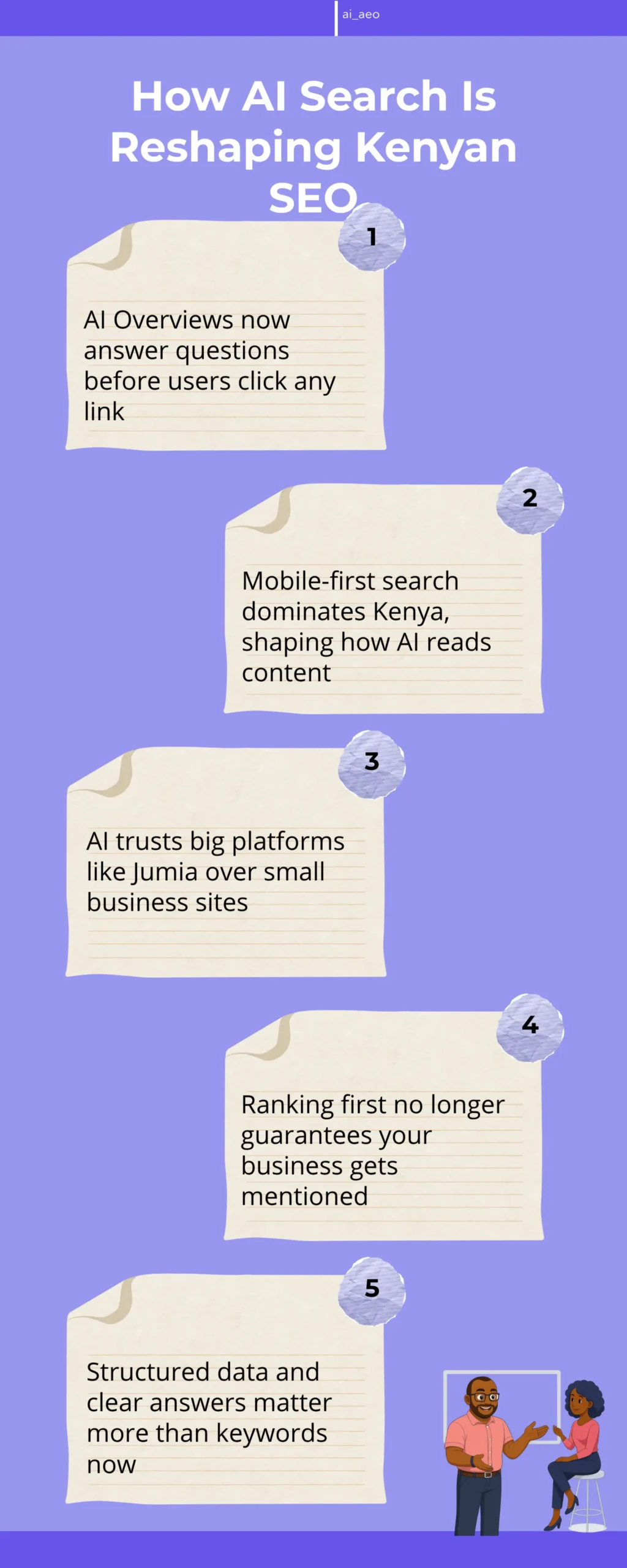
That model is breaking down. Google now often answers the question itself, right there on the results page, using an AI-generated summary pulled from several sources at once.
The Kenyan Business Owner’s Blind Spot
Most Kenyan SMEs I talk to still think SEO is only about keywords and page one rankings. That thinking made sense in 2018.
It does not fully hold up anymore because Kenya now has millions of active internet users. A growing share of their searches end in an AI-generated answer rather than a website visit. If your business is not built to be quoted by that answer, you become invisible even while technically ranking well.
How Kenyan Consumers Are Using AI to Find Businesses
From WhatsApp Groups to Google AI Overviews
Kenyans do not search the way American or European users do. Someone looking for a plumber in Kasarani is just as likely to ask in a residents’ WhatsApp group as they are to type it into Google.
Those WhatsApp conversations never reach AI search engines. This means a big chunk of real Kenyan discovery happens in channels that Google’s AI cannot see or learn from.
Mobile-First Search on a Kenyan Budget
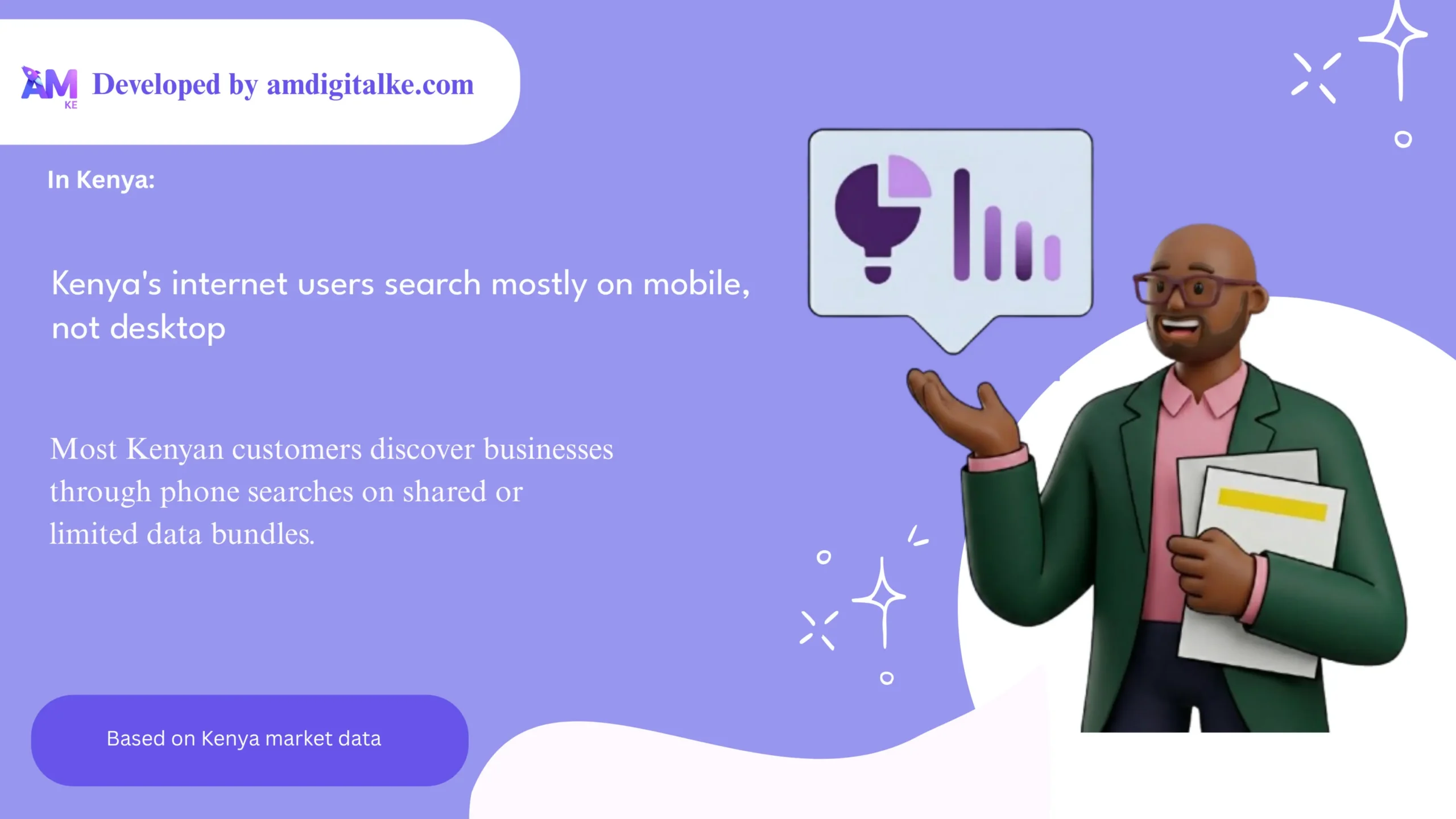
Most Kenyan searches happen on a smartphone, often on limited data. When someone searches “cheapest fridge Nairobi” on a slow connection, the AI Overview box can take longer to load than the regular results below it.
That delay actually helps traditional website links for now. This is a temporary window, and it will close as networks improve, so businesses should not assume slow internet will protect them for long.
On the flip side, when AI answers do load, they tend to reduce how often users click through to any single site. This shows up directly in click-through rates on search results for businesses that rely purely on organic ranking.
From Search Engines to Answer Engines: What’s Changed?
The Old Model: Ten Blue Links
Traditional Google search gave you ten results and let the user decide who to trust. Your job as a business was simple: rank higher than your competitor and the customer would find you.
That model rewarded persistence. Write more content, get more backlinks, rank higher, get more calls.
The New Model: One Direct Answer
Answer engines behave differently. Instead of listing options, Google’s AI Overview feature tries to summarize the best answer and present it directly, often citing two or three sources instead of ten.
ChatGPT and Bing Copilot work the same way when someone asks “where can I get a good caterer in Nairobi.” The businesses that get mentioned are the ones the AI trusts enough to quote, not necessarily the ones that rank highest. Understanding how to get featured in AI search results is now critical for visibility.
The Biggest Ways AI Search Changes SEO Strategy
Structured Data Becomes Non-Negotiable
AI tools read your website differently than a human does. They look for clear signals: is this a real business, does it have a physical location, does it have consistent information across the internet.
Structured data, which is a way of labeling your website content so machines can understand it, helps AI confirm those signals quickly. Without it, even accurate information on your site can get overlooked.
Trust Signals Matter More Than Keywords
Stuffing a page with the phrase “best hotel Mombasa” used to help you rank. It does almost nothing for AI trust today.
What matters now is whether other credible sources mention your business the same way, whether your Google Business Profile is complete, and whether your content actually answers the question in plain language. This is where AEO GEO LLMO strategies come into play.
| Old SEO Approach | New AI-Era SEO Approach |
|---|---|
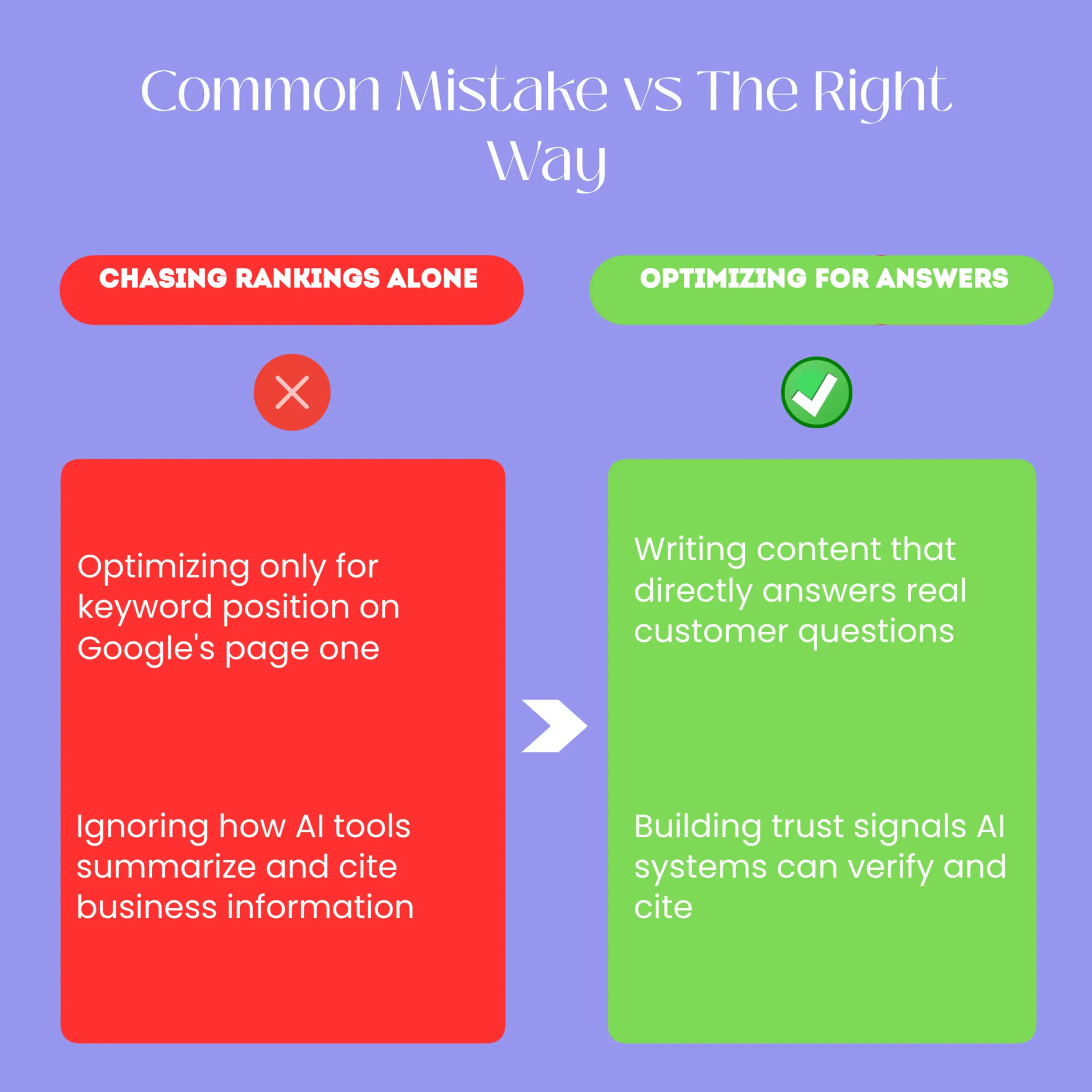
| Focus on ranking position (page one, top three) | Focus on being cited as a trusted answer source |
| Keyword density and repetition | Clear, direct answers to real customer questions |
| Backlinks as the main trust signal | Consistent business information across the web plus structured data |
| Success measured by clicks | Success measured by mentions, citations, and brand recall |
Why Traditional Rankings Alone Are No Longer Enough
Ranking Number One, Getting Zero Clicks
This is the exact problem my Kilimani real estate client faced. He was ranked first, but the AI Overview answered the question using a property portal instead of his site.
Rankings still matter, but they are now a starting point, not the finish line. Being findable is different from being chosen.
The Citation Gap for Kenyan Websites
AI models are trained heavily on data from large, well-established platforms. In Kenya, that often means Jumia, Jiji, OLX, and Lamudi get cited by AI far more often than individual SME websites, even when the SME has better, more specific local information.
This is not because those platforms are always more accurate. It is because AI trusts scale and consistency, and most individual Kenyan business websites have neither.
How Kenyan SMEs Can Stay Visible in AI Search Results 📊
Answer the Exact Questions Your Customers Ask
AI search rewards content written like a direct answer, not marketing copy. A plumber in Nairobi should have a page that plainly states “we fix burst pipes and blocked drains in Nairobi, same-day callout,” rather than vague language about “quality service.”
This matters even more given that a large share of Kenyan internet traffic now happens on mobile, where users expect fast, specific answers rather than long paragraphs to scroll through. Learning what is voice search seo helps you structure content for conversational queries.
Build Digital Trust the AI Can Verify
Consistency is the quiet advantage most Kenyan SMEs ignore. Your business name, phone number, and location should match exactly across your website, Google Business Profile, and any directory listing.
Reviews matter too, because AI treats a business with fifty consistent Google reviews very differently from one with three. This is one of the fastest, cheapest trust signals a small business can build.
The AI Readiness Gap: Why Some Businesses Will Win and Others Will Disappear
Industries Most at Risk
E-commerce sellers and independent real estate agents face the sharpest threat. AI already prefers citing large marketplaces like Jumia or Lamudi over individual sellers, and that bias is likely to deepen, not shrink.
Fintech-adjacent businesses relying purely on generic content also risk disappearing. AI tends to cite the platforms themselves, such as M-Pesa or Pesapal, rather than the small businesses using them. Even seo for saccos kenya requires a shift toward answer-focused content.
Industries Positioned to Win
Local service businesses with strong location intent, think plumbers, clinics, salons, and schools, are better positioned. Their customers search with specific local phrases like “dentist near Westlands,” which AI still struggles to answer well without a genuinely local, well-documented source.
Based on AM Digital KE client data across Kenyan accounts, service businesses that update their Google Business Profile weekly and answer common questions directly on their websites are appearing in AI-generated answers far more consistently than those that do not. Many of these strategies overlap with the best niche and industry seo strategies built for kenyan markets.
What Kenyan Businesses Should Do Right Now
Audit Your Business Information Across the Web
Start by searching your business name on Google. Check if your name, phone number, and address match everywhere they appear.
If they do not, fix them. AI reads inconsistency as a red flag.
Rewrite Your Homepage to Answer One Clear Question
Your homepage should answer the question “what does this business do and where” in the first two sentences. Not in a tagline. Not buried in the third paragraph.
AI does not scroll. It reads the top of the page and moves on.
Build a Simple FAQ Section
Write down the five questions customers ask you most often. Answer each one in two or three sentences on a dedicated FAQ page.
This is one of the easiest ways to get cited by AI. It works because AI is trained to pull from question-and-answer formats.
The Role of Social Platforms in AI Search Visibility
Why Instagram and Facebook Still Matter
AI does not yet crawl Instagram or Facebook posts the way it crawls websites. But social platforms still influence AI indirectly.
When customers mention your business on social media, it builds brand recognition. That recognition shows up in search volume, which AI interprets as a trust signal. Understanding which social platforms matter for kenyan businesses helps you focus your efforts.
WhatsApp Business as a Trust Signal
WhatsApp Business profiles are not indexed by Google AI yet. But they do show up in Google Business Profile listings, and those listings are heavily cited by AI.
Keep your WhatsApp Business profile updated with the same information as your website. Consistency across channels builds the kind of trust AI looks for. Some businesses are even integrating ai chatbot for kenya tools into WhatsApp to handle common queries faster.
How National vs Local SEO Strategy Changes in the AI Era
Local Businesses Have a Short-Term Advantage
AI still struggles with hyper-local queries. A search for “best mechanic Rongai” is harder for AI to answer confidently than “best mechanic Kenya.”
This gives local businesses a window to build authority before AI gets better at local answers. Deciding between national seo vs local seo which does your kenyan business need depends on your service area and growth goals.
National Brands Need Stronger Entity Signals
If your business operates across multiple counties, AI needs to see you as a single, unified entity. That means consistent branding, a single authoritative website, and mentions across credible national directories.
Businesses that operate nationally but have inconsistent regional pages or multiple unlinked websites confuse AI. They get cited less often as a result. Building national link building authority across kenyan regions helps unify your digital presence.
Service Area Businesses and AI Search
The Challenge of Ranking Without a Physical Location
Plumbers, electricians, and delivery services often do not have a storefront. They serve a region but do not have a fixed address customers visit.
AI struggles with this model because it looks for physical location signals. Without them, your business can rank lower even if you serve the area well. Mastering service area business seo ranking without a physical location requires specific technical setup.
How to Signal Service Areas to AI
Use structured data to define your service area clearly. List the neighborhoods or towns you serve on your website in plain text, not just in a dropdown menu.
AI reads text. It does not interact with forms or menus the way a human does.
Education and Parent-Focused Businesses in the AI Search Era
Why Schools and Tutors Are Well-Positioned
Parents search with very specific intent. “Best primary school Kileleshwa” or “affordable tutor for KCSE maths” are the kinds of queries AI can answer well if the right content exists.
Schools and tutors that publish clear, question-answering content about fees, curriculum, and location are getting cited more often than those that rely on vague mission statements. Knowing parent focused keywords understanding education search intent in kenya helps you write content that matches real search behavior.
The Importance of Reviews for Education Businesses
AI weighs reviews heavily when answering education-related queries. A school with fifty Google reviews and a 4.5-star rating will get cited far more often than one with five reviews, even if both rank similarly in traditional search.
Ask parents to leave reviews. Make it easy. Send a direct link.
What Happens If You Ignore AI Search?
The Slow Fade, Not a Sudden Drop
Businesses that ignore AI search will not disappear overnight. They will fade slowly as more of their competitors get cited by AI and they do not.
You will still rank. You will just stop getting calls.
The Cost of Waiting
Every month you wait to adapt is a month your competitors can use to build the trust signals AI looks for. Reviews, consistent listings, and clear content take time to accumulate.
Starting now gives you a head start. Waiting until 2026 means you will be playing catch-up.
Final Thoughts: AI Search Is Not the Future, It’s Already Here
The shift from search engines to answer engines is not something Kenyan businesses need to prepare for in five years. It is happening now.
The businesses that win will be the ones that stop optimizing for rankings alone and start optimizing for trust, clarity, and consistency. Those are the signals AI reads. Those are the signals that get you cited.
If your business is not showing up in AI-generated answers today, it will not magically appear tomorrow. Start building the foundation now.
Additional Resources
- What is Voice Search SEO – Voice search uses the same AI-driven answer extraction as ChatGPT and Google AI Overviews, so optimizing for voice prepares you for all AI search formats.
- Why Your Social Media Ads Send Customers to Competitors (+Free Checklist) – If AI search is stealing your organic traffic, you need paid channels that convert, and this checklist shows you how to stop wasting ad spend on clicks that don’t convert.
- Which Social Platforms Matter for Kenyan Businesses? – Building multi-platform presence is critical for AI trust signals, and this guide shows you which platforms Kenyan customers actually use to research businesses.
- Tracking What Matters – Essential Metrics for Kenyan Websites – You need to track AI Overview citations separately from regular organic traffic to measure your AI SEO success, and this guide shows you which metrics actually matter.
- Tourism SEO Kenya – How to Attract International Visitors – Tourism businesses face intense AI Overview competition from global sites, so this guide shows niche-specific tactics for getting cited in AI answers for Kenya travel queries.
- Social Media Content That Drives Website Traffic in Kenya – Since AI search reduces direct Google traffic, you need alternative channels to drive qualified visitors, and this shows you how to turn social followers into website visitors.