Table of Contents
- Key Takeaways
- Why Most Safari Pages Don’t Rank
- How to Optimise Safari and Tour Pages for Rankings
- Your Safari Page Quick-Win Checklist
- Related Content
- Frequently Asked Questions
- How do I choose the right keywords for Kenya safari pages?
- What should a good safari itinerary include?
- How can I build trust with international travellers?
- Why is localised content important for safari pages?
- What are common mistakes on Kenya safari pages?
TL;DR: To rank safari and tour pages, use detailed Kenya-specific content that answers travellers’ questions directly.
Last Updated: March 2026
Key Takeaways
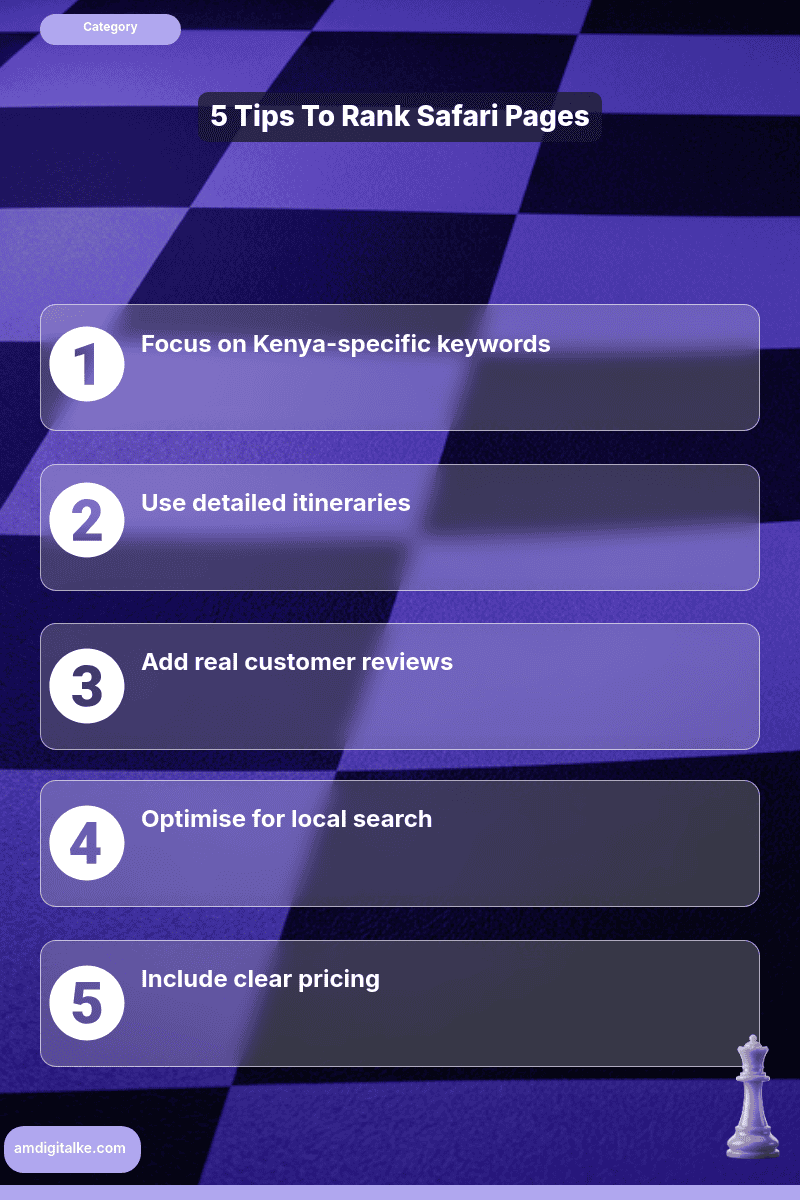
- Target specific long-tail keywords
- Write detailed, scannable itineraries
- Include trust-building elements
- Optimise for local search intent
- Use Kenya-specific examples
Your safari company offers incredible experiences. Game drives in the Maasai Mara, beach getaways in Diani, and cultural tours across Kenya.
But when international travellers search “Kenya safari packages” or “Maasai Mara tours,” they’re finding your competitors instead.
The problem isn’t your experiences. It’s how you’re presenting them to Google.
Experience and activity pages are where bookings happen. If they’re not optimised, you’re leaving thousands of dollars on the table.
Why Most Safari Pages Don’t Rank
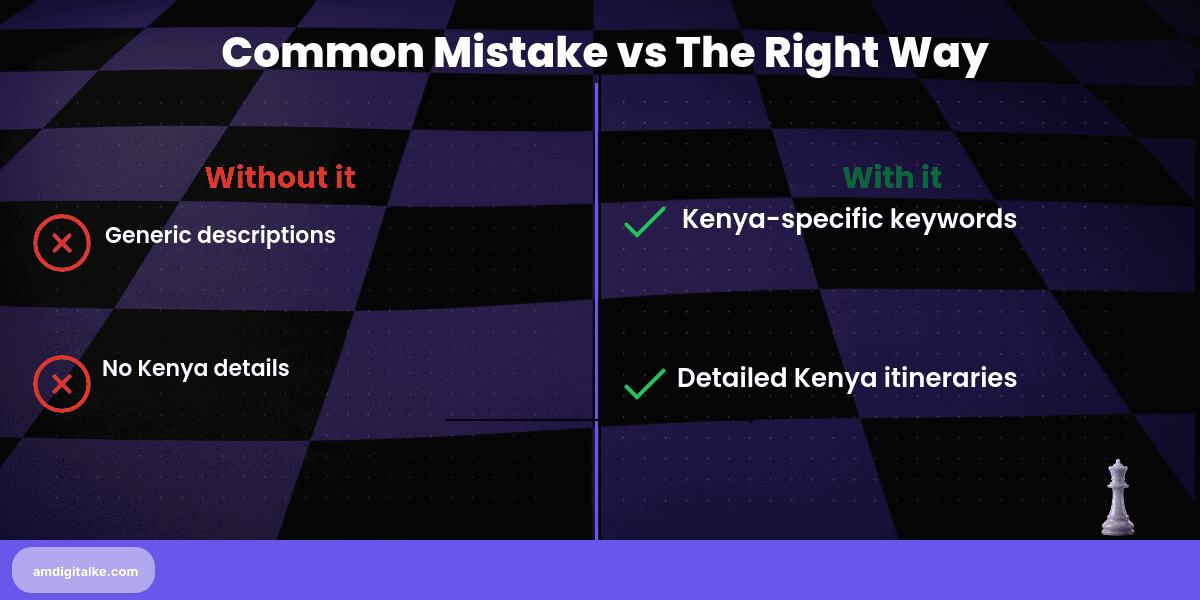
Most Kenyan tour operators make the same mistakes. Generic descriptions copied from brochures.
Thin content that doesn’t answer traveller questions. Zero optimisation for how people actually search when understanding what SEO really means for tour bookings.
When a potential visitor searches “3-day Maasai Mara safari cost,” they’re comparing dozens of options.
Google prioritises pages that comprehensively answer search intent. Detailed itineraries, transparent pricing, trust signals like reviews, and location-specific information.
How to Optimise Safari and Tour Pages for Rankings
Target Long-Tail, Intent-Driven Keywords
Don’t optimise for “Kenya safari.” You’ll never outrank SafariBookings through implementing keyword research properly.
Instead, target specific queries:
- “3-day Maasai Mara budget safari”
- “luxury Amboseli safari with balloon ride”
- “family-friendly Diani beach holiday”
Use Google’s autocomplete and “People also ask” to find what travellers actually search.
Write Detailed, Scannable Itineraries
Generic itineraries don’t inspire bookings by creating valuable content marketing strategies. Compare:
❌ Bad Example: “Day 1: Arrive and game drive”
✅ Good Example: “Day 1: Nairobi to Maasai Mara
6:00 AM: Hotel pick-up from Nairobi
1:00 PM: Arrival at camp with Maasai welcome
3:00 PM: Afternoon game drive through Mara Triangle
7:30 PM: Dinner under the stars”
Specific timings and vivid details answer questions and sell the experience.
Include Trust-Building Elements
International bookings require trust. Add:
- Real customer reviews with names and countries
- Safety certifications (Kenya Tourism Board licensed)
- Payment security badges
- Clear cancellation policies
- TripAdvisor ratings
Optimise Images for Search
Use descriptive file names like maasai-mara-lion-game-drive.jpg (not IMG_1234.jpg).
Write detailed alt text: “Male lion resting under an acacia tree during Maasai Mara game drive.” Compress images for faster loading through optimising page speed strategically.
Fast loading is crucial for international visitors.
Display Transparent Pricing
Hidden pricing kills conversions. Show:
- Base price per person for different group sizes
- What’s included (park fees, meals, transport)
- What’s extra (tips, optional balloon safaris)
- Seasonal variations
Example: “Starting from $450 per person (4 travellers sharing). Includes: All park fees, 3 meals daily, 4×4 safari jeep, professional guide, mid-range tented camp.”
Implement Tour Schema Markup
Schema markup helps Google display rich results with pricing and reviews by implementing schema markup correctly.
Add structured data for:
- Tour name
- Location
- Pricing
- Reviews
- Booking URL
Use tools like Yoast SEO to implement this easily.
Create Internal Linking Clusters
Link strategically from:
- Your homepage (feature signature safaris)
- Location pages (“Best Safaris in Maasai Mara”)
- Blog posts (“Planning a Kenya Safari? Our 5-Day Mara Package is Perfect”)
This builds topical authority when understanding what link building means for tour visibility.
A Nairobi-based tour operator’s 5-day Kenya safari package was invisible online.
Before:
- Generic 150-word page
- Ranking page 8+
- Zero organic bookings
After:
- Comprehensive 2,000-word page with detailed itinerary
- Transparent pricing ($1,250/person)
- 15+ reviews
- FAQ section
- Optimised images
- Schema markup
Result:
- Position 3-5 for “5-day Kenya safari” and related terms
- Based on AM Digital KE client data across Kenyan accounts, organic bookings increased 340% in 6 months
Your Safari Page Quick-Win Checklist
☐ Target 5-10 long-tail safari keywords (e.g., “budget Maasai Mara safari 3 days”)
☐ Write a detailed day-by-day itinerary with specific timings (minimum 1,500 words total)
☐ Display transparent pricing with group options and inclusions/exclusions
☐ Add 10+ customer reviews and trust badges (Kenya Tourism Board, SafariBookings verified)
☐ Optimise all safari images (descriptive filenames, alt text, compression)
☐ Implement Tour schema markup for rich search results
☐ Create internal links from the homepage, blog posts, and location pages through optimising your local SEO presence
For comprehensive guidance on optimising tour content, check out my SEO FAQs page, where I answer common safari SEO questions.
Before launching your optimised safari pages, download this complete SEO Checklist to ensure you’ve covered all booking-driving elements.
Turn Safari Searches Into Confirmed Bookings
Safari bookings happen when travellers feel informed and trust your expertise.
At AM Digital KE, we help Kenyan tour operators transform thin experience pages into comprehensive resources. Pages that rank for safari keywords and convert international visitors into confirmed bookings.
Want your safari packages ranking when travellers are ready to book? Visit our Hospitality SEO Services in Kenya and see how we transform generic tour pages into comprehensive experiences that capture high-intent safari searches and drive bookings.
Are you unsure why your tours aren’t converting searchers? Get a free, comprehensive analysis where we’ll evaluate your itinerary presentation, assess pricing transparency, and identify content gaps that prevent international travellers from booking with confidence.
Related Content
Curious to learn more about ranking safari and tour pages? Check out the posts below
- What is Keyword Research (For the Kenya Market) – Keyword research reveals the exact long-tail safari queries international travellers use when comparing tour packages
- What is Search Intent (from a Kenyan Expert) – Understanding search intent helps you create safari content that answers booking questions and drives conversions
- Why Search Intent Beats Search Volume: The Strategic SEO Move – Targeting booking-ready safari searches delivers better ROI than chasing high-volume but low-intent traffic
- The Best Niche and Industry SEO Strategies Built for Kenyan Markets – See how Kenyan tour operators apply niche SEO strategies to dominate safari and tour searches
These articles will walk you through the basics of building safari pages that rank and convert international travellers.
Have more SEO questions? Our SEO FAQs Kenya page answers the most common ones.
Frequently Asked Questions
How do I choose the right keywords for Kenya safari pages?
Use Kenya-specific searches like ‘budget Maasai Mara safari’ or ‘family-friendly Diani beach holiday’.
What should a good safari itinerary include?
Timings, vivid details, and Kenya-specific experiences like Maasai welcomes or Mara Triangle tours.
How can I build trust with international travellers?
Add real Kenya-based customer reviews with names and countries.
Why is localised content important for safari pages?
Google prioritises Kenya-specific pages that comprehensively answer search intent.
What are common mistakes on Kenya safari pages?
Generic descriptions, thin content, and lack of Kenya-specific details.