Table of Contents
- What You Need to Know About Marketing Automation
- 📋 Key Takeaways
- What is Marketing Automation?
- Why Does Marketing Automation Matter for Kenyan Businesses?
- How Marketing Automation Works
- Marketing Automation Examples in Kenya
- Common Mistakes to Avoid
- ✅ Quick Action Checklist
- Ready to Improve Your Marketing Automation?
- Frequently Asked Questions
- Additional Resources
- Take the Next Step
TL;DR: Marketing automation is software that handles repetitive marketing tasks like sending emails, scoring leads, and following up with customers automatically. Instead of your team manually sending emails and tracking who is interested, the system does it for you based on rules you set. For Kenyan businesses, this means your small team can manage hundreds of leads without working nights and weekends.
What You Need to Know About Marketing Automation
Your sales team is drowning in follow-ups. Your marketing person is copy-pasting emails.
Leads are falling through the cracks because nobody has time to nurture them properly. This happens in Nairobi, Mombasa, and everywhere else in Kenya.
Marketing automation fixes this problem. It automates the repetitive work that wastes your team’s time and costs you sales.
Think of it like this: instead of your marketing person manually sending 50 follow-up emails every Monday morning, the system sends them automatically. It works based on what each customer did on your website.
The customer visited your pricing page? The system sends them a pricing email. They clicked a link in that email? The system sends the next email in the sequence.
They have not opened anything in 5 days? The system sends a re-engagement email. If you want the practical steps to set this up, check out our guide on setting up marketing automation for your business.
This is not just email, though email is the core. Marketing automation also tracks which leads are most likely to buy and reminds your sales team to follow up with hot prospects.
It gives you reports showing exactly where customers are in their buying journey. These become marketing workflows that scale your kenyan business without adding headcount.
For a Kenyan business, this is transformational. You can compete with bigger companies without hiring a huge team.
📋 Key Takeaways
- Marketing automation handles repetitive tasks like emails, follow-ups, and lead scoring so your team focuses on selling and strategy.
- It works by setting rules and triggers: when a customer does X, the system automatically does Y (send email, move to sales pipeline, score higher).
- The main benefit for Kenyan SMEs is time savings: what takes 20 hours manually now takes 2 hours to set up, then runs itself.
- Common tools include HubSpot, Mailchimp, and ActiveCampaign, though many are too expensive for startups; cheaper alternatives exist for Kenya.
- The biggest mistake is buying the tool and expecting magic; automation only works if you have good data, clear processes, and a real strategy behind it.
What is Marketing Automation?
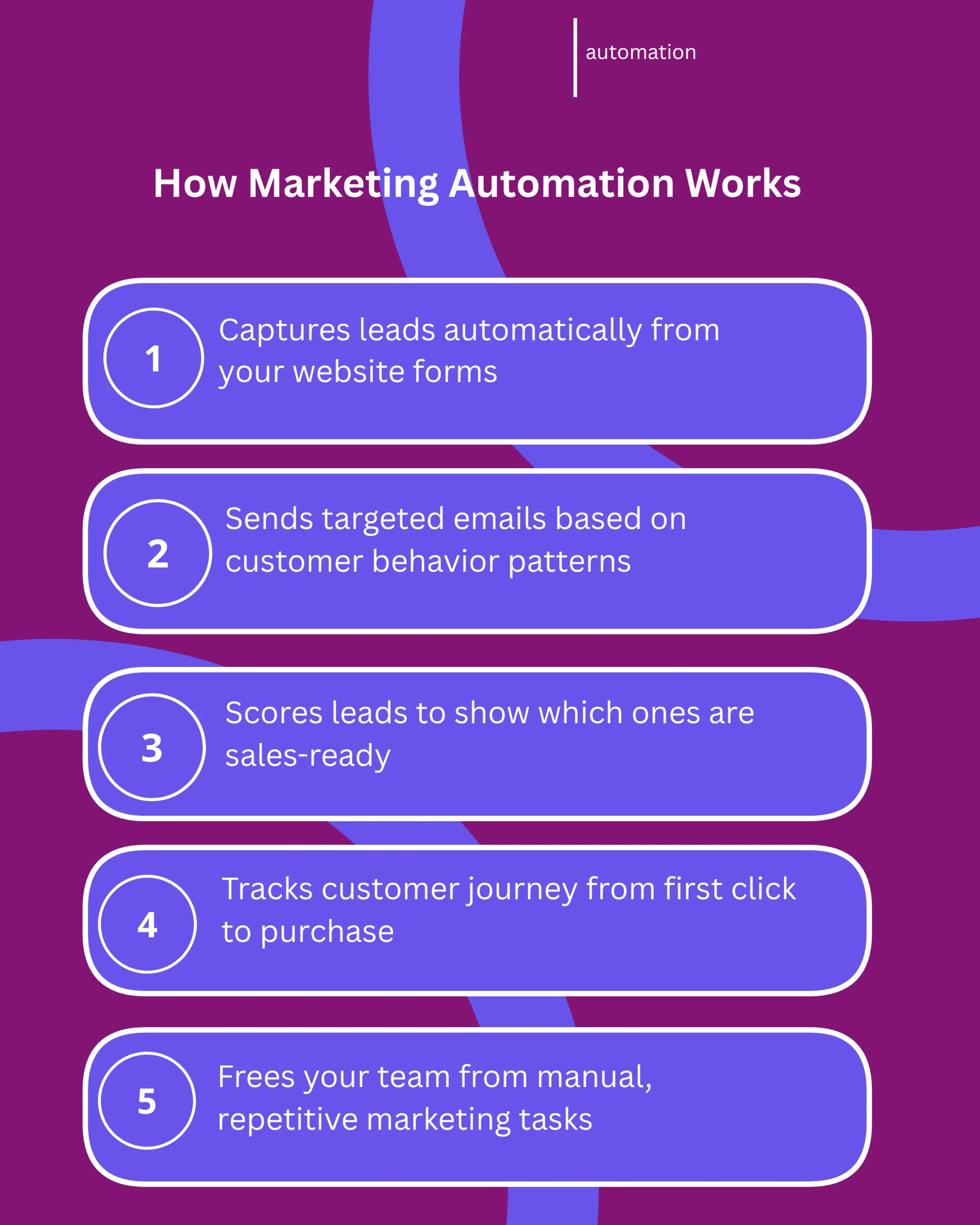
Marketing automation is software that performs marketing tasks automatically based on rules and triggers you define. You set it up once. It runs without human intervention 24/7.
The core idea is simple. Stop doing the same repetitive task over and over, and let software do it instead.
The Core Functions of Marketing Automation
Every marketing automation platform does a few key things. First, it captures leads from your website, landing pages, or forms and stores them in a central database.
Second, it sends emails automatically based on triggers. A trigger is an action the customer takes: they download a guide, they visit your pricing page, they click a link, they do not open an email for 7 days.
Third, it scores leads. Lead scoring assigns points to each lead based on their behavior, so your sales team knows which leads are hot and ready to talk to a salesperson.
Fourth, it segments your audience. Instead of sending the same message to everyone, the system groups people based on what they did, who they are, or what they are interested in.
Each person then gets a relevant message. Reviews and Q&As from real customers strengthen these segments too, since user generated content reviews and qas that boost rankings gives you fresh signals about buyer intent.
Fifth, it tracks behavior. You see exactly which emails were opened, which links were clicked, which pages were visited, and how many times.
Marketing Automation vs Manual Marketing
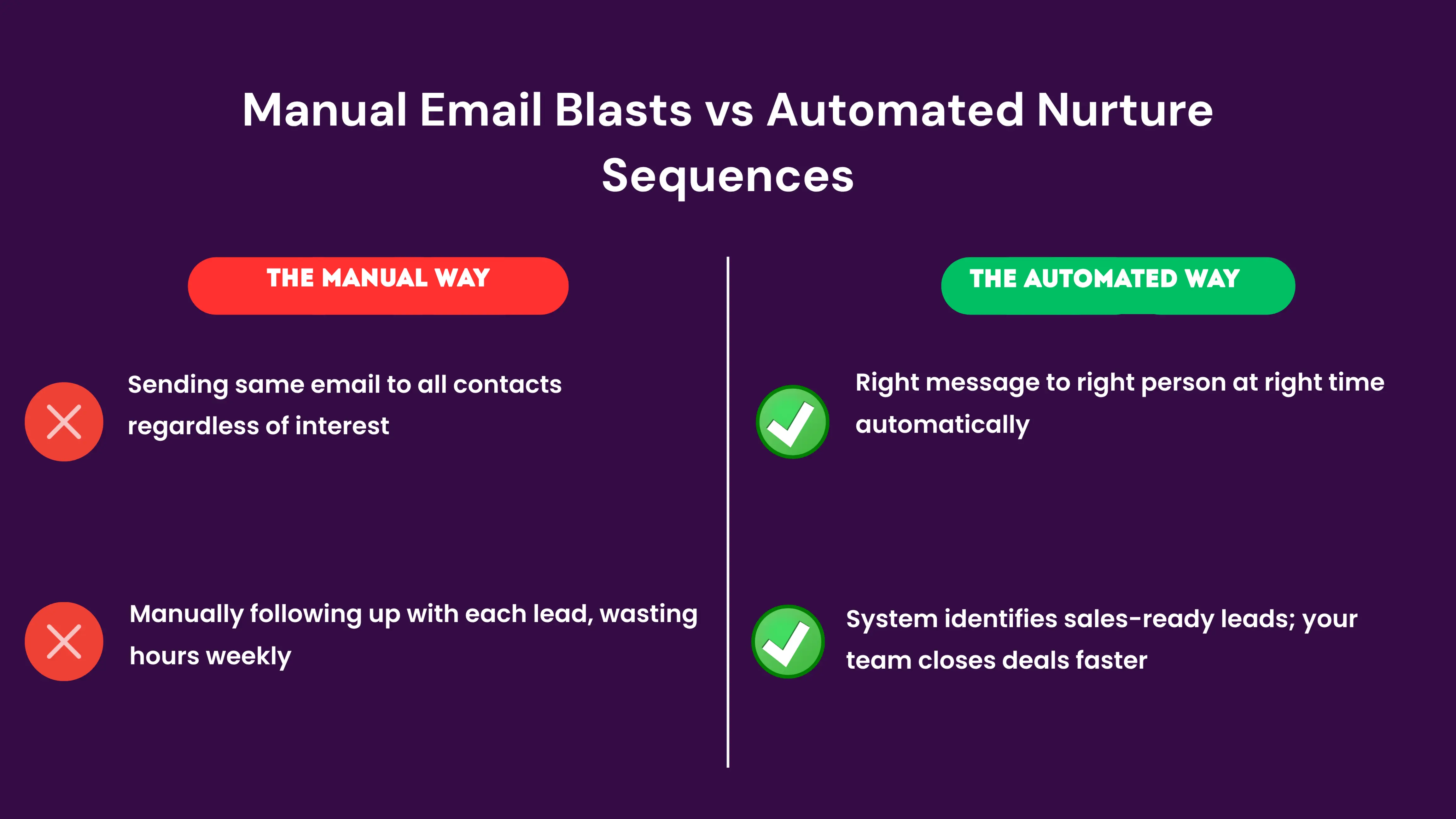
Without automation, your team does this manually. Your marketing person checks email replies, looks at Google Analytics to see who visited your site, and manually sends follow-up emails to interested people.
They also keep a spreadsheet of who is a hot lead. This is slow, error-prone, and exhausting.
A Nairobi digital agency we know spends 15 hours every week just sending and tracking follow-up emails. Choosing the right partner matters here too, which is why comparisons like savage digital vs am digital ke help business owners see what proper setup looks like.
With automation, the system does all of this instantly, 24/7, without mistakes. Your team spends 2 hours setting it up, then 1 hour per week maintaining it.
Why Does Marketing Automation Matter for Kenyan Businesses?
Marketing automation kenya is not a luxury for big companies. It is a necessity for Kenyan SMEs that want to grow without hiring a huge marketing and sales team.
Here is why it matters so much in the Kenya market.
You Can Compete With Bigger Companies
A small business in Nairobi with 3 employees should not lose deals to a bigger competitor just because they have a larger team. Marketing automation levels the playing field.
When you automate lead nurturing, your 3-person team can manage as many leads as a 10-person team at a bigger company. Your leads get follow-ups automatically, so nothing falls through the cracks.
This is especially true in competitive markets like digital marketing, e-commerce, and B2B services. Many businesses in these spaces are chasing the same customers.
You Save Massive Amounts of Time
Manual follow-up sequences take 15-20 hours per week for most small teams. That is almost half a full-time employee doing nothing but sending emails and tracking responses.
Automation cuts this to 1-2 hours per week. Your team can then spend that time on high-value work like closing deals and talking to customers.
For a Mombasa e-commerce business we worked with, this meant real change. The owner went from spending 12 hours on follow-ups to 1 hour, and revenue increased by 40% because the sales team had time to actually sell.
You Get Better Data About Your Customers
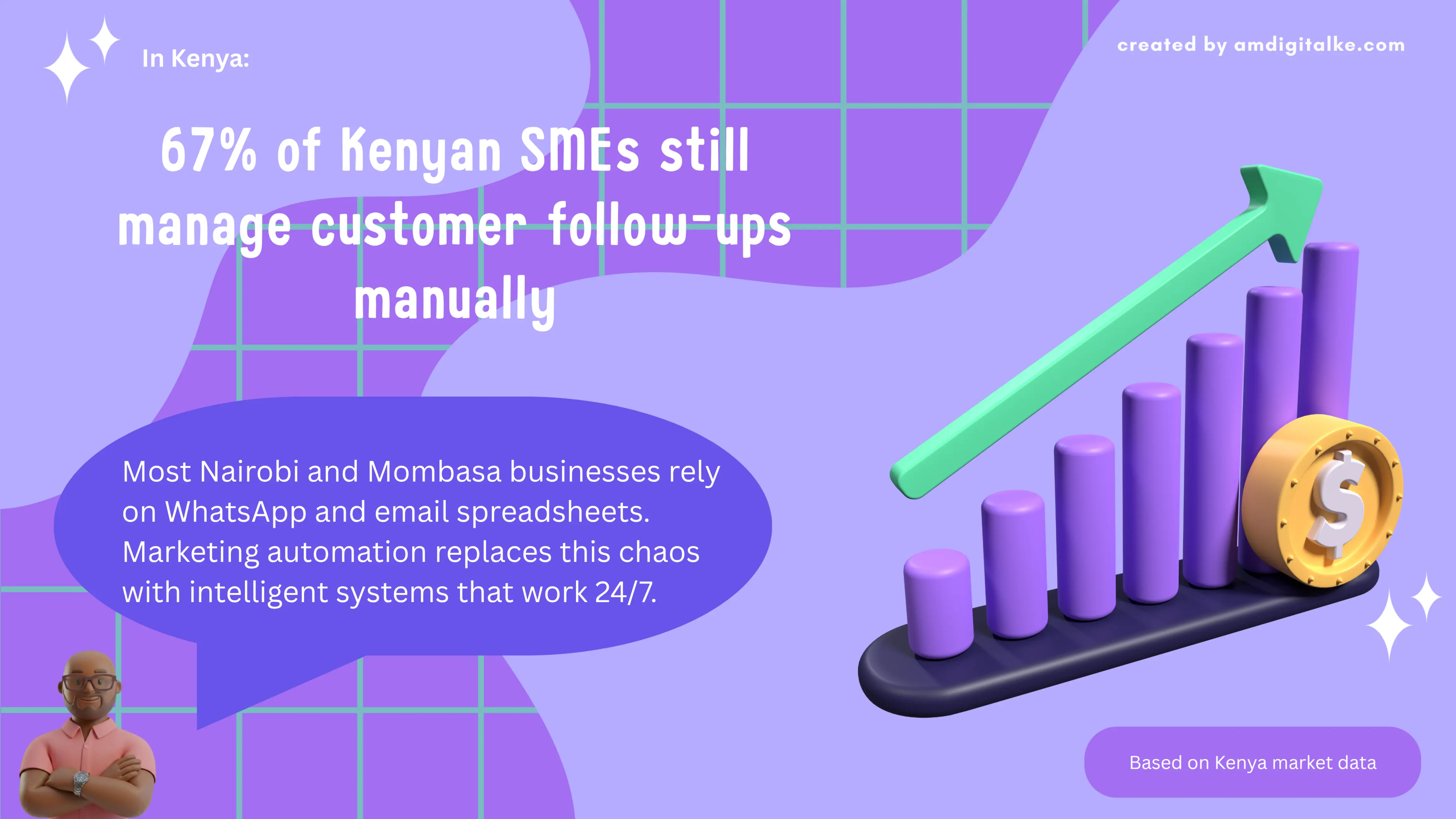
Most Kenyan businesses have customer data scattered across email, WhatsApp, spreadsheets, and their own memory. This makes it impossible to know who is actually interested, who is about to buy, and who has gone cold.
Marketing automation centralizes this data and creates a clear picture. You see exactly what each customer did, when they did it, and what they are interested in.
This data then drives better decisions. You know which marketing messages work, which products sell best, and which customers are most likely to buy.
You Convert More Leads Into Customers
When leads get ignored or forgotten, they go to your competitor. When they get consistent, relevant follow-ups, they convert.
Studies show that businesses that nurture leads with automated sequences have 50% higher conversion rates than those that do not. For a Kenyan SaaS company, this could mean the difference between 5 customers per month and 7-8.
The key is consistency. Every lead gets the same high-quality follow-up sequence, every time, without exception.
How Marketing Automation Works
Marketing automation runs on clear steps: capture, segment, trigger, send, track, score, and repeat. It is a system, not magic.
Understanding how it works will help you decide if it is right for your business and how to set it up correctly.
Step 1: Lead Capture
The system starts by capturing leads through lead capture automation that never misses a potential customer. This happens through forms on your website, landing pages, email signups, or integrations with your other tools.
When someone fills out a form to download a guide or sign up for a webinar, their information goes automatically into your marketing automation platform. No manual data entry.
For a Kenyan consultant offering free resources, this might work like this. A visitor downloads your “How to Export to East Africa” guide and their email address is instantly captured and added to your system.
Step 2: Segmentation
Once the lead is captured, the system puts them into groups based on what you know about them. These groups are called segments.
You might segment by industry, company size, behavior, or interests. A real estate business in Nairobi might segment leads into “looking for residential”, “looking for commercial”, and “just browsing”.
Segmentation matters because it lets you send the right message to the right person. A commercial property buyer does not need emails about residential properties.
Step 3: Triggers and Workflows
A trigger is a rule you set. When a customer does X, the system automatically does Y.
Common triggers include a form fill, a link click, a page visit, a resource download, or no action for a set number of days.
Once triggered, the system follows a workflow. A workflow is a sequence of actions: send email 1, wait 2 days, send email 2, wait 3 days, send email 3, then move to sales if they clicked a link.
Step 4: Lead Scoring
Lead scoring tells you which leads are hot and which are cold. Each action a lead takes earns them points.
Visiting your pricing page might be worth 10 points. Opening an email might be worth 2 points, clicking a link 5 points, and downloading a case study 15 points.
When a lead reaches a certain score, say 50 points, the system automatically notifies your sales team or moves them to a “sales-ready” list. Your sales team then knows exactly who to call.
Step 5: Tracking and Reporting
The system tracks everything. It logs which emails were opened, which links were clicked, which pages were visited, how many times, and when.
This data feeds into reports that show you exactly what is working. You see which subject lines get the most opens, which emails drive the most clicks, and which sequences convert the most leads into customers.
A Mombasa hotel using automation can see that emails about “last-minute deals” get 45% open rates while emails about “loyalty rewards” get 28% open rates. Comparing tools matters here too, as shown in this Artly vs AM Digital KE breakdown, since the right platform shapes what data you can act on.
Marketing Automation Examples in Kenya
Marketing automation works differently depending on your business type. Here are real examples of how Kenyan businesses use it.
E-Commerce: Abandoned Cart Recovery
An online retailer in Nairobi sells fashion. A customer adds items to their cart but does not check out.
Trigger: cart abandoned for 1 hour. Workflow: send email 1 with the abandoned items and a discount code.
Wait 24 hours. If they did not buy, send email 2 with a different offer.
Wait 48 hours. If they still did not buy, send email 3 with urgency (“only 2 left in stock”). This kind of email automation for Kenyan businesses converting leads while you sleep runs without anyone touching it.
Result: 20-30% of abandoned carts convert to sales. Without automation, that number would be zero.
B2B Services: Lead Nurturing
A Nairobi digital marketing agency targets small businesses. A business owner downloads their “SEO Guide for Kenyan SMEs”.
Trigger: downloaded the guide. Workflow: send email 1 thanking them and offering a free audit.
Wait 3 days. Send email 2 with a case study.
Wait 5 days. Send email 3 with pricing.
Wait 7 days. Send email 4 asking if they have questions.
Lead scoring: opening an email earns 5 points. Clicking a link earns 10 points, downloading a case study earns 20 points, and visiting the pricing page earns 25 points.
When they hit 50 points, the sales team calls them.
Result: 15-20% of leads convert to paying clients. Without nurturing, that figure sits at 2-3%.
SaaS: Onboarding New Users
A Kenyan accounting software company signs up a new user. Trigger: account created.
Workflow: send email 1 with login instructions and a quick start guide. Wait 2 days, then send email 2 with a video tutorial.
Wait 3 days. Send email 3 offering a live demo.
Wait 7 days. If they have not logged in, send email 4 asking if they need help. Some businesses pair this with WhatsApp business automation answering customer questions 24 7 so new users get help the moment they ask.
Result: users who go through the automation sequence are 60% more likely to stay active after 30 days.
Common Mistakes to Avoid
Marketing automation fails fast when businesses skip the basics. Here are the most common mistakes Kenyan businesses make.
Buying the Tool Without a Strategy
Many businesses buy a marketing automation platform and expect it to magically generate sales. It does not.
Automation is only as good as the strategy behind it. If you do not know who your customers are or what your sales process is, automation will not help.
Before you buy any tool, define your customer journey, your messaging, and your sales process. Then use automation to execute that process at scale.
Sending the Same Message to Everyone
Segmentation is critical, but many businesses skip it. They set up one email sequence and send it to all 5,000 contacts, regardless of who they are.
This does not work. A lead who just downloaded your free guide needs a different message than a lead who visited your pricing page 10 times.
Always segment your audience and create different sequences for different groups.
Ignoring Data Quality
Automation is only as good as your data. If your email list is full of fake addresses, wrong names, or outdated information, your automation will fail.
Many Kenyan businesses import data from old spreadsheets without cleaning it first. This leads to high bounce rates, low engagement, and damaged sender reputation.
Before you set up automation, audit your data. Remove duplicates and invalid emails, then update outdated information.
Setting It and Forgetting It
Automation is not a set-it-and-forget-it tool. You need to monitor performance, test new sequences, and adjust based on results.
Check your open rates, click rates, and conversion rates weekly. If a sequence is not working, fix it.
The businesses that see the best results treat automation as an ongoing experiment. They do not treat it as a one-time setup. Some even structure their guides to answer common questions directly, since Google often pulls these into featured snippets.
✅ Quick Action Checklist
- ☐ Define your customer journey: from first touchpoint to sale to repeat customer
- ☐ Audit your current customer data and clean out duplicates, invalid emails, and outdated information
- ☐ List the repetitive marketing tasks your team does weekly (follow-ups, welcome emails, etc.)
- ☐ Choose a marketing automation platform that fits your budget and needs (start with free or low-cost options)
- ☐ Create your first email sequence: capture, segment, trigger, send, track
- ☐ Set up lead scoring rules based on actions that indicate buying intent
- ☐ Monitor performance weekly: open rates, click rates, conversion rates, and lead quality
- ☐ Test and iterate: change subject lines, email timing, and messaging based on what works
Ready to Improve Your Marketing Automation?
Marketing automation is not a future technology. Kenyan businesses are using it right now to save time, convert more leads, and compete with bigger companies.
The best time to start is today, with a clear strategy and realistic expectations. Start small, measure everything, and scale what works.
Stop wasting time on manual follow-ups. We can help you build a system that actually works for your business, from social media automation consistency without burnout to full lead nurturing.
Frequently Asked Questions
What is the difference between marketing automation and email marketing?
Email marketing is sending emails to a list. Marketing automation is a system that sends emails automatically based on customer behavior, segments audiences, scores leads, and tracks everything.
Email is one tool within marketing automation, not the whole thing.
How much does marketing automation cost in Kenya?
Prices range from free (Mailchimp for small lists) to KES 5,000-50,000+ per month for advanced platforms like HubSpot or ActiveCampaign. Start with a free or low-cost option and upgrade as you grow.
Do I need marketing automation if I am a small business?
Yes. Small businesses benefit most because automation lets you do the work of a much larger team.
If you have more than 50 leads per month, automation will save you time and money. A car repair shop using auto service SEO to attract local repair and maintenance customers can pair that traffic with automated follow-up to book more jobs.
How long does it take to set up marketing automation?
A basic setup takes 1-2 weeks. You choose a platform, clean your data, create segments, and build your first 2-3 email sequences.
Start simple and add complexity as you learn.
What happens if my marketing automation platform breaks or goes down?
Most reputable platforms have 99%+ uptime. Back up your data regularly and have a support plan in place.
Choose platforms with good customer support. This matters most for Kenyan businesses with limited IT resources, similar to how YMYL content writing for health information Google trusts demands extra care and reliability.
Additional Resources
- Social Media Automation Kenya – See how one piece of the marketing automation puzzle works in practice on Kenyan social platforms.
- Tourism SEO Kenya – How to Attract International Visitors – Learn how automated email and content workflows can feed a tourism SEO strategy that captures international bookings.
- The Review Velocity Strategy-Outranking Competitors Fast – Find out how to automate review requests, one of the easiest wins once your marketing automation system is set up.
- Strategic Partnerships – Co-Marketing for Mutual Link Benefits – Discover how automated co-marketing campaigns with partners can extend your reach without extra manual work.
- Service Route Pages – Optimising for ‘Nairobi to Mombasa Transport’ – See a real example of how automated lead nurturing can support location-specific service pages like this one.
- Service Area Pages – Targeting Multiple Nairobi Neighbourhoods – Learn how businesses use automation to follow up with leads from different Nairobi neighbourhoods without hiring extra staff.
Take the Next Step
Marketing automation is a game-changer for Kenyan businesses that want to scale without hiring a huge team. The question is not whether you can afford to automate. It is whether you can afford not to.
Stop wasting hours on manual follow-ups. Download the Marketing Automation Audit for Kenyan Businesses to see exactly where you stand and what you can automate first.