Table of Contents
- Why Your Product Pages Aren’t Selling (Even Though You Have Good Products)
- 📋 Key Takeaways
- What You Need Before You Start
- Step 1: Research and Choose the Right Keywords for Each Product
- Step 2: Write Product Titles That Rank and Convert
- Step 3: Write Product Descriptions That Answer Customer Questions
- Step 4: Optimize Your Meta Description for Click-Through Rate
- Step 5: Fix Your Page Speed (This Matters More Than You Think)
- Step 6: Add Internal Links to Related Products
- Common Mistakes to Avoid 🚫
- Quick Comparison Table: Before vs. After Optimization
- ✅ Quick Action Checklist
- Ready to Improve Your Product Page Rankings?
- Frequently Asked Questions
- Additional Resources
- Take the Next Step
TL;DR: Your product pages are invisible to customers because Google can’t understand them the way you’ve written them. Fix your keyword research, title tags, descriptions, and page speed, and you’ll rank for what people actually search for in Kenya. Stop copying manufacturer text and start writing for your customer’s search intent.
Why Your Product Pages Aren’t Selling (Even Though You Have Good Products)
You have products. You have a website.
But customers aren’t finding you on Google, so they’re buying from your competitors instead.
The problem isn’t your products. It’s that your product pages are invisible to Google, and invisible to the people searching for what you sell.
This happens to almost every Kenyan business owner because we’re taught to write product descriptions the way manufacturers write them. Generic. Keyword-free. Useless for search engine optimization.
Product page SEO is different from regular SEO. It’s not about writing long blog posts or building backlinks from news sites.
It’s about understanding exactly what your customers search for, then writing your product pages in a way that Google understands and ranks them. When you optimize on page seo correctly, customers find you organically.
No paid ads. No Facebook spend. Just Google search traffic converting into sales.
📋 Key Takeaways
- Keyword research for product pages is different: you’re looking for buyer intent, not just search volume. A customer searching “affordable office chairs Nairobi” is closer to buying than someone searching “what are office chairs.”
- Your title tag and meta description are your first impression on Google. They must include your target keyword and speak directly to the customer’s problem, not just describe what you sell.
- Product descriptions rank when they answer the questions customers actually ask before buying: price, quality, delivery time, warranty, and whether it works in Kenya’s climate or environment.
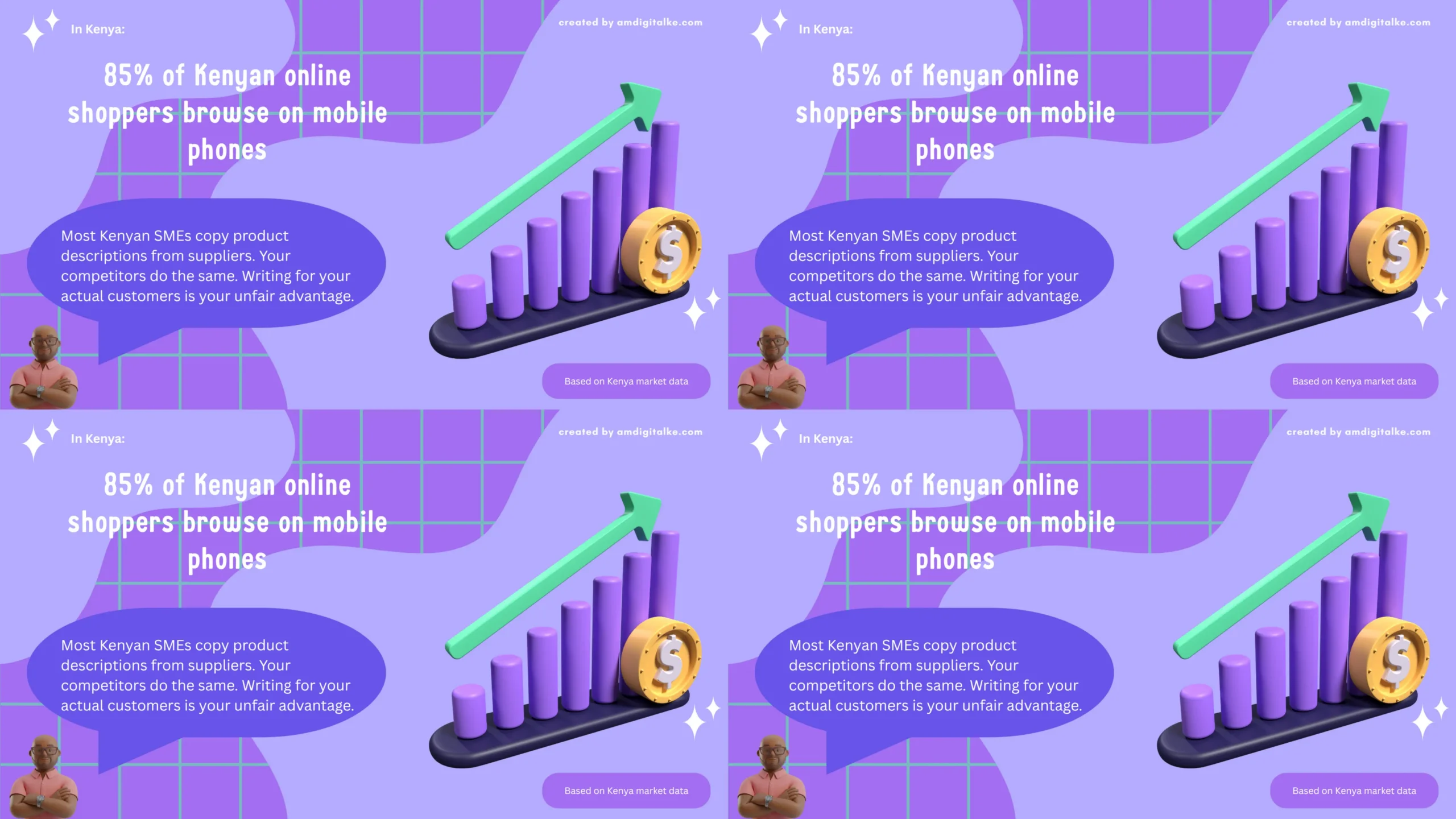
- Page speed on mobile is non-negotiable in Kenya. Based on AM Digital KE client data across Kenyan accounts, customers browse on 3G or 4G. A slow page loses sales and ranking positions simultaneously.
- Internal linking between related products keeps customers on your site longer and tells Google which pages are most important. This is where most Kenyan e-commerce sites fail completely.
What You Need Before You Start
Before you optimize a single product page, you need three things: a list of keywords your customers actually search for, a way to measure whether your changes work, and an honest look at your current page speed.
Most Kenyan business owners skip this step. They jump straight to rewriting their product descriptions.
Then nothing changes because they’re optimizing for the wrong keywords.
Keyword Research: Finding What Your Customers Actually Search For
Keyword research for product pages is simpler than blog post research, but more specific. You’re not looking for “office chairs.”
You’re looking for “office chairs Nairobi,” “ergonomic office chairs Kenya,” or “office chairs under 5000 shillings.”
These longer, more specific searches are called long-tail keywords. They have lower search volume, but higher buyer intent.
Someone searching “office chairs under 5000 shillings” is ready to buy today.
Start by typing your product into Google and looking at the search suggestions that appear. If you sell phone screen protectors, Google will suggest “phone screen protectors Kenya,” “tempered glass screen protector,” “iPhone screen protector price.”
Write down the top 10 suggestions. These are real searches real people make every month.
Next, look at what your competitors rank for. Go to Google, search your main product keyword, and click on the top 5 results.
Read their product titles and descriptions. What keywords are they targeting?
You don’t copy their approach. You find the gaps.
If every competitor is targeting “office chairs Nairobi,” maybe you target “affordable office chairs Nairobi” or “office chairs Westlands” to own a specific neighborhood or price point.
Set Up Basic Analytics Before You Change Anything
You can’t improve what you don’t measure. Before you optimize your first product page, you need to know your current baseline: how many people visit this page, how long they stay, and whether they buy.
Google Analytics is free. Set it up on your website if you haven’t already.
Create a simple spreadsheet with your top 20 product pages and their current metrics: monthly visitors, bounce rate, conversion rate.
Come back to this spreadsheet in 60 days. If your changes worked, these numbers will improve.
Check Your Page Speed Right Now
Go to Google PageSpeed Insights. Paste in the URL of one of your product pages.
Your score will appear instantly.
If your score is below 50 on mobile, your page is slow. Customers are leaving before they even read your product description.
Screenshot this score. You’ll need to improve page speed later, and you’ll want proof that your changes worked.
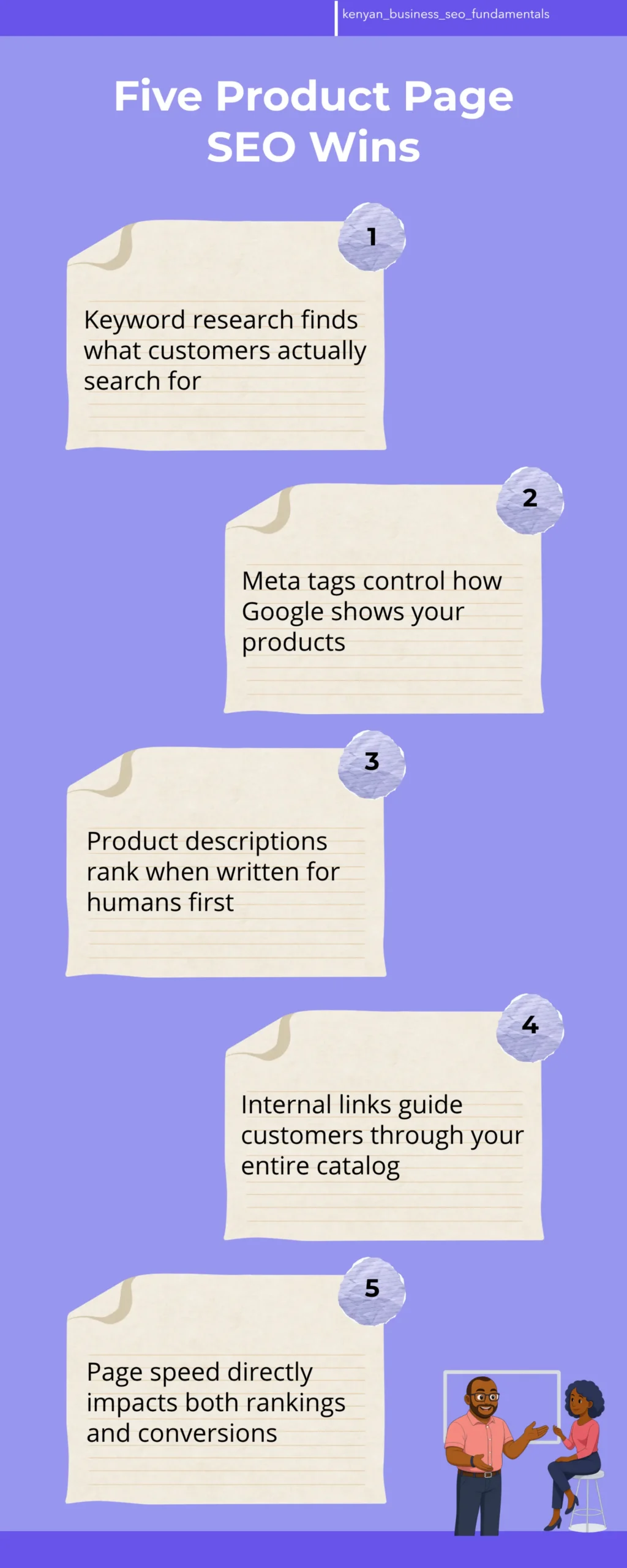
Step 1: Research and Choose the Right Keywords for Each Product
This step determines whether your product page ranks or stays invisible. Most Kenyan business owners skip it and go straight to writing.
That’s why they don’t get traffic.
Keyword research isn’t complicated. It’s just methodical.
Build Your Product Keyword List
For each product you sell, write down every keyword your customer might search for. Think like a customer, not like a business owner.
If you sell beauty products, don’t just write “foundation.” Write “best foundation for dark skin Kenya,” “waterproof foundation Nairobi,” “affordable foundation under 1000 shillings,” “foundation that doesn’t cause acne.”
Each product page should target 2-3 primary keywords and 5-10 secondary keywords. A primary keyword is the main search term you want to rank for.
Secondary keywords are related terms that support it.
Example: If you sell laptop bags, your primary keyword might be “laptop bags Nairobi.” Your secondary keywords might be “water-resistant laptop bag,” “laptop bag under 2000 shillings,” “laptop bag with USB port,” “laptop bag for MacBook.”
Check Search Volume and Competition
You don’t need expensive tools for this. Google Search Console is free and shows you exactly what people search for and how often they search it.
If you don’t have Search Console set up, set it up now. It takes 10 minutes and it’s the most useful SEO tool you’ll ever use.
Look for keywords that have at least 50 monthly searches but aren’t dominated by massive companies. If you’re a small furniture shop in Nairobi, you won’t rank for “office chairs” nationwide.
But you might rank for “office chairs Westlands” or “office chairs near Nairobi CBD.”
This is the Kenyan business owner’s advantage. You’re local. Your customers are local. Own that.
Step 2: Write Product Titles That Rank and Convert
Your product title appears in Google search results. It’s the first thing a customer sees.
It must include your target keyword, describe what you sell, and make the customer want to click.
Most Kenyan business owners write titles like “Blue Office Chair.” That’s invisible on Google.
No keyword. No benefit. No reason to click.
The Formula for Product Titles That Rank
Use this structure: [Primary Keyword] + [Benefit or Differentiator] + [Price or Unique Selling Point].
Bad title: “Office Chair”
Better title: “Ergonomic Office Chair Nairobi – Lumbar Support – 8,500 KES”
The second title includes the keyword “office chair,” adds “Nairobi” for local search, includes a benefit (lumbar support), and shows the price. A customer searching “office chair Nairobi” will see this title and know immediately that you have what they want at a price they can see.
Keep your title under 60 characters if possible. Google cuts off titles longer than that in search results.
For a beauty product: Instead of “Foundation,” write “Waterproof Foundation for Dark Skin – 24-Hour Wear – 950 KES”
For a phone accessory: Instead of “Phone Case,” write “Shockproof iPhone Case – Drop Protection – Under 500 KES”
Include Your Primary Keyword in the First 3 Words
Google weighs the beginning of your title more heavily than the end. If your primary keyword is “laptop bags Nairobi,” put it at the start.
Good: “Laptop Bags Nairobi – Water-Resistant – 2,500 KES”
Weak: “Durable Bags for Your Laptop in Nairobi – 2,500 KES”
The first version puts the keyword right at the beginning. Google sees it immediately and understands what this page is about.
Step 3: Write Product Descriptions That Answer Customer Questions
Your product description is where you rank for secondary keywords and answer the questions customers ask before they buy.
Most Kenyan business owners copy descriptions from their supplier or manufacturer. These descriptions are generic.
They don’t mention Kenya. They don’t address local concerns like delivery time, payment methods, or warranty support.
Your description must be written for your actual customer, in your actual market. This is core product page optimisation selling and ranking on google kenya strategy.
Structure Your Description to Answer Real Questions
Before you write, think about what a customer in Nairobi or Mombasa asks before buying your product. Write down the top 10 questions.
If you sell kitchen equipment: “Is it durable?” “Does it work with Kenyan electricity?” “What’s the warranty?” “Can I get it delivered to my area?” “Is it easy to clean?”
Your description should answer these questions in the first 150 words. This is where customers decide whether to buy or leave.
Use this structure:
Paragraph 1: What is this product and why should you care? (Include your primary keyword naturally.)
Paragraph 2: What problems does it solve? (Use secondary keywords here.)
Paragraph 3: What are the key features and benefits? (List them clearly.)
Paragraph 4: Local details: delivery, warranty, payment methods, installation support.
Paragraph 5: Call to action. Make it easy to buy.
Write for Humans First, Google Second
Never keyword-stuff your description. Never write sentences like “Buy office chairs, office chairs Nairobi, ergonomic office chairs, office chairs online.”
That’s spam. Google penalizes it. Customers hate it.
Instead, write naturally. Use your keywords once or twice in your first 150 words.
Then forget about keywords and focus on helping the customer understand why your product is right for them.
Example of good product description for an office chair:
“This ergonomic office chair is designed for people who sit 8+ hours a day. The lumbar support reduces back pain, the adjustable height works for any desk, and the breathable mesh keeps you cool in Nairobi’s heat. Many office workers in Nairobi switch to this chair and report less back pain within a week. Comes with a 2-year warranty and free delivery to most Nairobi locations.”
This description mentions the keyword naturally, addresses local climate, includes a benefit (less back pain), mentions delivery, and builds confidence with warranty information. It’s written for a Nairobi office worker, not for Google.
Step 4: Optimize Your Meta Description for Click-Through Rate
Your meta description appears under your title in Google search results. It’s your second chance to convince someone to click on your page instead of your competitor’s.
Most Kenyan business owners leave the meta description blank or let WordPress auto-generate it. This is a missed opportunity.
Write a Meta Description That Makes People Click
Your meta description should be 150-160 characters. It should include your primary keyword, mention a key benefit, and include a reason to click now (like price, free delivery, or limited stock).
Bad meta description: “Office chair for sale at our store.”
Better meta description: “Ergonomic office chair in Nairobi with lumbar support. Reduces back pain. Free delivery. 2-year warranty. 8,500 KES.”
The second version includes the keyword, a benefit, a reason to click (free delivery), and the price. A customer comparing options will see this and click on your page instead of your competitor’s.
Always include your target keyword in your meta description. Google bolds it in search results, which draws the eye.
Test Different Meta Descriptions
Come back to your top 10 product pages in 30 days. Check your click-through rate in Google Search Console.
If your click-through rate is below 5%, rewrite your meta description and test again.
A/B testing meta descriptions takes 5 minutes but can increase your traffic significantly. If you want to optimize for featured snippets, strong meta descriptions help.
Step 5: Fix Your Page Speed (This Matters More Than You Think)
Google ranks faster pages higher. But more importantly, customers leave slow pages before they even read your product description.
In Kenya, where many customers browse on 3G or 4G, page speed is the difference between a sale and a customer bouncing to your competitor.
Measure Your Current Page Speed
Go to Google PageSpeed Insights and test your product page. Write down your mobile score and desktop score.
Anything below 50 is slow. Anything below 75 needs improvement. Anything above 90 is excellent.
If your score is low, the report will tell you exactly what’s slowing you down: unoptimized images, render-blocking JavaScript, unused CSS, or a slow server.
The Quickest Wins for Page Speed
You don’t need to be a developer to improve page speed. Start with these three things:
First, compress your product images. A high-quality product photo should be under 200KB.
Use a free tool like TinyPNG to compress images before uploading them to WordPress.
Second, enable caching. If you use WordPress, install a caching plugin like WP Super Cache or W3 Total Cache.
Caching stores a copy of your page and serves it faster to repeat visitors.
Third, use a Content Delivery Network (CDN) like Cloudflare. A CDN stores your images and content on servers around the world, so they load faster no matter where your customer is.
These three changes alone can improve your page speed score significantly. You should also optimize for mobile specifically for Kenyan networks.
Step 6: Add Internal Links to Related Products
Internal links are links from one page on your site to another page on your site. They do two things: they keep customers browsing longer, and they tell Google which pages are most important.
Most Kenyan e-commerce sites have zero internal links between products. This is a massive missed opportunity.
Link Related Products Together
If you sell office chairs, link to your office desks. If you sell phone cases, link to your screen protectors.
If you sell beauty foundations, link to your concealers and setting sprays.
Use descriptive anchor text (the clickable text of the link). Instead of “click here,” write “browse our water-resistant phone cases” or “see our ergonomic office desks.”
Example: In your office chair product description, add a sentence like “Pair this chair with one of our standing desks for the ultimate ergonomic setup.” That sentence links to your standing desk product page.
A customer comes to your site looking for an office chair. They see your chair is good. Then they see a link to standing desks. They click. They buy a desk too. You’ve just increased your average order value.
Create a Related Products Section
At the bottom of every product page, add a “Related Products” section with 3-5 links to similar or complementary products.
This serves two purposes: it increases the chance that a customer buys more than one thing, and it tells Google that these pages are related, which helps them rank together. Similar strategies work for property listing pages seo best practices for kenyan real estate sites.
Common Mistakes to Avoid 🚫
These are the mistakes I see every Kenyan business owner make. Avoid them and you’ll be ahead of most of your competition.
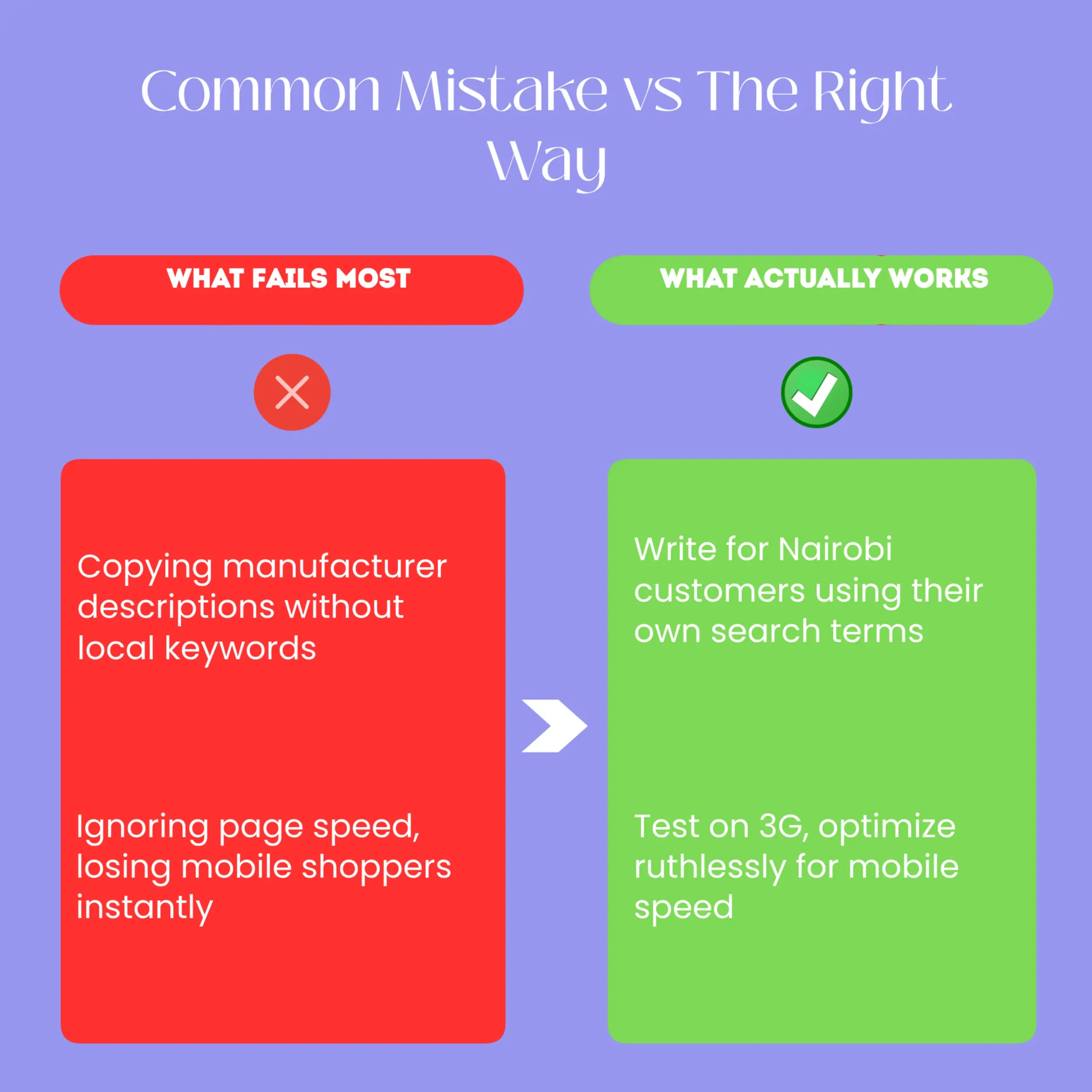
Mistake 1: Copying Manufacturer Descriptions Word-for-Word
When you copy a description from your supplier’s website, you’re using the same text as 100 other retailers selling the same product. Google sees duplicate content and ranks none of you.
Even worse, the manufacturer’s description doesn’t mention Kenya. It doesn’t address local concerns like delivery time, payment methods, or warranty support.
Rewrite every description for your actual market. Mention Kenya. Mention your local payment options. Mention your delivery areas. This makes your page unique and relevant to local customers.
Mistake 2: Ignoring Mobile Page Speed
You test your site on your desktop and it feels fast. Then a customer tries it on 3G and it takes 15 seconds to load.
By then, they’re gone. They’re on your competitor’s site instead.
Always test your product pages on mobile using a 3G connection. Use Chrome DevTools to simulate slow networks.
If your page takes more than 3 seconds to load on 3G, it’s too slow.
Mistake 3: Targeting Keywords Nobody Searches For
You write a beautiful product description for “blue leather office chair with adjustable armrests.” Nobody searches for that exact phrase.
Instead, they search “office chair Nairobi,” “ergonomic office chair,” or “office chair under 10000 shillings.”
Use Google Search Console and Google Trends to find keywords people actually search for. Don’t guess. Let the data guide you.
Mistake 4: Writing Titles That Sound Good But Don’t Include Keywords
You write a title like “Premium Seating Solution for the Modern Professional.” It sounds nice.
Nobody ranks for it because it doesn’t include any keyword a customer would actually search for.
Always include your primary keyword in your title. Make it clear what you’re selling and where you’re selling it.
Mistake 5: Not Testing Anything
You optimize 10 product pages but never check whether your changes improved traffic or sales. You don’t know what worked and what didn’t.
Set up Google Analytics. Track your metrics before and after. Come back in 60 days and measure the impact.
Quick Comparison Table: Before vs. After Optimization
| Element | Before (Not Optimized) | After (Optimized) |
|---|---|---|
| Product Title | Office Chair | Ergonomic Office Chair Nairobi – Lumbar Support – 8,500 KES |
| Meta Description | Auto-generated or blank | Ergonomic office chair with lumbar support. Reduces back pain. Free delivery to Nairobi. 2-year warranty. 8,500 KES. |
| Description Length | 50-100 words (copied from supplier) | 300-400 words (answers customer questions) |
| Keyword Mentions | Zero or keyword-stuffed | Primary keyword 1-2 times naturally |
| Local Details | None | Delivery areas, payment methods, warranty support |
| Page Speed (Mobile) | 45-55 | 75-85 |
| Internal Links | Zero | 3-5 links to related products |
| Monthly Organic Traffic | 0-5 visitors | 20-50+ visitors |
✅ Quick Action Checklist
- ☐ Research 2-3 long-tail keywords for your top 10 products using Google Search Console
- ☐ Rewrite product titles to include primary keyword, benefit, and price
- ☐ Write 300-400 word product descriptions that answer customer questions (not copied from supplier)
- ☐ Write meta descriptions (150-160 characters) that include keyword and a reason to click
- ☐ Test page speed on Google PageSpeed Insights and compress images if score is below 75
- ☐ Add internal links between related products (3-5 per page)
- ☐ Set up Google Analytics and Google Search Console to track changes
- ☐ Come back in 60 days and measure traffic, click-through rate, and conversion rate improvements
Ready to Improve Your Product Page Rankings?
Product page SEO is straightforward. Research your keywords, write for your customer, optimize for speed, and measure your results.
Most Kenyan business owners never do this because they think SEO is complicated. It’s not. It’s just methodical.
Start with your top 5 products this week. Apply these steps.
Come back in 60 days and measure the traffic improvement. Then roll out to your entire product catalog. If you want to how to optimize for ai overviews, these fundamentals still apply.
Frequently Asked Questions
How long does it take to rank a product page on Google?
Most product pages take 60-90 days to rank in Google’s top 50 results after you optimize them. Ranking in the top 10 takes 3-6 months depending on competition.
Don’t expect overnight results, but expect consistent improvement if you’re optimizing for the right keywords.
Should I include price in my product title?
Yes. Including price in your title or meta description reduces clicks from price-sensitive shoppers who can’t afford you, but increases clicks from shoppers in your price range.
This improves your click-through rate and conversion rate. Always include price if you can.
How many internal links should I add to each product page?
Add 3-5 internal links to related products. More than that feels spammy.
Make sure each link is relevant and uses descriptive anchor text that tells the customer what they’re clicking on. Similar principles apply to location pages that rank the complete guide for kenya.
What’s the ideal product description length for SEO?
300-400 words is ideal. Long enough to answer customer questions and include your keywords naturally, short enough that customers actually read it.
If your description is under 150 words, you’re not answering enough questions. If it’s over 500 words, you’re overwhelming the customer.
Can I use the same product description for multiple products?
No. Google penalizes duplicate content.
If you sell the same product in different colors or sizes, write a unique description for each one. Mention the specific color, size, or variant in the description and title.
Additional Resources
- How to Optimize NAP – If your product pages target local customers in specific Kenyan cities, consistent NAP (Name, Address, Phone) across your site helps Google verify your location and rank you for local product searches.
- How to Build Off-Page SEO – Once your product pages are optimized, building backlinks from Kenyan blogs, directories, and review sites increases their authority and helps them rank faster for competitive product keywords.
- What is Off-Page SEO – Understanding off-page SEO helps you see why product pages with strong on-page optimization still need external signals like reviews and mentions to outrank competitors.
- How to Optimize Images for SEO – Product pages rely heavily on images, and optimizing them with proper file names, alt text, and compression improves both page speed and image search visibility for your products.
- How to Optimize URLs – Clean, keyword-rich URLs for your product pages make them easier for Google to crawl and for customers to remember and share, improving both rankings and click-through rates.
- How to Optimize Keyword Density – Knowing how often to use your target keyword in product descriptions prevents keyword stuffing while ensuring Google understands what each product page is about.
Take the Next Step
Product page optimization is just one part of a complete SEO strategy. If you want to understand how product pages fit into your overall SEO plan and learn the other tactics that drive consistent organic traffic, download the Complete SEO Checklist for Kenyan Businesses.