Table of Contents
- Key Takeaways
- Why Customs Clearing Agencies Lose Clients to Google
- How to Rank for High-Value Customs Clearing Searches
- Your Customs Clearing SEO Checklist
- Related Content
- Frequently Asked Questions
- What are the most searched customs clearing terms in Kenya?
- How can I target specific locations in customs clearing SEO?
- Why is KRA compliance important in customs clearing SEO?
- How do I find high-value keywords for customs clearing?
- Can I optimize for both air and sea freight customs clearing?
TL;DR: Optimize your customs clearing website by targeting specific trade services and locations like JKIA and Mombasa Port to attract Kenyan importers.
Last Updated: March 2026
Key Takeaways
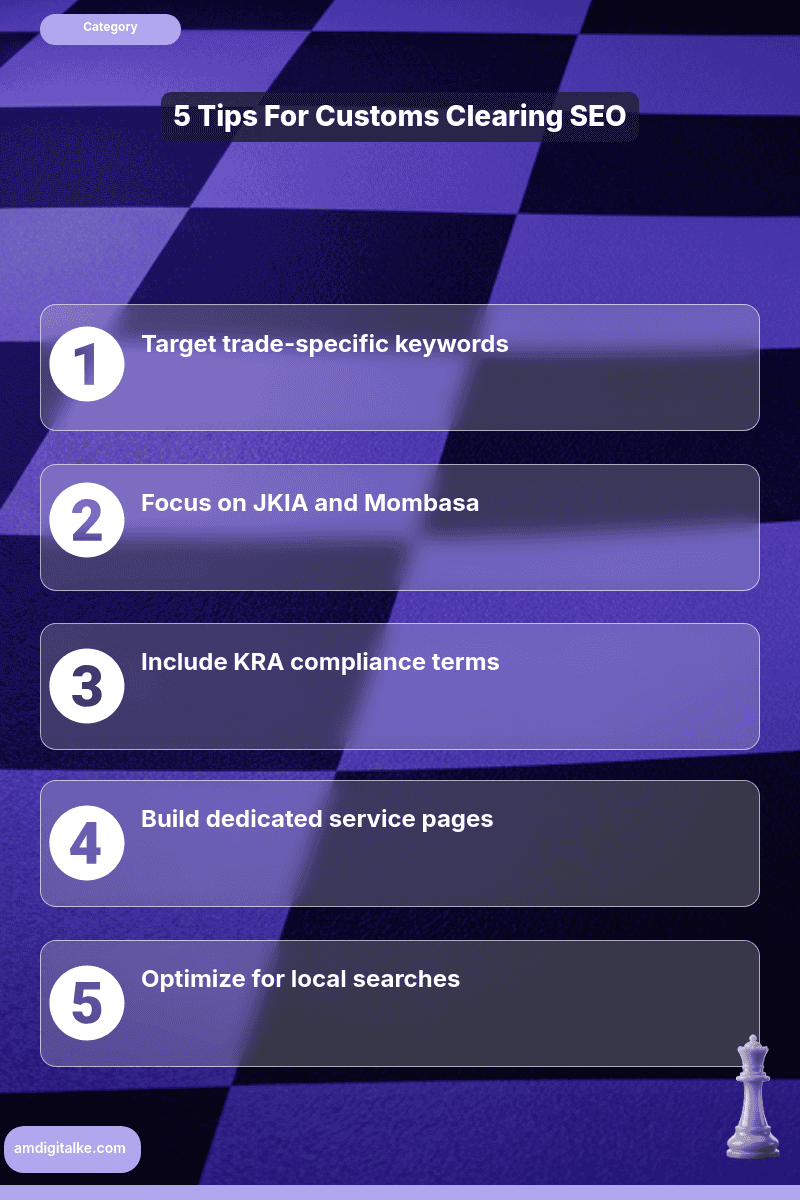
- Focus on trade-specific keywords
- Create location-specific content
- Use KRA compliance terms
- Build dedicated service pages
- Optimize for local searches
Your customs clearing agency handles shipments through JKIA and Mombasa Port every day.
You navigate KRA regulations, manage documentation, and get goods cleared faster than competitors.
But when Nairobi importers search “customs clearing agent near me” or “freight forwarder Mombasa,” they’re finding your competitors instead.
Your website isn’t optimised for the specific trade services searches that bring high-value clients.
Why Customs Clearing Agencies Lose Clients to Google
Kenya’s import/export industry is growing rapidly.
Businesses are constantly seeking reliable customs-clearing partners.
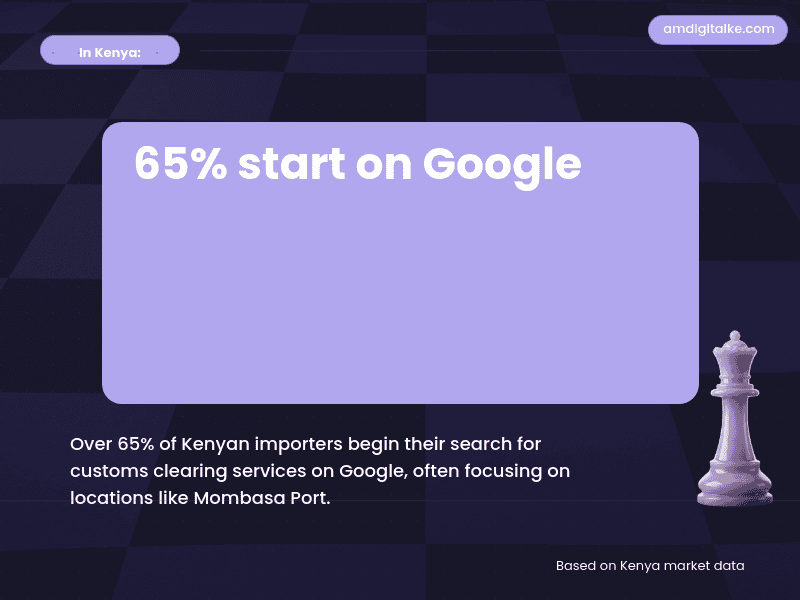
Over 65% of importers and exporters start their search for clearing agents on Google.
They’re typing searches like “customs clearing agent Nairobi,” “freight forwarding services Kenya,” or “KRA customs clearance.”
If your agency isn’t showing up for these searches, you’re losing clients to competitors who understand what SEO really means for trade services.
The challenge is unique.
Customs clearing involves technical terminology, compliance language, and location-specific services that generic SEO strategies miss completely.
How to Rank for High-Value Customs Clearing Searches
1. Target Trade-Specific Keywords
Your potential clients aren’t searching “logistics company.”
They’re searching for exact services:
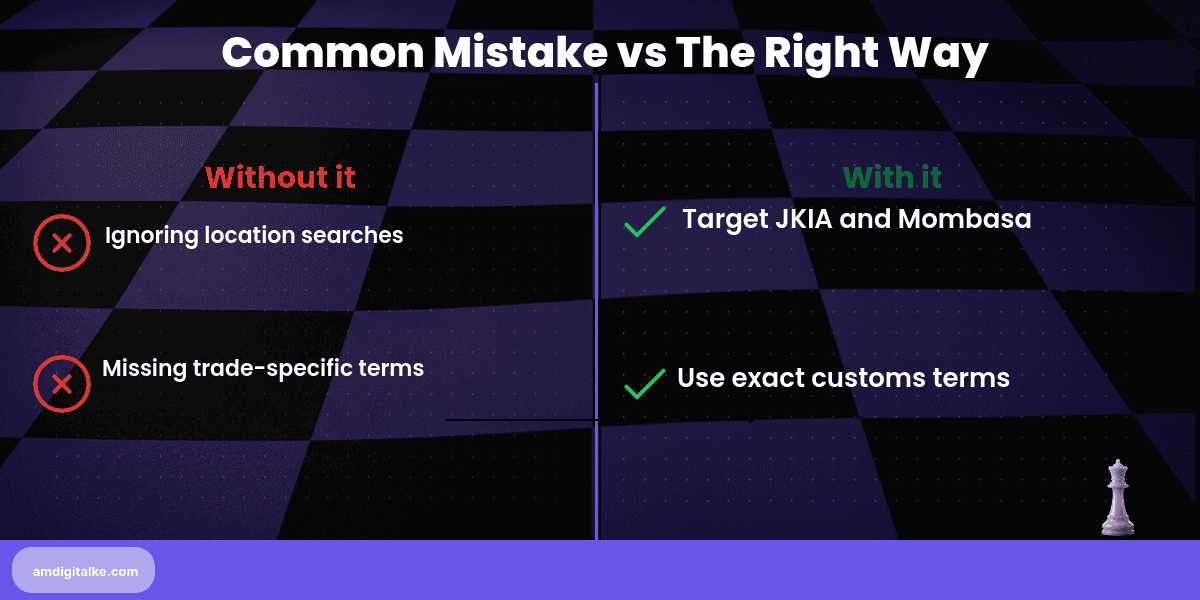
- “Customs clearing agent [location]”
- “Import clearance services Kenya”
- “Export documentation assistance”
- “KRA customs broker”
- “Freight forwarding Mombasa Port”
Build dedicated service pages for each clearing speciality: air freight clearance, sea freight clearance, KRA compliance services, warehousing, and transit cargo handling.
Implementing proper keyword research reveals these high-intent terms.
2. Create Location-Specific Content
Most customs clearing searches include locations.
Create pages targeting:
- JKIA customs clearance – for air freight clients
- Mombasa Port clearing services – for sea freight importers
- Nairobi CBD customs brokers – for walk-in clients
- Industrial Area warehousing – for storage needs
Each page should include your physical proximity to these locations and response times.
This is understanding what Local SEO means for trade services.
3. Optimise for Compliance Keywords
Importers and exporters search for compliance help:
- “KRA PVoC requirements”
- “Import duty calculator Kenya”
- “Customs documentation checklist”
- “HS code classification Kenya”
Create blog content answering these questions.
When businesses find helpful compliance information on your site, they trust you to handle their clearance.
Executing content marketing strategically positions you as the compliance authority.
For detailed answers on compliance topics, check out my SEO FAQs page, where I address common technical questions.
4. Showcase Your Clearing Process
Add a detailed “How It Works” section explaining your clearance process step-by-step:
- Documentation review
- HS code classification
- KRA lodgement
- Duty payment processing
- Cargo release coordination
Use schema markup strategically to help Google understand your service offerings.
This makes your listings show up with rich details in search results.
5. Build Authority Through Industry Links
Get backlinks from:
- Kenya International Freight and Warehousing Association (KIFWA)
- Kenya Shippers Council directories
- Trade associations and chambers of commerce
- Shipping line websites that list local agents
These industry-specific backlinks signal to Google that you’re a legitimate clearing authority.
Building quality backlinks strategically is essential for trade services.
Before launching your campaign, download this complete SEO Checklist to ensure you cover all critical elements.
6. Leverage Client Testimonials with Details
Generic reviews don’t work for customs clearing.
Feature testimonials that mention:
- Types of cargo handled (machinery, electronics, pharmaceuticals)
- Clearance speed (“cleared in 24 hours”)
- Ports serviced
- Compliance expertise
This creates keyword-rich content while building trust.
Case Studies
Mombasa Port Success: A Mombasa customs-clearing agency optimised its website with dedicated pages for “Mombasa Port customs clearing,” “container freight station services,” and “transit cargo to Uganda.”
They added detailed blog posts about KRA procedures and import regulations.
Based on AM Digital KE client data across Kenyan accounts, they saw 60% more website inquiries from importers searching for specific clearing services within four months.
Pharmaceutical Clearance Niche: A Nairobi-based agent created content targeting “pharmaceutical import clearance Kenya.”
They now rank #2 and receive 15+ qualified leads monthly from manufacturers importing medical supplies.
Both success stories came from optimising on-page SEO properly for trade-specific searches.
Your Customs Clearing SEO Checklist
☐ Create dedicated service pages for each clearing speciality (air, sea, transit)
☐ Build location pages for JKIA, Mombasa Port, and major industrial areas
☐ Write 5 blog posts answering common KRA compliance questions
☐ Add schema markup to service pages, highlighting clearance services
☐ Get listed in the KIFWA directory and the Kenya Shippers Council database
☐ Feature detailed client testimonials mentioning cargo types and clearance times
☐ Set up Google Business Profile with “Customs Broker” as the primary category
Customs clearing SEO requires understanding both the logistics industry and how importers/exporters search for services.
Want importers to find you when they need clearing services?
Check out our Logistics SEO Services in Kenya and learn how we help customs clearing agencies rank for trade-specific searches that bring high-value clients actively seeking clearing partners.
Losing import/export clients to competitors with better visibility?
Get a free SEO analysis where we’ll assess your service page optimisation for KRA and compliance keywords, and identify trade searches sending clients to competing clearing agents.
Related Content
Curious to learn more about trade services SEO? Check out the posts below:
- What is Technical SEO (As Explained By A Kenyan Expert) — Technical SEO is crucial for customs clearing sites with complex service pages and compliance documentation that must load fast.
- What is Link Building (By Kenya’s SEO Authority) — Building links from KIFWA, Kenya Shippers Council, and trade associations establishes your clearing authority.
- How to Leverage Long-tail Keywords – A Kenyan Expert’s Handbook — Long-tail keywords like “pharmaceutical import clearance” bring the highest-intent clearing clients.
- Automotive SEO Services — See how another trade-focused industry uses specialised SEO to attract high-value B2B clients.
These articles will help you understand the technical foundation needed for customs clearing success.
Have more SEO questions? Our SEO FAQs Kenya page answers the most common ones.
Frequently Asked Questions
What are the most searched customs clearing terms in Kenya?
Common searches include ‘customs clearing agent Nairobi’, ‘freight forwarding Mombasa’, and ‘KRA customs clearance’.
How can I target specific locations in customs clearing SEO?
Create pages targeting JKIA, Mombasa Port, and Nairobi CBD with proximity details and response times.
Why is KRA compliance important in customs clearing SEO?
Including KRA compliance terms helps attract clients looking for trusted and legal customs clearing services.
How do I find high-value keywords for customs clearing?
Use keyword research tools to identify terms like ‘import clearance Kenya’ and ‘export documentation assistance’.
Can I optimize for both air and sea freight customs clearing?
Yes, create separate pages for JKIA air freight and Mombasa Port sea freight services.