Table of Contents
- Introduction: Why Kenyan Business Owners Need Marketing Automation Now
- 📋 Key Takeaways
- What You Need Before You Start
- Step 1: Choose the Right Automation Tool for Your Business
- Step 2: Set Up Your First Automated Workflow
- Step 3: Create Automated Workflows for Your Sales Process
- Step 4: Measure Results and Optimize
- Step 5: Scale and Integrate Other Tools
- Common Mistakes to Avoid 🚫
- Common Automation Workflows for Kenyan Businesses
- ✅ Quick Action Checklist
- Ready to Improve Your How to Automate?
- Frequently Asked Questions
- Additional Resources
- Take the Next Step
TL;DR: Marketing automation means setting up systems to send messages, nurture leads, and track customer behaviour without doing it manually each time. Start by choosing the right tool (email platform, CRM, or all-in-one system), set up your first workflow (like a welcome email series), and track results to improve over time. Most Kenyan business owners waste 10+ hours weekly on manual tasks that automation can handle in minutes.
Introduction: Why Kenyan Business Owners Need Marketing Automation Now
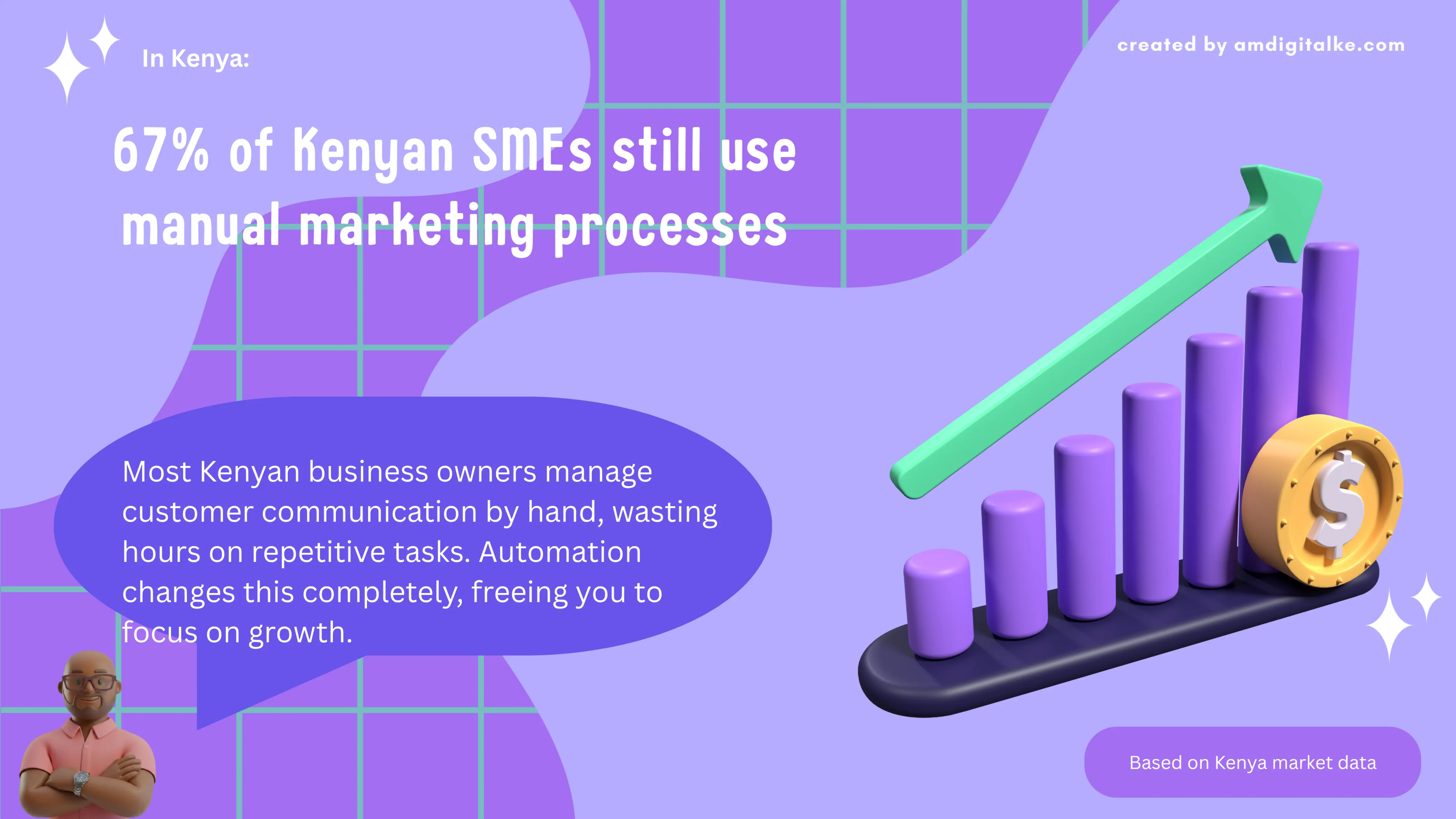
If you run a Kenyan business, you already know time is your scarcest resource. You manage inventory, handle customer calls, deal with suppliers, and try to grow revenue all at once.
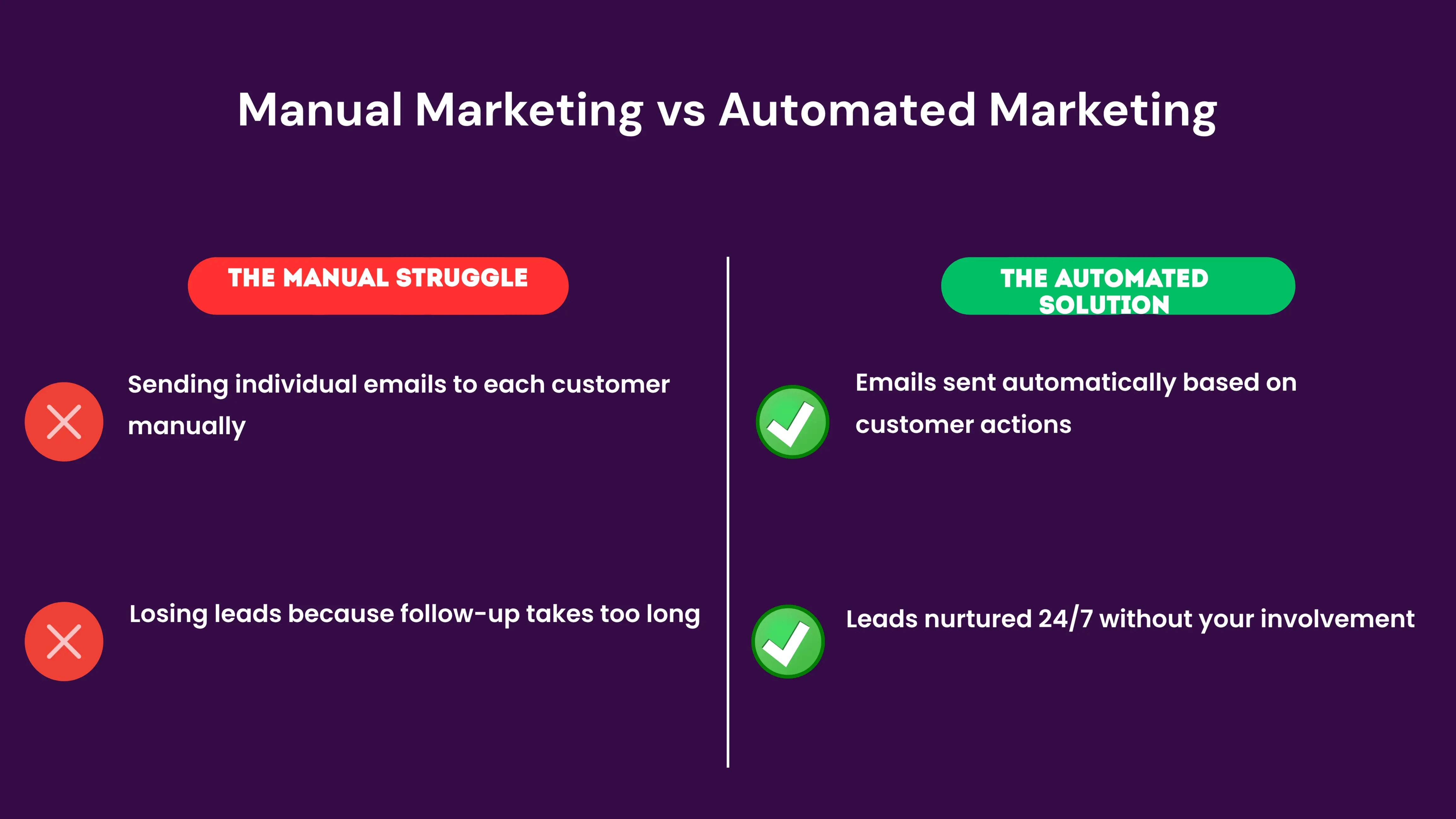
Marketing often gets squeezed into the gaps. Most of it happens manually: sending individual emails, following up with leads one by one, entering customer data into spreadsheets by hand.
Marketing automation changes this. It sets up systems that do the repetitive work for you, 24 hours a day, without you lifting a finger.
When a customer signs up for your newsletter, they automatically get a welcome email. When they download your product guide, they automatically get follow-up messages over the next week. This same logic applies to sales leads, and we cover it in detail in our guide on automating lead follow-up for Kenyan businesses.
When they go quiet, an automated reminder brings them back. This is email automation for kenyan businesses converting leads while you sleep, working while you focus on the business.
The result is simple: more leads convert to customers, and you get repeat business. You also get your time back to focus on strategy and sales.
For Kenyan SMEs competing against bigger players, automation is not a luxury. It is how you level the playing field.
📋 Key Takeaways
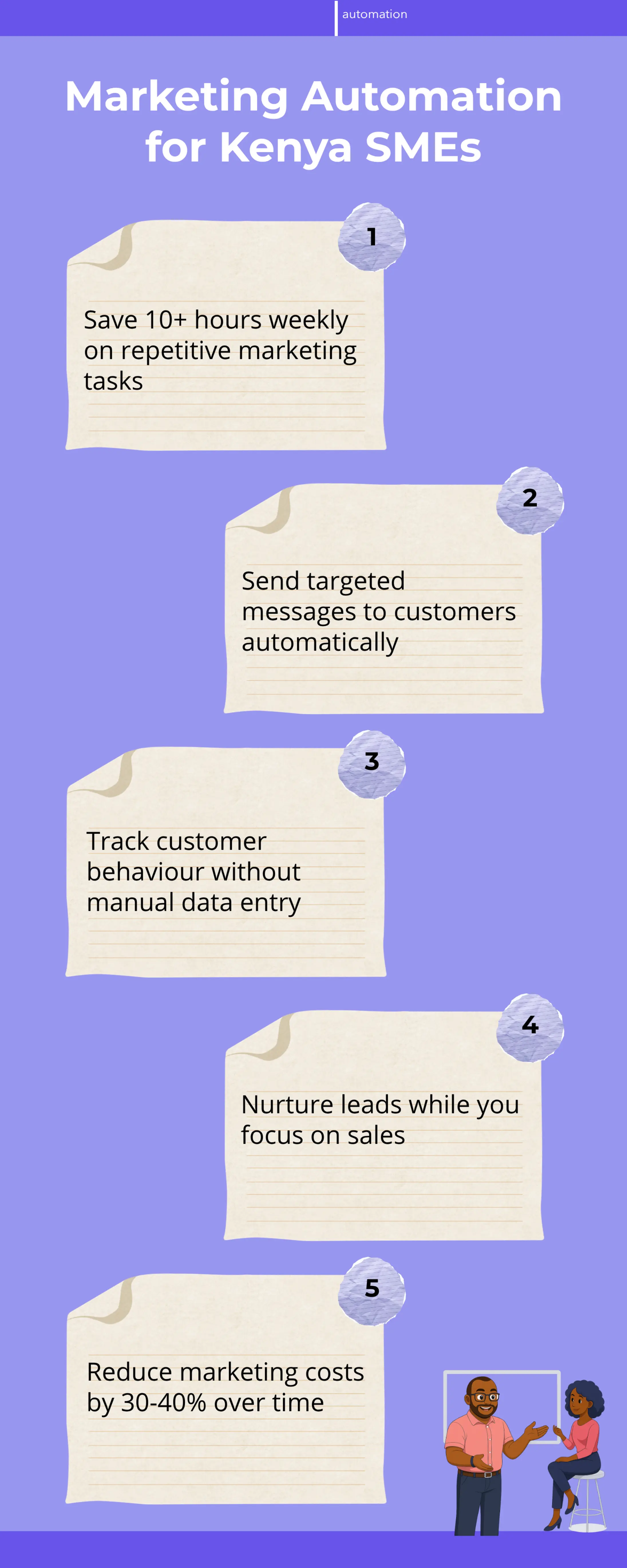
- Marketing automation saves 10+ hours per week by handling repetitive tasks like emails, follow-ups, and data entry automatically.
- Start with one workflow (a welcome email series or lead nurture sequence) before trying to automate everything.
- Choose a tool that fits your budget and current needs: email platforms like Mailchimp, CRMs like Zoho, or all-in-one systems like HubSpot.
- Track the right metrics (open rates, click rates, conversion rates) to prove automation is working and improve your campaigns.
- Most Kenyan businesses leave revenue on the table because leads go unanswered and customers are not followed up. Automation fixes this immediately.
What You Need Before You Start
Before you set up your first automated workflow, you need three things in place. Without them, automation will not work and you will waste money on a tool you do not understand.
The good news is that none of these require technical skills or large budgets.
A Clear Customer List and Email Database
You cannot automate what you do not have. If your customer data is scattered across WhatsApp conversations, phone notes, and random spreadsheets, stop now and collect it first.
Create one master list with names, email addresses, phone numbers, and any other useful information. Include what they bought, when they bought it, and how much they spent.
This list is the foundation of everything. Without it, automation tools have no one to send messages to.
If you already have customers, export their data from your current system. This could be accounting software, an e-commerce platform, or manual records.
Clean it up once you have it. Remove duplicates, fix misspelled emails, and organize it logically.
A Clear Understanding of Your Customer Journey
Automation works best when you understand what happens after someone becomes a customer. What is your sales process, and how long does it take from first contact to purchase?
Think about what messages you send at each stage. For a Nairobi salon, the journey might look like this.
A customer sees your Instagram ad, visits your website, and books an appointment. They get a reminder email the day before, come in for service, and receive a follow-up email asking for feedback.
Then they get offered a loyalty discount. Each step can be automated, but you need to map it out first on paper before you touch any tool.
A Goal That Matters to Your Business
Do not automate just to automate. Pick one specific business outcome you want: more email sign-ups, more repeat customers, faster sales cycle, or lower customer acquisition cost.
This goal will guide every decision you make. It also helps you measure whether automation is actually working, and it should reflect your real marketing budget kenya allows for.
Based on AM Digital KE client data across Kenyan accounts, businesses that start with a single, clear goal see results in 4-6 weeks. An example is “nurture leads within 24 hours of sign-up.”
Those that try to automate everything at once usually give up within a month. If you are unsure where to focus first, review how to use marketing channels template kenya before picking your goal.
Step 1: Choose the Right Automation Tool for Your Business
This is where most Kenyan business owners get stuck. There are dozens of tools and they all look confusing. Pricing varies wildly too.
The truth is simpler. Pick a tool that matches your current size and budget, then upgrade later if needed. Starting small with marketing automation kenya is better than buying an expensive system you do not use.
Email Platforms (Best for Beginners)
If you are just starting, an email platform like Mailchimp, ConvertKit, or ActiveCampaign is the right choice. These tools send emails to lists, segment customers into groups, and automate simple workflows like welcome series.
Most offer free plans up to 500-1000 subscribers. That is perfect for testing.
Email platforms are cheap, often free to start, and easy to learn. They do one thing well: send the right message to the right person at the right time.
For a Kenyan florist, you could set up an automated email that goes out every week to past customers offering a discount. When they click the link, they get added to an “active customer” segment and receive different emails than inactive customers.
Customer Relationship Management (CRM) Systems
A CRM like Zoho CRM or Pipedrive tracks all your interactions with customers in one place. It automates emails, task reminders, follow-up scheduling, and sales pipeline management.
CRMs are more powerful than email platforms but also more complex to set up. A garage owner using auto service seo attracting local repair and maintenance customers strategies might still find email tools sufficient at first.
Use a CRM if you have a sales team, a long sales cycle like B2B software or real estate, or if you need to track detailed customer information. For most Kenyan SMEs starting out, a CRM is overkill.
Start with email, then graduate to a CRM once you have 50+ regular customers and a clear sales process.
All-in-One Platforms
Tools like HubSpot, Keap, or Kartra combine email, CRM, landing pages, and automation in one place. They are powerful but expensive and have a steep learning curve.
Only consider these if you have a marketing budget of at least 20,000 KES per month. You also need time to invest in learning the tool.
For most Kenyan businesses, an all-in-one platform is premature. Start with email, prove that automation works, then upgrade when you have the revenue and team to support it.
Step 2: Set Up Your First Automated Workflow
Now that you have chosen a tool, build your first automation. Do not try to automate your entire marketing strategy at once.
Pick one simple workflow that will have the biggest impact on your business. The most common first workflow is a welcome email series for new subscribers.
Build a Welcome Email Series
A welcome series is a set of 3-5 emails that go out automatically when someone joins your list. The first email goes out immediately, the second after 2 days, the third after 5 days, and so on.
Each email has a purpose: introduce your business, show your value, build trust, and make an offer.
Here is what a welcome series looks like for a Kenyan digital marketing agency. Email 1 (immediate): “Welcome to AM Digital KE. Here is how we help Kenyan businesses get found on Google.”
Email 2 (day 2): “Why most Kenyan SMEs fail at SEO (and how to fix it).” Email 3 (day 5): “Meet the founder. Why I started AM Digital KE.”
Email 4 (day 7): “Your free SEO audit is ready. Click here to see what we found.”
To set this up in your tool, create the emails, then set the trigger (new subscriber) and the timing. The tool handles the rest.
New subscribers get the series automatically. You never touch it again.
Set Up Lead Segmentation
Segmentation means dividing your email list into groups based on behaviour or characteristics. Instead of sending the same email to everyone, you send targeted emails to specific groups.
This dramatically improves results. It also helps you avoid common seo mistakes kenyan businesses make when they treat every customer the same way.
For example, a Mombasa hotel might segment guests into first-time visitors, repeat customers, and past customers who have not booked in 6 months. First-time visitors get an email about what makes the hotel special.
Repeat customers get an email offering loyalty perks. Inactive customers get a “we miss you” email with a special discount.
To set up segmentation, identify 2-3 key groups in your customer base. Then create simple rules in your automation tool.
“If customer made a purchase in the last 30 days, add them to the active segment. If they have not purchased in 6+ months, add them to the inactive segment.” The tool does this automatically and sends different emails to each group.
Step 3: Create Automated Workflows for Your Sales Process
Once your welcome series is working, build workflows that match your actual sales process. Most businesses have multiple touchpoints where automation can help.
Think about after a customer downloads something, after they attend a webinar, after they request a quote, or after they make their first purchase.
Lead Nurture Workflows
A lead nurture workflow is a series of emails that keeps prospects interested while they decide whether to buy. It works like this: someone downloads your free guide, they get an email the next day with more information.
Then an email 3 days later shares a customer success story. An email 7 days later offers to book a call.
The goal is to move prospects closer to a purchase without manual follow-up on each one. For a Nairobi accounting firm, a lead nurture might include emails about tax planning, business growth strategies, and client testimonials.
Each email builds trust and moves the prospect closer to hiring the firm.
Customer Retention Workflows
Do not forget about customers you already have. Retention workflows keep existing customers engaged and buying more.
A simple retention workflow is a “win-back” email that goes out to customers who have not purchased in 3 months.
For an online shop selling Kenyan handicrafts, a win-back email might say: “We have new products you will love. Here is a 20% discount just for you.”
This single automated email can bring back 10-15% of inactive customers. That is pure revenue that costs almost nothing to generate.
Step 4: Measure Results and Optimize
Automation is not set-and-forget. Track what works and what does not, then improve over time. If you are still fuzzy on the basics, revisit what is marketing automation before you dig into metrics.
The key metrics to watch are open rate, click rate, and conversion rate. Open rate is the percentage of people who open your email. Click rate is the percentage who click a link, and conversion rate is the percentage who complete the desired action.
Track the Right Metrics
Email open rates for most industries average 20-30%. Kenyan businesses often see higher rates because email usage is less saturated.
Click rates usually sit between 2-5%. If your open rate is below 15%, your subject lines need work. If your click rate is below 1%, your offer is not compelling enough.
Your automation tool shows you these metrics automatically. Check them weekly for the first month, then monthly after that.
Look for patterns. Which subject lines get more opens? Which emails get more clicks? Which workflows drive the most conversions?
Run A/B Tests to Improve Performance
A/B testing means sending two slightly different versions of an email to small segments of your list. You then see which one performs better and use that winner going forward.
You might test two subject lines, two calls-to-action, or two send times. Small tweaks often produce big shifts in results.
For example, test “50% off this weekend only” against “Last chance: 50% off ends Sunday.” Send each to 10% of your list and measure which gets more clicks.
Send the winner to the remaining 80%. This simple test can increase your click rate by 10-20%.
Step 5: Scale and Integrate Other Tools
Once your first workflows work and generate results, scale them up. Add more segments, more workflows, more touchpoints.
Integrate your automation tool with other systems you use. Think e-commerce platform, booking system, accounting software.
Connect Your Automation Tool to Other Platforms
Most automation tools integrate with popular platforms via API connections or pre-built integrations. If you use Shopify, WooCommerce, or a Kenyan e-commerce platform, connect it to your email tool so purchase data syncs automatically.
When someone buys from your shop, they get added to a “customer” segment automatically. They then receive post-purchase emails without any manual work from you.
For a Nairobi salon using booking software like Calendly or Acuity Scheduling, integrate it with your email platform. Customers then get appointment reminders and follow-up feedback requests automatically.
This saves hours of manual work. It also improves the customer experience.
Build More Workflows Based on Data
As you collect data from your first workflows, you will spot opportunities for new automations. Maybe customers who click a specific link are more likely to buy, so you create a workflow that sends those high-interest prospects a special offer.
Maybe customers from a certain region show a different buying pattern. Build targeted workflows for each region based on what you see.
Based on AM Digital KE client data across Kenyan accounts, businesses that build 5-10 workflows see 3-5x higher conversion rates than those with just one workflow. Not sure which channels deserve their own workflow first? The marketing channels template for Kenyan businesses can help you map that out.
Start simple, measure results, then expand based on what the data tells you.
Common Mistakes to Avoid 🚫
Most Kenyan businesses make the same mistakes when implementing automation. Learning from these now saves you months of frustration and wasted money.
Automating Without a Clear Process
Do not set up automation before you understand your customer journey. If you automate randomly without a strategy, you send confusing emails that hurt your business instead of helping it.
Spend a week mapping out your sales process first, then automate it. Not sure where your business fits strategically? Try the chess piece business quiz kenya to get a clearer picture before you build.
A common mistake is automating too many emails too close together. A prospect signs up and immediately gets 5 emails in 2 days.
They feel spammed and unsubscribe. Instead, space out your emails: one immediately, one after 2-3 days, one after a week.
Ignoring Email Deliverability
If your emails end up in spam, automation does not help. Email deliverability means ensuring your emails actually reach the inbox, not spam.
This depends on your sender reputation, list quality, email content, and sending frequency. Get these wrong and your best workflow will never get seen.
To protect deliverability, only email people who explicitly opted in. Remove bounced addresses immediately and avoid sending too many emails too fast.
Use a reputable email platform with good relationships with Gmail, Outlook, and other providers. For Kenyan businesses using local domains, make sure your domain has proper SPF and DKIM records.
Not Cleaning Your Email List Regularly
As time passes, your email list gets stale. People change jobs, abandon email addresses, or lose interest.
If you keep emailing inactive addresses, deliverability suffers and you waste money. Clean your list every 6 months.
Remove anyone who has not opened an email in 12 months. Remove any address that bounces.
Segment your list by engagement level and send different frequencies to engaged versus inactive subscribers. This keeps your list healthy and your results strong.
Forgetting to Include a Clear Call to Action
Many automated emails fail because they do not tell the reader what to do next. Include a clear call-to-action in every email: “Click here to book a demo,” “Download your free guide,” “Claim your discount.”
Make the CTA obvious and easy to find. A common mistake is hiding the CTA in the middle of long paragraphs.
Instead, make it stand out with a button or a link at the end of the email. For Kenyan audiences who often read emails on mobile phones, make sure your CTA button is large enough to tap easily.
Setting Up Automation and Ignoring It
The biggest mistake is treating automation as a one-time setup. You build a workflow, launch it, then never look at it again.
Real automation requires ongoing monitoring and optimization. Check your metrics weekly, test new variations, and update your workflows based on what you learn.
Automation is not a magic solution that works forever without attention. It is a system that gets better the more you refine it.
Dedicate 1-2 hours per week to checking your automation results. Small, consistent improvements beat one big setup you never touch again.
Common Automation Workflows for Kenyan Businesses
Here are the most effective workflows we see working for Kenyan SMEs. Adapt these to your specific business as part of marketing workflows that scale your kenyan business.
| Business Type | First Workflow to Automate | Expected Result |
|---|---|---|
| E-commerce / Online Shop | Welcome series + post-purchase follow-up + win-back emails | 15-25% increase in repeat purchases |
| Service Business (salon, plumber, consultant) | Appointment reminders + post-service feedback + loyalty offers | 30-40% reduction in no-shows, 20% more repeat bookings |
| B2B / Professional Services | Lead nurture sequence + client onboarding + re-engagement | 2-3x faster sales cycle, 25% more qualified leads |
| Content / Media / Creator | Welcome series + new content notifications + subscriber re-engagement | 40-50% higher engagement, 20% more conversions |
| Real Estate / Property | Lead nurture + property alerts + buyer/seller follow-up | 3-5x more qualified leads, 50% faster deal closure |
✅ Quick Action Checklist
- ☐ Export your current customer list and clean it up (remove duplicates, fix emails)
- ☐ Map your customer journey on paper (what happens from first contact to purchase to repeat business)
- ☐ Choose one automation tool to start with (recommend Mailchimp or Zoho for Kenyan SMEs)
- ☐ Create your first workflow (welcome email series for new subscribers)
- ☐ Set up 2-3 email segments based on customer behaviour
- ☐ Launch your first workflow and track open rates, click rates, and conversions
- ☐ Test one variation (subject line or CTA) after 2 weeks and measure the difference
- ☐ Schedule a weekly 30-minute check-in to review results and plan improvements
Ready to Improve Your How to Automate?
Marketing automation is not complicated. It is a series of simple systems that work together to do repetitive work automatically.
This frees you to focus on strategy and growth. Start with one workflow, measure results, then expand based on what works.
The Kenyan businesses winning right now are not the ones with the biggest budgets. They are the ones who automate the basics and optimize relentlessly.
You can do this today. If your current efforts feel scattered, start by reading why isnt my marketing working.
Frequently Asked Questions
How much does marketing automation cost?
Email platforms like Mailchimp start free for up to 500 subscribers. Zoho CRM is free up to 1000 contacts.
Most businesses pay 0-500 KES per month to start. Budget 2000-5000 KES per month once you have 5000+ subscribers or a sales team.
How long does it take to see results from automation?
You should see measurable results within the first week. Opens, clicks and conversions come fast.
Significant business impact like more revenue and more repeat customers usually takes 4-8 weeks. This happens as you optimize based on data and expand your workflows.
What if I do not have an email list yet?
Start building one immediately. Add a sign-up form to your website, ask customers to join your list in person, and promote your newsletter on social media.
You need at least 100-200 emails to make automation worthwhile. Once you have that, set up your first workflow.
Can I automate SMS and WhatsApp messages like I do emails?
Yes. Many automation platforms now support SMS and WhatsApp.
For Kenyan businesses, WhatsApp automation is powerful because most customers use WhatsApp daily. You can send automated welcome messages, order confirmations, and reminders via WhatsApp just like email.
What happens if my automation breaks or stops working?
Check your email list for bounces, verify your sender settings, and confirm your workflows are still active in your tool. Most issues are simple fixes.
Set a monthly reminder to audit your automation. This keeps everything running smoothly.
Additional Resources
- How to Calculate Marketing ROI for Kenyan Businesses – Once your marketing runs on autopilot, you need to know if it’s actually making money, and this guide shows you how to track that.
- Savage Digital vs AM Digital KE – If you’re weighing whether to build automation in house or hire an agency, this comparison shows what different Kenyan agencies actually deliver.
- Artly Digital Marketing vs AM Digital KE – Before you outsource your automation setup, see how agency approaches and pricing compare so you pick the right partner.
- What are Featured Snippets (for the Kenya Market) – Automating your content distribution means nothing if nobody finds it, so learn how to get your business seen first on Google.
- Whatsapp Business Automation – Answering Customer Questions 24/7 – WhatsApp is where most Kenyan customers message you, so this shows how to automate that channel specifically.
- Tourism SEO Kenya – How to Attract International Visitors – If your business is in tourism, pair your marketing automation with this guide to pull in visitors booking from abroad.
Take the Next Step
Now that you understand how to automate marketing, pick your tool and build your first workflow. Run a full seo checklist kenya alongside your automation setup so new leads have somewhere strong to land.
We have created a step-by-step guide specifically for Kenyan business owners. It walks you through choosing the right tool, setting up your first emails, and tracking results.
Download the Complete Marketing Automation Setup Guide for Kenyan Businesses and start automating this week.