Table of Contents
- 📋 Key Takeaways
- Why Most Kenyan Businesses Pick the Wrong Marketing Channels
- What Most Marketing Advice Gets Wrong About Channel Selection
- 📊 What You Actually Need: A Marketing Channels Scoring System
- Step 1: List Every Channel You’re Using or Considering
- Step 2: Score Each Channel Against Your Business Goals
- Step 3: Pick Your Top Three Channels and Commit
- How to Use This Template Every Month (Not Just Once)
- ✅ Common Mistakes to Avoid When Using the Template
- ✅ Quick Action Checklist
- Ready to Improve Your Channel Strategy?
- Frequently Asked Questions
- Additional Resources
- Take the Next Step
TL;DR: Most Kenyan businesses waste money on marketing channels that don’t work for their specific business. This guide shows you how to use a free Google Sheets template to score every channel against your goals, pick your top three, and stop throwing budget at platforms that don’t convert. You’ll learn the exact framework I use with clients in Nairobi to turn scattered marketing into focused revenue growth.
Your competitor isn’t beating you on Facebook.
They’re winning on the one channel you haven’t measured yet.
I’ve watched Nairobi businesses spend 50,000 shillings a month on Instagram ads while their Google My Business listing sits unclaimed, a gap that usually shows up fast in a no-cost SEO review.
I’ve seen Westlands agencies pour budget into TikTok because it’s trendy, while their email list converts at 8% and gets ignored.
The problem isn’t that you picked the wrong channels.
The problem is you picked them without data.
This guide walks you through using a marketing channels template kenya to score every platform against your actual business goals.
You’ll stop guessing and start knowing which three channels deserve your time and money.
📋 Key Takeaways
- Most Kenyan businesses spread budget across 5+ channels without tracking which ones actually drive sales
- A simple scoring system (cost, reach, conversion potential, time to ROI) reveals your best channels in under 30 minutes
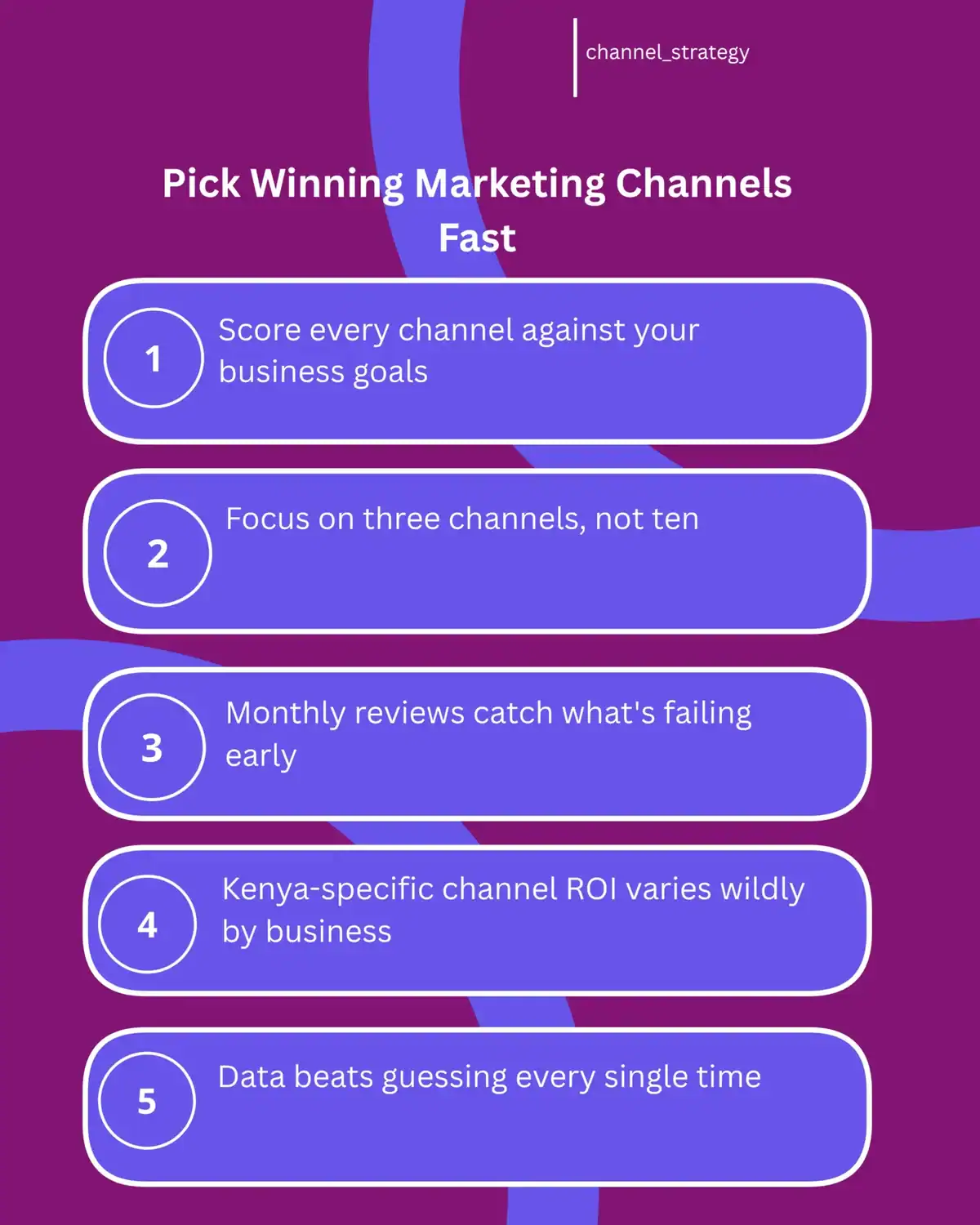
- Focusing on three channels instead of ten doubles your results because you can actually optimize what you’re running
- Monthly reviews catch failing channels early, before you’ve burned through your entire quarterly budget
- Kenya-specific channel performance varies wildly—WhatsApp and SMS often outperform Instagram for e-commerce, but nobody talks about it
Why Most Kenyan Businesses Pick the Wrong Marketing Channels
Walk into any Nairobi co-working space and ask a startup founder where they market.
You’ll hear the same list: Facebook, Instagram, Google Ads and search marketing, maybe TikTok if they’re feeling adventurous.
Ask them which one drives the most revenue.
You’ll get a blank stare.
The Scatter Approach Costs More Than Money
I worked with an e-commerce store in Kilimani last year.
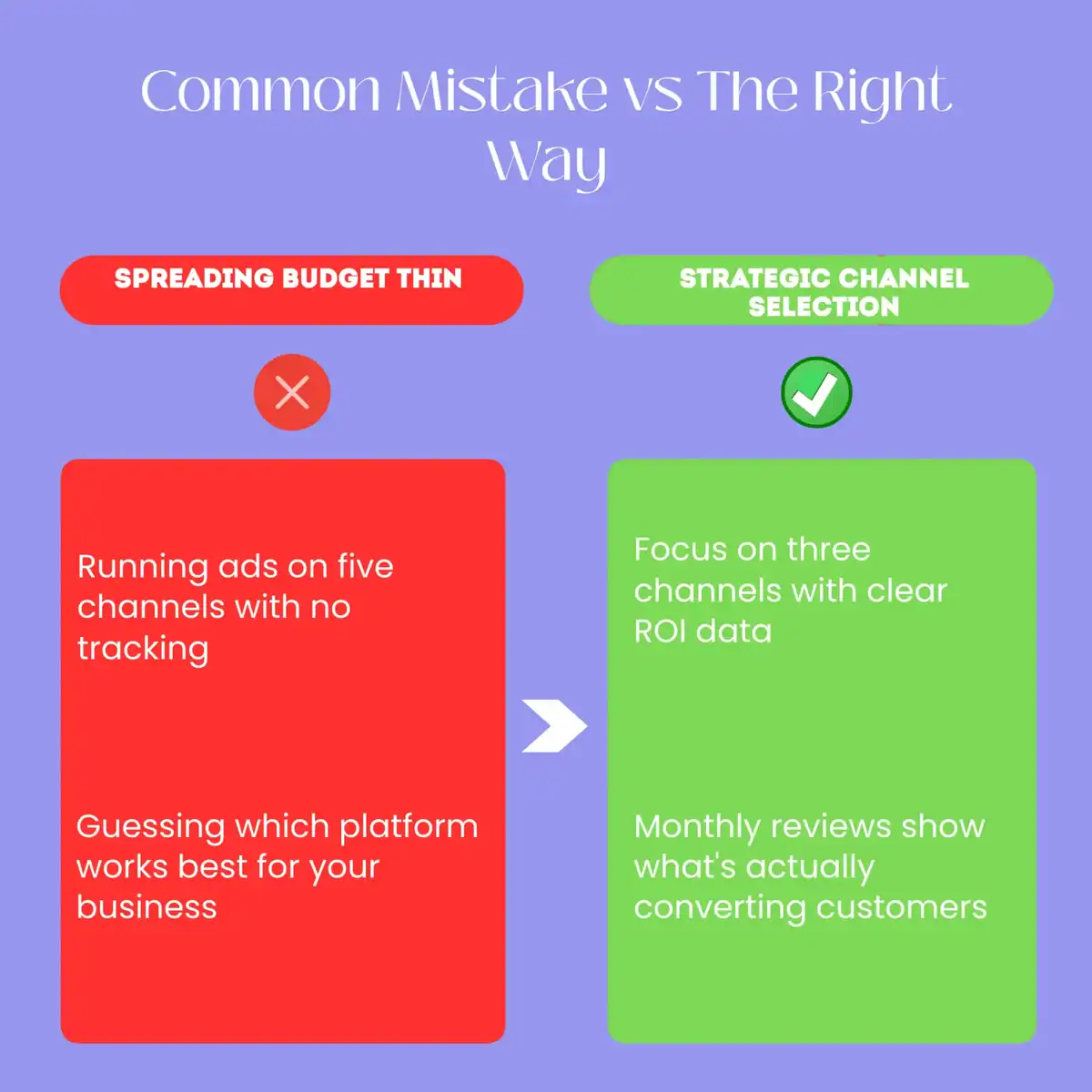
They were running campaigns on five platforms simultaneously.
Facebook ads, Instagram stories, Google Shopping, email newsletters, and LinkedIn posts.
Their marketing manager spent 60 hours a week keeping all five alive.
When we pulled the numbers, 73% of their sales came from email.
Instagram had generated exactly two orders in four months.
They were spending 40% of their budget on a channel that delivered 3% of results.
The real cost wasn’t just the wasted ad spend.
It was the opportunity cost of not doubling down on email while they had momentum.
Why Smart Business Owners Still Make This Mistake
You’re not picking channels randomly.
You’re following what looks like logic.
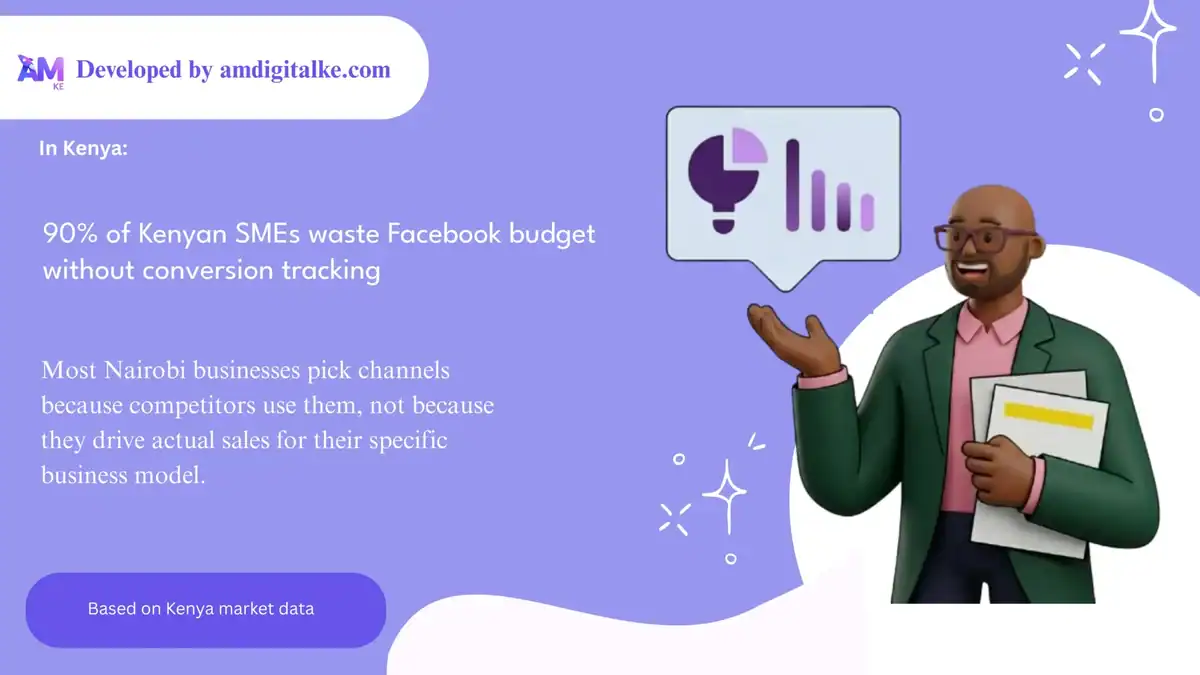
Your competitor posts on Instagram daily, so you assume Instagram works.
A marketing webinar told you Google Ads converts, so you opened an account.
But your competitor might be a clothing brand where visual content drives impulse buys.
You’re a B2B consultancy where decision cycles take three months and happen over email and LinkedIn.
What works for them won’t work for you.
Without a framework to evaluate channels for your specific business, you’re just copying homework from someone in a different class.
The Real Cost of Channel Confusion
Wasted budget is obvious.
You can see the 15,000 shillings you spent on Facebook ads that generated zero leads.
The hidden cost is diluted messaging.
When you’re trying to show up on five platforms, you’re creating five different versions of your brand voice.
Your Facebook posts sound casual.
Your LinkedIn articles try to sound corporate.
Your Instagram captions chase trends.
Your customer doesn’t know who you actually are because you don’t sound like the same business across channels.
What Most Marketing Advice Gets Wrong About Channel Selection
Every marketing blog tells you to “meet your customers where they are.”
That’s not wrong, but it’s not actionable.
Your customers are on Facebook, WhatsApp, email, Google, and probably walking past your shop in Westlands.
You can’t be everywhere, so which one matters most?
The Myth of Universal Channel Performance
Global marketing guides recommend the same channels to everyone.
Facebook for reach, Google for intent, email for retention.
In Kenya, that framework breaks down fast.
WhatsApp Business API converts better than Instagram DMs for most service businesses.
SMS order confirmations drive more repeat purchases than Facebook retargeting for e-commerce.
Google My Business generates more walk-ins for Nairobi clinics than any paid social campaign.
But you won’t read that in a blog written for US SaaS companies.
You need Kenya-specific data for Kenya-specific businesses.
Budget Reality Nobody Talks About
Most channel selection guides assume you have $500 a month to test platforms.
If you’re running a startup in Nairobi, your entire marketing budget might be 20,000 shillings.
You can’t afford to test five channels for three months each.
You need to pick the right one in week one and optimize from there.
That requires a scoring system, not a guess.
It requires honesty about what you can actually execute with your current team and budget.
The One-Time Decision Trap
Most businesses pick their marketing channels once, usually at launch.
Then they run those channels for two years without questioning whether they still work.
Markets shift.
Your Westlands audience might have moved from Facebook groups to WhatsApp communities.
Your email open rates might have dropped because Gmail’s new tabs bury promotional content.
If you’re not reviewing channel performance monthly, you’re optimizing last year’s strategy.
📊 What You Actually Need: A Marketing Channels Scoring System
I built a free Google Sheets template that scores every marketing channel against five factors: cost, reach, conversion potential, time to ROI, and execution difficulty.
It takes 20 minutes to fill out and shows you exactly where to focus.
This isn’t theory.
This is the same framework I use when a client in Karen asks me which channels to prioritize for their law firm or online store.
The Five Columns That Change Everything
The template has one row for every channel you’re using or considering.
Facebook, Google Ads, Instagram, TikTok, email, LinkedIn, YouTube, WhatsApp, SMS, Google My Business.
List them all.
Then you score each channel from 1 to 5 on cost (1 = expensive, 5 = cheap), reach (1 = small audience, 5 = massive), and conversion potential (1 = rarely converts, 5 = converts consistently).
You also estimate time to ROI in weeks or months.
The final column calculates a total score.
The channels with the highest scores are your winners.
Why This Beats Guessing
Before you use the template, channel selection feels like a coin flip.
After you fill it out, you have data.
You can see that Google Ads scores high on conversion potential but low on cost, while email scores high on both conversion and cost.
That tells you where to start if you’re on a tight budget.
You can also spot channels you’re running out of habit.
If Instagram scores a 12 out of 25 and you’re spending 10 hours a week on it, you now have permission to stop.
How It Saves Time vs Manual Analysis
Without a template, you’d need to pull reports from five different platforms, export CSVs, and build your own comparison spreadsheet.
That’s a full day of work.
With the template, you plug in your scores and the sheet does the math.
You spend 20 minutes scoring, 10 minutes reviewing the results, and the rest of your day actually running campaigns.
| Channel | Cost (1-5) | Reach (1-5) | Conversion (1-5) | Time to ROI | Total Score |
|---|---|---|---|---|---|
| 5 | 3 | 5 | 2 weeks | 13 | |
| Google Ads | 2 | 4 | 5 | 8 weeks | 11 |
| Facebook Ads | 3 | 5 | 3 | 4 weeks | 11 |
| 4 | 4 | 2 | 12 weeks | 10 | |
| WhatsApp Business | 5 | 3 | 4 | 1 week | 12 |
Step 1: List Every Channel You’re Using or Considering
Open the template and look at the first column.
You’ll see a pre-filled list of common channels, but don’t just use mine.
Add yours.
Include both paid and organic.
Include platforms you’re actively using and ones you’ve been thinking about testing.
Why You Need to See Them All in One Place
When your marketing channels live in different browser tabs and apps, you never compare them side by side.
Email lives in Mailchimp.
Facebook lives in Meta Business Suite.
Google lives in Google Ads.
You never see that you’re spending equal time on a channel that converts at 2% and one that converts at 12%.
The template forces that comparison.
Don’t Skip Offline Channels
If you run a clinic in Kilimani, foot traffic from your Google My Business listing might be your best channel.
If you’re a Westlands agency, referral partnerships might drive more revenue than any digital platform.
List those too.
The goal isn’t to pick the trendiest channels.
It’s to pick the ones that actually grow your business.
Step 2: Score Each Channel Against Your Business Goals
This is where most businesses skip ahead and get it wrong.
You can’t score a channel until you define what you’re scoring it for.
Are you trying to generate leads, close sales, build brand awareness, or drive website traffic?
Your answer changes everything.
Define Your Goal First
If your goal is lead generation, conversion potential matters more than reach.
A channel that gets you 10 qualified leads is better than one that gets you 10,000 impressions and zero inquiries.
If your goal is brand awareness, reach matters more than conversion.
You’re not trying to close sales this month.
You’re trying to make sure 50,000 Nairobi residents know your name.
Write your primary goal at the top of the template before you score anything.
It keeps you honest.
How to Score Cost, Reach, and Conversion Potential
Cost is simple: 5 means free or nearly free, 1 means expensive.
Email is a 5 if you’re using a free plan.
Google Ads is a 2 because you’re paying per click.
Reach is how many people you can realistically get in front of.
Facebook is a 5 because the audience is massive.
LinkedIn might be a 2 if you’re targeting a niche B2B audience in Kenya.
Conversion potential is the hardest to score because it requires honesty.
Don’t score based on what you hope will convert.
Score based on what has converted or what similar businesses report.
Real Example: A Kilimani Law Firm Scoring Channels
I worked with a law firm in Kilimani that wanted more corporate clients.
They were running Facebook ads and posting on Instagram daily.
When we scored their channels, Facebook got a 3 on conversion potential because their audience wasn’t looking for legal services while scrolling memes.
LinkedIn got a 5 because decision-makers were actively looking for business content.
Google My Business got a 4 because people searching “corporate lawyer near me” had high intent.
We killed Facebook, doubled down on LinkedIn and Google, and their inquiry rate tripled in two months.
Time to ROI: The Factor Nobody Tracks
Some channels pay off fast.
WhatsApp Business can generate responses within hours.
Email automation for kenyan businesses converting leads while you sleep can drive sales in a week.
Based on AM Digital KE client data across Kenyan accounts, Google Ads takes 6-8 weeks to gather enough data for optimization.
SEO takes 4-6 months before you see real traffic.
If you need revenue this quarter, you can’t bet everything on long-term channels.
Score time to ROI honestly.
It doesn’t make a channel bad.
It just tells you when to expect results.
Step 3: Pick Your Top Three Channels and Commit
Look at your total scores.
The top three channels are your focus for the next 90 days.
Not five.
Not seven.
Why Three Channels, Not Ten
You don’t have the time or budget to optimize ten channels.
Even if you did, you’d be spreading your attention so thin that none of them would perform well.
Three channels gives you enough diversification that you’re not dependent on one platform.
It’s also few enough that you can actually learn what works and improve month over month.
How to Allocate Budget Across Your Top Three
If your top three channels scored 15, 13, and 11, don’t split your budget equally.
Weight it toward the highest scorer.
A simple rule: 50% of budget to your top channel, 30% to your second, 20% to your third.
That way you’re betting big on what’s most likely to work while still testing alternatives.
The 80/20 Rule in Action
In most businesses, 80% of results come from 20% of your marketing channels.
The template helps you identify that 20% so you stop wasting money on the other 80%.
I’ve seen Nairobi e-commerce stores get 85% of their sales from email and Google Ads.
The other five channels they were running contributed almost nothing.
Once they reallocated budget to the two winners, revenue grew 40% without increasing total marketing spend.
That’s the power of focus.
Real Example: Westlands Agency Focuses on Three
A digital agency in Westlands was posting on Facebook, Instagram, LinkedIn, Twitter, and YouTube.
They were also running Google Ads and attending networking events.
When we scored their channels, Google Ads, LinkedIn, and referral partnerships were the clear winners.
Everything else scored below 10.
They killed all social media except LinkedIn.
They stopped YouTube entirely.
They redirected that time into optimizing Google Ads and building referral systems.
Their pipeline grew 60% in four months because they finally had time to do three things well instead of seven things poorly.
How to Use This Template Every Month (Not Just Once)
Channel selection isn’t a one-time decision.
Markets shift, algorithms change, and your business evolves.
The template is a monthly tool, not a launch-week exercise.
Set a recurring calendar reminder to review your scores on the first Monday of every month.
Monthly Review Process: What’s Working, What’s Not
Pull your analytics for each of your three channels.
Look at cost per lead, conversion rate, and total revenue generated.
If a channel’s performance has dropped, adjust its score in the template.
If a channel you weren’t using has become more relevant, add it and score it.
The goal isn’t to chase shiny new platforms every month.
The goal is to catch declining performance before you’ve burned through a full quarter of budget.
When to Pivot Channels
If a channel’s score drops below 8 for two consecutive months, it’s time to test a replacement.
Don’t kill it immediately.
Run a one-month experiment with the next-highest-scoring channel.
Compare results.
If the new channel outperforms the old one, make the swap permanent.
I worked with a Nairobi e-commerce store that was running Instagram ads.
After three months, their cost per acquisition had doubled and their score dropped to 7.
We tested SMS campaigns for order confirmations and upsells.
SMS scored a 13 and converted at triple the rate of Instagram.
They reallocated the Instagram budget to SMS and saw a 25% increase in repeat purchases.
That’s a smart pivot, not a panic move.
How to Track ROI for Each Channel
You can’t score accurately without data.
For every channel, track at minimum: cost, leads generated, conversions, and revenue attributed.
Use UTM parameters for every link you share so Google Analytics can tell you which channel drove which sale.
Set up conversion tracking in Google Ads and Facebook Ads.
For offline channels like referrals or walk-ins, ask every new customer how they found you and log it in a simple spreadsheet.
You don’t need fancy software.
You just need consistency.
Link to Your GSC, GA4, and Ad Account Data
The template is most powerful when you’re pulling real numbers, not guessing.
Before you score each month, open Google Search Console to see organic traffic trends.
Open GA4 to see which channels are driving the most engaged sessions.
Open your ad accounts to see cost per click and conversion rate.
Then score based on what the data shows, not what you hope is happening.
That’s how you turn the template from a planning tool into a decision-making system.
✅ Common Mistakes to Avoid When Using the Template
The biggest mistake is scoring based on what you want to be true instead of what is true.
You want Instagram to work because you’ve spent six months building a following.
But if the data shows it’s not converting, your score needs to reflect that.
The template only works if you’re honest with it.
Don’t Score Channels You’ve Never Tested
If you’ve never run Google Ads, don’t score it a 5 on conversion potential just because you heard it works.
Score it based on industry benchmarks or leave it unscored until you have real data.
Guessing inflates scores and leads you to invest in channels that don’t actually fit your business.
Test first, then score.
Don’t Ignore Execution Difficulty
A channel might score high on paper but require skills you don’t have.
YouTube scores well for reach and conversion, but if you don’t know video editing and you can’t afford to hire someone, it’s not a realistic choice.
Add a sixth column for execution difficulty if you need to.
Score 1 for hard, 5 for easy, and factor that into your decision.
✅ Quick Action Checklist
- ☐ Download the free marketing channels Google Sheets template
- ☐ List every marketing channel you’re currently using or considering
- ☐ Define your primary business goal (leads, sales, awareness, traffic)
- ☐ Score each channel on cost, reach, conversion potential, and time to ROI
- ☐ Identify your top three channels and allocate 50/30/20 budget split
- ☐ Set a monthly calendar reminder to review and update your scores
- ☐ Set up conversion tracking for every channel you’re running
- ☐ Kill any channel that scores below 8 for two consecutive months
Ready to Improve Your Channel Strategy?
Most Kenyan businesses waste money on marketing channels because they never measured which ones actually work.
The free template gives you a scoring system that turns guessing into data-driven decisions.
Download it, fill it out, and focus on your top three channels for the next 90 days.
You’ll see better results with less budget because you’re finally putting your money where it converts.
If you need help interpreting your scores or want a second opinion on your channel strategy, contact AM Digital KE today.
We help Nairobi businesses turn scattered marketing into focused revenue growth.
Frequently Asked Questions
How often should I update my marketing channels template?
Review and update your template monthly.
Pull fresh data from Google Analytics, your ad accounts, and any other tracking tools you use.
If a channel’s performance has changed significantly, adjust its score.
Monthly reviews help you catch declining channels before you waste a full quarter of budget on something that’s stopped working.
What if my top three channels are all expensive?
If your highest-scoring channels are all costly, you have two options.
First, look for a high-scoring low-cost channel you can add as a fourth focus area.
Second, optimize your expensive channels ruthlessly so you’re getting maximum ROI.
Sometimes the best channel is expensive because it works.
Just make sure you’re tracking every shilling and cutting what doesn’t convert.
Can I use this template for a business that’s just launching?
Yes, but your scores will be educated guesses until you have real data.
Research what similar Kenyan businesses report for each channel, and score based on that.
Then commit to testing your top three channels for 90 days and updating your scores monthly as you gather actual performance data.
The template helps you start with strategy instead of random guessing.
Should I score organic and paid versions of the same channel separately?
Absolutely.
Organic Facebook and Facebook Ads perform completely differently and deserve separate rows in your template.
Organic Facebook might score high on cost (free) but low on reach (algorithm limits).
Facebook Ads score low on cost but high on reach.
Treat them as distinct channels so you can make smart budget decisions for each.
What if my competitors are succeeding on a channel that scores low for me?
Your competitor’s business model might be different from yours.
A Nairobi clothing brand will score Instagram higher than a B2B consultancy because visual content drives apparel sales.
Don’t copy your competitor’s channels.
Use the template to find what works for your specific business, audience, and goals.
Their winning channel might be your money pit.
Additional Resources
- Artly Digital Marketing vs AM Digital KE – Compare two Kenyan agencies to see which channel selection approach fits your business model and budget.
- What are Featured Snippets (for the Kenya Market) – Learn how to optimize your content for Google’s featured snippets, a high-conversion organic channel worth scoring in your template.
- Whatsapp Business Automation – Answering Customer Questions 24/7 – Discover how to automate WhatsApp, one of Kenya’s highest-converting channels that often outscores Instagram and Facebook.
- Tourism SEO Kenya – How to Attract International Visitors – See how tourism businesses score SEO channels differently when targeting international audiences versus local Kenyan customers.
- Social Media Automation- Consistency Without Burnout – Automate your social channels so you can maintain presence on lower-scoring platforms without draining time from your top three.
- Service Area Business SEO – Ranking Without a Physical Location – Learn how service businesses score local SEO channels when they don’t have a physical storefront to drive foot traffic.
Take the Next Step
Stop guessing which marketing channels will work for your business.
Download the free marketing channels Google Sheets template and score every platform against your actual goals.
It takes 20 minutes to fill out and shows you exactly where to focus your budget for maximum ROI.
Get the template here: download the Free Marketing Channels Template for Kenyan Businesses.