Table of Contents
- What Does Nofollow vs Dofollow Actually Mean?
- 📋 Key Takeaways
- Why Does This Matter for Kenyan Businesses?
- How Nofollow vs Dofollow Actually Works
- Real Examples from Kenya
- Common Mistakes Kenyan Businesses Make
- ✅ Quick Action Checklist
- Ready to Improve Your Nofollow vs Dofollow Strategy?
- Frequently Asked Questions
- Additional Resources
- Take the Next Step
TL;DR: Dofollow links pass ranking power to your website and directly improve your Google search position. Nofollow links don’t pass ranking power, but they build brand credibility and drive real traffic from trusted sources. The best Kenyan businesses use both strategically: dofollow links from quality sites and nofollow links from industry authorities to create a natural, trustworthy online presence that Google rewards.
What Does Nofollow vs Dofollow Actually Mean?
If you’ve been building your business online in Nairobi or anywhere else in Kenya, you’ve probably heard someone say “Get more backlinks” or “Build links to your website.”
But here’s what nobody tells you: not all links are created equal.
A link is simply a connection from one website to another.
When someone clicks a link on another site and lands on yours, that’s traffic.
But there’s a hidden layer to links that most Kenyan business owners never understand.
It’s the difference between a link that helps your Google ranking and one that doesn’t.
That difference comes down to two words: dofollow and nofollow.
Every single link on the internet is one or the other.
📋 Key Takeaways
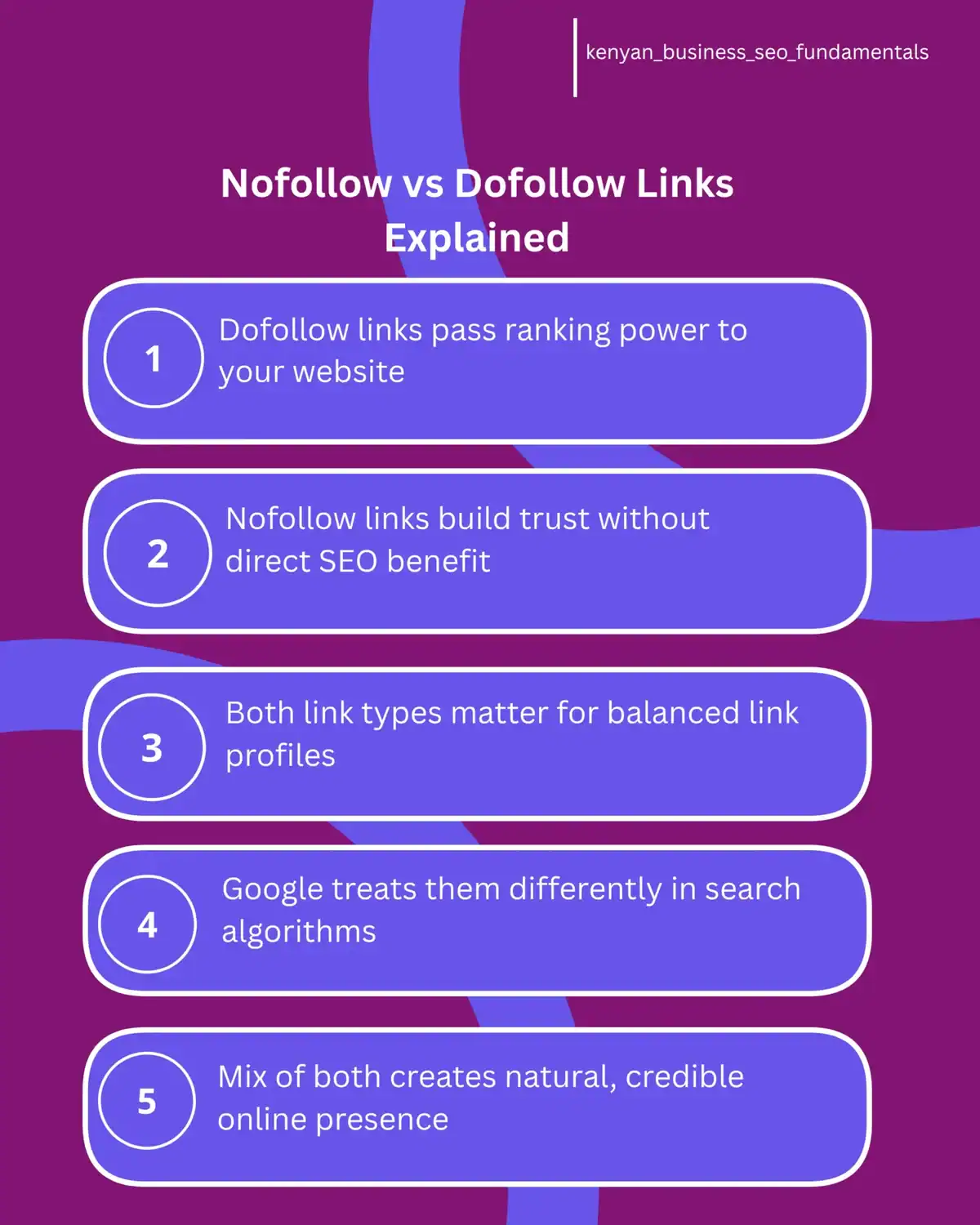
- Dofollow links pass ranking authority to your site and directly improve Google search visibility
- Nofollow links drive traffic and build credibility but don’t directly boost rankings
- A natural link profile includes both types: too many dofollow links from low-quality sites looks suspicious
- Most Kenyan businesses should focus on quality dofollow links from relevant local sites first
- Nofollow links from trusted sources like news outlets and industry directories are still valuable for brand awareness
What is a Dofollow Link?
A dofollow link is a normal link.
When someone links to your website without adding any special code, it’s dofollow by default.
Think of it this way: when a dofollow link points to your site, Google sees it and thinks, “Someone trusts this website enough to recommend it.”
Google then passes a small amount of ranking power (called link equity or link juice) from that linking site to yours.
If a popular Nairobi business website links to your plumbing company’s site with a dofollow link, Google notices that recommendation.
It slightly boosts your ability to rank for plumbing-related searches in Nairobi.
Dofollow links are what most SEO professionals chase because they directly impact your search rankings.
They’re the currency of Google’s ranking system.
What is a Nofollow Link?
A nofollow link is a link with special code attached that tells Google, “Don’t pass ranking power through this link.”
When a website owner adds nofollow code to a link, they’re essentially telling Google to ignore that link when calculating your site’s ranking authority.
The link still works. People can still click it and visit your website.
But Google doesn’t count it as a vote for your site.
A nofollow link from a major Kenyan news site like Business Daily or Nation still sends real people to your business.
But Google won’t boost your search ranking because of that link.
Nofollow links became common when Google wanted to prevent spam.
If every link counted equally, spammers would just post links everywhere.
Nofollow let website owners link to things without accidentally helping spam sites rank higher.
Why Does This Matter for Kenyan Businesses?
You might be thinking, “Alvin, I just want customers.
Why do I care about this technical stuff?” Fair question.
Here’s why it matters to your bottom line.
Your Google Ranking Directly Affects Revenue
If you run a salon in Westlands or a restaurant in Upper Hill, most of your new customers find you through Google search.
When someone searches “best hair salon near me” or “Italian restaurant Nairobi,” you want your business to appear on the first page.
Dofollow links are one of the three biggest factors Google uses to decide which websites appear first.
Without them, you’re competing with one hand tied behind your back.
A competitor with better links will outrank you.
You’ll lose customers to them.
When you get backlinks from relevant, trusted Kenyan websites, Google sees your business as more trustworthy and moves you higher in search results.
More visibility means more calls and walk-ins.
Nofollow Links Still Drive Real Business
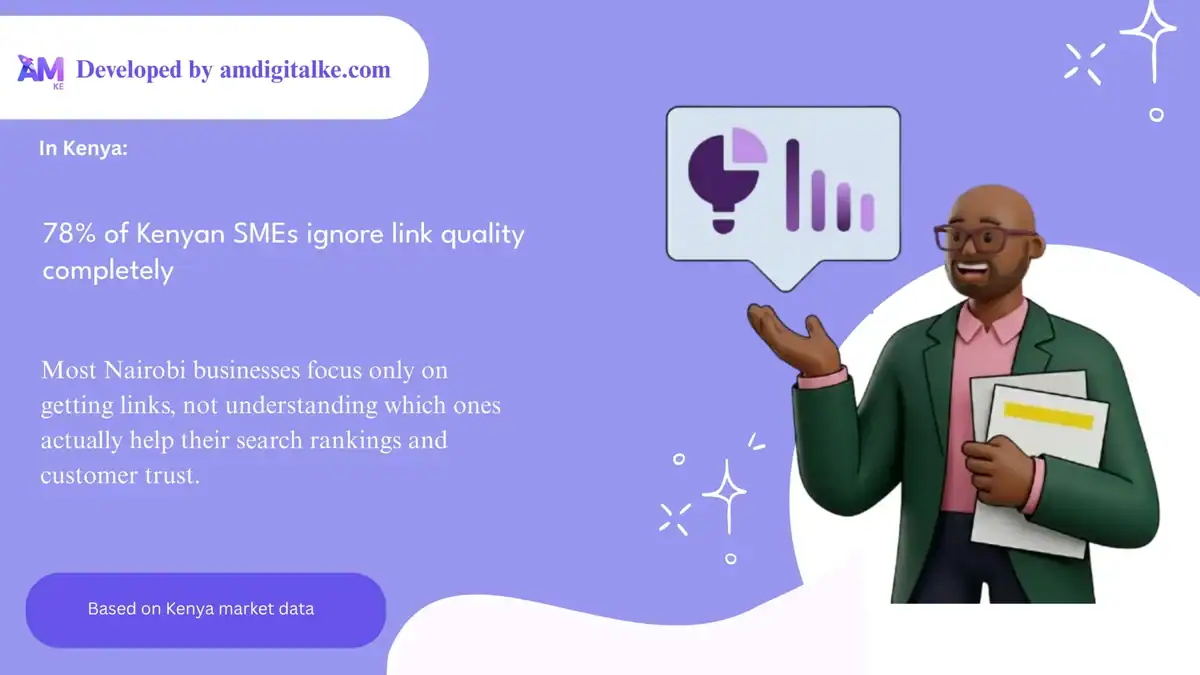
Here’s the part most SEO agencies get wrong: they tell you nofollow links are worthless.
That’s nonsense for a Kenyan business owner.
If a major publication like Nairobi Wire or TechMtaa writes about your business and links to you (even with nofollow), thousands of people see that link and click through to your site.
That’s real traffic, real potential customers, and real credibility in your market.
A mention on a trusted news site or industry directory (even with a nofollow tag) tells potential customers that your business is legitimate and noteworthy.
That trust converts to sales.
Google Rewards Natural, Balanced Link Profiles
If your website only has dofollow links from low-quality sites, Google gets suspicious.
It looks like you paid for links or manipulated the system.
Google penalizes that behavior.
A natural link profile includes both dofollow and nofollow links from a variety of sources.
It looks like people organically discovered your business and linked to it for genuine reasons, not because you paid them.
Kenyan businesses that build links in a balanced mix of quality dofollow and credible nofollow rank better and stay in Google’s good graces longer.
How Nofollow vs Dofollow Actually Works
The Technical Side (Explained Simply)
When a website owner creates a link, they write HTML code.
For a normal dofollow link, the code looks like this: <a href=”https://yoursite.com”>Your Business</a>
For a nofollow link, they add one extra piece of code: <a href=”https://yoursite.com” rel=”nofollow”>Your Business</a>
That rel=”nofollow” instruction is like a note to Google that says, “Don’t count this link.”
Google’s robots read that instruction and skip over it when calculating your site’s ranking authority.
How Google Processes These Links
Google has robots that crawl the internet constantly, following links from site to site.
When they hit a dofollow link, they follow it and note that it’s a recommendation.
When they hit a nofollow link, they still follow it and index the page, but they don’t treat it as a ranking signal.
It’s like the difference between someone saying “You should hire this person” versus someone just mentioning that person exists.
Over time, Google combines all the dofollow links pointing to your site (called your backlink profile) and uses that data to decide your authority level for different search topics.
More quality dofollow links mean higher authority and better rankings.
Real Examples from Kenya
Example 1: A Nairobi E-Commerce Store
Imagine you run an online fashion store selling Kenyan-designed clothes from your Nairobi warehouse.
You want to rank for “buy Kenyan fashion online” and similar searches.
If a popular Kenyan lifestyle blog links to your store with a dofollow link, Google sees that as a vote of confidence.
That one link from a trusted source might help you rank higher for fashion-related searches in Kenya.
But if you get mentioned on a major news site like the Standard or Daily Nation (usually with nofollow), thousands of Kenyans see your brand.
That nofollow link doesn’t boost your ranking, but it drives real traffic and builds your brand reputation.
The best strategy combines both: get dofollow links from relevant fashion blogs and industry sites, plus nofollow mentions from news outlets and fashion influencers.
Example 2: A Mombasa Tourism Business
You run a beach resort in Mombasa.
You want to rank for “luxury beach resort Mombasa” and “best hotels in Mombasa.”
Travel websites and tourism directories link to hotels constantly.
If major tourism sites like TripAdvisor or Kenya Tourism Board link to your site with dofollow links, those are gold for your rankings.
If travel bloggers write about your resort and link to you (often with nofollow), you get featured on their platforms.
Their readers see your resort and book stays because of that exposure, not because of the link’s ranking power.
A Mombasa resort that builds dofollow links from travel sites and nofollow mentions from travel influencers will dominate local search results and fill rooms consistently.
Example 3: A Nairobi Law Firm
You’re a lawyer in Nairobi offering corporate law services.
You need to rank for “corporate lawyer Nairobi” and “business law firm Kenya.”
When other law firms, business associations, or industry directories link to your site with dofollow links, you gain authority for legal topics.
Each quality link makes Google see you as a legitimate legal expert.
When you get mentioned in business publications or quoted in articles (usually nofollow), you build credibility with potential clients.
They see you as an authority and call your firm for consultations.
The law firm that combines quality dofollow links from legal directories with nofollow mentions in business publications becomes the top result when Nairobi businesses search for legal help.
Common Mistakes Kenyan Businesses Make
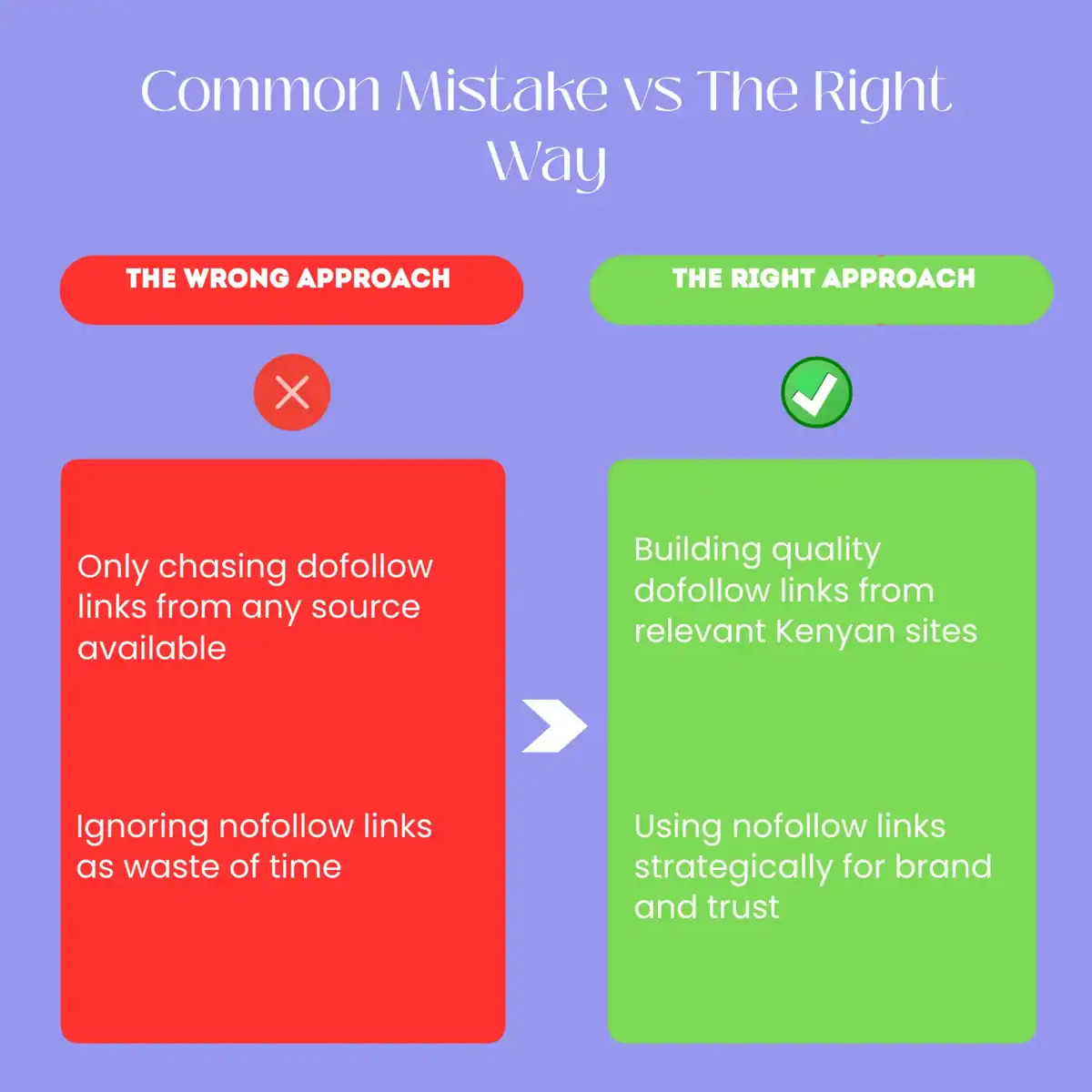
Mistake 1: Treating All Links the Same
Many Nairobi business owners think any link is a good link.
They’ll accept links from random sites, paid link schemes, or link farms just to increase their link count.
This backfires.
Google’s algorithms detect unnatural link patterns and penalize sites that look like they’re gaming the system.
Your rankings drop, and you lose customers.
A single dofollow link from a relevant, trusted Kenyan website is worth more than fifty links from low-quality sites.
Quality beats quantity every single time.
Mistake 2: Ignoring Nofollow Completely
Some business owners hear that nofollow links don’t help rankings and stop pursuing them entirely.
That’s a missed opportunity.
A nofollow link from a major Kenyan news outlet or industry authority still brings real traffic and builds real credibility.
You’re leaving money on the table if you ignore those opportunities.
The smartest strategy uses nofollow links strategically from trusted sources while building dofollow links from quality relevant sites.
Mistake 3: Buying Links or Using Link Schemes
You’ll see ads online promising “500 backlinks in 30 days” or “Buy cheap links here.”
These are scams, and they’ll destroy your website’s ranking.
Google explicitly forbids buying links.
When they detect it (and they always do eventually) they penalize your site.
You might drop from page one to page ten or disappear entirely.
Kenyan businesses that understand link building the right way (through genuine relationships, quality content, and legitimate outreach) stay safe and rank consistently for years.
| Link Type | Ranking Impact | Traffic Impact | Trust Impact |
|---|---|---|---|
| Dofollow from Quality Site | High | Medium | High |
| Dofollow from Low-Quality Site | Low/Negative | Low | Low |
| Nofollow from Authority Site | None | High | Very High |
| Nofollow from Random Site | None | Low | Low |
✅ Quick Action Checklist
- ☐ Audit your current backlinks to identify which are dofollow vs nofollow
- ☐ List 10 relevant Kenyan websites in your industry that you could build relationships with
- ☐ Create a content piece worth linking to (case study, guide, or resource)
- ☐ Reach out to 5 relevant sites with genuine, personalized link requests
- ☐ Apply for listings on Kenyan business directories and industry associations
- ☐ Identify 3 Kenyan news outlets or publications where you could get mentioned
- ☐ Check your competitor’s backlink profile to see where they’re getting links
- ☐ Set up monthly tracking of your dofollow vs nofollow link growth
Ready to Improve Your Nofollow vs Dofollow Strategy?
Understanding the difference between nofollow and dofollow links is just the beginning.
The real work is building a strategy that gets you quality links from relevant Kenyan sources while protecting your site from low-quality spam.
Most Kenyan businesses either chase links blindly or ignore them completely.
You now know the middle path: build dofollow links from quality sites in your industry, pursue nofollow mentions from trusted authorities, and watch your rankings and traffic grow together.
If you’re ready to build a link strategy that actually works for your Kenyan business, reach out to AM Digital KE.
We’ll audit your current links, identify opportunities, and help you build the right way.
Frequently Asked Questions
Can I convert a nofollow link to a dofollow link?
No.
Only the website owner who created the link can change it from nofollow to dofollow.
You can politely ask them to change it, but they’re under no obligation.
Focus on getting new dofollow links instead of trying to convert existing ones.
Do I need both types of links, or should I focus only on dofollow?
You need both.
A natural link profile includes both types.
If you have only dofollow links, especially from low-quality sites, Google sees it as unnatural and penalizes you.
Mix high-quality dofollow links with nofollow mentions from trusted sources.
How many dofollow links do I need to rank on Google’s first page in Kenya?
It depends on your industry and competition.
Based on AM Digital KE client data across Kenyan accounts, a less competitive keyword might need 5-10 quality dofollow links.
A competitive one might need 50+.
Quality matters more than quantity.
One link from a major Kenyan site beats ten links from random sites.
Are links from Kenyan sites more valuable than international links?
For ranking in Kenya, yes.
Google prioritizes links from local sources when determining rankings for local searches.
A link from a Nairobi business site is more valuable for “plumber Nairobi” than a link from a US site.
What if a spammer links to my site? Will it hurt my rankings?
Not anymore.
Google’s algorithm is smart enough to ignore spam links.
However, if you notice a lot of spam linking to your site, you can disavow those links using Google Search Console to be extra safe.
Additional Resources
- What is SEO in Kenya – Understand the foundational SEO principles that make link building effective in the Kenyan market.
- What are Featured Snippets (for the Kenya Market) – Learn how quality links help you win featured snippets and dominate search results above traditional rankings.
- What is Anchor Text – Master the text you use in your links to maximize the ranking power of both dofollow and nofollow links.
- What is SACCO SEO in Kenya – See how financial institutions use strategic link building to build trust and authority in competitive markets.
- National SEO vs Local SEO – Which Does Your Kenyan Business Need? – Determine whether you need local or national links based on your business model and target market.
- From Nairobi to Mombasa- Scaling Your SEO Nationally – Discover how to build links across multiple Kenyan regions to expand your visibility beyond one city.
Take the Next Step
Ready to build a link strategy that actually works for your Kenyan business?
We’ve created a complete guide that walks you through finding link opportunities, reaching out to website owners, and tracking your progress.
Download the Complete Link Building Guide for Kenyan Businesses and start building links the right way today.