Table of Contents
- Why Lead Follow-Up Automation Matters for Your Kenyan Business
- 📋 Key Takeaways
- What You Need Before You Start
- Step 1: Set Up Your Lead Capture Points
- Step 2: Choose Your Automation Platform
- Step 3: Build Your Automated Email Sequences
- Step 4: Set Up Lead Scoring
- Step 5: Integrate Your CRM or Sales Tool
- Step 6: Monitor and Optimize Your System
- Common Mistakes to Avoid
- ✅ Quick Action Checklist
- Ready to Improve Your Lead Follow-Up?
- Frequently Asked Questions
- Additional Resources
- Take the Next Step
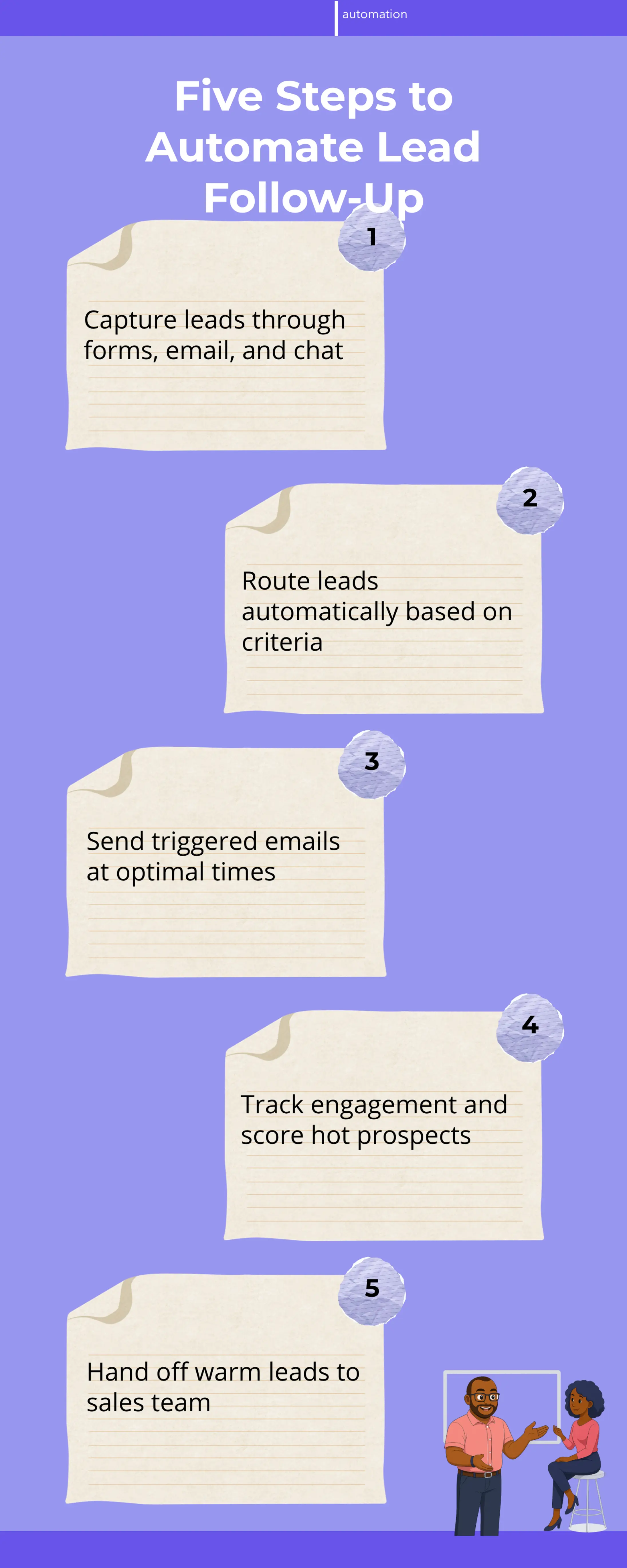
TL;DR: Lead follow-up automation sends the right message to the right prospect at the right time, without your team lifting a finger. For Kenyan businesses, this means capturing leads through forms and chat, routing them to the right person, sending triggered emails automatically, scoring hot prospects, and handing off warm leads to sales. You can start with free or affordable tools today.
Why Lead Follow-Up Automation Matters for Your Kenyan Business
A lead comes in from your website, Facebook, or a referral. Your sales team is busy.
That lead sits in your inbox for three days. By then, they have already talked to your competitor.
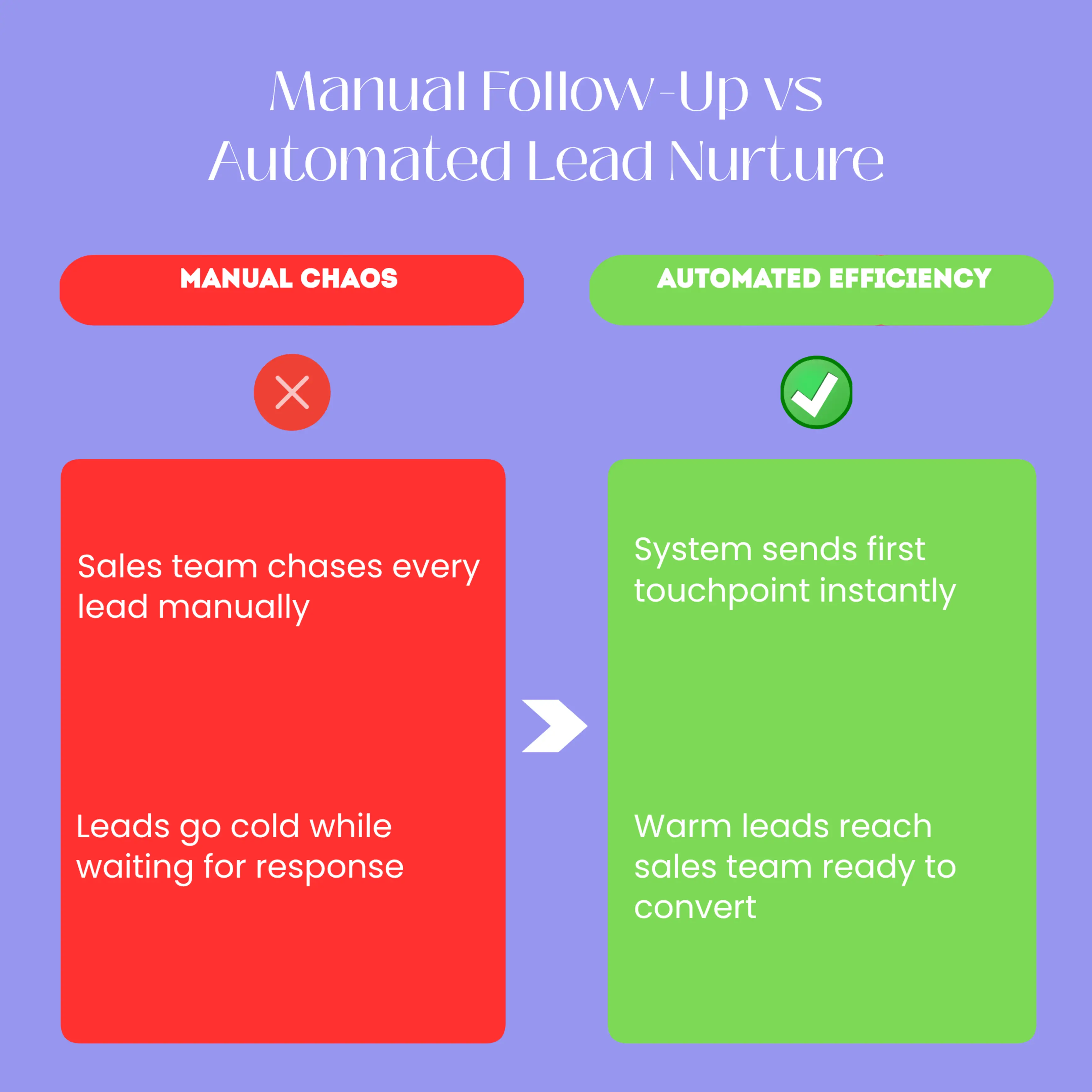
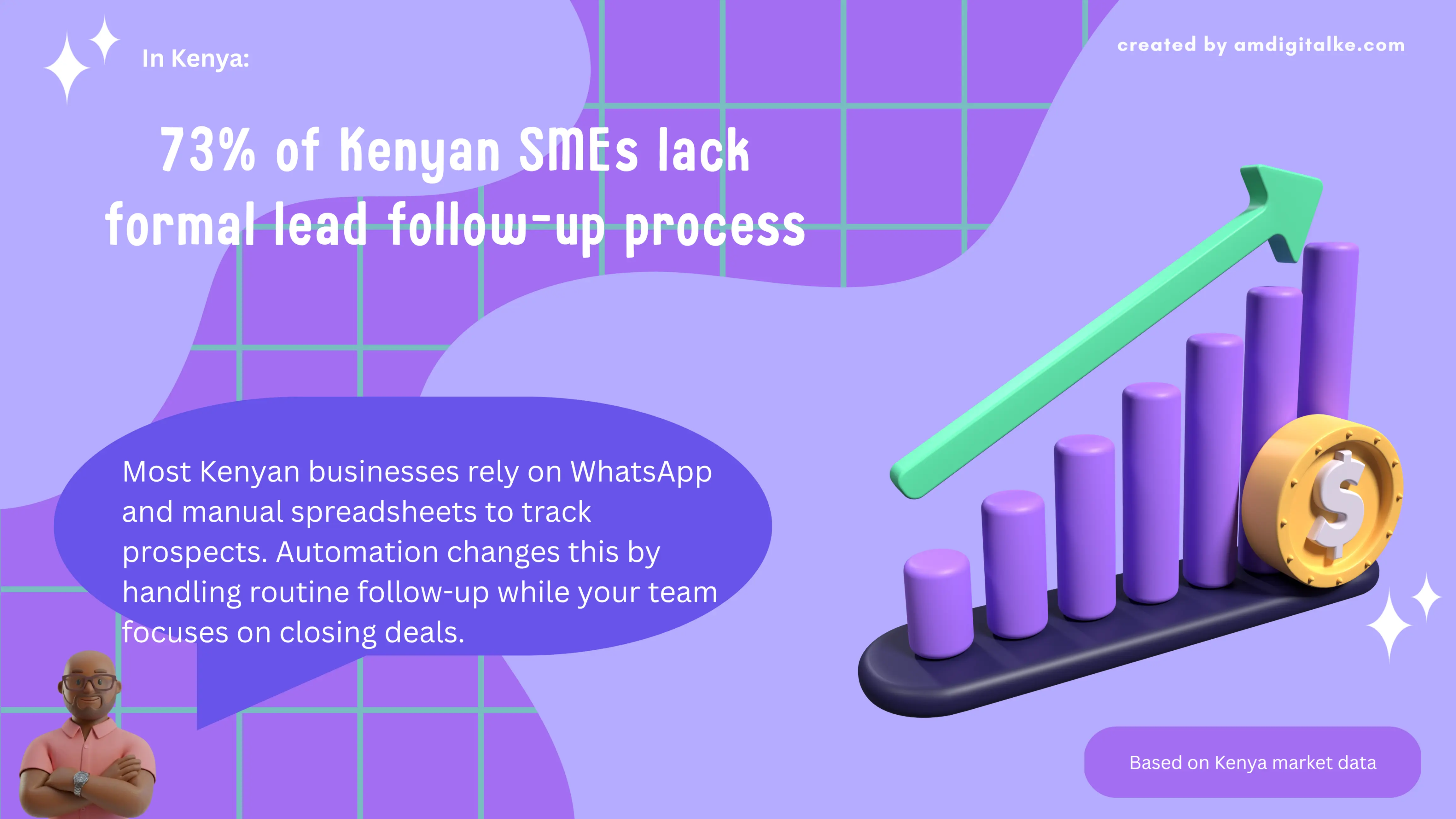
This is the reality for most Kenyan businesses. A prospect fills out a form or sends a WhatsApp message, but nobody responds fast enough, and the opportunity dies.
Lead follow-up automation fixes this problem. It sends your first message within seconds, keeps the conversation warm, and shows your sales team which prospects are ready to buy.
The result is more deals closed and less time wasted on cold leads. Your sales team gets time to actually sell instead of chasing spreadsheets.
📋 Key Takeaways
- Automated follow-up responds to leads instantly, before competitors do, giving you a real advantage in competitive markets.
- Lead scoring automatically identifies hot prospects so your sales team only chases buyers, not tire-kickers.
- Email sequences nurture cold leads over weeks or months without any manual effort from your team.
- You can start with free tools like Google Forms and Zapier, then upgrade to dedicated platforms as you grow.
- Most Kenyan businesses lose 40-60% of leads simply because they don’t follow up fast enough or consistently enough.
What You Need Before You Start
Before you set up automation, you need three things in place. Without them, your system will fail or confuse your team.
A Clear Sales Process
Automation only works if you know what you want to happen at each stage. Map out your sales journey: how many touchpoints before a lead becomes a qualified prospect, what information you need to collect, and who decides when a lead is ready for the sales team.
For a Nairobi marketing agency, this might look like: lead fills form, receives welcome email, gets two educational emails, then a sales call offer. For a Mombasa e-commerce business, it might be: customer browses products, gets abandoned cart email, then a discount offer email.
A Lead Capture System
You cannot automate follow-up without a way to capture leads first. This means a form on your website, a landing page for campaigns, a chat widget, or an email address where prospects can reach you.
Most Kenyan businesses already have at least one of these. If you don’t, start with a simple Google Form on your website or a WhatsApp Business account linked to email automation for kenyan businesses converting leads while you sleep.
An Email Address or Communication Channel
Your automation system needs a way to send messages. This is usually an email address, but it can also be WhatsApp, SMS, or in-app notifications.
If you are sending emails, use a professional domain email address like [email protected]. Skip the Gmail account, since a branded email improves deliverability and builds trust with prospects.
Step 1: Set Up Your Lead Capture Points
The first step is connecting every possible way a prospect can reach you to your automation system. If a lead contacts you but that contact never reaches your system, you have wasted the opportunity.
Create a Website Form
Your website should have at least one form where prospects can request information, book a call, or ask a question. This form should ask only for essential information: name, email, phone number, and what they are interested in.
Too many questions scare people away. A Nairobi SaaS startup that asked for 15 pieces of information saw 80% of prospects abandon the form, so they cut it to four questions and conversions doubled.
Set Up a Landing Page for Campaigns
If you run Facebook ads, Google ads, or email campaigns, each one should link to a dedicated landing page with a form. This form should match the ad message so prospects know they are in the right place.
A landing page for a “Free SEO Audit” offer should have a form asking for business name, website, and email. A landing page for a “Book a Demo” offer should ask for company size and current tools being used, similar to how loan calculator pages converting searches into leads capture intent-based prospects.
Connect Your Chat or Messaging
Many Kenyan businesses get leads through WhatsApp, Facebook Messenger, or website chat. These need to flow into your system too.
You can use tools like Zapier to connect WhatsApp Business to your CRM, or a platform like Intercom to capture all chat conversations in one place. When someone messages you, it automatically creates a lead record, and pairing this with lead magnets that convert gives prospects a reason to hand over their details.
Step 2: Choose Your Automation Platform
You have options here. It depends on your budget and how complex your sales process is.
The good news is that every option works for Kenyan businesses. This is marketing automation kenya businesses can actually afford.
Free or Low-Cost Options
If you are just starting out, use Google Forms plus Zapier plus Gmail. A prospect fills out your form, Zapier sends you a notification, and Gmail sends an automatic thank you email.
This costs almost nothing and works surprisingly well for small businesses. A Kampala-based consulting firm used this setup for six months before upgrading.
Mid-Range Platforms
Once you need more sophistication, look at platforms like Mailchimp, HubSpot’s free tier, or Brevo. These let you build email sequences, segment leads, and track opens and clicks.
Mailchimp’s free plan supports up to 500 contacts and unlimited emails. This is perfect for most Kenyan SMEs starting out, and you pay nothing until you grow beyond that.
Enterprise Platforms
If you already run a large sales team or have complex requirements, consider HubSpot’s paid CRM, Pipedrive, or Salesforce. These give you full automation, lead scoring, and detailed reporting.
These platforms cost money. But they pay for themselves if you close deals worth KES 500,000 or more.
A Nairobi fintech startup saw a 35% increase in closed deals after moving to Pipedrive.
Step 3: Build Your Automated Email Sequences
This is where the real work pays off. You create a series of emails that go out automatically based on what the prospect does.
The Welcome Email
This goes out immediately after someone fills out your form or subscribes to your list. It should be personal, acknowledge what they asked for, and set expectations for what comes next.
A good welcome email for a Nairobi digital agency might say: “Hi Sarah, thanks for requesting our SEO audit. We will send you a customized report within 48 hours. In the meantime, here are three quick wins you can implement today.” Then include a link to a blog post or resource.
The Educational Sequence
Over the next 5-10 days, send emails that educate the prospect about your solution. Do not sell yet.
Share case studies, answer common questions, or provide tips. Each email should build trust, not push a sale.
For a Mombasa e-commerce business, this might look like: Day 2, an email about how successful online stores handle inventory. Day 4, an email about payment methods popular in Kenya.
Day 7, an email about shipping logistics. Each one is helpful on its own.
The Sales Email
After 7-10 days of education, send an email that directly offers a call, demo, or purchase. By now, the prospect has learned about your approach.
They are far more likely to say yes at this stage. A good sales email is direct: “I think we can help you increase sales by 30% in the next quarter. Are you open to a 20-minute call to explore how?”
This works better than vague asks like “Would you like to learn more?”
The Re-Engagement Email
If a prospect does not open your emails or click your links, send one final email in 14 days. This is your last chance to get their attention.
Make it different from the others. Try a special offer or a different angle.
After that, move them to a nurture list that gets one email per month. They might not be ready now, but in six months they might be.
Step 4: Set Up Lead Scoring
Not all leads are equal. Some are ready to buy today, others are just researching and will not be ready for six months.
Lead scoring tells you which prospects are hot and which are cold. Your sales team then focuses on the hot ones, which starts with strong lead capture automation never miss a potential customer systems upstream.
How Lead Scoring Works
You assign points to actions that show buying intent. Opening an email is worth 5 points, clicking a link is worth 10 points.
Visiting your pricing page is worth 25 points. Downloading a case study is worth 15 points.
When a prospect reaches 50 points, they are “qualified.” Your system automatically sends them to your sales team or triggers a sales call offer.
Setting Your Scoring Rules
The key is to base scoring on actions that actually predict a sale. For a SaaS company, visiting the pricing page and reading a comparison guide are strong signals.
For a consulting firm, downloading a case study and requesting a proposal are strong signals. Where your leads come from matters too, which is why knowing which social platforms matter for kenyan businesses helps you score them accurately.
A Nairobi marketing agency found that prospects who visited their case studies were 3x more likely to become clients than those who just read blog posts. They adjusted their scoring to give case study downloads double the points.
Step 5: Integrate Your CRM or Sales Tool
Your automation system needs to talk to your sales tool. When a lead is qualified, they should appear in your CRM automatically so your sales team knows exactly what to do next.
Connect Your Platform to Your CRM
If you use HubSpot, Pipedrive, or Salesforce, most automation platforms integrate with them directly. A lead that reaches 50 points in your email system creates a contact in your CRM automatically, complete with their information and interaction history.
Your sales team opens the CRM and sees the lead. They already know this person opened three emails, clicked a case study, and visited the pricing page. This saves time and improves conversion.
Set Up Notifications for Hot Leads
When a lead hits your qualification threshold, your system should alert your sales team immediately. This can be a Slack notification, an SMS, or an email.
Speed matters. A prospect is 50 times more likely to respond if you reach out within five minutes of their inquiry. Automation makes this possible.
Step 6: Monitor and Optimize Your System
An automation system left alone will slowly lose effectiveness. Check it regularly and ask what is working and what is not.
Track Key Metrics
Look at your email open rates, click rates, and conversion rates. If your open rate sits below 20%, your subject lines are weak.
If your click rate is below 5%, your email content is not compelling. For a Kenyan business, healthy benchmarks are 25-35% open rate, 5-10% click rate, and 2-5% lead-to-customer conversion. If you sit below these numbers, your sequences need work.
Test and Refine
Change one thing at a time. Test a new subject line with half your list and keep the old one for the other half, then compare results.
Also test sending times, morning versus evening, weekday versus weekend. A Mombasa e-commerce business tested a promotional email at 9am versus 6pm. The 9am send got a 40% higher open rate because customers checked email at the start of their workday.
Review and Adjust Monthly
Every month, spend one hour reviewing your automation metrics. Check whether leads move through your sequences as expected and whether qualified leads actually convert.
If qualified leads are not converting, the problem is usually not your automation. It is your sales team’s follow-up or your offer, and this is where how to automate marketing across your whole funnel starts to matter. If leads are not reaching qualification at all, your sequences need more engagement.
Common Mistakes to Avoid
Most Kenyan businesses trip on the same automation mistakes. Here is how to avoid them.
Sending Too Many Emails Too Fast
If a prospect gets three emails in two days, they will unsubscribe. Space your emails out, one every 2-3 days, with a maximum of 10 emails in your first sequence.
A Nairobi SaaS company sent five emails in four days and had a 45% unsubscribe rate. They slowed to one email every three days and the rate dropped to 8%.
Collecting Too Much Information Upfront
Do not ask for 15 pieces of information on your form. Ask for three: name, email, and one question about their need.
You can gather more detail later through email or a call. The more fields on a form, the fewer people finish it, and this is especially true in Kenya where many people fill forms on mobile phones with limited data.
Not Personalizing Your Emails
Generic emails get ignored. Use the prospect’s name, reference what they asked for, and speak to their specific situation.
An email that says “Hi there, are you interested in our services?” gets ignored. An email that says “Hi Sarah, thanks for asking about SEO for your e-commerce store, here is how we helped three other Nairobi retailers increase sales by 40%” gets opened and clicked.
Forgetting to Set a Re-Engagement Strategy
Not every prospect is ready to buy immediately. That does not mean you should ignore them.
Move inactive prospects to a nurture list that gets one email per month or per quarter. A Kisumu consulting firm used to delete prospects who did not convert after 30 days, but they switched to a monthly nurture email and six months later, 15% of those “dead” leads became clients.
Not Testing Your System Before Launch
Fill out your form yourself. Go through the entire sequence as if you were a prospect and confirm emails send, links work, and timing makes sense.
One Kampala business launched its automation without noticing a broken link in the welcome email. They lost three days of leads before catching it, a mistake that building thought leadership through pr in kenya efforts can also expose if your intake forms are not checked first.
| Mistake | What Happens | How to Fix It |
|---|---|---|
| Too many emails too fast | High unsubscribe rate, damaged reputation | Space emails 2-3 days apart, max 10 in first sequence |
| Too many form fields | Low form completion, fewer leads captured | Ask only for name, email, and one key question |
| Generic emails | Low open and click rates, wasted effort | Use prospect name, reference their request, personalize |
| No nurture strategy | Lose prospects who were not ready immediately | Move inactive prospects to monthly nurture list |
| No testing before launch | Broken links, wrong timing, lost leads | Go through entire sequence yourself first |
Automation without the right traffic strategy behind it will only take you so far. Understanding national SEO vs local SEO, which does your Kenyan business need, helps you decide where your leads should come from before you build a sequence to catch them.
✅ Quick Action Checklist
- ☐ Map out your sales process: how many touchpoints, what information you need, who qualifies a lead
- ☐ Create a lead capture form on your website with no more than four fields
- ☐ Choose your automation platform: start free with Mailchimp or Google Forms plus Zapier
- ☐ Write your welcome email, two educational emails, one sales email, and one re-engagement email
- ☐ Set up lead scoring: assign points to actions that show buying intent (email opens, link clicks, page visits)
- ☐ Connect your automation to your CRM or sales tool so leads flow automatically to your team
- ☐ Test the entire system yourself before sending to real prospects
- ☐ Review your metrics weekly: open rate, click rate, conversion rate, and unsubscribe rate
Ready to Improve Your Lead Follow-Up?
Building a follow-up system is not complex. It is a series of small decisions made in the right order.
Start with one form, one email sequence, and one scoring rule. Get that working, then add complexity as you learn. This is the same approach we recommend when building marketing workflows that scale your Kenyan business.
Most Kenyan businesses see a 30-50% increase in leads converted to customers within the first 90 days of setting up automation. That is not because the automation is magic.
It is because you respond fast, stay consistent, and let your sales team focus on closing deals instead of chasing spreadsheets. If you are still unsure what marketing automation actually involves, start there before building your first sequence.
Frequently Asked Questions
How long does it take to set up lead follow-up automation?
You can have a basic system running in 2-3 hours. Write your emails, create your form, and connect them to an automation platform.
Advanced systems with lead scoring and CRM integration take 1-2 days. Most of that time is planning, not technical setup.
What if I only get 10-20 leads per month?
Automation is still worth it even at low volume. With 10 leads per month, automating your follow-up means you never miss a lead or forget to send a reply.
You always respond fast. This alone improves your close rate.
Can I use WhatsApp for automation instead of email?
Yes. You can use tools like Zapier to send automated WhatsApp messages.
WhatsApp has stricter rules about automated messages than email does. Start with email and add WhatsApp later if your audience prefers it.
What if a prospect unsubscribes from my emails?
Respect it. Do not email them again.
Every email platform has an unsubscribe link for a reason. Sending emails to unsubscribed users damages your reputation and can get your account suspended.
How do I know if my automation is working?
Look at three metrics: open rate (should be 25%+), click rate (should be 5%+), and conversion rate (should be 2-5%). If all three are healthy, your automation is working.
If any are low, that is where you need to improve. Treat those numbers the same way you would judge nofollow vs dofollow links in an SEO audit: each metric tells you something different, and none of them lies to you.
Additional Resources
- Home Improvement Blog Topics That Generate Leads – Before you automate follow-up, you need leads coming in. This shows you how to attract them through content.
- Google Analytics 4 for Kenyan Businesses-Setup Guide – Track which leads your automated follow-up actually converts by setting up GA4 correctly first.
- Digital PR for Kenyan Businesses – Getting Media Coverage That Links – Media coverage brings a spike in inquiries, and your follow-up system needs to be ready to catch them.
- Auto Service SEO – Attracting Local Repair and Maintenance Customers – See a real example of a local service business generating leads that then need fast, automated follow-up.
- How to Use Anchor Text for Your Kenyan Business – Your follow-up emails and messages often link back to your site, and anchor text choice affects their SEO value.
- How to Protect Your Site from Google Penalties for Your Kenyan Business – Automating lead capture forms and pop-ups can hurt your site if done wrong, so check this first.
Take the Next Step
You now understand how to build an automated lead follow-up system for your Kenyan business. The next step is to implement it.
Download our free Lead Follow-Up Automation Checklist for Kenyan Businesses to get a step-by-step template you can use today.