Table of Contents
- Introduction
- 📋 Key Takeaways
- What You Need Before You Start
- Step 1: Calculate Your Total Marketing Spend
- Step 2: Track Revenue Attributed to Each Channel
- Step 3: Apply the ROI Formula
- Step 4: Compare Against Your Baseline and Industry Benchmarks
- Common Mistakes to Avoid
- ✅ Quick Action Checklist
- Ready to Improve Your Marketing ROI?
- Frequently Asked Questions
- Additional Resources
- Take the Next Step
TL;DR: Marketing ROI is the profit you make from marketing spending, calculated as (Revenue – Spend) ÷ Spend × 100. Track every shilling you spend and every shilling that comes back from each channel. Most Kenyan businesses skip this step and waste thousands monthly on campaigns that don’t convert.
Introduction
You’ve spent money on Facebook ads, Google Search, or maybe hired someone to manage your Instagram. But you have no idea if you actually made money back.
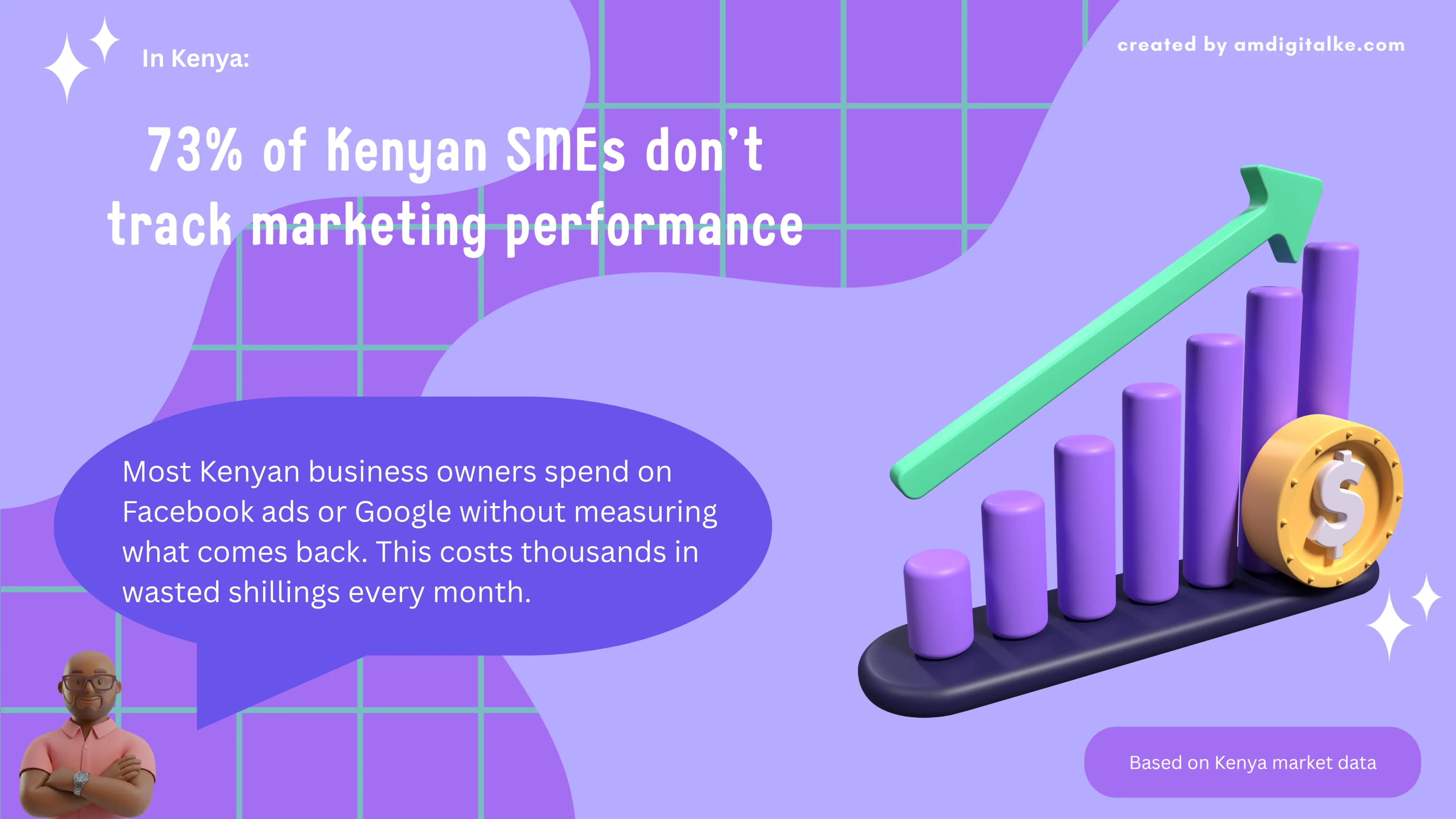
This is the reality for most Kenyan business owners. You’re spending, but you’re not measuring.
Marketing ROI (Return On Investment) answers one question: for every shilling you spend on marketing, how many shillings come back as profit? If you spend 10,000 KES and make 50,000 KES in revenue, your ROI is 400%.
But if you spend 10,000 KES and make 5,000 KES back, your ROI is negative 50%. You’re losing money. Before you spend another shilling, it helps to know how much does seo cost in kenya so you can compare it against what you’re already spending on ads.
This guide walks you through the exact formula. You’ll learn how to track the numbers and stop guessing whether your marketing actually works.
📋 Key Takeaways
- ☐ Marketing ROI formula: (Revenue – Marketing Spend) ÷ Marketing Spend × 100 = ROI percentage
- ☐ You must track both sides: every shilling spent AND every shilling earned from that spend
- ☐ Different channels have different ROI; Facebook ads might be 200% while Google Search is 600%
- ☐ Most Kenyan SMEs lose money because they don’t connect spending to actual revenue
- ☐ Once you know your ROI by channel, you can cut waste and double down on what works
What You Need Before You Start
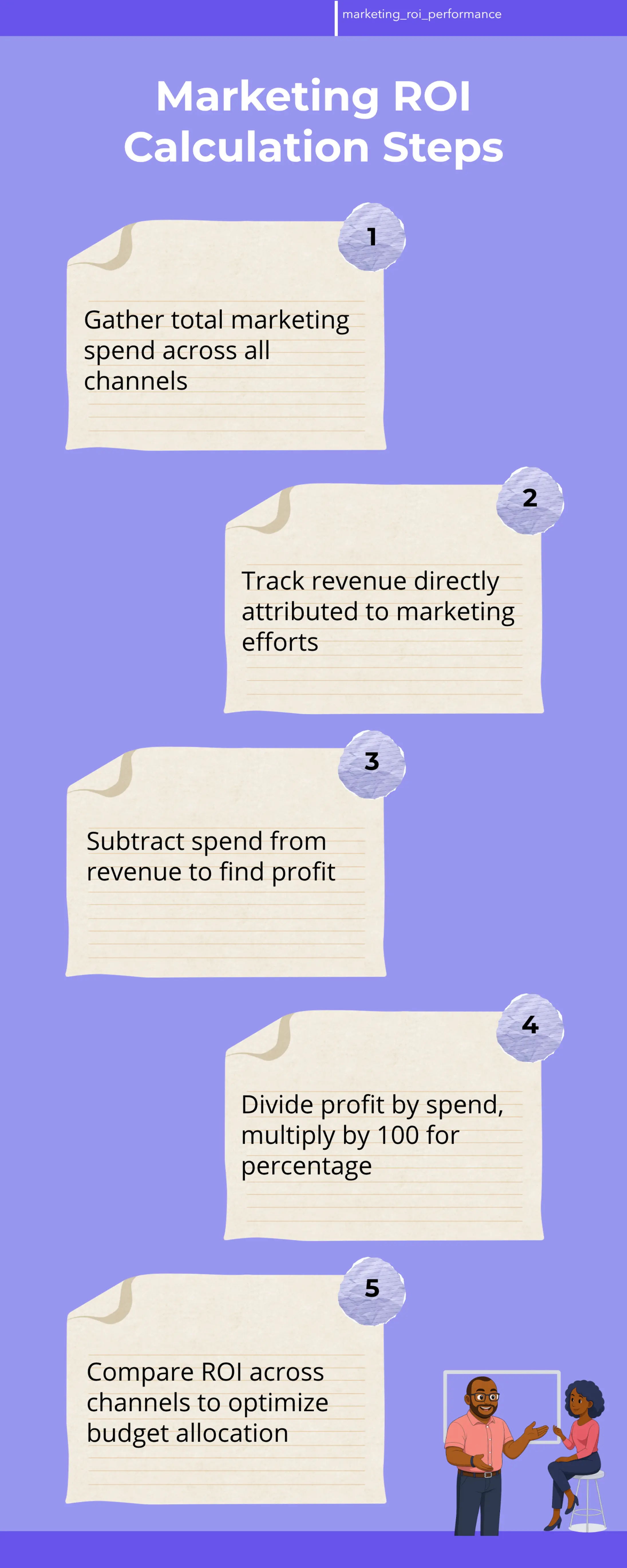
You cannot calculate ROI without the basic data first. Before you run the formula, gather these four things.
1. A Clear Definition of “Revenue from Marketing”
Revenue from marketing is not all revenue. It’s only the revenue that came because of your marketing effort.
If you run a Facebook ad for your salon and someone books a haircut the same day, that revenue counts. If someone walks in off the street without seeing your ad, it doesn’t count toward your ROI.
This is why tracking is hard for most Kenyan businesses. You need a system that connects the sale back to its source, which is where seo analytics kenya tools come in handy.
2. Total Marketing Spend by Channel
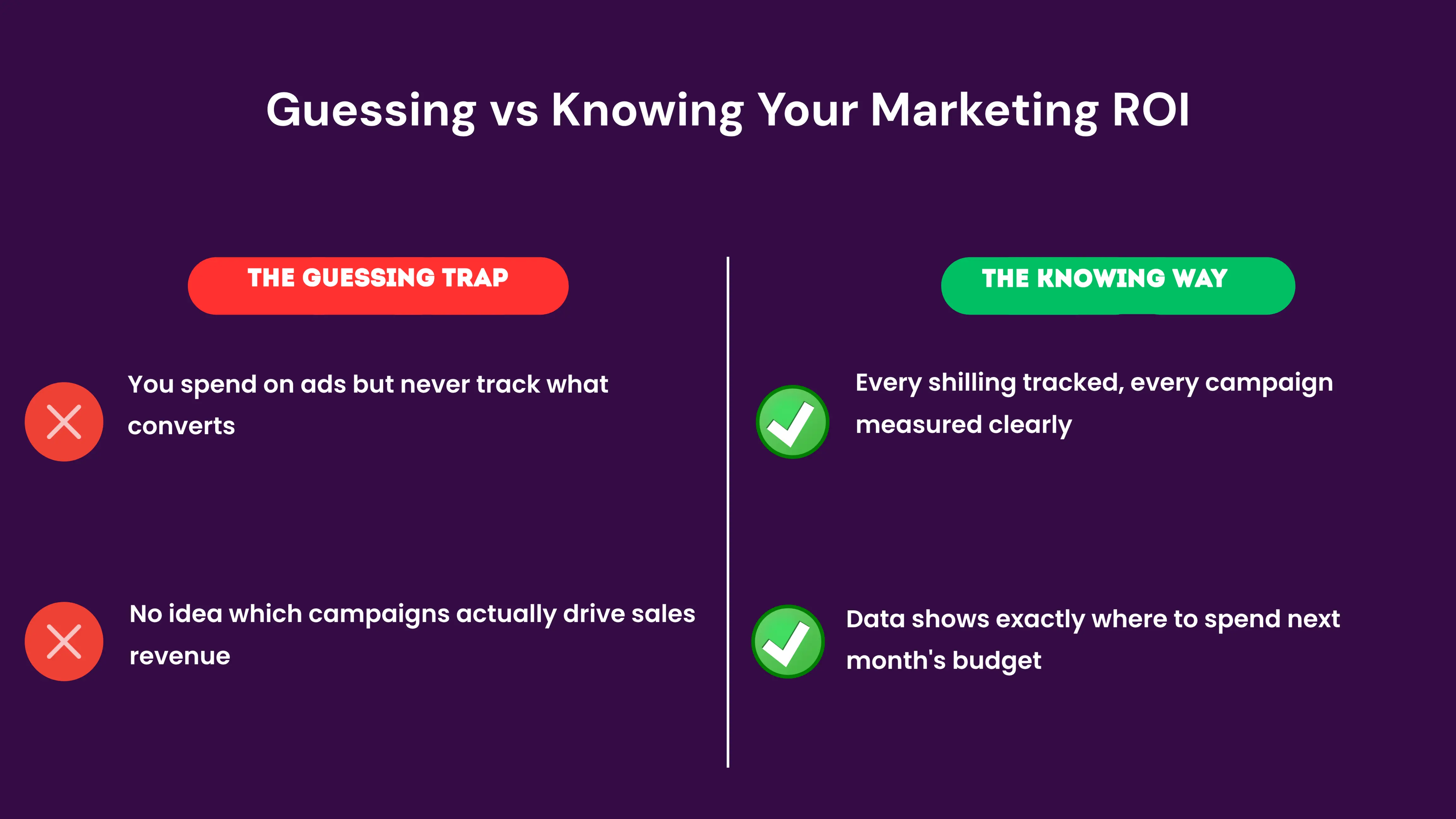
Write down every shilling you spend on marketing. This includes Facebook ads, Google Ads, Instagram promotions, email marketing software, SEO agency fees, content creation, and even the salary of your employee who manages social media part-time.
Many Kenyan business owners forget to count the salary component. If you pay someone 20,000 KES per month to run your Instagram, that 20,000 is a marketing cost.
3. A Time Period (Usually Monthly or Quarterly)
ROI is always measured over a specific time frame. You cannot say “my ROI is 300%” without saying “over what period?”
Most Kenyan businesses track ROI monthly because expenses come in monthly. Your mobile money transfers, salaries, and ad spends all happen on a monthly cycle.
4. A Way to Link Revenue to the Marketing Channel That Caused It
This is the hardest part. You need to know which sales came from Facebook, which came from Google, and which came from referrals.
Use UTM parameters in your links, a free Google tool that tags your URLs so Google Analytics knows where the click came from. Use unique coupon codes for each channel too.
Ask your customers directly where they heard about you. Keep a simple spreadsheet with the date, customer name, sale amount, and source, or if you’re unsure what type of business owner you are when it comes to tracking discipline, try the chess piece business quiz kenya for a quick gut check.
Step 1: Calculate Your Total Marketing Spend
Open a spreadsheet or a notebook. Write down every marketing expense for the month you’re measuring.
Include These Expenses
Facebook ads: 15,000 KES. Google Ads: 8,000 KES. Email marketing software subscription: 1,500 KES. Instagram ads: 5,000 KES. SEO agency retainer: 25,000 KES. Content creation (freelancer): 10,000 KES. Salary for part-time social media manager: 20,000 KES.
Total for the month: 84,500 KES. This is your marketing spend baseline.
Separate Spend by Channel
Don’t just add everything together. Write down the spend for each channel separately.
Facebook: 15,000 KES. Google Search: 8,000 KES. Email: 1,500 KES. Instagram: 5,000 KES. SEO: 25,000 KES. Content: 10,000 KES. Social media management: 20,000 KES.
You need this breakdown to calculate ROI per channel later. You want to know which channel is actually profitable.
Step 2: Track Revenue Attributed to Each Channel
Now track the money coming in. Only count revenue you can trace back to a marketing channel.
Use Google Analytics or a Simple Spreadsheet
If you have a website, Google Analytics (free) shows you which traffic sources led to sales. Clear website copywriting kenya practices make this tracking easier because visitors take clearer action paths.
You can see: 50 people came from Facebook and 8 of them bought, generating 120,000 KES in revenue. 30 people came from Google Search and 12 of them bought, generating 180,000 KES in revenue.
If you don’t have a website or your sales happen offline, like a salon, restaurant, or retail shop, use a spreadsheet instead. Every time someone buys, write down the date, amount, and source.
Ask them: “How did you hear about us?” Log the answer immediately, before you forget.
Create a Revenue Tracking Table
Here’s what your tracking table should look like for a month of sales:
| Channel | Spend (KES) | Revenue (KES) | Transactions |
|---|---|---|---|
| 15,000 | 120,000 | 8 | |
| Google Search | 8,000 | 180,000 | 12 |
| 5,000 | 45,000 | 5 | |
| 1,500 | 35,000 | 3 | |
| SEO / Organic | 25,000 | 220,000 | 18 |
| Direct / Referral | 0 | 50,000 | 4 |
| TOTAL | 54,500 | 650,000 | 50 |
This table shows you exactly where your money comes from. It also shows how much you spent to get it.
Step 3: Apply the ROI Formula
The formula is simple. ROI = (Revenue – Spend) ÷ Spend × 100.
Calculate Overall ROI
Using the table above: Total Revenue is 650,000 KES. Total Spend is 54,500 KES.
Profit = 650,000 minus 54,500 = 595,500 KES. ROI = (595,500 ÷ 54,500) × 100 = 1,093%.
This means for every shilling you spent on marketing, you made 10.93 shillings back as profit. Your business generated 1,093% return on marketing investment.
Calculate ROI by Channel
Now calculate ROI for each channel to see which ones are actually working. Facebook: (120,000 – 15,000) ÷ 15,000 × 100 = 700% ROI.
Google Search: (180,000 – 8,000) ÷ 8,000 × 100 = 2,150% ROI. Instagram: (45,000 – 5,000) ÷ 5,000 × 100 = 800% ROI.
Email: (35,000 – 1,500) ÷ 1,500 × 100 = 2,233% ROI. SEO: (220,000 – 25,000) ÷ 25,000 × 100 = 780% ROI.
Google Search and Email are your stars. They generate 2,000%+ ROI.
Instagram is solid at 800%. Facebook at 700% is still profitable but lower than the others.
Step 4: Compare Against Your Baseline and Industry Benchmarks
Numbers alone don’t tell you much. You need to know if they’re good.
A healthy marketing ROI for most businesses is between 300% and 500%. If you’re above 500%, you’re doing very well. Below 300%, you need to optimize.
Compare Month to Month
Calculate your ROI for January, February, and March. Is it going up or down?
If your January ROI was 800% and February dropped to 600%, something changed. Maybe your ad costs increased, or your conversion rate dropped.
Based on AM Digital KE client data across Kenyan accounts, businesses that track monthly ROI catch problems 6 weeks faster than those who don’t. Following a proper seo checklist kenya alongside this tracking helps you spot the exact cause faster.
Compare Your Channels Against Each Other
In the example above, Email is your best performer at 2,233% ROI. Google Search is second at 2,150%.
Facebook is fourth at 700%. SEO takes longer to show results, so check how long does seo take kenya before judging its ROI too early.
This tells you to spend more on Email and Google Search. Optimize Facebook or reduce spend there instead.
Many Kenyan businesses do the opposite. They spend more on Facebook because it feels easier, even though Email and Search are actually more profitable.
Common Mistakes to Avoid
Most Kenyan business owners make the same mistakes when calculating ROI. Knowing them will save you thousands of shillings.
Mistake 1: Counting All Revenue, Not Just Marketing-Attributed Revenue
Your business made 1 million KES last month. You spent 50,000 KES on marketing.
You calculate ROI as (1,000,000 – 50,000) ÷ 50,000 × 100 = 1,900% ROI. That number is wrong.
You had 800,000 KES in revenue from repeat customers who didn’t click on any ads. You had 100,000 KES from walk-ins.
Only 100,000 KES actually came from your Facebook and Google ads.
Your real marketing ROI is (100,000 – 50,000) ÷ 50,000 × 100 = 100% ROI, not 1,900%. This is why tracking the source matters.
Mistake 2: Forgetting Hidden Marketing Costs
You count your Facebook ad spend (15,000 KES) but forget the salary of your employee who manages it (20,000 KES). You count your Google Ads (8,000 KES) but forget the email marketing software (1,500 KES).
These hidden costs reduce your real ROI significantly. A Nairobi e-commerce business thought their Facebook ROI was 500% until they added the cost of their part-time social media manager.
Real ROI dropped to 200%. This is why every marketing budget kenya plan needs a full cost audit, not just ad spend.
Mistake 3: Not Separating Channels
You lump all spending together and calculate one overall ROI. But this hides the truth.
Maybe Facebook is losing money while Google Search is making 2,000% ROI. If you only look at the overall number, you keep spending on Facebook even though it’s unprofitable.
You need channel-by-channel ROI to make smart decisions. Learning how to use marketing channels template kenya businesses rely on makes this tracking far easier.
Mistake 4: Using the Wrong Time Frame
Some products have a long sales cycle. You spend on Google Ads in January, but the customer doesn’t buy until March.
If you only measure January ROI, you’ll think the ads didn’t work. For most Kenyan businesses, retail, services, and e-commerce, measure ROI monthly or quarterly.
For B2B or high-ticket sales, measure quarterly or annually.
Mistake 5: Not Accounting for Customer Lifetime Value
A customer buys once from your ad, spending 5,000 KES. You spent 1,000 KES to get that customer, so your first-purchase ROI is 400%.
But that customer comes back three more times over the next year, spending another 15,000 KES. Your real ROI is (20,000 – 1,000) ÷ 1,000 × 100 = 1,900%.
Many Kenyan businesses cut profitable channels because they only look at first-purchase ROI. A Mombasa salon thought their Instagram ads weren’t working with 300% first-purchase ROI.
Then they tracked that customers came back 4 times on average. Real ROI was 1,200%. Building marketing workflows that scale your kenyan business helps you catch these repeat-customer patterns early.
✅ Quick Action Checklist
- ☐ Open a spreadsheet and list all marketing spending for the past month by channel
- ☐ Set up Google Analytics or a simple tracking system to link sales back to marketing sources
- ☐ Calculate total revenue attributed to marketing (not all revenue, only marketing-attributed)
- ☐ Apply the ROI formula: (Revenue – Spend) ÷ Spend × 100 for overall and each channel
- ☐ Compare your ROI against the 300-500% baseline to see if you’re above or below average
- ☐ Identify your top 2 performing channels and your bottom 2 performing channels
- ☐ Set a goal to increase spend on top channels by 20% next month
- ☐ Schedule a monthly ROI review every first Friday of the month
Ready to Improve Your Marketing ROI?
Calculating ROI is only the first step. Once you know your numbers, you can make decisions that actually increase profit.
Most Kenyan businesses waste 30-40% of their marketing budget on channels that don’t work. When you know your ROI by channel, you can cut waste and double down on what’s profitable.
The businesses that track ROI monthly grow faster, spend smarter, and make more money. Start tracking this month.
Frequently Asked Questions
What’s a good ROI for marketing?
A healthy marketing ROI is between 300% and 500%. Above 500% means you’re doing very well. Below 300% means you need to optimize your campaigns or targeting. Every business is different, so compare your ROI to your own previous months and to your competitors if possible.
How do I track revenue if I sell offline (no website)?
Use a simple spreadsheet or notebook. Every time a customer buys, write the date, amount, and source (Facebook, Google, referral, walk-in, etc.). Ask customers directly: “How did you hear about us?” Train your staff to ask this question consistently. After a month, you’ll have clear data on which channels drive sales.
Should I include my own salary as a marketing cost?
Only if you spend a significant portion of your time on marketing. If you spend 50% of your time managing social media and your monthly salary is 50,000 KES, then 25,000 KES is a marketing cost. If you only spend 5% of your time, include only 2,500 KES. Be honest about how much time you actually spend.
How often should I calculate ROI?
Most Kenyan businesses should calculate ROI monthly because expenses and revenue cycle monthly. If you run seasonal campaigns or have a long sales cycle, calculate quarterly. Never go longer than 3 months without measuring ROI, or you’ll lose track of what’s working.
What if my ROI is negative?
You’re spending more than you’re making back from that channel. Stop spending immediately and investigate why. Maybe your targeting is wrong, your offer isn’t compelling, or your landing page doesn’t convert. Fix the problem before you spend more money. If you can’t fix it in 2 weeks, stop the campaign entirely.
Additional Resources
- Best Lead Magnets That Convert Traffic To Clients (And How To Use Them In Kenya) – If your ROI numbers look weak, the problem might be a lead magnet that isn’t turning traffic into contacts worth counting.
- SEO Packages in Kenya – Once you know your ROI target, compare it against real SEO package pricing to see what return you can actually expect.
- AM Digital KE Pricing – Before you plug costs into your ROI formula, check what marketing services actually cost so your calculation is grounded in real figures.
- What is Conversion Rate Optimization – Improving your conversion rate is one of the fastest ways to lift ROI without spending more on ads.
- How to Improve Organic CTR – A better click-through rate means more visitors per shilling spent, which directly boosts the ROI figure you just calculated.
- SEO Reporting – To track ROI properly over time, you need reporting that shows the data behind the numbers, not just a one-off calculation.
Take the Next Step
Tracking ROI manually every month takes time. If you want to automate this process, run a marketing reality check kenya and see which channels actually pay off.
Download the AM Digital KE Marketing ROI Calculator for Kenyan Businesses. Start tracking your channels properly today.