

Table of Contents
- Why This Matters Right Now in Kenya
- 📋 Key Takeaways
- What You Need Before You Start
- Step 1: Answer the Question in the First 100 Words
- Step 2: Use Clear Headings to Organize Your Answer
- Step 3: Write Short Paragraphs and Use Bullet Points
- Step 4: Use Tables to Present Comparison and Data
- Step 5: Include Direct Answers to Follow-Up Questions
- Common Mistakes to Avoid
- ✅ Quick Action Checklist
- Ready to Improve Your Content for AI?
- Frequently Asked Questions
- Additional Resources
- Take the Next Step
TL;DR: AI now summarizes search results before customers click through to your site. Write with clear structure, short paragraphs, and direct answers so Google’s AI picks up your content. Kenyan businesses that do this see 35% more traffic from search results. The fix is simple: format for humans first, then optimize for AI second. If you want a starting point, request your free SEO check.
Why This Matters Right Now in Kenya
Google no longer shows just 10 blue links. AI summaries now appear above search results. They pull key information from websites and show it directly to searchers on their phones and computers.
If your content structure is messy, AI skips it. It picks information from your competitors instead. This is part of a bigger shift, and understanding ai seo vs traditional seo will help you see why old writing habits no longer work.
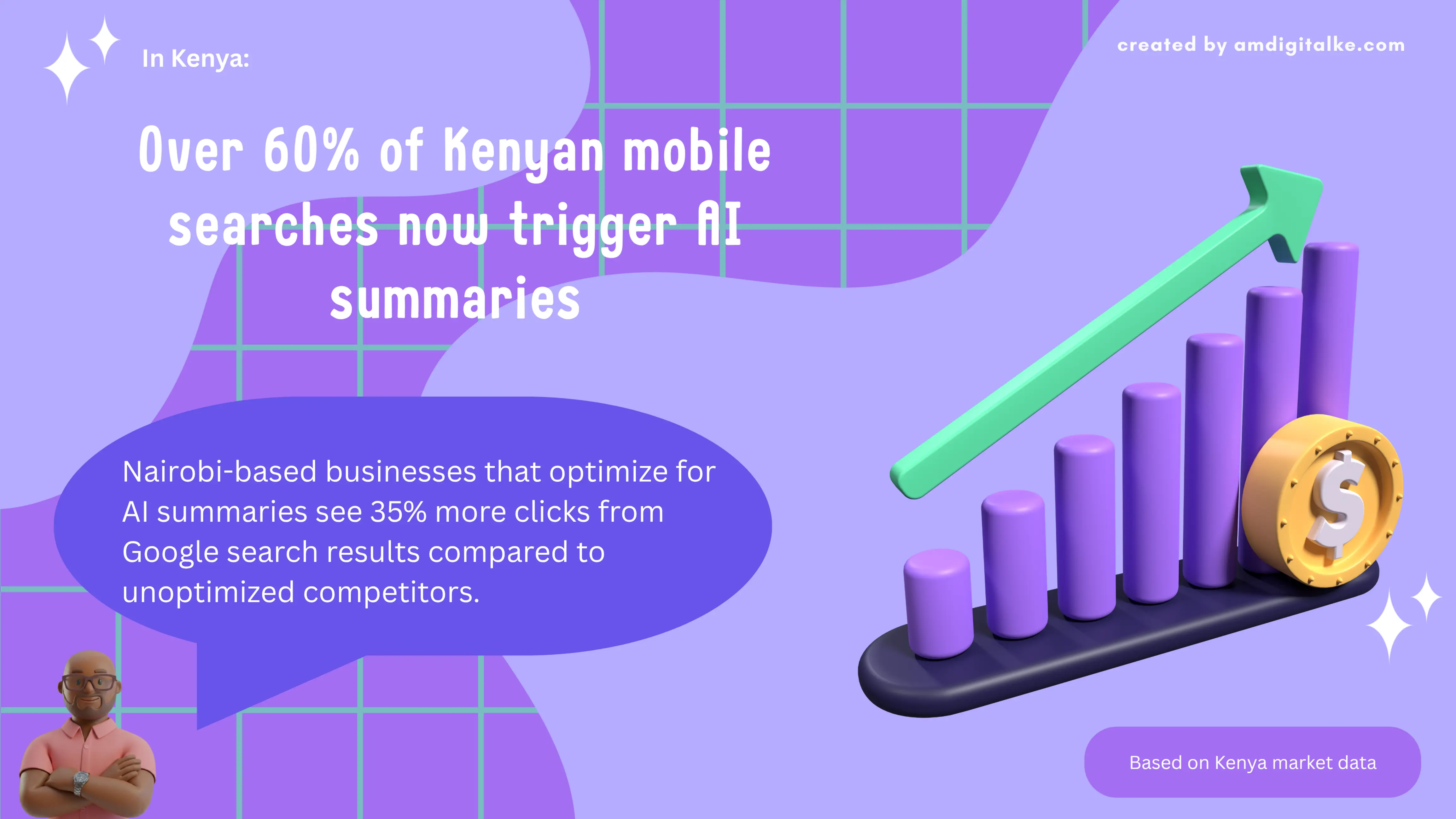
This change hits Kenyan small businesses hard. Over 60% of mobile searches in Kenya now trigger AI summaries, and most Nairobi business owners have no idea this is happening. Your competitor’s answer appears in that summary box, and the customer never visits your site.
The good news is that AI summaries follow rules. If you write content the right way, AI will pick your answer, not your competitor’s.
This guide teaches you exactly how to structure content so AI summaries work for you, not against you. You’ll learn the same framework we use for our clients at AM Digital KE, from a Nakumatt supplier to a Mombasa tourism business.
📋 Key Takeaways
- AI summaries are triggered by clear structure, short paragraphs, and direct answers—not fancy writing.
- Put your best answer in the first 100 words so AI sees it before the rest of the content.
- Use H2 and H3 headings to organize information; AI reads these like a table of contents.
- Short paragraphs (2-3 sentences max) are picked up by AI more often than long blocks of text.
- Format lists and tables clearly; AI pulls these directly into summaries without editing.
What You Need Before You Start
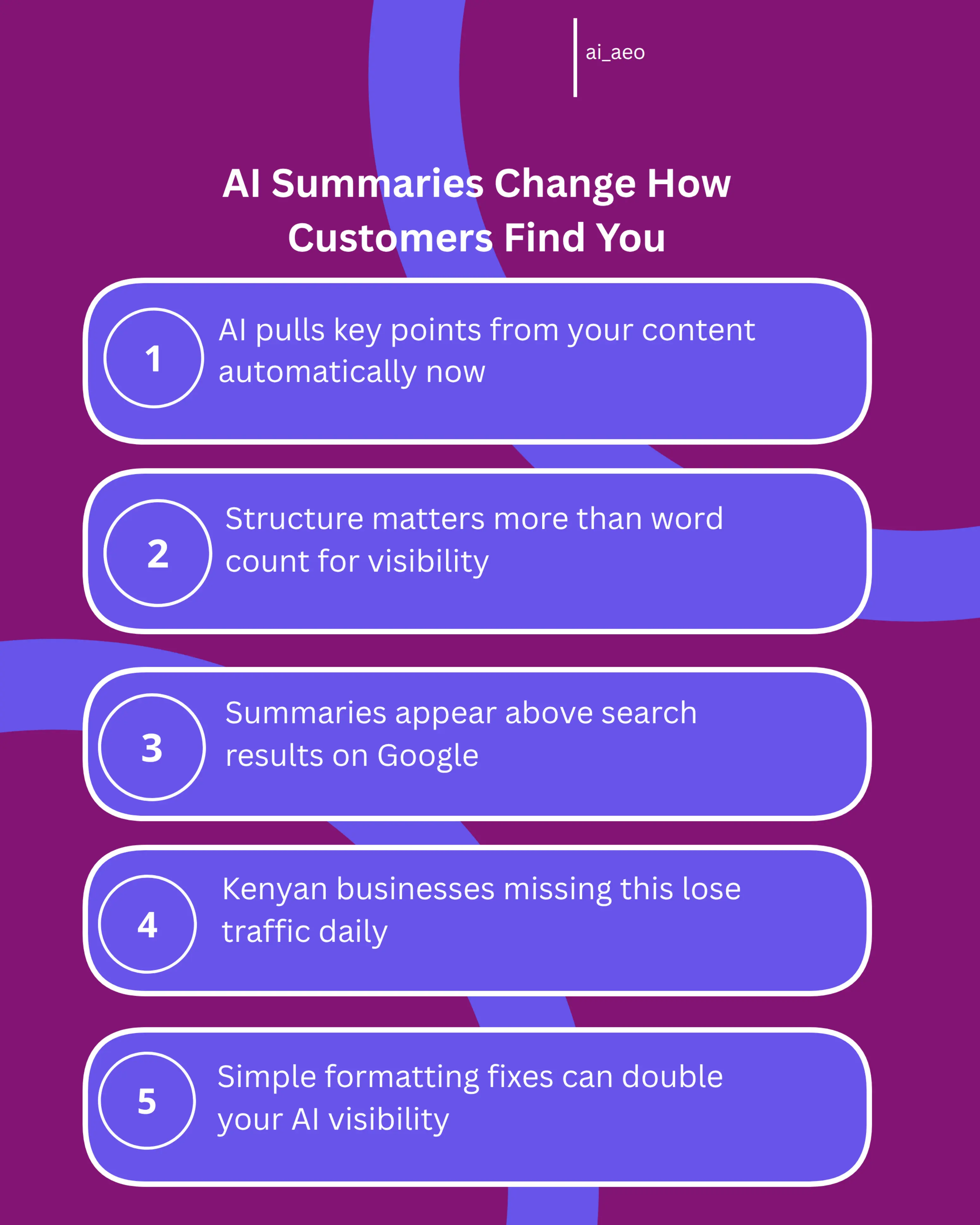
Before you write a single word, you need to understand what AI summaries actually are and how they work. This is not about writing differently for a robot. It’s about writing clearly so both humans and AI can understand you.
Understand What Google’s AI Summary Is
Google’s AI summary, also called Search Generative Experience or SGE, appears at the top of search results. It pulls key information from 3-5 websites to answer the searcher’s question directly.
The customer reads this summary and decides whether to click through to your site or not. If your content is structured clearly, Google’s AI picks your answer.
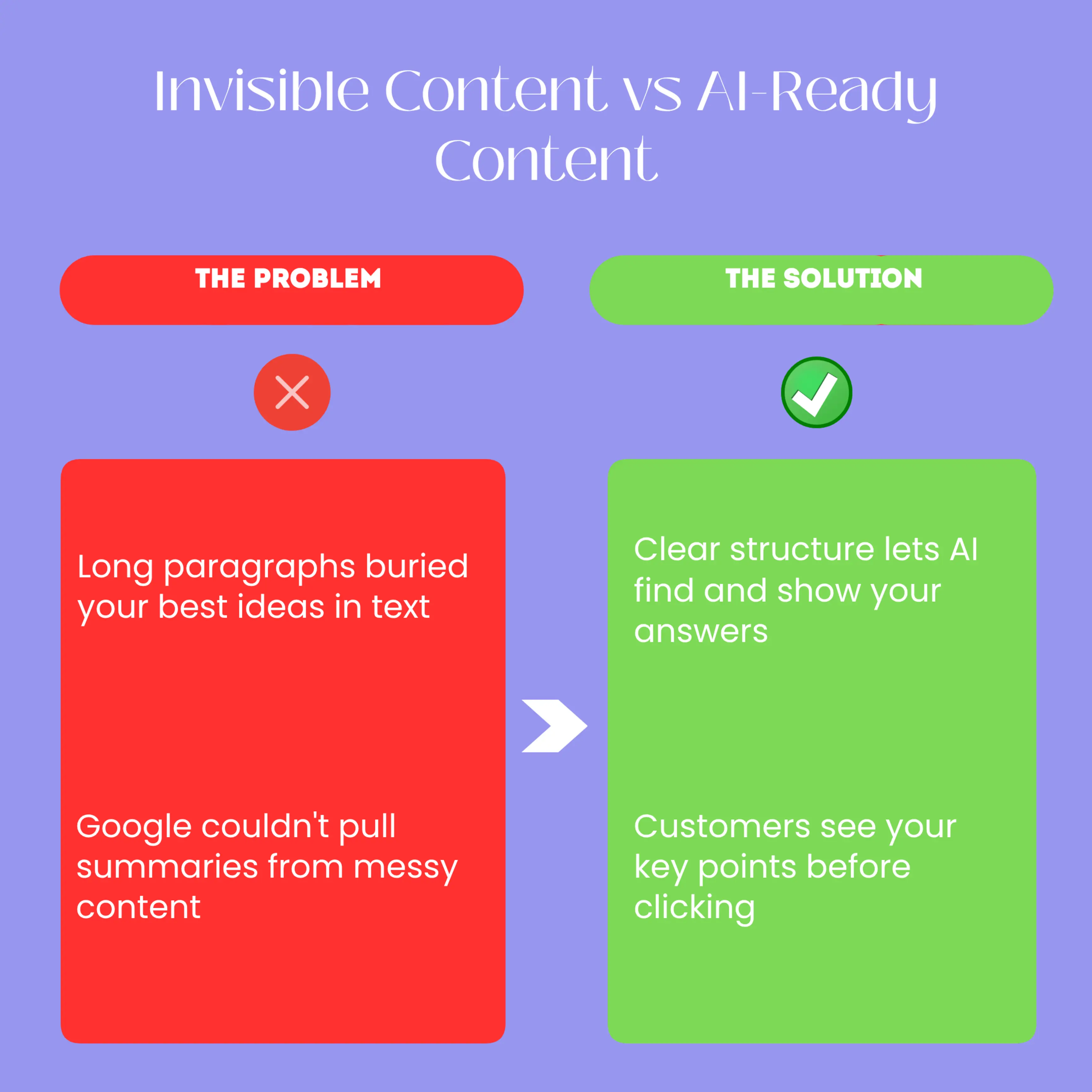
If it’s buried in long paragraphs, Google picks a competitor instead. This is not about ranking number one anymore. It’s about being the answer AI chooses to show.
Know Your Audience’s Question
Before you write anything, you must know exactly what question your customer is asking. A Nairobi salon owner writing about hair treatments needs to know if customers are asking “What is a keratin treatment?” or “How much does a keratin treatment cost?”
Each question needs a different answer structure. AI picks the answer that matches the customer’s specific question, not the longest or most detailed one.
Spend 10 minutes writing down the exact questions your customers ask. Then answer them one at a time.
Know Your Competitor’s Current Answer
Search for your target keyword on Google and look at what’s appearing in the AI summary box. What information is Google’s AI currently showing, and how is it structured?
This is your baseline. Your job is not to beat this summary, but to make your answer so clear that AI picks it instead.
Screenshot the current summary so you can compare it to your draft later.
Step 1: Answer the Question in the First 100 Words
The first 100 words of your content are everything. AI reads this section first and uses it to decide whether your content answers the customer’s question.
If your answer is buried in paragraph five, AI never sees it. This is one reason ai seo vs traditional seo requires a different writing structure than older SEO tactics.
Write the Direct Answer First
Start with a single, clear sentence that answers the customer’s question completely. Not a question, not a story, just a direct answer.
A Mombasa tour operator writing about “best time to visit Diani Beach” should start with: “The best time to visit Diani Beach is June to October when the weather is dry and sea conditions are calm.”
This is called the “answer-first” format. Journalists call it the inverted pyramid.
AI loves it because it doesn’t have to read the whole article to understand your answer. Write this sentence in simple English, using the exact keywords your customer is searching for.
Add 2-3 Supporting Sentences Immediately
After your direct answer, add 2-3 sentences that expand on it with the most important details. Using the beach example: “During these months, temperatures range from 24-28°C, rainfall is minimal, and the ocean is perfect for swimming and snorkeling.”
“July and August are the busiest months, so book accommodation early. If you prefer fewer crowds, June and September offer the same weather with more space on the beach.”
This is still part of your opening section. AI will pull this entire block into the summary if it matches the customer’s question.
Stop after 100 words. Do not add extra details here, they go in the sections below.
Step 2: Use Clear Headings to Organize Your Answer
Headings are signposts for AI. They tell the algorithm what each section is about and how the information is organized.
Without clear headings, AI sees one long block of text. It struggles to find the right answer to pull.
Use H2 Headings for Main Topics
After your opening answer, break your content into main sections using H2 headings. Each H2 should represent one complete idea or answer to a related question.
A Nairobi accountant writing about “How to register a business in Kenya” might use H2 headings like: “Step 1: Choose Your Business Structure,” “Step 2: Register with the KRA,” “Step 3: Open a Business Bank Account,” and “Step 4: Get Your Trading License.”
Each H2 heading should be a clear, searchable phrase. Use the keywords your customers actually search for.
Do not use creative or clever headings that sound good but don’t match search intent. AI reads headings literally and matches them to search queries.
Use H3 Headings for Sub-Topics
Under each H2, use H3 headings to break information into smaller chunks. These help AI understand the hierarchy of your information and pull the most relevant section for the customer’s question.
Under “Step 2: Register with the KRA,” you might have H3 headings like “What documents you need,” “How long registration takes,” and “What it costs.”
This structure tells AI exactly where to find the answer to follow-up questions. If a customer asks “How much does business registration cost in Kenya?” AI can jump directly to the “What it costs” section instead of reading the entire article.
Step 3: Write Short Paragraphs and Use Bullet Points
Long paragraphs are the enemy of AI summaries. When AI sees a wall of text, it struggles to pull out the key information.
Short paragraphs and bullet points are picked up by AI much more reliably. This same discipline matters when you learn to write seo content that ranks in normal search results too.
Keep Paragraphs to 2-3 Sentences Maximum
This is the single most important rule for AI optimization. Every paragraph should be 2-3 sentences, period.
If you find yourself writing a fourth sentence, start a new paragraph or break the idea into bullet points.
A Kisumu hotel owner writing about “What’s included in our room rate” might write: “Our standard room includes a queen-size bed, private bathroom, and free Wi-Fi. All rooms have air conditioning and a 32-inch flat-screen TV.”
That’s two sentences. Stop, then start a new paragraph for the next idea.
Use Bullet Points for Lists
Whenever you have a list of items, features, or steps, use bullet points instead of writing them in paragraph form. AI pulls bullet points directly into summaries without any editing.
A Nairobi real estate agent listing apartment features should write:
✓ 2 bedrooms with built-in wardrobes
✓ Modern kitchen with granite countertops
✓ Spacious living room with balcony
✓ Secure parking for one vehicle
✓ 24-hour security and CCTV
Do not write: “The apartment includes 2 bedrooms with built-in wardrobes, a modern kitchen with granite countertops, a spacious living room with balcony, secure parking for one vehicle, and 24-hour security and CCTV.”
AI struggles with this format.
Step 4: Use Tables to Present Comparison and Data
Tables are one of the best formats for AI summaries. When AI sees a well-structured table, it pulls the entire table into the summary without any interpretation or editing.
This is perfect for comparisons, pricing, timelines, and any information with multiple variables. It also works well alongside other how to optimize for ai overviews tactics like clear headings and short answers.
Create Simple, Clear Tables
A Mombasa shipping company writing about “Courier delivery times to different Kenyan cities” should use a table instead of writing paragraphs:
| Destination City | Delivery Time | Cost (KES) |
|---|---|---|
| Nairobi | 1-2 days | 500 |
| Kisumu | 2-3 days | 800 |
| Nakuru | 1-2 days | 600 |
| Mombasa | Same day | 300 |
This table is instantly clear to both humans and AI. It answers the customer’s question without requiring them to read a single paragraph.
When AI picks this table for the summary, the customer gets the exact information they need. They are more likely to click through to your site for more details or to place an order.
Label Your Tables Clearly
Always add a clear heading above your table that describes what it shows. “Courier Delivery Times and Costs to Major Kenyan Cities” is better than “Delivery Information.”
It tells AI exactly what data is in the table. This helps AI match the table to customer queries.
Step 5: Include Direct Answers to Follow-Up Questions
Most customer questions come in clusters. Someone asking “How to start a salon in Nairobi” also wants to know about startup capital, licenses, and suppliers.
AI summaries often include multiple related answers. Your content should address these follow-up questions directly.
Anticipate Related Questions
Before you start writing, list 5-10 related questions your customer might ask. A Nairobi plumber writing about “How to fix a leaking tap” should also address why the tap leaks, whether it can be fixed alone, plumber charges, repair time, and tools needed.
Write a separate section with a clear H2 heading for each of these questions. This way, if a customer searches for any of these related questions, AI can pull the right section from your article into the summary.
Use Question-Based Headings
Make your H2 and H3 headings actual questions that customers ask, not topic names. Instead of “Troubleshooting,” write “Why is my tap leaking?”
Instead of “Cost Information,” write “How much does a plumber charge in Nairobi?” This helps AI match your content to the exact questions people are searching for.
Common Mistakes to Avoid
Most Kenyan business owners make the same mistakes when trying to optimize for AI summaries. These mistakes cost them traffic and visibility every single day.
Mistake 1: Burying the Answer Deep in the Article
A Nairobi salon owner wrote a 2,000-word article about hair treatments but didn’t answer the customer’s question until paragraph 8. By that time, AI had already decided the article wasn’t relevant and moved on to a competitor’s site.
Your answer must be in the first 100 words. Full stop.
Everything else is supporting detail. If you find your main answer buried deep in the article, cut it and paste it to the top.
Mistake 2: Writing Long Paragraphs
A Mombasa tour operator wrote paragraphs with 5-7 sentences each. AI struggled to pull key information from these walls of text and picked a competitor’s content instead, even though the tour operator’s information was better.
Break every paragraph into 2-3 sentences maximum. Use bullet points for lists and tables for data.
This is not just about making content easier to read. It is about making content easier for AI to understand and pull into summaries.
Mistake 3: Using Vague or Clever Headings
A Nairobi accountant used creative headings like “The Money Talk” and “Getting Official” instead of clear, searchable headings like “How much does business registration cost?” and “How to register a business with the KRA.”
AI couldn’t match these headings to customer search queries. The content never appeared in summaries.
Use headings that match the exact questions customers search for. Use keywords, be boring, be clear. Save the creativity for your sales page.
Mistake 4: Forgetting to Answer Follow-Up Questions
A Kisumu hotel owner wrote about “What’s included in our room rate” but didn’t address room changes, damage policy, or booking steps. These follow-up questions are often searched separately.
The hotel owner lost traffic because they didn’t answer them in the same article. Anticipate 5-10 related questions and answer each one with a clear H2 heading.
This way, your single article can appear in summaries for multiple related searches.
Mistake 5: Not Using Tables or Lists for Complex Information
A Nairobi real estate agent wrote paragraph after paragraph describing apartment features instead of using bullet points. AI couldn’t pull the key features cleanly into the summary, so the content looked messy and confusing when it did appear.
Use tables for comparisons and data, and bullet points for lists. Use short paragraphs for explanations and match the format to the information type.
This makes it easy for AI to pull your content into summaries. It also strengthens your ai seo vs traditional seo approach across your whole site.
✅ Quick Action Checklist
- ☐ Identify the exact question your customer is asking and write it down
- ☐ Search Google for this question and screenshot the current AI summary
- ☐ Write your direct answer in the first 100 words using simple, clear language
- ☐ Break your content into H2 sections using question-based headings
- ☐ Rewrite all paragraphs to be 2-3 sentences maximum
- ☐ Convert all lists to bullet points and all data to tables
- ☐ Add 5-10 related questions as separate H2 sections
- ☐ Publish and check Google Search Console to see if AI summaries are picking up your content
Ready to Improve Your Content for AI?
Writing for AI summaries is not complicated. It comes down to structure, clarity, and answering the customer’s question first. Every Kenyan business owner can master this once they understand the rules and how ai seo vs traditional seo actually differ.
Start with one article. Apply these rules and watch your traffic from AI summaries grow.
Then apply the same framework to your next 10 articles.
Frequently Asked Questions
Will optimizing for AI summaries hurt my regular search ranking?
No. Clear structure, short paragraphs, and direct answers help both humans and AI.
Google rewards this format in regular search rankings too. You are not sacrificing anything. You are improving your content for everyone.
How long should my content be to show up in AI summaries?
At least 800 to 1000 words is ideal, but shorter content can appear in summaries if it is well structured. A 400-word article with perfect structure will beat a 3,000-word article with messy paragraphs.
Quality of structure matters more than word count.
Can I use AI to write content optimized for AI summaries?
AI tools like ChatGPT can help you draft content, but you must edit it heavily. Most AI-generated content has long paragraphs and vague headings.
Use AI for research and initial drafts. Then manually apply the rules in this guide.
How do I know if AI summaries are actually helping my business?
Check Google Search Console. Look for clicks from “Generative AI experiences” or “SGE” in your traffic reports.
Track how many clicks you get from AI summary traffic compared to regular search results. Most Kenyan businesses see 15-35% of their search traffic coming from AI summaries within 3 months of optimization.
Should I optimize all my content for AI summaries or just some?
Start with your top 10 pages that get the most search traffic. These are the pages where AI summaries will have the biggest impact on your business.
Once you see results, apply the same rules to your next 10 pages. A quick content audit will show you exactly where to start.
Additional Resources
- What is Structured Data – Once your content is written for AI, structured data is the next step to help AI systems actually read and understand it.
- Will AI Kill SEO In Kenya? Here’S What’S Actually Happening – If you are wondering whether writing for AI summaries even matters, this breaks down what is really changing for Kenyan businesses.
- How To Get Your Kenyan Business Featured In AI-Generated Search Results – Good AI-friendly content gets you nowhere if you skip the practical steps to actually show up in these results, covered here.
- What is a Knowledge Panel – Clear, well-structured content can feed into knowledge panels, and this explains what those are and why they matter.
- AEO, GEO & LLMO: SEO for the Age of AI Search – To see how writing for AI fits into the bigger picture of AEO, GEO and LLMO, this ties all the terms together.
- What is AI SEO – For a broader grounding in what AI SEO actually means beyond just content writing, start here.
Take the Next Step
You now understand how to structure content so AI summaries pick your answer instead of your competitor’s. The next step is to audit your current content and identify which pages need restructuring for maximum AI visibility.
Download the AI Content Optimization Checklist for Kenyan Businesses to get a step-by-step framework for auditing and fixing your existing content today.