Table of Contents
- What Does eCommerce SEO Mean for Your Online Shop in Kenya?
- 📋 Key Takeaways
- Why Does eCommerce SEO Matter for Kenyan Online Businesses?
- How eCommerce SEO Works in Practice
- Real eCommerce SEO Examples in Kenya
- Common Mistakes to Avoid with eCommerce SEO 🚫
- eCommerce SEO vs. Other Marketing Channels: A Quick Comparison
- ✅ Quick Action Checklist
- Ready to Improve Your Online Shop’s Visibility?
- See What Is Working, Any Day You Ask
- Frequently Asked Questions
- Additional Resources
- Take the Next Step
TL;DR: eCommerce SEO is the practice of optimizing your online shop so it ranks on Google when Kenyans search for products you sell. It means fixing your product pages, building trust signals like reviews, and creating content that answers buyer questions. Done right, it brings consistent, free customer traffic that converts to sales without you paying for ads every single month.
What Does eCommerce SEO Mean for Your Online Shop in Kenya?
If you run an online shop in Kenya, you have probably heard the word SEO thrown around at networking events, in Facebook groups, or by someone trying to sell you a service. But what does it actually mean when we talk about eCommerce SEO, and why should you care?
eCommerce SEO is the process of making your online shop visible on Google when Kenyans search for the products you sell. Instead of paying for Google Ads every time someone clicks your link, SEO in Kenya gets your products in front of buyers organically.
Think of it this way. You run a shop selling phone cases in Nairobi.
When someone in Westlands types “best phone cases Nairobi” into Google, you want your shop to appear on page one of the results. That is eCommerce SEO. Without it, your competitor appears first, and the customer buys from them instead.
eCommerce SEO is different from regular SEO because it focuses specifically on getting people to buy. Your product pages need to rank, your product descriptions need to convince, and your site needs to be fast and trustworthy so people actually complete their purchase.
It is not just about traffic. It is about the right kind of traffic: people actively searching for what you sell, ready to buy, speaking your language, and based in Kenya.
📋 Key Takeaways
- ☐ eCommerce SEO helps your online shop rank on Google for product searches, bringing free, consistent customer traffic
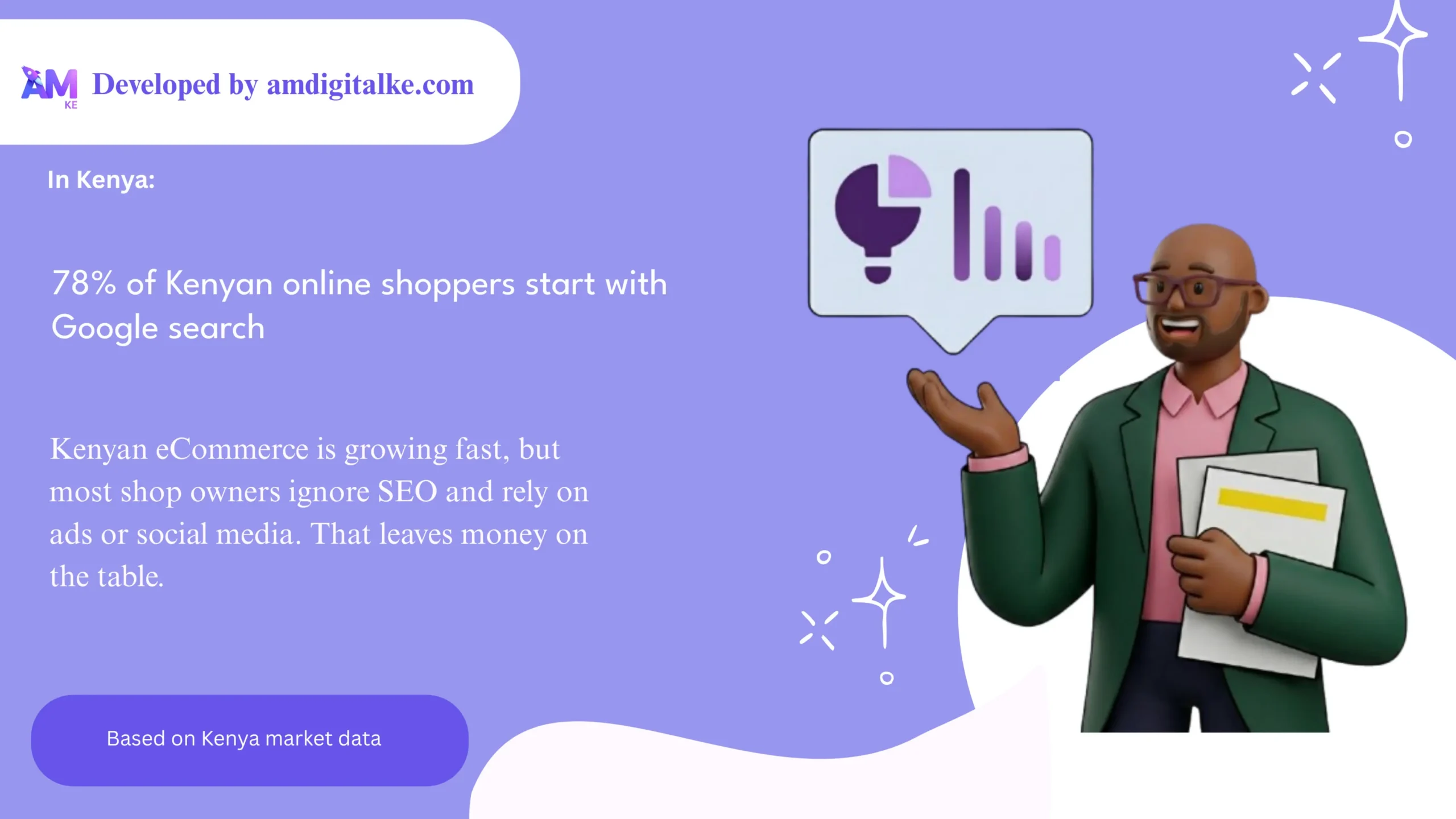
- ☐ 78% of Kenyan online shoppers start with Google search, making SEO critical for visibility and sales
- ☐ Product page optimization, customer reviews, and site speed are the three pillars of eCommerce SEO success
- ☐ Unlike paid ads, SEO traffic keeps coming even when you stop spending money, making it a long-term investment
- ☐ Most Kenyan online shop owners skip SEO and rely only on ads or social media, leaving significant revenue on the table
Why Does eCommerce SEO Matter for Kenyan Online Businesses?
You might be wondering: I already run Facebook ads and Instagram promotions. Why do I need eCommerce SEO?
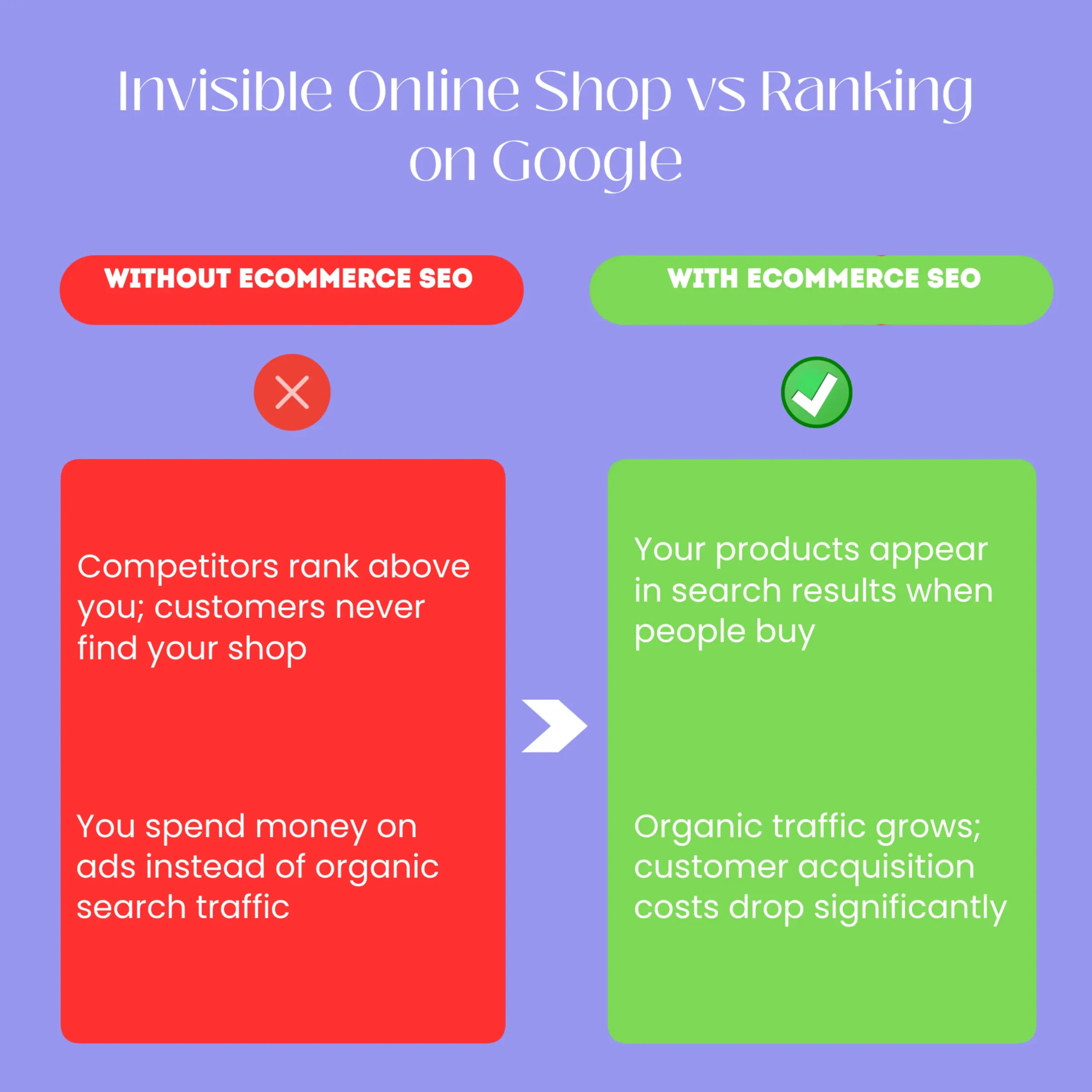
The answer comes down to money and sustainability. Every time someone clicks your Facebook ad, you pay. Every day you stop paying, the traffic stops.
Your Customers Are Already Searching on Google
When a Kenyan decides to buy something online, they do not always start with social media. They start with Google.
They search for “best laptop bags in Mombasa” or “affordable running shoes Nairobi” or “where to buy solar power banks Kenya.” If your shop does not appear in those search results, you lose that customer to someone who did invest in SEO.
Based on AM Digital KE client data across Kenyan accounts, shops that rank for product searches get between 40% and 60% of their traffic from organic search within the first six months of proper optimization.
SEO Traffic Costs Less Than Ads Over Time
Google Ads in Kenya are getting expensive. A click on a competitive keyword like “buy phones online” can cost you 50 to 200 KES per click.
If you get 100 clicks a day on ads, that is 5,000 to 20,000 KES per day just to maintain visibility. Stop paying, and your traffic disappears tomorrow.
With eCommerce SEO services Kenya, you invest upfront in optimization, and then the traffic keeps coming. A well-optimized product page can bring customers for months or years with minimal ongoing cost.
SEO Builds Long-Term Competitive Advantage
When you rank on Google for a product search, you are not just getting traffic. You are signaling to customers that your shop is credible, established, and trustworthy.
Google does not rank unknown or low-quality shops on page one. If you are ranking, customers assume you are legitimate. This trust translates directly to higher conversion rates and repeat purchases.
You Capture Buying Intent, Not Just Awareness
Social media ads often reach people who are not ready to buy yet. They are scrolling, they see your ad, maybe they click, but they are not actively searching for your product.
Google search is different. When someone types “phone cases for sale Nairobi,” they have already decided they want a phone case. They are ready to buy. Your job is just to show up and convince them your shop is the best option.
How eCommerce SEO Works in Practice
eCommerce SEO is not magic, and it is not complicated if you understand the basic mechanics. Google wants to rank shops that give customers what they are looking for.
Your job is to make it easy for Google to understand what you sell and to prove that your shop deserves to rank above your competitors.
Keyword Research: Finding What Your Customers Search For
Before you optimize anything, you need to know what Kenyans are actually searching for. This is keyword research, and it is the foundation of everything.
You do not optimize for keywords you think people should search for. You optimize for keywords people actually search for.
If you sell phone cases, you need to know: Do Kenyans search for “phone cases” or “phone covers”? Do they search for “iPhone 15 case” or “iPhone case”? Do they include their location, like “phone cases Nairobi”?
Tools exist to help you find this data, but the simplest method is to start typing your product into Google and see what autocomplete suggestions appear. Those suggestions are real searches people are making.
Product Page Optimization: Making Your Pages Rank
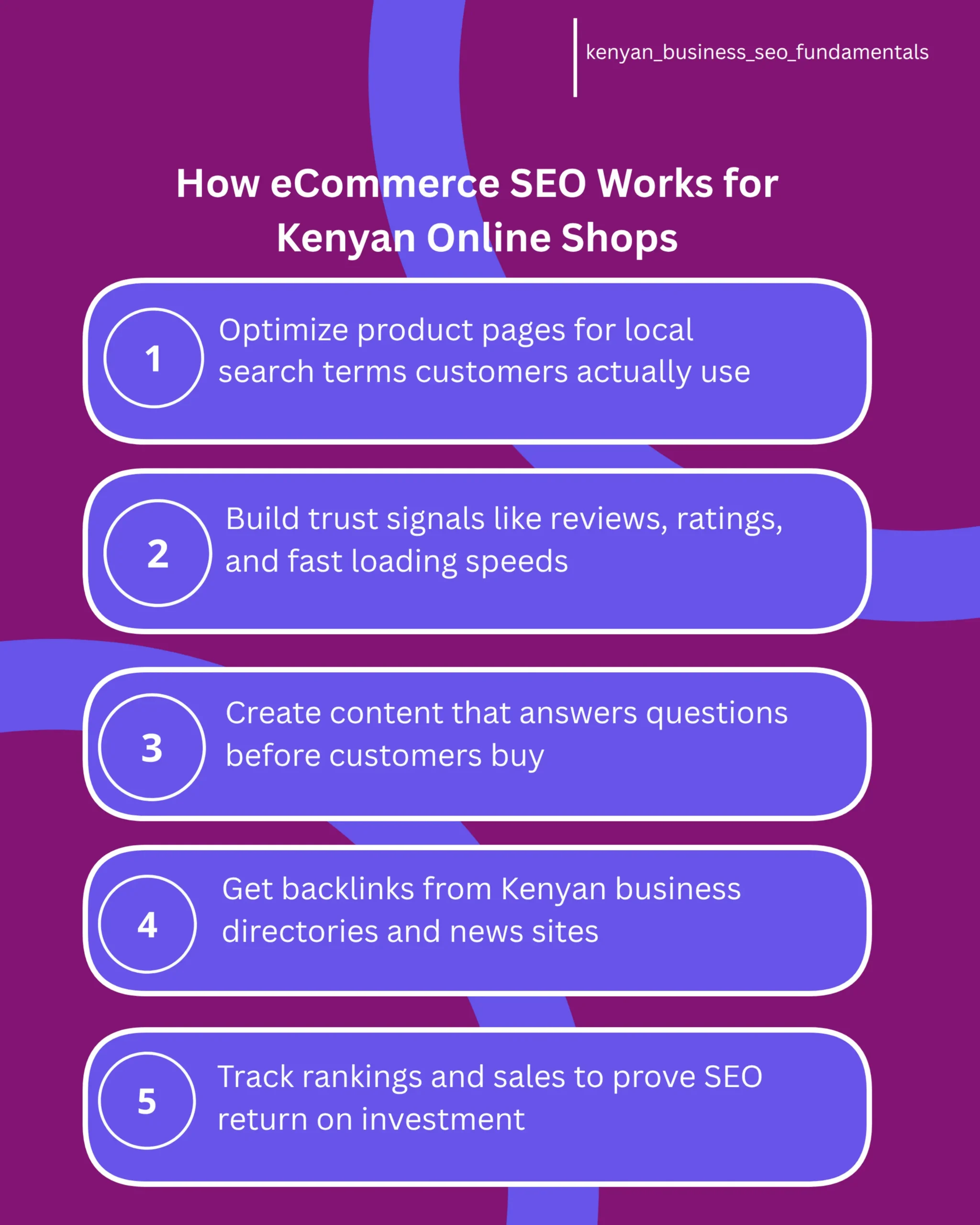
Once you know what keywords matter, you optimize your product pages around those keywords. This means your product title, description, images, and even your URL should include the keywords your customers search for.
But optimization is not just about keywords. Your product description needs to be clear, persuasive, and answer the questions a buyer would ask: What is this? How does it work? Why should I buy from you? Is it in stock? How fast will it arrive?
Learn more about product page optimisation selling and ranking on Google Kenya to maximize conversions.
Technical SEO: Making Your Shop Fast and Reliable
Google cares about how fast your shop loads. If your site takes 5 seconds to load, customers leave, and Google notices.
Technical SEO means fixing things like site speed, mobile responsiveness, broken links, and security. A Kenyan customer browsing on a 4G connection needs your shop to load quickly, or they will buy from a faster competitor instead.
Trust Signals: Reviews, Ratings, and Credibility
Google ranks shops that customers trust. This means customer reviews, product ratings, trust badges, and clear contact information all matter.
If your shop has 50 five-star reviews and your competitor has none, Google will favor you. Reviews are proof that real people bought from you and were happy. Discover how user generated content reviews and QAs that boost rankings can strengthen your SEO.
Backlinks: Getting Other Sites to Vouch for You
A backlink is when another website links to your shop. It is like a vote of confidence.
If a popular Kenyan business blog links to your shop, Google sees that as a signal that you are credible and worth ranking. Building backlinks is harder than optimization, but it is part of the full eCommerce SEO picture. Explore strategies for national link building authority across Kenyan regions.
Real eCommerce SEO Examples in Kenya
Let us look at how this actually plays out in the Kenyan market. These are not hypothetical examples; they reflect how real Kenyan shops are using SEO to grow.
Example 1: A Nairobi Fashion Boutique Ranking for Local Searches
A small boutique in Westlands sells high-end women’s clothing. They used to rely entirely on Instagram ads and foot traffic.
After optimizing their product pages for searches like “designer dresses Nairobi” and “women’s fashion boutique Westlands,” they started ranking on Google. Within four months, they were getting 30-40 organic searches per day leading to their shop.
The conversion rate on organic search traffic was higher than their Instagram ads because the customers were actively looking for what they sold. Their ad spend dropped by 40% because they no longer needed to buy as many ads.
Example 2: An Online Shoe Retailer Capturing National Search Volume
A shoe retailer based in Mombasa sells shoes across Kenya via their website. They competed against larger retailers with bigger ad budgets.
Instead of trying to outspend competitors on ads, they focused on eCommerce SEO. They optimized for long-tail keywords like “affordable running shoes Kenya” and “leather shoes Nairobi online.”
Six months later, they ranked on page one for 20+ product-related keywords. Their organic traffic grew from 50 visits per month to 1,200 visits per month. Their conversion rate was 3.2%, bringing them 38 new customers per month from organic search alone.
Understanding national SEO vs local SEO which does your Kenyan business need helped them choose the right strategy.
Example 3: A Nairobi Electronics Shop Competing Against Bigger Brands
A small electronics shop in Nairobi sells phone accessories and chargers. They compete against huge retailers like Jumia and Jiji.
They could not outbid Jumia on Google Ads. Instead, they focused on niche keywords and local searches: “best phone charger Nairobi,” “original USB-C cable Kenya,” “fast-charging adapter Eastleigh.”
These keywords had lower search volume than “buy phone chargers online,” but they had less competition. The shop now ranks on page one for five of these keywords and gets 15-20 qualified customers per month from organic search.
Common Mistakes to Avoid with eCommerce SEO 🚫
Most Kenyan shop owners who fail at SEO do not fail because SEO does not work. They fail because they make preventable mistakes.
Mistake 1: Ignoring Mobile Optimization
Over 85% of Kenyans browse the internet on mobile phones. If your online shop does not work well on mobile, you are losing customers and Google rankings.
Your product pages need to load fast on mobile, images need to resize properly, and the checkout process needs to be smooth on a small screen. If a customer has to pinch and zoom to read your product description, they will leave.
Mistake 2: Copying Product Descriptions from Suppliers
Many shop owners copy product descriptions directly from their suppliers or manufacturers. Google sees this as duplicate content and does not rank duplicate pages well.
Write your own product descriptions that speak to your Kenyan customers. Mention local benefits, local pricing, local delivery times, and local customer testimonials.
Mistake 3: Not Building Customer Reviews
Shops with no reviews rank lower than shops with reviews. Period.
After a customer buys from you, ask them to leave a review. Make it easy. Send them a simple email with a link to your review page. Offer a small incentive if it is legal in your market.
Mistake 4: Slow Site Speed
If your shop takes more than 3 seconds to load, you are losing customers and Google rankings. Test your site speed using Google PageSpeed Insights.
Common causes of slow speed in Kenya: unoptimized images, poor hosting, too many plugins, and not using a content delivery network. Fix these, and your rankings and conversion rates will improve.
Mistake 5: Using Generic Keywords Instead of Local Keywords
If you optimize for “buy shoes online,” you are competing against massive retailers worldwide. You will not rank.
Instead, optimize for “buy shoes online Kenya” or “shoe shop Nairobi” or “affordable shoes Mombasa.” These keywords have less competition and higher intent from Kenyan customers.
eCommerce SEO vs. Other Marketing Channels: A Quick Comparison
| Channel | Cost Per Customer | Time to Results | Ongoing Cost | Customer Intent |
|---|---|---|---|---|
| Google Ads | High (50-200 KES per click) | Immediate (days) | High (daily spend) | High (active search) |
| eCommerce SEO | Medium (upfront investment) | Slow (3-6 months) | Low (maintenance only) | High (active search) |
| Facebook Ads | Medium (20-100 KES per click) | Fast (days) | High (daily spend) | Medium (awareness stage) |
| Instagram Organic | Low (no direct cost) | Very slow (months) | Low (time investment) | Low (awareness stage) |
Comparing your options helps you decide where to invest. If you serve specific industries, check out SEO for SACCOs Kenya for sector-specific insights.
✅ Quick Action Checklist
- ☐ Audit your top 10 product pages for mobile responsiveness using Google Mobile-Friendly Test
- ☐ Research five high-intent keywords your customers search for using Google autocomplete and Google Keyword Planner
- ☐ Rewrite one product description to include your target keyword naturally and speak to Kenyan customers specifically
- ☐ Check your site speed using Google PageSpeed Insights and identify the top three speed issues
- ☐ Set up a system to collect customer reviews after purchase (email, SMS, or review platform)
- ☐ Identify three Kenyan business directories or news sites where you could get a backlink
- ☐ Claim and optimize your Google Business Profile if you have a physical location in Kenya
- ☐ Create a simple spreadsheet tracking your top 10 keywords, current rankings, and monthly search volume
Ready to Improve Your Online Shop’s Visibility?
eCommerce SEO is not optional for Kenyan online shops anymore. Your customers are searching on Google, and if you are not there, they are buying from your competitors.
The good news is that you do not need a massive budget to get started. You need strategy, consistency, and the right guidance. Start with the checklist above, focus on your top-performing products, and build from there.
If you want to see how AM Digital KE compares to other agencies, read Savage Digital vs AM Digital KE or Artly vs AM Digital KE.
See What Is Working, Any Day You Ask
You see which products and categories bring sales, not just sessions.
Every campaign move is logged in your SEO Brain, so you can ask which pages are bringing enquiries and get a straight answer in plain language. Our pricing is published, so you can evaluate us the same way you would evaluate any supplier.
See what that looks like in practice on our ecommerce SEO services page, or start with a free SEO audit.
Frequently Asked Questions
How long does it take to see results from eCommerce SEO?
Most Kenyan shops see initial results within 3-4 months and significant results within 6-12 months. It depends on competition, keyword difficulty, and how well you execute. Paid ads are faster, but SEO builds lasting visibility.
Can I do eCommerce SEO myself, or do I need to hire an agency?
You can start yourself by learning keyword research, product page optimization, and basic technical SEO. However, building backlinks and staying current with Google updates takes time. Many shop owners hire an agency after trying DIY and realizing the complexity.
What is the difference between eCommerce SEO and regular SEO?
eCommerce SEO focuses on getting people to buy. It emphasizes product pages, pricing, reviews, and checkout experience. Regular SEO is broader and might focus on blog content, brand awareness, or lead generation.
Do I need a specific platform to do eCommerce SEO?
No. eCommerce SEO works on any platform: Shopify, WooCommerce, custom websites, or even Jumia seller accounts. The principles are the same. Some platforms make SEO easier than others, but all can be optimized.
Will eCommerce SEO work if I sell the same products as bigger competitors?
Yes. You cannot compete with big retailers on generic keywords, but you can dominate local keywords and long-tail keywords. A small Nairobi shop can rank for “phone cases Nairobi” even if Jumia ranks for “phone cases Kenya.”
Ranking in search results can also help you appear in featured snippets, giving you extra visibility above traditional results.
Additional Resources
- From Nairobi to Mombasa- Scaling Your SEO Nationally – Shows you how to expand your eCommerce reach beyond one city and rank for product searches across multiple Kenyan regions.
- Content Strategy for National Reach – Targeting All of Kenya – Explains how to create product and blog content that attracts buyers from Nairobi, Mombasa, Kisumu, and beyond.
- Competing Nationally in Kenya – Ranking Beyond Your City – Teaches you how to compete with larger retailers by targeting national keywords without a massive budget.
- What is Search Volume (as seen from a Kenya SEO) – Helps you understand how many Kenyans are searching for your products so you can prioritize the right keywords.
- What is Keyword Research (For the Kenya Market) – Walks you through finding the exact phrases Kenyan customers type when they are ready to buy what you sell.
- What is CTR (As Seen From a Kenya SEO) – Shows you how to write product titles and meta descriptions that get more clicks from Google search results.
Take the Next Step
If you are ready to stop leaving money on the table and start capturing organic search traffic, we have created a resource specifically for Kenyan shop owners. It walks you through the exact steps to audit your current SEO, identify your best opportunities, and create a 90-day optimization plan.
Download the eCommerce SEO Audit Checklist for Kenyan Online Shops and start ranking for the searches that bring real customers. You can also explore tools like AI chatbot for Kenya to improve customer engagement, or learn which social platforms matter for Kenyan businesses to complement your SEO strategy.