
Table of Contents
- 📋 Key Takeaways
- What You Need Before You Start
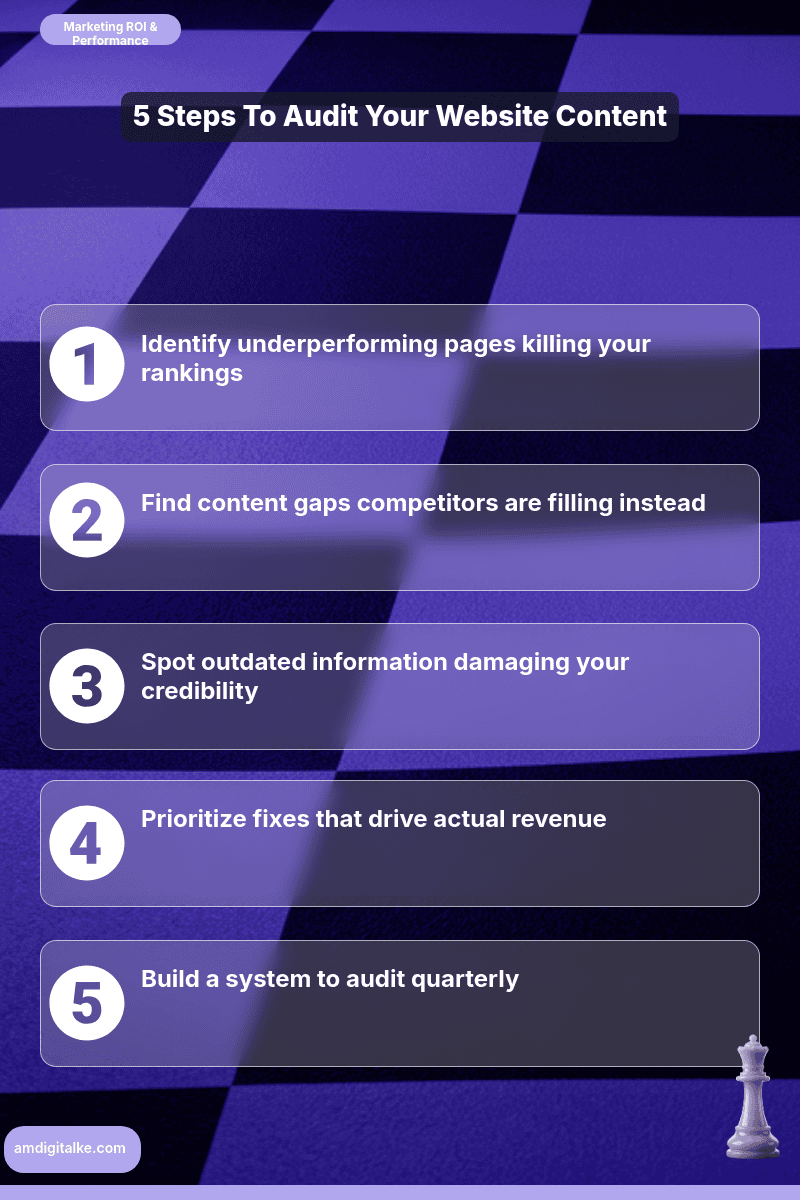
- Step 1: List Every Page on Your Website
- Step 2: Gather Performance Data for Each Page
- Step 3: Grade Each Page on Business Value
- Step 4: Identify Content Gaps and Competitor Wins
- Step 5: Audit Content Quality and Freshness
- Common Mistakes to Avoid
- ✅ Quick Action Checklist
- Ready to Improve Your Content Audit?
- Frequently Asked Questions
- Related Posts You May Be Interested In
- Take the Next Step
TL;DR: A content audit is a systematic review of every page on your website to find what’s working, what’s broken, and what’s missing. You’ll discover which pages drive revenue, which ones waste your time, and where your competitors are winning. Start by listing all your pages, then grade them on traffic, rankings, and business value.
If you’ve been running a website for more than six months, your content is probably outdated.
Not completely dead, but slowly losing power like an old phone battery.
Most Kenyan business owners build a website, add some content, then move on.
They don’t realize that Google rewards fresh, relevant content, and they penalize pages that haven’t been updated in years.
A content audit is not a luxury.
It’s the foundation of any top SEO strategy that actually works.
Think of it like a stock take at a retail shop in Westlands.
You walk through your store, check what’s selling, what’s gathering dust, and what customers are asking for but you don’t have.
Your website is the same.
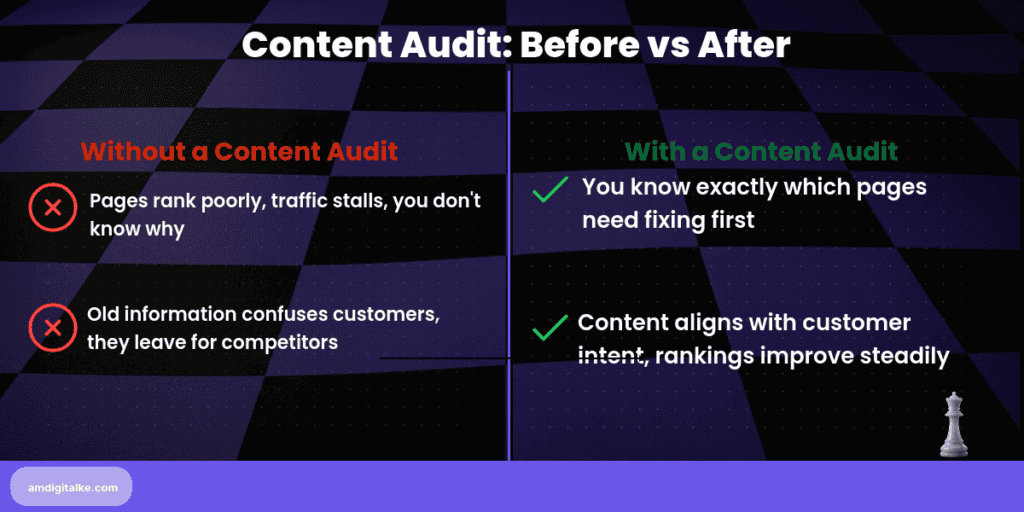
Without an audit, you’re flying blind.
You don’t know which pages bring customers, which ones confuse them, and which ones are costing you money by ranking for the wrong keywords.
📋 Key Takeaways
- ☐ A content audit reveals which pages drive business value and which ones waste your time
- ☐ You’ll find content gaps that competitors are filling, meaning lost revenue for you
- ☐ Outdated information on your site damages trust and pushes customers to competitors
- ☐ Most Kenyan SMEs need to audit quarterly because the market moves fast
- ☐ Start with a simple spreadsheet. You don’t need expensive software to begin
What You Need Before You Start
Before you dive into the audit, gather the right tools and information.
If you try to do this without preparation, you’ll waste three weeks and give up.
Google Analytics Access
You need to see which pages actually get traffic.
Log in to your Google Analytics account and make sure you have access to the last 12 months of data.
If you don’t have Google Analytics installed, stop everything and set it up now.
This is not optional.
Google Search Console Data
Google Search Console shows you which keywords your pages rank for and how many clicks you get from Google.
This is gold for an audit.
You’ll see which pages are invisible to Google and which ones could rank higher with a small update.
A Simple Spreadsheet or Document
You don’t need fancy software.
Open Google Sheets or Excel and create columns for page title, URL, traffic, rankings, and notes.
Many Kenyan business owners overthink this step and buy expensive tools they never use.
Start simple.
Access to Your Website Backend
You need to log in to WordPress or whatever platform your site runs on.
You’ll need to update pages, so make sure you have editor access or can contact whoever manages your site.
If you can’t access your own website, that’s a separate problem you need to solve before auditing.
Step 1: List Every Page on Your Website
Start by creating a complete inventory of your website.
Open your spreadsheet and add every single page, including blog posts, service pages, product pages, and landing pages.
Don’t skip the small stuff.
That old FAQ page or forgotten case study might be driving more traffic than you realize.
Export Your Sitemap
The fastest way to get a complete list is to export your XML sitemap.
This file is usually at yourwebsite.com/sitemap.xml.
If you use WordPress, there are free plugins that generate a sitemap automatically.
Copy the list of URLs into your spreadsheet.
Manual Walkthrough
Don’t rely only on the sitemap.
Walk through your website manually and check your navigation menu, footer links, and internal linking.
Sometimes pages don’t appear in the sitemap but still exist and get traffic.
A Nairobi plumber might have an old “Meet the Team” page that ranks for local searches but isn’t in the sitemap.
Check Google Search Console
Log into Search Console and go to the “Pages” report.
This shows every page Google has indexed from your site.
If a page appears in Search Console but not in your sitemap, add it to your spreadsheet.
These are often orphaned pages that should either be deleted or updated.
Step 2: Gather Performance Data for Each Page
Now that you have your list, add real data.
This is where you discover what’s actually working.
Pull Traffic Numbers from Google Analytics
Go to Google Analytics and set the date range to the last 12 months.
Look at the “Landing Pages” report to see how many sessions each page gets.
Add this number to your spreadsheet.
This is your traffic column.
Add Rankings Data from Search Console
In Search Console, go to the “Performance” report.
You’ll see which keywords each page ranks for and what position it’s in.
Note the top three keywords for each page and the average ranking position.
If a page ranks for nothing, write “No data.”
Check Click-Through Rate (CTR)
Search Console also shows your click-through rate.
This tells you whether people actually click on your page when they see it in Google.
A page that ranks for 50 keywords but gets zero clicks has a title or description problem.
That’s a quick win to fix.
Understanding what an organic ctr helps you identify these opportunities.
Here’s a table to organize what you’re collecting:
| Page Title | URL | Monthly Traffic | Top Keyword | Ranking Position | CTR % | Last Updated | Status |
|---|---|---|---|---|---|---|---|
| Best Legal Services Nairobi | /legal-services | 240 | lawyer nairobi | 5 | 8% | 2 years ago | Needs Update |
| Our Team | /team | 12 | None | N/A | 0% | 3 years ago | Consider Deleting |
| Blog: 10 Tips to get a good lawyer | /blog/good-lawyer-tips | 890 | lawyer tips nairobi | 2 | 12% | 1 month ago | Keep Optimizing |
Step 3: Grade Each Page on Business Value
Traffic is good to know, but it doesn’t tell you everything.
A page might get 1,000 visits but zero customers.
Another page might get 50 visits and close five deals.
Grade each page on whether it actually drives revenue for your business.
Identify Money Pages
These are pages that directly lead to sales.
For a Nairobi real estate agent, that’s the “Properties for Sale” page.
For a SACCO, it’s the “Apply for a Loan” page.
Mark these Sacco pages with a star or color code.
These are your top priorities for updates and optimization.
Find Traffic Pages That Don’t Convert
Some pages get lots of visitors but don’t lead anywhere.
A blog post might get 500 monthly visitors, but no one clicks through to a service page.
These pages need a strategic update.
Add internal links to money pages, or update them to better match what visitors are actually looking for.
This is where conversion rate optimization becomes essential.
Look for Orphaned Pages
Orphaned pages get almost no traffic and no internal links from other pages.
These are usually old pages that should be deleted or merged with newer content.
If a page gets fewer than 10 monthly visits and ranks for nothing, it’s probably an orphan.
Note it for deletion.
Step 4: Identify Content Gaps and Competitor Wins
This is where you find money you’re leaving on the table.
Your competitors are ranking for keywords you’re not targeting, and customers are searching for things you don’t have content for.

Search for Your Top Keywords
Take your highest-traffic keywords from Search Console and search them on Google.
Look at the top 10 results.
If a competitor is ranking and you’re not, that’s a gap.
If they rank for five variations of a keyword and you only have one page, that’s another gap.
Check What Your Competitors Are Ranking For
Use free SEO tools to see which keywords your top three competitors rank for.
Look for keywords with decent search volume that you’re missing.
A Mombasa hotel might discover competitors are ranking for “beachfront hotel with conference facilities,” but they only have a page for “beachfront hotel.”
That’s a content gap.
Listen to Customer Questions
Check your customer emails, WhatsApp messages, and phone calls.
What questions do people ask that your website doesn’t answer?
Create a list of these questions.
These are content opportunities that will drive qualified traffic because they match real customer intent.
Step 5: Audit Content Quality and Freshness
Traffic numbers tell you if a page gets visitors.
Content quality tells you if it’s good enough to keep.
Check Last Update Date
Go through each page and note when it was last updated.
If a page hasn’t been touched in more than a year, it’s probably stale.
Google prefers fresh content, especially for pages about current events, prices, or services.
A page about “2024 Tax Rates for Kenyan Businesses” that was written in 2022 is actively harming your credibility.
Verify Factual Accuracy
Read through your content and check if everything is still true.
Prices change, phone numbers change, addresses change, and team members come and go.
A single wrong detail on your website makes visitors question everything else.
If your address is outdated or your price is wrong, they’ll leave.
Check for Broken Links and Missing Images
Click through pages and look for broken links, missing images and ALT text, or formatting problems.
These hurt both user experience and SEO.
A broken link on a money page is literally broken revenue.
Fix these immediately.
Common Mistakes to Avoid
Most Kenyan business owners mess up their first content audit.
Here’s what not to do.
Mistake 1: Only Looking at Traffic Numbers
A page with 2,000 monthly visitors might be completely useless if it doesn’t convert.
A page with 50 visitors might bring in half your revenue.
Always connect traffic to business outcomes.
If you don’t know which pages drive sales, use Google Analytics goals or UTM parameters to track them.
Mistake 2: Deleting Pages Too Quickly
Just because a page gets low traffic doesn’t mean you should delete it.
Sometimes old content ranks for long-tail keywords that bring qualified customers.
Before deleting, check if it ranks for anything in Search Console.
If it does, update it instead of deleting it.
Mistake 3: Ignoring User Experience Issues
A page might rank well but have a confusing layout, slow loading speed, or mobile formatting problems.
These issues destroy conversions.
During your audit, note any pages that look bad on mobile or have poor user experience.
Based on AM Digital KE client data across Kenyan accounts, fixing mobile UX issues can double your conversion rate.
Mistake 4: Not Prioritizing Fixes
After your audit, you’ll have a long list of things to fix.
If you try to fix everything at once, you’ll fix nothing.
Prioritize by business impact.
Fix money pages first, then high-traffic pages, then everything else.
A Nairobi marketing agency should fix their “Services” page before their “Company History” page.
Mistake 5: Doing the Audit Once and Forgetting It
A content audit is not a one-time project.
Your website changes, your competitors change, and customer needs change.
Schedule a full audit every quarter.
It gets faster after the first one because you’re just updating your existing spreadsheet.
✅ Quick Action Checklist
- ☐ Set up Google Analytics and Search Console if you haven’t already
- ☐ Export your sitemap and create a list of all pages in a spreadsheet
- ☐ Pull 12 months of traffic data from Google Analytics for each page
- ☐ Add ranking and keyword data from Google Search Console
- ☐ Grade pages by business value (money pages vs. traffic pages vs. orphans)
- ☐ Check last update dates and fix any outdated information
- ☐ Identify your top three content gaps and create a plan to fill them
- ☐ Schedule your next audit for three months from today
Ready to Improve Your Content Audit?
A content audit shows you exactly where your website is strong and where it’s bleeding money.
Most Kenyan business owners skip this step and wonder why their SEO doesn’t work.
Now you know better.
Start with your spreadsheet today, and in two weeks you’ll have a clear roadmap for improving your website’s performance.
The key is combining your audit findings with strong copywriting to turn insights into results.
Ready to audit your site content?
Contact AM Digital KE today for a free SEO audit.
Frequently Asked Questions
How often should I do a content audit?
For most Kenyan SMEs, a full audit every three months works well.
The market moves fast, competitors update their content, and Google’s algorithm changes.
A quarterly audit keeps you ahead without becoming overwhelming.
Track changes month-to-month in your spreadsheet to make quarterly audits faster.
Do I need expensive software to do a content audit?
No.
Google Analytics, Google Search Console, and a spreadsheet are enough to start.
Many expensive SEO tools add features you don’t need when you’re beginning.
Use free tools first, then upgrade to paid tools only when you have specific problems they solve.
What should I do with pages that get no traffic?
Don’t delete immediately.
First, check if they rank for any keywords in Search Console.
If they do, update them instead of deleting.
If they rank for nothing and get zero traffic, they’re orphans.
Decide whether to delete them, merge them with other pages, or add internal links to give them a chance.
How do I know which pages to prioritize for updates?
Prioritize by business impact first, traffic second.
A money page that gets 100 monthly visits is more important than a blog post that gets 1,000 visits.
Update pages that rank for important keywords but are losing position.
Then update high-traffic pages that aren’t converting.
What if I don’t have 12 months of data?
Use whatever data you have.
If you just installed Analytics, start your audit with three months of data and plan to do a fuller audit in nine months.
The audit gets better as you collect more data, but don’t wait for perfect data to start improving your content.
Related Posts You May Be Interested In
These articles cover topics that work alongside how to do a content audit.
Worth reading if you want stronger results in Kenya.
- Tracking What Matters – Essential Metrics for Kenyan Websites
- Social Media Content That Drives Website Traffic in Kenya
- Product Page Optimisation – Selling and Ranking on Google Kenya
- SEO FAQs: Your Complete Guide to Search Engine Optimization in Kenya
- Quiz: Why isn’t My Marketing Working- 2-Minute Business Diagnosis
Take the Next Step
A content audit is just the beginning.
Once you know what’s working, you need a strategy to fix what isn’t.
Use the calculator below, designed for Kenyan businesses, to see if your marketing budget makes sense.
See exactly what to audit, what to fix, and how to measure results.