Table of Contents
- Key Takeaways
- Why Direct Bookings Matter for Kenyan Hotels
- The Revenue Management Strategy: SEO + Direct Booking Incentives
- Your Direct Booking SEO Checklist
- Related Content
- Frequently Asked Questions
- Why should Kenyan hotels focus on SEO?
- What are top keywords for Kenyan hotels?
- How does direct booking save money?
- Can SEO work for small Kenyan hotels?
TL;DR: SEO helps Kenyan hotels reduce OTA commissions by ranking higher for bookings like ‘Diani Beach hotels’, leading to more direct website reservations.
Last Updated: March 2026
Key Takeaways
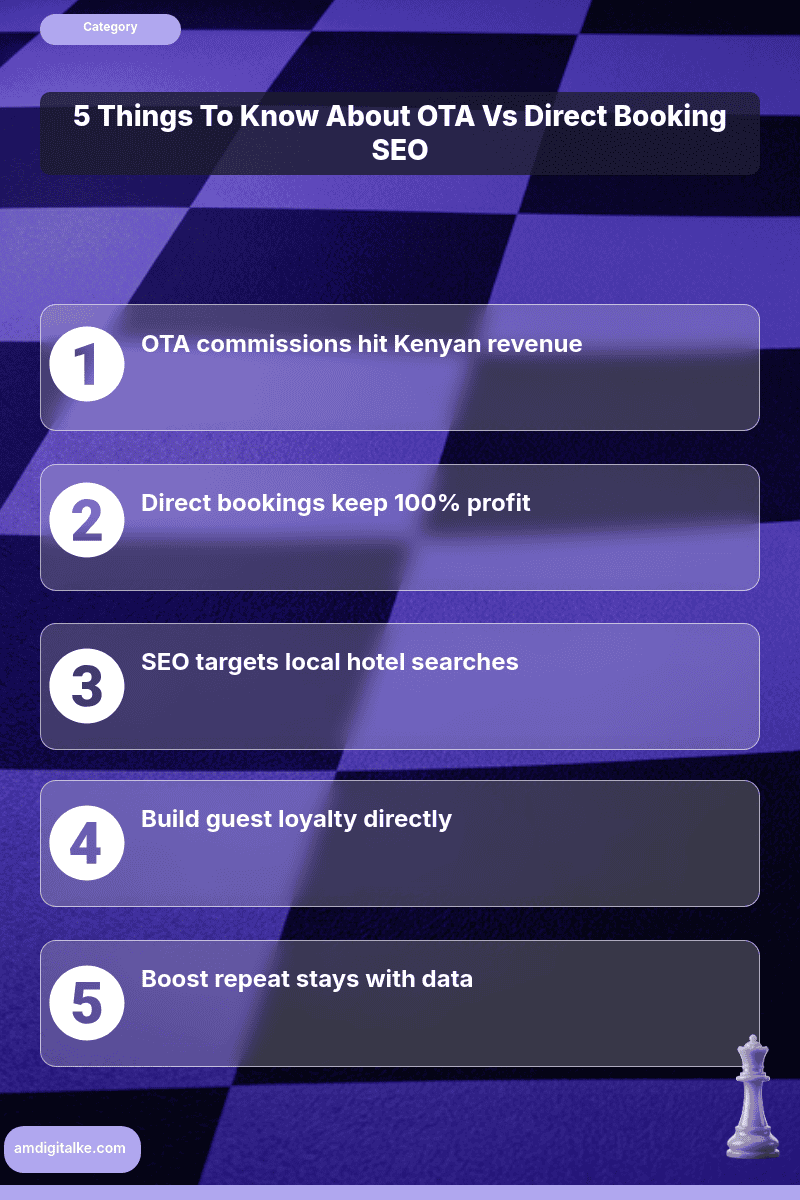
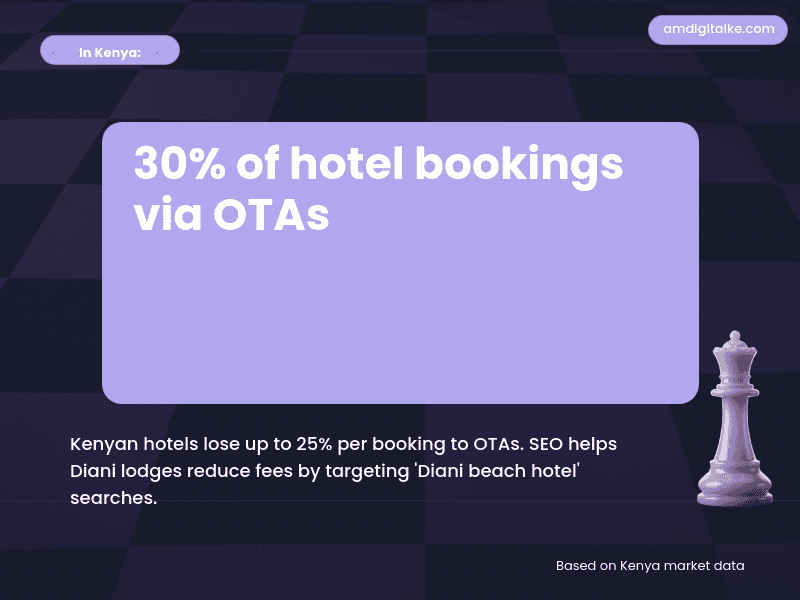
- Cut OTA commissions by up to 25%
- SEO boosts direct bookings
- Target local travel keywords
- Keep guest data for marketing
- Build brand loyalty directly
Your boutique hotel in Diani Beach has 30 rooms.
Last month, 23 bookings came through Booking.com and Expat Africa. You paid 15-25% commission on each. Only 7 guests booked directly through your website.
That’s thousands of shillings in commissions. Money that should be improving your guest experience or marketing budget.
The problem isn’t the OTAs themselves. It’s that your website doesn’t show up when travellers search for “beach hotels in Diani” or “romantic getaway Kenyan coast.”
Why Direct Bookings Matter for Kenyan Hotels
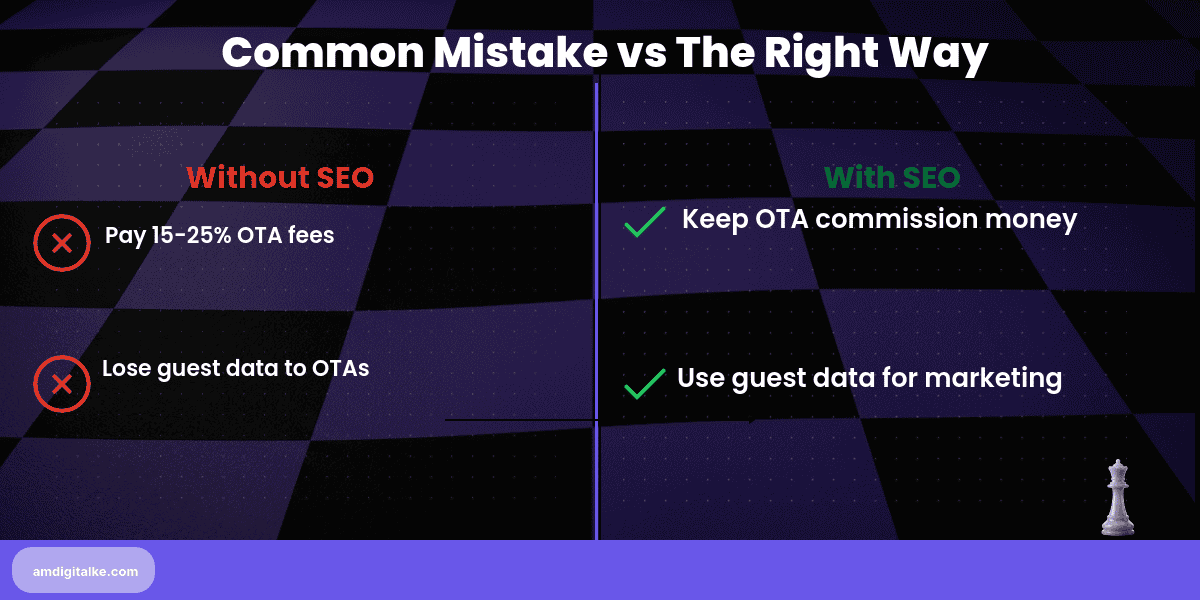
Every booking through an OTA costs you 15-25% in commission.
For a KES 15,000 room, that’s KES 2,250-3,750 down the drain when understanding what SEO really means for hotel revenue optimisation. Multiply that by hundreds of bookings annually, and you’re losing serious revenue.
Beyond commissions, OTAs own the customer relationship.
You can’t build loyalty or encourage repeat visits when the guest’s email and booking data stays with the platform.
Direct bookings through your website mean:
- Zero commission fees (100% revenue retention)
- Full control over guest data for remarketing
- Ability to offer personalised packages and upsells
- Stronger brand loyalty when guests book with you, not through a third party
But here’s the challenge: Kenyan travellers and international tourists research online first.
If your hotel doesn’t appear in search results, they’ll never reach your website. They’ll book through the OTA that ranks. SEO changes this equation.
The Revenue Management Strategy: SEO + Direct Booking Incentives
1. Target High-Intent Local Keywords
Most Kenyan hotels focus on generic terms like “hotel in Kenya.”
That’s too broad to implement keyword research properly. Instead, target location-specific, high-intent keywords that capture travellers ready to book:
- “boutique hotel Diani Beach”
- “luxury lodge Maasai Mara”
- “family hotel Nairobi Westlands”
- “business hotel Mombasa CBD”
- “eco-lodge Nakuru”
Create dedicated landing pages for each location and traveller type.
A page titled “Romantic Beachfront Hotel in Diani – Perfect for Couples” will rank better than a homepage trying to be everything to everyone.
2. Optimise for “Best Price Guarantee” Keywords
Travellers compare prices across OTAs before booking.
Rank for comparison keywords and intercept them:
- “best rates [your hotel name]”
- “cheapest [location] hotel deals”
- “[your hotel] direct booking discount”
On these pages, clearly state your Best Price Guarantee: “Book direct and get 10% off OTA prices, plus free breakfast.”
Make it impossible for guests to ignore the value of booking directly.
3. Create Content That Ranks AND Converts
Blog posts aren’t just for SEO.
They’re revenue drivers when done right through creating valuable content marketing strategies. Write content that ranks for travel research queries and funnels readers toward direct bookings:
- “10 Best Beachfront Hotels in Diani (2025 Guide)” – Feature your hotel prominently
- “Maasai Mara Safari Planning Guide” – Link to your lodge’s safari packages
- “Where to Stay in Nairobi for Business Travellers” – Highlight your corporate rates
Each post should include internal links to your booking page with compelling CTAs such as “Book direct and save 15%” or “Check availability for your dates.”
4. Leverage Google Business Profile for Local Visibility
When travellers search “hotels near me” or “hotels in Kilifi,” Google shows a map with three local results through optimising your Google Business Profile effectively.
If your Google Business Profile isn’t optimised, you’re invisible.
Complete your profile with:
- High-quality photos (rooms, dining, amenities, views)
- Accurate business hours and contact info
- Regular posts about special offers (“Valentine’s Package: KES 25,000 for two nights—book direct”)
- Active review responses (respond to every review within 24 hours)
Add a “Book Now” button that links directly to your website, not an OTA.
5. Build Trust with Reviews and Social Proof
Travellers trust peer reviews.
But if all your reviews are on Booking.com, guests click through and book there. Move reviews to your website when improving your local SEO rankings:
- Add a testimonials page with guest photos and quotes
- Embed TripAdvisor or Google reviews on your homepage
- Use schema markup so star ratings appear in search results (boosts click-through rates)
When travellers see social proof on YOUR site, they’re more likely to book direct.
6. Speed and Mobile Optimisation Are Non-Negotiable
Based on AM Digital KE client data across Kenyan accounts, most travellers research hotels on mobile devices.
If your site loads slowly or looks broken on phones, they’ll bounce to an OTA with a faster, smoother experience through optimising page speed strategically.
Use tools like Google PageSpeed Insights to test your site.
Compress images, enable caching, and ensure your booking engine works flawlessly on mobile. A one-second delay in load time can cost you conversions. That’s direct bookings lost to OTAs.
7. Offer Exclusive Direct Booking Perks
Give travellers a reason to skip the OTA.
SEO gets them to your site; incentives convert them:
- 10-15% discount on direct bookings
- Free breakfast, spa credit, or airport transfer (value-adds that cost you less than OTA commissions)
- Flexible cancellation (match or beat OTA policies)
- Loyalty points for repeat guests
Highlight these perks in your SEO title tags and meta descriptions: “Beachfront Bliss Hotel Diani | Book Direct & Save 15% + Free Breakfast”
A 20-room boutique hotel in Lamu was losing KES 180,000 monthly in OTA commissions when they understood what link building means for hotel visibility.
They implemented this SEO strategy:
Before SEO:
- ❌ 5% of bookings were direct (3 rooms/month)
- ❌ 95% through OTAs (18 rooms/month)
- ❌ Website ranked page 3+ for “Lamu boutique hotel”
After 6 Months:
- ✅ 40% of bookings now direct (12 rooms/month)
- ✅ OTA dependence dropped to 60% (still using them strategically)
- ✅ Website ranks position 2 for “boutique hotel Lamu”
- ✅ Monthly commission savings: KES 108,000
The Strategy:
- Created location-specific landing pages targeting “Lamu boutique hotel,” “luxury stay Lamu Old Town”
- Published 8 travel guide blog posts (“Best Things to Do in Lamu,” “Lamu vs. Zanzibar”)
- Offered a 15% direct booking discount prominently on every page
- Optimised Google Business Profile with weekly posts and review responses
Your Direct Booking SEO Checklist
☐ Audit your current traffic sources – What % is direct vs. OTA referrals? (Use Google Analytics)
☐ Create location + intent landing pages – Target keywords like “[location] [hotel type]” (e.g., “family hotel Watamu”)
☐ Set up Best Price Guarantee messaging – Display “Save 10-15% booking direct” on homepage and booking pages
☐ Publish 1-2 travel guide blog posts monthly – Rank for research queries and funnel to booking pages
☐ Optimise Google Business Profile – Add photos, respond to reviews, post weekly updates, enable “Book” button
☐ Add review schema markup – Show star ratings in search results to boost click-through
☐ Test mobile booking experience – Ensure site loads in under 3 seconds on Safaricom network
For more detailed guidance on each optimisation step, check out my SEO FAQs page, where I answer common revenue management questions.
Before implementing your direct booking strategy, download this complete SEO Checklist to ensure you’ve covered all revenue-driving optimisations.
Balance OTAs with Direct Booking Growth
Reducing OTA dependence isn’t about eliminating them.
It’s about balance. Use OTAs for visibility with international travellers, but use SEO to capture direct bookings from high-intent searchers.
At AM Digital KE, we help Kenyan hotels and lodges build SEO strategies that drive direct bookings, cut commission costs, and maximise revenue per room.
Ready to keep more of what you earn?
Visit our Hospitality SEO Services in Kenya and discover how we help hotels reduce OTA dependence through strategic SEO that captures direct bookings.
Want to calculate your potential commission savings?
Get a free SEO analysis where we’ll assess your OTA vs. direct booking ratio, identify high-value keywords you’re missing, and project revenue recovery over 6-12 months.
Related Content
Curious to learn more about maximising direct bookings? Check out the posts below
- What is Organic Traffic (from a Kenyan SEO Expert) – Organic traffic from search engines delivers booking-ready travellers who haven’t been filtered through OTA comparison tools
- What is Domain Authority? (A Kenya Business Guide) – Building domain authority helps your hotel website compete with OTAs’ massive search presence over time
- Why Search Intent Beats Search Volume: The Strategic SEO Move – Understanding booking intent helps you target travellers ready to book instead of browsers casually comparing options
- The Best Niche and Industry SEO Strategies Built for Kenyan Markets – See how Kenyan hotels apply niche revenue management strategies to maximize direct booking revenue
These articles will walk you through the basics of building profitable direct booking channels while strategically using OTAs.
Have more SEO questions? Our SEO FAQs Kenya page answers the most common ones.
Frequently Asked Questions
Why should Kenyan hotels focus on SEO?
SEO ranks your hotel for local searches like ‘Nairobi business hotel’, so travellers book directly, cutting OTA commissions.
What are top keywords for Kenyan hotels?
Use specific terms like ‘luxury lodge Maasai Mara’ or ‘family hotel Nairobi Westlands’ to attract ready-to-book guests.
How does direct booking save money?
Direct bookings avoid 15-25% OTA fees, keeping thousands for hotel upgrades or marketing.
Can SEO work for small Kenyan hotels?
Yes, SEO helps boutique hotels in places like Diani Beach compete with OTAs for bookings.